When building DevOps or continuous delivery practices you can learn a great deal from others. What choices did they make, what practices did they put in place, and how did they connect the dots? At Sonatype, we pulled together a set of 21 reference architectures for folks building continuous delivery and DevOps practices using Docker. Why? After 3,000 DevOps professionals attended our webinar on "Continuous Integration using Docker" discussing just one reference architecture example, we recognized there was a strong interest in the community to learn more. That's why we assembled 20 more reference architectures into this collection. A picture speaks a thousand words, but beyond the images, we also share the details of each DevOps/CD Docker reference architecture. In the bottom right corner of each slide, we share the original blog or presentation source for the image. When one of the images piques your interest, you can then dive deep into the source. Cool, huh?
Today we can collect lots and lots of performance data. We build beautiful dashboards and even have fancy query languages to access and transform the data. Still performance data is a secret language only a couple of people understand. The more business becomes digital the more stakeholders are interested in this data including how it relates to business. Some of these people have never used a monitoring tool before. They have a question on their mind like “How is my application doing” but no idea how to get a proper answer.
Application performance problems can be quite challenging to resolve and even more difficult to predict. In my role as Dynatrace Guardian Consultant - leading the implementation of APM best practices with our customers - I've experienced quite a few "head-scratcher" situations. In this blog, I'll relate a recent problem that had most of the IT department scrambling early one Monday morning.
Do you know how much your organization risks with every potential outage? Application performance issues can impact away more than revenue, your brand might take a substantial hit as well. Hundreds, thousands of potential customers could take to Facebook, Twitter, Yelp, the App Store and voice their complaints and give poor reviews simply because your app crashed, stalled, or they weren’t able to successfully check out.
Cloud analytics is dramatically altering business intelligence. Some businesses will capitalize on these promising new technologies and gain key insights that’ll help them gain competitive advantage. And others won’t. Whether you’re a business leader, an IT manager, or an analyst, we want to help you and the people you need to influence with a free copy of “Cloud Analytics for Dummies,” the essential guide to this explosive new space for business intelligence.
While API virtualization is already over a decade old, many developers, testers, and decision-makers still misunderstand it. Virtual APIs create an environment that teams can use to mimic the characteristics of the production environment and create simulated responses from all APIs the application relies on. API virtualization is a single technique that pays off in several distinct roles. Let's take a look at a few examples to help illustrate the benefits attached to virtual APIs.
A very wise man in a movie once put it, “It’s good for a man to know his limitations.” When it comes to a computer system, it’s essential. Understanding your capacity is a healthy part of running a business. Any business must understand what it needs in terms of its personnel (and the resources to support those personnel) to support and sustain itself. A technology business must take this understanding further in terms of its networking, hardware, and software infrastructure.
Okay, okay, that seems like an odd thing to say. But at a recent keynote, that came out of my mouth. But that’s a confusing statement, so let me share the entirety of what I said: Big Data is about getting small; it’s about getting down to the level of the individual. Sometimes the Big Data conversation gets too fixated on the “big” part of the conversation: Is my data big enough? Is my company big enough? Is my analytics team big enough?
It’s surprisingly difficult to find a concise proper definition of just what exactly DevOps entails. However, I did come across this quote that seems to do a decent job, “DevOps is a culture, movement or practice that emphasizes the collaboration and communication of both software developers and other information-technology (IT) professionals while automating the process of software delivery and infrastructure changes.”
"It is not necessary to change. Survival is not mandatory." – W. Edwards Deming. How often do we see this quote used in DevOps blogs without a hint of irony? It’s as if we need to instantly complete generations of evolution to stave off extinction, like trying to grow an extra lung overnight. DevOps or Die!!! So this is it – the dreaded DevOps transformation looms large. The department will be ‘shaken up’, practices will be ‘turned on their head’, and staff will be ‘taken out of their comfort zone’. It’s sink or swim: The extinct will be carried out on stretchers, to graveyards in which Ops and Dev are siloed for eternity.
After Internet of Things (IoT), Connected Cars is the most used buzzword in the industry. From automobile manufacturers to software vendors to telecom operators to consumer electronic companies, everyone is excited about the connected vehicle phenomenon. With the power of 20 modern PCs, contemporary cars pack more punch than any another computing device. They contain more
With so much going on in this space you could be forgiven for thinking you were always working with yesterday’s technologies. So much change, so quickly. What do you do if you have to build a solution from the ground up that is expected to live in the field for at least 5-10 years? This is the challenge we faced when we looked to refresh our existing 10-year-old custom hardware stack to measure the fullness of trash cans and compactors.
Amazon has gradually rolled out parts of its IoT offerings in the last year, but these are just the tip of the iceberg. In addition to optimizing their back-end AWS offerings, Amazon is laying the ground work to be a major force in IoT – especially in the connected home and office. Amazon is extending its reach by building on its dominant Cloud IoT platform, its Dash Button strategy, recently announced Replenishment Services, the Echo/Alexa voice recognition control platform, the 6-7 strategic investments of its Venture group, strategic partnerships with 50+ major consumer package goods companies and the 50-70 million current Prime customers to become a dominant force in IoT.
As the Big Data marketplace moves closer to a point of mass-maturity, business leaders have begun to take new approaches to implementation and utilization. Advanced analytics solutions have made their way into a range of industries and regions, and companies that successfully align these investments with core goals and requirements will enjoy more progressive improvements to operational sustainability, intelligence and general performance. However, there is some housekeeping that must be addressed as organizations embark on Big Data and analytics initiatives. Data preparation, information governance and security are three fundamental elements of effective analytics strategies, yet, ironically, each has been largely ignored by many organizations in the rush to realize the promise of Big Data.
In this blog I’ll show you how to guard routes in Angular 2 Router (currently at 3.0.0-beta.2). Let’s consider some scenarios that require a certain validation to be performed to decide if the user (or a program) is allowed to navigate to or leave the route: Allowed to open the route only if the user is authenticated and authorized to do so. Implement a multi-part form that consists of several components, and the user is allowed to navigate to the next form section only if the data entered in the current one is valid.
Akana has announced the availability of version 8 of its API Management solution. The Akana Platform provides an end-to-end API Management solution for designing, implementing, securing, managing, monitoring, and publishing APIs. It is available as a SaaS platform, on-premises, and as a hybrid deployment. Version 8 introduces a lot of new functionality, all aimed at offering customers the richest API Management capabilities in a way that is easier than ever for API and app developers to use.
My friend Dan sent me this press release (since he knows that I like all things “Data Analytics” related). In the press release, “Boeing Announces Data Analytics Agreements with Six Airlines,” Boeing announces that they are providing advanced analytic solutions to several airline customers including: All Nippon Airways (ANA) signed a renewal contract for Airplane Health Management (AHM) on its entire future fleet of Boeing 787 aircraft. ANA uses AHM tools to monitor their aircraft in real time and proactively manage maintenance operations more efficiently.
The convergence of cloud, mobility, and Big Data analytics has prompted companies to innovate and produce new levels of award-winning productivity. To learn how these trend-setters create innovation value, we're joined by some finalists from the Citrix Synergy 2016 Innovation Awards Program: Olaf Romer, Head of Corporate IT and group CIO at Bâloise in Basel, Switzerland; Alan Crawford, CIO of Action for Children in London, and Craig Patterson, CEO of Patterson and Associates in San Antonio, Texas. The discussion is moderated by me, Dana Gardner, Principal Analyst at Interarbor Solutions.
The enterprise is enjoying a period of rapid technological innovation driven by real-time collaboration on a grand scale. New tools have brought the ability to work from anywhere, on any device, and at any time. Centralized offices and individually assigned desks are giving way to a distributed, mobile workforce. Digital workspaces offer enormous benefits for the enterprise and for workers, but there are also challenges ahead.
Conjecture, an opinion or conclusion formed on the basis of incomplete information. All digital transformation initiatives introduce new problems, software bugs, guaranteed network vulnerabilities, new competitors; new business challenges and new stresses. The elimination of all negative consequences and vulnerabilities are impossible, so our focus should be on limiting and containing it, not eliminating it.
This is the second in a two part series of posts pertaining to using some common server storage I/O benchmark tools and workload scripts. View part I here which includes overview, background and information about the tools used and related topics.
In September 2014, Apple made encryption default with the introduction of the iPhone 6. Then, in February 2016, a Los Angeles judge issued an order to Apple to help break into the encrypted iPhone belonging to a terrorist involved in a mass shooting. Apple had used some of the strongest encryption technologies and practices to protect its users and their data. The encryption technology did not discriminate between lawful and unlawful users. While there were many sides to this issue, it surfaced many important debates on security, privacy, and civil rights.
We’re all aware that dev/test != production environments. While the software stacks upon which applications are deployed may be (and hopefully are) the same, there still remains a whole lot of “infrastructure” (that’s everything else) that isn’t the same. Routers, switches, security devices, load balancers, caches, and other devices dedicated to ensuring the secure delivery of applications to hungry consumer and corporate users simply don’t exist in the dev/test environment. That’s particularly true as organizations continue to view “the cloud” as its ideal dev/test environment while continuing to insist that production remain firmly rooted on-premises.
Competitors can't compete, and leaders can't lead if they don't know the rules of the game. Understanding how points are scored, and what is required to win is key to any competition. In the age of digital transformation there are key rules to learn: Data is the modern commercial battlefield Information dominance is the strategic goal
Forging a viable business technology strategy for today’s global networked economy is a high priority for most forward-thinking CEOs across the globe. Their guidance to CIOs is to create the fusion between existing IT infrastructure and modern cloud services. Moreover, the shift to a Hybrid IT model must support the organization’s key commercial expansion objectives.
The savvy leaders who have a superior approach can extract greater value from their legacy IT investments, and launch new initiatives based upon public and private cloud computing services. This is the new normal -- CIOs must create the optimal blended environment for purposeful technology-enabled innovation.
Primary Motivation
A global study of 500 hybrid cloud decision makers revealed that organizations are increasingly integrating cloud computing and storage resources with traditional IT infrastructure to accommodate dynamic needs and specific business priorities, according to a market study by the IBM Center for Applied Insights.
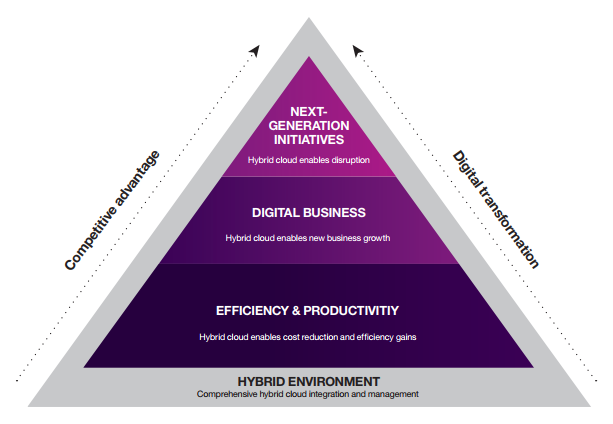
This thought-provoking study found that improving productivity is currently the number one goal of cloud service adoption, as the most progressive senior executives plan to offload some of their IT resources and management complexity to the cloud.
A close second goal of digital transformation is improved security and risk reduction -- using the flexibility of a hybrid solution to choose which workloads and data to move to the cloud and which to maintain on-premise.
The other two most mentioned goals by survey respondents are IT infrastructure cost reduction -- i.e. shifting costs from fixed IT to as-needed cloud services -- and scalability to handle dynamic IT workloads.
Why Maturity Matters
Following their detailed analysis, the IBM report authors grouped the survey respondents into three categories, based upon the maturity of their hybrid management capabilities and whether they’re reporting a strategic edge that’s realized from their hybrid cloud deployments: