
U.S. companies are desperately trying to recruit and hire skilled software engineers and developers, but there is simply not enough quality talent to go around. Tiempo Development is a nearshore software development company. Our headquarters are in AZ, but we are a pioneer and leader in outsourcing to Mexico, based on our three software development centers there. We have a proven process and we are experts at providing our customers with powerful solutions. We transform ideas into reality.
SYS-CON Events announced today the Containers & Microservices Bootcamp, being held November 3-4, 2015, in conjunction with 17th Cloud Expo, @ThingsExpo, and @DevOpsSummit at the Santa Clara Convention Center in Santa Clara, CA. This is your chance to get started with the latest technology in the industry. Combined with real-world scenarios and use cases, the Containers and Microservices Bootcamp, led by Janakiram MSV, a Microsoft Regional Director, will include presentations as well as hands-on demos and comprehensive walkthroughs.
SYS-CON Events announced today that Pythian, a global IT services company specializing in helping companies leverage disruptive technologies to optimize revenue-generating systems, has been named “Bronze Sponsor” of SYS-CON's 17th Cloud Expo, which will take place on November 3–5, 2015, at the Santa Clara Convention Center in Santa Clara, CA. Founded in 1997, Pythian is a global IT services company that helps companies compete by adopting disruptive technologies such as cloud, Big Data, advanced analytics, and DevOps to advance innovation and increase agility. Specializing in designing, implementing, and managing systems that directly contribute to revenue growth and business success, Pythian’s highly skilled technical teams work as an integrated extension of our clients’ organizations to deliver continuous transformation and uninterrupted operational excellence.
In today's digital world, change is the one constant. Disruptive innovations like cloud, mobility, social media, and the Internet of Things have reshaped the market and set new standards in customer expectations. To remain competitive, businesses must tap the potential of emerging technologies and markets through the rapid release of new products and services. However, the rigid and siloed structures of traditional IT platforms and processes are slowing them down – resulting in lengthy delivery cycles and a poor customer experience.
Our guest on the podcast this week is Helen Beal, Head of DevOps at Ranger4 Limited. We discuss how successful DevOps transitions depend on culture, so to start companies must identify their current problem areas. Helen describes the most successful DevOps culture as a place where each individual has autonomy as part of the larger team and where experimentation is encouraged.
You can never be too careful. Security is on everyone’s mind. Not too long ago, we talked about how beefed up security impacts load testing and we want to continue the conversation. How do you keep yourself and your company safe in the age of industrial and state-sponsored hacking? In this post, we'll outline a few things you must know.
Skeuomorphism usually means retaining existing design cues in something new that doesn’t actually need them. However, the concept of skeuomorphism can be thought of as relating more broadly to applying existing patterns to new technologies that, in fact, cry out for new approaches. In his session at DevOps Summit, Gordon Haff, Senior Cloud Strategy Marketing and Evangelism Manager at Red Hat, discussed why containers should be paired with new architectural practices such as microservices rather than mimicking legacy server virtualization workflows and architectures.
As more intelligent IoT applications shift into gear, they’re merging into the ever-increasing traffic flow of the Internet. It won’t be long before we experience bottlenecks, as IoT traffic peaks during rush hours. Organizations that are unprepared will find themselves by the side of the road unable to cross back into the fast lane. As billions of new devices begin to communicate and exchange data – will your infrastructure be scalable enough to handle this new interconnected world?
We live in a hyper-connected world, and we're sharing information and collaborating on an entirely new scale. Millions of smartphones are sold every day. In a single minute online we send more than 200 million emails, share 2.4 million pieces of content on Facebook, and perform 4 million searches on Google. There are more than 1.3 billion websites out there. Angel investors, crowd-funding and crowd-sourcing are sparking a rich start-up culture. It has never been easier to realize a good idea. This level of collaboration and the sophistication of connectivity are casting everyone as an innovator. We are enjoying a period of deep technology innovation right now, but it comes at a cost.
Cloud security is at the top of every CIO’s list. It is also the first subject that comes up when you engage in a discussion about the cloud. For those of us who followed the recent Ashley Madison story (from a tech perspective), you would agree that while the breach happened for so many reasons, security is at the heart of it. Here are some key aspects for creating a solid organization, keeping cloud security in perspective.
“10 Hot Internet of Things Startups.” “5 Internet of Things Startups to Watch.” “Top 8 IoT Startups of 2015.” These are the actual titles of just a few of the many articles being written about IoT. It’s a concept that generates a lot of excitement among business leaders and consumers alike, a paradigm shift that will impact every person, home, business and public infrastructure in the developed world over the next decade. How might IoT impact your organization? What new revenue streams are waiting to be discovered? Read on for examples of how businesses are already applying the technologies that comprise the IoT to transform their organizations.
Like me, you’re probably familiar with the story of the Pied Piper of Hamelin. A cautionary tale about the consequences of reneging on debt – it sure scared the crap out of me as a kid. In enterprise IT, we also accrue debt, but of the technical kind. While the results of non-payment aren’t as severe as those suffered by the good folk of Hamelin, not ‘paying the piper’ will have dire consequences for any businesses trying to compete on an economic playing field where the rules are determined by software. DevOps of course is now being touted as a tune organizations must play if they’re to digitally transform their businesses – and for good reason. Businesses in every vertical are showing that through effective cross-functional collaboration, automation, and the adoption of agile and lean practices, high quality software can be released more rapidly – the result, a high performance IT function that’s inextricably linked to increased customer satisfaction, profitability and market share.
Red Hat is investing in Tesora, the number one contributor to OpenStack Trove Database as a Service (DBaaS) also ranked among the top 20 companies contributing to OpenStack overall. Tesora, the company bringing OpenStack Trove Database as a Service (DBaaS) to the enterprise, has announced that Red Hat and others have invested in the company as a part of Tesora's latest funding round. The funding agreement expands on the ongoing collaboration between Tesora and Red Hat, which dates back to February 2014 when Tesora was re-launched with the mission to become the market leader in database as a service (DBaaS) and OpenStack Trove. Most recently, the Tesora DBaaS Platform Enterprise Edition added support for Red Hat Enterprise Linux OpenStack Platform 6.
Everyone talks about continuous integration and continuous delivery but those are just two ends of the pipeline. In the middle of DevOps is continuous testing (CT), and many organizations are struggling to implement continuous testing effectively. After all, without continuous testing there is no delivery. And Lab-As-A-Service (LaaS) enhances the CT with dynamic on-demand self-serve test topologies. CT together with LAAS make a powerful combination that perfectly serves complex software development and delivery pipelines. Software Defined Networks (SDNs) turns the network into a flexible configurable system of software components and connections that is powerful but presents new complexities and challenges for network software development, delivery and deployments.
The pricing of tools or licenses for log aggregation can have a significant effect on organizational culture and the collaboration between Dev and Ops teams. Modern tools for log aggregation (of which Logentries is one example) can be hugely enabling for DevOps approaches to building and operating business-critical software systems. However, the pricing of an aggregated logging solution can affect the adoption of modern logging techniques, as well as organizational capabilities and cross-team collaboration. We need to choose our log aggregation tools carefully to make sure that we don't introduce unintended barriers or silos driven by unhelpful pricing.
Culture is the most important ingredient of DevOps. The challenge for most organizations is defining and communicating a vision of beneficial DevOps culture for their organizations, and then facilitating the changes needed to achieve that. Often this comes down to an ability to provide true leadership. As a CIO, are your direct reports IT managers or are they IT leaders? The hard truth is that many IT managers have risen through the ranks based on their technical skills, not their leadership ability. Many are unable to effectively engage and inspire, creating forward momentum in the direction of desired change. Renowned for its approach to leadership and emphasis on their people, organizations increasingly look to our military for insight into these challenges.
Mobile testing is getting harder: more devices, multiple operating systems, higher quality expectations and shorter development cycles. In his session at DevOps Summit, Tom Chavez, Senior Evangelist at SOASTA, will discuss the seven steps to improving your mobile testing process. Tom Chavez, with 20+ years of experience as a product manager in software development tools, works in product management at SOASTA, the leader in performance analytics. He has worked across the Silicon Valley at industry leaders including Apple, Sun, PalmSource, and Intuit delivering tools for Mac, Java, PalmOS, and Android development and testing.
I've been asked several times recently about the difference between Verification and Validation in automated testing and for some advice on applying and documenting each kind of testing. Let me first take a minute to define these terms. Verification is testing that your product meets the specifications / requirements you have written. "Did I build what I said I would?"
Converged infrastructure solutions are hastening the path to big-data business value and cloud deployment options. We'll also delve into how the right balance between open-source and commercial IT products helps in creating a big-data capability, and we'll further explore how converged infrastructure solutions are hastening the path to big-data business value and cloud deployment options.
In 2011, then United States CIO Vivek Kundra released the US Federal Cloud Computing Strategy [1]. In the executive summary he pointed to cloud computing as a key component of the US Federal Government’s information technology modernization efforts: “Cloud computing has the potential to play a major part in addressing these inefficiencies and improving government service delivery. The cloud computing model can significantly help agencies grappling with the need to provide highly reliable, innovative services quickly despite resource constraints.”
Through WebRTC, audio and video communications are being embedded more easily than ever into applications, helping carriers, enterprises and independent software vendors deliver greater functionality to their end users. With today’s business world increasingly focused on outcomes, users’ growing calls for ease of use, and businesses craving smarter, tighter integration, what’s the next step in delivering a richer, more immersive experience? That richer, more fully integrated experience comes about through a Communications Platform as a Service which allows for messaging, screen sharing, videoconferencing and more. In her session at WebRTC Summit, Dr. Natasha Tamaskar, Vice President and Head of Cloud and Mobile Strategy and Ecosystem at GENBAND, will explore what’s next on the horizon and how to create amazing experiences by embedding real-time communications everywhere.
Most informed CEOs seem to know intuitively that the most qualified person to lead their forward-looking business technology advancement isn’t likely to have the profile of a typical legacy CIO. In contrast, the role of a Digital Business Transformation innovator has very different requirements to the traditional IT utility infrastructure custodian of the past.
That said, some progressive CIOs are already making the transition to lead the digital competitiveness quest, and others will surely follow. Moreover, a few multinational companies currently have a CIO in a highly strategic, visible and collaborative position within the company. Their challenge is to guide the rest of the organization’s leadership to attain the required skills that will enable them to actively participate in the planning and execution of a new strategy – empowered by digital technologies.
The Harvard Business Review (HBR) market research team recently completed a global study of the path that several organizations have taken to develop and deliver the digital learning support resources that their key internal stakeholders both need and want. The results of this research portrays an environment that may be familiar to many CEOs that have, or are about to, embark upon a similar journey.
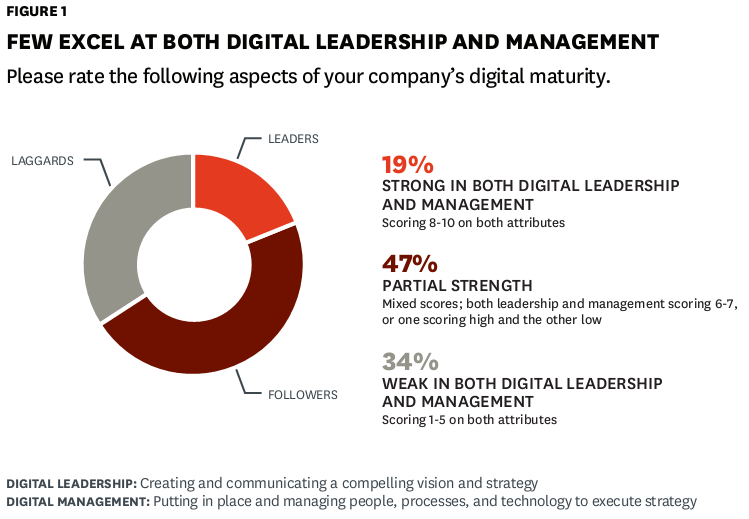
The HBR survey found that companies that rate highly in both digital leadership and management have better business results than their peers, with stronger revenue growth and greater profit margins.
Just under a fifth of survey respondents fell into this early-adopter or “Digital Leader” category, while over a third were deemed to be “Laggards” – i.e. an organization that’s weak in both digital leadership and management. Moreover, nearly half of the survey respondents had mixed scores and were rated as “Followers.”
What set the leaders apart from their peer group, in laggard or follower organizations? These proactive CIOs help their business colleagues to understand which digital knowledge and skills need to reside in their function, and which they can defer to the IT support team. The CIOs and their staff typically communicate in language that makes sense to a Line of Business (LoB) leader that’s focused on achieving outcomes.
While many app developers are comfortable building apps for the smartphone, there is a whole new world out there. In his session at @ThingsExpo, Narayan Sainaney, Co-founder and CTO of Mojio, will discuss how the business case for connected car apps is growing and, with open platform companies having already done the heavy lifting, there really is no barrier to entry.
Docker containerization is increasingly being used in production environments. How can these environments best be monitored? Monitoring Docker containers as if they are lightweight virtual machines (i.e., monitoring the host from within the container), with all the common metrics that can be captured from an operating system, is an insufficient approach. Docker containers can’t be treated as lightweight virtual machines; they must be treated as what they are: isolated processes running on hosts. Why? Because they are processes that start and terminate quickly. Virtual machines aren’t designed to run for only a short time and then be terminated. Likewise, processes serve specific tasks while virtual machines typically serve multiple tasks.
WebRTC has had a real tough three or four years, and so have those working with it. Only a few short years ago, the development world were excited about WebRTC and proclaiming how awesome it was. You might have played with the technology a couple of years ago, only to find the extra infrastructure requirements were painful to implement and poorly documented. This probably left a bitter taste in your mouth, especially when things went wrong.