
What factors make you think a web page is good or not? What keeps on that page longer than others? On the one hand it is the content on the page and whether this content is of interest to you. On the other it is the velocity with which you can navigate through the individual pages. High-Speed internet and performance-optimized pages make our day-to-day browsing easier when accessing our emails, tweets, latest updates on sports or news. With all the changes in the recent years in Web Performance Optimization (WPO) we’ve been spoiled by those sites that follow all these Best Practices and boosted their web site experience. No wonder that we start losing our patience with a site that doesn’t respond as fast as we’ve come to expect.
Google has pulled out all 17 of its presentations from the upcoming JavaOne conference in San Francisco. Yes, it's because of that lawsuit. This is what Reuters has to say about it.
Unless Oracle and Google will settle on their little issues, JavaOne may be dead. Or to say it properly, Java One will fork, bit it'll never be an event that would gather 10-12 thousands of ENTHUSIASTIC Java developers under the same roof. I'm still going there and, on return, will share with you what kind of vibe/energy I've experienced, if any.
I know this guy who should consider this as an opportunity and create large conference, an alternative to JavaOne. He knows how to do it.
In general, this Oracle/Google dispute may turn into a birth of a new language created by Google, which will make java obsolete like COBOL.
Now there are 17 empty slots to be filled with substitute speakers. I'm wondering who's going to be a substitute presenter for the annual Java Puzzlers by Joshua Bloch and Neal Gafter?
Fujitsu president Masami Yamamoto said the company is “very actively” seeking software acquisitions, particularly the cloud and middleware kind, to ratchet up its global growth, according to BusinessWeek. It could take another six months or more for Fujitsu to light on anything. It’s also interested in alliances presumably like its recent Azure appliance hardware deal with Microsoft.
A US court has told Chen Lai-juh, the CEO of Taiwan LCD screen maker AU Optronics Corporation, not to leave the country until his trial on Justice Department-brought charges of price-fixing is over. A federal grand jury indicted Chen and a half-dozen other AU officials of years of price fixing back in June. Alleged victims include IBM, Apple and Dell. Six LCD suppliers had pleaded guilty to price fixing and have been ordered to pay upwards of $860 million in fines.
Worldwide server revenues surged 11% to $10.9 billion in Q2, according to IDC, which calls it the second consecutive quarter of year-over-year revenue growth, the fastest quarterly revenue growth since 2003 and the fourth consecutive quarter of improving server market demand. Trouble is that was two months ago and, what with Wall Street saying PC demand has subsequently tanked, one would really like to know whether server sales are still looking better. Based on its Q2 numbers IDC says it “continues to see widespread infrastructure refresh occurring across all geographies. While much of this refresh is occurring first in x86-based servers, IDC expects the recovery to extend to Unix and mainframe platforms in the second half of 2010.”
Security is a prime impediment to cloud adoption, right? Right. Well, Centrify has this idea: Suppose it turns any company’s venture into the cloud into a lock-box – sealed off from the nasties – if anything dastardly happens the user has only its own staff to blame. That way companies won’t be forfeiting their soul simply to take advantage of the cloud’s siren’s song about cheap price points. Next week at VMWorld Centrify is going to offer to isolate virtual machines no matter where they are through the security in Microsoft’s Active Directory – complements of AD’s policy logic – and let them take the job away from the host provider.
Remember that rosy picture that Intel CEO Paul Otellini painted in mid-July about how everything was simply lovely and how “the PC and server segments are healthy and demand for leading-edge technology will continue to increase for the foreseeable future? Well, it’s turning into “The Portrait of Dorian Gray.” Those warning signs that Wall Street was getting about the chip market turning down were on the money. Intel Friday morning lowered its buoyant outlook of a few weeks ago and cut its Q3 projections of sales of $11.2 billion-$12 billion down to $10.8 billion-$11.2 billion. Analysts that were really thinking $11.5 billion will have to adjust even more.
In this white paper read how Skyline Software Systems, Inc. needed a “more comprehensive solution that could work across multiple media formats,” and switched from homegrown to SafeNet Sentinel HASP.
Hard drive is a commodity. Whether it is IDE, EIDE or SATA, you buy the right one and you can plug it directly into your computer. On the service providers front (service providers are the biggest cloud storage service providers), they may not all create cloud storage services themselves. For example, AT&T and Peer1 are using EMC Atmos. Verizon and Planet are using Nirvanix. As time goes on, we will see the same provider using multiple backend solutions to satisfy different need. Also when service providers merge, the merged company may be using backend solutions from multiple vendors. On the cloud storage vendor front, more and more are conforming to the Amazon S3 API. We saw Google Storage for Developers, Eucalyptus, Dunkel and Mezeo all creating S3 compatible APIs for their cloud storage solutions. On the other hand, Rackspace is pushing the OpenStack project. All are trying to create a unified interface.
Data virtualization has become a hot topic as enterprises and government agencies add this maturing technology to their data integration toolkits in pursuit of greater IT agility and lower costs. Rising key performance indicators (KPIs) for both demand and supply clearly tell this story. With demand exploding fivefold[1], and ETL, ESB and BI vendors extending their existing data integration offerings and bringing new data virtualization wares to market, enterprises and government agencies are seeking a way to measure and compare the data virtualization platform offerings available, to determine which is the most appropriate for their information architectures.
SafeNet discusses IDC's findings on the best practices for the deployment of software licensing and entitlement management technologies. Learn how software publishers can benefit from faster time-to-market, increased ability to capture and optimize revenue, and reduced operational inefficiencies.
Oracle CEO Larry Ellison is supposedly going to open his mind on the subject of Java, the prime reason he bought Sun. He’s supposed to deliver the keynote at JavaOne the middle of September and, along with Oracle EVP Thomas Kurian, discuss Oracle’s vision and strategy for Java. There’s unlikely to be bigger news than Oracle suing Google 10 days ago for Android trespassing on its Java widgetry. JavaOne is supposed to be part of OracleWorld in San Francisco September 19-23.
I'm speaking with Vikas Jain from Oracle at Java One (co-located with Oracle Open World this year) on the topic of REST Security. The session link is below:
read more
This provides an introduction to the architecture style namely, process-centric architecture (PCA). PCA is suited for IT systems in the enterprise.
Is Oracle the Java killer? Probably not. Java is too strong to be killed. Will Oracle's lawsuit Against Google Put a Chill on Java Adoption? When Oracle acquired Sun, I thought it was a wrong decision. It seems that Oracle's managers reached a similar conclusion and are trying to minimize the amount of money they lose. The lawsuit against Google is one of the ways to achieve it. However, this lawsuit supports the concerns about Java after Oracle acquired Sun.
Estimate the value of automating your application deployments and overall software delivery Take two minutes to determine the value your organization could attain. The IBM Rational software delivery automation value estimators illustrate how your organization can be positively impacted by the use of Rational automation software solutions.
Oracle is apparently rolling back Solaris to its pre-open source days. The company hasn't made an official announcement, and may never, but an internal e-mail ostensibly to its own remaining Solaris engineers outlining its position on OpenSolaris just happened to fall into the hands of OpenSolaris contributor Steven Stallion last Friday. He posted it under the headline "OpenSolaris is Dead" here. Generally regarded as authentic, the e-mail says Solaris is meant to drive Oracle's newfound proprietary server and storage business, which is supposed to be worth "many billions of dollars," and as such "is not something we outsource to others, it is not the assembly of someone else's technology, and it is not a sustaining-only product."
Having said nothing for months about its intentions, a deafening silence that had Sun users biting their nails down to the quick about where the technology was really going – then demonstrating their angst in their order rate or their leap into the waiting arms of competitors – Oracle the other day finally opened its mind a tad. For starters, it staged a webcast Tuesday and said that it means to put its resources behind Sun’s Sparc and x86 systems, something it said before however unconvincingly. But now it’s got what it called an “aggressive” albeit stripped-down – and for that matter pretty much unreadable – five-year roadmap to wave around that plots out Sparc server development through 2015.
Measurement is the most central concept in any performance-related activity. If you are not measuring you are blind. As important as measuring per se is collecting the right measurements. Which metrics are the right ones depends on what you want to do. However there are some general principles which – when followed – can make your life much easier.
To save me time in the future, rather than having to write it again and again for clients, this blog entry documents how to install JDeveloper 11g Studio Edition v11.1.1.2.0 build 5536 under Windows. I'll admit it's not the most exciting blog post, for sure Oracle's already done it (without my witty dialogue of course), and hey, it's not even the latest release, but sometimes we just gotta-do-documentation-for-documentation's-sake.
Software
The JDeveloper software can be obtained from here ... then selecting the Downloads tab -> Archived Downloads -> Oracle JDeveloper 11g 11.1.1.2.0 -> Accept License Agreement -> jdevstudio11112install.exe (that constitutes the Studio Edition for Windows including JDK 6.
Prerequisites
Disable virus scanners - to make your life easier, disable any virus scanners during the installation as this will slow the install process down if the virus scanner scans each Java archive. This has from experience been a particular problem with McAfee's products, and I recommend an alternative virus scanner.
Administrative access – you'll require privileges to install software onto the local PC.
Installation
1) On the local Windows PC execute the jdevstudio11112.install.exe. This will display the Oracle Installer Welcome dialog: 2) Selecting Next presents the Choose Middleware Home Directory dialog where you can select an existing Fusion Middleware Home directory or create a new one. It's recommended you always install each JDeveloper installation in it's own directory, so create a new directory either by typing the directory in the text box or using the Browse button.
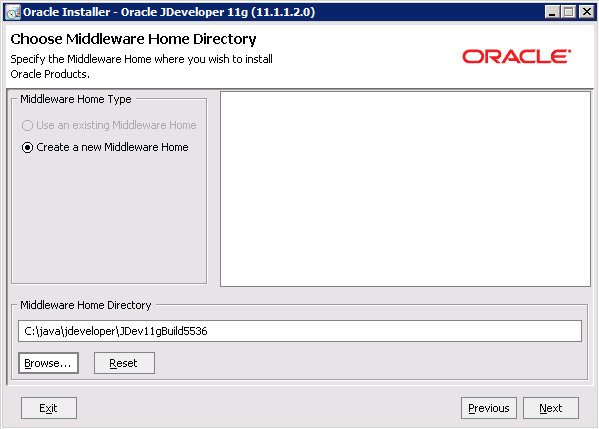 If you have multiple developers setting up JDeveloper on their local PCs, it's recommended you standardize the installation directories, and cater for multiple JDeveloper versions. In the picture above C:javajdeveloperJDev11gBuild5536 reflects a separate directory for JDeveloper 11g v11.1.1.2.0 build 5536. As alternative a later version JDeveloper 11g v11.1.1.3.0 build 5560 could be installed under C:javajdeveloperJDev11gBuild5560. Note to avoid cross-platform issues in the future it's recommended you standardize the capitalization of the directories too.
3) Selecting Next presents the Choose Install Type dialog, allowing you a choice between installing the full package or customising the install and dropping off components: As it's unknown what future parts of JDeveloper will be required for development purposes it's recommended the Complete installation option is chosen. If you do choose the Custom option you'll be presented with the Choose Products and Components dialog:
 .....where you need to make you're own informed choices.
4) Next presents the Confirm Product Installation Directories dialog. Of note are the base Middleware Home Directory, and the two separate directories for the actual JDeveloper software and the separate integrated WebLogic Server: 5) The Choose Shortcut Location dialog displayed next gives you options to create the JDeveloper Windows group either for the current user or all users on the local PC. As multiple developers may use the same PC, giving access to all users may be the preferred option:
 If you do choose to create the JDeveloper Windows group in all users accounts, assuming you have administrative rights on the local PC for installing JDeveloper, install at the end of this process that the installed JDeveloper files can also be run by other users on the same PC.
6) The Installation Summary dialog on selecting Next displays what will be installed, how much disk space will be consumed:  Select Next starts the installation process:
 7) On successful completion the Installation Complete dialog will show:
 Leaving the Run Quickstart checkbox checked and selecting the Done button will close the installer and open the Quickstart program (explained in the next section). We'll assume you uncheck the checkbox and start JDeveloper separately below.
Your JDeveloper installation is now complete.
What was Installed
Post installation JDeveloper will have installed the following:
1) Under the specified installation directory the JDeveloper and integrated WebLogic Server files will exist: 2) A new directory C:bea will have been created if this is your first Fusion Middleware install with the file beahomelist. This text file when open reveals the installation home directory for each product installed.
3) Within the Windows Start menu a new group Oracle Fusion Middleware 11.1.1.2.0 will exist: 4) When you run JDeveloper for the first time it will create two sets of files under the Windows user directories for the current user. Where these are found depends on which version of Windows you're using. Older versions including Windows XP stores the files under:
a) C:Documents and Settings<username>Application DataJDeveloper
...in that directory you'll notice a subdirectory like "system11.1.1.2.36.55.36" where the system directory numbering scheme references the version of JDeveloper and build number (e.g. version 11.1.1.2.0 and build 5536 from the example above) you've installed. Multiple versions of JDeveloper will see additional system directories created here.
b) C:Documents and Settings<username>Oracleoradiag_
....I'm not entirely sure what this directory is used for presumably capturing diagnostic information. I believe it's enabled by selecting the XXXX option in the following section.
If you're using a modern version of Windows the likely location for these files are:
a) C:Users<username>AppDataRoamingJDeveloper
b) C:Users<username>Oracle
Running JDeveloper
You can open JDeveloper via the Windows group Oracle Fusion Middleware 11.1.1.2.0 – JDeveloper Studio 11.1.1.2.0 option. The first dialog you'll see is the loading window: At certain points during the load JDeveloper will prompt you for more information, including:
1) The Select Role dialog will display: This allows you to select different developer modes for the IDE which influence which features run. As typically it's unknown what the developer will be doing in thee future, selecting the Default Role option and unselecting the Always prompt for role selection on startup checkbox are recommended.
If you wish to turn this dialog back on at a later date, it's preference is accessible via the JDeveloper menu option Tools -> Preferences -> Roles, then selecting the Always prompt for role selection on startup checkbox.
2) The first time you run a newly installed JDeveloper version, if you have previous versions of JDeveloper installed on the same machine, the installer will prompt you to migrate the user's settings from the previous JDeveloper install into the new JDeveloper install:
todo: need a screenshot of this dialog
3) On the IDE opening for the first time it will prompt you to associate certain file types under Windows with the IDE: This is a personal preference left up to the reader.
4) On the IDE opening for the first time it will prompt you to report back IDE errors and crashes to Oracle Corporation: Assuming Oracle is actually gathering and using these statistics, this can be useful for improving the quality of the IDE in the future. However it may be against your organization's security policy to enable this. In addition if JDeveloper has connectivity problems in reaching Oracle's website this could also slow JDeveloper down.
5) On the IDE opening for the first time it will display a Tip of the Day: Enabling or disabling this is a personal preference left up to the reader.
JDeveloper is now running for the first time.
After sometime you might see the following Check for Updates green popup in the bottom right of the IDE:
todo: need picture
JDeveloper periodically scans external plug in servers to see if there are updates available to various parts of the JDeveloper install. Blindly accepting the choices provided can result in developers having inconsistent installations, and code that will work on one developer's PC but not anothers as the wrong updates are installed. Thought needs to be given on standardizing the patches installed and if the update feature should be used at all.
Priming the Integrated WebLogic Server (WLS)
To speed up further development in JDeveloper it's useful to run and stop the integrated WebLogic Server (WLS) such that it is initialized for the first time. To do this:
1) Select the Run -> Start Server Instance (IntegratedWebLogicServer) option: 2) As a result in the Log window under the Running: IntegratedWebLogicServer child tab, you'll see the WLS server initialize and start for the first time:
 Of particular note you're looking for the <Server started in RUNNING mode> message that shows a successful initialization.
3) To stop the WLS server, in the Log window select the red box icon, then the IntegratedWebLogicServer option: 4) In the resulting Log window under the Running: IntegratedWebLogicServer child tab, you'll the WLS messages as it shuts down:
 This completes the initialization of the integrated WebLogic Server.
Anybody really know why Mark Hurd was forced to resign? We ask because the story that HP put out Friday to explain why its golden boy suddenly wasn’t its CEO anymore doesn’t make much sense especially in view of the contradictions now coming from Hurd’s side of the aisle. If Hurd wasn’t having an affair with 50-year-old company geisha Jodie Fisher why would he fudge his expense account to cover up the fact that he had dinner with her?
Fifteen years ago there was no iPhone and Android. Web browsers were hot. Netscape market share was over 90% - they didn't have competition.The situation changed when Microsoft has introduces Internet Explorer (me too, me too). Back in 1998, there was an infamous law suite between Microsoft and Sun Microsystems – the former started quietly introducing their own class libraries to Java breaking the write-once-run-anywhere idea of Sun that back then seemed to be achievable. Sun won that $10B law suite. But as the saying goes, they won the battle but lost the war.
Angry Microsoft refused to include upgrades to JVM that came with Internet Explorer, which seriously hurt applets popularity – the end user couldn’t just open a Web page to see the applet that required, say 1.3 version of JVM. They’d need to first download the proper version of JVM, and only then the applets that were written with the assumption that JVM 1.3 was available would work. The process of downloading the right JVM Plug-in was a multi-step process, and a truck driver from Alabama wouldn’t be able to go through it.
High penetration of the required runtime environment and the ease of its upgrade are the crucial moments for any Web-based technology. Adobe Flash Player shines in this area today (sorry, Steve). Flash Player is also a virtual machine with a small memory footprint (1.5Mb), and its installation takes under 20 seconds after one button click. For years, the size of the JVM Plug-in was about 16Mb and install was complicated for a non-programmer, and (the rumor has it) – it’s a lot smaller now.
This situation has changed after the release of Java 6 update 10, which includes so called next-generation Java Plug-in. Now applets don’t run in the JVM packaged with the Web browser, but run in a separate JVM launched by the Java Plug-in. The applet still appears in the Web browser’s window, but now it doesn’t depend on the goodwill of the browser vendor to include the latest Plug-in. You can read more about this Java Plug-in at https://jdk6.dev.java.net/plugin2.
The other major change introduced in the next-generation Java Plug-In is ability to launch Java applets directly from JNLP (Java Network Launch Protocol) files, which in the previous releases were used only in Java Web Start technology that allowed local deployment of the applications over the network. As of Java 10.6.10 you can use the JNLP meta descriptors to launch applets too. JNLP support is described in details at http://www.oracle.com/technetwork/java/javase/index-142562.html.
Earlier versions of HTML standard included the tag <applet> to incorporate Java applets into HTML page. But as of HTML 4.01 this tag has been deprecated and you should use the tags <object> for users who like Internet Explorer or <embed> for other Web browsers. But Oracle, the company behind Java, recommends using <applet> for Web pages accessed through the Internet and <object> or <embed> for intranet-based Web sites. The main reason being that Web browser vendors are infamous for being inconsistent of implementing HTML standards, and it’s safer to use tried and true <applet> tag to get predictable look and feel of the Web pages that host Java applets. But intranet is a more controlled environment. You can read about the differences of embedding applets with these tags at http://download.oracle.com/javase/6/docs/technotes/guides/plugin/developer_guide/using_tags.html. When young and old kids (sorry Steve) tell that HTML 5 will change the world, it's funny.
The deployment options for applets have been extended as of release of Java 6 update 10. To learn all the options of applet deployment in depth, refer to the Oracle document titled “Java Rich Internet Applications Deployment Advice” available at http://download.oracle.com/javase/6/docs/technotes/guides/jweb/deployment_advice.html.
What’s the next step in applet’s evolution? You’ll be creating UI for the Web-based applications with a relatively new language called JavaFX. In a month, I'll be trying to attend every JavaFX technical session at JavaOne conference to see if it'll become a real competition to Adobe Flex and Microsoft Silverlight.
If you're not into Java applets, consider attending our Third Annual Enterprise Flex Symposium in New York City. It’s a small event where attendees and presenters will talk turkey about Adobe Flex.
Currently SOA is used as a technology at one customer that is using ESB, Repository, etc. Cloud computing is used in such a way that all the components are put on the cloud, requiring a complete switch for the customer to a cloud infrastructure. However, the integration of the systems at one customer with the cloud offerings has the potential to provide additional capabilities such as process modeling, business activity monitoring, or simulation in the cloud integrated with the customer’s systems. In his session at the 7th International Cloud Expo, Ulf Fildebrandt, Chief Development Architect SOA Infrastructure at SAP AG, will explain the potential of this integration and how it can be done.
This post is yet another Contextual Event blog description with a slight programmatic twist. It was inspired by Lucas Jellema's OTN forum post on how to raise programmatic Contextual Events, and in addition uses techniques as demonstrated by Pino and Frank described below. Readers might be interested in a thread on the ADF EMG about the design of Contextual Events in the ADF framework, and the idea of Implicit Contextual Events - The Rise and Rise of Contextual Events (or the birth of Implicit Contextual Events). In that ADF EMG thread I allude to a near "million blogs" that already describe Contextual Events as supporting collateral for Oracle's documentation. If you're interested in other posts check out Pino Jeddah's or Frank Nimphius's screencasts.
One objective look at the current PaaS market provides all the evidence you need to conclude that we are in but the infancy of development for this technology. I want to be clear here, there are some really cool (and more importantly value-providing) offerings out there, but there is a long way to go. Specifically, I am not convinced anyone can make a case that we have solutions today that comprehensively address two concepts that will become mere table-stakes in the PaaS play space.

