
SYS-CON Events announced today that SourceForge has been named “Media Sponsor” of SYS-CON's 21st International Cloud Expo, which will take place on Oct 31 – Nov 2, 2017, at the Santa Clara Convention Center in Santa Clara, CA. SourceForge is the largest, most trusted destination for Open Source Software development, collaboration, discovery and download on the web serving over 32 million viewers, 150 million downloads and over 460,000 active development projects each and every month.
DevOps at Cloud Expo, taking place October 31 - November 2, 2017, at the Santa Clara Convention Center in Santa Clara, CA, is co-located with 21st Cloud Expo and will feature technical sessions from a rock star conference faculty and the leading industry players in the world. The widespread success of cloud computing is driving the DevOps revolution in enterprise IT. Now as never before, development teams must communicate and collaborate in a dynamic, 24/7/365 environment. There is no time to wait for long development cycles that produce software that is obsolete at launch. DevOps may be disruptive, but it is essential.
SYS-CON Events announced today that TechTarget has been named “Media Sponsor” of SYS-CON's 21st International Cloud Expo, which will take place on Oct 31 – Nov 2, 2017, at the Santa Clara Convention Center in Santa Clara, CA. TechTarget storage websites are the best online information resource for news, tips and expert advice for the storage, backup and disaster recovery markets.
SYS-CON Events announced today that Silicon India has been named “Media Sponsor” of SYS-CON's 21st International Cloud Expo, which will take place on Oct 31 – Nov 2, 2017, at the Santa Clara Convention Center in Santa Clara, CA. Published in Silicon Valley, Silicon India magazine is the premiere platform for CIOs to discuss their innovative enterprise solutions and allows IT vendors to learn about new solutions that can help grow their business.
Colocation is a central pillar of modern enterprise infrastructure planning because it provides greater control, insight, and performance than managed platforms. In spite of the inexorable rise of the cloud, most businesses with extensive IT hardware requirements choose to host their infrastructure in colocation data centers. According to a recent IDC survey, more than half of the businesses questioned use colocation services, and the number is even higher among established businesses and businesses with an existing base of IT expertise.
Many organizations are associating data monetization with selling their data. But selling data is not a trivial task, especially for organizations whose primary business relies on its data. Organizations new to selling data need to be concerned with privacy and Personally Identifiable Information (PII), data quality and accuracy, data transmission reliability, pricing, packaging, marketing, sales, support, etc. Companies such as Nielsen, Experian and Acxiom are experts at selling data because that’s their business; they have built a business around gathering, aggregating, cleansing, aligning, packaging, selling and supporting data.
The post Analytic Profiles: Key to Data Monetization appeared first on InFocus Blog | Dell EMC Services.
The purpose of enterprise architecture is to be able to consciously design an enterprise rather than allowing it to happen randomly and unconsciously. It is worth noting that it implies knowledge of a certain intended outcome or desired state in mind. Enterprise architecture (EA) is a discipline that enables designing the enterprise consciously and deliberately, rather than letting it happen randomly. EA design is informed by business vision, strategic intent, and insights on the functioning of the enterprise. So the purpose of enterprise architecture is to be able to consciously design an enterprise rather than allowing it to happen randomly and unconsciously. It is worth noting that it implies knowledge of a certain intended outcome or desired state in mind. This is usually referred to as the target state. The target state is defined in terms of the attainment of certain capabilities and fulfillment of certain milestones.
What's disruptive innovation, and why does it matter to leaders in the C-suite? It's how the savvy non-conformist will target market opportunities. How does this happen, when established companies seem to have the advantage? Creative software developers can quickly apply new technologies and digital business models to capture untapped demand.
Moreover, the most disruptive new companies will eventually reshape entire industries, swiftly pushing aside the legacy incumbent players -- it's a form of Digital Darwinism. The global networked economy will blossom, thanks to the pervasive Internet, while the adaptive entities will survive and prosper.
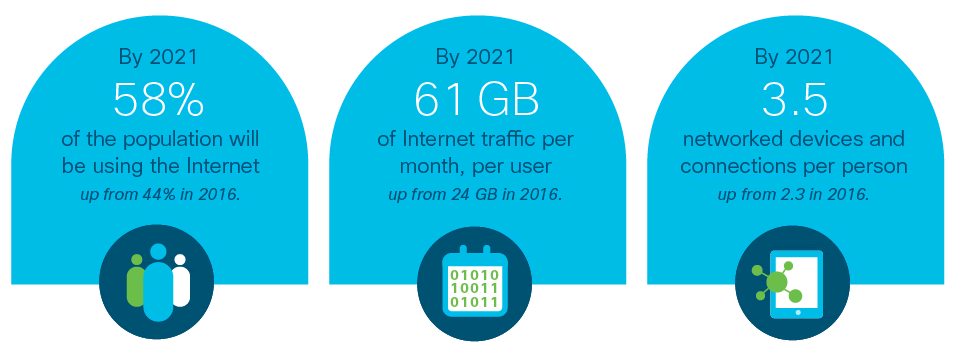
Over the next five years, global digital transformation will continue to have a significant impact on the demands and requirements of Internet Protocol (IP) networks, according to key findings from the latest Cisco Visual Networking Index (VNI).
Over the forecast period, global IP traffic is expected to increase three-fold reaching an annual run rate of 3.3 zettabytes by 2021 -- that's up from an annual run rate of 1.2 zettabytes in 2016.
Let’s rewind the clock a bit. A few years ago, object storage was the new technology that promised to replace file system in the secondary storage market. It would scale beyond the limits of file systems and deliver better costs. The trade-off would be lower ease-of-use with new protocols that required rewriting of the applications. File systems would keep its place as the tier-one storage solution, because of its superior performance. The world order was clear with object storage elbowing file system out of secondary storage and gradually squeezing it out of tier one as its performance improved. The marketing message was that the role of the file system was rapidly diminishing, because its technology could not keep up with the data explosion.
Multiple data types are pouring into IoT deployments. Data is coming in small packages as well as enormous files and data streams of many sizes. Widespread use of mobile devices adds to the total. In this power panel at @ThingsExpo, moderated by Conference Chair Roger Strukhoff, panelists looked at the tools and environments that are being put to use in IoT deployments, as well as the team skills a modern enterprise IT shop needs to keep things running, get a handle on all this data, and deliver the analytics that add value.
"Tintri focuses on the Ops side of the DevOps, which basically is pushing more and more of the accessibility of the infrastructure to the developers and trying to get behind the scenes," explained Dhiraj Sehgal of Tintri in this SYS-CON.tv interview at 20th Cloud Expo, held June 6-8, 2017, at the Javits Center in New York City, NY.
In the decade following his article, cloud computing further cemented Carr’s perspective. Compute, storage, and network resources have become simple utilities, available at the proverbial turn of the faucet. The value they provide is immense, but the cloud playing field is amazingly level. Carr’s quote above presaged the cloud to a T. Today, however, we’re in the digital era. Mark Andreesen’s ‘software is eating the world’ prognostication is coming to pass, as enterprises realize they must become software companies to remain competitive. The value IT brings to such companies is unquestionable. If Carr’s conclusions hold up, however, such technology will become less strategic as it becomes more ubiquitous – suggesting that digital enterprises are in for a world of hurt. Perhaps we should set aside his conclusions as more applicable to a decade gone by. Or maybe there’s more to digital transformation than meets the eye?
Today we can collect lots and lots of performance data. We build beautiful dashboards and even have fancy query languages to access and transform the data. Still performance data is a secret language only a couple of people understand. The more business becomes digital the more stakeholders are interested in this data including how it relates to business. Some of these people have never used a monitoring tool before. They have a question on their mind like “How is my application doing” but no idea how to get a proper answer.
Cloud promises the agility required by today’s digital businesses. As organizations adopt cloud based infrastructures and services, their IT resources become increasingly dynamic and hybrid in nature. Managing these require modern IT operations and tools. In his session at 20th Cloud Expo, Raj Sundaram, Senior Principal Product Manager at CA Technologies, will discuss how to modernize your IT operations in order to proactively manage your hybrid cloud and IT environments. He will be sharing best practices around collaboration, monitoring, configuration and analytics that will help you boost experience and optimize utilization of your modern IT Infrastructures.
With the introduction of IoT and Smart Living in every aspect of our lives, one question has become relevant: What are the security implications? To answer this, first we have to look and explore the security models of the technologies that IoT is founded upon. In his session at @ThingsExpo, Nevi Kaja, a Research Engineer at Ford Motor Company, discussed some of the security challenges of the IoT infrastructure and related how these aspects impact Smart Living. The material was delivered interactively to engage with the audience.
Wooed by the promise of faster innovation, lower TCO, and greater agility, businesses of every shape and size have embraced the cloud at every layer of the IT stack – from apps to file sharing to infrastructure. The typical organization currently uses more than a dozen sanctioned cloud apps and will shift more than half of all workloads to the cloud by 2018. Such cloud investments have delivered measurable benefits. But they’ve also resulted in some unintended side-effects: complexity and risk. End users now struggle to navigate multiple environments with varying degrees of performance. Companies are unclear on the security of their data and network access. And IT squads are overwhelmed trying to monitor and manage it all.
Mark Burgess (@markburgess_osl) is a theoretical physicist, but in his keynote at the 2016 All Day DevOps conference, he talked more about economics and human interactives than physics. What does either have to do as the keynote for a conference on DevOps? Well, for a little more background, Mark Burgess is also the founder and former CTO of CFEngine, a configuration management and automation framework, and is the author of Promise Theory. While at CFEngine, Mark worked to apply a theory of how the autonomous agents in software interact with each other. Promise Theory was born.
The Internet giants are fully embracing AI. All the services they offer to their customers are aimed at drawing a map of the world with the data they get. The AIs from these companies are used to build disruptive approaches that cannot be used by established enterprises, which are threatened by these disruptions. However, most leaders underestimate the effect this will have on their businesses. In his session at 21st Cloud Expo, Rene Buest, Director Market Research & Technology Evangelism at Arago, will discuss the digital enterprise evolution in the context of artificial intelligence.
In his session at @ThingsExpo, Eric Lachapelle, CEO of the Professional Evaluation and Certification Board (PECB), provided an overview of various initiatives to certify the security of connected devices and future trends in ensuring public trust of IoT. Eric Lachapelle is the Chief Executive Officer of the Professional Evaluation and Certification Board (PECB), an international certification body. His role is to help companies and individuals to achieve professional, accredited and worldwide recognized certification against various international standards. He also has extensive experience as a trainer and an educator in the fields of Information Security, Risk Management and IT. Throughout his career, he has worked in North America, Latin America and Asia with individuals and various companies of all sizes.
After more than five years of DevOps, definitions are evolving, boundaries are expanding, ‘unicorns’ are no longer rare, enterprises are on board, and pundits are moving on. Can we now look at an evolution of DevOps? Should we? Is the foundation of DevOps ‘done’, or is there still too much left to do? What is mature, and what is still missing? What does the next 5 years of DevOps look like? In this Power Panel at DevOps Summit, moderated by DevOps Summit Conference Chair Andi Mann, panelists looked back at what DevOps has become, and forward at what it might create next.
In the world of DevOps there are ‘known good practices’ – aka ‘patterns’ – and ‘known bad practices’ – aka ‘anti-patterns.' Many of these patterns and anti-patterns have been developed from real world experience, especially by the early adopters of DevOps theory; but many are more feasible in theory than in practice, especially for more recent entrants to the DevOps scene. In this power panel at @DevOpsSummit at 18th Cloud Expo, moderated by DevOps Conference Chair Andi Mann, panelists discussed the patterns and anti-patterns of DevOps, and what it means to ‘do the right thing’ in a DevOps way, but in the real world.
New competitors, disruptive technologies, and growing expectations are pushing every business to both adopt and deliver new digital services. This ‘Digital Transformation’ demands rapid delivery and continuous iteration of new competitive services via multiple channels, which in turn demands new service delivery techniques – including DevOps. In this power panel at @DevOpsSummit 20th Cloud Expo, moderated by DevOps Conference Co-Chair Andi Mann, panelists examined how DevOps helps to meet the demands of Digital Transformation – including accelerating application delivery, closing feedback loops, enabling multi-channel delivery, empowering collaborative decisions, improving user experience, and ultimately meeting (and exceeding) business goals.
While DevOps most critically and famously fosters collaboration, communication, and integration through cultural change, culture is more of an output than an input. In order to actively drive cultural evolution, organizations must make substantial organizational and process changes, and adopt new technologies, to encourage a DevOps culture. Moderated by Andi Mann, panelists discussed how to balance these three pillars of DevOps, where to focus attention (and resources), where organizations might slip up with the wrong focus, how to manage change and risk in all three areas, what is possible and what is not, where to start, and especially how new structures, processes, and technologies can help drive a new DevOps culture.
@DevOpsSummit at Cloud Expo taking place Oct 31 - Nov 2, 2017, at the Santa Clara Convention Center, Santa Clara, CA, is co-located with the 21st International Cloud Expo and will feature technical sessions from a rock star conference faculty and the leading industry players in the world. The widespread success of cloud computing is driving the DevOps revolution in enterprise IT. Now as never before, development teams must communicate and collaborate in a dynamic, 24/7/365 environment. There is no time to wait for long development cycles that produce software that is obsolete at launch. DevOps may be disruptive, but it is essential.
You know you need the cloud, but you’re hesitant to simply dump everything at Amazon since you know that not all workloads are suitable for cloud. You know that you want the kind of ease of use and scalability that you get with public cloud, but your applications are architected in a way that makes the public cloud a non-starter. You’re looking at private cloud solutions based on hyperconverged infrastructure, but you’re concerned with the limits inherent in those technologies.