
As more intelligent IoT applications shift into gear, they’re merging into the ever-increasing traffic flow of the Internet. It won’t be long before we experience bottlenecks, as IoT traffic peaks during rush hours. Organizations that are unprepared will find themselves by the side of the road unable to cross back into the fast lane. As billions of new devices begin to communicate and exchange data – will your infrastructure be scalable enough to handle this new interconnected world?
Cloud security is at the top of every CIO’s list. It is also the first subject that comes up when you engage in a discussion about the cloud. For those of us who followed the recent Ashley Madison story (from a tech perspective), you would agree that while the breach happened for so many reasons, security is at the heart of it. Here are some key aspects for creating a solid organization, keeping cloud security in perspective.
We live in a hyper-connected world, and we're sharing information and collaborating on an entirely new scale. Millions of smartphones are sold every day. In a single minute online we send more than 200 million emails, share 2.4 million pieces of content on Facebook, and perform 4 million searches on Google. There are more than 1.3 billion websites out there. Angel investors, crowd-funding and crowd-sourcing are sparking a rich start-up culture. It has never been easier to realize a good idea. This level of collaboration and the sophistication of connectivity are casting everyone as an innovator. We are enjoying a period of deep technology innovation right now, but it comes at a cost.
Too often with compelling new technologies market participants become overly enamored with that attractiveness of the technology and neglect underlying business drivers. This tendency, what some call the “newest shiny object syndrome,” is understandable given that virtually all of us are heavily engaged in technology. But it is also mistaken. Without concrete business cases driving its deployment, IoT, like many other technologies before it, will fade into obscurity.
Converged infrastructure solutions are hastening the path to big-data business value and cloud deployment options. We'll also delve into how the right balance between open-source and commercial IT products helps in creating a big-data capability, and we'll further explore how converged infrastructure solutions are hastening the path to big-data business value and cloud deployment options.
In 2011, then United States CIO Vivek Kundra released the US Federal Cloud Computing Strategy [1]. In the executive summary he pointed to cloud computing as a key component of the US Federal Government’s information technology modernization efforts: “Cloud computing has the potential to play a major part in addressing these inefficiencies and improving government service delivery. The cloud computing model can significantly help agencies grappling with the need to provide highly reliable, innovative services quickly despite resource constraints.”
In their Live Hack” presentation at 17th Cloud Expo, Stephen Coty and Paul Fletcher, Chief Security Evangelists at Alert Logic, will provide the audience with a chance to see a live demonstration of the common tools cyber attackers use to attack cloud and traditional IT systems. This “Live Hack” uses open source attack tools that are free and available for download by anybody. Attendees will learn where to find and how to operate these tools for the purpose of testing their own IT infrastructure. They will also witness a cyber-attack from both sides – attacker and defender. Get an inside view how indicators of compromise are researched to develop security content to be deployed for detection based on these attacks.
Most informed CEOs seem to know intuitively that the most qualified person to lead their forward-looking business technology advancement isn’t likely to have the profile of a typical legacy CIO. In contrast, the role of a Digital Business Transformation innovator has very different requirements to the traditional IT utility infrastructure custodian of the past.
That said, some progressive CIOs are already making the transition to lead the digital competitiveness quest, and others will surely follow. Moreover, a few multinational companies currently have a CIO in a highly strategic, visible and collaborative position within the company. Their challenge is to guide the rest of the organization’s leadership to attain the required skills that will enable them to actively participate in the planning and execution of a new strategy – empowered by digital technologies.
The Harvard Business Review (HBR) market research team recently completed a global study of the path that several organizations have taken to develop and deliver the digital learning support resources that their key internal stakeholders both need and want. The results of this research portrays an environment that may be familiar to many CEOs that have, or are about to, embark upon a similar journey.
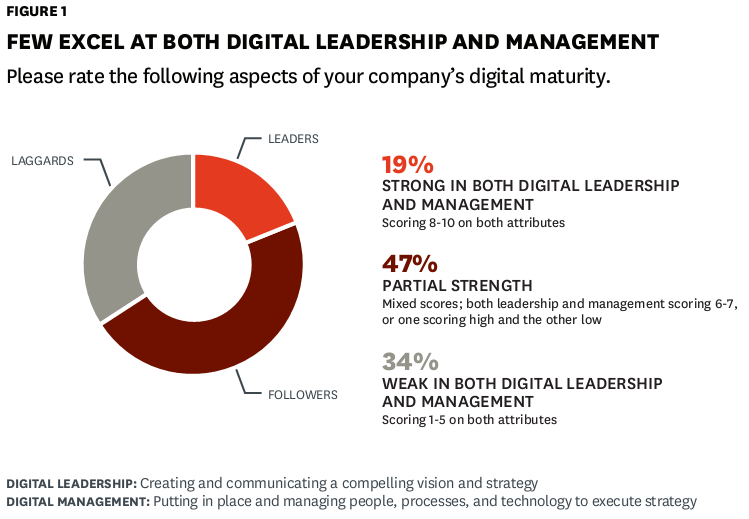
The HBR survey found that companies that rate highly in both digital leadership and management have better business results than their peers, with stronger revenue growth and greater profit margins.
Just under a fifth of survey respondents fell into this early-adopter or “Digital Leader” category, while over a third were deemed to be “Laggards” – i.e. an organization that’s weak in both digital leadership and management. Moreover, nearly half of the survey respondents had mixed scores and were rated as “Followers.”
What set the leaders apart from their peer group, in laggard or follower organizations? These proactive CIOs help their business colleagues to understand which digital knowledge and skills need to reside in their function, and which they can defer to the IT support team. The CIOs and their staff typically communicate in language that makes sense to a Line of Business (LoB) leader that’s focused on achieving outcomes.
Early in my DevOps Journey, I was introduced to a book of great significance circulating within the Web Operations industry titled The Phoenix Project. (You can read our review of Gene’s book, if interested.) Written as a novel and loosely based on many of the same principles explored in The Goal, this book has been read and referenced by many who have adopted DevOps into their continuous improvement and software delivery processes around the world. As I began planning my travel schedule last summer, I learned of a workshop taking place in Nashville by Gene Kim, co-author of The Phoenix Project. I jumped at the chance to not only meet and speak with Gene, but absorb as much as possible from his workshop.
There are many parallels to Google’s move to set up Alphabet as a holding company to remain at the forefront of innovation and what is required by all companies to foster innovation in the age of the Cloud and IoT. No one will argue that Alphabet was a change Google needed to make to remain relevant, fresh and innovative across a number of product initiatives. Under the Alphabet structure, Google provides operating divisions with the freedom and accountability for making decisions all while being nimble and quick on their feet. And perhaps most importantly, keeping their most creative people engaged and well…creative and not stifled by red tape and bureaucracy.
A few weeks back, I wrote a post about getting ready to address a coworker's bad code. This sparked some conversation across various media, including the following interesting question: ...seems that there is a breakdown in managing the development process. Why is Bob allowed [to keep] writing bad code? This feedback is interesting enough to merit a blog post in and of itself. I recognize a question that cuts to the heart of a software development conundrum when I see it. The structure of most organizations that employ software developers is this: the developers responsible for code report up through a structure of people that don't. To put it another way, the people responsible for personnel management usually don't understand how to evaluate the work of those reporting to them - at least not directly.
The evolution of IT operations is upon us. There has been a lot of change in both direction and momentum over the last several years, and at this point, it is not hard to see the future of Ops. Perhaps, having worked for a networking firm and a server automation firm, it is easier to see than for the average operations person, so let’s just take a look at the burgeoning ops trends and technologies and see where they ultimately lead us…
I am not sure how many people remember Cisco SANTap. About ten years ago, Cisco introduced a data tapping mechanism in the MDS 9000 fibre channel switches. The idea was to allow the data path to be “tapped” at-will. Tapping in this case meant using a mechanism in the switch to split the data being written from client hosts to the storage, allowing the identical “split” data to be routed through a second, separate path. SANTap therefore allowed a copy of the data to be seamlessly “mirrored” through the switch and subsequently used by other applications for multiple purposes (especially for backup). It facilitated real-time protection of critical data, and allowed advanced functions such as migration, snapshots, etc.
What does “big enough” mean? It’s sometimes useful to argue by reductio ad absurdum. Hello, world doesn’t need to be broken down into smaller services. At the other extreme, building a monolithic enterprise resource planning (ERP) system is just asking for trouble: it’s too big, and it needs to be decomposed.
Over the last few years we’ve seen just about every part of the data centre move towards virtualization and software. First we virtualized desktops, then storage, then even our security tools. So when the idea of Software Defined Networking (SDN) started being floated around, it wasn’t a big surprise. But what exactly is it?
SYS-CON Events announced today that DataClear Inc. will exhibit at the 17th International Cloud Expo®, which will take place on November 3–5, 2015, at the Santa Clara Convention Center in Santa Clara, CA. The DataClear ‘BlackBox’ is the only solution that moves your PC, browsing and data out of the United States and away from prying (and spying) eyes. Its solution automatically builds you a clean, on-demand, virus free, new virtual cloud based PC outside of the United States, and wipes it clean, destroying it completely when you log out. If you wish to store your data, the solution will include a custom data encryption system with multiple factor authentication. DataClear also provides a corporate solution for multiple networked users and secure cloud based servers.
One of the perennial cloud predictions has been that 200x would be the year of the Platform as a Service (PaaS) cloud. The logic goes that if an automated data center in the sky is good, an automated development platform in the sky must be even better. “Normal” clouds like Amazon AWS give the developer a virtual computer to load their OS and App onto. PaaS gives the developer a virtual computer with the OS, database and middleware “pre-loaded,” thereby simplifying the deployment. Yet so far, PaaS adoption has been anemic and Gartner puts PaaS at 1% of the overall cloud market. At the same time, new technologies like Docker and containers have attracted far more attention from the developer community.
Aristotle (384 – 322 BC) is credited as the first person to classify our five sense organs: sight, smell, taste, touch, and hearing and Immanuel Kant, a famous philosopher from the 1700s said that our knowledge of the outside world depends on our modes of perception. Our highly developed organs of the eyes, ears, nose, tongue and the skin on your hand provide the sensing equipment necessary to send that information to the brain. In some cases, one of the sensors might not work properly in the case of the blind or deaf, yet the four other senses are heightened and exceed normal operation to make up for the missing information. Daniel Kish, for example, uses echolocation like a bat to see the imprint of the sound waves as they bounce back. Pretty cool, eh?
The Internet of Things (IoT) is about the digitization of physical assets including sensors, devices, machines, gateways, and the network. It creates possibilities for significant value creation and new revenue generating business models via data democratization and ubiquitous analytics across IoT networks. The explosion of data in all forms in IoT requires a more robust and broader lens in order to enable smarter timely actions and better outcomes. Business operations become the key driver of IoT applications and projects. Business operations, IT, and data scientists need advanced analytics tools incorporating predictive analytics, prescriptive analytics, and machine learning for rapid development and innovation to divine timely value out of IoT networks.
DevOps has traditionally played important roles in development and IT operations, but the practice is quickly becoming core to other business functions such as customer success, business intelligence, and marketing analytics. Modern marketers today are driven by data and rely on many different analytics tools. They need DevOps engineers in general and server log data specifically to do their jobs well. Here’s why: Server log files contain the only data that is completely full and accurate in the context of how search engines such as Google are crawling websites. If a search engine spider encounters an error and does not load a page, the webmaster does not know because traditional traffic analytics tools such as Google Analytics do not track those issues. Log file data, on the other hand, does reveals what problems bots are encountering on a website – and many of those issues can hurt a site’s appearance and rankings in Google.
Organizations from small to large are increasingly adopting cloud solutions to deliver essential business services at a much lower cost. According to cyber security experts, the frequency and severity of cyber-attacks are on the rise, causing alarm to businesses and customers across a variety of industries. To defend against exploits like these, a company must adopt a comprehensive security defense strategy that is designed for their business. In 2015, organizations such as United Airlines, Sony Corp, Anthem and the Office of Personnel Management experienced data breaches through malware and other targeted attacks. How will your business adapt to this shift in technology while keeping its security posture?
Developers are – despite their attention to what is considered a very logic-based field of study – a very creative group. Give them a hurdle to overcome and they will. The problem, of course, is not that they’ve solved a problem, it’s that in doing so they’ve likely created a source of technical debt that will, over time, become problematic. In fact, technical debt is a significant focus of the Agile methodology and is flows (quite naturally) into DevOps. That’s good, because technical debt, like real debt, compounds over time and can put a significant damper on future growth and success.
Brands are more than the sum of their brand elements – logos, colors, shapes, and the like. Brands are promises. Promises from a company to its customers that its products will deliver the value and experience customers expect. Today, digital is transforming enterprises across numerous industries. As companies become software-driven organizations, their brands transform into digital brands. But if brands are promises, then what do digital brands promise – and how do those promises differ from traditional, non-digital brands?
With the proliferation of connected devices underpinning new Internet of Things systems, Brandon Schulz, Director of Luxoft IoT – Retail, will be looking at the transformation of the retail customer experience in brick and mortar stores in his session at @ThingsExpo. Questions he will address include: Will beacons drop to the wayside like QR codes, or be a proximity-based profit driver? How will the customer experience change in stores of all types when everything can be instrumented and analyzed? As an area of investment, how might a retail company move towards an innovation methodology to bring new IoT solutions to market?
In 2011 the US Federal Government issued a Cloud First policy mandating that agencies take full advantage of cloud computing benefits to maximize capacity utilization, improve IT flexibility and responsiveness, and minimize cost. Cloud computing is a design style that allows for efficient use of compute, storage, and memory in order to decrease cycle time for mission delivery and promises to change the way that agencies deliver services to citizens for the next twenty years. Roger Hockenberry, CEO of Cognitio and former CTO for the National Clandestine Services of the Central Intelligence Agency, helped create and realize the potential of cloud capabilities for the Intelligence Community. Getting the Intelligence Community to accept Cloud computing as a viable platform was a difficult road to travel. This interview with Roger offers some thoughts and suggestions for a successful Cloud journey: