
Having just returned from the Handheld Learning Festival I thought I would share some thoughts about what I saw and what we brought to the festival.
There was a range of thought provoking and interesting speakers from Professor James Paul Gee, author of “What Video Games Have to Teach Us About Learning and Literacy”(2003) and “Good Video Games and Good Learning: Collected Essays” (2007)
Through personal reflections on education by Zenna Atkins, the Non-Executive Chairman of Ofsted, to Malcolm McLaren, artist and pop culture icon, as well as a host of others.
As well as these keynotes I also managed to hear John Davitt talk of the tools and technology available to teachers and his desire that we use these tools more productively. I was also delighted to see Tim Rylands, he of MYST fame, show work he has been undertaking with children using Wild Earth:African Safari.
Perhaps the highlight, for me anyway, was to be involved with the Spotlight Scotland Breakout, hosted by Learning and Teaching Scotland. It was standing room only for a series of 30 minute bursts of great practice and innovation in Scottish Education. Katie Barrowman gave a great presentation on GLOW which highlighted GLOW meet and the power of sharing, Derek Robertson introduced CANVAS (Children’s Art at the National Virtual Arena of Scotland) to the appreciative audience. My presentation was on the work undertaken by children in Clackmannan Primary and their teacher Morag Clark. You can watch a version of this below.
After a short break Lisa Sorbie from Perth High School showcased work an S1 class had undertaken with Hotel Dusk:Room 215, some great writing in the noir genre. Anna Rossvoll from Aberdeenshire showed the power of GLOW meet and Wii music introducing, live, a class from Peterhead who spoke to and performed for the audience in London. Ollie Bray concluded the session with a great presentation on the power of free tools for teachers. You can click this link for more on Ollie’s presentation.
New to the post!
A quick introduction; I am Brian McLaren and I am the new Consolarium Development Officer. Three weeks into the job and my head is beginning to stop spinning. I am amazed by the energy and application of everyone I have met so far and I am really looking forward to supporting and sharing the good practice going on in schools.
I am currently looking into the potential of a number of games for classroom use including “Little Big Planet” for PS3, “Wild Earth African Safari” and “SimAnimals” for Wii.
If you have any experience of using these games in your class or are keen to do so please feel free to contact me. I am also keen to hear of your experiences using Games Based Learning in your class and would love to see some pics of your success.
My email is B.McLaren@LTScotland.org.uk
As part of the ongoing remit to explore emerging technologies and their potential application within teaching and learning contexts Learning and Teaching Scotland’s Consolarium has been exploring Virtual Worlds. Virtual Worlds present players/learners with a computer-based simulated environment intended for its players/learners to inhabit and interact via avatars. The most famous virtual worlds would include World of Warcraft and Second Life. Although World of Warcraft is of great interest to us we are not yet looking at this due to reasons that include the time required to spend ‘in-world’ and the unprotected nature of the environment in terms of knowing who is engaging with young learners. However, the world of Second Life has been of interest to us and this is an area that we have been considering. Our ongoing discussions with various industry partners led to a meeting with an Aberdeen based company called Second Places. They make bespoke virtual worlds for clients and have worked with organisations as varied as BP, The Royal Liverpool Philharmonic Orchestra, and even the comedian Jimmy Carr! Discussions between us led to the germ of an idea that would make the concept of the virtual world in relation to teaching and learning something that would be attainable, accessible and relevant in the modern Scottish classroom. This idea is CANVAS. (Full presentation of CANVAS’ design and planned implementation will be available at a seminar at SLF’09 & HHL’09)
What is CANVAS?
In essence CANVAS (Children’s Art at the National Virtual Arena of Scotland) is a virtual art space where Scottish pupils can exhibit their still or moving image art. Access to CANVAS will be through Glow (full Shibboleth Authentication) and with this comes the opportunity to exhibit pupils’ work, in a safer and securer environment, to the huge audience of pupils and teachers throughout Scotland. Not only will pupils be able to exhibit their work but they also will be able to appear in-world, represented by a virtual character called an avatar, so that they can talk via a chat facility to gallery visitors who come to visit and view the art works on show in CANVAS. We believe that the participative nature of the design will offer a context in which young learners experiences, thoughts and understanding of their own work and development can be enriched and enhanced by the proposed opportunity for dialogue and discussion that the world offers. The exhibiting pupils will not be able to appear in world all the time so we have also built in the functionality that would allow the artist to record and embed a short video that can be played by gallery visitors when learners/artists are not in-world. This in itself is also another rich learning experience in terms of ICT but also in relation to the drafting and recording of a focused and succinct piece that would tell the viewer all about the artist’s work. To further add to this collaborative environment is the function that enables gallery visitors to leave formative comment about their experience and what they have thought about the art that is on show. Each separate artist will have their own forum where comments can be left for them to consider and reflect on.
What is the technology that is used?
Although the world looks and feels like Second Life it is actually made using an application called Open Sim. This has allowed us to create our own bespoke virtual world that can be hosted on our servers so that we have full control over whom we allow in to view and interact in the world. In order to view the world there are some technical issues that need to addressed. These include
• some ports require to be opened in firewalls before schools can access the world. Local Authority partners have been very helpful in addressing this issue so that the integrity of their networks is not compromised
• A CANVAS client will require to be installed locally to any machine that will be used to view the world. Again, we are working with Local Authority partners in order to find solutions for the delivery of this resource across managed networks
• Quicktime must be installed on any machine to be used to view CANVAS (in order to view videos within the world)
It seems that innovation does not come without its challenges and this project has certainly not found itself short on challenges. We would like to comment on the dedication and ‘stickability’ of Second Places and in particular Mark Duffy who has faced a series of what appeared to be never-ending hilltops! We are almost at the top!
What is the role of local Authorities in making CANVAS work?
Initially the idea behind CANVAS involved the use of only one exhibition space. This space would allow a local authority to exhibit pupils’ work for a three-week period. However, this would have meant that some local authorities would need to wait almost three years before they could participate and showcase pupils’ work from their schools. This was not acceptable to us. Further discussions led to the extension of the world so that there were 32 separate rooms so that all local authorities can choose to maintain and refresh their own gallery in a manageable way. The refresh timescale of the exhibition is down to each local authority. There is also some discussion still to be had in relation to what each gallery would exhibit. We are leaving this open to local authorities so that they may choose to have something along the lines of:
• an exhibition that focuses on a particular theme
• a focus on a school to showcase their pupil’s work
• best of Secondary
• best of Primary/Nursery
• a moving image special
• a focus on a particular style such as Impressionism, modern art, portraiture
We still have the main exhibition space but we are currently in discussion about the role that this will play in the future. Should we make this somewhere that displays the work from a selected local authority as first envisaged or should it exhibit a monthly selection of art from the 32 local authority galleries? Might this main exhibition space showcase art of a particular theme from schools across Scotland or can it also show art from galleries not connected with school or maybe even art teachers work? These are questions that we are currently discussing but at this stage we still envisage using this main space to showcase pupil art from selected local authorities.
Management of the CANVAS environment has been made as accessible as possible for users. We aim to give ‘god’ accounts to the people within each local authority who would be willing/responsible to manage the collation of the artwork and the subsequent uploading of this to CANVAS. They will also need to work with the exhibiting schools/pupils in order to arrange times when the pupil will be available to be ‘in-world’ so that they can interact and engage with visitors to the gallery. LTS are more than willing to support local authorities in the use of CANVAS so that they can take ownership of it at as early a stage as possible.
There will also be some requirement to moderate the comments that are submitted to the formative forum. We do hope that this will not be too onerous a task and as we know the identity of everyone in the world is (via the Shibboleth authentication) then we can trace any inappropriate comment, delete it and then, if appropriate, suspend the offending person from the world. This is an issue that may cause us the occasional headache but we believe that we have the mechanisms in place to address it if it does arise.
Taking this forward
We understand that there are have been some unfortunate stories linked with Second Life over the past year or so. We wish to stress that we are not using Second Life but an application called Open Sim that has enabled us to create out own world that we have complete control over in terms of who can access it. We would also like to stress that this project has been carefully considered with CfE and AifL clearly in mind and has been developed in conjunction with a range of ICT, Expressive Arts, AifL and school partners. It has the potential to be a significant resource and is another example of how we are exploring emerging technologies that have become embedded, for good or bad in contemporary culture, but with a clear focus on teaching and learning. Finally, CANVAS has such a low technology skills threshold that we believe that it will enable the vast majority of teachers to use it without any fear of its technical aspect.
We believe that CANVAS has the potential to be a transformational resource and that it will enrich learning in art & design for Scottish pupils
If you are thinking of getting your schools pupils involved in the LTS does Dragons’ Den event at SLF’09 this year then maybe this promotional poster will help promote interest in the exciting opportunity and challenge faced by pupils and encourage them to get their creative juices flowing.
We are very lucky this year to have three Dragons from the Scottish Games Industry to sit on the panel . These are:
Chris van Der Kuyl of Brightsolid
Colin Macdonald of Realtime Worlds
Denki have kindly offered a visit to their games design studios in Dundee as a prize for the winning entry/presentation.
Full details of the competition can be accessed from this post from the summer term.
Get the guitars and the drums of Guitar Hero World Tour at the ready and get those scores in for this year’s Guitar Hero Challenge SLF’09! Full details of the competition can be accessed from this blog post from the summer term and as you can see we now have our leaderboard ready and waiting to be filled with the highest scores possible.
There is a choice of songs this year and each song has its own icon to identify it:
Teacher validated scores should be sent to the consolarium@ltscotland.org.uk and these scores will be added to the leaderboard as soon as they come in.
Make sure your band name is something to behold and good luck. Your GH band might make it to the stage in Glasgow for the final showdown.
There are still a couple of kits available for any schools that may want to participate. Again, drop a line to consolarium@ltscotland.org.uk if you think your pupils have what it takes…
Please remember that the closing date for the competition is Friday 11th September.
I was delighted to have the opportunity to return to Lairdsland Primary School on June 23rd to see how Cooking Mama:World Kitchen had developed as a project in P3/4 with class teacher Catriona Calvert. I was enchanted and excited by what I saw and heard – quality learning, enthusiastic and confident children completely absorbed in the world of international food and cuisine!
Catriona explained to me that the project had started by choosing four countries; these were chosen to reflect the nationalities of families in the school. The children had then researched these countries and created a fact file. This had given them the opportunity to extend their geographical vocabulary and knowledge of sense of place.
Many contexts and opportunities for writing were facilitated by the game. These included writing biographies for imaginary chefs that were brought to life using Crazy Talk, booklets about the equipment used in the kitchen, instructions for making a chef’s hat and apron and menus for use in the Lairdsland Café (a role play area in the classroom where e.g. goods were priced and recipes costed out).
The class had collaborated to create a ‘Foods of the World’ recipe book and made a profit of £300! The children had written letters to parents appealing for recipes, they word processed the recipes, advertised the book and coordinated the sales including handling the money and keeping accounts. Catriona explained that the preparation of the book had heightened the children’s awareness of different cooking methods, the variety of foodstuffs and different cultures.
Health Week in the school had provided an opportunity for cross sector working – staff and pupils from Lenzie Academy had come and worked with the class and cooked ‘Tortilla Wraps’ with the children. I had the pleasure of being present at the first screening of the ‘cookery shows’ that the children had made with the help of pupils from P6. This process had involved writing a script, identifying props, accurately weighing and measuring ingredients and adopting the role of chef and presenter in front of the camera. The films had been edited by the P6 pupils and the results were fantastic! Everyone was given a copy to take home as a memento and to share with their families.
The visiting art teacher had explored working with different media with the children, a classroom assistant from Poland had talked to the class about her home country and what it was like to live there and the portraits of celebrity chefs were amazing! Children handled money confidently as they worked through shopping lists and easily navigated their way around the internet as they searched for information about their favourite foods and recipes.
I had a wonderful time in P3/4 at Lairdsland Primary school – I saw rich cross curricular learning, facilitated by creative and innovative teacher Catriona Calvert resulting in motivated, enthusiastic and confident children! Cooking Mama:World Kitchen – obviously a recipe for great learning!
I love watching the Grand Prix so it will be no surprise to learn I also love Mario Kart for the Wii. I could see an opportunity here for a great context for learning so I was delighted that Head Teacher, Gillian Penny at Gavinburn Primary School could also see the potential and was happy to trial it for me with a P5 class.
I visited on June 18th and class teacher Lorna McNicol had done a great job. The P5 classroom was festooned with pieces of writing, maths and art work all arising out of the context facilitated by Mario Kart. When I arrived the children were busy rehearsing advertisements about an up and coming racing championship. Later on these were captured on the computer complete with sound effects and music, ready to be burnt to CD to take home as a memento of the project, all done with the help of a P7 tutor. Nice to see ICT permeating through the learning!
The children had been organised into seven kart teams of four. The teams competed on Mario Kart and a championship had been created out of that. All the teams had names – Killer Karts, Wheels on Fire, Mega Mushrooms – and everyone had their own name badge. Team logos and pod stickers for their karts had also been designed.
Writing: Each kart team comprised a driver, a mechanic, a press agent and a manager and they had written biographies about imaginary characters who are drivers, mechanics etc. The children had interviewed each other in role as their imaginary characters and produced an account of that interview. They had drafted letters to a company asking for sponsorship and had also written reports about an accident at the race track. Lorna explained that drama had been used where ever possible to help with the writing process. She said that it had really helped the boys in particular to be immersed in this imaginary world with the visual aspect of the game helping them with a starting point for writing activities. One boy said, “ I don’t like writing but I liked writing The Accident Report. We had pictures of a racing car accident and imagined that we were there and of course we have crashes when we play Mario Kart!”
Maths: Problem solving in maths fitted easily into this context with opportunities to calculate fuel consumption, speed and costs. The children had looked at decimal places for lap timing using a model race track and had also investigated the cost of flights and accommodation to visit a Grand Prix location.
Art and Design: Logos had been designed, karts made from junk material, suits designed for racing drivers and a crowd scene witnessing the crash had been created.
Next week, the plan was to focus on Science and some of the science teachers from the secondary school were coming to get involved in the investigation of friction, air resistance, stream lining and water and fire proof materials in the classroom. Great – and an opportunity for cross sector working too!!
Lorna is a probationary teacher and this is her first experience of games – based learning and she has been delighted with the enthusiasm and motivation that the children have shown. The children were obviously still motivated, energetic and excited and were producing work of high quality – and there was only a week to go before the holidays!! Lorna has been enthusiastically sharing her experiences with other probationary teachers which is great news.
Much more had been planned for the project, but the end of term was looming. Drama, music, animation, web design and a trip to a kart track will all be on the agenda next time they run the project….(and Gillian says they will definitely be doing it again….!)

Rock and Roll is returning to the Scottish Learning Festival this year so be prepared to turn those speakers up to eleven once again with the return of the Scottish Schools Guitar Hero Challenge! The standard of competition last year was extremely high with David Whyte from Baldragon Academy in Dundee outperforming all comers to take the title. If you think that your pupils have the potential to win this then get involved in this year’s Game Zone Challenge at SLF’09. All you need is one of the following: a PS3, XBox360 or Nintendo Wii along with a copy of Guitar Hero World Tour (with an extra guitar).
This year’s competition is different in the sense that we are not looking for individual entrants but groups of players who will form a band to play the instruments in Guitar Hero World Tour. This would mean a drummer, guitarist, bassist and vocalist!
This year we are offering a choice of songs as opposed to just one. The songs that you can choose from are as follows:
You can open all the songs in the game by going in to the Cheats option and keying in the following combination Blue, Blue, Red, Green(2), Blue(2), Yellow
Scores that are achieved by bands should be validated by validated by their teacher and emailed to consolarium@ltscotland.org.uk and we will then upload these to the leaderboard. Schools can enter as many bands as they like. The closing date for submissions to the competition is Friday 11th September with the successful contestants being notified by Monday 14th September. Travel costs will be covered by LTS. This event will take place at the SLF’09 on Wednesday 23 September, 4:00pm.
Last year’s event was a great success and we hope that this year’s event will at least match if not better it. Who knows, we might even see this year’s finalists really going for it and coming ‘dressed for the event’. We’ll leave that idea up to you…
We have established a Guitar Hero Glow Group for schools to share the associated curricular work that can go on around a game such as a Guitar Hero but if your school is not yet in Glow don’t worry you can still participate by sending your high scores to the earlier stated email address and we’ll ensure that they are added to the leaderboard.
We have a small number of kits that we can loan to those who don’t have access to the game and the console so please contact us if you have are interested in this or if you have any other questions related to the competition
Have you got a good idea for a computer game?
Do you have an idea for a computer game that might be the next worldwide smash hit or do you have an idea for a character that could capture the imagination of game players across the globe?
If so, then this year’s LTS does Dragons’ Den competition at The Scottish Learning Festival could be just the opportunity for you to showcase your imagination and ideas to a panel of professional experts from the Scottish computer games industry.
What we are inviting school pupils to do is to devise a concept for a computer game that they will be pitched to the Dragon’s. The time that you will have for your pitch is 10 minutes. The content of your presentation can take any form that you decide but we suggest five areas that you may like you to give consideration to. These are:
* Please note: if you and your team have made a game or have built any associated aspects of your game then please do include this.
Who is the competition open to?
The competition is open to boys and girls from the ages of 3-18
What is the maximum team size?
The maximum numbers of team members is four
Who are the Dragons?
The full and final line-up of Dragons has yet to be confirmed.
What form will the event at SLF’09 take?
The pre-event judging will select four teams to present at SLF’09. At the event each team will be given 10 minutes to make their pitch with 5 minutes questions and feedback from the Dragons. The Dragons will be given a few minutes at the end to decide on which entry they felt proved to be the most innovative and appealing for a games design company.
What presentation facilities are available at SLF ’09
A PC with Powerpoint and a Mac with Keynote will be available to present. We will try, where possible, to accommodate all presentation requirements
Submitting an entry
Entries to the pre-judging aspect of this competition can be sent to consolarium@ltscotland.org.uk. A detailed submission is welcome but contestants must realise that any detailed submissions need to be summarised and delivered in the 10 minute pitch that they have to the Dragons. The closing date for submissions to the competition is Friday 11th September with the successful contestants being notified by Monday 14th September.
We ask that competition entries are submitted by a teacher who has been working with the pupils involved.
Travel arrangements
LTS will cover the cost of travel to and from SLF’09 for all the finalists.
Is there a prize?
Yes, more details to follow…
A day this week at Lairdsland Primary School surrounded by engaged and motivated children and creative and enthusiastic teachers was a real privilege and a pleasure.
I had been invited to visit Fiona Angus and her P4/5 class who have been using the Nintendo Wii game Endless Ocean as a contextual hub for cross curricular learning. Endless Ocean is a game in which the player explores the ocean and swims on a coral reef, interacting with a huge variety of sea creatures.
The children have been keeping diving diaries about what they find whilst exploring the ocean in the game, producing tourist guides, creating newspaper reports about discoveries on the reef, researching the animals they find, exploring many different media in art and design in producing art work of different kinds of marine animals and inventing their own exotic sea creatures. During my visit, we brought some of these creatures to life using CrazyTalk which allows a digital image to be animated and a voice added. The children were keen to share their writing with each other in this way (even those who were usually quiet and reserved!) and had been rehearsing some great accents! What wonderful ideas they had for their creatures and what fun! Children are bringing things in from home connected to what they are doing in school and are keen to continue with their activities even when the bell rings for break time or lunch time!
Fiona is using the Endless Ocean project as a starting point for a study of Australia and the children hope to have the opportunity to ask questions and to exchange ideas with visitors from Australia next month. Endless Ocean has already proved to be a great resource for creating a rich context for learning and has done it again at Lairdsland.
I also had a chance to talk to Vicky Mackenzie and Fiona Morrison about their Guitar Hero World Tour project currently running in P7 and P6/7. They have replicated a lot of what has been highlighted as good practice with this resource but this year the topic has the title ‘Making it BIG in the USA’. The idea is that the children are members of a successful UK band and they are now trying to break into the American market. The children are going on a tour of America and are responsible for budgeting and managing their own tour.
The children have their ‘Making it BIG in the USA’ glow group. This group contains these sections:
Notice board - used to target news such as promotions on hotel rooms, deadlines for budgets etc
Classified Ads - this will be used to advertise for staff (such as security) and will also be used to advertise band merchandise (which they have designed), to raise funds.
Band Banter - this is a discussion page where the class teachers will set questions that the children must respond to in the style of their band.
Useful Websites - this has been categorised into Travel, Accommodation, Restaurant and General Websites. The children will use these when booking their flights to the USA and between states, finding appropriate places to stay etc.
Band Budgets - this is for the children to store their Band Budgets. These are excel spreadsheets that the children are creating throughout the topic. They will keep a record of everything that they have spent and earned. At the end of the topic the band with the most money in their account will be awarded a prize. A good way to use the context for learning about currency conversion and financial education and a great way to use Glow!
My last stop was the P3/4 classroom where class teacher, Catriona Calvert, is using Nintendo’s Cooking Mama World Kitchen as a starting point for another interdisciplinary project. I was shown the chefs’ hats that the children have made and the instructions that they wrote for that process. They have researched countries and have made fact files, they have written menus and are in the process of setting up a restaurant in the classroom for role play. They have just completed a really successful enterprise project in which they wrote, produced and sold their own cookery book, selling over fifty copies on the first day! I have been promised photographs and examples of the children’s work as the project develops which I can’t wait to see. Well done Vicky and Catriona for spotting the potential of the game for classroom use!
What a great day!
A few weeks back I was up at Fraserburgh South Park PS because of visit from the BBC Newsround team who were interested in doing an article about the Dr Kawashima work that we did. I met a propbationer teacher called Jo Barcas Buchan and got to see what she had been doing with Nintendogs in her P.2 class.
It was great to see that Jo has written about her experience with this games based learning approach on the GTCS probationerscotland.org.uk site.
Great to see you sharing your experience Jo and hopefully other probationers may learn from what you have done.
Ollie Bray, depute headteacher of Musselbrough Grammar School, East Lothian, took first place in the Innovation in Community section for his presentation of ‘Thinking out of the XBOX’ at the Innovative Teachers Forum 2009 in Vienna. He is currently on secondment to Learning and Teaching Scotland as a National Adviser for Emerging Technologies in Learning.
Inspired by a project initiated by Learning and Teaching Scotland’s Consolarium initiative he organised an extension of this innovative idea and organised a transition project for the associate Primary schools of Musselburgh GS using Guitar Hero. This approach proved to be a great success and the Guitar Hero transition project will now be rolled out across East Lothian schools within weeks. Schools all over Scotland are already using this resource. Schools in England and even as far afield as Hong Kong and Australia, are interested in the project. Mr Bray devised a three-step process of ‘learning, social interaction and reflection and moving on’ as children change.
The Scotsman article: Teacher who inspires pupils with rock ‘n’ roll wins top award
Merlin John’s blog: Ollie Bray takes gaming to international stage
Ollie Bray’s blog: Microsoft 2009 European Innovative Teachers Forum
Being involved with and leading the games based learning initiatives with the Consolarium is great fun but it is also a great experience in terms of meeting teachers who take some of our ideas forward and then really make the realisation of such projects their own. We are finding that in doing so, these teachers are setting the standard for the use of some of the games. Names that immediately spring to mind in this regard include Kim Aplin and subsequently Ollie Bray with Guitar Hero and Anna Rossvoll, Ruth McDonald and Michelle Law with Nintendogs as well as many others who have taken this on and extended the practice of the appropriate integration of computer games into teaching and learning. I’d now like to add another name to this list and introduce Margaret Young to everyone. A teacher at Port of Mentieth PS near Stirling Margaret has been using Moshi Monsters with her P.1 - P.3 class. I wrote about Moshi Monsters a wee while back due to my interest being stirred when I watched my wee girls using it last summer. It reminded me of Nintendogs in the way it replicated much of what that game does in terms of looking after a virtual creature: ensuring it was healthy and happy as well as managing a budget. However, Moshi Monsters has problem solving, early literacy and numeracy tasks all embedded into the game play as well as the facility to introduce social networking to children via a friends finder and a noticeboard. However, this game was freely available (although an enhanced experience via subscription is now on offer) and can be used by anyone that has an computer with an internet connection.
I have been working on ways in which we could try an extended pilot for Moshi Monsters but while I have been doing that Margaret Cassidy, ICT Development Officer in Stirling decided to try it out with one of her teachers. She introduced the idea to Margaret Young at Port of Menteith PS and since the initial presentation of the idea the most fantastic set of associated rich learning tasks has just flourished.
I had the great pleasure of visiting the class last Wednesday morning and within 5 minutes I was captivated and enchanted by what I was seeing and hearing and I found myself like a child in a sweet-shop in terms of not knowing where to look in terms of the quality learning that was happening.
I had a discussion with Margaret about how she got involved in the project, how she managed it and what added value she feels it has brought to learning in her class and to her continuing professional development.
The game at the heart of the learning experience
The most prevalent method that we employ in our Consolarium initiatives usually involves the game becoming the contextual hub about which learning experiences are planned for and presented to the children. This gives the teacher the freedom and flexibility to combine curricular areas and present learning tasks via the creation of a collaborative story or a process of enquiry. The flexibility of such an approach allows the teacher to accommodate any ideas and questions that come from the children as a result of their experiences and interests arising from the learning tasks. This is exactly what Margaret has done with Moshi. as from the following examples you will see that the game really became the beating heart of the rich learning in the class.
Writing
Very many contexts for writing were facilitated by the game. These included writing adverts to sell your Moshi Monster’s house, writing to explain the desing of flags made to represent Monstro City as well as news flashes about what has been happening in Monstro City itself. I was particularly impressed by the idea of making a tourist information leaflet for visitors to refer to if they were planning a visit to Monstro City. Have a look at how the teacher did this:
…and have a look at some their adverts:
Talking and listening
An engaging debate was cultivated in the classroom when the question of whether or not the children should allow new building work to be permitted on Flutterby Fields: a beautiful fun place to be in Monstro City. The teacher talked about the development of the children’s thinking and their ability to consider and reflect on opposing points of view in this task and even how some children changed their minds as a result of the discussions and arguments put forward by their peers.
Encouraging problem solving in maths
In order to function in the game you must visit the Hall of Puzzles. This is packed full of puzzles that engagement with rewards you with Rox, the currency in Monstro City. The more Rox you have then the more you can spend in the various shops that you can visit. The puzzles are particularly engaging and the children were all very keen to tell me what their high scores were at many of the different puzzle that are available. The teacher has worked with the children to set up the Hall of Puzzles in the class. This became a really appealing ‘den’ in the classroom for the children to visit and explore a range of puzzles and games with each other. Have a look at how this was done:
Design and Technology
The children were asked to think about what kind of shops should be in Monstro City. These ideas were then brought to reality as the children made their own models of their shops from card, paper and other materials. Have a look:
Animation
Children are naturally creative. They have ideas. One of the superb aspects of learning with ICT is that it gives young learners the vehicle through which they can express their creativity and ideas and in doing so develop their ICT skills set. They can also have a positive impact on planning, presentation and awareness of audience. Here we have one example of a stop motion animation created by two 6 year old children. Just look at what they can do….
They also used Crazy Talk to bring to life their Monster characters that had been created in Art & Design.
All of these videos can be viewed at our Consolarium Blip TV channel.
Keeping connected and being safe
One of the benefits of using this resource is that children can keep connected. One child in this class spends six months of the year in Scotland and six months in New Zealand. Currently in her antipodean abode she can keep in touch with the class via her noticeboard. As Moshi Monsters is freely available to anyone (see their safety policy) there is an issue in terms of ensuring that the children are not exposed to any inappropriate contact. The teacher and the class decided to use a special code for the duration of the project and this meant that they could only accept a friend request if this code was in the name of the person requesting to make friends. This meant that the community was kept to the classroom and any worries about unknown people becoming involved with the children in the classroom context were fully addressed.
There has been some concern about children wanting to play with their Moshi Monster for far too long at home. Incentives to jump up the levels and to ensure that your Monster is happy and healthy in the game play need to be maintained and balanced in terms of appropriate time spent on the game. Lessons need to be learned about what the Consolarium can do to ensure that parents are fully informed about such initiatives, what benefits they can bring to their child’s learning but also what the school and the home need to do to ensure that children understand that too much of one thing is not necessarily good for them. Everything in moderation is a lesson that we can help children learn.
Maybe Moshi Monsters also need to consider ways in which children can withdraw from the game for periods of time without their lack of engagement with their monster leading to its demise! Something akin to the ‘dog hotel’ in Nintendogs wouldn’t go amiss here.
A delightful time at Port of Menteith was most certainly had by me. Rich learning, happy and motivated children, innovative teachers and a Headteacher willing to allow informed risks with new ideas and approaches in the use of ICT and games, in this example, to happen in his school.
Superb stuff and very many thanks to all at Port of Mentieth PS and Stirling Council for enabling such innovative work to take place. Now, how do I make an extended study of this work….?
Hello, I’m Kim Aplin. I’ve been working in the Consolarium with Derek Robertson since January. I was interested to read in The Times today that Scottish children are falling behind in science because they see science as ‘uncool’. Well this certainly was not the case at Meldrum School last week where children had been investigating friction and gravity and excited by their learning!…..
Kororinpa at Meldrum School: The project is now in full swing in P5. I was very pleased to see how enthusiastic and excited the children and their teacher, Hazel Sim, were about their whole learning experience. The work that had been done with the game involved the investigation of friction and the designing of the class marble run. The game had been used to analyze what they could incorporate into their designs for their marble runs. The class have worked together to create a wall mounted run that they are immensely proud of.
There had been a thorough investigation into friction with a consideration of where friction is helpful and unhelpful. One of the children suggested that making rubbings of the soles of shoes would allow them to study the patterns closely and then they could work out how the patterns related to friction and whether a shoe was ‘fit for purpose’ – an investigation suggested by the children with a real objective!
Hazel reported that the project has resulted in an excellent ethos in the classroom. The children are hooked into the learning and some in particular have displayed a real progress in developing their practical problem solving skills that they are now transferring into other curricular areas.The children are also planning and writing stories about their own marble characters and they are creating animated PowerPoint presentations of their stories so that they can be shared easily with younger children. The characters are displayed on the wall and the children are incorporating each other’s characters into their stories.The quality of the descriptive language in their stories is fantastic. The children also suggested writing poetry about the feelings and emotions you might feel if you were travelling down the marble run. The poems are tremendous with a rich and varied vocabulary that captures the imagined journey eloquently. Have a look at this example by Holly in P.5:
The Marble Run
Gradually, little by little
The marble starts to race
It’s very cold just now
Until it builds up its pace
Swerving, hopping, spiralling
It’s crashing quite a lot
So much friction going on
The marble’s getting hot
Wee! It made a jump
Lifting off happily on its back
Soaring over treetops high
Until its back on track
Very gently the marble
Skids daintily to a halt
It was dizzily racing down the run
Though it’s not the marble’s fault
The class described in detail how they worked together as a team to solve problems and listened to everyone’s ideas. They had also discussed their learning and thinking and this has been recorded in their big talking book and clearly illustrates the problem solving process that they have gone through.The class have designed and made their own games. They used Kororinpa to discuss what they liked about a game and incorporated these things into their own ideas for designs. They all agreed that playing Kororinpa gave them a really good starting point for the design process.They have even re-enacted being in a marble run with equipment in the gym!This is the first GBL project that Hazel has been involved in. She is delighted and excited by the learning that is taking place and how engaged and motivated the children are. It has resulted in quality discussion, quality work, confident children and a fun, active way to learn. The children summed it all up: “It has been a fun way of learning that made learning easier and gave us lots of ideas”. Kororinpa in Meldrum School has definitely facilitated the creation of a rich context for quality, active, challenging and enjoyable cross curricular learning!
The Consolarium’s approach to the use of games is somewhat exemplified by the Nintendogs project we carried out last year. Nintendogs is a game that was made for commercial sale and one that is very much for entertainment. Look a little closer though and you can see how powerful this game/learning environment is and with a little bit of imagination and a big bit of belief that it is appropriate to use this you can do tremendous things with it.
I met a probationer teacher during my time at Fraserburgh PS called Jo Barcus Buchan. A P.2 teacher, Jo recently graduated and was lucky enough to get a chance to try out the Nintendogs project with her class. She replicated a lot of what has been established as a good practice with this resource. Have a look at some of the photos .
She has though extended the learning that may be achieved through the context of Nintendogs by moving into the world of art & design and to engage her P.2 children in dialogue about artists craft and what paintings make you feel or think. She introduced four paintings about dogs to her class and these were observed and discussed. These observation’s and discussions were then taken into the children’s own work where they had to think about what choices they were making in the creation of their pieces of art based on what they had seen.
Have a listen to the latest Consolarium podcast to hear our more detailed discussion, some perspective from the children and the view of the Headteacher.
Thanks go out to all Fraserburgh South Park PS for allowing us to come and see and record the excellent work that is happening up there. Well done to you all.
Earlier last week LTS was contacted by BBC Newsround and asked if we’d be able to accommodate a visit by them to a school that has been using Dr Kawashima’s Brain Training. Apparently they had picked up on an article in The Scotsman that was questioning the costs of such a venture and the suggestion that schools were being ‘urged to spend’ on games consoles. At short notice Fraserburgh South Park PS were able to offer a venue for the ‘shoot’ and it was all systems go and up to the Broch everyone headed!
The BBC crew arrive and duly made their way to the P.6 class who were to play the starring role. Fraserburgh South Park was one of the primary schools involved in our extended Kawashima trial that we carried out last summer. The school was, however, one of the control groups and after their go with the consoles and games they decided to allocate some of their own funds to purchase their own set of consoles and some games.
The BBC engagement was interesting. They spent a bit of time interviewing me and asked me to remember that I was speaking to a young audience, Now, I thought I would manage that quite well but it became quite difficult to distil what we have been trying to do into a quick soundbite for children’s TV. I was directed in some way to saying that using the game was fun and better than boring maths but I don’t believe that that’s what it is about. There’s so much more to this than having fun with a computer game. They eventually got something that they were happy with and then made their way to the class.
The eager Newsround stars of P.6 were very excited by the arrival of the BBC Newsround people and it must be said that each and every one of them conducted themselves in a manner that must have delighted their Headteacher. They were polite, friendly and very willing to talk openly about what they thought the use of games in the classroom meant for them. If the story about costs is what the BBC Newsround team were more focused on then I think they really missed the point. If you have a look at the clips on the Newsround website where the children are interviewed you can hear how much they think the intervention has helped them. Each response from the children was better then the previous one with one boy in particular talking about how the game has really helped him with his maths because he now feels much more confident and doesn’t feel that it’s such a struggle any more. Every time I hear comments such as this I smile. I have to ask Newsround a question though and it is was the decision to go on the costs issue the right one in terms of presenting this idea as an issue for debate to their audience? Shouldn’t they have been debating the efficacy of such an undertaking? I can’t help feeling that they may have missed an opportunity here to present the real issue to their audience.
Irrespective of whether the children were asked to look glum by the BBC people as they constructed their piece that talked about moving from old school pencil and paper (look glum please) to new school (games consoles and now smile) or if I was slightly disappointed about the focus of the piece the visit and subsequent coverage turned out to be another positive experience for Scottish children and further positive exposure of the work we are doing.
One last thing, the Campaign for Real Education person they rolled out this time talked about schools having money to burn, this being a crazy idea and that children need to do maths - well have a look at this. On my arrival at the school I was told about a boy who was able to do the x20 game in Dr Kawashima in 9 seconds! Yes 9 seconds!!! I had to see this for myself so they went and brought this ridiculously talented lad to me as I couldn’t believe he had bettered my best time of 10 seconds! Who did he think he was!  I watched him do it in 13 seconds but saw his profile and look for yourself…9 seconds:

Brilliant stuff young man! This is why we feel games have a place in school. We believe that our work in this paricular context has helped make it an aspiration for children to be as good as they can possibly be at mental maths,. How can anyone suggest, with such fundamental zeal, that this is a crazy idea?
Thanks to all in Aberdeenshire, Fraserburgh South Park and the BBC for a great day and for showcasing the innovative, yet informed, work with games and learning that we are willing to explore in Scotland.
I had the very great pleaseure of contributing to the Orkney Learning Festival that took place at Kirkwall GS in Oct 2008. This was a great occasion and it showed the excitement and passion for teaching and learning that there is in Orkney’s schools.
I met Joanna McLeod, a teacher from Firth PS, and she expressed an interest in getting involved in one of the projects that I was looking to start. This project involved the use of a game called Professor Layton and the Curious Village for the DS. I had twenty DSs and 20 copies of the game to give to a teacher to see what, if any, use and impact on learning that this game might have. I had mentioned the obvious links to problem solving that the game offers what with there being over 180 maths puzzles but I also talked about the opportunities for imaginative writing, animation, art and design and other curricular areas to be explored. If you look closely at the beautiful animations in the game then you might see a style that is redolent of Sylvain Chomet’s movie Belleville Rendevouz. Joanna, as it turned out, has an animation degree and trained in this area so she was very aware of his work and of the history of animation and she was keen to see what she could do in this area as a result of using Prof. Layton as the stimulus.
A few months later and a return trip to Orkney was organised. Yet again I was deighted to see how a teacher had used this device to great effect and how it had been used to enthuse and excite a class full of children. The main work that had been done with the game involved the planning, storyboarding, design and sharing of animations based on the theme of Winter. The children used the Custom Animation function within Powerpoint and they used this to great effect. What was particularly pleasing to see was the zany and original ideas that the children came up with. One movie was called, The Good, The Normal and The Hairy! Where they got that name I don’t know but it certainly caught my attention. Each group had a ‘puzzlemaster’ and their job was to ensure that there was some maths puzzles in the game so that when others played it they were faced with a challenge as well as enjoying the narrative of the story and the aesthetic of its design.
The children also talked most eloquently about the maths aspect of the project. They talked about how engaging with the puzzles in the context of the game was really motivating and how, if they couldn’t solve a prob lem, they would work with their peers to see if they could solve it together. One child even said that it felt like he was having ‘adventures in maths’! Now, as we found with our Dr Kawashima work (still digesting this interesting claim from France, although there is not much available to read as yet it seems), here is yet another games based learning scenario in which schoolchildren are saying it’s cool do and be good at maths. Again I ask, is this not what we want?
Hopefully I’ll get al the video footage edited (along with everything else that I have still to finish) and get it online soon.
One last thing…if you ever get the chance to go to Orkney then you must take it. I managed to visit Skara Brae, Maes Howe and the Ring of Brodgar prior to catching the flight home today. Have a look and see what you make of this beautiful and mysterious place…
Thanks to all in Orkney and at Firth PS for
Endless Ocean for the Nintendo Wii was one of those games that immediately caught my eye. A wonderful world in which the player can become immersed in a rich, vibrant and somewhat hypnotically therapeutic underwater world. I’ve written about how I thought it might be used to drive learning before but my initial ideas have been put into place and extended beyond recognition by some really creative teachers.
Last week I went with Margaret Cassidy from Stirling Council to Cowie PS to see a teacher that was using Endless Ocean with her class:
Mrs Bullivant and her class of P.6 children treated me to an afternoon of sheer joy. I walked in to a class that had been turned into an underwater world that was awash with a tide of enthusiastic and industrious learnning.
This was just a wonderful visit and an example of what learning in class can be. Yes we need creative teachers to lead this but isn’t that what we are meant to be. The work that was in evidence in this class was delightful to witness and further cemented my ideas of the possibilities of sandbox games such as Endless Ocean.
 I am delighted to see that Anna Rossvoll from Aberdeenshire Council has been selected as one of the three finalists for the Primary Practitioner award at this year’s Handheld Learning Conference in London. This is truly an accolade and excellent recognition of the work that Anna does. Anna has been a particulalry strong supporter of the work of the Consolarium does and in relation to the development of Glow in her authority. Her nomination entry included this description of her:
“We need leaders in education who are prepared to take informed risks, leaders who can see the relevance of new ideas and technologies but who can embed them in sound principles for teaching and learning, leaders who can build relationships with teachers in order to take new ideas and practice forward. Anna Rossvoll is an example of this. She has proved to be a particular creative and dynamic colleague of the Learning and Teaching Scotland’s Consolarium initiative. An initiative that aims to take games based learning forward. She has been very influential in supporting and promoting this work but also has her own ideas. She approached the Consolarium to ask if we would support an idea she had to put Nintendogs in a P.2 class. We teased this out and agreed to fund this initiative. Anna put the equipment in two schools and worked with the teachers to help plan what they might do. It must be said, and Anna will say this too, that both teachers who were involved in the project did all the work but without her initial idea, her passion for teaching, the relationships that she has built with teachers in Aberdeenshire this initiative would never have started. “
If you need reminded of the Nintendogs project that Anna has been nominated for then have a look at this link.
If you wish to vote for her then text ANNAROSSVOLL to : +447786203140
Good luck Anna.
The voting for this is by text message and if
 To celebrate the impact that this work has had in Scottish schools and to test the ability of teachers and pupils alike we decided to have the Dr Kawashima (how fast can you do your sums) Challenge at this year’s Scottish Learning Festival? This event was supported by Nintendo and they kindly donated 30 DS plus games to us to offer as prizes in this competition. We asked the delegates at this years conference if they were the fastest sums expert in Scotland! We were unsure if teachers would avoid this because they might have felt a little compromised because they couldn’t quite remember things like 7 x 8 under pressure.
Over the course of both days the LTS stand was extremely busy with teachers undertaking the x20 challenge in the game in order to get on the leaderboard so that they had a chance of getting in the top eight that would compete at the Gamezone Challenge at the end of the day.
The final involved the top 8 teachers directly competing against each other in the x30 download challenge. The teachers that did compete did very very well and they contributed to a great session at the end of both days., The winners were:
Well done to both winners and we hope that you enjoy and make good use of your newly acquired games/learning devices.
 The Consolarium’s attempts to bring games based learning to the Scottish Learning Festival culminated in the final of the Sonic and Mario at the Olympics competition at the Gamezone Challenge. The past month has seen Scottish schoolchildren attempting to qualify for the finals by playing the trampolining game and their expertise left me with a little bit of egg on my face… I had thought long and hard about which game to set as the qualifier and after much deliberation I chose the trampolining because I thought it was far too difficult to get a perfect 10 and that the children’s efforts would be a real spread of scores that would allow me to get my 8 qualifiers for the final. Great thinking on my part because on the final day of qualifying no less than 19 children had registered a perfect 10 on the leaderboard! As a result of this four of the qualifying schools had their own play-offs to select the two children who would represent their school at SLF ‘08.
 The event itself was brilliant. Children from Lairdsland PS & Woodhill PS (East Dunbartonshire), Clepington PS (Dundee City) and Cathkin HS (South Lanarkshire) came to compete and compete they did. A large crowd had gathered to see the competition and they gave superb backing to all the competitors with Simon Tait from Cathkin HS just taking the title in the last game. Simon won an Xbox 360 with Guitar Hero plus a Nintendo Wii with Mario Kart and a Wii Fit for his school.
The Gamezone Challenge proved to be a real hit and hopefully it will become a fixture of the Scottish Learning Festival in years to come. Well done to all who participated.
LTS Dr Kawashima Summary Report
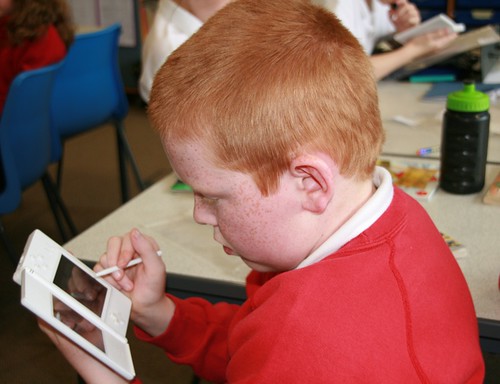 As a result of a small scale intervention that we carried out in some classrooms last year we managed to fund an extended study to explore further the findings that we identified in relation to mental maths attainment and academic self-concept as a result of playing Dr Kawashima’s Brain Training for the Nintendo DS in the primary school.
As a result of this extended study, carried out by Learning and Teaching Scotland in partnership with the University of Dundee and HMIE, we now have some concrete evidence of learning gains that can be attributed to the use of a games console in the primary classroom. But it has also raised a series of questions in our minds; there is a lot more we need to learn…
Although our research does indicate significant gains by the Nintendo group we feel that two things are particularly important for those with an interest in Scottish education. The first is that even the control group children showed measurable improvements in performance; this reflects very well on hard-working Scottish class teachers. The second point is important when thinking about the implications of our findings: because of the research design, we can feel confident that these findings are likely to be typical of what we can realistically expect across the board in Scotland.
We attach a summary paper that gives an outline of what we have found. We intend to submit a fuller paper for full academic review hence the summary nature of the information that we are sharing with you. The results will be discussed and shared with a wider audience for the first time at the Scottish Learning Festival in Glasgow.
 Congratulations to David Whyte from Baldragon Academy in Dundee who yesterday swept all challengers aside to become the Scottish Schools Guitar Hero for 2008. Congratulations also to Craig Davidson, Shaun Caldwell and Lewis Bayne for making it to the semi-finals and for giving such a spirited and skilled performance at the Gamezone Challenge.
David thoroughly impressed the viewing delegates at the conference with his expertise at the game. Whilst playing the song: When We Were Young by The Killers he managed to hit a 500 note streak on expert level. Superb!!!
Thanks to all who supported this event by either participating over the course of the last month or by coming along to the venue to support the boys and to support the unusual addition of something like the Gamezone Challenge at an educational conference.
Thanks also to Microsoft and Nintendo for the donation of prizes for the competitions that we are running in the Gamezone Challenge.
As part of this year’s Consolarium inspired Gamezone Challenge at this year’s SLF we have the DR Kawashima Challenge: How fast can you do your sums? Delegates are invited to take the x20 challenge within this game and see if their score gets on the leaderboard! If a score features in the top eight by 3:30pm on the Wednesday or 2:30pm on the Thursday then the talented delegate will be invited to take part in the x30 download challenge to see if they are the fastest sums expert in Scotland! This title will come with 15, yes I said 15 Nintendo DS plus Dr Kawashima’s Brain Training for the DS.
Established in 2006 The Consolarium was Learning and Teaching Scotland’s initiative to explore the potential, worth and manageability of games based learning in nursery, primary and secondary classrooms. Last year’s Scottish Learning Festival allowed a number of these projects to be shared and celebrated and it is with great delight that I can say that this year’s event, SLF ‘08 has given us the opportunity to show what has continued to happen in Scottish classrooms.
What’s on then you may be asking? A full Games pathway brochure is available but as a quick ready reckoner here’s what’s going on over the two days:
Wednesday 24 September
11:30am Please Miss, my Nintendog needs fed! Cross-curricular learning in P2 with virtual pets: Anna Rossvoll, Aberdeenshire Council Education Village
12:30pm Using the Sony PSP as a learning tool in the primary classroom, Tess Watson & Alicia Macfarlane, East Lothian Council seminar code N1B
1:30pm Scotland’s Got Game: How Scotland has embraced games-based learning: Derek Robertson, LTS seminar code N1C
1:30pm Thinking out of the Xbox: if a picture really did speak a 1000 words: Ewan McIntosh, LTS seminar code C2C
4:00pm Consolarium Challenge: Derek Robertson, Education Showcase
Thursday 25 September
9:30am Can Nintendo’s Dr Kawashima impact on mental maths? An extended study: Derek Robertson & Dr David Miller, LTS & University of Dundee seminar code N1F
10:30am Get in training for the Mario Olympics on the Wii (and get enthused about writing too!): Jo-Anne Bell, Dundee City Council seminar code N1G
12:15pm Wiimbledon, anyone for tennis? Using Nintendo’s Wii Sports as the contextual hub for a cross-curricular project: Vicky Mackenzie, Lairdsland PS Education Village
1:30pm The Winning Game: Can a computer game contribute to the development of a culture of success and self-improvement within a school?: Jim Scott, Perth & Kinross Council seminar code N1G
3:00pm Consolarium Challenge: Derek Robertson, Education Showcase
We hope to see you there and at as many events as possible. They promise to be very interesting and I’m sure worth your while.