
The band Kcor hails from P.7 at Gavinburn PS, Old Kilpatrick in West Dunbartonshire. Their song Party On Our Own is due for imminent release and will, the band hopes, be featured on playlists on your music player very soon! Have a listen to their song and watch the accompanying video that the band made to go along with it:
Look at what children can do when they are faced with a challenge that is set within a context that resonates with them. Look at what children can do when a school embraces and integrates ICT in such a way that children’s skill levels progress and develop over the years. Look at what children can do when ICTs are embedded in sound teaching and learning experiences. Just look at what our children can do!
The video that you have just watched clearly demonstrates a high level of ICT literacy in the use of video editing software to tell the story of their song. In this case (and in the other nine examples in this series of posts) iMovie, from the iLife suite of software from Apple, has been used and techniques such as green screen, stop-motion animation, time lapse and transitions have been confidently and competently employed by these children in amongst the basic skills of shooting, uploading and editing their movie. A question for us to consider is where do these chidren sit in relation to progress in the Curriculum for Excellence Technology Outcomes. What would you use in order to assess performance and progress here? Your comments in relation to this would be most welcome…
Meet the children behind the band…
I managed to grab some time to chat with the children behind Kcor (pronounced core and did you notice it is rock backwards?!) and I asked them a bit about their experience of the Band in a Box project at Gavinburn PS. Have a listen to what they had to say:
 The whole idea of the Guitar Hero (Band in a Box) Project was that in keeping with methodologies that Primary teachers have employed for many years, the actual game is used rarely in class but it acts as the source from which a collaborative story can be constructed. This collaborative story acts as the contextual hub around which learning in other curricular areas can be structured in a cohesive, purposeful and relevant fashion. The main thrust of the collaborative story that is created in this project is that the children develop a character that joins a rock band. This character then lives and breathes along with the other band members and is the vehicle through which learning is situated. As a result, associated tasks are directly linked to the developing life of this ‘rock character’ and the suspension of disbelief is continually in play as these older P.7 children get themselves lost in the developing experiences of their character. This kind of activity has the potential, if used thoughtfully, to position the aims of Curriculum for Excellence in purposeful, challenging and appealing ways.
Let’s explore how aspects of curricular learning have been developed in this project by looking at some work done by the pupils in this band:
Curriculum for Excellence: Literacy
Literacy is at the heart of this project and in particular the need to work as an effective member of a team is central to success in this project. The teachers involved in the planning of this topic wanted to focus on developing children’s ability to work effectively in teams and so decided to refer to LIT 2-02a in order to assess this aspect of learning.
The children were also presented with many literacy tasks that were challenging but that sat perfectly within the collaborative story that developed as their band took life. This example shows how the children have demonstratedb their understanding of writing in na functional way and for an audience in the creation of a merchandise ordering form for distribution to parents and other guests at the school’s Band in a Box open evening. Look at how they have also demonstrated their ability to use a desktop publishing application in a confident and skilled way.
Kcor’s merchandise ordering form
The teachers involved in the planning of this topic decided to refer to LIT 2-02a in order to assess this aspect of learning.
Our experiences over the past few years in using the Guitar Hero/Band in a Box idea have been that the initial stages of setting up the band and developing a rock alter-ego to partner the pupil on the collaborative learning journey they undertake as their ‘band evolves can be very powerful. Here we meet the band members of Kcor as described by the children in the earlier stages of the project:
Meet Adelye Rose Blue from Kcor
Meet Princess Ame Lee from Kcor
The teachers involved were very interested to ensure that the performance aspects of children’s work over the course of this project and so ensured that the following outcomes were also at the heart of the planning process: Spelling LIT 2-12a, Punctuation and Structure LIT 2-22a, Sense and Purpose LIT 2-23a
Curriculum for Excellence: Music
With the use of Garageband from the iLife suite of tools that comes installed on Mac computers, the group was able to structure and compose an original song. The music you are listening to was put together using the preset loops available within Garageband. Inspired by contemporary music from the rock and R’n’B world as well as the Guitar Hero tracks, the group decided on the style of song the group wanted to compose. They auditioned and selected guitar riffs, drum patterns, bass lines and piano fills, as well as textures and other loops from hundreds of samples available. The group then created the track by arranging and layering their selected loops into verses, choruses and musical breaks. Once the original backing track was created, they then recorded the vocals. Looking at the Expressive Arts Music outcomes, it is clear to see that these young learners are displaying evidence of EXA 2-18a and EXA 3-17a.
Curriculum for Excellence: Modern Foreign Languages
Following on from the budget task the children then had to script and record their interview with a French music journalist. It is interesting to note that the Headteacher and the class teachers noting a marked change in attitude to learning French as a result of it being situated within this context. This also came through in discusions with the children.
Kcor’s French music interview script
The teachers involved in the planning of this topic decided to refer to M.LAN 2-07b in order to assess this aspect of learning.
Have a listen to Kcor’s interview with a French music journalist:
The teachers involved in the planning of this topic decided to refer to M.LAN 2-03b in order to assess this aspect of learning.
Congratulations to all the children involved in the band Kcor and to the staff at Gavinburn PS for enabling these pupils to meet the challenge of Band in a Box in such a confident and successful fashion.
Visit the other nine posts as well to see how this work was not a one-off.
The band Starstruck hails from P.7 at Gavinburn PS, Old Kilpatrick in West Dunbartonshire. Their song is due for imminent release and will, the band hopes, be featured on playlists on your music player very soon! Have a listen to their song and watch the accompanying video that the band made to go along with it:
Look at what children can do when they are faced with a challenge that is set within a context that resonates with them. Look at what children can do when a school embraces and integrates ICT in such a way that children’s skill levels progress and develop over the years. Look at what children can do when ICTs are embedded in sound teaching and learning experiences. Just look at what our children can do!
The video that you have just watched clearly demonstrates a high level of ICT literacy in the use of video editing software to tell the story of their song. In this case (and in the other nine examples in this series of posts) iMovie, from the iLife suite of software from Apple, has been used and techniques such as green screen, stop-motion animation, time lapse and transitions have been confidently and competently employed by these children in amongst the basic skills of shooting, uploading and editing their movie. A question for us to consider is where do these chidren sit in relation to progress in the Curriculum for Excellence Technology Outcomes. What would you use in order to assess performance and progress here? Your comments in relation to this would be most welcome…
Meet the children behind the band…
I managed to grab some time to chat with the children behind Starstruck and I asked them a bit about their experience of the Band in a Box project at Gavinburn PS. Have a listen to what they had to say:
 The whole idea of the Guitar Hero (Band in a Box) Project was that in keeping with methodologies that Primary teachers have employed for many years, the actual game is used rarely in class but it acts as the source from which a collaborative story can be constructed. This collaborative story acts as the contextual hub around which learning in other curricular areas can be structured in a cohesive, purposeful and relevant fashion. The main thrust of the collaborative story that is created in this project is that the children develop a character that joins a rock band. This character then lives and breathes along with the other band members and is the vehicle through which learning is situated. As a result, associated tasks are directly linked to the developing life of this ‘rock character’ and the suspension of disbelief is continually in play as these older P.7 children get themselves lost in the developing experiences of their character. This kind of activity has the potential, if used thoughtfully, to position the aims of Curriculum for Excellence in purposeful, challenging and appealing ways.
Let’s explore how aspects of curricular learning have been developed in this project by looking at some work done by the pupils in this band:
Curriculum for Excellence: Literacy
Literacy is at the heart of this project and in particular the need to work as an effective member of a team is central to success in this project. The teachers involved in the planning of this topic wanted to focus on developing children’s ability to work effectively in teams and so decided to refer to LIT 2-02a in order to assess this aspect of learning.
The children were also presented with many literacy tasks that were challenging but that sat perfectly within the collaborative story that developed as their band took life. This example shows how the children have demonstratedb their understanding of writing in na functional way and for an audience in the creation of a merchandise ordering form for distribution to parents and other guests at the school’s Band in a Box open evening. Look at how they have also demonstrated their ability to use a desktop publishing application in a confident and skilled way.
Starstruck’s merchandise ordering form
The teachers involved in the planning of this topic decided to refer to LIT 2-02a in order to assess this aspect of learning.
Our experiences over the past few years in using the Guitar Hero/Band in a Box idea have been that the initial stages of setting up the band and developing a rock alter-ego to partner the pupil on the collaborative learning journey they undertake as their ‘band evolves can be very powerful. Here we meet the band members of Starstruck as described by the children in the earlier stages of the project:
Meet Lacie Dewinter from Starstruck
Meet Marlyn Rose Taylor from Starstruck
Meet Olivia Rose from Starstruck
The teachers involved were very interested to ensure that the performance aspects of children’s work over the course of this project and so ensured that the following outcomes were also at the heart of the planning process: Spelling LIT 2-12a, Punctuation and Structure LIT 2-22a, Sense and Purpose LIT 2-23a
Curriculum for Excellence: Numeracy
One of the earlier ideas that came with the beginnings of the Guitar Hero in class project work was the opportunity to include a European Tour. This allowed exploration of European countries but also an opportunity to present purposeful, challenging and appealing tasks involving the use of money. The idea of costing a tour was born. At Gavinburn PS, however, they have taken that a step further… Direct links with learning French are maximised because each of the bands receives a letter from a French music agent who invites them to visit a French city and play a gig there. A budget is in place and the children then have to work out all travel and accommodation costs to fulfil that gig.
Starstruck’s Bordeaux trip itinerary and budget breakdown
The teachers involved in the planning of this topic decided to refer to MNU 2-09a in order to assess this aspect of learning.
Curriculum for Excellence: Music
With the use of Garageband from the iLife suite of tools that comes installed on Mac computers, the group was able to structure and compose an original song. The music you are listening to was put together using the preset loops available within Garageband. Inspired by contemporary music from the rock and R’n’B world as well as the Guitar Hero tracks, the group decided on the style of song the group wanted to compose. They auditioned and selected guitar riffs, drum patterns, bass lines and piano fills, as well as textures and other loops from hundreds of samples available. The group then created the track by arranging and layering their selected loops into verses, choruses and musical breaks. Once the original backing track was created, they then recorded the vocals. Looking at the Expressive Arts Music outcomes, it is clear to see that these young learners are displaying evidence of EXA 2-18a and EXA 3-17a.
Curriculum for Excellence: Modern Foreign Languages
Following on from the budget task the children then had to script and record their interview with a French music journalist. It is interesting to note that the Headteacher and the class teachers noting a marked change in attitude to learning French as a result of it being situated within this context. This also came through in discusions with the children.
Starstruck’s French music interview script
The teachers involved in the planning of this topic decided to refer to M.LAN 2-07b in order to assess this aspect of learning.
Have a listen to Starstruck’s interview with a French music journalist:
The teachers involved in the planning of this topic decided to refer to M.LAN 2-03b in order to assess this aspect of learning.
Congratulations to all the children involved in the band Starstruck and to the staff at Gavinburn PS for enabling these pupils to meet the challenge of Band in a Box in such a confident and successful fashion.
Visit the other nine posts as well to see how this work was not a one-off.
The band Explosion hails from P.7 at Gavinburn PS, Old Kilpatrick in West Dunbartonshire. Their song Poison is due for imminent release and will, the band hopes, be featured on playlists on your music player very soon! Have a listen to their song and watch the accompanying video that the band made to go along with it:
Look at what children can do when they are faced with a challenge that is set within a context that resonates with them. Look at what children can do when a school embraces and integrates ICT in such a way that children’s skill levels progress and develop over the years. Look at what children can do when ICTs are embedded in sound teaching and learning experiences. Just look at what our children can do!
The video that you have just watched clearly demonstrates a high level of ICT literacy in the use of video editing software to tell the story of their song. In this case (and in the other nine examples in this series of posts) iMovie, from the iLife suite of software from Apple, has been used and techniques such as green screen, stop-motion animation, time lapse and transitions have been confidently and competently employed by these children in amongst the basic skills of shooting, uploading and editing their movie. A question for us to consider is where do these chidren sit in relation to progress in the Curriculum for Excellence Technology Outcomes. What would you use in order to assess performance and progress here? Your comments in relation to this would be most welcome…
Meet the children behind the band…
I managed to grab some time to chat with the children behind Explosion and I asked them a bit about their experience of the band in a Box project at Gavinburn PS. Have a listen to what they had to say:
 The whole idea of the Guitar Hero (Band in a Box) Project was that in keeping with methodologies that Primary teachers have employed for many years, the actual game is used rarely in class but it acts as the source from which a collaborative story can be constructed. This collaborative story acts as the contextual hub around which learning in other curricular areas can be structured in a cohesive, purposeful and relevant fashion. The main thrust of the collaborative story that is created in this project is that the children develop a character that joins a rock band. This character then lives and breathes along with the other band members and is the vehicle through which learning is situated. As a result, associated tasks are directly linked to the developing life of this ‘rock character’ and the suspension of disbelief is continually in play as these older P.7 children get themselves lost in the developing experiences of their character. This kind of activity has the potential, if used thoughtfully, to position the aims of Curriculum for Excellence in purposeful, challenging and appealing ways.
Let’s explore how aspects of curricular learning have been developed in this project by looking at some work done by the pupils in this band:
Curriculum for Excellence: Literacy
Literacy is at the heart of this project and in particular the need to work as an effective member of a team is central to success in this project. The teachers involved in the planning of this topic wanted to focus on developing children’s ability to work effectively in teams and so decided to refer to LIT 2-02a in order to assess this aspect of learning.
The children were also presented with many literacy tasks that were challenging but that sat perfectly within the collaborative story that developed as their band took life. This example shows how the children have demonstratedb their understanding of writing in na functional way and for an audience in the creation of a merchandise ordering form for distribution to parents and other guests at the school’s Band in a Box open evening. Look at how they have also demonstrated their ability to use a desktop publishing application in a confident and skilled way.
Explosion’s merchandise ordering form
The teachers involved in the planning of this topic decided to refer to LIT 2-02a in order to assess this aspect of learning.
Our experiences over the past few years in using the Guitar Hero/Band in a Box idea have been that the initial stages of setting up the band and developing a rock alter-ego to partner the pupil on the collaborative learning journey they undertake as their ‘band evolves can be very powerful. Here we meet the band members of Explosion as described by the children in the earlier dtages fo the project:
Meet Ruby Ramone from Explosion
The teachers involved were very interested to ensure that the performance aspects of children’s work over the course of this project and so ensured that the following outcomes were also at the heart of the planning process: Spelling LIT 2-12a, Punctuation and Structure LIT 2-22a, Sense and Purpose LIT 2-23a
Curriculum for Excellence: Numeracy
One of the earlier ideas that came with the beginnings of the Guitar Hero in class project work was the opportunity to include a European Tour. This allowed exploration of European countries but also an opportunity to present purposeful, challenging and appealing tasks involving the use of money. The idea of costing a tour was born. At Gavinburn PS, however, they have taken that a step further… Direct links with learning French are maximised because each of the bands receives a letter from a French music agent who invites them to visit a French city and play a gig there. A budget is in place and the children then have to work out all travel and accommodation costs to fulfil that gig.
Explosion’s Marseille trip itinerary and budget breakdown
The teachers involved in the planning of this topic decided to refer to MNU 2-09a in order to assess this aspect of learning.
Curriculum for Excellence: Music
With the use of Garageband from the iLife suite of tools that comes installed on Mac computers, the group was able to structure and compose an original song. The music you are listening to was put together using the preset loops available within Garageband. Inspired by contemporary music from the rock and R’n’B world as well as the Guitar Hero tracks, the group decided on the style of song the group wanted to compose. They auditioned and selected guitar riffs, drum patterns, bass lines and piano fills, as well as textures and other loops from hundreds of samples available. The group then created the track by arranging and layering their selected loops into verses, choruses and musical breaks. Once the original backing track was created, they then recorded the vocals. Looking at the Expressive Arts Music outcomes, it is clear to see that these young learners are displaying evidence of EXA 2-18a and EXA 3-17a.
Curriculum for Excellence: Modern Foreign Languages
Following on from the budget task the children then had to script and record their interview with a French music journalist. It is interesting to note that the Headteacher and the class teachers noting a marked change in attitude to learning French as a result of it being situated within this context. This also came through in discusions with the children.
Explosion’s French music interview script
The teachers involved in the planning of this topic decided to refer to M.LAN 2-07b in order to assess this aspect of learning.
Have a listen to Explosion’s interview with a French music journalist:
The teachers involved in the planning of this topic decided to refer to M.LAN 2-03b in order to assess this aspect of learning.
Congratulations to all the children involved in the band Explosion and to the staff at Gavinburn PS for enabling these pupils to meet the challenge of Band in a Box in such a confident and successful fashion.
Visit the other nine posts as well to see how this work was not a one-off.
The band Skulls and Rockbones hail from P.7 at Gavinburn PS, Old Kilpatrick in West Dunbartonshire. Their song Fear is due for imminent release and will, the band hopes, be featured on playlists on your music player very soon! Have a listen to their song and watch the accompanying video that the band made to go along with it:
Look at what children can do when they are faced with a challenge that is set within a context that resonates with them. Look at what children can do when a school embraces and integrates ICT in such a way that children’s skill levels progress and develop over the years. Look at what children can do when ICTs are embedded in sound teaching and learning experiences. Just look at what our children can do!
The video that you have just watched clearly demonstrates a high level of ICT literacy in the use of video editing software to tell the story of their song. In this case (and in the other nine examples in this series of posts) iMovie, from the iLife suite of software from Apple, has been used and techniques such as green screen, stop-motion animation, time lapse and transitions have been confidently and competently employed by these children in amongst the basic skills of shooting, uploading and editing their movie. A question for us to consider is where do these chidren sit in relation to progress in the Curriculum for Excellence Technology Outcomes. What would you use in order to assess performance and progress here? Your comments in relation to this would be most welcome…
Meet the children behind the band…
I managed to grab some time to chat with the children behind Skulls and Rockbones and I asked them a bit about their experience of the band in a Box project at Gavinburn PS. Have a listen to what they had to say:
 The whole idea of the Guitar Hero (Band in a Box) Project was that in keeping with methodologies that Primary teachers have employed for many years, the actual game is used rarely in class but it acts as the source from which a collaborative story can be constructed. This collaborative story acts as the contextual hub around which learning in other curricular areas can be structured in a cohesive, purposeful and relevant fashion. The main thrust of the collaborative story that is created in this project is that the children develop a character that joins a rock band. This character then lives and breathes along with the other band members and is the vehicle through which learning is situated. As a result, associated tasks are directly linked to the developing life of this ‘rock character’ and the suspension of disbelief is continually in play as these older P.7 children get themselves lost in the developing experiences of their character. This kind of activity has the potential, if used thoughtfully, to position the aims of Curriculum for Excellence in purposeful, challenging and appealing ways.
Let’s explore how aspects of curricular learning have been developed in this project by looking at some work done by the pupils in this band:
Curriculum for Excellence: Literacy
Literacy is at the heart of this project and in particular the need to work as an effective member of a team is central to success in this project. The teachers involved in the planning of this topic wanted to focus on developing children’s ability to work effectively in teams and so decided to refer to LIT 2-02a in order to assess this aspect of learning.
The children were also presented with literacy tasks that were challenging but that sat perfectly within the collaborative story that developed as their band took life. Here we can see how the band comes to life in a magazine article that has been written by the children. Look at how they have also demonstrated their ability to use a desktop publishing application in a confident and skilled way.
Skulls and Rockbones Magazine Article
The teachers involved in the planning of this topic decided to refer to LIT 2-02a in order to assess this aspect of learning.
Our experiences over the past few years in using the Guitar Hero/Band in a Box idea have been that the initial stages of setting up the band and developing a rock alter-ego to partner the pupil on the collaborative learning journey they undertake as their ‘band’ evolves can be very powerful. Here we meet some of the band members of Skulls and Rockbones as described by the children in these biographies (ENG 2-31a) written in the early stages of the project:
Meet Ash Rock from Skulls and Rockbones part1, part (2),
Meet Ace Wilde from Skulls and Rockbones
Meet Ashton De Lorean from Skulls and Rockbones
The teachers involved were very interested to ensure that the performance aspects of children’s work over the course of this project and so ensured that the following outcomes were also at the heart of the planning process: Spelling LIT 2-12a, Punctuation and Structure LIT 2-22a, Sense and Purpose LIT 2-23a
Curriculum for Excellence: Numeracy
One of the earlier ideas that came with the beginnings of the Guitar Hero in class project work was the opportunity to include a European Tour. This allowed exploration of European countries but also an opportunity to present purposeful, challenging and appealing tasks involving the use of money. The idea of costing a tour was born. At Gavinburn PS, however, they have taken that a step further… Direct links with learning French are maximised because each of the bands receives a letter from a French music agent who invites them to visit a French city and play a gig there. A budget is in place and the children then have to work out all travel and accommodation costs to fulfil that gig.
Skulls and Rockbones’ Bordeaux trip itinerary
Skulls and Rockbones’ Bordeaux trip budget breakdown
The teachers involved in the planning of this topic decided to refer to MNU 2-09a in order to assess this aspect of learning.
Curriculum for Excellence: Music
With the use of Garageband from the iLife suite of tools that comes installed on Mac computers, the group was able to structure and compose an original song. The music you are listening to was put together using the preset loops available within Garageband. Inspired by contemporary music from the rock and R’n’B world as well as the Guitar Hero tracks, the group decided on the style of song the group wanted to compose. They auditioned and selected guitar riffs, drum patterns, bass lines and piano fills, as well as textures and other loops from hundreds of samples available. The group then created the track by arranging and layering their selected loops into verses, choruses and musical breaks. Once the original backing track was created, they then recorded the vocals. Looking at the Expressive Arts Music outcomes, it is clear to see that these young learners are displaying evidence of EXA 2-18a and EXA 3-17a.
Curriculum for Excellence: Modern Foreign Languages
Following on from the budget task the children then had to script and record their interview with a French music journalist. It is interesting to note that the Headteacher and the class teachers noting a marked change in attitude to learning French as a result of it being situated within this context. This also came through in discusions with the children.
Skulls and Rockbones’ French music interview script
The teachers involved in the planning of this topic decided to refer to M.LAN 2-07b in order to assess this aspect of learning.
Have a listen to Skulls and Rockbone’s interview with a French music journalist:
The teachers involved in the planning of this topic decided to refer to M.LAN 2-03b in order to assess this aspect of learning.
Congratulations to all the children involved in the band Skulls and Rockbones and to the staff at Gavinburn PS for enabling these pupils to meet the challenge of Band in a Box in such a confident and successful fashion.
Visit the other nine posts as well to see how this work was not a one-off.
The band Red Hot Ice hail from P.7 at Gavinburn PS, Old Kilpatrick in West Dunbartonshire. Their song Burning Love is due for imminent release and will, the band hopes, be featured on playlists on your music player very soon! Have a listen to their song and watch the accompanying video that the band made to go along with it:
Look at what children can do when they are faced with a challenge that is set within a context that resonates with them. Look at what children can do when a school embraces and integrates ICT in such a way that children’s skill levels progress and develop over the years. Look at what children can do when ICTs are embedded in sound teaching and learning experiences. Just look at what our children can do!
The video that you have just watched clearly demonstrates a high level of ICT literacy in the use of video editing software to tell the story of their song. In this case (and in the other nine examples in this series of posts) iMovie, from the iLife suite of software from Apple, has been used and techniques such as green screen, time lapse and transitions have been confidently and competently employed by these children in amongst the basic skills of shooting, uploading and editing their movie. A question for us to consider is where do these chidren sit in relation to progress in the Curriculum for Excellence Technology Outcomes. What would you use in order to assess performance and progress here? Your comments in relation to this would be most welcome…
Meet the children behind the band…
I managed to grab some time to chat with the children behind Red Hot Ice and I asked them a bit about their experience of the band in a Box project at Gavinburn PS. Have a listen to what they had to say:
The whole idea of the Guitar Hero (Band in a Box) Project was that in keeping with methodologies that Primary teachers have employed for many years, the actual game is used rarely in class but it acts as the source from which a collaborative story can be constructed. This collaborative story acts as the contextual hub around which learning in other curricular areas can be structured in a cohesive, purposeful and relevant fashion. The main thrust of the collaborative story that is created in this project is that the children develop a character that joins a rock band. This character then lives and breathes along with the other band members and is the vehicle through which learning is situated. As a result, associated tasks are directly linked to the developing life of this ‘rock character’ and the suspension of disbelief is continually in play as these older P.7 children get themselves lost in the developing experiences of their character. This kind of activity has the potential, if used thoughtfully, to position the aims of Curriculum for Excellence in purposeful, challenging and appealing ways.
Let’s explore how aspects of curricular learning have been developed in this project by looking at some work done by the pupils in this band:
Curriculum for Excellence: Literacy
Literacy is at the heart of this project and in particular the need to work as an effective member of a team is central to success in this project. The teachers involved in the planning of this topic wanted to focus on developing children’s ability to work effectively in teams and so decided to refer to LIT 2-02a in order to assess this aspect of learning.
The children were also presented with literacy tasks that were challenging but that sat perfectly within the collaborative story that developed as their band took life. Here we can see how the band comes to life in a magazine article that has been written by the children. Look at how they have also demonstrated their ability to use a desktop publishing application in a confident and skilled way.
Red Hot Ice’s Magazine Article
The teachers involved in the planning of this topic decided to refer to LIT 2-02a in order to assess this aspect of learning.
Our experiences over the past few years in using the Guitar Hero/Band in a Box idea have been that the initial stages of setting up the band and developing a rock alter-ego to partner the pupil on the collaborative learning journey they undertake as their ‘band’ evolves can be very powerful. Here we meet some of the band members of Red Hot Ice as described by the children in these biographies (ENG 2-31a) written in the early stages of the project:
Meet Rachel Burns from Red Hot Ice part1, part (2),
Meet Dexter Sting Wilde from Red Hot Ice
Meet Ksomi Kasati from Red Hot Ice
The teachers involved were very interested to ensure that the performance aspects of children’s work over the course of this project and so ensured that the following outcomes were also at the heart of the planning process: Spelling LIT 2-12a, Punctuation and Structure LIT 2-22a, Sense and Purpose LIT 2-23a
Curriculum for Excellence: Numeracy
One of the earlier ideas that came with the beginnings of the Guitar Hero in class project work was the opportunity to include a European Tour. This allowed exploration of European countries but also an opportunity to present purposeful, challenging and appealing tasks involving the use of money. The idea of costing a tour was born. At Gavinburn PS, however, they have taken that a step further… Direct links with learning French are maximised because each of the bands receives a letter from a French music agent who invites them to visit a French city and play a gig there. A budget is in place and the children then have to work out all travel and accommodation costs to fulfil that gig.
Red Hot Ice Lyon trip itinerary
Red Hot Ice’s Lyon trip budget breakdown
The teachers involved in the planning of this topic decided to refer to MNU 2-09a in order to assess this aspect of learning.
Curriculum for Excellence: Music
With the use of Garageband from the iLife suite of tools that comes installed on Mac computers, the group was able to structure and compose an original song. The music you are listening to was put together using the preset loops available within Garageband. Inspired by contemporary music from the rock and R’n’B world as well as the Guitar Hero tracks, the group decided on the style of song the group wanted to compose. They auditioned and selected guitar riffs, drum patterns, bass lines and piano fills, as well as textures and other loops from hundreds of samples available. The group then created the track by arranging and layering their selected loops into verses, choruses and musical breaks. Once the original backing track was created, they then recorded the vocals. Looking at the Expressive Arts Music outcomes, it is clear to see that these young learners are displaying evidence of EXA 2-18a and EXA 3-17a.
Curriculum for Excellence: Modern Foreign Languages
Following on from the budget task the children then had to script and record their interview with a French music journalist. It is interesting to note that the Headteacher and the class teachers noting a marked change in attitude to learning French as a result of it being situated within this context. This also came through in discusions with the children.
Have a listen to Red Hot Ice’s interview with a French music journalist:
The teachers involved in the planning of this topic decided to refer to M.LAN 2-03b in order to assess this aspect of learning.
Congratulations to all the children involved in the band Red Hot Ice and to the staff at Gavinburn PS for enabling these pupils to meet the challenge of Band in a Box in such a confident and successful fashion.
Visit the other nine posts as well to see how this work was not a one-off.
The band Peas On Earth hail from P.7 at Gavinburn PS, Old Kilpatrick in West Dunbartonshire. Their song Timeout is due for imminent release and will, the band hopes, be featured on playlists on your music player very soon! Have a listen to their song and watch the accompanying video that the band made to go along with it:
Look at what children can do when they are faced with a challenge that is set within a context that resonates with them. Look at what children can do when a school embraces and integrates ICT in such a way that children’s skill levels progress and develop over the years. Look at what children can do when ICTs are embedded in sound teaching and learning experiences. Just look at what our children can do!
The video that you have just watched clearly demonstrates a high level of ICT literacy in the use of video editing software to tell the story of their song. In this case (and in the other nine examples in this series of posts) iMovie, from the iLife suite of software from Apple, has been used and techniques such as green screen, time lapse and transitions have been confidently and competently employed by these children in amongst the basic skills of shooting, uploading and editing their movie. A question for us to consider is where do these chidren sit in relation to progress in the Curriculum for Excellence Technology Outcomes. What would you use in order to assess performance and progress here? Your comments in relation to this would be most welcome…
I managed to grab some time to chat with the children behind Peas On Earth and I asked them a bit about their experience of the band in a Box project at Gavinburn PS. Have a listen to what they had to say:
Meet the children behind the band…
The whole idea of the Guitar Hero (Band in a Box) Project was that in keeping with methodologies that Primary teachers have employed for many years, the actual game is used rarely in class but it acts as the source from which a collaborative story can be constructed. This collaborative story acts as the contextual hub around which learning in other curricular areas can be structured in a cohesive, purposeful and relevant fashion. The main thrust of the collaborative story that is created in this project is that the children develop a character that joins a rock band. This character then lives and breathes along with the other band members and is the vehicle through which learning is situated. As a result, associated tasks are directly linked to the developing life of this ‘rock character’ and the suspension of disbelief is continually in play as these older P.7 children get themselves lost in the developing experiences of their character. This kind of activity has the potential, if used thoughtfully, to position the aims of Curriculum for Excellence in purposeful, challenging and appealing ways.
Let’s explore how aspects of curricular learning have been developed in this project by looking at some work done by the pupils in this band:
Curriculum for Excellence: Literacy
Literacy is at the heart of this project and in particular the need to work as an effective member of a team is central to success in this project. The teachers involved in the planning of this topic wanted to focus on developing children’s ability to work effectively in teams and so decided to refer to LIT 2-02a in order to assess this aspect of learning.
The children were also presented with literacy tasks that were challenging but that sat perfectly within the collaborative story that developed as their band took life. Here we can see how the band comes to life in a magazine article that has been written by the children. Look at how they have also demonstrated their ability to use a desktop publishing application in a confident and skilled way.
Peas On Earth’s Magazine Article
The teachers involved in the planning of this topic decided to refer to LIT 2-02a in order to assess this aspect of learning.
Our experiences over the past few years in using the Guitar Hero/Band in a Box idea have been that the initial stages of setting up the band and developing a rock alter-ego to partner the pupil on the collaborative learning journey they undertake as their ‘band’ evolves can be very powerful. Here we meet some of the band members of Peas on Earth as described by the children in these biographies (ENG 2-31a) written in the early stages of the project:
Meet Jenny Bloom from Peas On Earth part1, part (2), part (3)
Meet William Rockfire from Peas On Earth
Meet Avril Star Rose from Peas On Earth
The teachers involved were very interested to ensure that the performance aspects of children’s work over the course of this project and so ensured that the following outcomes were also at the heart of the planning process: Spelling LIT 2-12a, Punctuation and Structure LIT 2-22a, Sense and Purpose LIT 2-23a
Curriculum for Excellence: Numeracy
One of the earlier ideas that came with the beginnings of the Guitar Hero in class project work was the opportunity to include a European Tour. This allowed exploration of European countries but also an opportunity to present purposeful, challenging and appealing tasks involving the use of money. The idea of costing a tour was born. At Gavinburn PS, however, they have taken that a step further… Direct links with learning French are maximised because each of the bands receives a letter from a French music agent who invites them to visit a French city and play a gig there. A budget is in place and the children then have to work out all travel and accommodation costs to fulfil that gig.
Peas On Earth Marseille trip itinerary
Peas On Earth’s Marseille trip budget breakdown
The teachers involved in the planning of this topic decided to refer to MNU 2-09a in order to assess this aspect of learning.
Curriculum for Excellence: Music
With the use of Garageband from the iLife suite of tools that comes installed on Mac computers, the group was able to structure and compose an original song. The music you are listening to was put together using the preset loops available within Garageband. Inspired by contemporary music from the rock and R’n’B world as well as the Guitar Hero tracks, the group decided on the style of song the group wanted to compose. They auditioned and selected guitar riffs, drum patterns, bass lines and piano fills, as well as textures and other loops from hundreds of samples available. The group then created the track by arranging and layering their selected loops into verses, choruses and musical breaks. Once the original backing track was created, they then recorded the vocals. Looking at the Expressive Arts Music outcomes, it is clear to see that these young learners are displaying evidence of EXA 2-18a and EXA 3-17a.
Curriculum for Excellence: Modern Foreign Languages
Following on from the budget task the children then had to script and record their interview with a French music journalist. It is interesting to note that the Headteacher and the class teachers noting a marked change in attitude to learning French as a result of it being situated within this context. This also came through in discusions with the children.
Have a listen to Peas On Earth’s interview with a French music journalist:
The teachers involved in the planning of this topic decided to refer to M.LAN 2-03b in order to assess this aspect of learning.
Congratulations to all the children involved in the band Peas On Earth and to the staff at Gavinburn PS for enabling these pupils to meet the challenge of Band in a Box in such a confident and successful fashion.
Visit the other nine posts as well to see how this work was not a one-off.
The band Papercut hail from P.7 at Gavinburn PS, Old Kilpatrick in West Dunbartonshire. Their song Just Be Youself is due for imminent release and will, the band hopes, be featured on playlists on your music player very soon! Have a listen to their song and watch the accompanying video that the band made to go along with it:
Look at what children can do when they are faced with a challenge that is set within a context that resonates with them. Look at what children can do when a school embraces and integrates ICT in such a way that children’s skill levels progress and develop over the years. Look at what children can do when ICTs are embedded in sound teaching and learning experiences. Just look at what our children can do!
The video that you have just watched clearly demonstrates a high level of ICT literacy in the use of video editing software to tell the story of their song. In this case (and in the other nine examples in this series of posts) iMovie, from the iLife suite of software from Apple, has been used and techniques such as green screen, stop-motion animation, time lapse and transitions have been confidently and competently employed by these children in amongst the basic skills of shooting, uploading and editing their movie. A question for us to consider is where do these chidren sit in relation to progress in the Curriculum for Excellence Technology Outcomes. What would you use in order to assess performance and progress here? Your comments in relation to this would be most welcome…
Meet the children behind the band…
I managed to grab some time to chat with the children behind Papercut and I asked them a bit about their experience of the band in a Box project at Gavinburn PS. Have a listen to what they had to say:
 The whole idea of the Guitar Hero (Band in a Box) Project was that in keeping with methodologies that Primary teachers have employed for many years, the actual game is used rarely in class but it acts as the source from which a collaborative story can be constructed. This collaborative story acts as the contextual hub around which learning in other curricular areas can be structured in a cohesive, purposeful and relevant fashion. The main thrust of the collaborative story that is created in this project is that the children develop a character that joins a rock band. This character then lives and breathes along with the other band members and is the vehicle through which learning is situated. As a result, associated tasks are directly linked to the developing life of this ‘rock character’ and the suspension of disbelief is continually in play as these older P.7 children get themselves lost in the developing experiences of their character. This kind of activity has the potential, if used thoughtfully, to position the aims of Curriculum for Excellence in purposeful, challenging and appealing ways.
Let’s explore how aspects of curricular learning have been developed in this project by looking at some work done by the pupils in this band:
Curriculum for Excellence: Literacy
Literacy is at the heart of this project and in particular the need to work as an effective member of a team is central to success in this project. The teachers involved in the planning of this topic wanted to focus on developing children’s ability to work effectively in teams and so decided to refer to LIT 2-02a in order to assess this aspect of learning.
The children were also presented with literacy tasks that were challenging but that sat perfectly within the collaborative story that developed as their band took life. Here we can see how the band comes to life in a magazine article that has been written by the children. Look at how they have also demonstrated their ability to use a desktop publishing application in a confident and skilled way.
The teachers involved in the planning of this topic decided to refer to LIT 2-02a in order to assess this aspect of learning
Our experiences over the past few years in using the Guitar Hero/Band in a Box idea have been that the initial stages of setting up the band and developing a rock alter-ego to partner the pupil on the collaborative learning journey they undertake as their ‘band’ evolves can be very powerful. Here we meet some of the band members of Papercut as described by the children in these biographies (ENG 2-31a) written in the early stages of the project:
Meet Jennifer Heart from Papercut
Meet Rafael Shade from Papercut
Meet Ricardo Lopez from Papercut
The teachers involved were very interested to ensure that the performance aspects of children’s work over the course of this project and so ensured that the following outcomes were also at the heart of the planning process: Spelling LIT 2-12a, Punctuation and Structure LIT 2-22a, Sense and Purpose LIT 2-23a
Curriculum for Excellence: Numeracy
One of the earlier ideas that came with the beginnings of the Guitar Hero in class project work was the opportunity to include a European Tour. This allowed exploration of European countries but also an opportunity to present purposeful, challenging and appealing tasks involving the use of money. The idea of costing a tour was born. At Gavinburn PS, however, they have taken that a step further… Direct links with learning French are maximised because each of the bands receives a letter from a French music agent who invites them to visit a French city and play a gig there. A budget is in place and the children then have to work out all travel and accommodation costs to fulfil that gig.
Papercut’s Lyon trip itinerary
Papercut’s Lyon trip budget breakdown
The teachers involved in the planning of this topic decided to refer to MNU 2-09a in order to assess this aspect of learning.
Curriculum for Excellence: Music
With the use of Garageband from the iLife suite of tools that comes installed on Mac computers, the group was able to structure and compose an original song. The music you are listening to was put together using the preset loops available within Garageband. Inspired by contemporary music from the rock and R’n’B world as well as the Guitar Hero tracks, the group decided on the style of song the group wanted to compose. They auditioned and selected guitar riffs, drum patterns, bass lines and piano fills, as well as textures and other loops from hundreds of samples available. The group then created the track by arranging and layering their selected loops into verses, choruses and musical breaks. Once the original backing track was created, they then recorded the vocals. Looking at the Expressive Arts Music outcomes, it is clear to see that these young learners are displaying evidence of EXA 2-18a and EXA 3-17a.
Curriculum for Excellence: Modern Foreign Languages
Following on from the budget task the children then had to script and record their interview with a French music journalist. It is interesting to note that the Headteacher and the class teachers noting a marked change in attitude to learning French as a result of it being situated within this context. This also came through in discusions with the children.
Papercut’s French music interview script
The teachers involved in the planning of this topic decided to refer to M.LAN 2-07b in order to assess this aspect of learning.
Have a listen to Papercut’s interview with a French music journalist:
The teachers involved in the planning of this topic decided to refer to M.LAN 2-03b in order to assess this aspect of learning.
Congratulations to all the children involved in the band Papercut and to the staff at Gavinburn PS for enabling these pupils to meet the challenge of Band in a Box in such a confident and successful fashion.
Visit the other nine posts as well to see how this work was not a one-off.
The band Epic hails from P.7 at Gavinburn PS, Old Kilpatrick in West Dunbartonshire. Their song Immortal Love is due for imminent release and will, the band hopes, be featured on playlists on your music player very soon! Have a listen to their song and watch the accompanying video that the band made to go along with it:
Look at what children can do when they are faced with a challenge that is set within a context that resonates with them. Look at what children can do when a school embraces and integrates ICT in such a way that children’s skill levels progress and develop over the years. Look at what children can do when ICTs are embedded in sound teaching and learning experiences. Just look at what our children can do!
The video that you have just watched clearly demonstrates a high level of ICT literacy in the use of video editing software to tell the story of their song. In this case (and in the other nine examples in this series of posts) iMovie, from the iLife suite of software from Apple, has been used and techniques such as green screen, time lapse and transitions have been confidently and competently employed by these children in amongst the basic skills of shooting, uploading and editing their movie. A question for us to consider is where do these chidren sit in relation to progress in the Curriculum for Excellence Technology Outcomes. What would you use in order to assess performance and progress here? Your comments in relation to this would be most welcome…
Meet the children behind the band
I managed to grab some time to chat with the children behind Epic and I asked them a bit about their experience of the band in a Box project at Gavinburn PS. Have a listen to what they had to say:
 The whole idea of the Guitar Hero (Band in a Box) Project was that in keeping with methodologies that Primary teachers have employed for many years, the actual game is used rarely in class but it acts as the source from which a collaborative story can be constructed. This collaborative story acts as the contextual hub around which learning in other curricular areas can be structured in a cohesive, purposeful and relevant fashion. The main thrust of the collaborative story that is created in this project is that the children develop a character that joins a rock band. This character then lives and breathes along with the other band members and is the vehicle through which learning is situated. As a result, associated tasks are directly linked to the developing life of this ‘rock character’ and the suspension of disbelief is continually in play as these older P.7 children get themselves lost in the developing experiences of their character. This kind of activity has the potential, if used thoughtfully, to position the aims of Curriculum for Excellence in purposeful, challenging and appealing ways.
Let’s explore how aspects of curricular learning have been developed in this project by looking at some work done by the pupils in this band:
Curriculum for Excellence: Literacy
Literacy is at the heart of this project and in particular the need to work as an effective member of a team is central to success in this project. The teachers involved in the planning of this topic wanted to focus on developing children’s ability to work effectively in teams and so decided to refer to LIT 2-02a in order to assess this aspect of learning.
The children were also presented with literacy tasks that were challenging but that sat perfectly within the collaborative story that developed as their band took life. Here we can see how the band comes to life in a magazine article that has been written by the children. Look at how they have also demonstrated their ability to use a desktop publishing application in a confident and skilled way.
The teachers involved in the planning of this topic decided to refer to LIT 2-02a in order to assess this aspect of learning.
Our experiences over the past few years in using the Guitar Hero/Band in a Box idea have been that the initial stages of setting up the band and developing a rock alter-ego to partner the pupil on the collaborative learning journey they undertake as their ‘band’ evolves can be very powerful. Here we meet some of the band members of Epic as described by the children in these biographies (ENG 2-31a) written in the early stages of the project:
Meet Rocky De Lorean from Epic
The teachers involved were very interested to ensure that the performance aspects of children’s work over the course of this project and so ensured that the following outcomes were also at the heart of the planning process: Spelling LIT 2-12a, Punctuation and Structure LIT 2-22a, Sense and Purpose LIT 2-23a
Curriculum for Excellence: Numeracy
One of the earlier ideas that came with the beginnings of the Guitar Hero in class project work was the opportunity to include a European Tour. This allowed exploration of European countries but also an opportunity to present purposeful, challenging and appealing tasks involving the use of money. The idea of costing a tour was born. At Gavinburn PS, however, they have taken that a step further… Direct links with learning French are maximised because each of the bands receives a letter from a French music agent who invites them to visit a French city and play a gig there. A budget is in place and the children then have to work out all travel and accommodation costs to fulfil that gig.
Epic’s Toulouse trip itinerary
Epic’s Toulouse trip budget breakdown
The teachers involved in the planning of this topic decided to refer to MNU 2-09a in order to assess this aspect of learning.
Curriculum for Excellence: Music
With the use of Garageband from the iLife suite of tools that comes installed on Mac computers, the group was able to structure and compose an original song. The music you are listening to was put together using the preset loops available within Garageband. Inspired by contemporary music from the rock and R’n’B world as well as the Guitar Hero tracks, the group decided on the style of song the group wanted to compose. They auditioned and selected guitar riffs, drum patterns, bass lines and piano fills, as well as textures and other loops from hundreds of samples available. The group then created the track by arranging and layering their selected loops into verses, choruses and musical breaks. Once the original backing track was created, they then recorded the vocals. Looking at the Expressive Arts Music outcomes, it is clear to see that these young learners are displaying evidence of EXA 2-18a and EXA 3-17a.
Curriculum for Excellence: Modern Foreign Languages
Following on from the budget task the children then had to script and record their interview with a French music journalist. It is interesting to note that the Headteacher and the class teachers noting a marked change in attitude to learning French as a result of it being situated within this context. This also came through in discusions with the children.
Epic’s French music interview script
The teachers involved in the planning of this topic decided to refer to M.LAN 2-07b in order to assess this aspect of learning.
Have a listen to Epic’s interview with a French music journalist:
The teachers involved in the planning of this topic decided to refer to M.LAN 2-03b in order to assess this aspect of learning.
Congratulations to all the children involved in the band Epic and to the staff at Gavinburn PS for enabling these pupils to meet the challenge of Band in a Box in such a confident and successful fashion.
Visit the other nine posts as well to see how this work was not a one-off.

As well as dong a lot of work at the Consolarium on Games Based Learning and Games Design we also research and investigate other technologies that we think will have a real impact in the classroom. In the last 12 months this has included 3D printing, mobile Apps, social software, multi-point and tablet technology.
One of the technologies that we see real potential in at the moment is GPS and Geocaching. We will be publishing a whole heap of resources and ideas to help support schools with this sometime before the summer.
As part of the recent Games to Learn Conference we ran a Geocaching workshop to help introduce practitioners into what GPS and Geocaching is and how it might have real education value. The weather was spectacular for the workshop and 30 educators had a great time treasure hunting around Dundee.
Have a look at the picture below:

Can you see the joy and excitement on their faces? This is impact of finding your first Geocache – pure excitement! The video below explains what Geocaching is:
During the workshop at Game to Learn participants had an opportunity to find some cashes from geocaching.com. These were mainly magnetic cashes and hidden around the city. We also hid some of our very own Consolarium Cashes and cryptic questions for people use their GPS to find and answer.
Using a GPS with pre-loaded co-ordinates our Consolarium adventures had to complete the following tasks:
1) Uncover a micro magnetic cache in the middle of the city (who would have know it was there!) -

2) Collect a sticker from inside a false rock in the graveyard -

3) Explore the history of Dundee by taking a crayon rubbing of the historic plaque (also works well with trees, statues and grave stones!) -

4) Find out about Roman Numerals and the height of the water at the HMS Discovery -

5) Take a digital picture of an engraving on the roof of a landmark that you would never normally see unless you stood in exactly the right place and looked up – 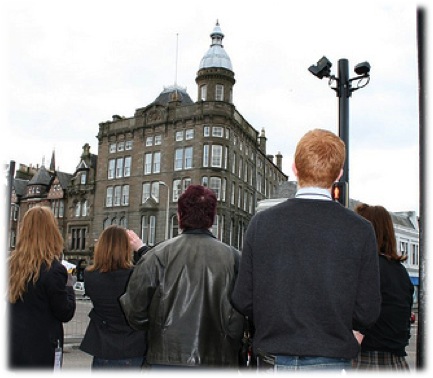
6) Record and answer in audio using their mobile phone or talking tin -

As well as the above the groups has to work as a team, persevere and look after each other while they were alone in the city! They all did very well!
@OnTheSuperFly recorded the journey of his group really well as a series of Flickr Images and an associated blog post. Most of the above photos are his as well.
When he got home Andrew McLaughlin re-created the excitement as a Go-Animate Animation! GoAnimate4Schools.com: Geocaching #gametolearn by Andrew McLaughlin
In summary, at the Consolarium we think geocaching and educaching had huge potential in schools to help support learning and we will be writing more about this very soon!
The Consolarium team is currently working with three local authority partners in Scotland to explore the application of The Land of Me in the Early Years setting. Having already started things off a couple of months back with Dundee City and West Lothian Councils we finally managed to kick things off today when we met Maggie Irving (check out her own site that has some great help for CfE) and the teachers involved in this stage of the initiative from Argyll and Bute. It was great to see that the teachers had been funded to take the day out of school in order to come to this initial event.
 Maggie Irving had planned for everyone to have a ‘fluid’ day in order for us to tease out and explore just how we might begin to plan for the use of The Land of Me. The consensus of opinion was that the last thing we wanted to create was a set of pre-planned activities that would be used by everyone and so there was a general discussion of how each of the six chapters could be used.
It is fair to say that Maggie Irving was particulalry taken with the The Land of Me so I took the opportunity to record our discussion about just why it was she thought it was so appealing. You can hear our discussion here:
(Transcript to follow)
The main points about the resource that Maggie raises are:
The teachers involved over the course of the day were delight to work with and they seemed to be of the opinion that the resource and the learning opportunities that could be exploited from it was something that they could use to great effect in their settings. Maggie was really pleased with her colleagues response to the day saying, “If this is the response from teaching staff then it will be fabulous to see what the kids do with it!”
In order to suport this initiative we introduced the teachers to the Land of Me area within Glow and this gave us a perfect opportunity to share the forums within Glow with them. CPDConsolarium was also shared with the teachers and we have asked that this becomes integral to how they manage their progress when using The Land of Me in their settings.
Future follow up posts about progress will be published over the next few months.
 What’s in a catchphrase? The shortest, snappiest, cleverest sound-bites can make a star of out even the most ordinary of us and in so doing win a Sony PS3 for your school/establishment at Game to Learn: Take2! on Saturday.
Yes, with one eye on the great Roy Walker (“say what you see”) we’d like to challenge you to the Consolarium Twitter Catchphrase Challenge! Get your thinking caps on, your Twitter account at the ready and come up with the catchiest catch-phrase that will meet this challenge:
Why is Game Based Learning and/or Game Design a success in schools?
If you don’t have a Twitter account then you can sign up for one here www.twitter.com. Once you have set this up and you wish to submit your catchy catchphrase then please ensure that you are within the 140 characters that a ‘tweet’ allows. You will also need to add this hashtag to your tweets #g2lcomp. The Consolarium team will look at this #g2lcomp stream over the course of the day and make a decision on the one that they feel is the catchiest catchphrase.
The most terrific, tastiest and topmost tweet takes home (to their school/educational establishment) a wonderful Sony PS3 with a copy of Little Big Planet AND Little Big Planet2!
Please Note: You must be at the conference venue to claim your prize.
If your tweet does not win then do not fear for there is the chance that you could yet be lucky as we have two desirable Nintendo DSi, a superb Nintendo Wii AND a fantastic Xbox 360 with Kinect to give away at the end of the day….details of you might get your hands one of these prizes to be given out on the day.
We wish to thank our friends at Sony, Nintendo & Microsoft for their support for Game to Learn.
*Guest post from Judi Regan and Dawn Calder at Menzieshill Nursery School, Dundee who are involved with our Kinectimals initiative. JUdi, along with het HT LOuise REid will be sharing their experience of using Kinectimals at Game to Learn: Take2! on Saturday 19 March 2011.
We’ve been investigating lots of ways that Kinectimals can develop learning in line with Curriculum for Excellence recently. For the purpose of the blog, we will look at one curricular area each update. This fortnight we are focusing on numeracy and in future updates we will discuss some of the other curricular areas. We have included the CfE code in brackets.
Through various aspects of the game the children have been learning to use number for practical purposes such as counting down using the on screen timer. Although the timer starts quite high, sometimes from 60, the children are able to join in the countdown from a number they recognise. Similarly, there are many other games, which develop counting skills such as throwing virtual soft toy piggies at skittles; kicking the ball, turning the skipping rope and many others. (MNU 0-02a)
Cross curricular opportunities for re-creating patterns, such as stripes, spots etc have been explored in our art and craft area. The children have been printing spots and stripes, and have been making masks of the various animals. (MNU 0-03a)
The children have been able to experience positional terminology, such as on top, behind, under, over and are learning left and right by the variety of movements required during the game. While kicking the virtual ball to burst bubbles, the player needs to move from side to side to receive the ball before kicking it back and when they do the assault course there is a great scope to use prepositions such as over, under, by, past, on, through etc. (MTH 0-17a)
Comments and thoughts from children and staff have been very positive since beginning this project. The children are saying every day, that they want to play Kinectimals and there is always a queue. Sharing and turn-taking skills are clearly being demonstrated here! When asked “What do you like best when you play Kinectimals?” responses included, “I like when you throw the ball” and from another, “I like it when you jump up and down”,(teaching the cub new tricks, such as jumping, star jumps, etc) and “I like it when you throw the piggies at the thingys!” (it’s dominos and skittles being referred to!) There has been lots of discussion around the water pistol activities and the children empathising (or not) with the cub who’s fur gets soaked! Admittedly, some of the games have required a degree of skill and it depends on which child and which adult is there as to who helps who!
Staff opinions have been positive also, despite some feeling slightly apprehensive about using the console, although after a short time, their confidence grows. The whole idea of using your hand/body to control the game has been a learning curve for everyone, and staff and children alike have been pleasantly surprised at how easy it is to get the hang of.
Parents and students have been quite incredulous that a nursery school is using a games console for learning opportunities, and a number have shared personal experience of using one at home. To this end, we are considering holding a Gaming evening in the future, for parent’s to come and have a go – and to share some of the educational benefits of games based learning.
In March 2010 representatives of LTS’ Consolarium team attended and participated in the Game Based Learning Conference in London. One of the conference presentations that we saw was from a company called Made in Me who were showcasing their as yet unreleased resource, Land of Me. The team found this resource to be instantly intriguing and it’s design, both aesthetic and pedagogic, was such that we approached the company to express and interest in trying the software out in Early Years settings in Scottish schools. Have a look at one of the chapters here:
One of the aspects of this resource that proved most appealing to us was that the designers had worked with Prof. John Siraj-Blatchford who has a long and illustrious record in academic publication and is seen, along with his wife Professor Iram Siraj-Batchford, as expert in the pedagogy of teaching and learning in the Early Years. The partnership between Dr. Blatchford and Land of Me led to a the design of a resource that aimed to immerse young learners in a beautiful and engaging world but in such a way that opportunities for deep learning and active participation could occur within the game but just as importantly, away from the game. This concept is what most interested us about this particular resource as we felt that it most certainly would help address the underlying principles of CfE and offer exciting and purposeful avenues for learning at Early Level and possibly beyond that.
The LTS/Land of Me Pilot
 Once the Land of Me was fully completed and ready to be launched to schools LTS negotiated a pilot programme to take place in Dundee City, Argyll & Bute and West Lothian Councils. This pilot is currently in its early stages with schools in Dundee and West Lothian already making great use of the resource with the Argyll & Bute schools due to come on board at the end of March.
As yet we have no firm data in terms of qualitative feedback from out partner schools other than a general feeling of delight and positivity in relation to how young learners are responding to this resource and the learning activities that can arise as a result of playing in and outwith the game.
This was evident in a recent feedback session in Dundee City from the teachers and Early Years Practitioners who working with us on the pilot. Their early feedback was very positive with some insightful observations about its use being fed back. Most of the feedback that was of the ‘wish’ variety focused on the activities that could be downloaded from the resource itself. Even so, the general feeling was that this resource has great potential with Chapter 4: Rythmn & Dance, where the learners/players have the opportunity to dance along with a family of Otters, appearing to be a particular favourite for the children in the Dundee schools! Can you do the crab, flamingo, tiger dance?
I took the opportunity at the event to speak to Maggie Llanwarne who is the Headteacher at Longhaugh Nursery School about her thoughts on the resource. Maggie was very impressed with the resource however her experienced eye also offered some formative fedback in terms of its design and how it can be used. Here is what Maggie had to say:
I also spoke with Bernadette Donald from Wallacetown Nursery School. Again her feedback was very positive but some formative ‘wishes’ were also suggested by this experienced practitioner in terms of the tasks/activities that can be downloaded as a part of the overall Land of Me experience: Here is what Bernadette had to say:
Some of the schools talked of how they were still exploring the resource whereas others talked of how having explored the resource, they were now beginning to embed Land of Me in to the daily life and learning of their children. We look forward to sharing the further experiences and thoughts of teachers and EYPs in Dundee and those of the teachers and EYPs in West Lothian and Argyll & Bute. If you are using this resource in your school please do tell us what your experience has been.
*There is a Land of Me Glow Group to support this initiative and any other teachers who might be using this resource in their particular setting. Please do feel free to contribute to this group.
Wow! What a response we have had to our Game To Learn afternoon practical workshops! More than half are fully booked and only a few spaces left in the others! As you can see from the table below, we’ve had great interest in our Game Design work shops that focus on Scratch, Build Your Own Blocks, Kodu, RPG Maker VX and 2Simple’s Purple Mash /2DIY as well as Thinkworlds 3D environment building session.
This demonstrates just how keen educators are in Scotland to equip themselves with skills to deliver the Game Design CfE outcomes in their classrooms. What is even more great to see is that it’s not just Computing teachers taking advantage of the sessions, but practioners from all over the curriculum – secondary and primary.
The three sessions that still have spaces in them promise to be an engaging experience for everyone involved.
NB – We will keep you updated via this blog and twitter (follow @gametolearn and the hashtag #gametolearn) should we receive any cancelations or find some more space in any of the full workshops.

|
 The Consolarium in partnership with JISC are delighted to be bringing the Game To Learn conference to the University of Abertay Dundee on Saturday 19th March.
The Saturday Programme offers both a fun-packed CPD event for teachers as well as a celebration of the diverse and innovative practice in games-based learning and game design that has been happening in schools across Scotland. Over the past few years the LTS Consolarium initiative has been working with partner schools across Scotland to help nurture the idea that commercially available computer games, that have been developed for entertainment, can be used to help create appealing, purposeful and challenging contexts for learning.
Game Design also offers learners of all ages to engage with the creative process in an engaging and contemprary way that really can facilitate effective CfE delivery. Throughout the morning seminars and afternoon workshops, delegates will have the opportunity to hear from practioners and their use of game design and get some hands on time with game design tools.
Half of the sessions are already fully booked so book your place now to avoid disappointment.
Sessions that are still available include, but not limited to ….
Read about our work with Nintendogs and the Nintendogs case study
Read about our work with the Kinectimals and our Professor Layton case study.
Read about our work with the Eyepet and Gerry’s experiences with Game Based Learning, and others’ experiences in the futurelab report
This may be especially of interest to languages teachers, active school coordinators, PE teachers, class teachers and deputes from Primary and Secondary schools who are interested in seeing how ‘subject specific’ game based learning projects can impact on the whole school.
Read about our work with Just Dance and My French Coach.
Phew! What a start to the day! Follow up your morning seminar with a spot of free lunch, the chance to talk to industry exhibitors then on to a practical, fun filled hands on session. Workshops still available include, but again not limited too..
Using RPG Maker VX to Help Tell Stories & Make Connections Across Learning
Mathew Reid, English Teacher, Garnock Academy, North Ayrshire
“If you’re asking, I’m dancing!” – Join Us for the Just Dance-athon!
Fiona Ferrie, PE Teacher, Doon Academy
Derek Robertson, National Adviser, Consolarium, Learning and Teaching Scotland
Purple Mash: Glow Resources and Game Design with 2DIY
Alan Yeoman, 2Simple Software
Playful, Outdoor and Blended Learning Using GPS
Ollie Bray, National Adviser for Emerging Technologies in Learning, Learning & Teaching Scotland
What are you waitng for? Get your game on now … for FREE!
Hope to see you all on Saturday 19th March 2011
 The Eyepet for the Sony PS3 is a resource that the Consolarium team believe has great potential in schools. The promise of an augmented reality Nintendogs type character on the big screen that could be interacted with by groups of children was something that we felt would prove to be a magical experience for young learners. When we first hatched and played with our Eyepet at the Consolarium we experienced for ourselves the power of this technology and we immediately began discussing just what this could bring to teaching and learning. We were enchanted with this beautiful yet vulnerable little creature and after much hand waving in mid-air our Eyepet came to trust us and looking after it became part of our day.
We put Eyepets in a number of schools across Scotland to see how teachers might begin to integrate the resource into their teaching. Cathkin Community Nursery in South Lanarkshire made superb use of their Eyepet and its application in the learning experiences of their learners was commented on favourably by HMIE. We have also spoken with many other teachers who have had similarly positive experiences however we have also had some teachers who have felt that the resource is not for them or for their children because it is too difficult to use. There is a knack to controlling the Eyepet with the card that is supplied (feeding the Eyepet and throwing biscuits for it is really quite tricky when you first start) so maybe this is a training issue for the Consolarium team. The advent of the Move controller for the PS3 has made this aspect of using the Eyepet a lot easier though. This being said there are many teachers in schools that we are working with who are making great progress with the resource as it is.
On a recent visit to Islay I visited Port Charlotte PS where I was introduced to P2-3 teacher Catherine MacMillan. Catherine is one of the teachers in Argyll & Bute who is working with the Eyepet this term. I was introduced to her class, some of whom were working away in the corner about to hatch their first Eyepet. Here they are going through the initial stages of the hatching process:
After the Eyepet had hatched it had to be scanned to see if it was hungry or not. Here we see the children scanning their new Eyepet to see if it requires feeding or not. :
 Whenever I have seen the Eyepet used in schools I am always drawn to the look of concentration and involvement on the faces of the children as they play/learn with the resource. Can you see that on the children’s faces here? It also has to be said that the thoughtful and considered application of this engaging resource by teachers really can ‘make learning more creative, challenging and fun.’ This is most certainly the case with Catherine MacMillan because as we talked I quickly saw how she had seen the potential of this resource and just how it could help her deliver learning experiences in Curriculum for Excellence that would offer the challenge, demand and appeal that Port Charlotte PS expects. Her initial foray into making links to other curricular areas was focused on Writing. She saw the perfect opportunity to capitalise on the supportive discussions that were naturally occurring in the children’s groups when they were showing each other what to do with the Eyepet. This instruction giving would be explored further as part of a purposeful and relevant writing activity focusing on instruction writing. One could associate this activity with this Outcome from CfE:
“I am learning to use my notes and other types of writing to help me understand information and ideas, explore problems, generate and develop ideas or create new text.” LIT 1-25a
Have a look at some of the children’s writing:
Here is Catherine talking about how she planned for this activity and how the Eyepet is helping her deliver this aspect of her teaching.
As Catherine and I talked the children played away quite confidently and contentedly and took charge of looking after their new Eyepet. I took the opportunity to continue talking about just what technologies such as games can bring to the classroom. Catherine had clearly given some serious thought to the application and appeal of a resource such as the Eyepet and as we talked she focused on the following aspects as positive reasons to use the Eyepet and also what she had seen for herself in the short time that she had been using the resource:
As you can see from the video, the children still carried on working independently as we chatted. So much so that even when the bell rang it took some encouraging to get the children away from their Eyepet and out to play:
We also discussed how, amongst other things, Catherine and her colleagues are using the Eyepet to aid transition from the nursery class to Primary 1. You can hear our discussion (over the children using the hairdryer to dry their Eyepet) here:
Transcript of discussion with Catherine MacMillan
We will be sharing some more experiences of teachers in Scottish classrooms who are using the Eyepet over the coming months. No doubt we will see some more innovative yet grounded practice from many of the teachers currently using the resource. If you are using this resource in your own setting then please do get in touch and share with us what your experience has been.
At the Game To Learn: Take2! Conference in Dundee on Saturday 19 March Brian McLaren, DHT Clackmannan PS (ex Consolarium Development Officer) will be delivering a seminar in which he will talk about his experience of leading the Eyepet initiative for the Consolarium. Come along to hear what Brian has to say.
*Full transcription of videos to come
*Guest post from Stuart Meldrum at Hawick High School who is involved with our rapid prototyping initiative.
“Cool sir! That looks amazing!…but what is it?”
 That is generally the reaction from pupils (and staff) when they first set eyes on the RapMan currently sitting in my classroom. This fantastic monster looks like it has been pieced together with whatever spare parts were lying around the workshop and that isn’t actually too far from the truth. The kit that LTScotland have provided to three schools was essentially a thousand piece jigsaw, where the parts are all standard components like nuts, bolts, and washers, with some laser cut acrylic sheets thrown in. This meant that a lot of my time was spent piecing it all together, this is not a quick task! There is a prebuilt version available for quite a bit more cash.
For the uninitiated the RapMan is one example of a Rapid-Prototyper. This essentially means that it is a machine that can print in 3 dimensions, but instead of leaving a trail of ink the RapMan has a head that can move in two directions and pulls though a filament of plastic, heating it as it moves. The melted plastic is trailled over a bed and a 2D shape is laid out. Then the bed is lowered and the head starts leaving another trail on top of the first. Over time and successive layers the melted plastic fuses together to build up a 3D shape.
For years in Design and Technology departments we have been drawing and designing things in 3D using CAD software but now we have an affordable method or realising these designs. Normally the cost of this sort of machine puts it well out of reach of schools.
Now that our RapMan is up and running in Hawick High School we have loads of ideas as to how we could start to use it in our courses. It lends itself naturally to Product Design where pupils have to create models of their designs, but it fits in all the way down the school too. Also, now that Computer Aided Manufacture is explicitly mentioned in the Level 3 and Level 4 Outcomes and Experiences (TCH 3.13 and TCH 4.15) schools will be increasingly looking to use this technology.
Listen to Stuart’s take on the challenges that he has faced in trying to get the rapid protoyping kit up and running in Hawick High School.
Although we are heavily focused on game based learning and games design at the Consolarium our remit also includes exploring other emerging technologies and how these can impact on teaching and learning. To this end we are currently working with schools in Argyll & Bute, Scottish Borders and Edinburgh City to explore how rapid prototyping kit might be able to play a part in the Design & Technology curriculum.
 What this kit allows us to do is create 3D objects that can then be ‘printed’ in 3D form via the Rapman. This could allow you to create piece of jewellery for example on the computer, in 3D form, and for this to be printed out in 3D form.
We purchased three sets of kit from Anarkik 3D that would enable us to begin this work. This kit includes the Falcon 3D Mouse, the Rapman 3D printer and the Cloud 9 software. The Rapman 3D printer can be purchased fully assembled or in flat pack. Obviously the costs are less for the flat packed version.
I visited Islay High School in Argyll & Bute recently where I met with Ian Stuart who is looking to integrate this kit in to the Design & Tech experiences of his pupils. The day that I arrived I saw the pupils using the software and the 3D mouse to create a pendant that could be attached to a necklace. The school is still in the very early stages of getting to grips with this kit and over the past few months it is fair to say that it has faced some challenges particularly in relation to the construction of the flat-packed Rapman printer. Their experiences to date were captured in this chat with Ian Stuart.
Transcript of discussion with Ian Stuart
Even though it is clear that the flat packed option of the Rapman 3D printer does mean an investment of time and effort in order to build it I have to say that what I saw at Islay HS suggests that this kit can really play a part in pupils experiences of Product Design and Computer Aided Manufacture. Some of the pupils’ designs were rather impressive and their feedback about using the Falcon 3D mouse was very positive.
We will follow up and report on the experiences of Islay HS with this exciting resource.
Just what can a game such as Just Dance for the Wii bring to the life of a school? How can it impact on girls attitudes to physical exercise and what can it do to encourage a whole school to be active? This post shares the experience of the teachers and pupils at Doon Academy in Scotland and how their partnership with LTS' Consolarium team helped explore this game based learning resource. Watch out for the video and audio material towards the end of the post.
At the Consolarium we have a long history in trying out games built for entertainment in the educational setting. This has been particularly true of games such as Nintendogs and Eyepet. These games were most definitely built for entertainment but the educational potential within these superb digital experiences is fantastic. As always, we continue to look to see what else can be explored in the games world in terms of its appropriate use in teaching and learning contexts…
The Kinect system for Microsoft’s Xbox360 games console was something that we greatly anticipated, particularity when we saw how the game Kinectimals might allow us to continue the theme of caring and nurturing for a digital creature/pet that was central to the experience in using Nintendogs and the Eyepet. If you haven’t seen Kinectimals then have a quick look:
As you can see we have the most wonderful participative world that has no controller but the player/players themselves! Just what, we wondered, could such a resource bring to the classroom and how it could support opportunities to develop rich learning experiences within Curriculum for Excellence.
Having shared this idea and proposed pilot project with the delegates at the LTS Early Years conference in November 2010 we were approached by Judi Regan from Menzieshill Nursery School in Dundee who said that she’d be more than willing to try out the resource in her setting. This agreed and after a discussion about its possible use we loaned the kit out to the school and let them get on with it. Alas, as is often the case with educational technology in schools, some technical issues presented some small hurdles that had to be cleared before any teaching and learning could be addressed! Issues related to linking up the audio to a pair of old PC speakers were eventually rectified and it was all systems go (apart from a scratched disc that had to be replaced)!
 The resource was introduced to the staff by Judi and Louise Reid at last week’s in-service day and this was followed up today by me when I spent all morning working with various groups of children and their workers in order to set up profiles and start them on their journey with Kinectimals. It must be said that initial reactions to the resource from the children varied from bemusement to excitement but with very many of them wanting to know when it would be their turn!
Lousie Reid (Acting Head) and Judi Regan will be sharing their experiences via guest blogposts on our site over the next few weeks as well as through their seminar at the Game To Learn: Take 2! GBL Conference in Dundee on Saturday 19 March. Come along to hear their story and in the meantime have a listen to our chat with Judi about the early beginnings of their Kinectimals project.
Judi Regan discussion transcript
If you are also using Kinectimals in your seting we’d love to hear from you. Watch out for the developing story from the team and children at Menzieshill Nursery School.
Learning about word, excel and powerpoint is not going to give you a career in the high tech creative industries.

At the Consolarium, we have been developing resources and capacity throughout Scotland in the area of Game Design. We were delighted to have one of our pilot schools, Girvan Primary School involved with this project. This is the trailer that has been produced for the Livingston Hope Skills Review. Near the start of the film, teacher Avril Denton and her class celebrate their achievements in Game Design with Kodu from Microsoft. You can read more about the pupils experience in Girvan Primary School here
The review itself illustrates the need for building capacity in digital creation from an early age in schools in the UK. Our new Curriculum for Excellence recognises this, and has explicit outcomes relating to game design and digital creation. We really need to embrace this area and give all our learners the opportunity for culturally relevant creativity and challenge. At the Consolarium we will continue to develop resources to support learners and teachers in Scotland in game design tools and techniques.
The NESTA report can be found on the NESTA home page.
Read Part 1 here
In S3, pupils have a fairly developed knowledge of French and my class has initially enjoyed playing the game and progressing through levels for the first couple of weeks of its used.
They soon needed to be more challenged and felt that the “compare” tool (repeating phrases) was making them feel self aware in front of others in the class.

Pupils were asked to work in pairs in order to create a conversation in French using the My French Coach software. They were invited to choose a topic of their choice and make reference to their consolidated knowledge of French in order to create sentences which were grammatically and structurally correct. Their task was flexible in terms of length, vocabulary, originality, use of humour and props, etc…
Previously, pupils had only practised very short, set up role plays in class on specific topics.
Pupils first familiarised themselves with the phrase book and dictionary tools. Each pair then discussed and agreed on a topic and started constructing their sentences being able to get confident with unknown vocabulary using the “compare tool” in order to learn and practice the pronunciation of their new words.
The phrase book tool offers a variety of topics (such as holidays, greetings, shopping…), most of which haven’t been taught in class.
Below, we can see a short clip of pupils discussing their role play using the DS.
Once the task was completed, pupils were filmed, performing their role play and were asked to assess each other as follows
Pupil A: “It’d be good if the phrase book focussed more on topics studied in French such as school, but the compare tool helps with pronunciation.”
Pupil B: “I enjoyed using the DS and feel it’d be good if there was a voice recognition device where you can record your Standard Grade speaking pieces and it would then be said by a French person!”
I feel this task has been very well received by my pupils. They felt it was something exciting to do and it really raised their confidence in speaking French as well as thinking about their next steps in order to make progress.
During the preparation of their task, pupils needed teacher’s help but a lot less than for other types of writing work. I also felt that pupils were “on task” and developed their social skills without realising: compromising, working as part of a team, listening to others’ views, use of praise and being considerate: “is it ok to use stereotype? Will I offend someone?”
Below is an example of the role plays produced by the pupils.
Finally, we can see the critera chosen, and the feedback given by the pupils.
Read Part 1 here

When first playing my French Coach, the user takes a test which sets their initial comprehension of the French language. The player is then placed into a level reflective of their score. A player who scores highly will be able to skip many of the initial levels and more basic concepts.
When starting a lesson, the player is shown ten new words, which include nouns, verbs, adjectives, or adverbs, as well as their meanings and pronunciation.
The software also includes a dictionary and phrase book, complete with audio pronunciations and the facility to record your own pronunciation for comparison purposes.
Hélène Clark, Modern Languages teacher at Firrhill High School in Edinburgh, has used My French Coach with her S1 – S3 classes between September and December 2010. This is the first of 3 blog posts which will document some of her work with pupils using the software.
In S1, pupils have a limited knowledge of French and my classes have enjoyed playing the game and progressing through levels for 15-20 minutes use about twice a week.
Pupils have been keeping a record of their progress at the back of their jotters, reflecting on their learning and noting new words they have learned. This coupled with the individuals user profile on the software allows the pupils to see how they are progressing with the language in a contemporary, familiar way that many of them are used to seeing with their social network profiles and console game profiles. In order to unlock different areas and types of game, pupils must master words. This has proven to be a highly motivating factor.
While the game itself is a useful and motivating tool, Helene used other parts of the software as learning tool. Below is a summary of one of the tasks.
Pupils were asked to work in groups in order to create sentences using prepositions which they had learnt in class: sur, sous, dans, devant, derrière
Previously, pupils were taught how to create sentences using words they had been taught in class eg: Le chat est sur la table.
Each group was then given a photo/drawing (similar to the one below) that had unfamiliar animals, objects and rooms in them.

In groups, pupils used the My French Coach dictionary to inspire them in completing the task,
Pupils were already familiar with the dictionary tool available in the software. They were asked to examine the pictures given to them and construct descriptive sentences, using DS dictionary to find and learn unfamiliar words, including learning the pronunciation of their new words. (using the “compare” tool)
NOTE – One drawback of using the dictionary on the “My French Coach” software is that it does not give the gender of nouns and doesn’t specify if the French word given is a noun, adverb or verb. Therefore, a broader understanding of the language is necessary and S1 pupils needed to use a “paper dictionary” in order to find the gender: masculine (le) / feminine (la)
When asked about the task, pupils felt assertive about expressing their opinions:
Pupil A: “the software is very useful but it should be changed so that we can see the gender”
Pupil B: “Looking up words on the DS is fast and easier than a paper dictionary”
Pupil C: “Some words aren’t on the DS dictionary”
Pupil D: “The DS tells you how to pronounce words and makes me happier to talk French”
I started using the Nintendo DS consoles in August 2010, at the beginning of the new school year. I didn’t know my S1 students. The first thing I noticed is that using the Nintendo DS has helped me establish a strong, positive relationship with my new classes very quickly. The mention of the project created motivation, excitement and engagement with technology relevant to pupils.
The initial test and progressing through levels lead naturally to peer evaluation, informal discussions, bonding of class members, meaningful reward in the context of the game and meeting each student’s needs – for example:
A lower attaining ADHD pupil, who can be quite restless, started at level 1 after his initial test. He felt frustrated, knew very little French but was engaged and motivated to learn with the DS. Progressing through levels was very meaningful to him. As a result, he has made incredible progress. He may spend 20 minutes to produce 3 French sentences but he thinks thoroughly about the structure of the language and always tries to achieve his full potential. He also learns his vocabulary after each lesson as he has understood the importance of building on his own knowledge. In class, he is always positive, calm and hardworking despite his condition.
A very able, slightly over confident pupil started at level 12 after his initial test. He started by showing off to the rest of the class which didn’t make him very popular in class discussions. However, he soon realised that it was very difficult for him to progress through the levels as the game gets more challenging. He also realised that he was often rushing his work and was missing on important information or making various mistakes from grammar, spelling or structure. His attitude has now changed as he is being more conscientious on his DS or class work. He also often offers to support other pupils, using his own ability and mistakes to helping others in the class. His relationship with the rest of the class is also more positive.
I believe using the game as one tool in my classroom, has helped create an engaging climate for learning for all pupils. I have observed my pupils demonstrating the 4 capacities of Curriculum for Excellence: successful learner, confident individual, responsible citizen and effective contributor.
You can contact Hélène at Helene.Clark@firrhill.edin.sch.uk
Read Part 2 here
 How long does it take to fall one thousand feet? Ok, 7.9 seconds is the answer. How long would it then take to fall 2000ft then 4000ft then 8000ft. As I thought through these answers I couldn’t help think of the old cartoon with Wiley Coyoye and the Roadrunner and the Acme contraptions that often lead to precipitous falls. However, moving away from the trivial to the extraordinary let me share Wolfram Alpha with you.
Wolfram Alphas is a ‘computational knowledge engine’. Wolfram Alpha introduces a fundamentally new way to get knowledge and answers—not by searching the web, but by doing dynamic computations based on a vast collection of built-in data, algorithms, and methods.
I was tremendously impressed with this resource and incredibly motivated to learn from it. The example I quoted at the beginning of this post came to my mind when I was searching through the examples that are available on the site. I saw the question ‘Compute how long to fall 1000ft.’ Once I saw this and then looked at the formula I had flashbacks to my youth in school with Higher Maths and how much I really did enjoy using maths that had a practical application and that was applied to contexts that had meaning. These opportunities back then were few and far between I may add.
Here are some other examples from the site that had me totally absorbed:
This resource has great potential. There are clear cross-0vers in to a variety of areas of interest and the ways in which this can be used to help address numeracy across learning for CfE and how it can have particular applied use in Maths, Physics and Chemistry is there to be explored. If you are a school in Scotland that intends to tap in to this excellent resource then please do let us know so that we can document just how this can help learners learn.
When the Consolarium team talk about the use of games in schools they always talk about the benefits of creating learning opportunities that are situated within the cultural framework of learners. We feel that this is one of the main reasons as to why our ideas in using Guitar Hero for example worked so well. This game initially built for entertainment has become very popular thanks to the initial ideas and practice that showed how ‘traditional learning’ such as writing could be made even more appealing, relevant and purposeful to learners.
Steve Bunce shares this view. He currently leads CPD for teachers in England through his work with Vital and has been a major player in building understanding, practice and capacity for game based learning in schools in England. One of the projects that Steve has been working on recently has involved a skateboarding game that works with the Wii, Skate it. Have a look:
This video review shows the game and the controller in action.
I managed to grab a few minutes of Steve’s time at the Learning Without Frontiers conference in London earlier this week where he gave me an explanation of what he has been doing with this game. Have a listen
Another speaker at this event proved to be incredibly interesting and much of what he said gave me some food for thought in terms of the riole that open source software can be used in schools. Evan Roth is an artist who works in Paris. work is in the permanent collection of the MoMA (NYC) and has been exhibited widely in the Americas, Europe and Asia, including the Pompidou (Paris), the Kunsthalle (Vienna), the Tate (London), the Fondation Cartier (Paris) and the front page of Youtube. Roth has received numerous awards for his work, including the Golden Nica from Prix Ars Electronica, Rhizome/The New Museum commissions (2007, 2009), the Future Everything Award and Brit Insurance Designs of the Year (1, 2).
He is also a co-founder of Graffiti Research Lab and the Free Art & Technology Lab (F.A.T. Lab), a web based, open source research and development lab.
Have a look at how they have subverted this Michael Jackson performance using open source software:
Evan Roth provides full access to all the materials and code associated with this clever piece of work from this part of his site.
Some of these ideas might be just outwith the boundaries of education in schools for some but the more we see how contexts that engage learners due to the experiences and content being something that sits within their cultural framework, is something that resonates with them, excites them – then maybe we should be exploring the practical application of these so that we can really meet learners needs and help them grow and flourish.