Log on:
Powered by Elgg

Feed detail

July 23, 2012

Embrace the medium

One of the perennial problems teachers face, especially in early years education, is trying to get children to write. The main problem is that children are expected to write in a vacuum, for an audience of one (the teacher). There is often very little incentive in this exercise for kids, who would probably rather be doing other things with their time like playing on their Nintendo. But several schools are beginning to address this 'won't write' problem by making it entertaining and productive through the use of social media. In an article entitled Could blogging be the key to raising a generation of great writers? Liz Dwyer argues for creating audiences online for children to write for:

'"I don't like to write." That's the refrain teachers have heard for a generation when they ask students why they're struggling to complete a short, three-paragraph essay. Thankfully, more and more educators are using two things kids love, technology and social media, to change that. By encouraging students to write on their own blogs, savvy teachers are helping kids take their writing out of the classroom vacuum, and cultivate a broader audience.'

Liz is right of course. Children raise their game when they know they are being watched, so why should it be any different with writing? David Mitchell, Acting Head Teacher at Bolton's Heathfield Primary School is a great advocate of blogging as a means to develop children's writing skills. He reveals that some children are proactive
in setting up their own blogs when they realise they can write for a large audience and actually receive feedback. Many of the children at Heathfield have become avid bloggers, and the results of this are clear for all to see. According to David, some children within the school have raised their literacy attainment scores by two full levels. Blogging is gaining ground, and it's not that hard to set up for a group of children in your own school. Some teachers reading this might ask the question: What about internet safety and child protection? Well, I could answer here and now, but I won't. Instead, I'll let Liz Dwyer answer:

'Concerns about online privacy have historically made teachers wary of allowing students to blog, but the rise of platforms built specifically for students has made blogging safer for kids of all ages. Plus, in our networked 21st century world, more teachers are already taking precautions by talking about internet safety, telling kids not to reveal their home addresses or engage in online bullying. Let's hope more teachers embrace the medium and let their students get some real-world writing experience.'


This post as first published on August 4, 2011.

Image by WallMic


Creative Commons License
Getting the bloggers to write by Steve Wheeler is licensed under a Creative Commons Attribution-NonCommercial-ShareAlike 3.0 Unported License.


July 20, 2012

Sorting the wheat from the chaff

There has been discussion recently about whether or not blog comments should be moderated. Some maintain an 'open for all' policy, and allow any comments to be posted on their blog. They do so for a number of reasons. Some wish to make posting comments as easy as possible, and want their blog to be as welcoming as it can be. Others do not have the time to moderate all the comments that are posted to their site. It's a very democratic approach.

Several years ago, I took the decision to moderate comments on my own blog, not because I'm undemocratic, but because there are two kinds of comment I will not allow to be published. The first kind are comments that come from people who will be politely referred to as 'trolls'. Trolls post hateful, destructive, off-topic and inflammatory comments, because they enjoy provoking emotional responses and upsetting others. You can imagine how heart breaking that kind of comment could be for children who are blogging. In the UK, under the Communications Act of 2003 it is an offence to send messages that are of grossly offensive, obscene, indecent or menacing character. Two recent court cases have resulted in internet trolls being successfully prosecuted and sentenced to prison. For whatever reasons these individuals post such comments, I don't want that kind of content on my blog, so I usually screen for them, and delete them if I receive them. I dealt with one of my own personal trolls several years ago by openly writing about them here in Dear eLearning 101.

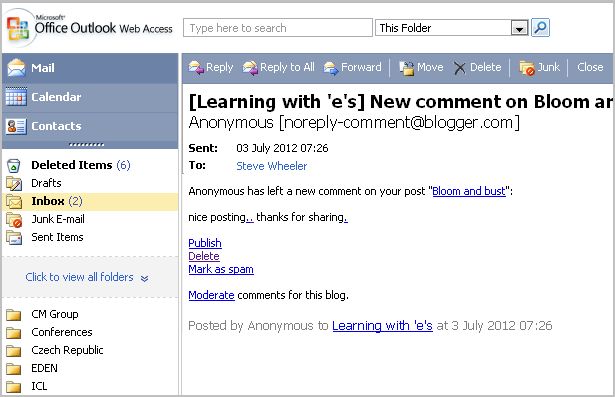
The second reason I moderate my blog comments is due to the increase in spam comments that are coming through, sometimes several each day. This blog currently has an average of 125,000 visitors each month, so the spam messages can be frequent. You can easily recognise most spam messages because they are sychophantic and painfully complimentary, sometimes very bland, and often written in appallingly bad English. They always contain at least one hyperlink. The example (above) is a fairly clear cut case of some sad person desperately trying to get people to click on their links. Who knows what the links contain? They could take you to dodgy sites or open you up for a virus attack.

I don't want these comments on my blog for a number of reasons. I don't want my readers exposed to dangerous links that may infect their computers with a virus or subject them to hacking. Secondly, I only want relevant and useful comments to appear on my blog. Anyone who wishes to comment constructively on my blog is very welcome to do so, but I won't accept spurious or irrelevant contributions. Finally, look at the example below - probably one of the most subtle spam comments I have received recently. Note that there are two hyperlinks, almost invisible in the post. Can you spot them?


Now you know why I screen all the comments submitted to this blog. I want to promote great discussions here, but to do so, I occasionally have to sort the wheat from the chaff. Do you moderate your blog comments, and if so why?


Creative Commons License
Sorting the wheat from the chaff by Steve Wheeler is licensed under a Creative Commons Attribution 3.0 Unported LicenseBased on a work at steve-wheeler.blogspot.com.


July 18, 2012

Reading the World

Two years ago I started sharing my thoughts about digital literacies. I wrote a series of blog posts arguing that multiple literacies are needed to make sense of the digital media we use. More recently, people have been asking me what I think is the difference between a literacy and a skill. It's a question that often turns up in plenary discussions at conferences. Let me try to address this question:

Skill is a dexterity or ability that comes from your knowledge and aptitude, and manifests itself in being able to do something well. Writing is a skill, but it is also a literacy. In fact it constitutes a set of literacies. Literacy goes beyond skill. Lankshear and Knobel (2006) argued for the 'embeddedness' of literacy within wider social practices. Their reasoning is that the act of writing involves more than the reproduction of a sequence of letters, words, sentences and paragraphs. Words in isolation mean very little - it is the context within which they are located that invests meaning. My recent post on blogging as literacy hopefully illustrates this logic. Literacy is therefore more than a skill. It is the capability to be able to interpret meaning within context. I often give the example of learning to drive to explain this concept.

When I learnt to drive in England, I learned all the basic skills needed to be a (reasonably) safe motorist, and thus to earn my driving licence. Mirror, signal, manoeuvre is still emblazoned upon my memory. Stopping at traffic lights, knowing what the colours of the lights mean, and reading the road signs, are all essentials of driving. But many of the skills I learnt are peculiarly British. Driving on the left hand side of the road is only common in a few countries around the world. When I found myself driving my family around France for our holiday a few years ago, I realised that my driving skills were not enough to be fully proficient. I was driving on the other side of the road for a start. We had to drive counterclockwise around roundabouts, and trying the interpret some of the road signs was taxing to say the least. It was also confusing to note that drivers there kept their indicators on whilst overtaking other vehicles - something we don't do in the UK. It took a week of driving around France before I began to feel comfortable. I had by then begun to developing some of the literacies - the cultural and social awareness of the new country I was staying in - and was starting to appreciate some of the nuances and social mores of driving in France. The same thing happened to me when I drove for the first time in America. There you find very few roundabouts, but you do encounter many four way road junctions. Here the unwritten rules are quite interesting, and I had to discover for myself what sequence people are expected to follow to drive across the junction when there are no traffic signals. Lankshear and Knobel cite the work of Freire (1972) who claimed that literacy was not only reading the word, but also reading the world. Authentic learning comes through immersion within the culture. This clearly resonates with the explanations above.

Digital literacies are characterised through the appropriate interpretation and use of digital media and technology. Literacies of this kind are acquired as the learner engages with the culture, mediated through the tools. You learn through social engagement online for example, that typing words in UPPERCASE represents shouting. It's a part of the social etiquette (or 'netiquette') of using social media, e-mail and texting tools. Many of these literacies are learnt serendipitously - through encountering problems and solving them while using digital tools. The question we should now ask is, should we be teaching these literacies more formally in schools, colleges and universities, and if so, how will we go about it?


References
Freire, P. (1972) Pedagogy of the Oppressed. Harmondsworth: Penguin.
Lankshear, C. and Knobel, M. (2006) New Literacies: Everyday practices and classroom learning. Maidenhead: McGraw Hill/Open University Press.

Image by Freefoto

Creative Commons License
Reading the World by Steve Wheeler is licensed under a Creative Commons Attribution 3.0 Unported LicenseBased on a work at steve-wheeler.blogspot.com.


July 16, 2012

Reciprocity failure

I once trained as a photographer. We learnt a lot of practical skills, such as how to light a subject in studio conditions, and we learnt about exposure rates and shutter speeds. Because I trained in the pre-digital era, we spent a lot of time in the darkroom, fiddling blindly with developer containers and stumbling around fumbling for the light switch. We also learnt a lot of technical and theoretical content. One of the more important things I learnt was the theory of reciprocity. Essentially, there is a balance between shutter speed and aperture (the iris of the lens). Simplified, it meant that the lower you set the shutter speed, the narrower the aperture had to be and vice versa. We learnt that aperture values needed to match shutter speeds, otherwise the resulting image would be poor. Failure to take account of this would result in reciprocity failure, and this was particularly evident in low light situations. Today's digital cameras are generally automatic. You point and click, and you have your photograph.

Today, few people understand or care about the old photographic theories, because with contemporary technology, few apply. But nothing you learn is ever wasted. I wrote in my previous blog post about reciprocity learning, where I discussed the sharing culture emerging through social media. I suggested that Personal Learning Networks would not be able to function if people failed to share their ideas and content freely. But we can take this a step further. At present in the UK we have a silo system of education and training. Children learn in primary and then secondary school, leaving at around 16 years old to enter vocational education (Further education) or they stay on for another two years (in either secondary school or further education) to gain additional qualifications that will gain them entry into Higher Education. When they gain their degree or vocational qualification they generally seek employment. Once in their chosen career, they will receive on the job training, and the Learning and Development (L and D) department will ensure that they are equipped to do their jobs.

Do L and D departments and companies talk to the schools? Occasionally, but not that often. Are schools aware of the needs of the business sector? Sometimes, but not as much as they should be. There should clearly be a relationship between what is taught in schools and what is taught in L and D, but how many can actually understand the links? It's obvious to me that a kind of reciprocity failure has occurred. There is a mismatch between what schools teach and what businesses want. This is because there is still little or no communication between schools and businesses. This needs to change. Schools and businesses need much more dialogue. Businesses need to be working with the schools, and children need to gain more understanding of the world of work while they are still in school. Sure, we see a limited amount of work placement (usually one week) for students when they are 15 years old. But is this enough to help them to understand what it will be like when they eventually work full time? What are our schools missing? Do businesses understand what goes on in schools to prepare children for a world of work? We need to break down the silos and establish some seamless progression from school, through training, to the workplace. This can only be achieved through better dialogue. Innovative practices are evident in schools and in the corporate sector. These need to be shared by both. At the moment, this isn't happening, which means we are still stumbling around in the dark.

Photo by Steve Wheeler

Creative Commons License
Reciprocity failure by Steve Wheeler is licensed under a Creative Commons Attribution 3.0 Unported LicenseBased on a work at steve-wheeler.blogspot.com.


July 13, 2012

Reciprocity learning

I watched this morning's PLE conference (#pleconf) unkeynote by Grainne Conole and Ricardo Torres Kompen, which was streamed live from Aveiro, in Portugal. In it, they represented a number of perspectives on personal learning environments, including a discussion on the differential between institutionally managed Virtual Learning Environments (or VLEs) and the free tools that learners are now using on the web. Particularly emphasised was the power and capability of the personal learning network (or PLN) which can not only save you time when you are looking for the answer, but can also lock you into a huge network of like-minded individuals, from where you can 'distribute your knowledge'. We are indeed 'distributed beings', said Grainne, perhaps invoking the work of Mark Curtis.

There was much food for thought, but the conversation that struck me the most, was between them and one of the delegates in the hall, Ilona Buchem (aka @mediendidaktik). Grainne and Ricardo had crowdsourced much of their presentation, through a series of video clips, blogs and tweets. Reflecting this willingness to participate, Ilona suggested that much of the power of the PLN is owed to the willingness of participants to share their knowledge with each other freely. The old adage 'you scratch my back, and I'll scratch yours' has never been so well applied as it is to does to the PLN. This kind of reciprocity occurs because people are willing to share, and in so doing, are free to then gain access to the sharing of the other members of their community. It's a kind of membership fee of the largest community on the planet - the network of networks that many millions of people are making use of to connect to each other, to ideas, knowledge and experiences beyond their own immediate physical sphere.

The psychologist Leon Festinger developed social comparison theory - a theory that attempted to explain how people relate to each other psychologically. He suggested that we compare ourselves to others often subconsciously, and then attempt to improve our own positions and gain more accurate self evaluation. It is very much rooted in the traditions of symbolic interactionism (see for example the work of Charles Cooley or George Herbert Mead). Social comparison, in Festinger's terms, is not considered to be a form of competition, but more likely will be to elicit a feeling of belonging within our chosen community. It goes farther. Most would agree that the act of self-disclosure at the start of a relationship can garner a similar response from others. Self disclosure reveals something personal or subjective about yourself. If I remark that I come from Plymouth in South West of England (personal information), the person I am conversing with is more likely to reciprocate by telling me where they are from, or may even remark on their interest in England, or Plymouth, some allied topic such as Sir Francis Drake or the Mayflower. It breaks the ice to self disclose.

In the same way, reciprocity learning relies on the willingness of both parties to give freely. I have written before about the merits of giving your stuff away for free. You never fail to be rewarded. We are, in Mark Zuckerberg's terms, living within a gift ecology - where without freely offered knowledge, and a little give and take, we would all be much poorer.

Image by Chris Ishikawa (NB: Chris made his cute animal image free for use under a CC licence, so his photo gains a wider audience on this blog. Other photographers chose not to offer their cute animal photos in the same way, so they miss out on you appreciating their artistry. Just saying....)

Creative Commons License
Reciprocity learning by Steve Wheeler is licensed under a Creative Commons Attribution 3.0 Unported LicenseBased on a work at steve-wheeler.blogspot.com.


July 11, 2012

My Personal Learning Network

I was asked by Grainne Conole to record a short video on my views about Personal Learning Networks, VLEs vs PLEs and other related topics, as a contribution toward her unkeynote with Ricardo Torres Kompen for the PLE conference in Aviero, Portugal this week. Well, here it is, as a short 3 minute video on YouTube:


Creative Commons License
My Personal Learning Network by Steve Wheeler is licensed under a Creative Commons Attribution 3.0 Unported License.
Based on a work at steve-wheeler.blogspot.com.


July 10, 2012

We're better connected

I recently presented at a conference with my Plymouth University colleagues Peter Yeomans and Oliver Quinlan. We had planned to present a version of this paper at the annual EDEN Conference held in June in Portugal, but for one reason or another, none of us were able to make it. This is probably the first time we have presented as a team, and I hope it is the first of many future conference appearances together. The result can be found as a 20 minute YouTube video - Connected: Supporting Student Blogging and Communities of Learning - complete with audio track and slides below:


Pete, Oliver and I spoke about the work we have been doing with undergraduate teacher students in Plymouth, using a variety of social media, including blogging and Twitter to support and encourage critical and reflective learning. The important concept we wanted to talk about was communities of learning, and how students can use social media tools to participate in them. Peter talked about the power of social media to create a Personal Learning Network (PLN) and also discussed the ways students manage their online presence. Oliver presented some case studies of how students have successfully harnessed the power of social media tools to gain a foothold in the teaching profession and promote learning. The final section of the presentation, which I presented, dealt with some of the pedagogical theory and implications. I talked about connectivism, paragogy, heutagogy and other emerging theories that seek to explain how we learn in new digitally rich environments. We hope you enjoy listening to the presentation and following the slides. We look forward to reading any comments you may have on the presentation.

Creative Commons License
We're better connected by Steve Wheeler is licensed under a Creative Commons Attribution 3.0 Unported License.
Based on a work at steve-wheeler.blogspot.com.


July 09, 2012

What is learning?

I was in a meeting with a prospective PhD candidate today and the conversation inevitably led to learning. He pointed out that in his lterature reviews he had uncovered a bewildering number of different, and often opposing learning theories. He was clearly impressed if not a little phased by the huge array of concepts and ideas that theorists had developed to try to explain what it means when we learn something. My response was that this was to be expected, because asking someone how they learn is similar to asking them what their favourite food is. But learning theories are variable in their significance, scope and validity. Some of the more revered theories such as social constructivism and cognitivism seem to enjoy a longevity which is evidenced in a large number of existing educational practices, including course design, learning activities, resource development, assessment and design of learning spaces. Yet in the digital age, it is probably in the area of tools selection and application that learning theories are at their most potent. Consider why the iPad and other touch screen tablet computers are becoming so popular in schools. Is this down solely to the intuitive nature of the tablet design, or do teachers see other more tacit pedagogical uses that are supported by the affordances of the tablet?

Our conceptions of learning are as individualised as our fingerprints. During a conference in Barcelona last week, I was asked what I did to make learning fun for my students. I responded by saying that I didn't always make learning fun, because sometimes learning needs to be painful. This response was met by frowns and smiles in equal distribution. Over 70 years ago, John Dewey argued that the 'educative process' consisted of 'severe discipline' to aid intellectual and moral development (Dewey, 1938). We may not be able to agree on a single definition of learning (a good thing) but we can probably all agree that learning can be as painful as it can be enjoyable, depending on the context.

A number of new 'theories' and emerging in the digital age, as people attempt to provide explanations for what is happening with learning. Some argue that learning is changing as a direct result of technology. Learners are indeed consuming, creating, organising and sharing a lot more content than they ever previously did. The exponential rise in user generated content on social media sites bears testament to this, and when these kind of activities spill over into the formal learning domain, previously well established learning theories are challenged. We now see the emergence of a number of new theories that attempt to explain learning in the 21st Century. These include heutagogy, paragogy, connectivism and rhizomatic learning. One of the characteristics of learning through digital media is the ability to crowd source content, ideas and artefacts, and to promote and participate in global discussions. That's why I want to ask the questions: What is learning? Does it differ from learning prior to the advent of global communications technology? Does learning now require new explanatory frameworks? Your comments on this blog are welcomed and discussion encouraged.

Reference

Dewey, J. (1938) Experience and education. New York: Kappa Delta Pi.

Image source

Creative Commons License
What is learning? by Steve Wheeler is licensed under a Creative Commons Attribution 3.0 Unported License.
Based on a work at steve-wheeler.blogspot.com.


July 05, 2012

Push on the door

A man checked into a hotel for the first time in his life, and went up to his room.
Five minutes later he called the reception desk and said: "You've given me a room with no exit. How do I leave?"
The desk clerk said, "Sir, that's absurd. Have you looked for the door?"
The man said, "Well, there's one door that leads to the bathroom. There's a second door that goes into the closet. And there's a door I haven't tried, but it has a 'do not disturb' sign on it."

Often we make it very difficult for ourselves. Sometimes the answer is staring us in the face, and we can't see it due to all the complexities we impose upon our lives. Just like the man in the hotel room, if we are unfamiliar with the context, we can easily overlook the obvious. While using the Smartboard during one of my teaching sessions at university this year, I was trying to erase part of the work on the screen. I was struggling, trying to erase each word as if I had an old dry wipe board in front of me. I was making the classic mistake of trying to use new technology as I would use old technology. It took one of my students to point out to me that circling the appropriate text with the wiper and then tapping in the middle was a great short cut. It seems obvious to me now, but at the time I didn't know.

The same thing happened to a lot of people last week when I tweeted that in PowerPoint's presentation mode tapping the B key blacks out the screen, and tapping the W key makes the screen go white. There are many technology shortcuts similar to these, but most of us don't know about them. More often than not it takes a friend or colleague - or more likely, a student - to point out a better way to solve a problem. That's the great thing about social media - it connects us to all kinds of useful expertise and great ideas. But for social media to change our behaviour, we have to be open, and amenable to correction. Life is an adventure, and one in which we need to be willing to take a few risks. We have to swallow our pride now and then, and admit that we don't know it all. Once in a while, we need to try all the doors... and we especially need to push on the door that says 'Do not disturb'.

Image by Steve Wheeler

Creative Commons License
Push on the door by Steve Wheeler is licensed under a Creative Commons Attribution 3.0 Unported License.
Based on a work at steve-wheeler.blogspot.com.


July 01, 2012

Learning in a Digital Age: The myth and the reality

I recently gave a keynote at the eLearning 2.0 conference held at Brunel University, in West London. The presentation was a reworked version of one I gave earlier in the year in Tallinn, Estonia. In Learning in a Digital Age: The Myth and the Reality, I present a number of widespread beliefs about elearning, and challenge the provenance, reasoning and application of these theories. Learning styles, digital natives and immigrants theory, and the arguments that you cannot personalise learning in large organisations; or that SMS txting is dumbing down language; are all scrutinised and challenged. Brunel University did an excellent job of recording my voice and the slides, and synchonising them, probably using Camtasia or a similar tool. Here it is in full, for those who want to follow the arguments and discussion that ensued.


Creative Commons License
Learning in a Digital Age: The myth and the reality by Steve Wheeler is licensed under a Creative Commons Attribution 3.0 Unported License.
Based on a work at steve-wheeler.blogspot.com.


June 30, 2012

Manufactured education

In 1980, sociologist Alvin Toffler described a third wave of civilisation, the first two 'waves' of the agricultural, and the industrial civilisations would be swept aside by a greater, technological wave. Describing the disruptive and transformational impact of this technological wave, Toffler wrote:


"The emergent civilisation writes a new code of behaviour for us and carries us beyond standardisation, synchronisation and centralisation, beyond the concentration of energy, money and power. The new civilisation, as it challenges the old, will topple bureaucracies, reduce the role of the nation state, and give rise to semi-autonomous economies in a post imperialist world" (Toffler, 1980, p 24). 


This prescient view of the future of society has largely been realised. Toffler envisioned a world in which centralised power was dissipated, and where control was firmly in the hands of each individual. It is clear that technological developments have radically transformed the structure of society over the last few decades. As it accelerates further, and pervades more deeply into our world, technology will continue to disrupt our way of life. The advent of the World Wide Web has changed forever the way we communicate, share ideas, buy and sell, are entertained, and conduct our relationships. But technology has reached farther into our society still. The use of mobile telephones and social media has also promulgated democratic change and political upheaval in recent years. Social media played a vital role in Barack Obama's election success, and was instrumental in overthrowing governments in a number of countries during the Arab Spring. Technology can liberate ideas, amplify content and reach far into previously information poor regions of the world. The issues of standardisation, synchronisation and centralisation Toffler identified - the bastions of previous industrial age processes - are indeed being challenged as individuals within society carve their own niches in business, entertainment, government, the media and personalised learning. Very early on in the short history of the Internet, sites such as Napster began to erode the power structures enjoyed by the elite music industry giants. Similar events occurred in the film and photography industries. Nic Negroponte's prediction that atoms would be transformed into bits was realised when music and book sales flipped from CDs and paper based to downloads and e-books. Even the long lived postal delivery service has seen declining popularity as a result of the increased accessibility of e-mail and social networking services. 


And yet standardisation, synchonisation and centralisation stubbornly persist in a few notable enclaves. Perhaps the most notorious resistance to the technological wave comes from the state education systems. Synchronisation of behaviour was required in the industrial age. Industrial processes such as ship building, mining and manufacturing required workers to arrive at the gates together, work beside each other in teams and operate in specialised compartments to get the job done. It was little wonder that the schools tasked to train these workforces emulated these practices by requiring children to turn up to the gates at the same time, work together in rows, supervised by a teacher (representing the foreman), and be delivered curriculum subjects that were compartmentalised with little or no explicit linkage. Sound familiar? Well, this scenario will be as familiar to those who went to school in the 1950s and those who attend school today. Little has changed, even though, ironically, the world of production and manufacturing has gone through radical change and is now but a vestige of its former self. Technology may be in the schools, but little has changed in terms of the pedagogy practiced in many. The factory model of education persists, because in the mind of its proponents, it is still the most efficient, cost effective way to train the workforce of the future. And yet, according to critics such as Sir Ken Robinson, this is not the way forward. In e recent speech, Robinson intoned: 


"We still educate children by batches. We put them through the system by age group. Why do we do that? Why is there an assumption that the most important thing kids have in common is their date of manufacture?" The entire video can be viewed here.     


Michael Shaw, editor of TESPro, suggests that a new form of teaching - vertical teaching - can be an improvement on the failing state school factory model of batch processing by age. He does caution however, that extreme versions of the 'stage not age' education approach can result in "16 year olds being sent to university and infants sitting GCSEs." He doesn't elaborate on why he thinks that would be such a bad idea though. Shaw argues that schools continue to teach children in year groups simply because it is practical. Yet batch processing children by age leads to the inevitable issues of differentiation such as having to maintain ability sets within year groups. It also leads to demotivation, stress and a number of other negative outcomes. Whichever arguments we subscribe to, it is clear that children deserve to be educated according to their abilities, not according to their age. As it stands, the factory model of education little to provide for the needs of society, and it certainly fails to provide personalised learning for the children in our care.


Image by Freefoto


References


Negroponte, N. (1995) Being Digital. London: Hodder and Stoughton.
Toffler, A. (1980) The Third Wave. London: Pan Books. 

Creative Commons License
Manufactured education by Steve Wheeler is licensed under a Creative Commons Attribution 3.0 Unported License.
Based on a work at steve-wheeler.blogspot.com.


June 29, 2012

The industrialisation of learning

The industrial model of education that has such a strong grip on schools has been critiqued by a number of high profile commentators, from Ivan Illich (1970) and Paulo Freire (1970) through to contemporary commentators such as Stephen Heppell and Sir Ken Robinson. Indeed, Robinson's 2006 TED talk video goes as far as to say that current schooling is stifling innovation and creativity, and squandering talent. The video has been viewed over 11 million times, which shows that the message clearly resonates. Robinson argues that children are educated out of creativity. He warns that if we are not prepared to take risks and get it wrong occasionally, we will never come up with anything original. The education system, he complains, is predicated on academic ability to the detriment of art and creativity. Watch this entertaining and challenging video to grasp the full value and impact of Sir Ken's message.


Alvin Toffler (1980) describes a number of features that maintain the status quo in society, including synchronisation of behaviour, standardisation of content and maximisation of resources. Robinson talks of 'batch processing by age', another erroneous strategy schools still employ for convenience rather than for the wellbeing of individual children. It is a mass production of education, or as Noah Kennedy once put it 'The industrialisation of intelligence.' A closer look at school systems reveals that these features remain central to the management of education. These were ideal features to prepare children for a future of work in industrial settings. But time has moved on and schools have not. We now work in fluid situations were more often than not, there is no 'job for life' and portfolio careers are dominant.  

The future of work is more uncertain now than it has ever been. We are preparing children for a world that we cannot yet clearly describe. It makes sense for schools to reappraise their mode of operation and decide what to change to engage children with learning in new ways, to develop them into independent learners, agile thinkers, creative and innovative in all they do. Only then can we be assured that we have done our very best for them.

NB: In my next few posts, I'm going to critically explore several of the school strategies Toffler and Robinson have identified, and offer some alternative approaches to promote independent learning and creativity.

Image by Steve Wheeler

References

Freire, P. (1970) Pedagogy of the Oppressed. London: Penguin.
Illich, I. (1970) Deschooling Society. London: Marion Boyars Publishers.
Kennedy, N. (1989) The Industrialisation of Intelligence. London: Unwin.
Robinson, K. (2006) Ken Robinson says schools kill creativity. TED Talk Video available online at http://www.ted.com/talks/ken_robinson_says_schools_kill_creativity.html (Accessed 29 June 2012).
Toffler, A. (1980) The Third Wave. London: Pan Books.

Creative Commons License
The industrialisation of learning by Steve Wheeler is licensed under a Creative Commons Attribution 3.0 Unported License.
Based on a work at steve-wheeler.blogspot.com.


June 28, 2012

Stuck in the past?

What changes has technology made in schools? In 1970, sociologist Alvin Toffler predicted: 'Within thirty years, the educational systems of the United States, and several Western European countries as well, will have broken decisively with the mass production pedagogy of the past, and will have advanced into an era of educational diversity based on the liberating power of the new machines.' (Toffler, 1970, p 251) By new machines, Toffler was clearly referring to computers and their associated tool sets. By mass pedagogy, he referred to the factory production model of education that schools have been caught in for over a century. More than four decades after Toffler's book was published, there is conflicting evidence that technology has actually delivered any significant change to the pedagogy practiced in school classrooms. The answer to the question for many schools, is that technology brings very little change to the way teachers educate. The mass production pedagogy model stubbornly persists, and personalised learning seems far from the reach of many young people.

Technology (in the form of mobile telephones) has changed the way we communicate with each other, and social networking services such as Facebook have made similar advances in the way we relate to our friends and family. Broadcast media are ubiquitous, with television in every living room, on our hand held devices, even on large screens in the public areas of major cities around the world. Our leisure, economy and social lives have been transformed by the impact of the World Wide Web, and arguably, we are a lot better of because of it. In fact advances in interactive, personalised technologies are so prominent that hardly a day goes by without some new innovation being trumpeted by the media. So why has technology wrought so few changes in the school classroom? Why was Toffler's prediction so far off the mark, when many of his other, contemporary predictions were clearly realised?

One reason there has been little change in schools is that many continue to operate on a factory production system that belongs in last century's industrial age, and new technology is not permitted to disrupt it. Schools continue to jealously protect a conservatism that resides in few similarly large-scale institutions. Even when new technologies are introduced into classrooms, they are often used in a similar manner to the older technologies they replace. Disruption of old practices is unwelcome in school. A classic example of this is the Interactive Whiteboard (IWB). Over the last few years IWBs have been installed into many classrooms in the UK with little impact. Teachers continued to use IWBs as though they were standard dry-wipe or chalk boards - as presentational tools or slide projection screens. 

The pedagogical opportunities the new tools afforded (such as interactive touch surfaces on which children could experiment, create and manipulate images and text) were largely ignored because a) teachers were concerned about damage or b) disruption or c) lack of knowledge and fear of exposure to new ideas. Often the failure to adopt new practices arising from new technology provision can be blamed on a lack of good leadership. Sometimes it can be the result of lack of knowledge, but more often than not, teachers fail to develop new pedagogies due to a lack of time or resources to be able to do so. This is where good leadership intervention could benefit the entire school. One of the greatest barriers to innovative practice in schools arises from the ban many place on the use of mobile phones in their classrooms. Place this in the context of local education authorities concertedly blocking social media services due to 'safety' concerns, and there is little wonder that schools struggle to capitalise on the technological benefits being enjoyed by the rest of society. It is an abysmal situation.

And yet there are pockets of inspiration and innovation in the schools sectors. What kind of new pedagogies are emerging as a result of technology provision in classrooms? Firstly, we are seeing children being encouraged to improve their writing and reading through the use of social media such as blogs and wikis. They are being encouraged to communicate more effectively through podcasts, videos and on social networking sites. A great deal of creativity is being unleashed through the use of image sharing sites, touch screen tools and new dimensions to learning are being realised through game playing. Mobile learning takes the experience of discovery outside the classroom into the community the children will eventually work within. IWBs, when used effectively can enhance and enrich the entire learning encounter, with students as actively involved in knowledge production as their teachers. None of this has been achieved without some self-sacrifice by educators, some visionary leadership, and a large amount of disruption. If these three elements are present, innovative pedagogical practices will begin to spread, and we will see a realisation of Toffler's prediction. If not, we will be stuck with the mass production pedagogy of the past.

Reference
Toffler, A. (1970) Future Shock. London: Pan Books.

Image by David Wright
Creative Commons License
Stuck in the past? by Steve Wheeler is licensed under a Creative Commons Attribution 3.0 Unported LicenseBased on a work at steve-wheeler.blogspot.com.


June 24, 2012

Blogging as literacy

The advent of the social web has given people everywhere a virtually limitless new territory to discover and explore. Many millions of people worldwide are enjoying sustained connections with their peers, family, colleagues and friends which they would never otherwise have experienced. Content too is being prodigiously generated, remixed, organised and shared on an unprecedented scale. Current figures suggest for example, that between 40 to 60 hours of video is being uploaded to YouTube every minute. Facebook is already the world's largest photo repository, and with almost 850 million accounts and over 100 billion connections, has to be one of the most influential communications devices ever created to bring people together.

My view is that in the social media universe, blogging is potentially the most powerful tool. Time and again, blogging is proving its worth in education and training, with countless learners discovering that sharing their ideas, sharing content and discussion ideas worldwide has a whole range of benefits. Blogging requires a particular set of literacies to ensure that its potential is realised. Dughall McCormick argues that in online learning environments, learners need to develop literacies that are similar to those required for letter writing or giving an explanation. I concur with these views, but would add that digital literacies are not simply extensions of more traditional literacies. They are new and agile forms of learning, because the environments are new, and constantly changing.

For me, one of the new digital literacies bloggers need is the ability to encapsulate ideas succinctly and in a form that is accessible and engaging. Another literacy is the ability to be able to devise posts that draw an audience and provoke responses. One of the most powerful aspects of blogging is its social dimension which includes open discussion. Still another is the skill of managing those responses and replying in a way that promotes further discussion and sustains the discourse. Knowledge about tagging, RSS feeds, trackback and other blogging features will enhance the presence of the blogger online.

I have previously written about some of the literary and visual devices that can be used to draw a blog readership. These include images and video that evoke or underline a message; catchy and memorable titles for blog posts; and useful/relevant hyperlinks that enable readers to drill down further into the topic if they so desire. Blogging encompasses an entire new range of literacies, and as learners get to grips with it, we can expect to see some new and powerful pedagogical practices emerging.

Image by Ed Yourdon

Creative Commons License
Blogging as literacy by Steve Wheeler is licensed under a Creative Commons Attribution 3.0 Unported License.
Based on a work at steve-wheeler.blogspot.com.


June 23, 2012

Bloom reheated


In an age of digital media, where learners create, remix and share their own content, an overhaul of Bloom's Cognitive Taxonomy was long overdue. Yesterday I posted a critique of Bloom's Cognitive Taxonomy and argued that it is outmoded in the digital age. Unfortunately, Lorin Anderson's revised model (2001 in conjunction with Krathwohl) of the taxonomy is not as great an improvement on the original model as its adherents might claim. Supposedly upgraded to take into consideration new ways of learning using digital tools, the revised model remains firmly rooted in the old behaviourist paradigm, and is just as reliant on the production of observable (and therefore) measurable behaviour as the original model. This is not surprising, because Anderson is one of Bloom's former students, and Bloom was steeped in the behaviourist tradition. However, one useful feature of Anderson's model is that it slides the focus away from declarative knowledge (knowing that) toward procedural knowledge (knowing how), and this is useful in constructionist learning contexts (learning by making - See for example the work of Seymour Papert). If students learn facts, but have no understanding of how or why these facts can be applied, or how they can be constructed into some useful form, learning is two-dimensional.

One of the gravest errors in Anderson's revised model is that it's still a taxonomy. It is flawed at that. Anderson's new categorisation simply moves the old categories around a little. He places 'Creating' at the apex of the pyramid, with 'Evaluating' beneath it. Overbaugh and Schultz (2005) suggest that in Anderson's model, Bloom's Synthesis is replaced by 'Creating', and that Bloom's 'Evaluation' and 'Synthesis' therefore trade places. This raises a question - should we really expect learners to create something and then not bother to evaluate it? So why the swap? The problem lies in the sequence. Ultimately, synthesis and evaluation, along with all the other levels of cognitive achievement cannot be represented as a single linear process. Let's suppose instead that learning processes are chaotic and iterative in nature, and that we learn through a continual flux of categories, combined in increasingly complex ways. We might acquire better knowledge while we are in the process of applying and evaluating, for example. This leads to the conclusion that the classification of 'levels' of attainment is misrepresented in both Bloom's and Anderson's models. Tim Brook makes the point that the sequence of learning categories is problematic and suggests a matrix instead. But this still fails to address the problem that Bloom's taxonomy segregates and compartmentalises activities, when often we learn across and through combinations of learning modes.

Neither Bloom's nor Anderson's models take new, fluid methods of learning into consideration. Emerging theories such as connectivism, heutagogy and paragogy are more representative of digital age learning, and for many, the future of learning through and with digital tools will rely heavily upon such explanatory frameworks. We need to find ways to nurture the agile, flexible, critical and creative learners we desperately need in our communities today. Neither Bloom's nor Anderson's taxonomies can achieve this. Patching up an old model and rehashing it just won't do. As John Lennon once put it: 'You can't reheat a soufflé.'

Anderson's Revision Model image source

References

Anderson, L.W., and D. Krathwohl (Eds.) (2001). A Taxonomy for Learning, Teaching and Assessing: a Revision of Bloom's Taxonomy of Educational Objectives. Longman, New York.
Overbaugh, R. C. and Schultz, L. (2005) Bloom's Taxonomy. Available online at:  http://www.odu.edu/educ/roverbau/Bloom/blooms_taxonomy.htm (Accessed 21 June, 2012)

Creative Commons License
Bloom's taxonomy rehashed by Steve Wheeler is licensed under a Creative Commons Attribution 3.0 Unported License.
Based on a work at steve-wheeler.blogspot.com.


June 22, 2012

Bloom and bust

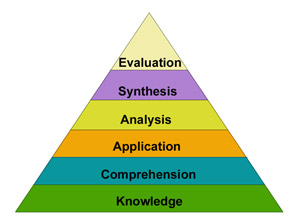
Bloom's Taxonomy has been hailed as a template for best practice in course design. It has been a part of the bedrock of teacher education courses for over half a century, and is a model just about every learning professional is aware of, and has used at some point in their teaching career. Bloom's Cognitive Taxonomy is probably the best known and most used, and is organised into six levels of learning rising from simple to complex. These are often represented as a pyramid with the most complex category at the apex. Benjamin Bloom and his colleagues identified three distinct domains of learning, namely the Cognitive (thinking - knowing, reasoning), Affective (feeling - emotions, attitudes) and Psychomotor (doing - physical skills, practice) domains. Both the Cognitive domain and Affective domain were published as edited volumes, in 1956 and 1964 respectively. In the past, the usefulness of the model was widely acknowledged, particularly in the construction of lesson plans.

Veronica Alexander talks about how the taxonomy has been successfully used as a template for learning programmes. She writes:

"A well-written educational objective (or learning objective) is a single, specific, measurable description of what the learner will be taught and is expected to master. The learner can only be measured if they can demonstrate a behavior that provides evidence of their knowledge or skill. One learning experience can be composed of one or more objectives. Objectives can also be nested where a Terminal Learning Objective (TLO) is a high-level summary of the demonstrable knowledge or skill and one or more Enabling Learning Objectives (ELO) are sub-skills which support each TLO. Bloom’s taxonomy provides a method for learning designers to plan, organize and scale the complexity of the content in a way that supports learner performance".

And yet Bloom's taxonomy raised some serious issues. How relevant is it in the digital age? Should we still be organising learning experiences as a gradient of 'terminal learning objectives' in an age where learning is changing, and where personal technologies and social media are increasingly significant? Learning is changing, because the boundaries between discrete learning activities are blurring. Assessment methods are changing too. Bloom's Cognitive taxonomy represents a very rigid method of control over learning behaviour, and offered structure for teachers in the last century. But just how desirable is it in today's classrooms? Exactly how much control do teachers need to exert over students' learning today? What about freedom to learn, and what about individual creativity? Where do they fit into the grand scheme of 21st Century learning? If you subscribe to the belief that students are blank slates (tabulas rasa) on which knowledge can be inscribed by experts, then Bloom's taxonomy is for you. If on the other hand, you believe that all learners have the ability to be creative, critical and independent, then you will start looking elsewhere for guidance on how to provide engaging learning experiences. Bloom and his colleagues identified three domains - knowledge, attitudes and skills - but omitted some important additional components - intuition and creativity. Was this because they are difficult to 'measure' objectively?

These are not the only problems. Criticism of Bloom's Cognitive taxonomy has been widespread, but at the outset, I want to argue that it is often a mistake to try to represent complex ideas in the form of simplistic diagrams. I'm not sure whether Bloom and his colleagues ever wished to see their work represented as a pyramid, but that's how it now appears in many popular interpretations, and it was originally presented as a progressive linear sequence. Portraying the 6 levels of attainment in this manner only serves to reinforce the prescriptive, sequential and reductionist nature of Bloom's Cognitive taxonomy. Secondly, there is doubt over the validity and reliability of Bloom's taxonomy (see for example Brenda Sugrue's critique). Way back in 1974, Ormell criticised Bloom for failing to acknowledge 'imaginative understanding' - essential creativity in learning.

Bloom's taxonomy has been criticised for its simplistic view of a very complex human activity. Post modernist criticism points to its neat and ordered classification of learning modes and argues that the human mind is far to complex to be represented in such a prescribed manner. Another post-modern critique is that many of the terms used in the taxonomy are artificially constructed as ideology to 'conceal the messy side of learning' (Spencer, 2008). Probably the most important criticism of Bloom though, and the most relevant in an age of social media, is that the taxonomy tends to focus on individual learning activities. Technology has changed that. Today social learning is increasingly prevalent. Collaboration, shared online spaces, discussion, co-construction of content and negotiation of meaning are all evident in the 21st Century classroom. Bloom's taxonomy has little to offer here, because it was devised in an era of instruction in which drill and practice were common and where behaviorism was the dominant ideology.

Ultimately, Bloom's Taxonomy was used as a tool to aid curriculum design. However, it is nonsense to expect teachers to continue to write verb laden 'instructional objectives' to describe behaviour for each and every one of the six cognitive levels that they are subsequently required to 'measure'. At best, applying the taxonomy to assessment reduces learning to a series of fairly meaningless behavioural links, and at worst, it does nothing to support or encourage the intuitive and creative instincts of every child in the class. Shelly Wright also expresses disquiet, suggesting that in the pyramid model, it appears that to reach a peak of creativity, learners need to traverse all the inferior stages of learning first. This is also clearly untrue in many real life experiences. Shelly suggests flipping, or inverting the pyramid so that creating (or making) becomes the first stage in the learning process. I'm not convinced that this significantly improves the taxonomy. It simply creates yet another linear, artificial representation of complex learning processes.

Tomorrow: Part 2: Bloom reheated

References
Bloom, B. S. and Krathwohl, D. R. (1956) Taxonomy of Educational Objectives: The classification of educational goals. Handbook I: Cognitive Domain. New York: Longmans.
Krathwohl, D. R., Bloom, B. S. and Masia, B. B. (1964) Taxonomy of Educational Objectives: The classification of educational goals. Handbook II: Affective Domain. New York: David McKay Company.
Ormell, C. P. (1974) Bloom's Taxonomy and the Objectives of Education, Educational Research, 17, 1.
Spencer, J. T. (2008) Bloom's Taxonomy: Criticisms. Teacher Commons. Available online at: http://teachercommons.blogspot.co.uk/2008/04/bloom-taxonomy-criticisms.html (Accessed 22 June, 2012)

Bloom's Taxonomy image source

Creative Commons License
Bloom and bust by Steve Wheeler is licensed under a Creative Commons Attribution 3.0 Unported License.
Based on a work at steve-wheeler.blogspot.com.


June 20, 2012

Recycling Kolb

Most learning professionals have heard of David A. Kolb. His experiential learning model (1984) is just one part of his grander theory on learning, and is often cited as a model that encapsulates the entire learning journey. Kolb's model was categorised by Mayes and deFreitas (2004) as an individual constructivist theory, in that it features a number of components that reflect solo learning activities. This is in direct contrast to the more familiar social constructivist theories of Vygotsky, Bruner et al, which rely on co-construction and negotiation of meaning. It owes more to Piaget's 'scientific' or cognitive constructivist camp. Kolb's model frames individual exploration of the world, and can be seen in a number of activities such as problem based learning, inquiry based learning and experiential learning. Although none of these preclude a social element of learning such as collaboration or group discussion, individual constructivism tends to rely on the ability of the learner to be an autonomous and independent self-learner.

The experiential model Kolb proposed reveals a particular flow of activity that is represented in the image below. It flows clockwise and is both iterative and cyclical. It is representative of the kind of activities one sees in the old style e-learning package designs still used in many companies to impart basic health and safety or customer care training. One of the criticisms of Kolb's model is that it is fairly prescriptive, and from it derives the four learning styles he identified; diverging, assimilating, converging and accommodating. A number of derivative learning styles models 'borrowed' from this model (for example Honey and Mumford's Learning Styles model). It continues to feature strongly in many corporate training/learning and development (L and D) design and delivery strategies because it focuses largely on competence and performance, traits most businesses value and require their employees to acquire and develop. And yet, although L and D departments are also embracing social learning, many still continue to refer to Kolb's model as an important model of learning. This is questionable. One view is that the experiential learning model is increasingly irrelevant in an age where social media, and social learning are increasingly prevalent. It is worth revisiting Kolb's model to explore its criticisms and weaknesses.


A major criticism of Kolb's experiential learning cycle is that any or all of the four phases he identifies could occur simultaneously (Jeffs and Smith, 1999). Another is that the model does not sufficiently acknowledge the power of reflection on learning (Boud et al, 1985). Probably the most important criticism of the cycle is that depending on the learner, and/or the activities they are engaged in, some stages of the process can be bypassed, or repeated several times in any sequence. Way back in 1933 John Dewey remarked that reflective learning processes are highly complex and as Smith (2001) has argued, representing this complexity in such neat and precise units is simplistic and clearly problematic. There is little to stop the process being reversed or sequenced in entirely different ways, depending on learner motivation, individual differences, subject being studied and a new component Kolb probably had no reason to consider at the time - the digital tools being employed to support those learning activities.

Besides there being very little (or mostly weak) empirical evidence to support Kolb's model (and all of its derivatives), I also argue that in a digital age, it is now increasingly obsolete. It served its purpose in the 'instructional design' period of e-learning development where 'stand alone' Computer Aided Training (CBT) content was king, but we have moved on.  Social learning processes are showing greater promise than isolated learning, and we now have the tools to capitalise on the human instinct to learn collaboratively and to create, remix and share our own content. Kolb's model is anachronistic, belonging to another time. It is time to develop new models to explain the processes that occur when people learn using socially rich interactive digital media.

Image by Fotopedia
Experiential Learning Model Graphic source  

References

Boud, D., Keogh, R. and Walker, D. (eds.) (1985) Reflection. Turning experience into learning, London: Kogan Page.
Dewey, J. (1933) How We Think, New York: Heath.
Jeffs, M. and Smith, T. (1999) Learning from Experience. Available online at: http://www.infed.org/foundations/f-explrn.htm (Accessed 20 June, 2012).
Kolb, D. A. (1984) Experiential Learning Englewood Cliffs, NJ.: Prentice Hall.
Mayes, T. and deFreitas, S. (2004) Review of e-learning theories, frameworks and models. Stage 2 of the e-learning models desk study. Available at: http://www.jisc.ac.uk/whatwedo/programmes/elearningpedagogy/modelsdeskstudy.aspx (Accessed 20 June, 2012).
Smith, M. K. (2001) David A. Kolb on Experiential Learning. Available online at: http://www.infed.org/biblio/b-explrn.htm (Accessed 20 June, 2012).

Creative Commons License
Recycling Kolb by Steve Wheeler is licensed under a Creative Commons Attribution 3.0 Unported License.
Based on a work at steve-wheeler.blogspot.com.


June 15, 2012

You can't ban the blog

One Scottish local authority has tonight been left with egg all over its face. Argyll and Bute's attempts to censor a 9 year old blogging about her school dinners backfired spectacularly when they were forced to very publicly retract their original decision. The gagging order was imposed on Martha Payne, a primary school girl who attends Lochgilphead Primary School, because she took pictures of her school dinners and then rated them out of 10 on her blog. Although Martha was writing the blog to raise money for charity, and was glowing with praise about some of her dinners, the council decided that not all publicity was good publicity and instructed her head teacher to order her not to take any more photographs of her lunches. The Argyll and Bute council officials thought that newspaper coverage of the 9 year old's blog was causing catering staff to fear for their jobs. But the council backed down due to pressure from the public, ith support from celebrity TV chefs Nick Nairn and Jamie Oliver on Twitter and over the traditional media. The council admitted its mistake and through gritted teeth, a spokesman gave several TV and radio interviews to clarify their position.

Needless to say, the adverse publicity attracted by the council over their reactionary initial decision has reflected positively on Martha's blog, NeverSeconds, which is now receiving thousands of views and dozens of comments each hour. The blog has already amassed over 3 million hits.

The wider issue here is that free speech has many forms, and even children are able to speak out. Primary children such as Martha Payne are able to voice their opinions and gain huge audiences for their writing over the web. They are armed with cameras and mobile phones and they know exactly how to use them. Anyone who underestimates the power of blogging and other forms of social media therefore does so at their peril. And as Argyll and Bute council discovered the hard way yesterday, it is foolish to try to stop children from expressing their ideas publicly. Their decision blew up in their faces, and their only comfort is that Martha's blog has grown in the light of their inadvertent publicity of her work, and is earning even more money for her chosen charity. Go Martha!

Image by Freefoto

Creative Commons License
You can't ban the blog by Steve Wheeler is licensed under a Creative Commons Attribution 3.0 Unported License.
Based on a work at steve-wheeler.blogspot.com.


June 14, 2012

Dialogue, debate and destinations

I don't have the time or the inclination to calculate how many miles I have travelled in the last week, but it involved three car journeys, 11 train rides, numerous taxi trips and one flight. I managed to keynote four conferences in six days, respectively eLearning 2.0 at Brunel University, London; the CILIPS annual conference at the Apex Hotel in Dundee; the Solstice Conference at Edge Hill University, and finally the Digital Literacies Conference at Southampton University. I spent much of my time gazing out at the countryside going by from the windows of trains, but during the times my feet were on firm ground I did also manage to have some decent and productive conversations with old friends and new, and fielded questions from delegates during my presentations at all four events.

Some notable discussions took place, some of which I can briefly summarise here on this blog. I took issue for example with a statement by Rosemary Goring (Literary Editor and columnist for The Herald) who keynoted the CILIPS conference on Monday. She suggested that Libraries should conserve their traditional roles and that any change that took place should be 'geological'. Goring was essentially arguing that libraries should not be dictated to by technological changes, but in doing so she missed a fundamental point. Libraries must change, because the needs and perceptions of users is changing. In my own keynote speech the following morning, speaking to an audience of around 200 library and information professionals, I argued that libraries need to become more flexible and agile (and indeed many already are), to respond to new learning practices, and an increased interest in knowledge and research. Co-incidentally, in their packs, each delegate received a copy of Panlibus Magazine, containing an article written by me entitled 'Moving away from books'. I remarked that before they burnt me at the stake for heresy, there should in fact have been a question mark at the end of the title. The jury is still out on the future of paper based content, but for the record I see no immediate demise of the book. The question is: do you like reading or do you like books? (acknowledgement to James Clay for this question). If you like reading, then any avenue of enquiry (kindle readers, e-books, online search, even audio) remains open, whereas if you insist on reading only from books, then your scope is increasingly limited. I cited the fact that for the first time this year, Amazon is reporting selling more e-book downloads than it is paper based books. This and other technology driven changes demand that libraries move quickly to adapt to new trends and remain agile to maintain relevance in a digital age.

Other noteworthy debates took part at Solstice and the Digital Literacy conferences during the week. I was challenged by delegates at Solstice to elaborate on the legal and ethical issues of Creative Commons and other Copyleft approaches. Creative Commons, I explained, is a means of circumventing Internet Copyright constraints. It seems perverse in today's adverse economic climate, said Brian Lamb, to hoard knowledge in any form. I added to this that in a time when knowledge is needed more than ever, why do we allow edubusinesses and greedy publishers to commoditise knowledge and publicly funded research? I advocate giving content away for free, by publishing it (as with this blog post) under a Creative Commons licence that allows anyone to take any or all of the content for reuse, as long as they attribute the source and re-licence it under the same conditions (share and share alike). Many academics, I argued, feel uneasy about giving content away for free, preferring to perpetuate the old ivory tower mentality. But give away we must, if we are to reach audiences that extend beyond our own little academic fraternities. Gone are the days when we can rest on our laurels by publishing our research to a small and select group of elite scientists. The general public also need to know about advances in science, medicine, technology and education, and the best way to do this is to publish openly. I gave another challenge to those present to boycott closed journals, and publish in open access journals. I was not calling for publishers to give away journal content for free, but simply to reduce their prices to reasonable rates so that the average student can afford access. The ethics of this are clear - publicly funded research has been paid for out of taxes. It should therefore be made freely available to those who have paid their taxes.

Finally, a note about the Digital Literacies Conference at Southampton (pictured). With Salford University's Cristina Costa, I presented an 'unkeynote' - a kind of plenary workshop - and we had a whale of a time disrupting the proceedings and causing a great deal of mess and chaos. Yet out of the chaos came some order, from social tagging, online collaboration, critical thinking and intelligent searching activities, we led toward round table discussions, delegates explored the spectrum of new literacies that are emerging as a result of the introduction of new technologies into formal learning contexts. After several quick-fire 10 minute presentations, the second unkeynote, presented by Doug Belshaw and Sue Beckingham dwelt on essential elements of digital literacies, and was drawn largely from Doug's recent doctoral thesis. Doug helped us to think about digital literacies in a sort of periodic table of 8 'c's - their slideshow is here. As each table came to grips with the Cultural, Cognitive, Constructive, Communicative, Confidence, Creative, Critical and Civic aspects of using technology to learn, we were then asked to choose two and develop a learning activity around them. The result was a lot of great ideas that could be incorporated into learning activities in any education sector. Doug and Sue concluded an excellent presentation with the quote from Johnson (2008) who said 'functional internet literacy is not the ability to use a set of technical tools; rather, it is the ability to use a set of cognitive tools'.

I thank all of my hosts in London, Dundee, Ormskirk and Southampton for making me feel so at home. The Storify record of the event by Ivan Mendelez and the Flickr image collection by Farnoosh Behraman have captured some of the dynamics and atmosphere of the conference.

Images by Farnoosh Berahman

Creative Commons License
Dialogue, debate and destinations by Steve Wheeler is licensed under a Creative Commons Attribution 3.0 Unported License.
Based on a work at steve-wheeler.blogspot.com.


June 09, 2012

Letting go of the past


As a man was walking past some elephants in a circus, he suddenly stopped, confused by the fact that these large animals were being held by only a small rope tied to their front leg. No chains, no cages. It was obvious that the elephants could, at anytime, break away from their bonds. Yet they stayed were they were.
He asked the trainer why the animals didn't try to escape. “Well,” the trainer explained, “when they were very young and much smaller we used the same size rope to tie them and, at that size, it was enough to hold them. As they grow up, they are conditioned to believe they cannot break away. They believe the rope can still hold them, so they never try to break free.”
The man was amazed. These animals could at any time break free from their bonds but because they believed they couldn’t, they were stuck right where they were.
Like the elephants, how many of us go through life hanging onto a belief that we cannot do something, simply because we failed at it once before?
Failure is part of learning; we should never give up the struggle in life.
Sometimes it can be difficult to let go of the past. But often, it's the only way we see any progress. Not only do we need to learn, we sometimes need to unlearn and relearn. That could mean breaking down a long established belief or perception. For me it meant overcoming the fear and embarrassment that I had experienced in primary school when I was laughed at for asking a seemingly 'stupid' question. It took me years to gain the confidence to speak in public and overcome the thought that may be I was the only one in the room who didn't understand what was being said. I asked a question once during a conference plenary, and afterwards several delegates came up to me and said 'thanks for asking that question, I didn't understand either, but was too scared to ask'.

We are all in the same boat it seems. Letting go of previous bad experiences and trying again with a 'clean sheet' is a way of unlearning. It is freedom to learn from failures and previous shortcomings so we can do it better next time. What do you do in your classroom to give learners a fresh chance to let go of the past?

Image by Fotopedia
Creative Commons License
Letting go of the past by Steve Wheeler is licensed under a Creative Commons Attribution 3.0 Unported License.
Based on a work at steve-wheeler.blogspot.com.


June 07, 2012

Everyone's a critic (again)


I recently blogged about the hidden audience effect, and cited Westfields Junior School's S'cool Internet Radio and David Mitchell's Quadblogging projects as examples of how students can become better engaged with learning when they perform their work for an audience. Social media and the internet have largely been responsible for this change. Before social media, the school play or the end of term concert was a good way to allow children to perform to an audience, as was the art display and the school sports day. But not every child excels at art, or is good at music or sport. What about those who are good mathematicians, or the scientists or linguists? Prior to social media, how did they perform their skills for an audience? Social media now provides a way. A recent blogpost by Katherine McKnight listed 12 ways technology has changed learning, and includes 'expanding audiences' near the top of the list:

Students' sense of audience is completely different. When I was in high school in the 1980's, the audience was the teacher. When I started teaching high school in 1988, the audience was the teacher and peers.  In the 21st century, it's the WORLD. Blogging, Twitter, Facebook, and other online platforms changed our notion of audience.

I think the statement requires some unpacking. Yes, social media is changing our concept of audience, because the tools we use are naturally participatory. Students blog their ideas and in doing so, they perform to a potential worldwide audience. They receive feedback from their peers in the form of comments, and gain a sense of pride in their work. When they record themselves on camera, they can release it as a YouTube video and gain feedback from their peers. It can be very motivational: watching a growing number of views, comments, shares and favourites can be a huge incentive for students. But there are also risks. The danger of playing to this gallery is the exposure to a potentially harsh and unforgiving environment. YouTube is particularly notorious for trolling (individuals who patrol social media sites to make mischief) and can be a breeding ground for unneccesarily harsh, or deliberately hurtful comments. Receiving such responses, no matter how ill informed or illiterate they often may be, can seriously damage the delicate self esteem of vulnerable young learners.

Teachers should therefore promote the use of YouTube as a performance channel with due consideration to such a risks. The same safeguards should apply to blogging, where teachers are advised to act as moderators of the comments that are received, filtering each one before allowing it to be posted on the blog for students to read. There is also the danger of cyberbullying from within the peer group, and such malicious activities also need to be obviated by the appropriate management of social media tools in formal learning settings. A fine line needs to be drawn between deliberately destructive behaviour, and critial review of a learner's work. Whilst the former knocks down, the latter can build up, challenging the student to refine their skills and learn more about their subject.

Arguably, the benefits outweigh the risks, and performing your learning online using social media is a game changer. Never before have students enjoyed the opportunity to shine on such a global stage. The audience has indeed expanded, and where once a student was writing their assignment to be read by an audience of one (the teacher or examiner), now there is potential to demonstrate new learning through a huge range of globally accessible media.

Assessment should no longer be confined to the written tests or essays that were so prevalent in the last century, but might be extended to podcasts, blogs, wikis, videos, image collections and combinations of these in other media. What teachers now need to avoid is replicating old practices within new media. The opportunities to create new ways of assessment are there to be exploited. The only real limitation is imagination.

Image source

Creative Commons License
Everyone's a critic by Steve Wheeler is licensed under a Creative Commons Attribution 3.0 Unported License.
Based on a work at steve-wheeler.blogspot.com.


June 06, 2012

Everyone's a critic

I recently blogged about the hidden audience effect, and cited Westfields Junior School's S'cool Internet Radio and David Mitchell's Quadblogging projects as examples of how students can become better engaged with learning when they perform their work for an audience. Social media and the internet have largely been responsible for this change. Before social media, the school play or the end of term concert was a good way to allow children to perform to an audience, as was the art display and the school sports day. But not every child excels at art, or is good at music or sport. What about those who are good mathematicians, or the scientists or linguists? Prior to social media, how did they perform their skills for an audience? Social media now provides a way. A recent blogpost by Katherine McKnight listed 12 ways technology has changed learning, and includes 'expanding audiences' near the top of the list:

Students' sense of audience is completely different. When I was in high school in the 1980's, the audience was the teacher. When I started teaching high school in 1988, the audience was the teacher and peers.  In the 21st century, it's the WORLD. Blogging, Twitter, Facebook, and other online platforms changed our notion of audience.

I think the statement requires some unpacking. Yes, social media is changing our concept of audience, because the tools we use are naturally participatory. Students blog their ideas and in doing so, they perform to a potential worldwide audience. They receive feedback from their peers in the form of comments, and gain a sense of pride in their work. When they record themselves on camera, they can release it as a YouTube video and gain feedback from their peers. It can be very motivational: watching a growing number of views, comments, shares and favourites can be a huge incentive for students. But there are also risks. The danger of playing to this gallery is the exposure to a potentially harsh and unforgiving environment. YouTube is particularly notorious for trolling (individuals who patrol social media sites to make mischief) and can be a breeding ground for unneccesarily harsh, or deliberately hurtful comments. Receiving such responses, no matter how ill informed or illiterate they often may be, can seriously damage the delicate self esteem of vulnerable young learners.

Teachers should therefore promote the use of YouTube as a performance channel with due consideration to such a risks. The same safeguards should apply to blogging, where teachers are advised to act as moderators of the comments that are received, filtering each one before allowing it to be posted on the blog for students to read. There is also the danger of cyberbullying from within the peer group, and such malicious activities also need to be obviated by the appropriate management of social media tools in formal learning settings. A fine line needs to be drawn between deliberately destructive behaviour, and critial review of a learner's work. Whilst the former knocks down, the latter can build up, challenging the student to refine their skills and learn more about their subject.

Arguably, the benefits outweigh the risks, and performing your learning online using social media is a game changer. Never before have students enjoyed the opportunity to shine on such a global stage. The audience has indeed expanded, and where once a student was writing their assignment to be read by an audience of one (the teacher or examiner), now there is potential to demonstrate new learning through a huge range of globally accessible media.

Assessment should no longer be confined to the written tests or essays that were so prevalent in the last century, but might be extended to podcasts, blogs, wikis, videos, image collections and combinations of these in other media. What teachers now need to avoid is replicating old practices within new media. The opportunities to create new ways of assessment are there to be exploited. The only real limitation is imagination.

Image source

Creative Commons License
Everyone's a critic by Steve Wheeler is licensed under a Creative Commons Attribution 3.0 Unported License.
Based on a work at steve-wheeler.blogspot.com.


June 05, 2012

Feet keep walking

Someone made the ironic remark on my Facebook page that I travel a lot to speak about how information travels in 'bits and digital form'. I retorted that, yes, it is a little ironic, but certainly not surprising, because people are naturally social beings. Our social nature ensures that we are more at ease in face to face contexts, and that technology mediation of communication will always be second best. That's why so much research has been invested in studying how people respond to digitally mediated forms of interaction. I was personally involved in some of the early large scale studies into how students and their teachers adapt to communication through audio, video and internet based tools. Unequivocally, those involved said that although technology is a great way of keeping in contact, personal connection in co-present environments is always more desirable. Learning technology has taken me all around the world to teach, speak and research, and I see no respite in the travelling as my schedule shows. It's conference season, and this coming month I'm travelling the length and breadth of the nation to give keynotes in four conferences and hosting two invited workshops.

I start on Friday 8 June with a keynote speech on Day 2 of the eLearning 2.0 conference, hosted by Brunel University, in West London. My presentation is entitled Learning in a Digital Age: The myth and the reality, and will feature several debates on issues such as learning styles, digital natives and immigrants theory and other pedagogical themes.

On Sunday I fly up to Edinburgh and then onwards to Dundee where to keynote on Day 2 of the Chartered Institute of Librarians and Information Professionals Scotland (CILIPS) Conference at the Apex City Quay Hotel. My keynote speech for CILIPS is called 'Learning in a Digital World' and will feature some of my recent work on 'Library 2.0' and 'Libraries without walls', featured on this blog.

On Tuesday afternoon I travel down to Ormskirk, near Liverpool  in time for the Solstice Conference on Wednesday 13 June, hosted by Edgehill University. I will be giving the opening keynote on Day 1 and speaking on the topic of 'Digital Pedagogy: The Future is Open'. I'm speaking about open source, open content, open educational resources and open scholarship.

My final event of the week will be at Southampton University, on Thursday 14 June, where I have been invited to present an unkeynote with Salford University's Cristina Costa at the Digital Literacies Conference. Cris and I are old friends, and because the conference focuses on digital literacies, we will be asking our audience to explore a number of contexts around literacies in a digital age.

The month of June draws to an end with two workshops at the E2BN Conference at the Robinson Centre in Wyboston. I will be talking about how social media and personalised learning can be brought together to provide dynamic new learning environments for all students.

The travel will be tiring, but I hope to meet a lot of old friends and new contacts, and I'm sure I will learn a lot. If you are at any of the above events, please come and say hello.

Image by Steve Wheeler

Creative Commons License
Feet keep walking by Steve Wheeler is licensed under a Creative Commons Attribution 3.0 Unported License.
Based on a work at steve-wheeler.blogspot.com.


May 31, 2012

The hidden audience effect

A splendid time was had by all at yesterday's bMoble12 event. Held in Bradford's prestigious National Media Museum (more on this in a future post), the day was packed full of quick fire workshops, seminars and plenary presentations. The conference was enhanced by the presence of several very tech savvy young students from primary schools, who took a full part in the proceedings, tweeting and live blogging from the event on their mobile devices. Speakers included Derek Robertson, Steve Dale, James Langley, Chris Mayoh and Julian Wood, who presented variously on games based learning, e-safeguarding, embedding the iPad across the curriculum, the use of QR codes and mobile devices in education, and how to engage readers with digital texts.

Headteacher Karine George's post lunch keynote was one of the highlights of #bMoble12, and included a great first section from two of the children from her large school, Westfields Junior School in Hampshire. They had been up since 6 am that morning to travel for 5 hours on a train to arrive in time for their presentation, and had to travel back that evening. It must have been a very long day for the kids, but they performed very well, and were very entertaining and raised a few laughs too.

Karine George's presentation was one of those keynotes that raises the eyebrows and gets you thinking. It must be the first time a keynote speaker has appeared on stage accompanied by a toilet seat, but I think we were all relieved when she made a point about emerging technologies, featuring the Japanese Washlet 'intelligent loo' as an example of how technology can improve lives. You can see video of Karine's keynote and many of the other bMoble12 sessions on this website.

As I looked around the room during Karine's keynote, the audience was transfixed by the volume of new ideas that were being applied at Westfields School. She reported great learning results through activities supported through the use of games, mobile technology, video, music technology and other specialised software. One great innovative idea Karine talked about was particularly useful at engaging kids across the entire curriculum. Their learning activities are scaffolded through their own internet radio channel S'cool Radio. The children take turns in operating and hosting the radio channel, working in pairs. They take on the responsibility to write and produce their own shows, and in doing so they are able to reach out not only to their own peers (the radio shows are broadcast over public address systems during break times) and their parents, but also the wider community, and ultimately, to a worldwide audience.

In effect, S'cool Radio is taking a similar approach to Dave Mitchell's Quadblogging concept but developing it in another direction. What both projects have in common is their capitalisation on the 'hidden audience' effect. Dave Mitchell stresses the importance of providing an audience for young bloggers, who then 'perform' their ideas and writing skills, receiving feedback from their peers. It is highly motivational to know you have an audience. Performance levels are raised as extra effort is made. The meteoric success of Quadblogging lies in its organisation of 4 school clusters, which provide a guaranteed audience to read and comment on every post the children make. Evidence from earlier studies I conducted with my own researchers in Plymouth in 2007 revealed that the 'hidden audience' who read  my own students' wiki content, encouraged them to raise their game in terms of improved academic writing, greater accuracy, deeper critical analysis and thinking, and a more polished presentational style. The entire account of that research can be found in the 2008 British Journal of Educational Technology article The Good, the Bad and the Wiki.

Clearly, the hidden audience effect is only one of the components that make projects such as Quadblogging and S'cool Radio a success. For Westfields Junior children, the ability to communicate clearly, self-organise, self-broadcast, express ideas, work in a team, problem solve, plan ahead and think on one's feet, are all brought into play when they plan, present and perform their shows on their internet radio shows. The Westfields internet radio project is therefore destined to be a great success, because not only does it provide learners with a ready made audience, it also gives them space to practice and acquire these key transferable skills - skills they will certainly need to use when they enter a world of work that is uncertain and in a constant state of change.

Image courtesy of Westfields Junior School

Creative Commons License
The hidden audience effect by Steve Wheeler is licensed under a Creative Commons Attribution 3.0 Unported License.
Based on a work at steve-wheeler.blogspot.com.


May 28, 2012

Learning on the move

It was nice to be invited to present a session for Sheffield Hallam University on mobile learning earlier today. The university has quite a strong research group in this area, and my talk, presented online via Adobe Connect had to be on point. Mobile learning is going to be very big indeed. One report suggests that as many as 8 out of every 10 people now having access to some form of mobile communication device. Whatever source you trust, mobile device use is high and rising, leading to the conclusion that mobile learning is clearly an area of development that will  have a massive impact on society in the coming months and years.

Where to start with a subject such as mobile learning? I decided that rather than merely cover practical issues (the 'how to do mobile' approach), I would try to take a more challenging approach, and explore social, pedagogical and psychological theories that relate to mobile technology, and present some of the issues that mLearning practitioners are currently facing. I used several images I have recently captured to illustrate the presentation, including the one above of the free Xbox 360 Kinect areas at Prague Airport, Czech Republic. I predict we will see more of this in public places.  It's interesting, because what we see here is a form of mobile learning without a mobile device. I suggested that mobile learning doesn't necessarily rely on carrying a device around with you, although it is the norm. Perhaps we need to reconceptualise our idea of what mobile learning is really all about.

There are many social implications of mLearning, some of which I covered in my presentation (slides below). I cited Puro (2002) who declared: 'The mobile phone ... is a new kind of stage where the mobile information society is acted out'. This echoes Goffman's (1967) drama theory where individuals manage their impressions in a kind of performance in social contexts. Puro's perspective is that the mobile phone evokes performances from users, but what is in question is the extent to which these performers manage their impression, and how much of this management is conscious effort. Fortunati (2002) speaks of the alienation and isolation that sometimes comes from mobile phone use, and comments that some isolation can be self-imposed, particularly when 'defending the space within which one would like to isolate one's voice'. Anyone who has sat next to someone loudly talking on their mobile phone in a confined space will see the truth, and Puro's expression that - 'the social distance on the mobile stage is small, but the emotional bond may be weak. [The] mobile phone ... may increase contact, but also increase loneliness' - will resonate with many.
There is no denying that at its heart much good learning has a social component. Earlier today in a meeting with one of our training staff, I argued that e-learning needs a social learning element. I suggested that he consider introducing some social media tools into the mix, so that the somewhat 'flat' two dimensional rote learning normally presented was bolstered by some deeper thinking supported by discussion, the creation of content and critical engagement with learning. I believe that mobile devices can help to achieve this mix of content and context based learning.

I explored the question of whether txting is 'dumbing down' language and causing problems. Does SMS text (the unorthodox spelling, or 'squeeze text' imposed by a limit of 160 characters) cause informal language to spill over into formal contexts? David Crystal (2008) says it doesn't. His argument is that in most cases, young people know the differences between communication modes, and that the ethos of language has changed with the introduction of new communication technologies, to the extent that there are now lots of acceptable versions of English. In effect, habitual use of a variety of tools (Facebook, Twitter, SMS, MS Messenger, YouTube, etc) is ensuring that this current generation is more versatile in literacy skills than any previous generation.

Finally, I discussed some of the practicalities of establishing mLearning strategies at an institutional level. There are many constraints, including small screens (a problem for those who require larger screens due to visual impairment or different expectations), bandwidth and connectivity problems, problems integrating mobile devices into institutional VLEs, and compatibility issues across multiple devices. A great article covering these and other issues by Edudemic is entitled How to develop your own mobile learning tools. Each institution has to decide on what basis (if any) it will implement mLearning strategies, which include the need to improve quality of delivery, widening access and participation, and tapping into the huge potential of mobile devices to maximise the study time that is available to each student.

References

Crystal, D. (2008) Txting: The gr8 db8. Oxford: Oxford University Press.

Fortunati, L. (2002) Italy: Stereotypes, true and false. In J. E. Katz and M. Aakhus (Eds.) Perpetual Contact: Mobile Communication, Provate Talk, Public Performance. Cambridge: Cambridge University Press.

Goffman, E. (1967) Interaction Ritual. New York: Doubleday.

Puro, J-P. (2002) Finland: A Mobile Culture. In J. E. Katz and M. Aakhus (Eds.) Perpetual Contact: Mobile Communication, Provate Talk, Public Performance. Cambridge: Cambridge University Press.

Photo by Steve Wheeler

Creative Commons License
Learning on the move by Steve Wheeler is licensed under a Creative Commons Attribution 3.0 Unported License.
Based on a work at steve-wheeler.blogspot.com.


<< Back Next >>