
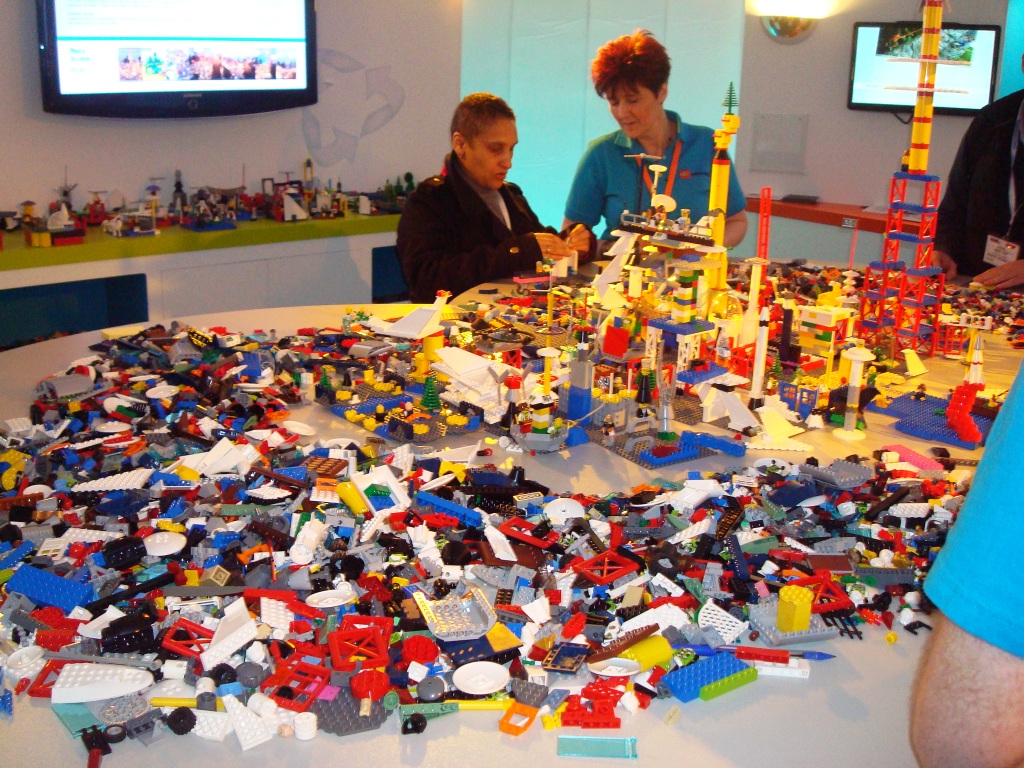




 Learning is performance. No matter what we learn, our knowledge, skills (and also our attitudes) are usually externalised in some kind of outward expression. Some are obvious: Learning a language will lead to conversation. Acquiring dexterity in art results in the production of artifacts. Learning to play an instrument ultimately results in some form of musical performance. Such performances don't have to be public, but often they are. Some are less obvious - learning complex mathematical formulae will result in applying these to mathematical problems. Learning engineering will result in the construction of engines, bridges, walls, buildings, etc. The image above, taken in Melbourne, Australia, is a performance of learning that includes several disciplines, including engineering, design, construction and mathematics. We talk about 'becoming'. Becoming a nurse, carpenter, doctor, lawyer, technician, accountant, teacher. On our journey of becoming, we engage in a great deal of performance.
Some of our earliest performances, particularly in formal learning contexts (school, college, university), are under the scrutiny of subject experts who award grades, and ultimately, some form of accreditation. This kind of performance is commonly referred to as formal assessment. Sadly, it is often the case that the measure of performance is not fit for purpose, as we have all witnessed recently in the universal failure of standardised testing, or the exam paper fiascos that continually assail our senses via the media. Some forms of assessment are ill suited because they are not designed to measure important aspects of learning, or more commonly, are too narrow to consider the entire performance. Inappropriate assessment methods can be a disaster.
'Everyone is a genius. But if you judge a fish by its ability to climb a tree, it will live its whole life believing it is stupid.' - Albert Einstein
Yet the externalisation of learning - knowledge performance - is a vitally important part of the learning process, not only for the student, but also for the entire community they live within. It is important for the student's motivation and also, if done properly, will provide the student with feedback on how to improve the performance next time. It is important for the community, because the community needs skilled and knowledgeable members, and some form of check is required to ensure that the skill or knowledge is up to date, safe to use, and is relevant for the needs of society. If we get assessment wrong, we fail the student, and ultimately we fail society.
But what of those who have already become? Do they stop becoming? The answer of course, is no - we continue to become, because we do not stop learning and we continue to perform our knowledge. For performers, there have never been more channels, stages and platforms upon which we can perform our knowledge than there are in today's media rich and internet aware society. More and more people are performing their knowledge online to a potentially worldwide audience, through blogs, through YouTube and on other popular social media channels such as Twitter, Facebook, Flickr. Blogging and other user generated content practices enable us to focus our performance of knowledge and project it toward relevant peer groups. These are powerful practices because of their immediacy and accessibility; and having an audience raises your game. Some performances provoke comments from the community - a form of peer review that works as a professional assessment of thoughts and ideas, invention, ways of articulating, strength of argument, contribution to debate, illustration of points and reflective criticality. This represents the conversation as curriculum I wrote about in a recent post. But this curriculum extends beyond conversation into community. Knowledge performance is at the centre of community as curriculum. From the sharing of knowledge comes the discourse that adds to everyone's collective knowledge within the community of practice, and extends its boundaries. It is this sharing of experience, new ideas, contention and support that advances the community of practice exponentially. The tools are here to achieve it. Performance of knowledge through social media will be one of the vital components of education and training in the coming years.
Learning and performance by Steve Wheeler is licensed under a Creative Commons Attribution-NonCommercial-ShareAlike 3.0 Unported License.


In my last post I recalled some of the great places I went to this year and some of the awesome people I met. Continuing my review of the year, here are my top five places and some more great people of 2011.


I was fortunate this year to be invited to speak at major events in some of the most beautiful cities in the world. Although I hate the travel, I have to admit that when I am in such places, and while I am meeting such brilliant and inspirational people, I am in my element. Here is the first part of my end of year retrospective on the top ten (actually eleven) places I visited in 2011, and the great people I met. Today's post goes from 10 down to 6. (Continues tomorrow).
 10 =. Newcastle, England. I had an absolute blast in the North East in June. Newcastle is a city I'm quite familiar with from many day excursions with my wife and family over the years (Her parents live in Washington, Tyne and Wear). On this occasion, I was delighted to be invited to keynote the Northern Grid for Learning Annual Conference, and what an event it was! For a start, I flew up in the company of Mr Chickenman himself, Dan Roberts, and when the two of us invaded the executive lounge in the hotel, they quickly ran out of pretzels (Dan's doing, not mine I hasten to add). The speaker list read like a who's who of innovative educators from across the UK. It was wonderful to meet face to face some of the people whom I have followed on Twitter for some time, including Bill Lord, Ian Usher, Steve Bunce, Martin Waller, Ian Addison, Lisa Stevens, Joe Dale, Bev Evans and Jan Webb. Conference organiser Simon Finch and his team did an excellent job putting together what turned out to be a memorable, inspirational day, and the evening social post event at a Spanish tapas bar on the banks of the Tyne was the icing on the cake. Full story here: It's grins up north.
 10 =. Liverpool, England. In March I attended the JISC annual conference in Liverpool, for once purely as a delegate rather than as a speaker. It was a nice change for me, not having to worry about preparing a talk or trying desperately to find my speaking venue. I stayed in a hotel just across the road from the Liverpool Echo Arena where the conference took place, within the beautifully rebuilt and repurposed Albert Dock quayside. In the distance I could see the iconic (new) Liverpool Cathedral on the skyline. I was delighted to discover that I was staying no more than 100 yards from the famous Beatles museum, so I spent a very enjoyable afternoon wandering around looking at all the exhibits, and reliving some of my younger days listening to the Fab Four. Full story here: The next ten years.
 7. Lisbon, Portugal. It was a pleasant surprise to be invited to keynote not one, but two conferences in Portugal this year. What was even better, was that they were back to back and in the same area of beautiful Oeiras, near Lisbon (this is a picture I took of the Palace of the Marquis de Pombal, the venue we met in). I first visited Lisbon in 2008 when I attended the EDEN Annual Conference and picked up a Fellowship award. It is a beautiful city - the kind that glistens in the sun, captivating your senses wherever you go within in. I spoke at the Concede Conference and then keynoted the final day of the EFQUEL Innovation forum. Many of the great and the good from the world of European e-Learning were present, including Grainne Conole, Chahira Nouira, Deborah Arnold, Alastair Creelman, EDEN President Morten Paulsen and Ulf Daniel Ehlers. I also had the distinct pleasure of meeting up with prolific Twitter activist Paulo Simoes for the first time, and also spent some time with charismatic OER guru Wayne Mackintosh. Full story here: Grand Residence and Wayne's World.


