New Zealand is simply amazing. What can I say about the many sights I have seen, people I have met and things I have experienced? Time and space are not enough, but I will try: Perhaps the crowning highlight of my three week tour was the traditional Maori Powhiri and honour that was bestowed upon me during the ICELF Conference in Auckland. I was invited to present my keynote speech in the Maori sacred meeting house - the marae. This was a barefoot keynote, because no-one should enter the marae with their shoes on. Afterwards I was presented with a greenstone gem with inlaid paua shell as a symbol of everlasting friendship with the people of New Zealand. I will treasure it always. Many photographs of the conference can be found here on the ICELF website.

 It's that time of the year when the edublog community honours its members with awards. The 2011 Edublog Awards have come around again with frightening speed, and once again this year I am both honoured and humbled to have been nominated in two categories - best individual blog and best individual tweeter (for my @timbuckteeth account). I'm very much aware that there are many, many active and creative edubloggers out there who could and should have been nominated and included in the list, but even without them, the list is still quite impressive. As I have previously said during past Edublog Awards, it really doesn't matter that much who wins in each of the categories, the real spirit of the Edublog Awards is about honouring those who have served another year by writing, blogging, tweeting and otherwise freely sharing their ideas and wisdom with their community through social media. I learn so much each year from these people, and my own professional and personal worlds would be poorer without my daily dose of news, views and commentaries throughout the Edublogsphere and across the Twitterverse.
So congratulations to all those who made it to the final cut, and please - everyone, show your appreciation for your colleagues by voting for your favourites. And one final thing - you are allowed to vote in as many categories as you like, each and every day, right up to the deadline on December 13th.
Image courtesy of Edublog Awards
Across the Twitterverse by Steve Wheeler is licensed under a Creative Commons Attribution-NonCommercial-ShareAlike 3.0 Unported License.


"Our world appears to be integrated as a world market, but the counterpart of this globalization is the more and more aggressive defense of personal and collective identity. Instead of living in a cosmopolitan world as some pretend we do, we live in a dualized world in which not only North and South are more and more distant from each other, but where rich and poor districts in cities are more and more separated universes and in which most individuals are split between their participation in a globalized world and their consciousness of individual and collective identity." (Touraine, 1995: 46)Touraine is arguing that the sense of personal (and collective) identity is more robust than the seemingly all-powerful forces of globalisation, and that individuals and communities tend to resist these forces naturally. In this context, it is perhaps easier to understand how resistance to technological forces comes about. At Massachusetts Institute of Technology (MIT) Marvin Minsky, has argued that intelligence is to be found in the collective behaviour of large groups of interconnected machines (Minsky, 1987). Nicholas Negroponte, Minsky's MIT colleague, applies this connectivist analogy to human behaviour and argues that the process of 'decentralization' (also referred to as 'atomisation') is becoming the antithesis of globalisation. He concludes that it probably has a great deal more power (Negroponte, 1995: 157-159). More recent theorists such as George Siemens and Stephen Downes propose a version of connectivism that describes the many ways we can tap into the huge potential of distributed cognition as and when required through personal and professional learning networks. This is personalisation of content at an individual level within the vast social congregation of the web.


 Whether there is any commonality between learners remains to be seen, but a key question for universities is whether we can create learning spaces that are conducive to learning for all. Professor Rob Allen, Deputy Vice Chancellor at Auckland University of Technology believes we can. In an effort to transform the environs of AUT, he and his team have launched a grand design scheme that will transform the inner city campus of the former polytechnic dramatically over the next two years. Today at the Informa Tertiary Education Summit in Wellington, he unveiled his plans. The Learning Precinct is a structure that will join the entire AUT campus from one end to the other, so that students can wander between spaces, in one very large, continuous building complex. It will include multiple glass atria, a tower block, media studios and flexible lecture areas that feature rotatable seating to encourage collaborative work. Within the learning precinct some of the flexible shared spaces are able to be transformed into formal or informal community spaces for collaborative work, or individual places of self-study. The entire structure will be designed using sustainable materials to provide a comfortable, aesthetic and environmentally controlled space for learning of all types to be supported. Professor Allen promises that the new learning precinct will connect teaching, technology and spaces in an effective and stimulating manner. You can read more about this ambitious, multi-million dollar project here.


 What do you think is the teacher's worst enemy? Some would say lack of time. Others would say unsupportive leadership, or the dreaded government inspection. Rigid curriculum, lack of resources and bad student behaviour may also be high on the list for many educators. For me, the worst enemy is bad theory. Bad theory, when accepted without challenge, can lead to bad practice. It's insidious, because bad theory that is accepted as fact without a full understanding of its implications, results in bad teaching, and ultimately, learners will suffer.
One of the biggest myths known to teacherdom is learning styles. Time and time again, the belief that students can be placed into specific categories such as activist or theorist, or that they are predominantly inclined toward one modal category of learning (e.g. visual, auditory, kinaesthetic) is inserted into professional conversations as if the theories are fact. And time and again, such beliefs are the justification for placing students into a specific style of learning so that a class can be 'managed' more effectively. Such categorisation of students is an absolute nonsense and the practice of doing so should be challenged strongly. It is lazy pedagogy, and the only reason I see that such beliefs persist, is that it is a convenient untruth which allows some teachers to stay within their comfort zones.
In an excellent expose on learning styles, Riener and Willingham (2010) argue this:
"...learning-styles theory has succeeded in becoming “common knowledge.” Its widespread acceptance serves as an unfortunately compelling reason to believe it. This is accompanied by a well-known cognitive phenomenon called the confirmation bias. When evaluating our own beliefs, we tend to seek out information that confirms our beliefs and ignore contrary information, even when we encounter it repeatedly. When we see someone who professes to be a visual learner excel at geography and an auditory learner excel at music, we do not seek out the information which would disprove our interpretation of these events (can the auditory learner learn geography through hearing it? Can the visual learner become better at music by seeing it?)"
Clearly one of the problems that emerges when teachers administer a learning styles inventory or questionnaire to their students is that the result tends to become a 'self fulfilling prophecy' (See Rosethal and Jacobson, for more on this phenomenon). One of the most notorious (and vacuous) inventories is Honey and Mumford's LSI, which in essence is nothing more than a repurposing of David Kolb's earlier experiential learning cycle model. Another is Neil Fleming's VAK model (Visual, Auditory, Kinaesthetic) which is basically a reworking of 'tell me I forget, show me I remember, involve me I understand'. Such learning styles theories are based on little more than anecdotal observations, and are akin to folk medicine. But the student doesn't know this, and simply trusts the teacher's judgement. The student then sees the results of the questionnaire which informs them that they are for instance predominantly a 'reflector' or that they are an 'auditory learner'. They then actively seek to maximise their 'learning style' by engaging in reflective activities, or visually rich media. This all progresses to the detriment of the other learning modes, which become deficient and atrophied. Result - the learner fails to gain a holistic learning experience, and misses out on the many rich opportunities to expand and develop their other sensory or cognitive skills. Worse still, as Barbara Prashnig explains:
"....it remains a fact that every human being has a learning style which can consist of contradictory components, often leading to inner confusion and uneasiness. Style mismatches between teaching and learning, physical learning environments not conducive to information intake and unmet physical needs during the learning process can lead to frustration, stress, learning problems, underachievement, low self esteem, discipline problems among younger students, and dropoutism in high schools."
Do we really need to label people and brand them in this way? Riener and Willingham again:
"...learning-styles theory is sometimes offered as a reason to include digital media in the classroom. While including multimedia may be a good idea in general (variety in modes of presentation can hold students' attention and interest, for example), it is not necessary to tailor your media to different learning styles. We shouldn't congratulate ourselves for showing a video to engage the visual learners or offering podcasts to the auditory learners. Rather, we should realize that the value of the video or audio will be determined by how it suits the content that we are asking students to learn and the background knowledge, interests, and abilities that they bring to it. Instead of asking whether we engaged the right sense (or learning mode), we should be asking, what did students think about while they were in class?"
The final nail in the coffin on learning styles comes from a report by Frank Coffield and his colleagues (2004) who reported that not only was the concept of learning styles so ill defined as to be virtually useless in pedagogical terms, the instruments used to 'determine' student learning styles were flawed. They failed to measure accurately what they were purported to measure (validity construct) and they failed to measure learning styles consistently over time (reliability construct). Probably the only reason some teachers (and many training organisations) hang on to the idea of testing learning styles is that it is convenient to do so, and that to ditch the idea altogether would leave them having to work harder with students.
We can conclude that in the selection of digital media (and any other learning resource) teachers should not be dictated to by the fallacy of learning styles, nor should they attempt to measure what turns out to be a moving feast of approaches to learning that are actually dependent more on changing context than they ever will be on any deep-seated human propensity. Would it not be better to simply acknowledge that all learners are different, and that all can benefit from a range of varied experiences that ultimately leads to enriched personal experiences? It may mean more work, but it would certainly be a lot fairer.
References
Coffield, F., Moseley, D., Hall, E., and Ecclestone, K. (2004) Learning styles and pedagogy in post-16 learning: A systematic and critical review. Learning and Skills Research Centre.
Riener, C. and Willingham, D. (2010) The Myth of Learning Styles. Change Magazine, Sept-Oct.
Rosenthal, R. and Jaconson, L. (1992) Pygmalion in the Classroom, New York, NY: Irvington.
Image source
A convenient untruth by Steve Wheeler is licensed under a Creative Commons Attribution-NonCommercial-ShareAlike 3.0 Unported License.




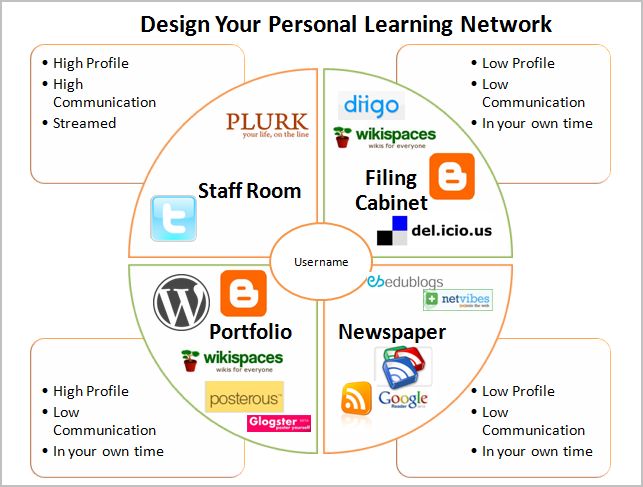
 I was quite impressed by Joyce Seitzinger's Professional Learning Environment (PLN) model that she presented at Deakin University in Melbourne this week. The first slide on the left shows a quadrant model in which she has used a work/office metaphor to define four discrete functions of a PLN. The first, the Staffroom is quite public, calling on high levels of communication and high profile, and involves the use of microblogging tools such as Twitter. This will work provided the user subscribes to a requisite number of other relevant user accounts, and can share their ideas and converse freely. It will fail if the user does not follow or is not followed by enough other subscribers to enable the benefits of the network effect.
Joyce calls the second quadrant the Filing Cabinet, because essentially, it is low profile and low in terms of the efforts put into communicating with others, and it provides a repository for the user (and their PLN) to store, categorise and possibly share content they think is important to them. Social tagging sites such as Diigo and Delicious can offer this kind of filing cabinet organisation, but so too can wikis and other collaborative tools, which would I imagine, raise the level of engagement and profiling of individuals who organised and shared their content in this manner.
The third quadrant is the Newspaper, which again Joyce sees as low profile and low in terms of communication. I assume that this is because most of the tools she identifies as falling into this category of PLN deployment is push technology (RSS feeds, Google Reader etc). I would imagine that if Joyce placed blogs into this category, (and in the model's present form I see no reason why they shouldn't be there), then a higher profile and higher level of engagement between user and PLN would ensue.


 I'm in Australia this week to give the opening keynote for the Inaugural Technology for Learning and Teaching Forum, which will be held over two days at the Rendezvous Hotel in Melbourne, just across from Flinders Street Railway Station (pictured). Melbourne, this part anyway, is quite Bohemian, bustling, vibrant and very colourful. You can stand on a street corner and watch the whole of humanity pass by in about ten minutes. The other invited keynote at the event will be Tom Cochrane (Auckland University of Technology, NZ) who will address the topic: Transforming pedagogy with Mobile Web 2.0. Here are Tom's key points: