


 Reading Edupunks, Edupreneurs and the Coming Transformation of Higher Education by Anya Kamenetz has been fascinating. It's a book that has been recommended to me several times over, so it was long overdue that I laid my hands on a copy. With its lurid red cover and aggressive image of a fist gripping a pencil (I would have suggested an iPod Touch or iPhone instead) while wearing a wrist band that proclaims DIY U, the books holds a lot of promise. But we all know you don't judge a book by its cover. Anya Kamenetz is no edupunk, and doesn't pretend to be. Turns out she's a journalist, working the scene, trying to make sense of the open access and bricollage movements that are gripping the imagination of teachers in schools, colleges and universities across the globe. Yet she does express opinions that are sympathetic to the Edupunk philosophy of 'do it yourself', rage against the system, undermine the edubusinesses and give it all away for free (with the exception of her book, which is reasonably priced .... and she does earn her living as a writer). You can visit her DIY U website for a deeper insight into her views.











I seem to be doing a lot of interviews lately, many of which are on video. No-one ever warned me that I would be doing video interviews when I first became a teacher. No-one came up to me and offered me media presentation training like they do for politicians. I have never been briefed on what to do when standing (or sitting) in front of a camera. I have had to learn all about it by trial and error. Error more than trial actually. I can now tell you what a noddy is (no, it's not a Toytown character) and what a cut-away does (best not to ask, really). It has very much been informal training on the job, and I'm sure I've screwed up now and then. Yet my most recent video interviews seem to be watchable, and I appear to be reasonably coherent and not talking too much gibberish. I'm now at the point where I don't care anymore if someone comes up to me and asks for a video interview. I'll do a talk to camera at the drop of a hat. That actually helps when people suddenly walk up to me and shove a mobile phone into my face and ask for an impromptu interview. Talking to camera doesn't make me sweat or tremble like it used to when back in 1992 I did my first ever TV studio interview. Back then, I remember feeling physically sick, and spending a lot of time prior to broadcast in the toilet (yes, the TV interview was a live broadcast and there was no room for error .... scary).
My time spent later working for the RATIO telematics project from 1996-1998 gave me plenty of opportunities to sit on the other side of the microphone, and I suppose was a kind of on the fly media training. I had to learn fast. I even had my own Training Hour show once each week, which went out live by satellite to the whole of Europe. It helped me to think on my feet and cope with most situations (dead air with guests clamming up and not speaking, technical problems such as failed phone-ins, mouse droppings on the carpet, etc....)
When James Clay invited me at the recent ALT-C event in Leeds to sit in as an interviewer, and converse with guests for the live webstreaming ALT-C Live Beta TV programme, it all came back to me. I would have no more than a minute or two to find out a little about them and formulate a few questions and then it was straight in with the live streaming interview. It felt quite natural to do the intro direct to camera, and then turn to the guest and try to get some interesting snippets of insight from them. John Traxler was probably the best to interview because I only had to ask him one or two questions and then he was off, talking twenty to the dozen until we eventually hauled him out of the studio kicking and screaming (OK, I exaggerate, but John did most of the work for me). Above is a brief, unscripted one minute elevator pitch interview I did for my own university, about some of the research I'm currently engaged in. And below is an on the spot interview I did while over in Dublin at the EDEN Conference in June. There are several more in the pipeline that will appear on the web in the next week or so that were recorded in Lisbon and Cologne recently. I'm getting to be an old pro at this video lark now. I even managed to video myself smashing a can of baked beans down onto my finger to make a point for a student group. Look, don't ask - just click on the video link and watch it for yourself. That's the kind of stuff I get up to in the classroom when there's a camera to perform in front of.
Talking to camera by Steve Wheeler is licensed under a Creative Commons Attribution-NonCommercial-ShareAlike 3.0 Unported License.


 Wayne Mackintosh's world vision of free learning for all is one that is shared by countless educators around the world. We all want to see quality learning provided, especially to the populations of the less well-off nations of the world. The difference though, is that he's going to make it happen. Born in South Africa, and now working in New Zealand, Wayne Mackintosh is chair of the WikiEducator Community Council, and is a strategy innovator with a passion for making learning futures happen. Trained as an accountant, he is in his own words, 'an educator by choice.' He has more than a passion. He also has the pragmatic wherewithal to realise his dream, cultivating many connections and in the process, helping to establish a powerful worldwide consortium of Open Education Anchor partners. These are universities across the globe who are willing to open up their courses and programmes to any learner for free. What's more, they have also agreed to provide free accreditation of learning in the form of degrees.
Speaking at the opening plenary of the Efquel Innovation Forum in Oeiras, Portugal, Wayne asked the delegates: Why do we ask people to pay more than they can afford for education? This is of course an important question to ask, even if it is unpalatable to many in the higher education sector. It's one that many institutions worldwide would be wise to begin asking themselves. Wayne didn't pull any punches in his keynote. Citing Sir John Daniel's iron triangle, he argued that the biggest challenge for free open worldwide education is to lower the cost while widening access and raising quality. We WILL provide free education for all, he declared. This will be done by creating a growing network of partners who have enough influence and reach to create the critical mass with which the Open Educational Resources movement will gain purchase. Recognition of prior learning, whether credentialed or experiential, will be a key part of the success in achieving this vision, he said. His key question was that we already have all the ingredients to provide free learning for all at university level, so why aren't we doing it?
There is a long way to go to achieve this vision, but Wayne warned that those who do not subscribe will be left behind. It is a red herring question, he assured us, to ask whether providing free and open education for all will put universities our of business and lose teachers their jobs. Another red herring, he suggested, was that open educational resources were poorer in quality than the traditional course delivery currently offered by most universities. If the quality is poorer, he remarked, then the institution is unlikely to risk its reputation by offering it.
Image source
Wayne's world by Steve Wheeler is licensed under a Creative Commons Attribution-NonCommercial-ShareAlike 3.0 Unported License.





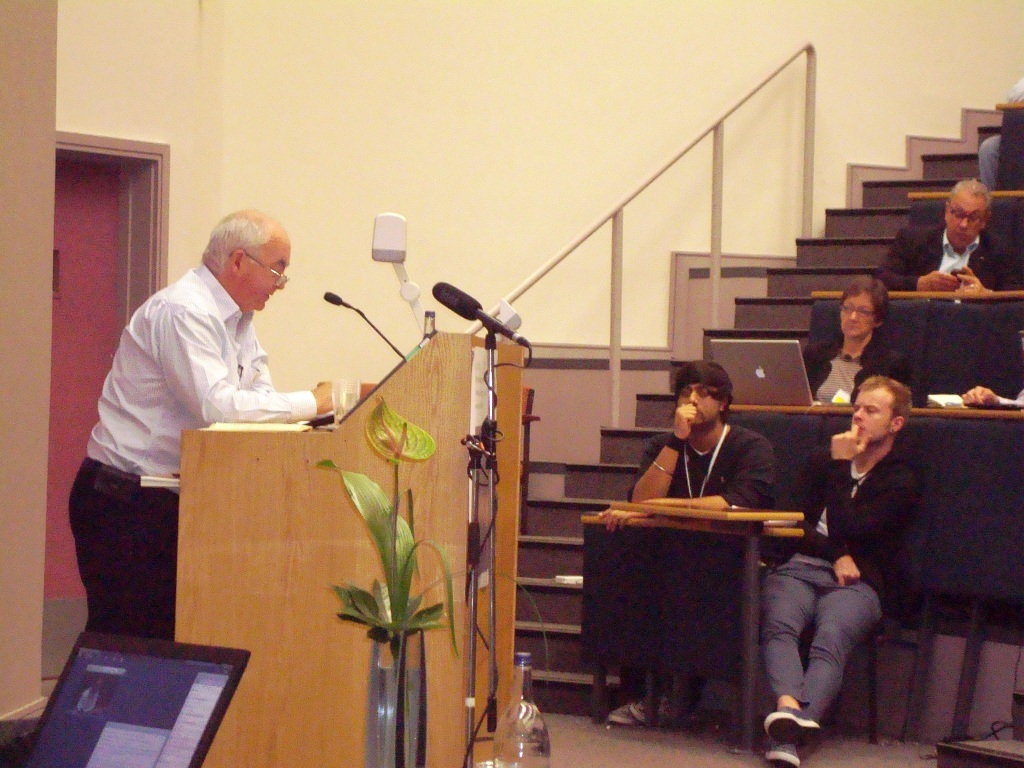


 We have enjoyed an interesting, intense and invigorating few days at the ALT-C event in Leeds this week. It was wonderful to encounter face to face so many people who I have previously got to know on Twitter. The days were filled with papers and demonstrations, symposia and workshops, some excellent, some thought provoking, and a few that could perhaps do with a little more development....
There were some interesting new features at ALT-C this year too. A fair amount of my time was taken up working with James Clay and Darren Moon (LSE) on the live streaming TV channel ALT-C Live Beta, which I helped to present. Throughout the conference, a small studio was used to interview delegates, speakers and guests, and James occasionally foraged among the crowd during the breaks to capture some of the vox pop ambience of the conference. The results of these hours of live video will be available on demand very soon on YouTube for all to revisit. For now you can view some of the interviews on this site. ALT-C Live Beta was an experiment that I feel worked extremely well and one that I hope can be a feature at future events. The content from the interviews in particular is rich and varied, and worth a revisit, and I am sure it has already been instrumental in amplifying the conference. Congratulations to James and Darren for adding an extra new dimension to the conference, and thank you both for involving me.
On the final day of ALT-C, in the first session I was pleasantly surprised to see a room full of delegates attending my own future pedagogy session. On the morning after the Conference Gala Dinner - commonly referred to as 'the graveyard slot', you are lucky to have half a dozen resilient punters present. On this occasion, surprisingly, every chair was taken. Three papers were presented, and a lively discussion ensued. Below is my own slide presentation on group blogging, entitled Learning Together Online.


