
 You are only as good as your last game - so goes the sporting maxim. And it's true - in sport you can't rest on your laurels, or live on past glories, because before you know it, some young pretender is ready to bury you, and you are suddenly second best. Fortunately, for most of us at least, the academic world usually isn't as cut-throat as that. But it is probably still true that you are only as good as your last journal article, book, or conference presentation. It's important to keep moving forward, because if you stand still, you stagnate and quickly lose touch with the leading edge of your profession. But are you as good as your last blog? Does yesterday's blog post still hold currency or must you continually press forward to write better, to expand on your ideas and elaborate your understanding of your subject?


 I know this is a strange title for a blog post, but let me explain: This week, in the north of the Czech Republic, I have just completed my tenth spell of teaching at the Technical University of Liberec. Each year, around half-term time in May, I am invited to teach a week of 'Argumentation and Rhetoric' to a group of international students of the University Neisse. What is argumentation and rhetoric? Well, as a psychologist, I interpret it as the study of interpersonal communication skills. To that end, when I was first invited to teach at University Neisse in 2002, I put together a 5 day programme which explored a number of social psychological theories around interpersonal skills, which involved lectures, demonstrations, discussion and games that focused on debating, argument and critical dialogue. Over the years I have included several social media elements including the use of blogs and wikis, when these were still seen as new in the education world.


 Today I enjoyed an interesting chat with Dr. Robert Nagy over lunch in Liberec, in the North of the Czech Republic. Robert is a lecturer both at the Technical University of Liberec and also at Charles University in Prague. He's a fellow psychologist, and we had a lot to chat about subsequent to him sitting in on one of my sessions this morning.
I was discussing one of my favourite theories with the group - Erving Goffman's Drama model of social interaction. Goffman suggests that each of us attempts to 'manage our impression' before our 'audience' as if we were performing on a stage. Front stage representation draws upon scripts, costumes, roles and props, as each person tries to present themselves in their most favourable manner. Back stage is different - this is the region where we are at our most informal, and where we let our guard down. I was applying Goffman's theory to online spaces such as social networks. I asked the group how many of them had a Facebook account. Of course, as I expected, everyone did. Next we discussed how people represent themselves on Facebook through their profiles, pictures, games they play, groups they join, and people they 'friend' online. Part of the downside of Facebook, I reminded them, is when you (or someone else) posts images of yourself onto the site. It's difficult to remove them once they are posted, and if they are tagged, it is easy to find them. Most people don't mind this, we agreed, but if an image is inappropriate (falling out of a pub at 3 am, the worse for wear), this may work against you when you apply for a job and your prospective employer decides to check you out on Facebook.
The problem, I theorised, is that many Facebook users perceive the social network as a 'back stage' area where they can let their hair down a little, remove their mask, relax and banter with their friends, and generally say what they want to. The mistake of course, is that Facebook is quite public (depending on how you manage your privacy controls) and open to many people to view. In reality it is a front stage region, yet with your guard down, you are likely to make a public fool of yourself if you are not careful and think you are bacjstage. The rules of social interaction, I suggested, are changing.
Afterwards, over lunch, Robert expressed doubt that the rules are actually changing. His argument is that most social conventions are usually quite rigid and that bad or good behaviour is the same, whatever platform, real or virtual, it is acted out upon. To an extent I agreed, but I pointed out that some conventions are in fact changing because of new affordances being introduced by technology. What is considered rude or aggressive by one person may not be seen as such by another. An innocent text message sent by one person may be construed by its recipient to be offensive or threatening. This may be due to a reduction in social cues, or simply not enough supplementary information being embedded within the text. Failure to include emoticons, or other 'non-textual' communication may render the message void of emotion, and then readers are left up to their own devices to decide whether the message is in fact ironic, or sent with some malice. Lack of experience in an online environment may lead the recipient to take the least form of resistance and miscontrue the message.
For me, the rules of engagement are changing to adapt to the technology that is increasingly mediating our conversations. The reduced or 'squeezed' text that is redolent of short message services such as mobile texting has spawned a new style of communication. If you are on the inside you will ROFL when you read the message. If you are on the outside, and not used to this style of communication, you may very well take offense or miss the point. So are the rules of social interaction changing, or are they the same as they ever were, just dressed up in a different form?
Image source by Slimmer_Jimmer
Back stage front stage by Steve Wheeler is licensed under a Creative Commons Attribution-NonCommercial-ShareAlike 3.0 Unported License.


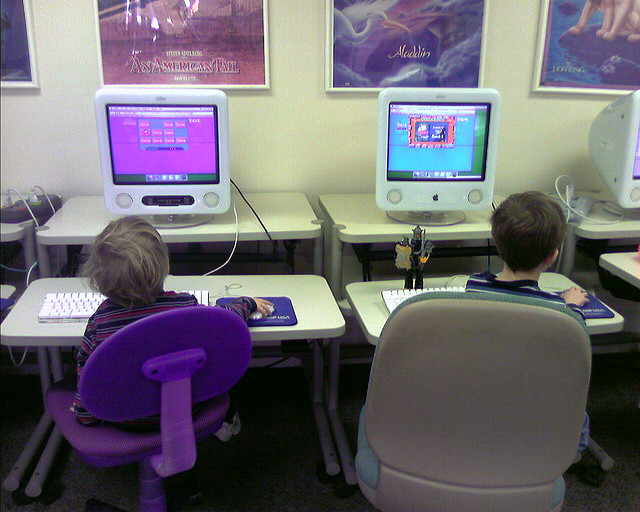 I'm firmly of the opinion that Information and Communication Technology (ICT) in schools is misplaced and therefore misused. In essence, the way it is conventionally deployed negates much of the potential of ICT, and unless there is a dramatic reappraisal, we won't be witnessing much in the way of learning gains in schools. Here's my argument in two points:


 A lot of stuff never gets done because it's 'against the rules'. Rules and regulations are the bane of creativity, and can stop innovation dead in its tracks. Every organisation has an IPD - an Innovation Prevention Department which is there to ensure that the rules are abided by, and that nothing happens without a rubber stamp of approval.
My reading of 'The Facebook Effect' recently has led me to believe that mavericks and anarchists - those who tend to bend the rules, or simply ignore them - are at the centre of many creative projects, and in some cases actually become the gamechangers. Mark Zuckerberg and his Harvard student friends have radically changed the way we communicate with each other, and they have changed it on a global level. Regardless of your opinion of Facebook, you would probably agree that it was a game changer. Zuckerberg was not, and is not someone who 'tows the line'. He got into trouble while at Harvard and ever since, he has led an edgy existence at the vanguard of a movement which has fractured many of the social conventions that existed prior to the advent of online social networking.
Zuckerberg isn't the only one who has kicked against the rules and bent them to get where he needs to go. Richard Branson, in his recent book 'Screw it, let's do it,' also admits to being a maverick (but we all knew that anyway). He says 'Though I have never followed the rules at every step, I have learned many lessons along the way. I am still learning and I hope I never stop.' Branson has carved out, time and time again, business opportunities that have broken the conventional mould with outrageous success. Beside their vast fortunes, what do Zuckerberg and Branson have in common? They are both free thinkers. They disregard the structure and restrictions of their surroundings, and dream up new ways to circumvent the constraints imposed upon them by 'the rules.' For them, the way forward is to 'just do it.'
There are many other free thinkers I could talk about - in the field of art (Picasso, Monet, Pollock), music (Mozart, Stockhausen, the Beatles), and science (Einstein, Darwin, Edison) - who were renowned for bending the rules and sometimes ignoring them. Creativity in this sense, is not so much about building on old models (although this is sometimes the case), nor is it about extemporisation around a known theme. No, it is more to do with what Margaret Boden called 'transformational creativity' where scant regard for what is acceptable or achievable, is replaced by the will to make something happen regardless of the constraints, the rules, the expected.
Is this the kind of ethos we see in our schools, colleges, universities? As teachers are we fostering a sense of the impossible in our learners, and are we nurturing dreamers and entrepreneurs? Or are we instead continuing to impose rules and constraints which are no longer necessary or simply outmoded, because 'it has always been done that way?' Carl Rogers, a free thinker in his own right, once made it clear that the educational situation which most effectively promotes significant learning is one in which 1) threat to the self of the learner is reduced to a minimum, and 2) differentiated perception of the field of experience is facilitated (Smith, 2004)
In clear language, this means that people learn best when they feel that they are under no constraints to express themselves and when they are given licence to change things and make them personal. How could this be applied to our own classrooms, and how many of us as teachers facilitate free thinking within our practice? Next time, don't ask for permission. Just do it.
'It's easier to ask for forgiveness than permission'
Image source by Jack Lyons
Free thinking by Steve Wheeler is licensed under a Creative Commons Attribution-NonCommercial-ShareAlike 3.0 Unported License.


 The highlight of yesterday's student education conference at the University of Plymouth was the final keynote speech from Deputy Headteacher Dave Mitchell. Dave has carved out quite a reputation for himself as a champion of blogging for early years children. Much press and media coverage has celebrated the many and varied successes the school has achieved through good pedagogy and the appropriate application of social media tools. It was fitting then that he should have the last word at the #earlyyears event held in the Faculty of Education.


 It was always the case, in every school I ever attended (9 in total) that once the door was closed, the lesson began and the teacher was in charge. Even now, as a classroom practitioner myself, I sometimes joke - 'close the door so people outside won't hear the screaming.' The connotation of closed door classrooms is that no-one sees or hears what goes on except the teachers and the students, who are all locked in, until the bell sounds. But this literal expression of a closed classroom can also represent an underlying philosophy. And I ask, are classrooms in schools, colleges and universities as closed conceptually as they are literally?


 An interesting question was raised today during the Effective Teaching and Learning in a Digital Age event at the University of Birmingham. Organised by the Higher Education Academy, the one day conference attracted around 40-50 people from a number of universities across the UK. One of the invited speakers was Professor John Traxler (University of Wolverhampton) who spoke on how mobile technologies are extending and enhancing learning. In a 'hot off the press' publication from the HEA, which he also edited, John writes about mobile technologies, (of which he includes smart-phones, media players, games consoles, netbooks and handheld computers):
"By now almost everyone owns one and uses one, often more than one. Not only do they own them and use them but they also invest considerable time, effort and resource choosing them, buying them, customising them and exploiting them. These handheld devices express part or much of their owners' values, affiliations, identity and individuality through their choice and through their use. They are both pervasive and ubiquitous, both conspicuous and unobtrusive, both noteworthy and taken-for-granted in the lives of most people. This explains in part why mobile learning is not just e-learning on mobile devices; it also hints that we might leverage learners' own devices and in doing so take education into new modes, spaces and places." (Traxler, 2011, p 4-5)
The entire 44 page booklet, published by HEA Subject Centre for Education (ESCalate) is a thoroughly good read, but the paragraph above has provoked some discussion already. Here's the question: Should students' personal devices become a part of the delivery strategy in higher education, or indeed elsewhere in other sectors? If student owned devices are brought into play (and in many contexts they already have been) what issues are raised?
What about digital exclusion? Some students don't own personal devices such as mobile- or smart-phones. Would any widespread or persistent use of such devices cause them to be digitally excluded and thus disadvantaged? On another issue, if student owned devices are personal, they will no doubt contain a great deal of personal data and information. Would the integrity of these personal data be compromised at all during everyday use in a formal education context? What safeguards might institutions put into place to ensure that this would not occur? Finally, is it ethical or indeed desirable to ask students who have purchased their personal devices, to use them for purposes they may not have expected them to be used for? What about wear and tear, or accidental damage of the devices during learning? Who would pay for replacement or repair, or insure the devices during these kind of activities. OK, I'm playing devil's advocate here, but I wonder what other possible objections might be raised in relation to student being asked to use their own personal devices in formal education? Your omments are as ever, most welcome.
Reference
Traxler, J. (2011) Introduction, in: J. Traxler and J. Wishart (Eds.) Making mobile learning work: Case studies of practice. Bristol: The Higher Education Academy.


 I want to inspire you to reach farther. Most teachers are limited to their classroom, or to the environment within which they and their students can interact. Some may be fortunate enough to escape from the classroom to lead outdoor education trips, or work within a forest school, spending class time exploring and learning from their surroundings. Some teachers are even lucky enough to conduct a comparative studies trip in a foreign country. Most teachers though, usually find themselves trapped within the four walls of the classroom or lecture hall for much of their working week. And yet with the new social media tools, we can all be worldwide educators. All we need is something important to say, and a tool such as this blog as a vehicle to say it with.
It never ceased to amaze me how many students contact me to say how much they enjoy reading this blog. Some have told me how much it has inspired them to learn more, explore, take risks, and reach further. This kind of positive affrirmation is very important to me and to other edubloggers. Personally, it's one of the main reasons I continue to blog and invest my time in it. Knowing that what I'm writing, and the richness of the subsequent dialogue are having a such positive impact on someone, is one of the main reasons I blog so regularly.
This morning I happened to stumble upon an interesting Twitter stream hashtag - #qaz11 - which I quickly realised was being generated by a group of students in the care of my old friend Jose Luis Garcia (well worth following him on Twitter: @JL3001, over at the University of Cantabria in Spain. Although the tweets were in Spanish, I was able to translate them using Tweetdeck, and I followed for a little while. The students were discussing the merits of the 10 Teaching with Twitter activities I posted on this blog. It was interesting to see them analyse and evaluate the potential of each of the activities within their own professional context as trainee teachers. Without me actually being there, my thoughts were having an impact on the students' learning - my ideas were helping them to frame their thinking, promote discussion and engage critically with the topic.
The same is happening all over the world, every hour, every day as teachers begin to share their ideas and advice, best practice and top tips across a global platform - the blog. We have become a new breed of teacher Quite literally, we are worldwide educators, with students in every country of the world, who read our blogs, think, argue, learn and then go off to try out some ideas. We don't always see them, and we may never meet them, but they are there, and they are learning.


 Earlier today Shelly Terrell tweeted that she would prefer to see schools invest in mobile technologies than in Interactive White Boards (IWBs). Here's what she said: "Personally, I feel $$ better spent on mobile devices in classrooms vs IWBs." Actually, I can see her reasoning behind this, because although I have observed some excellent learning and teaching using IWBs in some schools, they are few and far between. Many teachers I have watched tend to use IWBs like an expensive display board. They won't let smaller hands anywhere near it. Perhaps the boards are positioned wrongly on walls so the kids can't reach them, as in Neil Selwyn's account Revisiting the promise of digital technology in schools. Perhaps the teacher simply wants to maintain control of the classroom, and feels that letting kids interact with the screen might unleash some kind of diabolical anarchy. Kids at the front of the class? Never! They should be sat down behind their desks, listening quietly, making notes! 'Elf and safety mate. Perhaps the teacher thinks the kids might damage the board, because after all, IWBs can be expensive to repair? Sticky fingers all over the board - not on my watch my friend. Or perhaps, most likely, the teacher is too hard pressed for time to dream up activities in which the children can actually leave their seats and interact with the resources on the screen.


I was deliberately provocative on Twitter this morning when I tweeted this: In just a few hours I had responses of all hues and colours, some agreeing, some disagreeing, many wanting more flesh to be put on the subject. So here, just for the record are my own, and other people's thoughts on the controversy of Marc Prensky's Digital Natives and Immigrants theory. Prensky originally suggested that those who were born before the digital age are immigrants, whilst those who have grown up with technology are the natives. The implications for this dichotomy?
Children don't need instruction manuals to use technology - they expect the device to teach them. Older people - the immigrants - can't multitask like younger 'natives' can, because they are not as immersed in the gaming culture, and therefore don't live at 'twitch speed'. Older people have a foot in the past, and speak technology with an 'accent' that they cannot lose, while younger people are naturally adept at using new and emerging technologies. OK, this is a potted version of Prensky's article, and you can read the entire thing for yourself at the link above. I won't begin to deconstruct his ideas on the supposed 'cognitive changes' he suggests are taking place in the heads of younger users. I'll leave that for another blog post.
A welter of similar terminologies have emerged alongside Prensky's 2001 distinction. Veen and Vrakking published an entire book dedicated to an analysis of ' Homo Zappiens ', whilst Diane Oblinger, Don Tapscott and others popularised the now oft repeated phrase 'Net Generation'. Other terms, such as 'Net Savvy Youth', 'Screenagers' and the 'Google Generation' played on a supposed distinction between age groups, and in doing so, created a dangerous perception that the two really were somehow different. As a response to this feeding frenzy, Mark Bullen set up a blogsite entitled 'Net Gen Skeptic', which he has used to attempt to debunk much of the rhetoric that has been generated on the subject. Bullen actually speaks a lot of sense, and in a recent interview said:
"...my basic point is that the claims about this generation are not based on research. They are speculations that emerge from anecdotal observations and from a techno-utopic view of the world and a fascination with technology. I don’t dispute that this generation is different than previous generations. Every generation differs from the previous in some way. The social, political and technological context changes so this is bound to have an impact on the people growing up at that time. But before we start making radical changes to the way to do things in education we need some evidence." (from Open Education.net)
Bullen goes on to warn of the dangers that lurk when politicians and school leaders swallow the digital natives theory whole and assume that policy and provision should be based upon it:
"...there is an assumption that because this generation is much more immersed in digital technologies for primarily social and recreational purposes that they a) want to use them for educational purposes and b) will be skilled at using these technologies for educational purposes. I have yet to see any evidence to support these assumptions. Also, some of the claims are the same or very similar to claims that have been made about every generation of young people: impatient, social, prefer to learn by doing, and goal oriented." (from Open Education.net)
The message is clear: teachers should not assume that because many children are adept at using new and emerging technology, that they are able to apply them freely in formalised learning contexts such as school. Nor as a result, should they shy away from using technology in the classroom with the fear that 'the children will know more about it than me' - children may have skills in the use of technology, but teachers have the skills and the knowledge to create engaging and exciting learning opportunities and environments. Technology is simply a part of that equation.
JISC has also produced a research based rebuttal of the Google Generation and several other evidence based refutations have recently been published, including Neil Selwyn's Digital Natives: The Myth and the Reality in which he provides a measured commentary of the difficulties the theory imposes upon education. The Chronicle has weighed in with its own report entitled Generational Myth while a useful critical review of the digital natives debate so far, has been captured by Bennett et al in the British Journal of Educational Technology. Finally, David White (University of Oxford) has proposed his own alternative theory - the Residents and Visitors theory, which is not based on the false distinction of age, but rather on perceptions of usefulness and habituation within digital environments. The evidence is now stacking up that there is indeed a lot of doubt being cast over the digital natives and immigrants theory. It's interesting that although Marc Prensky has revised his theory, with a much more measured 'digital wisdom' approach, many people are either ignorant of it, or simply choose to continue to subscribe to, and quote from the digital natives theory. Perhaps it conveniently suits their purpose....?
The natives are revolting by Steve Wheeler is licensed under a Creative Commons Attribution-NonCommercial-ShareAlike 3.0 Unported License.


 Much of my understanding of digital identity was founded in my studies into personal identity, whilst a student of social psychology. The work of William James and George Herbert Mead influenced my thinking, as did the study of sociologist Charles Cooley into 'the Looking Glass Self.' Essentially, in this hybrid early school of social psychology, known as symbolic interactionism, theorists tried to explain the influence of audiences/other people on the behaviour of individuals. It was a fluid theory that allowed for behavioural adjustments on the fly, as people saw themselves 'reflected in the eyes of the other' - the impact of what they were saying - as they conversed. Therefore, 'in order to develop and shape behavior, interactions with others must exist. People gain their identity and form their habits by looking at themselves through the perception of society and other people they interact with.' (New World Encyclopedia)


 Had a great conversation at lunch today with Peps McCrea over at the University of Brighton. We were talking about our common interest in the educational benefits of blogging, and I made a suggestion that digital identity was a significant factor in the way teachers and other professionals use it (I will blog on this idea in a future post). I expanded by talking about my own use of blogging. I had to examine my own motives which I have already reflected on in previous posts such as Why do I bother? So what are my reasons for expending so much of my time on blogging?


 They say that our school years are the best years of our lives. But for many children, that is untrue. About a year ago, I wrote a personal account of an incident during my primary schooling that shaped my young adulthood. In That'll teach him, I recounted an incident where I asked a question in class, and the teacher ridiculed me. It was a bad experience. Being laughed at by the whole class on the teacher's instigation was humiliating, embarrassing and also a very powerful negative influence on me. I learnt never to ask questions in school again. It took me a long time to shake off that stigma and be bold enough to ask questions again. And it was important for me, because we learn by asking questions. Teachers have such power and influence over their young charges, and many are largely unaware of it. It's true that doctors save lives, but teachers make lives. That post served to illustrate some of the bad practices some my teachers adopted, and said a lot more about that particular teacher than it did about me. From that bad experience, eventually, came some very positive outcomes. But what about my positive experiences in education? Well, there have also been some very inspirational teachers...


 I have just had a new paper published on how smartphones are being used in patient education and remote health care. The paper appears here in Biomedical Engineering Online and is entitled How smartphones are changing the face of mobile and participatory healthcare. I see it has already been labelled as 'Highly Accessed' which bodes well, and of course, it is published as an open access article complete with downloadable pdf file. Written in collaboration with my colleagues in the Faculty of Health at the University of Plymouth, the paper covers a range of telehealth issues as detailed in the abstract:
The latest generation of smartphones are increasingly viewed as handheld computers rather than as phones, due to their powerful on-board computing capability, capacious memories, large screens and open operating systems that encourage application development. This paper provides a brief state-of-the-art overview of health and healthcare smartphone apps (applications) on the market today, including emerging trends and market uptake. Platforms available today include Android, Apple iOS, RIM BlackBerry, Symbian, and Windows (Windows Mobile 6.x and the emerging Windows Phone 7 platform). The paper covers apps targeting both laypersons/patients and healthcare professionals in various scenarios, e.g., health, fitness and lifestyle education and management apps; ambient assisted living apps; continuing professional education tools; and apps for public health surveillance. Among the surveyed apps are those assisting in chronic disease management, whether as standalone apps or part of a BAN (Body Area Network) and remote server configuration. We describe in detail the development of a smartphone app within eCAALYX (Enhanced Complete Ambient Assisted Living Experiment, 2009-2012), an EU-funded project for older people with multiple chronic conditions. The eCAALYX Android smartphone app receives input from a BAN (a patient-wearable smart garment with wireless health sensors) and the GPS (Global Positioning System) location sensor in the smartphone, and communicates over the Internet with a remote server accessible by healthcare professionals who are in charge of the remote monitoring and management of the older patient with multiple chronic conditions. Finally, we briefly discuss barriers to adoption of health and healthcare smartphone apps (e.g., cost, network bandwidth and battery power efficiency, usability, privacy issues, etc.), as well as some workarounds to mitigate those barriers.
Image source by C Frank Starmer


I started a discussion on Twitter today about blended learning, after reading an exchange between @simfin and @whitec. Unfortunately, the limit of 140 characters, on this occasion at least, badly let me down. Now look, just like any other academic, I don't mind a bit of a verbal punch-up, in fact I relish it. If you want an argument, I'll give you one, and just when you think it's all over, I'll come back for some more. But what I don't enjoy under any circumstances being misunderstood. Today's discussion about blended learning on Twitter was for me at least, somewhat unsatisfactory. I was away for some of the time, engaged in editorial work, and as I wasn't able to make my point clearly, I didn't persist. But, knowing me like you do, you know it's not over. So I'm using this blog to elaborate on my ideas in the hope that a more informed discussion can ensue and that this time I will not be misunderstood. Here's what I originally tweeted: 
By this statement I meant this: Blended learning (in the established, traditional sense) means a mix of learning activities that involved students learning both in the classroom, and at a distance from the classroom, usually mediated through technology. I am claiming that this type of blended learning - in concept at least - is now outmoded because the boundaries between local and remote have now been substantially blurred. The tyranny of distance has been fractured. My students now learn across a continuum that encompasses the classroom, home and all points in between, any time, any place. They use the same or similar technologies in the classroom as they do at home, as they do on the bus, as they do... you get the idea. Geography (location of study) matters less and less as technology becomes more familiar, transparent and affordable, and students are connected with their peers, tutors and content in continually new and dynamic ways. This is why blended learning, in the old traditional sense is now a fairly meaningless term.
The second part of my statement was more contentious to those who responded to my tweet. I said that the 'new blend is to blur formal and informal learning.' This provoked a storm of responses. Someone said that the idea of formal/informal learning wasn't 'new'. Let me clarify - by 'new' I meant it's a new challenge for teachers. It means they may have to consider replacing some of their practices and it means that schools may need to revise some of their rules. Let me explain again:
Young people now bring so much informal technology into the classroom (mobile phones, handheld games consoles, etc), which they use constantly outside the formal boundaries of formal learning. Without really thinking about it, they use these tools to create and share content, connect, communicate and collaborate for their informal learning. Presently many schools simply ask their students to 'turn off' the devices when they arrive in school, because there are concerns about innappropriate use (cheating, bullying, recording and posting images or videos, etc). One challenge for school leaders today is to balance the risks against the benefits and decide what role if any these informal tools have in a formal context. The major challenge for educators then is to decide whether they wish to harness the power, excitement and allure of these informal technologies with a formal context.
A point was made by Anne-Marie Cunningham that the formal and informal have always been naturally blended by students, and it's nothing new, and to a great extent this is true. However, there is something new we need to consider. With the advent of emerging digital technologies, there are now more opportunities than ever to exploit the potential blend between formal and informal learning. To simply say that it's not new, has always been there, and therefore we don't need to be concerned with it, is ignoring the incredible potential we now have within our grasp to enrich, enhance and extend student experiences.
Mike John implied that because there is only learning and teaching (of which of course I agree) we shouldn't be labelling it with other terminology, because in doing so, we are 'taking our eye off the ball.' I know what he's getting at - the learner should be central - but I counter this by pointing out that if you are discussing the pedagogical theories behind the multitude of different practices observed in the classrom every day (my stock-in-trade) you need different words to engage fully and effectively in the discourse. Differentiating these practices necessitates giving them terms that describe, define and delineate them from each other. Yes, in the final analysis there is only learning and teaching, but we are not taking our eye off the ball in this discussion, we are merely finding out how many ways there are of kicking the ball. Education would be poorer without variety.
Finally, I want to make the point that blended learning in the new sense will also see the boundaries between teacher and learner blurring. I believe the two are a part of a continuum, because we learn by teaching. Sure, the teacher will be paid to develop and facilitate learning processes, but they will accompany students rather than leading them, and students in turn will surely teach each other more. We know that one of the most powerful and persistently positive learning outcomes in all sectors of education arises when reciprocal teaching is employed - the metastudies of John Hattie have established this across multiple contexts. So my prediction is that learning and teaching as activities will blend too. So there you have it. Blended learning as a concept is outmoded, and the new challenge for educators is to bring the excitement and affordances of informal technologies into the formal context. Other boundaries will blur as teaching and learning begin to coalesce. I hope I have been clear, and I'm quite happy to debate this further. Am I right or am I wrong? You tell me.
New blends in learning by Steve Wheeler is licensed under a Creative Commons Attribution-NonCommercial-ShareAlike 3.0 Unported License.


 Over at the University of Brighton, Peps McCrea is currently blogging about MOOCs (Massively Online Open Courses) and is speculating how they might influence the future of Higher Education. Having taken part in a MOOC run by Stephen Downes and George Siemens a couple of years ago (as a speaker not a student), I can say that it was a very enjoyable experience. I was grilled by Stephen for a sustained period of time about my ideas on Personal Learning Environments, and in true gladiator style, I enjoyed the cut and thrust of my live, widely distributed debate.
Running a MOOC by Steve Wheeler is licensed under a Creative Commons Attribution-NonCommercial-ShareAlike 3.0 Unported License.

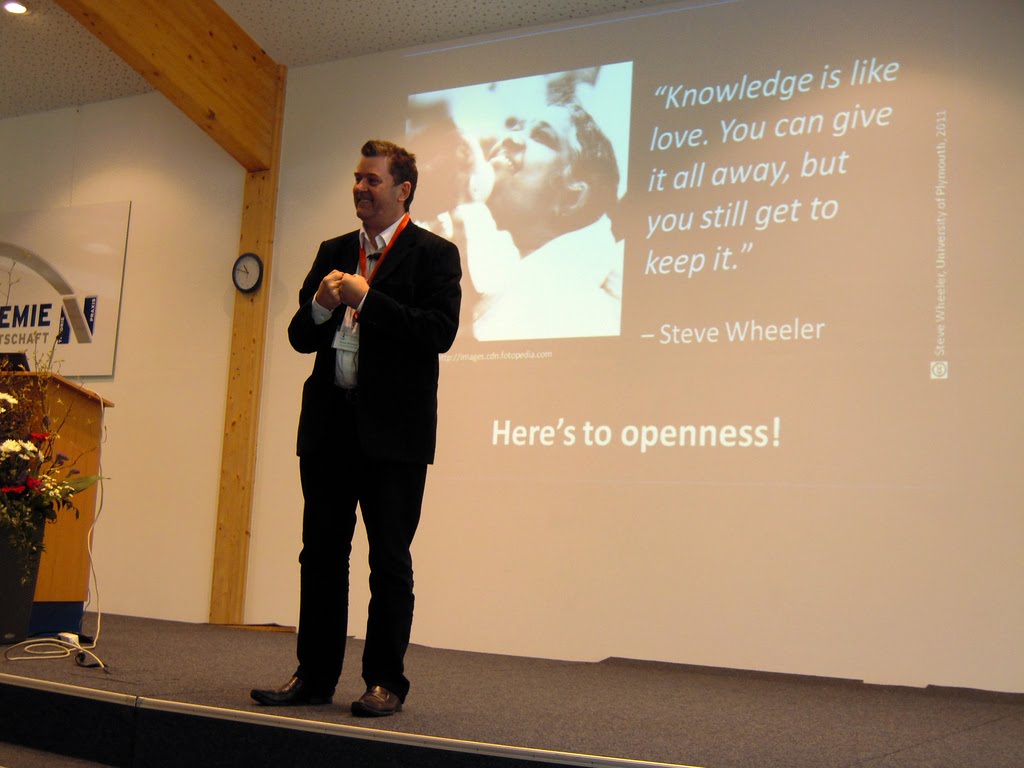 In spite of the trials and tribulations of international travel, I actually had a wonderful time in Elmshorn, Germany this week during the two day Moodlemoot event. I met a lot of smart people, and engaged in some very valuable conversations about learning, technology, culture and life in general. The Sounds of the Bazaar Internet radio guys were also present and I managed to squeeze in a live interview on Day 1 with Klaus Rummler on the 'future of learning', as we stood outside in the spring sunshine. My opening keynote focused on openness in education, and I made a call for more open scholarship and open educational practices. Because I was 'preaching to the converted' (the audience was made up of around 300 teachers and other professionals who were already sold on the idea of using open source tools such as Moodle and Mahara in their work), my presentation was very well received, and there were some excellent, thoughtful questions at the end. My slides are here.
The road is open by Steve Wheeler is licensed under a Creative Commons Attribution-NonCommercial-ShareAlike 3.0 Unported License.

 It's official. Brussels Air sucks. I'm very disappointed in them, and if they were one of my students, they would get a big fat zero. I have to admit that the only thing with Brussels in front of it that I dislike more at the moment is sprouts. I have just arrived home after a horrendous 20 hours being trapped in transit. And it was all Brussels Air's fault. It all started when I left the German Moodlemoot (#mootDE11n) which I keynoted this week. T'was a great conference with plenty of good stuff to come away with (and this will be the subject of another post, later in the week). My keynote speech was entitled 'The Road is Open.' In hindsight I think I should have called it 'The Road is Endless.' Here's why ...
The road is endless... by Steve Wheeler is licensed under a Creative Commons Attribution-NonCommercial-ShareAlike 3.0 Unported License.

 The current consensus is that Twitter is for oldies, and that younger people (particularly those under 30) don't tend to use it. Whilst we must avoid sweeping statements, and accept that some young people do actually use Twitter on a regular basis, some recent polls such as the Pearson and Babson Survey have suggested that only 2% of teachers have used it to communicate with their students. The survey, which was conducted in the U.S., says that Facebook and Youtube are the tools of choice for college students.
But let's stop one moment and think about this. We need to take care that we don't pigeon hole the use of social media (or any other tool for that matter) within age limits. It's just as rediculous to claim that only old people use wheelchairs. We made this mistake when we swallowed Marc Prensky's digital natives and immigrants theory whole. In hindsight, we now know that age is not a determining factor in whether or not we effectively use digital media. In fact, Dave White's alternative theory - visitors and residents, is a much more appropriate explanatory model in this context. Dave argues that residents are those who habituate themselves within particular media and virtual environments, and therefore have a deeper understanding and appreciation of the nuances and affordances of the tools they are using. On the other hand, visitors tend to know a lot less about the tools they are using if they only use/visit them intermittently. This explains in a more convincing way why some become very skillful in using technologies, whilst others struggle to master them. It may also provide an explanation about how people choose their social media tools - often because of the utility they perceive it can offer them, and in the case of social networking, by whoever else might also be already using the tool.
A recent discussion on Twitter (about the use of Twitter!) resulted in a number of interesting points being made about the way people adopt, exploit and develop their use of social media. There are clearly a number of different reasons why people use social networks, whether socially, professionally and for personal learning development. My suspicion is that people will choose different tools for different purposes, and consider their options based on who else uses the tools in question. There is evidence that several schools are using Twitter and other social media in everyday teaching. Dave Mitchell (Deputy Head Teacher at Heathfield Primary School in Lancashire) uses Twitter with his Year 6 students on a regular basis, and has reported very positive results. Dan Roberts (Deputy Head Teacher at Saltash.Net Secondary School in Cornwall) is also using Twitter and other social media of all types on a regular basis and has reported some very creative and award winning outcomes.
Dan Kennedy (an under-30 teacher at the Grange Secondary School in Dorset) pointed out that the main reason he uses Twitter is because his community - those he wishes to connect with - are best contacted using it. This should give us a clue that the use of Twitter, or any other social media tool, is not about age, but more about community. It's not so much about when you were born, but where you place yourself in the terrain of digital connection. Twitter is also about sharing - emotions, experiences, resources and great ideas. In Why Twitter is so Powerful, I made the following point:


 Some of my Twitter buddies have reminded me today of the torrid picture that was taken of me jokingly emulating Edupunk Poster Boy Jim Groom. There's an image of me floating around the web with 'PUNK IT UP' on my knuckles. I guess it's timely, because I travel to Hamburg tomorrow to keynote the German Moodlemoot conference (#mootDE11n) on Thursday, and one of the key themes of my speech will be 'do it yourself' education, the ethos of edupunk. My title is 'The Road Ahead is Open', and I will cover a spectrum of open approaches, including open learning, open educational resources, and the open bricollage approach espoused by Levi Strauss. Ultimately, the entire speech will boil down to a plea for people to adopt an open scholarship approach to their learning and teaching.
Open Scholarship, as I have previously suggested, is much more than a term denoting open practices. Open Scholarship is a way of life, based on the belief that to share your ideas is much better than to hoard them. It's also about opening yourself and your ideas up for constructive criticism, so that in receiving feedback from your PLN, you will learn and grow together. Let me ask you this: What possible purpose is there to hide knowledge away from people who need it to survive and make their lives better? Stephen Heppell, in last week's Plymouth e-Learning Conference stunned us all by declaring that around half a billion children in the world (like the ones in the picture above) are outside of education, and don't have a hope of even seeing the inside of textbook, let alone a classroom. And yet all it would take to educate the lot of them would be 5 billion US dollars. It got me thinking. There are a few super-rich people in the world who have this kind of money, and more, in their personal fortunes. Certainly, many of the banks or corporations around the world are rich enough to have this kind of cash to spare. But how many of them would be willing to stump some up to educate our world?
Several years ago, we all gave money to a world wide appeal to feed the starving of the world. The 'Feed the World' campaign was a triumph of compassionate fund raising, but it simply solved a problem in the there and then. Poverty and starvation still exist and although we can't cure it, we can educate people who are in poverty if we simply share the wealth and knowledge about.
It doesn't take a genius to work out that if you give a man a fish you feed him for a day, but if you show him how to fish you feed him for life. In many cultures, if you educate a man, he is self sufficient. Yet if you educate a woman, you educate an entire family. How are we going to meet the challenge of this century? The challenge to educate people out of poverty? Open scholarship will go a long way to resolving that one, because if everyone shares what they know, and we don't greedily hoard that knowledge away, or capilulate to the invasion of the edubusinesses, the world will be a far more equitable place.
Educate the world, don't just feed it by Steve Wheeler is licensed under a Creative Commons Attribution-NonCommercial-ShareAlike 3.0 Unported License.


Shelly talked about the butterfly effect - a mainstay example of chaos theory - and used it as an analogy to describe the incredible potential of social media. 'Blog or tweet a good idea, and minutes later, teachers may be using it for real, in a classroom somewhere' she said. The ripples caused by some content can extend onto the screens of many thousands or millions of people worldwide, she pointed out. Youtube videos go viral very quickly as the crowd gains awareness of the content and message. How can we harness this phenomenon in learning? she asked. Yes, there is incredible power in Twitter, Facebook, Youtube, Flickr and a host of other free tools. The key question and take away points from this keynote were - how do we harness this potential of social media, and how can we apply such tools in authentic learning contexts so that learners are engaged, challenged and inspired? Shelly Terrell's keynote was a fitting finale to this year's Plymouth e-Learning Conference. The theme - digital futures - was well and truly covered, and from many angles, perspectives, arguments. A number of other people are also blogging about pelc11. Check out their blog posts below:  There is a growing swell of movement toward informal learning through social media. It is free, connected, creative and disruptive. It happens across all sectors of education - it's for everyone. Shelly Terrell's well received keynote speech at the 6th Plymouth e-Learning Conference exemplified this kind of learning. Many who watched her speech, either from within the room, or via the livestreaming elsewhere in the world would have seen that Shelly passionately believes in what she preaches. And she also practices it. The previous evening she had dashed back from the conference dinner to present a live webinar from her hotel room in Plymouth.


 I have now had some time to reflect on this week's Plymouth e-Learning Conference. For me, No. 6 has been the best of the series so far. A growing collection of colourful images of the conference can be found at the Flickr Group Pool for sharing and download. Several people came to me after the event and said that they thought the conference had morphed, turned a corner, transformed into something entirely new. And to be honest, there did seem to be a new ambience around the conference this time that I had not previously encountered. Was it that we included children this year, on Day 1, for the student voice technology showcase? Possibly, because they certainly added a new and very welcome dimension to the event. Looking around the room as they spoke, the audience was all smiles, and many people have stated that it was one of the highlights of the conference for them to listen to groups of such articulate and confident young people showing us oldsters how they used technologies to enhance their own learning in the classroom. We will reprise this next year, that's for sure.
 Stephen Heppell also gave an inspiring speech on designing physical learning spaces, drawing on what we had already learnt from virtual spaces. He showed examples of a number of 'playful learning spaces' including rooms with no corners, 'fidget seats' that you fall off if you sit still for too long, classrooms where you remove your shoes and go barefoot, and even a classroom where they bake bread in an oven. These kind of sensory experiences, said Stephen are important for us to consider in the wholistic education of young people. "This generation of learners will astonish us", he declared, but only if we astonish them by providing stimulating and relevant learning environments. Teach less, learn more by Steve Wheeler is licensed under a Creative Commons Attribution-NonCommercial-ShareAlike 3.0 Unported License.

 The Plymouth e-Learning Conference (PeLC) is over for another year, but the memories and the reverberations will be there for a long time, methinks. Delegates from Ireland, Germany, Holland, Portugal, Turkey, Bulgaria, USA, Canada, Argentina, Oman, Austria, Lebanon, Italy and Australia, as well as from all over the UK, attended the event this year. I got the impression from all I talked to, that people were thrilled to be at the event, keen to engage with such a passionate and knowledgeable audience, and extremely excited to listen to our world class speakers, Stephen Heppell, John Davitt, Jane Seale and Shelly Terrell. The #pelc11 Twitter stream was alive and kicking long before the event started, with over 300 tweets before the conference started at 1pm.
 The weather throughout the conference has been perfect, as we promised - clear blue skies and plenty of sunshine show the seaside city of Plymouth at its glittering finest. PeLC started with a free day, which welcomed children and their teachers from several local schools, and several more schools around the UK via technological means. One of the highlights of Day 1 was the student voice technology showcase, hosted by Dan Roberts, in which children from both the primary and secondary sector regaled the audience with their astounding and inspirational uses of digital tools in the classroom. The session prompted Matt Lingard to blog about how much the children had impressed everyone with their enthusiasm for learning. They were clearly very confident and extremely articulate, and seemed completely undaunted by their surroundings and audience. Children it seemed, were everywhere at PeLC on Day 1, playing with small humanoid machines in the Robot Show, trying their hand at Internet Radio broadcasting with the wonderfully entertaining Russell Prue, and sampling the excellent food in the main atrium of the Levinsky Building.
 Another highlight of Day 1 was the evening Teachmeet where several teachers and many more student teachers were chosen at random to stand up for a few minutes to share their ideas and experiences on how to harness the power of learning technology.
Yet Day 1 really belonged to the children, and the conference reverberated with their energy. It was a joy to have them joining us at the conference, and we will certainly be planning more children focused events next year, because let's face it, our kids are not the future - they are the 'now'. (More reports from the conference later)
Images by Jason Truscott (More pictures of #pelc11 here)
It's about the kids by Steve Wheeler is licensed under a Creative Commons Attribution-NonCommercial-ShareAlike 3.0 Unported License.

I admit that whilst some people do natter on about irrelevant or self indulgent stuff, I tell them that there is also a lot of good content being tweeted daily on Twitter and also an occasional nugget of gold - a link for example to a must-see resource. The answer to effective Twitter use, I point out to them, is the manner in which you use it. The potential is there for it to be used as a very powerful Personal Learning Network (PLN) if it is employed appropriately. PLNs can help professionals by providing solutions to all kinds of problems. Follow the right people, and you will always have food for thought. Ask the right questions of the right people, and you will get very useful answers, pretty damn quick. The answer to finding your own powerful PLN in Twitter is simple: It's all about filtering, and Twitter can be filtered on three levels at least. I've been discussing the merits of Twitter as a professional social network recently in conversation with colleagues. One of the regular objections to using Twitter professionally is that there is too great a noise-to-signal ratio. In other words, people are reluctant to get too deeply involved with Twitter because they think they will be swamped with people talking about what they had for breakfast, how their cat was sick on their auntie Bessie, or other niff naff and trivia. Professionals don't have a lot of spare time, and want to maximise the time they do have. I don't blame them. But they should also realise that Twitter can actually save them time if used in an appropriate manner.
Secondly, filter by choosing to follow the right people. There are at least three ways to choose the people you should most likely follow. 1) Go on the recommendations of people you trust. If they have been on Twitter for a while, they will know the ropes and they will know the dopes. Ask for their advice, or simply trust them and follow the people they recommend in their Twitter lists. 2) Choose to follow people on the basis of their content - look at their profiles and the Tweets they post, and you'll soon see whether or not it will be worth your while following them. 3) Don't forget that you can also discover people to follow on Twitter through serendipity. This may be because someone else you follow has retweeted them or simply because you spot them online. If they look interesting, follow them - you have nothing to lose - and you can always unfollow later if it all gets a little too tedious.
Thirdly, you can filter your Twitter stream by using keywords to search for specific content. You can also be very specific by following hastags for say, events such as conferences, or breaking news stories. Keeping an eye on trending topics can also be useful occasionally, especially if you want to lock into something that is breaking news. These three levels of filtering should enable you to enjoy Twitter as a useful PLN, without you being swamped with spurious content. Third party tools such as Tweetdeck can also compartmentalise content and make it manageable. You can choose what each of your columns contains, including your own mentions or DMs (Direct, private messages to you from friends). Happy Twittering!
Image source by Sarah Gallagher
 Twitter: Le triple filtre by Steve Wheeler is licensed under a Creative Commons Attribution-ShareAlike 3.0 Unported License.


