Log on:
Powered by Elgg

Feed detail

October 24, 2019

#TwistedTropes 3. Occam's bloody razor

Image from Wikimedia Commons
This is William of Occam. It's the best selfie I can find of him. It was taken in the dark ages, when decent lighting wasn't much of a priority.

William was both a philosopher and theologian. Just one of these would have been sufficient, but no - he had to be both. Because he was a philosopher (and a theologian) he spent a lot of time thinking. Eventually, he invented a way of determining the value of an argument or idea.

We call it Occam's razor, because it cuts through all crap and leaves only the bare essentials.

Now before you ask, Occam's razor would not have been allowed into a football match, and William would probably have been arrested in a stop and search. His razor would be considered a dangerous weapon that could cause a lot of damage if it fell into the wrong hands. It might not be as dangerous as Chekhov's gun, which would have to go off, but you wouldn't want to mess with it.

But it turns out that Occam's razor is actually quite useful. If used appropriately, it helps us realise that we should always choose the explanation that has the fewest possible clauses, factors, or variables. It shouldn't be used as an arbiter between competing theories or ideas, but is best used as a tool to select the theory or idea with the least number of assumptions. Bottom line: simpler theories are more preferable to complex theories because they are more testable. Sharp eh?

One final thought. What if William of Occam had possessed an electric razor? Would he.... but of course that would have been too complicated for him... he demanded simplicity.

Next time: 4. Schrödinger’s undead cat

Previous posts in the #TwistedTropes series
1. Pavlov's drooling dog
2. Chekhov's smoking gun

Creative Commons License
Occam's bloody razor by Steve Wheeler was written in Plymouth, England and is licensed under a Creative Commons Attribution-NonCommercial-ShareAlike 3.0 Unported License.


October 23, 2019

#TwistedTropes 2. Chekhov's smoking gun

Photo from Pxhere
Anton Chekhov didn't muck about. He was a serious writer who never wasted his words. He expected the same from every other writer.

He couldn't stand waste. So when he read something that he didn't think had a place in a storyline, he called it out. Chekhov once wrote to a friend: ".... never place a loaded rifle on the stage if it isn't going to go off. It's wrong to make promises you don't mean to keep." 

There you go. If it's there, you should use it. It's no good introducing a green-faced wombat into auntie's lounge, if it's not going to vomit all over her carpet. Red herrings are not welcome - they are simply false promises to the reader and audience, and should be removed from the net before the catch is landed. Shaggy dog stories don't cut it either, because rambling narratives just take up space. In fact, don't use any animals that double as metaphors. Anton Chekhov hated false promises, so I bet he'd froth at the mouth at the current political shenanigans.

And he'd probably be spitting lead at the wasted resources we see in education. He would insist on parsimony, because Chekhov's gun is all about minimising redundancy.

So just how can parsimony be applied in education? Think of it this way: Just as every element in a story must be essential, so everything that happens in the classroom should be necessary. What is present, but shouldn't be because it never gets used? Or, what is there but gets overlooked in favour of something less effective? Don't get me started, because we'll be here all day. I'll restrict myself to just three things:

Firstly, get rid of testing. There are a shedload of better ways to measure student progress without putting the little chaps through purgatory. See for example, my post on assessment without torture. Many teachers would also be thankful if they weren't forced to mark so many exercise books.

Secondly, we should only use technology in the classroom if it adds something to learning. If it can extend, enrich or enhance learning, or if it engages students more, then use it. If not, ditch it and try something else. Seriously.

Thirdly, don't just use the classroom. Use the entire school. Better still, get out and about, use the whole world. Leave the school and take the children on a field trip if you can. Call on your entire community to support learning. Bring people in from outside to talk about their lives, their history, their culture. If you have it, or can gain access, use it.

Previous posts in the #TwistedTropes series
1. Pavlov's drooling dog

Next time: 3. Occam's bloody razor

Creative Commons License
Chekhov's smoking gun by Steve Wheeler was written in Plymouth, England and is licensed under a Creative Commons Attribution-NonCommercial-ShareAlike 3.0 Unported License.


October 22, 2019

#TwistedTropes 1. Pavlov's drooling dog

Photo by Charles Deluvio on unsplash
It wasn't so much the dogs. It was the bells. Those incessant ringing bells. Just like Quasimodo, Ivan Pavlov was probably maddened by the bells.

Pavlov was interested in drooling. Not his own drooling, but the dogs. He was merrily going about his experiments on canine digestion. And then the bells started ringing.

But the bells served a purpose, because although they did Pavlov's head in, they also rang a bell in his head, so to speak. He had no control over the bells. He thought he could control the dogs, but discovered that they were controlled by the bells.

You see, whenever a bell rang, the dogs associated the ringing of the bell with what had happened the last time the bells rang. Like being fed. So every time the bell rang, the dogs drooled. Whether the food was there or not.

Pavlov realised that the dogs associated the ringing of the bells with being fed. Others who heard about this breakthrough made the mistake of thinking that perhaps human behaviour could also be explained by this principle of association. They included J. B. Watson, B. F. Skinner and other psychologists who enjoyed using two initials and had expanding foreheads. This was not clever. Human behaviour turned out to be a lot more complex than dog behaviour. Well, usually.

A lot of questions remain unanswered. What would have happened if instead of being fed, the dogs had been played Beethoven's third symphony? This would have given a whole new meaning to the term classical conditioning of course, but that's beside the point. The dogs would associate the bell with classical music instead of food. They wouldn't salivate, but their tails would probably wag rhythmically. So the psychologists would still have made the same mistake.

And what if, instead of bells, a gun shot had gone off as the food was presented? Would the dogs drool every time they heard a gun shot? Would the carpet be ruined during a showing of Gunfight At The OK Coral? Or would they be afraid of food, and die of starvation?

And lo and behold, some bright spark (probably a psychologist with two initials in place of a first name) thought it would be a great idea to apply these principles in schools. Were they expecting children to respond like Pavlov's drooling dogs? Well, it's applied at a very simple behavioural level. Every time the bell rings, children pack up their things, and move to the next lesson. Expose them to enough of the same and they are conditioned to do this. Every time the lunch bell rings, every child must be hungry. They are managed by the bell .... or sanctions .... or grades. Everything is compartmentalised, sequenced, homogenised and tested to destruction. Punishment and reward. Stay in line. Speak when spoken to. Never question authority. Know your place.

Such conditioning devices shouldn't take precedence over freedom to learn. But they do, and school ends up as a cultural conditioning tool. And we wonder why education is going to the dogs.

Ring a bell with anyone?

Next time: 2. Chekhov's smoking gun

Creative Commons License
Pavlov's drooling dog by Steve Wheeler was written in Plymouth, England and is licensed under a Creative Commons Attribution-NonCommercial-ShareAlike 3.0 Unported License.


October 21, 2019

Fractals, holograms and learning

Image from Pixabay
I'm intrigued by esoteric theories, and one is the simulated universe hypothesis - you know, the idea that we might all be living in a simulated universe, similar to the Matrix movies. As I was searching through web pages on the subject today, I found a text on Crystalinks and it is fascinating:

"A hologram is a three-dimensional photograph made with the aid of a laser. To make a hologram, the object to be photographed is first bathed in the light of a laser beam. 

Then a second laser beam is bounced off the reflected light of the first and the resulting interference pattern (the area where the two laser beams commingle) is captured on film. 

"When the film is developed, it looks like a meaningless swirl of light and dark lines. But as soon as the developed film is illuminated by another laser beam, a three-dimensional image of the original object appears. The three-dimensionality of such images is not the only remarkable characteristic of holograms. If a hologram of a rose is cut in half and then illuminated by a laser, each half will still be found to contain the entire image of the rose. Even if the halves are divided again, each snippet of film will always be found to contain a smaller but intact version of the original image. Unlike normal photographs, every part of a hologram contains all the information possessed by the whole. 

"The 'whole in every part' nature of a hologram provides us with an entirely new way of understanding organization and order. For most of its history, Western science has labored under the bias that the best way to understand a physical phenomenon, whether a frog or an atom, is to dissect it and study its respective parts. A hologram teaches us that some things in the universe may not lend themselves to this approach. If we try to take apart something constructed holographically, we will not get the pieces of which it is made, we will only get smaller wholes."

Shouldn't learning be the same as a hologram? Once I have understood a principle, I should be able to apply it across many similar contexts, because of its fractal, recursive nature. If I can't, what use is it to me? I want the whole of what I need to be present in what I learn, regardless of whether it is a fragment or the whole. Some might have issues with this, but bear with me. 

Meta-learning - learning how to learn is an example of the fractal nature of learning. If we learn something fully, we should be able to take any element of it and use it to understand other concepts. We should also be able to take a part of it and do the same thing. This is the beauty of learning - it grows and expands without losing any of its potential and power to transform. It can spread and propagate, because knowledge does not behave like tangible assets. We can give our knowledge away to others, but we still retain it in its entirety, and we may learn even more from the experience.

Creative Commons License
Fractals, holograms and learning by Steve Wheeler was written in Plymouth, England and is licensed under a Creative Commons Attribution-NonCommercial-ShareAlike 3.0 Unported License.


October 18, 2019

The knowledge machine

Image by Mike MacKenzie on Flickr
In 1972 I was living in the Netherlands, near to the NATO military base on which my father worked. One Saturday my family spent the day at a fair held by various members of the forces to raise money for charity. There were colourful tents, marquees and enclosures spread out across a large playing field, where you could buy food and souvenirs, ride on a pony or try your luck at a game of chance. It was simple fun for all the family.

One tent in particular caught my attention, and I stopped with my Dad to have a look. There was a large kiosk in the centre of the tent called 'The Knowledge Machine' with a notice on the outside that read: "Ask me any question, and I will answer." I wanted to try this, so my father paid a few coins and I took a sheet of paper from the table and wrote my question. I wrote: 'Who was the oldest man in the world?' folded the paper and slipped it into the slot. A few seconds later a note appeared from the slot. On it was typed: John Mosely Turner, 15 June 1856 – 21 March 1968, 111 years, 280 days. At the time, he was the oldest man to have lived, so the answer was correct.

I was still wondering how this had been achieved (there were no accessible computers in 1972 and the Web was almost 20 years in the future) when my father wrote another note saying 'Wrong answer - the oldest man ever to have lived was Methuselah, who in the Bible lived to be 969 years old.' He folded the note and inserted it into the slot.

There was another pause, and then a typed reply emerged. It read: 'Methuselah falsified his birth records to dodge the draft'. We both laughed at the humour. Clearly, what was inside the kiosk wasn't a machine, but a couple of guys (probably US servicemen from the style of response) having a lot of fun as they sifted through dictionaries, encyclopaedias and other tomes of knowledge to respond to any questions the public posted through the slot.

Recalling that story from my youth led me to think about John Searle and his Chinese Room thought experiment. In it, Searle postulates that a man is locked inside a kiosk, and there is a slot in the kiosk through which questions are posted, in Chinese. The man has no knowledge of how to read the symbols or understand the language. What he does have available are detailed instructions about how to process the symbols and respond with other Chinese symbols. His task is to take each question and respond appropriately in Chinese.

Those outside believe that a native Chinese speaker is inside the kiosk. In effect they believe that the kiosk contains a 'mind' that can comprehensively process morphographic, syntactic and semantic - and perhaps even cultural elements - of Chinese. What they don't realise is that the process involves no knowledge of Chinese at all - just an operator systematically following a list of instructions to achieve convincing results. This is also the basic principle of the Turing test - are you talking to a computer or to another human? Ultimately, the test determines whether a computer can be considered 'intelligent'. The Turing test is the measure of the extent to which machine intelligence can mimic human intelligence through complex pattern matching.

We've come a long way since 1972. Today, search engines and similar technologies can achieve results instantaneously, whether it is answering simple knowledge-based questions about the oldest man in the world, or more complex problems such as translating one language accurately into another. What's more they are delivered directly to our devices, wherever we are, at any time of the day or night. All we need to do is ask. The answers seem intelligent, and we are comfortable conversing with technology to the point that we entrust it with our daily quest for knowledge. A lot of artificial intelligence is built into the search algorithms and natural language processing it employs. And yet we are still a long way from the point where we can converse with technology as we would another human. If we could, would it be desirable? I wonder how far down the artificial intelligence road we have travelled to the point we see a computer spontaneously responding with humour?

Creative Commons License
The knowledge machine by Steve Wheeler was written in Plymouth, England and is licensed under a Creative Commons Attribution-NonCommercial-ShareAlike 3.0 Unported License.


October 17, 2019

The tribal web

Anthropologists ascribe a variety of definitions to the word 'tribe' and it can be a contentious term. Most are agreed though, that a tribe is a small society that has its own customs and culture and that these define it. This series has explored the notion of digital tribes and clans, and has applied these concepts to those who consistently inhabit virtual spaces. See the list below of previous posts in the series.

Such digital territories are ideal environments within which new forms of cultural transmission can propogate and sustain themselves. The tribes and clans I have identified, it could be argued, are emerging as a direct result of their sustained interaction with, and through, social technologies.

Attempting to categorise the behaviour of online users into distinct tribal characteristics can be problematic, because behaviour in virtual worlds (and indeed in the real world) is ultimately diverse and often chaotic or inconsistent. When observed in its entirety however, the trails of evidence emerging on the Web can readily support the notion of the virtual clan. Individuals have an inherent need to belong, so groupings will occur naturally in the real world, in families, kinship groups, clans and other social collectives.

The evidence for clannish behaviour online is abundant too, as seen in the creation of specific cultural artefacts that identify distinct web user groupings. The tacit gathering around new 'digital totems' to form transient interest groups is another form of evidence as is the marking out of territories through the sharing of social bookmarks, the tagging of digital objects and voting for preferences and usability. Consistent representation of digital identity within specific tools (recall the Facebooker and Flickrite tribal differences) is yet another form of evidence for the existence of virtual clans.

It should also be acknowledged that clans tend to emerge within tribes as cutural definitions and user generation of digital artefacts become more pronounced. There may be one single digital tribe in the broadest sense of its meaning, but an analysis of the virtual world and it multitude of social networking and communication behaviours indicates that there are indeed many subsets of this large digital tribe - they are the virtual clans, and although we shift our allegiances, we may each belong to several.

Previous posts in this series:
1. Digital tribal identity
2. Digital tribes and the network nation
3. Always connected
4. Digital pervasion and loss of identity
5. Virtual clans
6. Online, en masse

Creative Commons License
The tribal web by Steve Wheeler was written in Plymouth, England and is licensed under a Creative Commons Attribution-NonCommercial-ShareAlike 3.0 Unported License.


October 16, 2019

Online, en masse

Photo by William White on unsplash
Still other virtual clans are emerging from the cultures surrounding online leisure activities such as massively multiplayer online role-playing games (MMORPGs), strategy games and transnational special interest groups that meet en masse, online. In massively multiplayer online gaming, the ‘clan’ (sometimes referred to as ‘guild’) is the name used to describe a group of individuals who play competitively against other clan groups.

One very popular online role-playing game, World of Warcraft, has millions of adherents who compete seriously on a regular basis in guilds with strangers they become very familiar with but never meet face to face. MMORPG clans who engage with war games sometimes name their virtual clans after real or fictitious military divisions or armies. They may further identify themselves as members of their clan by creating uniformly themed avatars (their digital altar egos) to represent themselves within cyberspace. World of Warcraft even introduced digital tabards which could be adjusted electronically to show unique features that identify a particular guild. Members then purchase their own for their avatar to wear, thereby identifying more closely with their virtual kin group.

Furthermore, virtual clans often develop their own closed newsgroups and e-mail listings to keep their geographically distributed members informed. In MMORPGs, clans can identify themselves further by developing their own virtual territories, building businesses, and earning virtual currency (Childress and Brasswell, 2006). They can be fiercely competitive and often take immense pride in their achievements at the expense of rival clans. As virtual clans become larger and more organised they also tend to become more hierarchical, even electing their own leaders – clan chieftains, and developing their own unique ‘tags’ which can be used to visually identify themselves as clan members in text communication.

In Second Life, a 3-D multi-user virtual environment (MUVE) which at the time of writing has reached in excess of 8 million subscribers, there is a distinct differential between those SLifers who own land and commodities - the 'residents', and those who are simply ‘visiting’ and making use of these commodities. The traders and the consumers are a reflection of real life, so in effect, in-world experience mirrors our observations of real life. The use of avatars is a departure from real life with many SLifers participating in the practice of gender swapping.

Even more strangely, some SLifers employ avatars that represent themselves as animals of all kinds, some common, some exotic. Still others choose to present themselves as fantasy figures, such as characters with Anime cartoon features, or aliens, wizards, pixies or fairies. Yet the clear distinction in Second Life is between the traders and those who purchase. The SLife tribe thus has at least two distinct clans, and it is highly likely that others will emerge as Second Life and other MUVEs become better established.

Previous posts in this series:
1. Digital tribal identity
2. Digital tribes and the network nation
3. Always connected
4. Digital pervasion and loss of identity
5. Virtual clans

Tomorrow: The Tribal Web

Reference
Childress, M. D. and Brasswell, R. (2006) Using Massively Multiplayer Online Role-Playing Games for Online Learning. Distance Education. 27 (2), 187-196.

Creative Commons License
Online, en masse by Steve Wheeler was written in Plymouth, England and is licensed under a Creative Commons Attribution-NonCommercial-ShareAlike 3.0 Unported License.


October 15, 2019

Virtual clans

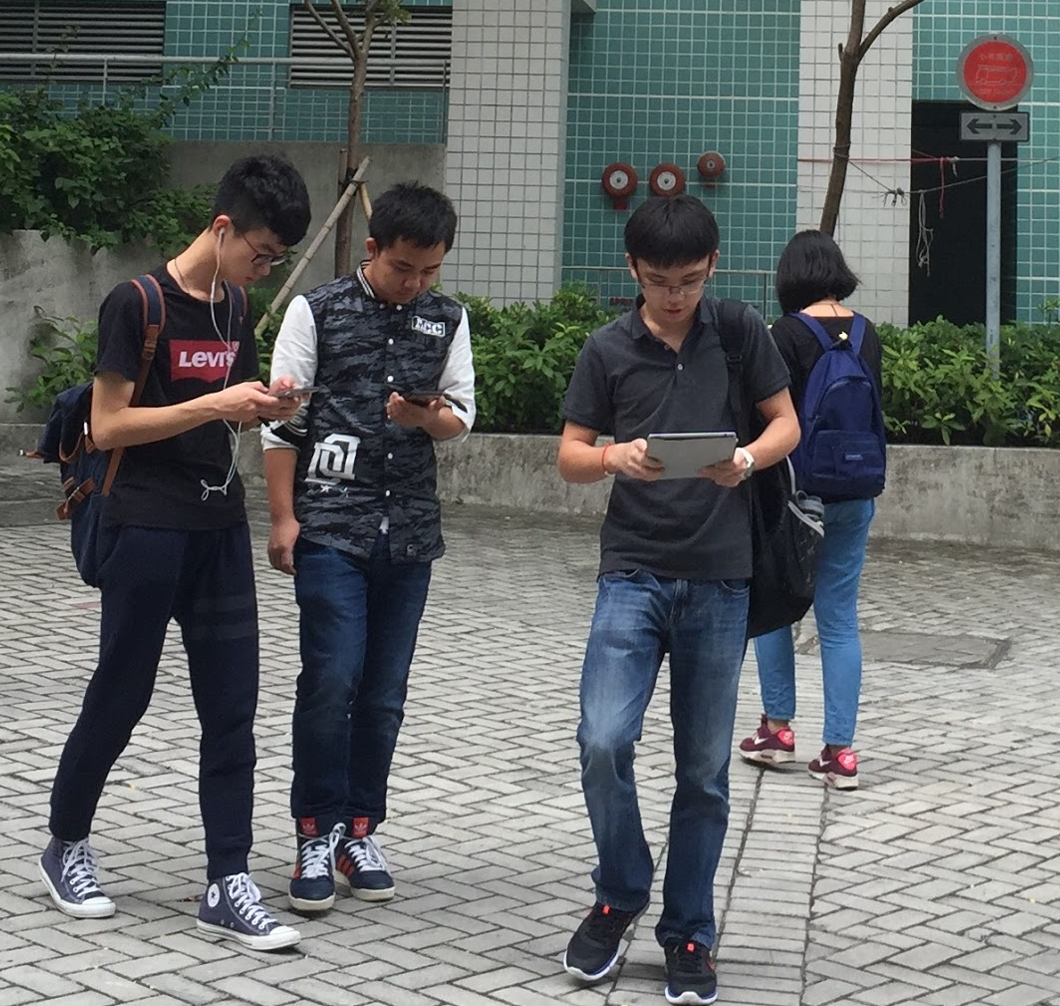
Virtual clannish behaviour can be observed in a number of ways, but probably most overtly in the subtly distinctive ways in which people use their mobile phones. Members of the mobile tribe can be divided into at least two clans. One clan can be observed holding their mobile phones to their ears whilst another group tend to stare at their devices.

This is the audio message clan and the text message clan. The former continue to conceive of the mobile phone as having the same functionality of the fixed line telephone – ‘that’s why it’s called a phone’. The latter have made the conceptual leap of seeing the mobile phone as a multi-functional communication tool, and as we have already seen, have developed their own reduced or slang version of common language.

Another example is the social networking tribe which boasts many clans, such as the WhatsApp clan, the Instagram clan, the YouTube clan and so on. One particularly interesting comparison can be made between the users of Flickr and Facebook. The Flickrite kin group generally trades in images (photographs) and members often don't identify themselves using their real names.

By contrast, Facebookers identify themselves using real names and photographs, and coalesce around groups with common interests that are wider than photographs. Facebookers also have a reputation for being frivolous, and engage in virtual food-fights, ‘poking’ each other and sending silly notes, much akin to the naughty school children who sit in the back row of the classroom.

Flickrites are more likely to trade in affirmative comments, the ‘favouriting’ of attractive images and the awarding of prizes in mutual celebration of each other’s photographic skills. FaceBookers on the other hand, are more intent on gathering together as many ‘friends’ as possible – some with strong social ties, many with weaker ties, as they are ‘friends of friends’ or simply random acquaintances.

One virtual tribe will behave in a manner that can be distinguished from other tribes. Clans on the other hand tend to be large ‘kin groups’ that generally involve themselves in an identifiably common practice, but are distinct in some way within this practice. They yet remain a part of the larger social mass of the tribe. Whereas clans represent a part of society, tribes may constitute the entire society. Virtual clans are defined more by the technology they subscribe to, and ultimately, the software they use.

Although we are bombarded on all sides by advertisements and corporate images prompting us to subscribe, buy into and involve ourselves in commodities of all shapes and sizes, many of us also have infinitely more choice in what we do, the alliances we make and how we spend our money. As a result of this plethora of choice there are many virtual clans – the distinctions are often subtle, but the clans are different, inspired by different motives, identified by different artefacts and activities, and ultimately, distinguished by different aims and destinations.

Virtual youth clans spend much of their time texting each other on their mobile phones. They may identify their clan more subtlety that through the kind of mobile phone they use, its features and capabilities. They may identify as a part of a clan through the use of specific language and other symbolism. Some virtual clanships are emerging through the choice of social networking service – WhatsApp users are distinctly different in many small ways to their counterpart clans who subscribe to Facebook, who are again different to those who use Instagram.

Previous posts in this series:
1. Digital tribal identity
2. Digital tribes and the network nation
3. Always connected
4. Digital pervasion and loss of identity

Next: Online, en masse

Creative Commons License
Virtual clans by Steve Wheeler was written in Plymouth, England and is licensed under a Creative Commons Attribution-NonCommercial-ShareAlike 3.0 Unported License.


October 14, 2019

Digital pervasion and loss of identity

Image from Pixabay
“We are all digital now” claimed Paul Longley of University College London, in a research report (BBC News, 2006). In so doing, he identified a global digital tribe. Taking into account the fact that much of the world’s population is more than a day’s walking distance from a fixed line telephone, and even allowing for the growing trend toward mobile phone usage in developing countries, or the paucity of computers in the third world, Longley’s claim could be considered contentious. However, where applied to western industrialised nations, it musters some credibility.

There is none the less a need to acknowledge the digital divides that are perpetuated wherever technology is applied. Interestingly, Longley’s claim may hold some truth when contextualised in a world where cable and satellite television channels proliferate, digital mobile communication becomes ever more pervasive, surveillance of civil movement and activity is automated, and where digital identification of individuals, commodities and services is becoming common place. The location of a global digital tribe within this landscape is a feature of interest for this chapter.

Longley’s research team identified digital tribes by their socio-economic activities and by the manner in which they used information and communication technologies. Yet there are more subtle distinctions that can be made, particularly at the perceptual and motivational levels of analysis.

There is an argument that due to the process of globalisation, national boundaries (and therefore tribal boundaries) have been eroded to the point that we are amalgamating into a homogenous mass of humanity, and where the last vestiges of tribal identity are vanishing. In essence, the forces of globalisation have amalgamated us all into one tribe. We are living in a ‘corporate age’ runs the argument, in which all of our decisions are being dictated by ‘those who have the real power’.

Therefore, wherever I travel, I can find the same fast food outlets, and the same familiar chain stores where I can purchase clothing and footwear I will be comfortable wearing. I can blend into the background because I am wearing a similar style of clothing to the hundreds of other people milling around in the high street, and I will not be conspicuous, because I am eating the same food and drinking from an identical soft drink can as the natives.

Have I therefore blended in to such an extent into the local culture that I lose my identity? No, my individual identity remains intact, whilst my individualism is subsumed into the social melange within which I am located. Identity and individualism are not synonymous, even though there are obvious commonalities. The identity argument may break down when it is applied to the formation of a single ‘digital tribe’, but clearly there are many personal identities represented within the tribe. It is quite possible then, that there is in fact one 'global digital tribe’ in the broadest sense of its meaning, but there are many sub-sets of this large digital tribe – what we can term ‘virtual clans’.

Previous posts in this series:
1. Digital tribal identity
2. Digital tribes and the network nation
3. Always connected

Tomorrow: Virtual clans

Creative Commons License
Digital pervasion and loss of identity by Steve Wheeler was written in Plymouth, England and is licensed under a Creative Commons Attribution-NonCommercial-ShareAlike 3.0 Unported License.


October 12, 2019

Always connected

It was Howard Rheingold (2002) who coined the term ‘smart mobs’ (a play on the word 'mobile' or mobile phone) to describe individuals who work collectively and intelligently toward a mutual goal without necessarily having met. Unlike their more feral counterparts, smart mobs tend to act intelligently and with a purpose.

They are distributed beings (Curtis, 2004), carrying devices that have immense computing power and telecommunication capability, enabling them to collaborate in ways which were previously inconceivable.

The immediacy of their communicative ability and the ubiquity and persistence of their engagement (they are always connected) within the smart mob enable them to perform collective feats of imagination, co-operation, trading and the exploitation of aggregative mind power, beyond anything humankind has ever achieved up to this point in its history.

This may appear to read as a eulogy, but in reality smart mobs are the vanguard of an influential social movement that will gather pace over the next few years and will ultimately radically change the face of education.

Smart mobs can act for the public good, for example where drivers use their mobile phones to inform a local radio station of a road traffic accident. They can also act concertedly for more nefarious purposes, such as tram or bus passengers who text their ticketless friends to warn them of the location of ticket inspectors. Some smart mob activities may be pointless to all but those who participate in the action. In recent years, a new social phenomenon has been observed, particularly in urban areas.

Known as ‘flash mobs’, they are large groups of people who suddenly gather in a public place, perform some meaningless activity for a period of time, and then just as quickly disappear. The T-Mobile dance was an example of this phenomenon and there are many more examples. Flash mobs are almost always co-ordinated by one or more individuals through mass SMS texting, e-mails or other electronic message transmission methods.

Technology directed flash mobs have occasionally gathered for political purposes at times of civil unrest in Romania and China, but generally their purpose is ill defined. Flash mobs have been explained as a classic example of the innate need for people to belong to a group, be privy to inside knowledge, and be able to participate in what is ‘happening’.

Rheingold also identifies a ‘thumb tribe’ which consists predominantly of those younger members of society who appear to be constantly connected to the rest of their tribe and who use ‘one thumb signalling’ via text to communicate. They belong to the larger tribe of the ‘always connected’ who are identifiable by their apparent dependency on mobile telecommunication technologies. They are clearly identified not only by the means through which they communicate, but also by the manner in which this communication is constructed, i.e their vocabulary.

SMS text is constrained by a single message limit of 160 characters. To save money, txters have developed a reduced form of language made up of letters, numbers and symbols. Known as ‘squeeze text’ (Carrington, 2005) this clannish form of language changes the morphology of the language being used, with little or no loss of its semantics for those who are members of the clan. For those outside the clan however, txting can present a bewildering conundrum.

Previous posts in this series:
1. Digital tribal identity
2. Digital tribes and the network nation

Tomorrow: Digital pervasion and loss of identity

References
Carrington, V. (2005) Txting: The end of civilisation (again?) Cambridge Journal of Education. 35 (2), 161-175.
Curtis, M. (2004) Distraction: Being human in a digital world. London: Futuretext.
Rheingold, H. (2002) Smart Mobs: The Next Social Revolution. Cambridge, MA: Basic Books.

Creative Commons License
Always connected by Steve Wheeler was written in Plymouth, England and is licensed under a Creative Commons Attribution-NonCommercial-ShareAlike 3.0 Unported License.


October 11, 2019

Digital tribes and the network nation

Photo from Wikimedia Commons
I will argue here that within the present information age, where digital communication technologies have fractured the tyranny of distance beyond repair, and where computers have become pervasive and ubiquitous, identification through digital mediation has become the new cultural capital (Bordieu and Passeron, 1990). Cultural capital is the set of ‘invisible bonds that tie a community together’ (Curtis, 2004, p 72) without which societal cohesiveness begins to unravel.

It is this ‘social glue’ - such mutual understandings and exchanges that occur on a daily basis – that holds together the basic building blocks of social life in which people simply ‘look out for each other’. In the real life community, people work hard to sustain such mutual exchange, and its value is instilled in them from an early age. This results in the transmission of the culture from generation to generation.

For the digital community, such tribal identification operates at least within the social and individual levels, but may be inherently more complex, transcending age, ethnicity, gender and other social divisions such as disability. Paradoxically, it is largely the individual figures within this equation who act in concert to perpetuate the social cohesion of the tribe. Even stranger in the digital age, such exchanges are conducted regularly through one or more mediating technologies.

The anthropologist Erving Goffman suggested that the performance of the self is a social act designed to regulate the impression one presents to others. Goffman’s notion of impression management in public spaces evokes the construction of the self simultaneously in the mind of the individual and in the collective mind of the audience (Goffman, 1959). We see ourselves reflected in the eyes of the other, and adjust our behaviour to conform and remain accepted by those with whom we choose to identify (Cooley, 1902).

Howard Rheingold (2002) applies this ‘theory of being’ to the use of short message service (SMS) texting by young people – who they send texts to, and receive them from, defines an element of their social identity, as constructed by themselves in relation to the others in their SMS circle of communication. Such small friendship circles may be physical, or virtual, or a combination of both, but for the individual, this may matter little, but remains very much an essence of his or her identity as a tribal member. The content of the text message may also be secondary to the fact that the message has been sent, and the perception that the sender has been ‘thinking about you’. Such management of impression is projected through the technology to show the sender in a ‘best light’ to others.

Previous posts in this series:
1. Digital tribal identity

Next time: Always connected

References
Bordieu, P. and Passeron, J-C. (1990) Reproduction in Education, Society and Culture.London: Sage Publications.
Cooley, C. H. (1902) Human Nature and the Social Order. New York: Scribner.
Curtis, M. (2004) Distraction: Being human in a digital world. London: Futuretext.
Goffman, E. (1959) The Presentation of Self in Everyday Life. New York: Doubleday.Rheingold, H. (2002) Smart Mobs: The Next Social Revolution. Cambridge, MA: Basic Books.

Creative Commons License
Digital tribes and the network nation by Steve Wheeler was written in Plymouth, England and is licensed under a Creative Commons Attribution-NonCommercial-ShareAlike 3.0 Unported License.


October 10, 2019

Digital tribal identity

Photo by Bruce Warrington
Ten years ago, in 2009, I published an edited volume entitled 'Connected Minds, Emerging Cultures' which was a compendium of papers written by leading theorists and practitioners in the field of learning technology. Over the next few days I will present an abridged, bite size series of exerpts from one of my chapters in that volume: 'Digital Tribes, Virtual Clans'. I hope you enjoy it and I look forward to reading your comments. This is a repost from my 2009 blog series on the same subject.

Tribes use common culture to construct group identity and will employ dialects as a shared but often exclusive form of communication. The dialect of the London East End for example, is peppered with rhyming slang, whereas just a few hundred miles away, the Geordie dialect of the North East of England is heavy with accent and vocabulary that have survived from the incursions of the Norsemen several centuries before. Such linguistic devices, although deriving from different roots, both serve to exclude outsiders who attempt to enter into the circle.

Thus the shared symbolism of the slang or dialect tacitly protects the tribal culture and secures its social exclusivity for its members. Communication, including speech, clothing and actions all serve to signal our cultural identities and group membership (Pahl and Rowsell, 2006). Cultural transmission is the communication of ideas. According to Dawkins (1976) key actions and thinking patterns of members of a culture are influenced by a contagious patterns of information known as ‘memes’. Memes carry no specific rules, but in effect are adopted and shared around by the tribe as a means of perpetuating that culture.

The smaller elements with the tribe, which we call clans, also employ shared symbolism. Each clan for example, has its totem, a symbol that represents it and distinguishes it from other, possibly rival clans. In primitive clans, the totem was often a representation of an animal or tree. Emile Durkheim suggests it is easier for clan members to project their feelings of awe toward a totem than toward something that is as complex as the clan itself (Haralambos and Holborn, 1995). 

For digital tribes and virtual clans, the totem – the traditional rallying point for all tribal activity – is patently the world wide web. Not only are these digital spaces objects of intense interest and rallying points for the clans, they also act as transmitters of units of cultural knowledge. Several authors have argued that digital technologies and electronic networks provide perhaps the best environment for the transmission of memes (Blackmore 1999; Adar, Zhang, Adamic and Lukose, 2004). Such new literary practices of communication (Lankshear and Knobel, 2006) rely heavily on shared spaces, shared symbolism and the viral nature of the social web.

Weber originally suggested that culture should be construed as a ‘web of significance’ that was spun by the individuals who comprised the culture (Weber, 1947). Significantly, the increasing role the World Wide Web plays in the shaping of modern tribal culture causes Weber’s notion to resonate. Until recent technological innovation, people with common tribal identity lived in geographically specific locations, and considered areas of land to be their sole territory. Such territories are now being eroded due to the emergence of new digital tribes who occupy spaces located within cyberspace – a virtual space that transgresses all traditional, social and political boundaries.

Tomorrow: Digital tribes and the network nation

References
Adar, E., Zhang, L., Adamic, L. and Lukose, R. (2004) Implicit Structure and Dynamics of Blogspace. Cited in Lankshear, C. and Knobel, M. (2006) New Literacies: Everyday Practices and Classroom Learning. Maidenhead: Open University Press.
Blackmore, S. (1999) The Meme Machine. Cited in Lankshear, C. and Knobel, M. (2006) New Literacies: Everyday Practices and Classroom Learning. Maidenhead: Open University Press.
Dawkins, R. (1976) The Selfish Gene. Oxford: Oxford University Press.
Haralambos, M. and Holborn, M. (1995) Sociology: Themes and Perspectives (4th Edition). London: Harper Collins.
Pahl, K. and Rowsell, J. (2006) Literacy and Education: Understanding the new literacy studies in the classroom. London: Paul Chapman Publishing.
Weber, M. (1947) The Theory of Social and Economic Organisation. New York: The Free Press.

Creative Commons License
Digital tribal identity by Steve Wheeler was written in Plymouth, England and is licensed under a Creative Commons Attribution-NonCommercial-ShareAlike 3.0 Unported License.


October 07, 2019

Our digital future 11: AI enhanced course design

Photo by Andras Vas on unsplash
Previous posts in this series have highlighted the importance of human intelligence and emotion in education. We have traversed several emerging ideas, including the use of virtual teaching assistants (chatbots), ultra-personalised learning and machine intelligence, but the most important component in education is still the human element.

Other jobs in society may already have been supplanted by robotics and artificial intelligence. Mostly, they are repetitive, low level skill or dangerous jobs, but when it comes to replacing higher skill level professionals such as teachers with computers is neither desirable nor expedient. However, replacing some aspects of what teachers do is both effective and inevitable.

"AI is not about replacing the human with a robot, it is about taking the robot out of the human" says Usama Fayyad, and this will prove to be a key theme in the future of AI enhanced education.

The future of education, in all sectors, will be a marriage of convenience between teachers and technology. In many parts of the world this won't happen at all, usually because of what has been called the digital divide. Even in the Western industrialised nations of the world, AI and other advanced forms of technology may not be deployed, for a variety of reasons including professional reluctance, lack of infrastructure, political resistance or lack of funding resources. Where it is implemented, AI will rapidly transform the design of courses, providing educators with vast amounts of new insight into what students do, how they study and what is most effective.

But what about regions of the world where AI will become commonplace?

AI enhanced course design is supposedly the next big development in digital education. It will not replace good teaching, but will improve the ability of teachers to create and curate resources, and will have an impact on the learning environments they operate within. Futurist Nicholas D Evans suggests that AI tools will enable course developers to discover shortcuts, and improve their efficiency. He writes:
"As an example, course developers at leading institutions will utilize AI technologies to help them quickly assemble their courseware and reduce the manual effort required by up to 80 percent. This frees up course developers and administrators to be more strategic and plan their portfolio roadmaps in close collaboration with business and community partners."
This is due in part, he claims, to the capability of emerging AI technologies to be able to 'learn' based on the massive array of data patterns they can access. Evans is optimistic about how computer vision may play a constructive part in observing and interpreting human behaviour:
"Trainable AI will be able to observe a physical class via machine vision and thereafter create a template or blueprint for the online equivalent of the course. This will speed online course creation and the ability for leading institutions to produce up-to-the-minute courseware."
I'm more sceptical about the next prediction from Evans. He suggests that automatic grading of student work will be sufficiently advanced to determine fair grades for all:
"In addition, AI-enabled course grading will be at highly advanced stage in 5 to 10 years where course administrators will be confident of the fairness and accuracy of automated free-text grading algorithms due to advances in machine learning, semantics and natural language processing. If they have questions about a student’s grade, they will be able to speak with the AI system, understand the rationale, and adjust as and where necessary."
It's not so much the prediction about AI development that is problematic - AI is advancing at a pace, and is likely to reach this level soon. Rather, it is the persistent assumption that 'grading' is paramount for the measurement of student understanding, and that we should focus the power of AI to support this kind of pedagogy. If teachers are still grading students' work in 10 years, then AI can indeed remove the tedium of interpreting marking rubrics and wading through pages of written text. However, if we believe that assessment should focus on providing students with constructive criticism and feedback on their work so that they can learn and improve, we will question this. Teachers provide assessment for learning, alongside assessment of learning.

Computers are excellent at storing and processing vast arrays of metrics and performing complex calculations very quickly, but when it comes to providing empathetic, intuitive and personalised feedback to students, teachers will come out on top every time.

Previous posts in this series:
1: Telecommunications
2: Classrooms
3: Music
4: Enhanced vision
5: Robot teachers?
6: Home learning
7: Work
8: Artificial Intelligence
9: Omni-choice learning
10: Cognitive courseware

Creative Commons License
Our digital future 11: AI enhanced course design by Steve Wheeler was written in Plymouth, England and is licensed under a Creative Commons Attribution-NonCommercial-ShareAlike 3.0 Unported License.


October 01, 2019

Our digital future 10: Cognitive courseware

Image from Pixabay
You have probably heard of data science, Artificial Intelligence, machine learning, and cloud computing. You may also have heard of big data, The Internet of Things and Blockchain. These technologies are all beginning to play roles in our digital lives and will grow in significance in the future.

But have you heard of cognitive technology? It's another way of saying 'computers that are capable of mimicking human characteristics'.

Cognitive technologies can be defined as artificial intelligence tools that perform tasks that were once the sole preserve of humans. Examples of cognitive technologies include computer vision, deep learning, natural language processing, speech recognition, and humanised robotics. There is no cognitive component however. Rather than 'thinking', the machine follows complex code to artificially replicate some of the traits that humans perform naturally. As Donald Clark says, AI has the all the competence without any comprehension.

Teachers might ask: will we be replaced by artificial intelligence? This question will be addressed at the end of this post.

Teachers might also ask: how does all this translate to learning, and what are the benefits to students? This is where cognitive courseware comes in. Based on cognitive technology, it is a way of creating learning environments and support systems that mimic human tutors or teaching assistants. Some might call them chatbots, and this would be a reasonable label to describe their current engagement levels. Chatbots currently exhibit limitations, especially when you ask them something they can't access in their databases. 

An example of this is the Hewlett Packard online customer support service. When you connect, you are invited to 'chat' online to a virtual agent. The chatbot is very polite and asks you to state your problem. It then asks you a series of further questions to refine its response, before providing you with what - you hope - is the definitive solution to your problem. If it can't (which is 90 per cent of the time in my experience), it suggests you either a) refine and rephrase your question or b) wait for a human operative to come online to try to solve your problem. 

Other companies have similar two-tier systems of customer support. They reckon that filtering out low-level problems through a digital assistant will give real human operatives a chance to interact more meaningfully with their customers. In education, the 'customer' is often an online student. This was indeed the case with Jill Watson, a chatbot teaching assistant introduced into a large MOOC by Professor Ashok Goel at Georgia Tech a few years ago (see the video below). 


Watson was deployed to filter out and addressed a large percentage of low-level issues students posted each day, while human teaching assistants were able to address the more complex problems the students reported. At first some students thought Watson was human, but it didn't take long to see through the facade when it failed to respond appropriately or couldn't answer their questions.

We are still a long way from seeing the development of chatbots that can exhibit emotional nuances that are convincing (NB: several research teams have been working on emotional modelling for many years). Even before this happens, we will need to see chatbots/cognitive courseware that can actually respond appropriately to the high-level problems students encounter, in both text and voice mode. The application of deep learning algorithms in the design and execution of digital assistants will improve over time, and when it does, we might see chatbots that can fool students into thinking they are human, or at least sustaining a worthwhile conversation. Chatbots might then be able to specialise in specific forms of support such as personal counselling, advice giving, or motivational coaching. At present this is very limited.

In the meantime, programmers will continue to refine cognitive courseware, and the research into deep learning and emotional modelling will advance. Many of the mundane, routine and low-level tasks of the teacher can, and probably will be replaced by cognitive courseware. But in the foreseeable future, and perhaps for a very long time, teachers won't be replaced by computers. It will simply free them up to perform more constructive, cerebral - and human - activities.

Next time on Our Digital Future - 11: AI enhanced learning

Previous posts in this series:
1: Telecommunications
2: Classrooms
3: Music
4: Enhanced vision
5: Robot teachers?
6: Home learning
7: Work
8: Artificial Intelligence
9: Omni-choice learning

Creative Commons License
Our digital future 10: Cognitive courseware by Steve Wheeler was written in Plymouth, England and is licensed under a Creative Commons Attribution-NonCommercial-ShareAlike 3.0 Unported License.


September 30, 2019

Our digital future 9: Omni-choice learning

Photo by Loewe Technologies on unsplash
There's plenty of hype about artificial intelligence (AI) and its potential, future impact on society. In many areas, such as manufacturing, defence, transport and health, AI is already impacting significantly. In the tech industry, it's already seen as a notorious element in targeted advertising, surveillance and propaganda (for example in recent elections). That's where the money is, so it's where the most frenetic development work is focused. But this is all very low level stuff right now compared to what could happen. There is plenty of scope for AI to transgress the boundaries of artificial narrow intelligence, but until it does, it remains fairly limited. And in education, it is barely present. So, if and when, it does begin to make its presence felt in our schools, colleges and universities, what might we expect?

Writing on CIO's Managing Innovation and Disruptive Technology website, futurist Nicholas D. Evans suggests there are four AI trends we can expect to see. The first he says, is where AI begins to influence the choices learners will have. At present, the golden touchstone is in personalised learning, where anytime, anyplace education is possible through mobile technologies. Evans writes:
"Firstly, online education will have evolved beyond omni-channel (anytime, anywhere) to omni-choice whereby students will be able to select and configure every pathway in their learning journey to personalize and customize their near-term and long-term learning plan and approach to their unique situation, needs and interests. 
"As an example, with self-driving cars commonplace – learning will be conducted at home, in class or on the road during lengthy commutes, with students able to pick up and resume their online courses on any device in any location and in any duration and format. AI will help to hyper-personalize this omni-choice functionality so that students can focus more on their actual learning and less on the mechanics of their learning."
 I quite like the idea of 'omni-choice' learning, where each learner can shape their pathways individually to suit their expectations, needs, approaches to study and personal contexts. At present it is quite impossible for any educator to tailor-make study programmes for individual students. Evans doesn't go on to describe how AI will make omni-choice learning possible, but the promise sits there, ripe for the picking. It will likely be achieved through a combination of learning analytics (big data) and the evolution of personal technologies and ubiquitous computing. We will see in the next few years whether this promise is realised.

Next time on Our Digital Future - 10: Cognitive courseware.

Previous posts in this series:
1: Telecommunications
2: Classrooms
3: Music
4: Enhanced vision
5: Robot teachers?
6: Home learning
7: Work
8: Artificial Intelligence

Creative Commons License
Our digital future: Omni-choice learning by Steve Wheeler was written in Plymouth, England and is licensed under a Creative Commons Attribution-NonCommercial-ShareAlike 3.0 Unported License.


Are we wasting our time?

There's no such thing as down-time, or spare time. Only time. Time is finite, each day we are allocated exactly the same amount as everyone else, and how we use that time is our personal choice. So time is a precious resource, and what we do with our time determines the outcomes of our lives. Sobering stuff.

I was therefore interested in a recent tweet from my friend and colleague Nick Shackleton-Jones on our use of time. Here's what he said:


There is often an impression, especially from those on the outside looking in, that time spent on social media is time wasted. For many that may well be the case. But there are times when I am on social media, trawling through my timelines, that I feel it is time spent on worthwhile reading, thinking and doing. I have gone on record several times to say that Twitter (and other selected social media channels I use) has probably offered me the best continuing professional development I have ever had. And if CPD wasn't enough, look at what Nick says above. 

We are doing what matters to us, and that is why we spend so much time on social media. We are connecting with our peers, creating and communicating with our professional communities of practice, and we are expressing our learning to an audience of knowledgeable others. Here lies the greatest value of social media. Regardless of the many inherent dangers and pitfalls of social media, it remains a valuable tool to leverage our knowledge and consolidate our understanding of our expertise. Without it, we would all be the poorer. 

Creative Commons License
Are we wasting our time? by Steve Wheeler was written in Plymouth, England and is licensed under a Creative Commons Attribution-NonCommercial-ShareAlike 3.0 Unported License.


September 27, 2019

Online assessment: the student voice

Photo by Jason Roswell on unsplash
Online learning is becoming increasingly popular and widespread, and is now reaching into compulsory education. Teachers in schools are considering the extent to which common pedagogical methods can be adapted into online environments, or whether they need to be completely revised and reconceptualised.

Assessment is the measurement of learning; One definition suggests that assessment is 'the wide variety of methods or tools that educators use to evaluate, measure, and document the academic readiness, learning progress, skill acquisition, or educational needs of students.' It is often characterised as 'testing' to provide a grade, but this would be a restricted view of assessment. Assessment comes in a variety of forms, and has many objectives beyond grading, including the provision of feedback to students, mapping of their progress, offers insight into differentiation for individual differences among students, and allows teachers to gain feedback on the effectiveness of their own pedagogical methods, resources, activities and environments.

The most important principle of any online learning programme is involvement. Australian Outback schools discovered this many years ago, when the only technology available to reach geographically remote children was radio. Schools of the Air functioned not only on transmission format but also on two-way radio to encourage interaction between students and their teachers. Success was based on giving students a voice.

In contemporary web based education, presenting online learners with multiple choice questions to check their understanding is a low-level form of assessment. It is commonly built into online learning environments simply because it is relatively easy to do. But most LMS platforms have more options. Giving them a quiz or a matching task can be more engaging. Asking them to post their work to a forum which can be viewed and evaluated by the entire peer group is more engaging still, which brings us to a key principle of online assessment:

Perhaps the most engaging approach to e-assessment (as it has come to be known) is to involve students as partners in the process. This would require elements of self- and peer-assessment as additional components to the teacher's assessment. Involving students in this manner not only gives them a voice in the assessment process, but also engages them in thinking about what is being assessed and how they can meet the assessment criteria.

Self- and peer-assessment has enjoyed success in adult forms of online education, but may be more problematic for school children who are not in direct contact with teachers and their peer group. Fontanillas et al (2016) write that assessment of online learners should be continuous and participatory, and that distance students value both individual and group forms of feedback. They argue that 'peer assessment becomes an incentive in order to improve the work of the group and individual efforts and the involvement of students increases when teacher shares the responsibility of the assessment with the students.' (Fontanillas et al, 2016).

Active involvement of online learners is clearly an important element for the success of any online learning programme. For children, especially younger students, it is essential to maintain attention and obviate behaviour management issues. All activities, including assessment need to be consistently engaging, so that children are captivated by their experience and maintain their focus.

What are your experiences and views in this area? Your contributions as ever, are welcome in the comments box below:

Reference
Fontanillas, T. R., Carbonell, M. R. and Guitert, M. (2016) E-Assessment Process: Giving A Voice to Online Learners. International Journal of Educational Technology in Higher Education. 13, 20.

Creative Commons License
Online assessment by Steve Wheeler was written in Plymouth, England and is licensed under a Creative Commons Attribution-NonCommercial-ShareAlike 3.0 Unported License.


September 26, 2019

How can we engage online learners?

Photo by Filip Mroz on unsplash
In my first post in this blog series I outlined the changes taking place in schools due to the adoption of online forms of education. I promised I would pose at least 3 key questions around this context. In my follow-up post, I posed a key question for teachers to answer if they wished to become successful online educators. Below is the second question I promised:

Several years ago, when it first became clear that online education was becoming more prevalent, questions were asked about the format of educational content. At the time, in the early years of online education, we witnessed teachers taking content that had been traditionally delivered, and pushing it across into the online environment. This practice quickly became known as 'shovelware' because teachers were ultimately shovelling their content across to the online platform. Quantity was more important than quality, because a rapid population of new digital spaces was deemed to be expedient - the pedagogy could wait.

This strategy didn't work. In fact, it was an unmitigated disaster. Students were unimpressed by reading reams and reams of content online, with little or no possibility of interaction. They craved active engagement - if they are passive in online environments, it isn't long before they lost interest. Huge attrition rates still exist today in online education, especially in some of the latest forms such as MOOCs. As online education evolved, it quickly became clear that new forms of content needed to be developed, and new forms of pedagogy needed to be devised to support the new ways of learning that were emerging.

Discussion groups and forums, hyperlinked content, videos, audio in the form of podcasts, and ultimately, user generated content emerged as important forms of online activity. Dialogue between students and their tutors became especially important due to the geographical separation. User generated content developed to include blogs, status updates, voting, aggregation, curation, remixing, repurposing and sharing of content, podcasts, wikis, videos, images and other online creation of content. These activities supplemented the content, and in some ways, replaced it as the new learning objects of online education.

Today, an important, vital question for all educators to address is this:
What forms of content, activity and pedagogy are needed now to ensure the success of online education?
What are your views, words of advice or supplementary questions? Please post them in the comments box below.

Creative Commons License
How can we engage online learners? by Steve Wheeler was written in Plymouth, England and is licensed under a Creative Commons Attribution-NonCommercial-ShareAlike 3.0 Unported License.


September 25, 2019

What do online educators need?

Photo by Steinar Engeland on unsplash
In yesterday's post I wrote about how teachers are beginning to use online forms of education to enhance and extend the reach of schools.

Distance education in all its forms has been used for more than a century in education, leveraging the potential of each new technology as it emerges. Correspondence course, radio, television, video, the Web, computers and smart phones - each in turn has been harnessed to reach students for education that are traditionally outside of the conventional learning space.

I also mentioned in my last post that I had been involved in a very large school distance education project where teachers were expected to use new technologies to extend their traditional classrooms into non-traditional learning spaces across geographical distance. The disruption this created was largely due to lack of knowledge and skills, along with raised expectations about what was required. There was a wide spectrum of responses, from fervent adoption through to vehement rejection of the idea.

The bottom line for online education is schools today though, is how prepared teachers are to adopt new online educational practices. The question is over what teachers need, in terms of knowledge, skills and disposition, to be able to make a success of such a radical change in pedagogy. The first question therefore is:
What do teachers need to know and do, to be able to successfully transition into, and harness the potential of, online education?


Creative Commons License
What do online educators need? by Steve Wheeler was written in Plymouth, England and is licensed under a Creative Commons Attribution-NonCommercial-ShareAlike 3.0 Unported License.


September 24, 2019

Schools and online education

Photo by Sergey Zolkin on unsplash
Many educators are now investigating how online technologies can improve, extend or enrich teaching and learning experiences. Some schools have begun to experiment, and a few are well down the road to adopting and using online education as a viable supplement, or even replacement for face to face teaching. We now need to think about learning environments rather than simply 'classrooms'. We now need to consider that geographical distance need no longer be a separator between teachers and students - the distances can be bridged by appropriate use of technology.

Way back in 2002 I was involved in one of the largest distance education projects the world had seen at the time. We worked with the Star Schools project to connect over 300 schools in the US state of South Dakota, installing fast internet, satellite television and full motion interactive video into classrooms. Educators could teach from their own school base, working with children across the entire state, and classrooms could connect with each other so that children could learn together and collaborate in educational projects. No travel was involved, but there was a time of disruption while teachers developed their skills around the new technologies.

Where have we managed to travel in the intervening years? Today, technology has become less expensive, and more prevalent in our schools. Networked computers abound, and teachers regularly use video conferencing to connect with classrooms and schools in other parts of the world. We see many creative uses of personal technologies, such as games consoles, smart phones and e-readers, and social media can be used in a variety of ways to promote deeper engagement and reach.

In the lead up to a presentation I'm giving for a group of New Zealand educators on October 7th at the NEX national Hui, I want to pose three key questions that will shape our future use of distance and online technologies for education. In my next post I will present the questions, and elaborate on them to support an online discussion. Before that, do you have any specific questions relating to schools and online education that you think are important? Please post them in the comments box below.

Tomorrow: 3 key questions for the future of online education

Creative Commons License
Schools and online education by Steve Wheeler was written in Plymouth, England and is licensed under a Creative Commons Attribution-NonCommercial-ShareAlike 3.0 Unported License.


September 20, 2019

An apple for teacher

Photo from Pxhere
I had the pleasure to do an interview with Sophie Bailey recently, when we recorded a session for Edtech Podcast. Our entire conversation, sat out in the shade of an apple tree in my Dad's garden, was wide ranging, including (but not limited to) digital technology, marmalade making, schools and education, American teachers, studying art and music, (Picasso, Genesis, Supertramp, Ed Sheeran, Arcade Fire and Rihanna), vinyl records, philosophy and politics, can be heard on the link below. Go on. Have a listen.


Creative Commons License
An apple for teacher by Steve Wheeler was written in Plymouth, England and is licensed under a Creative Commons Attribution-NonCommercial-ShareAlike 3.0 Unported License.


September 17, 2019

Lies, damn lies and social media

Photo by Jesper Sehested on Flickr
In my last post I outlined some of the issues and challenges of deceptive online content. Bad content arrives because it has been promoted through social media company commercial algorithms, or it is made visible on our personal timelines by well-meaning (but incredibly naive) friends and family members (see above). Either way, the irritating regularity with with we are exposed to this turgid tide of trash has driven many people away from social media use. People are closing down and deleting their accounts, and they are not coming back.

86 per cent of respondents in a recent Ipsos poll admitted that they had been taken in by at least one item of fake news on Facebook. And 75 per cent believed that social media companies were a leading source for their distrust in the internet, surpassed only by cybercriminals. From the patently ridiculous 'Donald Trump ends school shootings by banning school', through to the embarrassingly bizarre 'Woman sues Samsung for $1.8M after cellphone gets stuck in her vagina', we are bombarded by fake news.

I've said this before, but its always worth repeating: We all need to be more careful what we click on, and who we follow and interact with online. The essential digital literacy of being able to discern good content from bad will become ever more important as the deluge of deceiving dross increases. Knowing how to filter it out, block and eventually eliminate it from our timelines may be our only hope of staying sane in an increasingly crazy digital world.

With that in mind, here are five questions you can ask yourself when checking whether content is fake or real:

1) Who is the author of the article. Are they a legitimate writer, journalist, academic? What is their track record with other articles? Are they credible? Are they actually real?
2) What is the source of the article? Find the original source - website, social media feed. Are there contact details, and is the a particular mission statement or ethos of the organisation or individual?
3) What's behind the headline or picture? They may be deliberately misleading just to get you to click on the link.
4) What is the date of publication? Is it current, or is it out of date? Reposting and sharing old news can be a faux pas.
5) How does the story check out against fact checking sites like Snopes or Full Fact?

Creative Commons License
Lies, damn lies and social media by Steve Wheeler was written in Plymouth, England and is licensed under a Creative Commons Attribution-NonCommercial-ShareAlike 3.0 Unported License.


September 16, 2019

Yeah, right

Photo from Pixabay
Or in other words .... meh. That's my response to a lot of news headlines these days.

Call me cynical, but a lot of content today doesn't impress me, and it probably doesn't impress you either. Just spotting some of the puerile wordplay headlines on the front pages of the tabloids as I walk past a newsagents is enough to put me off my morning latte. Newspapers and media channels in particular revel in pushing sensationalist headlines that attract people who seem to be starved of sensory input. But worse than that is the deceit.

A lie can travel halfway around the world before the truth can get its boots on. It was always thus, but in the age of the web, smartphones, social media and connections at the speed of thought, the dumbing down of content and the spreading of lies seems to be accelerating. Content can be misleading, inaccurate, fanciful, or downright misleading. It's designed to make you click the link, spread the content.

The format is formulaic.

There is usually a click bait headline and/or image that has little or no connection to the actual content. Often the headline has '...what happens next will blow your mind...' or a similar phrase to grab your attention. There may also be an element of subtle blackmail - '95% of my Facebook friends won't bother to read this....' or 'Share if you care about this....'

People are gullible, and will often click on any 'interesting' content that appears without thinking, so the pernicious purveyors of pap are onto a winner every time. Every time you click, they make cash. They make money off people's curiosity, and this only encourages them to create more crappy content for us to consume.

The important thing to know is that you don't need to like or share content for it to spread. Often, simply by clicking the link to read the article, you can inadvertently spread the content to the timelines of your own small circle of social media friends. You probably don't want to do that. The content may be hateful and racist, or discriminatory in some other way, or more subtly, it may be an innocuous headline that has a deeper agenda and a extreme political organisation behind it (See for example the Britain First Facebook posts).

Every one of us is susceptible to this, but to safeguard our timelines, our reputations as professionals, and the hearts and minds of our friends and family, a simple strategy is available. Firstly, block and/or unfollow anyone who is an incessant trash content sharer. Don't engage with them. Simply cut them out of your timeline. However, the best strategy would be to question everything you see online - use your discretion, and check out the headlines.

If it looks too good to be true or looks unbelievable, it probably is.

[To be continued in the next blog post - Lies, damn lies and social media]

Creative Commons License
Yeah, right by Steve Wheeler was written in Plymouth, England and is licensed under a Creative Commons Attribution-NonCommercial-ShareAlike 3.0 Unported License.


September 13, 2019

What shapes teachers' uses of technology?

Photo by Steve Wheeler
The image on this page is a slide from the keynote presented by Graham Brown-Martin at Learning Live, a conference hosted recently in London by the Learning and Performance Institute (LPI). It derives from the work of Seymour Papert on Constructionism - the theory behind 'learning by making', Makerspaces, Fab Labs and Logo.

It summarises the difference between teachers' attitudes to technology depending on whether they subscribe to pedagogy that privileges the transmission of knowledge by experts to novices through instruction, against those who espouse knowledge as something that can be constructed by the learner through negotiation, practice, social interaction and reflection.

Granted, some might consider this to be an over-simplification of the two theories, but regardless of what camp you sit most comfortably within, it's interesting to note that the way technology can be deployed is influenced by teacher beliefs, and its success or failure can be influenced by the manner of its deployment. It's not just about teaching and learning. The successful integration of technology will depend on the critical balance of activities and engagement with knowledge, and will continue to be influenced by the role teachers believe technology can play in supporting learning. Your comments, as ever, are encouraged in the comments box below.

Creative Commons License
What shapes teachers' uses of technology? by Steve Wheeler was written in Plymouth, England and is licensed under a Creative Commons Attribution-NonCommercial-ShareAlike 3.0 Unported License.


September 12, 2019

Education: Have we nuked the fridge?

Photo by Erich Ferdinand on Flickr
'Nuking the fridge' is a strange phrase, and you may never have heard of it - but in the popular culture context it means something. Here's the etymology of the phrase from the Know Your Meme website:

"Nuking the Fridge is an idiomatic phrase used by movie fans to describe the declining point of a film franchise as a result of its heavy reliance on special effects. The phrase stems from a scene in the 2008 action-adventure film Indiana Jones and The Kingdom of the Crystal Skull wherein Jones survives a nuclear explosion by hiding in a refrigerator.

"The phrase was coined by fans of the franchise who were disappointed with Indiana Jones and The Kingdom of the Crystal Skull, released on May 22nd, 2008, particularly about a highly unrealistic scene wherein Jones (played by Harrison Ford) escapes a nuclear explosion unharmed by hiding inside a refrigerator."


Yes, surviving a nuclear blast by hiding in a lead-lined fridge does tend to stretch the imagination somewhat. The Urban Dictionary elaborated on the origin of the phrase, which is

".... a colloquialism used to refer to the moment in a film series that is so incredible that it lessens the excitement of subsequent scenes that rely on more understated action or suspense, and it becomes apparent that a certain installment is not as good as a previous installments, due to ridiculous or low quality storylines, events or characters."

This got me thinking - there are many movie franchises that outstay their welcome, and eventually end up overreaching and inadvertently becoming ridiculous parodies of themselves.  Are we equally guilty in the world of education and learning, in perpetrating similar 'crimes'? Has education become a cliché or a pale shadow of its former glory? Are there practices in schools, colleges and universities that have now outlived their credibility, or outstayed their welcome? Or .... are there new practices or systems that have been introduced that totally 'nuke the fridge'? I think we should be told. Comments are welcome below.

Creative Commons License
Education: Have we nuked the fridge? by Steve Wheeler was written in Plymouth, England and is licensed under a Creative Commons Attribution-NonCommercial-ShareAlike 3.0 Unported License.


<< Back Next >>