My memories of the first moon landing are not in vivid colour. I remember them in greyscale.
I was sat inside a small croft in the tiny village of Sandwick, on the Shetland Islands on the morning of July 20th, 1969. Our croft had no running water, was sat on the side of a hill overlooking the bay, and if to be honest, was quite primitive. Five of us lived inside this two-up two-down grey stone building, the wind never stopped blowing, and the electricity supply could be intermittent. It was ironic, because up to that point, what I was witnessing was the most high-tech event in history.
I was 12 years old, and unusually for me, I was up very early before 0500 to watch the
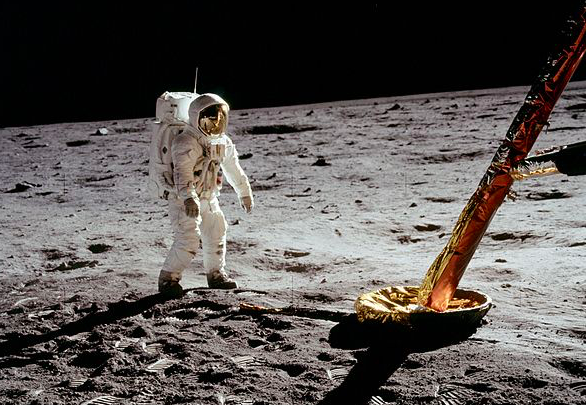
Apollo 11 astronauts walk on the moon. It was a grey morning, and I watched excited, huddled up in a large blanket, as the action unfolded on our small monochrome TV set. The images I saw were fuzzy and grey and the movement seemed ghostly, as first Armstrong, and then Aldrin, descended from the
Lunar Excursion Module and kicked up grey moondust as they bounced around the surface in their voluminous white spacesuits. And yet I felt like I was there with them, and imagined what it must be like to be a quarter of a million miles away from home, in an alien environment, the first humans to walk on that dusty surface.
The year before, as the three
Apollo 8 astronauts (Borman, Lovell and Anders) circumnavigated the moon for the first time, I had been captivated by space exploration, and I had built my own scale model of the
Saturn V rocket, which actually stood a couple of centimetres taller than me. I knew just about everything that an eleven-year-old boy needed to know about the moon shots. I could tell you the escape velocity from the earth's gravitational pull, the distance from the Earth to the moon, and I could name all the astronauts on all the Apollo missions. I was completely absorbed by it all.
I learnt a lot from following the Apollo moon missions. The science, engineering and technology of Apollo fascinated me, and in combination they enabled me to appreciate what an amazing feat had been accomplished by NASA. I have carried at least five important lessons from following the Apollo missions with me throughout my life:
1. Follow your dreams. If you are passionate enough about anything, you learn everything you need to know about it. Whatever the subject, if you are interested in it, you will become completely familiar with it, to the finest detail.
2. Believe in yourself. If you reach high enough and far enough, you will achieve what you need to achieve. All it requires is vision, commitment and effort.
3. Have courage. The astronauts needed great resolve to launch themselves into the unknown, and they were probably fearful. But still they took the ultimate risk, relied on the expertise and knowledge of their team, and they achieved their goal.
4. Work with others. No single human could have achieved what Apollo and NASA did. It took dedicated people from all walks of life, and from many backgrounds to achieve the moon landing.
5. Nothing is impossible (See number 2). It takes small steps at first, but giant leaps will follow.
Tomorrow:
Giants leaps
Small steps
by Steve Wheeler was written in Plymouth, England and
is licensed under a Creative Commons Attribution-NonCommercial-ShareAlike 3.0 Unported License.