Log on:
Powered by Elgg

Feed detail

December 16, 2017

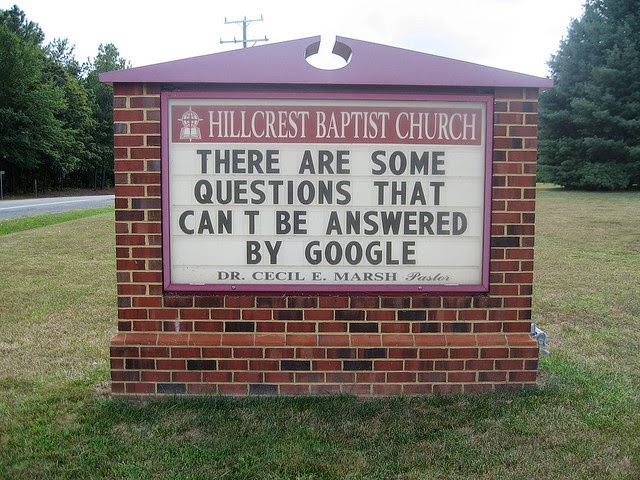
UnGoogleable questions again

Photo by Steve Wheeler
Recently I posted a challenge in response to a question about lack of student engagement. It was to solve an unGoogleable question. Google (and other search engines) are used every day by academics and students alike to find content, and more often than not, to answer questions.

It's no surprise then that many think that everything can be Googled. But they would be wrong. There are many questions that cannot be answered by simply going online and Googling.

I blogged this in that previous post:
One of the remedies for lack of engagement is to present students with a wicked problem to solve, or an irresistible question to answer. Some teachers have said to me that everything is searchable on Google, and that it doesn't take students long to crack such challenges or questions. My response is - oh really? You're probably asking the wrong questions then! I'm going to argue here that there are many questions that are unGoogleable. I wrote about this idea 5 years ago, when I discussed some of the issues around the nature of knowledge and knowing. There were several responses, many of which were searching and considered about the role of teachers, the process by which we come to know and the function of technology in education.
I posted an anatomy question that had previously stumped many medics and experts, and argued that if they are challenged, then students would be even more challenged, to go out and discover the answer. But this is just the starting point. Just like Wikipedia, we can use the unGoogleable question to create a launching pad into more serious enquiry. It becomes a gateway question that engages students in seeking deeper learning around the topic in question.

Here's the question:
One of my favourite unGoogleable questions has been posed to audiences across the globe, and specifically to medical colleagues. No-one has arrived at the answer without a great deal of thinking, searching and analysis. It is this: In the normal human body, what do each of us have exactly five of?
Eventually someone came up with an answer - the are 5 lobes in the lungs - 3 on the right side and 2 on the left. But that's not the end. Good answers should generate new questions. So why is this part of the human body asymmetrical? The answer is that it is because the heart is slightly inclined to the left, and then the next question is why is this? Then there is a chain reaction of further, deeper questions. This draws the student into a deeper investigation and appreciation of the cardio-pulmonary system, and in the process, they become more engaged in questioning, discovering and conjecturing. 

Interestingly, someone then complained that now we had discussed this unGoogleable question online, it was now no longer an unGoogleable question. But that is the entire point of this kind of method of learning. Engaging in this process amplifies knowledge, sharing it across the web, so that everyone can benefit. Why keep learning to yourself if others can benefit. Go out and create another unGoogleable question!

I would be very interested in hearing from anyone who has discovered unGoogleable questions within their own discipline. Please take this opportunity to share them in the comments box below. 

Creative Commons License
UnGoogleable questions again by Steve Wheeler was written in Plymouth, England and is licensed under a Creative Commons Attribution-NonCommercial-ShareAlike 3.0 Unported License.


December 12, 2017

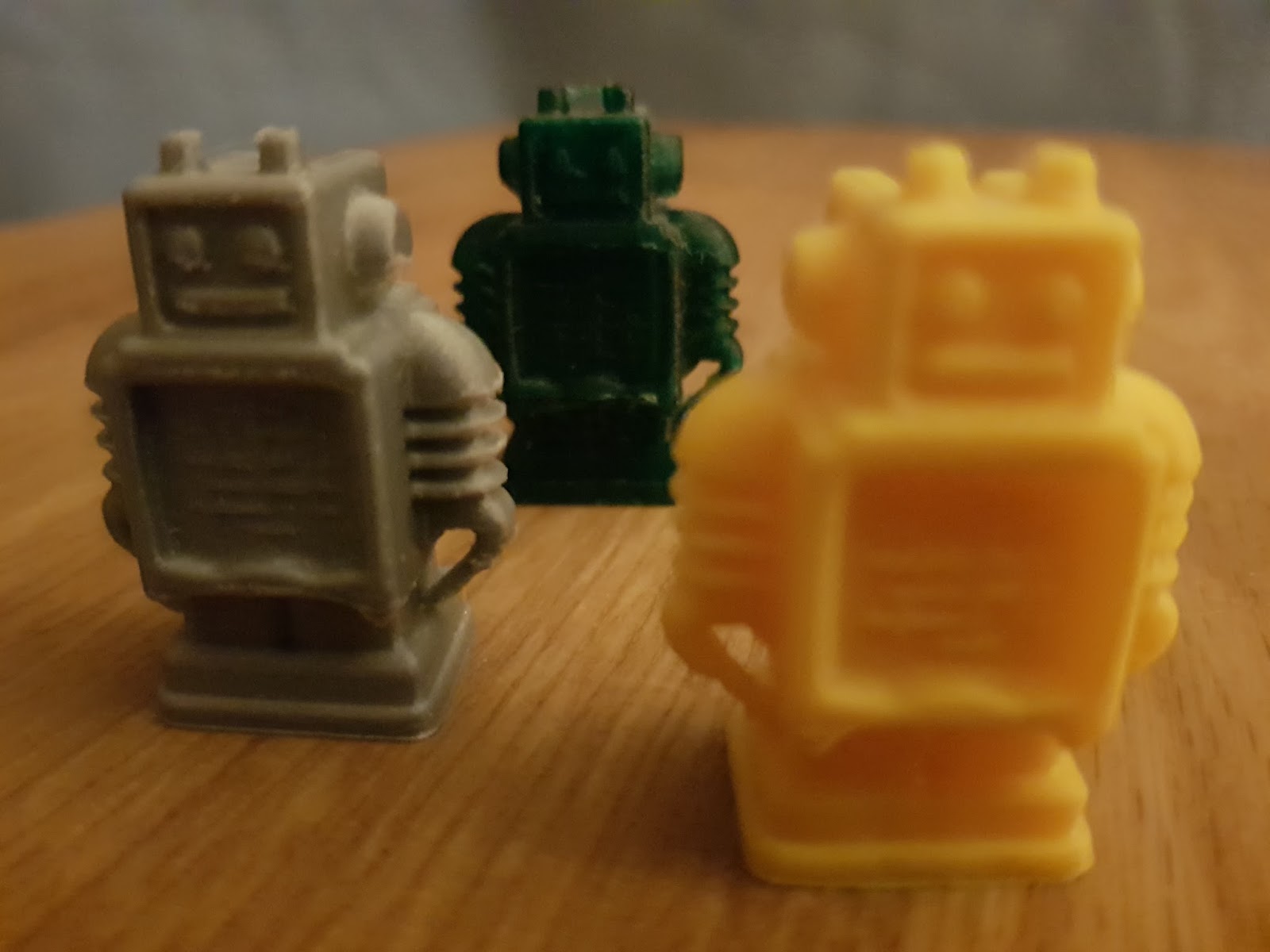
Created in our image

Photo by Steve Wheeler (3D printed robots)
There is no doubt. Robots are going to feature significantly in our future. They are already overtly embedded in manufacturing and retailing (e.g. see Amazon), and also feature in other sectors of society in more discrete forms.

At the supermarket checkout, you now have a choice. Either you elect to have your goods checked out by a human or you go to a robot checkout. The queues for the human checkout can be longer, but the conversation is usually better. (How often have you found yourself annoyed with the robot checkout? Unexpected item in the bagging area!)

We now have machines that can do all the boring, repetitive and also hazardous and undesirable tasks that we can't or don't want to do. This seems to be a legitimate application of machines, whether they resemble humans or not. Ever since the idea of automated work emerged, there have been objections. From Luddites to Saboteurs (mill workers who would throw their clogs or sabots into the machinery to stop it working), right up to the modern day objections of robots stealing our jobs, most of the issues can be distilled in one word - deskilling (see for example Harry Braverman's deskilling thesis that focused largely on the march of technology and its degrading effects on human labour).

Society seems to have come to terms with this problem in recent years and there are arguments that even if robots do replace humans in certain aspects of work, there are other aspects that cannot be replaced. Another argument is that new jobs are being created to support the growing robotics industry, and this in some way balances out the problems of deskilling. The real problems emerge when we create robots in our own image

The word 'robot' derives from 'robota' from the Czech meaning 'forced labour'. It was coined in 1920 when it appeared in a play by the writer Karel ?apek. It is a useful description of the early concept of machines that could do the bidding of humans. However, in recent popular culture, robots have taken on a more sinister connotation, representing malevolent force in movies such as The Terminator, Ex_Machina and I, Robot. This trope can be traced back to novels such as Mary Shelly's Frankenstein, and ultimately, the classical Greek myth of Prometheus. All of these stories portray creations that in some way are designed to resemble humans, but then deviate from the pathway their human creators made for them. In so doing, the creature transgresses boundaries and becomes a threat, not least because it possesses more strength and/or intelligence than its creator.

In recent years, robots have again featured in the media, with stories such as the humanoid robot Sophia, which responds to complex questions, can smile and frown, and maintains an intelligent conversation (Sophia so impressed 'her' hosts that 'she' has since been awarded citizenship of Saudi Arabia). It has also been proposed, rather controversially, that in the near future sex robots will take the place of a human partner. Such erosion of distinctly human roles and activities undoubtedly produces consternation, and as machine intelligence is advanced, we are likely to encounter robots more and more in society. Do we treat them as 'new life forms', and offer them human rewards, such as citizenship, or do we see them merely as machines that can do our bidding?  It is human nature to anthropomorphise objects and machines, affording them human characteristics so we can feel more comfortable with their presence. But does this natural propensity ultimately open us up to new pathologies and problems that have never before been encountered? What a world we are creating for ourselves and for our children....

As ever, the comments box below is open for your views on these issues.

Creative Commons License
Created in our image by Steve Wheeler was written in Plymouth, England and is licensed under a Creative Commons Attribution-NonCommercial-ShareAlike 3.0 Unported License.


December 08, 2017

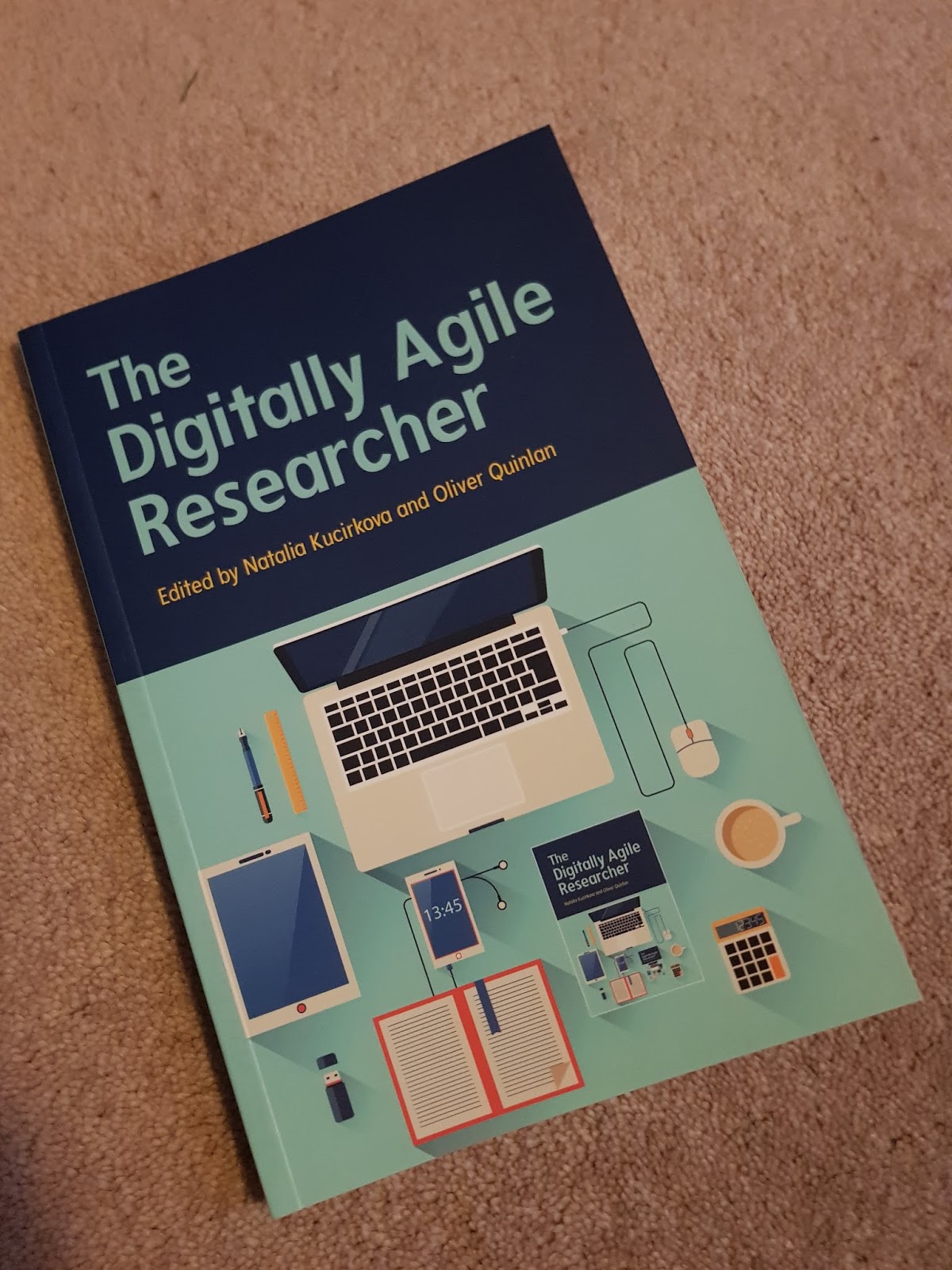
Digitally agile research


When my old friend and former colleague Oliver Quinlan invited me to write a chapter for his new book, I didn't need to take long to decide. The title of the book itself was enough to convince me to participate in the project. The book finally arrived through my letter box yesterday, and I'm glad I did take part.

The slim volume (140 pp), edited by Oliver and Natalia Kucirkova (Senior Research Fellow at University College London), is published by McGraw Hill and draws on the experience and knowledge of a raft of digitally agile researchers, scholars and journalists, including Christian Payne (you will know him on Twitter as @documentally), Victoria Pearson, Carl Gombrich, Ian O'Byrne, Gemma Ware and Mark Russell. 

There are chapters on open scholarship, academic blogging, the use of smartphone and tablets, crowdsourcing data, developing a digital profile, getting started with Twitter, personal learning networks, and leveraging the power of social media, as well as my own chapter on 'Using social media for action research: the benefits and limitations'. 

It's a book that provides essential reading for all academics in a time where digital, mobile and social media technologies are an increasingly important part of the research equation.  Each chapter also presents Common Pitfalls and Best Practice panes to support the texts. To quote the sleeve of the book: "With a range of helpful strategies, The Digitally Agile Researcher is a credible and practical guide for academics at all stages of their career, doctoral students, early careers researchers or experienced academics." 
Creative Commons License
Digitally agile research by Steve Wheeler was written in Plymouth, England and is licensed under a Creative Commons Attribution-NonCommercial-ShareAlike 3.0 Unported License.


November 30, 2017

UnGoogleable questions

Image by Jim Groom on Flickr
A perennial challenge for teachers everywhere is how to engage students and keep them engaged. Wherever I travel, I hear the same stories about how students are not engaged, and how they can be so easily distracted. Recently, technology (the handheld, personal variety) has come under fire from those who claim that it is a distraction in the classroom and lecture hall. Others have retorted that if teaching was engaging there would be no distractions - students would be completely focused and intent on their learning.

One of the remedies for lack of engagement is to present students with a wicked problem to solve, or an irresistible question to answer. Some teachers have said to me that everything is searchable on Google, and that it doesn't take students long to crack such challenges or questions. My response is - oh really? You're probably asking the wrong questions then! I'm going to argue here that there are many questions that are unGoogleable.  I wrote about this idea 5 years ago, when I discussed some of the issues around the nature of knowledge and knowing. There were several responses, many of which were searching and considered about the role of teachers, the process by which we come to know and the function of technology in education.

Let's start with the simple ones. I'm sure you can come up with some simple, unGoogleable questions for your students. Anyone can, if they spend a little time thinking about what they want students to learn in any given knowledge domain. One of my favourite unGoogleable questions has been posed to audiences across the globe, and specifically to medical colleagues. No-one has arrived at the answer without a great deal of thinking, searching and analysis. It is this: In the normal human body, what do each of us have exactly five of?

Common responses are digits on the hand, which is not strictly the answer, because most people have ten. Some might respond with senses in the body, to which my answer is no - there are at least seven, and some claim there are more than twenty senses in the human body. Another response is systems of the body, but again this is incorrect, because there are eleven systems. Some try for lumbar vertebrae - but strictly, this is also incorrect, because there are more than 5 vertebrae, and 'lumbar' is a medical categorisation. Most people are stumped at this point.

Once you know the answer, you will then see that it is a gateway into deeper questions around anatomy and physiology - how the human body is constructed and functions. As with all unGoogleable questions, the challenge is to provide students with a significant challenge, after which the process of learning will escalate to a point where students are critically questioning and analysing their knowledge. Teachers who wish to engage their students, should ask unGoogleable questions. The learning is in the struggle, and students will not find it easy. How will they meet the challenge when they can't simply search for it online? What will they do next? And what other learning will it lead to when they discover an answer?

Creative Commons License
UnGoogleable questions by Steve Wheeler was written in Plymouth, England and is licensed under a Creative Commons Attribution-NonCommercial-ShareAlike 3.0 Unported License.


November 28, 2017

The EDEN interviews: Rosie Jones

Image by Timothy Vollmer on Flickr
Want to know about the future of libraries? Rosie Jones is probably one of the best placed people to tell you exactly how they will evolve over the next few years. Based at the British Open University, Rosie is Director of Library Services, a central component to the success of the distance education institution.

I caught up with her after her keynote speech during the EDEN summer conference in Jonkoping, Sweden and interviewed her on camera. It was a fascinating interview, giving some keen insights into how university libraries might operate in the near future. We covered a lot of ground in a short time, including discussion around learning analytics, designing for digital, visions for the future, including the university in the cloud, and moving learning beyond physical spaces into online environments.


Rosie talked extensively about digital literacies too - and emphasised the importance of digital capabilities for the future of not just the Open University, but for education in general. Developing digital engagement, curation and a vast range of other skills will be vital, she says, if we are to leverage the full potential of technology, both in physical and virtual spaces.

Creative Commons License
The EDEN interviews: Rosie Jones by Steve Wheeler was written in Plymouth, England and is licensed under a Creative Commons Attribution-NonCommercial-ShareAlike 3.0 Unported License.


November 23, 2017

The EDEN interviews: Manjula Srinivas

Image by Johnny Silvercloud on Flickr
My interview with Manjula Srinivas (Co-co-ordinator of KC BMM in Mubai, India), was fascinating for a number of reasons, not least because she gave me a keen insight into how education is conducted in India.

Sitting down with her after her keynote at the summer EDEN conference in Jonkoping, Sweden, we discussed a number of issues around diversity and inclusion, the use of technology in education, games based learning, peer learning and emerging learner-led pedagogies.

Manjula's personal views on the use of social media, smart mobile phones and youth engagement are particularly thought provoking.

Here's the video interview:


Creative Commons License
The EDEN interviews: Manjula Srinivas by Steve Wheeler was written in Plymouth, England and is licensed under a Creative Commons Attribution-NonCommercial-ShareAlike 3.0 Unported License.


The EDEN interviews: Manjula Srinivas

Image by Johnny Silvercloud on Flickr
My interview with Manjula Srinivas (Co-co-ordinator of KC BMM in Mubai, India), was fascinating for a number of reasons, not least because she gave me a keen insight into how education is conducted in India.

Sitting down with her after her keynote at the summer EDEN conference in Jonkoping, Sweden, we discussed a number of issues around diversity and inclusion, the use of technology in education, games based learning, peer learning and emerging learner-led pedagogies.

Manjula's personal views on the use of social media, smart mobile phones and youth engagement are particularly thought provoking.

Here's the video interview:


Creative Commons License
The EDEN interviews: Manjula Srinivas by Steve Wheeler was written in Plymouth, England and is licensed under a Creative Commons Attribution-NonCommercial-ShareAlike 3.0 Unported License.


November 20, 2017

All lies and jests...

Image from Pixabay
I was intrigued to read a blog post by Tim Holt that was written in response to my own recent post on teachers and technology. In his post, Tim (I will refer to him by his first name throughout to give him the respect he deserves) concludes, rather bleakly that he is 'putting his money on the march of technology', implying that teachers will one day have to make way for artificial intelligence. In order to reach this conclusion, Tim refers to what he perceives are several flaws in my original argument that teachers should not, and cannot be replaced by technology.

Tim, who is a director of instructional technology, makes his argument that all of the roles and attributes of teachers can be replicated by machine intelligence and quotes from Sir Anthony Seldon to support this claim. Yes, Seldon is effusive in his commentary on the future of education, and yes he talks of advances in the use of technology that will create personalised, inspirational environments for learning. If the full text of his interview is read however, Seldon is advising that although computers might be able to 'instilling knowledge into young minds' teachers will still need to be in the classroom, to manage the learning, behaviour and other essential pedagogical aspects without which technology would fail miserably. Seldon is not, as Tim implies, completely positive about artificial intelligence. He concludes that he is 'desperately sad' by the rapid technological developments and their threat to teachers, and says that he is 'alarmed' by artificial intelligence.

It is true that many of the human attributes we take for granted can be recreated within complex algorithms and represented as 'machine learning' or the 'recognition' of facial expressions or vocal tones. And yet, try as they might, no-one, including Tim - has yet been able to refute my claim that the main reason teachers will always be needed is because they have a distinct advantage over computers. Computers always follow the rules. It's the nature of their programming. However, teachers can and do break rules - this often happens when a teacher intuits the need to help a student.

Tim refers to one of my another of my recent blog posts where I present a model of change, and attempts to use this as refutation of my position. He claims that:

"Wheeler even seems to ignore a blog entry he wrote a few days later where he talks about disruptive technologies and even graphs out what happens when new technologies replace old, which would be the example of AI replacing classroom teachers:"


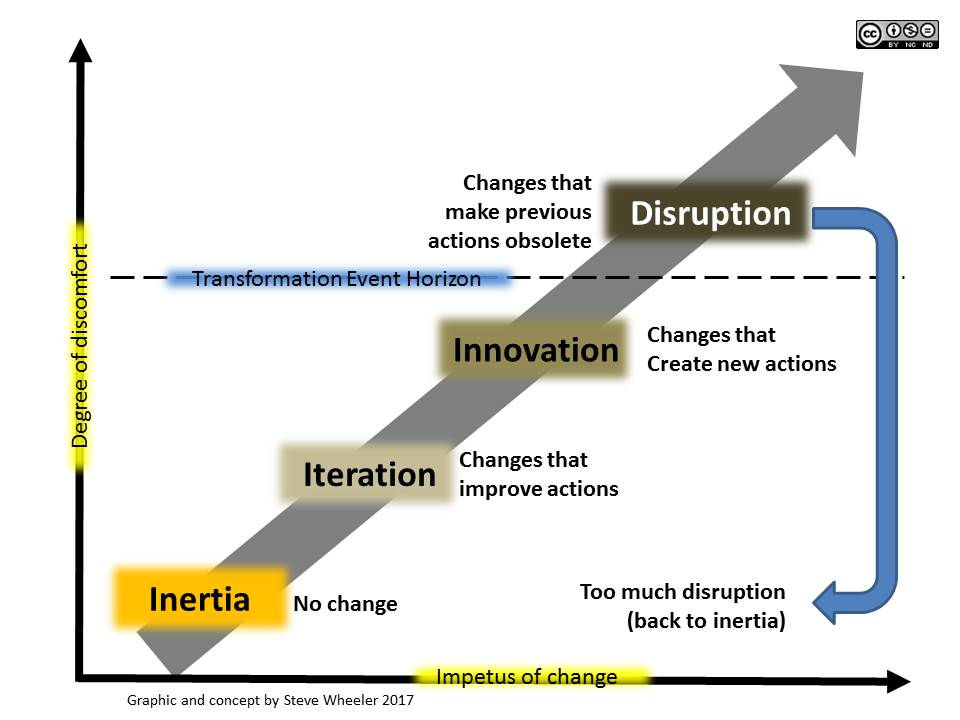
It's a neat trick to try, attempting to turn an opponent's own ideas against him, but the argument is falls over because Tim fails to acknowledge (or notice) the caveat I present on the same page to this model (below). It is simply that when we over-disrupt - for example by attempting to replace human systems with technology, for the sake of technology sake - then we often regress back to square one (i.e. inertia).

Also, how could I ignore my own writing, if I have only just written it? This is a counterintuitive argument to me, but at least it proves that Tim Holt is not a chatbot! Thank you for reading the blog posts Tim. I'm flattered that you are aware of them, but I would be grateful if you could read them in their totality before you attempt to turn my own arguments and ideas against me.

I'm not sure I would like to live in the world Tim Holt describes. In answer to another question he poses about my knowledge: Yes, I am aware of the upcoming AI developments, and although great advances are being made in areas such as machine learning, cognitive computing and even emotional modelling, teaching will remain the preserve of humans. I'm not convinced that something as complex and vital as teaching could ever be hived off to a computer. Imparting of knowledge is one thing. But it is such a small aspect of a teacher's daily work.

Technology is useful for supporting, enhancing and even extending the capabilities of humans. It was not created to replace our minds, creativity and emotional intelligence. I certainly wouldn't wish for my children to exclusively use technology to explore their world. We are highly social, and we all need human interaction. The pseudo-utopian world Tim Holt espouses sounds like an absolute nightmare.

When Arthur C Clarke intoned 'Any teacher who can be replaced by a computer, should be', he was indeed bemoaning bad teachers that delivered instruction. But the implied caveat was that there were also other (good) teachers in the equation - and that these would not need to be replaced by computers.

Creative Commons License
All lies and jests... by Steve Wheeler was written in Plymouth, England and is licensed under a Creative Commons Attribution-NonCommercial-ShareAlike 3.0 Unported License.


November 16, 2017

Change and inertia

Concept by Steve Wheeler
I have studied change management in large organisations for over 25 years. Indeed, the very first peer reviewed journal article I published, was entitled 'Managing technological change in nurse education'. It appeared in a British Computer Society journal in 1992.

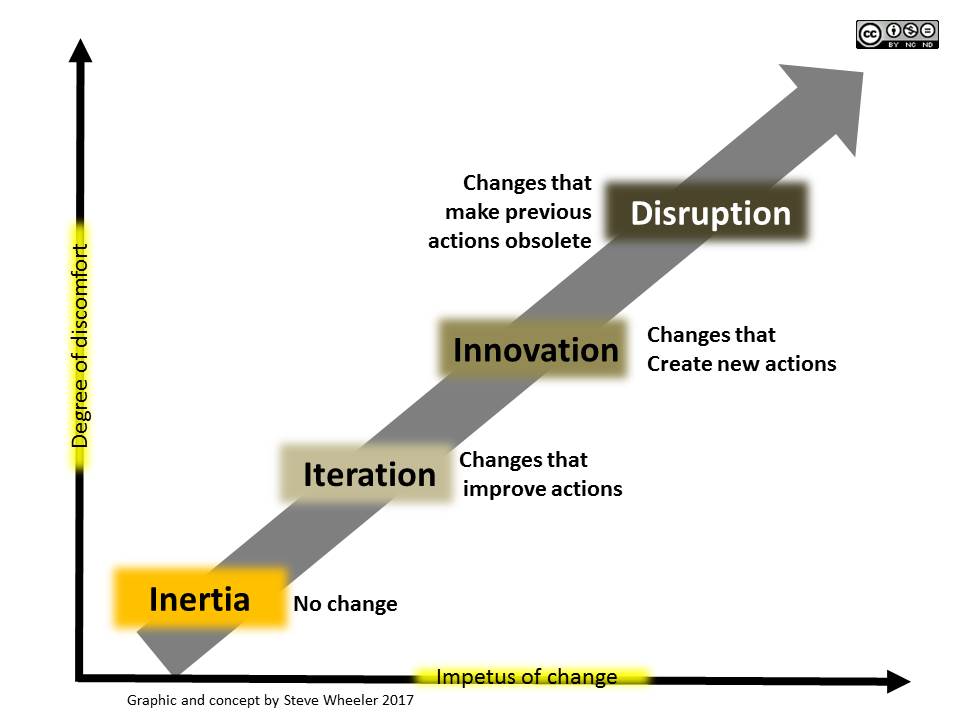
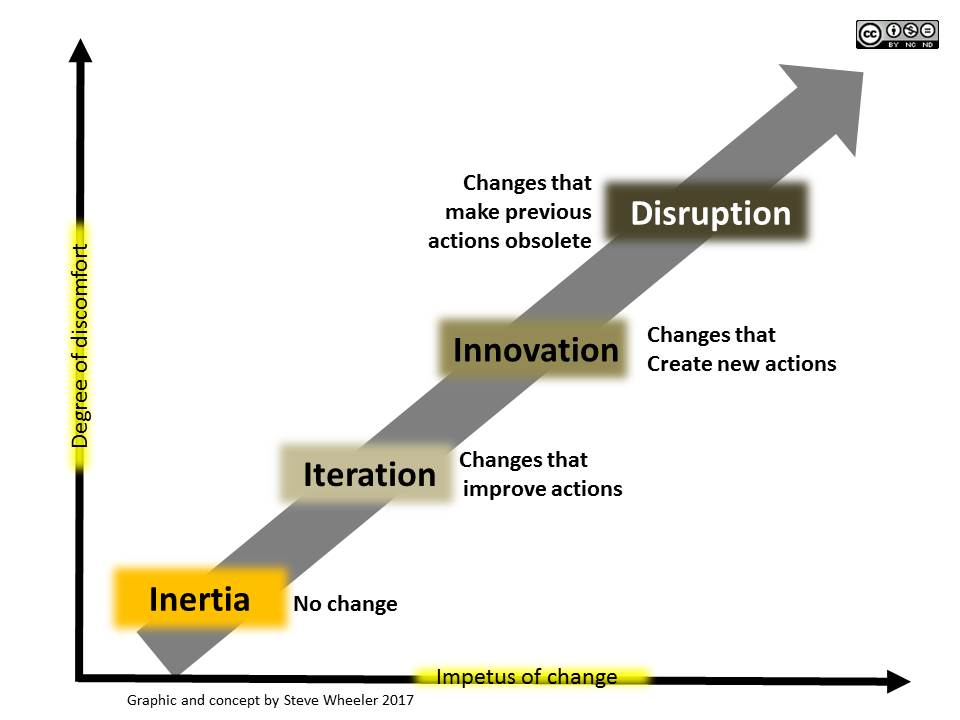
Recently, I was discussing change with teams of academic staff at a large university in the Southern Hemisphere, and as a result of the conversations I developed the model of change which is illustrated here. It synthesises the work of Clayton Christensen and others, and is a simple linear stage model that attempts to identify sequences of events that can lead to transformation of organisations. I propose that this model applies as equally to schools, colleges and universities as it does to large businesses - which I will refer to collectively as organisations.

The first stage, inertia - is the default position many organisations find themselves in when they realise that nothing is changing and as a result they may be at a disadvantage, missing out on key opportunities, or lagging behind their competitors. The realisation of a state of inertia may be just the trigger leaders or managers need to convince themselves that 'something should be done', and for a process of change to be instigated.

The second stage, iteration, is where the organisation attempts to do something new or different to improve the current practices or processes of the organisation. For some this may promote enough changes required to regain competitiveness, but for many this may not create sufficient impetus.

Concept by Steve Wheeler
The third stage, innovation, has many dimensions and can be considered a cyclical process or spiral. Innovation may - or may not - lead to the creation of new markets, opportunities or processes that will alter the trajectory of the organisation significantly. Innovation requires new actions and creative solutions to existing problems if it is to succeed.

The final stage (and I suspect it may not be the final stage) is disruption. This is a word that is liked and loathed in equal measure by everyone with whom I discuss change. It is liked because it signifies a sea change in the way things can be done, so that previous processes or activities are made obsolete. It is disliked, or even feared, because of the connotation of the word - that disruption is something to be avoided because it upsets people, makes them uncomfortable and takes the entire organisation on a journey into the unknown. People like certainty and are more comfortable in familiar contexts than they are in the unknown and unpredictable.

I have included a 'transformation event horizon' in the model. It was borrowed loosely from the work of Prof Kevin Burden (Hull University) which indicates that at a specific juncture in the change process, new processes and actions emerge that make it undesirable to return to the old practices.

Disruptive forms of innovation are desirable in that they can open new doors for organisations, and provides a new impetus for the organisation to develop and grow in unexpected directions. However, there is a caveat. When disruption is sudden and abrupt, it may become too far reaching or uncomfortable as to have deleterious effects on people within the organisation. Too much change, at too rapid a pace could drive the organisation back into inertia, where all the previous good work is undone. Therefore change management needs to be conducted in a sensitive and measured manner. I'll write more on this model when I have had time to think through the implications, and as ever I'm receptive to constructive comments (please use the box below) about this work.

Creative Commons License
Change and inertia by Steve Wheeler was written in Plymouth, England and is licensed under a Creative Commons Attribution-NonCommercial-ShareAlike 3.0 Unported License.


November 15, 2017

In search of penguins

Image from Antarctica Bound on Flickr
Polar adventurer Antony Jinman may have been on several epic trips to both the North and South Poles but he has yet to see a penguin - and that's a fact he's determined to change when he journeys to the South Pole again later this year.

Plymouth-born Antony is the 12th Briton to ski to both the Geographic North Pole and solo to the South Pole and his boyhood dream was to follow in the footsteps of his hero Captain Robert Falcon Scott, to journey to the white continent and hopefully see a penguin in real life. Yet despite making it to the South Pole 102 years after Captain Scott, after skiing solo for 46 days to the pole he didn't see a single penguin on the snow or ice!

Antony is now about to embark on MS Hebridean Sky (one of the finest small ships in the world) as a guest lecturer, and will be venturing down to the continent once again this December and January. On this occasion, he will be exploring the coastline of Antarctica and running an interactive program for schools via his new social media platform LiketoBe.org*

He is inviting teachers and schools to sign up for free, so that pupils and teachers alike can share in his adventure and, hopefully, join him as he fulfils his goal of seeing a penguin in real life standing on some ice.

There are other experiences on offer too. Teacher and students can interact with experts such as Antony online, download free lesson plans and teaching materials, and even host visits from climate change experts and polar scientists in their schools. LiketoBe offers a lot more details on how this can be done, or you can connect directly with me, Steve Wheeler - via this email address: steve@steve-wheeler.net.

*NB: Teachers will need to sign up to create a free school profile on LiketoBe in order to participate.

Creative Commons License
In search of penguins by Steve Wheeler was written in Plymouth, England and is licensed under a Creative Commons Attribution-NonCommercial-ShareAlike 3.0 Unported License.


November 14, 2017

Hyperconnected

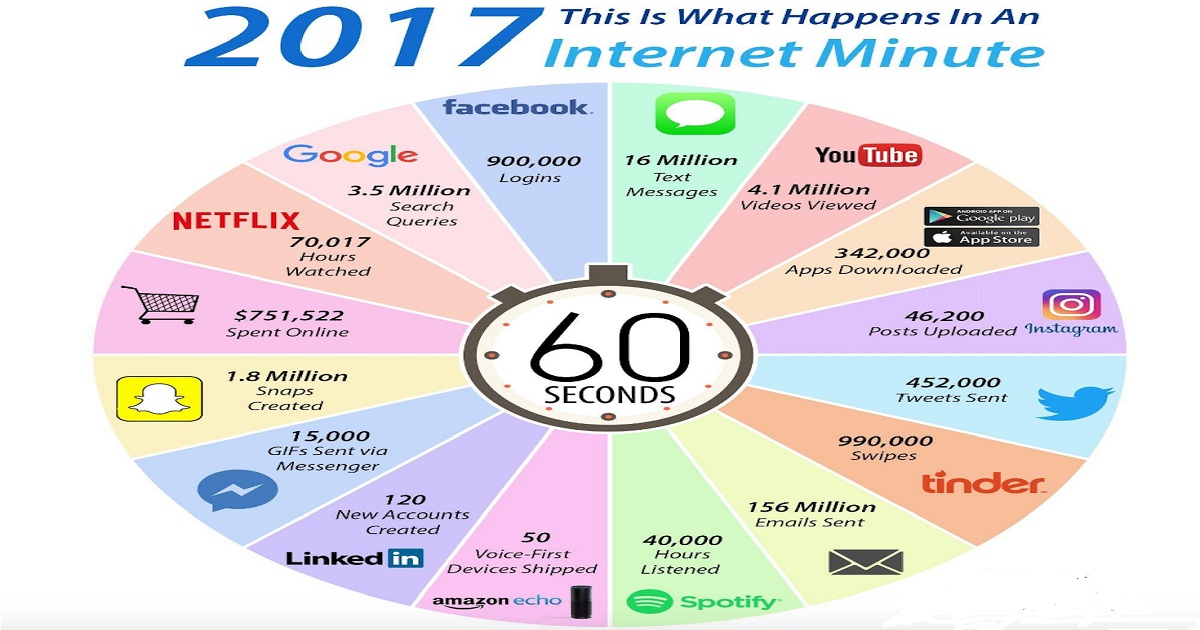
What would you miss if you switched off the Internet for just one minute? In sixty seconds, as this infographic (created by @LoriLewis and @OfficiallyChad) shows, we would see 3.5 million search enquiries on Google, nearly 2 million photos created on Snapchat, over 4 million hours of video watched on the video sharing channel YouTube (and 400 hours uploaded), nearly half a million tweets sent on Twitter, and more than 16 million text messages sent. Tinder would see almost one million swipes (doesn't differentiate between left and right swipes!), almost a million logins on Facebook, and more than 150 million emails would be sent. This is a human phenomenon that we couldn't have anticipated even ten years ago. The exponential rise in these online activities tells us that many people in the western world live in an 'always on' hyperconnected culture, where we seem to be wedded to our smartphones and laptops.

Recently I shared a version of this infographic on Twitter, with the caption: 'We are all just one click away from connecting with every other Internet user. The trick is knowing where to click...' It resonated, with many people sharing and liking the update (itself a measure of interest in the social media age). It's staggeringly true. We are a hyperconnected society. We can literally have a live conversation with anyone who has a social media account, if we and they are willing to spend some time doing so. I have enjoyed some very interesting chats with famous musicians, actors and politicians on various social media platforms, and some very instructional discussions with professors, teachers and other education professionals in my own particular field of expertise - and so, probably have you. The entire point about this post is that when we can do this, the world of knowledge opens up before us. We can learn anything we wish, at any level we require, and all from the comfort of our own homes.

The caveat is that we need to know where to click to access these interactions and knowledge bases. This is where knowledge about social media and how it works is important. Digital literacies, competencies and readiness will be increasingly important in our society, especially within our schools, colleges and universities in the coming years. I hope we get it right, because a lot is at stake.

Creative Commons License
Hyperconnected by Steve Wheeler was written in Plymouth, England and is licensed under a Creative Commons Attribution-NonCommercial-ShareAlike 3.0 Unported License.


November 13, 2017

Choose your words carefully

Image by Alan Levine on Flickr
A few days ago, while walking through Auckland Airport in New Zealand, I indulged in some moblogging. I wrote a post on my smartphone entitled 'Any computer who can be replaced by a teacher, should be.' It was a tongue in cheek play on the famous quote from Arthur Clarke who said 'Any teacher who can be replaced by a computer, should be.' Clarke was not championing technology, but rather identifying the need for teachers to reach beyond instructional and didactic methods into deeper engagement with their students. During that period, computers were quite rudimentary and were mainly being used in education to present text and test learning through simple multiple choice questions. I know, because I was one of those programming the software that made it happen.

My post argued that teachers should not and could not be fully replaced by technology, because of the rich emotional, relational and creative aspects of the role they performed. There was an immediate response from many in the computing and education communities, some arguing for, and some against this position. Unfortunately, a very few chose their words poorly in their attempts to refute my position. (It's often the case on social media that some are unable to frame their arguments without a personal dig at their opponents). I consider some of these people my friends, while others are not personal acquaintances.

Let's start with one of the major fomenters of this debate. Sugata Mitra shared the link to my blogpost on his Facebook page (thanks Sugata) with the words: 'An emotional piece from Steve Wheeler.' He then proceeded to make some comparisons with humans replacing technology. Some were humorous, whilst others were pointed out by commenters as inappropriate. Sugata, when our paths next cross, hopefully we will enjoy another drink or meal and exchange some ideas, but a word to the wise - a more appropriate word to describe my piece might be 'passionate'. It has more appropriate connotations than 'emotional', which implies that I might not have been fully in control of my writing. Whether you intend it or not, the use of value laden words tends to force you into a judgemental stance.

The exchanges that followed were interesting. Some challenged Sugata about his position on teachers, and others supported him. Lenandlar Singh for example remarked on Twitter: 'It's actually shocking that he would interpret what @timbuckteeth said in that fashion.' Some were less charitable. A war of personalities ensued, and the original topic was sidelined. It all reminds me of the Paul Simon lyric - a man hears what he wants to hear and disregards the rest.  

Discussion should be encouraged. The last thing we need is another echo chamber where everyone agrees with each other. But we need some ground rules. Some critics chose their words poorly to articulate their dislike of my position, or indeed that of Sugata. Teemu Leinonen called the examples I presented in my post 'extreme and simple'. Now, I would settle for 'radical', which again has more acceptable connotations than 'extreme'. Then Teemu targeted the headline, which was meant to be emotive, and thought that this was 'extreme' too. Well Teemu, sometimes a little goading is necessary for a deeper discussion of issues to be promoted, and it seemed to make this happen. But the best quote was when he suggested my post was 'internet-like'. Er, Teemu - you read it on the internet. What do you expect?

The quote of the day however, goes to Sarge Salman, who said my post was 'bizarre and disjointed'. And yet he understood my argument and proceeded to engage with it. Not bad for a 'disjointed essay' Sarge? It would probably have been wiser for you to engage with the topic rather than criticise my literary style - all you managed to do was distract from the theme of the discussion. We should all choose our words more carefully if we wish to engage dialogically. Thinly veiled value judgements on the capabilities of your opponent create the opposite effect.

Martyn Wild's comments were extensive and perhaps the most balanced in the entire thread. I agree with some of you commentary Martyn, but I take issue with your characterisation of teachers. Yes, students can learn in spite of their teachers, and yes, all of us have the capability to be teachers, especially parents. But you miss the point, and it's something I have articulated it previously here. Anyone can be a teacher, but only a few are educators. This is something that requires a genuine human with emotions, affection, empathy, life experience, artistry and a whole range of other traits that enable true educators to connect at a deeper level with students. Educators go the extra mile, and move beyond mere 'teaching'. It's a philosophical question that will take much more space to unpack than we have on social media. It deserves a wider public debate. Finally, I'm disappointed Martyn that you do not see teachers as anything particularly special, but are comfortable to privilege 'great artists and great composers' above them. We each have a role to play in society, but to replace any of our artistry with technology (and that includes great artists and composers) would be a great shame.

No, I won't take back a single word of my blog post, and I won't have my voice (or the voices of countless other teachers around the world) drowned out by the strong AI agenda that seeks to promote technology as a replacement for human interaction. I restate my case:

1. Teachers perform a very significant and powerful role in education. The role is too important to be fully replaced by technology.
2. Some aspects of teachers' work can be replaced by technology, releasing them to engage more with their students.
3. Technology has an important role to play in education, as long as it can enrich, extend and enhance learning and teaching. If it can't, we shouldn't be using it.

The bottom line is this: when you resort to poor choice of words to argue your case, you can detract from your own argument. The focus becomes not what you say, but the way you have said it. If you use words that encourage discussion, others will engage with you, and the focus will be on the points of the debate. So please, if you want to continue to engage in this discussion, choose your words carefully.

Creative Commons License
Choose your words carefully by Steve Wheeler was written in Plymouth, England and is licensed under a Creative Commons Attribution-NonCommercial-ShareAlike 3.0 Unported License.


November 11, 2017

The EDEN Interviews: Georgi Dimitrov

Pure Diversity (1993) by Mirta Toledo
The EDEN interviews are a series of conversations I have recorded with keynote speakers during EDEN summer conferences. EDEN video interviews have included Tony Bates, Cristobal Cobo, Sir John Daniel, Jim Groom, Melissa Highton, Michael G. Moore, Sugata Mitra, Marci Powell, Yves Punie, Audrey Watters, Lesley Wilson and Martin Weller. In this interview, which took place during the 2017 Conference in Jonkoping, Sweden, I talked to European Commission representative Georgi Dimitrov.

Georgi Dimitrov joined the European Commission in 2008 where he was instrumental in establishing the European Institute of Innovation and Technology (EIT). In his current role Georgi manages the initiative HEInnovate which was jointly launched in November 2013 by the European Commission and the OECD. HEInnovate focuses on higher education institutions (HEI) interested in developing their entrepreneurial strategies and capabilities. He also manages the development of evidence based and policy initiatives related to innovation and entrepreneurship in higher education.

Before joining the Commission, Georgi worked for a leading multinational telecommunication company in Düsseldorf, Germany. Prior to that, he worked an IT start-up for four years in different functions (Erlangen, Germany). Georgi studied at the University of Bonn  with a first degree in European Studies, and the University of Erlangen-Nürnberg where he completed his PhD. He is currently a student at the British Open University where he is studying technology management.


The conversation ranged from diversity and innovation to the digital economy and ICT in schools, colleges and universities across Europe. The interview offers fascinating insights into the future of European education and the role technology will play in developing new pedagogies and approaches.

Creative Commons License
The EDEN interviews: Georgi Dimitrov by Steve Wheeler was written in Plymouth, England and is licensed under a Creative Commons Attribution-NonCommercial-ShareAlike 3.0 Unported License.


November 08, 2017

Limiting managers and liberating leaders

Image from Public Domain Pictures
During more than 40 years of employment in large organisations I encountered two kinds of people in authority.* There were the limiting managers who dictated and directed what I should be doing and there were the liberating leaders who gave me space to discover for myself how I should be doing things. The limiting managers monitored my work and chastised me when I didn't measure up to their standards, while the liberating leaders gave me space to achieve my own goals and praised me when I succeeded. It was working with the liberating leaders that I began to discover my true potential, because they gave me freedom to explore my personal potential and develop my role.

Limiting managers tend to dictate what their teams are doing often ignoring the talent within the team. Those who exert power over their workforce in this way do so out of a need to meet specific targets they have set, or have had set for them by their own managers. If they have no trust in their team they may adopt an autocratic style that is controlling, with little space offered for the team to experiment and innovate. This hierarchical style of management is focused on controlling the behaviour and direction of a team that has been compared to driving a team of horses.

Compliance is demanded and such obedience means there is only one direction and goal that can be expected. Little deviation from the set course is possible, and each member of the team is compelled to move at the same speed. The team is therefore limited to the pace of its weakest member and there is no latitude for personal innovation or extemporisation. This is comforting for limiting managers who lack confidence or fear uncertainty, because progress can be constantly monitored and controlled.

Conversely, liberating leaders often allow their team to diversify and to innovate. These leaders allow their team members to run free within wider boundaries. They acknowledge that a team consists of individuals with unique attributes who are able to share their knowledge, skills and expertise. This style of leadership values the diverse expertise and knowledge of the team and naturally creates opportunities for multiple perspective to be considered. Decisions are often made democratically where leaders see multiple possibilities due to the diverse nature of the views represented within the team. Their role is to ensure the team reaches its goals.

Liberating leaders do not drive from behind, but lead from the front. They allow their team latitude to create spaces for new ways of thinking, knowing and doing. The strength of the entire team is focused on moving forward and the pace of progress is diverse. To be a leader requires an open mind and a confidence in the team that derives from openness and flexibility. Liberating leaders are more focused on finding the best impetus for their organisation where creative play and exploration around problems can result in more sustainable progress. Leaders trust their teams to do what is best for the organisation, and there is power sharing across the workspace.

As Julian Stodd recently wrote, there is a need for trust within organisational structures. Without this form of social understanding, there will be no equity, and certainly no capability to innovate and transform. The liberating leader recognises this and creates the conditions in which it can be achieved.

*This is a simplistic binary explanation of a complex human phenomenon, but I use it here as a device to highlight and explore the power structures and practices observed in many large organisations.

Creative Commons License
Limiting managers and liberating leaders by Steve Wheeler was written in Singapore and is licensed under a Creative Commons Attribution-NonCommercial-ShareAlike 3.0 Unported License.

November 05, 2017

Any computer that can be replaced by a teacher, should be


Photo by Steve Wheeler
Here's my opinion, for what it's worth. I write from more than 40 years experience working in educational technology while observing the rapid development of machine intelligence.

Remember the old Arthur Clarke quote? Any teacher who can be replaced by a computer, should be. It raises a few smiles because of its wit, but also serves to remind us that teaching is a complex human, relational profession in which emotional connections are made and where teachers don't simply present information.

And what is more, good teachers will never be redundant. They will always be needed because they can motivate and inspire, making all the difference to children's learning and aspirations.

Teachers can do a lot more than even the most sophisticated computer or the most agile robot. And artificial intelligence may be a great tool for high level computation, and even such rich human activities such as interaction, but has little benefits when it comes to emotional intelligence.

Artificial intelligence has been designed to bring us to the point where it replaces human activity. Even cognitive computing has been developed to mimic human decision making and other natural characteristics of being human. But humans have many characteristics it would be impossible to mimic, including empathy, emotion, appreciation for aesthetics, and most importantly deviance - also known as breaking or bending the rules. The latter is something no computer will ever do voluntarily. It would need to be programmed to do so - and that would still confine it to following those instructions without deviation.

Teachers won't be replaced by computers because it is nigh on impossible to describe accurately what teachers do. Much is intuitive, creative or unpredictable and cannot be made into neat algorithms. The mundane stuff can be offloaded into the mindtools that computers and AI offers, so we can expect routine activities to be automated in the future. But the more specific pedagogical roles of teachers, their reflective and critical processes will always remain the remit of the educator. Technology was created to serve our needs as humans, not to replace us.

NB: This post was written while on the move using my smartphone. There may be errors, but that just shows I'm human. I guess you could call it moblogging.

Creative Commons License
Any computer that can be replaced by a teacher, should be by Steve Wheeler was written in Auckland, New Zealand and is licensed under a Creative Commons Attribution-NonCommercial-ShareAlike 3.0 Unported License.


November 03, 2017

Walking backwards into the future


Image by J Shook on Wikimedia Commons
I learnt a lot during my two weeks in New Zealand, where I was working with the staff of Auckland University of Technology. New Zealand is culturally very rich, not least because of the pervasive Maori influence. Their language in particular is appropriated regularly in every day conversation. Kia Ora for example, is the greeting most commonly heard.

But one Maori expression will stay with me for ever because it has a more profound meaning than a simple welcome or a hello. It is ka mura, ka muri  - which means 'walking backwards into the future'. The Maori always honour their ancestors, and they know that because there is no way they can predict the future accurately, they call upon the wisdom of their ancestors to guide them.

When we consider the future we tend to strain our minds to imagine what will come next. And usually we fail miserably. Perhaps instead we should follow the Maori tradition and build our own future on the shoulders of giants. In the case of education and the future of learning we should consider what those who have gone before us have achieved, the lessons they learnt and the trajectory they have set us on.

The future is uncertain. Nothing is guaranteed except change, and even the jobs we will see emerging in the next decade or two cannot be accurately anticipated. The future is imaginary. All we can do is imagine the demands that will be placed on those who follow in our paths. But the past is our collective memory and we could do far worse than pay heed to the wisdom we already have at our fingertips. We can observe the rapid changes that have recently occurred and deduce that the pace of that change will increase exponentially.

We therefore need to educate our children to be resilient, agile, critical and proactive. They will need to solve problems we may inadvertently have made for them as well as new problems of their own making. They will need to schieve this collectively because surviving the future will be a team sport. They will need to be creative too, and learn the lessons of our failures and successes as they in turn walk backwards into their future.

Creative Commons License
Walking backwards into the future by Steve Wheeler was written in Auckland, New Zealand and is licensed under a Creative Commons Attribution-NonCommercial-ShareAlike 3.0 Unported License.

The EDEN interviews: Stefan Hrastinski


Image source unknown
I like being interviewed about my work, but I'm just as happy firing questions at others. I have had the privilege to interview many great thinkers in the education field, some of which appear elsewhere on this blog. For the past 4 or 5 years I have recorded video conversatiins with keynote speakers who have presented at EDEN events. In June of 2017, Jonkoping, Sweden, was the latest European city to host the annual summer gathering and once again, I managed to record some in depth conversations with several of the conference plenary speakers, including this one with Stefan Hrastinski.


Stefan is a professor in the School of Education and Communucation at the Royal Institute of Technology in Sweden. At the conference his key theme was one to one online learning. In this interview after his keynote, we enjoyed a wide ranging discussion around various theories of pedagogy, student engagement and participation, networjed learning, and the specific characteristics and practices that make a teacher effective in digitally mediated spaces. We also spent some time debating the evolution and trajectory of MOOCs and their significance for the future of education. Above is the video, courtesy of the European Distance and Elearning Network (EDEN).

Creative Commons License
The EDEN interviews: Stefan Hrastinski by Steve Wheeler was written in Auckland, New Zealand and is licensed under a Creative Commons Attribution-NonCommercial-ShareAlike 3.0 Unported License.


October 29, 2017

Reasons to be blogging ... 1 2 3....


Image from Pixabay
I'm often asked why I blog. What's the attraction? Is it worth the effort? How do I keep it going? Here are 5 reasons:

Firstly, blogging keeps me focused and engaged. I'm always seeking new ideas and content for my next blog. When you write regularly, you're always on the look out for new content. Also, you're only as good as your last blog post! This means that I try to be actively engaged with everything I do and see as I hunt for new images, methods, projects and ideas that can be used for education contexts. Then I blog about them.

Secondly, blogging helps me to think more clearly.  I write and compose a post as a means of turning my abstract thoughts and disparate ideas into some coherent and meaningful whole. This post for example, started life as a series of notes on my smartphone after a conversation. You might be surprised how many posts I actually discard. Those that are actually published represent my thinking more clearly, and blogging helps me to reflect upon, and crystallise those ideas.

Thirdly, blogging compels me to raise my game. I compose my post in a manner that best conveys my thinking to an audience. This means I am compelled to write concisely and with relevance. It also encourages me to check the provenance and accuracy of my sources, the status of the information I'm presenting and the copyright status of images and other content I incorporate.

Fourthly, blogging gives me a creative outlet for my thinking. I don't have to stick to a specific format of writing. I can develop posts into satire, narrative, dialogue, metaphor... or stick with academic prose. The possibilities are endless.

Finally, it gives me feedback from, and promotes dialogue with my professional community of practice. I post my content with an awareness that I have an audience out there who will be critical and inquiring. Some might respond with comments which themselves could present me with further learning opportunities. This double loop of learning and reflection is one of the most powerful aspects of blogging.

Creative Commons License
Reasons to be blogging... 1 2 3 by Steve Wheeler was written in Auckland, New Zealand and is licensed under a Creative Commons Attribution-NonCommercial-ShareAlike 3.0 Unported License.


October 28, 2017

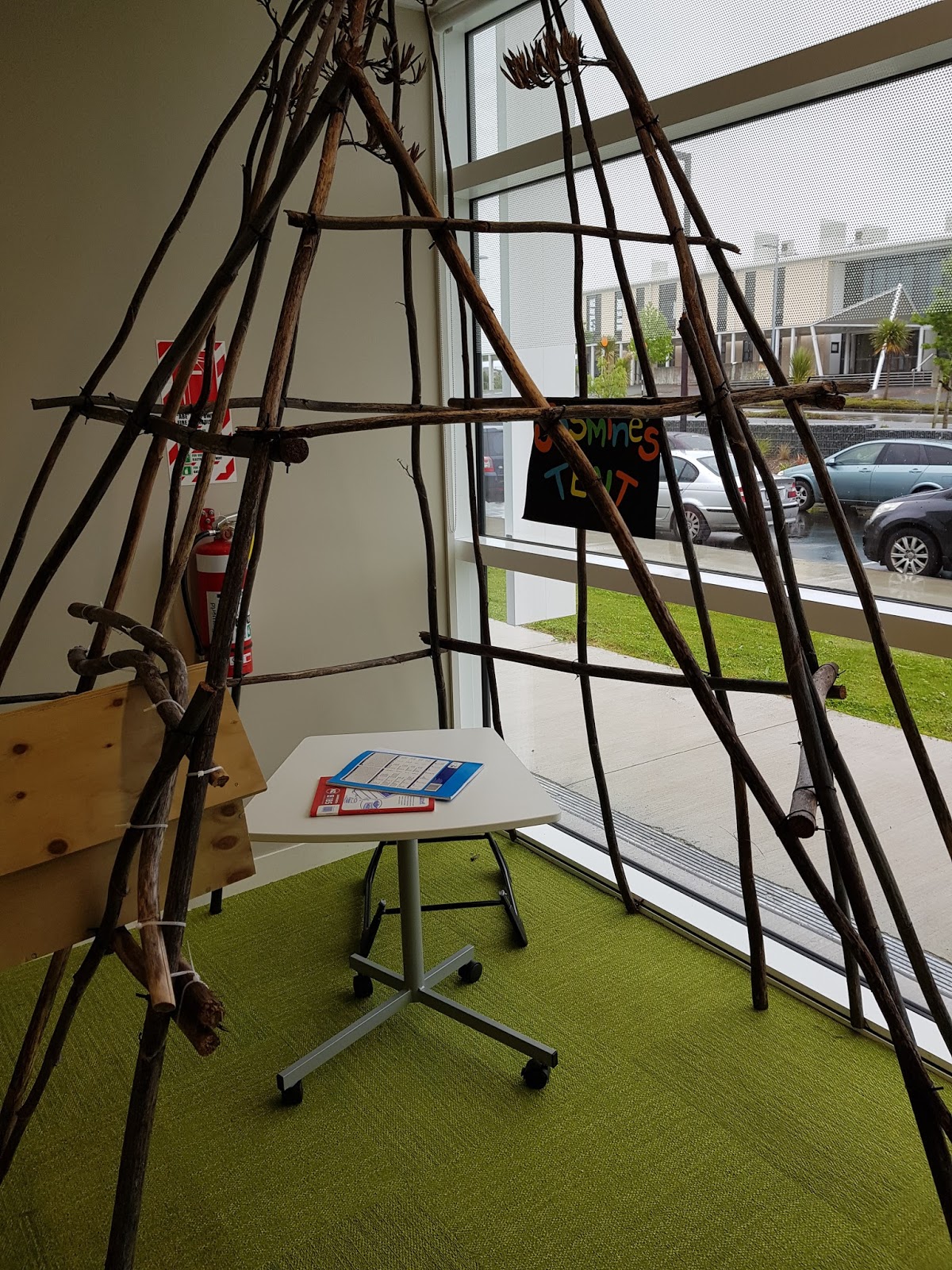
Jasmine's tent


Photo by Steve Wheeler
There is a large, flexible learning space in Ormiston Junior College on the outskirts of Auckland. It's called a modern learning environment or MLE. In one of the corners, near a large window is Jasmine's tent. It's only a framework, no more than a semblance of a teepee really, but Jasmine sits comfortably inside and quietly gets on with her work. All around her, noisy, messy chaos erupts as the rest of the Ormiston students busy themselves with their learning.

Noise, said one teacher, means the children are engaged in making, testing, discussing and exploring. Open, modern learning spaces are dynamic and student centred, and they offer great opportunities for creative learning. They are appearing in schools everywhere as teachers and school leaders begin to realise the importance of flexible and open learning, where the student is the prime focus. MLEs have many advantages, but they not for everyone, it seems.

Jasmine is severely autistic and this used to mean that she would sit in the room with her coat over her head. The noise and the constant movement overloaded her senses and she couldn't cope. She would need to detach from her environment to protect herself. A simple idea of tying together some branches of wood was all that was needed and now she is included in the learning.

It doesn't look like much. There are no walls and she isn't shielded by the noise or the movement. But it is her space, and it's her perception of a space that she owns which is the important factor. Sometimes it's the simple ideas that make all the difference. And in Jasmine's case it is a game changer.

Creative Commons License
Jasmine's tent by Steve Wheeler was written in Auckland, New Zealand and is licensed under a Creative Commons Attribution-NonCommercial-ShareAlike 3.0 Unported License.

October 23, 2017

Outdated practices

Image source
I was thinking today about change. We all desire change, but not many of us want to change ourselves. Irony.

Well, time moves on, doesn't it? New technologies emerge, outmoded devices are discarded; old buildings are knocked down to make way for new ones, and children grow up fast. Everything is changing, except perhaps in schools. School is the main experience for children, the key influence on their preparation for the future. So why is it so difficult to get schools to keep pace with the rest of society?

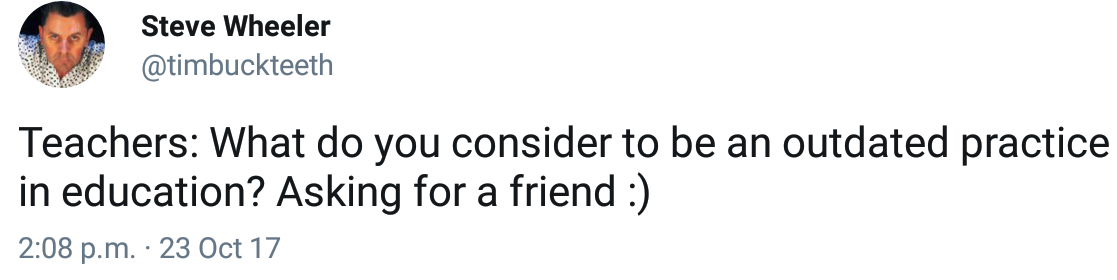
So I posed a question on Twitter for my professional learning network:


The responses came thick and fast, from educators across the globe. Very few were about technology. Almost all focused on teacher methods and student activities. In short, many teachers saw a need to change pedagogy.

Danne Levy, an English teacher in Tamworth, England, said that teaching to the test needs to stop. It has been imposed on teachers because funding bodies want to measure everything, and testing has become a priority. Children are therefore presented with a narrow experience, because there simply isn't enough time to deal with content that won't appear in the tests. On the topic of assessment, Matt Bury, teaching in Guelph, Canada, said that norm referenced grading had to go.

Naomi Barnes, a Brisbane educator zeroed in on homework as outmoded. She argued that it was for an era where only one parent worked. Today, if the child struggles with their homework, they will spend more time fretting and being anxious than learning, so is it time to ditch this idea?

In the UK, Leicester based educator Terese Bird thought that we need to put a stop to purely didactic instruction. For many this teaching method is linked to rote learning which is a particular dislike of Paul Kleiman, who also echoed the earlier sentiments about homework. On the subject of didactic teaching, Harvey Alvy, a school principal in Washington state, USA, thought that lectures work with one group but not another, so teachers need to be aware of group differences. Timothy Leffert, teaching in Kansas, USA, called lecturing the 'sage on the stage' implying that we really need to see the student take more of a centre stage of the learning process.

Individual differences were also seen as a pedagogical battlefield. Iowan High School teacher Tim Scholze raised the ugly spectre of identifying learning styles, still the bane of reason in many school classrooms, while Melissa Techman, a librarian at a school in Virginia bemoaned a lack of differentiation. We clearly need to treat all children as individuals, and one size has never fitted all.

Phillip Moss, a teacher based in Auckland, New Zealand, had plenty of gripes about outmoded practice. He suggested we need to see the back of 3 hour written exams, school bells and rows of desks. However, his most telling and insightful comments were around the need to situate learning in authentic contexts, with 'real world connection' - something echoed by Matt Bury, and a sentiment that many other teachers would agree with wholeheartedly.

Finally, Cal Armstrong, a mathematics teacher in Oakville, Canada, was highly critical about some of the recent 'fads' in education, including flipped classes (another buzz word for homework?) and interactive whiteboards. The latter, others thought, had failed to offer significant benefits to students. And on the subject of fads, Jocelyn Sanders, teaching in Delaware, thought that repackaging old ideas as new buzz words was something we would all be better off without, especially the recent focus on 'grit'.

Comments are still coming in, and you're welcome to add yours below, but I would like to thank all those who took part in this impromptu discussion around outdated practices.

Creative Commons License
Outdated practices by Steve Wheeler was written in Auckland, New Zealand and is licensed under a Creative Commons Attribution-NonCommercial-ShareAlike 3.0 Unported License.


October 14, 2017

Space exploration

Image from University of Northampton
A death was announced today in the Times. The newspaper covered the 'demise' of the university lecture theatre. The news created a small stir on social media, with several educators opining about what they thought of lecture theatres, their place in universities, the role of technology, and teaching and learning in general.

It seems that the subject of the article, the University of Northampton (one of the newest universities in the UK) has decided to do away with their traditional raked lecture theatres, and replace them with more open, flat, flexible spaces where teaching can be conducted. The picture above (an artists impression) depicts a lectern and a wall of screens at one end of a carpeted room, with chairs and tables dotted around, cabaret style. Some of the students are using laptops or other connected devices, whilst others are listening as a lecturer holds forth at the front. Above are steps and a raised area, presumably a thoroughfare.  It all looks very bright, modern and colourful.

Only trouble is, the illustration holds on to the concept of teaching from the front. It perpetuates the idea that the teacher (lecturer) is at the front of the room, and all attention is there, because that is where the knowledge, and therefore the learning is located. We teach in the same way we ourselves were taught, it is said. It is very difficult to break out from this kind of legacy model, but as sure as Christmas starting in the shops on the first day of November, that is exactly what most teachers do.

While I applaud Northampton's moves to try to change the model and improve spaces for students, I have to ask - are they doing it for the right motives? The Vice Chancellor is quoted as saying that sitting in a hall 'being spouted at does not offer value for money.' Yes, students are paying high tuition fees, and yes they expect more for the more they are paying, but why don't universities make the changes anyway, regardless? It should behove every university to continue to make changes to improve pedagogy. Money, or league tables, or National Student Surveys - none of these should be drivers for improvement.

I also notice that in the illustration at least, there seems to be a fundamental lack of understanding about learning today. Several educators on Twitter this morning underlined the problems: Where are the repeater screens for those facing the wrong way? Why don't the chairs have wheels for more flexibility? Why is there still a lectern? And ultimately, where are the power sockets that provide the juice that keeps the laptops going when batteries are low? These are perennial problems in any large space where student gather, so designing new spaces is surely a wonderful opportunity to address these problems? And perhaps it's simply the journalist's lack of knowledge about university life, but could we call them 'learning spaces' instead of 'cafe style teaching areas' please?

All that said, I still applaud Northampton for making the step toward better learning spaces. I suspect that not many other universities will follow suit, but for those that do, let's remember that it's the student that should always be placed at the centre of the learning process, and that we should design our spaces accordingly. I'm not so sure about their decision to replace lecturer studies with open planned office space though. It's been tried several times before and it never works. And I suspect the announcement of the death of the traditional lecture theatre is somewhat premature.

Creative Commons License
Space exploration by Steve Wheeler was written in Plymouth, England and is licensed under a Creative Commons Attribution-NonCommercial-ShareAlike 3.0 Unported License.


October 02, 2017

Like to be connected?

LiketoBe working in partnership with Plymouth School of the Creative Arts
What would happen if someone created a digital platform that schools could use to connect with businesses, experts and industry? Imagine what it would be like if children could talk directly via a video link or webinar to a famous author, musician, astronaut, or polar explorer? How might this inspire them to pursue a similar career when they left school? The same might apply to a train driver, a doctor, a chef or an engineer, I'm guessing.

Think what might happen if the children in your class could speak to these people direct, ask them the questions they always wanted to ask, and find out exactly what it would be like working in that kind of environment. Through a platform like that, schools could organise a different themed online event every month, or a series of assemblies in which professionals and experts could 'come into the school' on a big screen and speak to the children about their passion or their career.

Teachers could select a profession from an easy-to-use visually rich menu on the front page of the platform and find people who were willing to share a lesson plan, resources and activities related to their talk. The discussion could continue for a long time afterwards, perhaps developing into a group project, or some entrepreneurial activities for real-world, authentic learning.

And the best part - it would be totally free for the school. Those who funded such activities would be the businesses and companies, because their reward would be to have access to an entire classroom of interested children who might one day want to be a part of their organisation. As a teacher, would you be interested? Would your school want to be a part of it?

Well, the platform has already been created and we just raised £195,000 in investment to help us make it happen. The platform is called LiketoBe and it's recruiting schools and teachers to test it out from around the globe. Here's our Facebook page with all the latest news. I'm personally heading up the research and development of the platform, and I want to hear from schools who are willing to try it out, and tell me what I need to do to improve it. You can try out a digital careers fair, or form connections with similar schools on the other side of the world.

So - would you like to be involved? The success of LiketoBe will depend upon the interest of the education community - please help us inspire a generation of children by taking part. My school liaison team will send you details on how to participate. Simply contact me on this email address if you would like to be a part of this exciting new project!

Creative Commons License
Like to be connected? by Steve Wheeler was written in Plymouth, England and is licensed under a Creative Commons Attribution-NonCommercial-ShareAlike 3.0 Unported License.


October 01, 2017

What I miss and what I don't

Photo by Kevin Harber on Flickr
Watching my colleagues from around the UK posting images of themselves with their new cohorts of students gives me mixed feelings.

On the one hand, now I'm no longer teaching in higher education, I feel as though I'm missing out on something that has been a part of my life for the past two decades.

On the other, I feel a huge sense of relief that I'm no longer involved with all the behind the scenes admin and trivia that all teachers have to endure. I wrote about this recently in a post called Walking Away.

Lecturing at a university can appear glamorous. Standing in front of large groups of undergraduates to give a lecture, or running a seminar for a small group of students looks fun, and usually it is. But behind the scenes, there are a thousand and one other jobs lecturers must do just to keep their heads above water. What I won't miss now I am 'retired' are all the tedious meetings you are expected to attend. Some turn out to be a waste of time where nothing is decided.

At the start of each year, lecturers scratch their heads as they study their timetables detailing all their lecture dates, times and venues (some of which inexplicably overlap). There are the time consuming phone calls and emails to admin to try to get certain lectures or seminars rearranged or adjusted so one doesn't spend entire days running across campus just to get to a session on time. At the opposite end of the academic year there are the exam boards where everyone sits around a large table and goes through each and every result and verifies that yes, indeed, Sally Forth really did get a 56 for her study on moles invading the school playing field.

Sandwiched in the middle of these chores is chaos. Controlled chaos, but chaos none the less. Lecturers now need to create and update content and share it via a Learning Management System (other names are available), usually 48 hours prior to the relevant lecture so that students can see the slides and notes beforehand to 'prepare'. They need to create alternative resources for those with special needs. Reading lists have to be agreed with the Library and Resources staff months before a course starts, so there goes your summer. The planning can sometimes be up to one year ahead, with 'module delivery sheets', reserving rooms and additional resources, booking external speakers (and going through all the mandatory checks lecturers now need to do to simply get someone clearance to be on campus) and supply of all sorts of other data.

On top of all these requirements, the university lecturer is also expected to research and publish on a regular basis. Not in just any academic journal. To have any worth, lecturers need to publish in the 'right kind' of academic journals. For many, research funding, promotion, the proportion of time you spend teaching and a whole load of other privileges are based upon satisfying the powers that be that you have published your work in a 'high impact' journal. In other words, a journal that has a very low circulation, and is so expensive that only university libraries can afford to subscribe. All of it is meaningless anyway, unless you happen to be working in one of the elite universities that attract the lion's share of the funding.

It doesn't stop there. Summer months, particularly late August - are also sacrificed for clearing - the period where school leavers receive their A level results and then hunt around to see which university they would like to attend for the next three years. The inevitable round of time consuming interviews, public relations exercises, open days and other associated duties follows - in fact it is scheduled for the entire year for many departments.

There are the optional extras too (but why any clear thinking academic would involve themselves in any of these is beyond me. I can't speak though, because I did most of these at some point during my academic career), including academic offences committees, faculty boards, ethical clearance committees, staff funding approval boards, technical management groups and the myriad of staff research clusters that constantly email their lengthy missives across the network. Many lecturers spend a decent proportion of their time deleting and trashing a large percentage of these emails and circulars they receive each week.

At home in the evenings and weekends, reading and preparation is done, and this is usually alongside all of the personal and organisational research one is expected to do just to keep abreast of all the new developments in one's specialist field of expertise. There are the additional commitments of serving on academic journal boards, professional bodies, conference committees, governance groups and external examiner roles (have I missed anything?). Lecturers don't have to do any of this, but if they don't they are definitely gazed on with some disdain. And then there is the inevitable assignment marking, which comes in waves about three or four times each academic year, and if assignments are submitted digitally, there are hours and hours of late night screen staring, followed by agonising decisions about whether someone's assignment is worth a 59 or a 61. The moderation meetings are usually tedious too. Second (and sometimes third) marking of assignments is commonplace, and just as time consuming.

If lecturers dare to raise their heads above the parapet and get noticed by a director or dean, they may not only be invited to lead modules (additional preparation work and management roles), but also to manage entire programmes, chair a committee or take on further additional responsibilities such as 'co-ordinator of this and that' or 'senior tutor in charge of niff-naff and trivia' (not authentic roles, I'm told).

So, there are many things I won't miss about teaching at university. But I will miss all my lovely colleagues and students, the final joys and emotions of the degree awards ceremony, and the fun of engaging with thought provoking academic problems or challenges on a regular basis (to be fair I still do a lot of that). At this time of year, I am definitely missing out on that. But in the final analysis, I'm very pleased that I finally have my academic freedom.

Creative Commons License
What I miss and what I don't by Steve Wheeler was written in Plymouth, England and is licensed under a Creative Commons Attribution-NonCommercial-ShareAlike 3.0 Unported License.


September 30, 2017

Curiosity, cognition and content

Image from Wikimedia Commons
Where does knowledge come from? As teachers we trade in knowledge on a daily basis, but how often do we think about its provenance? We could argue that the majority of what we 'know' derives from our ability to be able to think, to reason, to reflect, to ask questions - our higher cognitive processes. Curiosity provides the impetus for us to be able to investigate the universe we are in. Exploration and discovery have formed the basis of all scientific endeavour. Asking questions is the fundamental expression and genesis of all research. We can ask how, where, what, who and when? Yet for me, the most important question of all, when attempting to understand the true nature of knowledge, is to ask the question why?

Another question is: How do we know that what we know is correct? No-one can be certain that the knowledge we hold to be 'true' today is the ultimate knowledge, because our understanding of the world changes. Scientific advances sometimes often render previous knowledge redundant or untrue. But we do build new knowledge on old knowledge, and we need confidence in that knowledge. In the digital age where knowledge seems to be increasingly democratised, how can we be sure that knowledge is not adulterated, or contaminated with false evidence?

There is much debate about this question, especially with the advent of social media and services such as Wikipedia and Wikimedia Commons, where anyone can contribute toward a global understanding of what we 'know'. What becomes of those 'elite experts' who were previously the gatekeepers of knowledge before the Internet?

The digital age has spawned digital literacies - extensions of standard literacies that were developed in the Industrial Age. Reading, writing, listening and speaking (the latter two were literacies from an even earlier age) are now no longer enough if we wish to successfully navigate the digital terrain of modern life. How do we separate fact from fiction in the age of the remix? How can we maintain a clear, critical stance in the face of so much content?

I have written and researched extensively about digital literacies and so have many others, so I won't labour that point here. It's important though, to acknowledge that knowledge is growing rapidly and diversifying constantly, partly because of our increased access to new technologies - the mind tools of our time - and also because of the urgency of needing to know more to solve the complex and unprecedented problems faced by our society. So my third question is - what kinds of new literacies do we all need to survive and thrive in the digital age?

These are just three of the challenges I will discuss with my New Zealand colleagues when I begin my two week visit to work with Auckland University of Technology in October. What questions and challenges would you pose that are relevant to education today?

Creative Commons License
Curiosity, cognition and content by Steve Wheeler was written in Plymouth, England and is licensed under a Creative Commons Attribution-NonCommercial-ShareAlike 3.0 Unported License.


September 20, 2017

Comfortably numb

Image from Flickr by Ilmicrofono Oggiono
How do teachers get to the place where they are comfortable admitting they don't know everything about their subject? Some might argue that teachers should be expert at the highest level. But is this feasible for everyone and surely there is always scope to learn more? I want to ask the question: how can teachers and their students construct their knowledge together?

The process of co-learning between teachers and students can only effectively occur if and when teachers realise that learners can offer something new.  I know that over the years I have spent in classrooms, my students have often taught me things I didn't know. I cam remember several times recently when I have emerged from a teaching session with more knowledge than I had when I entered the classroom. At first I found it difficult to acknowledge that my students could teach me a thing or two. My mindset was fixed on the idea that I was there to impart knowledge and that my students were there to learn. Indeed, this is primarily the reason I am employed as a teacher, and also the reason my students arrive each day in the classroom. But this is a limited perspective on education.

The latin phrase docendo discimus - 'we learn by teaching' or, perhaps more accurately, 'people learn while they teach' is apt. This clearly applies not only to students (we ask them to prepare seminars and presentations for this very reason), but also to teachers. The so called 'expert in the room' is only expert to the extent that she has studied her discipline and has obtained a degree or other recognised accreditation at an appropriate level. There is always more to learn, and the teacher is, after all, a professional learner. So what better place to continue to learn than the classroom, where our students are gathered?

Successful teachers should learn continuously and be open to learning at all times. Without it we stand still, or fall away, particularly if our subject is fast moving. We need to put away any pride we have in our expertise and make ourselves open to the possibility that we don't know everything, we can learn as we teach, and we can also learn things from our students. We need to be comfortably numb to any misplaced notion that the teacher is the 'sage on the stage.' Education doesn't and shouldn't continue to be fashioned in this manner. Successful teachers today are indeed professional learners as well as educators. Making ourselves open to new ideas and new knowledge doesn't weaken our position as teachers. It strengthens our role, and models for our students the fact that learning is lifelong. It sends them the message that no matter how many degrees or qualifications we accumulate, we can still learn more, we can all learn together, and they can play a part in that process.

Creative Commons License
Comfortably numb by Steve Wheeler was written in Plymouth, England and is licensed under a Creative Commons Attribution-NonCommercial-ShareAlike 3.0 Unported License.


<< Back Next >>