Log on:
Powered by Elgg

Feed detail

September 14, 2017

Smoke and mirrors

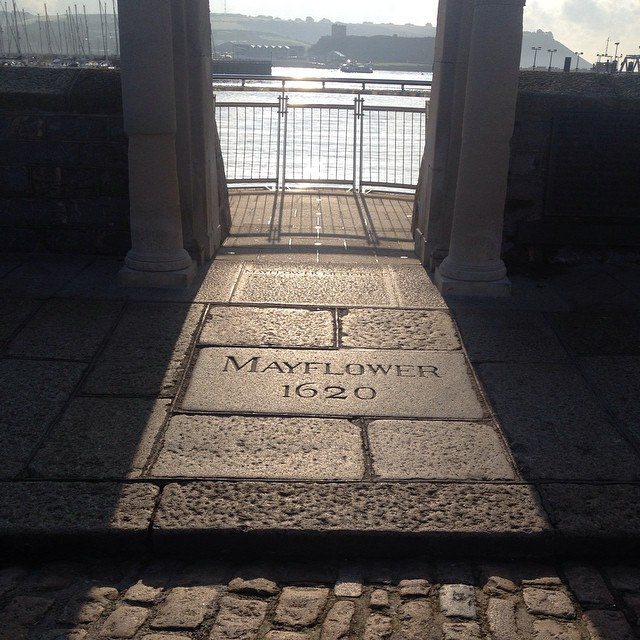
Photo by Sarah Joy on Flickr
Hidden away in the heart of the ancient Barbican area of Plymouth, England are the authentic Mayflower Steps. You probably know the story. In 1620, a little ship set sail from the South Devon port and launched out across the great Atlantic Ocean, carrying a contingent of around one hundred Pilgrims - mainly Puritan folk - and abut thirty crew. When they eventually arrived in the New World they established one of the first colonies on the East coast of what is now the United States of America. The Mayflower was a relatively small ship, and the stone steps from which it departed are even smaller. In fact, they are so small that only a few of the locals and a handful of historians know where they really are.

For any visitors to my home town of Plymouth (and this includes many Americans), the Mayflower Steps are ostensibly located on a stone pier in Sutton Harbour. A portico with pillars and a balcony has been erected to celebrate this famous voyage of discovery, and it is visited by thousands every month. The engraved stone at the base of the monument simply declares 'Mayflower, 1620'. Those who visit and take photos to capture the moment are largely unaware that the steps are fake. They have been built on a part of the Barbican that simply didn't exist back in 1620. Four centuries ago, the water's edge was back at least 30 metres from its current location. You see, the truth is often much more mundane than the myth.

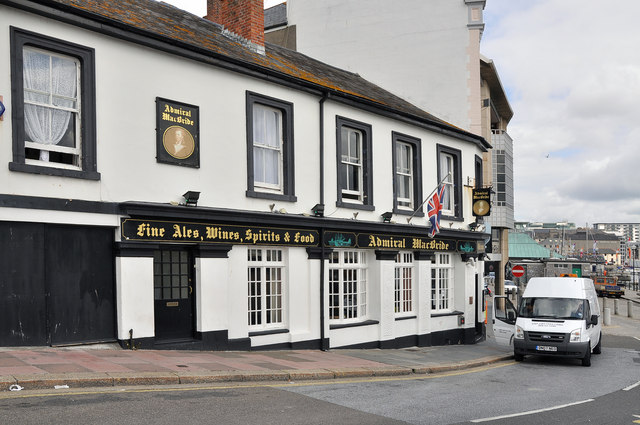
Photo by Mick Lobb on Geograph
In reality, the true Mayflower Steps are located inside a nearby public house called the Admiral McBride. Specifically, they are under the floor in the Ladies toilets. This can be confirmed by anyone who cares to visit the premises, simply by asking the bar staff. The Mayflower Steps portico has not been built there with the intention to deceive, merely to celebrate such a great feat of human endeavour. Most of the visitors to the site have no idea it is faux, and if they did many would probably not care too much. But this manipulation of historical fact is useful as a metaphor for a challenge facing contemporary society around the changing nature of 'knowledge'.

Sometimes referred to egregiously as 'alternative truth', there is plenty of fake news and manufactured 'fact' available today. Knowledge is now more vulnerable to manipulation that it has ever been, due to mass media and the proliferation of the Web. It is not hard to deceive people today, because many take content they find on the Web at face value, and some have yet to learn how to question and cross reference the information they encounter. Much as a magician or illusionist will misdirect us from what is really going on, so fake news often fulfils a similar function, distracting us from what is really going on. Certain politicians have learnt to do this.

Education has a key role to play in countering this problem. Many educators work hard to teach students how to discern fact from fiction, and how to verify the truthfulness of content on the Web. The notion of 'digital literacies' embraces a range of skills and competencies, but perhaps one of the most important is the ability to know when content is fake or real. We constantly encounter untruths, some of them subtle. The City of Plymouth markets itself as 'Britain's Ocean City', but it is actually quite a distance from the Atlantic Ocean, located on the English Channel. We will never know the true extent of all the smoke and mirrors the Web contains, but it would certainly do us no harm as a society if we possessed the skills to determine truth from fiction. However, we also need to acknowledge that people sometimes feel comfortable believing in a well-manufactured lie if it confirms their personal bias.

'Useful lies are preferred to harmful truth.' - Geoge Orwell

Creative Commons License
Smoke and mirrors by Steve Wheeler was written in Plymouth, England and is licensed under a Creative Commons Attribution-NonCommercial-ShareAlike 3.0 Unported License.


September 09, 2017

Like to be involved?

Want your school to be involved in some leading edge research? Read on!

I've just been appointed Head of Research and Innovation at one of the UK's brightest new edtech startups and I'm excited. My challenge now is to find out what teachers and schools would like the platform to do for them. I'm looking for primary and secondary schools who would be willing to try out the service for free and tell me what they think.

LiketoBe has been designed to disrupt the analogue world of Careers Advice. We're developing a unique platform and content to connect teachers and students with professionals to provide impartial, authentic careers advice.

Much as British Astronaut Tim Peake did using technology, the founder of LiketoBe, polar explorer Antony Jinman has engaged live and direct with classrooms while on various expeditions. He found that instant reaction and subsequent feedback from teachers and pupils alike, demonstrated that technology represents a wide reaching, penetrative gateway to informing and inspiring young minds. The next step is to help businesses and schools to connect together in ways that will streamline career pathways, advice and enable better exchange of

We realised that enabling this will be relevant to any career aspirations and throughout a child’s education, starting with primary schoolchildren, we will be asking “what would you ‘like to be?”

If you think your school would be a good test bed for LiketoBe and help us with our research and development, please email me at: steve@steve-wheeler.net to register your interest. Schools who help us with our research will be offered a free one year trial of the full service with full support.

Creative Commons License
Like to be involved? by Steve Wheeler was written in Plymouth, England and is licensed under a Creative Commons Attribution-NonCommercial-ShareAlike 3.0 Unported License.


September 07, 2017

Imagined futures 7: Work

Image from Gamma Keystone/France
The image on this page is from a 1969 exhibition in Hanover, Germany. It's a simulation of how the photographer imagined working in an office would look like in the year 2000. The size of the monitors on the console reflects the technology of the time, which was bulky and heavy, reliant on cathode ray tubes. Today's screens are slim and lightweight, due to rapid the development digital technology and relentless miniaturisation of components in recent years.

Perhaps the most striking aspect of this image of future work is that the office worker is tethered to a specific location within a work space. Whilst office work is far from obsolete, and many people still spend much of their working day tethered to desks gazing at computer screens, the trend is now very much toward mobile, any time, any place working. Boundaries are blurring between what we consider work and what is allocated as leisure (this can of course be both a threat and an opportunity). Devices today are small and portable (I'm typing this text on my MacBook Air which weighs less than 1.4 kilograms). Many people conduct their entire business days using little more than a smartphone, often while on the move.

As I look at this image, I can't help but notice the cumbersome design of the console and the  psychology behind it. I wonder how the office worker feels about being confined, as if she were navigating a starship or piloting an airliner. Is there a sense of claustrophobia? Does she long to get out and spend time in the open somewhere? The keyboard unit(s) also appear to be less than intuitive, and wonder about how long it would take to train someone to be proficient. Today's interfaces are far more intuitive, often touchscreen designs, and in the future they may be voice or gesture controlled. Siri, Cortana, Alexa and other intelligent personal assistant tools are already widely deployed on smartphones, laptops and room based systems in home and office. The rapid development of user interfaces is changing the face of work dramatically, and as we become more dependent on these tools, so our conception of what it means to 'go to work' will also need to be reimagined.

Previous posts in this series:
1: Telecommunications
2: Classrooms
3: Music
4: Enhanced vision
5: Robot teachers?
6: Home learning

Creative Commons License
Imagined futures 7: Work by Steve Wheeler was written in Plymouth, England and is licensed under a Creative Commons Attribution-NonCommercial-ShareAlike 3.0 Unported License.


September 05, 2017

Imagined futures 6: Learning from home

Image source: Chicago Sunday Tribune
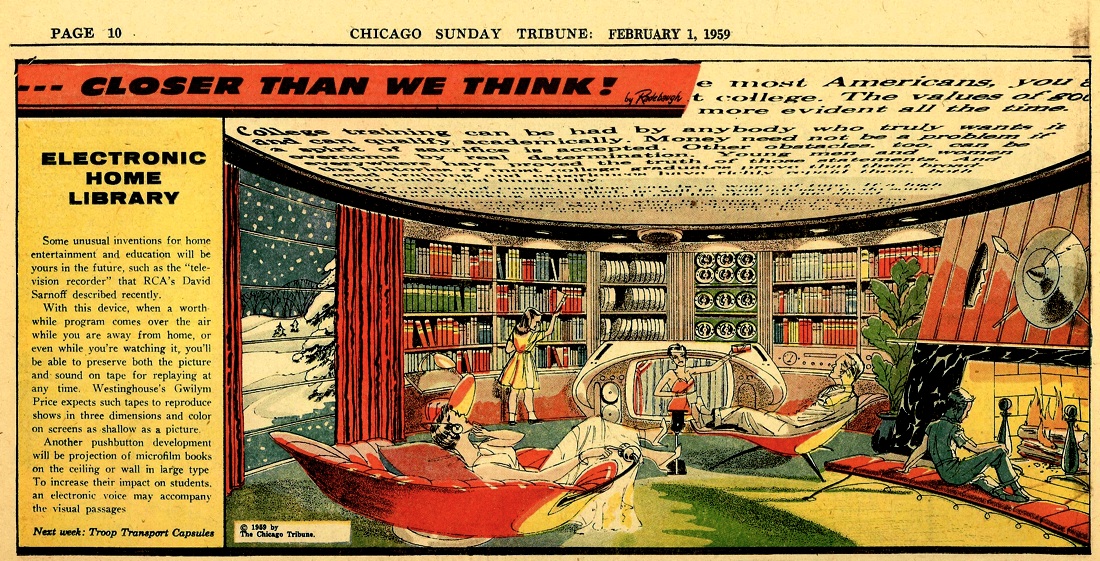
Back in 1959, when television was still monochrome, and movie films ruled the entertainment industry, people were already dreaming about how we could capture the moving image for home use. Video recorders were very much in their infancy. The first commercially available video recording device wasn't available until 1956, and the more affordable home video cassette recorders (VCRs) such as VHS and Betamax would not be seen in homes for at least another two decades.

The text from this image reveals a lot about the hopes and aspirations of futurists in 1959. The 'electronic home library' in the illustration is reminiscent of any traditional library one might have walked into during the 20th century, with its organised shelves and rows of physical media. Nic Negroponte's vision of 'atoms becoming bits' was still a distance dream for the few visionaries who could actually conceive a purely digital world, where physical media had more or less become obsolete.

Another interesting feature in the illustration is ceiling projection - ostensibly to make text more easy to read and to 'increase impact on students', but of course this could be extrapolated to any image, still or moving, and the article does moot the idea of accompanying audio ('electronic voice'). This is the essence of all multi-media, where text, images, video and sound are combined to provide the user with a rich experience of knowledge and information access. It's interesting that right now, developers are working hard to create affordable projectors that can work on just about any surface, including our own skin. Therefore the principle of the electronic home library was a fairly accurate prediction, but the means through which it might be accomplished was rooted in the 20th Century.

Previous posts in this series:
1: Telecommunications
2: Classrooms
3: Music
4: Enhanced vision
5: Robot teachers?

Creative Commons License
Imagined futures 6: Learning from home by Steve Wheeler was written in Plymouth, England and is licensed under a Creative Commons Attribution-NonCommercial-ShareAlike 3.0 Unported License.


September 04, 2017

Imagined futures 5: Robot teachers?

Image source: Novak Archive (1965)
In a conversation with Sugata Mitra several years ago, the novelist Arthur C. Clarke stated: 'Any teacher who can be replaced by a computer ... should be.'

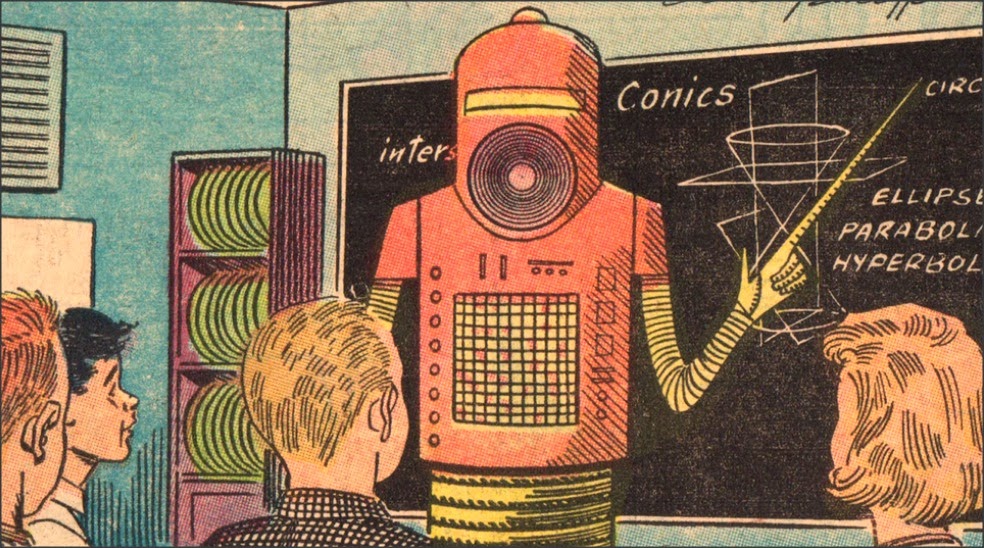
Clark was right of course. Teachers cannot be compared to machines, and should certainly never function as such. If they do, then they aren't teaching. Good, effective teachers are intuitive, empathetic and responsive to the needs of their students. They get to know their charges well, finding creative ways to help them to learn optimally, engaging them with methods and activities designed to draw out the best performances. Good teachers are memorable because they go the extra mile, make personal connections that are genuinely human, and yes, occasionally they bend or break the rules. Good teachers continually reflect on their practice, think critically and act creatively. These are just a few of the convincing reasons why teachers could never be replaced by computers ... or robots.

This doesn't mean that robots have no place in the classroom though. Robots (or intelligent systems) can be very useful when they are tasked to complete some of the functions that teachers previously performed. Most of these are mundane, repetitive jobs including much of the administrative duties teacher are expected to perform, and also low level instruction and assessment. The use of artificial intelligence can even mimic some of the communication needed for large groups who are online. The case of 'Jill Watson', a chatbot designed  to act as a teaching assistant on a large MOOC at a US university demonstrated how well they can be designed and deployed. AI has a place in the modern education equation, and has plenty of scope to improve, but when it comes to human empathy and interaction, you can't do better than a human educator.

Image source: Novak Archive (1958)
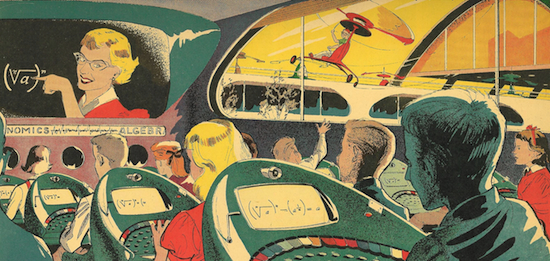
But that didn't stop retro-futurists back in the 1950s and 60s depicting a 21st Century in which robots performed the role of classroom teachers. These pictures show how artists of that period conceived an education that was technologically dominated. Note the illustration with the large screen TV from 1958. Entitled 'Push button education' image is either a facsimile of a teacher or a live presentation from a real teacher at a distance. If it's the latter, then allowing for the constraints of the technology that mediates the conversation, the teacher can be almost as effective as if she were co-present. If it's a facsimile, then interaction is entirely dependent on the instructions (programming) behind the robot. Responses from the robot teacher might be limited, perfunctory, or even non-existent. In today's classroom, it is more likely that children will be busy programming robots, rather than the other way round.

Note also that each of the students has their own personal screen and console. This represents a form of programmed learning similar to the early days of computer assisted learning, where each student worked through a set menu of learning texts, followed by a multiple choice question and possibly a remedial loop to take them back if they failed the test. This was just as didactic an experience as a lecture and exam, but began to tap into the potential of machines to personalise pace and place of learning.  In future posts, I'll be considering some of the more realistic means of using robots in education.

Enjoy the retro-futuristic images!

Previous posts in this series:
1: Telecommunications
2: Classrooms
3: Music
4: Enhanced vision

Creative Commons License
Imagined futures 4: Robot teachers by Steve Wheeler was written in Plymouth, England and is licensed under a Creative Commons Attribution-NonCommercial-ShareAlike 3.0 Unported License.


September 02, 2017

Imagined futures 4: Enhanced vision

Image from Wikimedia Commons
The notion of technology as a mind tool is seductive. Being able to enhance or extend any or all of the capabilities of the mind through the use of distributed memory, crowdsourced knowledge and enriched experiences is a goal for many researchers and developers, especially in education.

Perhaps the most seductive of all goals is the capability to enhance or improve vision. We've been working on it for years, correcting vision problems with spectacles and contact lenses, but more recently, we have also been experimenting with virtual reality (VR) systems. VR has many applications for entertainment and commerce, but can also be applied to education.

VR has featured in popular culture for decades. Way back in 1994, the movie Disclosure featured a high tech, futuristic virtual reality environment, and Star Trek also showcased the idea of a Holodeck as early as 1974. The term 'virtual reality' was probably coined as early as 1938 by the French playwrite Antonin Artaud who wrote about the illusory nature of theatre characters as 'la réalité virtuelle'. Today, as we experiment with visors, headsets and other forms of VR that can provide us with enhanced perceptual experiences, we are continuing to push the boundaries of what can be achieved with technology. Whatever we choose to label this experience, it is a means of feeding the visual system with images, both moving and static, and in so doing, immersing the perception of the user within the context that is being portrayed. This is an incredibly powerful way to impact on memory and emotions, because users experience visual encounters with objects and characters that simulate real encounters, without the potential danger or risk. Users can be transported to impossible realms, or places that are beyond their physical reach. The visceral experiences garnered from some VR systems are unforgettable, and can induce physical responses such as stress, raised heart rates, and even nausea and vomiting (the so-called inertia effect).

The picture above shows Hugo Gernsback demonstrating an invention called TV glasses. He designed the prototype in 1963 and although the strange looking technology depicted was merely a mock-up of the intended device, (which was never manufactured) the idea was, if you will excuse the pun - quite visionary. It contained two small screens or lenses, similar to today's VR visor configuration, and could give the user a 3-D experience of television. Whether or not this is a forerunner to modern VR, it is still a fascinating insight into what people in the 1960 thought the future might look like. In years to come, it's probable that our own recent attempts at creating VR devices might appear just as outlandish as Gernsback's TV glasses.

Creative Commons License
Imagined futures 4: Enhanced vision by Steve Wheeler was written in Plymouth, England and is licensed under a Creative Commons Attribution-NonCommercial-ShareAlike 3.0 Unported License.


August 31, 2017

Imagined futures 3: Music

Photo from Wikimedia Commons
I recently visited the Science Gallery in Dublin where they had several exhibits dedicated to sonic science - the science (and art) of making sounds. The exhibition is there until September 24th, so if you're in the neighbourhood, you really should check it out.

I was particularly fascinated with the room full of vintage synthesisers, and spent quite some time tinkering with them, programming them and playing them. There was a Moog synth which was very recognisable with its banks of switches, buttons, patch cables and knobs, similar to the one Keith Emerson used to play. There were others too - old Korgs, Oberheims and ARPs to play with. It was quite fabulous seeing them all in one place, and being able to play them.

I still have a vintage synthesiser in my collection of instruments from the past. It's a Yamaha DX7, and is still fully functional, in spite of being stored for more than 20 years in a flight case in my garden shed. Yamaha keyboards were of robust design.

The DX7 was one of the first digital commercially available (affordable) polyphonic synthesisers to be equipped with MIDI - or Musical Instrument Digital Interface. It was a 61 note keyboard, and it had touch sensitivity. It was incredibly complex to program, with up to 32 separate algorithms that could be brought into play, and many of the sounds generated could be a little hit or miss. However, it did come complete with a couple of cartridges that housed several dozen preprogrammed voices. The percussive sounds of the DX7 were particularly impressive, and the grand piano, pipe organ and bell voices were very realistic. I used it on stage on many occasions in place of a conventional grand piano, but for organ and string sounds, it was a bit of a washout. For sustained sounds such as strings I turned to other synthesisers such as the Roland Juno 106. The beauty of these synthesisers was that you could rack them up, 'daisy chain' connect them and they would play on their own, triggered by a drum machine such as the Yamaha RX11 (I also have one of those!). They may sound quite primitive compared to what is available now, but back in the 1980s, these instruments provided the background sounds for many commercial hits. They broke new ground and were the force behind Synth Pop.

Today, looking back on these retro musical instruments, it's easy to see how they laid the ground work for future digital music. The synths I describe above created the soundscape for the synth pop genre that was to emerge that decade. Bands such as OMD, Depeche Mode, Human League, Yazoo, Thompson Twins, and artists such as Howard Jones and Gary Numan all made their mark using similar instruments. You can express yourself with any musical instrument, but for me, one of the most personalisable instruments just has to be the synthesiser - You can make it your own by creating your very own voices, sequences, riffs and melodies.

Creative Commons License
Imagined futures 3: Music by Steve Wheeler was written in Plymouth, England and is licensed under a Creative Commons Attribution-NonCommercial-ShareAlike 3.0 Unported License.


August 30, 2017

Imagined futures 2: Classrooms

From Villemard, c 1910
Aspirations, dreams, hopes and desires for the future appear in many art forms. Known as retrofuturism, the study of how people in the past represented their imagined futures is quite fascinating. In my last blog post I wrote about an illustration from 1930 that depicted - quite accurately - how people would be using their mobile phones for video communication.

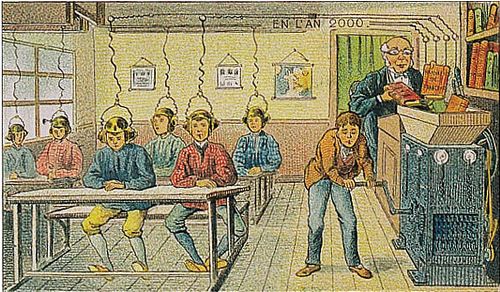
The illustration featured on this page is one that is familiar to many teachers. It has featured regularly in keynote speeches, articles and texts about the future of education. The illustration is by the French artist Villemard, and it dates back to 1910. In fact, Villemard painted many images of life as he envisaged it in the year 2000, some of which are collected here as a series of postcards. Some were fairly ridiculous or at best fanciful, but others are quite revealing both sociologically and psychologically, about what people of the time thought about the future and about new technology. The image captures his thought of what a school classroom might look like at the turn of the millennium.

In Villemard's image, book contents are transmitted to the students as audio files, fed through headphones. In one sense, the students are also connected, albeit in a simplex (one way) mode - but if the technology exists to transmit data in one direction, the flow can easily be adjusted for two way (or duplex) mode. If that occurs, you have networked learners. Once the connections exist, it really doesn't matter where you are located - you can gain access to all of the content, as is now seen in MOOCs and other online courses. The illustration really depicts education as it would have been in 1910, with a teacher as the gatekeeper of knowledge, and with the students as passive recipients of that knowledge once it was released. Technology is thrown in to make it appear futuristic. This is analagous of a problem that exists to this day in our education systems. If new technology is introduced into a conservative environment, but the pedagogy doesn't change, there is little hope for any transformation.

When we try to predict the future, we are gazing down a narrow corridor of experience which is heavily influenced by our present knowledge and experiences. As Voltaire once argued, 'Every man is a creature of the age in which he lives, and few are able to raise themselves above the ideas of their time.' Most of us look at what is around us and try to make predictions based on what we know, rather than what is possible. If we restrict ourselves to the current mindset, we limit the extent to which we can effectively imagine the future and constrain ourselves to old practices.

“Prediction is difficult, especially when it is about the future.” Danish Proverb

Creative Commons License
Imagined futures 2: Education by Steve Wheeler was written in Plymouth, England and is licensed under a Creative Commons Attribution-NonCommercial-ShareAlike 3.0 Unported License.


August 29, 2017

Imagined futures 1: Telecommunications

Image source unknown
I'm fascinated by vintage 'future' visions - the way people in the past thought we might live in this century. Known as retrofuturism - this is the history of predictions. To that end, I'm writing a series of posts that feature ideas, images and visions of the 21st century. How did people in the past envisage life in the 21st century? One might argue that it would have been more difficult to predict the future in 1930 than it is now, because change was slower. But predicting the future has always been difficult.

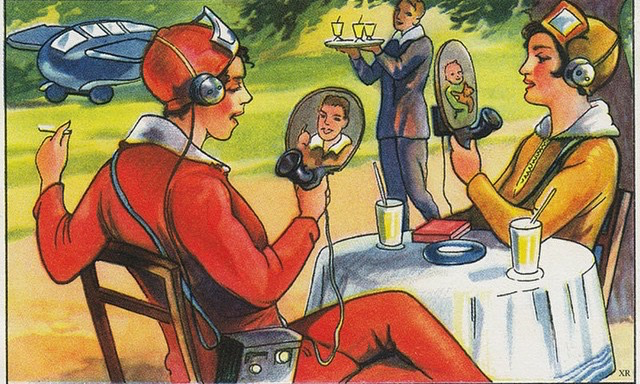
The first image I've chosen is an illustration created by an artist from 1930. It depicts a vision of how people in the future might communicate with others over distance, combining telephony and video. In 1930, telephones and television were already in existence, and video was some years away. Telephones had become quite widely available, but television was still in its infancy. These technologies had been invented around 1876 (Alexander Graham Bell) and c 1926 (John Logie Baird) respectively (although earlier versions had been proposed by several other inventors) and were tethered, bulky devices. Mobile phones would not appear on the scene until Motorola's Martin Cooper created the first prototype in 1973.

The image depicts two women sitting in an outdoor café at the same table (is the woman on the right wearing a hoody?), but interestingly, both are talking to other people on their handsets while simultaneously ignoring each other. Apart from the unlikely flying car in the background, this seems to be a fairly accurate depiction of contemporary life. The women are using two-way video communication similar to services such as Facetime, and the illustration captures the social disregard that occurs when two individuals who are sharing the same space are each absorbed into an interaction that is digitally mediated. Note also the large battery pack on the hip, the large microphone, and the headset. Early mobile phones had substantial battery units, and were therefore a lot larger than the pocket devices we carry around today. But battery life is still a significant issue even today. The face-to-face at a distance communication depicted, is common now, both in handheld and desktop format, but 20-30 years ago, videotelephony was confined to room based systems that were large and expensive. We have made significant technological advances in the last few decades but predicting the future is just as difficult now as it was in 1930. It's been said before, but predictions of the future often reveal more about the mind of the artist than they do about the future.

Creative Commons License
Imagined futures 1: Telecommunications  by Steve Wheeler was written in Plymouth, England and is licensed under a Creative Commons Attribution-NonCommercial-ShareAlike 3.0 Unported License.


August 26, 2017

Oh! Canada

Photo by Benson Kua on Wikimedia Commons
Coming in to land after a long flight is always a great relief. You wait for the bump of the wheels after that second or two of sudden silence, and then follows the juddering, swaying, careening deceleration, before your plane finally taxis onto the apron and ultimately the stand. Well, it didn't go quite as smoothly as that on my first, (and then second) visit to Canada recently...

As we landed at Toronto airport, the plane immediately took off again at a steep angle, with whining engines, and as we banked steeply above the terminal buildings, and the plane shuddered with the acceleration, the pilot's calm voice could be hear over the intercom. "Ladies and gentlemen", he said, "I apologise for the aborted landing. We had to take off again, because there was another plane on the runway ahead of us." Good call, I thought. It could have been much worse. The pilot was alert and took a decision to avoid a potential catastrophe. It could have been much, much worse. A wheel might have fallen off, or our undercarriage could have been faulty. The pilot might have come to the door wearing a parachute and saying "I'm going for help."

We breathed a collective sigh of relief and searched in our baggage for fresh underwear, the plane banked around, and 10 minutes later, we landed and stayed landed. As we taxied over to the terminal building, and I prepared mentally for the week ahead of me (my keynote speaking slot and two workshops for the Peel School District Board Summer Conference entitled: Empower Modern Learners), I couldn't help thinking about the similarities between airline travel and going to school.

Firstly, you have to queue up to enter. Then you are sent to your designated seat where you sit next to all the others in rows, facing forward to where all the action is. You put your life in the hands of a stranger. A very well trained stranger, but a stranger none the less. You have a limited choice on the menu. You can only choose what is placed in front of you, and it's all or nothing (just like the school curriculum). There are lots of rules and regulations and they are strictly enforced by the cabin crew. Step out of line, and you are in trouble. Now and again you have to pay strict attention, but there are hours and hours of boredom and tedium. You are told to turn off all electronic devices.... I could go on, but I won't. Air travel is a necessary evil. You have to go through it to get where you need to be.

My Canadian experience was actually quite wonderful, once I had managed to get out of immigration and exited the airport. I would like to thank my hosts - all of the team at Peel District School Board for their hospitality and care, and to Lawrence DeMaeyer and Patrick McQuade for inviting me to speak. I was welcomed like an old friend, and the audience of >300 teachers impressed me with their passion and enthusiasm for education and their attention and response to everything I said. I enjoyed some very interesting and thought provoking discussions with several educators while in Toronto, and I am sure I have made some connections that will go on to become lasting friendships. The technology playground was particularly well conceived, jammed full of all the latest tools and technologies for teachers to try for themselves. It was quite simply a great event with more than enough CPD for everyone. If you want to check out what happened at the conference, follow the Twitter hashtag #PeelEML17. Oh Canada, I hope I will return one day, and that the plane will land on the first attempt.

Creative Commons License
Oh! Canada by Steve Wheeler was written in Toronto, Canada and is licensed under a Creative Commons Attribution-NonCommercial-ShareAlike 3.0 Unported License.


August 14, 2017

The New Education #bookreview

Image from Carpe Diem
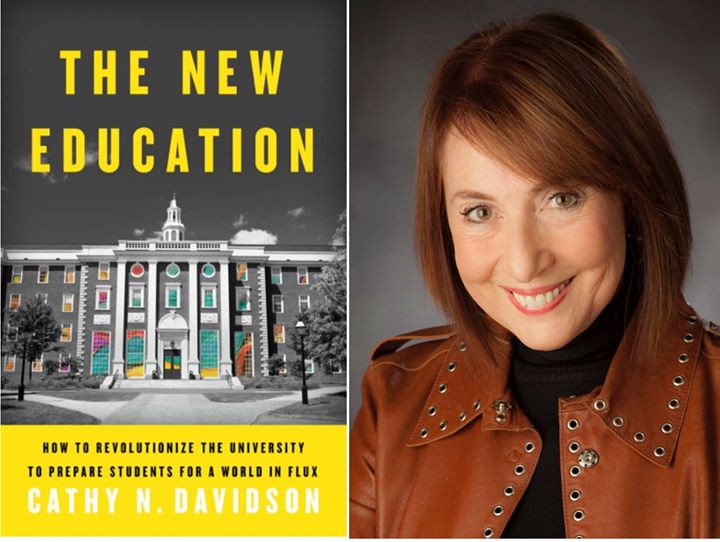
I was sent a pre-publication copy of Cathy Davidson's new book The New Education recently, to review. Cathy is one of my favourite authors because she pulls no punches and writes in a style that challenges and encourages in equal measure. She is a doyen of the progressive education movement, and her ideas are far reaching and influential.

The strapline for Davidson's latest book is 'how to revolutionize the university to prepare students for a world in flux.' It's one that many, many academics can identify with across the globe, because higher education is generally in a state of inertia while the world flows by rapidly around it. No matter what innovations are created inside of the university around pedagogy, they rarely if ever seem to take root and spread across institutions. This is ironic, given that many other innovations, usually of a technical nature (i.e. inventions and techniques) do tend to take root and grow quickly beyond the bounds of universities.

Cathy Davidson is quite critical of current the higher education system, citing numerous examples of how creativity is stifled and how '...the teacher's authority, the broadcast model of pedagogy - all the components of higher education...' are perpetuated regardless of whatever innovations emerge (p. 110). This translates from American campus based education to faculties across the globe, because this is a world wide issue, she says.

So what of technology? Davidson does not see technology as a panacea for all the ills of higher education though. Rather she warns that technology can dazzle us so much that we forget the past and lose our way in the present (p. 109), arguing that whatever our reaction to digital tools, 'technophilia and technophobia harm in both directions' (p 109). She does however, see a future for blended campus learning, where traditional forms of education stand side by side with online learning in all its forms. 'Online learning,' she states pragmatically, 'will never fully replace brick and mortar institutions, but it is also certain to get better over time' (p 120). This implies that campus based higher education may not be able to improve at a similar rate, due to its inertia and stagnation.

Davidson also rightly criticises the manner in which MOOCs (Massive Online Open Courses) have been hijacked by the for-profit platforms, and cites several failures in recent years by the likes of Coursera and Udacity to make any headways into revolutionising higher education. Yes, more students than ever are enrolled on MOOCs (p. 122), but 'completion rates remain dismal'. She concedes that online education will continue to succeed, not because it is better than anything else out there, but 'it's succeeding because it's better than nothing, and nothing is what's currently on offer for millions of people' (p. 123). Davidson's passion and enthusiasm for equity in education is evident throughout this eminently readable text. It is written and presented in a populist style and avoids any of the complicated, dense language that sometimes occurs in volumes of this nature. She soundly critiques the system, providing systematic reviews, evidence and interviews with key players, but goes farther to offer some solutions to the malaise of university teaching. At the tail end of the book, she provides two appendices which map out some of the immersive, interactive teaching methods she employs successfully with her own students. The book would be worth the cover price just for academics to read this section alone.

Apart from a few minor inaccuracies (she cites George Siemens as the inventor of the acronym MOOC, when in fact the credit should go to fellow Canadian academic Dave Cormier, p. 123), the book provides a balanced and reasoned critique of age old establishments, offers some practical solutions, and presents these in a fast paced, accessible and memorable manner. Whether a revolution will ever take place in universities along the lines Cathy Davidson recommends, remains to be seen, but we all yearn to see higher education produce 'muti-talented, versatile, visionary, cross-disciplinary thinkers' (p. 39), - and heaven knows, we'll need them in a world of rapid change where every layer of society is in a constant state of flux.

The New Education by Cathy N. Davdson will be published by Basic Books, New York in September this year. 


Creative Commons License
The New Education #bookreview by Steve Wheeler was written in Plymouth, England and is licensed under a Creative Commons Attribution-NonCommercial-ShareAlike 3.0 Unported License.


August 11, 2017

Surviving higher education: 7 top tips

Image from Pixabay
Here are top 7 survival tips for working in higher education (or for that matter, any profession).

1. When I first started work, one wise old colleague told me that wherever I went, I should always carry a piece of paper around with me. It didn't matter what was on the paper. It could even be blank. He told me it would made people think I was busier than I actually was. He was fired.

2. If you don't want to be in a boring meeting, you can set the alarm on your smartphone to go off exactly 7 minutes in. Look embarrassed, make your excuses with 'I'm sorry, I have to take this - it's a very urgent call', stand up and quickly leave. Better still, send your apologies beforehand for each and every meeting. Your boss will thank you.

3. If you really really can't get out of a meeting, conspire with another member of staff (who'll also be at the meeting) to have a game of Disney Bingo. Liven up the meeting by making contributions that include Disney characters. Example: 'We need to avoid Mickey Mouse courses' and 'This department is the Cinderella department of the university....' and 'The Vice Chancellor looks just like Quasi Modo'. No-one will ever twig, but it will amuse the pants off you and your collaborator, and the meeting will go a lot faster.

4. Get your students to do all the work. Set them a random task or problem that it will take them hours to solve. They will work hard, with minimum effort from you, as you swan around the room 'monitoring their progress' and lobbing in an occasional grenade. Always keep them guessing. Especially about what they are meant to be learning.

5. Never volunteer for anything, ever.

6. Only drink coffee if you want to stay awake.

7. Join a union.

Can you think of any more? Answers in the comments box below!

Creative Commons License
Surviving higher education: 7 top tips by Steve Wheeler was written in Plymouth, England and is licensed under a Creative Commons Attribution-NonCommercial-ShareAlike 3.0 Unported License.


August 09, 2017

Balancing act

Image from National Photo Library on Flickr
As my colleagues at Plymouth Institute of Education make their way back to work, and I sit gazing, relaxed (and retired) from the sidelines, I have mixed emotions. I am happy that I no longer need to worry about timetables, module delivery sheets, digital learning environment content updates, online marking, exam boards, deadlines and more deadlines, but I'm also a little worried about how my colleagues will cope with ever increasing workloads, and the incessant emails and other digital content they have to wrestle with on a daily basis. It's the same globally for all those involved in the business of education. In short I think we should ask - how can teachers regulate and balance all of the demands on their time?

A very interesting theory about self regulation of work life comes from Professor Ellen Ernst Kossek of Purdue University, USA. She discusses the idea of 'flexstyles' in her research (Kossek & Lautsch, 2008), a description of the ways people switch rapidly between modes as they cope with demands on their time. It can be nicely applied to digital environments as an explanation of the ways people create a work-life balance. Technology, she says rightly, can help us all to work more flexibly, but there is a danger that work can invade every aspect of our lives, because we can so easily take it home with us, and digital access is ubiquitous. Having web access it seems, is a double edged sword.

Kossek identifies three modes in which people manage their work-life balance: Integrating, separating and vollying. The first is self-explanatory. It tends to be what many of us do - we bring our work home with us, and integrate it into all the other aspects of our lives. I know it was something I did - there was no boundary between my working life and my home life, and my excuse was that I really enjoyed teaching and research. I was fooling myself though, into believing that all the other stuff that comes with it (mainly admin and trivia) was also enjoyable when all it did was take away my family time. The second mode represents those who separate out work from home life, which she calls 'segmenters'. This is a difficult trick to master, but some can achieve this if they put their minds to it and are strict with their time. The final mode, vollying, is the least understood but refers to those who can switch between integrating and segmenting as context demands. I suspect that vollying is the mode that most of my colleagues adopt, and it's the mode I shall be practising myself from now on!

Reference
Kossek, E. E. and Lautsch, B. A. (2008) CEO of Me: Creating a Life that Works in the Flexible Job Age. Philadelphia, PA: Wharton School Publishing.

Creative Commons License
Balancing act by Steve Wheeler was written in Plymouth, England and is licensed under a Creative Commons Attribution-NonCommercial-ShareAlike 3.0 Unported License.


August 08, 2017

Whatever happened to inspiration?

Whatever happened to inspiration? Where does all of the excitement of early years education go when children progress to big school?

Schools often demonise failure - students failing exams, children failing tests and failing to attend classes. They wish to cover up failure and emphasis success - especially when the school inspectors pay a visit. And yet failure is often a prelude to good learning. We shouldn't stigmatise it, but rather see it as a step in the right direction to future success. My two best teachers at school gave me permission to fail and then showed me how to do better next time.

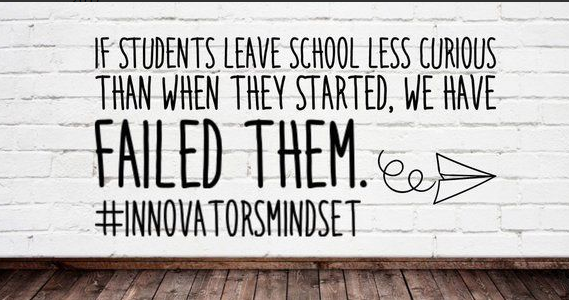
But what happens when schools fail children? The graphic on this page was shared on Twitter by Aaron Hogan, and originated on the #innovatorsmindset hashtag organised by George Couros. It presents a truth that some schools might choose to ignore, as they set about perpetuating an old, out of date education regime that does more damage than good.

One of the many undesirable consequences of standardised testing in schools, is that it treats children as metrics rather than people. Award a number or a letter to a student's work, and that's all they will see. Whatever feedback/forward they are given will be ignored. All they want to know is 'have I passed?' and then ... 'What level is my pass?' It's how they have been conditioned to think - and the grade takes precedence over the learning.

Schools that treat children as numbers instead of as individuals are in danger of switching students off from the potential of education. How can we foster curiosity in our students instead of stamping it out? How can we engage them, and create within them an unquenchable thirst for knowledge? The sad irony is that children arrive on their first day in school with this thirst, but it is gradually sapped from them as they progress through the punishing cycle of teaching and testing.

Good teacher assessment, coupled with inspirational teaching, where children are involved, engaged and immersed in the experience of education, and timely personal feedback - all have been identified as essential if children are to progress. Teachers' commitment to children's progress is the greatest influence on their future attainment (Hattie, 2012). If we know all this, we should be doing it more often.

Reference
Hattie, J. (2012) Visible Learning for Teachers: Maximising Impact on Learning: Abingdon: Routledge.

Creative Commons License
Whatever happened to inspiration? by Steve Wheeler was written in Plymouth, England and is licensed under a Creative Commons Attribution-NonCommercial-ShareAlike 3.0 Unported License.


July 27, 2017

A bridge between learning and work

Image from Pixabay
Asking a child what they want to be when they grow up can be a great conversation opener. They will be very honest with you about their aspirations, and tell you how they are going to become a police officer, train driver, nurse or scientist. But as they grow older, and they learn more about the world around them and their potential role within it, children may become a little more circumspect. When they eventually leave school, many children simply don't know where they are headed, because they know very little about the job market.

When I was 16, I was asked by my careers guidance tutor what I would do when I left school. I told him quite frankly that I wanted to be an astronaut. It wasn't an aspiration that was treated seriously, because there weren't many astronaut jobs going in 1972. And yet, as I developed my career around research, teaching and innovation, I did become an 'astronaut' of sorts - an explorer of learning and technology and the connections between the two. If only my teacher had read between the lines.

How do children today express their ideas about what they would like to be? How do they find out what they could do, and what problems they would like to solve? How do schools (and the teachers employed by them) become aware of these aspirations, talents and abilities? How can teachers offer appropriate careers guidance to children while they are still in school, and help them to realise their aspirations? Perhaps most saliently, how are businesses and industry made aware of the raw talent that emanates annually from schools, colleges and universities? How might all of these activities and progressions be managed, and children effectively guided into the very career pathways they yearn to follow?

A new, and in my opinion, unique technology platform might just provide the answers to all of the questions above. Founded by polar explorer Antony Jinman, a new platform called LiketoBe has been designed to create the short-cuts and channels that will enable children, through their schools, teachers and parents to connect and communicate directly with organisations, offering a technology bridge between previously disconnected stakeholders. It will track students as they progress through their education, providing profiles for businesses, and generating potential career pathways for them when students eventually leave full time education. It's a technology idea that I am very keen to support and help develop.

Technology is designed to help us to do things easier, quicker and more effectively. In education, technology should be used specifically to help us to learn, teach, connect and communicate in new and better ways. I believe LiketoBe will enable schools, children, teachers and businesses to connect in ways that were previously inconceivable. It will create new pathways for career development that will have a direct, positive impact on the future of education and work.

Note: LiketoBe is currently seeking crowd funding on the Seeders website

Creative Commons License
A bridge between learning and work by Steve Wheeler was written in Plymouth, England and is licensed under a Creative Commons Attribution-NonCommercial-ShareAlike 3.0 Unported License.


July 18, 2017

Winter is here

Image from Pexels
We are heading into the perfect storm. Students numbers are growing, and there aren't enough teachers.

For the second year in the UK, secondary (high) school numbers have grown, and it's expected that over the next 8 years there will be a 19% rise in these numbers, with over 600,000 additional students. The sudden increase in births from 2002 onwards is largely responsible for this trend, and this was an expected rise. However, at the same time, funding for schools (regardless of the recent announcement for additional funding - which is simply being siphoned from elsewhere in the education budget - a case of robbing Peter to pay Paul) is paltry, and hardly makes a dent in the urgent problems we have in our British schools. There is a teacher shortage, and it's worsening.

A recent report from the National Union of Teachers reveals some disturbing statistics.  Recruitment of new teachers is a growing problem. Maths teacher specialists are down to 84% and computing specialists are only at 68% of the capacity required. In many secondary schools, students are now being taught mathematics by teachers who are not qualified to do so. Retention of teachers is also a problem according to the report. In 2016, the UK government confirmed that 30% of teachers who had joined the profession in 2010 had left within five years. The report holds many other equally worrying statistics which are beyond the scope of this discussion.

What can be done? There are some solutions to these problems. The British government should urgently fund the building of new schools, and should do so with money from elsewhere than the already stretched education budget. If they can find £1billion to buy the support of another party to prop up a minority government then they can find more. The British government can also reduce (or preferably eliminate) the tuition fees for students for those wishing to study to become a teacher. Many prospective trainees are simply dissuaded from training as a teacher because of the huge debts they will run up as a university student. Alternatively, the government could decide to offset the tuition fees by offering some form of bursary. By far the biggest problem though, is the failure to retain teachers in the profession. Training a teacher is an expensive business, so retaining their expertise and knowledge once they qualify should be the main priority. Teachers are currently surveilled and scrutinised beyond decent boundaries. They are weighed down with bureaucracy and work extraordinarily long hours, mainly spent at home marking exercise books and tests to try to keep up with the punishing assessment regimes the government imposes on all schools.

If as a society, we don't address these problems soon, education in the UK will be stifled, children will be deprived of a good education, and we will all suffer. The UK government must urgently intervene, before winter is here.

Creative Commons License
Winter is here by Steve Wheeler was written in Plymouth, England and is licensed under a Creative Commons Attribution-NonCommercial-ShareAlike 3.0 Unported License.


July 14, 2017

Future sense

Photo by Fosco Lucarelli on Flickr
The celebrated American physicist Michio Kaku claimed that it is impossible to accurately predict the future, and he is right. When we try to predict anything, we always run up against a number of variables, and the longer time goes on, the more variables there are to consider. Astrologers tend to keep their predictions extremely vague, so they can be interpreted in many different ways. Gamblers have to be more specific, and as a result are spectacularly less successful, more often losing their money than winning. Predicting the future is a very risky business, because it hasn't happened yet.

Predicting the future one year down the track can be fairly straight forward, but to predict three years or even five years is increasingly precarious and can lead to some strange and unsupportable assumptions (see the Horizon Report). Occasionally, I see some wonderfully misguided quotes about the future of technology. Some of the most notorious bad prediction are about what is not possible. Take the quote from Ken Olson, president of Digital Equipment Corporation who in 1977 said 'There is no reason anyone would want a computer in their home.' Similar predictions were made about motion pictures (movies) by none other than movie mogul Harry Warner who in 1927 opined: 'Who the hell wants to hear actors talk?' and by Thomas Edison who said 'Books will soon be obsolete in public schools. Scholars will be instructed through the eye.' Well, time has proven that motion pictures, video and multi-media have become an important part of our entertainment and education, we do want to hear actors talk, and we don't want to get rid of our books.

French philosopher Voltaire was insightful about our problems with 'the future'. He said: 'Every man is a creature of the age in which he lives, and few are able to raise themselves above the ideas of their time.' Most of us look at what is around us and try to make predictions based on what we know, rather than what is possible. We restrict ourselves to the current mindset, and in so doing limit the extent to which we can imagine the future. In literature we find perhaps the richest vein of imagination, and probably always will. Writers such as H. G. Wells, Arthur C. Clarke, Isaac Asimov, Gene Roddenberry, William Gibson and Robert Heinlein pointed us to the future, where technology could achieve seemingly impossible aims. Doors that open when you approach them, global satellite coverage, personal communication systems, cyberspace, videophones, artificial intelligence, replicators and space travel all seemed impossible when they were written about, but now each of these is common place.

We may not be able to predict the future with any accuracy, but we can certainly imagine it - and in so doing, prepare the ground from which these ideas might grow for future generations.

Creative Commons License
Future sense by Steve Wheeler was written in Plymouth, England and is licensed under a Creative Commons Attribution-NonCommercial-ShareAlike 3.0 Unported License.


July 12, 2017

Generation next

Photo from LSE Library on Flickr
Most of the students starting university at the end of summer 2017 were born around the turn of the century. They will have no memories of the 20th century, which just happens to be the same century their lecturers were born and educated within. It's a sobering thought.

The class of 2020 may have expectations about learning which run counter to the ethos of the traditional university. These young people - sometimes referred to as Generation Z, or Centennials - will redefine our understanding of learning, and will challenge the way university education is conducted.

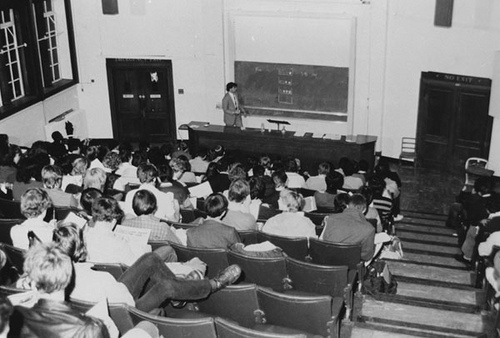
It's safe to claim that much of higher education is firmly rooted in the past, reflecting colonial history, traditional values and 20th (or even 19th) Century pedagogies. The latter is perpetuated consistently and guarded jealously. Lecturers tend to teach in the same way they themselves were taught. This might be seen as a generalisation, because there are some pockets of innovative pedagogy to be found in every large education institution. Yet innovative pedagogy in higher education is not prevalent, and academics are generally reluctant to change their methods.  This is due to a number of factors, some of which are discussed in this Time Higher Education article. The lecture in a tiered amphitheatre to large groups of students remains the norm, and undergraduates are expected to learn mainly by listening and reading, before sitting examinations or writing lengthy essays to test their knowledge. The guardians of this knowledge are the academics. Students are often dissuaded from using technology unless they are in a designated area such as an ICT suite. It's a cycle that is repeated across three or more years of undergraduate study, and at the end the student hopefully emerges with a degree in their chosen subject.

Nearly two decades into the third millennium, we need to question the effectiveness of this process, and ask whether a degree from a university still equips people for higher level work. What will this new generation of learners think about their university experience? What will they need in a world of work that is increasingly dependent on digital technologies?

In my 20 years working as a lecturer in higher education, I have heard many times that it's not so much the subject studied, but the key graduate skills acquired, that makes a degree so important. Whether it's science, the arts, technology, law, medicine or engineering, graduates should all leave university with a standard set of skills that enable them to practice safely and professionally. The skills include the ability to apply their knowledge reflectively, think critically and analytically, communicate effectively (written and verbal), solve problems creatively, adapt to change, manage and organise time, work independently and collaboratively, and be enterprising. It's sometimes hard to see how listening in lectures, attending seminars, and sitting exams promotes these skills. I am left with the impression that in many cases, graduates adopt these skills almost in spite of the didactic, hierarchical and rule bound regime of university.

Ultimately, how many graduates actually secure employment in their chosen sphere of interest is the measure of success. Some professions have a better track record than others. The future of work will heavily feature knowledge working, where people will be working on the move, using technology to connect, communicate and create. Work will polarise between high and low skills level employment. As global management consultants McKinsey and Company rightly identify, jobs in the near future will increasingly come under threat from artificial intelligence and robotics. Those who thrive in the new, emerging economies of this century will be those who can use their minds and their knowledge to create new ideas, to solve problems, to open up new markets. They will be the workers whose skills and knowledge cannot be replicated easily by technology. The next generation, those currently embarking on their university careers, must be able to confront these challenges, and turn the threats into opportunities.

Generation Z are the first generation who have had been exposed to networked technology from birth. They carry their personal technology around with them and know how to use it to connect and to communicate. They are self-aware and conscious of their image, due to a lifetime of public exposure on social media. They are acutely aware of the social context of their lives, and prefer to learn together with their friends. They are the nodes of their own production and they value peer feedback. Whether or not they have a shorter attention span is open for discussion (I think it is dubious), but lecturers still need to engage these students, and maintain their interest. It makes sense to help students to engage more deeply in their university studies using the technology with which they are familiar. Lecturers who ignore the potential of personal technology and rely solely on traditional methods will miss an important lever for engagement. The future of university education in the UK does not look particularly bright right now. Official figures show a 4 per cent decrease in applications for the 2017 student intake.

Creative Commons License
Generation next by Steve Wheeler was written in Plymouth, England and is licensed under a Creative Commons Attribution-NonCommercial-ShareAlike 3.0 Unported License.


July 06, 2017

Digitally safe?

It is claimed that the 'digital birth' of a child is around 6 months. They first begin to appear online when they are on average 6 months old. This baby (6 weeks old at the time the picture was taken) seems to be accessing digital content using an iPad. But is he really? This is one of many evocative images of young children using technology that have been circulating on the web recently. It seems that children really 'get it' when they use technology.

But we should exercise caution before when we make such claims and assumptions. How do we know that the little boy in the picture is actually doing anything with the iPad other than looking at it, or randomly touching it? And how do we check the claim that the digital birth of children is 6 months? I don't know where this statistic came from, and probably, neither do you. And yet these claims are swallowed whole by a lot of people, because they sound convenient, and they neatly fit into our assumptions about how children use the web, technology and other digital tools.

Actually, children are appearing on the web much earlier than claimed. I (and no doubt you too) have seen images of unborn babies in ultrasound scans, sent to me on social media by friends and family. Children are appearing online before they are born, and regardless of the ethical implications, the increasing regularity of this occurrence says something about the glibness of the society we are living in. How do we expect children to react when they are older and able to decide for themselves what pictures of them might be publicly available online? What are we doing to our children? More importantly, are they safe?

This week there was a warning from school leaders that the new Snapchat feature called Snap Maps is exposing our children to danger. Many schools take online safety very seriously, and won't even allow photos to be taken of them within school settings. For most teachers, the capability for children to share their location and routes from home to school on a public digital space is the stuff of nightmares. In their defence, Snapchat argue that Snap Maps is a feature that can be switched on and off, but how many children know how to do this, and are aware of the potential dangers? It's a topic that needs a lot more discussion and as technology becomes more sophisticated and increasingly available to children, these discussions will become more urgent. As ever, your views on this are very welcome in the comments box below.

Photo by Steve Paine on Flickr

Creative Commons License
Digitally safe? by Steve Wheeler was written in Plymouth, England and is licensed under a Creative Commons Attribution-NonCommercial-ShareAlike 3.0 Unported License.

June 27, 2017

Making an impact

How do you make an impact in the classroom? You can deploy all the latest shiny technologies you can get your hands on. You can introduce new, whizzy methods into the classroom, and continually invent new ways to engage students. You can pack your lessons full of content, activities, games and creative assessment. You can plaster your classroom walls with colourful posters and displays, and even invite guest speakers in to motivate your students. You can rearrange the tables and chairs into progressive seating plans and move students around the room constantly to keep them occupied. You can promote collaborative learning through group work, create authentic learning opportunities, and even set up a makerspace in the corner of the room. You can rip it all up and start over again.

Try it all. It can all make a difference. But the thing that makes the most impact in the classroom? It's when teachers care about each and every one of their students, are passionate about learning and are in love with their subject. Students will remember that for the rest of their lives.

Enthusiastic and caring teachers really do make the biggest impact on children's lives.

Photo by Ilmicrofono Oggiono on Flickr

Creative Commons License
Making an impact by Steve Wheeler was written in Plymouth, England and is licensed under a Creative Commons Attribution-NonCommercial-ShareAlike 3.0 Unported License.

June 26, 2017

Taking a NAP

It has been a pleasure and privilege to lead one of the most influential global organisations in digital education. It’s now time to step down, as my 3 year term has been completed.

Since 2014 I have served as chair of the steering committee of the Network of Academics and Professionals, an elected body that works autonomously alongside the European Distance and E-learning Network (EDEN). It presently has over 1200 individual members worldwide, many of whom are active in distance education and technology supported learning. In my original position paper, written as part of the process leading to my election, I stated that I aimed to raise the profile of EDEN on the international stage. I hope the members will agree that is what has been achieved.

Over the 3 years, the NAP steering committee has been behind a number of new initiatives, most notably the highly successful series of Twitter based discussions known as #edenchat. NAP committee members host the live discussions, supported increasingly by NAP members and guest presenters, and the conversations are often lively and constructive. We have covered such diverse topics as personalised learning, silent learners, pen versus screen, and the future of the university. More than 30 #edenchats are now archived using Storify on the main EDEN NAP website.

Another initiative is my series of keynote interviews for the EDEN YouTube channel. Since 2014 I have chatted on camera to more than 20 luminaries in the field of distance education and digital learning including Sugata Mitra, Martin Weller, Audrey Watters, Marci Powell, Yves Punie, Leslie Wilson, Jim Groom, and one that I’m particularly proud of, a four way conversation with Sir John Daniel, Tony Bates and Michael Moore (see the embedded link below). The latter video caused some controversy because I billed it as an interview with three of the ‘founding fathers’ of modern distance education. Some pointed out that there were founding mothers too, such as Ann Elliot Tinkner. Yes, I am well aware of the history of distance education, but I worked with what I had available at the time, and no-one should allow their eyes to be clouded from the important messages any, and all of these keynote speakers bring to us, regardless of their gender, or the style in which I have packaged them.


Other initiatives are planned for the future by the NAP, and membership is free. It is now in the capable hands of my successor, Antonella Poce, who will no doubt continue to pursue the agenda of writing EDEN large across the global education community. I’m sure membership will continue to grow. NAP is all about sharing, and generosity is at its core, We are all in this together, we can all benefit from each others’ knowledge and experiences. Let’s all commit to sharing our ideas freely in our social spaces, and across our networks as we learn and teach together.

This article first appeared on the EDEN main website.

Image from EDEN

Creative Commons License
Taking a NAP by Steve Wheeler was written in Jonkoping, Sweden and is licensed under a Creative Commons Attribution-NonCommercial-ShareAlike 3.0 Unported License.


June 22, 2017

The realms of possibility

Everything that is imaginable is possible, but not everything that is possible is imaginable. That puts humankind in a bit of a dilemma. We are limited to our own imaginations, and any invention that is ground breaking or transformative often transgresses the boundaries of conventional thinking.

Many of the great ideas across history were dreamt of by mavericks, people who were considered to be a little unconventional, or simply downright strange. And yet such people brought us an understanding that the earth orbits the sun, time is relative, computers can do more for us than mere calculations, and much more. At the time they may be despised or ignored, but later when the idea emerges as extremely useful, they are revered. Such creativity of imagination produces the big inventions and revelations of our age. It is disruptive and it changes our thinking for ever. Various psychologists such as Csikszentmihalyi, Boden and Dweck refer to this as 'big C creativity.' It often relies on people taking great risks, trying something new, or adapting old ideas in radically new ways.

Voltaire said that we are all creatures of the world in which we inhabit, and that few can raise themselves above the ideas of their time. We are limited by what we know and experience now. We gaze down a very narrow corridor of existence. It takes a creative mind, drawing on big C creativity to dream up new and disruptive ideas that will affect society deeply. It takes thinking of a new kind to become a Galileo, Einstein or Lovelace. It takes someone who is prepared to risk their reputation, learn through their failures and forge their successes by doing the hard miles. How many educators are prepared to make that level of commitment?

Photo by Mehdinom on Wikimedia Commons

Creative Commons License
The realms of possibility by Steve Wheeler was written in Plymouth, England and is licensed under a Creative Commons Attribution-NonCommercial-ShareAlike 3.0 Unported License.


June 19, 2017

Jolly good fellows


We enjoyed a great time in Jonkoping, Sweden this past week, where we held our 26th annual conference of the European Distance and Elearning Network (EDEN). Around 200 people attended the conference, representing 34 different countries. During the event, it was time for me to step down as the chair of the Network of Academics and Professionals of EDEN after serving 6 years on the steering committee. Another blog post is in the pipeline to report on my work with that particular organisation.

I was very pleased, if not a little surprised, to be awarded Senior Fellow of EDEN and was presented with my certificate by the EDEN president in a ceremony on the first evening of the conference. It is the highest honour EDEN bestows, and I was delighted to know it is in recognition of my contributions to European education. The award means very much to me, personally as well as professionally. Also awarded senior fellowships were my good friends Jack Koumi (UK), Gila Kurtz (Israel), Wim van Petegem (Belgium) and Rory McGreal (Canada). I suppose you could say we are all jolly good fellows.

Photo by Dawn Wheeler

Creative Commons License
Jolly good fellows by Steve Wheeler was written in Dublin, Ireland and is licensed under a Creative Commons Attribution-NonCommercial-ShareAlike 3.0 Unported License.


June 16, 2017

60 years ago today


I have reached a milestone in my life. Today I have completed 60 orbits of the sun. I don't feel any different physically, but in my mind it has given me cause to reflect. I often talk about many of the experiences that have shaped my life, formed my personality and directed my journey. Here's a brief reflection:

In the 70s my time was spent learning my 'trade', exploring the new world that was opening up in the form of educational technology, and discovering the true power of computers for the first time. While still in school I was inspired by a visit to a technology museum. Later, in my first professional role as a technician, I built a desktop personal computer from a kit, soldering all the components into place, connecting and building, testing and finally using. We really had very little idea what we would be using these new devices for, but we had a beginning.

In the 80s, I had changed my career, moving from teacher education to work in nurse education. I began to experiment with microcomputers, finding ways to use them in support of learning. I learnt to program. I placed a BBC micro outside my office, loaded with a menu of half a dozen simple education programs. I connected it to a printer, wrote a short routine so that it would print out a summary of all the student activities and I stood back to watch what happened next. I was astounded at how often it was used. The students were queuing up. Soon there were 2 computers in the corridor, and then later an entire suite, networked in a dedicated computer suite. This was the beginnings of computer assisted learning.

In the 90s, change accelerated. The web arrived, and we found ourselves beginning to network across the globe, forming the first social networks. I began to involve myself in the open learning movement, encouraging my colleagues to produce learning content in accessible formats. I began to experiment with satellite and video teleconferencing, which emerged from research I did during my teacher training. I completed a degree at the Open University in psychology, which piqued my interest further toward all forms of learning - both the theory and practice. The end of the decade saw me working on one of the largest distance education projects of its time. I learnt how to connect the dots together, integrating technology into practice, and also worked on a similar distance education project in the USA.

The 00s was a time of more rapid change, where we witnessed the emergence of the social web, and mobile phones became smart. I was now back in teacher education again, where I began to experiment with blogs, wikis, social networks and other Web 2.0 tools, using them with my students while establishing my own online presence. I completed my Masters and research degrees during this time, and began to travel the world, speaking about my research in many countries. I discovered that social media was one of the most powerful means of connecting with ideas, people and events. Twitter became the most valuable and reliable continuing professional development I had ever experienced. I led several initiatives, including editing high profile ed tech journals, leading academic programmes and chairing professional bodies.

The 10s have been equally busy for me. I have consolidated my position as a researcher, author, academic and speaker, always learning as I go forward. Although I have just recently stepped away from full time academia, I will continue to work in all sectors of education and training, and will continue to be a global educator for as long as I am needed, working with people and organisations that have as much passion as I do to see high quality, open and accessible education for all. It all began a long time ago.

Image from Wikimedia Commons


Creative Commons License
60 years ago today by Steve Wheeler was written in Jonkoping, Sweden and is licensed under a Creative Commons Attribution-NonCommercial-ShareAlike 3.0 Unported License.


June 07, 2017

Learning by design?

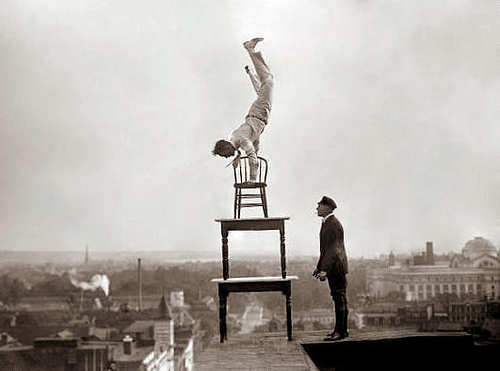
A recent tweet by Jason Elsom made me sit up and take notice: 'We need to stop designing schools for teaching and start designing schools for learning.' And therein lies the dichotomy of education. Are teachers there to instruct, or to facilitate? Do they lecture, or do they support? Most teachers do both depending on context, but I believe it's the balance that Jason is questioning in his statement. We can either place an emphasis on teaching or we can privilege learning as the most important facet of education. Which do you favour?

Also, what does Jason mean by 'designing'? Does he mean the shape and appearance of classrooms and other built environments in which we conduct education? If so, we need to take care deciding what activities go on in those spaces, before we begin fixing screens and display boards on walls, configuring tables and chairs in blocks or rows and even placing clocks on walls. Should chairs be on wheels for greater flexibility, and can the furniture in the classroom be configured in multiple ways to adapt to needs? Do we want to synchronise group behaviour, or do we want students to be able to express themselves as individuals? Do we want them to learn what is inside our heads, and the content of textbooks, or do we want them to go beyond this knowledge and discover new ideas for themselves? You see, it all depends on your philosophy of education - its purpose and the value it holds for you.

So, do we design our schools with learning in mind, or do we configure them so they best optimise teaching? All schools are different, and simply walking into some classrooms within each school will tell you a lot about the teacher beliefs that operate in them.

By design, does Jason Elsom mean the learning experience? Our curricula and schemes of work are so crammed full of content there sometimes seems little room for movement, no flexibility or scope for creativity. If we design our lessons around the students, we see a free flowing, open terrain within which they can experiment, learn actively, make mistakes and learn in ways that suit their individual needs and motivations. If however, we design lessons around the teacher with activities that are rigid, with no room for movement, is it any wonder the students want to leave the classroom as quickly as they can?

Designing spaces is vitally important, but so is designing learning experiences. We each need to decide the true purpose of education and then create the spaces and experiences that provide the best possible learning outcomes for our students.

Photo from Wikimedia Commons

Creative Commons License
Learning by design? by Steve Wheeler was written in Plymouth, England and is licensed under a Creative Commons Attribution-NonCommercial-ShareAlike 3.0 Unported License.


<< Back Next >>