 |
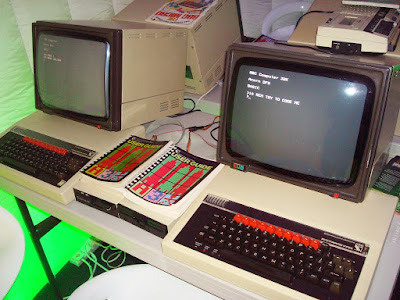
| BBC B Computers with Microvitec monitors |
Here are five of the most important things I have learnt from my 40 years working in educational technology:
- Technology doesn't improve teaching. If you are a poor teacher, no amount of technology will turn you into a good one.
- If you are a good teacher, you can teach well in any context, either with or without technology.
- If you want to make an impact, use technology appropriately in a way that enhances, extends and enriches the learning experience.
- If you put technology into the hands of learners, they will discover things you could never have taught them on your own.
- You can't simply drop technology into education. Technology needs relevant pedagogical actions to be wholly effective.
It's clear to me, watching the development of technology from my early days in the 1970s, it has developed from a set of tools that were designed to support the teacher, to a range of tools that enable everyone to learn. Personal technologies in particular are designed to fit an individual's needs and preferences. Smart phones, tablet computers and e-readers can all be adjusted and changed to meet the requirements of their principal user. I firmly believe that the gradual shift from teacher centred education to personalised, learner led education has evolved in parallel to the development of new technologies. Pedagogy and technology are in a symbiotic relationship, and I have been privileged to witness its development first hand over the last 40 years.
Back in 1976, when I first began work as an educational technologist, technology was limited in functionality. We were still several years away from the digital age, and devices such as personal computers, the Web, social media and handheld devices were still in the future. However, we made use of the technology of the time, and as we did so, we pushed the boundaries.
Graphics and printingBecause I had trained as a graphic designer, I was asked to do design work which included type setting. All of my illustrations were hand drawn, usually in black ink with
Rotring art pens, using manual techniques to separate out colours, which all had to be printed separately in individual runs. A four colour print would involve four passes through the
offset litho printer we ran in an adjacent room to my workshop. If precision lettering was required, which was often, I would break out the sheets of
Letraset, and painstakingly transfer letters onto paper in preparation for printing. Dry transfer lettering took a lot of precision and a great deal of patience, and of course was very time consuming. I can't even begin to imagine how many hours of my life I devoted to Letraset artwork. It was amazing how quickly I adapted to using Desk Top Publishing (DTP) software when it became available in the 1980s. Probably the best piece of software at the time was Aldus Pagemaker, which could be used to layout graphics and font styles, but this wasn't available until 1986. When I had access to DTP it saved an incredible amount of time, and boosted my creative output.
ComputersIn the 1970s, computers were gradually being reduced in size, but the first personal computer I built was quite large, about the size of a small suitcase. It came complete with cables and a small green screen (monochorme) monitor which perched on top. This first built-from-kit device had a memory of 128k and was state of the art. We used it, along with several others to demonstrate some of the first uses of computers in education in the UK. We established the ITMA project - Investigations into Teaching with Microprocessors as an Aid and took the computers into local schools. From this project came several more initiatives which helped us all to learn what we could use computers for in their rudimentary stage of development.
Computer Assisted Learning (CAL)I left the teacher training college in June 1981 to take up a new post at the school of nursing. It was a new post where I had to establish and then develop an educational technology department that served several nurse training sites, mostly inside hospitals. Once I had developed the classroom technology, upgraded the video facilities, and introduced a video editing suite (VHS), I began to look around and take notice of the wider developments. Around 1986, the BBC had introduced a device called the Acorn computer, which was a small plastic device complete with keyboard. An external disk drive and monitor had to be purchased separately, but the BBC computer was specifically designed for educational purposes. I needed to know more about using computers for education. I next joined the network of users of microcomputers in nurse education (NUMINE) which had members across the country, and eventually became a member of the British Computer Society's Nursing Specialist Group.
I learnt a lot from meeting with these groups and tried out some new ideas, including
learning how to program. Over time I developed several educational software packages during this time which were distributed across the country, and just about every nurse in the UK at the time, learnt at least some of their theory and practice through my CAL software. I placed a BBC Acorn computer outside my office with some learning software on it, and connected up a dot matrix printer, which logged each time a student used a program, their scores and how long they took to complete it.
At the end of that first week I checked the print outs and was amazed. More students had used the computer than I could have expected, so another computer soon joined it. Users multiplied as the word got around. Soon I had enough evidence to justify the purchase of an entire suite of computers, and a room was designated as the computer learning suite. It was always packed with students who wanted to use a computer to learn. We had placed learning into the hands of the students, who could now learn at their own pace, choose the topics they wished to research, and assess their own learning. They had never experienced this before. The queues to use the computer suite lengthened. We had gained some great momentum, and networked computers and the Web were just around the corner.
Photo by Steve Wheeler

#40years of educational technology: Computers
by Steve Wheeler was written in Plymouth, England and
is licensed under a Creative Commons Attribution-NonCommercial-ShareAlike 3.0 Unported License.