Log on:
Powered by Elgg

Feed detail

February 04, 2016

Wearing out our welcome

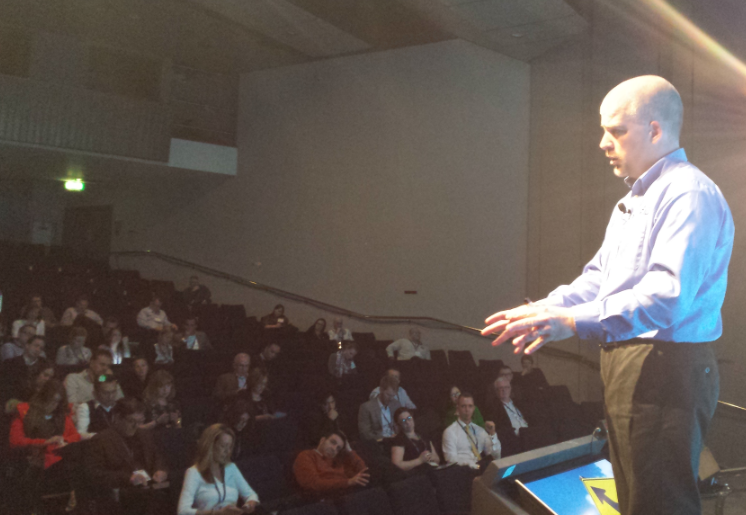
David Kelly addressing Learning Technology delegates
I launched a new module for my first year students today called 'Digital Reputation and Digital Literacies'. Here's the blurb:

Module Overview
This module explores living and learning in the digital age, with a particular focus on digital reputation, e-safety and digital literacies. All students will be expected to undertake projects and directed study to explore a range of digital environments, and gain an understanding of the threats and opportunities these might present to them, their students and their organisation.

Module Aims

  • To experience and reflect upon personal use of social media and networking tools
  • To investigate some of the key theories and influences on the development and emergence of digital cultures
  • To develop and consolidate personal digital literacies and digital reputation management
  • To understand key threats and risks of using web based technologies in education


  • It resonates with a session I chaired at yesterday's Learning Technologies Conference at Olympia in London, featuring the e-Learning Guild's Executive Director David Kelly. The title of Kelly's presentation was 'A look ahead: The now and the next of learning and technology' featured a quick fire examination of the new and emerging technologies we are getting to grips with, or which will soon be in the workplace. His talk is summarised on his blog.

    What chimed with digital reputation and literacies from Kelly's presentation was his various stories about wearable technologies. We have already learnt that there are new and emerging social mores and conventions that we need to adopt. For example, texting in upper case letters is deemed to be SHOUTING. David Kelly's early adoption of various wearable technologies led him to learn the hard way about some of the issues that arise when new technology collides with established social and cultural expectations.

    He told the story of how wearing Google Glass became so natural that he often forgot he was wearing it. Then, one day at a baseball match, he visited the men's toilet, but forgot he was wearing the camera device on his head. It wasn't until he noticed the strange, hostile looks from the other men using the toilet that he suddenly realised he had broken an important, unwritten social protocol. He beat a hasty and apologetic retreat. 

    On another occasion, while wearing his Apple Watch, and in conversation with his wife, she gradually became more irritated with him and eventually asked him 'do you need to be somewhere else?' At that point he realised that he had been regularly glancing at his watch as social media messages came through. In ordinary circumstances, glancing at your watch conveys a pointed social meaning - that you are bored with the conversation and would rather be somewhere else.

    In his engaging and thought provoking session David Kelly caused all of us to think more seriously about our personal technology and how we use it. Issues of responsibility, privacy and social cues were raised. There are new affordances that create contexts and behaviour we may not have anticipated. Inadvertent messages are sent that can be easily misconstrued, and intentions are conveyed that are not intended. It seems we still have a lot to learn about the adoption of new technologies, particularly those we wear.

    Photo by Steve Wheeler at Learning Technologies 2016

    Creative Commons License
    Wearing out our welcome by Steve Wheeler was written in Plymouth, England and is licensed under a Creative Commons Attribution-NonCommercial-ShareAlike 3.0 Unported License.


    PD in your PJs with #EDENchat

    When I was elected as chair of the Network of Academics and Professionals (NAP) in 2014, I wondered what I might do to make my mark. NAP is the membership wing of the European Distance and E-Learning Network (EDEN) which is a prestigious, global co-operative of education professionals, representing all sectors and aspects of technology enhanced learning. Because the membership is so eclectic and wide ranging, I wondered just how I and my team of NAP steering group members would be able to represent all their interests.

    And then it dawned on me. The answer was staring me right in the face. I would establish a new Twitter chat, where everyone, members and non-members of EDEN could come together periodically and virtually, to discuss the burning issues of the day. Twitter has been, for me and countless other professionals, a powerful form of informal professional development, where you can learn from each other, share ideas and collaborate across distance. It is easily accessible, populated with thousands of people who share a common interest with you, and many of these are willing to freely share their ideas, expertise and resources with you. It can also be PD in your PJs – professional development at any time, even if you’re in bed! Twitter was therefore an ideal medium for the membership to use to communicate their ideas and debate topics of interest.

    And so, after some initial discussion, we decided on the name #EDENchat (we needed a short, unique hash tag and it does what it says on the can), and began to plan our first series of Twitter chats. On Twitter, our chats are moderated by a NAP steering group member and are always exactly one hour in duration. Every chat is archived using the social media tool Storify, so that anyone can revisit the discussion at any time on the EDEN website here. Those who do so will discover a treasure trove of ideas, comments and dialogues that focus on the themes of the chats, and often a shared link to additional relevant resources or media. It really is informal learning at its best, and as an added bonus, people who participate often discover other like minded individuals they would never have encountered otherwise. It's simple to connect to each other with a click to 'follow' so you can continue to share each others' timelines.

    We are now in our third series of #EDENchats, which commenced this January. In previous series, we have covered subjects ranging from personal learning environments, open education, the future of distance learning, and mobile learning. Our sessions on new and emerging learning environments, e-assessment, MOOCs, critical thinking and open scholarship were particularly popular, drawing participants from all over Europe and also farther afield. The discussions are always lively and though provoking and take the form of prompting questions that are posed by a moderator. We have also conducted special edition #EDENchat sessions to coincide with Distance Learning week (in conjunction with the USDLA) and live from the EDEN summer conference in Barcelona. Upcoming chats are already planned and can be seen on this schedule.

    Any EDEN member can propose a topic for discussion by emailing me, and suggesting some questions, usually around 6-7 in a sequence. We look forward to welcoming you as a participant in the forthcoming #EDENchats!

    Unattributed image modified by Amy Burvall

    Footnote: President of EDEN Antonio Teixeira's commentary on this post can be viewed here.

    Creative Commons License
    PD in your PJs with #EDENchat by Steve Wheeler was written in Plymouth, England and is licensed under a Creative Commons Attribution-NonCommercial-ShareAlike 3.0 Unported License.


    February 03, 2016

    PD in your PJs with #EDENchat

    When I was elected as chair of the Network of Academics and Professionals (NAP) in 2014, I wondered what I might do to make my mark. NAP is the membership wing of the European Distance and E-Learning Network (EDEN) which is a prestigious, global co-operative of education professionals, representing all sectors and aspects of technology enhanced learning. Because the membership is so eclectic and wide ranging, I wondered just how I and my team of NAP steering group members would be able to represent all their interests.

    And then it dawned on me. The answer was staring me right in the face. I would establish a new Twitter chat, where everyone, members and non-members of EDEN could come together periodically and virtually, to discuss the burning issues of the day. Twitter has been, for me and countless other professionals, a powerful form of informal professional development, where you can learn from each other, share ideas and collaborate across distance. It is easily accessible, populated with thousands of people who share a common interest with you, and many of these are willing to freely share their ideas, expertise and resources with you. It can also be PD in your PJs – professional development at any time, even if you’re in bed! Twitter was therefore an ideal medium for the membership to use to communicate their ideas and debate topics of interest.

    And so, after some initial discussion, we decided on the name #EDENchat (we needed a short, unique hash tag and it does what it says on the can), and began to plan our first series of Twitter chats. On Twitter, our chats are moderated by a NAP steering group member and are always exactly one hour in duration. Every chat is archived using the social media tool Storify, so that anyone can revisit the discussion at any time on the EDEN website here. Those who do so will discover a treasure trove of ideas, comments and dialogues that focus on the themes of the chats, and often a shared link to additional relevant resources or media. It really is informal learning at its best, and as an added bonus, people who participate often discover other like minded individuals they would never have encountered otherwise. It's simple to connect to each other with a click to 'follow' so you can continue to share each others' timelines.

    We are now in our third series of #EDENchats, which commenced this January. In previous series, we have covered subjects ranging from personal learning environments, open education, the future of distance learning, and mobile learning. Our sessions on new and emerging learning environments, e-assessment, MOOCs, critical thinking and open scholarship were particularly popular, drawing participants from all over Europe and also farther afield. The discussions are always lively and though provoking and take the form of prompting questions that are posed by a moderator. We have also conducted special edition #EDENchat sessions to coincide with Distance Learning week (in conjunction with the USDLA) and live from the EDEN summer conference in Barcelona. Upcoming chats are already planned and can be seen on this schedule.

    Any EDEN member can propose a topic for discussion by emailing me, and suggesting some questions, usually around 6-7 in a sequence. We look forward to welcoming you as a participant in the forthcoming #EDENchats!

    Unattributed image modified by Amy Burvall

    Footnote: President of EDEN Antonio Teixeira's commentary on this post can be viewed here.

    Creative Commons License
    PD in your PJs with #EDENchat by Steve Wheeler was written in Plymouth, England and is licensed under a Creative Commons Attribution-NonCommercial-ShareAlike 3.0 Unported License.


    January 31, 2016

    New pedagogies?

    In a recent blog post, Antonio Teixera, President of EDEN wrote: "By just adding 21st century technologies to 20th century teaching practices we’ll only be diluting the effectiveness of teaching." 

    He's right. We can't simply introduce new technologies into conservative environments such as schools and universities and then expect them to have positive impact. We will fail if we attempt to use new tools while we teach in the same the old ways. Firstly, the technology will not fit the teaching method. Secondly, the teaching method will constrain the affordances of the new technology. Thirdly, the effectiveness of both technology and teaching will be diluted. Most new technologies, particularly handheld devices, lend themselves more to student led learning than they do to teacher led education.

    We need a new set of pedagogies (and we also need to know how these can be supported with theory) if we are to maximise the impact of technology on education. In my 2015 book I wrote about 'new wine' (technology) being forced into 'old wineskins' (conservative learning spaces and ideas) and warned of the inevitable failures. New wine needs to be poured into new wineskins, and similarly new technologies require new pedagogies, which requires us to change the way we teach, assess, and even represent knowledge. These are initial thoughts. I'm planning to write more about this in the next few days.

    Photo by Alan Levine on Flickr

    Creative Commons License
    New pedagogies? by Steve Wheeler was written in Plymouth, England and is licensed under a Creative Commons Attribution-NonCommercial-ShareAlike 3.0 Unported License.


    New pedagogies?

    In a recent blog post, Antonio Teixera, President of EDEN wrote: "By just adding 21st century technologies to 20th century teaching practices we’ll only be diluting the effectiveness of teaching." 

    He's right. We can't simply introduce new technologies into conservative environments such as schools and universities and then expect them to have positive impact. We will fail if we attempt to use new tools while we teach in the same the old ways. Firstly, the technology will not fit the teaching method. Secondly, the teaching method will constrain the affordances of the new technology. Thirdly, the effectiveness of both technology and teaching will be diluted. Most new technologies, particularly handheld devices, lend themselves more to student led learning than they do to teacher led education.

    We need a new set of pedagogies (and we also need to know how these can be supported with theory) if we are to maximise the impact of technology on education. In my 2015 book I wrote about 'new wine' (technology) being forced into 'old wineskins' (conservative learning spaces and ideas) and warned of the inevitable failures. New wine needs to be poured into new wineskins, and similarly new technologies require new pedagogies, which requires us to change the way we teach, assess, and even represent knowledge. These are initial thoughts. I'm planning to write more about this in the next few days.

    Photo by Alan Levine on Flickr

    Creative Commons License
    New pedagogies? by Steve Wheeler was written in Plymouth, England and is licensed under a Creative Commons Attribution-NonCommercial-ShareAlike 3.0 Unported License.


    January 27, 2016

    How free is open? #EDENchat

    Today at 8pm GMT, the second #EDENchat of 2016 will be live on Twitter. Follow the hashtag and join in the chat as we discuss issues around open learning and open scholarship. Questions will include:

    1) Your own experiences of being an open scholar. What have been the benefits to you of being open, and of freely sharing your content, experiences and ideas? And conversely, what have been the pitfalls?

    2) Can we be too open as scholars? Is there a line that could be crossed where we are 'too free' in sharing our ideas and content? What about scholars who don't wish to share their content or ideas - what are their reasons for holding onto and protecting their content? Are they right or wrong?

    3) How are MOOCs and other massive open study opportunities changing or influencing out thinking as educators? Should we all jump on the bandwagon and create open online programmes of study, or should we stand back and watch to see how the movement develops? Are we in danger of being left behind if our organisation/institution is not involved in MOOCs?

    4) Is open content truly 'free'? What can we learn from the open and free social media tools we use? Do we ourselves become the 'product' of those tools? Do we pay indirectly by giving away our information, is this leveraged to make money through advertising clicks, and do we become assets and commodities of the companies that run the social media services?

    5) What are the ethical implications of MOOCs and other massive open courses? What becomes of the data - especially personal information - that is captured on MOOC platforms? Where does it go, and how is it used by the organisations that capture it? Is it used ethically, and how can we be sure?

    6) What will be the future of 'free' and open content? Do MOOCs and other massive online courses actually provide an alternative to formal education, or are they a passing fad? Will the future of education reside within the walls of the universities and colleges, or will it be largely online learning? Or will both sit happily alongside each other?

    7) Are closed journals sustainable and are open access journals the future? Should publicly funded research be freely available or shut behind pay walls? Are publishers justified in charging fees for the academic community to access research? What are the best business models for pay-to-read research?

    These are some of questions that we might explore, but of course we will not be limited to them. They are merely a springboard from which we can develop a lively and thought provoking discussion. The more people that join us tonight, the more we will learn from each other. Remember - together, all of us will learn more than we will learn on our own.

    Photo by Hernan Pinera on Flickr

    Previous #EDENchat sessions are archived here.

    Creative Commons License
    How free is open? #EDENchat by Steve Wheeler was written in Plymouth, England and is licensed under a Creative Commons Attribution-NonCommercial-ShareAlike 3.0 Unported License.


    How free is open? #EDENchat

    Today at 8pm GMT, the second #EDENchat of 2016 will be live on Twitter. Follow the hashtag and join in the chat as we discuss issues around open learning and open scholarship. Questions will include:

    1) Your own experiences of being an open scholar. What have been the benefits to you of being open, and of freely sharing your content, experiences and ideas? And conversely, what have been the pitfalls?

    2) Can we be too open as scholars? Is there a line that could be crossed where we are 'too free' in sharing our ideas and content? What about scholars who don't wish to share their content or ideas - what are their reasons for holding onto and protecting their content? Are they right or wrong?

    3) How are MOOCs and other massive open study opportunities changing or influencing out thinking as educators? Should we all jump on the bandwagon and create open online programmes of study, or should we stand back and watch to see how the movement develops? Are we in danger of being left behind if our organisation/institution is not involved in MOOCs?

    4) Is open content truly 'free'? What can we learn from the open and free social media tools we use? Do we ourselves become the 'product' of those tools? Do we pay indirectly by giving away our information, is this leveraged to make money through advertising clicks, and do we become assets and commodities of the companies that run the social media services?

    5) What are the ethical implications of MOOCs and other massive open courses? What becomes of the data - especially personal information - that is captured on MOOC platforms? Where does it go, and how is it used by the organisations that capture it? Is it used ethically, and how can we be sure?

    6) What will be the future of 'free' and open content? Do MOOCs and other massive online courses actually provide an alternative to formal education, or are they a passing fad? Will the future of education reside within the walls of the universities and colleges, or will it be largely online learning? Or will both sit happily alongside each other?

    7) Are closed journals sustainable and are open access journals the future? Should publicly funded research be freely available or shut behind pay walls? Are publishers justified in charging fees for the academic community to access research? What are the best business models for pay-to-read research?

    These are some of questions that we might explore, but of course we will not be limited to them. They are merely a springboard from which we can develop a lively and thought provoking discussion. The more people that join us tonight, the more we will learn from each other. Remember - together, all of us will learn more than we will learn on our own.

    Photo by Hernan Pinera on Flickr

    Previous #EDENchat sessions are archived here.

    Creative Commons License
    How free is open? #EDENchat by Steve Wheeler was written in Plymouth, England and is licensed under a Creative Commons Attribution-NonCommercial-ShareAlike 3.0 Unported License.


    January 25, 2016

    In their own write

    In school I remember being reprimanded by a teacher for writing on a classroom desk. I always thought it was a rule that was meant to be broken because most of the desks throughout the school were already covered in graffiti, and on some the wood had even been carved into with knives (or more likely, metal compass points).

    In fact you could find graffiti just about anywhere in my school. We would write on the toilet cubicle walls, and we would sketch and doodle in our text books. This was terribly bad behaviour I know, but that's what kids did. We drew on things. We made cartoons. We experimented with rude words. I doubt that little has changed, and that the same still happens in many schools today.

    Why is it that children love to draw on surfaces? Is it to try out new ideas or simply to make a personal statement? It would be great if these were the only reasons, but it's equally likely that the kids are really bored, or want to show off. It's also possible that some children just want to leave their mark on surfaces because they share the mindset of urban graffiti artists who attempt to place their 'tags' in as many places across a city as they can - a kind of game. Some school graffiti might be the result of disaffected children who want to 'get their own back' somehow. Each of these is a possible explanation, but what if children simply need somewhere to express their thinking? What if they have so much creativity inside them screaming to get out, it just has to be unleashed somewhere, and the desk is the closest available space?

    Wouldn't it be wonderful if children could draw anywhere and express their creativity on any surface? And what might they learn if those drawings were non-permanent but could still be stored somewhere?

    Several years ago I visited a college where I saw a room made entirely of dry-wipe boards. Students could write on the walls and the doors, and then they could be wiped off (the walls and doors, not the students). On my travels I have seen many other versions of this idea, and now I'm also beginning to see dry-wipe desks (such as those in this picture) appearing in classrooms. It's a simple idea that can be so effective.

    When children sit at their desks in these schools, they are positively encouraged to write on their desks. The constraints on their creativity are being removed. It will one day be common to see children working out mathematics problems on their desktops, or drawing diagrams to explain a science experiment. They will be able to capture and share their work using their mobile phones, and connect their ideas together digitally. Perhaps their desks will one day be fully connected and interactive, like the tabletop surface technologies that have been available in large format for several years. Offering children a space upon which they can experiment, create, collaborate or solve problems and where the writing is non-permanent but storable would be a great way of unleashing new potential.

    Photos by Steve Wheeler

    Creative Commons License
    In their own write by Steve Wheeler was written in Plymouth, England and is licensed under a Creative Commons Attribution-NonCommercial-ShareAlike 3.0 Unported License.


    In their own write

    In school I remember being reprimanded by a teacher for writing on a classroom desk. I always thought it was a rule that was meant to be broken because most of the desks throughout the school were already covered in graffiti, and on some the wood had even been carved into with knives (or more likely, metal compass points).

    In fact you could find graffiti just about anywhere in my school. We would write on the toilet cubicle walls, and we would sketch and doodle in our text books. This was terribly bad behaviour I know, but that's what kids did. We drew on things. We made cartoons. We experimented with rude words. I doubt that little has changed, and that the same still happens in many schools today.

    Why is it that children love to draw on surfaces? Is it to try out new ideas or simply to make a personal statement? It would be great if these were the only reasons, but it's equally likely that the kids are really bored, or want to show off. It's also possible that some children just want to leave their mark on surfaces because they share the mindset of urban graffiti artists who attempt to place their 'tags' in as many places across a city as they can - a kind of game. Some school graffiti might be the result of disaffected children who want to 'get their own back' somehow. Each of these is a possible explanation, but what if children simply need somewhere to express their thinking? What if they have so much creativity inside them screaming to get out, it just has to be unleashed somewhere, and the desk is the closest available space?

    Wouldn't it be wonderful if children could draw anywhere and express their creativity on any surface? And what might they learn if those drawings were non-permanent but could still be stored somewhere?

    Several years ago I visited a college where I saw a room made entirely of dry-wipe boards. Students could write on the walls and the doors, and then they could be wiped off (the walls and doors, not the students). On my travels I have seen many other versions of this idea, and now I'm also beginning to see dry-wipe desks (such as those in this picture) appearing in classrooms. It's a simple idea that can be so effective.

    When children sit at their desks in these schools, they are positively encouraged to write on their desks. The constraints on their creativity are being removed. It will one day be common to see children working out mathematics problems on their desktops, or drawing diagrams to explain a science experiment. They will be able to capture and share their work using their mobile phones, and connect their ideas together digitally. Perhaps their desks will one day be fully connected and interactive, like the tabletop surface technologies that have been available in large format for several years. Offering children a space upon which they can experiment, create, collaborate or solve problems and where the writing is non-permanent but storable would be a great way of unleashing new potential.

    Photos by Steve Wheeler

    Creative Commons License
    In their own write by Steve Wheeler was written in Plymouth, England and is licensed under a Creative Commons Attribution-NonCommercial-ShareAlike 3.0 Unported License.


    January 23, 2016

    Minding the gap

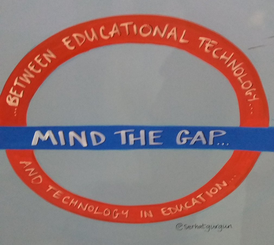
    This is one of the many evocative images from BETT 2016. It's a great example taken from a large array of thought provoking graffiti art that appeared on the walls of the BETT Arena during the show. The image was posted on Twitter by Lars Henriksen (aka @lektoren) based on a tweet from @serhatgurgun and I think it captures one of the most important messages to emerge from the event. The slogan 'Mind the gap between educational technology and technology in education' can be translated as: technology should be used with pedagogical purpose and should never be used just for the sake of it.

    Many teachers would agree that technology works best when it is embedded into the learning experience, where it can be used to extend, enrich or enliven learning. I had several conversations with those who bemoaned the fact that schools tend to buy new technology because someone has seen something new and interesting at a show such as BETT and then, when it arrives, they don't really know what to do with it. So the expensive technology gets stored away in a cupboard, gathering dust, or worse, ends up being used in the classroom just because it's there. Such use often distracts from learning, and my advice would be: if technology adds nothing useful to learning, it shouldn't be used at all. So teachers should be wary when they wander around trade shows. They should not be seduced by shiny new ideas or tools. They should ask the question: what can this idea/technology add to my students' learning that I can't do right now? If the answer is nothing, then they should move on - that technology is not for them. So watch the gap - or make sure your use of technology is so seamless and essential, that there is no gap there at all.

    Photo by Lars Henriksen at the BETT Show

    Creative Commons License
    You are what you tweet by Steve Wheeler was written in London, England and is licensed under a Creative Commons Attribution-NonCommercial-ShareAlike 3.0 Unported License.


    Minding the gap

    This is one of the many evocative images from BETT 2016. It's a great example taken from a large array of thought provoking graffiti art that appeared on the walls of the BETT Arena during the show. The image was posted on Twitter by Lars Henriksen (aka @lektoren) based on a tweet from @serhatgurgun and I think it captures one of the most important messages to emerge from the event. The slogan 'Mind the gap between educational technology and technology in education' can be translated as: technology should be used with pedagogical purpose and should never be used just for the sake of it.

    Many teachers would agree that technology works best when it is embedded into the learning experience, where it can be used to extend, enrich or enliven learning. I had several conversations with those who bemoaned the fact that schools tend to buy new technology because someone has seen something new and interesting at a show such as BETT and then, when it arrives, they don't really know what to do with it. So the expensive technology gets stored away in a cupboard, gathering dust, or worse, ends up being used in the classroom just because it's there. Such use often distracts from learning, and my advice would be: if technology adds nothing useful to learning, it shouldn't be used at all. So teachers should be wary when they wander around trade shows. They should not be seduced by shiny new ideas or tools. They should ask the question: what can this idea/technology add to my students' learning that I can't do right now? If the answer is nothing, then they should move on - that technology is not for them. So watch the gap - or make sure your use of technology is so seamless and essential, that there is no gap there at all.

    Photo by Lars Henriksen at the BETT Show

    Creative Commons License
    You are what you tweet by Steve Wheeler was written in London, England and is licensed under a Creative Commons Attribution-NonCommercial-ShareAlike 3.0 Unported License.


    You are what you tweet

    One of the topics we discussed at our social media panel session at the BETT Show 2016 was its dangers and pitfalls. I spoke about how some students, teachers - and indeed any professional - risk coming unstuck when they post content that has the potential to come back and bite them. It can take a lifetime to establish a reputation, and only seconds to lose it completely.

    I related the story of a student with a protected Twitter account, who felt it was acceptable to post disparaging tweets about his lecturers and university. He also resorted to abusive language when other students challenged him. Although very few people could see his tweets, he did manage to offend two other students, who captured screen shots of his activity. This evidence was shown to academic staff and he was in trouble.

    My advice to all present at the panel session was, if only one person sees what you write on social media, it's public. So be careful what you post or share on social media. Once you tap the enter key, it's out there for others to see, and your reputation rests on what you have posted. Take care. You are what you tweet.

    Image by Zakeena on Sketchport

    Creative Commons License
    You are what you tweet by Steve Wheeler was written in London, England and is licensed under a Creative Commons Attribution-NonCommercial-ShareAlike 3.0 Unported License.


    January 22, 2016

    You are what you tweet

    One of the topics we discussed at our social media panel session at the BETT Show 2016 was its dangers and pitfalls. I spoke about how some students, teachers - and indeed any professional - risk coming unstuck when they post content that has the potential to come back and bite them. It can take a lifetime to establish a reputation, and only seconds to lose it completely.

    I related the story of a student with a protected Twitter account, who felt it was acceptable to post disparaging tweets about his lecturers and university. He also resorted to abusive language when other students challenged him. Although very few people could see his tweets, he did manage to offend two other students, who captured screen shots of his activity. This evidence was shown to academic staff and he was in trouble.

    My advice to all present at the panel session was, if only one person sees what you write on social media, it's public. So be careful what you post or share on social media. Once you tap the enter key, it's out there for others to see, and your reputation rests on what you have posted. Take care. You are what you tweet.

    Image by Zakeena on Sketchport

    Creative Commons License
    You are what you tweet by Steve Wheeler was written in London, England and is licensed under a Creative Commons Attribution-NonCommercial-ShareAlike 3.0 Unported License.


    January 18, 2016

    Shocks to the system

    When the social web emerged sometime at the turn of the century, a new array of opportunities appeared for the creation of dynamic, collaborative and sociable learning environments - we now know it as social media. It wasn't simply blogs and wikis. Repurposing and remixing, mashups and aggregations of content became commonplace, and collaborative, community based spaces were populated with content that was ever shifting, never completed. This was a healthy movement in which anyone who was connected could participate, contribute and share.

    However, a dilemma arose. Although by its very nature social media attracts activities that are essentially democratic and free, such freedom can also have the effect of opening the door to misuse and exploitation. Seemingly destructive elements may appear where the right to participate is abused, and where some members of a community can be maginalised or even excluded. I interviewed the well known futurist Gerd Leonhard at Learning Technologies in front of a large audience in 2015. Among other questions, I asked him for his views on Wikipedia. To my surprise Gerd was less than complementary. He said the system was flawed. He related the story how his page had been deleted from the 'open' online encyclopaedia, because a certain member of the 'Wiki Police' had deemed him 'not notable enough' to have his own Wikipedia page. It was an unfortunate situation that deprived a high profile champion of (ironically) technology, a space in which his work could be made more visible. That's what happens when supposedly democratic movements spawn individuals who self-assign to cast judgement on the work of others.

    It's a shame the Wikipedia Police aren't more consistent in their actions. If Gerd doesn't deserve a page, then neither do several hundreds of others who currently have an entry. It gets worse. The Wiki wars that have been waged over certain pages - especially those with political and/or religious content - have causes several to be suspended, depriving readers of content they would find useful.

    New technologies can be a shock to the system. Social media challenges and undermines institutional and organisational rules. These can be broken, causing subversion of previously long accepted practices. Ownership of content and intellectual property are just two of the areas that are impacted upon. Copyright is still a useful way to protect the work of authors, artists and musicians from misuse and theft. But this long established legal balwark is in danger of being eroded. We are on the edge of a new era where social media is undermining, challenging, and in some cases even supplanting old paradigms that have existed for years. We could compare those who resist these challenges to King Cnut commanding the tide to turn. It will be futile, but it will demonstrate that social media and the Web are a force of nature that won't be stopped. Many more shocks to the system are in store.

    Image by Jeremy Brooks on Flickr

    Creative Commons License
    Shocks to the system by Steve Wheeler was written in Plymouth, England and is licensed under a Creative Commons Attribution-NonCommercial-ShareAlike 3.0 Unported License.


    January 16, 2016

    Work in progress

    A key feature of social media is its open architecture, because it allows all members of a community to easily modify, extend or delete content. Nothing is permanent, content is iterative and everything is a work in progress. Wikipedia is a classic example of this kind of open space editorial freedom. Although potentially divisive, such activities can produce content that represents more lucid thinking, judicious correction of errors and clearer elaboration of content. It's a fine balance. More importantly, such activities have been shown to be very beneficial for all those who participate  to learn together (Wheeler et al, 2008).

    But it's not easy. The division of labour required to engage an entire community of learners in these activities is often uneven and can be explained within the activity theory framework proposed by Engeström (1993). Division of labour in this context refers to the horizontal, heterarchical relationship between member of the community as a result of their mutual actions and exchanges. Wikis for example, can subvert traditional values such as personal ownership and intellectual property (Richardson, 2006) but community ownership of the content becomes an equalising factor. If there is a vertical, hierarchical division of labour, where some members of the community exert greater power over others or attempt to assume a higher status, conflict may result (Thorne, 2000).

    It's therefore important for those who organise such spaces - especially shared learning environments - that content remains within the reach and control of the community that has created it. In an organisational sense, this means that students should have full reign over wikis and other shared, collaborative online spaces, while educators would be advised to step back and maintain roles as observers. Maintaining equity between all contributors is a priority. Finally, it's highly appropriate that content within social media remains work in progress, because it reflects the fact that learning is never ending.

    References
    Engeström, Y. (1993) Developmental studies of work as a test-bench of activity theory: The case of primary care medical practice. In Lave, J. and Chaiklin S. (Eds.) Understanding Practice: Perspectives on activity and context. Cambridge: Cambridge University Press.
    Richardson, W. (2006) Blogs, wikis, podcasts and other powerful web tools for classrooms. Thousand Oaks, CA: Corwin Press.
    Thorne, S. (2000) Second language acquisition and the truth(s) about relativity. In Lantole, J. (ed.) Sociocultural theory and second language acquisition. Oxford: Oxford University Press.
    Wheeler, S., Yoemans, P. and Wheeler, D. (2008) The good, the bad and the wiki: Evaluating student generated content as a collaborative learning tool. British Journal of Educational Technology, 39 (6), 987-995.

    Image by Jakob Montrasio on Wikimedia Commons

    Creative Commons License
    Work in progress by Steve Wheeler was written in Plymouth, England and is licensed under a Creative Commons Attribution-NonCommercial-ShareAlike 3.0 Unported License.


    January 15, 2016

    Extreme learning

    What does it mean to be an extreme learner? In my role as a teacher educator I get to observe some interesting lessons. During my time working in post-compulsory education I went to some amazing places and observed some unconventional lessons.

    From watching outward-bound and outdoor education teachers while sat in a canoe, or from over the edge of a cliff; standing in surgical greens and mask, watching operating nurses teaching their students while a patient lay unconscious during open heart surgery; observing chefs flambé, footballers kick, hairdressers bleach and bricklayers build; watching one of my students teaching a belly dancing lesson in a garage. You could say I've seen it all! Not quite, but my time doing teaching observations was quite eclectic and in some cases you could say - extreme.

    Far more extreme is the high workload some students take on to achieve their goals. Sadly, some students put in minimal effort, and they often fail to achieve their full potential. Others work extremely hard, giving up their sleep and sacrificing their comfort to ensure they secure the best possible outcomes. I see this happening all the time as a university lecturer. But I can only speak authoritatively about my own learning experiences.

    While I was studying for my first degree, I knew that the clock was ticking. My job was coming to an end and I knew that I needed a good degree to be able to advance my career in the right direction. I had a young family with three small children at the time, and they were constantly in the back of my mind. So I enrolled on an Open University degree, studying psychology. OU degrees are usually part-time at a distance, completed while students are working and/or caring for others. It's not the easiest route to a degree, but for those with no other option, it's the University of the Second Chance. I decided I was going to complete my degree, part time, in just 3 years. This meant simultaneously completing two full courses each year. I spoke to my tutor, who told me it couldn't be done. Several of my colleagues who had completed OU degrees also advised me it was impossible. Doing an OU degree part-time, while holding down a full-time job (and my evening job teaching 3-4 nights a week at the local college) was not conducive to good health, I was warned.

    So I took all their advice into consideration. And I went and did it anyway.

    When someone tells me something can't be done, it's in my nature to do it at least once, just to prove them wrong. So I worked all the hours I could, giving up sleep, forgetting to eat, sometimes working around the clock, to manage the huge workload of a part-time degree programme. I was completely out of my comfort zone. And I was enjoying it. I caught up with sleep when I could. I ensured that all my reading was done ahead of time, and that when it came to writing my assignments, I focused completely and utterly on achieving the highest possible grades. I ate, slept and breathed psychology, and probably became a huge bore to all those around me. 'Look, there's that psychology bloke' - people would say, pointing me out (usually while I snoozed standing up in the lunch queue). In its own way, it was extreme learning, and I put my body and mind (and my relationships) through a lot of stress to achieve my goal.

    I achieved a first class honours degree in three years from the Open University, and almost immediately walked into an academic (research) post at the university. Extreme, but necessary. I was highly motivated and it paid off. It just goes to show - if you want something badly enough, you'll do almost anything to get it. You can learn anything if you want to. What about your students? What motivates them to extreme learning?

    Photo by Laura F on Flickr

    Creative Commons License
    Extreme learning by Steve Wheeler was written in Plymouth, England and is licensed under a Creative Commons Attribution-NonCommercial-ShareAlike 3.0 Unported License.


    January 14, 2016

    Peer assessment

    In my previous post Learning from each other I discussed the idea of peer learning, where children are encouraged to teach each other. While exploring peer learning I also raised the question of peer assessment, and wondered whether some teachers might think this would be a bridge too far. Here are some further thoughts...

    Peer assessment is clearly a more complex proposition than peer learning. In peer learning, children all know something and can impart these ideas to each other through sharing, collaboration and team working. In peer assessment, a certain amount of additional prior knowledge is required, and where assessment is based on a specific set of criteria that knowledge would need to be domain relevant. To be fair, most of the forms of peer assessment witnessed in a classroom are completely informal and don't rely on specific criteria.

    Those who formally assess keep in mind what is good, acceptable and poor in terms of performance or knowledge reproduction. Is it therefore fair or reasonable for children to be expected to act as peer assessors? Some would argue no, that the children are there to learn, and are not equipped with the skills and knowledge required to assess the learning of their peers. The issues of authenticity and validity arise, and there are questions over the negative psychological impact of having to give and receive feedback about poor performance from friends.

    Yet some might argue that if children are knowledgeable enough to peer teach, they should also be in a good position to ascertain if their peers have sufficiently learnt the content. Moreover, many teachers extol the benefits of peer assessment, claiming that those who assess the learning of others are also able to more deeply learn the processes that underlie learning, and also become more aware of what makes a good piece of work. Being exposed to this process, they become stronger learners as a result. Clearly there are several benefits as well as risks in peer assessment and learning. So - peer assessment for children - is it a good or a bad idea?

    Photo source: Flickr

    Creative Commons License
    Peer assessment by Steve Wheeler was written in Plymouth, England and is licensed under a Creative Commons Attribution-NonCommercial-ShareAlike 3.0 Unported License.


    January 13, 2016

    Learning from each other

    There has been extensive work around the concept of students teaching each other - otherwise known as peer learning. This approach to pedagogy has its roots in Vygotskiian Zone of Proximal Development theory, where a more knowledgeable other, whether teacher, adult or simply a better informed peer, can extend someone's learning experience beyond what they might achieve alone (Vygotsky, 1978).  But peer education can also be reciprocal. In terms of Corneli and Danoff's (2011) and Corneli (2012) approach - paragogy - anyone can teach anyone else, because everyone knows something, but no-one knows everything. Students can even teach their teachers, in an extreme form of flipped learning I mentioned in a previous post.

    It all sounds very democratic, but exactly how might it work?

    In paragogy, students can exchange knowledge and can be learning from each other simultaneously. This is not something ZPD theory explicitly takes into account. Whenever I have seen this kind of reciprocal learning occur, it has emerged during intense discussions or more commonly, during collaborative learning, where a small group solve a problem or address a complex issue. Some of the best reciprocal peer learning I have witnessed has been around group production of artefacts such as video production.

    The original ZPD concept was intended to be asymmetric - that a novice would be extended in their ability, knowledge or competency by the more knowledgeable other, but only in one direction. It was a formal pedagogical principle. However, the more one teaches, the more it becomes apparent that such lines of demarcation are notional at best, and that peer learning can readily occur informally across small groups, or even entire networks of individuals.

    Peer learning is rarely asymmetric, and is not restricted to dyads.  But what about peer assessment? I'll develop that question further in my next post...

    References
    Corneli, J. and Danoff, C. J. (2011) Paragogy. In: Proceedings of the 6th Open Knowledge Conference, Berlin, Germany.
    Corneli, J. (2012) Paragogical Praxis, E-Learning and Digital Media, 9(3), 267-272.
    Vygotsky, L. S. (1978) Mind in Society, Cambridge, MA: Harvard University Press.

    Photo by Primary Source on Flickr

    Creative Commons License
    Learning from each other by Steve Wheeler was written in Plymouth, England and is licensed under a Creative Commons Attribution-NonCommercial-ShareAlike 3.0 Unported License.


    January 10, 2016

    Tablets: The correct prescription

    A recent meta-study commissioned by the Commonwealth of Learning confirms what many teachers already suspected. A total of 27 quantitative studies on the use of tablets in schools dating from 2010 were analysed and the major finding was that the tools are most effective when used in student centred learning, rather than within teacher controlled environments (Tamim et al, 2015a). These findings are supported by another, larger meta-study of 41 qualitative reports from the same period, which showed that tablets and mobile devices are most effective when used in student-active contexts (Tamim et al, 2015b).

    Clearly tablets and mobile devices were designed to be used as personal tools, and as such can be best used for personalised learning, where students can work at their own pace, and in a place and time that suits their needs. What makes these findings so interesting are the implications for pedagogy. If teachers wish to maximise the power of tablets and mobile devices, they should create contexts in which students are encouraged to be proactive in their study, and to stand back and facilitate rather than dictate the process. As with any learning resources, it's not what they are, but how tablets are used that is important.

    References
    Tamim, R. M., Borokhovski, E., Pickup, D., Bernard, R. M. and El Saadi, L. (2015a) Tablets for Teaching and Learning: A Systematic Review and Meta-Analysis. Commonwealth of Learning: Burnaby.
    Tamim, R. M., Borokhovski, E., Pickup, D. and Bernard, R. M. (2015b) Large-Scale, Government Supported Educational Tablet Initiative. Commonwealth of Learning: Burnaby.

    Photo by Marcus Kwan on Flickr

    Creative Commons License
    Tablets: The correct prescription by Steve Wheeler was written in Plymouth, England and is licensed under a Creative Commons Attribution-NonCommercial-ShareAlike 3.0 Unported License.


    January 07, 2016

    2016 and all that...

    There are always predictions at the start of a new year. Many of them are about new technologies. The Horizon report has a monopoly on this for educaion, using a virtual round table of 'experts' to whittle down all the possibilities into one or two trends that they think will be prevalent in education in the next one year, 2-3 years and 4-5 years. The problem with this approach though, is that you get predictions based on what that small group of experts in really interested in. Predicting the future is fraught with difficulty because the future hasn't happened yet. It's imaginary. But it's on the way...

    Imagine if Darryl F. Zanuck, the famous movie producer, had been on an expert panel in 1946. He remarked: 'Television won't be able to hold on to any market it captures after the first six months. People will soon get tired of staring at a plywood box every night.' So, television was a doomed technology that wouldn't last for long.

    What would Thomas Edison have said if he had been on an expert panel in 1913? This: 'Books will soon be obsolete in public schools. Scholars will be instructed through the eye.' He went on to clarify this prediction: 'It is possible to teach every branch of human knowledge with the motion picture.' Not a bad prediction. It is likely he was correct, but it didn't really turn out that way. People still go to the movies, but it's a special occasion rather than the norm. Most of us watch TV, use the Web to find content, and we still read - whether it is paper based books or e-books, the main question is 'do you like books or do you like reading?' We still read and we still watch. There is room for every technology, all build on each other, and none ever fully supplants.

    Even farther back in 1876, William Orton, then President of the Western Union believed that the newly invented telephone would fail because it had 'too many shortcomings to be seriously considered as a means of communication.' He had a vested interest in promoting mail and telegram services. He was looking at the telephone through his own personal lens.

    For what they are worth, my predictions for the future of learning are listed below. Some of you might argue that these are already happening. Yes, they are (and there's the secret of successful prediction!) but they will happen in new and previously unforeseen ways. We will be surprised at how this will occur, and we'll also be amazed at the speed of progress. (NB: remember these are seen through the lens of my own personal interests and experience):

    1) Learning will become increasingly personalised. We will have more choice over what we learn, how we learn it, when and where we learn it and over the pace of our learning. MOOCs won't be the end. They are just the start of a huge wave of democratised learning, but that won't stop large corporations trying to muscle in to exploit the surge of interest in 'free content'.
    2) Technology will become more embedded in our every day lives. It will be more pervasive, and at the same time it will become less visible, blending into the fabric of our environments (see number 3)
    3) We will carry the means of our learning around with us. Our mobile phones (probably the name 'phone' will be replaced by another label - the Germans already call it a Handy) will become cheaper, more powerful and indispensable, and will connect with other technologies seamlessly, probably built into the fabric of our clothes or jewellery (see number 2).
    4) Schools will connect more with outside communities and may even blend in with them. They will become places where the entire community can access learning, and where anything can be learnt.
    5) Students will generate more of their own knowledge. Formal learning will involve knowledge production as well as knowledge consumption.
    6) The 'knowledge experts' as we know know them will assume less importance, because all of us will have the opportunity to become expert in our own specific areas of interest. Teachers, researchers and academics will increasingly become curators and brokers of knowledge rather than simply conveyors.
    7) Knowledge and skills we have previously taken for granted will become less important to learn. This could be the last generation who will need to learn to drive a car, operate a computer using a keyboard, clean the house or even visit a store to shop for food.
    8) We will find new things to do with the extra time at our disposal - it won't all be leisure based though. Instead there will be even more learning to be able to do your job better. It will be just in time, just for me, and just enough learning.
    9) Meetings and other work will increasingly be conducted from where you are in the world, using your personal technologies. Many will be visually oriented, and will have haptic and kinaesthetic capabilities.
    10) We will all wear spacesuits and live on Mars. (OK, this last one is unrealistic, because we all know that a Mars diet is not the healthiest option - but if the UK government introduces a chocolate tax, I predict I will leave the country).

    There are other things I could 'predict', but I've run out of steam (anyone remember that? No? Just me then.) Go on, make up the rest yourself....

    Photo by Mario Klingemann on Flickr

    Creative Commons License
    2016 and all that... by Steve Wheeler was written in Plymouth, England and is licensed under a Creative Commons Attribution-NonCommercial-ShareAlike 3.0 Unported License.


    January 06, 2016

    How do schools innovate?

    A recent list of 13 innovative schools is interesting because it is so diverse. Clearly innovation and creativity is not one dimensional. Some of the schools on the list are considered innovative because of the way they use their learning spaces, whilst others are vaunted because of their progressive pedagogical approaches. There is a common issue with many lists however, and it is that the inclusions are there because of the opinions of an individual or small group. I have visited several schools around the world that deserve to be included within such a list, and I'm sure other teachers and education specialists out there would have similar views. But looking at the 13 schools on this list, it is interesting to see what they have in common. What makes an innovative school?

    The first feature that many of the schools on this list have in common is their view of the children. The students are seen as unique individuals rather than groups, and are educated accordingly. Personalised learning is on offer, often with personal technologies in support, and children are encouraged to take an active role in their education. Standardisation is not an important element and does not impact on the daily business of many of these schools. On the contrary, personalisation and flexibility are paramount, with children encouraged to work and progress at their own pace.

    Secondly the schools are connected with the outside world. No longer can we say that inward facing schools are effective (and indeed this has never been the case). In some cases, local communities are encouraged to be involved in the life of the school, and they can also use the learning spaces for other purposes. There are explicit connections between what is learnt in the classroom and the world of work. Education within these schools is not just about knowledge transmission, it is also about developing the skills and competencies necessary to survive and thrive once the student has completed their formal education.

    Thirdly, the curriculum is delivered in a manner that encourages critical and creative thinking, through the use of problem solving, discussion and active engagement with the environment. Learning by making and doing is high on the agenda, and connections are made between the process of learning and what is actually learnt.

    Finally, the design of the learning spaces is creative. They don't mimic the template of the standard school. Instead the learning spaces take on many interesting shapes, and with intriguing features. Because the spaces are  flexible they can be used for a variety of creative purposes, and teaching and learning is more varied. Innovative building design encourages teachers and learners to take risks and to experiment. Nor is learning restricted to the school spaces. Blended approaches where on-site learning is mixed with off-site learning, also seems to be a common feature.

    If we want education to be more effective, these schools can teach us how it might be achieved. But we need to take some risks and try out new ideas without fear of failure. As Erich Fromm said: 'Creativity requires the courage to let go of certainties.'

    Photo by Annielogue on Wikimedia Commons
    Photo of Avery Coonley School on Wikimedia Commons

    Creative Commons License
    Innovative schools by Steve Wheeler was written in Plymouth, England and is licensed under a Creative Commons Attribution-NonCommercial-ShareAlike 3.0 Unported License.

    January 02, 2016

    A New Year of #EDENchat

    As the new year begins, I want to draw your attention to the new season of #EDENchat Twitter sessions we have planned.

    In each one hour session, we discuss a topic related to technology supported learning, distance education or innovative approaches to education.

    The chats cover all sectors of education and the discussion is global, drawing participants from all corners of the world.

    Each #EDENchat is moderated and the archives are made available as Storified content on the EDEN website. All sessions are between 8-9pm (GMT) on the dates shown.

    13 January: Openness in research. Moderated by Antonella Poce
    27 January: Free content, free education? Moderated by Steve Wheeler
    10 February: Critical thinking and technology. Moderated by Antonella Poce
    24 February: Rhizomatic learning. Moderated by Steve Wheeler
    9 March: Open Education Consortium Special - How open can we be? Moderator TBC
    23 March: Emerging learning environments - what do we need to know? Moderator TBC
    6 April: Theme and moderator TBC
    20 April: Theme and moderator TBC
    14 June: EDEN Conference Special - Live from Budapest
    16 June: EDEN Conference Special - reflecting on the keynote speeches


    More dates will also be announced in the future. Please consider joining us in this new year for some lively and thought provoking chats.

    Photo by Chiltepinster on Wikimedia Commons

    Creative Commons License
    A New Year of #EDENchats by Steve Wheeler was written in Plymouth, England and is licensed under a Creative Commons Attribution-NonCommercial-ShareAlike 3.0 Unported License.


    December 27, 2015

    A fine balance

    Who leads the learning in your institution? Is it the teachers, or students - or do both contribute equally to ensure the best possible conditions for learning? It's a fine balance.

    Carl Rogers championed student centred learning, while John Dewey emphasised the importance of learner participation. Seymour Papert strongly believed that the best learning takes place when learners take charge. The Progressive Education movement holds that education is not something that should be imposed upon students, but instead should be a conscious consensual process with which each learner is actively engaged. Education is not done to us. Education is something we do. Education is at its strongest when learners are at the centre of the process, and can exercise their choices about what happens.

    For students, education should be about taking control of learning, while for teachers it should be focused on letting go. But that can be a difficult proposition for some teachers, because we tend to teach in the same way we were taught. Perhaps the biggest objection traditional educators have about learners taking control is the argument that students don't really now what they want, so can't effectively direct their own learning. Progressives respond by pointing out that the most powerful learning occurs when it has personal meaning, and only the student can construct that.

    The middle ground is that students can be given freedom to learn while they are scaffolded by experts within prescribed knowledge sets. What students learn is important, but so is the manner in which they learn. The big question all educators must answer in the coming years is how we create a fine balance where students have control of their own learning, and teachers provide the best possible support. One important movement will be from passive reception to active engagement. It will require effective management of expectations - of both students and teachers.

    In Experience and Education, John Dewey highlighted the importance of students leading their own learning through active engagement: “There is, I think, no point in the philosophy of progressive education which is sounder than its emphasis upon the importance of the participation of the learner in the formation of the purposes which direct his [sic] activities in the learning process, just as there is no defect in traditional education greater than its failure to secure the active cooperation of the pupil in construction of the purposes involved in his studying.” Unfortunately, students will be unable to do this if the school regime forbids a student voice in favour of teacher dominated pedagogy. We need to get the balance right. 

    The last word should go to Paulo Freire: “The teacher is of course an artist, but being an artist does not mean that he or she can make the profile, can shape the students. What the educator does in teaching is to make it possible for the students to become themselves.” 

    References
    Dewey, J. (1983) Experience and Education. Gloucester, MA: Peter Smith Publishing.
    Horton, M and Freire, P. (1990) We make the road by walking: Conversations on education and social change. Philadelphia, PA: Temple University Press.
    Rogers, C. R. (1983) Freedom to Learn. New York: Prentice Hall. 

    Photo from the National Photo Company Collection via Flickr

    Creative Commons License
    A fine balance by Steve Wheeler was written in Plymouth, England and is licensed under a Creative Commons Attribution-NonCommercial-ShareAlike 3.0 Unported License.


    December 22, 2015

    The imitation game

    In my kitchen, my devices 'talk' to me. My American fridge lets me know if I have left the door open too long (which is often), and my microwave tells me if I have heated something up and then forgotten to remove it. I can communicate with my central heating wherever I am in the world via my phone. Siri and Cortana  talk to us through our mobile phones (but don't let them speak to each other - if they do, all you get is nonsense), and many people now also have conversations with their in-car Sat Navs. Just a generation or two ago, such experiences would have been science fiction. Now they are common place and we take our conversation with technology for granted.

    I say conversations, but I really mean basic interaction.

    With the best will in the world, you could never have an intelligent conversation with these tools - they merely alert you to what you need to know, or enable you to maximise your use of technology. You can have some fun though. Ask Siri what to wear for Halloween and you're likely to laugh out loud. It may respond with 'Go as an eclipse. Just dress in black and stand in front of people.' Or it may respond with 'Just go as yourself, pumpkin.' But Siri hasn't developed a sense of humour, nor is it about to embark on a lucrative career as a stand-up comedian. It's simply doing what its coders have told it to do.

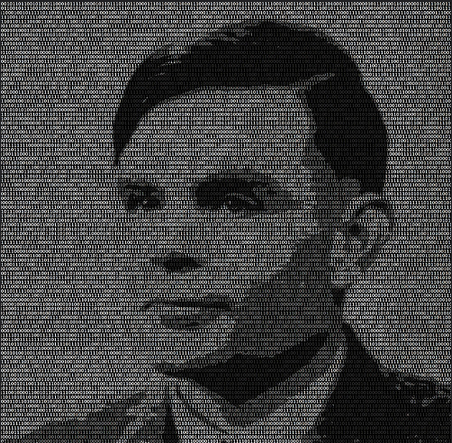
    Alan Turning
    Such intelligent personal assistants blindly follow algorithms to function, and have been doing so for a long time. In the 80s I discovered a program called Basically Eliza (created by Joseph Weizenbaum) and obtained a version for the BBC Computer. It had been written to mimic a psychiatrist consultation - a sort of early artificial intelligence demonstration. The British computer scientist Alan Turing had argued that for a computer to be 'intelligent', it would need to imitate a human so well that people would believe they were conversing with a fellow human being.

    Eliza responded to the questions typed into the keyboard by using a simple string matching algorithm. Eliza would first ask you to state your problem. Mainly, it reflected your statements back to you as questions. Occasionally it went a little further. If for example, if you told it you had a family problem, Eliza would ask how many brothers or sisters you had. Alternatively, it might ask about your marital status. But this wasn't a ghost in the machine - an emerging computer intelligence, simply Eliza following a random routine in its code. When I showed it to my nursing students back in 1985, such a semblance of artificial intelligence made quite an impression on them.*

    So I rewrote the algorithm to be verbally abusive.

    Instead of Basically Eliza, the psychiatric consultant, it became Dr Fraud, the psychiatric insultant. In itself, Dr Fraud was fairly meaningless. But my students loved it. They queued up to use it, and laughed as they were continually insulted by a machine. The more they sat there, the worse the insults became. Everyone was intrigued by this demonstration of artificial intelligence, and in turn, it switched them on to other, more educational programs on the menu. It was a gateway into computer supported learning. Soon, the computer suite had become one of the most popular places in the entire nursing college.

    Personal assistant software is a little more advanced than it was in the 80s, but not that much. It leads me to wonder just how advanced it will need to be before it can convince us that we are talking to a human rather than a machine. But that's another discussion, another (Turing) test and something to look for in our future. How do you see personal assistants developing in the future? What are your thoughts? The comments box below awaits you (....and I will respond intelligently, I promise).

    * The full story about my work programming BBC computers can be read here.

    Photos by N3WJack and Parameter_bond on Flickr

    Creative Commons License
    The imitation game by Steve Wheeler was written in Plymouth, England and is licensed under a Creative Commons Attribution-NonCommercial-ShareAlike 3.0 Unported License.


    December 17, 2015

    New learning environments

    Our final #EDENchat of 2015 focused on new learning environments, namely MOOCs, flipped classrooms and blended learning methods. It was one of the busiest we have seen, and the archive of the conversation can be viewed here. Those who participated shared their experiences of MOOCs and flipped learning both as teachers and as learners. One of the key discussion points was around the nature of these approaches and their effectiveness as learning environments. Some debated the merits of MOOCs, high attrition rates and the legitimacy of participating without completing a course. An inevitable comparison was made between the earlier cMOOCs (which were largely connectivist and student centred in their ethos) and the later xMOOCs (which are more commercially oriented and arguably less student centred). The merits and limitations of these are debated in finer detail here.

    Other issues were raised around student motivation and the impetus required to sustain focus when away from tutors/parent institution. There were calls to provide students with incentive to persist in their studies through enhanced forms of interaction (with content, other students and teachers) and more authentic learning and assessment activities. Some raised the issue of lurking and peripheral participation, but the point was also made that wherever there are open and free events, we will find those who lurk in the background.

    The final question asked whether new learning environments such as MOOCs, flipped classes and blended learning represented a new or emerging pedagogy. Opinion was divided on this, but what do you think? You views are welcome in the comments box below.

    Generally the Twitter timeline was fast moving and thought provoking. We plan to continue to momentum of this chat series and have already started putting together a programme of #EDENchat sessions for 2016. The dates and topics will be announced on this blog and on the EDEN website soon.

    Photo by Mark Brannan on Flickr

    NB: #EDENchat is supported by the European Distance and E-learning Network

    Creative Commons License
    New learning environments by Steve Wheeler was written in Plymouth, England and is licensed under a Creative Commons Attribution-NonCommercial-ShareAlike 3.0 Unported License.


    << Back Next >>