


Log on:
Powered by Elgg

Feed detail

November 06, 2014

Here comes the SAMR

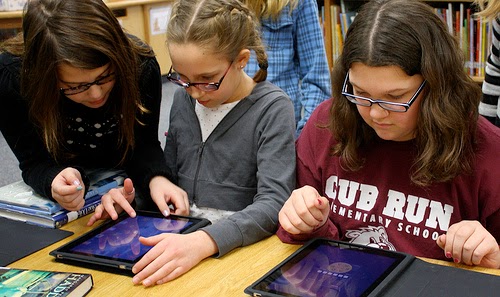
In previous posts I articulated some thoughts on how technology can (and should) be integrated into education. In an initial post I argued that technology use is not the same as technology integration. Technology integration results in digital tools being embedded into learning, so that for example maker cultures emerge, or the classroom activities are flipped, supporting more effective pedagogies and improving student learning outcomes. Ultimately, technology should be integrated into education so that learning can be transformed. More recently I wrote that there are several kinds of technology, characterised by levels of manipulation which can offer powerful reflective learning and critical thinking opportunities. In this post I will use a tried and tested model of technology adoption as a theoretical lens to examine some of the most recent, emergent properties of technology integration.

The model known by its acronym SAMR - was first proposed by Ruben Puentedura and represents four increasingly complex layers of engagement. The first layer, Substitution, is characterised by teachers using new technologies in very much the same ways they used older, more familiar technologies. One example is when classrooms began to be equipped with interactive whiteboards (IWBs). In retrospect we know that many teachers had little time to learn how to use these new technologies effectively, so merely used them to write on and to display their slides, as though they were traditional chalk boards or projection screens. This was far from a genuine integration of technology into the learning process, and it led to little or no change in pedagogy, and an inertia that prevented transformation. Possibly, some teachers were also concerned about how to use IWBs effectively, or were anxious about having to learn something new, and so resorted to comfortable and familiar use.

The second level of the SAMR model is Augmentation, where new technologies not only replace older technologies, but in some way begin to alter the pedagogy or methods that are being used. To achieve this, the technology is not only required to have new affordances, these new affordances need to be recognised by teachers and then exploited in authentic contexts to enhance learning. Such an approach could result in deeper engagement of learners, an extension of their learning experience or an enhancement of their physical or cognitive capabilities. One low level example of augmentation would be the use of Google Docs to not only manipulate and save text (a wordprocessor can do this), but also to share a document with others so that collaborative writing is possible, in both synchronous and asynchronous modes (something a standard wordprocessor cannot do).

I plan to write about the third and fourth levels - Modification and Redifinition in my next blog post.

Photo by Steve Wheeler

Creative Commons License

Here comes the SAMR by Steve Wheeler is licensed under a Creative Commons Attribution-NonCommercial-ShareAlike 3.0 Unported License.


Here comes the SAMR

In previous posts I articulated some thoughts on how technology can (and should) be integrated into education. In an initial post I argued that technology use is not the same as technology integration. Technology integration results in digital tools being embedded into learning, so that for example maker cultures emerge, or the classroom activities are flipped, supporting more effective pedagogies and improving student learning outcomes. Ultimately, technology should be integrated into education so that learning can be transformed. More recently I wrote that there are several kinds of technology, characterised by levels of manipulation which can offer powerful reflective learning and critical thinking opportunities. In this post I will use a tried and tested model of technology adoption as a theoretical lens to examine some of the most recent, emergent properties of technology integration.

The model known by its acronym SAMR - was first proposed by Ruben Puentedura and represents four increasingly complex layers of engagement. The first layer, Substitution, is characterised by teachers using new technologies in very much the same ways they used older, more familiar technologies. One example is when classrooms began to be equipped with interactive whiteboards (IWBs). In retrospect we know that many teachers had little time to learn how to use these new technologies effectively, so merely used them to write on and to display their slides, as though they were traditional chalk boards or projection screens. This was far from a genuine integration of technology into the learning process, and it led to little or no change in pedagogy, and an inertia that prevented transformation. Possibly, some teachers were also concerned about how to use IWBs effectively, or were anxious about having to learn something new, and so resorted to comfortable and familiar use.

The second level of the SAMR model is Augmentation, where new technologies not only replace older technologies, but in some way begin to alter the pedagogy or methods that are being used. To achieve this, the technology is not only required to have new affordances, these new affordances need to be recognised by teachers and then exploited in authentic contexts to enhance learning. Such an approach could result in deeper engagement of learners, an extension of their learning experience or an enhancement of their physical or cognitive capabilities. One low level example of augmentation would be the use of Google Docs to not only manipulate and save text (a wordprocessor can do this), but also to share a document with others so that collaborative writing is possible, in both synchronous and asynchronous modes (something a standard wordprocessor cannot do).

I plan to write about the third and fourth levels - Modification and Redifinition in my next blog post.

Photo by Steve Wheeler

Creative Commons License

Here comes the SAMR by Steve Wheeler is licensed under a Creative Commons Attribution-NonCommercial-ShareAlike 3.0 Unported License.


November 05, 2014

Trading places

One of the most radical shifts of pedagogy in recent years has been where learners take control of their own learning leading them to create their own content. Previously, the generation of new knowledge was the preserve of the expert, the academic, the teacher. In the last decade, user generated content has quickly become the most common content on the web, and is a digital age hallmark of student centred learning. When learners become producers of knowledge and not just consumers, you can be sure they are learning. And yet this is merely the precursor for greater shift where students assume the role of teacher. The old aphorism 'we learn by teaching' (or in Latin, docendo discimus) holds true when we consider that to teach something, you first need to learn it. Moreover, it cannot learning of a superficial kind, but demands a deeper process where students reflect on the meaning and critically evaluate the significance of what they are to teach. If you are teaching your peers, and your teacher is also in your audience, you really need to know your subject, or you end up looking a little foolish.

Perhaps the most radical shift of all though, is when teachers become learners, and when they take a back seat and even let their students teach them. This is not an easy thing to do for many teachers. It is often ingrained into the teacher mindset that they are there to lead from the front. Some teachers are breaking out from the mould, taking risks and encouraging their students to take the lead. It sometimes requires an act of humility to do this. Admitting that as a teacher, you don't know everything, and that sometimes others, such as your students can teach you something, can be a big step. I'm happy to admit that I learn a lot from my students, and I let them know when they teach me something new. When teachers stand back, relinquish control over 'knowledge' and become co-learners, collaborating with their students, wonderful, powerful learning occurs. It is learning that is not easily forgotten, because the joy of learning together, forging new ideas, and negotiating meaning always makes an impression on the mind. Some of the best learning I have seen in my career in education, has been when I have stepped back out of the way, and let my students discover for themselves.

Photo by Fancy Jantzi on Flickr

Creative Commons License

Trading places by Steve Wheeler is licensed under a Creative Commons Attribution-NonCommercial-ShareAlike 3.0 Unported License.


Trading places

One of the most radical shifts of pedagogy in recent years has been where learners take control of their own learning leading them to create their own content. Previously, the generation of new knowledge was the preserve of the expert, the academic, the teacher. In the last decade, user generated content has quickly become the most common content on the web, and is a digital age hallmark of student centred learning. When learners become producers of knowledge and not just consumers, you can be sure they are learning. And yet this is merely the precursor for greater shift where students assume the role of teacher. The old aphorism 'we learn by teaching' (or in Latin, docendo discimus) holds true when we consider that to teach something, you first need to learn it. Moreover, it cannot learning of a superficial kind, but demands a deeper process where students reflect on the meaning and critically evaluate the significance of what they are to teach. If you are teaching your peers, and your teacher is also in your audience, you really need to know your subject, or you end up looking a little foolish.

Perhaps the most radical shift of all though, is when teachers become learners, and when they take a back seat and even let their students teach them. This is not an easy thing to do for many teachers. It is often ingrained into the teacher mindset that they are there to lead from the front. Some teachers are breaking out from the mould, taking risks and encouraging their students to take the lead. It sometimes requires an act of humility to do this. Admitting that as a teacher, you don't know everything, and that sometimes others, such as your students can teach you something, can be a big step. I'm happy to admit that I learn a lot from my students, and I let them know when they teach me something new. When teachers stand back, relinquish control over 'knowledge' and become co-learners, collaborating with their students, wonderful, powerful learning occurs. It is learning that is not easily forgotten, because the joy of learning together, forging new ideas, and negotiating meaning always makes an impression on the mind. Some of the best learning I have seen in my career in education, has been when I have stepped back out of the way, and let my students discover for themselves.

Photo by Fancy Jantzi on Flickr

Creative Commons License

Trading places by Steve Wheeler is licensed under a Creative Commons Attribution-NonCommercial-ShareAlike 3.0 Unported License.


November 03, 2014

Digital reflections

My last post was about integrating technologies into education. This post examines some of the categories of technology and the places they might occupy when they are integrated into the learning process. It's important for teachers to consider that integrated technology can provide a doorway to deeper learning, characterised for example in critical analysis and personal reflection. A journal article by Kirk and Pitches (2013) is a useful starting point, because they identify three specific categories of technology that have a place in contemporary learning.

The first category, capture technologies, can be useful when students need to record things or events that they will later be able to reflect upon. This could be a conversation, an image or video, or some other digital artefact. Capture technologies include cameras, recording devices, and other simple to use tools that can record and store content. Most students carry capture technologies around with them in their pockets and bags, embedded in their mobile phones. What's more, they generally know how to use them to complete the task.

At a little higher up in the manipulation spectrum are archive technologies, which can be used to store, organise and document the digital artefacts that have been previously captured. This can be hosted photo and video sharing sites such as Flickr and YouTube, or social networking sites such as Facebook, but are equally likely to be curation and aggregation tools such as Scoop.it and Pinterest. The act of making and archiving such artefacts supports learning through doing, encourages students to develop skills such as problem solving, and enables the presentation of this content to peers and experts to elicit constructive feedback.

At the highest level of manipulation are reflection technologies - or digital reflection mechanisms, to use Kirk and Pitches' terminology. These are technologies that enable students to 'look and listen again' to their digital artefacts, a process that encourages them to reflect not only on the learning itself, but also on the process by which they came to that learning. In a cognitive sense, this is 'making sense of learning', affording students with deeper insight or explanation of what they have already learnt. The ultimate reflective tool in this context is blogging, because it performs all of the above and supports reflective forms of learning within its affordances. Blogging can take many forms from purely textual to multi-media, incorporating images, hyperlinks, audio and video. In Kirk and Pitches' terms the reflection mechanism can 'prompt the use of explanation, so that the selection of visual material, the ordering and presentation of it, and any verbal/textual commentary all prompt the process of making sense of what is being looked at.'

So much of education could be enriched and extended when technology is embedded in these ways into the process of learning.

Reference
Kirk, C. and Pitches, J. (2013) Digital reflection: Using digital technologies to enhance and embed creative processes. Technology, Pedagogy and Education, 22 (2), 213-230.

Photo by Paul Reynolds on Wikimedia

Creative Commons License

Digital reflections by Steve Wheeler is licensed under a Creative Commons Attribution-NonCommercial-ShareAlike 3.0 Unported License.


Digital reflections

My last post was about integrating technologies into education. This post examines some of the categories of technology and the places they might occupy when they are integrated into the learning process. It's important for teachers to consider that integrated technology can provide a doorway to deeper learning, characterised for example in critical analysis and personal reflection. A journal article by Kirk and Pitches (2013) is a useful starting point, because they identify three specific categories of technology that have a place in contemporary learning.

The first category, capture technologies, can be useful when students need to record things or events that they will later be able to reflect upon. This could be a conversation, an image or video, or some other digital artefact. Capture technologies include cameras, recording devices, and other simple to use tools that can record and store content. Most students carry capture technologies around with them in their pockets and bags, embedded in their mobile phones. What's more, they generally know how to use them to complete the task.

At a little higher up in the manipulation spectrum are archive technologies, which can be used to store, organise and document the digital artefacts that have been previously captured. This can be hosted photo and video sharing sites such as Flickr and YouTube, or social networking sites such as Facebook, but are equally likely to be curation and aggregation tools such as Scoop.it and Pinterest. The act of making and archiving such artefacts supports learning through doing, encourages students to develop skills such as problem solving, and enables the presentation of this content to peers and experts to elicit constructive feedback.

At the highest level of manipulation are reflection technologies - or digital reflection mechanisms, to use Kirk and Pitches' terminology. These are technologies that enable students to 'look and listen again' to their digital artefacts, a process that encourages them to reflect not only on the learning itself, but also on the process by which they came to that learning. In a cognitive sense, this is 'making sense of learning', affording students with deeper insight or explanation of what they have already learnt. The ultimate reflective tool in this context is blogging, because it performs all of the above and supports reflective forms of learning within its affordances. Blogging can take many forms from purely textual to multi-media, incorporating images, hyperlinks, audio and video. In Kirk and Pitches' terms the reflection mechanism can 'prompt the use of explanation, so that the selection of visual material, the ordering and presentation of it, and any verbal/textual commentary all prompt the process of making sense of what is being looked at.'

So much of education could be enriched and extended when technology is embedded in these ways into the process of learning.

Reference
Kirk, C. and Pitches, J. (2013) Digital reflection: Using digital technologies to enhance and embed creative processes. Technology, Pedagogy and Education, 22 (2), 213-230.

Photo by Paul Reynolds on Wikimedia

Creative Commons License

Digital reflections by Steve Wheeler is licensed under a Creative Commons Attribution-NonCommercial-ShareAlike 3.0 Unported License.


November 01, 2014

Integrating technology into learning

Using technology in the classroom and integrating technology for learning are two different things. The first is something that any teacher can do without much thinking, but to truly integrate technology into education takes a great deal of imagination, thinking and planning. Embedding technology so that it becomes transparent is clearly an aim to which all educators should aspire. Clearly, many schools and many educators struggle with this, and end up teaching using technology as an afterthought. It shows. There is an obvious difference between playing computer games as a reward for good behaviour, and playing a computer game that illustrates a key principle you want your students to learn. The impact of both experiences can be measured in learning outcomes. The first is merely enjoyable with some possible, serendipitous learning gain, whilst the second leads to deeper learning gain around the principle the students have learnt.

Technology is not a substitute for good teaching. No amount of technology can replace a great lesson that has been delivered in a passionate, inspirational and focused manner. The trick is not to make technology a central focus in the classroom. It should not be glamourised. It should be made mundane. Technology, in whatever form, should become just another part of the learning environment, as useful as a table around which students gather for discussion, or flipchart and pens used to brainstorm ideas for a plenary presentation. As soon as technology becomes a focus, learning is marginalised. True, teachers need to spend some time understanding the impact of technology and how it can be used to enhance or extend learning, and there should be some time invested in digital literacy and skills. Teachers should also think about what problems and issues they see in every day teaching that might be addressed with the addition of a technology. Can children with special educational needs be better engaged with appropriate use of technology? Do students integrate their ideas better if they have a social writing tool at their disposal? Is the personal device of use for searching and curating new ideas and knowledge? How can presentations be enhanced through the use of big screen technology?

The list of questions could go on, but any teacher worth their salt will know that specific challenges arise with each separate group of students and contexts change according to environment, time of day, subject matter and group dynamic. Successful integration of technology into education goes beyond mere use of technology. It involves a strategy that considers pedagogical need, technological affordances and the capabilities of each individual educator.

Photo by Lupuca on Flickr

Creative Commons License

Integrating technology into learning by Steve Wheeler is licensed under a Creative Commons Attribution-NonCommercial-ShareAlike 3.0 Unported License.


Integrating technology into learning

Using technology in the classroom and integrating technology for learning are two different things. The first is something that any teacher can do without much thinking, but to truly integrate technology into education takes a great deal of imagination, thinking and planning. Embedding technology so that it becomes transparent is clearly an aim to which all educators should aspire. Clearly, many schools and many educators struggle with this, and end up teaching using technology as an afterthought. It shows. There is an obvious difference between playing computer games as a reward for good behaviour, and playing a computer game that illustrates a key principle you want your students to learn. The impact of both experiences can be measured in learning outcomes. The first is merely enjoyable with some possible, serendipitous learning gain, whilst the second leads to deeper learning gain around the principle the students have learnt.

Technology is not a substitute for good teaching. No amount of technology can replace a great lesson that has been delivered in a passionate, inspirational and focused manner. The trick is not to make technology a central focus in the classroom. It should not be glamourised. It should be made mundane. Technology, in whatever form, should become just another part of the learning environment, as useful as a table around which students gather for discussion, or flipchart and pens used to brainstorm ideas for a plenary presentation. As soon as technology becomes a focus, learning is marginalised. True, teachers need to spend some time understanding the impact of technology and how it can be used to enhance or extend learning, and there should be some time invested in digital literacy and skills. Teachers should also think about what problems and issues they see in every day teaching that might be addressed with the addition of a technology. Can children with special educational needs be better engaged with appropriate use of technology? Do students integrate their ideas better if they have a social writing tool at their disposal? Is the personal device of use for searching and curating new ideas and knowledge? How can presentations be enhanced through the use of big screen technology?

The list of questions could go on, but any teacher worth their salt will know that specific challenges arise with each separate group of students and contexts change according to environment, time of day, subject matter and group dynamic. Successful integration of technology into education goes beyond mere use of technology. It involves a strategy that considers pedagogical need, technological affordances and the capabilities of each individual educator.

Photo by Lupuca on Flickr

Creative Commons License

Integrating technology into learning by Steve Wheeler is licensed under a Creative Commons Attribution-NonCommercial-ShareAlike 3.0 Unported License.


October 22, 2014

The AfL truth about assessment

David Warlick once said 'for the first time we are preparing young people for a future we cannot clearly describe.' In a fast changing world where everything technology touches grows exponentially, we really are in serious trouble if we cannot prepare children for uncertainty. And yet that is exactly what many school curricula are failing to do. Change is accelerating and uncertainty is ... well.... a certainty. Many of the jobs children will take when they leave school in ten years or so haven't even been conceived yet. What are we teaching them now, and will it be adequate to prepare them for this kind of uncertainty?

This entire week for me seems to have revolved around assessment. I have either been grading assignments, setting assignments or thinking about assessment (I'm speaking at an event on assessment in London later this week). There was even a live #edenchat on Twitter this week about e-assessment, which is archived here. Yesterday I presided over a 2 hour session on assessment with my second year Computing and ICT specialist primary education students. I showed them how assessment is vital - not for awarding grades, but for feeding back to students how well they have done, and what they need to do to improve. This is assessment for learning (AfL) rather than assessment of learning, and it's critical for good pedagogy. What's the difference between formative and summative assessment? I asked. Formative assessment is when the chef tastes the soup. Summative assessment is when the guests taste the soup. You have a lot of scope to change learning, unlearn, relearn in formative contexts. When summative assessment comes along, sadly it is often too late. And that's a problem with final exams and high stakes assessment.

We had a wide ranging discussion about other kinds of assessment (diagnostic, ipsative, triadic, etc), and a deep and meaningful debate about the nature of knowledge. I think we all agreed that in this information rich society, knowledge is changing, and that in some cases 'knowing' itself is taking on new meaning. What does it mean to 'know something' today? In an age where the vast majority of knowledge is discoverable via Google, what happens when kids smuggle wearable technology into the exam room and Google everything? Shouldn't curricula and assessment (especially the high stakes kind) now focus more on unGoogle-able knowledge - the kinds of knowledge and cognitive skills students need to survive and thrive in an information rich world? Testing is far too frequently administered in many schools to be effective and many exams still rely heavily on the testing of fact based learning - essentially the testing of crystallised intelligence. Shouldn't we instead be concentrating on developing young people's fluid intelligence? Does testing serve any other purpose than terrifying children and overburdening teachers? Yes - cynics would argue that it feeds into government league tables and ultimately contributes towards (the leaning tower of) PISA. Should there now be more emphasis on problem solving, team working and collaborative learning? I think we are heading in this direction, but we need to do so more quickly, or we risk losing the hearts and minds an entire generation of learners. Assessment should be primarily about helping students to learn better. It should be AfL. Anything else is mere candy floss.

Photo from Wikimedia Commons by Hariadhi

Creative Commons License

The AfL truth about assessment by Steve Wheeler is licensed under a Creative Commons Attribution-NonCommercial-ShareAlike 3.0 Unported License.


The AfL truth about assessment

David Warlick once said 'for the first time we are preparing young people for a future we cannot clearly describe.' In a fast changing world where everything technology touches grows exponentially, we really are in serious trouble if we cannot prepare children for uncertainty. And yet that is exactly what many school curricula are failing to do. Change is accelerating and uncertainty is ... well.... a certainty. Many of the jobs children will take when they leave school in ten years or so haven't even been conceived yet. What are we teaching them now, and will it be adequate to prepare them for this kind of uncertainty?

This entire week for me seems to have revolved around assessment. I have either been grading assignments, setting assignments or thinking about assessment (I'm speaking at an event on assessment in London later this week). There was even a live #edenchat on Twitter this week about e-assessment, which is archived here. Yesterday I presided over a 2 hour session on assessment with my second year Computing and ICT specialist primary education students. I showed them how assessment is vital - not for awarding grades, but for feeding back to students how well they have done, and what they need to do to improve. This is assessment for learning (AfL) rather than assessment of learning, and it's critical for good pedagogy. What's the difference between formative and summative assessment? I asked. Formative assessment is when the chef tastes the soup. Summative assessment is when the guests taste the soup. You have a lot of scope to change learning, unlearn, relearn in formative contexts. When summative assessment comes along, sadly it is often too late. And that's a problem with final exams and high stakes assessment.

We had a wide ranging discussion about other kinds of assessment (diagnostic, ipsative, triadic, etc), and a deep and meaningful debate about the nature of knowledge. I think we all agreed that in this information rich society, knowledge is changing, and that in some cases 'knowing' itself is taking on new meaning. What does it mean to 'know something' today? In an age where the vast majority of knowledge is discoverable via Google, what happens when kids smuggle wearable technology into the exam room and Google everything? Shouldn't curricula and assessment (especially the high stakes kind) now focus more on unGoogle-able knowledge - the kinds of knowledge and cognitive skills students need to survive and thrive in an information rich world? Testing is far too frequently administered in many schools to be effective and many exams still rely heavily on the testing of fact based learning - essentially the testing of crystallised intelligence. Shouldn't we instead be concentrating on developing young people's fluid intelligence? Does testing serve any other purpose than terrifying children and overburdening teachers? Yes - cynics would argue that it feeds into government league tables and ultimately contributes towards (the leaning tower of) PISA. Should there now be more emphasis on problem solving, team working and collaborative learning? I think we are heading in this direction, but we need to do so more quickly, or we risk losing the hearts and minds an entire generation of learners. Assessment should be primarily about helping students to learn better. It should be AfL. Anything else is mere candy floss.

Photo from Wikimedia Commons by Hariadhi

Creative Commons License

The AfL truth about assessment by Steve Wheeler is licensed under a Creative Commons Attribution-NonCommercial-ShareAlike 3.0 Unported License.

October 18, 2014

This time it's personal

Personal. Idiosyncratic. Individual. Separate. Different. Unique. Singular. Distinct. You.

Yes, you. Nobody else is like you. Many are similar, but only you are... you. That means that when you learn, you do it differently to everyone else. If you are a student you may be sat in the same classroom or lecture hall as many other students, and listening to the same content, but you interpret it differently to everyone else. You have a unique experience, peculiar to you. You have your own preferences, approaches and strategies. It follows that the tools and technologies you use for learning are those you have selected to use because you are (or should be) comfortable with them, personally. These tools, services and technologies become a part of your personal learning environment or PLE. The PLE is an approach rather than a technology.  It is something that evolves as we evolve, and adapts to our new knowledge and skills, our changing contexts and our circumstances.

Much has been written on PLEs, including a wealth of peer reviewed journal articles that feature empirical research. There is also at least one specialised conference dedicated to the concept. You can trawl the Web (using your PLE tools) and discover many videos, websites and blogs that focus largely on PLEs and their place in education. There is also a strong discourse around PLEs and the philosophy that underpins the concept.

One of my third year teacher education students, Tyla Elworthy, added to the discourse recently when she decided to create an animated video about PLEs and personalised learning. View it and I think you will agree that she has captured the essences of the idea, along with some useful discussion around its significance in education, now and in the near future.


Photo by Adib Wahab

Creative Commons License

This time it's personal by Steve Wheeler is licensed under a Creative Commons Attribution-NonCommercial-ShareAlike 3.0 Unported License.


This time it's personal

Personal. Idiosyncratic. Individual. Separate. Different. Unique. Singular. Distinct. You.

Yes, you. Nobody else is like you. Many are similar, but only you are... you. That means that when you learn, you do it differently to everyone else. If you are a student you may be sat in the same classroom or lecture hall as many other students, and listening to the same content, but you interpret it differently to everyone else. You have a unique experience, peculiar to you. You have your own preferences, approaches and strategies. It follows that the tools and technologies you use for learning are those you have selected to use because you are (or should be) comfortable with them, personally. These tools, services and technologies become a part of your personal learning environment or PLE. The PLE is an approach rather than a technology.  It is something that evolves as we evolve, and adapts to our new knowledge and skills, our changing contexts and our circumstances.

Much has been written on PLEs, including a wealth of peer reviewed journal articles that feature empirical research. There is also at least one specialised conference dedicated to the concept. You can trawl the Web (using your PLE tools) and discover many videos, websites and blogs that focus largely on PLEs and their place in education. There is also a strong discourse around PLEs and the philosophy that underpins the concept.

One of my third year teacher education students, Tyla Elworthy, added to the discourse recently when she decided to create an animated video about PLEs and personalised learning. View it and I think you will agree that she has captured the essences of the idea, along with some useful discussion around its significance in education, now and in the near future.


Photo by Adib Wahab

Creative Commons License

This time it's personal by Steve Wheeler is licensed under a Creative Commons Attribution-NonCommercial-ShareAlike 3.0 Unported License.


October 10, 2014

A FOTE opportunity


I greatly enjoyed attending the Future of Technology in Education (FOTE) conference at London University's Senate Building last week. It was an exciting and thought provoking, well attended event which somehow resembled a TED talk, with its large stage, bright studio lighting, music and arena style seating. It was also great to catch up with so many old friends and to meet some new ones. By the time I presented my closing keynote, I think just about everyone was a little 'conferenced out' but the audience was receptive and polite, and apart from one heckle (which I dealt with brutally), I wasn't booed off the stage. If you would like to know the essence of my talk entitled 'Digital Learning Futures: Mind the Gap', then look no further than the official review by FOTE which can be found right here. My thanks to Frank Steiner and the organising team of FOTE for giving me the opportunity to present.


Photos by FOTE 

Creative Commons License

A FOTE opportunity by Steve Wheeler is licensed under a Creative Commons Attribution-NonCommercial-ShareAlike 3.0 Unported License.


A FOTE opportunity


I greatly enjoyed attending the Future of Technology in Education (FOTE) conference at London University's Senate Building last week. It was an exciting and thought provoking, well attended event which somehow resembled a TED talk, with its large stage, bright studio lighting, music and arena style seating. It was also great to catch up with so many old friends and to meet some new ones. By the time I presented my closing keynote, I think just about everyone was a little 'conferenced out' but the audience was receptive and polite, and apart from one heckle (which I dealt with brutally), I wasn't booed off the stage. If you would like to know the essence of my talk entitled 'Digital Learning Futures: Mind the Gap', then look no further than the official review by FOTE which can be found right here. My thanks to Frank Steiner and the organising team of FOTE for giving me the opportunity to present.


Photos by FOTE 

Creative Commons License

A FOTE opportunity by Steve Wheeler is licensed under a Creative Commons Attribution-NonCommercial-ShareAlike 3.0 Unported License.


October 05, 2014

Stage by stage

This is number 33 in my series on learning theories. Psychologists and cognitive scientists have offered a number of useful theories that aid our understanding of learning. In this series I'm providing a brief overview of the theories, and how each can be applied in education. Previous posts in this series are all linked below. My last post explored the work of Allan Paivio and his theory of dual coding. In this post we examine one of the most influential theories of the 20th Century - the stages of cognitive development model proposed by Jean Piaget. As usual, this is a brief and concise explanation of the theory, and if you wish to delve deeper, you are advised to read the associated literature.

The Theory

Jean Piaget was interested in how children develop their thinking. He proposed several influential ideas about how as they grow, children pass through several stages of cognitive growth. The first level (0-2 years) was the sensorimotor stage where children are preoccupied with exploring the world through their senses and constructing mental models of what they discover around them. The second stage of cognitive growth, which he called the preoperational stage (2-7 years) is where the child begins to determine what is important from their own perspective. In other words, they understand the world only from their own viewpoint, or egocentrism. The third stage of development was named the concrete operational stage (7-11 years) where children can reason numerically and begin to decentre from their egocentrism to consider the perspectives of others. The final stage of development is the formal operations stage, where children can manipulate ideas inside their heads, and are able to reason abstractly.

Piaget believed that children developed along these lines by exploring their world more or less independently, assimilating new information, and accommodating it into previously formed knowledge, to construct their mental models of the world, which he identified as schemas. Children like to achieve a balance, but if they are in a state of disequilibrium (between what is understood and what is experienced), he claimed, they will seek to reduce this by resolving the deficit in their understanding.

How it can be applied in education

There is already substantial evidence that Piaget's ideas have been applied in schools. Discovery learning was introduced as a direct consequence of Piaget's theory, to encourage children to explore and discover for themselves as they learnt. Another key theme to emerge from Piaget's theory of stage development is the idea of 'readiness', where children are expected be able to cope with incremental rises in complexity and abstraction as they mature. The entire modern school curriculum is premised on this assumption, and is constructed in ways to support children's cognitive development. Children need to be active rather than passive learners, said Piaget, and this requires effort on the part of the teacher to stand back and let children learn for themselves. We should focus on the process of learning as well as the product, and offer children learning experiences that offer them problems to solve and challenges to meet, so that they are kept in a state of disequilibrium (uncertainty).

There are numerous criticisms of Piaget's work, especially around the provenance of his data (he predominantly gathered this by observing his own three children learning and growing), the concepts of egocentrism and conservation, and the inflexibility of the stages as described in his theory. For further reading on these criticisms, see Donaldson (1978).

Reference
Donaldson, M. (1978) Children's Minds. London: Fontana Press.

Previous posts in this series:

1.  Anderson ACT-R Cognitive Architecture
2.  Argyris Double Loop Learning
3.  Bandura Social Learning Theory
4.  Bruner Scaffolding Theory
5.  Craik and Lockhart Levels of Processing
6.  Csíkszentmihályi Flow Theory
7.  Dewey Experiential Learning
8.  Engeström Activity Theory
9.  Ebbinghaus Learning and Forgetting Curves
10. Festinger Social Comparison Theory
11. Festinger Cognitive Dissonance Theory
12. Gardner Multiple Intelligences Theory
13. Gibson Affordances Theory
14. Gregory Visual Perception Hypothesis
15. Hase and Kenyon Heutagogy
16. Hull Drive Reduction Theory
17. Inhelder and Piaget Formal Operations Stage
18. Jung Archetypes and Synchronicity
19. Jahoda Ideal Mental Health
20. Koffka Gestalt theory
21. Köhler Insight learning
22. Kolb Experiential Learning Cycle
23. Knowles Andragogy
24. Lave Situated Learning
25. Lave and Wenger Communities of Practice
26. Maslow Hierarchy of Human Needs
27. Merizow Transformative Learning
28. Milgram Six Degrees of Separation
29. Milgram Obedience to Authority
30. Norman The design of everyday things
31. Papert Constructionism
32. Paivio Dual Coding Theory

Photo by Pixabay

Creative Commons License

Stage by stage by Steve Wheeler is licensed under a Creative Commons Attribution-NonCommercial-ShareAlike 3.0 Unported License.


Stage by stage

This is number 33 in my series on learning theories. Psychologists and cognitive scientists have offered a number of useful theories that aid our understanding of learning. In this series I'm providing a brief overview of the theories, and how each can be applied in education. Previous posts in this series are all linked below. My last post explored the work of Allan Paivio and his theory of dual coding. In this post we examine one of the most influential theories of the 20th Century - the stages of cognitive development model proposed by Jean Piaget. As usual, this is a brief and concise explanation of the theory, and if you wish to delve deeper, you are advised to read the associated literature.

The Theory

Jean Piaget was interested in how children develop their thinking. He proposed several influential ideas about how as they grow, children pass through several stages of cognitive growth. The first level (0-2 years) was the sensorimotor stage where children are preoccupied with exploring the world through their senses and constructing mental models of what they discover around them. The second stage of cognitive growth, which he called the preoperational stage (2-7 years) is where the child begins to determine what is important from their own perspective. In other words, they understand the world only from their own viewpoint, or egocentrism. The third stage of development was named the concrete operational stage (7-11 years) where children can reason numerically and begin to decentre from their egocentrism to consider the perspectives of others. The final stage of development is the formal operations stage, where children can manipulate ideas inside their heads, and are able to reason abstractly.

Piaget believed that children developed along these lines by exploring their world more or less independently, assimilating new information, and accommodating it into previously formed knowledge, to construct their mental models of the world, which he identified as schemas. Children like to achieve a balance, but if they are in a state of disequilibrium (between what is understood and what is experienced), he claimed, they will seek to reduce this by resolving the deficit in their understanding.

How it can be applied in education

There is already substantial evidence that Piaget's ideas have been applied in schools. Discovery learning was introduced as a direct consequence of Piaget's theory, to encourage children to explore and discover for themselves as they learnt. Another key theme to emerge from Piaget's theory of stage development is the idea of 'readiness', where children are expected be able to cope with incremental rises in complexity and abstraction as they mature. The entire modern school curriculum is premised on this assumption, and is constructed in ways to support children's cognitive development. Children need to be active rather than passive learners, said Piaget, and this requires effort on the part of the teacher to stand back and let children learn for themselves. We should focus on the process of learning as well as the product, and offer children learning experiences that offer them problems to solve and challenges to meet, so that they are kept in a state of disequilibrium (uncertainty).

There are numerous criticisms of Piaget's work, especially around the provenance of his data (he predominantly gathered this by observing his own three children learning and growing), the concepts of egocentrism and conservation, and the inflexibility of the stages as described in his theory. For further reading on these criticisms, see Donaldson (1978).

Reference
Donaldson, M. (1978) Children's Minds. London: Fontana Press.

Previous posts in this series:

1.  Anderson ACT-R Cognitive Architecture
2.  Argyris Double Loop Learning
3.  Bandura Social Learning Theory
4.  Bruner Scaffolding Theory
5.  Craik and Lockhart Levels of Processing
6.  Csíkszentmihályi Flow Theory
7.  Dewey Experiential Learning
8.  Engeström Activity Theory
9.  Ebbinghaus Learning and Forgetting Curves
10. Festinger Social Comparison Theory
11. Festinger Cognitive Dissonance Theory
12. Gardner Multiple Intelligences Theory
13. Gibson Affordances Theory
14. Gregory Visual Perception Hypothesis
15. Hase and Kenyon Heutagogy
16. Hull Drive Reduction Theory
17. Inhelder and Piaget Formal Operations Stage
18. Jung Archetypes and Synchronicity
19. Jahoda Ideal Mental Health
20. Koffka Gestalt theory
21. Köhler Insight learning
22. Kolb Experiential Learning Cycle
23. Knowles Andragogy
24. Lave Situated Learning
25. Lave and Wenger Communities of Practice
26. Maslow Hierarchy of Human Needs
27. Merizow Transformative Learning
28. Milgram Six Degrees of Separation
29. Milgram Obedience to Authority
30. Norman The design of everyday things
31. Papert Constructionism
32. Paivio Dual Coding Theory

Photo by Pixabay

Creative Commons License

Stage by stage by Steve Wheeler is licensed under a Creative Commons Attribution-NonCommercial-ShareAlike 3.0 Unported License.


September 26, 2014

In two minds

This is number 32 in my series on learning theories. Psychologists and cognitive scientists have offered a number of useful theories that aid our understanding of learning. In this series I'm providing a brief overview of each theory, and how each can be applied in education. Previous posts in this series are all linked below. My last post explored  the work of Seymour Papert and his theory of learning by making, also known as constructionism. In this post we return to the cognitive domain, with an examination of Allan Paivio's theory of dual coding. As usual, this is a brief and concise explanation of the theory, and if you wish to delve deeper, you are advised to read the associated literature.

The Theory

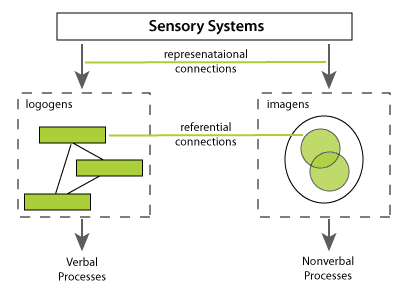
Paivio's dual coding theory considers the way we process verbal and non-verbal information. In 1986 he stated: 'Human cognition is unique in that it has become specialized for dealing simultaneously with language and with nonverbal objects and events. Moreover, the language system is peculiar in that it deals directly with linguistic input and output (in the form of speech or writing) while at the same time serving a symbolic function with respect to nonverbal objects, events, and behaviors. Any representational theory must accommodate this dual functionality.' (p 53). Paivio's model of cognition featured two modes of processing, known as imagens (images) and logogens (words), which are illustrated below.

Visual and verbal information are processed in different ways along discrete pathways in the brain, and these are thought to create different mental representations. In a variety of experiments, it was found that people can generally process images faster than text, and can make quicker and smarter decisions when presented with pictures than they can with verbal instructions.

How it can be applied in education

Teachers should be aware that all students can process information in several different ways. Looking at images can evoke a different response to listening to the spoken word, or reading text. Giving children pictures and words in combination can provide them with the best chances to learn concepts. If Paivio's theory is correct, and verbal and image storage of information occur in separate areas of the human brain, then retention (and retrieval) of that information should be stronger (and faster) if both memory traces have been established. The teaching of literacy for example, can be greatly enhanced when children receive verbal, text and imagery based information simultaneously. Thus literacy learning can encompass reading, writing, speaking and listening. Dual Coding theory also explains why multi-media forms of education have been so successful in the past, although alternative cognitive processing theories that feature later in this series challenge this view.

Reference

Paivio, A. (1986) Mental Representations. New York: Oxford University Press.

Previous posts in this series:

1.  Anderson ACT-R Cognitive Architecture
2.  Argyris Double Loop Learning
3.  Bandura Social Learning Theory
4.  Bruner Scaffolding Theory
5.  Craik and Lockhart Levels of Processing
6.  Csíkszentmihályi Flow Theory
7.  Dewey Experiential Learning
8.  Engeström Activity Theory
9.  Ebbinghaus Learning and Forgetting Curves
10. Festinger Social Comparison Theory
11. Festinger Cognitive Dissonance Theory
12. Gardner Multiple Intelligences Theory
13. Gibson Affordances Theory
14. Gregory Visual Perception Hypothesis
15. Hase and Kenyon Heutagogy
16. Hull Drive Reduction Theory
17. Inhelder and Piaget Formal Operations Stage
18. Jung Archetypes and Synchronicity
19. Jahoda Ideal Mental Health
20. Koffka Gestalt theory
21. Köhler Insight learning
22. Kolb Experiential Learning Cycle
23. Knowles Andragogy
24. Lave Situated Learning
25. Lave and Wenger Communities of Practice
26. Maslow Hierarchy of Human Needs
27. Merizow Transformative Learning
28. Milgram Six Degrees of Separation
29. Milgram Obedience to Authority
30. Norman The design of everyday things
31. Papert Constructionism

Photo by Steve Wheeler 
Graphic by Instructional Design

Creative Commons License

In two minds by Steve Wheeler is licensed under a Creative Commons Attribution-NonCommercial-ShareAlike 3.0 Unported License.


In two minds

This is number 32 in my series on learning theories. Psychologists and cognitive scientists have offered a number of useful theories that aid our understanding of learning. In this series I'm providing a brief overview of each theory, and how each can be applied in education. Previous posts in this series are all linked below. My last post explored  the work of Seymour Papert and his theory of learning by making, also known as constructionism. In this post we return to the cognitive domain, with an examination of Allan Paivio's theory of dual coding. As usual, this is a brief and concise explanation of the theory, and if you wish to delve deeper, you are advised to read the associated literature.

The Theory

Paivio's dual coding theory considers the way we process verbal and non-verbal information. In 1986 he stated: 'Human cognition is unique in that it has become specialized for dealing simultaneously with language and with nonverbal objects and events. Moreover, the language system is peculiar in that it deals directly with linguistic input and output (in the form of speech or writing) while at the same time serving a symbolic function with respect to nonverbal objects, events, and behaviors. Any representational theory must accommodate this dual functionality.' (p 53). Paivio's model of cognition featured two modes of processing, known as imagens (images) and logogens (words), which are illustrated below.

Visual and verbal information are processed in different ways along discrete pathways in the brain, and these are thought to create different mental representations. In a variety of experiments, it was found that people can generally process images faster than text, and can make quicker and smarter decisions when presented with pictures than they can with verbal instructions.

How it can be applied in education

Teachers should be aware that all students can process information in several different ways. Looking at images can evoke a different response to listening to the spoken word, or reading text. Giving children pictures and words in combination can provide them with the best chances to learn concepts. If Paivio's theory is correct, and verbal and image storage of information occur in separate areas of the human brain, then retention (and retrieval) of that information should be stronger (and faster) if both memory traces have been established. The teaching of literacy for example, can be greatly enhanced when children receive verbal, text and imagery based information simultaneously. Thus literacy learning can encompass reading, writing, speaking and listening. Dual Coding theory also explains why multi-media forms of education have been so successful in the past, although alternative cognitive processing theories that feature later in this series challenge this view.

Reference

Paivio, A. (1986) Mental Representations. New York: Oxford University Press.

Previous posts in this series:

1.  Anderson ACT-R Cognitive Architecture
2.  Argyris Double Loop Learning
3.  Bandura Social Learning Theory
4.  Bruner Scaffolding Theory
5.  Craik and Lockhart Levels of Processing
6.  Csíkszentmihályi Flow Theory
7.  Dewey Experiential Learning
8.  Engeström Activity Theory
9.  Ebbinghaus Learning and Forgetting Curves
10. Festinger Social Comparison Theory
11. Festinger Cognitive Dissonance Theory
12. Gardner Multiple Intelligences Theory
13. Gibson Affordances Theory
14. Gregory Visual Perception Hypothesis
15. Hase and Kenyon Heutagogy
16. Hull Drive Reduction Theory
17. Inhelder and Piaget Formal Operations Stage
18. Jung Archetypes and Synchronicity
19. Jahoda Ideal Mental Health
20. Koffka Gestalt theory
21. Köhler Insight learning
22. Kolb Experiential Learning Cycle
23. Knowles Andragogy
24. Lave Situated Learning
25. Lave and Wenger Communities of Practice
26. Maslow Hierarchy of Human Needs
27. Merizow Transformative Learning
28. Milgram Six Degrees of Separation
29. Milgram Obedience to Authority
30. Norman The design of everyday things
31. Papert Constructionism

Photo by Steve Wheeler 
Graphic by Instructional Design

Creative Commons License

In two minds by Steve Wheeler is licensed under a Creative Commons Attribution-NonCommercial-ShareAlike 3.0 Unported License.


September 25, 2014

Learning, making and powerful ideas

This is number 31 in my series on learning theories. I'm working through the alphabet of psychologists and theorists, providing a brief overview of each theory, and how it can be applied in education.

Previous posts in this series are all linked below. My last post explored Donald Norman's ideas around perception and the design of every day objects. In this post, the work of Seymour Papert will feature, especially his work on learning through making, also known as constructionism.

The Theory

Not to be confused with constructivism, constructionism is a cognitive theory that relates to learning by making things. Based on the work of the computer scientist Seymour Papert, contructionism tries to bridge the gap identified between children's and adults' thinking. With his colleagues, Papert was famous for developing one of the first educational programming languages, known as LOGO. It was used to great effect as early as the 1960s so that children could learn how to programme floor robots known as Turtles. The connection between thinking and doing is exploited, and interacting with one's environment to effect change can have a profound impact on young minds. Papert sees learning by making as a means to 'shift the boundary between concrete and formal operations' (Papert, 1980, p 21). As Papert argued: 'Even the best of educational television is limited to offering quantitative improvements in the kinds of learning that existed without it. By contrast, when a child learns to program, the process of learning is transformed. It becomes more active and self-directed.' (ibid, pp 20-21). If we want children to be more engaged in their learning, we therefore need to make them more active in constructing their learning. Learning to code is more than simply 'making a computer do something'. Algorithms are much more than sets of instructions. They represent the essence of rational thinking, developing cognitive skills that will prepare the child to deal with a multitude of challenges and problems they may encounter later in life.

How it can be applied in education

The theory of contructionism is experiencing something of a revival in recent years with the emergence of maker spaces, robotics, 3D printing and other tools that can promote the making of objects. Furthermore, the new school curriculum in England now includes computer programming and algorithms for primary age children. Many schools such as Plymouth School of the Creative Arts in South West England, and Taupaki School in New Zealand have made learning through making their primary strategy. The connections between thinking and making are important, and curricula based upon this principle draws out creativity and encourages children to experiment, take risks and ask more 'what if'? questions. Talk to head teacher Dave Strudwick at PSCA or principal Stephen Lethbridge at Taupaki and they will tell you the results are astounding, with children in both schools often exceeding expectations for their phases of development.

From the simple playing in sand of reception children, right through to designing robots and helicopters in the final year of primary school, such activities can cover all curriculum subjects, and enliven lessons through problem based and project centred learning. The more children are involved in constructing their own learning through doing and making, the more connected they become with the process of learning. If children blog, or create digital maps of their school, or create imagery and manipulate it in a multitude of ways, they are experiencing their own influence on changing contexts, and can see the implications of their actions. If they are encouraged to discover and explore for themselves, they develop independent skills and learn how to apply these later when they are met with challenges.

Learning through making is a very powerful form of learning, and one of which teachers worldwide should sit up and take notice. The challenge for educators now is - how can we incorporate more learning through making, and less teaching from the front, into our lessons?

Reference

Papert, S. (1980) Mindstorms: Children, Computers and Powerful Ideas. Brighton: Harvester Press.

Previous posts in this series:

1.  Anderson ACT-R Cognitive Architecture
2.  Argyris Double Loop Learning
3.  Bandura Social Learning Theory
4.  Bruner Scaffolding Theory
5.  Craik and Lockhart Levels of Processing
6.  Csíkszentmihályi Flow Theory
7.  Dewey Experiential Learning
8.  Engeström Activity Theory
9.  Ebbinghaus Learning and Forgetting Curves
10. Festinger Social Comparison Theory
11. Festinger Cognitive Dissonance Theory
12. Gardner Multiple Intelligences Theory
13. Gibson Affordances Theory
14. Gregory Visual Perception Hypothesis
15. Hase and Kenyon Heutagogy
16. Hull Drive Reduction Theory
17. Inhelder and Piaget Formal Operations Stage
18. Jung Archetypes and Synchronicity
19. Jahoda Ideal Mental Health
20. Koffka Gestalt theory
21. Köhler Insight learning
22. Kolb Experiential Learning Cycle
23. Knowles Andragogy
24. Lave Situated Learning
25. Lave and Wenger Communities of Practice
26. Maslow Hierarchy of Human Needs
27. Merizow Transformative Learning
28. Milgram Six Degrees of Separation
29. Milgram Obedience to Authority
30. Norman The design of everyday things

Photo by Steve Wheeler 

Creative Commons License

Learning, making and powerful ideas by Steve Wheeler is licensed under a Creative Commons Attribution-NonCommercial-ShareAlike 3.0 Unported License.


Learning, making and powerful ideas

This is number 31 in my series on learning theories. I'm working through the alphabet of psychologists and theorists, providing a brief overview of each theory, and how it can be applied in education.

Previous posts in this series are all linked below. My last post explored Donald Norman's ideas around perception and the design of every day objects. In this post, the work of Seymour Papert will feature, especially his work on learning through making, also known as constructionism.

The Theory

Not to be confused with constructivism, constructionism is a cognitive theory that relates to learning by making things. Based on the work of the computer scientist Seymour Papert, contructionism tries to bridge the gap identified between children's and adults' thinking. With his colleagues, Papert was famous for developing one of the first educational programming languages, known as LOGO. It was used to great effect as early as the 1960s so that children could learn how to programme floor robots known as Turtles. The connection between thinking and doing is exploited, and interacting with one's environment to effect change can have a profound impact on young minds. Papert sees learning by making as a means to 'shift the boundary between concrete and formal operations' (Papert, 1980, p 21). As Papert argued: 'Even the best of educational television is limited to offering quantitative improvements in the kinds of learning that existed without it. By contrast, when a child learns to program, the process of learning is transformed. It becomes more active and self-directed.' (ibid, pp 20-21). If we want children to be more engaged in their learning, we therefore need to make them more active in constructing their learning. Learning to code is more than simply 'making a computer do something'. Algorithms are much more than sets of instructions. They represent the essence of rational thinking, developing cognitive skills that will prepare the child to deal with a multitude of challenges and problems they may encounter later in life.

How it can be applied in education

The theory of contructionism is experiencing something of a revival in recent years with the emergence of maker spaces, robotics, 3D printing and other tools that can promote the making of objects. Furthermore, the new school curriculum in England now includes computer programming and algorithms for primary age children. Many schools such as Plymouth School of the Creative Arts in South West England, and Taupaki School in New Zealand have made learning through making their primary strategy. The connections between thinking and making are important, and curricula based upon this principle draws out creativity and encourages children to experiment, take risks and ask more 'what if'? questions. Talk to head teacher Dave Strudwick at PSCA or principal Stephen Lethbridge at Taupaki and they will tell you the results are astounding, with children in both schools often exceeding expectations for their phases of development.

From the simple playing in sand of reception children, right through to designing robots and helicopters in the final year of primary school, such activities can cover all curriculum subjects, and enliven lessons through problem based and project centred learning. The more children are involved in constructing their own learning through doing and making, the more connected they become with the process of learning. If children blog, or create digital maps of their school, or create imagery and manipulate it in a multitude of ways, they are experiencing their own influence on changing contexts, and can see the implications of their actions. If they are encouraged to discover and explore for themselves, they develop independent skills and learn how to apply these later when they are met with challenges.

Learning through making is a very powerful form of learning, and one of which teachers worldwide should sit up and take notice. The challenge for educators now is - how can we incorporate more learning through making, and less teaching from the front, into our lessons?

Reference

Papert, S. (1980) Mindstorms: Children, Computers and Powerful Ideas. Brighton: Harvester Press.

Previous posts in this series:

1.  Anderson ACT-R Cognitive Architecture
2.  Argyris Double Loop Learning
3.  Bandura Social Learning Theory
4.  Bruner Scaffolding Theory
5.  Craik and Lockhart Levels of Processing
6.  Csíkszentmihályi Flow Theory
7.  Dewey Experiential Learning
8.  Engeström Activity Theory
9.  Ebbinghaus Learning and Forgetting Curves
10. Festinger Social Comparison Theory
11. Festinger Cognitive Dissonance Theory
12. Gardner Multiple Intelligences Theory
13. Gibson Affordances Theory
14. Gregory Visual Perception Hypothesis
15. Hase and Kenyon Heutagogy
16. Hull Drive Reduction Theory
17. Inhelder and Piaget Formal Operations Stage
18. Jung Archetypes and Synchronicity
19. Jahoda Ideal Mental Health
20. Koffka Gestalt theory
21. Köhler Insight learning
22. Kolb Experiential Learning Cycle
23. Knowles Andragogy
24. Lave Situated Learning
25. Lave and Wenger Communities of Practice
26. Maslow Hierarchy of Human Needs
27. Merizow Transformative Learning
28. Milgram Six Degrees of Separation
29. Milgram Obedience to Authority
30. Norman The design of everyday things

Photo by Steve Wheeler 

Creative Commons License

Learning, making and powerful ideas by Steve Wheeler is licensed under a Creative Commons Attribution-NonCommercial-ShareAlike 3.0 Unported License.


September 22, 2014

Design for life

This is number 30 in my series on learning theories. I'm working through the alphabet of psychologists and theorists, providing a brief overview of each theory, and how it can be applied in education. Previous posts in this series are all linked below. My most recent post examined Stanley Milgram's experiments on obedience to authority and their application in education.

In this post, I explore Donald Norman's ideas around the design of every day objects. This should not so much be considered as a theory, but is a useful perspective on design and human perception. As usual, this is a simplified and concise interpretation, so if you wish to learn more, please read the associated literature.

The Theory

An examination of the work of JJ Gibson, as previously documented on this blog, shows that people perceive affordances in any object. He argued that what we see is directly perceived, and that we extract meaning from the shape and design of the object we are looking at. Its design suggests to us how we might use the object, based on its appearance, and previous experience with similar objects or contexts. Norman took this idea and argued that knowledge not only resides in our heads, but also in the world around us. That is, not all knowledge for skilled actions needs to be inside your head. It can also be present in the design of the objects you use to perform the skill. Skilled typists if tested, are often unable to correctly label unlabeled keys on a keyboard, but can type very fast without looking at the keyboard.

How it can be applied in education

As Norman suggests, when information to perform a task is present within the design of an object, the need to learn it is reduced. How many readers could say (without looking) whether the Queen's head on a £10 note faces left or right?* It takes several hours to learn a systems such as typing on a keyboard, and several more months to become competent to the point of expertise. The payoff for all the practice, says Norman, is not only increased typing speed and accuracy, but also a reduction in mental effort, freeing up the mind to process other things.

Teachers can harness this principle in the design of just about anything from the layout of the classroom to the design of a learning resource. If a design is expected, students will spend little time figuring out how to use the object. The user interface on most VLE/LMS technologies is often too complex for students, who spend much more time trying to navigate and discover content than they do actually learning that content. An example of transparent design is where the technology interface is so familiar or simple that students need to expend no mental effort using it. Conversely, presenting a problem to students places them in an unfamiliar context where they are compelled to expend mental energy to solve it. This can be a desirable effect if the student is required to learn something deeply and reason about its significance. In such a case, using a great deal of mental effort can result in learning the structure and space of the problem. In the future when students encounter similar problem spaces, they are then able to use analogical reasoning to solve those problems more quickly.

Clearly, presenting problems is a more effective pedagogical approach than giving answers, especially if the aim is to encourage independent learning. The manner in which a problem is presented can be various, from well structured, to ill-defined. Ill-defined problems offer less parameters/information and have less information in their design. This often provokes the learner to work harder to discover the solution to the problem and to delve deeper into the problem space. Sudoku puzzles with fewer spaces completed are harder to solve that those with more spaces completed.

* The answer is neither left nor right - the Queen faces forward on the note.

Further Reading

Norman, D. A. (1990) The Design of Everyday Things. Cambridge, MA: MIT Press.

Previous posts in this series:

1.  Anderson ACT-R Cognitive Architecture
2.  Argyris Double Loop Learning
3.  Bandura Social Learning Theory
4.  Bruner Scaffolding Theory
5.  Craik and Lockhart Levels of Processing
6.  Csíkszentmihályi Flow Theory
7.  Dewey Experiential Learning
8.  Engeström Activity Theory
9.  Ebbinghaus Learning and Forgetting Curves
10. Festinger Social Comparison Theory
11. Festinger Cognitive Dissonance Theory
12. Gardner Multiple Intelligences Theory
13. Gibson Affordances Theory
14. Gregory Visual Perception Hypothesis
15. Hase and Kenyon Heutagogy
16. Hull Drive Reduction Theory
17. Inhelder and Piaget Formal Operations Stage
18. Jung Archetypes and Synchronicity
19. Jahoda Ideal Mental Health
20. Koffka Gestalt theory
21. Köhler Insight learning
22. Kolb Experiential Learning Cycle
23. Knowles Andragogy
24. Lave Situated Learning
25. Lave and Wenger Communities of Practice
26. Maslow Hierarchy of Human Needs
27. Merizow Transformative Learning
28. Milgram Six Degrees of Separation
29. Milgram Obedience to Authority

Photo by Cyrano82 on Deviant Art

Creative Commons License

Design for Life by Steve Wheeler is licensed under a Creative Commons Attribution-NonCommercial-ShareAlike 3.0 Unported License.


Design for life

This is number 30 in my series on learning theories. I'm working through the alphabet of psychologists and theorists, providing a brief overview of each theory, and how it can be applied in education. Previous posts in this series are all linked below. My most recent post examined Stanley Milgram's experiments on obedience to authority and their application in education.

In this post, I explore Donald Norman's ideas around the design of every day objects. This should not so much be considered as a theory, but is a useful perspective on design and human perception. As usual, this is a simplified and concise interpretation, so if you wish to learn more, please read the associated literature.

The Theory

An examination of the work of JJ Gibson, as previously documented on this blog, shows that people perceive affordances in any object. He argued that what we see is directly perceived, and that we extract meaning from the shape and design of the object we are looking at. Its design suggests to us how we might use the object, based on its appearance, and previous experience with similar objects or contexts. Norman took this idea and argued that knowledge not only resides in our heads, but also in the world around us. That is, not all knowledge for skilled actions needs to be inside your head. It can also be present in the design of the objects you use to perform the skill. Skilled typists if tested, are often unable to correctly label unlabeled keys on a keyboard, but can type very fast without looking at the keyboard.

How it can be applied in education

As Norman suggests, when information to perform a task is present within the design of an object, the need to learn it is reduced. How many readers could say (without looking) whether the Queen's head on a £10 note faces left or right?* It takes several hours to learn a systems such as typing on a keyboard, and several more months to become competent to the point of expertise. The payoff for all the practice, says Norman, is not only increased typing speed and accuracy, but also a reduction in mental effort, freeing up the mind to process other things.

Teachers can harness this principle in the design of just about anything from the layout of the classroom to the design of a learning resource. If a design is expected, students will spend little time figuring out how to use the object. The user interface on most VLE/LMS technologies is often too complex for students, who spend much more time trying to navigate and discover content than they do actually learning that content. An example of transparent design is where the technology interface is so familiar or simple that students need to expend no mental effort using it. Conversely, presenting a problem to students places them in an unfamiliar context where they are compelled to expend mental energy to solve it. This can be a desirable effect if the student is required to learn something deeply and reason about its significance. In such a case, using a great deal of mental effort can result in learning the structure and space of the problem. In the future when students encounter similar problem spaces, they are then able to use analogical reasoning to solve those problems more quickly.

Clearly, presenting problems is a more effective pedagogical approach than giving answers, especially if the aim is to encourage independent learning. The manner in which a problem is presented can be various, from well structured, to ill-defined. Ill-defined problems offer less parameters/information and have less information in their design. This often provokes the learner to work harder to discover the solution to the problem and to delve deeper into the problem space. Sudoku puzzles with fewer spaces completed are harder to solve that those with more spaces completed.

* The answer is neither left nor right - the Queen faces forward on the note.

Further Reading

Norman, D. A. (1990) The Design of Everyday Things. Cambridge, MA: MIT Press.

Previous posts in this series:

1.  Anderson ACT-R Cognitive Architecture
2.  Argyris Double Loop Learning
3.  Bandura Social Learning Theory
4.  Bruner Scaffolding Theory
5.  Craik and Lockhart Levels of Processing
6.  Csíkszentmihályi Flow Theory
7.  Dewey Experiential Learning
8.  Engeström Activity Theory
9.  Ebbinghaus Learning and Forgetting Curves
10. Festinger Social Comparison Theory
11. Festinger Cognitive Dissonance Theory
12. Gardner Multiple Intelligences Theory
13. Gibson Affordances Theory
14. Gregory Visual Perception Hypothesis
15. Hase and Kenyon Heutagogy
16. Hull Drive Reduction Theory
17. Inhelder and Piaget Formal Operations Stage
18. Jung Archetypes and Synchronicity
19. Jahoda Ideal Mental Health
20. Koffka Gestalt theory
21. Köhler Insight learning
22. Kolb Experiential Learning Cycle
23. Knowles Andragogy
24. Lave Situated Learning
25. Lave and Wenger Communities of Practice
26. Maslow Hierarchy of Human Needs
27. Merizow Transformative Learning
28. Milgram Six Degrees of Separation
29. Milgram Obedience to Authority

Photo by Cyrano82 on Deviant Art

Creative Commons License

Design for Life by Steve Wheeler is licensed under a Creative Commons Attribution-NonCommercial-ShareAlike 3.0 Unported License.


September 12, 2014

Shocking behaviour!

This is number 29 in my series on learning theories. I'm working through the alphabet of psychologists and theorists, providing a brief overview of each theory, and how it can be applied in education. Previous posts in this series are all linked below. My most recent post examined Stanley Milgram's concept of Six Degrees of Separation. Another of Milgram's experiments led to a theory of compliance, more generally referred to as obedience to authority. As usual, this is a simplified and concise interpretation of the theory, so if you wish to learn more, please read the associated literature.

The Theory

Stanley Milgram was active in social psychology research during the sixties and was influenced by the events of the Second World War. He, like many others, was appalled by the Nazi Holocaust and other war atrocities and took a keen interest in the 1961 trial of the Nazi criminal Adolf Eichmann. Many of the accused war criminals during the Nuremberg War Crime trials had explained that they were 'just following orders'. Milgram wanted to discover whether people really would follow orders from an authority figure, even if they knew they could harm or even kill another person. In his experiments, one of Milgram's confederates posed as a volunteer and was strapped into a chair with electrodes attached to his body. Another (real) volunteer sitting in an adjacent room was then asked to 'administer shocks' to the first 'volunteer' when he answered questions wrongly. The voltage started low but was increased for each wrong answer given. Participants believed they were giving electric shocks, but in fact the confederate of the experimenter was merely acting, shouting in pain, banging on the table, and pleading for the experiment to stop.

At this point, many participants also asked for the experiment to be stopped when they thought they were causing pain and distress. The experimenter would then insist that they carry on, so the experiment would not be 'spoiled'. It was noted that many volunteers carried on delivering electric shocks even though they believed that the participant was being harmed. Milgram concluded that ordinary people, when faced with strong authority figures often did not have the moral resources to resist, and complied even though their actions were incompatible with their personal ethics. Clearly, such experiments would be forbidden today on ethical grounds, as they would inflict psychological distress upon participants.

How it can be applied in education

Teachers should be aware that they may be perceived as authority figures in formal education settings. Their behaviour is not only a model toward which young people pay particular attention, teachers also need to take some care about the manner in which they ask and expect their students to comply. Thus teachers have a great deal of power which they should use wisely to encourage children to behave appropriately and conduct themselves responsibly.

Teachers should also understand that children's behaviour can be shaped by the behaviour of others around them, especially those peers who they see as leaders or who are perceived to be more authoritative. Thos involved in behaviour management in schools should take into account the influence of other, older or 'stronger' children. Children who misbehave may not be doing so willingly, but may be simply overwhelmed by the force of character of others in their peer group, or they may be simply drawn along by the crowd.

Previous posts in this series:

1.  Anderson ACT-R Cognitive Architecture
2.  Argyris Double Loop Learning
3.  Bandura Social Learning Theory
4.  Bruner Scaffolding Theory
5.  Craik and Lockhart Levels of Processing
6.  Csíkszentmihályi Flow Theory
7.  Dewey Experiential Learning
8.  Engeström Activity Theory
9.  Ebbinghaus Learning and Forgetting Curves
10. Festinger Social Comparison Theory
11. Festinger Cognitive Dissonance Theory
12. Gardner Multiple Intelligences Theory
13. Gibson Affordances Theory
14. Gregory Visual Perception Hypothesis
15. Hase and Kenyon Heutagogy
16. Hull Drive Reduction Theory
17. Inhelder and Piaget Formal Operations Stage
18. Jung Archetypes and Synchronicity
19. Jahoda Ideal Mental Health
20. Koffka Gestalt theory
21. Köhler Insight learning
22. Kolb Experiential Learning Cycle
23. Knowles Andragogy
24. Lave Situated Learning
25. Lave and Wenger Communities of Practice
26. Maslow Hierarchy of Human Needs
27. Merizow Transformative Learning
28. Milgram Six Degrees of Separation

Photo by Deviant Art

Creative Commons License

Shocking behaviour by Steve Wheeler is licensed under a Creative Commons Attribution-NonCommercial-ShareAlike 3.0 Unported License.


Shocking behaviour!

This is number 29 in my series on learning theories. I'm working through the alphabet of psychologists and theorists, providing a brief overview of each theory, and how it can be applied in education. Previous posts in this series are all linked below. My most recent post examined Stanley Milgram's concept of Six Degrees of Separation. Another of Milgram's experiments led to a theory of compliance, more generally referred to as obedience to authority. As usual, this is a simplified and concise interpretation of the theory, so if you wish to learn more, please read the associated literature.

The Theory

Stanley Milgram was active in social psychology research during the sixties and was influenced by the events of the Second World War. He, like many others, was appalled by the Nazi Holocaust and other war atrocities and took a keen interest in the 1961 trial of the Nazi criminal Adolf Eichmann. Many of the accused war criminals during the Nuremberg War Crime trials had explained that they were 'just following orders'. Milgram wanted to discover whether people really would follow orders from an authority figure, even if they knew they could harm or even kill another person. In his experiments, one of Milgram's confederates posed as a volunteer and was strapped into a chair with electrodes attached to his body. Another (real) volunteer sitting in an adjacent room was then asked to 'administer shocks' to the first 'volunteer' when he answered questions wrongly. The voltage started low but was increased for each wrong answer given. Participants believed they were giving electric shocks, but in fact the confederate of the experimenter was merely acting, shouting in pain, banging on the table, and pleading for the experiment to stop.

At this point, many participants also asked for the experiment to be stopped when they thought they were causing pain and distress. The experimenter would then insist that they carry on, so the experiment would not be 'spoiled'. It was noted that many volunteers carried on delivering electric shocks even though they believed that the participant was being harmed. Milgram concluded that ordinary people, when faced with strong authority figures often did not have the moral resources to resist, and complied even though their actions were incompatible with their personal ethics. Clearly, such experiments would be forbidden today on ethical grounds, as they would inflict psychological distress upon participants.

How it can be applied in education

Teachers should be aware that they may be perceived as authority figures in formal education settings. Their behaviour is not only a model toward which young people pay particular attention, teachers also need to take some care about the manner in which they ask and expect their students to comply. Thus teachers have a great deal of power which they should use wisely to encourage children to behave appropriately and conduct themselves responsibly.

Teachers should also understand that children's behaviour can be shaped by the behaviour of others around them, especially those peers who they see as leaders or who are perceived to be more authoritative. Thos involved in behaviour management in schools should take into account the influence of other, older or 'stronger' children. Children who misbehave may not be doing so willingly, but may be simply overwhelmed by the force of character of others in their peer group, or they may be simply drawn along by the crowd.

Previous posts in this series:

1.  Anderson ACT-R Cognitive Architecture
2.  Argyris Double Loop Learning
3.  Bandura Social Learning Theory
4.  Bruner Scaffolding Theory
5.  Craik and Lockhart Levels of Processing
6.  Csíkszentmihályi Flow Theory
7.  Dewey Experiential Learning
8.  Engeström Activity Theory
9.  Ebbinghaus Learning and Forgetting Curves
10. Festinger Social Comparison Theory
11. Festinger Cognitive Dissonance Theory
12. Gardner Multiple Intelligences Theory
13. Gibson Affordances Theory
14. Gregory Visual Perception Hypothesis
15. Hase and Kenyon Heutagogy
16. Hull Drive Reduction Theory
17. Inhelder and Piaget Formal Operations Stage
18. Jung Archetypes and Synchronicity
19. Jahoda Ideal Mental Health
20. Koffka Gestalt theory
21. Köhler Insight learning
22. Kolb Experiential Learning Cycle
23. Knowles Andragogy
24. Lave Situated Learning
25. Lave and Wenger Communities of Practice
26. Maslow Hierarchy of Human Needs
27. Merizow Transformative Learning
28. Milgram Six Degrees of Separation

Photo by Deviant Art

Creative Commons License

Shocking behaviour by Steve Wheeler is licensed under a Creative Commons Attribution-NonCommercial-ShareAlike 3.0 Unported License.


September 11, 2014

Our mutual friends

This is number 28 in my series on learning theories. I'm gradually working through the alphabet of psychologists and theorists, providing a brief overview of each theory, and how it can be applied in education. Previous posts in this series are all linked below. My most recent post explored Jack Merizow's Transformative Learning theory. In this post, I will examine Stanley Milgram's concept of Six Degrees of Separation. As usual, this is a simplified and concise interpretation of the theory, so if you wish to learn more, please read the associated literature.

The Theory

You are at a party, and begin conversing with another guest. You've never met them before, but as you talk you begin to realise you have a mutual acquaintance. 'What a small world we live in' you remark. This is a phenomenon that we all seem to have experienced at some point in our lives. It fascinated social psychologist Stanley Milgram. He was interested not so much in mutual acquaintances, but wanted to show that 'even when I don't know someone who knows you, I still know someone, who knows someone, who knows someone who does know you. Milgram's question was, how many someones are in the chain?' (Watts, 2003, p38.)

So Milgram's notion of six degrees is not so much a theory of learning, more a social contact theory, but it has significant implications for learning in the social media age. Milgram theorised that it could be established that no-one is separated from anyone else in the world by more than six social contacts. Who we know and who they know, he believed, define our social structure. In his Small World experiments, Milgram set out to establish evidence that this was indeed the case. The basic data gathering methods and procedures for the Small World experiment can be found at this link. The results confirmed his hypothesis, suggesting that on average in the USA, people were indeed separated by no more than 6 social connections.

How it can be applied in education

Social ties are crucially important in the digital age, for as Henry Jenkins argues, it's the dynamic and participatory elements of reaffirming a group's social ties that helps us to acquire our collective knowledge (Jenkins, 2006, p. 54). Where groups collaborate, social ties are critical in ensuring that their aims are achieved. The notion of wisdom of crowds put forward by James Surowiecki (2004) relies on people working together, even when they don't know each other directly. For teachers, seen in the context of social media, this is a key concept, because it opens up new possibilities for their students to connect with other students, or indeed world class experts anywhere in the world. Learning within a highly connected community of practice provides learners with new vistas, greater scope for exploration, and access to dialogue at the highest level in their field of study.

It is highly likely that in highly connected societies, where social media and mobile phones are commonplace and regularly used, the six degrees of separation proposed by Milgram may in fact be a conservative estimate. Social media can reduce the degrees of separation. It's much more likely that we are now able to connect directly or within one or two social connections to just about anyone who uses social media. Anyone who uses Twitter regularly will tell you that they meet many people online who have a mutual interest, and often find their connections through other people they mutually follow. When they finally meet in person, they feel they already know each other, even though their relationship has been mediated through text based messaging technology. But that is the subject matter for another blog post...

References
Jenkins, H. (2006) Convergence Culture: Where Old and New Media Collide. New York: New York University Press.
Surowiecki, J. (2004) The Wisdom of Crowds: Why the Many are Smarter than the Few. London: Abacus.
Watts, D. (2003) Six Degrees: The Science of a Connected Age. London: William Heinemann.

Previous posts in this series:

1.  Anderson ACT-R Cognitive Architecture
2.  Argyris Double Loop Learning
3.  Bandura Social Learning Theory
4.  Bruner Scaffolding Theory
5.  Craik and Lockhart Levels of Processing
6.  Csíkszentmihályi Flow Theory
7.  Dewey Experiential Learning
8.  Engeström Activity Theory
9.  Ebbinghaus Learning and Forgetting Curves
10. Festinger Social Comparison Theory
11. Festinger Cognitive Dissonance Theory
12. Gardner Multiple Intelligences Theory
13. Gibson Affordances Theory
14. Gregory Visual Perception Hypothesis
15. Hase and Kenyon Heutagogy
16. Hull Drive Reduction Theory
17. Inhelder and Piaget Formal Operations Stage
18. Jung Archetypes and Synchronicity
19. Jahoda Ideal Mental Health
20. Koffka Gestalt theory
21. Köhler Insight learning
22. Kolb Experiential Learning Cycle
23. Knowles Andragogy
24. Lave Situated Learning
25. Lave and Wenger Communities of Practice
26. Maslow Hierarchy of Human Needs
27. Merizow Transformative Learning

Photo by Stefano Bertolo on Flickr

Creative Commons License

Our mutual friends by Steve Wheeler is licensed under a Creative Commons Attribution-NonCommercial-ShareAlike 3.0 Unported License.


<< Back Next >>