 |
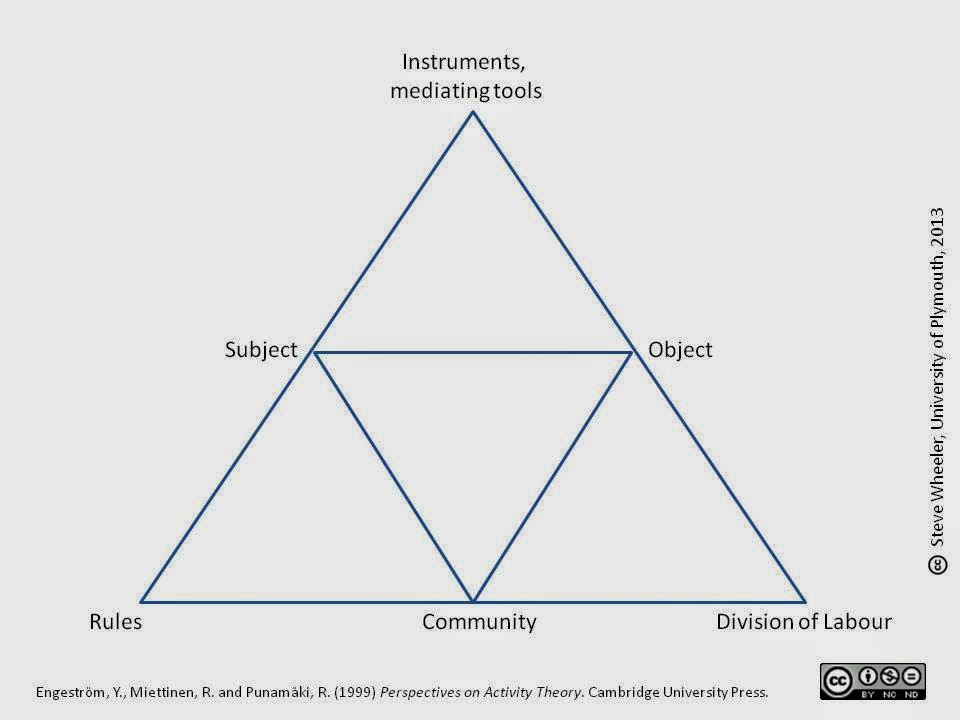
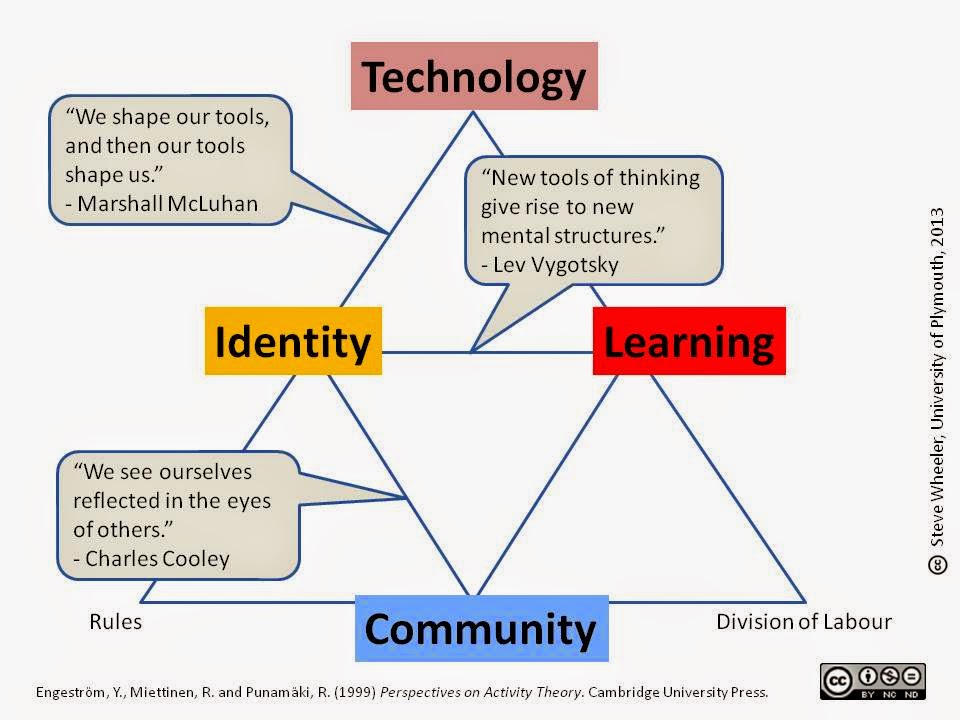
| Figure 1: Second generation Activity Theory |
 |
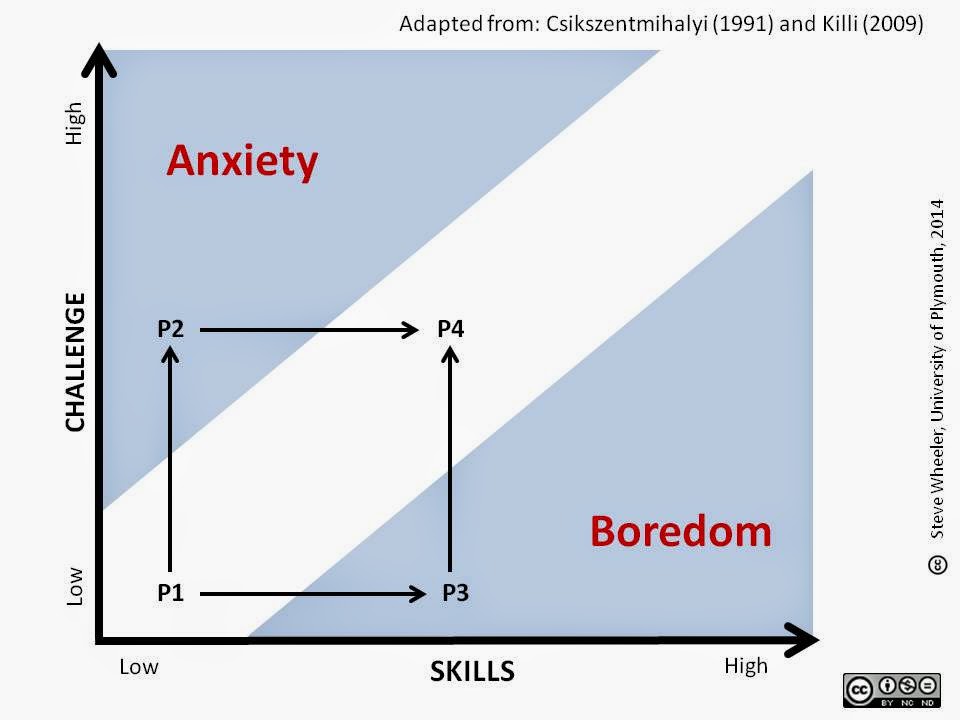
| Figure 2: Interpretation of AT in the context of digital identity |





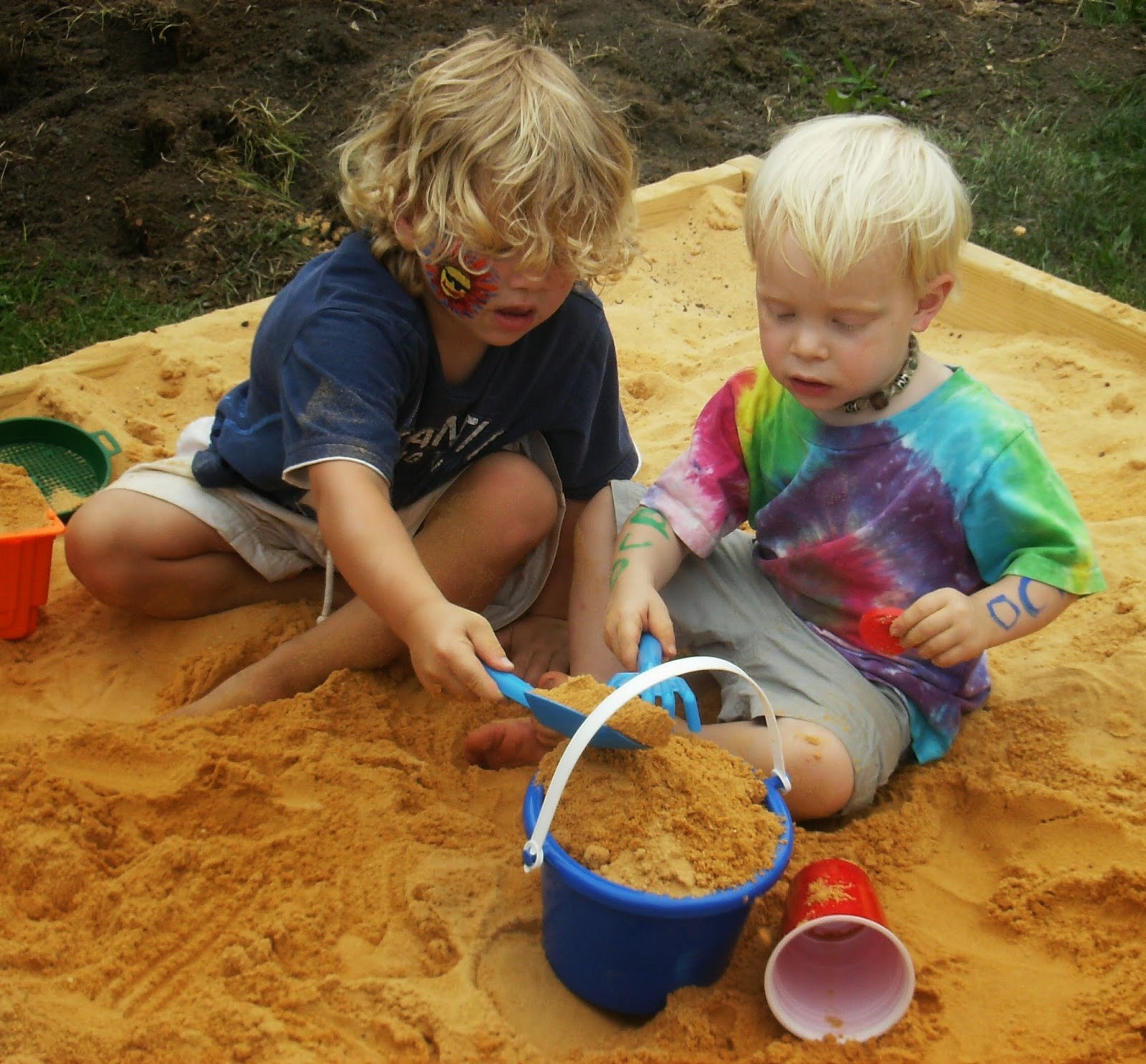
 This is number 4 in my blog series on major learning theories. My plan is to work through the alphabet of psychologists and provide a brief overview of their theories, and how each can be applied in education. Yesterday we examined the work of Albert Bandura on social learning theory. In this post, we explore the work of Jerome Bruner on scaffolding of learning. This is a simplified interpretation of the theory, so if you wish to learn more, please read the original works.
The theory
Bruner's theory of scaffolding emerged around 1976 as a part of social constructivist theory, and was particularly influenced by the work of Russian psychologist Lev Vygotsky. Vygotsky argued that we learn best in a social environment, where we construct meaning through interaction with others. His Zone of Proximal Development theory, where we can learn more in the presence of a knowledgeable other person, became the template for Bruner's model.
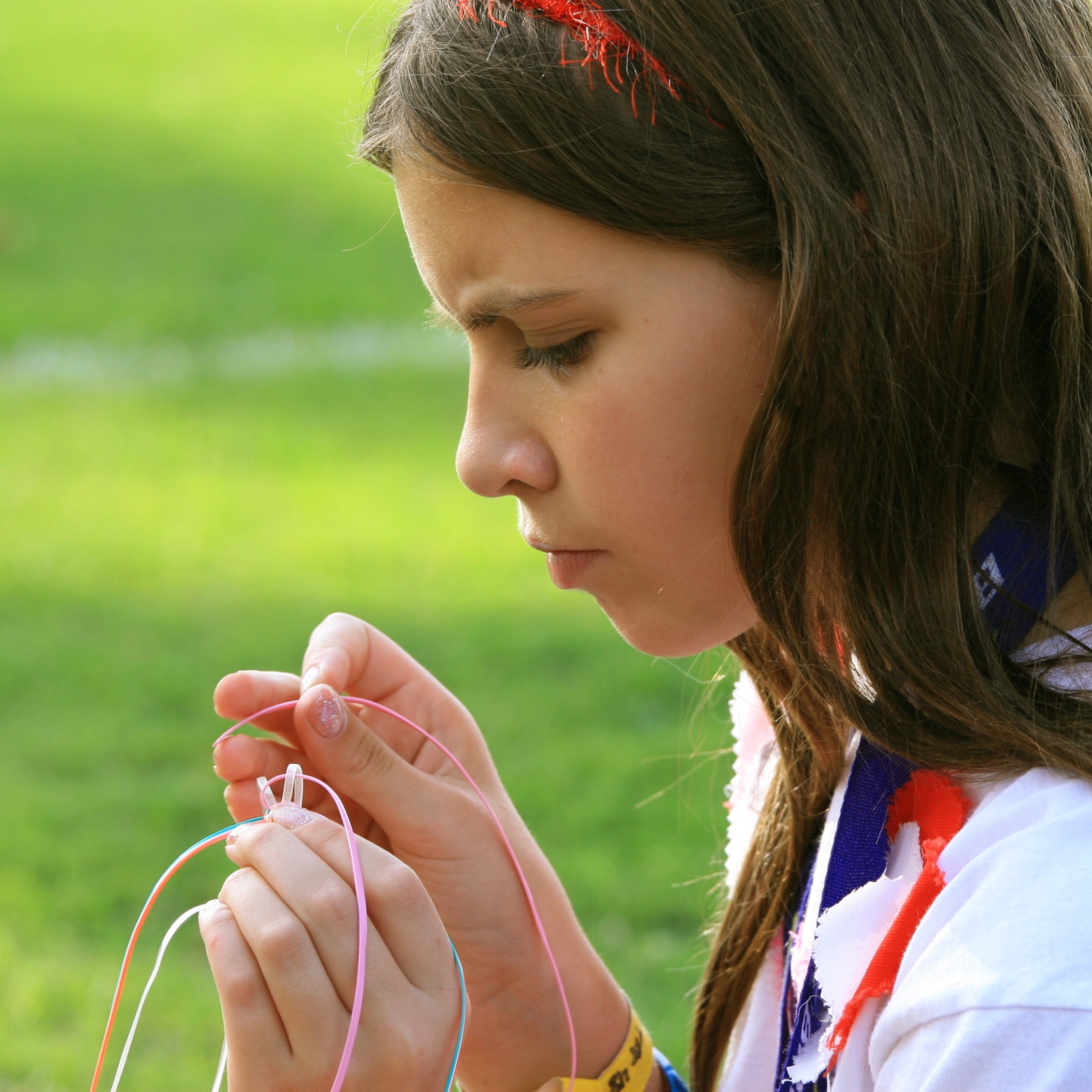
Bruner believed that when children start to learn new concepts, they need help from teachers and other adults in the form of active support. To begin with, they are dependent on their adult support, but as they become more independent in their thinking and acquire new skills and knowledge, the support can be gradually faded. This form of structured interaction between the child and the adult is reminiscent of the scaffolding that supports the construction of a building. It is gradually dismantled as the work is completed. In a very specific way, scaffolding represents a reduction in the many choices I child might face, so that they become focused only on acquiring the skill or knowledge that is required. The simplistic elegance of Bruner's theory means that scaffolding can be applied across all sectors, for all ages and for all topics of learning.
How it can be applied to education
It is important for teachers to provide opportunities for children to constantly learn new things. Some of those may be highly complex and will require support of a very focused kind. Teachers need to be aware of the developmental state of each of the children in their care, and should provide scaffolding that is appropriate. Although this may not be possible to do on their own, teachers can improvise and provide scaffolding through other support, including the use of other adults such as teaching assistants (para-educators) parent helpers, or more knowledgeable other children within the classroom. As children gain in confidence and competence in a particular areas, teachers might place them in groups to extend each other's learning further. It's also important that teachers recognise when a child is at the point where they begin to learn independently, and decisions can be made to set them free from the scaffolding.
Reference
Wood, D. J., Bruner, J. S. and Ross, G. (1976). The role of tutoring in problem solving. Journal of Child Psychiatry and Psychology, 17(2), 89-100.
Other posts in this series:
Anderson ACT-R Cognitive Architecture
Argyris Double Loop Learning
Bandura Social Learning Theory
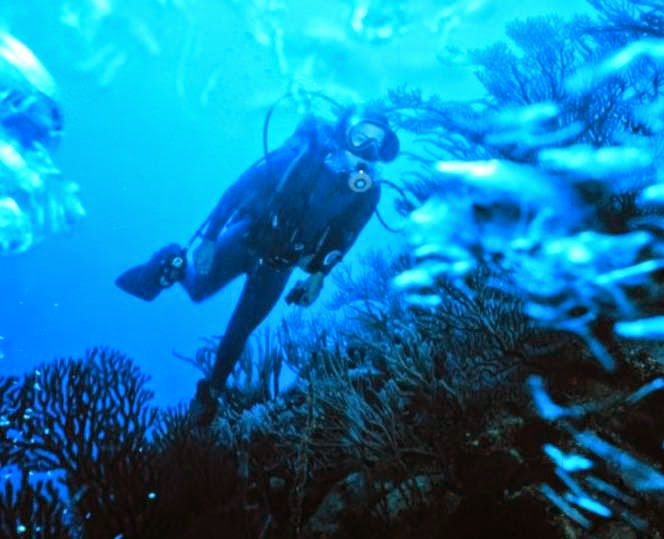
Photo by Clément Bucco-Lechat on Wikimedia Commons
Reaching further by Steve Wheeler is licensed under a Creative Commons Attribution-NonCommercial-ShareAlike 3.0 Unported License.


This is the first in a series of posts on important theories of learning and memory. Over the next few weeks I plan to work through the alphabet of psychologists to explain over 30 major theories that relate to teaching and learning. In each post I'm going to try to simplify some complex ideas and present the models and theories in brief, bite sized posts. Each will also have a brief section on how the theory might apply to everyday teaching and learning. Here's the first: John Anderson's ACT-R model of memory.
A considerable amount of research into learning has focused on human memory. A number of theories about how memory and recall function has been published, but one that stands out is a model derived from the work of Canadian psychologist John Robert Anderson. Adaptive Control of Thought - Rational - abbreviated to ACT-R (previously known as ACT*) - is a cognitive theory of learning that is concerned with the way memory is structured. The so called cognitive architecture of ACT-R is made up of three main components. These are represented in the model below (adapted from the earlier ACT* model)..









 I'm often invited to speak about the future. Normally the invitation is for me to discuss what we can expect in the world of education and learning, and my presentations usually cover new and emerging technologies, new pedagogical theories, and a range of ideas about what future classrooms (if there are going to be any) might look like. There is also a range of ideas about changing roles of teachers and learners, and some speculation about what new technologies we might expect to see in the future. I very rarely tread onto very dangerous ground though. This is the speculative and controversial area of future humans.
Several terms can be used to describe our future as humans. Recently I wrote an article entitled Human 2.0, but the title is probably inadequate to describe the incredible and far reaching changes we might witness. I also wrote about the controversial potential of the impact of genetic, robotic, artificial intelligence and nanotechnology sciences on our future in GRIN and bear it. Another expression sometimes heard is 'post-human', but this sounds a little lurid and sensational, as though we have entered into a new phase in human evolution. Cyborg is a name given to those who are both cybernetic and organic by nature or design. The lines are blurred between how much technology we would need to integrate into and around/on our bodies before we actually begin to lose our humanity.
As Martin Rees, Astronomer Royal, claimed at a conference in 2013:
'Post-humans will evolve from our species not via natural selection but by design. They could be silicon-based, or they could be organic creatures who had won the battle with death'
Whether or not this statement will ever be realised, we will need to wait and see. What we do need to ask though, is do we actually want a future like this? Do we really wish to subsume our humanity and immerse our identities under a sea of technology? Do we truly want to live forever? Am I alone in thinking that whatever name we decide to call our future collective state, and no matter how technologically advanced or integrated we choose to become with our technologies - we will, and must - always maintain an essence of our humanity. Very few of us will really wish to live forever. Physically and biologically it is impossible to do so. Metaphorically, and with a stretch of our imagination, it may be possible. There are theories that we can live on (or at least our memories can live on) within the vast digital acreage of the cloud. This is already possible, because whatever we create and share via the cloud, is indeed preserved for future use by ourselves and others. But this is not our true essence, our consciousness, our real selves. It is merely a representation of each of us. It is merely another version, albeit more accessible and malleable, of the diaries, books, films, music, photographs, paintings and sculptures previous generations have left behind for us to experience. As the dying android in the movie Bladerunner says:
'I've... seen things you people wouldn't believe... Attack ships on fire off the shoulder of Orion. I watched c-beams glitter in the dark near the Tannhäuser Gate. All those... moments... will be lost in time, like .... tears... in... rain. Time... to die...'
To truly 'live forever', computers would need to capture our humanity, the true essence of who we are. And since it is impossible for any of us to conclusively define who we are, how can we ever expect a computer to work it out? Our ideas may truly be in the clouds, but our heads certainly aren't and we are still a very long way off from being 'post-human'.
As ever, your views are welcomed.
Single frame from the movie Bladerunner via Wikimedia Commons
Who wants to live forever? by Steve Wheeler is licensed under a Creative Commons Attribution-NonCommercial-ShareAlike 3.0 Unported License.