The case of Santiago Swallow is intriguing. Swallow was born in Mexico, took up residence in the USA, and rapidly rose to prominence as a respected and influential guru in the world of social media. Now 42, Swallow is a veteran of the TED and SXSW conference circuit, and regularly tweets out his wisdom and insight to more than 76,000 Twitter followers. His recent nuggets have included: 'The first cloud computer was us' and 'to write is to live endlessly'. Swallow's eagerly awaited book - entitled Imaginary Identities in the Age of the Internet - has been predicted to have such impact potential that it will define an entire generation. Indeed, Swallow has been hailed by some commentators as 'one of the greatest thinkers of the Millennial Generation'.
So just who is Santiago Swallow?
The answer, surprisingly for his many followers, is that Santiago Swallow doesn't actually exist - he is in fact a fictional character.
Swallow is the alter ego of Kevin Ashton, a British technology pioneer who is famous for coining the phrase 'the Internet of Things.' If you search on Wikipedia for Santiago Swallow right now, you will be redirected to Ashton's page. The whole Swallow charade was concocted as a social experiment, a way of exploring how many people online create their own legends, often by buying Twitter followers, creating false email accounts and generally masquerading as someone else. It was easy to create the legend of Santiago Swallow, Ashton says in his blogpost 'How to Become Internet Famous for $68'. He first created a new gmail account, and then a Twitter account.The next stage was to acquire 90,000 Twitter followers for a small sum of about £33. A Wikipedia page was created, and the final step was to construct a Swallow website with its own domain name for another £12. Others soon noticed Swallow's presence and started to follow, assuming that he was indeed who he said he was. This fascinating social online experiment has revealed how easy it is to fake an identity, or in this case, simply create a new one from nothing but a germ of an idea.
Reputation can be bought it seems. But is one's reputation dependent upon online presence only? How many more people would have been fooled by the Santiago Swallow personality if Ashton had not himself exposed the ruse? How long could the experiment have continued if Ashton had stayed silent? How many of us still take content and personalities at face value when we encounter them online? These and many other questions about online identity, reputation, provenance and trust are still to be answered. My own rudimentaty manipulation of identity with my @timbuckteeth account and more recently the activation of my @stevewheeler sleeper account have given me some clues about the above questions. I have written about this in two posts, Double Agent and Double or Quits, where I explain some of my own thinking about online presence and digital identity. I would be very interested to hear from others about their views on these and other online identity experiments. What are the implications for us personally, socially and culturally?
Image source: Wikimedia Commons

A hard act to Swallow by Steve Wheeler is licensed under a Creative Commons Attribution-NonCommercial-ShareAlike 3.0 Unported License.







Collaboration is where two or more people work together to achieve a common objective. In education, the common objective is usually to learn specific content, skills or competencies within defined areas. Ostensibly, learning is an individual goal, and each student does tend to learn in their own way, using their own favoured approaches and tools. We refer to this as personalised learning (a video explains). However, as we become increasingly connected to each other through technology, and our social ties strengthen, so there is greater scope for students to learn together, sharing their resources and ideas, and approaching their study collaboratively. Collaborative learning does not undermine or contradict personalised learning. It simply amplifies it.
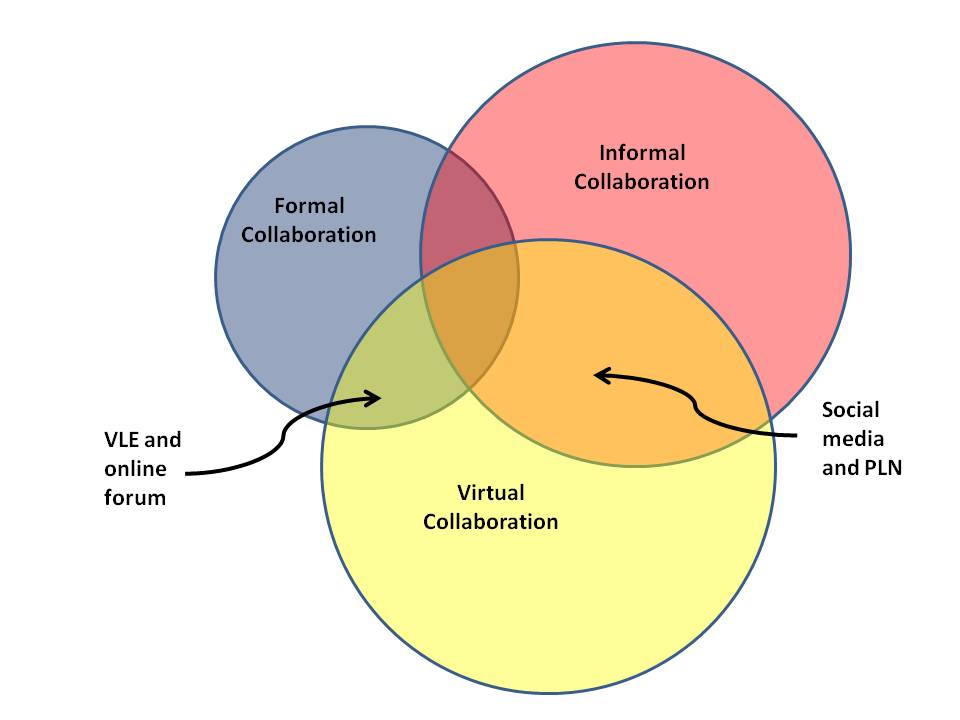
When it comes to learning with others, space is usually required. There is plenty to say about collaborative spaces. I can think of at least three kinds. There are the formal, classroom based collaborative spaces and there are the informal, non classroom spaces where we learn most of what we know in interaction with others. Then there are the virtual, online spaces where many of us are increasingly spending our time collaborating, conversing and sharing with our personal learning networks. I guess I could represent these three kinds of space in a simple Venn diagram below, which would then indicate that there is a lot of crossover, fuzziness, and boundary incursion between the three. You could see where we might place formal learning using a VLE, or where students might meet to chat using Facebook, for example. But it's far from perfect. Ultimately such a diagram serves one purpose - it reveals that where there were once very real boundaries, now they are many false frontiers.


 One of the most persuasive affordances of social media is that it encourages users to generate their own content. Potentially, this is a pedagogical gold mine for teachers if they choose to dig a little deeper. Teachers know that active forms of learning are better than passive forms. One result is deeper learning. Active learning is encouraged when students need to do something, solve a problem or produce something related to the content they are studying. Teachers who recognise this and see the potential of social media to promote active learning are in for an exciting time. Learning through digital media, says US educator Douglas Thomas, means that children are not only critical consumers of knowledge, but also producers of new knowledge. For too long, schools have been promoting the exclusive consumption of knowledge, some of which goes out of date very quickly. Schools (along with other educational institutions) should also be knowledge production centres. Our society needs new knowledge to supplement the established knowledge that already exists. Why leave it until university before students get to do research? Why not start them off on a lifelong journey of inquiry while they are still young?


Once again, thanks to Don H Taylor and his crew, this year's Learning Technologies conference was a highly successful event. 50 speakers presented talks at the event in London's Olympia over the two days, in what has become one of the premier, must attend events for learning professionals in Europe. High profile speakers including MIT's Nicholas Negroponte, futurist Gerd Leonhard, Lord David Puttnam, Professor Stephen Heppell and author Tony Buzan took to the stage to talk about their visions for the future of learning. All of the videos of their presentations can now be viewed (complete with synchronised slides) at this link.
My own presentation in the main arena at Olympia is entitled Future Learning Environments: Professional, Powerful, Personal. In it, I give my own vision for the future of learning, featuring new pedagogical approaches, emerging technologies and speculation about what we might see in education and training over the next few years. Do take a look by clicking on this link and if you wish to comment, please feel free to do so in the comments box under this blog post.


 |
| Futurist Gerd Leonhard speaking at Learning Technologies 2013 |