Log on:
Powered by Elgg

Feed detail

September 23, 2012

The future is a big place

If I have learnt nothing else this week, I have learnt that the future is a very, very big place. I wrote recently that we live in exponential times, and this was brought home to all of us this week at The Windsor Debates. We are simply not prepared for the future. We are not ready for the rapid and wide reaching changes that will impact us all in the next few decades. But at least, if we begin to spot the trends, we can try to prepare as best we can.

The Debates are hosted at Windsor Castle at least twice each year, under the auspices of the Thames Valley Chamber of Commerce, and have gained a reputation as a gathering point for the good and the great of business and industry and a nexus for grown-up debate around the issues of the day. On this occasion the economy, science and innovation, technology supported education and training, healthcare, globalisation, technology enhanced humans, world population trends, gender and race issues all came under scrutiny. It was a little surreal to be talking about such futuristic ideas in such an ancient setting as the Windsor Castle dungeon, but that simply added to the appeal and atmosphere of the event. You can view the list of invited speakers at this site. My own presentation outlined the problems of traditional education in a changing world, and called for a closer alignment of business and higher education, so that at least we can begin to understand what we need from each other. Other than that, I'm not at liberty to divulge who said what (Chatham House Rules, see), but I can summarise some of what was said for you.

Many of the speakers were interested in discussing how we can prepare for a future we cannot clearly describe. Some cited seriously frightening statistics about the trends of population growth and decline in the world. China's population will shrink by the middle of this century (to be overtaken by India) while Nigeria's and Indonesia's will rise precipitously. What will be the jobs we will do in the next few years, and where will the work be done? Will there even be a workforce in a few years time, or will we look back on the past 200 years or so and say, yes, that was the era of employment and it was merely a strange blip in human history? Organised, industrial work practices have only existed for that amount of time, it was argued. Prior to that, people generally worked for themselves or for a ruler. Global distribution of products, outsourcing of workforces, ubiquitous technology, new divisions of labour and ways of working, all are contributing to a seismic shift in the way business is being shaped. A lot of soul searching is going on inside companies. One speaker called for an end to hierarchy in the workplace, to be replaced by heterarchy (more on this in my next blogpost), which promotes a more democratic way of working, and gives ownership to all employees. Another advocated Punk HR - a quirky idea that turns out  not to be so strange after all, and may yet gain as much traction as it's pedagogical counterpart - Edupunk.

Essentially, the mood was that we are in a post-modern age, where all the rules we previously held dear are being challenged, eroded and supplanted by other, looser ideas. Many of the companies represented at the Debates are household names. Top ranking executives attended from each. Together, these people pack a big punch, and have impressive pedigrees, and each more or less agreed that we need to start moving in new directions, and do things differently if we are to survive into this new century. The demise of Kodak was cited.  Kodak was a leading global corporation that stuck to its old practices and business model, and paid a severe price, because it believed in a product that non-one wanted anymore. It didn't adapt to the trends, looked inward instead of outward, and ultimately paid the price.

Some of the futurologists present gave us insight into technological trends, and we discussed what it means to be a modified, enhanced human being. The ethics surrounding this debate were disturbing and complex, and the animated conversations lasted long into the night. Some of the statistics cited about ubiquitous computing, Giganomic trends (look it up), population growth and decline, and economic flow were as imposing as making your entry through the Henry VIII gate, past the stern armed police officers, and into the Castle compound. If you are ever invited to attend a Windsor Debate, grab it with both hands. You certainly won't be disappointed.

Image source

Creative Commons License
The future is a big place by Steve Wheeler is licensed under a Creative Commons Attribution 3.0 Unported LicenseBased on a work at steve-wheeler.blogspot.com.


September 22, 2012

Limitless learning

The personal learning environment (PLE) is still a bone of contention. Over at the Open University of Catalonia, in Barcelona, Ismael Peña-López has been doing some stirling work on theories surrounding Vygotsky's learning model and PLEs. His article can be accessed here in its entirety. Ismael starts by simplifying Vygotskian theory. He reasons that for Vygotsky, learning features three distinct layers: 1) What learners can achieve independently, 2) what they can do with the help of someone else (he calls this a more knowledgeable other or MKO and 3) that which is beyond the learner's reach, even with the help of an MKO.

Layer two can be defined as the Zone of Proximal Development or ZPD. What is interesting about Ismael's model is the way he incorporates the ZPD into a general model of the PLE, and argues that in fact, both MKOs and ZPD can constitute a PLE. This is all premised on whether we conceive of a PLE as a learning philosophy rather than simply a set of tools as most people see it. I'm in agreement with Ismael on this - I see the Personal Learning Environment as more than just a set of tools, or experiences, or environments. For me, the PLE is also more than a counterpoint to the centralisation/standardisation philosophy that spawned the institutional content management systems and services we see commonly today in schools, colleges and universities.

For me, the PLE is peculiar to the individual who makes it. It reflects his personality, learning characteristics and preferences. PLEs are constructed by the individuals who use them. This requires individuals to manage the connections between the tools, experiences, spaces and people, and this is often achieved within a digital framework. It is at the point that we accept that PLE is a learning philosophy, says Ishmael, that the entire vista of possibilities begins to open up to us. Ismael then makes the bold claim: "A PLE can be conformed by virtually everything that exists out in the cyberspace. If virtually everything is at reach, virtually everything can be understood as the more knowledgeable other. With a full, total, comprehensive access to the more knowledgeable other there virtually is no upper limit of the Zone of Proximal Development, there virtually is no level of problem solving that is unreachable for the student." The diagram above illustrates this vast potential very clearly. This is a bold and interesting theoretical punt which should serve to reinvigorate the debate about the purpose and scope of Personal Learning Environments. It means that potentially, if we have the appropriate tools and are connected to the right people, learning will be limitless.

Image by Ismael Peña-López

Creative Commons Licence
Limitless learning by Steve Wheeler is licensed under a Creative Commons Attribution-NonCommercial-ShareAlike 3.0 Unported License.


September 19, 2012

Exponential times

We live in exponential times. Change is rapid and events often take us all by surprise. Social, economic, environmental and political challenges roll across our screens every day. Now, more than ever, we need good education to negotiate our way through the turbulence of our times. There is a distinct separation forming between those who are teachers and those who aspire to be educators. Anyone can be a teacher, and indeed, whether they know it or not, just about everyone does do some teaching during an average week, usually on a very informal basis. Although we all teach, not everyone can be an educator. Educators are a breed apart, and although the professional title of 'teacher' is sustained in schools, it is often the educators that make all the difference. Not everyone can see the difference between teachers and educators, and many tend to think they are synonymous as this online discussion forum demonstrates. But there are distinct differences, and it is essentially the attitude of the individual that is at the heart of the question. I read an excellent blog recently which brings the differences into sharp focus:

Ashley Tan's blog Another dot in the Blogosphere? features an excellent exposition of the differences between educators and teachers, and I really believe it needs a wider audience. So here, on this blog, is a summary:

  • A teacher teaches; an educator reaches.
  • A teacher typically focuses on curriculum and assessment. An educator focuses on development and evaluation.
  • In the curricular race, a teacher perspires. In the journey of lifelong learning, an educator inspires. (An educator goes the extra mile.)
  • A teacher works with content. An educator deals with people.
  • Teaching is a job. Educating is a calling.
  • Some teachers do this to earn. Educators do this to learn (about themselves, their learners, better ways to inspire, etc).
  • A teacher might network locally. An educator is connected globally (and thinks and acts that way too).


  • The world needs individuals who will go the extra mile. This is what true educators do. They reach out to our young people, and they make a difference. It's not simply a job for them, and no amount of money would recompense them for all their commitment and overtime spent engaging their students, preparing, marking, planning and studying. As a teaching profession, we all need to work more with people than we do with content. In 1962, President John F. Kennedy stated that 'a child miseducated, is a child lost'. During my lifetime I have encountered many individuals who were miseducated, and took the wrong pathway in life. We need to be so careful how we execute our roles as learning professionals, because the future of an entire generation is in our hands. Any poor decisions we make can influence our students badly, but conversely, any good decisions we make can inspire that same generation to succeed, to burn brightly, and be a real force for good in this world. What an opportunity we have, but what a frightening prospect, if we get it wrong.  Yes, we live in exponential times, with change and uncertainty all around, but I have met some incredible educators in the last few years that give me a lot of hope for the future. They are more connected that any previous generation of educators, and they are more passionate. They will be the ones who make a difference to young lives. I believe that one day we'll look back on this period of time and say 'that was an extraordinary generation of educators.'

    Photo by Anders Hoff

    Creative Commons License
    Exponential times by Steve Wheeler is licensed under a Creative Commons Attribution 3.0 Unported LicenseBased on a work at steve-wheeler.blogspot.com.


    September 18, 2012

    Uncertainty principles

    It's extremely difficult to predict the future accurately, because as futurologist Ray Kurzweil once said, change isn't linear, it's exponential. I often consult The Horizon Report, which is published every year and attempts to predict what will be the widespread adoptions of technologies in education and training. The annual report is published after extensive consultation with an international panel of technology and pedagogy experts. Yet even this is problematic, because the farther you move away from the present, the more opportunity there will be for unforeseen and unpredictable events to occur. And experts are not infallible. You really have to turn to science fiction and read something like Isaac Asimov's Foundation Trilogy to appreciate some of the complexity associated with this kind of uncertainty. What does the future hold? We can't be certain, because right now it's imaginary. The Horizon Report is usually quite accurate in the 1 year cycle. When we examine the predictions in the 2-3 year cycle, it becomes a little hit and miss, and by the time we attempt to predict what will be widely available on the 5 year horizon, it becomes even more tricky to maintain accuracy. The farther out we move in projected time from the familiarity of 'here and now' the less accurate we are in our predictions.

    I was invited to speak at the Learning and Performance Institute's annual conference - Learning Live - at St Paul's in London recently, on the subject of Learning Futures, and afterwards talked to Martin Couzins, who recorded the brief video interview below (yes, I know it says 'learning tends'... but perhaps that's a fortuitous error):


    Creative Commons License
    Uncertainty principles by Steve Wheeler is licensed under a Creative Commons Attribution 3.0 Unported LicenseBased on a work at steve-wheeler.blogspot.com.


    September 17, 2012

    Inspired

    The Plymouth University Vice Chancellor Enterprise Awards and Gala Dinner took place in a large marquee on Plymouth Hoe this weekend. It was a grand event, with chandeliers, live music and an excellent dinner, and as you can see, it was a black tie affair (you may never see me dressed so smartly again). My colleagues Peter Yeomans, Oliver Quinlan and I were delighted to be nominated for this year's inspirational teacher award, and we attended in the hope that we might be in with a chance. However, it was a very strong field, with 4 other shortlisted nominees, all doing remarkable work with their learners, and seeing incredible results. We were very proud then, when the envelope was opened, to hear our names being read out as the winners. Making our way from the very back of the hall, meandering around the tables and onto the stage to receive our award while the spotlights played upon us, it all felt a little like the Oscar ceremony, but we didn't get to make a speech, thankfully. We were doubly proud because not only had we been nominated for the award by our university colleagues, but also by our current and past students too. Here is an excerpt from the website nomination, with endorsements from a former student and a current student:

    This team has been developing a collaborative, open and meaningful social media presence in e-learning and primary pedagogy. They are developing an innovative pedagogy by working to enable trainee teachers to develop their own sustainable network of professional development and the confidence to draw the best of their contacts into lectures and seminars, to enhance their own student experience. The team has inspired students to learn beyond their course, engaging with national experts and using their own personal blogs to make meaning of the learning taking place on the course. The result is a stream of nationally significant educators, willing to spend time helping our students and seeking to take our students on placements. Some students were able to showcase their dissertations as part of the international PELeCON conference. The goal of their work is to create connected students who are "hammers, not nails", with a credible and deep understanding of their own values and the purpose of education.

    The team have put Plymouth on the national and international map amongst the social media in education fraternity. Regularly the team receive complements about the quality of the @plymuni experience which shared with thousands of twitter followers.

    "During my time at university they inspired not only me, but many others on my course to think in a way that challenges the norm. Through their influence a generation of trainee teachers were pushed to consider the rights and needs of the children in their care above all other influences. They encouraged us all to be passionate about our work, to think creatively and to make changes to our world. For me personally they have long been a source of support, advice and inspiration. Since leaving the University they have supported me in my new career and their way of working is still a standard I hope to reach. In this way they have empowered me, and many others they work with to continue challenging ourselves to improve." - Alumni.

    "They have encouraged me to do things that I never thought I could do. Firstly, I was asked to speak at an event in front of 200 professionals. I then had the opportunity to arrange a Teach Meet conference for like-minded professionals. They have opened my eyes to the world of teaching in a way that no other lecturers have been able to do. They motivate me to get involved with all aspects of University life and because of this, I am now involved in volunteer projects, arranging Teach Meets and I had the confidence to stand for secretary of the Plymouth Education Society, which I was successful with. I know that without the support and dedication that I have been given, I would still be working my way through University without taking part in all of these projects and events that really are life-changing for me." - Student.

    That is why this award means so much to Peter, Oliver and I - it is recognition that we are in some small way contributing to inspiring a generation of new teachers who are, or who will soon be, let loose to teach our children, to pass on that inspiration - that zest for learning, and curiosity to ask the what if questions for the rest of their lives. Thanks to everyone who has sent us congratulatory messages. It means a lot.

    Photo by Amy Parkin

    Creative Commons License
    Inspired by Steve Wheeler is licensed under a Creative Commons Attribution 3.0 Unported LicenseBased on a work at steve-wheeler.blogspot.com.


    September 15, 2012

    Learning by making

    The transmission model of learning is still dominant in education. Whether you are in a primary or secondary school classroom, or in a lecture hall or laboratory in a university, you will almost always see the teacher or lecturer directing proceedings, often from the front, usually 'instructing' their students in some way. You may also witness other, underlying pedagogical models playing out, usually where students are asked to do some group work or find out for themselves through individual project work. Whilst these approaches to learning are often more effective for personalised and collaborative learning, they tend to be kept to a minimum in most cases, because teachers like to maintain some level of control over their students, and finite time and resources constrain them. So passive reception often becomes the dominant mode of learning in traditional environments.

    Back in the early 1990s, when I was involved in nurse education, I introduced a project where students were given an entire day to create a 5 minute video on a subject directly related to their course. In groups of threes and fours, the student nurses were sent out to conceive their video, script and storyboard it, decide on roles, procure their props, scout out shooting locations, record their video, and then edit it. Then, during the final hour of the day, each group introduced, showed and discussed their 5 minute video. Many of my colleagues were sceptical about the value of this kind of approach to learning. They argued that it was a waste of time when the nurses could be studying their text books, writing their essays, or practicing how to give injections into oranges. I countered that the students were, in fact, engaged in a very high level of cognitive activity where they were engaged in learning by making. It wasn't until a few years later when I discovered the work of Seymour Papert (now one of my Facebook friends!), that I was able to build a theoretical framework around the nurses video project. In his theory of constructionism, Papert argued that we build mental representations of what we learn, and that the situated nature of where we learn influences and strengthens that representation. In other words, we learn by doing and building within relevant environments, and that authentic tasks can be very powerful in support of that situated learning.

    At the time I showed my colleagues that the nursing students were learning numerous skills that they would later be able to transfer across into their professional practice. To successfully complete their video project they needed to be able to solve problems, create content, construct artefacts, take decisions and make critical judgements, work together as a team, divide their labour and select appropriate tasks, manage their time, think creatively, negotiate difficult situations, consider ethical issues, work with finite resources, successfully bring a task to completion and reflect on their practice. How many of these skills could be modelled and situated within a classroom in such a short period of time?  The very act of constructing something tangible allows students to test out hypotheses, learn from each other and solve problems as they progress. Abstract ideas and concepts become concrete and are situated in real life contexts. These are essential skills for 21st Century working. It is for these reasons that making things is a central part of all my courses, and whether it is a video, podcast, blog or any other digital artefact, students gain ownership, and invest their energies and their ingenuity into making and presenting it. In so doing they are constructing their own versions of knowledge and developing the skills they will later need outside in the world of work.

    Photo by Ah Zut

    Creative Commons License
    Learning by making by Steve Wheeler is licensed under a Creative Commons Attribution 3.0 Unported LicenseBased on a work at steve-wheeler.blogspot.com.


    September 12, 2012

    The games we play

    What is it about games that make them so popular, and such a powerful learning method? For a start, there are an impressive array of transferrable skills to be acquired, especially if the games played are designed effectively. Secondly, most people now have the capability to play games on the move, using smart phones, touch screen tablets and handheld consoles. Thirdly, many online games have very rich social dimensions, which lead gamers to extend their learning further through discussion, collaboration and competition. Many scholars have researched the effects of games on learning, but perhaps one of the most prolific and profound games theorists is James Paul Gee. Gee provides several principles that together constitute a games based learning theory. The first is the psychological moratorium principle, which could also be referred to a 'suspension of reality'. Gamers are free to take risks in spaces where 'real world' consequences are negated. In a first person shooter game for example, you can kill as many enemies as you wish, and you won't be prosecuted for murder. You can fall from the top of a building or endure a high speed car crash, but you won't suffer a scratch or a bruise.

    There is also the committed learning principle, which describes how gamers have sustained engagement as extensions of their real world identities in relation to their virtual identity (or avatar). This often enables gamers to develop an emotional attachment for which they feel some sense of commitment, and this also makes the virtual world they inhabit more compelling. Lots of effort and practice invested in World of Warcraft or the Sims results from the gamer being committed (some might even say 'hooked') to the game.

    Another principle is the identity principle, which relates closely to the committed learning principle above. Learning through games often involves manipulation of identity in such a way that the gamer has real choice over how they wish to represent themselves, particularly in social games. This can result in forms of role playing where the gamer can choose to be a hero, a villain, or something entirely different.

    The self knowledge principle relates to virtual worlds (or games terrains) being constructed in such a way that gamers learn not only about that environment, but also about themselves and their current skills, knowledge and capabilities. Gamers can make mistakes and learn from them. Next time, they improve their performance and avoid the same errors. As Graham Brown-Martin remarked, gaming is powerful because there is constant assessment of performance (usually self assessment, but also from the community who are playing the game if it is a social game).

    Perhaps one of the most powerful principles is the achievement principle, which is instrumental in bringing many gamers back time and time again to improve their scores, hone their skills and relive previous experiences within the game. There are intrinsic rewards within most games, which if designed cleverly, will provide a gradient of difficulty (levels and goals) including problems to solve and knowledge to gather, which gamers can achieve with incremental effort and commitment. It is clear that problem solving and critical thinking skills are essential skills for successful learning and working.

    There are several other principles identified by Gee, but I believe the ones listed above provide a reasonably clear model that explains why games are so powerful, and why they should be considered as tools to support learning for the 21st Century. More on Gee's learning principles can be found at this website.

    Photo by Steve Wheeler

    Creative Commons License
    The games we play by Steve Wheeler is licensed under a Creative Commons Attribution 3.0 Unported LicenseBased on a work at steve-wheeler.blogspot.com.


    September 11, 2012

    Touch and go

    Since the introduction of the iPad and the subsequent parade of similar touch screen tablets, there has been much speculation about exactly what impact the devices might have on learning and teaching. A lot has been written about the potential of the devices, and much has been purely anecdotal. Clearly tablets are easy to use and have potential to revolutionise the way people access information. But what about formal education? I have contributed to the dialogue on this blog and there is much to discuss in relation to pedagogy, teacher roles, assessment and curriculum issues. There are also huge potential benefits in untethering learning - allowing students to roam while using the devices as mobile learning platforms. Recently a book was published with the title iPads in Schools, and several conference papers and articles are emerging which debate the place of touch tablets in formal education. Will they be a welcome addition to formal learning, or will they be a distraction? The intuitive design of touch screen tablets and their usability serve to fuel the hyperbole. But what impact are iPads really having on learning in formal education?

    Until very recently, little empirical evidence had emerged to demonstrate clear learning benefits from tablets. The publication by NAACE (authored by Jan Webb) will add to our knowledge. Entitled 'The iPad as a Tool for Education' the report is one of the most comprehensive yet on the impact of tablets in schools. It is a case study conducted at Longfield Academy in Kent, one of the first schools in the UK to adopt a school wide roll out of iPads to all of its students. Results of the study were mainly positive, showing that iPads were instrumental in encouraging better collaboration and increasing the motivation for learning. The tablets were used to develop beyond school activities and for supporting homework, and the quality of student work and learning outcomes has improved. This will be the first of a range of studies that will emerge in the next year or two, as more school adopt one iPad per child strategies, and time is taken to realise tangible and measurable outcomes from embedding the tools into daily learning and teaching.

    Image by Fotopedia

    Creative Commons License
    Touch and go by Steve Wheeler is licensed under a Creative Commons Attribution 3.0 Unported LicenseBased on a work at steve-wheeler.blogspot.com.


    September 07, 2012

    Taking the risk

    I spent a very enjoyable day in North Yorkshire this week working with the teachers and students of Skipton Girls High School. I was invited to give a keynote presentation at the start of the school year and afterwards watched a showcase of all the students and staff have been doing with technology and learning. In my own presentation I challenged teachers to take risks by breaking down some of the silos that currently exist in education. I asked why we still use ICT suites, which send a message to the children that 'this is where we do computing'. We have the technology to do this now in the palm of our hands, so why do we continue to tether children to one specific space? The same applies to subject teaching. Why do we stick to one subject for each lesson, when in fact all subjects have links across the entire curriculum. Why do we insist on synchronized behaviour, where everything is dependent on the clock? Many of these practices, I argued, are vestiges of a long gone industrial era. They represent the factory model of education where children are 'batch processed' by age group rather than ability. Perpetuating standardised testing regimes is also a big mistake. What does it achieve apart from providing whole school data for league tables? How will standardised testing encourage children to think independently and creatively?

    Today, I argued, we need to prepare children for flexible working and agile thinking, where their employment may well be highly mobile and location independent. They will need to acquire critical thinking and problem solving skills, and will need to be highly digitally literate. They will need to be creative and will need to know how to innovate. They will need to know how to self organise, and also work in distributed teams, where the other members of that team may be connected over great distance through technology. They will need to gain an appreciation that change is an opportunity rather than a threat, and that a lifetime of work may encompass a portfolio career of several different jobs, requiring different skill-sets. They will need to be lifelong learners. I warned that anything less will not prepare children for a future we cannot clearly describe, but may even disadvantage them.

    I was gratified later on during the student showcases to see that Skipton Girls High School is clearly already adopting many of the innovative learning strategies that will prepare children for portfolio careers in an uncertain future. Skipton is beginning to break down the compartmentalisation between curriculum subjects. I saw several examples of how students are learning a combination of physics and music (analogue and digital sound engineering principles) and again physics coupled with biology (how sound waves are interpreted into impulses for hearing). SGHS is an Engineering specialist school, so the emphasis is clearly on problem solving, design and implementation of ideas. I asked one of the students why she thought it was important to have lessons where different subjects were linked. 'Because when we do that, we get a better understanding of what we are learning' she replied. I was also impressed by the co-construction projects the students were involved in. Co-construction involves group work, collaborative skills, decision making, negotiation, creative problem solving, diplomacy, design skills, and a whole host of other soft skills, all of which are essential in the modern workplace. The students used PowerPoint to create hyperlinks between their content, which they developed as a part of their course. Students creating the course content - now there's innovation. SGHS is a very impressive set up. The teachers and students are willing to take risks to make the necessary changes that will break schools out of the stranglehold the industrial era still exerts on contemporary education. Skipton and other schools are trailblazing the way ahead, where risk taking, creative thinking and new technologies are central components in that process. Let's hope that more schools do the same.

    Image source

    Creative Commons License
    Taking the risk by Steve Wheeler is licensed under a Creative Commons Attribution 3.0 Unported LicenseBased on a work at steve-wheeler.blogspot.com.


    September 03, 2012

    Learner analytics

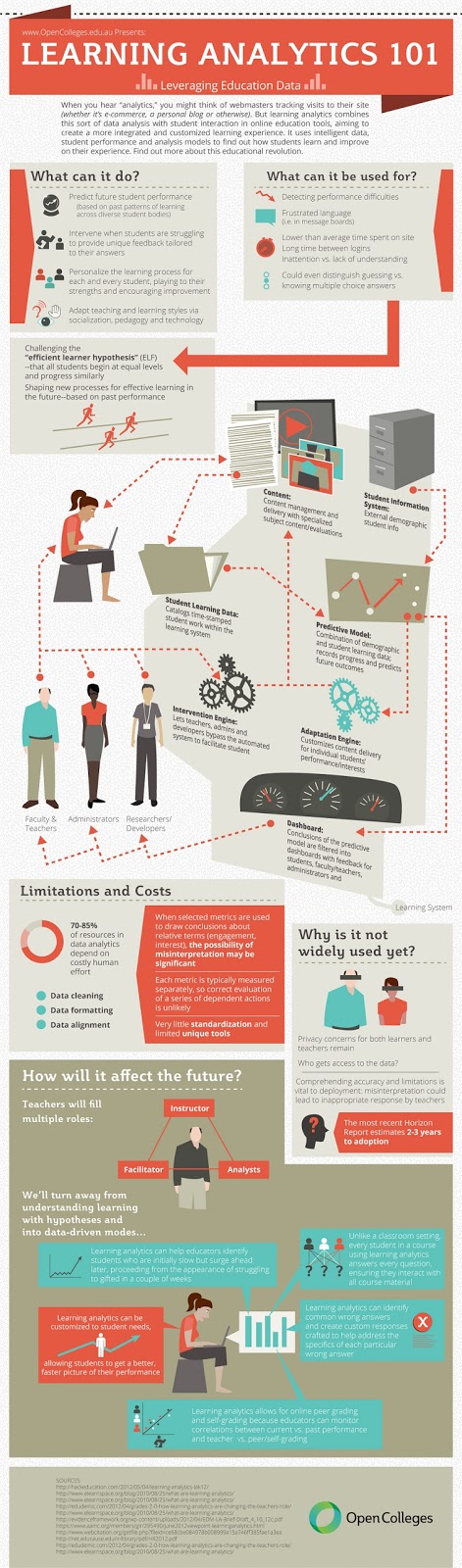
    As was identified in the 2011 NMC Horizon Report ( I served on the advisory board of the UK JISC version), it seems that learner analytics is going to be a big thing for education over the next four to five years. Expect to see it emerging into mainstream practice in a number of versions, specifically aligned to the personalised learning agenda. From the report comes an explanation of learner analytics:

    Learner analytics loosely joins a variety of data gathering tools and analytic techniques to study student engagement, performance, and progress in practice, with the goal of what is learned to revise curricula, assessment and teaching in real time. Building on the kinds of information generated by Google Analytics and other similar tools, learner analytics aims to mobilize the power of data-mining tools in the service of learning, and embracing the complexity, diversity and abundance of information that dynamic learning environments can generate.

    Below is a very useful infographic developed by the Australian Open Colleges organisation. I think it explains just about everything you will need to know about learning analytics:


    Image source 

    Creative Commons License
    Learner analytics by Steve Wheeler is licensed under a Creative Commons Attribution 3.0 Unported LicenseBased on a work at steve-wheeler.blogspot.com.


    September 01, 2012

    Promoting change in schools

    In yesterday's blogpost I discussed the problems of change management in schools and suggested that the biggest barrier to the successful adoption of new technologies lies in the minds of teachers. The attitudes of  teachers toward new technologies for example, are shaped by their perceptions of the usefulness of these technologies in day to day practice. In 2005 I edited a book entitled 'Transforming Primary ICT' (Wheeler, 2005) in which I authored a chapter on change management. Here is an extract, much of which, I believe, still holds true today:

    The arrival of information and communication technologies (ICT) in the primary classroom has produced some astounding outcomes. For many, teaching and learning has been transformed, with new methods and practices often emerging as a direct result of the use of computers. The internet has unleashed countless new resources and caused teachers to rethink what teaching and learning are all about. Electronic records and databases enable the classroom practitioner to access a wealth of useful information that was previously out of reach. Tedious and mundane jobs can be automated, liberating teachers to concentrate on the more creative aspects of their professional practice. ICT is quite simply transforming primary education, and it is doing so at many levels.

    Teachers have met the rapid uptake of computers in schools with both positive and negative responses. From a positive perspective, ICT brings a number of clear advantages for the teacher and the learner, which encompass new resources, new ways of teaching and new ways of learning. The internet, for example, can provide children with access to a vast repository of information, learning resources and experiences. The use of interactive whiteboards can enhance lessons by providing teachers with a range of new delivery methods and teaching resources. Use of e-mail can cut down response time from days to minutes, with teachers connecting to each other, school governors, Local Education Authorities, suppliers, specialist teachers and advisors, and of course, pupils and their parents. In short, the introduction of ICT has the potential to radically alter the face of teaching and learning in schools.

    Less positively, ICT has been instrumental in alienating many teaching staff, causing them to question their role as educators, and engendering a great seal of disquiet and anxiety for the future. With any change comes uncertainty and, in the case of the computer, this change has been all pervasive. It is no wonder that some teachers feel threatened by technology. (pp 7-8).

    Seven years on from writing this piece, I am seeing schools adopting technologies and embedding them within the curriculum. Things are improving, but there are still many schools who lag behind, either due to lack of vision or leadership, lack of resources, or a fear of the implications of technology. The latter may be one of the most trenchant barriers to the adoption of new technology in schools. In my next post, I plan to explore 'technophobia' and how it impacts of the adoption of new technologies in education.

    References
    Wheeler, S. (Ed.) Transforming Primary ICT. Exeter: Learning Matters.

    Image source

    Creative Commons License
    Promoting change in schools by Steve Wheeler is licensed under a Creative Commons Attribution 3.0 Unported LicenseBased on a work at steve-wheeler.blogspot.com.


    August 31, 2012

    Teacher beliefs

    How can we promote successful change in education? Schools are notoriously conservative institutions, so it is often difficult to introduce new ideas. Much of the resistance to change comes from teachers who 'have always done it this way' and who have the mentality that 'if it ain't broke, don't fix it'. Teacher beliefs about pedagogy are central to the successful integration of new technologies into schools. The extent to which they see technology skills as relevant and valuable directly relates to the extent to which these skills are practised and applied in their work. If teachers believe that technology adds no value to their teaching, they will simply not use it. New technology really has to be shown to be relevant and useful. The technology in any given school can be as high quality, shiny and compatible as you like. Technical support can be second to none, and all the support in the world on offer, but if the teacher is not convinced of its usefulness, forget it.

    A long history of psychological research supports the argument that an individual is more likely to perform a behaviour when there is a high probability of a positive outcomes. See for example the work of Ajzen and Madden (1986) or Doll and Ajzen (1992). Teachers will only adopt new technology if they can see the benefits and are convinced something can be improved or enriched.

    Perhaps even more important is the issue of professional practice. If teachers see no need to question or challenge their own practices, another barrier to the adoption of change arises. Reflection on practice is therefore a vital component in change management.

    Put the political issues (such as regulation of activities and bans on the use of certain technology in schools) to one side for a moment. Do the same with the technical issues such as lack of bandwidth or hardware, or human issues such as lack of knowledge or skill. These have an impact on the success of technology integration in schools, but by far the biggest barrier to change lies inside the head the teacher.

    More on change management in schools next time.

    References
    Ajzen, I. and Madden, T. (1986) Prediction of goal-directed behaviour: Attitudes, intentions and perceived behavioural control. Journal of Experimental Social Psychology, 22, 453-474.
    Doll, J. and Azjen I. (1992) Accessibility and stability of predictors in the theory of planned behaviour. Journal of Personality and Social Behaviour, 63 (5), 754-765.

    Photo by Steve Wheeler

    Creative Commons License
    Teacher beliefs by Steve Wheeler is licensed under a Creative Commons Attribution 3.0 Unported LicenseBased on a work at steve-wheeler.blogspot.com.


    August 29, 2012

    Thinking in networks

    'Build your network and always think in networks. They create a sonor map of intelligence, expertise, information and insight. Your allies, your connections, can help you to navigate the larger number of challenges that can ultimately derail a startup company'. - Reid Hoffman (Founder of LinkedIn)

    When he made this statement at Babson College in May 2012, Reid Hoffman was referring to startup companies, but he could very well have been giving advice to any undergraduate student, or indeed any teacher or academic. Let's be honest. We all need help. Education has always been a team sport, whatever side of the classroom you sit on. I know I increasingly rely upon my own colleagues, but that collegial reliance has extended beyond the walls of my institution. In fact it did so several years ago, even before the introduction of social media, through the use of e-mail and bulletin board services (remember them?). Social media has simply provided an increasingly powerful range of tools to extend personal learning networks (PLNs) to virtually any part of the world. I regularly hold conversations with colleagues in multiple time zones, because I can. I am connected, and I am thinking now as Reid Hoffman advised, in networks.

    It would be a mistake to think of networks simply as connections (See my previous post entitled 'the importance of being networked'). They are much more complex than that. Networks involve connections, but they also hold the capability to boost the power of those connections exponentially, through multiple nodes of knowledge production and rapid amplification of ideas. In a mimicry of the myriad connections in the human brain, each node has the potential to link with many other nodes, and thus extend the power of the network exponentially. I can send out a Twitter link, which may be retweeted by a dozen of my Twitter followers. Each of those may have thousands of followers who don't follow me. They in turn retweet to their independent followers. Within a few minutes, or even seconds, my link is being shared by potentially hundreds of thousands of people worldwide. If they like my content, they may track back and follow me on Twitter too. This is why I say that retweeting is not repetition of ideas - it is amplifcation.

    And Twitter is just one of a multitude of social networking tools available to teachers and academics. Other networks are available. The ability to connect these networks together (e.g. Twitter feed into your blog, or Facebook links mirrored in LinkedIn) means that teachers are never alone. Suddenly the team sport has become a relay that can go in any and all directions simultaneously, and every time the baton is passed on, it reproduces itself, so other teams can join in. As I have already suggested above, all we are really doing with social technology is replicating what we see in nature. Cell division and rapid proliferation of genetic material across an organism. Viral reproduction of genetic material between and across organisms. Rhizomatic spread of connections in a similar manner to brain cells or underground root systems. We are passing on memes instead of genes. It is the meosis and mitosis of ideas. At the moment though, we are merely scraping the surface of immense, almost infinite potential, and Reid Hoffman is right. If we want to exploit the power of this for the benefit of our students, we need to start thinking in networks.

    Image source

    Creative Commons License
    Thinking in networks by Steve Wheeler is licensed under a Creative Commons Attribution 3.0 Unported LicenseBased on a work at steve-wheeler.blogspot.com.


    August 24, 2012

    The changing Web

    This is number 4 in the series of blog posts entitled 'Shaping Education for the Future.' Yesterday's post can be found at this link.

    The web is constantly changing. Social media - often referred to as Web 2.0, or the participatory Web - is shaping up to be one of the most important tool sets available to support the promotion of change in education. Almost everyone, it seems, is using some element of social media in the planning, development, delivery, management or evaluation of teaching and learning. One of the greatest changes (and challenges) for education over the last few years has been the proliferation of user generated content. My own students create a lot of their own content during their study, usually in the form of podcasts, videos, wiki and blog content, and are encouraged to share these publicly online to gain additional feedback. Doing this, they tend to engage more deeply with learning, and find themselves collaborating more and learning from each other, as a result of using Web 2.0 tools. Essentially, Web 2.0 enables them to take more responsibility for their own learning. They like to share their ideas, and they enjoy playing their part in the production of knowledge. Learning is changing, and their experience is being shaped by the participatory Web. The Web is constantly changing, but it is also a change agent.

    We need to acknowledge that 'Web 2.0' remains a contested label for new and emergent properties that are found on the Web. It is a complex network of dynamic resources that we all acknowledge is constantly changing to adapt to the growing demand for entertainment, communication and access to knowledge. Debate focuses on whether the emerging social applications constitute a sea change or revolution in the Web (cf. Van Dijk, 2002) or simply another phase in its relentless progress. Personally, I find myself in agreement with Brian Winston (2003) who views the Web as a facet of gradual evolution rather than symptoms of sudden revolution. Essentially, the Web has become more social. As with most other technology innovations, Web 2.0 applications have grown out of the need for people to connect together, share experiences and knowledge, enhance their experiences and open up new possibilities in learning. Social software is software that enables people to both read from, and write onto web spaces. It truly is the ‘architecture of participation’ (Barsky and Purdon, 2006) and demands active engagement as a natural part of its character (Kamel Boulos and Wheeler, 2007).

    Web 2.0 tools include popular applications such as blogs, wikis and podcasting; social networking sites such as FaceBook and LinkedIn; photo and videosharing services such as Flickr and YouTube; familiar utilities such as RSS feeds, social tagging (e.g. Delicious, Diigo), microblogs such as Twitter, mashups (e.g. geotagging). Web 2.0 has spawned concepts such as folksonomy, ‘Darwikianism’ and the ‘wisdom of the crowds’ (Kamel Boulos et al, 2006). Also, we need to pay attention to the growing power, ubiquity and utility of the mobile phone and the central role it is already playing in enabling ‘anytime anyplace’ learning for students.

    More is becoming known about the effects the changing Web is exerting upon teaching and learning. We know of some of the benefits and the limitations it brings to education and training. But there are still many questions to be answered. How for example, does this architecture of participation help to scaffold remote learners and how can it promote quality learning outcomes? What is the extent of the capability of social software to encourage a culture of sharing and collaboration? How much will Web 2.0 applications help to shape the education provision of the future? What roles will online games and mobile, personal technologies play in developing the skills young people need to study independently? These are questions we are beginning to address in some of our current research. More on this in future posts on this blog.

    References
    Barsky, E. and Purdon, M. (2006) Introducing Web 2.0: Social networking and social bookmarking for health librarians. Journal of the Canadian Health Libraries Association, 27, 65-67.
    Kamel Boulos, M. N., Maramba, I. and Wheeler, S. (2006) Wikis, blogs and podcasts: a new generation of Web-based tools for virtual collaborative clinical practice and education. BMC Medical Education, 6, 41. Retrieved 14 April, 2008 from: http://www.biomedcentral.com/1472-6920/6/41
    Kamel Boulos, M. N. and Wheeler, S (2007) The emerging Web 2.0 social software: An enabling suite of sociable technologies in health and healthcare education. Health Informatics and Libraries Journal, 24(1), 2-23.
    Van Dijk, J. (2002) The Network Society. London: Sage.
    Winston, B. (2003) Media Technology and Society: A History: From the Telegraph to the Internet. London: Routledge.

    Image source

    Creative Commons License
    The changing web by Steve Wheeler is licensed under a Creative Commons Attribution 3.0 Unported LicenseBased on a work at steve-wheeler.blogspot.com.


    August 23, 2012

    Five things

    This is the third in a series of blog posts entitled 'Shaping Education for the Future.' Yesterday's post can be found on this link.

    Previous posts in this series have outlined the need for universities to respond to changes, and to develop strategies for survival in a world where the future is uncertain. It is increasingly apparent that learning technology and digital communication will play a key role in the shaping of future higher education. For digital technologies to become as successful in education as ‘paper and pencil’, I believe that five strategies will need to be put into place:

    1. Technology will need to become more ‘transparent’ (Wheeler, 2005). That is, technology will need to become so embedded into the day to day experiences of teachers and students that it becomes common place, and even mundane. The novelty value and opacity of technologies often prevent users from ‘seeing through them’, beyond the shiny toy with the buttons and lights, to a tool that is useful because it does something previous tools could not do.

    2. Universities must offer better support to academics. Often teaching staff are pushed into situations where they need to cope with new ideas and new technologies without clear guidance. In such situations, many teachers will struggle and fail with technology, or they will resist to the point of rejection. Very few will actually succeed without help. Appropriate training, support services and dialogue will invariably overcome many of these issues (John and Wheeler, 2008).

    3. Teachers need to see the relevance and application of new technologies. For teachers to adopt new technologies, they must first see the applications and understand the benefits (as well as the limitations) of the tool. If a tool adds nothing new to the teaching and learning equation it will be perceived as irrelevant and will be rejected (cf. Norman, 1990). I would add that new technologies should only be adopted widely if they have a use and can actually add something new to the learning experience (see point 5 below).

    4. Teachers will need to gain greater confidence in the use of new technologies. This will mean that they will need to be continually adaptive and responsive to change as it happens. This relates back to training, which brings familiarity, but teachers also need to see beyond the technology, using it as an extension and enhancement of their own cognitive capabilities,in the sense of a ‘mindtool’. They will also need to see that technology can be contextualised into real and authentic teaching situations. And they will need to be willing to change their own practice occasionally.

    5. Ultimately, more research is required into what can be done and what cannot be done with new technologies. How do we know whether or not something works, who it works with, and under what conditions it becomes less successful unless we study it? We can of course find out through trial and error, but more preferably, we can evaluate through thorough and systematic research where new technologies are tested out in authentic situations.

    References
    John, P. D. and Wheeler, S. (2008) The Digital Classroom: Harnessing the Power of Technology for Learning and Teaching. London: Routledge.
    Norman, D. (1990) The Design of Everyday Things. London: The MIT Press.
    Wheeler, S. (2005) Transforming Primary ICT. Exeter: Learning Matters.

    Image by Freefoto

    Creative Commons License
    Five things by Steve Wheeler is licensed under a Creative Commons Attribution 3.0 Unported LicenseBased on a work at steve-wheeler.blogspot.com.


    August 22, 2012

    A tale of two keynotes

    This is the second in a series of blog posts entitled 'Shaping Education for the Future' Yesterday's post can be found on this link.

    ‘May you live in interesting times’ (Old Chinese curse)

    We live in tumultuous times where change is constant and disruptive and where technologies are increasingly pervasive throughout society. Such change and disruption has been in the background of my thinking about learning technology for the past decade. In May 2000, I was invited to present two keynote speeches about the role technology would play in the future of higher education.

    The first keynote was presented to the European Universities Continuing Education Network (EUCEN) at the University of Bergen, Norway and was entitled ‘The Traditional University is Dead – Long live the Distributed University!’ (Wheeler, 2000a). In my speech I outlined the economic and organisational problems faced by universities in a time of radical technological change and economic stringency in which traditional catchment areas and boundaries were being eroded. I argued that in order to survive the economic and societal challenges, universities would need to revise their approaches to education provision. I urged universities to develop new strategies that were based upon digital technologies to widen access, increase quality of provision and generally subscribe to the idea that students need no longer attend traditional lectures to achieve quality learning outcomes (Wheeler, 2004). I also pointed out the need for universities to create their own niche markets of unique or signature courses, and that universities would need to co-operate together in order to survive the economic turmoil and to make sense of the strictures and limitations that would be imposed due to governmental pressures.

    My main recommendation however, was one grounded in the technology mediated learning approach. I argued that due to advances in information and communication technologies (ICTs) that traditional student catchment areas would begin to disappear or become less obvious (the death of distance) and recommended that universities turn their attention to blended and distance methods to broaden and extend their reach (the distributed model). I advised my audience that a number of new technologies were becoming increasingly available, easier to use and more economically viable to purchase into. I pointed out that one of the key technologies for the future would be the World Wide Web (I was of course unaware at the time just how vital it would become) and that managed (virtual) learning environments would become a useful means of organising and supporting online learning for large groups of distributed learners (again, I have revised my opinions a little on this). I took a risk and argued that universities that could not or would not rise to these challenges would either cease to exist, or become subsumed into larger universities who could respond to the challenge. In this speech I was deliberately provocative, and was rewarded by a passionate response from the delegates. Many were convinced that I was correct, whilst many more were equally convinced that I was wrong. It prompted much debate and led to a number of publications which presented my thinking to a wider audience (Wheeler, 2000b; 2001).

    Later that same month, I presented a second keynote speech at a Teachers’ Conference held at the University of Western Bohemia, Plzen, in the Czech Republic. In that presentation I focused on the role of the teacher and how it was changing as a result of technological drivers, such as the introduction of new ICTs as well as political, societal and organisational demands (Wheeler, 2000a; 2000b). I drew upon my experience working in British and American schools to describe some of the new technologies and media methods that were emerging, and outlined their applications in teaching and learning. I argued that new information and communication technologies offered teachers an unprecedented chance to enhance and extend their practice. I went on to suggest that teachers needed to modify their classroom management, curriculum design, resources development, assessment and evaluation methods and communication techniques, if they were to remain effective and responsive practitioners. Again, this was a somewhat contentious speech, particularly as many teachers at the time were traditionally minded, conservative in their approach, pressed for time and notoriously resistant to change.

    My first keynote dealt with the strategic changes institutions needed to adopt to survive in the new knowledge economy; my second keynote argued for changes at the level of the individual practitioner. In hindsight, neither argument was too wide of the mark. Across Europe and other western industrialised nations, most universities now have their own corporate e-learning strategies, and most manage their own virtual learning environments or VLEs (McConnell, 2006).

    Furthermore, many teachers and lecturers are now adapting their everyday practice to incorporate digital technologies into the classroom and to extend learning beyond the traditional boundaries of the institute (Bach et al, 2007). Distance education is high on the agenda of most higher education institutes and a great deal of effort and time has been invested into staff development to ensure that teachers are up to date and aware of how to teach remotely using new technologies. Teachers have now started to harness the power of ICT and the web and personal networked computers within their working practice, for organisational, communicative and pedagogical purposes (John and Wheeler, 2008).

    It is not only the role of the teacher that has changed. The embedding of digital technology into the fabric of everyday study has also changed the way students learn (Colllis and Moonen, 2002) and is more in keeping with what younger people tend to expect from higher education (Veen and Vrakking, 2006). Now students can assume more responsibility for their own learning and design their own study trajectories. They are able to learn on the move using mobile technologies, and are able to access a vast storehouse of knowledge through ubiquitous access to the World Wide Web. Communication is an easier prospect also with instant messaging and shared learning spaces becoming more common place. In many ways, and for most students, it would be hard to conceive of a way of learning and working that was devoid of the World Wide Web, e-mail or word processing.

    Next time: Disruptive technologies in Higher Education

    References
    Bach, S., Haynes, P. and Lewis-Smith, J. (2007) Online Learning and Teaching in Higher Education. Maidenhead: Open University Press.
    Collis, B. and Moonen, J. (2002) Flexible Learning in a Digital World: Experiences and Expectations. London: Kogan Page.
    John, P. D. and Wheeler, S. (2008) The Digital Classroom: Harnessing the Power of Technology for Learning and Teaching. London: Routledge.
    McConnell, D. (2006) E-Learning Groups and Communities. Maidenhead: Open University Press.
    Veen, W. and Vrakking, B. (2006) Homo Zappiens: Growing Up in a Digital Age. London: Network Continuum.
    Wheeler, S. (2000a) The Traditional University is Dead! Long Live the Distributed University! Keynote presentation for the European Universities Continuing Education Network (EUCEN) Annual Conference, University of Bergen, Norway. May 4-7.
    Wheeler, S. (2000b) The Role of the Teacher in the use of ICT. Keynote presentation for the Czech Teachers’ Conference, University of Western Bohemia, Plzen, Czech Republic. May 20.
    Wheeler, S. (2001) Information and Communication Technology and the Changing Role of the Teacher. Journal of Educational Media 26(1), 7-18.

    Wheeler, S. (2004). Five Smooth Stones: Fighting for the Survival of Higher Education. Distance Learning 1(3), 11-17.


    Photo taken during Zukunft Personal Conference, Cologne, Germany in 2011.

    Creative Commons License
    A tale of two keynotes by Steve Wheeler is licensed under a Creative Commons Attribution 3.0 Unported LicenseBased on a work at steve-wheeler.blogspot.com.


    August 21, 2012

    Who will survive?

    This is the first in a series of posts entitled 'Shaping Education for the Future'

    The dynamics of education in the 21st Century are very different from those witnessed in previous years. In the last century, education (in all its forms) was based on the assumption that knowledge content was scarce, and that formal education (university, college, school) was the only place it could be accessed. Then along came the World Wide Web. Things changed, and they changed dramatically. Within a short space of time, user generated content in all its forms began to assume prominence. In the age of social media, content is no longer scarce.  It is abundant, and although questions still remain over the accuracy and provenance of some content, much is usable and useful for informal learning. Do you want to know how to make Baked Alaska? (with Gordon Ramsay as your personal tutor no less!) Need to know how to build a computer? Like to learn how to waltz, or play blues guitar? Interested in the link between quantum physics and consciousness? It's all there on YouTube, waiting for you to watch it. For free. Wikipedia, the online crowd-sourced encyclopaedia, hosts over 14 million articles on just about every subject under the sun. They are constantly being updated as events occur around the globe. Citizen journalism is now a regular feature in much of mainstream media news coverage. We could go on, but I think the point has been made. Content is now abundant, accessible, and can be created as it is required. Content isn't king anymore. Context is.

    What will the future hold for education? The education systems of the previous century are outmoded, based on factory models of mass instruction that was fit for the period. There is a new world of work now. It demands change from education. Many universities and colleges are traditional and conservative, but change is constant and exponential. Institutions will need to respond to these changes if they wish to survive. Fortunately, new models of education are now emerging, many of which avoid content and instruction, and instead focus on expertise, tutoring, mentoring, guidance and specialism. Student centred approaches focus on personalised learning, and exploit the potential of personal technologies that enable any time, anywhere learning. This is quite a departure for education. It is a seismic shift that will have profound implications for formal education in the coming years. We can expect to see many institutions scrabbling to change their business models over the next decade as they compete for ever shrinking markets, and more demanding students. The more conservative institutions, placing their trust in their tradition and past reputation will stay as they are, resisting change. Many of these will die. In the worst case scenario, we can also expect to see many institutions going under, because they will not be able to respond to the new demands, or compete in the new market. At best, some institutions might expect is to be subsumed into more successful institutions.

    The successful institutions will be those that see the gaps and exploit them; they will be leaner, more efficient organisations that understand why knowledge is no longer a commodity. They will be institutions that can clearly discern the connections between learning and business, between technology and pedagogy, between individuals and society. The successful, surviving educational organisations will be those who have the ability to adapt, respond quickly to global trends. They will be the universities and colleges that are agile enough to change when needed and stand their ground when required. Will we see the death of the educational institution? No, we will not. There will always be a need for sound, organised education. What is in question is the nature of that organisation. The factory model of educational provision is no longer relevant, and no longer desirable. Universities and colleges that persist in this mode can expect hard times. What we will see is a drastic pruning of the dead wood, to make way for new shoots of growth to emerge.

    Next time: How institutions can respond to the challenges

    Creative Commons License
    Who will survive? by Steve Wheeler is licensed under a Creative Commons Attribution 3.0 Unported LicenseBased on a work at steve-wheeler.blogspot.com.


    August 17, 2012

    The importance of being networked

    In yesterday's blogpost Separation and connection I talked about the nature of social media and their capability to amplify human contact. Specifically, I made the point that Personal Learning Networks (PLNs) are enabled and strengthened when we make connections through social media tools. One of the key reasons educators need a PLN is to keep in touch, to maintain dialogue with their community of practice. Never before have there been so many opportunities to make contact with educators world wide, many of whom have wonderful creative ideas to share. Indeed, the fact that many social media users are altruistic and are willing to share their ideas for free to their community should be enough to convince most educators to join in. Clay Shirky had it right when he wrote:

    '...the use of social technology is much less determined by the tool itself; when we use a network, the most import asset we get is access to one another. We want to be connected to one another, a desire that ... our use of social media actually engages.' (Shirky, 2010: p. 14).

    The last line gives it away. We have an innate need to talk to others, to share and compare, reify our own ideas, learn from each other, and gain a sense of belonging to a group of like minded others. This is a deep seated human trait that many psychologists down through the years have researched. Think of Abraham Maslow's hierarchy of human needs (1954), and note that 'belonging' to a group and gaining respect from others are fundamental to his theory. In previous blog posts I have highlighted the need for professionals to share their content for free, and many are doing so. The advantages are enormous, bringing the altruism of others into play. When I share my slides and blogposts under a Creative Commons licence that enables repurposing, somewhere, someone has translated my content into Spanish, opening up a huge new audience for me in Latin America. None of this would be possible without social media, and the ability to connect into a world wide body of colleagues who are striving for exactly the same ends as me. To enrich, extend and enhance learning experiences for their students.

    References
    Maslow, A. H. (1954) Motivation and Personality (Third Edition). London: Harper Row.
    Shirky, C. (2010) Cognitive Surplus: Creativity and Generosity in a Connected Age. London: Allen Lane.

    Image source

    Creative Commons License
    The importance of being networked by Steve Wheeler is licensed under a Creative Commons Attribution 3.0 Unported LicenseBased on a work at steve-wheeler.blogspot.com.


    August 16, 2012

    Separation and connection

    The Internet has taken the act of human contact and amplified it exponentially. We are witnessing a time where a mobile world wide web of connections is proliferating, and in which social mores, human relationships and communication conventions have been irrevocably changed. This is not hyperbole. At the time of writing, Facebook boasts over 845 million subscriptions and this statistics grows each month. What is even more remarkable is that these 845 million user accounts have so far generated over 100 billion connections. These connections exist not only in links between 'friends', but also in fan page membership, tags, 'likes' and comments, image uploads (at least 250 million photos each day), hyperlinks and a whole host of other digital artefacts created by people simply linking into content and interacting with it. And that's just Facebook.

    In his 2003 book 'Six Degrees', Duncan Watts expounded the idea of being connected in the digital age, drawing upon the theories of psychologist Stanley Milgram. Milgram had previously postulated that although the world's population is relatively huge, person X could, through a series of links to people who 'know each other' connect with person Y. Milgram wanted to discover how many people would be in an average 'chain' of connections between X and Y. Through his research, he came up with an answer - there are six degrees of separation.

    Six Degrees of Separation is a useful book because it illuminates the science behind our daily use of Facebook, Twitter and other social media. Watts, for example, discusses the nature of biological viruses and uses the concept as a means to develop his ideas and theories around social connections in a digital world. He suggests that social connections mimic biological viruses, because they have one aim - to proliferate as far as possible. He cites a number of instances where content has gone 'viral' through the use of technology, and warns that such global connection potential has the power to influence just about everything .... genetics, 'global synchrony' and political revolutions (the latter was realised during the Arab Spring uprisings, where social media played a central role in the overthrow of despotic regimes). This approach to network theory is still refreshing, almost a decade after it was written. But what does this mean for education? For me, the concept of social connection means that as an educator, I am able to discover any kind of knowledge I wish, and converse with just about anyone I choose, as long as I am locked into the appropriate social network. It also means that for learners, there is absolutely no limit to the extent they can develop their personal learning networks. They have the power in their hand to make as many connections, and create as much content as they wish, regardless of time, space or geographical location. As an observer and commentator, I believe we have not even started to scratch the surface of the massive potential of social media and mobile technology to disrupt and transform learning. That's why it's so exciting to be an educator in the digital age.

    But what of the original research? In 1967, in a pre-Internet world, Milgram proposed that there were only an average of six degrees of separation between any two people in the world. The question now, in the light of the rapid penetration of social media and mobile communications, is - is that number being reduced?

    Reference
    Watts, D. J. (2003) Six Degrees: The Science of a Connected Age. London: William Heinemann.

    Image by Richard Giles

    Creative Commons License
    Separation and connection by Steve Wheeler is licensed under a Creative Commons Attribution 3.0 Unported LicenseBased on a work at steve-wheeler.blogspot.com.


    August 10, 2012

    Lost in the crowd?

    In his 2004 book 'Distraction', author Mark Curtis argued that our sense of self - or personal identity - can become confused or challenged when we habitually use digital technology. He made several interesting points about the blurring of boundaries between public and private (think of webcams and Facebook status updates for example) and that technology tends to distract us from 'who we are'. There has been some debate over whether or not people should combine their personal and business social media identities.

    Curtis argues from the position that identity is malleable, rather than fixed, and that we learn from a very early age that we can be someone else through role playing, imagination or masquerade. Our immersion in media, he argues, provides us with a myriad of alternative role models we can adopt or adapt. By the same token, social media also give us endless opportunities to engage with others, including sports stars, entertainers, politicians and other celebrities. The Curtis position is that other people's lives are more glamorous than our own, and therefore we wish we could be them to escape from the mundane, if only for a while. All very well, but I'm not convinced that this argument is applicable to everyone. Does wishing to be someone else mean that you actually adopt their identity? I think not.

    Curtis also seems to be implying that people are often unwilling or at least unconscious participants in the digital obfuscation of their identities. Again, this is a far from convincing argument, but even if it were true, would it really so much of a bad thing that we are able to engage in multiple online identity performance? What dangers might there be? Also, do we really find ourselves forced into performing multiple identities against our will?

    Those who follow this blog or my Twitter accounts (yes, plural) will know that I am very willing to experiment with multiple identities, because I am fascinated by the possibilities and intrigued by the psychology behind personal use of social media. However, I engage with this through choice, and I feel fully in control of what is broadcast/published.

    Immersion in environments such as virtual social worlds (Curtis uses Habbo Hotel as his example) are also argued to be a means where the boundaries of identity can be blurred. He makes a useful point that in such environments you don't necessarily know the people you are interacting with, because they often hide behind pseudonyms and always represent themselves as avatars. This does not necessarily mean though, that your identity is being changed or that you are 'losing control' of who you are. It may mean though that you open yourself up to identity theft or manipulation of your public facing image by others. Curtis also makes a useful point that managing multiple identities can demand a lot of effort and therefore becomes a distraction. I have discovered the effects of this personally, because I maintain six Twitter accounts. I therefore need to be very careful especially when using Tweetdeck that I check carefully which account I'm using before I hit the send button. Do you have any thoughts on this?

    Reference
    Curtis, M. (2004) Distraction: Being Human in the Digital Age. London: Futuretext.

    Image source

    Creative Commons License
    Lost in the crowd? by Steve Wheeler is licensed under a Creative Commons Attribution 3.0 Unported LicenseBased on a work at steve-wheeler.blogspot.com.


    August 07, 2012

    Inspiring a generation

    Many of us have watched in awe as the drama of the London 2012 Olympic Games unfolds. Emotions ebb and flow, and we find ourselves transfixed as we witness the triumphs and disasters of competition at the very highest level. The extraordinary skills, strength and stamina of the athletes has been compelling, exciting, inspirational. Many of the back stories emerging from the Games could be rewritten as screen plays for Hollywood movies, and indeed some may very well be. For teachers and educators there must be many lessons that can be learnt by observing the supreme dedication and commitment of the athletes as they compete for the ultimate prize - sporting immortality. Last week I read this piece from Learning and Skills Group Chairman Don Taylor, which set me thinking:

    In women's volleyball, team GB beat African champions Algeria in its first Olympic victory. This is remarkable given that the team is 53 places below in the rankings. Even more extraordinary is that they did it with no funding. The team managed to fund its own way to London2012 through a combination of money making and cash saving schemes. The team is an inspiration to anyone facing budget cuts.

    Yes, we do live in a time of economic uncertainty and austerity. It is a time where budget cuts affect many of our learning and development activities. School budgets are squeezed, and CPD suffers from cutbacks. One challenge in the coming months and years is to try to optimise learning in these stringent times. It's a time where we must try to maintain good learning experiences regardless of the economic difficulties. But this is not the main challenge. The main challenge has and always will be to inspire learners to reach their optimum level of achievement. Doctors save lives. Teachers make lives.

    The theme of London 2012 is 'Inspire a Generation'. I am certain the London Olympics will do just that for the next generation of sporting heroes. But inspiring the next generation of learners has, and always should be, the ethos and ultimate goal for all educators, wherever they find themselves.

    Image by Fotopedia

    Creative Commons Licence
    Inspiring a generation by Steve Wheeler is licensed under a Creative Commons Attribution-NonCommercial-ShareAlike 3.0 Unported License.


    July 28, 2012

    Teacher or educator?

    Everyone is a teacher. We all have the ability to help others to learn. This is exactly what Vygotsky had in mind when he proposed his famous Zone of Proximal Development (ZPD) theory. Children (and adults too) can learn more broadly, deeply and extensively if they have a knowledgeable person by their side, than they can on their own. In our society, we often think of that knowledgeable other person as a professional educator, a tutor, lecturer or classroom teacher. But it need not be. Not everyone is cut out to be a professional educator, but anyone can teach and most of us do exactly that, just about every day. The artistry of a good educator though is to continually engage students in learning, to inspire them to persist in their studies and to transfer their own personal passion to that student's learning. The art of education is to draw out the very best from learners, to encourage them to excel at what interests them, and to instill this within them so they continue to do so for the rest of their time on this planet. The very, very best teachers can do all these things, and usually instinctively.

    We learn in a multitude of ways, some within formal settings, others less formally. How did you learn to tie your shoelaces? Most people would remember a friend, or a parent showing them how it was done. Then it was practice, practice, practice, until you could do it without thinking. Your first language was acquired naturally before you ever went to school. You learnt informally, listening to your family members speak and then engaging with them as you built your vocabulary. One of the great, unchanging roles of a parent is to be an informal teacher of their children, and older siblings also take a hand. Children today learn a lot of social rules and mores through informal play, long before they ever see a school playground.

    If there is any difference at all between formal and informal learning, it is where that learning is heading. What is the study for? In formal learning contexts, learning is usually aimed toward obtaining some kind of qualification, an accreditation of a skill or knowledge. In informal contexts, it's simply about living. Going to school or college can be a real effort, day in, day out. Formalised learning can be a chore, but it need not be. This is where the skilled teacher can make learning engaging and fun, and motivate students to arrive each day anticipating something special. It takes passion, dedication, drive, tenacity and self-belief to become a professional educator. That's the difference between education and teaching, and it is why, although there are 7 billion teachers in the world, only a very few ever go on to become skilled educators.

    Image by Momento Mori

    This post was first published on August 1, 2011.
    Creative Commons Licence
    Seven billion teachers by Steve Wheeler is licensed under a Creative Commons Attribution-NonCommercial-ShareAlike 3.0 Unported License.


    July 26, 2012

    Three golden moments in time

    There are moments in time that shape who you are and who you become. They say that your school years are the best years of your lives, but for many people, school was something to be endured rather than enjoyed. In past blog posts I have related bad experiences of school and have questioned the relevance of current school practices to real world needs. Education is not the same as school. Sometimes schooling can get in the way of learning, but on this occasion I want to remember three golden moments that were instrumental in making me who I am today.

    In July, 1969, I was 12 years old and living in the remote Shetland Islands, off the north coast of Scotland. I recall waking up very early in the morning, sneaking downstairs, and watching the live television coverage of the first moon landing. I remember watching the very grainy black and white images of the Apollo 11 astronauts Neil Armstrong and Edwin Aldrin as they took their first tentative steps on the lunar surface, and thinking how incredible it was that man was actually on the moon. It was the spirit of adventure and discovery that really fueled my imagination and from then on I made models, collected artefacts and avidly studied space exploration. It was the first time in my life that I focused my attention and energy into learning a body of knowledge.

    In 1972, during my time living in Beek, near Maastricht, Holland, I went on a school trip to Eindhoven, for a visit to the Evoluon - the Philips electronic giant's building constructed in the shape of a flying saucer. The Evoluon (now a major conference venue) was a science and technology museum with a difference. There were live demonstrations of scientific principles and new technologies. Here was where I first saw video conferencing, and robotic technology. This visit turned me on to thinking about the future and the role technology was going to play in all our lives. This moment was a turning point for me in terms of the awareness I suddenly had about what technology could do to transform our experiences, our relationships, our lives.

    In 1973 while I was in my final year at AFCENT International School, in Brussum, Holland, I faced a bit of a dilemma. At the time, the curriculum was very gender biased. Girls were not allowed to take more than one science subject, but could study both art and music. Boys could do as many science subjects as they wished, but were only allowed to choose either music or art. I wanted to do both, but was limited to art, which was my strongest subject. So I began to subvert the rules. I spoke to the American music teacher, Larry Domingue, who was a liberal, progressive teacher. I asked him if he minded whether I could sit in the back of his lessons as an extra student. He smiled, and said I would be very welcome. I missed a whole year of PE - Physical Education - to do this, and was marked absent on every single occasion. The teachers knew what was going on, but because of my passion for music, turned a blind eye. I found that I could sometimes bend and subvert the rules and I learnt to create my own personalised pathway through my final year in school, something that has stood me in good stead throughout my professional life.    

    These three golden moments in time have instilled within me a spirit of discovery, a sense of wonder, and the agency to make my own way in life, even if it means breaking the rules occasionally. What are your golden moments in time?


    This was post first published on August 22, 2011


    Image by NASA

    Creative Commons License
    Three golden moments by Steve Wheeler is licensed under a Creative Commons Attribution-NonCommercial-ShareAlike 3.0 Unported License.


    July 25, 2012

    iPads in schools

    My colleagues and good friends Martin Ebner and Sandra Schon have released a new e-book in their Open Access 'books on demand' series. This one, written by Sabrina Huber, focuses on iPads in Schools is available as a free download and is in English. It will be of interest to anyone involved in the application of learning technology, particularly in schools, but also in colleges and universities. Here is a brief summary:

    "The current media landscape is changing and growing at a fast pace which is increasingly affecting the school sector. Numerous schools all over the world have already focused on the value added to lessons by tablet computers, such as Apple’s iPad. A myriad of learning applications and ways to transfer subject matters are provided on and through such devices. However, at the present time, there is little experience with respect to the didactically reasonable inclusion of tablets in schools. Therefore, the motivation of this book, which is based on a diploma thesis, is to provide a general overview of the didactical integration of tablets, in this case, Apple’s iPad. Within a field experiment educational apps are being tested and evaluated according to the Austrian curriculum for foreign languages as well as iOS Human Interface Guidelines that focus on user interface and user experience."


    Creative Commons License
    iPads in schools by Steve Wheeler is licensed under a Creative Commons Attribution 3.0 Unported LicenseBased on a work at steve-wheeler.blogspot.com.


    July 24, 2012

    Education funnels and webs of learning

    There has been a lot of discussion recently about the personalisation of education. The sticking point is that most education is publicly funded, the state has a major stake in how it's conducted, and therefore dictates what should be taught in schools. Because of lack of space, time and resources (you will always have this problem when the state intervenes) there is little latitude for personalised approaches and creativity is stifled. Every child gets the same content, and every child is tested in the same, standardised way. The result: children become disenfranchised and demotivated, teachers are exhausted and demoralised, schools are positioned unfairly in league tables, and governments measure success not through human achievement or creativity, but through cold, hard statistics. This is universal education, and if one size does not fit all ... tough. Shame no-one has told the powers that be that universal education is unachievable.

    Ivan Illich railed against this mindset way back in 1970 in his anarchical, visionary critique of the school system. In Deschooling Society, Illich called for personal learning through informal learning networks, and rejected the funnelling approach of mass, unidirectional, instructivist education systems. More recently, powerful modern day visionaries such as Stephen Heppell and Sir Ken Robinson are saying the same thing. They ask how we can sustain a factory model of education 'production', where children are 'batch processed' according to their age groups. It's obvious to any teacher or parent that children develop at different rates, and all have different talents and interests. I suppose we have Jean Piaget and his fellow 'stage theory' psychologists to thank for that kind of constrained thinking.

    In their current configuration, says Robinson, most schools kill creativity. The picture above was taken in 1909. If those students could jump into a time machine and be transported a century or so forward to 2011, what would they be amazed by? Jumbo jets, motorways? Satellites and HD television? The internet, medical science? Mobile phones and credit cards? They wouldn't recognise any of those. One thing they would almost certainly recognise though, would be the school classroom. It has been largely bypassed by the last century of progress, because institutions are very hard to change.

    Heppell points out that creativity could be encouraged and personal learning achieved through the use of handheld technologies such as mobile phones. When they use these tools, he says, children are in their element. When they walk into the classroom, they are told to switch off all devices, and in doing so, the school switches off the child too. Gaming consoles could also be used to personalise learning, engaging children in playful learning, something which Heppell strongly advocates. But ultimately, teachers have a vast array of personal learning resources at their disposal thanks to the social web. Students must choose their own personal tools - if they have tools imposed upon them there is little scope for personalisation. Schools are now beginning to incorporate some social media into their lessons and even allowing children to use mobile and handheld technologies during lessons. It's starting, but it's slow progress. If students are shown a range of tools and then allowed to choose which ones they would like to use, if they are allowed to create their own personal webs and choose their own connections, we might begin to see some very personal learning taking place in our schools.


    This post was first published on August 8, 2011.

    Creative Commons Licence
    No more funnels by Steve Wheeler is licensed under a Creative Commons Attribution-NonCommercial-ShareAlike 3.0 Unported License.


    << Back Next >>