
Welcome to WordPress. This is your first post. Edit or delete it, then start writing!
I’ve ditched Windows on my desktop machine. Similarly, I can’t keep using macOS on my laptop. I decided to put Linux on it (and dual-boot). I thought it would be a good idea to use a different distro. But which?
I thought I would do my deliberations publicly. So here goes.
If I haven’t exactly mastered Ubuntu with Gnome, why not keep working on it? But flavors of Linux are so similar that if you use one, it’s not hard to figure out another. So I think it’s a good idea for learning purposes to install a different one.
After a fair bit of hunting about, the following caught my eye enough to do some research and take some notes—your mileage may vary, obviously, as our needs and ability levels vary widely. I’ll put these in order of how quickly I rejected them (from fastest rejection to slowest).
So, I’m down to Manjaro, Antergos, and openSUSE Leap. I still haven’t made up my mind. So maybe you can help me decide, given my basic requirements:
This is going to be more interesting than it sounds, I promise.
When I first joined Quora in 2011, I loved it, with a few small reservations. Then, after some run-ins with what I regarded as unreasonable moderation, I started to dislike it; I even temporarily quit in 2015. Then the events of 2018 gave me a new perspective on social media in general. I re-evaluated Quora again, and found it wanting. So I deleted my account today, for good. All my followers and articles are gone.
I went through a similar process with Medium two weeks ago.
Why? Glad you asked.
Until maybe 2012 or so, if you had asked me, I would have said that I am a confirmed and fairly strict open source/open content/open data guy, and the idea of people happily developing content, without a financial or ownership stake, to benefit a for-profit enterprise had always bothered me. It bothered me in 2000 when Jimmy Wales said the job he hired me for—to start a new encyclopedia—would involve asking volunteers to developed free content hosted by a for-profit company (Bomis). I was happy when, in 2003, the Bomis principals gave Wikipedia to a non-profit.
(Ironically, not to mention stupidly, in 2011 Jimmy Wales tried to blame me for Bomis’ original for-profit, ad-based business model. Unfortunately for his lie, I was able to find evidence that, in fact, it had been his idea.)
In 2006, technology journalist Nicholas Carr coined the phrase “digital sharecropping“, saying that “Web 2.0,”
by putting the means of production into the hands of the masses but withholding from those same masses any ownership over the product of their work, provides an incredibly efficient mechanism to harvest the economic value of the free labor provided by the very many and concentrate it into the hands of the very few.
This bothers me. I’m a libertarian and I support capitalism, but the moral recommendability of building a business on the shoulders of well-meaning volunteers and people merely looking to socialize online struck me, as it did Carr, as very questionable. I even remember writing an old blog post (can’t find it anymore) in which I argued, only half-seriously, that this practice is really indefensible, particularly if users don’t have a governance stake.
The moral recommendability of building a business on the shoulders of well-meaning volunteers and people merely looking to socialize online struck me as very questionable.
By 2010, despite having been an active Internet user for over 15 years, my perspective started changing. I didn’t really begrudge Facebook, Twitter, or YouTube their profits anymore. The old argument that they are providing a useful service that deserves compensation—while still a bit questionable to me—made some sense. As to the rather obvious privacy worries, at that stage they were mainly just worries. Sure, I knew (as we all did) that we were trusting Facebook with relatively sensitive data. I was willing to give them the benefit of the doubt. (That sure changed.)
If you were plugged in back then, you regularly joined new communities that seemed interesting and happening. Quora was one; I joined it in 2011. It struck me as a somewhat modernized version of the old discussion communities we had in the 1990s—Usenet and mailing lists—but, in some ways, even better. There was very lightweight moderation, which actually seemed to work. A few years later I joined Medium, and as with Quora, I don’t think I ever heard from their moderators in the first few years. If I did, I was willing to admit that maybe I had put a toe over the line.
Within a few days, Quora actually posted a question for me to answer: “What does Larry Sanger think about Quora?” Here is my answer in full (which I’ve deleted from Quora along with all my other answers):
Uhh…I didn’t ask this. It’s a bit like fishing for compliments, eh Quora team? But that’s OK, I am happy to compliment Quora on making a very interesting, engaging website.
Quora is pretty interesting. It appeals to me because there are a lot of people here earnestly reflecting–this I think must be partly due to good habits started by the first participants, but also because the question + multiple competing answers that mostly do not respond to each other means there is more opportunity for straightforward reflection and less for the usual bickering that happens in most Internet communities.
A long time ago (I’m sure one could find this online somewhere, if one looked hard enough) I was musing that it’s odd that mailing lists are not used in more ways than they are. It seemed to me that one could use mailing list software to play all sorts of “conversation games,” and I didn’t know why people didn’t set up different sorts of rule systems for different kinds of games.
What impresses me about Quora is that it seems to be a completely new species of conversation game. Perhaps it’s not entirely new, because it’s somewhat similar to Yahoo! Answers, but there aren’t as many yahoos on Quora, for whatever reason, and other differences are important. Quora’s model simply works better. Quora users care about quality, and being deep, and Yahoo! Answerers generally do not. I wonder why that is.
But unlike Yahoo! Answers, Quora doesn’t seem to be used very much for getting factual information. Quora users are more interested in opinionizing about broad, often philosophical questions, which I find charming and refreshing. But for this reason, it’s not really a competitor of Wikipedia or Yahoo! Answers (or Citizendium…). It’s competing with forums.
I think it needs some more organizational tools, tools that make it less likely that good questions and answers aren’t simply forgotten or lost track of. Or maybe there already are such tools and I don’t know about them.
As I re-read this, some points have taken on a new meaning. I chalked up Quora’s failure to provide more robust search tools to it being at a relatively early stage (it was started in two years earlier by a former Facebook CTO), and the ordinary sort of founder stubbornness, in which the founders have a vision of how a web app should work, and as a result don’t give the people what they actually want. I see now that they had already started to execute a new approach to running a website that I just didn’t recognize at the time. It was (and is) very deliberately heavy-handed and top-down, like Facebook. They let you see what they want you to see. They try to “tailor” the user experience. And clearly, they do this not to satisfy explicit user preferences. They don’t care much about user autonomy. Their aim is apparently to keep users on the site, to keep them adding content. If you choose to join, you become a part of their well-oiled, centrally managed machine.
Quora and Medium, like Facebook, Twitter, and YouTube, make it really hard for you to use their sites on your own terms, with your own preferences. You’re led by the hand and kept inside the rails. Before around 2008, nobody could imagine making a website like that. Well, they existed, but they were for children and corporations.
I could see this, of course. But all the big social media sites were the same way. I guess I tolerated what looked like an inevitable takeover of the once-decentralized Internet by a more corporate mindset. I suppose I hoped that this mindset wouldn’t simply ruin things. By 2012, I was already deeply suspicious of how things were turning out.
But now it’s just blindingly obvious to me that the Silicon Valley elite have ruined the Internet.
Maybe the first or second times I heard from Quora’s moderation team, I was merely annoyed, but I still respected their attempts to keep everything polite. I thought that was probably all it was. That’s what moderation used to be, anyway, back when we did it in the 90s and 00s. But I noticed that Quora’s moderation was done in-house. That struck me as being, well, a little funny. There was something definitely off about it. Why didn’t they set some rules and set up a fair system in which the community effectively self-moderated? They obviously had decent coders and designers who could craft a good community moderation system. But they didn’t…
I see now only too well that the reason was that they wanted moderation to be kept in house, and not just because it was important to get right; it was because they wanted to exert editorial control. At first, it seemed that they had business reasons for this, which I thought was OK, maybe. But as time went on and as I got more moderation notices for perfectly fair questions and polite comments, it became clear that Quora’s moderation practices weren’t guided merely by the desire to keep the community pleasant for a wide cross-section of contributors. They were clearly enforcing ideological conformity. This got steadily worse and worse, in my experience, until I temporarily quit Quora in 2015, and I never did contribute as much after that.
Similarly, Medium’s moderators rarely if ever bothered me, until they took down a rather harsh comment I made to a pedophile who was defending pedophilia. (He was complaining about an article I wrote explaining why pedophilia is wrong. I also wrote an article about why murder is wrong.) I hadn’t been sufficiently polite to the pedophile, it seems. So, with only the slenderest explanations, Medium simply removed my comment. That’s what caused me to delete my Medium account.
They don’t care much about user autonomy. Their aim is apparently to keep users on the site, to keep them adding content. If you choose to join, you become a part of their well-oiled, centrally managed machine.
You don’t have to agree with my politics to agree that there is a problem here. My objection is not just about fairness; it’s about control. It’s about the audacity of a company, which is profiting from my unpaid content, also presuming to control me, and often without explaining their rather stupid decisions. It’s also not about the necessity of moderation. I’ve been a moderator many times in the last 25 years, and frankly, Internet communities suck if they don’t have some sort of moderation mechanism. But when they start moderating in what seems to be an arbitrary and ideological way, when it’s done in-house in a wholly opaque way, that’s just not right. Bad moderation used to kill groups. People would leave badly-moderated groups in droves.
Being on the web and not artificially restricted by nationality, Quora and Medium do, of course, a global user base. But they are single communities. And they’re huge; they’re both in the top 250. So whatever answer most users vote up (as filtered by Quora’s secret and ever-changing sorting algorithm), and whoever is most popular with other Quora voters, tends to be shown higher.
Unsurprisingly—this was plainly evident back in 2011—Quora’s community is left-leaning. Medium is similar. That’s because, on average, intellectual Internet writers are left-leaning. I didn’t really have a problem with that, and I wouldn’t still, if we hadn’t gotten absolutely stunning and clear evidence in 2018 that multiple large Internet corporations openly and unashamedly use their platforms to put their thumbs on the scales. They simply can’t be trusted as fair, unbiased moderators, particularly when their answer ranking algorithms and the moderation policies and practices are so opaque.
In addition, a company like Quora should notice that different cultures have totally different ways of answering life’s big questions. The differences are fascinating, too. By lumping us all together, regardless of nationality, religion, politics, gender, and other features, we actually miss out on the full variety of human experience. If the Quora community’s dominant views aren’t copacetic to you, you’ll mostly find yourself in the cold, badly represented and hard to find.
Look. Quora, like Medium, Facebook, Twitter, YouTube, and others, have been outed as shamelessly self-dealing corporations. It’s gone way beyond “digital sharecropping.” The problem I and many others have with these companies isn’t just that they are profiting from our unpaid contributions. It’s that they have become ridiculously arrogant and think they can attempt to control and restrict our user experience and our right to speak our minds under fair, reasonable, and transparent moderation systems. And while the privacy issues that Quora or Medium have aren’t as profound as for Facebook, they are there, and they come from the same controlling corporate mindset.
So that’s why I’ve quit Quora and Medium for good. I hope that also sheds more light on why I’m leaving Facebook and changing how I use Twitter.
As if to confirm me in my decision, Quora doesn’t supply any tools for exporting all your answers from the site. You have to use third-party tools (I used this). And after I deleted my account (which I did just now), I noticed that my account page and all my answers were still there. The bastards force you to accept a two-week “grace period,” in case you change your mind. What if I don’t want them to show my content anymore, now? Too bad. You have to let them continue to earn money from your content for two more weeks.
Clearly, they aren’t serving you; you’re serving them.
We’ve been in an experiment. Many of us were willing to let Internet communities be centralized in the hands of big Silicon Valley corporations. Maybe it’ll be OK, we thought. Maybe the concentration of money and power will result in some really cool new stuff that the older, more decentralized Internet couldn’t deliver. Maybe they won’t mess it up, and try to exert too much control, and abuse our privacy. Sure! Maybe!
The experiment was a failure. We can’t trust big companies, working for their own profit, to make good decisions for large, online communities. The entire industry has earned and richly deserves our distrust and indignation.
So, back to the drawing board. Maybe we’ll do better with the next, more robustly decentralized and democratic phase of the Internet: blockchain.
We’ll get this right eventually, or die trying. After all, it might take a while.
We’ve been in an experiment. Many of us were willing to let Internet communities be centralized in the hands of big Silicon Valley corporations. Maybe it’ll be OK, we thought. …
The experiment was a failure.
This is a little speech I gave to the Rotary Club of Pasadena, in the beautiful Pasadena University Club, January 31, 2019.
I’m going to say a few obvious things, and then then a few unobvious things, about the business model for news publishing.
Obvious thing #1: One of the most consequential facts of the Internet age is that news content has become free of charge. We all watched in morbid fascination in the 1990s and 00s when news came out from behind paywalls. What will this do to the business model? we wondered. How will news publishers survive and flourish?
Obvious thing #2: None of them flourished, and many didn’t survive. One of the worst industries to get into these days is journalism. Major news organizations have never stopped hemorrhaging jobs. I feel sorry for my journalist friends, and I’m glad there are some who still have jobs. There are quite a few desperate journalists out there; I don’t blame them.
Obvious thing #3: There are two main business models for news publishing: advertising and subscription. I’m not familiar with the statistics, but it seems obvious that most news that is read is supported by advertising. Note, I don’t say that most money that is made, or the best news available, comes from advertising. I’m just saying that if you add up all the news pageviews supported by ads, and compare it to the news pageviews supported by subscriptions, you’d find a lot more of the former.
I’m done boring you with the obvious. Now something perhaps a little less obvious: Desperate journalists, whose jobs depend on sheer pageviews because that’s how you pay the bills, are desperate to write clickbait. Standards have gone out the window because standards don’t pay the bills. Objectivity and fact-checking are undervalued; speed and dramatic flair are “better” because they drive traffic and save jobs. But even this is pretty much just the conventional wisdom about what’s going on in journalism. It’s very sad.
As long as the business of journalism is paid for by ads, it won’t be journalism.
It will be clickbait.
If you look at the line of reasoning above, however, you might notice something remarkable. At least, it struck me. It is the simple fact that the news is free of charge that led almost inevitably to a decline in standards. This lowering of standards has even affected more serious reporting that can only be found behind paywalls, in my opinion.
I remember keynoting a publishers’ conference in 2007, and many people were asking: “The Internet is threatening our business models. How do we solve this problem?” I suppose they thought I’d have a bright idea because I had managed to build something interesting on a shoestring; but I didn’t have any. Since then, as far as I can see, news publishing hasn’t gotten any farther along. I haven’t had or encountered any fantastic new ideas for getting journalists paid to do excellent work.
As long as the business of journalism is paid for by ads, it won’t be journalism.
It will be clickbait.
If you want to support real journalism, with real standards, consider subscribing to a publication that you think practices it, or comes as close to it as possible. It’s on us, the public.
But that’s lame. You thought I was going to stop there? If so, you don’t really know me. Journalism never was very good. Standards have dropped, that’s for sure; but we should look back and recognize that they never were terribly high in the first place. What we really need are journalists who recognize just how elusive the entire, nuanced truth really is. (Maybe require them to have had a few philosophy courses.) And we need publishers who demand not just good traditional journalism but neutrality, in the sense I defined in an essay (“Why Neutrality?”):
A disputed topic is treated neutrally if each viewpoint about it is not asserted but rather presented (1) as sympathetically as possible, bearing in mind that other, competing views must be represented as well, and (2) with an equitable amount of space being allotted to each, whatever that might be.
This standard, it turns out (as laid out in my paper), is pretty hard-core. But following it would solve many of the problems we’ve had. The extra work meeting such a high standard would cost more to produce. But I think enough people care enough about their own intellectual autonomy that they would pay a significant premium for truly neutral news reporting with unusually high standards, above and beyond the New York Times or the Wall Street Journal.
I know I would.
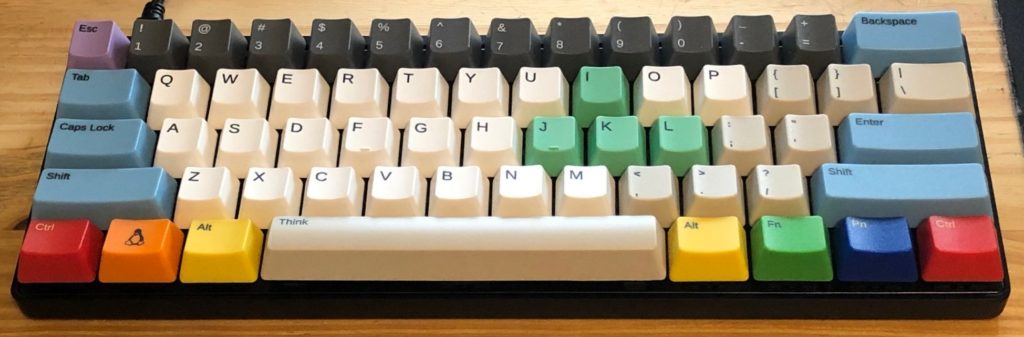
Yes, I’m another one who has plunked down unnecessary amounts of money just to get a keyboard with keys that bump, click, and have precise activation points, and with switches that people care a lot about, changeable keys, etc. So far, I don’t regret the purchase one bit and I’m rather happy with it. And proud, since here I am bragging about it.
Not only did I get one of these contraptions, called a mechanical keyboard, I totally geeked out and got a 61-key (so called “60%”) keyboard. This cut out the function keys, the arrow keys, the number pad, etc. How do I type all that stuff? What about when I want to do a screen capture? Well, for that there is the function layer. In fact, there is the default function layer, which has things like the arrow keys (on my keyboard, they’re the green keys, I, J, K, L), as well as three more programming function layers. I don’t have to use the Fn key to activate the function layer, either; I can use the Caps Lock key, which I reassigned to Fn with a simple dip switch. So if I want to print the screen, I simply type Fn (or Caps Lock) + p.
I bought the above keyboard from WASD Keyboards. They allow you to choose your keys and choose what is printed on your keys (see what I have on my space bar?). Mine is fitted with the both-bumpy-and-clicky Cherry MX Blue switches, and I can confirm that the bumpyclickiness is “satisfying,” whatever that means, in this context, exactly. I do feel approximately 5% geekier, which puts my geekiness ratio might higher than it was not that long ago, what with having installed Linux and starting to really pay attention to privacy. (Speaking of privacy, as some have observed, I need to make larrysanger.org https: . I will soonish, honest.)
So why spend this money (OK, it was $160) on a keyboard? The usual reasons are mine, too: the keys are rather more pleasurable to type on (it’s true! The sense of precision is great!). The colors on the self-designed keys make me happy. The high quality also makes me happy. And as for the reasons for a 60% keyboard: I think it will make me a faster writer and coder, as I don’t have to leave the center of the keyboard (I’m already seeing this to be the case). It also means I don’t have to reach over the extra keys to get to the mouse, so my fingers can be directly in front of me, with the keyboard centered in front of my monitors. I couldn’t do this with my old keyboard, which hogged the desk. My desk is much cleaner now and that’s actually a bigger deal than I thought it would be.
Normally, I would have put the above paragraphs on Facebook and/or Twitter. Instead, as part of my movement away from social media, I decided to put it on my blog and let people find it their own damn selves, and if not many people do find it, and if it has zero chance of “going viral,” ask me if I care.
Updated January 28, 2019.
It’s no longer a matter of whether—it’s a matter of how.
It’s sad, but for social media addicts, quitting seems to require a strategy. By now, some of us who have tried and failed know that it is simply unrealistic to say, “I’m going to quit social media,” and then just do it. There are reasons we got into it and why it exerts its pull. We must come to grips with those reasons and see what—if anything—we can do to mitigate them.
We participate in social media because we love it; but we want to quit, because we also hate it.
Why we love social media
We’ve tasted the forbidden fruit. We surely aren’t giving up the clear advantages that social media offer. That ain’t gonna happen.
The fear of missing out—that lies at the root of all five reasons. If you leave any of the networks, you just won’t be seen. It’ll be like you’re invisible. If you leave Twitter, you won’t really know what’s going on in the world’s most influential news and opinion network, and you will be leaving the field wide open to your political enemies. If you leave Twitter and LinkedIn, your career might take a blow; how could you possibly justify just giving up all those followers you worked so hard to get? And if you leave Facebook, you might be cutting yourself off from your family and friends—how could you do such a thing?
So, look. We’ve tasted the forbidden fruit. We surely aren’t giving up the clear advantages that social media offer. That ain’t gonna happen.
And yet, and yet. There are reasons we should stop participating in the current configuration of social media. I’ve written at some length in this blog about those reasons, as follows.
Why we hate social media:
What a horrible conundrum. On the one hand, we have terrifically compelling reasons to join and stay connected to social media. On the other hand, doing so shows contempt for our own privacy, autonomy, and rationality, and undermines the intelligence and toleration needed to make democracy work. It is as if the heavy, compelling hand of corporate-driven collectivization is pushing us toward an increasingly totalitarian society.
So what’s the solution? Is there a solution?
Let’s talk about a few things that aren’t solutions.
You can’t just quit cold turkey, not without a plan. If you’ve been hooked and you try, you’ll probably come crawling back, as I have a few times. I’m not saying nobody has ever done so; of course they have. But so many people who say they’re giving up or restricting social media do end up coming back, because the draws are tremendous, and the addicts aren’t getting their fix elsewhere.
You can’t expect “alt-tech” to satisfy you, either. This would include things like Gab.ai instead of Twitter or Facebook, just for example; other examples would include Voat instead of Reddit, BitChute instead of YouTube, Minds instead of Facebook, and the Mastodon network instead of Twitter. For one thing, some (not all) of the alternatives have been flooded by loud, persistent racist/fascist types, or maybe they’re just people paid by the tech giants to play-act such types on those platforms. More to the point, though, such sites don’t scratch the itches that Facebook and Twitter scratch. At best, they can appeal to your narcissism and provide some social visibility; but this isn’t enough for most people. They’re not happenin’ (yet); they almost certainly won’t help your career.
What about blockchain solutions? I, at least, am not satisfied to wait around for awesome crypto solutions, like Steemit, to grow large enough to challenge their main competitors (Medium, in that case). I mean, I probably will join them when more influential and widely-used decentralized platforms show up. The startup I joined a year ago, Everipedia, has plans to develop a platform for hosting a decentralized competitor of Quora. That’s exciting. But I want to quit these damn networks now. I don’t want to wait any longer.
Even if those are non-solutions, we do, at least, have the requirements for a solution: we want to secure the advantages of the first list above (1)?(5) without falling prey to the disadvantages of second list (a)?(c).
Let’s review (1)-(5). I think there may be ways to secure the advantages of privacy-stealing social media. I would really, really appreciate it if you have any other bright ideas about how to secure these advantages, because this is where the rubber meets the road; please share in the comments below.
So much for the suggestions. I haven’t really discussed whether they’re actually feasible qua solutions, so next I’ll tackle that.
A lot of the solutions suggested so far might sound like “rolling back” to older technologies. There’s something to that; but I’ll also consider some other, privacy-respecting solutions. Besides, the older technologies are still very sound, and the newer social ones that have replaced them are obviously problematic in various ways.
Consuming more traditional media
Like many, as I started spending more time on Facebook, Twitter, and YouTube, I started spending less time consuming professionally-produced content. Maybe, the suggestion goes, we should just regard this as something of a mistake. Now, don’t get me wrong; I’m a crowdsourcing guy at heart and I hold no brief for the merits of traditional media, especially mainstream media. But insofar as one of the purposes of social media is to clue us in to what’s going on, news reports and good blogs can be used. They probably should be, too; when I started Infobitt in 2013, one thing that really struck me was how poorly informed we would be if we just looked at the stuff that came across our social media feeds. I discovered this when I helped to prepare news summaries daily. There were a lot of important news stories that we found that were not widely discussed in social media, or even in most of the mainstream media. You’ll probably be better informed if you stop using social media to keep up with the news; of course, your mileage may vary.
Going back to email, cc lists, and listservs
There are many social functions that social media can do, that email and traditional email discussion lists can’t, or not as easily. But many of these functions have turned out to be unimportant and not worth preserving.
There are many social functions that social media can do, that email and traditional email discussion lists can’t, or not as easily. But many of these functions have turned out to be unimportant and not worth preserving.
And here are the ways in which email, email cc lists, and listservs are perfectly fine, if not superior to social media:
I’m not meaning to say that we must choose between email and social media, here. I’m saying that email (and listservs) can probably be considered a sound substitute for social media. There are other possible substitutes, too.
Blogs and traditional publishing
I’ve created a fair bit of value, I imagine, for Quora, Medium, Facebook, and even Twitter, with various long-form posts. I know that what I’ve written has given them well northwards of a million impressions over the years (I think several million), free of charge. I could have put those posts on my blog, or in some cases cleaned them up a little and submitted them to professionally published websites and magazines. Why did I end up spending so much time on Quora and Medium in particular? (By the way, as of this writing, I’ve saved my old Medium writings and I have deleted my Medium account. I will do the same with Quora soon.)
In the case of Quora, I joined because it looked like (and was, surely, and to some extent still is) a powerful and successful engine for extracting really interesting opinion and insight from some smart people. My problem with it is the same as the problem I’ve had with Medium. It’s a multi-part problem. First, over the years, the platforms have grown greatly, each a single enormous global community. (Federated sub-communities a la Stack Exchange would be better.) Second, partly as a result of that, they have come to be increasingly dominated by the left. As my regular readers know, I’m a libertarian and an individualist, but all groupthink I find to be a turn-off, especially when my contrarianism is no longer tolerated. Third, the left has become increasingly censorious. I’ve found my sometimes prickly remarks, once accepted without comment, increasingly censored by “moderators” who rarely explain their often arbitrary-seeming decisions, unlike the more honest and polite older-style listserv moderators.
While censorship is part of the problem I have with these platforms, another part is the fact that I am writing to financially benefit people who set themselves up as my digital masters. This was acceptable to me for a while, as it has been to many of us—mostly, I suppose, because I think it might have gained me a larger and more active audience. In retrospect, however, I’m not so sure. I think that if I had simply stuck with my blog and had written as much there as on Quora and Medium, I would have ultimately had a larger and higher-quality audience.
If I have an important message that I really want to get out there, then I hope I’ll try to get it traditionally published more often than I have been.
The big exception will be Twitter; more on that in the next section.
There are some social networks I won’t leave. One is Stack Overflow, the question and answer site for programmers. As far as I can tell, it really does seem to respect its audience and to be well-run. I might well be inspired to check out the other Stack Exchange sites. I’ll stick around on Reddit for a while, too, at least for work-related stuff. It seems relatively OK.
Messaging services are generally OK—but that, of course, is because you’re not the product. I hate Facebook, so I’ll stick around on Messenger only as long as my work colleagues use it. I’ll tell my friends and family to start using other services, like Slack or the awesome Telegram, if they want to message me. (Of course, good old text messaging is usually my favorite for people who have my phone number, but that’s for things that demand an immediate reply.)
I certainly see no reason whatsoever to leave any of the web forums that I occasionally frequent. Web forums are still robust and have few of the problems listed here. I’ll consider them over mailing lists, but I think mailing lists are a bit better for meaningful discussions.
I might well consider some alternative networks that respect privacy and practice decentralization more (I intend to study them more; see below). One is Mastodon; another is MeWe. I have great objection to such networks. The problem, as I said above, is that they don’t scratch the itch. The root problem is that they don’t have critical mass and I can’t guarantee that my friends and acquaintances will follow me there. Email is different: everyone has it, everyone uses it.
After much soul-searching, I decided to keep using Twitter, but only following one strict rule about how I use it: I will not post, retweet, respond to, or like anything else, including my many pet topics, unless I’m promoting something I or a work colleague has written.
I’ll just include a Twitter thread I posted:
Traditional media, email, listservs, and blogs: Are those really my answer to social media? Do I want to roll back the clock?
At this point, my honest answer is: Not really. I’m actually reluctant to leave social media, because what used to be called “Web 2.0” really does contain some useful inventions. The tweet is excellent for advertising and promotion. Multimedia sharing on YouTube, Facebook, and (if you use it much—I never did) Instagram is very convenient. The moderation engine on StackExchange sites is excellent. I might be able to get behind some variant on the general Facebook theme. I’m very sympathetic to some newer styles of social networks.
Centralization is what we got. That led directly to decisions that degraded our experience in the service of profits and political influence. The centralization of social media has proven to be a blind alley. It’s time to turn around and find a new way forward.
It will prove to be the downfall of all of the older, soon-to-be-dying social media giants that, at root, they chose centralization over neutral protocols. They chose to concentrate power in the hands of corporate executives and bureaucracies. That is neither needed nor welcome for purposes of connecting us online; once we knew what we wanted, Internet protocols could have been invented to deliver them to us in a decentralized way. But that would have made the platforms much less profitable. Centralization is what we got. That led directly to decisions that degraded our experience in the service of profits and political influence. The centralization of social media has proven to be a blind alley. It’s time to turn around and find a new way forward.
Do I want to stick with email and the rest forever? Of course not. I’ve had (and often proposed) all sorts of new technologies. I think we need decentralized versions of social media, in which we participate on our own terms and enjoy the benefits of ownership. That would bring me back.
We’ve already discussed these things, but you didn’t believe me the first time. Let’s review:
It’s OK. Really. Just remember: Facebook and Twitter really, actually, sincerely do suck. You’re not missing out on anything important, especially if you scratch the itches that they scratch in other ways.
If you, too, find yourself wanting to quit social media, maybe you’ll be asking me for advice on how to do it. Well, I can’t do better than tell you what my plans are. Obviously, though, your requirements are different from mine, so you should make your own damn plans.
I’m not saying I’m definitely going to do all of these, in just this order; this is more of a draft plan. The first step in every case is to figure out exactly what’s going on and think it through. I’m also pretty sure that locking down my contacts is the first thing to do.
It’s OK. Really. Just remember: Facebook and Twitter really, actually, sincerely do suck. You’re not missing out on anything important, especially if you scratch the itches that they scratch in other ways.
I will actually press the delete buttons on February 18, about a month from now. I’ll update this blog with specifics of how I do each task, and spam my social networks with repeated invitations to join various lists, because I’m going away, permanently this time.
I’m giving myself time because I want to talk about people about what I’m doing via social media, and try to spark a mass exodus among my friends, family, and followers. And who knows? Maybe we’ll get Silicon Valley to notice, and they’ll start competing to make better products, ones in which we aren’t the product. If not, we’re sure to benefit anyway.
The problem with racism is the collectivism—the tribalism—the treatment of people as mere tokens or representatives of their races. That, as it turns out, is a profoundly appalling and consequential attitude to take. Treating people as mere tokens of their race literally dehumanizes them. Why? Because it ignores, often accompanied by great contempt and hatred, the very feature that make a person human: their unique ability of reason, to think things through, to think for themselves, to direct their own lives.
We humans are defined by our rationality, Aristotle said. He wasn’t wrong. What distinguishes us is our ability to reason, not just in the sense of making a logical inference here or there (lots of animals can do that), but in the sense that we can reflect deeply and at length about important decisions, the direction of our lives (past, present, and future), our assumptions, and our values. Our ability to think things through, to step back and take stock: that is the nature of human rationality. And that is the thing that makes us human, and that is the thing that makes us each unique, and that it is the thing that is dismissed without a thought by actual racists.
Racists, probably without quite realizing it, make some assumptions when they encounter a member of a disdained race: “This person is merely a representative of that race. His uniqueness does not matter. His difference, his thoughts and values, his humanity—none of that matters. He’s fungible, interchangeable, equally worthy of contempt as any other member of his race.”
Our rationality, as I described it, is also—as I maintained at length in an essay on this blog—equivalent to our free will. It is also what gives us each our dignity, that which commands a basic sort of respect, no matter what. The reason a person should never, no matter how terrible his crimes, be discarded like only so much trash, is that we wish to respect that feature shared by all the rest of us. A mass murderer may be as awful a person as you can imagine, but no decent, sober person in the light of day wants to torture him to death; to do so would be to, as it were, discard his dignity, his humanity itself.
So we can say just as well that a racist essentially denies the freedom and dignity of members of hated (or disdained) races.
At this point, I should acknowledge that people can be more and less racist. For example, there are people who generally hate members of other races, but make exceptions for religious or political allies or personal acquaintances. They can also be merely biased, tending to discount any individuality and uniqueness of members of a disdained race, but rarely doing so wholly. A complete racist, by contrast, couldn’t imagine being friends with the disdained or hated race; one might as well be friends with a slug or a rock, or any other thing that is undifferentiated and worthless. The race per se is dehumanized for the thorough racist.
Let’s talk a bit about what “dehumanizing” means, because I think it’s very important to understand, if you want to grasp the awfulness of racism. Perhaps the best way to get a bead on it is to consider some clear examples, of all sorts.
Think of
There are other categories as well. These aren’t the only sorts of people who dehumanize others. Another sort of example would be the criminal sociopath, a genuine misanthrope who lacks a conscience and views all other people as mere tools to be manipulated. Another still would be a truly vicious criminal gang, which views everyone unassociated with the gang to be little more than weak prey.
What all these people have in common is a failure to evaluate others as individuals with a unique mind and the inherent freedom and dignity that go with them. Instead, the dehumanizer regards them as mere instances of some hated, despised, or in any case undifferentiated group: they are mere slaves, mere serfs, mere enemies, mere workers, mere proletarians, mere n?????s or Jews, mere heathens, mere [fill in the blank with an epithet for some utterly despised political enemy].
Note that we can have a similar dehumanizing attitude toward groups that it is more popular to hate, such as criminals, pedophiles, and—let’s not forget—racists.
Let’s recapitulate a few things. Racism begins by regarding people of the despised race as mere members of that race, i.e., lacking any individual identity worthy of consideration. When racists do not consider others’ individual identity, that means they have dehumanized them.
It is the dehumanization aspect of racism that leads racists to do horrible things to others, when they do, things that their victims (unlike, for example, convicted criminals) certainly do not deserve. Notice, this is true of all sorts of dehumanization. We are restrained from particularly brutal, inhumane behavior against people whose shared humanity and equal dignity we acknowledge. If we acknowledge someone’s shared humanity, we are generally (except perhaps under duress and other extraordinary circumstances) incapable of flouting that dignity. We might punch someone we respect in the chin, but we won’t torture him. We might force a disliked employee to work overtime, but we wouldn’t callously put her life in serious danger or consider enslaving her. We might teach or report respected citizens in a biased way, but we wouldn’t literally propagandize them or force their minds. There are some things that we simply do not do to our fellow human beings, if we accord them basic dignity.
The denial of a person’s humanity—which racism implies—has of course enabled all sorts of inhumane treatment, throughout history, as trivial as snubs that indicate “you mean nothing to me” and as profound as genocide. We might also point out that racism is profoundly and unnecessarily unfair, i.e., it singles out people by race—a feature they didn’t choose—for poor treatment. That, I suppose, is so obvious as not to need much further argument. It is, again, that denial of a person’s humanity that makes such poor and unfair treatment possible. And that comes back to collectivism: the racist regards the despised race as mere undifferentiated representatives of their race, their individual minds being unworthy of consideration.
The audience of this little essay is not racists; I wouldn’t expect racists to be persuaded by my arguments. But maybe some of them will read this. I imagine that the obviousness of the considerations of the last two paragraphs are such that any such racists would be unlikely to be moved to reconsider their racism. After all, no doubt most racists have somehow been confronted with the fundamental inhumanity and unfairness of their attitude. But they can’t bring themselves to care.
But I have something else to say to (and about) such people. There’s another sort of reason to think racism is wrong that might, perhaps, give some racists pause: racism is extremely bad for the soul. Here I don’t mean anything religious (although you can apply the notion in that way if you wish). I mean that racism involves denying your shared humanity with other people who very obviously possess every bit as much dignity and freedom as you. When your hate, contempt, or utter indifference to some other people is so profound that you are incapable of crediting their humanity, something surely must have died within yourself. You, the racist, become the sort of person who is instead capable of monstrous, inhumane behavior. Denial of humanity in others can lead you to inhuman acts. That is how your soul is at risk, so to speak.
Moreover, the collectivism or tribalism that lies at the root of your callous attitude toward others of a disdained race can and probably will be turned on other classes of people. Who knows where, for you and those you influence, it will end? Just for example, the KKK did not stop at hating blacks; they also turned their ire toward Jews, Catholics, and Catholic immigrants (maybe especially the Irish). The roster of groups hated by European fascists (beyond merely the Jews) was also large. The ability to regard all members of any one group as an undifferentiated collective of “vermin” opens your soul up to more of the same, compounding the madness. This will not just harm others, if it does; but it will certainly harm you, the racist, deeply.
If that means nothing to racists, there’s nothing that anyone can say to them, surely. But it ought to give them some pause.
I can imagine a committed, acknowledged racist—such people exist—responding that they would never dream of “monstrous, inhumane behavior” toward anyone of the race they hate. They simply want to have nothing to do with them. If you talk to neo-Nazis, some of them do say things like that: the Holocaust (if you can get them to admit that it happened) really was horrible. They just don’t want to live in a society with Jews or blacks in it.
So let me be clear: I’m not saying all racists are like the very worst racists. As I said earlier, I know there are gradations of racism. Also, I am not trying to establish an obvious conclusion (that racism is wrong) cheaply, by assuming (falsely) that everyone who deserves to be called a “racist” is capable of participating in lynchings or genocide, for example.
But that isn’t how my argument works. My argument is that racism does, in its most extreme or pure form, thoroughly dehumanize its targets. It is that dehumanization—that failure, to some degree or other, to acknowledge our shared humanity and equal dignity—that makes it possible for racists to do some truly awful things.
The thing that makes racism so awful is the dehumanization. As I argued, that is a feature it has in common with other of the most brutally destructive forces in human history: slavery, serfdom, dehumanizing the enemy, abusive labor practices, totalitarianism, zealotry, and true extremism. It’s also similar to sociopathy and gangsterism. It’s all about denying others their basic humanity: failing to regard them as having independent, unique minds worthy of basic consideration, minds that give us, all of us humans, the free will that gives us our equal dignity.
I wrote this essay primarily to clarify these issues to myself. I don’t pretend to be a race theorist, but as with many topics in philosophy, I don’t let that stop me from trying to clarify and test my own thinking on a topic. I hope you found this interesting and, whether you think I am right or wrong, I welcome your feedback below.
In order to install Ruby and Rails on Ubuntu 18.04, first I had to completely wipe my first, abortive attempt. That proved to be harder than expected. So, in order to save others the effort I had to go through, here’s what I did. This worked for me…who knows if it’ll work for you, though? I compiled some of the rm -f commands from other sources, but others I figured out myself. If it works, this should completely wipe Ruby and Rails (and other associated command line things, including rvm but not rbenv) from your system, so you can start over with a clean slate. Don’t complain to me if anything goes wrong, but if you want to suggest helpful edits, please do. Some of these commands require sudo; if you save this as a .sh file, though (as I did), you can sudo the whole thing.
# HOW TO DELETE RUBY AND RAILS (AND OTHER GEMS)
apt-get purge ruby2.5
aptitude purge ruby
rm -rf /usr/local/lib/ruby
rm -rf /usr/lib/ruby
rm -f /usr/local/bin/ruby
rm -f /usr/bin/ruby
rm -f /usr/local/bin/irb
rm -f /usr/bin/irb
rm -f /usr/local/bin/gem
rm -f /usr/bin/gem

rm -rf /home/globewalldesk/.gem/ruby
rm -rf /home/globewalldesk/.codeintel/db/ruby
rm -rf /usr/local/bin/rails
rm -rf /var/lib/gems/
rm -rf /home/globewalldesk/.bundle/
rvm implode
rm -rf ~/.rvm
unset rvm_path

# THEN DO THIS TO MAKE SURE YOU'RE CLEAN:
# sudo find / -name 'rvm' -name 'rbenv' -name 'ruby' -name 'rails' -name 'gem'
# sudo find / -name 'rbenv'
# sudo find / -name 'ruby'
# sudo find / -name 'rails'
# sudo find / -name 'gem'
# sudo find / -name 'railties'
# cat ~/.bash_profile ~/.bashrc ~/.profile ~/.zshrc ~/.mkshrc ~/.zlogin | grep 'rvm|rbenv|ruby|rails|gem|railties' # search for keywords in your bash profiles--they might need to be deleted
# env | grep rvm_path # ensure it's unsetI’ve been making up a bedtime story for my boys (ages 12 and 8). I decided to start writing it down. What I have below is the first few evenings’ worth. I have a fair bit to catch up; there will be adventures at school, making money, and trips here and there. I thought I’d share it on my blog to invite some feedback. Let me know what you think.
Once upon a time, there was a boy named Eric, age 10, who lay dreaming of bacon. It was a very vivid dream. He saw it cooked to perfection in a pan; he smelled that inviting, savory smell; he even heard it sizzling. Then, in his dream, he saw the gorgeous bacon removed from the pan, ready to eat on a plate. There was a lot of it, but not too much. It was the perfect amount of perfect bacon.
Then Eric jolted awake and sat up and rubbed his eyes. Next to him, on his nightstand, was just the plate of bacon that he had dreamed. It was still sizzling.
“Gee, thanks, Mom!” he called out.
Eric looked for his mother to appear in the doorway, but no one did and no one replied. Eric shrugged and took a piece of bacon. It was, indeed, just as perfect as in his dream. It didn’t burn his fingers, but it was crispy hot, and delicious.
“Eric!” his mother, Martha, called out from his doorway. “Where did that bacon come from?”
He looked up with a wrinkled brow. “I don’t know. You mean you didn’t make it?”
“No, I did not,”
she said, sternly. “I didn’t give you permission to—” She
stopped herself, then said,
“Wait.” She shook her head with
her eyes closed and yawned. “I don’t remember buying bacon.”
Eric’s four-year-old sister, Molly, appeared in the doorway with a frown of deep confusion on her face. She spotted the bacon and immediately ran and snatched a piece. “Yum!” she exclaimed.
By this time Eric’s father, Frank, appeared over Martha’s shoulder and said, “Where’d the bacon come from?” Then: “Wow, did you make that yourself, son? Looks good.”
“I didn’t buy bacon, Frank,” Martha said. “You must have.”
Frank looked at Martha, nonplussed. “I…don’t buy bacon,” he said, as he walked over and helped himself to a piece.
“I know you don’t, but you must have,” Martha said.
“I didn’t. Swear to God.”
Martha’s eyebrows raised and she shrugged her shoulders. “O…kay, guys, whatever. Enjoy your bacon.” She got herself a piece and went off.
“Eric,” Frank said, “I didn’t buy that bacon. And I didn’t make that bacon. And if I know your mother, and I think I do, I don’t think she—”Just as Martha had, Frank stopped himself, then said, “Maybe your mom forgot it.”
“No, no,” Eric said, “she’s just pretending that she didn’t make it. Obviously she made it.”
Molly was silently standing in front of the plate and biting into her second piece. Eric was on his third.
Frank, like everyone else, was frowning in confusion and thought. “You must be right, unless you’re the trickster. But it sure doesn’t sound like her. Or you.”
The breakfast table conversation was about who made the bacon. Everyone but Martha maintained that she made it and was puzzlingly pretending not to have done so, while Martha maintained that it was Frank who made it and who was pretending. Molly wondered grumpily why she didn’t get any bacon next to her bed, but Martha said that she had eaten as much as anyone, so it was perfectly fine.
* * *
Eric, an intelligent but otherwise (as far as he knew) perfectly ordinary fifth-grader, went through his normal school-day routine. Last year, he had asked to be allowed to come home instead of going to day care, which Martha agreed to, saying that she wanted to come home early and work from home anyway. She was a graphic designer. Besides, Frank was often at home; he was a professor of astronomy at a research university.
Today, however, Eric found himself home alone, as he sometimes was for an hour or two before his mother came home. His instructions were clear: stay at home, do his homework, have a snack if he needed one.
Eric, being a nice and diligent boy, usually did as he was told. That is why, today, he was sitting down at his desk in his bedroom frowning at his math book. “Ugh,” he said to himself, “I wish I didn’t have to do this. I wish it were already done.” He opened the textbook and then opened his binder to take out a clean sheet of paper, when he noticed that the paper was full of writing. This was a great surprise to him because, just a moment before, it had been blank. He was about to put it back, thinking it was yesterday’s homework, but he had just turned in yesterday’s homework. Besides, this had no markings on it. All of his old homework had markings on it. He looked again: it was marked with today’s date. He examined it carefully: he couldn’t remember doing it at all, but this was today’s assignment. Completed.
“Wow,” he said to himself, remembering the bacon. He had just been thinking he wished it were already done. And here it was, already done.
Eric held out his hand palm up, and said experimentally—not particularly expecting anything to happen—“I wish I had a pencil.”
A pencil popped into his hand.
Now, for a ten-year-old, Eric was not much of a dreamer. He didn’t really go in for swords and sorcery or fairy tales. He was, in his parents’ opinion, a geek who liked computers and machines. So while you might think that he would shriek with delight, or grow round-eyed with wonder, or maybe faint, that wasn’t Eric. Instead, he instantly frowned violently, mouth agape, and whispered:
“What the—”
Then he said said: “I wish it were a cupcake.”
The pencil became a cupcake, a glorious, fancy, chocolate-frosted confection. Eric bit into the cupcake, again experimentally, still frowning. Then his eyebrows went up. It was very good indeed.
I will not tell you everything that Eric popped into and out of existence just then, because there were a great many things and Eric had plenty of time. Whole cakes, a million dollars, a very expensive telescope, a friendly cat, and a wolf were just a few of the things that were popping into and out of existence in Eric’s bedroom. While perhaps not a dreamer, Eric did have an excellent imagination.
Then Eric had another idea: Could he levitate? That sounded potentially dangerous, so at first he sat on his bed, then he levitated about a foot off the bed.
That was the moment that Eric heard Martha’s scream. She hung onto the side of the doorway, staring at her floating son and looking quite faint. Eric floated down and got to his feet and said, “Now don’t freak out Mom, it’s OK, but—look at this!”
And he held out his hand and into it popped another cupcake. Martha sat heavily on the bed with her hand clutched to her head. You might think that she would suspect Eric to have learned some very effective magic trick. The problem was that she had seen. She had seen Eric actually levitating in the air, for several seconds. And had seen Eric’s hand absolutely empty and then, in the next moment, absolutely full of cupcake.
She was close to panicking, because she thought it likely she was going insane. Eric popped the cupcake out of existence, which did not help, and he patted his mother’s shoulder, saying, “It’s OK, Mom, really, don’t worry! It’s OK!” and other words of reassurance for about an entire minute. Martha was silent. Eric kept saying, “Do you want me to show you again?” and Martha just shook her head.
Eventually, Martha collected herself and managed a weak smile, and said, “How?”
“I dunno,” said Eric.
“Am I going crazy?”
“Absolutely not, Mom. Unless I’m going crazy too, because I’m seeing the same things! Look, you tell me what you want, and I’ll make it. Go ahead!”
“OK,” Martha said, nodding. “How about…how about a really big…ruby. You know, the gemstone.”
“Sure!” chirped Eric. “I know what a ruby is.” And he opened his hand to reveal a monstrous ruby, surely, Martha thought, the largest ruby that has ever existed. She was increasingly impressed and excited. She took the ruby.
“OK, now a diamond.” Eric produced one and handed it to her.
“An emerald?” Again, Eric handed her one. The three gemstones were difficult to hold all at once in a single hand.
“But I’ll tell you, Mom, I can fill a room full of those, so…” Eric waved a hand, unnecessarily but theatrically, and the giant gemstones disappeared.
“Aw,” said Martha. “I liked those.” Then she fainted.
* * *
Eric was holding her hand and looking quite worried when Martha came around. He was repeating such things as, “It’s OK, really” and “you’re not crazy, Mom!” This didn’t help Martha very much, but she didn’t faint again. By the time she was fully recovered, she seemed to have accepted the situation and was “all business.”
“All right, Eric,” she said, “let’s test you out a little more, OK? Come with me.”
Martha led her son to the living room. She pointed at a couch that was quite old and ratty. “Give me a new couch, please,” she said.
First, Eric waved his hand dramatically and the couch was instantly new again. Martha wrinkled her nose at this. “No, it needs to be something different. Not just new again.”
“Like what?” Eric said, waving his hand and changing the upholstery from brown to blue. “This?”
“No…” Martha looked thoughtful. Then she held out her hands. “Give me a new tablet.”
One appeared in her hands.
“Now open it up to the browser.”
A web browser opened itself up.
They searched the web for pictures of couches. She picked one out, made it larger so Eric could see it well, and said, “That one.” A fancy new sofa appeared in the place of the blue one. “Hmm, it’s kind of small.” It enlarged. “Yes, that’ll do for now.”
Next, they picked out new drapes, a stereo with large speakers, an 82” television, marble countertops for the kitchen, and other assorted odds and ends. Finally, Eric created a new sink. Martha tried it out, only to hear a strange sound coming from underneath; water was spilling onto the floor, because plumbing was missing. After some yelling and mild cursing, Eric said, “No problem!” and cleaned up the mess with a flick of his fingers. Martha showed him pictures of what sink plumbing looks like, and he got it in right.
“How on earth,” Martha said, “can you create a tablet and a television and get a sink wrong?”
“Well, I was only thinking about the sink. I wasn’t thinking about all the pipes and stuff underneath,” Eric said.
“Yes,” Martha replied, “but you don’t have to think about or know about all sorts of things that go into the tablet or television.”
Eric paused. “Well, but I was only thinking about the sink. I mean, that is all I was thinking about.”
“The point, dear son,” Martha said, “is that you can get things wrong.”
“Yeah. Well,” Eric said, “Hey. I’ll just, you know, wish I won’t get things wrong.” He nodded his head. “There! Done!”
Martha looked skeptical. “I’ll bet you still can, though…” She stared into the distance for a minute. “I know. Give me a new refrigerator.” Eric pointed at the old refrigerator and a new one appeared. Martha looked inside.
“Uh-huh,” Martha said, “I thought so.”
“What?”
“There’s no food.”
“Aw,”
Eric said, “here.” Assorted foodstuffs and drinks, roughly what
Eric remembered seeing there, appeared.
“Where’s the
yogurt?” Martha said. “We had yogurt.”
“Oh,” Eric said.
“Yes. You didn’t know what was in there. Can you give me back the old refrigerator?”
“Sure, I guess.” It was back with a wave of Eric’s hand. Martha opened it up. The old food was there.
“Interesting,” she said. Suddenly she looked very tired. She said, “I’m going to take a nap.” Then she turned around and looked very seriously at Eric, adding, “Don’t do anything dangerous, don’t tell anyone, don’t go anywhere. Just give me some time, OK? Do you hear me?”
“Yes, Mom.”
Let me briefly tell my Linux story. If you’re thinking about moving to Linux, and wondering how you’d do so, it might give you some pointers and inspiration.
My first introduction to the command line was in the 80s when I first started learning about computers and, like many geeky kids of the time, wrote my first BASIC computer programs. But it wasn’t until my job starting Nupedia (and then Wikipedia) that I spent much time on the Bash command line.
(Let me explain. “Bash” means “Bourne-again shell,” a rewrite of the class Unix shell “sh.” A “shell” is a program for interacting with the computer by processing terse commands to do basic stuff like find and manipulate files; a terminal, or terminal emulator, is a program that runs a shell. The terminal is what shows you that command line, where you type your commands like “move this file there” and “download that file from this web address” and “inject this virus into that database”. The default terminal used by Linux Ubuntu, for example, is called Gnome Terminal–which runs Bash, the standard Linux shell.)
Even then (and in the following years when I got into programming again), I didn’t learn much beyond things like cd (switch directory) and ls (list directory contents).
It was then, around 2002, that I first decided to install Linux. Back then, maybe the biggest “distro” (flavor of Linux) was Red Hat Linux, so that’s what I installed. I remember making a partition (dividing the hard disk into parts, basically) and dual-booting (installing and making it possible to use both) Linux and Windows. It was OK, but it was also rather clunky and much rougher and much less user-friendly than the Windows of the day. So I didn’t use it much.
When I decided in mid-2016 that I wanted to start learning to program, really really, more seriously this time, I knew I’d have to transition soon to Linux, especially if I was going to learn Ruby on Rails (which I was and am). There’s less pressure to do this if you’re a Mac user, since modern Macs make a Bash console easily available; OSX is based on Unix and so is a sibling of Linux. Anyway, if you don’t want to plunge headfirst into Linux-only or dual-booting, then the Thing To Do, beginners are rightly told, is to install Linux on a virtual machine.
A “virtual machine” (VM) is a program that, generally, runs in Windows or Mac and allows you to run a completely distinct operating system within a window (or in my case, a couple windows, one for each monitor). When I turned on my computer (i.e., the physical machine with the on switch), I booted into Windows as usual. But when I wanted to start programming, I started the VM and, inside the windows that popped up, it looks like a separate Linux computer is running. It’s easy to switch back and forth; you can do so with the click of a mouse.
One of the first things I had to decide was which distro (flavor of Linux) to use. Leading distros include Ubuntu, Mint, Debian, Fedora, and CentOS. I chose Ubuntu because it was (and is) popular, relatively stable, well-supported, and relatively easy for newbies to get into. I find Ubuntu running the Gnome desktop environment—I’m not going to bother explaining what that means, but different distros can run different desktop environments—to be a pleasure, as I’ll explain later.
My precocious son H., then age 10, had already set up a VirtualBox VM, so I had his help installing Linux in one myself. Installing Ubuntu to a VirtualBox VM is not terribly easy if you’ve never done it before, but there are plenty of tutorials and free help to be found online. If you’re moderately technical, you can do it. It’s not that bad.
I used Ubuntu in VirtualBox for a couple years. It was a great way to transition from Windows to Linux; I ran Linux on a VM when studying programming, and I ran Windows for everything else.
Then came 2018, with its stunning revelations and outrages by Facebook, Apple, Google, and others. With privacy and free speech—in short, digital autonomy—deeply under threat, I decided to lock down my cyber-life. (I encourage you to do the same.)
I’d wanted to run Linux on a partition for a long time (doing so is quite a bit faster and more seamless than a VM). But when all these giant, centralized corporations showed such contempt for our privacy (and thus our security) and free speech, I decided that I was going to do all I could to take my data out of their hands. Microsoft is and always has been terrible when it comes to security, but with Windows 10—though admittedly an improvement in UX—they jumped on the privacy-violating bandwagon. Windows 10 bothered me ever since it came out. Now finally I decided I’d have to do something about it.
See, I’ve always thought information privacy was important, but like many of us, I rationalized the increasingly jaw-dropping privacy violations and security failures by corporations (and government, for that matter) in the last ten years or so as the price we pay for awesome new technology. You know—awesome new tech like Facebook, Twitter, Google Search, Google Chrome, cloud storage, and a free but better-designed operating system like Windows 10 was (at launch). At first, all this seemed indeed worth the price. (Or enough to keep me from taking the privacy issues seriously.) But when these corporations (and government) over and over brazenly demonstrated just how much contempt they have for our information privacy and security, not to mention free speech rights, the bloom was off the rose. Something snapped, and I’m never going back to them.
Privacy matters. A lot. Facebook? Don’t need it. I’ll be switching back to good old-fashioned email groups soon. Twitter? OK, I might keep it around strictly for advertising purposes, but don’t expect much in the way of personal sharing. Google Search? Meh, DuckDuckGo has come a long way and is as good as Google for most (still not all) purposes. Google Chrome is simply not better than privacy-respecting browsers like Brave (my preference) and Firefox. I’ll be moving my data to a more secure solution than traditional cloud storage soon.
A few days ago, as I worked through my to do list, I finally decided it was time to ditch Windows and switch to Linux. I still have Windows available for things like Camtasia Studio (video production), but I really don’t need it for most purposes.
There are five basic steps to the process of adding Linux to your Windows or Mac machine:
I won’t explain how to do these things (there are lots of tutorials already available, like this), but here are a few notes. And for the non-techies out there who have bravely read this far, let me tell you: the hardest part of using Linux is installing it. Don’t feel bad if you need to get help. Heck, I’ve installed it myself before my 12-year-old son was born, and I wasn’t too proud to get a lot of help from him the second time around! If you don’t have a family or friend who can help, and you have to pay a rent-a-geek, it’ll be money well spent.
I discussed #1 above. Notes on #2 and #3: Creating a partition is a pretty simple process. But if you’re going to use a Linux boot loader (i.e., the thing that tells your computer which operating system to load; I use Grub) then you’ll first want to put Linux on a thumb drive, since it’s typically quite small and easily fits, and boot to that. Then you’ll probably use GParted (the Linux partition software) to actually do the partitioning. You’ll want to make sure you actually know what you’re doing (so, read up about potential pitfalls) before making any changes. It’s also very important to make sure your must-have data is well backed up, because you might lose it. If you do it right, there’s little chance you will; but there’s always a chance. Also, make sure you allocate reasonable amounts of space to your respective partitions. You don’t want to run out of space on either one.
As to #4, actually installing Linux, once the partition is ready, is the easy part. It takes a little while (i.e., waiting), then you set your time zone and a login (very important, as you’ll use it a lot), then you’re done!
The easiest part is #5, but you’re not totally out of the woods yet. The Ubuntu Software app is like a free app store (it’s not the only one, of course), and they’ve made it quite easy to install a lot of software. Especially if you’re programming, though, you’ll have to use the command line at least sometimes. The most important thing to remember here (and maybe for the whole process) is to do intelligent web searches for help whenever you need it.
There’s nothing magical or particularly deep and difficult about any step of this process. It just requires a little bravery, lots of Internet searching, time, and patience, and you can definitely get it done.
So far, I love using Linux (OS), Ubuntu (distro), Gnome (desktop environment) as my main workstation. I actually hate it when I have to boot up Windows. Not only does it feel clunkier (really) and more unnecessarily bloated, I can’t stop thinking about how I don’t know what data is being sent to Microsoft.
If you haven’t tried Linux for a long time, let me tell you: it has changed a lot from the early days. It is not just more usable than it was, in some ways it is more usable than Windows or Mac, in my opinion, for day-to-day work. I mean, of course this applies if you can deal with a few technical challenges. But if you can, Linux is more usable not just because of the nicer UX available, but also because of how configurable Linux is. You can change almost anything on the system you want. You want a different look and feel? There are apps for that. You want a different sort of app store? There are alternatives. You want something simpler and leaner? Available. Something that looks and feels like Windows or Mac? Available, of course.
One big exception is in installing some technical software that, if you aren’t a programmer, you probably won’t need to install. If for whatever reason you want or need to start using the command line (for example, running Bash on a terminal like Gnome, as I said above), try this beautifully written tutorial. The command line isn’t that difficult to learn, actually. The basics are rather simple once you get the hang of them.
Another big exception lies in the sometimes non-standard and quirky ways the software sometimes behaves. Again, this is much better than it was in days gone by, but quirkiness is still definitely a Linux thing. I guess I don’t mind.
A final difficulty is that it has some occasional, and almost always very minor, operating system issues that simply would never crop up for Windows or Mac. This is probably one of the bigger problems and obstacles to wider adoption. I can give you an example from Ubuntu 18.04, which I installed: it has a “memory leak” problem that very slowly and progressively eats up your memory (over the course of days) until you have to reboot. This will be fixed in an update soon if it hasn’t been already.
But enough of the negatives. One enormous positive that neither Windows or Mac is likely ever to be able to boast is that it’s an operating system that respects your autonomy. You own your system, not Microsoft or Apple. You don’t have to ask a giant corporation for permission to do anything. You don’t have to worry about them invading your privacy, putting your data at risk of hacking, or censoring you. And you have all the tools you’ll need to make the system just the way you like it. That might not sound like a big deal (and maybe it wouldn’t be to you), but if you try it, you might find yourself delighted with all the options. I was.
In summary, here are the similarities and difference to a typical desktop (Windows and Mac–I have both) experience:
Back in 2002 when I was using Linux the first time around, it wasn’t really ready for prime time. But it is now. You kind of have to be able to search the Internet and read some technical help pages in order to learn how to use the thing, or get help from someone who can do this. It is, after all, another whole operating system. So, yes, there’s still a learning curve. It’s not a huge learning curve, though, and not nearly as big as it used to be.
Linux: it’s not for just uber-geeks anymore. Admittedly, there is probably a minimum intelligence requirement. But in the not-too-distant future, we might well see a completely foolproof distro.
It’s not just because you are a criminal and the coppers might catch you. Or because you really, really hate big corporations who just want to sell you stuff more easily. Or because you’re paranoid.
If that’s as far as your thinking goes, when people start talking about “privacy” on the Internet, you really need to bone up on the subject.
You probably already knew that you don’t have to be criminal, paranoid, or anti-capitalist to be very jealous of your Internet privacy rights. After all, plenty of law-abiding, merely sensibly cautious, capitalism-loving people are freaking out about the way FAANG (Facebook, Apple, Amazon, Netflix, Google) companies, and many more, are creepily tracking their every move. Then those same corporations are selling the information and making it available to governments (or, at least, not going out of their way to stop governments from getting it).
Are people right to freak out about these privacy violations?
Yes, they are, or so I will argue. The threats come under three heads: corporate, criminal, and government. And let’s not forget that in the worst-case scenario, the three heads merge into one.
Left unchecked, in ten years, some of the biggest, most influential corporations will know (or have ready access to) not just your name, email address, phone number, age, sex/gender, credit card numbers, family relationships, friends, mother’s maiden name, first car, favorite food, various social media metrics, browsing history, purchase history, as well as a large collection of content authored and curated by you. That’s already bad enough (for reasons I’ll explain). But they might add to their dossiers on you such things as your social security number, credit score, criminal record, medical history, voting history, religion, political party, government benefits, and more.
But how? Well, you might have asked that about the first list twenty years ago. How indeed? They’ll create must-have devices and services that become very popular. Everybody has to have the device, or the service. Then they’ll talk a good game when it comes to your information privacy and security, but they’ll get their hands on your medical history, your credit score, your government benefits–and that will be it.
Imagine, too, the possibilities that highly motivated project managers will dream up when they can mash up your growing dossier with data from facial recognition, AI/big data text analysis, and other new technologies.
In such a situation, what information isn’t private?
“But I can make up my own mind about what to buy,” you say.
Well. Top-flight marketing and product people are, naturally, very good at what they do. It’s not an accident that, once everybody and his grandma got online, some of the wretched Mark Zuckerbergs of the world would stumble on some platform that would connect us by our personal relationships, not care one bit about privacy, and hire people who are and become very, very, very good at manipulating us in all sorts of ways. They’ll keep us online, give us more reasons to share more information, watch ads, and yes, buy stuff.
But corporate control of your private life is much more insidious than that.
Do you feel quite yourself when you’re reading and posting on Facebook and Twitter, shopping on Amazon, watching and commenting on YouTube and Netflix, etc.? I admit it: I don’t. We become more irrational when we get on these social networks. Sure, we retain our free will. We can stop ourselves (but often won’t). We are the authors of what we write (as influenced by our echo chambers), which reflects our real views (maybe). We could quit (fat chance).
We have become part of a machine, run by massively powerful corporations, with their clever executives at the levers. Only part of what is so offensive about this machine is that we are influenced to buy things we don’t need. What about radicalization–being influenced to believe things we haven’t thought sufficiently about? What about self-censorship, because the increasingly bold and shameless social media censors (no longer mere “moderators”) increasingly require ideological purity? What about the failure to consider options (for shopping, entertainment, socialization, discussion, etc.) that are outside of our preferred, addictive networks?
More importantly perhaps than any of those, what about the opportunity cost of spending our lives coordinated by these networks, with less time for offline creativity, meaningful one-on-one interaction, exercise, focused hard work, self-awareness, and self-doubt?
The machine, in short, robs us of our autonomy. As soon as we started giving up every little bit of information that makes us unique individuals, we empowered executives and technologists to collectivize us. It is not too much of a stretch to call it the beginnings of an engine of totalitarianism.
If you’ve never had your credit card charged for stuff you didn’t buy, your phone hacked, precious files held hostage by ransomware, your computer made inoperable by a virus, or your identity stolen, then you might not care much about criminal hackers. Several of these things have happened to me, and since I started studying programming and information security, I’ve become increasingly aware of just how extensive the dangers are.
Here’s the relevance to privacy: keeping your information private requires keeping it secure. Privacy and security go hand in hand. If your information isn’t private, that means it’s not secure, i.e., anybody can easily grab it. You have to think about security if you want to think about privacy.
So, even if you (wrongheadedly) trust the Internet giants not to abuse your information or rob you of your autonomy, you should still consider that you’re trusting them with your information security. If a company has your credit card information, government ID number, medical history and health data, or candid opinions, you have to ask yourself: Am I really comfortable with these companies’ confident guarantees that my information won’t fall into the wrong hands?
If you are, you shouldn’t be. Think of all the data hacking of systems that, you might have thought, were surely hacker-proof: giant retailers like Target, internet giants like Facebook, major political parties, and heck, the NSA itself (not just the hack by Snowden).
No, your credit card info is not guaranteed safe just because the corporation storing it makes billions a year.
If you want to keep your information safe from malevolent forces, you shouldn’t trust big companies. There are all sorts of ways bad actors can get hold of your information for nefarious purposes. They don’t even always have to hack it. Sometimes, they can just legally buy it, a problem that legislation can make better–or worse.
Remember when Edward Snowden revealed that the NSA has a (once) secret spy program that actually empowers it to monitor all telephone calls, emails, browser and search histories, and social media use? Remember when we all were shocked to learn that Bush and Obama, Democrats and Republicans had together created a monster of a domestic surveillance program?
I do. I think about it fairly often, although one doesn’t hear about it that much, and the programs Edward Snowden uncovered, like NSA’s PRISM, have not been canceled. That means (a) everything you do and access online can be put in government hands, whenever they demand it, and (b) it’s no more secure than the NSA’s security.
Remember when everybody left social media in droves and started locking down their Internet use, because otherwise the NSA would have easy access to their every move?
No, I don’t remember that either, because it didn’t happen. Nor, sadly, was there a popular revolt to get these programs repealed. I think many of us couldn’t really believe it was happening; it just didn’t seem real, it seemed to be about terrorists and spies and criminals, without any impact on us.
One thing that bothers me quite a bit is that pretty much the whole Democratic Party thinks Donald Trump is a crypto-Nazi and is one step from instituting fascism—but still, puzzlingly, nobody thinks to observe worriedly that he’s in control of the NSA and can find trumped-up excuses to spy on us if he wishes. In other words, if Trump were a fascist and he did turn out to want to start the Fifth Reich here in the good ol’ U.S. of A., it doesn’t seem to bother many Democrats that Trump holds handy tools to do just that.
Meanwhile, Republicans often think the Democratic Party is beholden to social justice warriors that want to institute socialism, thought policing, censorship, and general totalitarianism. You know–fascism. But they, too, seem strangely uninterested to dismantle government programs that systematically monitor everyone.
Both sides think the other side is just desperate to lord it over us, the innocent, good salt of the earth. But nobody seems to care that the very tools that make a police state worse than 1984 possible are already in place. And they’re only too happy to keep building and rewarding a corporate system that feeds directly into the NSA.
Government surveillance isn’t that bad! Fascism will never happen here! We can keep putting our entire lives in the hands of giant corporations! So say the people whose direst fear is that the other side will consolidate even more power and start executing their secret desires to institute fascist control.
But it can happen here. That’s why we need to start demanding more privacy from government.
If you’re really worried about fascism, then let’s defang the monster. Complain more about government programs that systematically violate your privacy rights. After all, knowledge is power, so NSA’s PRISM program, and similar surveillance programs in other countries, is really just an undemocratic power grab. With enough of a public uproar, Democrats and Republicans really could get together over what should be a bipartisan concern: shutting down these enormously powerful, secretive government programs.
In the meantime, we need to wake up about our personal privacy.
Look–everything you do online has multiple points of insecurity. If you can see that now, then what’s your response? Hope for the best? Throw your hands up in despair? Do nothing? Figure that decent people will eventually “do something” about the problem for you?
Don’t count on it. If you aren’t ready to start acting on your own behalf, why think your neighbor or your representative will?
Stop giving boatloads of information to giant corporations, especially ones who think you are the product, and contribute to the market for genuinely privacy-respecting products and services. If you don’t, you’re opening up that information to hackers who will exploit those points of security, and making it easier for governments everywhere to control their people.
Do your personal, familial, and civic duty and start locking down your cyber-life. I am. It’ll take some time. But I think it’s worth it and, soon, I’ll be finished getting everything set up.
What if you and all your family and friends did this? If there were a groundswell of demand for privacy, we might create tools, practices, education, and economies that support privacy properly.
Think of it as cyber-hygiene. You need to wash your data regularly. It’s time to learn. Our swinish data habits are really starting to stink the place up, and it’s making the executives, criminals, and tyrants think they can rule the sty.
Who is most responsible for your online privacy being violated?
You are.
Privacy is one of the biggest concerns in tech news recently. The importance of personal privacy is something everybody seems to be able to agree on. But if you’re concerned about privacy, then you need stop giving your information away willy-nilly. Because you probably are.
Well, maybe you are. See how many of the following best practices you already follow.
How many did you answer “I do that!” to? I scored 22, to be totally honest, but it’ll be up to 27 soon. Answer below. Well, answer only if you have a high score, or if you use a pseudonym. I don’t want hackers to know who they can hit up for an easy win!
If you’re like me, you feel a need to need to kick the tech giants out of your life. But how? Well, nobody said it would be easy, but I’m actually doing it!
Stop using Google Chrome. Google is contemptuous of your privacy and of free speech. I recommend Brave.
Stop using Google Search. And it tracks you after you search. I recommend DuckDuckGo, with results just as good as Google’s 90+% of the time, in my experience.
Stop using Gmail. Look. Gmail is way overrated. And there are many, many other options out there which do not read your mail and extract marketable data.
Stop using Google Contacts and iCloud. Start managing your own contacts and data. There are lots of great tools to do this; it’s not that hard.
Shields up on all the tech giants’ websites and devices. Dive in to the innards of your settings (or options)—not just a few, all of them, because they like to hide things—and set your privacy settings to max.
Maybe quit social media. Facebook, Twitter, YouTube, and others have becoming increasingly censorious and contemptuous of your privacy. Make them less relevant by spending more time elsewhere, if you can’t just quit for good.
Use a password manager. Stop letting your browser track your passwords.
And then, if you want to get serious:
Start learning Linux… Microsoft’s problems with privacy and security are famous. Apple has its own too. Well, there are these things called “virtual machines” which make it easy (and free) to install and play with your very own Linux installation. Try it!
…then switch to Linux. If you know how to use Linux, why not make the switch to something more permanent? You can always dual-boot.
If you’re one of those people who uses the same password for everything, especially if it’s a simple password, you’re a fool and you need to stop. But if you’re going to maintain a zillion different passwords for a zillion different sites, how? Password management software. I’ve been using the free, open source KeePass, which is secure and it works, but it doesn’t integrate well with browsers, or let me save my password date securely in the cloud (or maybe better, on the blockchain). So I’m going to get a better password manager and set it up on all my devices. This is an essential to locking down my cyber-life. One of the ways Facebook, LinkedIn, et al. insinuate themselves in our cyber-lives is by giving us an easy way to log in to other sites. But that makes it easier for them to track us everywhere. Well, if you install a decent password manager, then you don’t have to depend on social login services. Just skip them and use the omnipresent “log in with email” option every time. Your password manager will make it even easier than social login systems did.
Password management software securely holds your passwords and brings them out, also securely, when you’re logging in to websites in your desktop and handheld browsers. Decent browsers (like Brave) make your passwords available for the same purposes, if you let them, but there are strong reasons you shouldn’t rely on your browser to act as a password manager.
Instead, for many years I’ve been using KeyPass, a free (open source) password manager that’s been around for quite a while. The problem with KeyPass, as with a lot of open source software, is that it’s a bit clunky. I never did get it to play nicely with browsers, and your passwords are saved in a file on your computer and/or in the cloud. If you lose the file, you lose your passwords.
Password managers do, of course, automatically generate passwords and save them securely. They can also (but not all do) store your password database securely in the cloud, so you don’t have to worry about losing it (you can export a copy if you like). You can use it on all your devices with equal ease. They’ll let you log in with a fingerprint on your phone.
A very nice feature is that they’ll securely store payment information, so your browser, websites, and operating system don’t have to hold that information. That means you don’t have to trust them to manage this information properly. You only need to trust the password manager…
“Ah,” you say, “but can you trust password managers?” That’s not a bad or naive question at all; it’s an excellent question. Consumer Reports, of all things, weighs in:
By default, LastPass, 1Password, and Dashlane store your password vault on their servers, allowing you to easily sync your data across devices. As a second benefit, if your computer crashes you won’t lose your vault.
But some people just really hate the idea of storing all their passwords on one site in the cloud—no matter what the company promises about its security measures, there’s probably a bulls-eye painted on its encrypted back. If that sounds like you, it’s possible to store your passwords locally.
Dashlane lets you do this by disabling the “Sync” feature in Preferences. This will delete your vault and its contents from the company’s servers. Of course, any further changes you make to your vault on your computer won’t show up on your other devices.
So what’s my take? There are layers upon layers of security protecting your password repository, not least of which is the (hopefully well-chosen) master password to your password database. While you do have to choose the professionalism and honesty of a cloud-based password manager, I think that’s their business, so I’m inclined to trust them. But, but!
I ask myself: what is more likely, that they become compromised (for whatever reason—let your imagination run wild) or instead that I lose my master password or all copies of my password database or somehow allow myself to be hacked? I think both are fairly unlikely, first of all. I am certainly inclined to distrust myself, especially over the long haul. And frankly, the idea that a security business is compromised seems unlikely, since security is their business. But could a password manager server be hacked? That is, again, a really good question, and you wouldn’t be the first to ask it. Password manager company OneLogin was actually hacked, and the hackers could actually “decrypt encrypted data,” the company said. Holy crap!
Also, which is most disastrous? Losing my password file would not be a disaster; I can easily generate new passwords; that’s just a pain, not a disaster. But a hacker getting hold of my passwords in the cloud (no matter how unlikely)? That could be pretty damn bad.
After all, especially as password manager companies grow in size (as successful companies are wont to do), they naturally can be expected to become a honeypot for hackers. Another example of a hacked password management company was LastPass, which was hacked in 2015, although without exposing their users’ passwords.
If you’re like me, you have libertarian concerns about having to trust external entities (and especially, giant corporations) with your entire digital lives. You might also not want to trust (future?) dangerous governments with the power to force those corporations to give access to your entire digital life, then we’re no longer talking about anti-crime cybersecurity. Then it looks like you shouldn’tsensibly put your password files in a corporate-managed cloud. Then you’re having to trust people a little too much for my comfort. So you should manage their location yourself.
Then there are two further problems. First, can you be sure that it is impossible for anyone at the password management software company to crack your password database, even if you host it yourself? (Do they have a copy? Can they get access to a copy? If they have access, are there any back doors?)
Second, there’s the practical issue: Without the cloud, how do you sync your passwords between all your devices? That feature is the main advantage of hosting your passwords in the cloud. So how can you do it automatically, quickly, and easily?
Several password managers use the cloud, but what is stored in the cloud is only the encrypted data. All the login and decryption happens on your local device. This is called zero-knowledge security, and it might be a suitable compromise for many. I have one main issue with this: Especially if the software is proprietary, we must simply trust the company that that is, in fact, how it works. But that’s a lot to ask. So I’ll pass on these. I’ll manage the hosting of my own passwords, thanks very much.
Here are my notes on various password managers:
Dear reader, I went with EnPass.
So how did I get started? Well, the to do list was fairly substantial. I…
I’m now enjoying the new, secure, and easy access to my passwords on all my devices. I’m also happy to be free of browser password managers.
This was installment four in my series on how I’m locking down my cyber-life.
Here’s how I actually set up my own private email hosting—sanger.io! I already finished choosing a private email hosting provider. So what was the next step?
I still had to choose a plan with my chosen provider (InMotion Hosting, which didn’t pay me anything for this) and pay for it. The details are uninteresting; anybody could do this.
Now the hard work (such as it was) began. I…
(1) Read over the domain host’s getting-started guide for email. InMotion’s is here, and if you have a different host, they’re bound to have some instructions as well. If you get confused, their excellent customer service department can hold your hand a lot.
(2) Created a sanger.io email address, since that’s what they said to do first. In case you want to email me, my username is ‘larry’. (Noice and simple, ey?) InMotion let me create an email address, and I was rather confused about how this could possibly work since I hadn’t pointed any DNS, hosted by NameCheap, to InMotion.
(3) Chose one of the domain hosts’s web app options. For a webmail app (InMotion gave me a choice of three), I went with Horde, which is, not surprisingly, a little bit clunky compared to Gmail, but so far not worse than ZohoMail; we’ll see. Unsurprisingly, when I tried to send an email from my old gmail account to my new @sanger.io account, the latter didn’t receive it. Definitely need to do some DNS work first…
(4) Pointed my domain name to the right mail server. In technical jargon, I created an MX record on my DNS host. This was surprisingly simple. I just created an MXE Record on NameCheap, my DNS host for sanger.io, and pointed it to an IP address I found on InMotion. So basically, I just found the right place to paste in the IP address, and it was done. Now I can send and receive email via sanger.io (at least via webmail).
(5) Created email addresses for my other family members. Very easy.
(6) Installed a desktop email client. Why? I wasn’t using one before because I just used Gmail in a browser and Apple’s mail app on my phone. I could keep using webmail (on InMotion) but a desktop client is apt to be nicer. I’d tell you which one I used, but I’m not confident it’s particularly good.
(7) Installed a new email client for my phone. As I no longer trust or want to support Apple if I can at all help it, I wanted to stop using their email client. I paid $10 for a privacy-touting mail client which is quite good so far: Canary Mail.
(8) Change the mail address registered with the big, consequential apps and services. This is the most labor-intensive step, and the step I most dreaded. Sure, it was a pain. But it turns out it was tremendously satisfying to be able to tell them to stop using my wretched Gmail address and instead to start using my slick new permanent and personalized address. Was that fun? Heck yeah it was! Anyway, such apps and services include (click on the links for useful privacy tips):
(9) Create a Gmail forwarder! Buh-bye, Google! No need even to visit your crappy, biased, would-be totalitarian service for email any longer.
(10) Clean up and consolidation. There are a zillion little consequences when you change your email on all these big services, and I expect I’ll be dealing with the consequences (nothing major!) for a few days or weeks to come. Among the things I know I’ll have to do: (a) Install and configure mail clients on my laptop and iPad, and in other ways get those other devices working as expected again. (b) Update various email clients with address book information, as needed. (c) Actually collect my contacts from Google and Apple (harder than it sounds). (d) Change entries in my password manager from @gmail.com to @sanger.io. (e) Actually, get a new password manager…but that’s a whole nuther thang. (f) Get Microsoft and Google and whatever else to forget my contacts…ditto.
This was installment three in my series on how I’m locking down my cyber-life.
I want to lock down my cyber-life. One basic constraint is that I want to replace Gmail, and when I do so, I never want to change my email address again. My biggest concern is that I never again want to be beholden to any major Internet corporation that has shown its contempt for privacy and censorship concerns. But if I can get “the last email address I’ll ever need” while I’m at it, all the better.
The natural solution is to own my own domain name and seek out email hosting. This is not as difficult as it might sound, but it isn’t as easy as registering a new Google account. But then, that is exactly what Google is counting on: your laziness.
My new address will live at the newly-registered sanger.io domain. I and my family members can have unique and easy to remember email addresses for all the rest of our lives. After purchasing sanger.io (from NameCheap), I listed a number of features I knew I wanted: reasonable price, unlimited (or more than I could reasonably need) email storage space, IMAP support, a webmail app built in to the hosting provider (or else software that they make it easy for me to install on my new domain), and finally, enough email addresses for my purposes.
I ended up weeding out a fair few on grounds that they were too expensive (e.g., ProtonMail) or didn’t offer enough storage space or accounts (e.g., NameCheap). I also weeded many out because their Alexa ranking was above 10,000, and while that isn’t a make-or-break deal, I didn’t want to have to deal with a fly-by-night operation and maybe have to move operations again.
| Price | Space limit | IMAP support | Webmail app | # of addresses | Web Hosting Geeks.com rating | Includes web hosting | |
|---|---|---|---|---|---|---|---|
| BlueHost Plus | $5.95/mo | Unlimited | Yes | Yes | Unlimited | 2.5 | Yes |
| InMotion Hosting | $6.39/mo | Unlimited | Yes | Yes | Unlimited | 4.5 | Yes |
| Rackspace Email | $2/user/mo (so for me, $6/mo) | 25GB/ account | Yes | Yes | 1/$2 account | not reviewed | No |
| Zoho | $3/user/mo (so for me, $9/mo) | 30GB/ account | Yes | Yes | 1/$3 account | not reviewed | No |
I also discovered that some competitive email hosting (in the case of BlueHost and InMotionHosting) comes packaged with shared web hosting, which would be handy. I mean, then I could finally ditch GoDaddy, which I’ve used since time immemorial. (I dislike their upselling and bait-and-switch tactics, and detest their clunky user interface.)
I use Zoho Mail for work, and it’s quite decent, but it costs half again as much and doesn’t bundle shared web hosting. RackSpace email hosting seems high-quality, but it fails by comparison with BlueHost and InMotionHosting, in that those two offer unlimited email addresses and unlimited email storage space. And between the latter two, InMotionHosting seems to be the better reviewed by WebHostingGeeks.com and in other reviews. Besides, it supports Ruby; I could host my Rails projects there.
I looked at a number of other reviews of InMotionHosting, and it does indeed look good. It also has spam protection (which I didn’t think to check on at first), lots of PostgreSQL databases if I want them, and free website data migration from GoDaddy.
I understand that this is not a route that most people will take. Paying for email seems unnecessary, many people would say. And certainly most people don’t need their own domain name for email, they think. But just think: you can have the same, perfectly appropriate email address for the rest of your life. And you no longer have to feel beholden to the privacy practices of an Internet giant like Google.
Look, you don’t have to be an uber-geek to do this. If you can’t do it yourself, and you can get a geeky friend to set this up for you—it’s not that expensive, and then you’d have your own address forever.
And you’d no longer have to support the growing monster that is Google. Gmail is admittedly a pretty awesome web app, but frankly I find I haven’t missed it much when using ZohoMail for work, and I don’t even use the Google email client on my phone. So the slightly slicker quality of the Gmail web app really doesn’t make that much difference after all.
Next: how I set up my new private email hosting.
This was the second installment in my report about how I’m locking down my cyber-life.
My 2019 New Year’s resolution (along with getting into shape, of course) is to lock down my cyber-life. This is for two reasons.
First, threats to Internet security of all sorts have evolved beyond the reckoning of most of us, and if you have been paying attention, you wonder what you should really be doing in response. My phone was recently hacked and my Google ID reset. The threats can come from criminals, ideological foes and people with a vendetta or a mission (of whatever sort), foreign powers, and—of special concern for some of us—the ubiquitous, massively intrusive ministrations of the tech giants.
Second, the Silicon Valley behemoths have decided to move beyond mere moderation for objectively abusive behavior and shutting down (really obvious) terrorist organizations, to start engaging in viewpoint censorship of conservatives and libertarians. As a free speech libertarian who has lived online for much of my life since 1994, these developments are deeply concerning. The culprits include the so-called FAANG companies (Facebook, Apple, Amazon, Netflix, Google), but to that list we must add YouTube, Twitter, and Microsoft. Many of us have been saying that we must take ourselves out of the hands of these networks—but exactly how to do so is evidently difficult. Still, I’m motivated to try.
At the root of both problems is simply that the fantastic efficiency and simplicity of computer technology is secured via our participation in networks and EULAs offered by massively rich and powerful corporations. Naturally, because what they offer is so valuable and because it is offered at reasonable prices (often, free), they can demand a great deal of information and control in exchange. This dynamic has led to us (most of us) shipping them boatloads of our data. That’s a honeypot for criminals, authoritarians, and marketers.
There is nothing we can do about it—except to stop participating.
The threat to our privacy undermines some basic principles of the decentralized Internet that blossomed in the 90s and boomed in the 00s. The Establishment has taken over what was once a centerless, mostly privacy-respecting phenomenon of civil society, transforming it into something centralized, invasive, risky, and controlling. What was once the technology of personal autonomy has enabled—as never before—cybercrime, collectivization, mob rule, and censorship.
I don’t propose to try to lead a political fight. I just want to know what I can do personally to mitigate my own risks.
I’m not sure of the complete list of things that I ought to do. I will examine some of these in more depth (in other blog posts, perhaps) before I take action, but others I have already implemented.
What have I left out?
Are you going to join me in this push toward greater privacy and autonomy? Let me know—or, of course, you can keep it to yourself.
My 2019 New Year’s resolution (along with getting into shape, of course) is to lock down my cyber-life. This is for two reasons.
First, threats to Internet security of all sorts have evolved beyond the reckoning of most of us, and if you have been paying attention, you wonder what you should really be doing in response. My phone was recently hacked and my Google ID reset. The threats can come from criminals, ideological foes and people with a vendetta or a mission (of whatever sort), foreign powers, and—of special concern for some of us—the ubiquitous, massively intrusive ministrations of the tech giants.
Second, the Silicon Valley behemoths have decided to move beyond mere moderation for objectively abusive behavior and shutting down (really obvious) terrorist organizations, to start engaging in viewpoint censorship of conservatives and libertarians. As a free speech libertarian who has lived online for much of my life since 1994, these developments are deeply concerning. The culprits include the so-called FAANG companies (Facebook, Apple, Amazon, Netflix, Google), but to that list we must add YouTube, Twitter, and Microsoft. Many of us have been saying that we must take ourselves out of the hands of these networks—but exactly how to do so is evidently difficult. Still, I’m motivated to try.
At the root of both problems is simply that the fantastic efficiency and simplicity of computer technology is secured via our participation in networks and EULAs offered by massively rich and powerful corporations. Naturally, because what they offer is so valuable and because it is offered at reasonable prices (often, free), they can demand a great deal of information and control in exchange. This dynamic has led to us (most of us) shipping them boatloads of our data. That’s a honeypot for criminals, authoritarians, and marketers.
There is nothing we can do about it—except to stop participating. That’s why I want to kick the tech giants out of my life.
The threat to our privacy undermines some basic principles of the decentralized Internet that blossomed in the 90s and boomed in the 00s. The Establishment has taken over what was once a centerless, mostly privacy-respecting phenomenon of civil society, transforming it into something centralized, invasive, risky, and controlling. What was once the technology of personal autonomy has enabled—as never before—cybercrime, collectivization, mob rule, and censorship.
I don’t propose to try to lead a political fight. I just want to know what I can do personally to mitigate my own risks.
I’m not sure of the complete list of things that I ought to do. I will examine some of these in more depth (in other blog posts, perhaps) before I take action, but others I have already implemented.
What have I left out?
Are you going to join me in this push toward greater privacy and autonomy? Let me know—or, of course, you can keep it to yourself.
Back when the buzzword switched from “Web 2.0” to “social media,” I started to get quite suspicious. When I was participating in online communities, I wasn’t propagating “media.” That is something that boring corporate media types did.
What would those boring corporate media types, or rather their Silicon Valley equivalents, do with once-unconstrained, lively, frequently long-form debate communities? Make the conversations shorter, more vapid, more appealing to the masses, and more addictive. In short, more of a really dumb waste of time.
The Zucks and Dorseys of the world did this in order to hook people more and more. What they probably didn’t realize at first is that they had built tools for stupidification and radicalization. I don’t think “dumb down” is quite the right phrase: dumbing down means making something complex simpler, easier to understand, but also less accurate. To “stupidify” focuses on the effects on us; in social media mobs, we are truly stupid herd animals, and when enraged, rather frighteningly stupid mobs. What we are fed and say is dumbed down; consequently, we are stupidified.
That degraded quality of social relationship–that is these fools’ legacy. I have no respect for what Mark Zuckerberg and Jack Dorsey achieved. (This isn’t a personal slam; I don’t have that much respect for Wikipedia, either, which is something I built.)
If you had set out to reduce human Internet interactions to a subhuman, irrational, emotional level, an excellent strategy would be to replace long mailing list and Usenet newsgroup posts and rambling blog posts like this one with tweets (whether 140 or 280 characters–at that tiny length, it doesn’t matter), propaganda memes, and emotion-driven comments that are cut short and sent by default if you try to write more than one paragraph.
To make the medium of social interaction briefer and more visual is to convey that intelligence, which is almost always long-form, is not valued. We live in a tl;dr world, the world that Zuck and Jack built. They must be very proud. If Marshall McLuhan was right that the medium is the message, social media’s message is that your intelligence and individuality are worth little; your emotions and loyalty to your tribe are everything.
I will go farther than that. I lay the ongoing destruction of democratic institutions squarely at their feet. That’s a dramatic and indeed emotional-sounding claim, but just look at what has happened and what is going on right now. It’s a disaster. We increasingly distrust our institutions insofar as they are co-governed by our ideological opponents. That didn’t used to be the case; what changed? That we are constantly presented with idiotic and easily-refuted versions of our opponents’ social and political views. Consequently, we have lost all respect for each other. Staggering percentages of the American people want to split up the country and predict civil war. Long-term friendships and even family relationships have been broken up by relentlessly stupid arguments on social media.
It isn’t just that increased familiarity with, or constant exposure to, our opponents’ points of view has led to mutual contempt. Sure, familiarity might breed contempt; but through social media we do not project our most genuine, nuanced, intelligent, sensitive, and human selves. Social media makes us, rather, into partisan, tribal drones. We are not really more familiar with each other. We are familiar with stupidified versions of each other. And that is making society insane.
It certainly looks as if the combination of short, visual messages and simplified reactions to them–“hearting,” upvoting and downvoting, or choosing from an extremely limited menu of emotional reactions–is enough to dumb down, to stupidify, the versions of ourselves we portray to each other. And that is, again, wreaking havoc on our society. With social media absolutely dominant as the locus of modern socialization, how could this fail to have a profound impact on our broader societal and political mood?
It is Zuck’s and Dorsey’s fault. They built the medium. The medium stupidifies us. Stupid people are particularly bad at democracy, as our Founding Fathers knew. The leadership of republican institutions must be wisely chosen by a sober citizenry using good sense improved by education. What we have now, thanks to social media, is a citizenry made punch-drunk by meaningless but addictive endorphins awarded them by reinforcing their tribal alliances, stupidly incapable of trusting “the Other” and, therefore, of reaching anything like a reasonable, democratic consensus.
This is one of the main reasons why I quit social media cold turkey over a month ago. I don’t miss or regret it. I will continue to use it only for work purposes, i.e., essentially for advertising, which I hope is a reasonable use for it.
I sincerely, fervently hope that in five or ten years’ time this is the conventional wisdom about social media. What comes next, I don’t know. But we can’t survive as a democratic society under these conditions.
“Yet another public resolution to leave Facebook or Twitter,” you say with a laugh. “Only soon to be given up like so many others, no doubt.” That’s a reasonable reaction. But go ahead, check up on me: here are my Twitter account and my Facebook account. My last posts were Sept. 11 and Sept. 12. I promise to leave this blog post up forever–that’ll shame me if I get back to it.
I’ve critiqued social media philosophically and even threatened to abandon it before, and I’ve advised people not to use it during work time (I admit I’ve later completely ignored this advice myself). But I’ve never really quit social media for any length of time.
Until now. As of earlier today, I’ve quit cold turkey. I’ve made my last posts on Twitter and Facebook, period. I’m not even going to say goodbye or explain or link to this blog post on social media, which I’ll let others link to (or not). Friends and family will have to either call or email me or make their way here to get an explanation. I’ll be happy to explain further and maybe engage in some debate in the comment section below.
I thought I’d explain what has led to this decision. You’ll probably think it’s my sniffy political stance against social media’s threats to free speech and privacy, but you’d be wrong–although I’m glad I’ll no longer be supporting these arrogant, vicious companies.
This resolution didn’t really start as a reaction to social media at all. It began as a realization about my failings and about some important principles of ethics and psychology.
1. Socrates was right: we’re not weak, we just undervalue rationality.
We are a remarkably irrational species.
Recently I began giving thought to the fact that we so rarely think long-term. If we were driven by the balance of long-term consequences, there are so many things we would do differently. If you think about this long enough, you can get quite depressed about your life and society. Perhaps I should only speak for myself–this is true of me, for sure–but I think it is a common human failing. Not exercising, overeating, wasting time in various ways, indulging in harmful addictions, allowing ourselves to believe all sorts of absurd things without thinking, following an obviously irrational crowd–man might be the rational animal, as Aristotle thought, but that doesn’t stop him from also being a profoundly irrational animal.
I’m not going to share my admittedly half-baked thoughts on rationality in too much detail. You might expect me to, since I’m a Ph.D. philosopher who was once a specialist in epistemology, who has spent a great deal of time thinking about the ethical requirements of practical rationality, and who has done some training and reading in psychology. I’m not going to pretend that my thoughts on these things are more sophisticated than yours; I know they’re probably not. I’m not an expert.
I will say this, just to explain where my head is at these days. I have always taken Socrates’ theory of weakness of will (akrasia) very seriously. He thought that if we do something that we believe we shouldn’t–have an extra cookie or a third glass of wine, say–then the problem is not precisely that our will is weak. No, he said, the problem is that we are actually ignorant of what is good, at least in this situation.
This sounds ridiculously wrong to most philosophers and students who encounter this view for the first time (and, for most of us, on repeated encounters). Of course there is such a thing as weakness of will. Of course we sometimes do things that we know are wrong. That’s the human condition, after all.
But I can think of a sense in which Socrates was right. Let’s suppose you have a rule that says, “No more than one cookie after dinner,” and you end up eating two. Even as you bite into the second, you think, “I really shouldn’t be eating this. I’m so weak!” How, we ask Socrates, do you lack knowledge that you shouldn’t eat the second cookie? But there is a straightforward answer: you don’t believe you shouldn’t, and belief is necessary for knowledge. We can concede that you have some information or insight–but it is quite questionable whether, on a certain level, you actually believe that you shouldn’t eat the cookie. I maintain that you don’t believe it. You might say you believe it; but you’re not being honest with yourself. You’re not being sincere. The fact is that your rule just isn’t important to you, not as important as that tasty second cookie. You don’t really believe you shouldn’t have it. In a certain sense, you actually think you should have it. You value the taste more than your principle.
From long experience–see if you agree with me here–I have believed that our desires carry with them certain assumptions, certain premises. New information can make our desires turn on a dime. I think there are a number false premises that generally underpin weakness of will. I’m not saying that, if we persuade ourselves that these premises are false, we will thereafter be wonderfully self-disciplined. I am saying, however, that certain false beliefs do make it much easier for us to discount sober, rational principles, naturally tuned to our long-term advantage, in favor of irrational indulgence that will hurt us in the long run.
Here, then, are two very general premises that underpin weakness of will.
(a) Sometimes, it’s too strict and unreasonable to be guided by what are only apparently rational, long-term considerations.
There are many variations on this: being too persnickety about your principles means you’re being a hard-ass, or uncool, or abnormal, or unsociable, or positively neurotic (surely the opposite of rational!). And that might be true–depending on your principles. But it is not true when it comes to eating healthy and exercising daily, for example: in the moment, it might seem too strict to stick by a reasonable diet, so it might seem unreasonable. But it really isn’t unreasonable. It is merely difficult. It is absolutely reasonable because you’ll benefit and be happier in the long run if you stick to your guns. It will get easier to do so with time, besides.
(b) Avoiding pain and seeking pleasure are, sometimes, simply better than being guided by rational, long-term considerations.
This is reflected, at least somewhat, in the enduring popularity of hedonism, ethical and otherwise. The aesthete who takes the third glass of wine doesn’t want narrow principles to stand in the way of pleasure (it’s such good wine! I don’t want to be a buzzkill to my awesome friends!); instead, he will also congratulate himself on his nuance and openness to experience. The same sort of thinking is used to justify infidelity.
Such considerations are why I think it is plausible to say that, no, indeed, in our moments of weakness, we have actually abandoned our decent principles for cynical ones. You might object, “But surely not. I’m merely rationalizing. I don’t really take such stuff seriously; I take my principles seriously. I know I’m doing wrong. I’m just being weak.”
Well, maybe that’s right. But it’s also quite reasonable to think that, at least in that moment, you actually are quite deliberately and sincerely choosing the path of the cool, of the sociable friend, of the aesthete; you are shrugging with a self-deprecating smile as you admit to yourself that, yes, your more decent principles are not all that. You might even congratulate yourself on being a complex, subtle mensch, and not an unyielding, unemotional robot. This is why, frankly, it strikes me as more plausible that you’re not merely rationalizing: you are, at least temporarily, embracing different (less rational, more cynical) principles.
But as it turns out, there are good reasons to reject (a) and (b). Recently, I was talking myself out of them, or trying to, anyway. I told myself this:
Consider (a) again, that sometimes, rationality is too strict. When we avoid strict rationality, the things we allow ourselves are frequently insipid and spoiled by the fact that they are, after all, the wrong things to do. Take staying up late: it’s so greatly overrated. Overindulgence in general is a great example. Playing a game and watching another episode of a television program are simply not very rewarding; just think of the more gainful ways you could be spending your time instead. Having one cookie too many is hardly an orgasmic experience, and it is absolutely foolish, considering that the consequences of breaking a necessary diet can be so unpleasant.
Indeed, most Americans need to be on a diet (or to exercise a lot more), and that is an excellent example of our inability to think long term. It is hard to imagine the advantages of being healthy and thin. But those advantages are very real. They can spell the difference of years of a longer life, and considerably greater activity and, indeed, comfort in life. That is only one example of the advantages of rationality. The simple but profoundly beneficial activity of going to bed early enough and getting up early enough can make you much more alert, active, happy, and healthy. Why do so many people not do that every night? I think the reason is, at least in part, that we literally cannot imagine—not without help or creative effort—what that better life would be like. We are stuck in our own moment, and it seems all right to us.
In short, the requirements of a rational human life seem unreasonably “strict” only because we lack the imagination to consider a better sort of life.
Consider (b) now. Pain, and especially discomfort, are not all that awful. They are an important part of life, and if you attempt to avoid all pain, you ultimately invite even more. There is nothing particularly degrading about discomfort. Especially if it is unavoidable, and if working or fighting or playing through it results in some great achievement, then doing so can even be heroic. I’m not meaning to suggest that pain for its own sake is somehow desirable. It isn’t, of course. But being able to put up with discomfort in order to achieve something worthwhile is part of the virtue of courage.
2. It is irrational to use social media.
I want to be fair. So if I’m going to examine whether indulgence in social media is rational or not, I’ll begin with some purported advantages and see how solid they are.
Social media seems to benefit the careers of a few people. This seems true of people with a lot of followers; but my guess is that most people with a lot of followers already have successful careers, which is why they have a lot of followers. (Models on Instagram and popular video makers on YouTube might be an exception, in that they can make their career via the platform itself.) People with fewer than, say, 10,000 Twitter followers don’t really reach enough people to have a very interesting platform. I have about 3,000 Twitter followers, and I’ve deliberately kept my Facebook numbers smaller just because I use Facebook in a more personal way. Frankly, my career doesn’t seem to be helped all that much by my presence on social media. Besides, that’s not why I do it.
My Everipedia colleagues might be a little upset with me that I won’t be sharing Everipedia stuff on Twitter and Facebook anymore (which I won’t–because I know that even that little bit would pull me back in). But I can assure them that I’ll get more substantive and impactful work done as a result of all the time freed up from social media. I will continue to use communication platforms like Telegram and Messenger, by the way, and Reddit, in the Everipedia group, will also be OK. I’ll also keep using LinkedIn to connect to people for work purposes. But Quora and Medium are out. Those are too much like blogging anyway. My time is better spent writing here on this blog, or for publication, if I’m going to do long-form writing.
Social media also seems to be a way for us to make a political impact. We can talk back against our political opponents. We can share propaganda for our side. Now this, I was surprised to learn, does seem to have some effect in my case. I’ve heard from one person that she actually became a libertarian mostly because of my posts on Facebook. (I could hardly believe it.) Others say they love my posts, and I think I do probably move the needle some miniscule distance in the direction of Truth and Goodness. But I’m only writing to a few hundred people on Facebook, at most. My reach on Twitter is larger, but I almost certainly do not persuade anyone 280 characters at a time.
This isn’t to say that, in the aggregate, social media doesn’t have a great deal of impact on society. It clearly does. But I think its total impact is negative, not positive. Perhaps the way I use it is positive, although I doubt it. I am more given to long-form comments than most people on Facebook and Twitter. I like to think that my comments model good reasoning and other intellectual virtues. But are they my best? Hell no. Does my influence matter, on the whole? Of course not. I am participating in a system that does, on my account and on most people’s, lower the level of discourse.
On balance, I’m not proud of the political impact of my social media participation. I don’t think many of us, if any, have the right to be proud of theirs.
Social media is kind of fun. Sure, it’s fun to butt heads with clueless adversaries and get an endorphin boost from likes and other evidence of public visibility. But political debate is more frustrating than interesting, and the endorphin boosts are meaningless artifacts of how the system is designed. Nobody really thinks otherwise, and yet we do it anyway. It’s pathetically, absurdly irrational.
Facebook keeps me in touch with my friends and family. Admittedly, there is very little downside to this one. I frankly love hearing from old high school friends that otherwise I might not hear from for years. Facebook keeps me a little closer to my extended family. That’s a great thing. A common response to this is that the quality of our interactions is much worse than it would have been otherwise. But if I’m going to be honest with myself, I just don’t see this. I mean, Facebook lets me see remarks from my funny and nice old friends from high school, and I probably wouldn’t talk to them at all if it weren’t for Facebook (sorry, friends, but I think you understand! There isn’t enough time in the day to keep up with all the friends I’ve ever made in my life!). There’s no downside there. And no, I don’t think it makes my relationship with my family any worse. I think it makes it a little better.
So what about the disadvantages of social media?
We are driven by algorithms. Facebook, Twitter, and the rest carefully design algorithms that highlight the posts our friends make to fit their purposes, which are not ours. The whole system has been designed by psychologists to hook us to participate as much as we can, which it frequently does.
Social media companies spy on us. And they make it easier for other companies, organizations, and (most concerning to me) potentially repressive governments to do so. And by participating, we endorse that behavior. That seems extremely irrational.
Social media companies have started to openly censor their political opponents. And again, if you participate, you’re endorsing that behavior. Continuing to participate under those circumstances is irrational for conservatives and libertarians.
I sometimes get kind of addicted. I go through phases where I use social media a lot, and that can be a pretty awful waste of time, at least when I have many other things I should be doing. This is the main reason I think the right strategies are “cold turkey” and “you won’t see me again”–like it or not. In short, I want to minimize temptation.
We indulge in petty debates that are beneath us. This bothers me. I don’t like dignifying disgusting propaganda with a response, but I seem not to be able to restrain myself when I come across it in my feeds. Often, a proper response would require an essay; but I’d be writing an essay in response to an idiotic meme (say), which is kind of pathetic. I’d much rather have long-form debates on my blog (or between blogs that reply to each other, as we used to do).
It takes time away from more serious writing. I can write for publication. So why should I waste my time writing long Facebook posts that only a few people see? For things not quite worthy of publication, at least if I focus on my blog, I can write at a longer length and develop an argument more completely. Did you used to have a blog on which you had longer, better things to say?
So it’s a waste of time, on balance. The opportunity cost is too high. I can and should be spending my time in better ways–work, programming study, helping to homeschool my boys, and doing more serious writing. That’s the bottom line. Apart from keeping me in touch with family and friends on Facebook, the advantages of social media are pretty minimal, while the disadvantages are huge and growing.
Why don’t I just limit my social media use to personal interactions with family and friends on Facebook, you ask? Because I don’t want to take the risk of falling back into bad old habits. My friends can visit my blog and interact with me here, if they want. My family I’ll call and visit every so often.
So I’m turning the page. I don’t expect this to be big news for anybody. But it’s going to change the way I interact online. If you want to keep seeing me online, start following my blog.
3. Can I really do this?
I suppose I’ve given a reasonably good analysis of why using social media is irrational. I’ve said similar things before, and many others have as well. And yet we keep using social media. Obviously, human beings are often not guided by rationality; much would be different in our crazy old world if we always were.
It is remarkable, though, just how much we acknowledge all the irrationalities about social media, and yet we indulge in it anyway. There’s something deeply cynical about this. It can’t be good for the soul.
The big question in my own mind is whether I will really be able to stay away from social media as I say I will. My use of social media is irrational, sure. But I don’t pretend that the mere fact that is, all by itself, enough to motivate me; indeed, I’m not sure who it’s rational for, apart from the very few people who make a career out of it.
But I want to try. And as I said at the start of this post, it’s not just about social media. It’s about making my life more rational. So at the same time, I want to start eating more healthily and exercising more regularly, going to bed earlier, etc. Doing all that at once seems very ambitious. It might even seem silly and naive for me to say all this. But the insights I’ve reported on in part 1 above have really stuck in my mind, and they don’t seem to be going away. So we’ll see.