I have given a report about H. last Jan. 2, and now I have a little time to write about what’s going on with E., who is now 5, and not quite old enough to be in Kindergarten this year.
First of all, E’s Mama is homeschooling him, which means I know what’s going on with him mostly second hand, although I see some of it since I work at home. Anyway, here goes.
The big change with E. is that since his fifth birthday, last fall, he has slowly transitioned to being actually homeschooled. Theoretically he’s supposed to have at least 30 minutes’ reading, 15 minutes math, and 15 minutes writing. But a typical day looks very different from that.
We’re still not doing SuperMemo, because E. just doesn’t like it much. H. didn’t start until he was 6, so…
Reading/literature. Since the last report, and after his birthday, for his reading we let him read whatever he wanted, and he went through dozens and dozens of Berenstain Bears books, because they were on hand (left over from H.) and he likes them. He did read a few other things, occasionally science. He also read a pile of classic picture books, which I picked out for him. After going through all those picture books, I think he was bored, but not quite ready to tackle so many chapter books. Mind you, he can read them just fine (this is two years ago), but he hasn’t been motivated and we’re not going to push him. He did read Roald Dahl’s The Witches (more about Dahl below). He doesn’t read enough to my taste, probably not 30 minutes a day on average, but some days he reads for a few hours.
After his Mama insisted that he start something, a week or two ago, he did pick a chapter book and is now reading his hardest self-read book yet, The Lemonade War by Jacqueline Davies, which he says he likes quite a bit. I remember H. read that book at about the same age.
Meanwhile, at mealtimes, I’m still reading to him most breakfasts and lunches. I finished reading the entire Harry Potter series to him—he rarely wanted to read anything else, and it took over a year to read them all, I think. Then we went through various other books, including Black Ships Before Troy, the fantastic prose adaptation of The Iliad, which was quite advanced. In fact, I started reading it to H., although H. is perfectly capable of reading it to himself. H. lost interest (often leaving the meal table before anyone else to run to his computer to work on his latest programming project), but E. was hooked, and asked me to keep reading, even though I thought it was too advanced. I did have to explain quite a lot of the words.
The same thing happened again more recently. I thought I’d try reading The Odyssey to H., the awesome, poetic, and relatively accessible Fitzgerald translation, knowing that E. would get a little out of it (he always surprises me in how well he pays attention when I’m reading to H.). So H. quickly lost interest and said he’d rather read it to himself (which I’ll have him do after he’s finished with A Midsummer Night’s Dream). But again, E. was hooked. I said it’s beyond him but he insisted that I continue, and for several weeks I always said we didn’t have to read this, we could read something else, and he keeps asking for the Odyssey.
How do I read the Odyssey to a 5-year-old, you ask? (Sure, a precocious 5-year-old, but come on.) Basically, what I always do: as I read a sentence, I read the written words and immediately, parenthetically, insert glosses for the words that are easy to gloss. As to the more important, interesting, or hard-to-gloss words, we look those up in the handy on-screen dictionary (we read it on the iPad which makes this easy). When a whole sentence or phrase seems difficult, I retell the point in my own words. I’m rather proud of how much I seem to remember from my slender study of classics, lo, over 25 years ago. For pronunciation of names, it helps that H. and I have started studying ancient Greek at night (using Athenaze). I also do voices. The result is that the book (as glossed by me) still has E’s attention, and we’re up to Book 9 of 24. The cyclops part. Very exciting and gory. Perfect for E.
It helps a lot, and I mean it has been absolutely essential, that we read Tales from the Odyssey before, listened to it in the car as well, read a zillion other Greek myths books, etc. The gods and goddesses, Odysseus himself, and his story are all pretty familiar at this point. He can explain what’s going on. A few times Mama has asked for clarification of some point, and E. will answer before I do.
Speaking of advanced stuff, on Sunday evenings I read The Pilgrim’s Progress (this slightly modernized but gorgeously illustrated edition…I didn’t know that it was actually modernized when I bought it, but I think that’s actually not a bad thing in this case) to H. But E. as usual is paying close attention and so I try to bring this already somewhat simplified version down to his level in my glosses. Reading only once a week a half-hour at a time, we’ve gone through quite slowly but are now past the halfway mark.
But back down to earth: E. still likes reading easy stuff. I often catch him with my iPad looking at old Disney story apps, which he read when he was one and two, and the preschool-level Beginner’s Bible. (Probably because of readings from Pilgrim’s Progress.) Whereas H. said at that age that he was an atheist (pretty sure he still takes that position), E. says he believes in God. Go figure. E. is of a more magical and romantic cast of mind.
Math. He worked on 1st grade math (Splash Math) intermittently for over a year, I think, and after trying IXL for a bit, he started working on that instead, in 2nd grade. He’s been playing Tower Math (the iPad app) lately which helps a bit with his math facts, but he’s still counting on his fingers or quickly in his head, having memorized only a few. I think Mama has started using flash cards with him as well as LacerLinks, as I did with H. at that age, and maybe we’ll get him going in Two Plus Two Is not Five, which seemed to help H. Anyway, although he seems talented at math—it comes to him pretty easily—he’s not very motivated to do it, and again we don’t insist too much at this point.
Writing. He’s gone mostly through the Kumon Writing Words book, and his handwriting is getting reasonably good. Mama has taught him very well how to hold the pencil and write neatly. I encourage them to copy sentences, but they haven’t really started that yet—sometimes. So he’s not particularly advanced at writing yet. He’s also rather less confident than H. was at this age as far as spelling goes. He is demotivated to write because he needs to know exactly how things are spelled and doesn’t seem to believe us that he’ll pick it up automatically by random practice. E.g. earlier today he wrote a couple sentences as part of a little Scratch program. So who knows, maybe we’ll go through some sort of systematic speller with him, even if we didn’t do that with H.
He also types, and has practiced typing rather well. He types more confidently than he writes, and he gets in all sorts of typing practice when he does Google searches, e.g., for funny cats, and other such occasions. We started him on different typing software but nothing seems to be working out (bugs and/or poor design). That’s a problem I’m assigned to solve soon.
Latin and Russian. As with H., we started our Latin study with Rosetta Stone when he was three or four, but that didn’t last long; unlike H., E. just wasn’t that into Rosetta Stone. Then last year I discovered the easy children’s Latin curriculum Minimus, a British production, and we fairly carefully went through all but the last couple chapters of book 1. It was great on the iPad, as audio and cartoons are built in, making it all a very gentle introduction. Anyway, for some reason toward the end of that book he started refusing to go on, so we gave that up. Not long after I decided we could start with one of the easiest public domain Latin readers, Mima Maxey’s New Latin Primer. But we got several pages into that when the grammar started piling up, so to speak, and I figured it would be easier to just go through Getting Started with Latin, which I had used with H. when he was 8—it was very easy for him then. This book is somewhat challenging, but he’s still OK with it, if not always enthusiastic, and he does seem to get a kick out of the progressive knowledge he’s building up. This book is a great confidence-builder for kids, I highly recommend it. We’re around Lesson 25 now (of 144). We’ll see how it goes! My guess is that the next thing won’t be D’Ooge or Lingua Latina, because those are both too hard for him now and require grammar he hasn’t got under his belt yet. Instead, we’ll probably go through another elementary curriculum.
As to the time Getting Started with Latin takes, we do it typically during lunchtime, once a day but usually skipping a few days a week. Still, we’re making good forward progress. At this rate he’ll be at big brother’s level or beyond when he is that age.
E’s Mama also reads stories, sings, and teaches him to read in her language daily. She also speaks to them in her language, and while they respond back in English, they do understand quite a bit, and E. can read simple stuff. Recently, after H. discovered Duolingo, E. decided to get into it in Mama’s language. He’s been (with my and Mama’s help) starting to learn how to type/spell words, and this of course helps his English as well.
History. Mama is reading The Story of the World, Vol. 1, to E., and discussing it, as I did with H. around the same age. I think they’re several chapters in. They started only a couple of months ago. I have read him a few history books at mealtimes; in the last few months, I remember one about Lincoln and a few about the ancient world. Also, E. watches a lot of videos about history (and other subjects) on BrainPop. He did BrainPop Jr. for a long time, which wasn’t very interesting for H., so I decided to switch our subscription for a while to…
BrainPop. In other words, Tim and Moby. Turns out that E. likes these at least as much as BrainPop Jr. and for many months he was watching them religiously every morning as H. and I were doing Latin, something like 30 minutes a day or more. Then we sometimes watch one at the beginning of a meal. Similarly as H. absorbed loads of random facts from the Horrible Science series, then spewed the facts out at random intervals afterward, so E. watches dozens upon dozens of these middle school-level videos and later reports them back to me, often at inconvenient times, like when I’m trying to work. His favorite subject in BrainPop is…
Science, and in particular the human body and health. Often some quite advanced stuff. He paid fairly close attention as I read to H. about chemistry, and definitely picked some advanced topics up for a 4 or 5 year old. Also, since we switched to biology last fall, I started by reading H. What’s Biology All About? by Usborne. This is for H. a very easy book (he is doing high school biology), but H. enjoys the review and I generally leave the book choice up to him. It helps E. that this is a book closer to his level, especially after all those BrainPop videos, so I sort of read it to E. as well. We read it 1-2 times a week at dinner. E. has been saying for over a year now that he wants to be a scientist when he grows up. Mama has been doing occasional experiments with him, which is a good thing because she used to shoo us out of the kitchen and bathrooms when H. and I tried to use them for experiments, and now she has no excuse as she is responsible for the mess. Another sciencey thing we do is Thursdays, we read from William J. Long, Secrets of the Woods, a book of the nature writing genre that I hadn’t been exposed to since…maybe high school. Unusually and unexpectedly good book; the people on Goodreads who called it “wordy” are probably just in need of education themselves. The book is part of the Yesterday’s Classics series we bought and which I highly recommend, if you can transfer the books to your tablet. It was just the first plausible of their “Nature” books that I found in our collection. E. has also taken to watching some cool science videos in the Kurzgesagt series, which must be over his head, but what the hell, he found them and he wants to watch them. He has watched an awful lot of Magic School Bus videos (and I read a few of the books, some while back, at the table to him), and Bill Nye. We went all the way through the Brain Games series on Netflix, and recently started How We Got to Now, also on Netflix, both very cool. Also, as of last week, MacGyver. That’s science!
Art & Music & Poetry. Wednesday dinnertime is poetry; I read this ostensibly to H. but E. is often tuning in. Both seem to like poetry, and E. on occasion will request poetry during his (i.e., breakfast and lunch) reading times. Friday evenings is art and music, and again while I chose the books and media for H., E. tunes in closely and definitely learns quite a bit there too.
Bedtime reading. As much as he likes science, E. is totally into anything magical (like Harry Potter) and heroic (like The Odyssey). So at night, I’ve read him a series of Roald Dahl books, including Charlie and the Chocolate Factory, Matilda, James and the Giant Peach, The Witches, Danny the Champion of the World, and The BFG. (Did you know there’s a British cartoon BFG on YouTube that as of this writing hasn’t been taken down?) H. was never so much into these, but he has listened in on the last three. E. really likes Dahl. At the moment we are starting in on W.B. Yeats’ Fairy and Folk Tales of Ireland, beautifully told. I’m pretty sure we’ve read some others at night as well. We’re almost done with The Tower Treasure, the first Hardy Boys book.
I have a Kickstarter project that will close in two days! Unless I get a bunch of pledges in that time, I won’t raise the money. I haven’t tried very hard (actually, almost not at all)—been busy with other things.
Some salient points:
• I’ve made 26 educational videos for kids in my spare time (put on YouTube).
• As a homeschooling dad, Ph.D. philosopher, and reader of vast quantities of children’s literature, I am the perfect person to write these videos. I like making them, too.
• My videos are popular with and praised by students, parents, and teachers.
• My videos each average 52 views per day, or 18,834 per year.
• My videos on high-demand topics average 92 views per day, or 33,580 per year, about 4 years after being uploaded.
• Working full time, I can make 2-3 of these educational videos per day.
• So I can make 500 educational videos in a year.
• I can limit myself to high-demand topics.
• This would work out to over 30 million views per year (on high-demand topics), 4 years after being uploaded. That’s a lot!
• The videos don’t get stale. The amount of traffic my videos get has been growing year over year.
• I am seeking funding just for myself to make these videos.
• Massive traffic, based on years of clear, consistent data.
• Inexpensive: I make them quickly, by myself.
• High quality educational content.
It’s been 15 years since I announced the opening of the new Wikipedia.com site, with a little message that said:
http://www.wikipedia.com/
Humor me.
Go there and add a little article.
It will take all of five or ten
minutes.
--Larry
I am still sometimes called “Wikipedia’s sharpest critic,” but if you actually look at the panoply of Wikipedia criticism, you’ll quickly see that that’s not actually true. I happen to know some critics of Wikipedia, people like Gregory Kohs and Edward Buckner. They know a lot more (and care and are more “outspoken”) about Wikipedia’s assorted flaws than I do. Saying Wikipedia’s co-founder is a critic does make a nice headline, though, which is why, when I did a long, nuanced interview with VICE recently, the headline writer (not the interviewer) called me “Wikipedia’s most outspoken critic.”
Some people might come to this page to see what have I been up since leaving Wikipedia 14 years ago, so let me fill you in. I taught philosophy for a while, I worked on somebody else’s failed startup for a year, then transitioned to start Citizendium, which is still kicking six years after I left. I allowed myself to be poached from my own project by a Memphis-area philanthropist who wanted me to work on what became WatchKnowLearn. While developing that I was teaching my toddler son to read, and the video of his precocious reading inspired the same philanthropist to fund ReadingBear, which digitizes the method I’ve used with both my sons. Reading Bear was very difficult to develop, but I’m proud of it. You’ll probably see some new features on the site soon—mobile compatibility, probably.
After that I decided to try my first for-profit funded startup, Infobitt; we ran out of runway, as most startups do, but we also learned a lot about how a volunteer, collaborative news summary site might work. Since last July I’ve been working part-time doing various fun projects for Ballotpedia as well as ReadingBear, and I’ve been wooed by a few different startups. I’ve been developing a few different exciting ideas, just to test them and make proposals to different organizations. Whatever I do, I want my next move to be into something that has a good chance of being long-term.
One idea I’m toying with a lot lately is educational videos like these, which my boys liked quite a bit and which surprisingly get a good bit of traffic. The best part is that they’re fun to make and I can make them pretty quickly. I don’t have a sponsor as such for them, yet, but making a bunch of such videos does seem like a worthwhile way to spend my time. I have various other interests that I’ve thought about parlaying into meaningful employment: writing a curriculum about philosophy for kids; free speech, a topic I’m greatly interested in; organizing a community to defend the fundamental ideas behind enlightenment Western civilization; writing superior reviews of homeschooling resources; and joining a news startup interested in letting me develop Infobitt further.
There are two grand ambitions lurking in the background, although the jury’s still out whether I will ever have time and resources to work on them. One is Textop. The other is developing a system of philosophy roughly in the vein of Thomas Reid, the great Scottish Enlightenment philosopher of common sense.
I would love to hear from anyone with advice and help to move forward on any of these fronts.
<rant>
You don’t have to cite studies to me. I already know that various kinds of video games can have some positive educational effects. As somebody who has wasted way too many hours on video games since 1977 or so, this isn’t surprising to me. The notions that it might help train kids to think ahead, improve reaction time and some processing abilities, or even occasionally (very occasionally) teach some actual subject matter fall into the “duh” category for me. I have watched my sons get hooked on Minecraft (I never, never should have installed it last summer! I rue the day!), and I freely admit that they have learned a little about getting themselves organized, planning ahead, and of course a little about such things as mining and building.
So why am I not on the “let’s let kids play Minecraft for hours in class” train? It’s one thing mainly. There is one argument that some educators and parents for some bizarre reason are constantly ignoring:
Opportunity cost.
Yes, boys and girls, opportunity cost. You know what? If there were a multi-billion dollar industry behind any number of other activities—cooking, say, or board games or television-watching—you’d find zillions of new studies showing that those activities are delightfully educational as well. Why do I say so? Because almost everything has some measurable educational impact. You must be doing something pretty goddamned mind-dulling, like watching Growing Up Kardashian, if you don’t emerge just a little smarter.
So it’s not terribly surprising that playing video games, and Minecraft in particular—yes the time-sucking bane of the young lives of so many boys, and some girls too—has some educational benefit.
The question is whether it’s a wise use of time for educational purposes. And that is a matter of comparative educational benefit. You know what has more educational benefits than video games? Pretty friggin’ much everything on the curriculum. It’s all about efficiency, and qua efficient educational experience, most video games absolutely suck for most educational purposes—compared to the traditional alternatives.
Now, don’t get me wrong. I think reading textbooks and doing worksheets and taking way too many quizzes and tests is pretty inefficient. This is why we homeschool. Reading a lot more meaningful books and keeping the busywork to a minimum is more the thing (that’s what we try to do). My point is not that ordinary school curricula are wonderful, but only that adding heavy doses of Minecraft to it simply exacerbates an already appalling problem.
I can imagine a response: “But Minecraft is really inspiring to my kids! I can get them to write about their worlds, and we have worked in a lot of creative Minecraft lessons that the kids love!” I’m sure that’s all true. If it stopped at a few lessons now and then, then heck, maybe we’d be doing it. But Minecraft is like crack for kids. They don’t play for a half an hour. They play for hours and hours, until you drag them, kicking and screaming, from the computer. And I reiterate my point: There are all sorts of extremely fun stuff that we could be doing, which have some educational benefit. But we don’t do them during study time, and why? Because we have better things to do.
If you want your kids to be well-educated, you’ll think harder about educational efficiency and opportunity cost.
</rant>
I’ll dive right into H’s schooling. He’s now age 9.
The new tasklist orientation. This past year the biggest problem has been motivating him to study enough. Until November, it was a struggle. Although Mama’s helping quite a bit more, especially with E., H. still requires management and I still have to work full-time. While he can do quite a bit without being closely advised, if he’s not monitored, he’ll just do whatever he wants.
To get help with keeping him on track, we went through the long process of enrolling H. in Ohio Connections Academy. After testing he was admitted in the 8th grade in most subjects and 7th grade in math. So he was at OCA for one week in, I guess it was, November. I thought he’d be able to proceed through the curriculum at his own pace, but he really couldn’t, i.e., they aren’t flexible that way. OCA’s advertising and protestations to the contrary are spurious. The tasks are not really a la carte, either. H. ended up saying that he could learn a lot more doing “Papa’s curriculum,” and I had to agree.
Digression about OCA and public school curriculum
An aside—public school curriculum as represented by OCA’s Pearson texts (Connections Academy is owned by Pearson) looks very “meaty.” Kids are constantly doing things that certainly look educational and they’re hard to fault. The problem is that putting all that crap together amounts to a lot of busywork. A lot of assignments are basically repetitive or drilling what ought to be obvious or to be picked up on the fly. It’s more efficient (it has been for us) to stick mainly to reading high-quality books and do straight writing, math, and language study; much of the extra crap kids are drilled on ancillary to the main curriculum is incredibly annoying.
Language Arts texts, ugh, don’t get me started. H. was going to have to read just two chapter books for the semester. But on those books he was going to have to answer questions, take quizzes, do vocabulary sets, etc., etc., meaning he spent at least as much time with ancillary busywork as actually reading the book. Why not just answer some questions at the end the book, have him look up words he doesn’t know, then read another book in the same time? Worse than that—much worse—are the textbooks. Here we have short stories, nonfiction essays, poems, etc., which altogether looks great (although nonfiction should be studied in history and science). The trouble is that there is two or three times as much material padding all the readings. It’s appalling.
The history text was similarly ugh-inspiring. Don’t get me wrong, it seemed to be fairly well-written and comprehensive. The problem was that there were a zillion sidebars, too many pictures and other bells and whistles, and the text itself was a compilation of facts rather than anything resembling a narrative. This is not how to teach history.
The math and science curriculum was a bit better, but also suffered from the padding problem, albeit less so. H. likes the CK-12 biology set-up we have going much more, though, and Khan+IXL for math is hard to beat, for H. anyway.
There was also way, way, way too much testing/checking/quizzes over everything. That takes time, time that could be spent actually learning. I’m not referring to standardized tests. I’m referring to everyday quizzes and exams. Just way, way too much.
But we did bring from our failed experiment the excellent technique of breaking down the school day’s tasks into small chunks and getting them checked off (by me…hopefully to be passed on to Mama soon) regularly. The checklist discipline clarifies to H. exactly what we’ve decided he’ll work on. He can decide in what order he does things in, but he has to complete a whole “day’s” work before he moves on to the next “day.” Generally speaking a “day” requires anywhere from one to two days, maybe 1.5 days on average. The checklist discipline also helps me to decide how long to allot to H. for a task, and how long to set a timer after which I check in with him. For example, this was a recent checklist:
So far, so good: he’s done more work on an average day in the last six weeks or so than he has at any time in the last few years.
Math. H. is now working concurrently on IXL.com‘s 6th and 7th grade math. So, this is kind of weird. In my high school back in the early 1980s, most kids did pre-algebra in 8th grade, algebra in 9th grade, etc. If you were in honors classes, though, you’d do pre-algebra in the 7th grade, algebra in the 8th grade, and geometry in the 9th. So here’s the thing: IXL’s sixth grade is on the advanced track. Then they have two years, the 7th and 8th grades, doing pre-algebra. Algebra is supposed to be a 9th grade activity. (IXL doesn’t teach Calculus yet.)
As a result, and since the 7th grade stuff looked very doable, we decided to combine IXL’s 6th and 7th grade. If the 7th grade stuff is just a review of their 6th grade stuff, as it often is, I just make him get his IXL score for the 7th grade version up to 30, and if he does so without any mistakes, he can skip the rest. Anyway, that’s working out. The idea is that he’ll do this for the next six or nine months and then tackle IXL 8th grade, which does introduce quite a few new topics.
Khan Academy’s free videos at this level are finally quite good, so I just assign him to watch those before the topic comes up and lo and behold, he usually doesn’t need much help from me. That’s all we do for math now. Maybe when we get to algebra we’ll switch to a textbook. But at this point, we’ve tried Saxon and Singapore and a few others, and this seems to be most simpatico to H. I wish he liked a more substantive curriculum, but motivation is key, and with Khan, he does seem to be learning the concepts pretty well.
Writing. It’s been a long time since I had H. do anything like a systematic writing program, but I decided he needs systematic training in certain kinds of writing, even if he is able to put together decent sentences and paragraphs. So in November we started working on Writing with Skill. We’re going through it very slowly, maybe too slowly, because I still let him do “own choice” writing every other day, and I give him special assignments like poetry or, as recently, a speech (his speech is about why you should have a pet dog). Another “break” we took was to get feedback from Fiverr on a long story he wrote, then rewrite the story incorporating the feedback. That was fun. Anyway, I’d say his writing is progressing nicely.
He’s also occasionally been doing his own choice of IXL Language Arts topics and got hooked, for a little while anyway, on Vocabulary.com. He is still working in Cursive Writing Words (!) and I’m threatening to make him write some essays in cursive as soon as he’s done with that. He can type pretty quickly…up to 50 wpm or so.
Literature. As to literature, for a long time I was having him do an hour a day, except that for most of this year, he rarely did that. He did maybe an hour a day three times a week. So instead, after the Ohio Connections Academy experiment, I decided to make the assignments more reasonable: I’m having him do half-hour of reading actually daily. This works out much better than requiring an hour, and he’s made more consistent progress in his reading, with fewer of the “breaks” of many days that he used to take. Recently he finished The Hunger Games and The Lord of the Flies, and he’s almost done with The Wind in the Willows. I’m not sure I could tell you what else he’s read this year…definitely a fair few. E.g., he did read The Hobbit, and he read the first three chapters of The Fellowship of the Ring but decided that it was boring (as a Tolkien fan, I was scandalized by this but I let it go; he’ll get the appeal later). I got him The Hunger Games after he read and enjoyed a few other dystopian novels, Anthem, Animal Farm, and The Giver.
Another thing we did (are still doing, too) was to compile an anthology of poetry. I’m not sure how we got into this. This was mostly his idea, and he’s still quite gung-ho about it. The dream is to co-author and eventually publish a poetry anthology for young people (ages 8 to 15 or so). We were doing this for about 30 minutes per evening, most evenings, last fall; but then we decided we needed to get back into the evening reading (e.g., we still haven’t finished Oliver Twist, which I started reading to him a long time ago). But we still work on it every so often and our intention going forward is to spend a couple of hours working on it on Saturday or Sunday afternoons. We work together at the same time on this Google doc. Of course, I work more efficiently than he does, so I guess most of what you see there is my work, but H. does make a lot of contributions to every aspect of the production. We’ve also worked on transferring this document to a better-formatted MS Word version, but the text so far is pretty much the same.
This inspired some interesting poems from H. recently, the first doubtless inspired by “A Swing Song”:
The Sky
Sky, sky,
Up high,
No animal but
The bird is sly
Enough to venture
Into the sky.
Low, low,
Down below,
Where any foe
Would love to go
Who cannot fly high
Up into the sky.
=============
The Frog
There once was a frog,
Who loved to sit
On a particular log.
He liked it as no other,
And he didn’t even bother
To sit on any other.
There once was a frog,
Who loved to bathe
In a particular bog.
He liked it as no other,
And he didn’t even bother
To bathe in any other.
History. This is a subject that we started very well on, with the first 1.5 books of The Story of the World read alongside three other history books. Then we started slowing down and since then it’s been pretty hit and miss. Under the new checkbox scheme, H. is finally making excellent forward progress in The Story of the World vol. 3 (done as of early January; soon to start vol. 4), as well as The Landmark History of the American People and Look-It-Up Book of Presidents, and occasionally something else. He also has to add questions to SuperMemo, which is one big reason why he’s made relatively slow progress; but he does remember some history as a result.
Science. Last summer or so we finally finished our study of chemistry. This included What’s Chemistry All About? as well as the two long sections about chemistry in the Usborne Science Encyclopedia (quite good). He read a big long book about the elements as well as How to Make a Universe with 92 Ingredients and some other things. Then we switched to biology last fall. This was quite cool, because his fairly in-depth exposure to chemistry prepared him to dive past middle school level biology and go straight to this free CK-12 Biology text. For the first time ever he’s doing most of his science study without me, which is great. I still have been reading What’s Biology All About? at the dinner table, which is very easy, but he still enjoys it. In addition to just reading the CK-12 text, I make him answer half of the comprehension questions, do all of the corresponding quizzes in the (stunningly good) CK-12 app, and add questions to SuperMemo.
Geography, etc. In an earlier version of this post I neglected to say anything about his geography study. Well, this has been a problem. We’re still working on U.S. geography, and I don’t think we’re even halfway through the states. In our evening reading, among several other things, we were working our way through the National Geographic U.S. Atlas for kids, and our progress was steady, but quite slow. Then last fall we dropped all of that for the poetry anthology and, though H. did read a few short “True Books” about U.S. regions, for the most part geography was dropped. More recently I started him reading the atlas by himself, and making SuperMemo questions, and I think he did that for 2-3 states. But he complained that it was boring, so for Christmas I gave H. a geography workbook with map-labeling and fact-drilling work. He seems to like this better. Anyway, I do hope with the checklist method we’ll get through U.S. geography this year.
H. has continued to do drawing and other art projects, mostly with Mama, at home—when given specific instructions, he has retained some of the ability he gained in his art classes, which he no longer takes (they were getting repetitive). He has also been practicing piano, but not very much; he’s basically been treading water for the last year, although he has learned to play with two hands and it getting more confident anyway. But he declares he doesn’t like it and we haven’t insisted very often.
Java/programming. For a long time I’ve been telling my programming-crazy son that he really must go all the way through a programming tutorial. Well, I said to myself, if he isn’t going to do it all on his own, I’ll just “make” him. It turns out that he’s very happy to be “made” to do this; he enjoys having the time (only 15 minutes per day) to do it. He goes through the text quickly—he started a few weeks ago and is around the end of chapter three of Think Java, which is written for high school preparing for the AP exam. He seems to be highly motivated and enjoying himself greatly, and so far isn’t complaining about any problems. On his own he has thoroughly learned Scratch, and has made some inroads into Visual Basic, and bits of other languages. He wants to be a programmer when he grows up.
Latin and Greek. Don’t ask me how, but in the nine months since my last update, we have gone through only pp. 39-63 in Benjamin D’Ooge’s Elements of Latin. We have also made more progress in Maud Reed’s Julia, as well as Mima Maxey’s Cornelia. In the last week or two, though, we put these down and started in on Orberg’s Lingua Latina, mostly because H. says D’Ooge is boring. I exhaustively compared the programs, and I have to admit that LL might be better for us at this stage. Although it seems we have done only a little work on Latin, we have not really been shirking too much. We have actually gone over several things repeatedly, done a hell of a lot of review (we spend half of our 30-45 minutes each morning on Latin in SuperMemo review). The stuff that we’ve learned, we’ve learned to death, and that includes the stuff in Julia and Cornelia. We have mastered a lot more vocabulary than what appears in D’Ooge.
As of just a few days ago, we decided to let H. finish by himself the books we’ve started reading together at night. Instead, we’ve started studying (for 20-30 minutes per night) ancient (Attic) Greek out of the same textbook I used in college, Athenaze. We’re still learning the alphabet…I’ll let you know how it goes. I’m motivated and so is H. He thinks the alphabet is pretty cool and he infers (he realizes this is an invalid inference, however correct the conclusion is) that the language must be pretty cool too.
Supermemo. Here’s one of our great success stories. At some point in November, I told H. he can finish 100 SuperMemo review questions in 30 minutes (why not?). I check after 15 minutes if he has finished 50, then after another 15 minutes I check if he has finished 50 more. A lot of the time I don’t really have to check at all—he almost always does it without getting distracted. He writes down the number he has left to do after each three minutes on a snazzy spreadsheet, which automatically calculates his rate of review (instant feedback is very handy), and so I hardly have to monitor him at all. He actually chooses to do Supermemo first thing in the day sometimes, which he never used to do.
Dinner reading. I still do reading to H. at dinnertime. This includes Help Your Kids with Language Arts on Mondays (now mostly done), What’s Biology All About? Tuesdays and Thursdays, poetry on Wednesdays, art and music on Fridays (shared between both boys), logic workbooks on Saturday (almost done with Orbiting with Logic, thus completing the Prufrock series—again, both boys are doing logic now), and, lately, a slightly modernized version of Pilgrim’s Progress on Sundays. The amazing thing is that E. at age 4 and 5 absorbed quite a bit of the chemistry and biology I’ve been reading to H., and as a result he’s doing very well on science; he wants to be a scientist when he grows up.
Anyway, that’s all I have time to write up, for now…I’ll add some info about E., now age 5 and addicted to “BrainPop,” soonish.
I know, I know: That title sounds ridiculously click-baity. But if you’ll look at my blog, you’ll see that I don’t really go in for click-bait titles.
Unfortunately, I mean it quite literally. It’s an enormous problem that we aren’t talking about enough. And I want to propose that one reason for it is a massive failure of civics education.
Support for democracy is declining. First, let’s talk a bit about support for democracy—yes, democracy itself, as in voting for your leaders and representatives and holding them accountable in the arena of public debate. Only one in five Millennials aged 18 through 29 cast a ballot in the 2014 elections—the lowest youth voter turnout in 40 years, says the Atlantic.
As Vox recently asked, “Are Americans losing faith in democracy?” The article makes a series of points illustrating that Americans, especially younger Americans, are ignorant of and aren’t engaging in American political life. The article’s main source is a forthcoming paper by Roberto Foa and Yascha Mounk titled “The Democratic Disconnect,” together with the World Values Survey. The writers summarized their own work in the New York Times last September.
Asked how much interest they have in politics (as Vox reports), Americans born in the 1930s said “very interested” or “somewhat interested” almost 80% of the time; for those born in the 1970s, the figure dropped to about 50%, and for those born in the 1980s, it was continuing to drop just as precipitously.
More sobering is the survey question about how essential it is to live in a democracy, rated from 1 to 10. The percentage of Americans responding “10,” essential, has dropped from the 70% range for those born in 1930 down to the 30% range for those born in the 1980s. A 40% drop in support for democracy itself is a momentous generational change.
In case you think that’s a mistake, compare that to a question asking whether “having a democratic political system” was a “bad” or “very bad” way to run the U.S.: while the percentage for those born in the 1950s and 60s hovered around 13%, for those born after 1970, in the surveys since 1995, the percentage rose from about 16% to over 20%.
Even openness to army rule—something we associate with banana republics—has climbed from 7% to 16% of all Americans.
Support for free speech in America is declining. This is incredibly important: the Pew Research Center found that 40% of American Millennials are OK with limiting speech offensive to minorities (up from 12% for seniors aged 70-87). A stunning 51% of Democrats want to make “hate speech” a criminal offense, and 37% of Republicans. If you have even a passing familiarity with First Amendment law, you’ll know that these things are contrary to the First Amendment.
That is how it is possible—and not implausible—that 50 Yale students could sign a petition within an hour to repeal the First Amendment, as this video of Yalies showed:
What the video shows notwithstanding, Yalies are very smart. They can compare their attitudes toward offensive and hate speech with what they learned in their elite civics and history classes about the First Amendment, and infer that they’re opposed to the First Amendment. If they’re reasonably intelligent, self-aware, and honest with themselves, as some Yalies are, they’ll recognize that their intolerance to certain kinds of speech commits them to an opposition to free speech.
The increasing hostility toward free speech among many of our future leaders at elite colleges like Yale has been frightening to many of us, and has sparked a national conversation—an example is here, summarizing some recent episodes and calling academe to return to free speech.
Here’s a possible reason why: Civics education has been weak for years and recently declining even further. I don’t pretend to know why support for democracy and free speech have been declining, but if our students for some generations have simply not been well educated about basic American civics, that must be part of the explanation.
In the National Assessment of Educational Progress—the “Nation’s Report Card”—for 2014, only 23% of 8th graders scored at or above proficient in civics. While 39 states do require a course in American government or civics, only two states require students to pass a test in American government/civics to graduate from high school. As the Civics Education Initiative reports,
[T]he Civics Education Initiative…requires high school students, as a condition of graduation, take and pass a test based on questions from the United States Customs and Immigrations Services (USCIS) citizenship civics exam – the same test all new immigrants must take to become U.S. citizens.
To date, six states…have passed legislation implementing the Civics Education Initiative, with a goal of passage in all 50 states by September 17, 2017 – the 230th anniversary of the signing of the Constitution.
But, you wonder, if new immigrants have to pass this citizenship civics exam to get in the country, wouldn’t American high schoolers be able to pass it? No. In studies, only 4% of high schoolers in Oklahoma and Arizona passed it.
The National Council for the Social Studies published a position statement summarizing the sobering truth: “Sadly, the narrowing of the curriculum that has occurred over the past several years combined with the scarce attention to civic learning in a number of state standards and assessment measures has had a devastating effect on schools’ ability to provide high quality civic education to all students.”
According to a 2011 study by the Intercollegiate Studies Institute, ignorance was not rectified at the college level:
beyond mere voting, a college degree does not encourage graduates to become actively engaged in more consequential aspects of the political process. Said another way, among persons with equal civic knowledge, those having earned a bachelors degree do not demonstrate any systematic and added political engagement beyond voting. … A college degree appears to have the same negligible participatory impact as frequently listening to music, watching prime-time television, utilizing social networking sites, and emailing.
Knowledge of basic political facts among the general public is shockingly low. For example, only 40% of Americans surveyed in a recent survey by Pew knew which party controlled each house of Congress, and only about a third of Americans could even name the three branches of government.
Civics isn’t easy, and political philosophy is even harder. But both are necessary. If this purported decline of commitment to the basic American system is real, and if it’s rooted in poor civics education, it doesn’t seem surprising to me.
For all the emphasis on reading and the massive, feature-rich language arts textbooks, American public school students don’t have to read many books, period. Most of them are not prepared to read and comprehend the Constitution, much less the complex historical works such as The Federalist Papers, Common Sense, and Democracy in America that explain and defend the American system.
Education matters. It is likely that we will face more battles in higher education and, increasingly, in the public sphere over the necessity and advisability of maintaining robust democratic institutions and adherence to free speech. I fear that as we answer more and more attacks, reference to the Constitution and American political principles will not be sufficient. Part of the problem can be laid at Jefferson’s doorstep, when he wrote, “We hold these truths to be self-evident.” The fact is that they aren’t self-evident, that philosophers have argued for and against them quite a bit, and in the years ahead, the better the pro-freedom side acquaints itself with those arguments, the better chance we’ll have.
First, let me state my basic thesis poetically. To some, it will sound unoriginal, implausible, and overwrought:
We in the West are falling in a moral abyss. We are in mid-fall. It’s been long since we careened off the precipice, though we have not hit bottom.
 Poetic language is vague, so let me explain what I mean.
We began falling when we (many of us) stopped earnestly using the language of moral judgment, i.e., the discourse of individual responsibility, of suffering the hard consequences of foolish action, of liberal knowledge, hard-earned wisdom, of bad judgment, of the risky exercise of freedom that entails and requires judgment, of sound character and good habit, of courage, humility, and other virtues. In short, our strength of character is weakened, and the cultural wisdom needed to keep it strong, the cultural capital we built up over thousands of years, has been squandered in the space of a few generations.
So many good and necessary habits we used to have, which strengthened our character and that of our children, have been carelessly tossed in the dustbin of history. Instead, look at what we have. Look honestly. Look past your partisan or religious contempt and your haughty reactions, and try to judge soberly how far what I say here is actually true.
Blaming others, rejecting responsibility… What we have is a society that blames others for our failings. Our problems are blamed on benighted parents, racism and sexism, evil corporate masters, venal politicians, the corrupting influence of mass media, violent video games, and other dark forces. But ultimately, these too are all thought to be pawns and tools, and our problems are really all “structural” or societal. Ultimately we must engineer a better way to control the dark forces that inflict all our problems. In any case, our problems are not individual. We, too many of us, act as if we have no individual responsibility for our failings. We cannot be blamed.
 …because of a rejection of personal freedom. We have a society that increasingly rejects personal blame because it increasingly rejects personal freedom. This is a natural human belief that dies hard, but it is dying with contemporary education. Cynical journalists and “thought leaders” quote philosophically sophomoric scientists who assure us that free will is an illusion. Many educated young people believe this. Many educated older people also act as if they believe it. Our society is bathed in the language of therapy rather than philosophy and ethics. We are not lazy; we are depressed. We are not selfish, vain, and nasty; we have narcissistic personality disorder. Our children aren’t immature and irresponsible; their frontal cortexes are incompletely developed. We are not evil; we have antisocial personality disorder. Mass murderers are not inhumanly wicked, they are always “troubled” and must have a history of mental illness. The most appalling enemies of our civilization, groups like ISIS, are not monsters, they are merely reacting to abuse of Western power in their home territory. Even positive responsibility—praise—sometimes goes by the wayside. The inventors and entrepreneurs of every sort, the people who actually create progress, are sometimes denied their accomplishments by an egalitarian tendency to say, “you didn’t build that”: it was society, it was all of us working together. Both blame and praise are shared out into society at large.
Collectivized risk and coddling above freedom. We have a society that insulates our youth from risk, that cushions every blow, that places safety above freedom. Our older generations remember a society in which one saved diligently for “a rainy day.” Now, we have collectivized risk, with credit cards, bankruptcy meaning only the loss of credit, the social safety net beneath it all. These are not bad things in moderation, surely, but we have gone too far. We are forced to buckle up and we may not smoke in public—all for our own good, of course, and who really can complain? Many of our professors and university administrators are increasingly comfortable with and even insistent upon sheltering our children not just from harsh behavior but from harsh talk and offensive ideas, ideas known by society’s enlightened elite to be benighted and wrong. A growing number of young people, meanwhile, being so used to their cocoon-like existence, demand such coddling; they were apparently never taught that there might be something wrong with it, wrong because inconsistent with their self-reliance, rights, and freedoms.
“The salt of the earth”—ignored, at best. We have a society that indeed glorifies foolish youth and is fascinated with famous idiots, finding hard-earned wisdom—as opposed to the latest fads handed down from on high—to be just another, quaint point of view. The ordinary, solid man and woman, who get married, stay together, maintain a stable household for children, are productive and pay their taxes, obey the law and do their duty, and grow old and full of wisdom—these people used to be thought of as “the salt of the earth.” Today they are ignored, forgotten; worse, sneered at as bourgeois, middle class, and old-fashioned; or worse still, dismissed as merely “privileged” and as part of an oppressor class. They are rarely honored, except by their families and friends. The former “salt of the earth” hear signals everywhere that their lives are boring, inauthentic, even offensive. Many philosophers and priests of days gone by would disagree, but they too are boring and offensive.
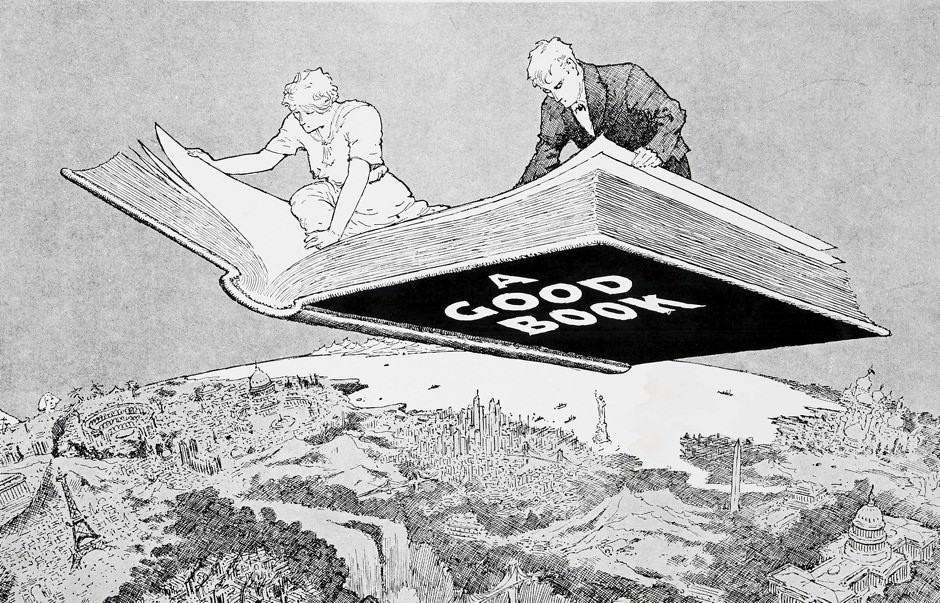 Wisdom literature—ignored, at best. We consult psychologists, celebrities, and pundits for wise advice on living, rather than philosophers and priests—but perhaps that’s understandable, since so many of today’s philosophers and priests have really gotten out of the wisdom game, after all. The philosophers focus on technical questions far more than broad, useful soul- and mind-craft, and I have heard that our religious leaders focus not on how to avoid sin and live more pure and holy lives, but instead on how to rely on God to inspire us to success and abundant joy. Increasingly, our teachers reject the wisdom of “dead white men,” glorifying whatever is new or genuinely produced by online communities, so long as it can be consumed quickly and easily by those who have never been taught to pay attention. The great books are less and less thought of as sources of perennial wisdom but instead are increasingly forgotten or, when remembered, viewed with contempt and hatred.
Increasingly, we lack the cultural capital needed to pass on the classic virtues.
So very much has been lost already.
A society of educated fools. Wisdom—gone. Although more of us than ever are college educated now, fewer than ever seem acquainted with or comfortable discoursing in terms of the best concepts, examples, and narratives of perennial, classical Western values. It’s all so old-fashioned and pretentious to us now. Much wisdom could be found in the Bible, whatever its faults might be, but in a largely secular society, those things are mentioned only the church services that a dwindling minority of the population attend on Sunday, and often not even there. Public discourse, which now mostly takes place online, the  discourse that at least among educated adults ought to be the most informed by classical standards of knowledge and logic, is mostly an exchange of tiresome fallacies, insults, and memes, when it does not consist of outraged head-nodding in Internet silos. We have become a society of educated fools.
Conscience replaced. And the practical wisdom, the wisdom that ought to inform how we spend our time and guide important decisions, seems a dwindling commodity as well, as more and more supposed adults act like selfish adolescents in their personal habits and relationships. Judgment of ourselves in moral terms, once called “conscience,” is rarely done or discussed. We can’t help but feel guilty at our faults—moral feelings die hard. But we don’t put a moral description on our faults. They are mistakes, self-destructive behavior, stresses, failures, embarrassments, addictions, flare-ups of psychological problems. They are so rarely vices, bad habits, foolish choices, bad actions, shameful behavior. The very idea of practical wisdom sounds increasingly antique and even foreign. Today we have “life hacks” that sound like technology instead of soulcraft.
Out of control, with a shrug. Self-control, or temperance—gone. Since around the 1990s we have freely admitted to binging on everything. We waste thousands of hours of our free time in front of television sets, not improving ourselves. We smile indulgently as many of our college students get drunk every weekend and “hook up”—it’s merely a rite of passage and youthful high spirits. Of course, everyone can agree there’s a problem when one of these hook-ups ends in a rape accusation. But the problem, society’s leaders say, is that our young men have failed to receive the proper sensitivity training. It is not due to a thoroughly vicious tendency on the part of everyone, men and women of all ages, to dehumanize others, to use others. We don’t discuss how appallingly damaging this high-spirited behavior can be to the souls of some students, those who go on to become alcoholics (not drunkards), who get pregnant and abort the babies and regret it for the rest of their lives, who cannot view the opposite sex with a sense of romance and without cynicism. Avoiding the entire morass, many of our men are glutted on desensitizing porn. Even our boys are glutted—on time-wasting video games. Many of us are glutted on social media, a huge time-suck that is often strangely impersonal. In the face of our many and varied temptations, it seems most of us can barely hold it together. We can’t stop ourselves—or so we tell ourselves, with a self-indulgent shrug.
Kindness and humility, uncool. Humility, unselfishness, kindness—the winning social graces of caritas, they too are sadly mostly gone. We are still restrained by peer pressures to behave more or less politely. But there is something at once pretentious and very small about so many people today. Few seem to find a value even in the outward display of ostensible humility, such as self-deprecating remarks. Besides that, actual humility involves candidly admitting faults, limitations, and ignorance, apologizing, allowing others to go first—everything that flows from a realistic assessment of human frailties and an acknowledgement of others as true equals. Instead, we are told to promote our personal brands and “never apologize, never explain.” In big cities especially, civilization has evolved in such a way that “taking what’s yours” and aggressive self-assertion are expected parts of being an ambitious go-getter. It is also simply part of being “cool.” Indeed, the very idea of “cool” involves some amount of contempt or cynicism toward other human beings. The notion seems to be that it is cool to act like you don’t really care about basic civility and kindness, about acting like ladies and gentlemen. The sheer inhumanity of man toward man sometimes on display online and in traffic still sometimes surprises me, and I’m almost 50; younger people don’t realize that “polite society” wasn’t always like this. It’s changed—really. Things have gotten better in some ways, yes, for example toward women and minorities; but they have also become ruder, cruder, and less graceful toward everyone.
I could go on but I don’t want to write a book—I just want to make it clear what I mean when I say we are in a “moral abyss.”
A nonpartisan abyss. I have not mentioned the moral criticisms conservatives make of the liberals: I take no stand, here, on whether the problems I have sketched are related to the conservative political bêtes noire of abortion, gay marriage, and drug legalization. Nor do I mention the moral criticisms liberals make of conservatives. Whether lingering intolerance, racism, sexism, anti-intellectualism, etc., are part of the abyss, I will leave the reader to decide.
The abyss is throughly nonpartisan. I have many friends who would take great issue with any suggestion that any such moral abyss is a consequence of the post-1960s liberal drift of society. I think they will mostly agree that good habits, and the classical virtues I have discussed, are important. I think my conservative friends will agree as well.
The sociological abyss. While I find our moral abyss can be described in a politically neutral way, there are some deep social problems I do associate with this moral abyss. Divorce rates have stayed at 50% for the last half-century; illegitimacy rates have soared over 40%, while marriage rates have shockingly declined; in Western societies and especially among elites, childbearing has fallen below the replacement rate, and appallingly, certain radicals in the “childfree” movement readily admit that they hate children; drug addiction is widely regarded as one of the leading ills of society; homelessness remains a huge problem; crime, while it has declined, lingers above pre-1970 rates, and it has probably declined in the U.S. because of how many criminals we lock up for long periods; etc. Arguably, these are each related to the common atrophying of our character.
Call all that the sociological abyss, and as appalling as it is, it is not the abyss that I mean. As bad and as consequential as all that is, I am more concerned about the moral abyss that resides within each of us.
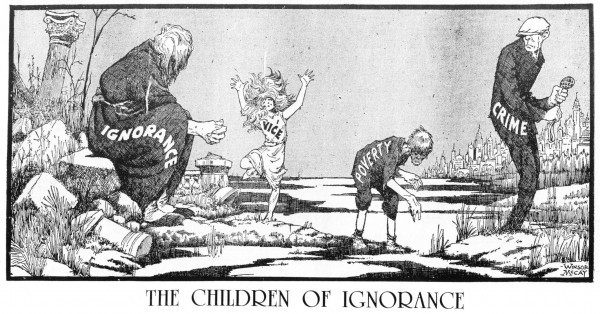
The abyss in us. I mean an abyss within me and within you. There are “saints” among us, no doubt. I’m not one of them, and I doubt you, reader, are one either. Our souls, so to speak, have collectively atrophied. When I talk about such things as lack of temperance and unkindness, I think ruefully of myself, my friends, and my family as much as I think of anyone else. I’m not trying to be falsely modest; I am making a hand-wringing confession. These problems seem to be in all of us, or nearly all of us, to some extent. If my hypothesis is correct and there were some valid way to measure at least the classical virtues I have mentioned, then as a society we would have seen a measurable decline from a hundred years ago until now.
Aren’t we living in a golden age? Still, you might say, it seems somehow ridiculous and perverse to complain about a moral abyss, and, if not motivated by a religious point of view, my complaint is simply weird, I will be told. (Especially by my fellow libertarians.) The world has gotten better. Literacy rates worldwide have grown. Standards of living have risen. Crime has declined. We live in nothing short of a golden age of invention, entrepreneurship, and technology.
A gilded age. All true. But all completely and utterly irrelevant to the problem I’m endeavoring to describe. Please, please make an effort to understand what I’m saying; it’s important. The problem I’m describing is not reliably reflected in sociological or partisan issues. Of course it seems bizarre, to someone strolling down the bustling, famous, elite avenues of New York City, San Francisco, London, or Paris, to hear we are falling in a moral abyss. I understand the attitude. I get it: our society is deeply impressive, yes, in many ways. I’d say we live in a gilded age.
If this is your reaction, I want to grab you metaphorically by the collar and shake some sense into you, because you don’t comprehend at all. The outward trappings of civilization in the centers of power mean nothing to the character of the everyday person in the civilization. Surely, if you are liberally educated or have some moral sense, you must know this.
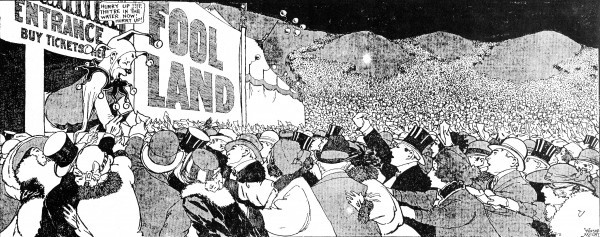
The challenges of parenting in the 21st century. So many parents lack a knowledge of the religious texts, the literature, the history, and the philosophy teaching such virtues. They have a weak grasp of the concepts and of the language needed to pass them on. Above all, they lack the virtues within themselves to teach them by example. Consequently, parents today produce children that must struggle to learn the qualities of character they so desperately need to know to lead decent, contented lives and ultimately maintain our civilization. And not surprisingly, we parents fail a lot, even if we try. It was always so, I’ll be told. Perhaps, but it’s gotten worse, a lot worse. The virtues were already weakened in our own parents’ generation.
Keeping up with the equally decadent Joneses. I admit that the problems I’m describing here might seem relatively unimportant “first world problems.” Your family is not homeless, probably nobody is strung out on drugs, the children are loved by their parents (whether together or divorced), etc. You’re doing fine. In that case, then yes, OK: you’re doubtless doing just fine compared to the Joneses. But you and the Joneses and everybody else together are living in a weakened version of Western civilization. I fear we are living on borrowed time, running on the fumes of the Enlightenment. The moral fiber within each of us has weakened, and in some it has thinned to the breaking point.
What is to blame for mass murders. It breaks in various startling ways. It was, for example, the recent shooting in Roseberg, Oregon, of nine innocent people, that inspired this cri du coeur.
Here’s why I don’t blame guns for mass murders. We went through generations in which guns were much less restricted than they are now, and we did not have regular mass shootings. Blame, instead, our moral abyss. We need to begin by blaming ourselves, our bad habits, and above all our utter foolish incomprehension about the way freedom, responsibility, and morality work in the world. After these atrocities, all too often we see hear stories that a brazen killer was “a nice guy” and good citizen and seemed normal enough. To be sure, sometimes the evil among us hide their evil thoughts and habits very well. But I think more often the actual behavior of those people is just not morally judged, period.
The rejection of responsibility makes the atrocities possible. The fact that we must look to societal causes rather than within the souls of the murderers—that is of course what these people are, after all, cold-blooded, soulless killers—is a profoundly deep part of the problem that brings these monsters into existence. If they had been raised in a society in which they were taught to take responsibility for themselves, in which the tools in their hands are not blamed, but instead the characters that wield them, then they might have found within themselves the moral wherewithal to resist the temptation to take out their frustrations on innocent others.
We are the abyss. I blame the monsters first and foremost. I also blame their parents and the abysmally amoral society they were brought up in, without which they would not seek to lash out as they do. “There but for the grace of God go I,” says the lovely, humble Christian sentiment. I do blame the abyss. But we are the abyss, all of us. The abyss is in the killers, it is in their parents, and it is in me, and you, and almost everyone in this utterly degenerate old world.
We need to change.
If we find a purpose in the so many senseless killings of innocents, let it be a call to all of us, a call from somewhere outside of the abyss, so that we may all climb out of it. We need to stop making excuses for our moral failings. We need to own up to them, hang our heads in shame, support each other in correcting them, and improve our souls and improve our society.
We need to regain our moral sense.
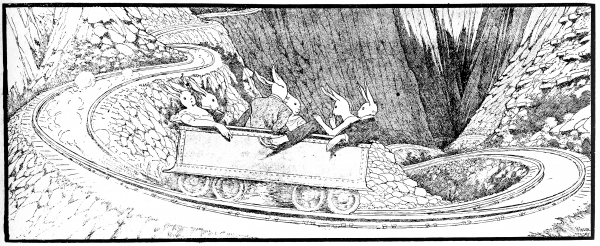
A video of this post (play it with close captions on):
I’ve just posted the following announcement to the big Infobitt mailing list.
=======
Friends,
I have some unfortunate news. While I don’t wish to give up on Infobitt, we have run out of money. I’ve let the programmers go, and I’m looking for a job myself. But I’ll still be contributing, and I hope you will too.
Before I say anything else, let me say thank you to the investors, my advisers (especially Terrence Yang), and especially the contributors. Thanks also to Vivy Chao, who has written the daily updates very well; Tim Chambers, who provided the awesome audio editions; and Ben Rogers, our technical adviser. And, of course, the readers!
Infobitt deserves to be rescued. It’s got an active, committed community, it’s an awesome idea, it works quite well at a small scale, and I’m confident it can be made to work at a large scale. So we’re very much open to new opportunities for Infobitt. Maybe you can help? I’ll explain how below.
Contents of this mail:
• If you keep at it, so will I
• What’s the core problem?
• Why I’m still excited about Infobitt
• What does Infobitt need?
• Potential partners
• How it can happen
• If not Infobitt: gigs I’d like to consider
• Idea 1: write Philosophy for Children and create a complete set of free philosophy videos for kids to go with it
• Idea 2: making educational videos for little kids—a free online preschool
Please do continue contributing to Infobitt!
If you keep at it, so will I.
If you continue to support Infobitt by writing bitts, adding facts, and so on, then I will too. I do hope that in the next few weeks or months, we’ll re-emerge, re-invigorated, with a new configuration of people who can really make things happen fast.
What’s the core problem?
1. Why don’t we do a proper launch? Because the software works OK only at a small scale. It desperately needs certain features if we are to benefit from the massive traffic we’d get after a proper launch. If we launched now, we simply wouldn’t be able to absorb the new arrivals. (That’s what happened after my Reddit AMA.)
2. So why don’t we just code up the features we need? Because our outsourced software is buggy, complicated, and lacks automated tests, all of which means it’s hard to maintain, and would become more so as we add more (badly needed—see below) features.
3. So why don’t we just raise the money? Because we’re out of money, which makes fundraising very hard. Besides, we need an active, productive team to raise money, and at this point it’s just me, a sole founder.
4. So why don’t I get some co-founders? Yes, just my thinking…read on.
Why I’m still excited about Infobitt:
• Unlike every other news startup I know of, we are actively, daily creating a purely volunteer, Wikipedia-like front page news site. Infobitt works as no other crowdsourced news startup does. It’s been working, in its current version, for about a year now—really working, even if our traffic numbers are still small. That can change (see below).
• People are still working on it, and not just a few, but over 25 every week, and that’s on an obscure project that still hasn’t been properly launched and is rarely discussed in the media. Regularly, I see old hands getting excited again and new people getting into it. We are onto something.
• I absolutely love your loyalty and I don’t forget the people who have helped my projects. You are the lifeblood of Infobitt.
• I’ve seen evidence of deeper support for Infobitt from outside our active community. There are people waiting in the wings, waiting for the software to get better, waiting to be able to share their work, waiting for it to get easier (e.g., a browser plugin to add facts by selecting text on a page and pressing a button to add to Infobitt), etc.
• When I work more on it, you do. If I were enabled to work full time just on growing the community—if I had the time to write 10 bitts per day, comment and add facts, do more tweeting and blogging, and especially if we were launched and I could do interviews about it, then the community would grow like gangbusters.
What does Infobitt need? So…why aren’t we there yet?
• We need a better API. (Our automatically-created Python/Django API lacks many features, although it works.)
• Then we need apps (which use the API). (But a high school kid has actually made one based on our existing API, but it’s not released yet.)
• We need to add some insanely obvious features:
• Fact editing!
• View counts!
• Choose a bitt’s rank from within the bitt!
• Social sharing!
• FB/Twitter login.
• Email notices.
• Automatic newsletters.
• Tags/categories.
• Browser plugin to start/expand bitts quickly.
• We’ve also got serious bugs to fix.
• Any one of these would inject new life into the project. All of them would make this a popular and growing website, I think.
• Then, we need to be properly launched.
• We’ve got to make the software faster and more resilient for when high traffic arrives.
• I’ve got to start doing interviews. But first we need to be positioned to benefit.
To be brutally honest, I never should have tried to start a startup as a sole founder. I need others on board as partners, who are passionately committed to our mission and to making it a success. I’m doing too many jobs at once, when my forte, what I need to be focused on, is community and project development.
Potential partners. I assume that many of Infobitt’s best potential partners will be reading this, or will know people who are reading this—and you can forward this mail to them. Here is what we need:
• Awesome engineers: Python/Django, Javascript/Angular, PostgreSQL. Solid sysadmin type skills, including experience on AWS, would be most welcome. Somebody who can improve our API so people can make full-featured apps around our (open content) data. Maybe more exciting would be somebody who is inspired (and, of course, positioned) to write Infobitt from scratch, in a more reliable form.
• Designers. (But we need engineers on board first, to be able to use design work.)
• Maybe eventually one or two community people to help me.
How it can happen. Here are some categories of people or organizations who might be interested in joining me and helping to turn Infobitt around:
• Remarkable individuals, especially those are free to work for equity or who might want to buy into the company. Especially awesome engineers who are on top of Python/Django, Javascript/Angular, PostgreSQL, sysadmin, AWS.
• Existing startups, or idle startup teams, that want to pivot to Infobitt, who are interested in working with me. Again, free to work for equity or who want to buy into the company.
• Big nonprofits or fast-moving universities (ha ha). Theoretically, we could become nonprofit, open source, and open content. This would probably make it easier for Infobitt to succeed, assuming the project funding were adequate, but Infobitt’s investors obviously would like to make money.
• An investor that wants to buy Infobitt, build a team, and will hire me (with significant equity) and assign me to work on it.
Such people (or entities) would have to buy a major stake in the company and, presumably, hire me as an employee. I’m cool with that.
As far as I’m concerned, everything is on the table. I’ll be interested in anything that has a reasonable chance of making Infobitt a success.
Other gigs I’d like to consider
If nobody bites on Infobitt, here are some opportunities that would intrigue me:
• Full-time worker on somebody else’s startup. Community leader, project manager, or you tell me. I’d prefer to work from home most of the time.
• Adviser. For the right sort of project, I can help a lot. I’m an endless fount of ideas and very useful critical feedback.
• Writer/analyst/advocate. About education, homeschooling, very early reading, the Internet, rescuing the Enlightenment, philosophy, etc. (from a libertarian, rationalist perspective, if relevant). I’m also a practiced public speaker. I’m interested in working for a nonprofit advocacy group.
I’d be excited to execute either of a couple ideas I’ve had:
Idea 1: write Philosophy for Children and create a complete set of free philosophy videos for kids to go with it
I started writing an intro to philosophy for elementary students, a chapter book, back in 2012. Here’s the first chapter. I’d love to finish it quickly, and use the text to make the world’s first complete set of videos about philosophy for kids approximately 5-10 years old. Here’s the first video. It would take about three months for me to finish if I work on it full time.
Thing is, to support this project, I need at least $17,500. I’d love to do this and make the next generation a bit more hip to the liberal arts and the Enlightenment. I started designing a Kickstarter about this, but I haven’t finished it.
Idea 2: making educational videos for little kids—a free online preschool
Are you a philanthropist? Want a high-impact way to support online education for kids everywhere? Pay me me to make 2-3 videos per day like these. Most of those 24 videos got over 10,000 views after a few years, and my top ten have over 50,000 views apiece (with one at 750K). They’re easy for me to make, I’m good at it, and I love to do it. Also, my 4-year-old will beta-test for free! I envision a library of thousands of videos like these…think of it as an awesome free online preschool. By the way, if you want to pay me per video, to make sure I don’t waste your money, let’s do it!
Please continue contributing to Infobitt!
All the best,
Larry
As I wrote in my last blog post,
I’m pledging to abandon social media networks when I am at work, except for narrowly defined work purposes. And I’m asking you to hold me to it and slag me mercilessly if you catch me at it! And I’m inviting you to take the pledge, too!
Yep, so for one day at least—and for many more, I still intend—I didn’t do any social media at work. I could have done some related to work, but I didn’t have any I wanted to do, so I didn’t.
I’ve had a tremendously productive day so far! (Among other things I promoted a plan to get people to write a bunch of one-fact bitts quickly; and I also started a list of our “beat writers,” six listed so far, under the first question of our FAQ. Sorry, you may have to log in in order to see this.)
But, sadly, nobody, not even a single person, took this “No Social Media at Work” pledge. Oh, well! I’ll continue myself, anyway!
Social media is a time suck. I’m not as bad as some, but I need to focus better. I think a lot of us do, frankly. Don’t you agree? Then let’s start a No Social Media During Work campaign!
I’m pledging to abandon social media networks when I am at work, except for narrowly defined work purposes. And I’m asking you to hold me to it and slag me mercilessly if you catch me at it! And I’m inviting you to take the pledge, too!
Here is my pledge. This feels like a big step. Here goes!
I pledge, as of NOW, to abandon social media networks when I’m at work! Pledge with me!
I am at work weekdays at least from 8 a.m. until 5 p.m. Eastern, taking noon until 1 p.m. for lunch; and also from 9:00 p.m. until 11 p.m.; on Infobitt.
I want to do as well as I can on it! So I hereby pledge to abandon social media networks when I am at work. Hold me to it and slag me mercilessly (after your work) if you catch me at it!
I am @lsanger on Twitter, larry.sanger on Facebook, Larry Sanger on Quora, and Larry Sanger on YouTube. Hold me to my pledge!
Exceptions are very, very narrowly limited to: posts and discussion about Infobitt; also, holidays and declared sick days.
Checking for responses on any network is permitted only if I recently posted something work-related, and I might actually get a response.
I also promise to track my friends’ pledges. If I notice a broken pledge, I will call them on it!
If you, too, want to take the pledge, then post a copy of your pledge to all social media networks you spend time on. Feel free to double down by adding your pledge to the bottom of this page: http://larrysanger.org/2015/06/take-the-pledge/ . Make sure to include your pledge somewhere on your user page, not just as a separate post, so you and others will not forget your pledge. Do make a video of yourself (here’s mine) reading a written version of your pledge on any video networks of yours, like YouTube.
Work hard, and then play hard!
Wow. I hope this is the right decision. I think it is. It feels like a big one. I’m actually very excited!
OK, are you ready to take the “No Social Media During Work” pledge with me? Come on, DO IT! Not only will you get more work done and feel better about yourself, if you post it publicly on all your networks, then you can help improve the productivity of the world! And you can publicize your own social media presence. It’s a massive win for everybody!
Come on, somebody write an app to catch me and others in violations, and I’ll use it (the iPhone version) and link to it!
Here’s a pledge form you can fill out:
I pledge, as of NOW, to abandon social media networks when I’m at work! Pledge with me!
I am at work weekdays at least [ list your work hours; list breaks if you want, though I didn’t list any, except for lunch] on [your company, project, school, etc.—optional].
I want to do as well as I can on it! So I hereby pledge to abandon social media networks when I am at work. Hold me to it and slag me mercilessly (after your work) if you catch me at it!
I am ___ on Twitter, ___ on Facebook, [ list other social networks similarly]. Hold me to my pledge!
Exceptions are very, very narrowly limited to: [ list exceptions as carefully as necessary]; also, holidays and declared sick days.
Checking for responses on any network is permitted only if I recently posted something work-related, and I might actually get a response.
I also promise to track my friends’ pledges. If I notice a broken pledge, I will call them on it!
If you, too, want to take the pledge, then post a copy of your pledge to all social media networks you spend time on. Make sure to include your pledge somewhere on your user pages, not just as a separate post, so you and others will not forget your pledge. Do make a video of yourself reading a written version of your pledge on any video networks of yours, like YouTube.
Work hard, and then play hard!
Well, are you in?
Here are some unpopular opinions, for your outrage or delight.
1. One of the biggest but least recognized reasons that American school system sucks—and it most certainly does—is that so many teachers and education professors are just as anti-intellectual as most parents. This is why we homeschool.
2. A large contingent of geekdom is actually anti-intellectual, too, as paradoxical as that might sound. Not all; certainly not my friends.
3. The most important purpose of education is not vocational education, but to train and liberate the mind, to create fully competent and responsible free citizens of a free republic. This, contrary to the much-celebrated Sir Ken Robinson, is not “boring stuff.” We’ve got to adopt the right educational goals, lest we continue to suffer great opportunity costs of various inefficient educational methods. It’s a goddamned shame that national treasures like Marva Collins have not been listened to and learned from.
4. Knowledge—which is a key element of the mission of education—involves no small amount of memory work. No, it doesn’t matter that research is updating our knowledge base very regularly. If we could only jettison our distaste for memory work, we might learn the tremendous advantages of spaced repetition.
5. Television is mostly a friggin’ waste of time. You’re better off without access to broadcast and cable TV. You can watch the good stuff on your own time via Netflix, Amazon Prime, etc.
6. Latin and Greek are still good languages for kids to study.
7. Yes, babies can read. Robert Titzer (of Your Baby Can Read fame) was badly misunderstood and unjustly attacked. At least, babies can start to learn to read. By the time they’re preschoolers, they can read well. This doesn’t require pressure in any way. It’s fun. Maybe you just didn’t know this. Try to keep an open mind.
8. Joyful, disorganized early education can generally do great things for little kids. It’s a completely avoidable national disgrace that so many kids exit first grade without knowing how to read.
9. All that just goes to show you that experts can be really friggin’ dogmatic, or so I find, as much as I do respect them. They’re highly susceptible to groupthink, and we must not confuse devotion to science and scholarship with uncritical acceptance of whatever trends happen to be in the ascendancy among the current generation. Follies are frequently collective, even among smart, well-educated people. Sad, but all too true.
10. Another example of dogmatic experts: yes, we do have free will, properly understood. Oh-so-clever science students stupidly assume that science alone can establish the contrary. They pretend not to be doing philosophy, when that is exactly what they are doing (albeit badly). They are annoying in their stubborn failure to understand the issues. Compatibilist free will is the only sort of freedom we need.
11. Our university system is broken, but it’s a huge mistake to conclude that college is a waste of time. I propose that we pop the education bubble by creating a new, more independent and modular system of higher education, with degrees by examination among other things.
12. It makes no sense to use reason to call into question the use of reason. “He must either be a fool, or want to make a fool of me, that would reason me out of my reason and senses,” said one of my heroes, Thomas Reid. It is per se rational to begin our reasonings from the principles of what philosophers like Reid and G. E. Moore called “common sense.”
13. An objective morality does exist. Relativism is dangerous and wrong. It is not the case that, if God is dead, everything is permitted. As Aristotle knew, life itself is the basic good that underlies our moral judgments; so our basic duty is to live well.
14. While in some ways Western civilization has never been more powerful and enlightened, it has also become morally and intellectually arrogant, sclerotic, and stunted. This can’t end well.
15. More specifically, I am appalled and saddened by how cynical and morally bankrupt so many people can be today when acting as part of governments, bureaucracies, parties, corporations, schools, social cliques, the dating scene, gangs, law enforcement, publishing, etc., etc.—and when our supposed intellectual leaders mostly avoid moral judgment of the contemptible behavior that takes place in these social contexts. Corruption and cynicism are not OK; it doesn’t matter if “everybody’s doing it.” Someday I’ll write an essay, or a book, about this.
16. We’ve lost our moral and intellectual bearings. Religion is no longer a unifying force, of course. Even the formerly unifying ideals of western civilization—knowledge, freedom, dignity, excellence, self-control, etc.—have come under attack by much of our intelligentsia. Ideology is no substitute; no, nothing substantial is in its place. As a society, we’re sleepwalking. It’s alarming. Again, it can’t end well.
17. Goddamned Hollywood is a morally depraved hot mess. They have got to get their house in order. They generally don’t deserve our attention beyond any worthwhile entertainment they happen to produce.
18. I’m sorry if this offends, and I’m not saying this about my many liberal friends, who are generally very original and brilliant, but I’m going to say it anyway: conventional, dull, social-climbing, ambitious people are now mostly liberal or progressive Democrats. Being a lefty is no evidence that you are a smart nonconformist, not that it ever was. There are still plenty of dull, conventional conservatives too, of course. But at some point we’ve got to start talking about big-government left-wingers in this country as “conservatives,” just as unreconstructed communists in the old Soviet Union were called “conservatives.” Then I’ll ask for the good old word “liberal” back.
19. I am particularly appalled by the illiberal hostility that certain left-leaning students, and some older people as well, are showing toward the fundamental American ideals of free speech and intellectual tolerance. In the Facebook alumni group for my alma mater, the uber-liberal Reed College, a lot of older liberals share my consternation at these trends; no, they aren’t conservative or even libertarian.
20. Jonathan Chait is correct that there is a new political correctness. We have become too sensitive and rely far too much on dismissive arguments regarding how people have allegedly broken new social norms that not everyone shares. We ought instead to engage on issues of substance. That we don’t is really screwing up our civic culture.
21. Speaking of political incorrectness, I have some guilty pleasures on YouTube that aren’t quite politically correct for me to admit to liking. I admire their outspokenness, their intellectual courage in an increasingly censorious age, and their thoughtfulness. Let me introduce you to them:
Pat Condell. In-your-face atheist, old-fashioned liberal, vociferous defender of free speech. I might not always agree with him—actually, I often do—but in any case, I admire his spirit.
Karen Straughan. I’m really going to catch it for endorsing her, so let me just say first that I’m not convinced that her general take on feminism is right—it’s a lot to process and I need to think her views through more (a book would help). Still, I love that she’s a bisexual single mother and yet has the courage to comes down, hard, against the bigger stupidities of radical feminism. She comes across as remarkably articulate, intelligent, and frequently shows she’s done a lot of research; it’s hard to believe she doesn’t even have a college degree. She’s going to be famous in 10 years if not sooner.
I also like the brand of feminism of my fellow philosopher Christina Hoff Sommers; I have ever since reading her Who Stole Feminism? back in the 1990s.
“Rockin’ Mr. E.” He’s sort of a long-haired Greek-Welsh cross between Pat Condell and Karen Straughan. Again, I don’t always agree, often because his arguments would require research and thought to evaluate properly—but I often do find myself inclined to agree, anyway. I appreciate his nonconformist, independent spirit, anyway. And his chops on the electric guitar.
Let the sneering begin!
I’m sure I’ve managed to piss off everybody to some extent. I swear this isn’t my intention. I’m not a troll because I actually believe what I say and think it actually important to say. I do own up to being a gadfly and possibly a pretentious, annoying git. But a troll, no.
1. Soul-making and the education bubble
One of my biggest pet peeves is the reduction of education to an economic transaction—to the gaining of marketable skills in exchange for fees.
That’s all wrong.
Professional and vocational education is all fine and well, but education at the K-12 and college level is essentially soul-making. To be educated, we must be liberated from our prejudices, from our bad habits of lazy thinking, from our tendency to rely upon emotional reaction and dogma in place of critical analysis. To be well and liberally educated, we must learn to value the truth and how to seek it, and we must be given background knowledge and academic tools to do so.
I think there’s a crying need for this today. All too much of what I encounter online that passes for argument seems to be more the spewing of reactions and dogma than the rational support of conclusions based on evidence, reasoning, and credible research.
We need to be better educated.
But let’s face it: there’s an education bubble. As many have pointed out (e.g., this guy and this one, both of whom were well-educated), education has become too expensive for “mere” soul-making.
Tuition at my alma mater, Reed College—one of the few colleges left that is still wholeheartedly committed to the liberal arts—rose from around $14,000 to $18,000 when I was there. (If I remember right.) The cost has simply continued to rise. The coming school year will cost $50,000. Of course, it’s not the most expensive: Harvard is up to $60,000. That’s absolutely insane. That does not reflect the real value of what one pays for when one attends college. It’s clearly and simply a bubble.
But to say it’s a bubble is to say it can be popped. How? Won’t there always be an enormous demand for the connections and status conferred by an elite degree?
Well, no. Not if the price continues to rise. The market will find a way. Eventually, many of the best and brightest, even students from rich families who can afford to pay the tuition bill, will balk at the opportunity cost and seek, or create, cheaper and better alternatives.
2. What people want (and don’t want) out of a college education
I made the contentious claim that Harvard’s $60,000 tuition “does not reflect the real value” of a Harvard education. OK, OK, I don’t really know if that’s true. In fact, I don’t even know what the words “the real value of an education” would mean. But let me explain what I was thinking.
Here’s what’s valuable about a college education:
• The credential itself.
• Knowledge and academic skill—and the liberal effects thereof.
• Marketable skills.
• The enjoyable “college experience,” consisting both of the joy of learning and the forging of meaningful (not just mercenary) relationships.
• Connections formed via friends and acquaintances and within an alumni community. These can be very valuable at elite colleges.
• Recommendations professors are willing to make to graduate school or employers.
• The credential itself.
• Other things (e.g., it’s easier to get into grad school at the university where you went to college; connections with researchers or practitioners in the field).
I don’t know what all that’s worth, but it’s a heck of a lot. The thing is, we already know it’s overpriced—because college tuition has gone up much faster than inflation, while the value of education has not increased. If anything, since more people have college degrees, and a lot of them are unemployed, the economic value of the degree has decreased.
The fact is, the things listed above, as valuable as they might be, can be had for a hell of a lot less than $60,000.
We also want a college education to treat us like adults with brains of our own. So there’s another reason the education bubble needs popping: the system of higher education is increasingly politicized. For libertarians like me, it’s ripe for revolution. A lot of people are disgusted with the fact that college, at least in the humanities and social sciences, has become as much a place of political indoctrination as of legitimate education. I remember some professors being extremely biased, back in the day; one could learn from them, but it was annoying. Things are several times worse now.
In addition, as a guy, I certainly would be thinking twice if I were getting ready for college, with so many stories of spurious harassment charges and so many students apparently incapable of handling controversial issues without freaking out (see the links listed in this Quora question). I think college should be a time of bold intellectual exploration, with students willing to fearlessly question and discuss anything together. I doubt I’d want to pay $50,000 per year in order to walk on eggshells around hyper-sensitive classmates, only to be indoctrinated by half of my professors.
Oh yeah, there’s a bubble, and it’s ready to be popped.
3. How to pop the bubble
The big question is, how on earth can we get the huge benefits conferred by college education, without actually going to college?
If we could answer that question, we’d have instructions for lancing the boil.
So here’s my solution. (The following is an updated version of this old manifesto of mine from 1995.) This is what I might tell my boys when they’re ready to start university-level study. It wouldn’t be free, but it’d a lot cheaper than a college degree.
First, how to get the credential:
(a) Plan on getting your degree itself by examination. Degree-by-examination programs already exist. So that problem is solved.
But you probably need more than such a degree, particularly if you want to go to graduate school or get certain high-powered jobs. So:
(b) In addition, plan to pay a distinguished expert to test you in your major. I think that, when there is a demand, comprehensive and prestigious exam services will come into being. Basically, you register for an exam, you pay $100 or $1,000 (it really depends on how comprehensive it is and how good the examiners are) to sit the exam, and at the end, the institution awards you a degree. Until such programs come into being, you arrange to have a private written, oral, and/or practical exam with a distinguished expert. Then you’ll be able to say, “Famous and distinguished scholar Dr. Knowitall gave me a final eight-hour written and oral exam about my subject area of Wonkology. Dr. Knowitall judged my level of mastery to be ‘Very Superior,’ which is defined as ‘superior to 90% of students awarded a bachelor’s degree.'” I think you’ll be able to find plenty of graduate programs that wouldn’t accept that sort of recommendation in lieu of an actual bachelor’s degree. And if one such examination doesn’t seem persuasive to graduate schools or employers, arrange for two or three from different scholars.
But what about actually getting the knowledge and academic and marketable skills? How does one do that?
(c) With plenty of help, execute a program of independent study. When you’ve decided to start getting an actual college education, head on over to a city with lots of colleges and highly-educated people. Boston and the Bay Area are obvious choices, but there are many others. Audit classes—many professors don’t care if you sit in on their lectures. For purposes of getting feedback on your work, hire tutors. Find the most distinguished professors you can who are willing to help (for a fee; and be prepared to pay a fair bit, as they are worth it). Get a guest library card from a large academic library. If I were advising my sons on how to do this, I would tell them to hire a freelance academic adviser to help them plan and manage their studies in the way described here. Such a person might also help motivate the student, and make sure he or she doesn’t get off track.
The more people do this, the more a group of independent students might be able to get together and pay professors in the area for independent courses, a la carte. And of course if there are enough people doing that, then support mechanisms—apps, companies serving basically as registrars—would inevitably come into being. What I would not recommend is simply cracking open books and viewing The Great Courses, as excellent as they might be. Of course that could be part of your program, but I recommend against becoming an autodidact. A real education absolutely requires (a) discussion, preferably with peers as well as professors, and (b) feedback on your written and oral work, which you use to improve. It’s best if both (a) and (b) are done face-to-face, but today, no doubt some of this work will be done via the Internet.
But what about the “college experience” and the social connections you get from college? Where could they come from?
(d) Seek out like-minded students to study and live with. A central part of a new ecosystem of independent study would be, one hopes, study groups and shared housing, like independent dormitories. The idea is that a group of students all starting to study the same subject might rent a house together, near some big prestigious university. This might forge relationships very similar to those found in the college setting. Such houses might invite professors to teach classes. (Speaking as a former college instructor, I have to say that that sounds like a blast.) Other academic social activities—invited lecturers, etc.—can be organized via the Internet and would no doubt be supported by a highly entrepreneurial ecosystem supporting such independent study. (Digital Badges and Uncollege are two forays in this direction.)
Perhaps, as such an ecosystem begins to cause problems for universities, some universities themselves might support the independent students in various ways. This is what happened when distance education started getting popular in the 1990s.
What about official letters of recommendation?
(e) Relationships between tutors and independent scholars would naturally be closer than between professors and students. The tutors would probably know and be better able to write letters and make other recommendations than they do for regular college students. Obviously, we won’t know the details until we’ve done more experimentation, but there’s no reason to suppose someone who has undergone a course of study described above could not find a berth in graduate school or industry, directly with the help of distinguished experts who know the students’ work very well.
If enough students followed the path of independent study, there would be various competing national testing services capable of vouching for your level of expertise in a subject and for your overall educational attainment. One advantage of such a system is that it would be potentially more meritocratic: rather than saying you have an English degree from Harvard, you would say that you scored a 96 (out of 100) on the Yalvard B.A. English exam and an 83 on the Yalvard B.A. General Liberal Arts exam. To be able to reach such scores, you would not necessarily need to attend an elite school. But such scores might well get you into graduate programs, and they would naturally open other doors as well.
The system envisioned would replicate the college experience, but without the college and without the exorbitant college fees. I’m sure you could get away with paying instructors $10,000 per year or less; maybe much less. The biggest risk that I can see is that the economies of scale don’t exist yet, making a bit of the plan less feasible, or harder to execute anyway, for the early adopters. But not a lot of it.
It’s a little like homeschooling for college (a notion Dale Stephens was talking about a while back). Public schools in the U.S. are so unsatisfactory to so many people that a significant number of parents (like me) are opting out of the system and doing it themselves. The affordances of the Internet and the entrepreneurial spirit of the early 21st century could combine to enable a bunch of people to drop out of high-priced colleges and come together in a less-expensive but still high-quality, less-politicized, face-to-face system.
And it sounds like fun to me. It almost makes me wish I were a college student myself, because if I were, this is almost certainly what I would want to do.
A final bonus: the early adopters can make a business out of it after they’ve learned how to do it and worked the bugs out.
This is a credo in defense of freedom of speech and intellectual tolerance. As a credo, anyone can endorse or sign this; please do, in whatever form you wish. Feel free to add, subtract, or respond.
It is a DRAFT statement of belief in response to certain claims sometimes made, loosely implied, or perhaps occasionally assumed by those whose main focus is social justice—people called perhaps unkindly “social justice warriors” (SJWs). (I prefer the phrase “radical social justice advocates” (RSJAs) to refer to the same people, but without the associations.) The worry is that some people seem to lack adequate respect for free speech rights in their fight for social justice. But before you call these statements “straw positions,” please bear in mind that we are not saying that any particular individual actually denies any particular statement here. I’d be happy to include some planks directed more specifically to problems with free speech that conservatives have.
I want these statements written so that they are acceptable by a wide range of people of progressive, liberal, centrist, libertarian, and conservative points of view. So please suggest edits.
1. Free speech, why important. Free speech is a deeply important right, because it enables responsible, democratic government, liberal education, more accurate journalism, conscientious religion, deep and critical philosophy, fair discourse, and through all of these, good habits of individual, rational deliberation.
2. Freedom of dissent. Free speech entails freedom to disagree, dissent, and criticize.
3. Open disagreement in forums. Simply expressing open disagreement with the tenets of—to take a few instances at random—religion, feminism, progressivism, conservatism, and government policy is and should remain free and welcome speech in most forums.
4. Free speech on campus means academic freedom. Speech and dissent should especially remain free on the university classroom and campus, in official and unofficial functions. Censorship of ideas, especially on a college campus, is wrong. Academic freedom extends not just to professors but to students as well.
5. Freedom of speech does not entail a right of respect. No matter how certain you feel about your views, you do not have a right for those views of yours to be respected.
6. Privacy of conversation. It is simply wrong to attempt to shame a person by sharing what they have stated in what they reasonably expected to be a private conversation publicly online or with their employer.
7. “Doxxing” is unacceptable. Even worse is an attempt to silence a person by sharing private information—their address, ID or credit card numbers, etc.—about them online.
8. Silencing through threats is unacceptable. Attempting to silence a person by threatening them with bodily or other harm is, obviously, completely incompatible with free speech. This must stop.
9. Offensive speech. The speech most in need of protection is offensive speech; after all, inoffensive speech is not in need of protection. If you do not support a protection for offensive speech, you do not support a right to free speech.
10. You do not have a right not to be offended. That means others have a right to say things you find offensive. This is a basic part of being an adult in a free society.
11. Offending is not harming. Words, especially about hot topics such politics, religion, race, gender, etc., can cause all manner of upset. Nobody likes that, but you aren’t being meaningfully harmed by those words in the legal sense. Society long ago agreed to set aside minor, passing emotional discomfort, such as is caused by ordinary discourse, as something you can be punished for causing—or else the government’s job becomes too big and too prone to unfairness.
12. Speech you hate is not necessarily hate speech. Speech that you hate is “hateful” (obnoxious, offensive, annoying) to you, but that does not by itself make it “hate speech” (expressing hatred of people for their, e.g., racial or ethnic identity). Careful not to mix these up.
13. Avoid false claims of triggering. Being “triggered” is something different from feeling offense or discomfort or outrage. If you don’t actually have a PTSD, you don’t deserve to be taken seriously if you claim to be triggered. In that case, you’re just expropriating the scientific language of therapy and applying it to your own feelings of discomfort.
14. Your trauma should not prevent others from learning. If a topic, book, or other media so traumatizes you that you cannot participate, you do not have the right to prevent others from learning from it.
15. Trigger warnings should not be required. Of course, polite warnings about difficult material are a fine idea. You may request that they be made, but a requirement puts pressure on instructors to avoid controversial or emotional material, which is at odds with the very purposes of education.
16. Free speech is not “unsafe.” The following things, all by themselves, do not in fact make you unsafe: someone disagrees with your opinion, your religion, your ideology, your cause; someone criticizes you; someone else is merely angry or offended; someone has an opinion that you find “hateful.”
17. Feeling unsafe is different from actually being unsafe. The circumstances matter, of course, but in general, simply claiming or even feeling that you are unsafe is not enough for you to be unsafe.
18. Avoid false claims about being “unsafe.” To state that something someone says makes you feel unsafe only because you wish to silence the person is wrong, contemptible, and a direct attack on free speech.
19. Free speech and intellectual tolerance go together. A society committed to free speech is also committed to intellectual tolerance, or tolerance of a wide variety of points of view. Societies that have many rules about what people may say are consequently strongly intolerant of the verboten points of view. A society devoted to free speech “agrees to disagree.”
20. Intellectual tolerance, what. Intellectual tolerance involves “letting” people have a different point of view from yours. You don’t have to like it. You don’t even have to respect it. But you should respect the moral right of people to hold those different views.
21. Intellectual tolerance means not shutting others’ speech down. If you’re personally committed to free speech and tolerance, you won’t shout people down at speeches they’re giving.
22. Intelligent people disagree with you. Just because somebody does not immediately agree with you, that doesn’t mean that they are ignorant or unenlightened.
23. Privilege does not need to be silenced. Just because someone is a member of a “privileged” group, it doesn’t follow that he or she deserves to be silenced or shamed.
24. Fixation on “privilege” can make you a bigot. Constant attention to the identity groups of your “privileged” opponents means you’re engaging in identity-based bigotry and stereotyping—which is something social justice is supposed to be opposed to.
25. Don’t pull out the big guns so quickly. Someone is not a sexist simply because he expresses skepticism of one of the tenets of feminism. Someone is not a racist simply because does not agree with you. Someone is not a socialist just because they are a Democrat or in favor of Obamacare. Words like these tend to shut down conversation and harden positions. They should be used only with evidence.
Anything else to add? Anything directed more toward conservatives?
Once this is completed, I might seek out more attention. For now I’ve just posted it on the blog and have sought a input from a few acquaintances.
Ultimately, I’d love to see such a statement drafted and posted for many people to sign. Of course, it should only include statements that (1) we have seen radical social justice activists (RSJAs) or conservative opponents of free speech make (or which they appear to assume), (2) seem to be very implausible, and also such that (3) some contrary point of view appears to be a matter of common sense. So, no conservative talking points, of course. Just the obvious stuff that most free speech-loving liberals, libertarians, and conservatives can agree upon and on which they disagree with RSJA types.
First, H., age 8. The trouble now is that H. is now mostly “unschooled,” not by choice but by necessity. While Mama is now taking on a lot more homeschooling responsibilities, especially now that E. is no longer a baby and Infobitt requires so much of my time, she leaves a lot to H.’s choice, which means that I still occasionally (a few times a day) monitor his work. Things we still do 100% together, as ever, include Latin, piano lessons, science reading at dinnertime, and other reading at bedtime.
Latin. We’re now on p. 39 of Benjamin D’Ooge’s Elements of Latin, which we are studying thoroughly, supplemented by repeated readings (and vocabulary memorization) from Maud Reed’s Julia, an excellent short Latin reader that begins very simply and gradually becomes more difficult. We spend about 1/3 of our Latin study time reviewing everything using SuperMemo. Note that we had already finished Getting Started with Latin and gotten to Level 3 of Rosetta Stone Latin. As a result, although we’re proceeding through D’Ooge, our main text, at a snail’s pace, after some review we have everything in the book up to the point we are studying down cold. Also as a result, when we sit down to do the exercise portions of the text, we generally have little trouble with them. In my experience, this is the proper way to study a foreign language: make sure you understand everything and have thoroughly practiced everything before you proceed to the next chapter.
D’Ooge is awesome. It is an unapologetic old textbook in the grammar-translation method, but that isn’t what makes it awesome. It’s just very well done. It’s gradual, it has just the right amount of review, it’s very clearly and precisely written, and it prepares the student to read Caesar’s Gallic Wars, and how cool is that? At our present pace (considering we’re supplementing with Julia) we’ll probably take 2-3 years to get through, but then H. will be 10 or 11, and to be done with a high school level textbook at that age is fine with us!
Math. H. has been doing Splash Math exclusively for many months now and is 95% done. Should be done in another week or less. No more long struggles with Saxon, we’re delighted to be completely done with 5/4. After this we’ll do another fifth grade math curriculum, probably Singapore, then move onto sixth grade. Also he has watched the entire Mathtacular 3.
Literature. Here are the more literature-y books he’s read recently (last year? Last six months? I’m not keeping track at this point):
Several of these I’d read to him earlier, between the ages of 3 and 5 (these are marked with *). In addition I think he went through the entire Henry Huggins series once again, then read the first 3-4 Ramona books, and did more of his beloved Hardy Boys; I think he’s up to #15 or so there. Other stuff too no doubt.
As to writing about what he reads, I’m afraid we’ve all fallen down on the job there. He rarely writes anything about what he reads, and I just don’t have time to make him. I did start him doing “brain dumps” about a few books he’s read lately (Johnny Tremain and a history book), which means: writing for 5-15 minutes without stopping (pauses of longer than five seconds are disallowed) in which you say basically the first thing that comes to mind about the book. Worked pretty well but we’ll see.
Also, I read to him at night…not nearly as much as we used to. The reason is that I stopped making sure he does review (SuperMemo) during the day, and as a result, half the time he ends up spending our reading time in the evening doing review. It’s kind of sad. I think we’ll improve. Anyway, we did finish Huckleberry Finn, after H. finished reading it to himself. I did start reading the original KJV Bible, but that’s of course going super-slow; we’re still in the book of Genesis. We’re making SuperMemo questions about it. Anyway, we mostly read other stuff at night (see below).
Writing. I’ve again given up doing anything systematic. I simply tell him to write something, and he typically does. My biggest regret here is that he rarely finishes anything, although he does write a lot, and he continues to write with prodigiously good spelling, grammar, sentence structure, etc. Almost everything he writes these days has something to do with computers. He knows stuff about computers I don’t know. My big plan at the moment is to get him to do “brain dumps” for 5-10 minutes after each half hour of reading that he does, somewhat according to the Charlotte Mason method. He’s done that last Thursday and Friday and it seemed like a good experiment, but we’ll see if we can keep it up. I’ve impressed upon H. very clearly that he must start writing a lot more about what he reads now, and that his goal is to get comfortable and proficient enough at doing so that it will not be too hard to write regular essays, rather than disorganized “brain dumps,” about what he reads.
Grammar. Every Monday at dinner I read and explain to him 2-4 pages from Help Your Kids with Language Arts. Occasionally, he’ll do a lesson from the Marie Rackham “Splashes from the River” Cozy Punctuation course, and I’ve been trying to get him to do exercises from another punctuation book, although that’s very slow going. He gets plenty of grammar, of a better quality, from Latin study. But of course that’s not enough, because English grammar and punctuation etc. is different from Latin.
Piano. H. continues to practice a few hours, all together, per week. I give him 15-30 minute lessons on average around three times a week, on a good week. He continues to progress, although slowly. His heart isn’t really in it.
History. By last fall we had finished The Landmark History of the American People, Vol. 1, and had read the corresponding parts of our usual history books, and then I decided we’d read key historical documents at the same time, 15 minutes per day. Well, that went on for a while but then I felt like I didn’t even have time for that. In any event we did carefully study, twice and with a commentary, the Declaration of Independence. Then we did all but a couple pages of the Constitution. He started (but as usual didn’t finish) some very impressive explication documents about the Declaration and the Constitution. We made SuperMemo questions about this, so H is pretty awesome for an 8 year old at his basic civics stuff. He read some other supplementary chapter books about American history, one about the Revolutionary War, one about Thomas Jefferson, one about Tom Paine; other stuff too I think. But sadly I’m now long out of the habit of reading history to him. I do intend to go through the Amendments with him. I did finish reading to him a Q&A USA book section about Indians (native Americans); I think he read another book about Indians himself. More recently he’s started and got halfway through Beesly’s Stories from the History of Rome, a very easy old text for elementary grades. I was happy that he volunteered to read this himself, when I told him, “You have to start reading history on your own.” He’s read bits from different books in the “Horrible History” series, but doesn’t do that so much anymore. I told him he needs to read a bunch more history stories on his own, like 50 pages a day preferably, and I think I might be able to get him to do something like that.
SuperMemo/review. H. does some amount of review every day, aiming at 150 questions reviewed per day. His recall percentage has dropped to something like 80%, of course because there are so many questions and he doesn’t do all the questions the software wants him to do. He can do his 150 in 30-60 minutes, and rarely reviews for longer than that, no matter how many he’s gotten through. Again, since we’re more or less unschooling, discipline has fallen down here and he ends up doing only 50 per day a few days per week. If you were to ask me whether SuperMemo has magical effects on memory, I’d say probably not. It is a good way to review, but the effects seem similar to what he’d get from re-reading old notes occasionally. On the other hand, he is phenomenally good at remembering passwords, even ones I’d never bother to try to remember, and other numbers. But this might have nothing to do with SuperMemo.
Science. Tuesday, Thursday, and Friday, ideally, at dinner, I’m reading chemistry books to H. We’ve got 3/4 through the two very meaty Usborne Science Encyclopedia sections about chemistry, and have written and reviewed questions about all that as well. Then I got tired of writing questions so much so I decided to start reading What’s Chemistry All About? to him. We’re close to finished with that now. The great thing about dinnertime reading is that E., at age 4, is actually able to understand 75% of what I’m reading to H., so the time isn’t wasted. He read a whole coffee table-type book about the elements (a two- or more page spread about each element, with emphasis on what they are used for), and also has continued to read or re-read the Horrible Science series. In that series he reads across all scientific subjects, so I am pleasantly surprised to find that he knows basic stuff about DNA etc. Also, we have continued to do occasional simple experiments, for the benefit of both boys. H. has done some stuff all by himself; he took my kitchen scale (for calorie counting, you know) and made a big long table of items and how much they weighed. Then he gave the same treatment with a ruler and yardstick. I made sure he included metric columns as well.
Dinnertime reading: Poetry, Religion, Logic, occasional Art History. On or around Wednesdays every week at dinnertime, I read H. (and E.) poetry. We’re still doing mostly children’s poetry but some of the stuff is getting pretty advanced. Occasionally I aim the poetry reading at E. as well as H. and we do easier stuff. I don’t know what book we’re using…does it matter? We’ve gone through many thick poetry books by now, one dinnertime per week at a time. Typically I read the poem, but if H’s attention seems to be flagging the least bit (and it often does), I make him read the poem. Then we read it again. Sometimes we read for meaning first, then quickly a second time; sometimes it’s the other way around. Occasionally we read a poem three times, and occasionally only once (if it’s really obvious). We usually get through 2-3 poems per day, depending on how long they are.
As to religion, we’ve been going through two pages at a time a book called What do you believe? It suffers from the usual problem of these sorts of encyclopedic-type books, viz., it doesn’t make up much of a narrative, and understanding religion is all about understanding narratives. Still, it’s a good general introduction, and we’ll gradually get into the details of each major world religion, as we’ve already been doing with regard to Christianity. Anyway we do religious studies every Saturday (no particular significance of that).
Every Sunday it’s logic (OK, maybe this one does have significance); he does two pages of that long Bonnie Risby/Prufrock Press series of logic books, or only one page if they’re very hard. He’s about to finish Logic Liftoff and to start Orbiting with Logic, the very last book in the entire series. After this I greatly look forward to moving to some basic but actual logic texts and none of this analogies stuff. Still, as I said before, I don’t regret going through this stuff. It’s a good brain builder and I think has been a good preparation for the more difficult logic stuff. And there has been some legit logic in the series, especially the last few books; I had to explain the difference between inclusive and exclusive or, and he immediately started working on an unfinished essay explaining why “or” must be understood in the exclusive sense (a common beginner mistake—made by college freshmen).
As to art history, well, we’ve been reading the rather crappy Art Book for Children, Book Two. I don’t know why we haven’t given it up. Maybe the spectacle of pretentious crap that goes under then name “art.” That’s part of our world too. But after this I think I’ll start reading from the “Getting to Know the World’s Greatest Artists” series (e.g., Degas) so E. and H. can both be exposed, or newly exposed, to some actual art at once. It’s always nice to have stuff that can be enjoyed and learned by both an 8-year-old and a 4-year-old.
Geography. The only geography we do these days is occasional readings from a U.S. atlas at night. We used to do more, when I read/studied 15 minutes of geography to/with him daily, but no time for that now. I think I’ll be having him do a lot more geography reading himself.
Law. Oh, I almost forgot about law. We’ve been reading Everyday Law for Young Citizens by son-mother/lawyer-teacher team of Eric B. Lipson and Greta Barclay Lipson. It’s a general introduction to the law, aimed at 5th to 9th grade. H. read ahead through the entire book months ago but now I’m reading and discussing in some detail everything, and making SuperMemo questions. We’re almost done…p. 86 of 109. At one point the book referred to Brown v. Board of Education, and for whatever reason H. decided he wanted to read the case. So we printed it out and I attempted to try to read and explain it to him, but it was pretty hard. He was later reading it to himself, although I have my doubts as to how much of it he actually understood. So anyway, since he likes the subject of law, I also bought him Law 101 and started reading a bit in that, but we won’t get to that until we’re done with Everyday Law.
Computer stuff. I rarely try to teach H. computer stuff anymore. He’s off enthusiastically on his own, learning everything he can about computers. Yesterday he got all excited and we went to the bookstore to buy a book about building your own computer. He has thoroughly mastered the capabilities of Scratch, has learned many of the basics of Python, and is now interested in Small Basic and Visual Basic. He also makes batch files and started learning command line stuff. He installed two different versions of Linux (some basic Ubuntu and then Uberstudent, which he continues to use). For writing he’s supposed to be researching for and writing a research report about processors. Anyway, this is obviously his hobby—his obsession, really—and if he keeps it up (and we don’t take the computer away from him, as we sometimes threaten to do), he’ll be ahead of me in his general technical knowledge in a couple years.
OK, that’s it for H.
As to E., age 4:
Latin. We’re now officially and reasonably far into Rosetta Stone Latin 1. Lately only a couple of times a week, but maybe that’s enough; generally, after his nap or just before dinner. I’m a little surprised that we decided to do this, but now that I see better the effect it had getting H. ready for the Latin he’s doing now, I think it’s time well spent. The main reason that’s the case is that it’s just easy and yet it does teach Latin. It doesn’t teach the grammar or the most of the traditional vocab (e.g., the words needed to read Caesar), but it does expose the student in an entertaining way to the basics. Anyway, E. insists on making all the sections “green” i.e. nothing wrong, so we go back over everything he gets wrong. OK with me I guess.
Math. Like big bro, E. is doing Splash Math, but at Grade 1 level. He’s about 25% through. We also do Tower Math and some other apps. He’s also been practicing writing his numbers. I tried to get him to work through first grade Singapore Math but that just isn’t much fun. So E. is very much into electronic learning when it comes to math and Latin both. Also he has been watching Mathtacular.
Literature. So…this is a little crazy. I don’t know when we started this, but after the whole family watched the entire Harry Potter series, E. declared that he wanted to read Harry Potter. So I started reading it to him. Pretty soon it was all Harry Potter, all the time. Every breakfast and lunch, for at least the last six months and I think more like the last nine months, I read E. Harry Potter. So now we’re on Book 5 (Harry Potter and the Order of the Phoenix). This has me torn. On the one hand, wow! What a huge amount of vocabulary and grammatical structure he’s getting exposed to! On the other hand, ugh, more Harry Potter? And no exposure to much science, history, etc., for that long? But when a kid is this enthusiastic about something that’s good for him, you follow the kid’s lead. I just look forward to being done with this series. BTW I read it all once before to myself when the books came out. My appreciation on second reading is increased. She really is a master storyteller!
I think due to all the Harry Potter reading, every. friggin. day., E. is no longer into being read to at night. When he does let me read to him, we read from a wide assortment of unfinished books such as Ribsy and The Jungle Book. I know we’ve finished a few books in the last few years; I just don’t know what they were off hand. He does let his Mama read stories and poetry to him in her language. (H. too. He’s gotten quite good at reading/translating there too.)
Penmanship/spelling/typing. Well, he’s improving. He knows his uppercase letters reasonably well and he’s learning lowercase letters. He’s graduated from individual letters to whole words. As to spelling/typing, he messes around on MS Word fairly regularly, plays with various spelling apps, and we had an interesting Skype exchange recently, which I think speaks for itself:
[4:43:14 PM] E.: papa is foofy
[4:44:07 PM] E.: papa is foofy
[4:43:14 PM] E.: papa is foofy
[4:44:07 PM] E.: papa is foofy
[4:44:44 PM] Papa: [E] is foofy!!
[4:44:54 PM] Papa: Ha ha ha ha!
[4:45:14 PM] Papa: [E] is the Foofmeister!
[4:51:21 PM] E.: papa !! is foofy !! ha ha ha ha papa is the foofmeister
[4:52:28 PM] E.: papa is foofy
[4:52:52 PM] Papa: Wait, there can be only one Foofmeister, and that is [E]!
[4:55:38 PM] E.: papa you are the foofmeister
[4:58:32 PM] E.: papa you can be the foofmeister and you are
[5:07:20 PM] E.: papa is foofier than foofy
[5:10:04 PM] E.: papa is foofy ha ha ha ha ha!!!!!!!!!!!!!!!!!!!!!!!!!!!!!!!!!!!!!!!!!!!!!!!!!!!!!!!!!!!!
[5:11:03 PM] Papa: [E] is foofy because he farts at the table!
[5:15:31 PM] E.: papa is foofy because he farts at the table
[5:16:11 PM] E.: (chuckle)!!!!!!!!!!!!!!!!!!!!!!!!!!!!!!!!!!!!!!!!!!!!!!!!!!!!!!!!!!!!!!!!!!!!!!!!!!!
[5:17:49 PM] E.: [e] is not foofy
[5:20:04 PM | Removed 5:20:33 PM] E.: This message has been removed.
[5:25:13 PM] E.: papa this message has been removed
Grammar. E. has sat in whenever H. watches the Marie Rackham videos. He also occasionally does grammar apps. As a result he’s started learning the basics such as what nouns and verbs are.
Piano. He demands lessons which I give sometimes. I could probably teach him a lot more and would if I had time. This makes me sad.
History. We only read a few history books before getting into Harry Potter, e.g., the Usborne Young Readers Rome and Julius Caesar and a few other things. I tried to start The Story of the World with him a few times. No dice.
Supermemo. Haven’t done this in the last year. Will start when we start The Story of the World.
Science. E. has absorbed a surprisingly lot of stuff from H.’s Chemistry lessons and has declared that he wants to be a scientist, although not enough to want to give up Harry Potter. We’ve read various other books.
Reading. E. has been reading more to himself than H. did at the same age. He has read Catwings 1 & 2, and I think another chapter book, but otherwise he’s stuck to relatively easy picture books. I think it helps that I give him occasional financial incentives which can be turned in for small toys at the store…but he often reads to himself anyway.
Chess. In the last few weeks, both guys have decided chess is fun and want to play all the time. They are starting to annoy Mama with how much they’re playing Chessmaster, which is an awesome program that I highly recommend. E. is much, much more interested and talented than H. was at this age. He just gets stuff right away and can already play a legit game, although it’s quite easy to beat him. This won’t last long, if he keeps it up. As to actual study, he’s been going through the Chessmaster series. As to H., he’s rediscovered chess and that he likes it, and is better than ever.
E. stopped requesting my old presentations (originally written for H.) several months ago. I think H. stopped asking for them at around the same age.
P.E. Both guys get out and play quite a bit, and inside on the gym. They’ve finally learned why soccer is fun and have started playing that. Lots of gymnastic type stuff from E., but H. as well, and bike riding and scooter riding from both of them. We’ve had some play dates/visits in which the usual running around occurred.
I’m sharing four different reasons why the world desperately needs Infobitt. The first was that we have a right to edit the news—that hard, front page news needs input from “we, the people.” And now:
Reason #2. The most important stories of the day are hard to find. Look at CNN.com, FoxNews.com, even NYTimes.com. I frequently find myself disagreeing with what they have as their top stories and disgusted at too much clickbait, emotionally manipulative stories, and other time-wasters. It’s even worse on primetime news broadcasts. (So, I’m agreeing with Bill Maher.) And then of course there’s the fact that newsrooms are generally limited in what they can cover, and they’re going to lead with whatever story they’re most proud of or they think will get the most clicks. Of course, they won’t lead with a very important story if they aren’t covering it themselves.
Aggregators like Google News do a better job of hitting all the highlights than the news sources themselves. But even there, there are problems. Some stories—the admittedly important ones—stay up for a couple of days, long after we’ve heard about them. Also, sometimes, the big stories of the day are far down on Google News one day, only to make it to the Top Stories the next. Journalists are a special breed (for whom, again, I have great respect); what they choose to write about sometimes represents a judgment, or taste, that many of the rest of us don’t share. Many journalists indulge in sensationalism; they seem to be drawn to dramatic stories which have little to no chance of making any difference in the world. The stories are just dramatic. Too often, our time is wasted—and that’s true even when journalists’ work is aggregated together.
Infobitt works differently. It matters how how many people participate, but it doesn’t take many. When we have over, say, 15 bitt writers and 30 people ranking the news, then in my opinion we typically do better than the aforementioned sites when it comes to picking and ranking the stories that matter. These numbers shouldn’t be that surprising. There aren’t that many “top stories” candidates at any moment; based on my experience on Infobitt, I estimate the number is not much more than 50. Then how many people does it really take to summarize the basics of that number of stories, and to rank them in order of real importance? Again, not that many.
With on the order of 100-500 active daily users—still not many—we’ll produce something that has never existed. We’ll have an exhaustive, non-redundant, beautifully ranked set of news stories, complete with excellent and well-fleshed-out summaries from many sources, updated all the time.
Already the news on Infobitt is usually pretty fresh. We aim now to make it fresh all of the time and to have covered all the main stories in a timely fashion. Do you want that? Join us and help make it happen! If we haven’t covered an important story yet, please add it. In our system, it’s called a “bitt.” And we always need people ranking new bitts, giving their opinion of whether a story belongs in the top 10 in Top Stories (or a category of interest).
This week, Infobitt will welcome thousands of new members (people waitlisted following my Reddit AMA). So, in the coming days, I’ll be sharing a different reason why the world desperately needs Infobitt.
Reason #1. We have a right to edit the news. We have a voice in government—we also deserve a role in the Fourth Estate, one we don’t currently enjoy. We desperately need a way to make our voices heard about how the news is prioritized and presented.
There’s no reason for journalists to be the sole or primary deciders of what we all should know.
Journalists—and I say this with respect for my several friends who are journalists—are experts at some important functions:
• Knowing where and how to find the most important stories of the day.
• Writing quickly and yet readably.
• Forming trusting relationships with newsmakers.
• Summing up the basic facts about a complex situation fairly accurately from scratch (this looks easy but is extremely difficult, and journalists are a whole lot better at it than most of us would be, if we tried).
Journalists serve a crucial and deservedly respected function in society. But they’re not any better than other reasonably intelligent, well-informed people at:
• Forming a wise judgment about what the most important stories of the day are.
• Understanding what the hell is going on (there are great reporters who are experts in some things, but most of them aren’t anything like experts on what they normally report about).
• Telling you what to think about the news.
• Avoiding bias and corruption in articulating the news.
As reporters of basic and important news, journalists serve an absolutely crucial role in society. But as news presenters and editors, journalists enjoy certain roles that also properly belong to us—to “we, the people.”
Simply having reported on some parts of the news doesn’t give a journalist an expert perspective on the whole of the news. There’s no such thing as an expert perspective on something so vast—”the whole of the news.” NBC anchor Brian Williams (just for example) is no better a picker of the top stories than any reasonably intelligent, well-informed person presented with the same breadth of stories. And the idiosyncratic judgment of Mr. Williams and his producers is certainly not better than the average of all of our choices.
Deciding which stories matter and deserve to be placed first is a deeply political one. That decision does not deserve to be made by elites handing down the truth to us lowly plebeians. Top journalists in particular are very powerful: they shape how society thinks about what’s going on. They can drive political agendas, boost politicians, make and break reputations, foster revolutions, affect economies, even change our personal habits. And they have important relationships with some of the most powerful people, governments, and corporations on earth.
Only a few journalists are the big decision-makers who determine which stories to highlight and which to tank, of course. But rank-and-file journalists also make important decisions, too—about what facts deserve to be placed in the headline and first paragraph of a story, and which deserve to be buried or ignored altogether.
Before the Internet, it was simply impossible to give us all a seat at the table when it came to ranking news stories and facts within stories. But now it is possible. Infobitt gives you precisely that ability: to rank stories and to rank facts within stories. We’re empowering people with editorial functions that they have never had before. The result is a readable, interesting, genuine, and a really useful summary of the news.
Just think: what happens when many thousands, or even millions, of us go to work on it?
So that’s one reason to get busy on Infobitt. You’re both exercising your own right to occupy the Fourth Estate and supporting the rights of others to do the same.
What do you think? Do “we, the people” have a right to occupy the Fourth Estate? Should we help determine what order stories appear in, how the facts are represented, and what order facts should go in?
Or should we leave these crucial functions to the professionals?
Please return tomorrow for reason #2. For more blogging about the project, please see the manifesto.
This is the first public discussion of Infobitt.
You can now sign up for an account without an invitation. We’re starting a 100,000-person pledge drive: when we reach 100,000 pledges to add one fact, we’ll ask everybody to show up at once! We’ve also opened up our daily newsletter and have kicked off a discussion group. If you join, be forwarned, it’s a little buggy; you might have to refresh. But do join us!
There’s a long version of this essay.
I’m co-founder of Wikipedia. Now think back to a time before Wikipedia—the 1990s, if you’re that old. If you didn’t know the answer to a question, and a web search brought no joy, you might have to take a trip to the library, or stay ignorant.
Today, if you don’t know the answer to a question, you can find one on Wikipedia within seconds. That’s a stunning development for humanity: we now have virtually instant access to answers. That’s a historical first. It changes how we learn, how we communicate, and how we think.
How did it happen? Millions of people from across the globe understood the vision of a free, open content encyclopedia and acted on it. It was my job to organize this effort. Wikipedia was the result.
Now I hope to organize people to summarize and rank the world’s news in a free, open content news resource. The project is called Infobitt.
It is human to want to know what’s going on. Perhaps billions of people follow the news every day in one form or another.
This is why there are endless streams of news flooding the media landscape, more than ever before. Many of us would like to stay on top of the spreading pool of news. But the flood is getting deeper and wider.
That’s why we skim various news sources, apps, our friends’ feeds, blogs, etc. We resign ourselves to not knowing many details; for that, we must read many articles in full. Only devoted newshounds have time for that.
Beyond the sheer quantity of news, we must navigate redundant news, click bait, sensationalism, and on and on. The news has become noisy and confusing. There’s a sea of it, and it’s uncharted.
The facts about an ongoing story are often spread across many different sources, from the New York Times down to a humble blog. Nobody organizes the facts. No media outlet has the motive or the ability to come to grips with everything.
But we do—billions of us have that motive, and if we are organized in the right way, we’ll have the ability. What if we pooled our efforts on the news in the way we did on Wikipedia?
But how?
Here’s the Infobitt model. We grab different facts from different news sources, summarize them in sentences which link back to those sources. We each drag-and-drop the facts into our preferred order, and the system calculates the sense of the community. The result is a bitt.
That’s not all. There’s a stream of new bitts arriving in the system. We put bitts in order of importance by drag-and-drop as well. We’ve made a new way to collaborate on collecting the news.
We want this done for every article about every story. And we want it constantly updated. After all, it’s 2014.
Only a giant, international, online community could make this happen. This is citizen journalism re-envisioned to include an enormous distributed editorial function. It’s ambitious, but we can do it.
Here are the Top Stories from late October:
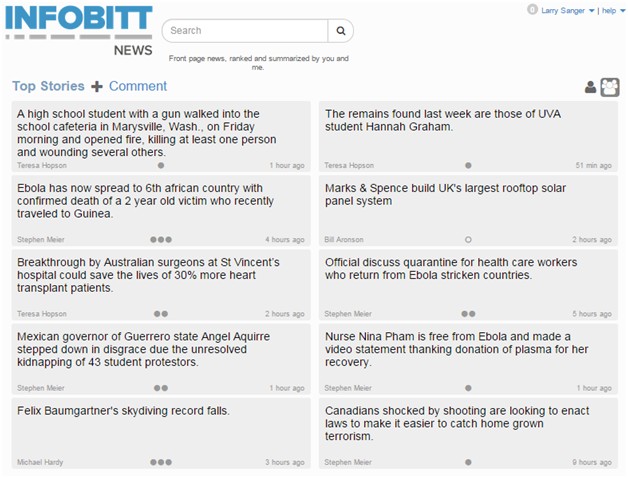
And here’s a representative bitt:
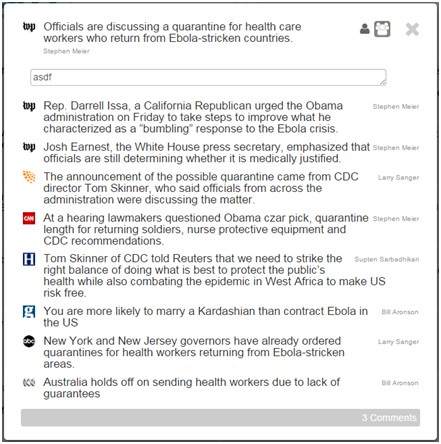
The back end of the software isn’t simple; it has lots of interacting rules. To fund its development, we raised a seed round a year ago. The system, now in its second version, is easy and fun to work on. No invitation is needed sign up, but be forewarned, it’s under development; refreshing fixes some bugs.
A small group of beta-testers have been using it for several months, and they regularly produce bitts and editions (especially the evening edition; subscribe here) of surprisingly good quality. We’ve opened a mailing list to discuss project policy.
With just 10 times the number of contributors, the top stories would always be fresh and detailed; that wouldn’t be hard. We can do this!
We’ll have to squash bugs and slowdowns fast enough, of course. We are looking for A-list web coders, so send us leads to awesome programmer who might be excited to work on a startup like this.
We’re announcing a pledge drive. I’m asking you to pledge to add one fact to the system—just a sentence and a source URL.
When we reach 100,000 pledges, then we’ll contact all the pledgers, and we’ll say, “OK, people, let’s get this party started!” Everybody converges on the website for 24 hours of fun, and our project really kicks into high gear.
People used to tell me that Wikipedia would go nowhere. They were wrong. Infobitt too tackles a universal problem and requires an ambitious solution. We’ll inevitably have naysayers. But they’ll be wrong, too. The latent demand for this is strong, and a lot of people will naturally want to organize the news. We can do this.
It’s potentially revolutionary whenever a bunch of smart people from around the world pool their efforts in making sense of information. We’ve done that with general knowledge. Now let’s do it with the news!
What do you think of the idea? Let’s discuss below.
This is the first public discussion of Infobitt.
You can now sign up for an account without an invitation. We’re starting a 100,000-person pledge drive: when we reach 100,000 pledges to add one fact, we’ll ask everybody to show up at once! We’ve also opened up our daily newsletter and have kicked off a discussion group. If you join, be forwarned, it’s a little buggy; you might have to refresh. But do join us!
There’s a long version of this essay.
I’m co-founder of Wikipedia. Now think back to a time before Wikipedia—the 1990s, if you’re that old. If you didn’t know the answer to a question, and a web search brought no joy, you might have to take a trip to the library, or stay ignorant.
Today, if you don’t know the answer to a question, you can find one on Wikipedia within seconds. That’s a stunning development for humanity: we now have virtually instant access to answers. That’s a historical first. It changes how we learn, how we communicate, and how we think.
How did it happen? Millions of people from across the globe understood the vision of a free, open content encyclopedia and acted on it. It was my job to organize this effort. Wikipedia was the result.
Now I hope to organize people to summarize and rank the world’s news in a free, open content news resource. The project is called Infobitt.
It is human to want to know what’s going on. Perhaps billions of people follow the news every day in one form or another.
This is why there are endless streams of news flooding the media landscape, more than ever before. Many of us would like to stay on top of the spreading pool of news. But the flood is getting deeper and wider.
That’s why we skim various news sources, apps, our friends’ feeds, blogs, etc. We resign ourselves to not knowing many details; for that, we must read many articles in full. Only devoted newshounds have time for that.
Beyond the sheer quantity of news, we must navigate redundant news, click bait, sensationalism, and on and on. The news has become noisy and confusing. There’s a sea of it, and it’s uncharted.
The facts about an ongoing story are often spread across many different sources, from the New York Times down to a humble blog. Nobody organizes the facts. No media outlet has the motive or the ability to come to grips with everything.
But we do—billions of us have that motive, and if we are organized in the right way, we’ll have the ability. What if we pooled our efforts on the news in the way we did on Wikipedia?
But how?
Here’s the Infobitt model. We grab different facts from different news sources, summarize them in sentences which link back to those sources. We each drag-and-drop the facts into our preferred order, and the system calculates the sense of the community. The result is a bitt.
That’s not all. There’s a stream of new bitts arriving in the system. We put bitts in order of importance by drag-and-drop as well. We’ve made a new way to collaborate on collecting the news.
We want this done for every article about every story. And we want it constantly updated. After all, it’s 2014.
Only a giant, international, online community could make this happen. This is citizen journalism re-envisioned to include an enormous distributed editorial function. It’s ambitious, but we can do it.
Here are the Top Stories from late October:
And here’s a representative bitt:
The back end of the software isn’t simple; it has lots of interacting rules. To fund its development, we raised a seed round a year ago. The system, now in its second version, is easy and fun to work on. No invitation is needed sign up, but be forewarned, it’s under development; refreshing fixes some bugs.
A small group of beta-testers have been using it for several months, and they regularly produce bitts and editions (especially the evening edition; subscribe here) of surprisingly good quality. We’ve opened a mailing list to discuss project policy.
With just 10 times the number of contributors, the top stories would always be fresh and detailed; that wouldn’t be hard. We can do this!
We’ll have to squash bugs and slowdowns fast enough, of course. We are looking for A-list web coders, so send us leads to awesome programmer who might be excited to work on a startup like this.
We’re announcing a pledge drive. I’m asking you to pledge to add one fact to the system—just a sentence and a source URL.
When we reach 100,000 pledges, then we’ll contact all the pledgers, and we’ll say, “OK, people, let’s get this party started!” Everybody converges on the website for 24 hours of fun, and our project really kicks into high gear.
People used to tell me that Wikipedia would go nowhere. They were wrong. Infobitt too tackles a universal problem and requires an ambitious solution. We’ll inevitably have naysayers. But they’ll be wrong, too. The latent demand for this is strong, and a lot of people will naturally want to organize the news. We can do this.
It’s potentially revolutionary whenever a bunch of smart people from around the world pool their efforts in making sense of information. We’ve done that with general knowledge. Now let’s do it with the news!
What do you think of the idea? Let’s discuss below.
This is the first public discussion of Infobitt.
We did a soft launch recently, meaning you can sign up for an account without an invitation (but that’s the only way you can see the site, for now). We are starting a 100,000-person pledge drive (when we reach 100,000 pledges to add one fact, we’ll ask everybody to show up at once!). We have also opened up our daily newsletter, and we are soon to kick off a discussion group. Please bear in mind the site is a little buggy; you might have to refresh. But do join us!
There’s a short version of this essay.
I begin with personal background. You can skip straight to the part about Infobitt.
Dreamer, nothing but a dreamer
I am a dreamer.
That might sound a little pathetic and weird for a 46-year-old short, bald guy to say. But ask anybody who knows me well, and they’ll agree. My life has been a never-ending succession of dreams, a few of which have come true.
In my childhood I dreamed of being a cartographer: I used to draw very detailed maps of my home state of Alaska from memory.
As a teenager, I dreamed of being a novelist, until my brother told me I was 16 and therefore had nothing to write about. So I decided to study philosophy, so I would become wise and have something to write about.
That led to a dream of being a philosopher and writing a great system of philosophy. So I majored in that.
While I was a grad student in the 1990s, I dreamed of playing the music I liked to listen to—Irish traditional—and took up fiddle.
I remember a dream I had in 1993, and I know the year because it was the year after the billionaire Ross Perot lost the 1992 presidential election. See, I wrote to Perot with this idea of getting a bunch of people together to summarize the news. I was excited, but of course it was half-baked and silly. I was only philosophy student and had no clue about how the business world works.
Another thing I did back then was start to organize online communities, in the form of Internet discussion groups. One of them was devoted to the idea that people could tutor each other online, leaving bloated, far-too-expensive universities behind. That was a dream and still is. (Many years later, this idea started getting real traction.) There were also a couple of philosophy groups, one of which (the Association for Systematic Philosophy) Wikipedia co-founder Jimmy Wales joined; I had joined his group MDOP. These groups all taught me that people working together on common interests could produce things of great value for everyone involved, things worth spending many hours on.
My dream of becoming a professor withered. I still wanted to be a philosopher, though. I remember thinking about becoming an encyclopedia editor. Not sure why I didn’t try harder.
I ended up, in 1998, starting a website (the content appears to be archived) with summaries of stories about the Y2K problem (the Millennium Bug). Jimmy Wales followed the website but we argued about whether there was anything to worry about. I wasn’t sure one way or another; he was a “naysayer.” He turned out to be right. Anyway, the site was popular but, since the world didn’t end on Jan. 1, 2000, it had a limited shelf life.
After that, I came up with another idea for a website. It was the dream that I pitched to Ross Perot, but now I better understood how it could be implemented. What if everyone were to write summaries of the news as I did about Y2K? I knew that online communities could be motivated to work together to create great stuff that they shared freely. It later came to be called “peer production.” So I shared the idea with people I knew online.
Wikipedia days
One of them was Jimmy Wales. He told me to forget about my dream of a free, community-produced news summary site and come and work on his dream: a free, community-produced encyclopedia.
That job offer was a dream come true. I came to work for Jimbo’s company, Bomis, in San Diego. Bomis had various projects, all funded by their main product, a web portal called Bomis.com, and a thriving Internet boom. By the time I had arrived, some ten days later, Jimbo’s dream of a free encyclopedia had become mine, and then some: I knew the potential of groups working together online. I really believed it was possible to get them to write an encyclopedia. There had to be a way. It was just a matter of time and iterations.
Starting this encyclopedia was a great job because, though I often sought Jimbo’s direction or advice on the project, he rarely gave it and specifically and repeatedly said it was up to me. I was able to get creative on somebody else’s dime. Jimbo even gave me a raise when, in early 2000, I finished my Ph.D., fulfilling another dream.
Our first “draft,” ultimately thrown away, was Nupedia. Nupedia was moving too slowly. The model wasn’t right; it was too complex. So it was my job (I was, after all, the full-time leader of Bomis’ encyclopedia project) to find a new way to involve more people.
Thus one fateful evening, Jan. 2, 2001, I had a Mexican dinner at a café in Pacific Beach with my friend Ben Kovitz. He was telling me about his interest in wikis. Now the next part seems to have become slightly confused. I don’t recall Ben suggesting, per se, that we should make a wiki encyclopedia. But he says he was talking about wikis in order to get me interested in the idea of a wiki encyclopedia. I don’t doubt that, and I certainly don’t begrudge him dropping the idea in my head, if that’s what he did: clearly it worked.
What I recall is that at some point in the conversation, I said something like, “This is very interesting, you know. I wonder if wikis could solve this problem I’m working on.” Skeptic that I was and am, but increasingly familiar with managing online content projects, I had a lot of questions about wikis and whether a wiki encyclopedia was really feasible. But based strictly on Ben’s description, I thought it was worth testing out; all we had to do was install a wiki, after all. So I asked Jimbo to have the software installed so I could play around with it.
Coming up with the idea isn’t what got Wikipedia started. The events of the first year did that. As I had done many times before, I started the community by inviting people and interacting with new arrivals. I watched the “recent changes” page, commenting and thanking people for their contributions, formulating our initial rules, writing essays, interacting with people constantly, and promoting the site elsewhere. Getting Wikipedia started became my full-time job and I loved it. (By the way, I’m just telling the same story I have told whenever anyone asked ever since 2001. I’m just telling it again.)
Then toward the end of 2001, the Internet boom turned to bust, as did the market for Internet ads—Bomis’ meat and potatoes. So Bomis had to lay off all but their original few people. I was the last to go, I was told. There was no money in ads, so my position as encyclopedia organizer, just representing a pie-in-the-sky dream for the company, couldn’t be sustained; Wikipedia, though it was growing like gangbusters, just couldn’t earn the money at the time to pay me.
I was getting married, so the situation was hinted at beforehand, and then I was given more official notice when I got back from my honeymoon. If I was then unemployed, at least I was able to live my dream of being married to an excellent woman. I left the project permanently in March 2002, 14 months after starting Wikipedia and two years after starting work on the idea of a free, volunteer-built encyclopedia.
Later I felt compelled to distance myself even further. My dream, or rather my specific version of a widely shared dream, was of a free, open, public-built encyclopedia—but also one that was a pleasure to contribute to and really authoritative. As of 2014, despite being a wonder and extremely useful, Wikipedia is still not authoritative and I still hear many stories of how difficult the community is to deal with. I still think we can do better.
In fact, I tried to do better.
Post-Wikipedia
After Wikipedia, I was actually unemployed for a little while. Friends of mine had become programmers, and it looked like fun, so I taught myself Perl. One of my projects for learning the language was a website that would—once again—let people collaborate on news summaries. But nothing came of that; the requirements became too difficult for a beginner to execute, and I didn’t stick with it.
I spent a couple of years teaching philosophy and wondering if any of my old dream of being a philosophy professor was still there. It was not. I still wanted to be a philosopher, but a professor not so much.
So I was hired by a Bay Area startup in 2005 that was going to make an attempt at a new sort of Internet resource, but after a year it was clear they didn’t have the funding to support my plans. One good thing that came out of that is that I was able to help get the wiki-based Encyclopedia of Earth off the ground. So, in 2006, I started Citizendium, another wiki encyclopedia. I won’t tell its story, but I will say that it’s still going, lo, these eight years, because there is a die-hard core of people who still share my dream of a different kind of wiki encyclopedia. I remain very grateful to them.
But ultimately the biggest problem Citizendium faced was the fact that it launched at the exact moment when Wikipedia was growing fastest, in 2006. A lot of people thought Citizendium was a good idea, but ultimately they went back to work on Wikipedia, simply because it dominated the scene and that was where the world could see their work. In a world with a limited number of volunteer encyclopedists, it’s probably true that only one could come out on top.
Citizendium was a nonprofit, and I had to seek funding. An elderly Memphis philanthropist, Charles Boone, started helping, but eventually he invited me to adopt his dream of getting people to make excellent educational videos. WatchKnow, later renamed WatchKnowLearn, was the result.
Around 2008, a dean I think from Duke University contacted me out of the blue and encouraged me to apply for a position that would lead the development of a news crowdsourcing site. I told him I had ideas about that but no time to execute them, not without abandoning my other projects; so I reluctantly had to pass up the opportunity.
While Citizendium and WatchKnowLearn were starting, I fulfilled another dream. My wife and I had a couple of kids, and we’ve later been able to homeschool them—another dream. Also, I dreamed of teaching my first son to read when he was very young, shortly after seeing various YouTube videos of other kids doing similar feats. It seemed implausible at first, but it turned out to be an achievable dream.
When Charles saw a video of my son reading the First Amendment at age three, he asked me in 2010 to finish a book-length essay on baby reading I had started and to create a web-based tool that would digitize the flashcard method I had used with my first son. My second son made use of the result, called ReadingBear.org, and he too started reading very early.
Reading Bear turned out to be a massive effort (it’s huge), but we launched it in 2012, which was another dream fulfilled. A lot of people love that site, which is 100% free, ad-free, and nonprofit. Charles wanted me to promote Reading Bear, but I decided someone else would have to do that job. So, parting with him amicably, I found myself wondering what I’d do next.
The problem
In late 2012, I returned to the dream I pitched to Ross Perot in 1993, shared with Jimmy Wales in 2000, coded in Perl in 2003, and sidestepped in 2008. But it was a new approach.
It can be described briefly but somewhat misleadingly as Wikipedia for news; but it’s not a wiki.
Think back to the year 2000, before Wikipedia. If you didn’t know the answer to a question, and the answer didn’t come up immediately in a web search, you had to look it up in a book or ask someone knowledgeable.
Today, if you don’t know the answer to a question, you can find the answer almost immediately in Wikipedia—or by searching Google or by asking Siri, which both heavily rely on Wikipedia.
If you think about it, that’s a stunning development for human beings: we now have virtually instant access to answers. That’s a historical first.
Millions of people (all told) from all over the world were ready and willing to record their knowledge. Wikipedia gave them a way to do that. They showed that our dream was a practically universal dream.
Now let’s talk about another deeply important kind of knowledge: the news.
There is practically universal interest in the news. Perhaps billions of people follow it every day in one form or another. It is human to want to know what’s going on. So you’d think that, by 2014, it would be easier than ever to catch up on the news.
In some ways it is. There are more streams of news flooding the media landscape than ever before. Many of us would like to stay on top of the spreading pool of information. After all, we value the productions of journalists; just think of how many of us share neat articles on Twitter and Facebook. But the flood of news content is getting deeper and wider.
In an effort to at least see all the important headlines, the latest way to consume news is to skim many different sources, read news apps, consult your friends’ Facebook and Twitter feeds, watch videos, read some blogs, etc. This shotgun approach acquaints us with more stories than in pre-Internet days, sure—but we don’t understand the details unless we read the stories. Who has time for that? Only the news hounds; the news is their hobby (or profession).
The problem is not just the sheer quantity of news. Speaking for myself, I can’t stand the cacophony of redundant news, click bait, human interest stories, different news angles that add nothing, opinion masquerading as news, news broken by opinion columnists, reheated old news, and so on. Perhaps you feel the same way.
The news has become noisy and confusing. There’s a mountain of it, and it’s completely disorganized.
If you religiously stick with it for a couple of hours every day, then you will be caught up with the news all the time. (I know; I’ve tried.) It doesn’t matter what tools you use. There simply is no tool that organizes all the important news intelligently and filters out the redundancy and other noise.
This is why only the news hounds are really well-informed.
This is also why so many news apps are personalized: they know we just don’t have time to get caught up with everything we’d like to, so the apps help us make choices based on our interests. That strikes me as giving up on getting well-informed. That just makes you informed about your interests, perhaps, but not about the news, period.
Other news apps and emailed newsletters try to make reasonable selections of the top stories for you, curating the news and summarizing it. They are an attempt to solve the same problem, but they don’t: you’re still missing a lot. And you don’t want to.
News hounds of the world, unite!
The news about an ongoing story is often spread across many different sources. High-density sources would include AP, Reuters, and The New York Times. But then there are the second- and third-tier sources, blogs and Twitter feeds of journalists and newsmakers and eyewitnesses and experts, YouTube channels, influential academic journals, and more.
The facts about a story are scattered across dozens of sources. Nobody organizes them. No one of those sources has any motive, or the ability, for that matter, to promote the other sources and summarize everything.
But we do—we, meaning almost everyone in the world who follows the news. Billions of us have that motive, and if we unite, then together we’ll have the ability. So what if we pooled our efforts on the news in the way we did on an encyclopedia?
I have a dream about how we can do that.
Will you consider making this dream your own?
The news is made up of facts, significant facts that have come to light recently, and the facts are scattered everywhere, as I said. What we want is all the different facts about a story picked from different news sources, thrown together in one place, and then ranked by importance. Finally, we want the facts linked back to their original sources.
This is exactly what we want and need. It would save us all a lot of time, because it would make it really easy and efficient to get caught up with the news about a story.
I’ve just been talking about one story. We want this done for every article about every story. We want it up to date at every minute of the day. After all, it’s 2014. We see what online communities like Wikipedia, YouTube, Pinterest, and others have done. We can imagine a community doing it.
But only a giant, international, online community could make this happen. Organizing thousands, and perhaps even millions, of people to work together in this way is the only way human beings could do it.
Highly-paid programmers have tried mightily to do something like this with automated summaries, finding news clusters automatically, ranking them, and so forth. But the fact is that, like writing encyclopedia articles, deciding how to summarize the facts, how to rank them, and how to prioritize whole stories as they break—this all requires careful human judgment. And if you’re talking about ranking and summarizing a vast, never-ending stream of facts and stories, no traditional paid editor, not even a large team of paid editors, is up to the job. It’s a job for a massive online community. Like Wikipedia.
You might say that this is just citizen journalism. Well yes, it is. But I maintain that we have not fully grasped the potential value of citizen journalism. It’s not just about ordinary people adding more facts to the flood of information out there. That is important and potentially revolutionary. But unless there is a way to organize and make sense of the flood of data, the voices of citizen journalists will be drowned out. So citizen journalists must also perform, democratically, an enormous distributed editorial function, one that traditional journalists simply aren’t equipped to perform.
If many of us together ranked news facts in order of importance, then sometimes, a fact sourced only from a blog or a tweet would jump to the top of the list. And they should! Finally, citizen journalists really could have a loud and clear voice if they broke some interesting news.
This is the way, perhaps the only way, to finally shine a clear light on the long tail of news reporting, capturing not just the high-profile professional reporting by the wires and world-class newspapers, but also the humble blogs.
Let’s do this. In some years, we’ll be able to look back and say, “Remember when it took a couple of hours really to get caught up with the news of the day? Do you remember when, half the time, you didn’t even know what was going on? Remember when important facts sourced from authoritative blogs couldn’t get equal billing to those from influential reporters? Remember when you didn’t want to read the news because the noise made it so much work?”
Infobitt’s story so far
So that’s the Infobitt vision. How far along are we to achieving it?
By late 2012, when I first had the idea, I had been working in academe or for nonprofits for almost my whole adult life. Almost all of the nonprofit projects I had worked on had very limited budgets. I didn’t want this project to be spoiled by lack of sufficient funds. I knew that if it were a for-profit project, we would have a shot at raising the money we needed for necessary experimentation and iteration. After all, the software didn’t exist yet, and the idea is very complex and there’s much that could go wrong with both conception and execution. For a really ambitious idea like this, a long runway was needed.
I thought the nascent enterprise might parlay my reputation as Wikipedia co-founder to get funding. So, with help of an awesome early investor/adviser, the L.A.-based Terrence Yang, we did! We ultimately closed our first round in November 2013. I thought the seed capital we raised wouldn’t give us a long runway if we didn’t cut expenses to the bone, so we did. We focused on building a working tool.
Here’s how it works now.
We begin by making bitts, which are collections of news facts. We get citizen journalists, news hounds, and you together into a news-curating community. We grab different facts from different news sources, summarize them in sentences, and put the sentences in order. The result is a bitt. You can add to any bitts in the system, and you get points both for adding facts and for creating new bitts. We also vote on fact order: we each drag-and-drop the facts into the order we prefer, and the system calculates the sense of the community.
That’s not all. There’s a stream of new bitts arriving in the system. We want to be put bitts in order of importance. “Importance” could mean your prediction of what will have the greatest long-term historical impact, your judgment of what most profoundly affects us, or whatever you think “hard news” means.
Editors vote on bitt order by drag-and-drop as well. By “editor,” I mean you, or anybody who shows up to work on the system. Sometimes we call ourselves “bitters,” because we’re writing bitts, but without bitterness—although the news is often a bitter thing.
At any moment there are ten “Top Stories”; the rest of the bitts are filed away in categories. We’ll add a tagging system too.
From the reader’s point of view, the Top Stories list looks like this (for now; it needs a snazzier design, and the content will improve too):
And here’s a representative bitt:
This is actually the second version of Infobitt. We started seriously coding the first version in summer 2013. We worked on it for about nine months, then decided to pivot because it wasn’t easy and fun enough; our early adopters were losing interest. We started coding the second version last March. It’s a lot easier and more fun, so we’ve had more enthusiastic feedback.
Unlike with Wikipedia and Citizendium, the software was not already written when we started, so there was little I could use to attract a community. I didn’t want to try to cause a splash with a mere idea that people have to wait to be developed; talking about vaporware gets old very fast. So for purposes of testing and feedback, I started a beta-tester list with around 80 people (to whom I am very grateful).
Despite being a “stealth private beta,” we’ve been creating 119 bitts per week since August, with 8-20 people out of that small group working on it every week, 4-12 per day. Two editions per day are posted automatically. The quality of the evening edition (subscribe here, it’s just a hand-managed Google Group for now) is to me surprisingly good for such a small number of people. The way the software is working now bodes very well for the future.
The software is fairly stable, but not entirely bug-free. If you join us, please be patient, and remember to refresh if you need to.
We quietly removed the invitation system and are now, for the first time, starting to promote the Infobitt vision and build the community. It’s not hard-launched because the system still has bugs and is under heavy development.
Still, the current version is now good enough to start galvanizing a community around. Do join us!
How we will grow (with your help)
So, you say, this all sounds very nice. But it’s one thing to talk about thousands or millions of active contributors. It’s quite another to cause them to show up. As many sad startups have discovered, it is not the case that if you build it, they will come. So what’s our plan to build the community?
First, Infobitt’s content will be open content, as you might expect: if you contribute, and even if not, you’ll be able to reuse the content from our feeds in your own projects. We haven’t finally decided which Creative Commons license we’ll use, but it’ll probably be CC-by-sa. The point is that our contributors will know that they are building a public resource.
While an encyclopedia project needs hundreds of active contributors to make much headway, we’ve started an interesting news report with far fewer people. With our small group of around 8 beta testers per day, we’ve been able to create a pretty good evening news report on most days.
Here’s why I find this exciting, although I am speculating:
With 15 active users per day, our news would be reasonably fresh throughout the day, with both morning and evening editions being good. Also, most or all the top stories would be fleshed out with many facts and multiple sources.
With 30-50 active users per day, the top stories would be consistently fresh and excellent; the community might demand more editions per day; generally, the site would have the latest news within an hour or two. Also, 3-5 of the main categories would be consistently fresh throughout the day.
With 100-500 active users per day, we’d see news being posted within minutes of its breaking. The top stories would be fully fleshed out with, perhaps, dozens of facts from many sources. People would create “beats” in which they frequently check up on specialized news feeds, Twitter feeds, blogs, etc., multiple times daily, in order to be the first to add new facts, or new stories, to Infobitt. All the top categories would be high quality and rarely lag behind breaking news more than an hour.
With thousands or millions of active contributors, the top stories and the main categories would be a marvel unlike anything seen in the history of journalism. Every story would break on Infobitt within seconds of breaking anywhere else. Bitts would be exhaustively detailed within minutes. For the top 50 stories of the day or so, the sources would be carefully selected and vetted. The writing of the top stories would be as excellent as in the New York Times. The ranking of bitts and of facts within bitts would be superb. Other exciting features would be achievable on that scale as well.
Now, 500 active users on a peer-production site is nothing to sneeze at, but it’s also not ridiculously ambitious to aim for. We can do this!
That’s assuming, of course, that we can squash any crippling bugs and slowdowns fast enough. Bugs and slowdowns seem inevitable. But we’re totally committed to fixing them as fast as we can. It will help when we hire some A-list web coders, so send us leads to awesome programmers who might be excited to work on a startup like this.
I’ve got another idea for growing our community. When Wikipedia got started about 14 years ago, many people still weren’t online, and most people who were online weren’t deeply immersed in the Internet the way they are now. Back then, there were lots and lots of little communities. So I initially recruited many people for for our free encyclopedia projects by reaching out to those groups. But since then, the social organization of the Internet has changed a lot. We really couldn’t organize Infobitt the same way today. Little communities still exist, but now, most people are organized through the big social networks like Facebook, Twitter, LinkedIn, and SnapChat, where things can go viral very fast.
The few-thousand strong grassroots community that it took me over a year to gather in 2000 and 2001 for Wikipedia could be done in a matter of days or weeks in 2014—if we went viral.
I have a plan about how Infobitt can go viral—how we can go from being a cool dream with a beta website to a massive community excited to work together making the world’s first peer-produced front page news site.
It begins, in fact, with this very manifesto.
I’m announcing a pledge drive. To join, you pledge to add one fact to the system. A “fact” means a sentence, preferably in your own words, summarizing some fact that you found in a news article, together with the URL of the article. Easy, right?
When we reach 100,000 pledges, then I contact everyone who has pledged, and I say, “OK, people, let’s get this party started!” Everybody converges on the website for 24 hours of fun, and our project really kicks into high gear.
Of course, the big question is how we collect the 100,000 pledges. This is where I need your help. I want you to take the pledge. Not only that, if you value democratic involvement in news collection, ranking, and summarizing, you could share the pledge drive and the project (a few times—many people won’t get it the first time) with your local networks. I’ll do my best to get publicity for the pledge drive. I’ll do interviews. We’re making a promotional video. I’ll write more.
Within the growing Infobitt community, we’re opening two mailing lists. On one, we’re posting news editions daily (please subscribe!) and discussing project policy (join if you like!). Soon we’ll set up a wiki where we can hammer out the rules, or guidelines. Just bear in mind that most project policy won’t have the same bureaucratic weight as on Wikipedia, because the content and its ordering is all determined by your voting habits, which needn’t be strictly controlled by the rules.
I can only hope that by that time we do have 100,000 pledges, Infobitt.com is in a state where it can handle 100,000 simultaneous users! But wouldn’t that be cool? In our interconnected world, it’s not unusual in the least for things to go viral, and 100,000 pledges for a project as cool as this would mean we’d kick Infobitt into high gear.
Let me briefly talk about project governance. If we’re starting a giant news community, do I want to become the dictator of the news? No. I want the community’s governance to be democratic; ultimately I want it to approximate a constitutional republic. Reining in bad actors on the site (a chronic problem for Wikipedia) will be done by randomly-selected users and mediated by automated tools. The brief, modular nature of Infobitt’s facts makes this feasible.
Let me make one thing clear. I’ve rallied people to work together on high-minded collaborative projects before. I’ve been doing it since the mid-90s, and I really like doing it; I love the barn-raising sense in us, the sense that we can come together and create something really awesome out of nothing more skill, good will, and mutual trust. So I have always felt that the project’s the thing: I just want Infobitt to succeed. Like Wikipedia and my other projects, it’s a lot bigger than me.
So, to maximize our chances, I’m going to listen to you closely and make sure you’re happy and motivated. I’m going to get it off to a roaring start, and then, as I’ve done many times before, I’m likely to step aside and hand the reins to someone else. Frankly, I’m a starter. I have no interest in being the pointy-haired boss or a community figurehead. Once the dream is alive and thriving, I’ll probably be off working on another one.
Call to Action
We’ve already done a lot toward getting this project ready for wider participation. But we still have a lot to do.
You can help! Here’s how:
Pledge to add a fact when 99,999 other people have pledged to add a fact. We’ll hold you to your pledge! Fortunately, adding a fact is easy.
Create an Infobitt account.
Send Larry an email at larry@infobitt.com with the subject “I’m in” in order to volunteer for a 50-person test pledge day, which we’ll do much sooner.
You could read the news with your new account!
Better yet, contribute! Add bitts, add facts to existing bitts, and rank bitts and facts.
Watch the brief orientation video (a bit old, but still basically correct) and check out the FAQ as necessary.
Give Larry leads to more awesome programmers who want to work on this startup. We have started a search for a full-time CTO…
Join Infobitt-Daily-Update for a peer-produced top stories of the day, as well as news about the project.
Join Infobitt-talk and discuss the future of the project. If you’re really interested in this project, you no doubt have a zillion questions. Possibly also a zillion opinions. Great!
A project policy wiki is coming!
One last word.
Remember what we can achieve with relatively few active contributors. We can do this.
People used to tell me that Wikipedia would go nowhere. They had all sorts of objections. The quality would be awful. We wouldn’t be able to handle the vandals. We wouldn’t be able to get people to volunteer to write encyclopedia articles (who wants to do that?).
The naysayers were wrong. We got together and created a resource that enables us to get practically instant answers to very many questions.
Infobitt tackles a similarly universal problem and requires a similarly global solution. The problem seems enormous and unsolvable: think of how much reporting is done every day, not just by mainstream news sources but by blogs, videos, tweets, and other things. Summarizing and ranking all the facts contained in that steady stream of data seems impossible. We’ll inevitably have naysayers.
But they’ll be wrong, too. We can do it.
And in time, perhaps soon, we’ll be in a position where, if you want to get caught up with the news, you don’t have to skim a dozen different sources and try to detect the latest important facts through all the redundancies, deciding what is important out of all the noise that the news media throw at you. You’ll still have to make choices—you still won’t be able to stay abreast of everything—but you’ll have a credible starting point that makes more sense.
In 15 minutes you’ll be as well-informed as a news hound was who formerly took an hour to comb through the confusion that is the news media.
As a result, we’ll all be better informed. And tyrants had better beware, just as I used to say they should beware of Wikipedia. When you have thousands of smart people from across the globe pooling their efforts in making sense of information, it becomes more difficult to count on widespread ignorance. We’ve done that with general knowledge. Now let’s do it with the news.
What do you think of the idea? Let’s discuss below.
This is the first public discussion of Infobitt.
We did a soft launch recently, meaning you can sign up for an account without an invitation (but that’s the only way you can see the site, for now). We are starting a 100,000-person pledge drive (when we reach 100,000 pledges to add one fact, we’ll ask everybody to show up at once!). We have also opened up our daily newsletter, and we are soon to kick off a discussion group. Please bear in mind the site is a little buggy; you might have to refresh. But do join us!
There’s a short version of this essay.
I begin with personal background. You can skip straight to the part about Infobitt.
Dreamer, nothing but a dreamer
I am a dreamer.
That might sound a little pathetic and weird for a 46-year-old short, bald guy to say. But ask anybody who knows me well, and they’ll agree. My life has been a never-ending succession of dreams, a few of which have come true.
In my childhood I dreamed of being a cartographer: I used to draw very detailed maps of my home state of Alaska from memory.
As a teenager, I dreamed of being a novelist, until my brother told me I was 16 and therefore had nothing to write about. So I decided to study philosophy, so I would become wise and have something to write about.
That led to a dream of being a philosopher and writing a great system of philosophy. So I majored in that.
While I was a grad student in the 1990s, I dreamed of playing the music I liked to listen to—Irish traditional—and took up fiddle.
I remember a dream I had in 1993, and I know the year because it was the year after the billionaire Ross Perot lost the 1992 presidential election. See, I wrote to Perot with this idea of getting a bunch of people together to summarize the news. I was excited, but of course it was half-baked and silly. I was only philosophy student and had no clue about how the business world works.
Another thing I did back then was start to organize online communities, in the form of Internet discussion groups. One of them was devoted to the idea that people could tutor each other online, leaving bloated, far-too-expensive universities behind. That was a dream and still is. (Many years later, this idea started getting real traction.) There were also a couple of philosophy groups, one of which (the Association for Systematic Philosophy) Wikipedia co-founder Jimmy Wales joined; I had joined his group MDOP. These groups all taught me that people working together on common interests could produce things of great value for everyone involved, things worth spending many hours on.
My dream of becoming a professor withered. I still wanted to be a philosopher, though. I remember thinking about becoming an encyclopedia editor. Not sure why I didn’t try harder.
I ended up, in 1998, starting a website (the content appears to be archived) with summaries of stories about the Y2K problem (the Millennium Bug). Jimmy Wales followed the website but we argued about whether there was anything to worry about. I wasn’t sure one way or another; he was a “naysayer.” He turned out to be right. Anyway, the site was popular but, since the world didn’t end on Jan. 1, 2000, it had a limited shelf life.
After that, I came up with another idea for a website. It was the dream that I pitched to Ross Perot, but now I better understood how it could be implemented. What if everyone were to write summaries of the news as I did about Y2K? I knew that online communities could be motivated to work together to create great stuff that they shared freely. It later came to be called “peer production.” So I shared the idea with people I knew online.
Wikipedia days
One of them was Jimmy Wales. He told me to forget about my dream of a free, community-produced news summary site and come and work on his dream: a free, community-produced encyclopedia.
That job offer was a dream come true. I came to work for Jimbo’s company, Bomis, in San Diego. Bomis had various projects, all funded by their main product, a web portal called Bomis.com, and a thriving Internet boom. By the time I had arrived, some ten days later, Jimbo’s dream of a free encyclopedia had become mine, and then some: I knew the potential of groups working together online. I really believed it was possible to get them to write an encyclopedia. There had to be a way. It was just a matter of time and iterations.
Starting this encyclopedia was a great job because, though I often sought Jimbo’s direction or advice on the project, he rarely gave it and specifically and repeatedly said it was up to me. I was able to get creative on somebody else’s dime. Jimbo even gave me a raise when, in early 2000, I finished my Ph.D., fulfilling another dream.
Our first “draft,” ultimately thrown away, was Nupedia. Nupedia was moving too slowly. The model wasn’t right; it was too complex. So it was my job (I was, after all, the full-time leader of Bomis’ encyclopedia project) to find a new way to involve more people.
Thus one fateful evening, Jan. 2, 2001, I had a Mexican dinner at a café in Pacific Beach with my friend Ben Kovitz. He was telling me about his interest in wikis. Now the next part seems to have become slightly confused. I don’t recall Ben suggesting, per se, that we should make a wiki encyclopedia. But he says he was talking about wikis in order to get me interested in the idea of a wiki encyclopedia. I don’t doubt that, and I certainly don’t begrudge him dropping the idea in my head, if that’s what he did: clearly it worked.
What I recall is that at some point in the conversation, I said something like, “This is very interesting, you know. I wonder if wikis could solve this problem I’m working on.” Skeptic that I was and am, but increasingly familiar with managing online content projects, I had a lot of questions about wikis and whether a wiki encyclopedia was really feasible. But based strictly on Ben’s description, I thought it was worth testing out; all we had to do was install a wiki, after all. So I asked Jimbo to have the software installed so I could play around with it.
Coming up with the idea isn’t what got Wikipedia started. The events of the first year did that. As I had done many times before, I started the community by inviting people and interacting with new arrivals. I watched the “recent changes” page, commenting and thanking people for their contributions, formulating our initial rules, writing essays, interacting with people constantly, and promoting the site elsewhere. Getting Wikipedia started became my full-time job and I loved it. (By the way, I’m just telling the same story I have told whenever anyone asked ever since 2001. I’m just telling it again.)
Then toward the end of 2001, the Internet boom turned to bust, as did the market for Internet ads—Bomis’ meat and potatoes. So Bomis had to lay off all but their original few people. I was the last to go, I was told. There was no money in ads, so my position as encyclopedia organizer, just representing a pie-in-the-sky dream for the company, couldn’t be sustained; Wikipedia, though it was growing like gangbusters, just couldn’t earn the money at the time to pay me.
I was getting married, so the situation was hinted at beforehand, and then I was given more official notice when I got back from my honeymoon. If I was then unemployed, at least I was able to live my dream of being married to an excellent woman. I left the project permanently in March 2002, 14 months after starting Wikipedia and two years after starting work on the idea of a free, volunteer-built encyclopedia.
Later I felt compelled to distance myself even further. My dream, or rather my specific version of a widely shared dream, was of a free, open, public-built encyclopedia—but also one that was a pleasure to contribute to and really authoritative. As of 2014, despite being a wonder and extremely useful, Wikipedia is still not authoritative and I still hear many stories of how difficult the community is to deal with. I still think we can do better.
In fact, I tried to do better.
Post-Wikipedia
After Wikipedia, I was actually unemployed for a little while. Friends of mine had become programmers, and it looked like fun, so I taught myself Perl. One of my projects for learning the language was a website that would—once again—let people collaborate on news summaries. But nothing came of that; the requirements became too difficult for a beginner to execute, and I didn’t stick with it.
I spent a couple of years teaching philosophy and wondering if any of my old dream of being a philosophy professor was still there. It was not. I still wanted to be a philosopher, but a professor not so much.
So I was hired by a Bay Area startup in 2005 that was going to make an attempt at a new sort of Internet resource, but after a year it was clear they didn’t have the funding to support my plans. One good thing that came out of that is that I was able to help get the wiki-based Encyclopedia of Earth off the ground. So, in 2006, I started Citizendium, another wiki encyclopedia. I won’t tell its story, but I will say that it’s still going, lo, these eight years, because there is a die-hard core of people who still share my dream of a different kind of wiki encyclopedia. I remain very grateful to them.
But ultimately the biggest problem Citizendium faced was the fact that it launched at the exact moment when Wikipedia was growing fastest, in 2006. A lot of people thought Citizendium was a good idea, but ultimately they went back to work on Wikipedia, simply because it dominated the scene and that was where the world could see their work. In a world with a limited number of volunteer encyclopedists, it’s probably true that only one could come out on top.
Citizendium was a nonprofit, and I had to seek funding. An elderly Memphis philanthropist, Charles Boone, started helping, but eventually he invited me to adopt his dream of getting people to make excellent educational videos. WatchKnow, later renamed WatchKnowLearn, was the result.
Around 2008, a dean I think from Duke University contacted me out of the blue and encouraged me to apply for a position that would lead the development of a news crowdsourcing site. I told him I had ideas about that but no time to execute them, not without abandoning my other projects; so I reluctantly had to pass up the opportunity.
While Citizendium and WatchKnowLearn were starting, I fulfilled another dream. My wife and I had a couple of kids, and we’ve later been able to homeschool them—another dream. Also, I dreamed of teaching my first son to read when he was very young, shortly after seeing various YouTube videos of other kids doing similar feats. It seemed implausible at first, but it turned out to be an achievable dream.
When Charles saw a video of my son reading the First Amendment at age three, he asked me in 2010 to finish a book-length essay on baby reading I had started and to create a web-based tool that would digitize the flashcard method I had used with my first son. My second son made use of the result, called ReadingBear.org, and he too started reading very early.
Reading Bear turned out to be a massive effort (it’s huge), but we launched it in 2012, which was another dream fulfilled. A lot of people love that site, which is 100% free, ad-free, and nonprofit. Charles wanted me to promote Reading Bear, but I decided someone else would have to do that job. So, parting with him amicably, I found myself wondering what I’d do next.
The problem
In late 2012, I returned to the dream I pitched to Ross Perot in 1993, shared with Jimmy Wales in 2000, coded in Perl in 2003, and sidestepped in 2008. But it was a new approach.
It can be described briefly but somewhat misleadingly as Wikipedia for news; but it’s not a wiki.
Think back to the year 2000, before Wikipedia. If you didn’t know the answer to a question, and the answer didn’t come up immediately in a web search, you had to look it up in a book or ask someone knowledgeable.
Today, if you don’t know the answer to a question, you can find the answer almost immediately in Wikipedia—or by searching Google or by asking Siri, which both heavily rely on Wikipedia.
If you think about it, that’s a stunning development for human beings: we now have virtually instant access to answers. That’s a historical first.
Millions of people (all told) from all over the world were ready and willing to record their knowledge. Wikipedia gave them a way to do that. They showed that our dream was a practically universal dream.
Now let’s talk about another deeply important kind of knowledge: the news.
There is practically universal interest in the news. Perhaps billions of people follow it every day in one form or another. It is human to want to know what’s going on. So you’d think that, by 2014, it would be easier than ever to catch up on the news.
In some ways it is. There are more streams of news flooding the media landscape than ever before. Many of us would like to stay on top of the spreading pool of information. After all, we value the productions of journalists; just think of how many of us share neat articles on Twitter and Facebook. But the flood of news content is getting deeper and wider.
In an effort to at least see all the important headlines, the latest way to consume news is to skim many different sources, read news apps, consult your friends’ Facebook and Twitter feeds, watch videos, read some blogs, etc. This shotgun approach acquaints us with more stories than in pre-Internet days, sure—but we don’t understand the details unless we read the stories. Who has time for that? Only the news hounds; the news is their hobby (or profession).
The problem is not just the sheer quantity of news. Speaking for myself, I can’t stand the cacophony of redundant news, click bait, human interest stories, different news angles that add nothing, opinion masquerading as news, news broken by opinion columnists, reheated old news, and so on. Perhaps you feel the same way.
The news has become noisy and confusing. There’s a mountain of it, and it’s completely disorganized.
If you religiously stick with it for a couple of hours every day, then you will be caught up with the news all the time. (I know; I’ve tried.) It doesn’t matter what tools you use. There simply is no tool that organizes all the important news intelligently and filters out the redundancy and other noise.
This is why only the news hounds are really well-informed.
This is also why so many news apps are personalized: they know we just don’t have time to get caught up with everything we’d like to, so the apps help us make choices based on our interests. That strikes me as giving up on getting well-informed. That just makes you informed about your interests, perhaps, but not about the news, period.
Other news apps and emailed newsletters try to make reasonable selections of the top stories for you, curating the news and summarizing it. They are an attempt to solve the same problem, but they don’t: you’re still missing a lot. And you don’t want to.
News hounds of the world, unite!
The news about an ongoing story is often spread across many different sources. High-density sources would include AP, Reuters, and The New York Times. But then there are the second- and third-tier sources, blogs and Twitter feeds of journalists and newsmakers and eyewitnesses and experts, YouTube channels, influential academic journals, and more.
The facts about a story are scattered across dozens of sources. Nobody organizes them. No one of those sources has any motive, or the ability, for that matter, to promote the other sources and summarize everything.
But we do—we, meaning almost everyone in the world who follows the news. Billions of us have that motive, and if we unite, then together we’ll have the ability. So what if we pooled our efforts on the news in the way we did on an encyclopedia?
I have a dream about how we can do that.
Will you consider making this dream your own?
The news is made up of facts, significant facts that have come to light recently, and the facts are scattered everywhere, as I said. What we want is all the different facts about a story picked from different news sources, thrown together in one place, and then ranked by importance. Finally, we want the facts linked back to their original sources.
This is exactly what we want and need. It would save us all a lot of time, because it would make it really easy and efficient to get caught up with the news about a story.
I’ve just been talking about one story. We want this done for every article about every story. We want it up to date at every minute of the day. After all, it’s 2014. We see what online communities like Wikipedia, YouTube, Pinterest, and others have done. We can imagine a community doing it.
But only a giant, international, online community could make this happen. Organizing thousands, and perhaps even millions, of people to work together in this way is the only way human beings could do it.
Highly-paid programmers have tried mightily to do something like this with automated summaries, finding news clusters automatically, ranking them, and so forth. But the fact is that, like writing encyclopedia articles, deciding how to summarize the facts, how to rank them, and how to prioritize whole stories as they break—this all requires careful human judgment. And if you’re talking about ranking and summarizing a vast, never-ending stream of facts and stories, no traditional paid editor, not even a large team of paid editors, is up to the job. It’s a job for a massive online community. Like Wikipedia.
You might say that this is just citizen journalism. Well yes, it is. But I maintain that we have not fully grasped the potential value of citizen journalism. It’s not just about ordinary people adding more facts to the flood of information out there. That is important and potentially revolutionary. But unless there is a way to organize and make sense of the flood of data, the voices of citizen journalists will be drowned out. So citizen journalists must also perform, democratically, an enormous distributed editorial function, one that traditional journalists simply aren’t equipped to perform.
If many of us together ranked news facts in order of importance, then sometimes, a fact sourced only from a blog or a tweet would jump to the top of the list. And they should! Finally, citizen journalists really could have a loud and clear voice if they broke some interesting news.
This is the way, perhaps the only way, to finally shine a clear light on the long tail of news reporting, capturing not just the high-profile professional reporting by the wires and world-class newspapers, but also the humble blogs.
Let’s do this. In some years, we’ll be able to look back and say, “Remember when it took a couple of hours really to get caught up with the news of the day? Do you remember when, half the time, you didn’t even know what was going on? Remember when important facts sourced from authoritative blogs couldn’t get equal billing to those from influential reporters? Remember when you didn’t want to read the news because the noise made it so much work?”
Infobitt’s story so far
So that’s the Infobitt vision. How far along are we to achieving it?
By late 2012, when I first had the idea, I had been working in academe or for nonprofits for almost my whole adult life. Almost all of the nonprofit projects I had worked on had very limited budgets. I didn’t want this project to be spoiled by lack of sufficient funds. I knew that if it were a for-profit project, we would have a shot at raising the money we needed for necessary experimentation and iteration. After all, the software didn’t exist yet, and the idea is very complex and there’s much that could go wrong with both conception and execution. For a really ambitious idea like this, a long runway was needed.
I thought the nascent enterprise might parlay my reputation as Wikipedia co-founder to get funding. So, with help of an awesome early investor/adviser, the L.A.-based Terrence Yang, we did! We ultimately closed our first round in November 2013. I thought the seed capital we raised wouldn’t give us a long runway if we didn’t cut expenses to the bone, so we did. We focused on building a working tool.
Here’s how it works now.
We begin by making bitts, which are collections of news facts. We get citizen journalists, news hounds, and you together into a news-curating community. We grab different facts from different news sources, summarize them in sentences, and put the sentences in order. The result is a bitt. You can add to any bitts in the system, and you get points both for adding facts and for creating new bitts. We also vote on fact order: we each drag-and-drop the facts into the order we prefer, and the system calculates the sense of the community.
That’s not all. There’s a stream of new bitts arriving in the system. We want to be put bitts in order of importance. “Importance” could mean your prediction of what will have the greatest long-term historical impact, your judgment of what most profoundly affects us, or whatever you think “hard news” means.
Editors vote on bitt order by drag-and-drop as well. By “editor,” I mean you, or anybody who shows up to work on the system. Sometimes we call ourselves “bitters,” because we’re writing bitts, but without bitterness—although the news is often a bitter thing.
At any moment there are ten “Top Stories”; the rest of the bitts are filed away in categories. We’ll add a tagging system too.
From the reader’s point of view, the Top Stories list looks like this (for now; it needs a snazzier design, and the content will improve too):
And here’s a representative bitt:
This is actually the second version of Infobitt. We started seriously coding the first version in summer 2013. We worked on it for about nine months, then decided to pivot because it wasn’t easy and fun enough; our early adopters were losing interest. We started coding the second version last March. It’s a lot easier and more fun, so we’ve had more enthusiastic feedback.
Unlike with Wikipedia and Citizendium, the software was not already written when we started, so there was little I could use to attract a community. I didn’t want to try to cause a splash with a mere idea that people have to wait to be developed; talking about vaporware gets old very fast. So for purposes of testing and feedback, I started a beta-tester list with around 80 people (to whom I am very grateful).
Despite being a “stealth private beta,” we’ve been creating 119 bitts per week since August, with 8-20 people out of that small group working on it every week, 4-12 per day. Two editions per day are posted automatically. The quality of the evening edition (subscribe here, it’s just a hand-managed Google Group for now) is to me surprisingly good for such a small number of people. The way the software is working now bodes very well for the future.
The software is fairly stable, but not entirely bug-free. If you join us, please be patient, and remember to refresh if you need to.
We quietly removed the invitation system and are now, for the first time, starting to promote the Infobitt vision and build the community. It’s not hard-launched because the system still has bugs and is under heavy development.
Still, the current version is now good enough to start galvanizing a community around. Do join us!
How we will grow (with your help)
So, you say, this all sounds very nice. But it’s one thing to talk about thousands or millions of active contributors. It’s quite another to cause them to show up. As many sad startups have discovered, it is not the case that if you build it, they will come. So what’s our plan to build the community?
First, Infobitt’s content will be open content, as you might expect: if you contribute, and even if not, you’ll be able to reuse the content from our feeds in your own projects. We haven’t finally decided which Creative Commons license we’ll use, but it’ll probably be CC-by-sa. The point is that our contributors will know that they are building a public resource.
While an encyclopedia project needs hundreds of active contributors to make much headway, we’ve started an interesting news report with far fewer people. With our small group of around 8 beta testers per day, we’ve been able to create a pretty good evening news report on most days.
Here’s why I find this exciting, although I am speculating:
With 15 active users per day, our news would be reasonably fresh throughout the day, with both morning and evening editions being good. Also, most or all the top stories would be fleshed out with many facts and multiple sources.
With 30-50 active users per day, the top stories would be consistently fresh and excellent; the community might demand more editions per day; generally, the site would have the latest news within an hour or two. Also, 3-5 of the main categories would be consistently fresh throughout the day.
With 100-500 active users per day, we’d see news being posted within minutes of its breaking. The top stories would be fully fleshed out with, perhaps, dozens of facts from many sources. People would create “beats” in which they frequently check up on specialized news feeds, Twitter feeds, blogs, etc., multiple times daily, in order to be the first to add new facts, or new stories, to Infobitt. All the top categories would be high quality and rarely lag behind breaking news more than an hour.
With thousands or millions of active contributors, the top stories and the main categories would be a marvel unlike anything seen in the history of journalism. Every story would break on Infobitt within seconds of breaking anywhere else. Bitts would be exhaustively detailed within minutes. For the top 50 stories of the day or so, the sources would be carefully selected and vetted. The writing of the top stories would be as excellent as in the New York Times. The ranking of bitts and of facts within bitts would be superb. Other exciting features would be achievable on that scale as well.
Now, 500 active users on a peer-production site is nothing to sneeze at, but it’s also not ridiculously ambitious to aim for. We can do this!
That’s assuming, of course, that we can squash any crippling bugs and slowdowns fast enough. Bugs and slowdowns seem inevitable. But we’re totally committed to fixing them as fast as we can. It will help when we hire some A-list web coders, so send us leads to awesome programmers who might be excited to work on a startup like this.
I’ve got another idea for growing our community. When Wikipedia got started about 14 years ago, many people still weren’t online, and most people who were online weren’t deeply immersed in the Internet the way they are now. Back then, there were lots and lots of little communities. So I initially recruited many people for for our free encyclopedia projects by reaching out to those groups. But since then, the social organization of the Internet has changed a lot. We really couldn’t organize Infobitt the same way today. Little communities still exist, but now, most people are organized through the big social networks like Facebook, Twitter, LinkedIn, and SnapChat, where things can go viral very fast.
The few-thousand strong grassroots community that it took me over a year to gather in 2000 and 2001 for Wikipedia could be done in a matter of days or weeks in 2014—if we went viral.
I have a plan about how Infobitt can go viral—how we can go from being a cool dream with a beta website to a massive community excited to work together making the world’s first peer-produced front page news site.
It begins, in fact, with this very manifesto.
I’m announcing a pledge drive. To join, you pledge to add one fact to the system. A “fact” means a sentence, preferably in your own words, summarizing some fact that you found in a news article, together with the URL of the article. Easy, right?
When we reach 100,000 pledges, then I contact everyone who has pledged, and I say, “OK, people, let’s get this party started!” Everybody converges on the website for 24 hours of fun, and our project really kicks into high gear.
Of course, the big question is how we collect the 100,000 pledges. This is where I need your help. I want you to take the pledge. Not only that, if you value democratic involvement in news collection, ranking, and summarizing, you could share the pledge drive and the project (a few times—many people won’t get it the first time) with your local networks. I’ll do my best to get publicity for the pledge drive. I’ll do interviews. We’re making a promotional video. I’ll write more.
Within the growing Infobitt community, we’re opening two mailing lists. On one, we’re posting news editions daily (please subscribe!) and discussing project policy (join if you like!). Soon we’ll set up a wiki where we can hammer out the rules, or guidelines. Just bear in mind that most project policy won’t have the same bureaucratic weight as on Wikipedia, because the content and its ordering is all determined by your voting habits, which needn’t be strictly controlled by the rules.
I can only hope that by that time we do have 100,000 pledges, Infobitt.com is in a state where it can handle 100,000 simultaneous users! But wouldn’t that be cool? In our interconnected world, it’s not unusual in the least for things to go viral, and 100,000 pledges for a project as cool as this would mean we’d kick Infobitt into high gear.
Let me briefly talk about project governance. If we’re starting a giant news community, do I want to become the dictator of the news? No. I want the community’s governance to be democratic; ultimately I want it to approximate a constitutional republic. Reining in bad actors on the site (a chronic problem for Wikipedia) will be done by randomly-selected users and mediated by automated tools. The brief, modular nature of Infobitt’s facts makes this feasible.
Let me make one thing clear. I’ve rallied people to work together on high-minded collaborative projects before. I’ve been doing it since the mid-90s, and I really like doing it; I love the barn-raising sense in us, the sense that we can come together and create something really awesome out of nothing more skill, good will, and mutual trust. So I have always felt that the project’s the thing: I just want Infobitt to succeed. Like Wikipedia and my other projects, it’s a lot bigger than me.
So, to maximize our chances, I’m going to listen to you closely and make sure you’re happy and motivated. I’m going to get it off to a roaring start, and then, as I’ve done many times before, I’m likely to step aside and hand the reins to someone else. Frankly, I’m a starter. I have no interest in being the pointy-haired boss or a community figurehead. Once the dream is alive and thriving, I’ll probably be off working on another one.
Call to Action
We’ve already done a lot toward getting this project ready for wider participation. But we still have a lot to do.
You can help! Here’s how:
Pledge to add a fact when 99,999 other people have pledged to add a fact. We’ll hold you to your pledge! Fortunately, adding a fact is easy.
Create an Infobitt account.
Send Larry an email at larry@infobitt.com with the subject “I’m in” in order to volunteer for a 50-person test pledge day, which we’ll do much sooner.
You could read the news with your new account!
Better yet, contribute! Add bitts, add facts to existing bitts, and rank bitts and facts.
Watch the brief orientation video (a bit old, but still basically correct) and check out the FAQ as necessary.
Give Larry leads to more awesome programmers who want to work on this startup. We have started a search for a full-time CTO…
Join Infobitt-Daily-Update for a peer-produced top stories of the day, as well as news about the project.
Join Infobitt-talk and discuss the future of the project. If you’re really interested in this project, you no doubt have a zillion questions. Possibly also a zillion opinions. Great!
A project policy wiki is coming!
One last word.
Remember what we can achieve with relatively few active contributors. We can do this.
People used to tell me that Wikipedia would go nowhere. They had all sorts of objections. The quality would be awful. We wouldn’t be able to handle the vandals. We wouldn’t be able to get people to volunteer to write encyclopedia articles (who wants to do that?).
The naysayers were wrong. We got together and created a resource that enables us to get practically instant answers to very many questions.
Infobitt tackles a similarly universal problem and requires a similarly global solution. The problem seems enormous and unsolvable: think of how much reporting is done every day, not just by mainstream news sources but by blogs, videos, tweets, and other things. Summarizing and ranking all the facts contained in that steady stream of data seems impossible. We’ll inevitably have naysayers.
But they’ll be wrong, too. We can do it.
And in time, perhaps soon, we’ll be in a position where, if you want to get caught up with the news, you don’t have to skim a dozen different sources and try to detect the latest important facts through all the redundancies, deciding what is important out of all the noise that the news media throw at you. You’ll still have to make choices—you still won’t be able to stay abreast of everything—but you’ll have a credible starting point that makes more sense.
In 15 minutes you’ll be as well-informed as a news hound was who formerly took an hour to comb through the confusion that is the news media.
As a result, we’ll all be better informed. And tyrants had better beware, just as I used to say they should beware of Wikipedia. When you have thousands of smart people from across the globe pooling their efforts in making sense of information, it becomes more difficult to count on widespread ignorance. We’ve done that with general knowledge. Now let’s do it with the news.
What do you think of the idea? Let’s discuss below.
My Greek mythology-obsessed 3-year-old remarked as he splashed in his bath: “It’s as fierce as Poseidon’s waves!”
Here he is reading from Mary Pope Osborne’s version of The Odyssey a few months ago:
Some Facebook friends were asking how we got him so interested in and able to follow Greek myths. Well, first of all, we just give him more of what he asks for, and he kept asking for Greek myths. That is certainly not going to be the case with every kid. H. (now age 8) at age 3 wasn’t as interested, for example.
Anyway, if you did want to introduce a child to Greek mythology (which I’ve done with both of my boys, in approximately the same order but not at the same ages), I can recommend the following. I’ve divided the books into stages, and within a given stage, it might not matter what order you go in. Note that not even stage 1 consists of “baby books.” We didn’t start these until E. was 2, I think, and he didn’t really get into it until he was 3.
STAGE 1
Usborne, Illustrated Stories from the Greek Myths
Never read this one, except maybe particular stories in single volumes, but given Usborne’s track record I’m sure it’s awesome.
Others in the single-volume “Usborne Early Reading” series such as this one but there are several others (Hercules, Jason; these might or might not be included in the above collection).
My five presentations. If you start with these and they like them, great. E. didn’t like them when I tried them out on him before reading any myths. Later, after we read quite a few myth books, he absolutely adored them. So for E. these would have gone in Stage 2.
STAGE 2
The combination of the next two worked very well as a good general intro for H.:
Usborne, Greek Myths (not a baby book, but not as hard as it might look)
E., who didn’t like this one right away, made it through this one later than H. did; still pretty good:
The Gods and Goddesses of Olympus
The various (at least a half a dozen) Graphic Myths & Legends series comix like this one about Hercules.
Whole series by Graphics Universe is highly recommended
This “Step Into Reading” version of the Trojan Horse story.
This is a rather nice one, pretty well-illustrated and well-written:
McElderry Book of Greek Myths
We also read this one but I barely remember it; it was OK; there are doubtless much better options we didn’t read:
Greek Myths and Legends
STAGE 3
D’Aulaires’ Book of Greek Myths
Osborne, Tales from the Odyssey (in two volumes; E. loved this to death, we not only read it but listened to it in the car; H. loved it too, we listened to it two times in the car when he was smaller)
We only listened to this one in the car, but the narrator was awesome and the versions were second to none. Arguably superior to both D’Aulaire and Osborne.
Evslin, Heroes, Gods and Monsters of the Greek Myths
Here’s the book version, which we might pick up.
There are many, many others. These are just the ones we used.
We own several “reference” type introductions to Greek myth, and we find them boring, so I don’t list them. It’s much better to learn about Greek myths by actually reading the stories, rather than lists of facts about gods, etc.
After that…
STEP 4
Percy Jackson books, Black Ships before Troy, Edith Hamilton’s Mythology
STEP 5
The originals in translation; Homer, Hesiod, Apollodorus, Ovid
STEP 6
The originals 
My Greek mythology-obsessed 3-year-old remarked as he splashed in his bath: “It’s as fierce as Poseidon’s waves!”
Here he is reading from Mary Pope Osborne’s version of The Odyssey a few months ago:
Some Facebook friends were asking how we got him so interested in and able to follow Greek myths. Well, first of all, we just give him more of what he asks for, and he kept asking for Greek myths. That is certainly not going to be the case with every kid. H. (now age 8) at age 3 wasn’t as interested, for example.
Anyway, if you did want to introduce a child to Greek mythology (which I’ve done with both of my boys, in approximately the same order but not at the same ages), I can recommend the following. I’ve divided the books into stages, and within a given stage, it might not matter what order you go in. Note that not even stage 1 consists of “baby books.” We didn’t start these until E. was 2, I think, and he didn’t really get into it until he was 3.
STAGE 1
Usborne, Illustrated Stories from the Greek Myths
Never read this one, except maybe particular stories in single volumes, but given Usborne’s track record I’m sure it’s awesome.
Others in the single-volume “Usborne Early Reading” series such as this one but there are several others (Hercules, Jason; these might or might not be included in the above collection).
My five presentations. If you start with these and they like them, great. E. didn’t like them when I tried them out on him before reading any myths. Later, after we read quite a few myth books, he absolutely adored them. So for E. these would have gone in Stage 2.
STAGE 2
The combination of the next two worked very well as a good general intro for H.:
Usborne, Greek Myths (not a baby book, but not as hard as it might look)
E., who didn’t like this one right away, made it through this one later than H. did; still pretty good:
The Gods and Goddesses of Olympus
The various (at least a half a dozen) Graphic Myths & Legends series comix like this one about Hercules.
Whole series by Graphics Universe is highly recommended
This “Step Into Reading” version of the Trojan Horse story.
This is a rather nice one, pretty well-illustrated and well-written:
McElderry Book of Greek Myths
We also read this one but I barely remember it; it was OK; there are doubtless much better options we didn’t read:
Greek Myths and Legends
STAGE 3
D’Aulaires’ Book of Greek Myths
Osborne, Tales from the Odyssey (in two volumes; E. loved this to death, we not only read it but listened to it in the car; H. loved it too, we listened to it two times in the car when he was smaller)
We only listened to this one in the car, but the narrator was awesome and the versions were second to none. Arguably superior to both D’Aulaire and Osborne.
Evslin, Heroes, Gods and Monsters of the Greek Myths
Here’s the book version, which we might pick up.
There are many, many others. These are just the ones we used.
We own several “reference” type introductions to Greek myth, and we find them boring, so I don’t list them. It’s much better to learn about Greek myths by actually reading the stories, rather than lists of facts about gods, etc.
After that…
STEP 4
Percy Jackson books, Black Ships before Troy, Edith Hamilton’s Mythology
STEP 5
The originals in translation; Homer, Hesiod, Apollodorus, Ovid
STEP 6
The originals 
[A video version of this post is at the bottom of the page.]
I was reading Climbing Parnassus, a book-length defense of learning Greek and Latin, and it goes into historical depth about the role of education as a preserver of the best of culture. This resonated strongly with me, because I think it explained my own revulsion at most educational practices today: perhaps what bothers me the most about the way children are educated by our schools is the fact that they are left almost completely ignorant of the substance, the foundation, and the beauty of Western civilization.
But the problem is not just a matter of ignorance of books and art. The problem is that knowledge of Western culture has a moral function—it is enculturating. Despite spending thousands of hours in school, students learn little of what can be called the ethical culture of Western civilization, apart from a few lessons drilled home especially hard, such as empathy, ethnic tolerance (not intellectual tolerance), and egalitarianism. Heard only in faint echoes in most classrooms, or in many cases long gone from them, are the texts, the art, and the discussion that would inculcate the rest of the great virtues: self-discipline and hard work, critical thinking and suspicion of superstition, love both as a romantic ideal and as the agape that drives our regard for all humans and maybe all life, good sense or wisdom, and so on. This has been the case since I was a student, and probably since before that, and I think it’s gotten worse. As a result, our popular culture has become crass, rude, and in a word (which would not sound so quaint if we all studied classics more) barbaric.
In largely the same way, despite a few perfunctory efforts here and there, most of our students emerge from high school largely ignorant of the Constitution and our civic culture. First, they lack the education to appreciate The Federalist and The Anti-Federalist, or even to read and understand the founding documents themselves, but beyond that they are simply ignorant of the concepts and the defenses of them that, together, undergird our free republican form of government. They have virtually no clue about such things as freedom of speech, freedom from warrantless search, division of powers, and many other things that one must understand well in order to criticize politicians who, today, are actively trying to limit these aspects of our government. And as a result, the government of what was once supposed to be “a city on a hill” standing for freedom, tolerance, and civic virtue has become a nanny state, constantly rescuing us from ourselves, and one of the largest and most powerful governments in history. As the three branches of government each slowly, gradually remove more and more of our liberty, most of our people lack the tools to articulate or even appreciate objections, and those who have such tools are misunderstood and smeared.
Two historical movements, among others, have brought us to this situation. The first is progressivism in education, beginning with Dewey and his colleagues in about the 1920s. This was a profoundly anti-intellectual movement and transformed education from being a force for the teaching of the entire body of Western culture and values to a bland, smothering force for vague “life skills” and “socialization” and “creative self-expression.” It is progressivism that has left our students incapable of understanding and appreciating our civic culture and values, leaving us open to gradual but inexorable domination of what might aptly be described as a new empire.
The second—and please don’t misunderstand here—is the decline of religion as a serious cultural force for most people. I hasten to add that I’m agnostic, not a Christian, and I know very well that religion still does influence politics, mostly on the right. That’s not what I’m talking about. Apart from a small percentage of evangelical Christians, few Americans (and of course many fewer Europeans) take religion seriously, as providing a broad moral basis that structures how we live our lives. Critics of the religious right often seem to forget that Christianity as a moral culture, beyond its religious and political tenets, instructed people to work hard, to hope for a better life, to treat others kindly and donate to charity, to practice the graces of humility and self-respect, to rein in our passions and practice moderation, to take responsibility for ourselves and our dependents, and much more. It wasn’t all good, but much of it was. It taught the very idea of obligation, which has grown much weaker for many of us. It was an organizing, all-encompassing, core part of the Western civic culture. But really no more. Many don’t go to church; many of those who do go to church don’t believe; even those who do believe don’t take religious moral strictures very seriously; even if they do, they probably don’t understand them well; and finally, those who understand them aren’t supported by most others, who are both ignorant and deculturated, and all too willing to “tolerate” all manner of sins. So, as I say, as a serious cultural force, inspiring us to live well, religion is a pale shadow of its former self. Even as a nonbeliever, this strikes me as a truly profound loss.
So we lack both the education and the cultural strength to resist enslavement both to our passions and to our government.
This is why it is so important that we reinvigorate our commitment to the liberal arts and that we show educational progressivism the door. I don’t know or particularly hope that we will get religion per se back; I think relearning the classic virtues and the civic culture of the early United States could heal many ills. But if that is not enough, then perhaps we do need some sort of ethical cultural movement, something not associated exclusively with the left, as what goes under the name “ethical culture” is.
We can hope and we can make efforts. But I fear that we’ll simply continue to leave our children largely incapable of assimilating Western culture, while we allow our governments both in North America and Europe to grow and become more authoritarian and centralized, running up massive debts. I fear the results of that situation. Our children and grandchildren will be very lucky if it ends well.