Log on:
Powered by Elgg

Rowena Blair :: Blog

October 12, 2009

I have become a little fed up with not quite being able to follow through the diagrams and instructions. I therefore spent some time going back through the beginning of the book to make sure that I understood the symbols and what they stood for. After I had done this I tried to create a basic duck with the large paer. This was successfull, I tried again and it seemed as though things were falling into place so I tried to create a basic duck using smaller paper. It worked, so I tried some more. After a few more successes I decided to go back to making them with the larger paper and the next one was to become a base for a complex duck.

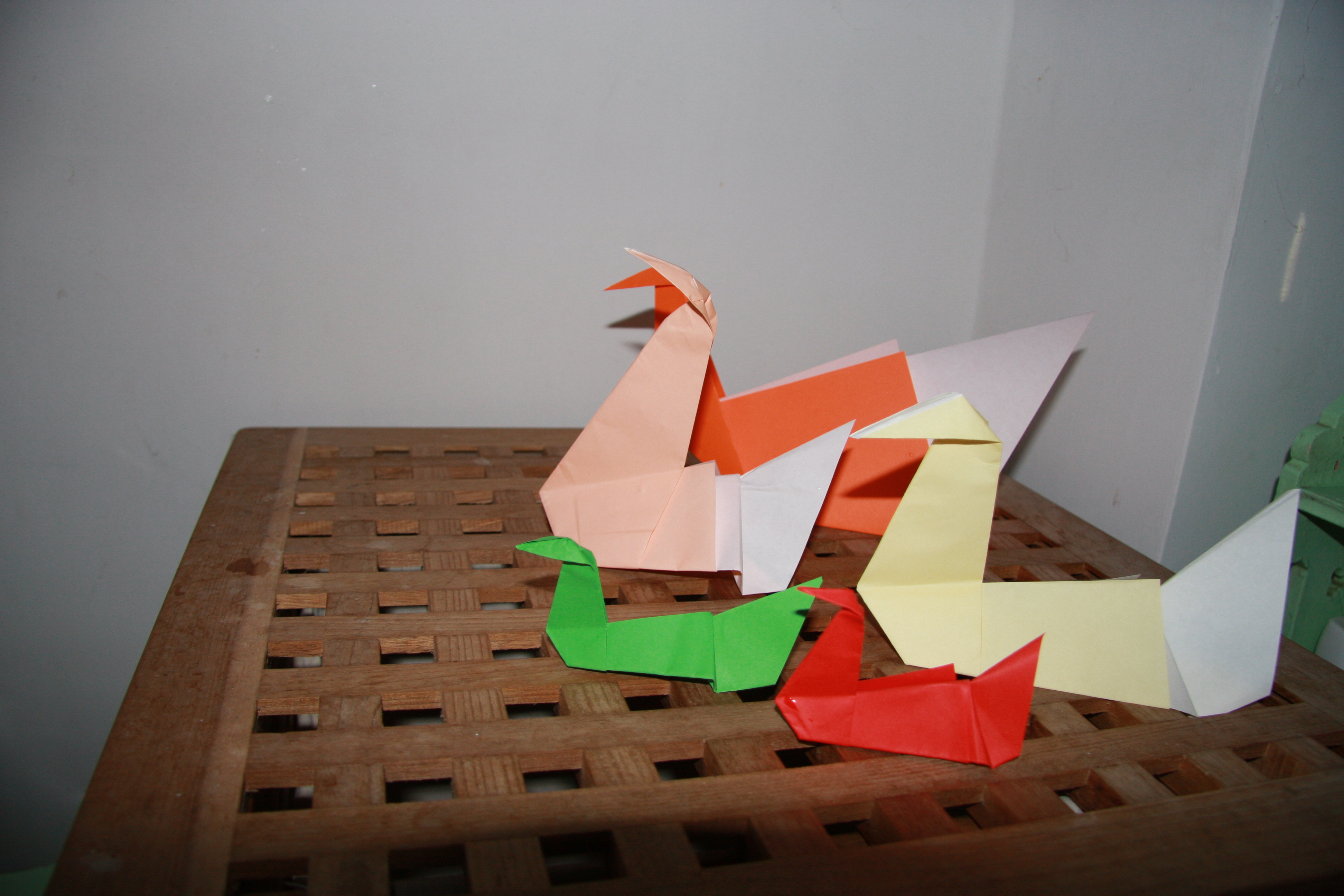
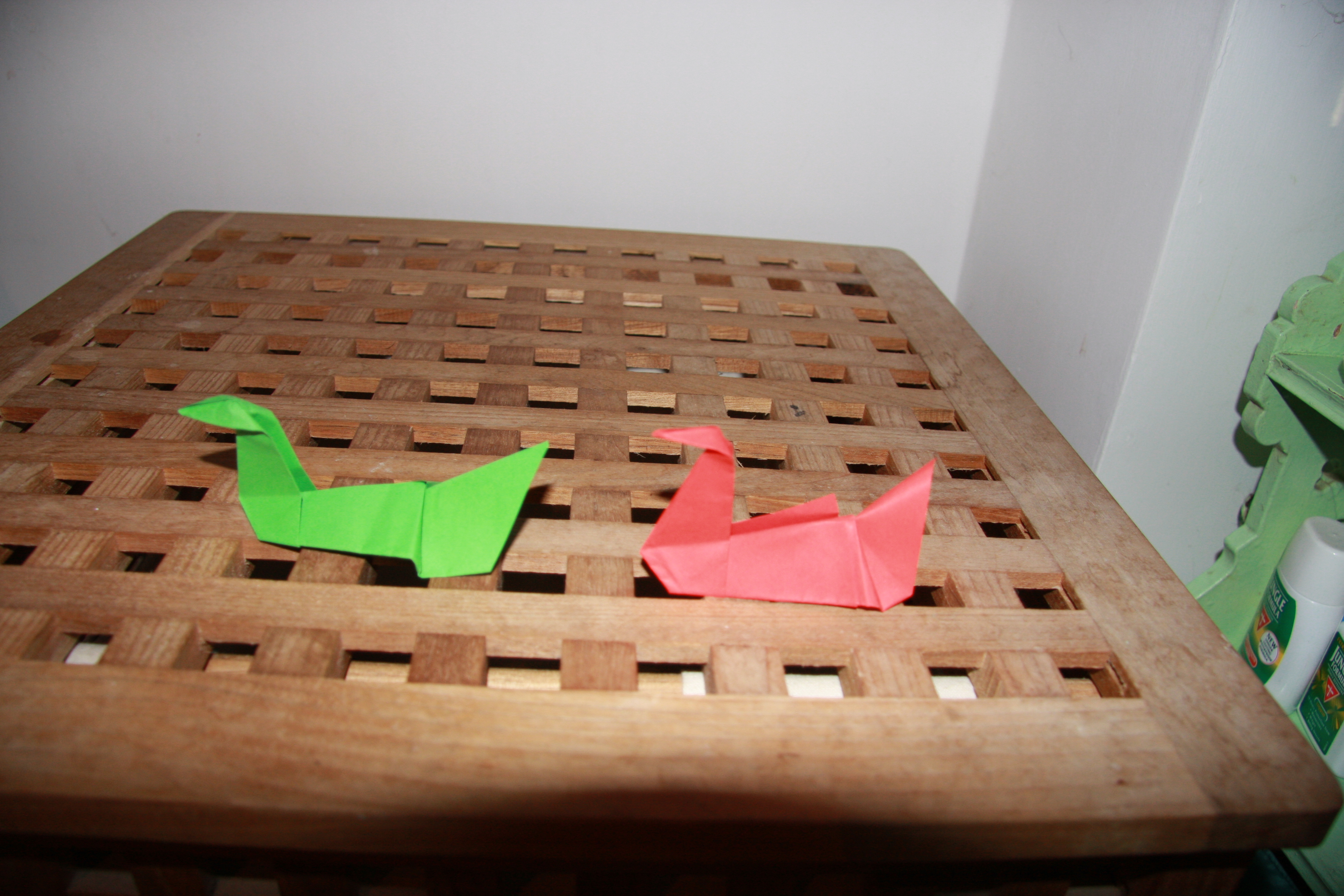
                      The pictue here shows some simple ducks that have been made out of small and larger paper squares.


So I started to create the next basic duck and found that at the stage where I was to make the first fold to create the ducks neck that I had folded it in the wrong direction which meant that when I tried to fold the neck it tried to develop in the wrong way. I managed to find where I went wrong by comparing a successfull model with the one I was having problems with. I also used the pictures to compare the folds and saw my error. Once idnetified the error was very easily corrected. I created an almost perfect basic duck. I then went through the diagrams and suddenly saw correctly how the folds should go and how it all fell into place. I put this all down to the time I spent making sure I understood the symbols and could relate the diagrams to the actual folds.

I found that after all of the initial hassles that I was able to create a complex duck. The first one had a slightly wonky tale but was a much better effort than any I had previously done.

After I made another with the larger paper and it was almost perfect. I then tried with a smaller piece of paper and was really happy with the results. In order to reinforce the process I made several large and small complex ducks and was pretty pleased wit myself as a result.

small basic ducks


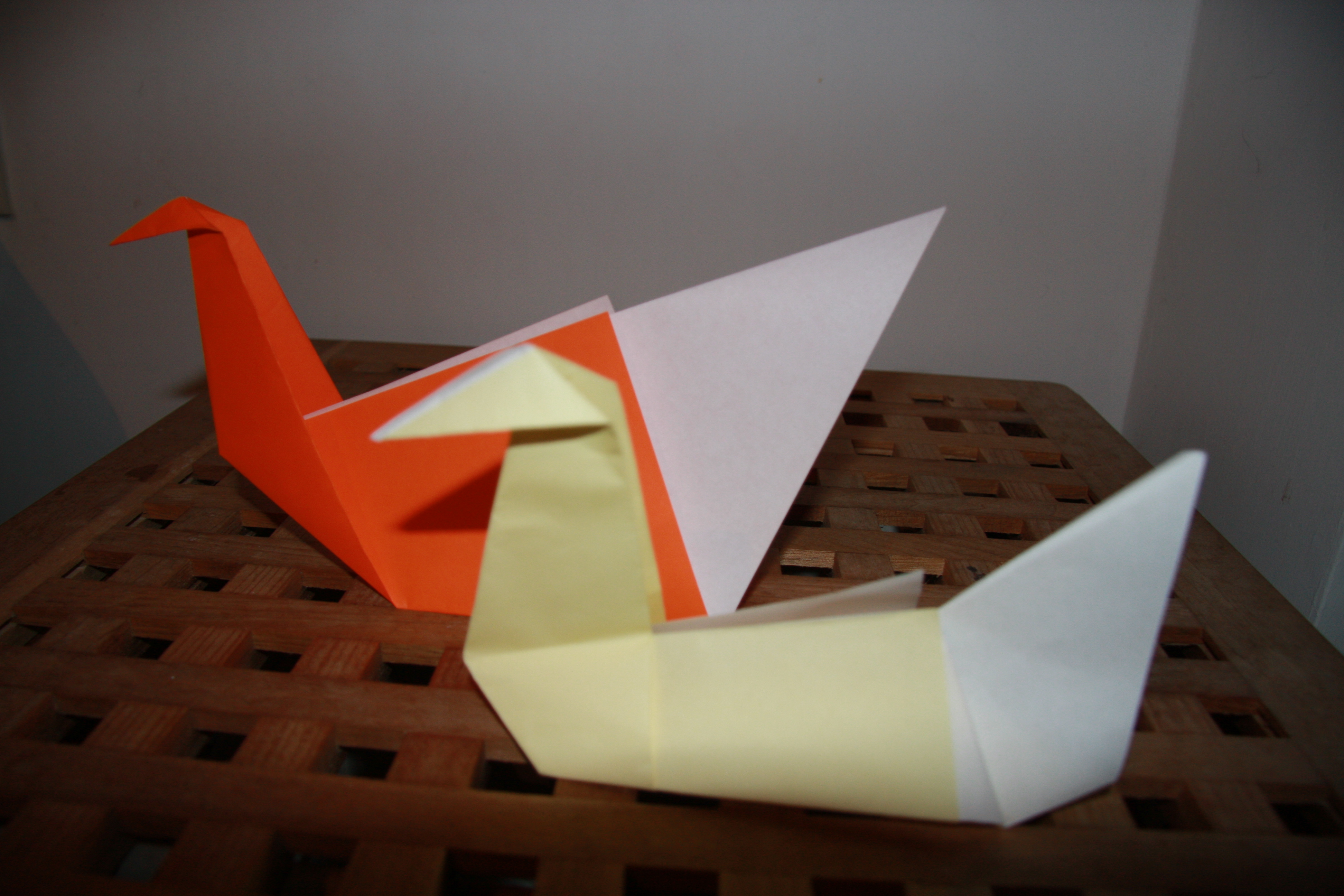
a mixture of small and large complex ducks.


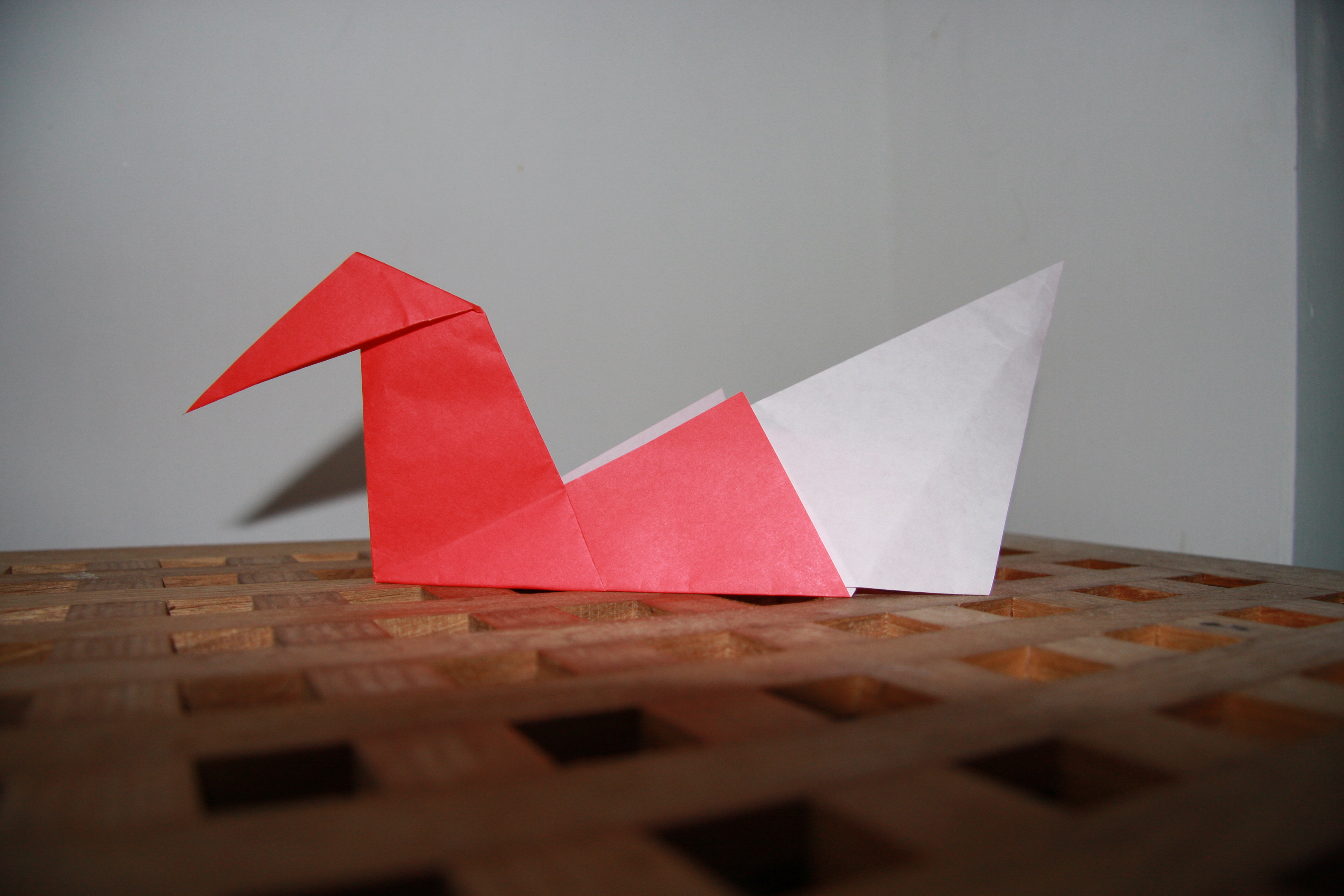
More detailed pictures 1) Large ducks of each type 

Small complex ducks in more detail 


Keywords: Origami

Posted by Nicholas Palmer | 0 comment(s)

October 07, 2009

Why on earth did I take up this challenge? I continued with the simple/complex duck. I made an attempt at the complex duck - a stage on from the simple duck and felt good. It wasn't quite right I seemed to be misunderstanding the final step. I then tried to do it again and found that I was struggling to complete a simple duckl. After four pieces of wasted paper I decided to give it a rest.


The positive that has come out of this is that I am feeling confident handling the paper to complete the kite base it feels as though I know what I am doing. It is very straightforward and to be honest I should be feeling confident by now as I have completed this stage a number of times. I am just hoping that I will be able to achieve more tomorrow.

Posted by Nicholas Palmer | 0 comment(s)

October 06, 2009

The origami has been forgotten for a few days. I decided to redo the simple duck using blue paper -I struggled to get there and had to discard two attempts before I succeeded. The more complex version is still alluding me and after an hour I decided it was time to do something else. As an aside I tried to make the simple duck with a smaller piece of paer and was unsuccesful. What was interesting is the paper was thicke and coarser in texture which and did not crease quite as easily as the larger squares.

Posted by Nicholas Palmer | 0 comment(s)

September 28, 2009

I worked through the introduction and this took me to a section that explained the symbols used in the book for the various folds and moves. I was able to understand this reasonably well until I came across the inside and outside crimp. Still I was reasonably confident and decided to have a go with my current knowledge.


The tips were very useful and one was to use larger  pieces of paper to start with. I have two sizes of paper nine and three quarter inches sq which is coloured oneside and white  the other and  five inches sq (came with the book) coloured bothsides.

THe first thing I did was to create a kite base with the larger paper using a red piece first. After the base had been created I produced the simple duck. I struggled wioth the diagram a little but perseverance paid off and I took some photographs of the model (model taken from Origami Kit  for Dummies). I then tried to create the more complex duck and this is where I was unable to fully understand the diagram at this point. After struggling for ten minutes I had a break. The overall session lasted 30 to 45 minutes and was partially successful.

The paper became vey crumpled with my efforts and I was left with a duck with a flat body, so it is time to try again.

First attempt Duck 1

Collapsed attempt Duck 2

Posted by Nicholas Palmer | 0 comment(s)

I am currently studying for an MSc in e-learning at Edinburgh University. I am on my fourth module which is understanding learning in digital environments. One of the assignments is a learning challenge and this blog will outline my experiences, thoughts and feelings whilst performing the learning challenge. I am going to learn how to create origami paper models. My previous attempts have got little further than paper darts or paper planesI tend to be all fingers and thumbs with these types of exercise.

I have chosen to learn how to make Origami figures for this challenge. Ther initial aim is to create a dragonfly (medium difficulty) and a beetle (challenging). I have decided to learn by 1) Working through the Origami Kit for Dummies by Nick Robinson - published John Wiley 2008. 2) websites and 3) videos from sites such as you tube.

The book is broken into three main sections

Introduction

Part 1 Coming to the crease: Basic Techniques

Part 2 Folding on: The Models

Part three: The part of Tens

I first looked atpart three which consists of three chapters 1) Ten Top Tips 2) Ten Origami Styles and 3) Ten Incredible folders ( a summary biog for ten famous Origamists)

It gave me a feel for the subject and those who excel at it. This also points the way to a number of websites which I have not looked at yet.

Lets get on with the folding!!!

Posted by Nicholas Palmer | 0 comment(s)

April 08, 2009

Tempus fugit - Doesn't time fly when you are having fun? After a 12 week tournament that is the "Digital Game-based Learning" module. All good things must eventually come to a full stop. Whilst we have been reading, writing and debating about the "serious" business of games, gaming and play; more importantly, we have also have had a lot of fun doing it and learning a little more about ourselves along the way.

I started the course by reflecting upon my previous experience and engagement with games, gaming and play (see "Flashbacks of a Fool") that had largely seen me leave videogames and computer games back in the 1990s preferring the more traditional games that had a largely social element to them, i.e. playing games with family or friends. The course had literally thrust me back into the digital gamesphere (see "All work and no play?" and "The Agony and Ectasy of Social Gaming") using a range of game consoles like the Nintendo Wii, Microsoft Xbox, Apple's iPod Touch as well as my own PC.

I had reflected that some of the games currently on the market and online had "enchanted me and brought out a child-like wonder in me (not seen since 1999)". This "enchantment" extended to the papers written by Pat Kane and Brian Sutton-Smith on their notions of play (see "The Language of Play") which can be a catalyst for creativity, originality and new developments and should actually be incorporated in each and every one of our lives as normal as it is eating, breathing and sleeping. Howeve, this "enchantment" is a little offset by the "moral panic" that sets in whenever the popular press or eminent scholars and thinker have their tu'penny worth to say on the subject (see "Videogames: A moral panic?").

Inevitably, the course would eventually touch upon my favourite hobby horse (my thanks goes to the course leaders of the "Digital Environments" modules and my colleagues at work for introducing me to it) that being Marc Prensky and the "Digital Natives" / "Digital Immigrant" dichotomy (see "Digital Natives Revisited"). Given that Prensky works in the games industry and feels passionately that learning and games can go hand-in-hand. No arguments there, it's just the grand rhetorical statements backed up by hardly any empirical research that has turn this issue into something of a pathological obsession for me - I should learn to take Michael Winner's esure advice, though James Newman's paper riled me more than Prensky's papers (see "Videogames: A tug of war").

One of my interests is identity and the course has given me ample to think about and experience. From Second Life, using the voice activated feature within it with Iris Bosa had raised questions about voice modification, personalisation and identity (see "The Curious Case of Voice Identity"); to J.P. Gee's concept of the “tripartite” of identities and the notion of the "other" in games, was presented in a very compelling and original way (see "The Learner with a Thousand Identities") that is an interesting addition to the Identity literature.

The module also called for group collaboration to design a Google Earth game (see "The New Seven World Wonders Quiz - A Team 2 Production"); solve a WebQuest (see "WebQuest DSV"); and devise a role playing game for Second Life (see "Dragons' Lair RPG - A Team 2 Production") that saw some fantastic online collaborations using Skype and a Wiki which led me to comment that it was the "most amazing brain-storming, project management session ever conducted virtually. We went from an idea to a fully-realised project plan in 1.5 hours". I have rarely seen online collaborations work at this frenetic speed and intensity before, so thank you Team 2 for an exhilarating experience. The group tasks themselves could also have been envisaged as a "game" that involved overcoming a number of obstacles and difficulties to arrive at the finish line in time with a fully realised product.

J.P. Gee presents some rather interesting concepts of "affinity groups" and "affinity spaces" (see "The Affinity towards Groups, Spaces and Learning") which I could use in relation to my insitution's new £35m library and learning centre, Augustine House, in terms of how learning spaces are been used physically as well as virtually by the student corpus and the academic community; and would such learning spaces present opportunities for real learning to take place (see "The Four Horsemen")?

So for now, I bid Hamish, Fiona and the challenging "Digital Game-based Learning" course a fond and affectionate adieu.

Until next time gamers, until next time ...

Posted by Wayne Barry | 0 comment(s)

April 07, 2009

Yesterday, I attended the Fourth Symposium on Social Learning Spaces at Oxford Brookes University with my boss who is, incidently, doing his masters on professional development and the use of e-portfolios. We had hoped to have come back from the symposium with lots of ideas and food for thought with regards to our University's new £35m library and learning centre, Augustine House, that will be opened later this year.

All this talk about technology, learning, spaces and group collaboration reminded me of the twin concepts of "affinity groups" (Gee, 2007) and "affinity spaces" (Gee & Hayes, 2009) - whilst a lot of this phenomena is organically and naturally conceived under informal learning situations, might it not be slightly contrived under directed learning circumstances? I can see "strong affinity groups" developing under a shared interest and passion for "Battlestar Galactica". How might a randomly selected group form over the shared responsibility of an assignment or project? Would they not develop as a "weak affinity group"? i.e. the group breaks up after the joint assignment is completed.

The most interesting part of the day was on the train journey back to Canterbury from Oxford. My boss was reading some papers as part of his masters and showed me a line that reminded me of a wonderfully quotable passage from Lawy (2006, p. 327, citing Biesta, 2004) that I used as part of my "Understanding Learning in the Online Environment" module assignment:

"Education … is a matter of risk, trust and violence that cannot be reduced to an economic transaction. Learning is a dangerous and risky enterprise that necessarily involves some challenge to existing shibboleths and ideas, and is not something that can be planned or linked with specific and intended behavioural outcomes or objectives."

Four Horses at ChauvetAt the heart of good learning, for me and my boss at least, are those four horsemen of education: risk, trust, violence and serendipity. Youenn Leborgne (2009) writes a lovely piece in his blog about making mistakes, which most of us can relate to and beautifully encapsulates these four elements.

From my own fumblings with playing with Agatha Christie's "Death on the Nile", "Lost" and Clive Barker's "Jericho" on the PC and "Fantastic Contraption", "Four Pro", "Blocked", "Asphalt 4: Elite Racing", "FSS Hockey" and "Cro-Mag Rally" on the Apple iPod Touch where I have succeeded through trial and error with the occasional flashes of pure luck and chance.

I have taken risks by having to deal with virus-infected servers - having to learn quickly once thrown in the deep end (especially as viruses were quite a new phenomena in the late 1980s / early 1990s). There have been periods of pure serendipity from chance encounters to chance readings. The violence has come from the shifting of ideas and knowledge and those once-in-a-blue-moon revelationary thoughts. Much of my real learning has been informal (i.e. self taught), situated (i.e. on the job) and experiential (i.e. hands on).

What becomes of those learners who do not take risks; who do not trust their teachers or peers; who are afraid of having world view blown apart; and who fail to see happy accidents that can occur right under their noses? What becomes of their learning and what they have learnt?

References

Gee, J.P. & Hayes, E. (2009). Public Pedagogy through Video Games. Game Based Learning. [online]. Available at: http://www.gamebasedlearning.org.uk/content/view/59/ [Accessed 7 April 2009] 

Gee, J.P. (2007). What Video Games Have To Teach Us About Learning And Literacy (Revised and Updated Edition). New York, Hampshire: Palgrave Macmillan.

Lawy, R. (2006). Connective learning: young people’s identity and knowledge-making in work and non-work contexts. British Journal of Sociology in Education, 27(3), pp 325-340.

Leborgne, Y. (2009). IDGBL - Learning online. Holyrood Park blog. [online]. Available at: http://holyroodpark.net/youenn/weblog/2101.html [Accessed 7 April 2009].

Keywords: education, four horsemen, IDGBL2009, learning, risk, serendipity, trust, violence

Posted by Wayne Barry | 0 comment(s)

April 01, 2009

When I started the "Introduction to Digital Game-based Learning" module back in January 2009, I kept a special Diigo list for all of the gaming articles that I either came across or were suggested by my peers on the course. As you can see by the rather extensive bibliography at the end of the post, that there is a relative even number of articles that paint videogames either in a positive or negative light.

As Gee (2007) points out, there are two major issues with videogames that concern people, laypersons and experts alike. These issues are violence and gender. Gee (2007, p. 11) makes an interesting case:

"Finally, despite some claims to the contrary, the fact of the matter is that the effect size of video-game play on aggression is smaller that the effect size for television, thereby rendering the claim that there is something special about the interactivity of games as a source of aggression suspect."

Gee's arguments share a similar resonance to those made by UK teachers who feel that "television had a greater influence on children's behaviour than computers and video games" (BBC, 2009a). Again, a recent EU report (Booth, 2009) seems to suggest that there is "no firm proof that playing them has an automatic negative impact on children's behaviour". Similar findings were published in "Personality and Social Psychology Bulletin" which suggested that "that high levels of gore did not make playing the games more enjoyable", with players preferring "challenge and being in control that they got from the games" (Devlin, 2009).

Infact, to the contrary, the EU report concluded that "computer games are good for children and teach them essential life skills". The EU's conclusion seems to be shared by another recent report from the UK's largest music charity, Youth Music, which states that 2.5 million British children have been inpired to taking up a instrument for the first time after playing such games as "Guitar Hero", "SingStar" and "Rock Band" (Telegraph, 2008). There have also been instances where videogames have been used to create fire drill simulations (BBC, 2009d); help to reduce the effects of Post Traumatic Stress Disorder (BBC, 2009e); help to improve the "contrast sensitivity" in vision (BBC, 2009b).

Despite these positive illustrations; a number of negative ones come to the fore like a bad nappy rash and spring upon us a sense of fear and loathing with anything that is connected with technology and children. These have included a form of skin disorder dubbed as "PlayStation palmar hidradenitis" from using games consoles too much (BBC, 2009c) - this is in many ways a throwback to the Repetitive Strain Injury (RSI) scares from using the mouse too often. However, when respected and eminent scientists, researchers and academics, like Baroness Susan Greenfield for example, wade into such debates, the Great Public prick up their ears and take notice.

Baroness Greenfield, a neuroscientist and the Director of the Royal Institution of Great Britain, has written a new book called "The Quest for Identity in the 21st Century" in which she suggests that children having prolonged exposure to screen technologies (like computers and videogames) may have an affect on children's brains and their ability to concentrate (Settle, 2008; Murphy, 2009). She makes the observation that:

"The last 10 years have seen a three-fold increase in the prescription of the drug Ritalin, a drug used for Attention Deficit Disorder. One asks why?"

A reason for this she suggests:

"This might, and I stress might, be something to do with the increased exposure of young children to unsupervised and lengthy hours in front of a screen."

She has even gone as far as suggesting to her peers in the House of Lords that "it might be worth considering whether the rise in autism ... was linked to the increasing prevalence of screen relationships" (Murphy, 2009). Dr Aric Sigman, a psychologist, has written an article in the "Biologist" claiming that a lack of face-to-face contact could alter the way genes work and may give rise to the likes of cancer, strokes, heart disease and dementia (Sigman, 2009; Murphy, 2009).

As Bennett et al (2008) speaking of the prevalence of the "digital native" in academic literature:

"[it] sparked an academic form of ‘moral panic’ using extreme arguments that have lacked empirical evidence"

I feel that we need to develop a realistic perspective of how videogames affects our children and members of our society that is based upon reasonably supportive empirical evidence, before we feel that we can say anything about it that is based on observations and rhetoric. What we might find is that there are a lot of factors that may be involved in these issues which are currently "invisible" to us. We may find to our ever-lasting regret that it might not be as simple as saying that "x causes y".

References

BBC. (2009a). Pupil TV habits concern teachers. BBC News, 30.03.2009. [online]. Available at: http://news.bbc.co.uk/1/hi/education/7972466.stm [Accessed 1 April 2009]

BBC. (2009b). Video games 'can improve vision'. BBC News, 29.03.2009. [online]. Available at: http://news.bbc.co.uk/1/hi/health/7967381.stm [Accessed 1 April 2009]  

BBC. (2009c). Game consoles 'cause skin sores'. BBC News, 24.02.2009. [online]. Available at: http://news.bbc.co.uk/1/hi/health/7907489.stm [Accessed 1 April 2009]

BBC. (2009d). Video game helps with fire drill. BBC News, 04.02.2009. [online]. Available at: http://news.bbc.co.uk/1/hi/health/7907489.stm [Accessed 1 April 2009]

BBC. (2009e). Tetris 'helps to reduce trauma'. BBC News, 07.01.2009. [online]. Available at: http://news.bbc.co.uk/1/hi/health/7907489.stm [Accessed 1 April 2009]

Bennett, S., Maton, K., & Kervin, L. (2008). The ‘digital natives’ debate: A critical review of the evidence. British Journal of Educational Technology.

Booth, R. (2009). Video games are good for children - EU report. The Guardian, 12.02.2009. [online]. Available at: http://www.guardian.co.uk/technology/2009/feb/12/computer-games-eu-study [Accessed 1 April 2009]

Devlin, K. (2009). Players of gory computer games 'like adventure not blood and guts'. The Telegraph, 16.01.2009. [online]. Available at: http://www.telegraph.co.uk/scienceandtechnology/technology/technologynews/4270752/Players-of-gory-computer-games-like-adventure-not-blood-and-guts.html [Accessed 1 April 2009]

Gee, J.P. (2007). What Video Games Have To Teach Us About Learning And Literacy (Revised and Updated Edition). New York, Hampshire: Palgrave Macmillan.

Irvine, C. (2009). Children spend six hours a day in front of TV or computer. The Telegraph, 19.01.2009. [online]. Available at: http://www.telegraph.co.uk/family/4286701/Children-spend-six-hours-a-day-in-front-of-TV-or-computer.html [Accessed 1 April 2009]

Murphy, C. (2009). Online risks: from cancer to autism?. BBC News, 24.02.2009. [online]. Available at: http://news.bbc.co.uk/1/hi/health/7907766.stm [Accessed 1 April 2009

Settle, M. (2008). Is computer use changing children?. BBC News, 15.08.2008. [online]. Available at: http://news.bbc.co.uk/1/hi/technology/7564152.stm [Accessed 1 April 2009]

Shiels, M. (2008). Online time 'is good for teens'. BBC News, 21.11.2008. [online]. Available at: http://news.bbc.co.uk/1/hi/technology/7740895.stm [Accessed 1 April 2009]

Sigman, A. (2009). Well connected? The biological implications of ‘social networking’. Biologist. 56(1), February 2009, pp. 14-20. [online]. Available at: http://www.iob.org/userfiles/Sigman_press.pdf [Accessed 1 April 2009]

Telegraph. (2008). Computer games inspire children to learn musical instruments . The Telegraph, 05.12.2008. [online]. Available at: http://www.telegraph.co.uk/scienceandtechnology/technology/3566594/Computer-games-inspire-children-to-learn-musical-instruments.html [Accessed 1 April 2009]

Keywords: benefits, games, gaming, health, IDGBL2009, moral panic, psychology, violence

Posted by Wayne Barry | 0 comment(s)

March 24, 2009

In the final chapter of his book, Gee explores the social and collaborative learning endeavours which is perhaps the most fascinating chapter of the book as it explicitly addresses the issue of group / team work that can take place within a given shared task, aim or objective. Although this chapter focuses upon group work within the sphere of playing a video game (either together in one room or remotely); the principles could be applied to any number of discussion boards; mailing lists; Web 2.0 technologies; classrooms; offices and community halls across the world.

Gee favours the term "affinity groups" (Gee, 2007; 2001) to, say, Wenger's (1998) "communities of practice" because:

"it has been given various meanings and because I wish to avoid the romantic notions that seem to accompany the word 'community'; affinity groups can be good, evil, or anything in between." (2007, p. 206)

For Gee, "affinity groups" can be viewed as:

"...groups wherein people primarily orient toward a common set of endeavours and social practices in terms of which they attempt to realize these endeavours. In such groups people orient less towards shared gender, race, culture, or face-to-face relationships, although all of these play a secondary role." (2007, p. 196)

Affinity groups, therefore, allow for shared thinking, knowledge and reasoning to be inherently social and distributed and can, though not necessarily, be augmented by technology - this concept is quite similar in principle to the crowdsourcing or collective intelligence phenomena where nodes and networks of people get together, either physically, though mostly virtually to solve problems or to produce a product, such practices have largely been enabled by the introduction of Web 2.0 type technologies.

In terms of e-learning courses or even traditional face-to-face classrooms this approach to gathering knowledge; solving problems; or completing a task suggests a change in practice as well as changing the power structures of teacher / student in what Gee describes as "reciprocal teaching" (after the work of Ann Brown and Joseph Campione) whereby students take it in turns to teach something that they have learnt or mastered.

Following on from, and extending, the concept of "affinity groups", Gee and Hayes (2009) present a paper that develops the notion that informal learning outside of school seems to fair better than formal learning inside of school. They go on to suggest that "humans seem to learn more deeply, and more equitably ... when they learn outside of school in areas they choose and for which they are motivated" (2009, para. 2). They quickly put to bed the myth that suggests that informal learning does not involve any teaching, arguing that "teaching in informal learning in ... today's popular culture involves three things: design, resources and ... 'affinity spaces'" (2009, para. 7) which they bind together as a form of "public pedagogy". At the centre of Gee and Hayes' paper is their concept of "affinity space" which they describe as "spaces - real world ot virtual world on Internet sites or in virtual worlds like Second Life - where people interact around a common passion" (2009, para. 17).

Unlike the "communities of practice", the "affinity space" does not segregate the "apprentices" from the "masters" - they co-exist. This space also allows for the generation of shared user content and encourages and enables people to:

  • gain "individual knowledge" (in their heads);
  • contribute to "distributed knowledge" that can be picked up from other people, shared links or materials on a site or via mediating devices;
  • use "dispersed knowledge" that can be found on other sites.

Gee and Hayes (2009, para. 19) make the claim that "affinity spaces" are "well-designed spaces that resources and mentor learners, old and new, beginners and masters alike" which can offer learners an identity, knowledge and status as well as encouraging and resourcing critical learning and reflective thinking. In their example, they have used the instance of the Yu-Gi-Oh! collectible card game (CCG) which is heavily supported by other players (face-to-face and online); video games; books; comics; posters; stat sheets; television shows; movies and websites (both official and non-official) which all fuses together in what Jenkins (2006) calls "media convergence" creating an enormous pool of "collective intelligence" and "collective resources".

In his blog post, Henry Keil (2009) discusses Gee and Hayes' paper and asks the pertinent question:

"Are we over-teaching during formal contact hours, and if [so] how can we engage students to learn more informally outside reduced class time?"

References

Gee, J.P. & Hayes, E. (2009). Public Pedagogy through Video Games. Game Based Learning. [online]. Available at: http://www.gamebasedlearning.org.uk/content/view/59/ [Accessed 24 March 2009]

Gee, J.P. (2007). What Video Games Have To Teach Us About Learning And Literacy (Revised and Updated Edition). New York, Hampshire: Palgrave Macmillan.

Gee, J.P. (2001). Identity as an Analytic Lens for Research in Education. Review of Research in Education, 25 (2000-2001), pp 99-125.

Jenkins, H. (2006). Convergence Culture: Where old and new media collide. New York: New York University Press.

Keil, H. (2009). Teaching in Informal Learning. Holyrood Park blog. [online]. Available at: http://holyroodpark.net/hkeil/weblog/1986.html [Accessed 24 March 2009].

Wenger, E. (1998). Communities of Practice: learning, meaning, and identity. Cambridge, England; New York: Cambridge University Press.

Posted by Wayne Barry | 0 comment(s)

March 19, 2009

Faces within a FaceOne of my pet interests is that of identity. Gee not only devotes a whole chapter on idenity (and learning), but also another chapter that looks at identity (and culture). Gee suggests that learning that takes place within, what he describes as "semiotic domains", or as he puts it more plainly: "an area or set of activities where people think, act and value in certain ways" (2007, p. 19) requires the learner to create and take on new identities as well as "forming bridges" between the learner's old identities to their new one (2007, p. 45).

These "semiotic domains" could be a science laboratory, so the learner "thinks and acts" as a scientist; or a kitchen, so the learner "thinks and acts" as a chef. In the realm of the video game, the player either has to construct their character from scratch if it is a role playing game (RPG) or they adopt the identity of the game's main protagonist, be it Mario, Sonic the Hedgehog, Max Payne or Lara Croft; so the "semiotic domains" become a fantastical and improbable world; the rain strewn streets of New York; or an archaeological dig somewhere in the mountains of Peru.

This is where Gee (2007, pp. 48-51) presents his fascinating “tripartite” perspective to identity where three complex and interrelating identities are at play: “real-world” (as “played by” the individual themselves and are imbued with a variety of competing/complementary identities); “virtual” (as “played out” by the individual’s alter-ego or “avatar” which can be seen as aspirational identities that befit a particular role); and “projective” (as “played towards” being a certain type of person / role based upon the individual’s own dispositions). Gee articulates this “tripartite” of identities in the following way:

  • student as scientist (real-world identity)
  • student as scientist (virtual identity)
  • student as scientist (projective identity)

Gee introduces another concept, that of the "psychosocial moratorium" (2007, p, 59), which was first introduced by psychologist Erik Erickson,  which has been used to describe the suspension of responsibility and accountability that allows players to explore alternate identities without the repercussions and dangers that one might face in real life; i.e. a player as a neurosurgeon performing brain surgery.

Gee (2007, pp. 53-54) suggests that the relationship of "player as virtual character" is a powerful one as it:

"...transcends identification with characters in novels or movies, for instance, because it is both active (the player actually does things) and reflexive, in the sense that once the player has made some choices about the virtual character, the virtual character is now developed in a way that sets certain parameters about what the player can now do."

The above statement reminds me of "The Hero with a Thousand Faces"; Campbell's (1993) seminal work featuring the journey of the archetypal hero that can be found in most world mythologies and has been a device adopted by many storytellers including J.R.R. Tolkien's "The Lord of the Rings" triology and George Lucas' "Star Wars" franchise. Each deals with a "rite of passage" - for the learner, this could be interpreted as a "learning footprint" or "learning trajectory" - that would ultimately result in some kind of sacrifice - for the learner, this could mean supplanting previously held beliefs or knowledge or letting go of some kind of redundant idenity - that would lead to some kind of transformation - again, for the learner, this could mean the assimilation of new beliefs or knowledge or acquiring a new identity.

Blinka (2008) offers an interesting insight between the relationship of the player and their avatar; Blinka's (2008) paper seems to suggest that the younger the player, the more they identify themselves as the avatar and that for all age groups daydreaming and emotional feelings towards their avatar, was found to be important.

In the "Cultural Models" chapter, Gee introduces the idea that players can also play the "bad guy" as well as the "good guy" which means adopting the identity of the "other"; this shadowy arch-nemesis. He states (Gee, 2007, p. 158) that:

"...far more interactively that you could in any novel or movie, you would have experienced the 'other' from the inside ...  since the cultural models built into the game are not yours, you would be able to reflect on them in a more overtly conscious way..."

Depending on the role of the "other", for some of us, this role-reversal may actually be a real eye opener or may take us down very uncomfortable and threatening avenues of inquiry and experience. Uncomfortable questions may be asked of our identities - a real "looking glass" moment that is reflected back to us in all of its most uncomfortable, uncompromising and unflinching reality.

References

Blinka, L. (2008). The Relationship of Players to Their Avatars in MMORPGs: Differences between Adolescents, Emerging Adults and Adults. Cyberpsychology: Journal of Psychosocial Research on Cyberspace. 2(1). [online]. Available at: http://cyberpsychology.eu/view.php?cisloclanku=2008060901&article=5 [Accessed 19 March 2009]

Campbell, J. (1993). The Hero with a Thousand Faces. Fontana Press.

Gee, J.P. (2007). What Video Games Have To Teach Us About Learning And Literacy (Revised and Updated Edition). New York, Hampshire: Palgrave Macmillan.

Suler, J. (2002). Identity Management in Cyberspace. The Psychology of Cyberspace. [onlne]. Available at: http://www-usr.rider.edu/~suler/psycyber/identitymanage.html [Accessed 19 March 2009]

Suler, J. (2004). Personality Types in Cyberspace. The Psychology of Cyberspace. [onlne]. Available at: http://www-usr.rider.edu/~suler/psycyber/persontypes.html [Accessed 19 March 2009]

Suler, J. (2007). The Psychology of Avatars and Graphical Space in Multimedia Chat Communities. The Psychology of Cyberspace. [onlne]. Available at: http://www-usr.rider.edu/~suler/psycyber/psyav.html [Accessed 19 March 2009]

Keywords: culture, identity, IDGBL2009, learning, otherness, relationship, semiotic domains

Posted by Wayne Barry | 0 comment(s)

<< Back Next >>