Log on:
Powered by Elgg

Colin Barnett :: Feeds

July 02, 2010

What Bouncers At Nightclubs Teach Us About Teaching Social Networking Skill

Friendly Bouncer
A professor from the Kellogg School of Management wondered: what rules do the bouncers at exclusive night clubs use to filter some clientele into the club and leave others out in the cold?

Bouncers weighed each cue differently. Social network mattered most, gender followed. For example, a young woman in jeans stood a higher chance of entrance than a well-dressed man. And an elegantly dressed black man stood little chance of getting in unless he knew someone special.

From Kottke.org

It's another reason that we need to raise an expectation that social networks' ins and outs need taught rather than caught. All amateurs get their appearance wrong at some time - we all get refused entry to the club. But  some of us get refused less often than others since we learned, or were told, how to dress, behave and hang out to get the things we want in life.

Trust me. I used to work in showbiz.

Bouncer pic is from Lomokev


[ #ghc GameHorizon ]: Seminal change in experience- & games-based learning with Kinect

Imagine being able to interact with content on the screen, with a game or experience, without needing any console control at all. That's what Kinect does (formerly project Natal for XBox 360), and it's about to dramatically change the way things are made in games, as well as experienced.

The video above shows the well-trodden animals-pets genre in a new light, but the technology brings a whole new console-control-less angle to sports and dance games. No more dance mats or flying Wiimotes!

Milo, in production by Peter Molyneux's Lionhead, will be unveiled at TED in a couple of weeks, where Peter's company seek to give users a sense of wonder like they've never had before - a computer game-experience where your computer game can hear you and talk back. It's what Jesse Schell saw as part of the final picture in his Gamepocalypse.

In the space of two days at GameHorizon we've gone from about to happen to happening in two weeks. That's a pace of change.


June 30, 2010

Ewan McIntosh eduTour 2010

Ewan McIntosh eduTour
This summer and autumn I'm embarking on an eduTour of proportions that are slightly scary, but I hope you'll join me on the journey, keep me right, contribute your own glowing examples of interesting practice and let me know how I could be doing things better as I seek, after two years of feeling out to pasture in medialand, to find my education voice once more. I'm lucky enough to be doing large parts of this with some of my best friends in the education world.

Six months ago I wanted to see if it was possible to bring the lessons I had picked up from the world of digital media investment and product management back into the classroom, the school leader's intray and policymaker's desk. I've been working with a few teams of brilliant educators in the UK this Spring, testing ideas, hypotheses, practices and concepts from one world transferred to another. It's time to give those ideas a bigger airing.

It's a chance to take our messages to a wider, fresh group of participants who will help emulate and expand upon practice that many of us have been developing for nearly a decade - or longer. It's also an enviable chance to learn from the amazing practice in all the countries that I've chosen for this initial tour, places I believe there is the best in schooling, informal learning, digital media development and investment.

Here's the schedule of meetings, rencontres, masterclasses and keynotes that I'll be working with over August, September and October. Many are open to those working nearby or can be ticketed by the organisers. I'm looking forward to meeting as many educators as possible, sharing stories and approaches across a wide array of activity.

This blog and my other websites will be getting a 360 degree overhaul this summer to make the experience delightful for you, too, with the help of amazing graphic designer David Airey and NoTosh developer Fraser Waters. I'll be capturing daily photo stories, videos, audioboos and, of course, blog posts of what has struck me most. Please join me!

August: New Zealand, Australia, San Francisco, Los Angeles

Core Education Grey August 9, Nelson, NZ (Link Learning)
August 10, Christchurch, NZ (Burnside High School)
August 11, Christchurch, NZ (Breakfast Masterclass Christchurch: Book Now)
August 12, Queenstown, NZ (e-Central)
August 13, Christchurch, NZ (Papanui High School)
August 14, Auckland, NZ (NEAL)
August 16, Wellington, NZ (Aotea College/PoriruaNet)
August 17, Wellington, NZ (Loop Cluster)
August 18, Wellington, NZ (Breakfast Masterclass Wellingto: Book Now)
August 18, Hamilton, NZ (Tawa College)
August 19, Hamilton, NZ (Coalface & King Country)
August 20, Hamilton, NZ (Breakfast Masterclass Hamilton: Book Now)
August 20, Hamilton, NZ (Southwell School)

ELH10 SchoolTech10 August 22-24, Lorne, Victoria, Australia (Expanding Learning Horizons & SchoolTech - Book Now)
August 25, Adelaide, South Australia (Learning Technologies Masterclass)

August 27, San Francisco, USA (Private Event)
August 28, Los Angeles, USA

The New Zealand breakfasts, masterclasses and workshops are being organised and hosted by my great friends at Core Education; Bruce Dixon, the Expanding Learning Horizons and SchoolTech conferences in Lorne, Victoria, Australia, and the South Australia Learning Technologies Department have helped take me to Australia


September: Canada, USA

September 12-14, Toronto, Canada (IN|10 - Book Now)

BeCuriousTour2010 September 15, Boulder, USA
September 16, Denver, USA
September 17, Bozeman, USA (Hatchfest)
September 19, Seattle, USA
September 21, Portland, USA
September 23, San Francisco, USA
September 24-27, San José, USA (Conference Talk tbc)
September 28-29, Los Angeles, USA
September 30, San Diego, USA

UK Trade and Investment are helping take me to Interactive Ontario in Toronto, which also kicks off my participation in the BeCuriousTour, with two of my best friends (who're going to be a lot better friends after two weeks sharing cars, vans, trains and planes). There's lots planned for that which cannot be made public quite yet.


October: Middle East

The Education Project October 7-10, Manama, Bahrain (The Education Project)

The Education Project Bahrain takes me for my first foray to the Middle East, as I seek to broaden the horizons of my own understandings and share some of our own vision: that it's not how you build an education city with bricks that is important - it's who and what you put in them that counts.


All photos Ewan McIntosh except for Lorne [bleamo], San Francisco [vgm], Toronto [dexxus], Manama [Hussain]


[ #ghc GameHorizon ]: Jesse Schell On The Roadmap To The Gamepocalypse

Jesse Schell GameHorizon
Jesse Schell sees games reaching out to real life and real life is reaching into games. He imagines a world, and sees increasing evidence of, the gamespocolypse: where every part of your life is part of playing a game, from brushing your teeth to eating your Cheerios. Some people think this sounds horrible, others like Jesse think it's going to come anyway, so we might as well learn how to do it as well as possible.

1. Social Networking
Networks - let's say, erm, Facebook - propagate material that is helpful, funny, controversial or just amazing. Material that is poor quality, that is viral in a bad way, bombard us every day. Our Facebook immune systems are getting stronger, repelling good content as well as bad, since it's easier to turn off all notifications from games or from my Wall on the basis of a few bad experiences, rather than to filter for the good stuff.

For developers, this means the spammy ways of sharing your games and ideas have to change.

2. Microtransactions
These have been a huge change in the games industry, and their success is unmitigated - just look at an app store to see this. Just because you're not making money out of microtransactions doesn't mean that the principle is wrong or not happening. This whole model scares console manufacturers who are loathe to move from their large-value consoles to the many times 0.99c transactions

3. Advergaming
Billboards in games, when done badly, are done badly. But making games around products (e.g. M&Ms, Dr Pepper, Sweetarts) might feel a bit better. Ultimately, though...

4. Retail gaming
Retail gaming is bringing huge potential in partnerships between Farmville-maker Zynga and 7-Eleven grocery stores. By choosing which Farmville-themed cup you'll have for your milkshake you are actually playing Farmville.

5. Brands and gaming - Extrinsic rewards
TV Commercial time has, since 1950 to 2010, gone from 13% to 36% of the television schedule. Its encroachment into the games space is inevitable. When we think about how the best brands have used other media, we see how it can work for both brand and individual: Harley Davidson and Tattoos.

6. Wearable gaming - disposable sensors
The Oral B Smiley face that tells you you've brushed enough, the Nike+ shoe that games your running and walking, the sleeptracker app on iPhone that tries to wake you at the best point towards the end of your sleep cycle...

7. Beauty
Everything is becoming more and more beautiful, and this trend towards beauty effects every aspect of life and especially digital media. Coming up with functional just doesn't work any more.

8. TV
Television is evolving. Fast. 3D isn't new (in 1849 the stereoscopic lens came into existence), yet we don't see 3D photography, 3D signage or 3D books everywhere. Are we really going to see this take off in such a ubiquitous fashion? That said, by Christmas 2010 1 in 5 televisions in the UK will be internet-enabled. What does that mean for digital media?

9. Personalisation
Games are adapting to take on me as the player rather than the avatar the graphic artist came up with. That's personalisation. Not just letting my type my username in before I play.

10. Authenticity
People want to connect with things that are really real, not artificial as games have been for the last thirty years. Which leads to ideas like...

11. Geo-caching
Is playing Foursquare and taking twenty minutes to enter any building fun? Will it really become an engaging game?

12. Sharing
The 21s Century is built on sharing if the first ten years are anything to go by. Little Big Planet players have made over 2m levels. This collaborative process is leading to more

13. Cloud Gaming
Take a look at OnLive - but ask yourself how the servers will be paid for? Cloud computing reduces the cost of storage and servers to 'near zero' if you read Chris Anderson, but it's less 'near zero' if you're paying the bill.

14. Transmedia worlds
A world is not just a movie, or a game. It's a separate thing that can be entered in several ways. One of the most successful is Pokémon (cards, TV, toys, Wii, Nintendo, DVD...). In the music world we are seeing more 360 degree deals: the record label takes control of the Lady Gaga music, downloads, games, books, merchandise...

15. Speech recognition
Chris Swain notes that film only became the core of modern culture when they started to speak. It's when games start to listen that they become the core of our media experiences. When the method of control is above the neck, rather than below it, the medium will be elevated beyond the power of film, of any other medium for that matter. Schell imagines how this might change our morning drive from a routine of listening to the radio, to speaking to our games, taking games (safely) into new arenas and locations, with different groups of people.

16. Nooks and crannies
When so much gaming takes place in so little time that we actually devote to entertainment, the nooks and crannies elsewhere in our packed lives become the new places to play - eating, drinking, working (we've already got that with mobile games) and how about sleep?

17. Portable screens
Portable screens easily fall prey to the Hype Curve. From the peak of inflated expectations, to the trough of disillusionment to the slope of enlightenment and into the plateau of productivity. Take a look at the iPad - where does it stand today? The slope of enlightenment? It must be when people are paying £500 to find out what it does!

18. Quantitative Design
Bringing in more data from more real-time places becomes a fresh way to make games that change every second.

19. THE GAMEPOCALYPSE
This is not maybe all that bad, as the one thing that will not change amongst all these other changes is human psychology. If we can get our heads around that constant, then we can begin to understand the scope of change and potential before us:


Links for 2010-06-27 [del.icio.us]


Links for 2010-06-29 [del.icio.us]

  • Parklands Primary Scrap Band – A Rip-roaring Roller-coaster Ride |
    In short, we took two classes of Year Six pupils on a roller-coaster ride from Myst III:Exile. We gave them very little time to record their thoughts on the ride, and then record those thoughts for real, using GarageBand. Sixty children screaming their way down a virtual roller-coaster, calling out expressions of their feelings, is only lacking one thing: the thunderous thwackings of a trash-band!

    Record a glorious cacophony of dramatic drumming from the school scrap-band and you have the ultimate accompaniment to a speedy descent. GarageBand was, again, the most effective way to record all of the stages of the process, because it is quick, intuitive and easy to use when under time and reliability pressures, but also because it is possible to layer sounds, AND video.

    We used Fraps to screen capture the run, used that as the video track, recorded the band, recorded the screams and guffaws on the first ride, and, lastly the children’s declamations.
  • FRAPS show fps, record video game movies, screen capture software
    Benchmarking Software - Show how many Frames Per Second (FPS) you are getting in a corner of your screen. Perform custom benchmarks and measure the frame rate between any two points. Save the statistics out to disk and use them for your own reviews and applications.

    Screen Capture Software - Take a screenshot with the press of a key! There's no need to paste into a paint program every time you want a new shot. Your screen captures are automatically named and timestamped.

    Realtime Video Capture Software - Have you ever wanted to record video while playing your favourite game? Come join the Machinima revolution! Throw away the VCR, forget about using a DV cam, game recording has never been this easy! Fraps can capture audio and video up to 2560x1600 with custom frame rates from 10 to 120 frames per second!
  • YouTube - 'The Falling Water' - cocktail making machine
  • YouTube - Ewan McIntosh, NoTosh - Game Based Learning 2010
    Ewan McIntosh, CEO, NoTosh presents a lead talk at the Game Based Learning 2010 Conference
  • Weblogg-ed » Yeah, You’ve Got Problems. So Solve Them.
    I could hear in the voice of the questioner that this lack of access was offered not as a problem to solve but as a reason for inaction, an excuse to maintain the status quo. Normally, the answer I give to that question includes the words “moral imperative” and “digital divide” or some other fairly typical phraseology that tries to honor the challenge, but this time, for some reason, I just looked at the person and said “Great question. How you going to fix that?”

    Silence.

    I think that’s going to be my new strategy, actually, for all of the “yeah buts.”
  • Do you have a business feedback process? Tour Notable.
    Built for business-design teams who need to easily swap feedback and iterate quickly.

    After a decade of working with businesses to create effective websites, and struggling to find an effective way for every team member to provide feedback, we finally realized what we had to do.

    We created Notable, a page capture utility with powerful annotation features that let you pinpoint copy, design elements and even code that needs to be tweaked. It's the most comprehensive feedback process tool on the Web.
  • Engagement - eMINTS 2010
    What is engagement, and how do you know when it's happening? Technology isn't enough to guarantee active, engrossed learning. At its heart, it's all still about good teaching and remembering what you already know. There are many fantastic tools out there on the internet that are free. All you need to do is to give your kids something challenging to do with them.
  • 30 Second MBA: "What's a Risk Worth Taking?" | Fast Company
    Business leaders answer the question: "What's a risk worth taking?"
  • 百度一下,你就知道
  • 51.com 我的朋友,我的家
  • 腾讯首页
  • Does The iPad Suppress Our Capacity For Creativity? - PSFK
    Peter Bregman, CEO of Bregman Partners, Inc., recently returned his iPad and explained on his blog how the gadget suppresses the human capacity for creativity. He says that the iPad’s ubiquitousness of being an all-in-one device is efficient for a diversity of tasks, but dismisses itself from the specialization of functions. Task performance on the iPad reaches the point where hyper-efficiency detracts from our creative inner nature which stimulates itself from given parameters. The iPad makes it really easy for us to consume, killing boredom or downtime, potent ingredients that opens the door for creativity. It’s the ultimate consumption device that can also water down our competence to create.


Why I Have A Problem With So Much Education Software

Bad day salesman Seth Godin proclaims:

A sad truth about most traditional b2b marketing

"People who don't care, selling products to people who care less."

He's arguing that companies who sell to other companies all too often don't have the end user at the heart of their product. All business to business (b2b) companies would say that this would never apply to them, but the sad truth is indeed that they have little inherent motivation to make a product that the end user wants. Their customer is the middleman.

Transfer this to education markets and you have a catastrophic truth to face up to: few virtual learning environment providers, education software as a service makers, or education publishers can - statistically, at least - get away with saying that they always have the end user in mind. They have the purchaser (Local Authorities, Schools or teachers, but not children) in mind first and foremost, with their best effort to balance the needs of the end user (the child) running alongside at best, second place at worst.

What examples have you seen in education where the b2b company, selling to Local Authorities, Schools or teachers, but not to children, has first and foremost an unbending loyalty to what the end user - the child - wants, over and above any competing demands of the middleman buying the product?

I'll start with the only one that comes to my mind: Moshi Monsters, which in 15 months has gone from 1m learners to 22m, nearly all of them 7-11 years old and making the choice to turn up there to learn.

Adendum: I say it's the only example that comes to mind given that any efforts to market directly to parents have failed completely for Moshi - direct referral through word of mouth, one kid to another, is what makes it spin. I wish VLEs worked on the same principles :-)

Pic of salesman having a bad day by Kenyee


Links for 2010-06-28 [del.icio.us]

  • International Baccalaureate - King William's College
    A Latin phrase is always printed at the top of the quiz: “Scire ubi aliquid invenire possis
    ea demum maxima pars eruditionis est”. Freely translated, this means "the greatest part of knowledge is knowing where to find something". However, be warned – using Google or a similar search engine may not always deliver the expected results!
  • Adam Hanft: Google Is the New "CorporNation" - Half Company, Half Virtual Government
  • Wikinomics – Playbor: When work and fun coincide
    the notion of playbor. I first came across the term—a combination of ‘play’ and ‘labor’—on the Web site for a conference on digital labor hosted by The New School in New York. The Internet as Playground and Factory notes that, “Today, communication is a mode of social production facilitated by new capitalist imperatives and it has become increasingly difficult to distinguish between play, consumption and production, life and work, labor and non-labor.” The simple idea driving the playbor discussion: What happens when we collapse the often conflicting interests of work, personal ambitions, and entertainment into a single activity?
  • FabFi Wireless
    Homemade wifi
  • Ushahidi :: Crowdsourcing Crisis Information (FOSS)
    The Ushahidi Platform allows anyone to gather distributed data via SMS, email or web and visualize it on a map or timeline. Our goal is to create the simplest way of aggregating information from the public for use in crisis response.
  • What type of personality are you?


Anil Dash Defends The Indefensible

I was fortunate enough to spend two days working with Anil Dash at the Macarthur Foundation in Chicago back in April. He's great fun to be around, highly perceptive and shares the dry humour that tends to get me through long days in Board rooms.

His talk at Ignite NYC, Defending The Indefensible, brings him together into a neat 5 minute YouTubed talk. Next time you're facing up to something that seems totally wrong and indefensible, or are stuck in a Board room for 16 hours, just play this on loop.

(I actually thought this whole question would make an interesting exercise with youngsters in the classroom - what have they seen that is indefensible, and can they make it completely defensible using the facts, history and a good bit of empathy?)


Links for 2010-06-24 [del.icio.us]

  • Sexting: Youth Practices and Legal Implications | Berkman Center
    This document was created for the Risky Behaviors and Online Safety cluster, which is focused on four core issues: (1) sexual solicitation and problematic sexual encounters; (2) Internet-related bullying and harassment; (3) access to problematic content, including pornography and self-harm content; and (4) youth-generated problematic content, including sexting. The Initiative’s goal is to bring the best research on youth and media into the policy-making debate and to propose practical interventions based upon that research.

    This document is intended to provide background for discussion of interventions related to sexting. It begins with a definition of sexting, and continues with overviews of research and media stories related to sexting. It then discusses the statutory and constitutional framework for child pornography and obscenity. It concludes with a description of current and pending legislation meant to address sexting.
  • NYC The Blog: Sidewalk Graffiti Provides Navigational Assistance For Subway Commuters
    A considerate cartographer wielding a stencil and a can of spray paint has left a helpful navigational compass at the top of the stairs outside the NRW train at Prince Street for commuters exiting the station. As even native New Yorkers cant attest, everyone has exited a subway station and needed a moment to reorient themselves; a directional compass will make it that much easier. The unknown compass crusader stenciled the sidewalk at the uptown 6 train station on Spring Street as well.
  • Six Game-Changing Steps to Social Media Innovation | Fast Company
    Just after the Marketing VP set the bar at 20,000 downloads in the first six months, Petra Neiger and the myPlanNet game team at Cisco wondered, “How the heck are we going to do that?” The marketing budget was well under $50,000, her team was tiny and each of them had other marketing responsibilities.

    In fact, myPlanNet, a simulation game that “puts you in the shoes of a service provider CEO,” exceeded expectations at every turn. Launched in October 2009, the game surpassed the download goal by 3,200 the end of January and has gained at least 20,000 more players since then. The game has attracted over 60,000 fans on Facebook with players from at least 2500 different companies and over 130 different countries. With 5,000 new fans joining between mid May and mid June, myPlanNet is a case worth studying, revealing six game-changing steps to social media innovation.


Links for 2010-06-22 [del.icio.us]

  • Fred Wilson: 10 Ways to Be Your Own Boss :: Videos :: The 99 Percent
    There's more than one "right" way to be an entrepreneur. In this talk, leading-edge venture capitalist Fred Wilson breaks down 10 alternative approaches to running your own business. According to Fred, "You don't have to be Twitter or Foursquare to be your own boss and do what you're passionate about."
  • Today's Guardian
    Phil Gyford's web-based Guardian 'app' makes for beautiful reading, 'placing' within the newspaper. Uses Guardian open data and api to operate


Links for 2010-06-19 [del.icio.us]

  • Our Addiction to the Printed Page? : John Connell: The Blog
    Has anyone ever seriously questioned our ‘dependency on the printed page’? I doubt it, because, of course, it is what is on the printed page that is important.

    I think the same should apply to those ‘gadgets with screens’. Otherwise we make a fetish of the medium rather than the content and activities offered by that medium. For many of those who would agree with Cuban, the notion of ‘addiction to the book’ would be a nonsense, and rightly so. They simply need to apply the same logic to the dreaded ’screen’ if they are not to be accused of double standards.


GETinsight live web discussion: Budget & education tech cuts: time to crowdsource policymaking

Crowdsourcing Business Challenges

This Monday, 12:00 p.m PST, 3:00 p.m. EST, 8:00 p.m. British Summer Time, I'll be hosting another of my regular 45-minute 'office hours' sessions with the GETinsight gang, looking at how leaders can look towards crowdsourcing techniques to make better policies that actually work on the ground.

Given the budget and education department cuts in the UK, and similar challenges around the world, the time has never been more ripe for those working in the public services, particularly in education, to harness the social tools around us and co-create policy, classroom strategies and tactics.

I come with the bias that the projects I've undertaken in these environments, such as eduBuzz, the BectaX process and the fairly hands-off development of 38minutes, have nearly always ended up more useful on the ground than they would have been had we organised things by committee in a Head Quarters building. Crowdsourced ideas tend to be more sustainable in the long term and free of the organisational red-tape that kills too many great ideas before they've got off the proposal paper.

My GETinsight blog post on crowdsourcing policy sums up the examples that come to mind from an educational perspective, and will be the starting point for Monday's live web chat. I've also been thinking recently about how business at large could benefit in these times from thinking about using the value of users/customers in their decision-making, instead of doing all the thinking themselves behind the metaphorical closed door of the intranet.

If you've got other examples you would add then please drop them into the discussion here, there or on Monday in the live chat. I hope plenty of you can join us as we hurtle into the summer holidays!

A quick pre-registration is required, and you will need to be sat near a telephone to take part in the WebEx discussion on Monday.


Links for 2010-06-21 [del.icio.us]

  • Live map of London Underground trains
    What is this?

    This map shows all trains on the London Underground network. The yellow pins are stations (click for a local map of that station), the red pins trains. The trains move in approximately real time. I have a (per-station) National Rail version, and a bookmarkable journey planner.
    How does it work?

    Live departure data is fetched from the TfL API, and then it does a bit of maths and magic. It’s surprisingly okay given this was done in only a few hours and the many naming/location issues, some unresolved (a small number of stations are misplaced or missing; inter-station journey times need improvement; occasional trains behave oddly due to duplicate IDs).
  • RMAS Homepage
    The amateur plane spotter page that helped uncover the CIA's flights rendition programme
  • Analysts' Notebook
    Amazing technology used by the police in investigating murders and other serious crime. Also used by Stephen Grey in uncovering the CIA rendition flights
  • World Without Oil :: Document Your Life In The New Reality
    The archive of this seminal arg, changing realworld habits through online gaming
  • Freebase - A wealth of free data
    Join a global community creating the definitive open database of people, places, and things.
  • What is HTML5 and why should we care? (Infographic)
  • Wireless Headstone Shares Its Owner’s Story With Future Generations - PSFK
    RosettaStone is another such device which brings digital innovation to gravestones and memorials. It is a palm-sized stone tablet with an embedded chip that can store information about the deceased, something which traditional memorials and headstones cannot accomplish. RosettaStone can be pre-installed in a new gravestone, or added to an existing one and can store both images and text including genealogical information, achievements, relationships and anything which the person would have liked to share with his grave-site’s visitors.

    This tablet uses NFC-RFID technology to allow compatible phones to display its associated information by simply touching it to the tablet and turning a standard memorial into a treasure trove for future generations and historians alike. The granite RosettaStone has an expected lifetime of 3,200 years and is priced at $191.
  • What's the carbon footprint of ... a cup of tea or coffee? | Environment | guardian.co.uk
    The carbon footprint of a cup of tea or coffee:
    21g CO2e: black tea or coffee, boiling only the water you need
    53g CO2e: white tea or coffee, boiling only the water you need
    71g CO2e: white tea or coffee, boiling double the water you need
    235g CO2e: a large cappuccino
    340g CO2e: a large latte
  • Many Eyes: Population in the Republic of Ireland by County and Year
    Lovely way of seeing the potato famine
  • Many Eyes
    Key tool for releasing data to the web in visualised formats
  • Alice Born Digital: How Transmedia Storytelling Becomes a Billion Dollar Business
    At the academic level it is a high-quality text that supports the deep reading and re-reading necessary for sustained enquiry. At the other end of the spectrum, it encourages the hard-to-engage or reluctant readers to interact with educators, as well as other students.

    The puzzles and games have become more elaborate with each new chapter. This framework simulates a multi-tasking environment with a high-quality text as a base that teachers can use for many different outcomes including ICT education. Further, it acts as a primer for those who are not yet familiar with computer games.

    IA2These early episodes provide the framework for a considerable (100+ hours) modular non-native-language training program.
  • WordPress 3.0: proof open source kicks butt | Econsultancy
    The two most important features in this respect are:

    * Custom post types. In previous versions of WordPress, content was either a 'post' or a 'page'. But in version 3.0, developers have the ability to easily create post types of their own (eg. events, podcasts, etc.). Each custom post type gets its own section in the WordPress administration area. This not only makes it easier to manage different types of content on the back-end, and easier to display it on the front-end, but with a little bit of extra work, developers can customize how content for custom post types is added in the administration area.
    * Custom taxonomies. WordPress has supported custom taxonomies for some time now, but in WordPress 3.0, custom taxonomies are taken to the next level. Now, fully hierarchical custom taxonomies can be added, making it easier to organize and group content and to display it to users in meaningful ways.
  • College Applicants, Beware: Your Facebook Page Is Showing - WSJ.com
    High-school seniors already fretting about grades and test scores now have another worry: Will their Facebook or MySpace pages count against them in college admissions?

    A new survey of 500 top colleges found that 10% of admissions officers acknowledged looking at social-networking sites to evaluate applicants. Of those colleges making use of the online information, 38% said that what they saw "negatively affected" their views of the applicant. Only a quarter of the schools checking the sites said their views were improved, according to the survey by education company Kaplan, a unit of Washington Post Co.


June 19, 2010

Links for 2010-06-17 [del.icio.us]


Links for 2010-06-16 [del.icio.us]

  • Chart: The Long Path to Discipline - ProPublica
    Amazing data crunching to show what misdemeanours and crimes were committed by Californian nurses, but also how long it takes the authorities to come to a decision on action.

    2000 pdf files in a boring bit of a boring website, placed (humanly) into a structured database told the story that would otherwise have been lost (and certainly not press released!)
  • How general election vote shares have changed over the years
    This is how understanding data would have made the coalition government in Westminster less of a surprise.
  • Charles Joseph Minard - Wikipedia, the free encyclopedia
    Minard was a pioneer of the use of graphics in engineering and statistics. He is famous for his Carte figurative des pertes successives en hommes de l'Armée Française dans la campagne de Russie 1812-1813, a flow map published in 1869 on the subject of Napoleon's disastrous Russian campaign of 1812. The graph displays several variables in a single two-dimensional image:

    * the army's location and direction, showing where units split off and rejoined
    * the declining size of the army (note e.g. the crossing of the Berezina river on the retreat)
    * the low temperatures during the retreat.

    Étienne-Jules Marey first called notice to this dramatic depiction of the terrible fate of Napoleon's army in the Russian campaign, saying it "defies the pen of the historian in its brutal eloquence". Edward Tufte says it "may well be the best statistical graphic ever drawn"
  • Dumpster – Break-Up Visualization for Valentine’s Day — Simple Complexity
    Developed in time for Valentine’s Day 2006, The Dumpster project is an interactive visualization of romantic behavior on a grand scale.
    Using real postings extracted from millions of online blogs, visitors to the project can surf through tens of thousands of specific romantic relationships in which one person has “dumped” another.

    Dumpster visualizes a fixed collection of 20,000 romantic breakups that occurred during 2005.
  • BBC News - The best graph of the election
    But squeeze a maxed-out credit card between these lines, relative to past variability, if you can. The differences - for the next seven years, no less - turn out to be rather smaller than New Labour managed all on its own. The party varied levels of tax or spend - not always up - far more than the parties now say makes all the difference.
  • BBC News - Interactive map: A decade of road deaths
    The data used to create this map comes from official statistics released by the Department of Transport. It covers the years 1999 to 2008 but only for those incidents where there was at least one fatality. Statistics for Northern Ireland are collected and released separately and are not included in this map.
  • 90 minutes that matter: The shape of the Football World
    Jabulani, the official ball at this year’s Football Worldcup in South Africa is almost making its rounds across the pitch – only a few days to go until the first kickoff. But how much is it a real “World” cup? This map shows, whose game it has been since the first Worldcup in 1930. The countries in this map are resized according to the number of participations in the FIFA Worldcups (including the 2010 Worldcup). This year’s participants are coloured white, non-participants are black. The stars in a country indicate how often this country has won the Fifa Worldcup so far: All former champions are back on stage in South Africa.
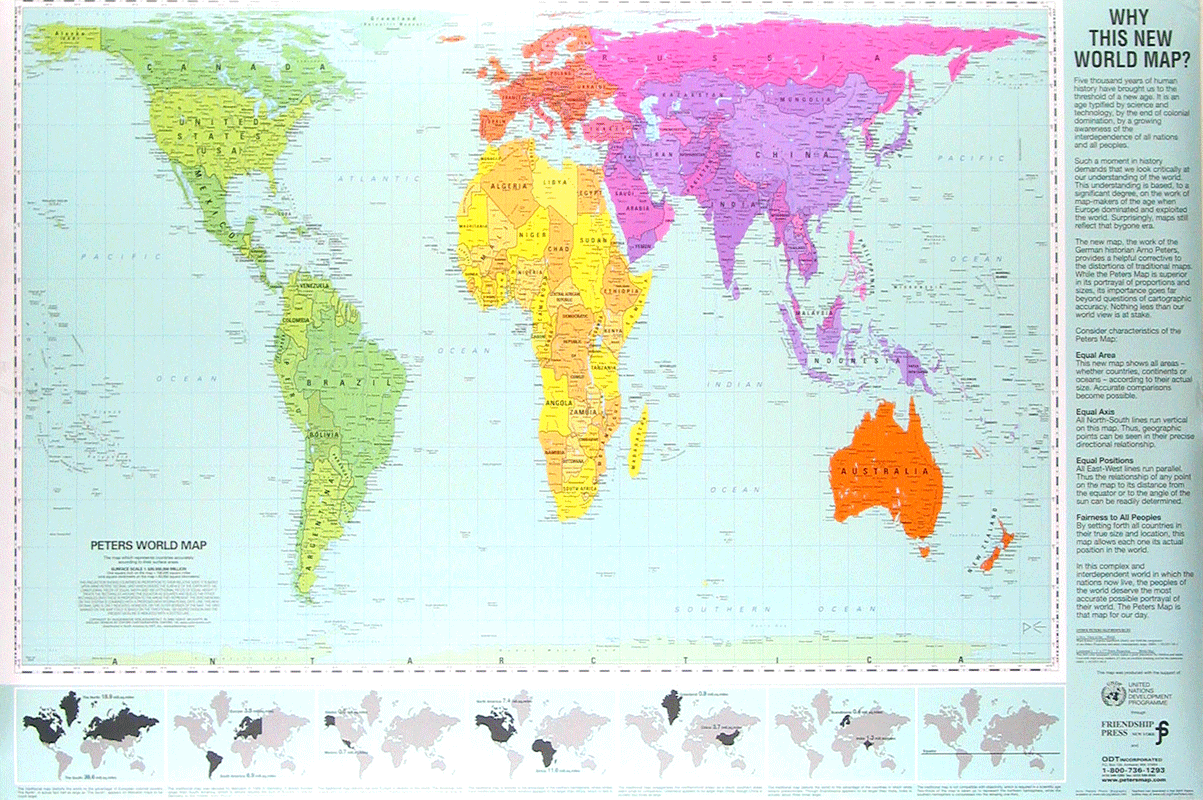
  • Peters Projection Map
    The world as it actually is


June 16, 2010

iPhone + Book = Book: beautiful transmedia book

Catriona would love this. It's an iPhone 'book' within a book, taking the best of both worlds, and my daughter's insatiable desire to turn the page (No, Dadddy! Don't you turn the page!), her delight in fun animations and adding some of the interactivity the iPhone offers. It's from the clever Mobile Art guys in Japan.

Thanks to the Swissmiss for the tip of the hat.


Links for 2010-06-08 [del.icio.us]


Links for 2010-06-14 [del.icio.us]


Links for 2010-06-06 [del.icio.us]

  • Nicholas Zambetti – LiveView for iPhone & iPad
    LiveView is a specialized remote screen viewing application intended as a tool to help designers create graphics for mobile applications, it has also proven to be useful for creating quick and dirty simulations, demos, and experience prototypes.

    For visual designers — Develop pixel–perfect graphics for the iPhone and iPad quickly and easily with a live view of your canvas/artboard while you work.

    For interaction designers — With your iPhone or iPad tethered via WiFi, you can interact with software prototypes and demos running on your Mac to communicate and iterate your concepts quickly.

    For everyone — If you've ever needed to press a button from afar or wished that you could take a piece of your monitor with you across the room, this app may prove useful from time to time.


Augmented Reality Is Helpful To Be Less Helpful

The app in the video above shows how augmented reality can help give you the answers to a Soduko quiz in your local newspaper. You can also ask it just to give you a hint. Now, imagine that this device, primed for heating, were constrained to solely giving you the interesting question, the clue or hint. We begin to see how augmented reality contributes towards Dan's mantra of "be less helpful" to make learning better.

Can you imagine holding the app over a French language text or physics problem and getting that little contextual nudge that great teachers have always offered? What would that free the teacher up to do? How could it add to the learning experience in homes where parents take less of an interest in (the learning of) their children?

Tip of the hat to my favourite polymath, Noah Brier.


Finding questions that Google can't answer (updated)

Google Search
The old reason for banning mobile phones and the use of 'always on' internet-enabled devices in schools was that children 'cheated'. We're beginning in some places to see over the top of that particular mountain, but how about this for a contentious question: should we allow smartphones and internet-enabled computers into examinations?

I'd argue it's worth thinking about. I was a French and German teacher, subjects which, when I was at school, did not allow the use of a dictionary in the examination. For some time now, students have been able to use dictionaries, something that tends to bring lower results to students who have not been taught well in specific dictionary and reading skills.

If we were to teach students how to effectively use the web, search, social search and shared bookmarking techniques within a pressure environment, in much the same way as we've done for decades in languages and dictionary tuition, what would we be left with?

My guess is that many educators and examination bodies would still not be happy, since too many of the answers sought could be machine programmable or searchable.

So, we need to change the way we ask questions, we need to change the way we test and assess. The remaining question is therefore: how?

Well, in a lovely example or two of truly higher order thinking, analytical and creative thinking, Bill Boyd mentioned two things.

First Dan Meyer's talk on how we should teach mathematics to be "less helpful", and construct a creative rub against which students can learn. His talk is a superb 20 minutes for any teacher:

But further still, and totally new for me, is the concept of Fermi Questions. These are questions named after the Nobel Prize-winning Italian physicist Enrico Fermi, who was well known for solving problems which left others baffled. There is no searchable answer, and no one way of answering them. They are the true meaning of "there is no right way to answer this".

Update: Had they not already written a blog post which is now Googleable, I'd have said that finding out how to play the world's shortest possible game of Monopoly would make a great Fermi question. But they did, and it is, so it's not.


<< Back Next >>