Log on:
Powered by Elgg

Simon Messer :: Blog

October 12, 2009

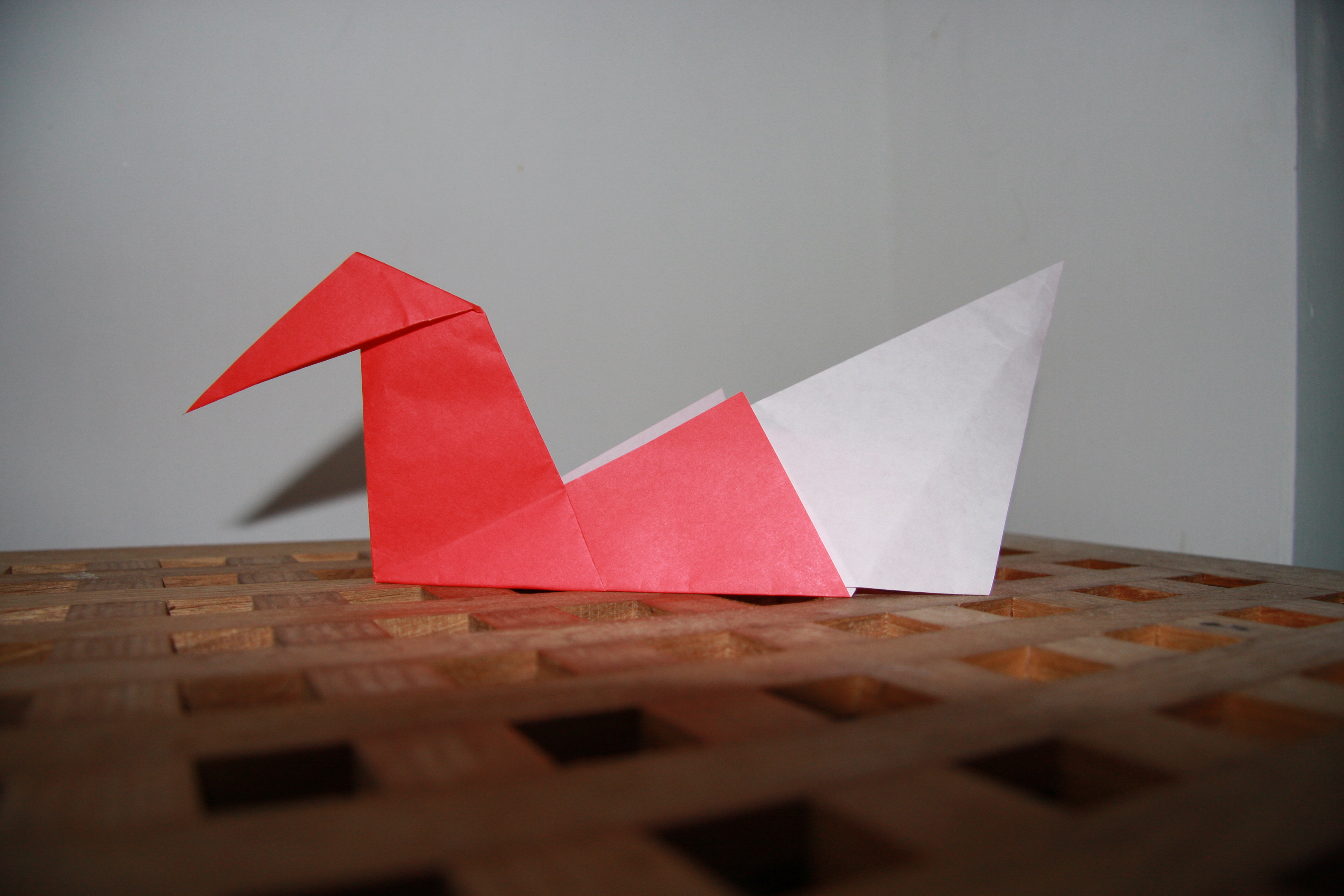
I have become a little fed up with not quite being able to follow through the diagrams and instructions. I therefore spent some time going back through the beginning of the book to make sure that I understood the symbols and what they stood for. After I had done this I tried to create a basic duck with the large paer. This was successfull, I tried again and it seemed as though things were falling into place so I tried to create a basic duck using smaller paper. It worked, so I tried some more. After a few more successes I decided to go back to making them with the larger paper and the next one was to become a base for a complex duck.

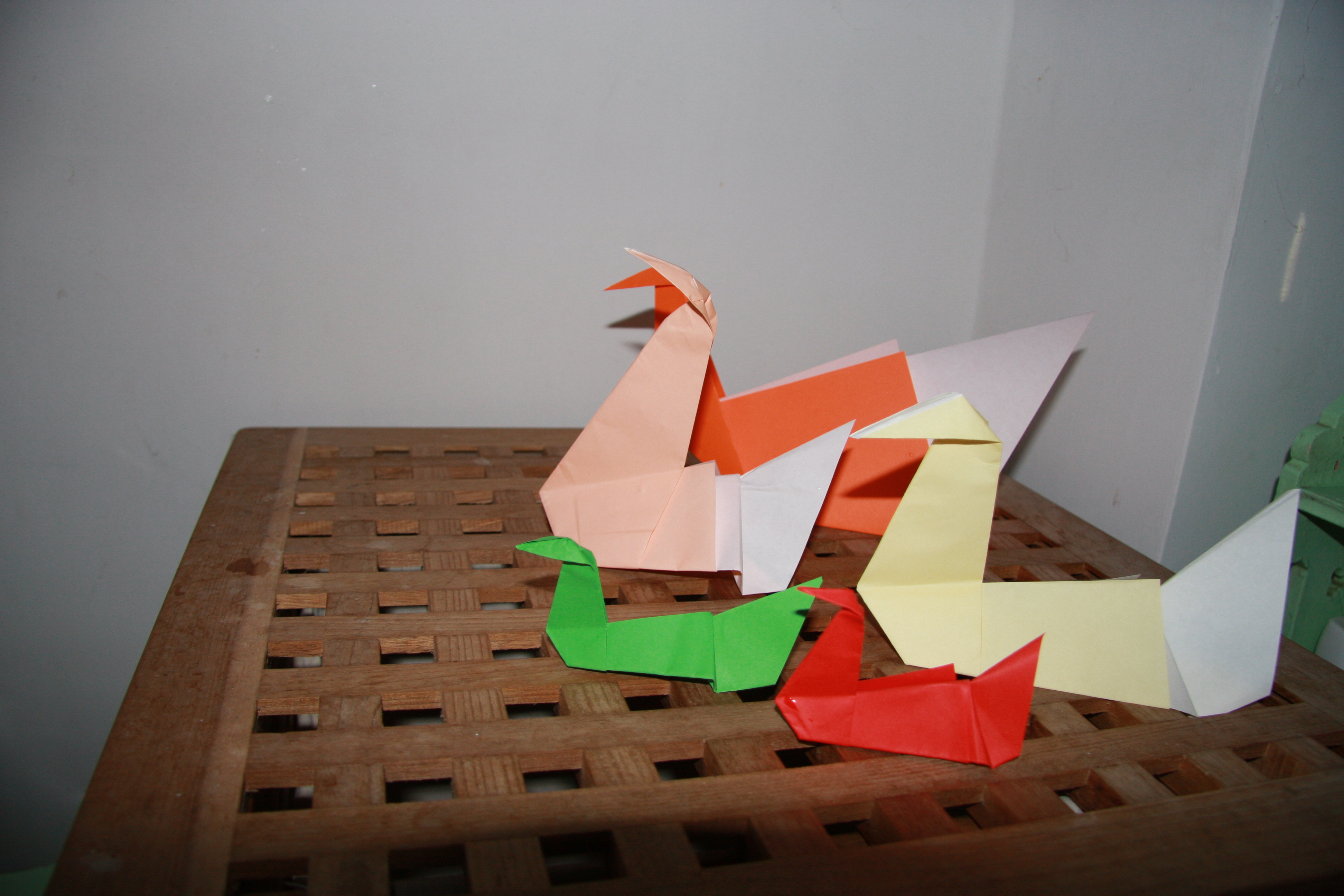
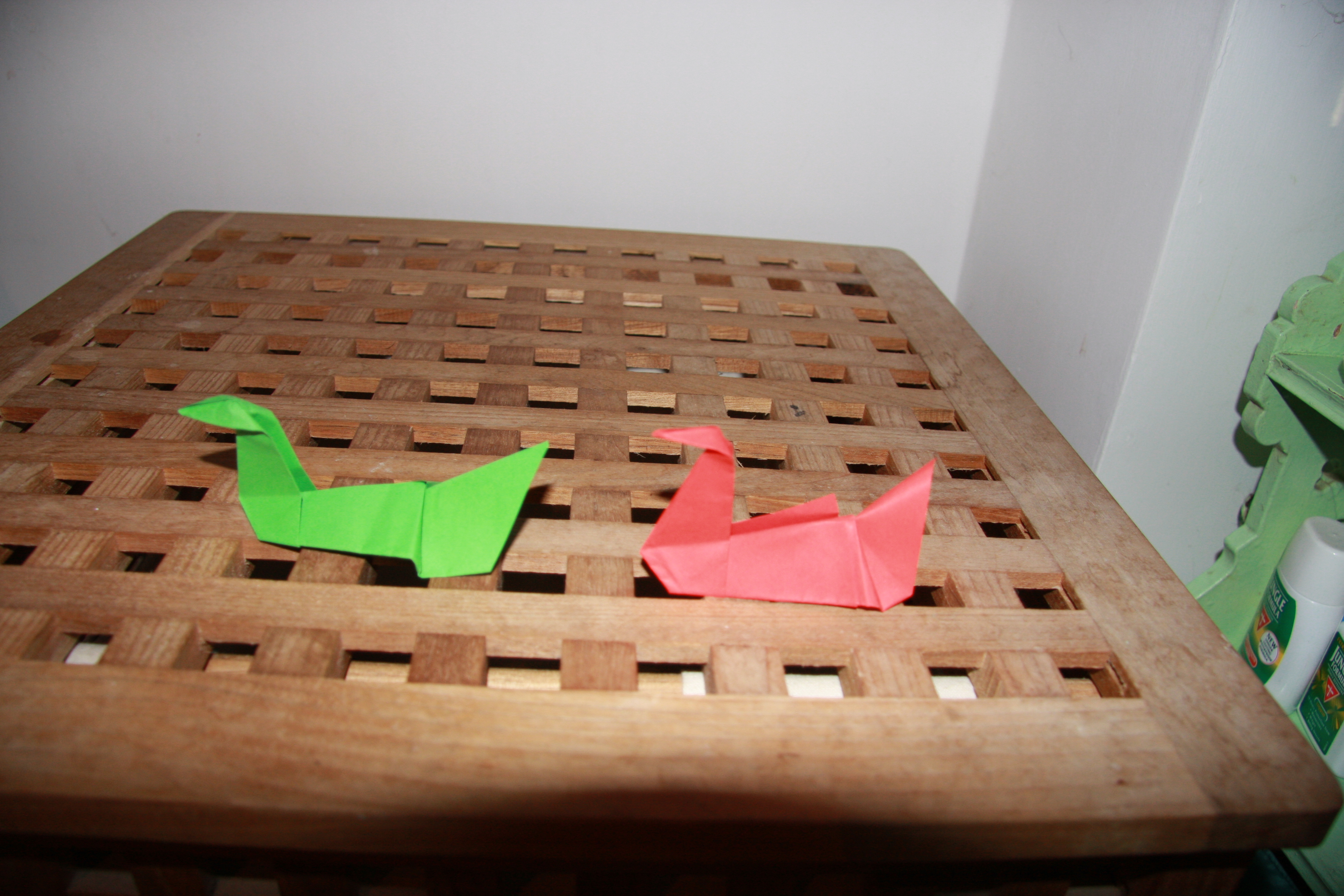
                      The pictue here shows some simple ducks that have been made out of small and larger paper squares.


So I started to create the next basic duck and found that at the stage where I was to make the first fold to create the ducks neck that I had folded it in the wrong direction which meant that when I tried to fold the neck it tried to develop in the wrong way. I managed to find where I went wrong by comparing a successfull model with the one I was having problems with. I also used the pictures to compare the folds and saw my error. Once idnetified the error was very easily corrected. I created an almost perfect basic duck. I then went through the diagrams and suddenly saw correctly how the folds should go and how it all fell into place. I put this all down to the time I spent making sure I understood the symbols and could relate the diagrams to the actual folds.

I found that after all of the initial hassles that I was able to create a complex duck. The first one had a slightly wonky tale but was a much better effort than any I had previously done.

After I made another with the larger paper and it was almost perfect. I then tried with a smaller piece of paper and was really happy with the results. In order to reinforce the process I made several large and small complex ducks and was pretty pleased wit myself as a result.

small basic ducks


a mixture of small and large complex ducks.


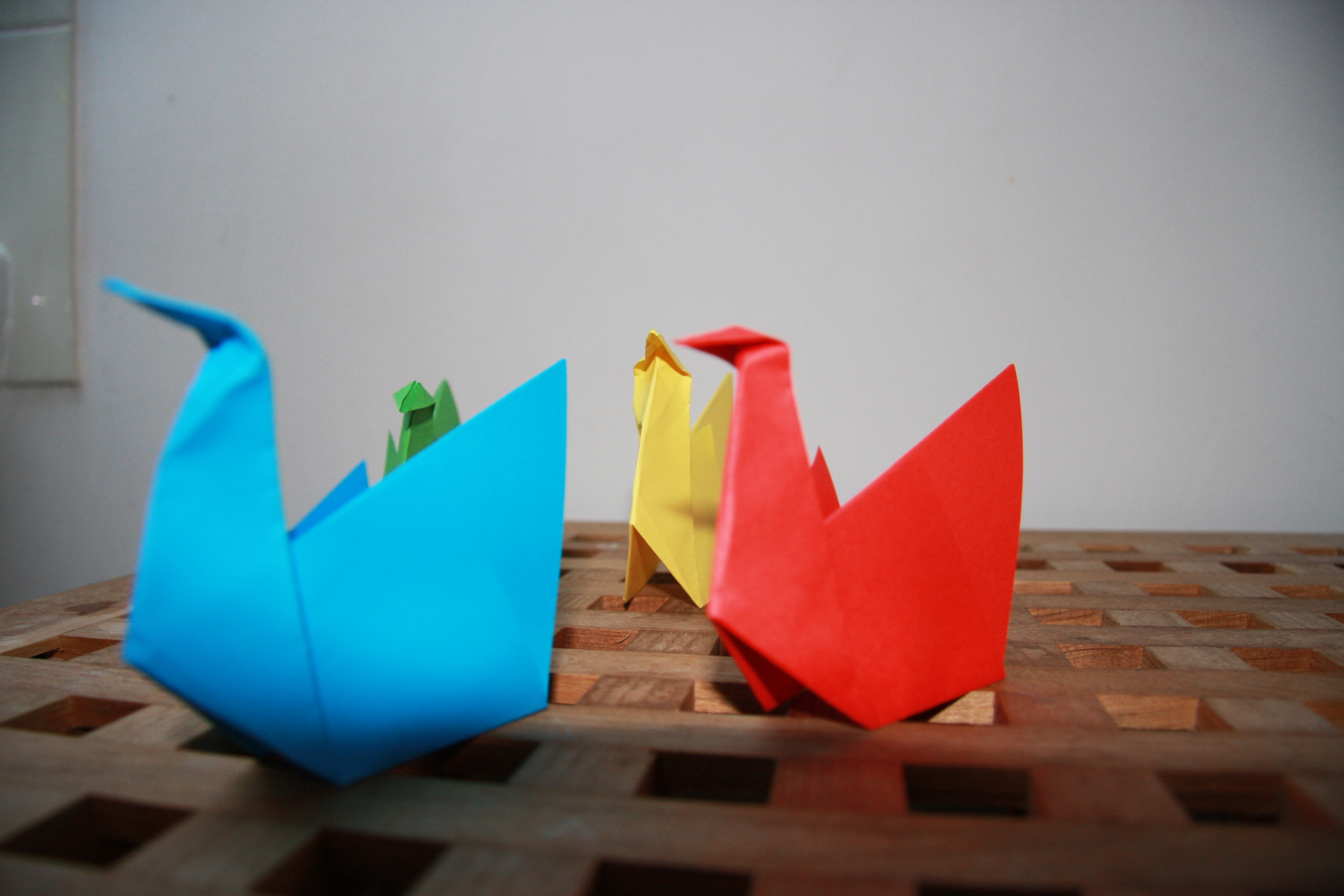
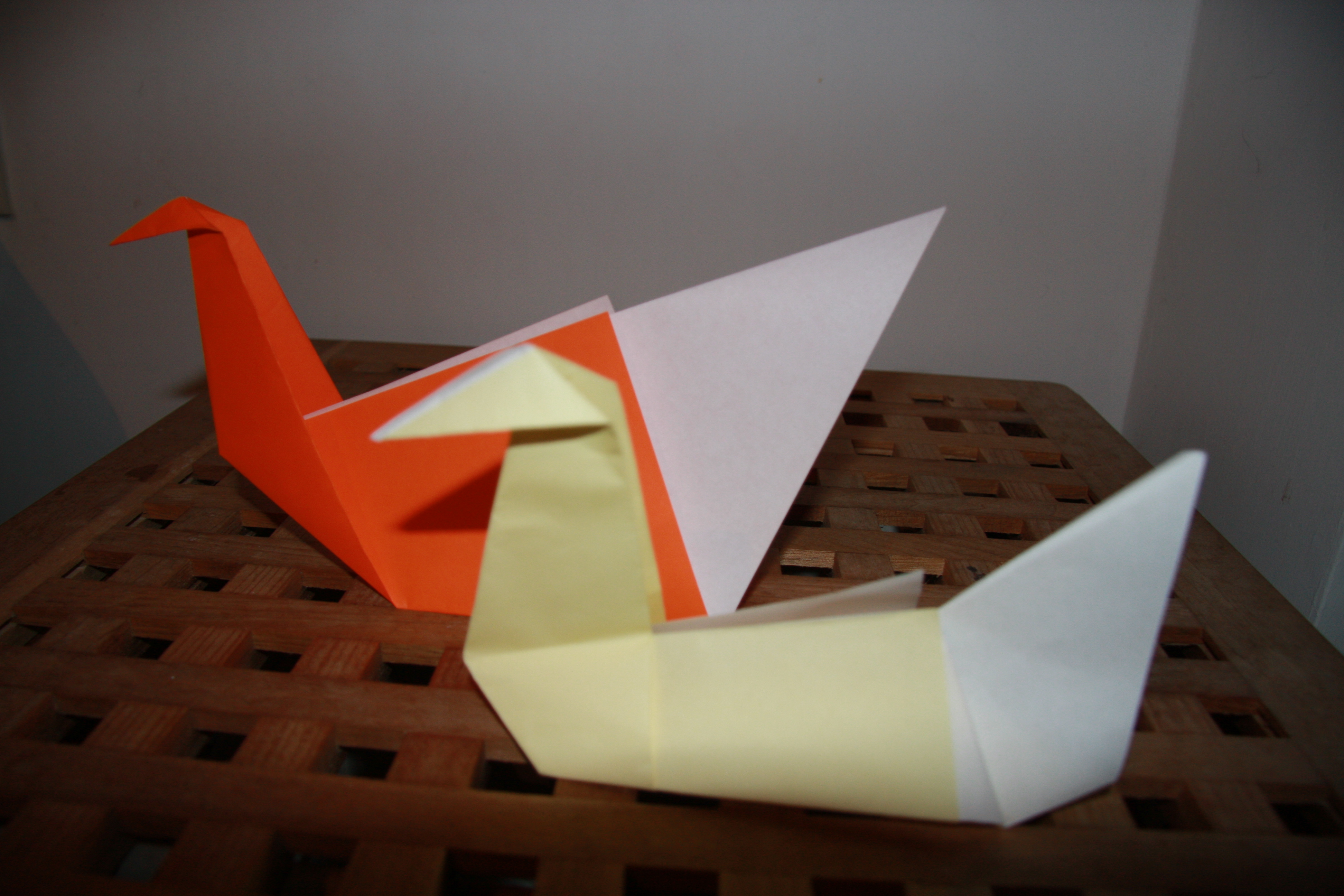
More detailed pictures 1) Large ducks of each type 

Small complex ducks in more detail 


Keywords: Origami

Posted by Nicholas Palmer | 0 comment(s)

October 07, 2009

Why on earth did I take up this challenge? I continued with the simple/complex duck. I made an attempt at the complex duck - a stage on from the simple duck and felt good. It wasn't quite right I seemed to be misunderstanding the final step. I then tried to do it again and found that I was struggling to complete a simple duckl. After four pieces of wasted paper I decided to give it a rest.


The positive that has come out of this is that I am feeling confident handling the paper to complete the kite base it feels as though I know what I am doing. It is very straightforward and to be honest I should be feeling confident by now as I have completed this stage a number of times. I am just hoping that I will be able to achieve more tomorrow.

Posted by Nicholas Palmer | 0 comment(s)

October 06, 2009

The origami has been forgotten for a few days. I decided to redo the simple duck using blue paper -I struggled to get there and had to discard two attempts before I succeeded. The more complex version is still alluding me and after an hour I decided it was time to do something else. As an aside I tried to make the simple duck with a smaller piece of paer and was unsuccesful. What was interesting is the paper was thicke and coarser in texture which and did not crease quite as easily as the larger squares.

Posted by Nicholas Palmer | 0 comment(s)

September 29, 2009


Well week 1 is over and we’re into week 2 and the first reflection is how I’ve failed to keep the planned blog, which I know will help me with the studying (I used one in my first module and not in the second and noticed the difference).   I could link this to work being really busy too but that’s just me making excuses so here’s an attempt at encapsulating the starting points for my thinking.

  • The way in which the course is structured to give us (as students) ownership of both content and direction of the course – and what this means we have to recognise as our responsibilities to ensure a successful programme
    • And to a lesser extent the tutor’s role in supporting/facilitating this work
  • The way in which technology is portrayed in films and books and how this might influence the way in which we perceive it in reality
    • Do we see truths in the films or do we question and disagree with them?
    • What are the implications of films portraying the negative/challenging sides of the relationship between humans and technology?
  • Why we chose to adopt particular technologies
    • What of our choice is linked to design?
    • How are we influenced by our peers?
    • How is Apple influencing the spectrum of early adopters? How do their design choices represent a consideration of the market?
  • The way in which our use of social media develops
    • Rise and fall of facebook
    • Does the use of social software ebb and flow – and if so what’s causing the tide to change? Is it all just linked to popularity and fashion or is there something more fundamentally linked to function?

Keywords: design, pscel09, questions, socialmedia

Posted by Emma King | 0 comment(s)

September 28, 2009

I worked through the introduction and this took me to a section that explained the symbols used in the book for the various folds and moves. I was able to understand this reasonably well until I came across the inside and outside crimp. Still I was reasonably confident and decided to have a go with my current knowledge.


The tips were very useful and one was to use larger  pieces of paper to start with. I have two sizes of paper nine and three quarter inches sq which is coloured oneside and white  the other and  five inches sq (came with the book) coloured bothsides.

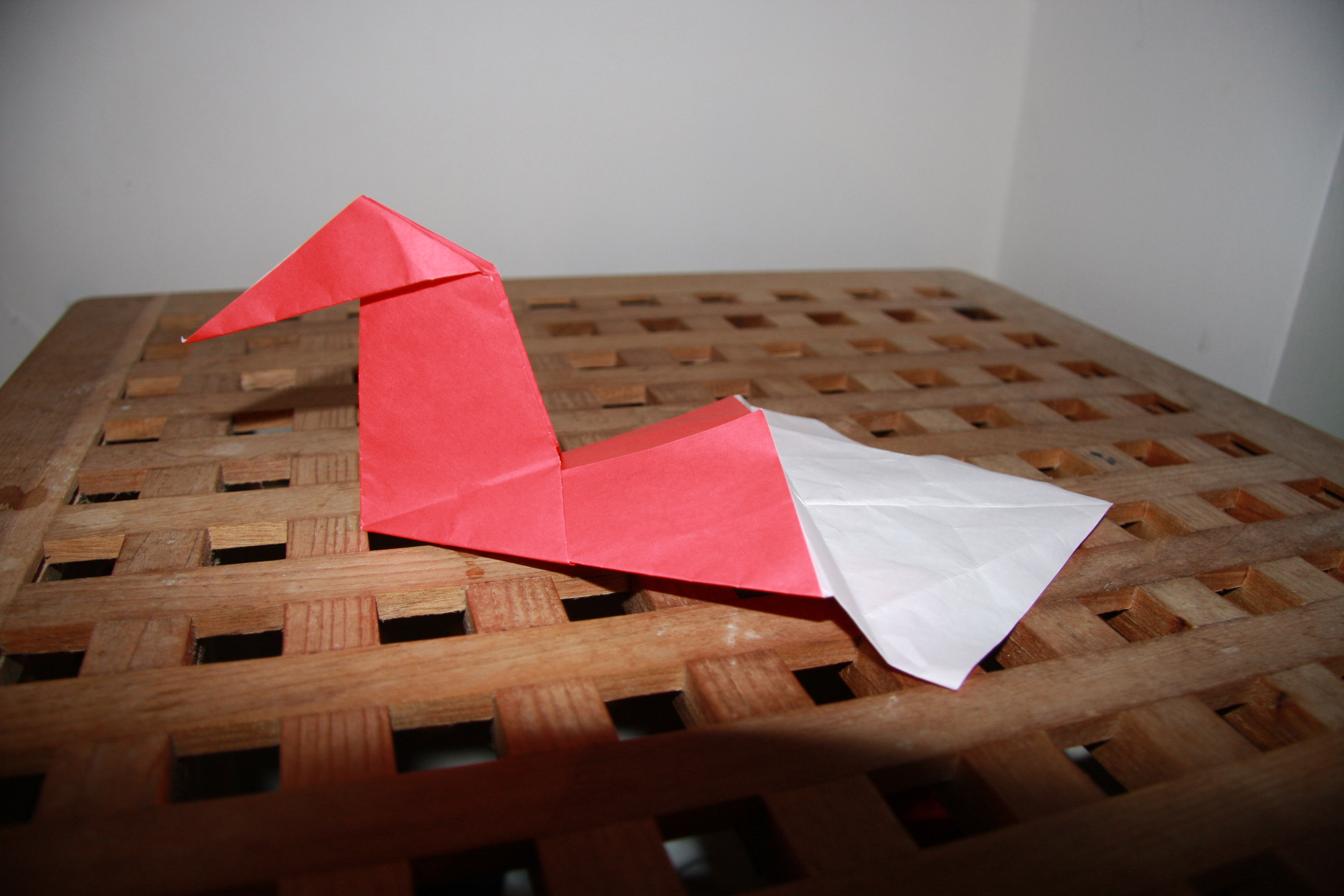
THe first thing I did was to create a kite base with the larger paper using a red piece first. After the base had been created I produced the simple duck. I struggled wioth the diagram a little but perseverance paid off and I took some photographs of the model (model taken from Origami Kit  for Dummies). I then tried to create the more complex duck and this is where I was unable to fully understand the diagram at this point. After struggling for ten minutes I had a break. The overall session lasted 30 to 45 minutes and was partially successful.

The paper became vey crumpled with my efforts and I was left with a duck with a flat body, so it is time to try again.

First attempt Duck 1

Collapsed attempt Duck 2

Posted by Nicholas Palmer | 0 comment(s)

I am currently studying for an MSc in e-learning at Edinburgh University. I am on my fourth module which is understanding learning in digital environments. One of the assignments is a learning challenge and this blog will outline my experiences, thoughts and feelings whilst performing the learning challenge. I am going to learn how to create origami paper models. My previous attempts have got little further than paper darts or paper planesI tend to be all fingers and thumbs with these types of exercise.

I have chosen to learn how to make Origami figures for this challenge. Ther initial aim is to create a dragonfly (medium difficulty) and a beetle (challenging). I have decided to learn by 1) Working through the Origami Kit for Dummies by Nick Robinson - published John Wiley 2008. 2) websites and 3) videos from sites such as you tube.

The book is broken into three main sections

Introduction

Part 1 Coming to the crease: Basic Techniques

Part 2 Folding on: The Models

Part three: The part of Tens

I first looked atpart three which consists of three chapters 1) Ten Top Tips 2) Ten Origami Styles and 3) Ten Incredible folders ( a summary biog for ten famous Origamists)

It gave me a feel for the subject and those who excel at it. This also points the way to a number of websites which I have not looked at yet.

Lets get on with the folding!!!

Posted by Nicholas Palmer | 0 comment(s)

December 09, 2008

I thought I would make my final blog post a reflection on the blog itself, using as a starting point the following mid-course feedback:


*Reflection - You are demonstrating sustained reflection on the course content and its application to your professional (and personal) practice.

*Regularity - You are posting reasonably regularly, and your postings are all substantial.

*Knowledge and understanding – You’re demonstrating a good understanding of the technologies and ideas introduced. You could engage more critically with the course readings. How do they impact on the way you understand the technologies, experiences and ideas you’ve come across in the course?

*Writing style – is excellent, making for an engaging read. Your use of the blog format (inclusion of pics, formatting etc) is above and beyond!


My update

Reflection: I initially had the rather simplistic sense that the purpose blog was to demonstrate the reflective learning that was going on in my head (look teacher I’ve been good, gold star please). I think this is because that is the kind of learner I was in a traditional classroom setting (waaay back), a quick to learn / eager to please type, and I fell into the same groove.  However the process of blogging caught up and took over and I found that the nature of the reflection sparked deeper reflection, which in turn led me deeper still.  I reread my posts and see them evolve – it is very satisfying.  Each post draws me in further.  I get a comment, I respond to the comment – either in the comment form, in a subsequent post, in a discussion board exploration or simply mentally.  It is a rather lovely process that is far more complex than it seems at first glance. I am still worried that I am not “academic enough” but I can see I am growing and have more confidence in my potential.  I am looking forward to the journey - which is good, cos at one course per semester it’s going to be a long one.

Regularity:  The regularity of the posts has been mainly down to prioritization / time management.  If I have had time I have posted.  The course as a whole lost me for a couple of weeks when I had to do my local tutor duties (ironically I am the F2F component of someone else’s online learning experience) and this took my attention and energy for a while.  It was a two week hiatus because I had a week of tasks and it took me another week to get back “in” to IDEL.  I read in the handbook that it was a good idea to check in daily and I can’t agree enough how essential that is.  It seems excessive but it is key to maintaining emotional contact as well as keeping up to date with discussion board posts etc. 

Another thing that I think affected my regularity was my struggle with style.  I felt I had to post fully “formed” thoughts, rather than fragments:

And I realised in that discussion that part of the reason I hadn’t posted as regularly as I had intended was the sense that I had to have a fully rounded thought before I could voice it. I wasn’t satisfied with posting fragments on my blog. I think this is because of my experience with blogging & reading blogs generally is of completed ideas being presented. Basically I am trying to use my blog as a canvas as opposed to a sketch pad. I think I will try and change that to see how it feels.

Well I tried, but I wasn’t satisfied.  I like to explore my ideas to some form of conclusion.  There is nothing final about them, a comment can reopen the topic (as I discussed above) and lead to new avenues.  But I couldn’t post fragments, and each post I made felt like a full piece of work.  It did mean I wasn’t able to post as frequently, but that (combined with time diverted into reading, discussion board posting, playing with the various web2.0 gizmos) was a compromise I felt more than happy to make.

Knowledge and understanding:  Your feedback here was very useful. I made an effort to “engage more critically with the course readings” and I felt the quality of my reflection go up a notch.  I was reading in the first part of the course, but I wasn’t doing the hard work of dissecting or digesting the readings.  It was more a case of reading and ticking it off my ‘to do’ list.  I think this was a symptom of simply being rusty with the process, but once I made a start on breaking down my reading (and simple things like highlighting key points / interest, adding comments to think about) the change in the level of my engagement was very satisfying.

Writing style: This is something that has amused me privately and I intend to touch on in it my final assignment.  For some reason, even though I knew this blog was an intimate tête-à-tête with my tutor the very nature of the medium caused me to post as if I was talking to the world (I’m bloggin’ to cyberspace innit?).  Therefore I tried to make every post not only useful to me (as a record of my learning process) and to you (to show you where I am in my learning process) but also interesting and entertaining.  Maybe I was trying to keep you coming back, to woo you.  It just happened, and I enjoyed it, so I went with it.  I have a story that illustrates a little of the compulsion:


A (True) Story

Friends of mine went on holiday to Southern Thailand.  They picked a bad week and it was raining and miserable (it’s not always blue skies and palm trees).  As they were trudging down a road sharing an umbrella they saw a stretch limo parked outside a 5-star hotel, so they paused wondering who had access to such ostentatious luxury.  At that moment the lobby doors flew open and a slew of bodyguards trotted out followed by…


*dramatic pause*


Bill Clinton!


They stood there with their mouths respectfully open as he jogged down the stairs to the waiting limo and as he was about to get in he looked up at them. They did the only thing that it is reasonable to do in that situation which is grin like a pair of fools and wave madly at him.  He beamed and waved back, but as he raised his hand must have been seized by his presidential alter ego because he gave them the full works, turned slightly to the left, then to the right waving and smiling as if confronted with a substantial and appreciative crowd.  My friends were a little embarrassed for Bill because they were in fact the only people in the street, but they puffed up a bit in order to try and give him the sense of ‘public’ that he so obviously needed.

So Clara (and world) thanks for being so many things, IDEL tutor, support, friend and audience of millions.  I have enjoyed it thoroughly and learned far more than I expected.  


Let’s do it again sometime.


Posted by Tracy Swallow | 2 comment(s)

Ok there is some quirky thing going on here.  I type my post in the form, start editing it and in the process of formatting hit some hot key that means "back" and the page goes back... and I lose my post.  I know I should save it.  I have a slow learning curve on this one - but what makes it so frustrating is it happens when I have finished... and all I am doing it bolding / italicising / adding images.  *weeps*

In the words of Commander Riker:


Keywords: IDEL08

Posted by Tracy Swallow | 1 comment(s)

December 05, 2008

Prensky's terminology has been much discussed on the board so I will only allude to it here, of more interest to me is his underlying theme of using games for learning.  This seems to be his ultimate raison d'etre allthough google Prensky's name and the 'immigrant' v 'native' debate is what is thrown up, more from a fortuitous choice of vocabulary - that were to become buzz words for an assumed divide - rather than from an original theory based on research.  Anyway, Prensky on games:

A frequent objection I hear from Digital Immigrant educators is “this approach is great for facts, but it wouldn't work for "my subject.” Nonsense. This is just rationalization and lack of imagination. In my talks I now include “thought experiments” where I invite professors and teachers to suggest a subject or topic, and I attempt– on the spot – to invent a game or other Digital Native method for learning it. Classical philosophy? Create a game in which the philosophers debate and the learners have to pick out what each would say. The Holocaust? Create a simulation where students role-play the meeting at Wannsee, or one where they can experience the true horror of the camps, as opposed to the films like Schindler’s List.

The holocaust reference jumped out at me as a really tacky way to make a point, so I googled it - and you know what?

Eternity's Child Creator Attempts to Tackle the Holocaust

Yes, somebody did, and for educational purposes too:

Luc Bernard, the mind behind the upcoming Wii-Ware title Eternity's Child is already hard at work on a new and what is sure to be a very controversial game or the DS. Imagination Is The Only Escape is the story of a young Jewish boy living in France during the occupation by the Nazis in World War II. In order to escape the horrors around him, he imagines a fantasy land that becomes the basis of the game's world. The adventure platformer will attempt to educate players on the atrocities experienced by many children during the time of the Holocaust.

Here is a screen shot of the game:

Not that this validates Prensky's argument, or makes his parlour trick, I'm sorry, 'thought experiment' more impressive.  It just surprised me that the concept of a holocaust game, which struck me as a (rarely) inappropriate use of a game in education was actually on the market for that very purpose.  Maybe Bernard read Presnky.

Who did Prensky read?  John Perry Barlow's A Declaration of Independance of Cyberspace (1996) maybe?

You are terrified of your own children, since they are natives in a world where you will always be immigrants [my italics]. Because you fear them, you entrust your bureaucracies with the parental responsibilities you are too cowardly to confront yourselves. In our world, all the sentiments and expressions of humanity, from the debasing to the angelic, are parts of a seamless whole, the global conversation of bits. We cannot separate the air that chokes from the air upon which wings beat.

How long has this face-off between impotent un-plugged adults (parents, teachers) and potent wired kids been going on? Since the 60's? Or did it all begin with Oedipus Rex?

Anyway, I am not going to accept the label of immigrant (and I am certainly too old to be a native) because almost all of my experience with technology in learning and teaching has shown me that you cannot measure technological skill against a demographic like age, social class or even economic background, it is too complex.  Rodger's (now rather dated) Innovation / Adoption curve is more meaningful in explaining those who embrace and those who are repelled by web technologies in an educational context, and explains why many 'immigrant' aged educator / innovators embrace what 'native' aged student / laggards avoid.

Turning 'it' (learning) into a game has been the bread and butter of EFL teachers for at least 20 years.   But often the aim has been no more ambitious than to motivate students to remain engaged through for the duration of a single lesson, rather than the kind of Weschean 'pervasive' engagement we touched upon in our Second Life chat, edited extracts below:

Hirondelle Sciarri: I suppose the interactive aspect of web 2.0 is key to engagement

Dagma Kiranov: 'the narrative must become pervasive in the learning environment' Welsch

Klara Otsuka: Again i think we need to think about we use a word like "enagement" - we're not just saying activity, we're saying really committing (as Dagma said very much earlier) to something

Hirondelle Sciarri: yes, engaging.... meaning contributing, buying in, negotiating content

Klara Otsuka: also - that kind of engaging usually has a social element - which I think we can draw even from our own course is quite key at times to learning!

Marieiram Dubrovna: i really liked the concept of the students then taking over with their learning, even covering topics outside his knowledge

Marieiram Dubrovna: and him being in a wondefully awkward place

Klara Otsuka: So - if we had appropriate support, and engaging, meaningful, technologically appropriate materials - would it matter if our students were "native" or "digital"?

Allowing ourselves as educators to divide our intention to inspire into 60 minute game filled chunks is just as much of a crime as digital (illegal?) immigrancy - and, from my frequent observations of the EFL classroom, far more commonplace. What is the purpose of the games, role-plays and simulations that Prensky proposes? Are they to enable our students to discover or create content for themselves? Or tools to glam up rote learning and memorisation of facts? Even with simulation and role play allowing for some student creativity games, unless supported by a holistic and fully realised (by the teacher and student) learning purpose, are often merely useful accessories. 

In my centre just gave our students a questionnaire to gather feedback on a variety of areas, from classroom management to use of technology.  Feedback has been, on the whole, positive - however our students score us consistently poorly on two points:  'The lessons on the course link together well', and 'I am making progress on the course'.  This I feel is because we approach our teaching from a discrete lesson to discrete lesson perspective.  I would guess that it is our focus on materials and activities that is behind this.  We create fun and motivating lessons as opposed to enabling fun and motivating learning.

Back to Prensky:

It's just dumb (and lazy) of educators – not to mention ineffective – to presume that (despite their traditions) the Digital Immigrant way is the only way to teach, and that the Digital Native's “language” is not as capable as their own of encompassing any and every idea.

Other than suggesting web2.0 inspired activities, games and speaking 'their' language and the "just do it" language of mass marketing (Nike? Please, that's immigrant footwear I am sure) Prensky highlights a divide and yet seems at a loss as to which methodology will breach it.  The point Prensky misses is that passion for the "subject" combined with a willingness to experiment and take risks (with web2.0 technologies or whatever) with our students is what makes inspirational educators like Michael Wesch so successful.  Wesch's world simulation doesn't work because it is a game, or because Wesch has learnt the lingo (and the gizmos) of his 'native' students. It works because he is passionate; he has worked to understand his learners' holistic needs and developed a personal "anti-teaching" methodology accordingly.  He experiments and learns with them - in a world of digital pirates he is the pirate king.  Web2.0 technologies, the supposed tools of the digital native (though developed by immigrants), with their focus on interaction and collaboration, user generated content and continual revision, process over product are a means of bridging the gap between teacher and learner - such a combination render the boundaries (temporal and spacial) in the native / immigrant divide meaningless.


Posted by Tracy Swallow | 6 comment(s)

November 25, 2008

Six years ago I registered on an online discussion board for fans of Terry Goodkind's Sword of Truth series.  I had just started reading it and was waiting for the next book, which was to be published in a few months.  I thought joining a fan site would be like a methadone programme... tiding me over until I got my next fix.

In addition to the forums dissecting plot and analysing character there were some text based role-play areas too.  After I had got used to posting (and being ignored as often as not) I stumbled into this area and got involved with an informal roleplay.  I loved it, my D&D character creating self was reborn, and within a couple of months I was a dark and deadly ruler of a an underworldly kingdom of the undead called... er... The Underworld, lol.  I was very circumspect about revealling much about my real-life self.  I preferred to stay in character and keep myself and Hirondelle separate.  It was escape, pure and simple.  

One day a wolf walked into my realm and he introduced himself as Timberwolf guardian of The Woods. He was fun but not at that time a huge role-player; he stayed in character, but didn't really immerse in plot. He would just drop by and say "hi how are you?" and wander back to his woods.  We started messaging and after a long and casual interlude we started to get more intense about our relationship.  We talked more about real life, we were both married, he with kids. Both a bit 'blah' about the state of our RL relationships. 

Falling in love was a slow process, and had little to do with the characters we created, and more to do with discovering the people behind the characters.I saw in him an ideal of what I wanted in a partner.  This scared me initially because I felt I was creating him rather than seeing who he really was.  I also realised that it was possible he was creating himself for me.  We spent a lot of time talking about who we were, and whether or not we were talking to real people of figments of each other's imagination.  It was actually at moments of crisis that we got closer.  When he did or said something that went against my ideal.  When I saw flaws and imperfections I started to believe in him more.  If I had created him (or simply superimposed an imagine on a basic framework) he wouldn't have been such an asshole. The fact that he could be an asshole made him real, and separate from me.  He had more veracity. Which meant I loved him more.

In 2004 Dom's wife asked him for a divorce and we talked for the first time about the possibility of being together.  It took another year or so for me to leave my husband. In September 2005 I moved out of my husband's apartment and in October Dom flew from the US to Thailand to live with me.  Not to visit, but to live. By this time we had talked on the phone for hundreds of hours and IM'd with webcams.  I had gone through phases when I thought I was making a huge mistake / decided he was a serial killer / worried he was just after my money (not that I had much but hey) / gone through every kind of fear imaginable plus worried about the really scary stuff I couldn't even imagine.

You know they say you should tell someone if you are meeting an online friend? And meet in a public place?  I had told no one he even existed.  I was ashamed of leaving my husband, and also afraid I had made a mistake.  By the time he was due to arrive I was almost more ready for my close friends to find my cooling mutilated corpse than to admit that I had met someone online and was willing to start a life with them.  In a world with him and me I had no doubts we were doing the right thing, it was only when I imagined presenting this to other people did I get antsy.

Anyway, we met for the first time in Bangkok Airport on October 9th and I took him back to our new home to start being forever together (whether that was 50 minutes or 50 years I didn't know, but I had a strong suspicion it was going to be the latter). 

It was a wonderful unusual experience knowing someone so well (we had talked about everything, he knew more about me than anyone I had ever met... because the "distance" of online communication, can make you feel safe and more able to be honest than face to face conversations) and yet not knowing them at all.  Honesty and openness is the cornerstone of our relationship.  I think that is thanks to the nature of the early days of our affair.  We see friends who have all these secrets (small and large) from their partners and we marvel at how that can be acceptable to them.  But obviously that is how we were too in our previous relationships.

I am not saying online relationships are better, but I do think there are lessons to be learned from that form of communication.  In order to be intimate and to have faith in the truth of your interlocuter (or lover) you need to make everything explicit. You cannot assume.  You cannot use body language or facial experession as a litmus test for honesty. Every fear I had, I discussed with him until it was gone.  I never second guessed what he was thinking.  I asked.  I clarified his meaning far more than I would have face to face. I asked (and answered) very deeply personal questions that I would never have had the courage to ask (or answer) if he were sitting in front of me.

In the course of our relationship I came to dislike to the distinction between real and online because what I had found online was far more real than anything I had experienced in my everyday existence.  I began to think in terms of authentic and inauthentic experiences... a value that I felt transcended the mode or medium of communication. 

The authenticity that Dom and I found in our online romance we have worked hard to maintain in our offline, real-life, flesh and blood love affair.  And I think we are happier and wiser for it.


Keywords: IDEL08

Posted by Tracy Swallow | 8 comment(s)

<< Back Next >>