Log on:
Powered by Elgg

Blog :: All

You can filter this page to certain types of posts:

Filtered: Showing posts with no comments (Remove filter)

November 02, 2009

The experience of using computers gives me the feeling of playing a game; sometimes I win (find what I need, do what I want to do etc.), sometimes I loose (can’t fix the damn machine, can’t download something etc.), but I always enjoy playing and that’s why I am returning back.

I started quoting my own metaphor of using computers only to say that I will try to apply a game metaphor for both VLE’s and PLE’s.


VLE (webct, moodle)

A VLE is a massive multiplayer online game. People play with it and accordingly learn from it but they have to stay inside game’s “margins”. When someone “finishes” playing and turns off the computer, the game is still there played by a lot of people; even if some of its gamers are sleeping or working. Accordingly, in VLE’s the discussion board is always open, anyone who is registered can contribute anytime. You can go to sleep or to work, but when you return back something new happened. Despite this, you can still read new posts or finish uncompleted tasks and hence continue “playing”.

In addition, gamers have to follow certain game rules; if they breach these rules they face the potential danger to been thrown out of the game by the authorities. In that sense they are somehow restricted. In VLEs there is always a sense of authority and of course there are always some rules to follow. Gamers can also communicate with each other (through the game or using extra tools; i.e. email-skype) and even structure groups inside the game. Accordingly participants communicate through VLE or/and other tools and they can follow one course or another (in that way they structure groups).

Finally, a MMOG can be a free game or a commercial one (moodle-webct). When it is free usually it is more open; some courses in moodle are open to anyone. Unfortunately, commercial games are usually more “fancy”, so if you like games usually you have to buy one (or more Wink).


PLE (igoogle, pebblepad)

A PLE is one’s game collection. In that sense it can be comprised of miscellaneous games: tableboard, online, mmog, free, commercial. Your game collection is your game story (summative in that sense, like pebblepad), you started with one game, then you proceeded to another, after that you played with some friends a multiplayer game etc. On the other hand, occasionally we try new games; when playing a new game we reflect a lot on that. Accordingly, when something is under development (i.e. a perspective, a thought , an idea) it is there in our PLE to reflect on that idea. Thus, our game collection is not only summative, but it also conceals dynamic. Besides, we must not forget that in every collection we have favorites, i.e. games we usually play; if you look at your igoogle screen you will notice that the links you use most are on the top. Finally, like games a PLE can be free (like igoogle) or commercial and thus glossy (like pebblepad; impressed by flash player, but I consider it redundant Money mouth).

My picture for PLEs can be illustrated somehow by one game only: the snakes and ladders. It is summative (our story in the game) and there is a dynamic and reflection (we can choose whether to follow a ladder or not or we must return back sometimes due to a snake).


snakes and ladders


Posted by Angelos Konstantinidis | 0 comment(s)

October 28, 2009

Just about to start recording my thoughts about my chosen community when have just heard on the news that  young person found dead on Monday evening meeting up with a man she met on facebook! This is really shocking and terribly sad for the families concerned.  What makes a young person meet up with a total stranger? 

the fact that this stranger was a virtual 'friend' initially is probably crucial. there was likely to have been a series of friendly chats in the first instance, chats whereby the girl felt as if she had got to know the other person.

I might be controversial in my views but I don't think keeping young people away from facebook or any IM/social networking site will stop this kind of thing happening. It needs to be about educating the children and young people surely. I believe this awful situation would have happened even if the young person had met her killer in a cafe.  

This predator won't be wearing a badge or have horns he will be charming, otherwise the young person would not have agreed to meet him in the first place. So there needs to be more education of young people to be less trusting of strangers no matter what. I have no reall answer but I do feel that the social networking available to young people can have more benefits than disadvantages.

  will come back to ethnograhic ramblings later - on way to hosp!!

Posted by lesley ferguson | 0 comment(s)

October 12, 2009

The next things to learn were same basic bases, a waterbomb base and a blintz base. I managed to make one of each but they were pretty tatty. I only tried to make them using the large paper squares. I decided to give up wilst I was winning and have another go tomorrow.

Keywords: Origami

Posted by Nicholas Palmer | 0 comment(s)

I have become a little fed up with not quite being able to follow through the diagrams and instructions. I therefore spent some time going back through the beginning of the book to make sure that I understood the symbols and what they stood for. After I had done this I tried to create a basic duck with the large paer. This was successfull, I tried again and it seemed as though things were falling into place so I tried to create a basic duck using smaller paper. It worked, so I tried some more. After a few more successes I decided to go back to making them with the larger paper and the next one was to become a base for a complex duck.

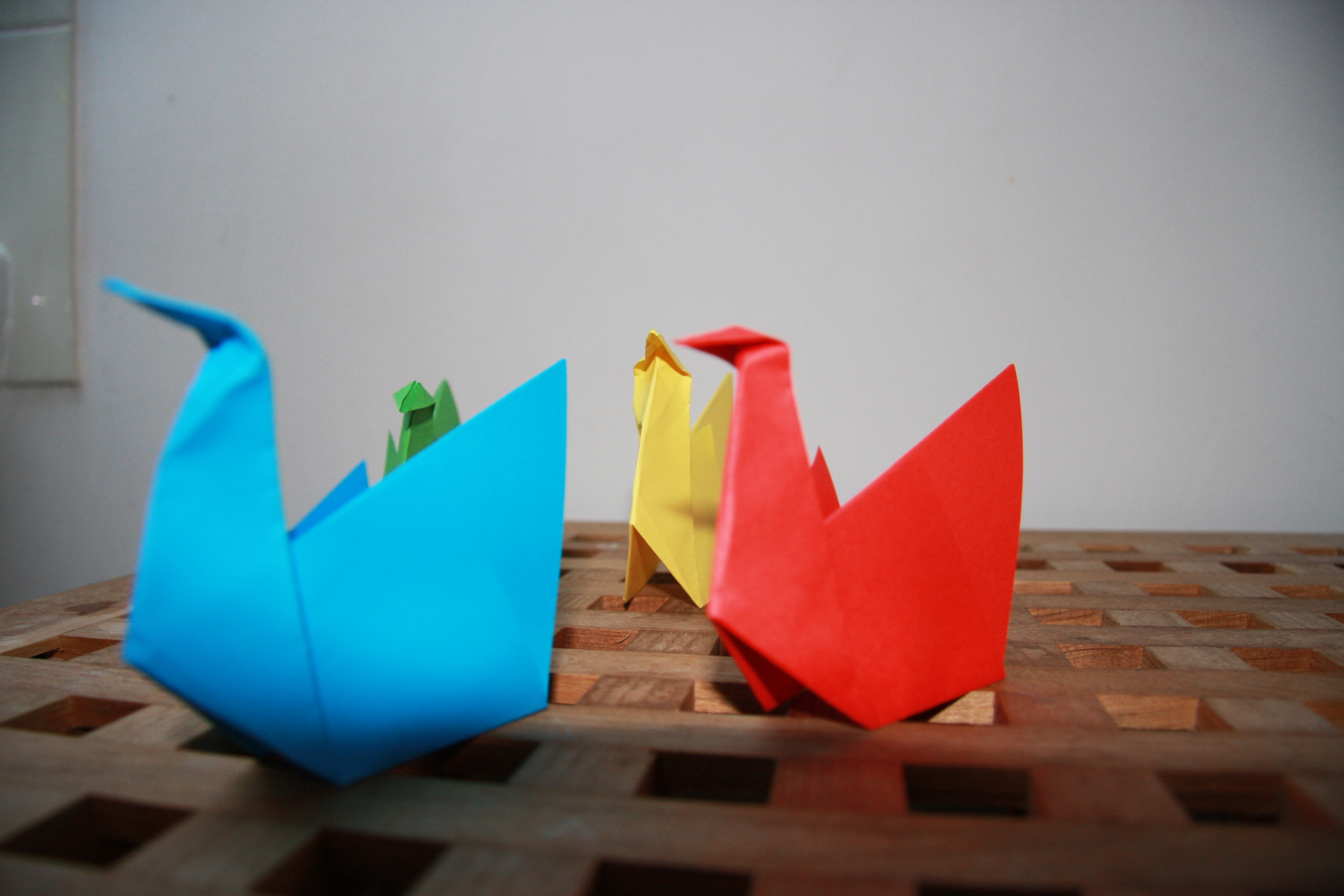
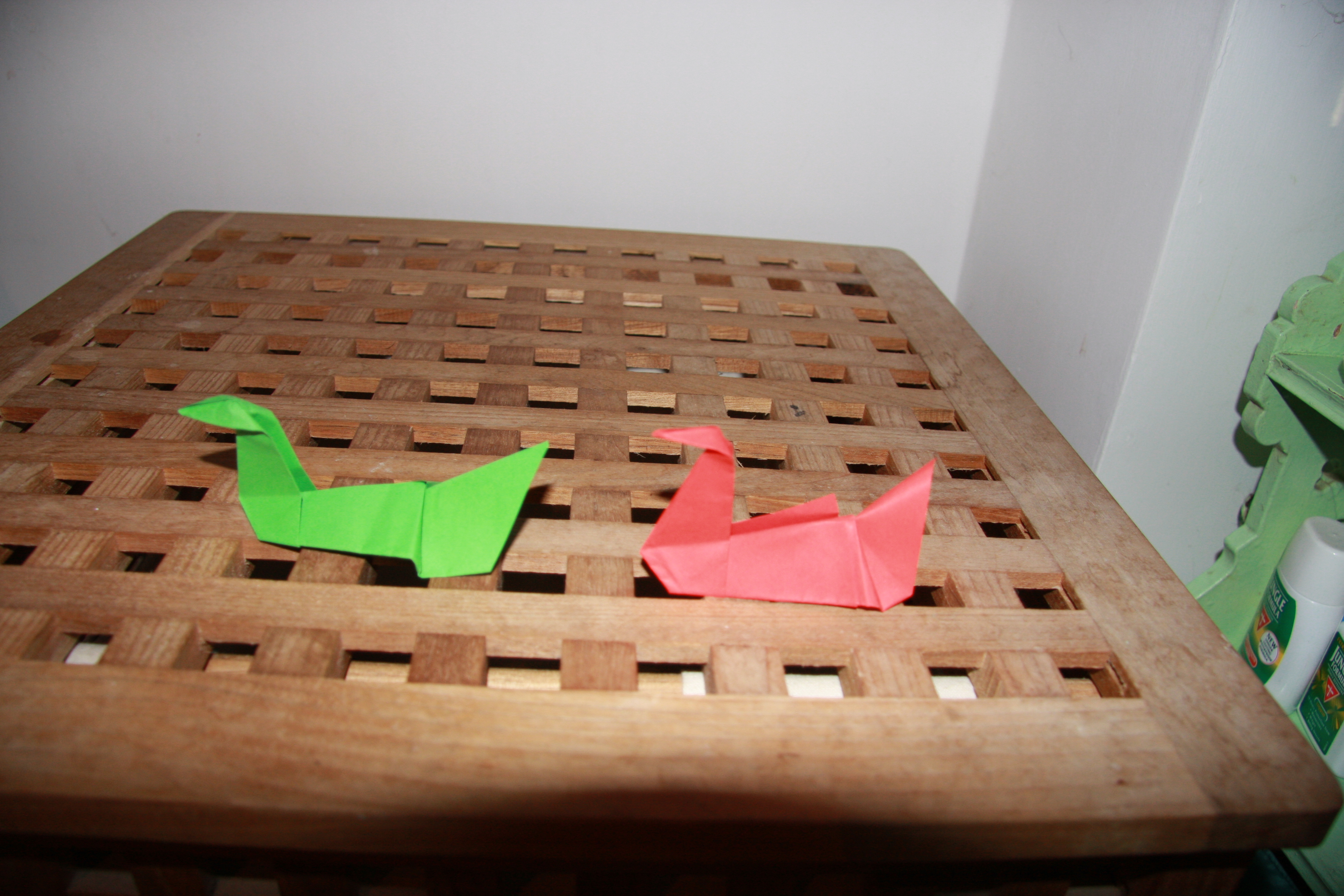
                      The pictue here shows some simple ducks that have been made out of small and larger paper squares.


So I started to create the next basic duck and found that at the stage where I was to make the first fold to create the ducks neck that I had folded it in the wrong direction which meant that when I tried to fold the neck it tried to develop in the wrong way. I managed to find where I went wrong by comparing a successfull model with the one I was having problems with. I also used the pictures to compare the folds and saw my error. Once idnetified the error was very easily corrected. I created an almost perfect basic duck. I then went through the diagrams and suddenly saw correctly how the folds should go and how it all fell into place. I put this all down to the time I spent making sure I understood the symbols and could relate the diagrams to the actual folds.

I found that after all of the initial hassles that I was able to create a complex duck. The first one had a slightly wonky tale but was a much better effort than any I had previously done.

After I made another with the larger paper and it was almost perfect. I then tried with a smaller piece of paper and was really happy with the results. In order to reinforce the process I made several large and small complex ducks and was pretty pleased wit myself as a result.

small basic ducks


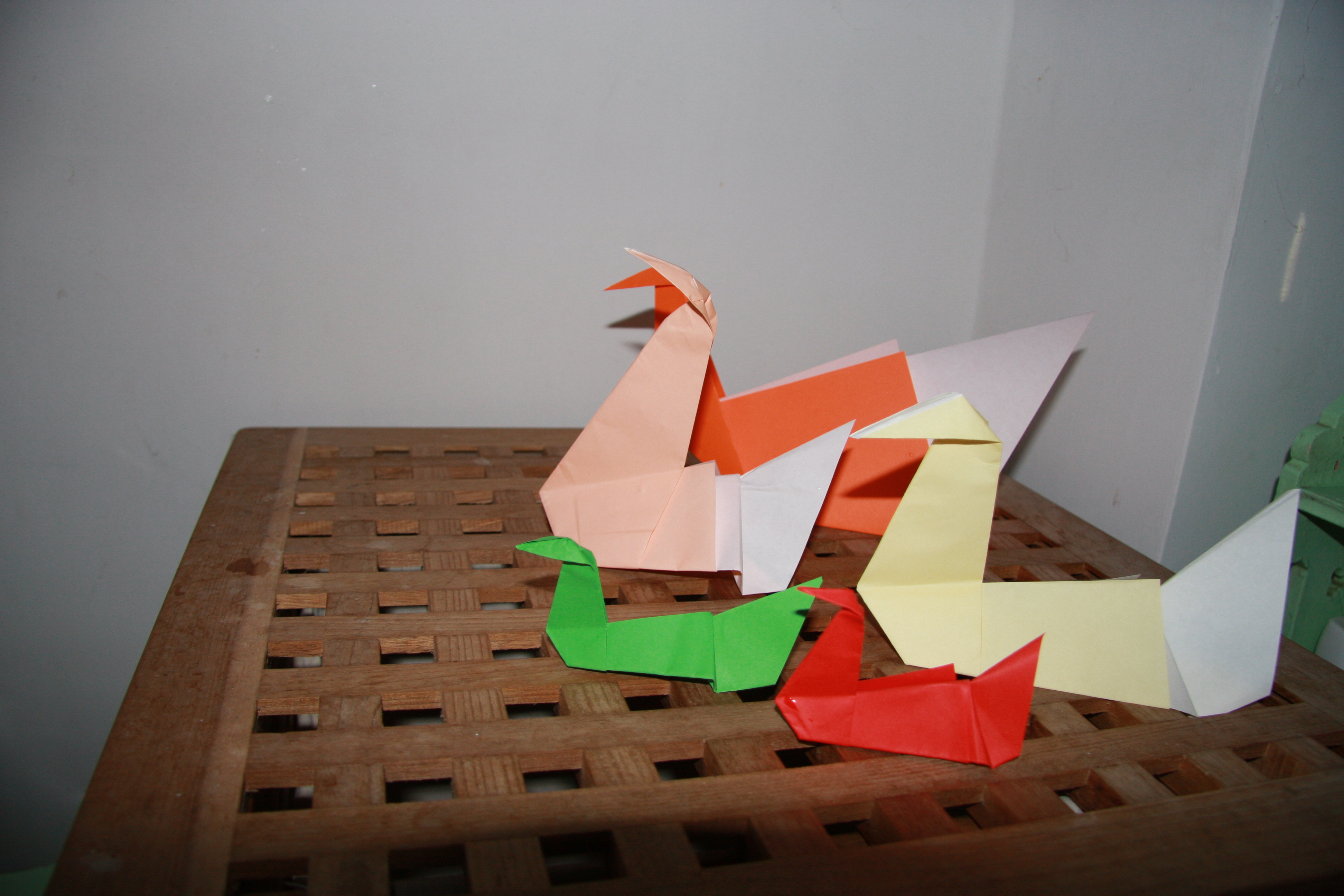
a mixture of small and large complex ducks.


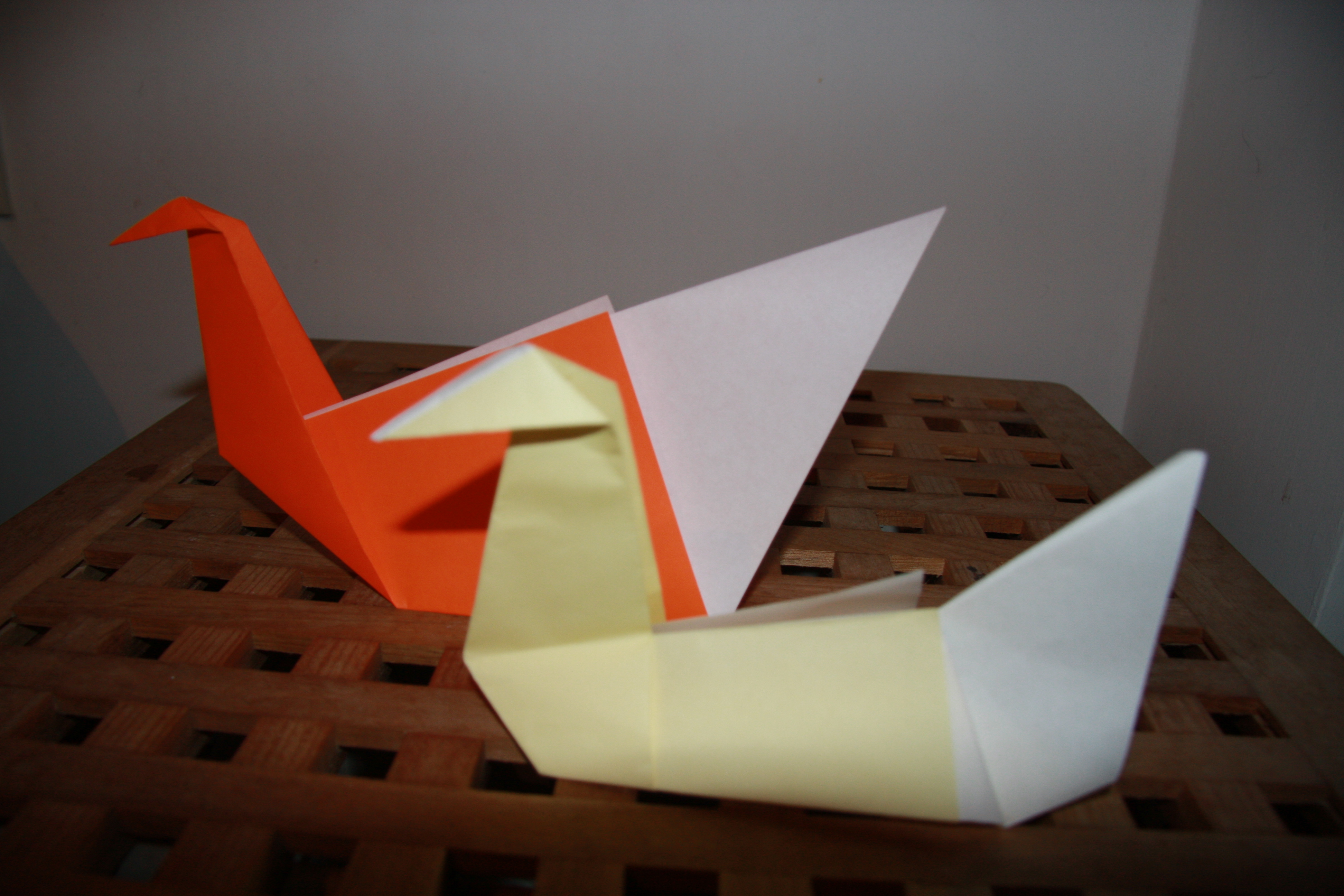
More detailed pictures 1) Large ducks of each type 

Small complex ducks in more detail 


Keywords: Origami

Posted by Nicholas Palmer | 0 comment(s)

October 07, 2009

Why on earth did I take up this challenge? I continued with the simple/complex duck. I made an attempt at the complex duck - a stage on from the simple duck and felt good. It wasn't quite right I seemed to be misunderstanding the final step. I then tried to do it again and found that I was struggling to complete a simple duckl. After four pieces of wasted paper I decided to give it a rest.


The positive that has come out of this is that I am feeling confident handling the paper to complete the kite base it feels as though I know what I am doing. It is very straightforward and to be honest I should be feeling confident by now as I have completed this stage a number of times. I am just hoping that I will be able to achieve more tomorrow.

Posted by Nicholas Palmer | 0 comment(s)

contemplating cyberculture, dystopia vs utopia and some of the arguments presented in the rading I can;t help but feel the need to ask  myself the question is it really possible to have evolve a cyberculture. I can't help but thin that whilst I sit at my computer posting inofrmation and files and blogs and working with a variety of programmes what am I really concerned about from a cultural persepcetive that is.  I can only think that what seems to be important is that I follow certain protocols and rules that would enable my informatio to reach its destination.

initially, I could not get into the filem festival videos , I didn't know what I was supposed to be looking for, and was not feeling anything, had no intuitin about what was actually going on. however it was not until the final two videos that it really struck me -even the blue fairy cannot work miracles. what are the miracles? making the boy feel and be human.

this seems to be the themes running through the videos. human senses , sadness, joy, shame..... etc cannot be felt by digital creations no matter how much music we attach to the videos

 music evokes feelings in us that can make us think these digital creatures are experiencing human emotions but surely we must fully appreciate that the creations cannot actually feel .

would we feel the same way viewing the videos wothout music....it is likely you might watch faces more closely looking for an expression which indicates an emotion. or you might look at the eyes - as with the cyberpunk. searching for a clue as to whats going on emotionally and make a judgement.as to what is going on.


Keywords: dystopia

Posted by lesley ferguson | 0 comment(s)

October 06, 2009

The origami has been forgotten for a few days. I decided to redo the simple duck using blue paper -I struggled to get there and had to discard two attempts before I succeeded. The more complex version is still alluding me and after an hour I decided it was time to do something else. As an aside I tried to make the simple duck with a smaller piece of paer and was unsuccesful. What was interesting is the paper was thicke and coarser in texture which and did not crease quite as easily as the larger squares.

Posted by Nicholas Palmer | 0 comment(s)

September 29, 2009


Well week 1 is over and we’re into week 2 and the first reflection is how I’ve failed to keep the planned blog, which I know will help me with the studying (I used one in my first module and not in the second and noticed the difference).   I could link this to work being really busy too but that’s just me making excuses so here’s an attempt at encapsulating the starting points for my thinking.

  • The way in which the course is structured to give us (as students) ownership of both content and direction of the course – and what this means we have to recognise as our responsibilities to ensure a successful programme
    • And to a lesser extent the tutor’s role in supporting/facilitating this work
  • The way in which technology is portrayed in films and books and how this might influence the way in which we perceive it in reality
    • Do we see truths in the films or do we question and disagree with them?
    • What are the implications of films portraying the negative/challenging sides of the relationship between humans and technology?
  • Why we chose to adopt particular technologies
    • What of our choice is linked to design?
    • How are we influenced by our peers?
    • How is Apple influencing the spectrum of early adopters? How do their design choices represent a consideration of the market?
  • The way in which our use of social media develops
    • Rise and fall of facebook
    • Does the use of social software ebb and flow – and if so what’s causing the tide to change? Is it all just linked to popularity and fashion or is there something more fundamentally linked to function?

Keywords: design, pscel09, questions, socialmedia

Posted by Emma King | 0 comment(s)

September 28, 2009

I worked through the introduction and this took me to a section that explained the symbols used in the book for the various folds and moves. I was able to understand this reasonably well until I came across the inside and outside crimp. Still I was reasonably confident and decided to have a go with my current knowledge.


The tips were very useful and one was to use larger  pieces of paper to start with. I have two sizes of paper nine and three quarter inches sq which is coloured oneside and white  the other and  five inches sq (came with the book) coloured bothsides.

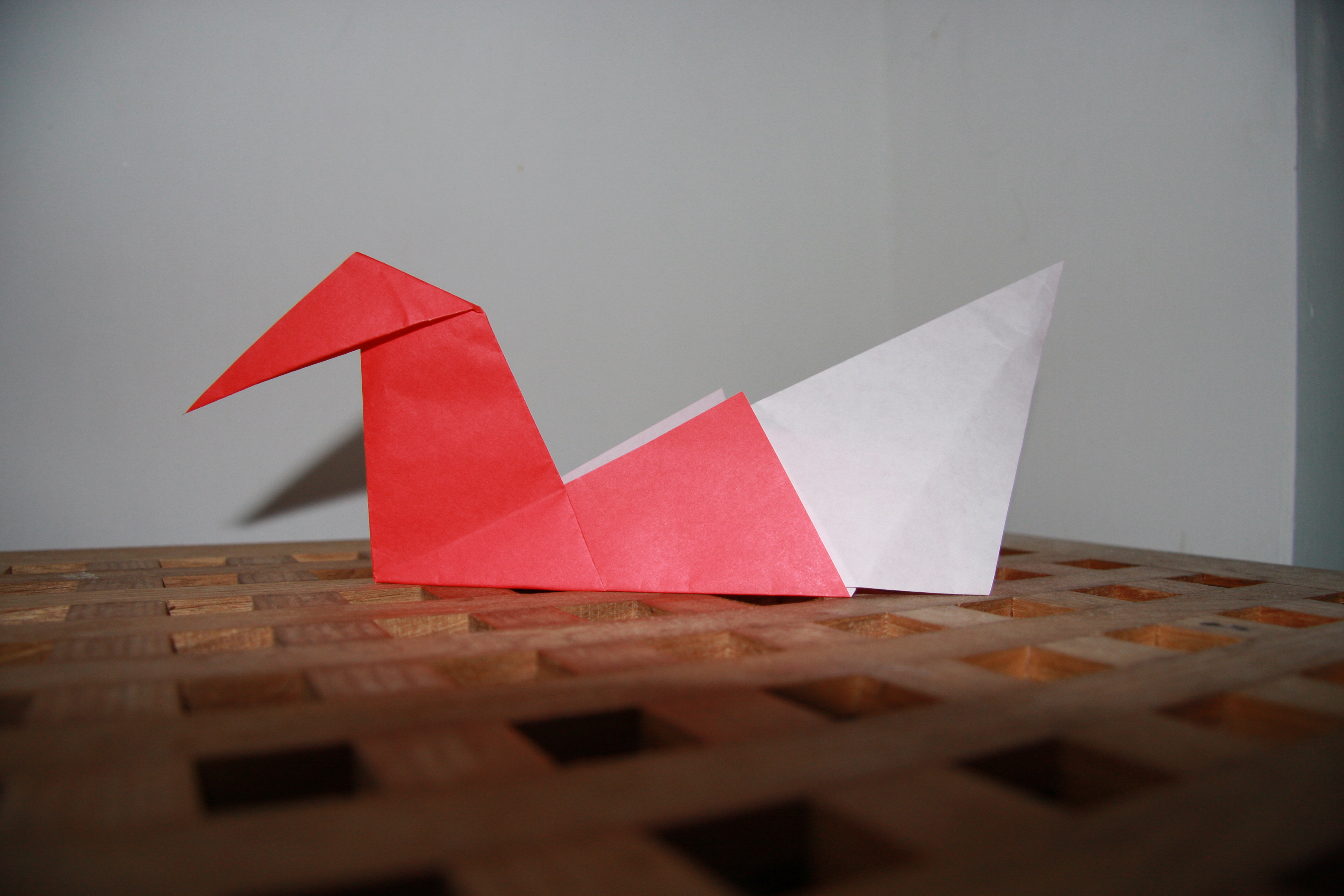
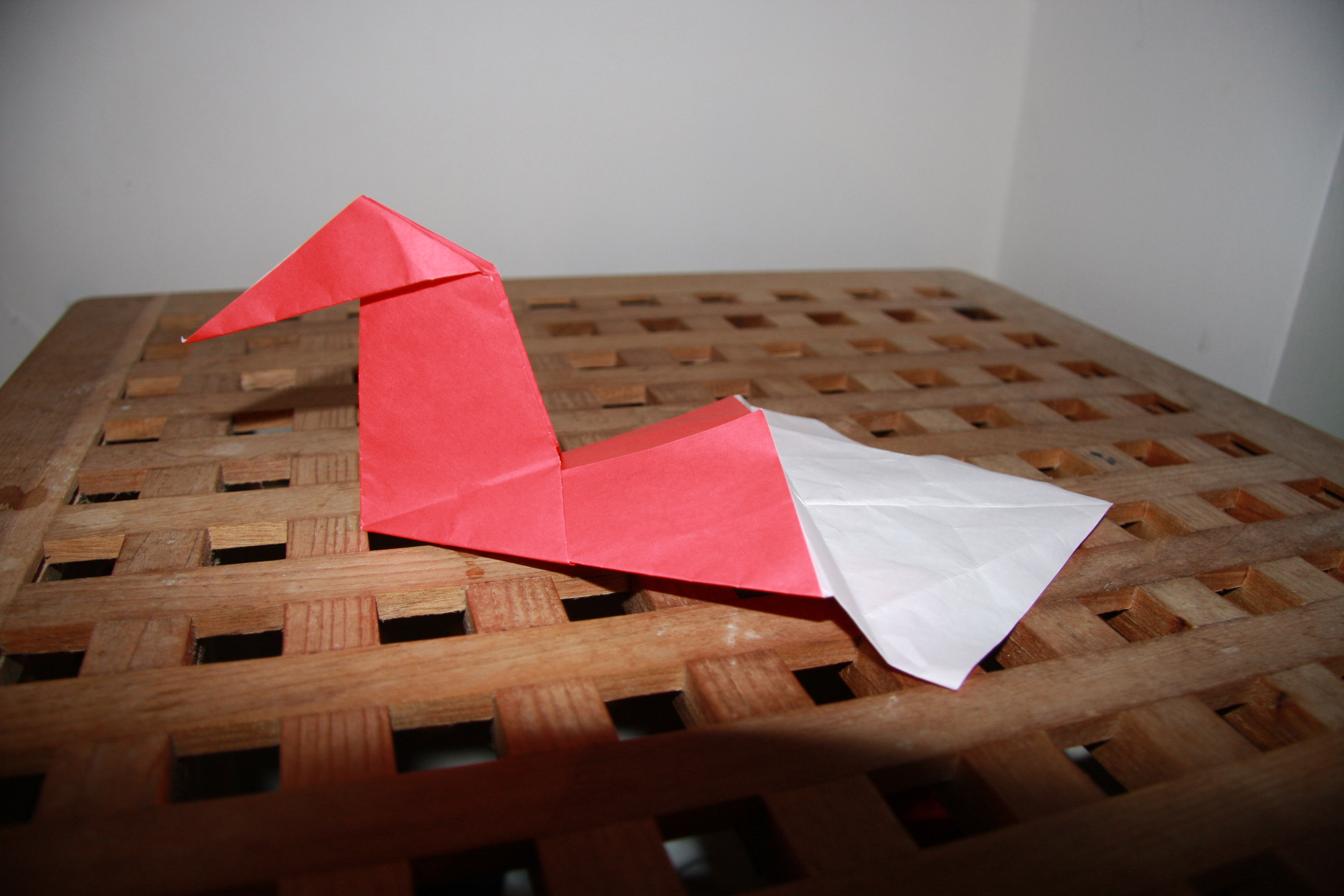
THe first thing I did was to create a kite base with the larger paper using a red piece first. After the base had been created I produced the simple duck. I struggled wioth the diagram a little but perseverance paid off and I took some photographs of the model (model taken from Origami Kit  for Dummies). I then tried to create the more complex duck and this is where I was unable to fully understand the diagram at this point. After struggling for ten minutes I had a break. The overall session lasted 30 to 45 minutes and was partially successful.

The paper became vey crumpled with my efforts and I was left with a duck with a flat body, so it is time to try again.

First attempt Duck 1

Collapsed attempt Duck 2

Posted by Nicholas Palmer | 0 comment(s)

I am currently studying for an MSc in e-learning at Edinburgh University. I am on my fourth module which is understanding learning in digital environments. One of the assignments is a learning challenge and this blog will outline my experiences, thoughts and feelings whilst performing the learning challenge. I am going to learn how to create origami paper models. My previous attempts have got little further than paper darts or paper planesI tend to be all fingers and thumbs with these types of exercise.

I have chosen to learn how to make Origami figures for this challenge. Ther initial aim is to create a dragonfly (medium difficulty) and a beetle (challenging). I have decided to learn by 1) Working through the Origami Kit for Dummies by Nick Robinson - published John Wiley 2008. 2) websites and 3) videos from sites such as you tube.

The book is broken into three main sections

Introduction

Part 1 Coming to the crease: Basic Techniques

Part 2 Folding on: The Models

Part three: The part of Tens

I first looked atpart three which consists of three chapters 1) Ten Top Tips 2) Ten Origami Styles and 3) Ten Incredible folders ( a summary biog for ten famous Origamists)

It gave me a feel for the subject and those who excel at it. This also points the way to a number of websites which I have not looked at yet.

Lets get on with the folding!!!

Posted by Nicholas Palmer | 0 comment(s)

<< Back Next >>