Log on:
Powered by Elgg

Blog :: All

You can filter this page to certain types of posts:

Filtered: Showing posts with no comments (Remove filter)

October 27, 2011

You may have heard that John McCarthy died this week. See 

John was an early pioneer of AI, inventor of Lisp, and indeed originator of the term "AI" in 1956. See http://en.wikipedia.org/wiki/John_McCarthy_(computer_scientist). It is good to see how broad and expansive John McCarthy's vision for computing was:

From Wikipedia: In 1961, he was the first to publicly suggest (in a speech given to celebrate MIT's centennial) that computer time-sharing technology might lead to a future in which computing power and even specific applications could be sold through the utility business model (like water or electricity).

Take a look also at his short sci-fi story "The Robot and the Baby" for some great fiction (or is it?) about future robotics. See

I worked with John both before and after his formal retirement, and it was a very enjoyable experience. His interest in formalising the notion of "context" was his most recent work which I spoke to him about. The ability to "assert that the proposition p is true in the context c" is a key to much of what we do in planning... and my own work some 30 years ago was involved with something I called "functions in context" that had similar aims.

Keywords: Context, IDEL11, McCarthy, ULOE11

Posted by Austin Tate | 0 comment(s)

October 26, 2011

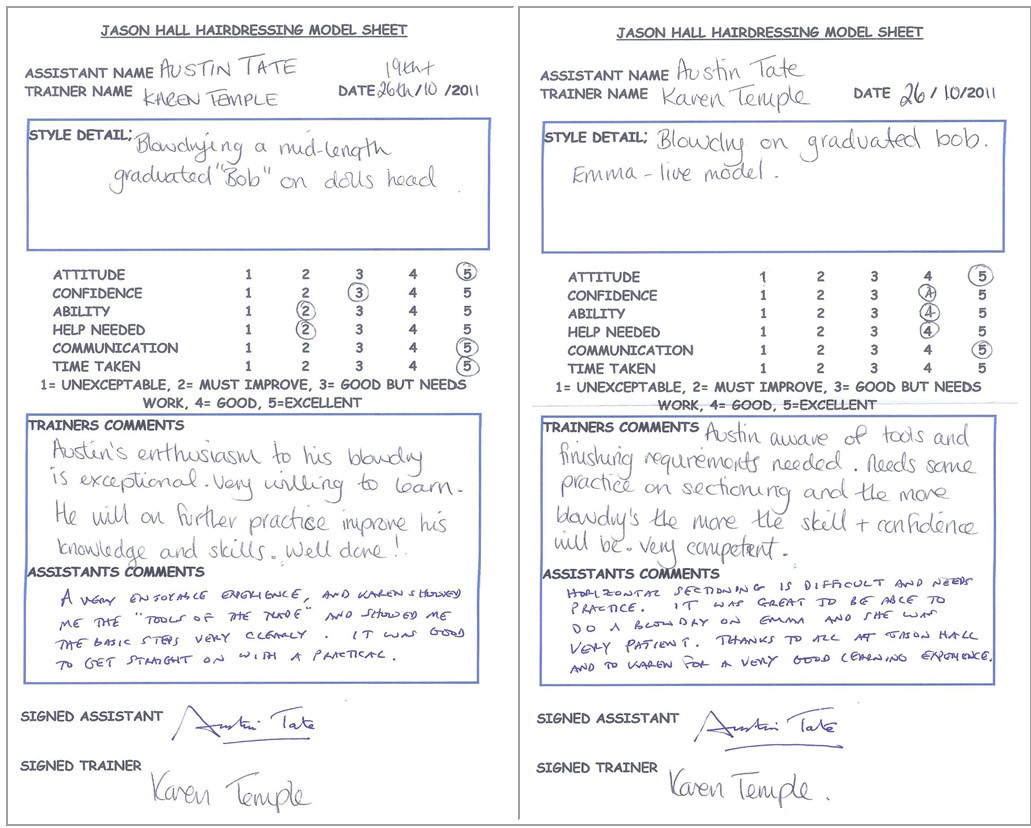
Here is my assessment as a trainee hairdresser on blow drying... from the first go to my final attempt on a live model today.

Keywords: Hairdresser, ULOE11

Posted by Austin Tate | 0 comment(s)

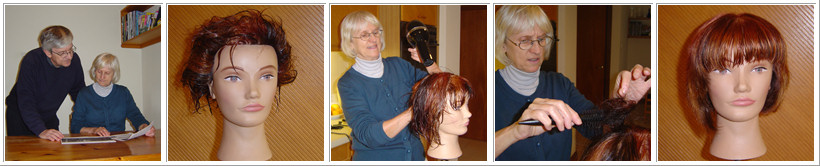
Emma very patiently let me do her hair today during my training session:

I now have access to the Hairdressing Foundations e-Teaching course at http://eteachhairdressing.co.uk along with some exercises to complete there.  I have also been given Hairdressing Trainee Model Sheets showing my experience and an assessment of my progress.  They will appear in my Hairdresser Training Photo Log at http://atate.org/mscel/hair/ and are available via a link on my new Personal Learning Space at http://atate.org/space/

Keywords: Hairdresser, ULOE11

Posted by Austin Tate | 0 comment(s)

October 25, 2011

For a full photo diary and report on my ULOE11 Learning Challenge see http://atate.org/mscel/hair/

Keywords: Hairdresser, ULOE11

Posted by Austin Tate | 0 comment(s)

October 24, 2011

After a small change in a login method made by Edmund Edgar, one of the SLoodle developers, to one file at mod/set-1.0/shared_media/index.php the 2.0.10-alpha release of SLoodle works in the SLoodle classroom on the VCE region in Second Life connected to Moodle 2.1.2.

This change will be in the next build.The experimental classroom is at http://maps.secondlife.com/secondlife/VCE/223/226/23

Posted by Austin Tate | 0 comment(s)

October 23, 2011

I have been in contact with the SLoodle development and test community in the last few week, as they are preparing a release that can work with the latest Moodle 2.1+.  The time now seems right to try the alpha code version they have prepared, and after a brief exchange this week updated to 2.0.10 alpha.  This could be near to being set as the first Moodle 2.0+ and 2.1+ SLoodle release. Previous versions only worked with the older Moodle 1.9+ reelases.

I have also been in touch with the SLoodle web site folks to point make suggestions on improving the descriptions of how to obtain and build a SLoodle setup.  These changes were made to http://sloodle.org on 23-Oct-2011.

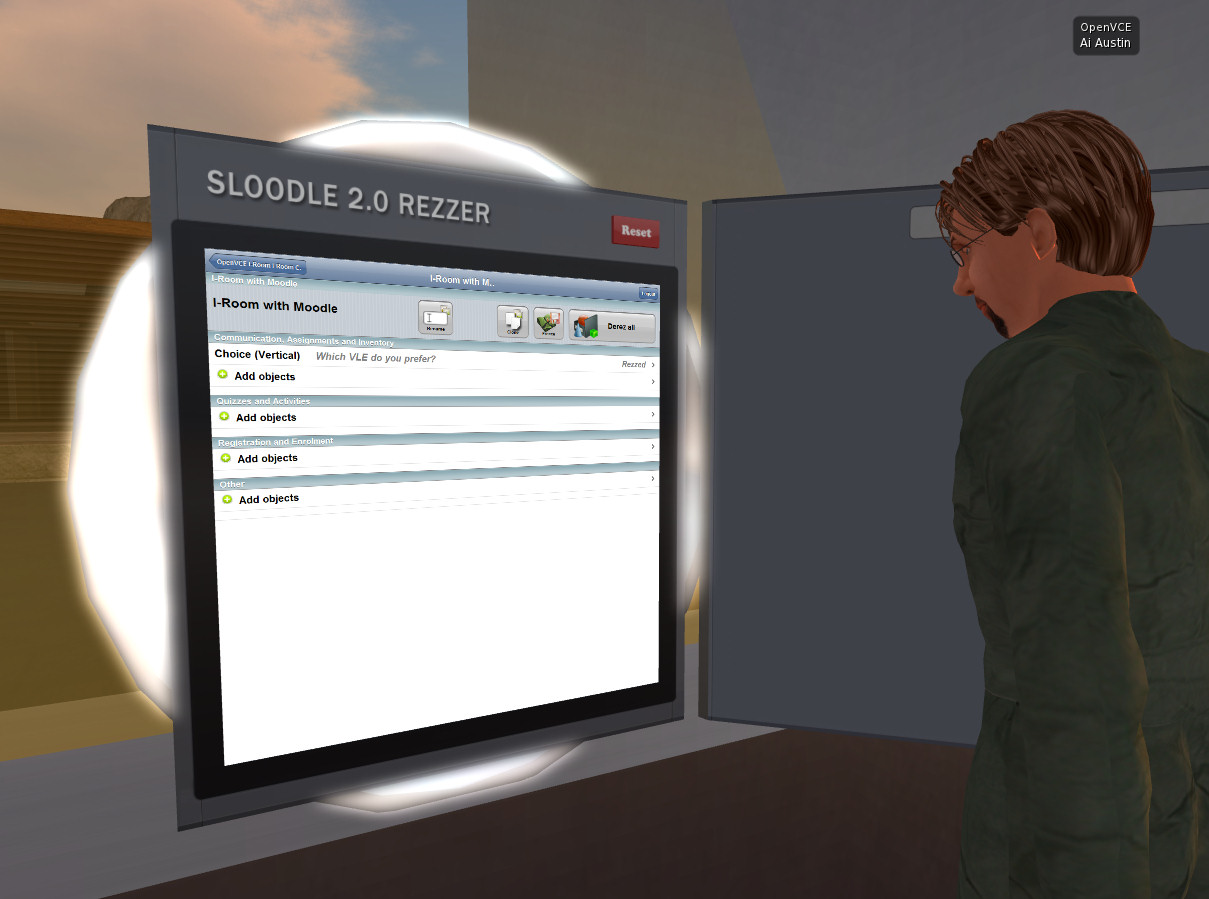
I now have the 2.0.10 alpha Moodle modules zip distribution and in world SLoodle rezzer object from the "Fragile" systems dispenser in Second Life on the Chilbo region:

So, these are ready to start testing a SLoodle classroom in Second Life with our Moodle 2.1.2 setup. I have made notes and given links to assist people intererested in Moodle and SLoodle at http://openvce.net/sloodle

Addendum: Cron job now set to run every 5 minutes to handle messaging and other matters.  Set up as scheduled task on the server.  See http://docs.moodle.org/20/en/Cron

Posted by Austin Tate | 0 comment(s)

October 22, 2011

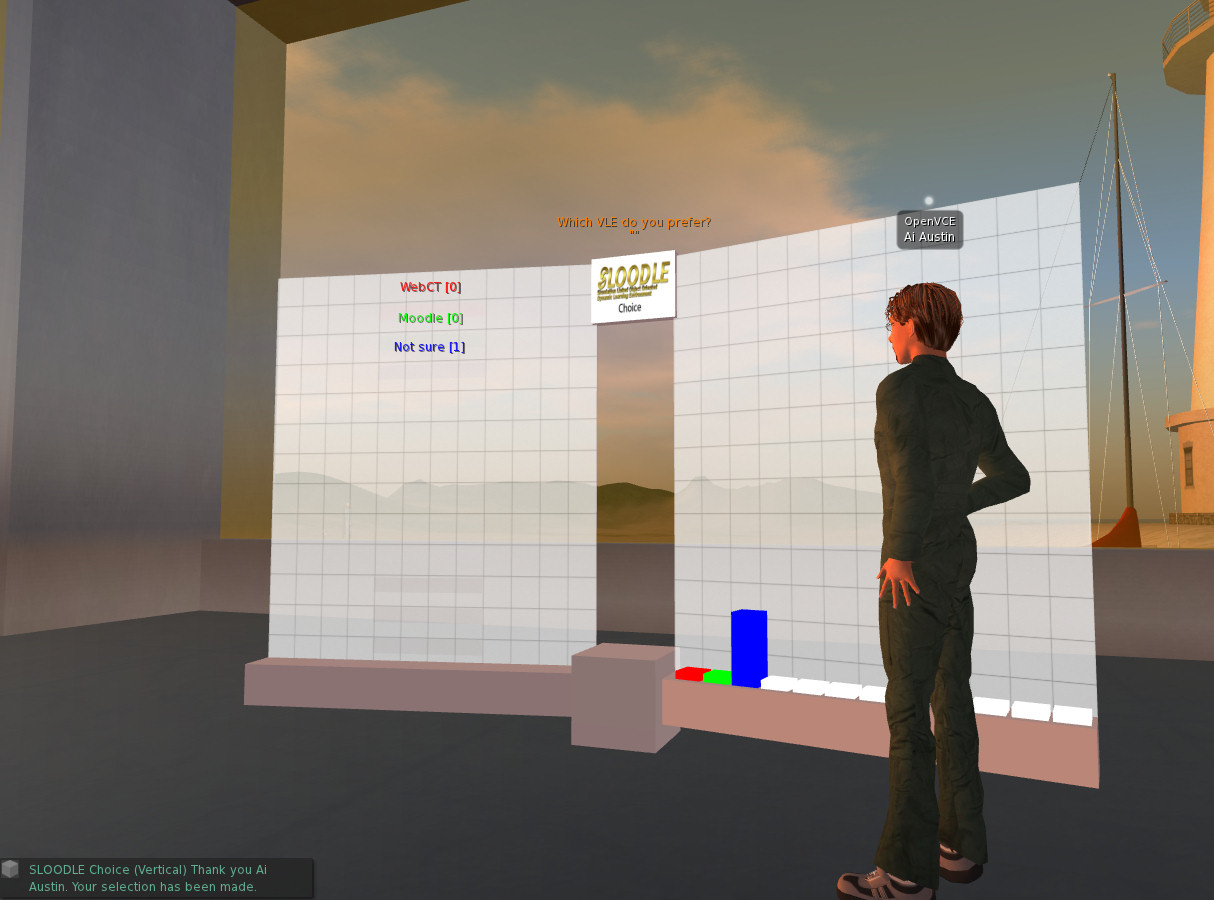
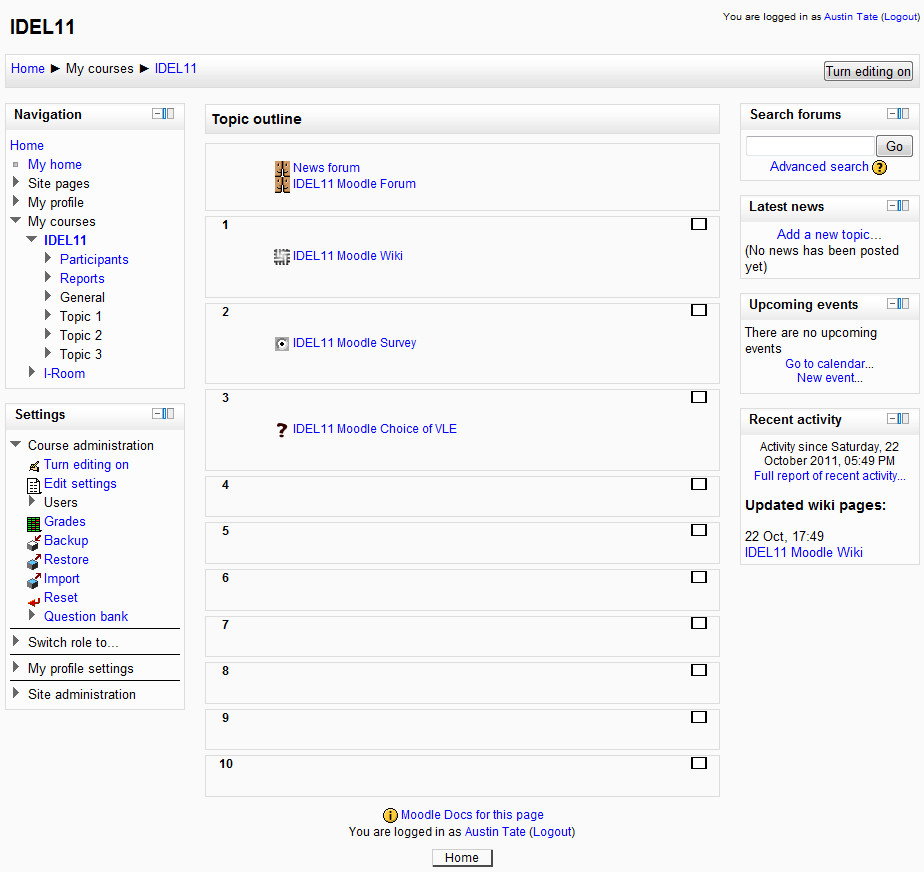
I have now used the admin account to set my self with a role of "course creator".  Logging back on as myself I had the extra site administration menu to create a course.  The setup was pretty easy and I set up a sample "IDEL11 Moodle" course... adding in a few initial "blocks" for a course collaborative Wiki (choosing simple visual NWiki editing style), a survey element, and a simple radio button style quiz showing everyone the answers to date before and after the vote.

The site uses the latest stable Moodle 2.1.1.  It is not set up to scale or be properly managed so we will just add students manually for our testing. But after I get some of the basics I would be happy to let anyone on the IDEL11 course join a sample "IDEL11 Moodle" course as a student if they want to look round or have not used Moodle before.

When I have things working reasonably, I would be happy to manually add users accounts with role "Student" for other IDEL11 participants who wish to explore Moodle a little.

Posted by Austin Tate | 0 comment(s)

To add to some of the history of MUD/MOO/MUVEs given by Warburton (2009), I will add here an information panel from one of my papers in IEEE Intelligent Systems (Tate et al., 2010) as it shows the history is not rooted only in game interests.

Tate, A., Chen-Burger, Y-H., Dalton, J., Potter, S., Richardson, D., Stader, J., Wickler, G., Bankier, I., Walton, C. and Williams, P.G. (2010) I-Room: A Virtual Space for Intelligent Interaction, IEEE Intelligent Systems, Vol. 25, No. 4, pp 62-71, July-August 2010, IEEE Computer Society.
http://www.aiai.ed.ac.uk/project/ix/documents/2010/2010-ieee-is-tate-iroom-as-published.pdf

A Brief History of Virtual Collaboration

While strongly influenced in recent years by advances in computer game technology, the origins of virtual worlds and their social networking aspects can be traced to research into multi-user persistent spaces that began in the late 1970s and explored object sharing and chat for collaborative systems, especially in the field of artificial intelligence. Adding object oriented programming to script or control the objects in the shared space expanded the possibilities. Dating from 1990, LambdaMOO (http://en.wikipedia.org/wiki/LambdaMOO) is one well known example of this type of multiuser, object-oriented virtual space.

Work in this area has continued, with the environments now being used alongside teleconferencing, videoconferencing, and instant messaging with agent presence and status information. A good example is the Collaborative Virtual Workspace (http://cvw.sourceforge.net/), originally built by MITRE between 1994 and 1999, that used a buildings-and-rooms metaphor for persistent storage of the documents and shared assets used in collaborations. Many videoconference support systems use the idea of setting up a virtual workspace "room" to give context to a particular presentation or meeting.

The foundations of the I-Room project, within the context of the wider I-X Research Program, lie in extensions to this idea to make use of intelligent planning and collaboration aids alongside CVW. These represent just a handful of the proposals that have appeared over the last decade that describe a room for intelligent team-based interaction or a room that could itself act as a knowledge-based asset for a group. Some of these concepts were explored in the Collaborative Advanced Knowledge Technologies in the Grid (CoAKTinG) project.

References
  • R.A. Bartle, “Early MUD History,”1990; http://www.mud.co.uk/richard/mudhist.htm
  • S. Buckingham Shum et al., “CoAKTinG: Collaborative Advanced Knowledge Technologies in the Grid,” Proc. 2nd Workshop Advanced Collaborative Environments, Advanced Knowledge Technologies (AKT), 2002; http://www.aktors.org/coakting/
  • Warbuton, S. (2009). Second Life in higher education" Assessing the potential for and the barriers to deploying virtual worlds in learning and teaching. British Journal of Educational Technology, 40(3), 414-426.

I very much like the persistence aspect of Second Life/OpenSim and other virtual worlds meeting spaces/classrooms/operations centres. I don't think this is captured at all by teleconference and video teleconferencing systems on their own, and even Adobe Connect with its resources, chat room and app sharing, etc. Though some systems like Mitre's CVW did set up the rooms/buildings metaphor for that persistence of shared resources while layering video teleconferencing on top. CVW was used heavily by the US military for their distributed ops centres teleconferening. It also included IMPs.

So, to add to this note, I would specifically draw your attention to the Mitre CVW idea of IMPs (Intelligent Multimodal Participants) that could reside in CVW functional "rooms" to monitor activity, give assistance in the room, or relay information to users whose attention was elsewhere.

Reference:

Michael Krutsch  (1999) "IMPs Enhance Virtual Collaboration Enmvironments", The Edge, Mitre Corporation, Intelligent Human-Computer Interface, December 1999, Volume 3 Number 4.

http://www.mitre.org/news/the_edge/december_99/fourth.html

Keywords: IDEL11

Posted by Austin Tate | 0 comment(s)

I believe that in future students when they first join a good educational institution should be given access to an e-mail address or equivalent, individual blog and a resources space which they can use for life. It will support them while a student, and later in their professional lives and into retirement.  It will allow for alumni and continuing educational engagement. But it will be primarily centred on being a service and benefit to the individual, not as a marketing mechanism for the hosting institution. It must be secure and not allowed to be sold to some external hosting company for data mining. It must use open standards and allow for ease of movement across to a new institution in whole or in part.  It should allow the user to create and store assets they can use via a single stable URL or URI for life... images, documents, assignments, artifacts or various kinds. And reliably embed them in

The current mode of using proprietary products that lack standards, and are poor at import and export, militates against this.

Keywords: IDEL11

Posted by Austin Tate | 0 comment(s)

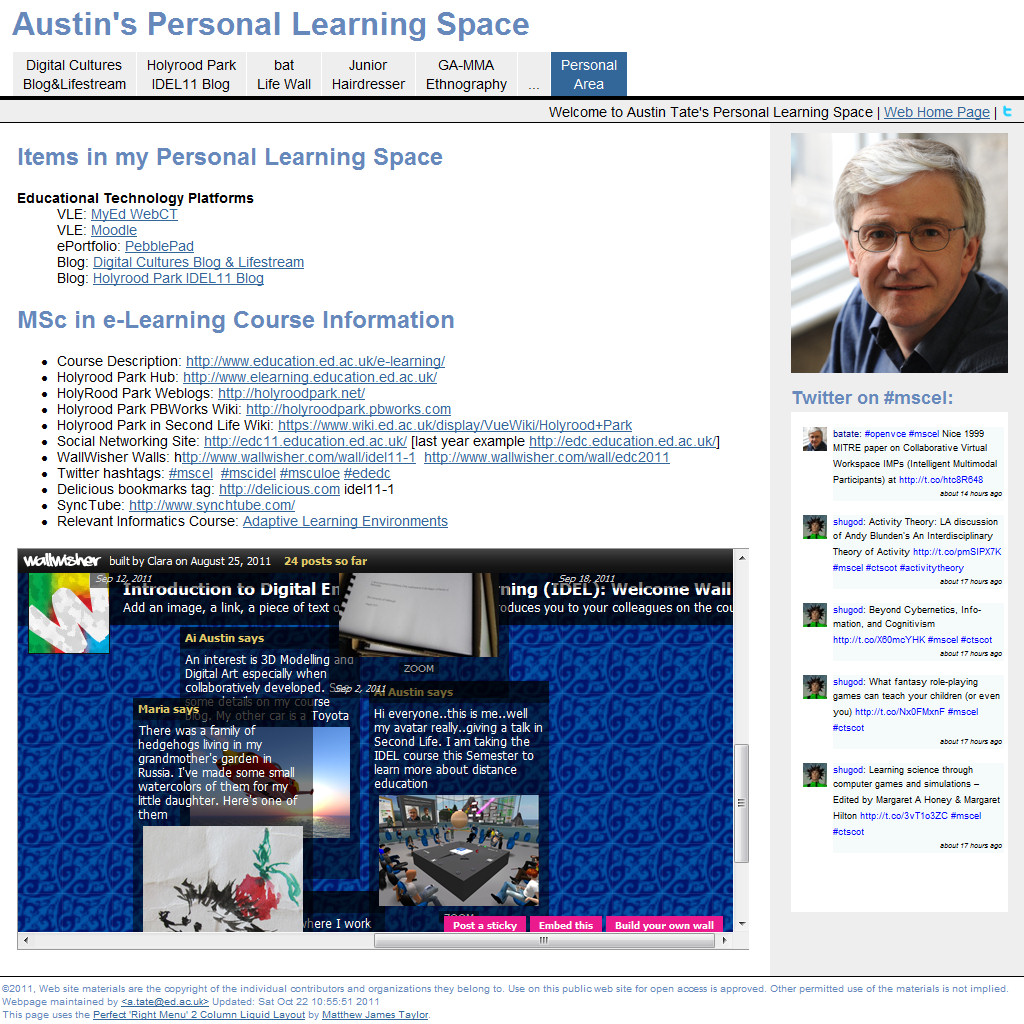
I have begun to create my Personal Learning Space... for which I prefer a flexible web site in an area that can outlive specific technologies and institutional changes. If I invest time in creating things like this I want to feel they can be preserved for use in future. Using proprietary products frustrates me as I know they will be lost or become unavailable sooner rather than later usually. The space uses a new (to me) flexible width flowing layout in CSS that should be useful in future projects. I have been meaning to try such a layout for a while, and this was the perfect excuse. It should work on most browsers and mobile platforms.  Tests to date are positive in that respect. The site uses my usually folder structure to keep things neat, with all style elements in one directory (inc), images in another (img), further resources (res), and a password protected area for items that cannot be made public, but which I want to gather into  the space for convenience. The site also uses, as is normal for my projects, relative URLs throughout so it can be rehosted easily, parts reused in other projects, or the whole site cut to a DVD/CD for archive.

For now the Personal Learning Space just gives quick access tabs to work already done on the MSc in e-Learning, a few blocks of embedded Twitter and the WallWisher for the IDEL11 course, and some useful links for the courses I am on which I previously had scattered across http://openvce.net/mscel and in desktop shortcuts across a number of desktops, a laptop and several mobile devices. The initial space is at http://atate.org/space/.

Keywords: IDEL11

Posted by Austin Tate | 0 comment(s)

<< Back Next >>