Log on:
Powered by Elgg

Blog :: All

You can filter this page to certain types of posts:

October 22, 2011

To add to some of the history of MUD/MOO/MUVEs given by Warburton (2009), I will add here an information panel from one of my papers in IEEE Intelligent Systems (Tate et al., 2010) as it shows the history is not rooted only in game interests.

Tate, A., Chen-Burger, Y-H., Dalton, J., Potter, S., Richardson, D., Stader, J., Wickler, G., Bankier, I., Walton, C. and Williams, P.G. (2010) I-Room: A Virtual Space for Intelligent Interaction, IEEE Intelligent Systems, Vol. 25, No. 4, pp 62-71, July-August 2010, IEEE Computer Society.
http://www.aiai.ed.ac.uk/project/ix/documents/2010/2010-ieee-is-tate-iroom-as-published.pdf

A Brief History of Virtual Collaboration

While strongly influenced in recent years by advances in computer game technology, the origins of virtual worlds and their social networking aspects can be traced to research into multi-user persistent spaces that began in the late 1970s and explored object sharing and chat for collaborative systems, especially in the field of artificial intelligence. Adding object oriented programming to script or control the objects in the shared space expanded the possibilities. Dating from 1990, LambdaMOO (http://en.wikipedia.org/wiki/LambdaMOO) is one well known example of this type of multiuser, object-oriented virtual space.

Work in this area has continued, with the environments now being used alongside teleconferencing, videoconferencing, and instant messaging with agent presence and status information. A good example is the Collaborative Virtual Workspace (http://cvw.sourceforge.net/), originally built by MITRE between 1994 and 1999, that used a buildings-and-rooms metaphor for persistent storage of the documents and shared assets used in collaborations. Many videoconference support systems use the idea of setting up a virtual workspace "room" to give context to a particular presentation or meeting.

The foundations of the I-Room project, within the context of the wider I-X Research Program, lie in extensions to this idea to make use of intelligent planning and collaboration aids alongside CVW. These represent just a handful of the proposals that have appeared over the last decade that describe a room for intelligent team-based interaction or a room that could itself act as a knowledge-based asset for a group. Some of these concepts were explored in the Collaborative Advanced Knowledge Technologies in the Grid (CoAKTinG) project.

References
  • R.A. Bartle, “Early MUD History,”1990; http://www.mud.co.uk/richard/mudhist.htm
  • S. Buckingham Shum et al., “CoAKTinG: Collaborative Advanced Knowledge Technologies in the Grid,” Proc. 2nd Workshop Advanced Collaborative Environments, Advanced Knowledge Technologies (AKT), 2002; http://www.aktors.org/coakting/
  • Warbuton, S. (2009). Second Life in higher education" Assessing the potential for and the barriers to deploying virtual worlds in learning and teaching. British Journal of Educational Technology, 40(3), 414-426.

I very much like the persistence aspect of Second Life/OpenSim and other virtual worlds meeting spaces/classrooms/operations centres. I don't think this is captured at all by teleconference and video teleconferencing systems on their own, and even Adobe Connect with its resources, chat room and app sharing, etc. Though some systems like Mitre's CVW did set up the rooms/buildings metaphor for that persistence of shared resources while layering video teleconferencing on top. CVW was used heavily by the US military for their distributed ops centres teleconferening. It also included IMPs.

So, to add to this note, I would specifically draw your attention to the Mitre CVW idea of IMPs (Intelligent Multimodal Participants) that could reside in CVW functional "rooms" to monitor activity, give assistance in the room, or relay information to users whose attention was elsewhere.

Reference:

Michael Krutsch  (1999) "IMPs Enhance Virtual Collaboration Enmvironments", The Edge, Mitre Corporation, Intelligent Human-Computer Interface, December 1999, Volume 3 Number 4.

http://www.mitre.org/news/the_edge/december_99/fourth.html

Keywords: IDEL11
Posted by Austin Tate | 0 comment(s)

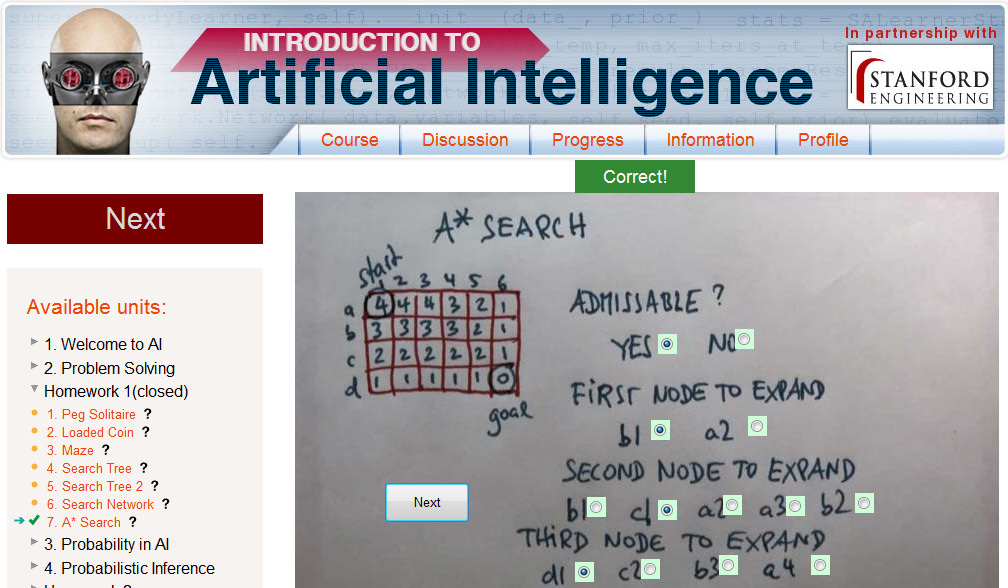
I am enrolled on the on-line Stanford AI Class... http://ai-class.com - along with 150,000 others - to watch how they present and deliver the "Introduction to AI" course, to see how the on-line assessment and quizzes work, and to see how student interaction with tutors and each other is arranged.  Its been an interesting experience so far. Everyone seems to be enjoying the course and the community.  The short video segments for each lecture are broken up with quizzes to check understanding as you go along.  Often with check boxes and type in areas overlaid with the video material itself.


Keywords: AI, IDEL11, Stanford

Posted by Austin Tate | 2 comment(s)

I believe that in future students when they first join a good educational institution should be given access to an e-mail address or equivalent, individual blog and a resources space which they can use for life. It will support them while a student, and later in their professional lives and into retirement.  It will allow for alumni and continuing educational engagement. But it will be primarily centred on being a service and benefit to the individual, not as a marketing mechanism for the hosting institution. It must be secure and not allowed to be sold to some external hosting company for data mining. It must use open standards and allow for ease of movement across to a new institution in whole or in part.  It should allow the user to create and store assets they can use via a single stable URL or URI for life... images, documents, assignments, artifacts or various kinds. And reliably embed them in

The current mode of using proprietary products that lack standards, and are poor at import and export, militates against this.

Keywords: IDEL11

Posted by Austin Tate | 0 comment(s)

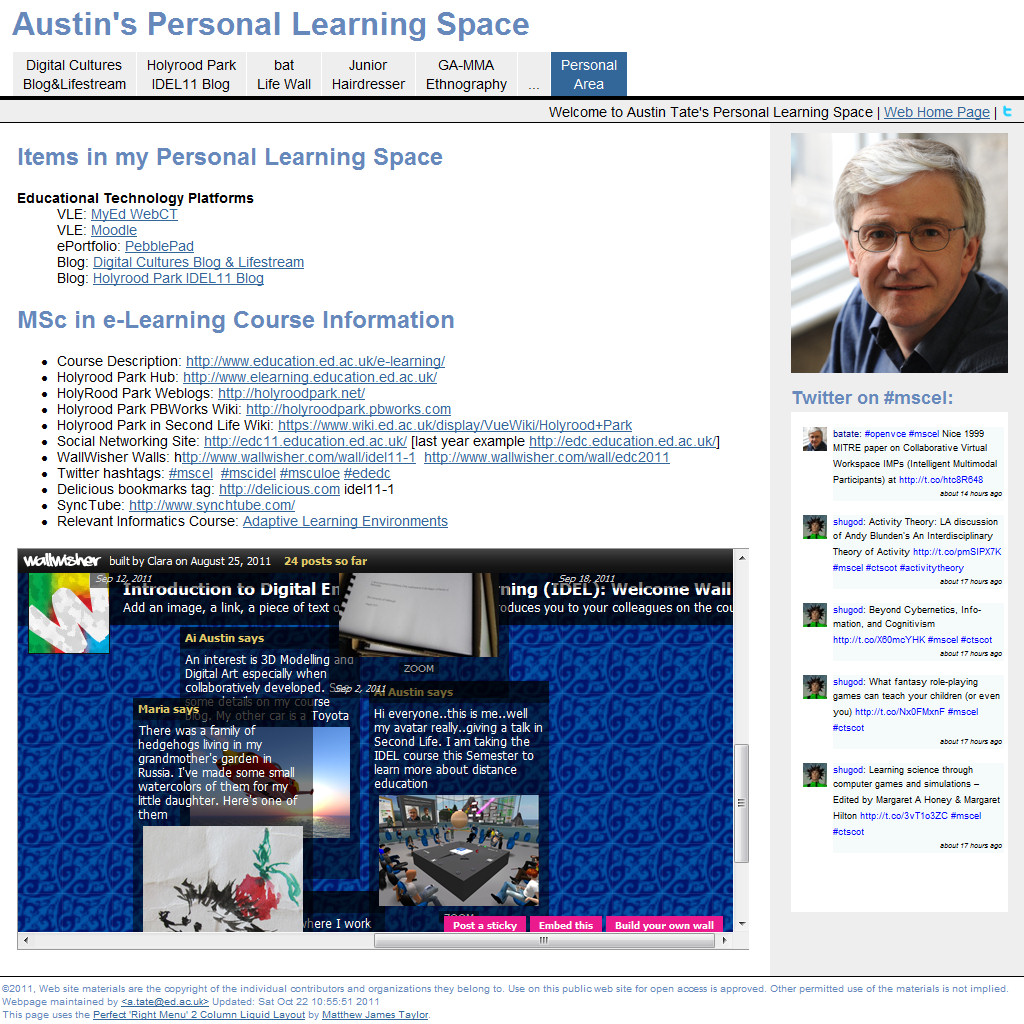
I have begun to create my Personal Learning Space... for which I prefer a flexible web site in an area that can outlive specific technologies and institutional changes. If I invest time in creating things like this I want to feel they can be preserved for use in future. Using proprietary products frustrates me as I know they will be lost or become unavailable sooner rather than later usually. The space uses a new (to me) flexible width flowing layout in CSS that should be useful in future projects. I have been meaning to try such a layout for a while, and this was the perfect excuse. It should work on most browsers and mobile platforms.  Tests to date are positive in that respect. The site uses my usually folder structure to keep things neat, with all style elements in one directory (inc), images in another (img), further resources (res), and a password protected area for items that cannot be made public, but which I want to gather into  the space for convenience. The site also uses, as is normal for my projects, relative URLs throughout so it can be rehosted easily, parts reused in other projects, or the whole site cut to a DVD/CD for archive.

For now the Personal Learning Space just gives quick access tabs to work already done on the MSc in e-Learning, a few blocks of embedded Twitter and the WallWisher for the IDEL11 course, and some useful links for the courses I am on which I previously had scattered across http://openvce.net/mscel and in desktop shortcuts across a number of desktops, a laptop and several mobile devices. The initial space is at http://atate.org/space/.

Keywords: IDEL11

Posted by Austin Tate | 0 comment(s)

October 21, 2011

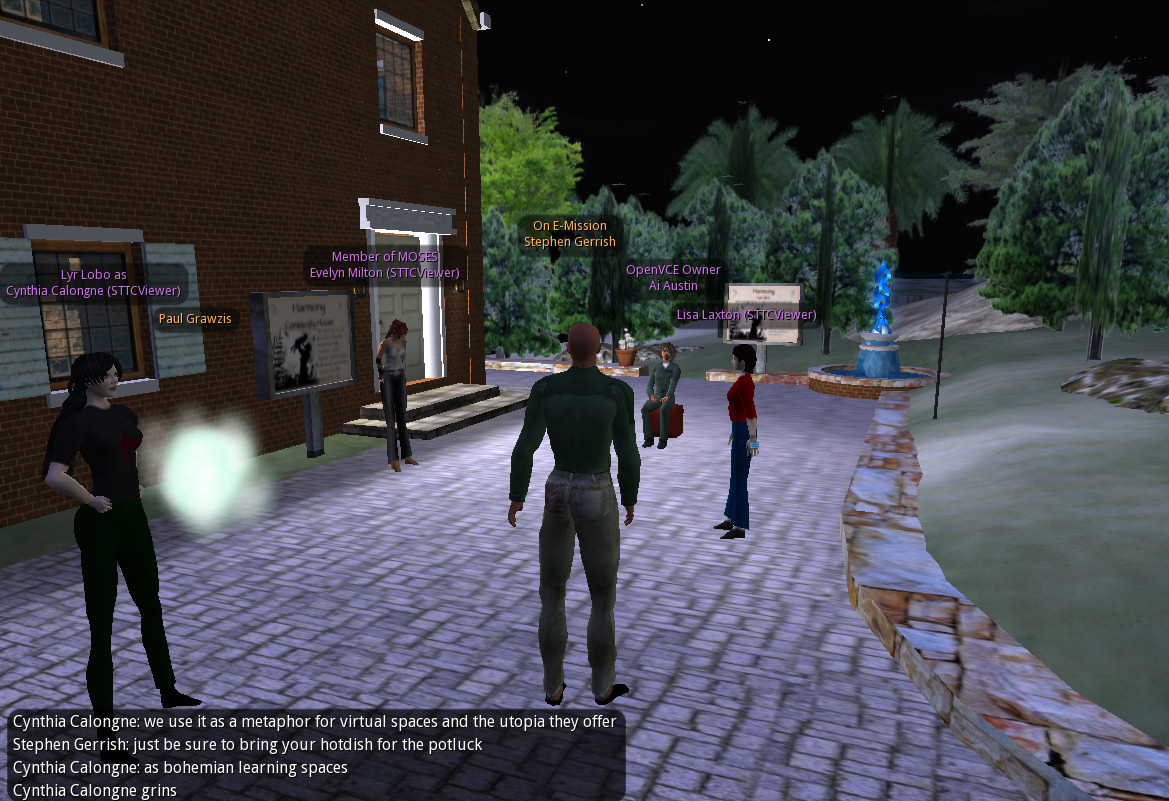
MOSES: Military Open Simulator Enterprise Strategy ( http://openvce.net/moses ) - is an OpenSim grid used for research purposes by educators and a range of organisation exploring simulation technology for training.  I am owner of a region on the grid for Open Virtual Collaboration Environment work with the US Army, and am a member of the Board of Directors who guide the development of MOSES.

The image is of one of the Office Hours meetings between estate owners...

Keywords: IDEL11

Posted by Austin Tate | 0 comment(s)

I like to create a web page when I start a new project... to add in the useful web links, pointers to information, notes, etc.  Then I gradually structure that as more content is created.  Most recently I have been doing that in the Drupal content management system on http://openvce.net which provides convenient additional facilities such as column layout, blocks in to which content can be placed, mash-up capabilities right down to adding custom HTML and PHP code, and ancillary blogging, image handling, etc.

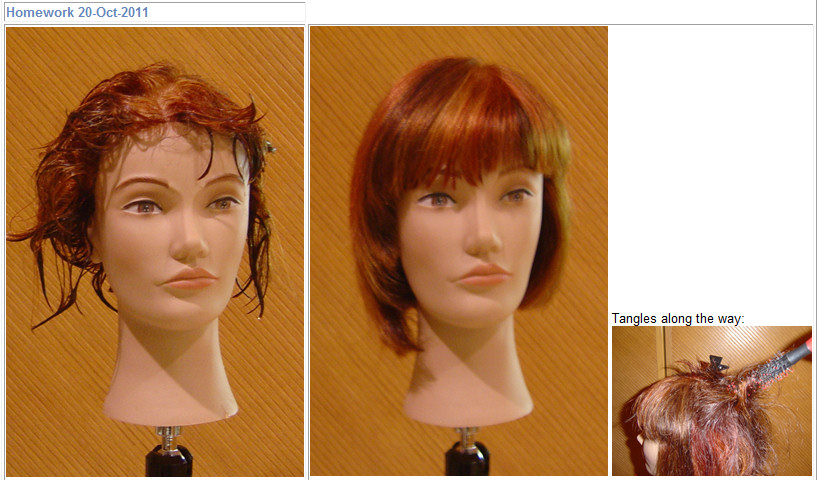
But for the MSc activities I chose to do some of this in my own web area at http://atate.org which initially just had my work on the "bat Life Wall" and where I wanted to collect together assets that would be long lived.  I have more recently added extra areas there for my course blogs and Lifestream, my Junior Hairdressing experience for the ULOE11 module, and the virtual ethnography study for the Digital Cultures EDEDC11 module. There is also a password protected personal work area.

For work in week 6 of the IDEL11 course we will be exploring personal learning spaces and mash-ups, and so I have tried to look to do something new... something I have been meaning to explore for a while.  I wanted to use a much more flexible layout that is cleaner, and adapts to the width of anyone's viewer. And into which I can drop elements without causing problems of rendering in the wide range of browsers.

I am experimenting at http://atate.org/space/ which such a personal working space. It is based on a freely available and nice simple CSS style sheet from http://matthewjamestaylor.com/. I have customised it somewhat for my sans serif font preference and colour choices.   I added initial content that I had been collecting at http://openvce,.net./mscel and put in quick access tabs for my current MSc work and blogs.

Keywords: IDEL11

Posted by Austin Tate | 0 comment(s)


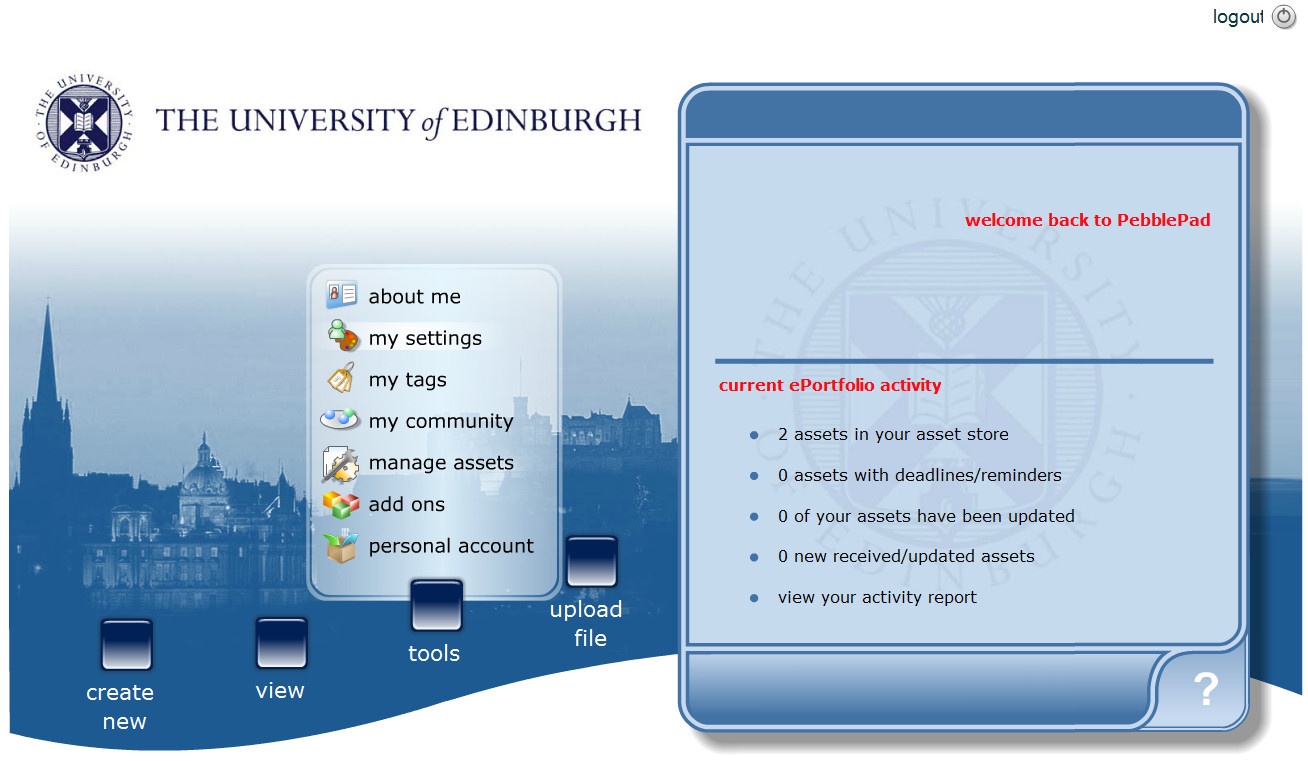
The PebblePad ePortfolio system is used to support personal learning spaces in the University of Edinburgh

If on EASE, you can log in via http://www.pebblepad.co.uk/edinburgh/pebblepad.aspx or launch from a button on MyEd with EASE login as student (MyEd - under Studies tab) or staff (MyEd - under Teaching tab).

My first experience indicated that creation of a trivial note with a few pasted web links was a very time consuming process, far beyond its value... and the resulting links note was poorly accessible with many steps to retrieve it or edit it.  The system seems designed for a very small number of assets rather than many tyhousands of assets in complex structures that would be needed in a serious personal learning environment for the future.

Keywords: IDEL11, PebblePad, PLE

Posted by Austin Tate | 1 comment(s)

I am reading some papers by Don Norman, and one on "Distributed Cognition" (Norman, 1993) makes some very nice points about the value of large situation rooms and operations centres for providing a joint view of the current situation and actions being taken in complex environments such as power station control rooms and emergency response centres.  I have been in such centres for real and training situations, for natural disaster response in Tokyo, for a nuclear power station in the UK and for search and rescue coordination in the UK and the USA.  They are all set up to allow for people to gather round or have a view of screens and see information in a shared environment.. the operators and responders are not all looking at their own screen separately... though of course they do that to use specialised tools, information and communications which they bring to the shared space.

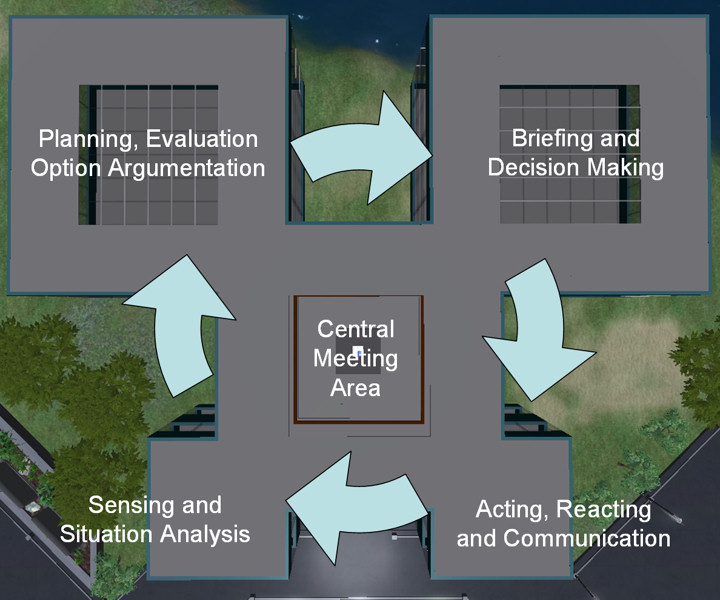
In our work we have sought to replicate this sort of shared situation space, as a basis for human centric decision support.  When we started to embody our technology in virtual worlds we wanted to replicate some of the benefits of this, and indeed provide a shared space for distributed participants, as is often the need in complex multinational emergencies.  We are sometimes asked why we want to replicate rooms with walls when we are in virtual worlds, and I respond that we want the wall space for displays and distinct functional areas that everyone can remember and use.

In our I-Rooms (http://openvce.net/iroom) we have a shared central space in which participants gather and communicate, and from which viewpoint they can direct their attention to any of four functional areas set in a cyclic pattern to allow for situation assessment, option exploration, briefing and external communications.  It supports the OODA Loop (http://en.wikipedia.org/wiki/OODA_loop) as an underlying approach and lets us place human and intelligent systems support into a meaningful whole which all the participants can involve themselves in as appropriate.

Reference: Norman (1993) Things that make us smart : defending human attributes in the age of the machine . Reading, Mass., Addison-Wesley Pub. Co. Chapter 6; Distributed Cognition (139 – 154).

Keywords: IDEL11, ULOE11

Posted by Austin Tate | 0 comment(s)

October 20, 2011

Keywords: IDEL11

Posted by Austin Tate | 0 comment(s)

Keywords: IDEL11, ULOE11

Posted by Austin Tate | 0 comment(s)

<< Back Next >>