Log on:
Powered by Elgg

Ania Rolinska :: Feeds

August 24, 2015

Selfie number 9

Bill Rammell, Stephen Heppell and Steve Wheeler
OK, so this one's not really a selfie, but it caught your attention didn't it? This is the second in my short series on my top ten photographs with people who have influenced my thinking. Click here to see selfie number 10.

This picture was taken in April 2011 at the start of the Plymouth Enhanced Learning conference (Pelecon), which was an annual learning technology event I chaired at Plymouth University. Our opening keynote speaker that year was Professor Stephen Heppell, and our Deputy Vice Chancellor was Bill Rammell.

Professor Stephen Heppell has been a regular mainstay on the keynote circuit for some time, due to his wide ranging and innovative research around education environments and learning technology. He has influenced my own work, encouraging me to be more aware of the entire learning environment. Stephen's research has resulted in some very useful insights into how children learn and why they don't. Consider for example his claim that red lighting in the morning wake students up, while blue lighting in the afternoon calms them down after lunch break. He also suggests that the entire sensory experience of school, including odours and configurations of wall spaces can positively influence children's learning. What resonates most for me though, is his statement that 'everything technology touches grows exponentially'.

Before joining Plymouth University as Deputy Vice Chancellor, Bill Rammell served as Member of Parliament for Harlow between 1997-2010. Among his other roles in government was his tenure as Minister of State for Higher Education under Labour prime ministers Tony Blair and Gordon Brown. During his all too short stay at Plymouth, Bill developed our student experience services and was also responsible for international developments. I will never forget his great spirit of service and his willingness to go the extra mile. He not only opened our conference that day, but also returned twice more during the 3 day event to see how we were doing. He left the university in 2012 to become Vice Chancellor of Bedfordshire University.

Coming soon: Selfie number 8.

Photo by Jason Truscott on Flickr

Creative Commons License
Selfie number 9 by Steve Wheeler was written in Plymouth, England and is licensed under a Creative Commons Attribution-NonCommercial-ShareAlike 3.0 Unported License.


August 23, 2015

Selfie number 10

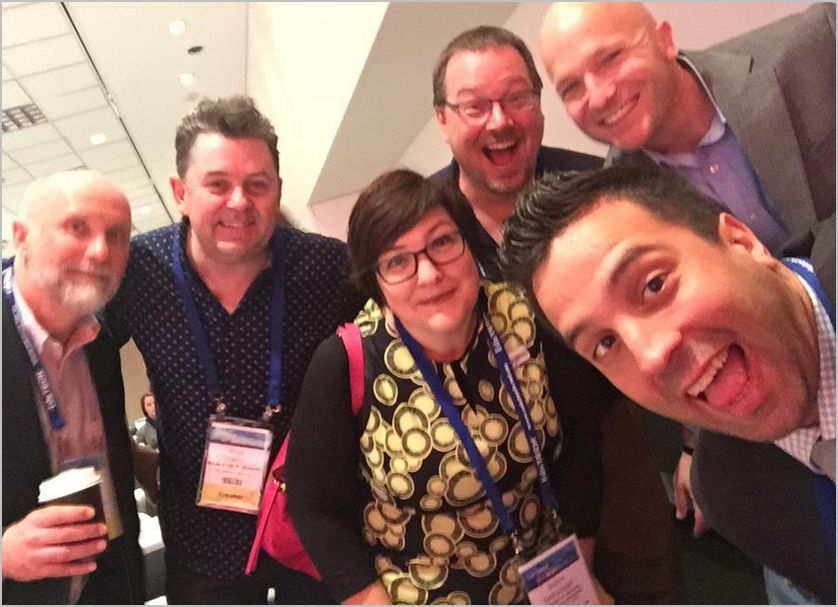
Recently, in the wake of the #blimage blogging challenge I've been thinking about the power of photos and images. Not only can they help us to think metaphorically, they can also emote memories. I have quite a collection of selfies and other photos (elsies) of me with people who have either inspired me or influenced my thinking in some way. I usually run into them at conferences, and of course, a good way to create a memory is to get a picture taken with them. So I thought - perhaps I should write a blog series about the top ten photos and selfies of people I admire, and who have contributed significantly to my own learning. So here it is, starting with this selfie of a gang of friends and colleagues, taken in June at the EduTech Expo in Brisbane, Australia.

On the left of the picture is Harold Jarche, who is chair of the Internet Time Alliance and a champion of social learning. I have followed his work for some time, but the first time I met Harold was at the Learning Technologies event in London in 2013. He specialises in work based learning and has made quite an impact with his work on innovative leadership, networked business solutions, and personal knowledge management. I often quote from his work or retweet his blog posts, because he thinks deeply, writes clearly and has a unique approach to workplace learning.

In the centre of the photo is Joyce Seitzinger. I first met Joyce at the first Personal Learning Environment (PLE) conference in Barcelona in 2009 and we have been friends ever since. We were sat just a couple of seats away from each other, and were already friends on social media. I quickly realised that Joyce and I had a lot in common, including our passion for great learning, technology integration and creative applications in higher education. I have subsequently worked with her in New Zealand and Australia. Joyce is best known for her Moodle Tools for Teachers model which has been translated into more than a dozen languages. She now runs her own consultancy - Academic Tribe -which offers training and professional development for educators.

Far right is George Couros. I also met George for the first time at the Barcelona PLE event. He works as a divisional principal in Canada and is a regular speaker on the international conference circuit. On his blog 'Principal of Change' George is constantly posting articles and videos about innovative learning, and is a strong advocate for change and reform in school systems. I often share and repost content from George on social media. As the younger brother of Alec Couros, George has a big shadow to emerge from, but he is very much a keynote speaker, author and scholar in his own right, and deserves his reputation as a key mover and shaker in the world of education.

You may also recognise the other people in this selfie. Answers below in the comments box please :)

If you have any selfies with people you value, I encourage you to share them in a blogpost of your own, and say how they have inspired you.

Coming up: Selfie number 9

Photo by George Couros

Creative Commons License
Selfie number 10 by Steve Wheeler was written in Plymouth, England and is licensed under a Creative Commons Attribution-NonCommercial-ShareAlike 3.0 Unported License.


August 21, 2015

Tipping the balance #blideo

I only ever saw the movie Equilibrium once, and it was a long time ago. I thought at the time what a dystopian picture it portrayed of the future. It's a world where all citizens are required to take drugs that repress their emotions. Now I've been #blideo challenged by Amy Burvall to interpret this clip from the movie. I don't remember seeing it when I watched the film, so I guess I'm approaching it with fresh eyes.

My first reaction after seeing this was that Preston, a member of the elite law enforcement agency, is steeped in the traditions of his society. He is fully invested in the requirement to repress his emotions, and knows all of the 'reasons' why this is demanded by his superiors. And then, during a house search, he discovers an old recording of a Beethoven symphony and in an unguarded moment, he decides to play it - on an old gramophone. As he waits for the music to start, he toys with a snow globe - a piece of trivia which holds his attention briefly. Then the music starts. Preston has an epiphany. In surprise, he drops the snow globe, which shatters on the floor... and he begins to weep as the music washes over him.


This speaks to me of the trivia of life, the irrelevant objects that grab our attention and within which we invest so much of our energy. We often we waste precious time on the less important things in life, when in reality we should be seeking the creative and emotional experiences that might forever shape our characters and define our lives. How many hours do children waste in school, studying subjects or content that will be useless or irrelevant when they finally leave school? How much content do schools deliver that resemble the snow globe? How much is a Beethoven symphony?

Another thought is that the record and the gramophone were old technology, from a bygone age. And yet, the music it produced was able to reduce a man to tears. Music has the power to reach deep down into our very souls and does so because it bypasses our intellect and aims directly for our hearts, our emotions. Regardless of the technology used, powerful experiences can be life changing. This is what all educators should seek to facilitate. It's a tipping of the balance for better learning experiences.

Photo by NCinDC on Flickr

Creative Commons License
Tipping the balance #blideo by Steve Wheeler was written in Plymouth, England and is licensed under a Creative Commons Attribution-NonCommercial-ShareAlike 3.0 Unported License.


August 19, 2015

"Everyone remember where we parked..."

The title of this post is a somewhat comedic quote from Captain James Kirk, as the crew leave their invisible starship parked in a public municipal park, somewhere near San Diego. (You couldn't make this up... but in this case I guess someone did). Where technology is concerned, it's important that we remember where we came from. 

Unlike the crew in the movie Star Trek IV The Voyage Home, we don't need to go back to our origins, but it's nonetheless key to our future success that we recognise our history and our trajectory. The long evolution of communication technologies has brought us to the point where we now carry universal devices in our pockets. If we compare what we are now capable of to say, 30 years ago, we have to concede that smartphones are a powerful disruptive innovation. Smartphones have utterly transformed the way we interact with each other, access information, entertain ourselves and conduct business. But is education being left behind in these advances? Have we forgotten where we parked?

Certainly smartphones can be used inappropriately, for example in cyberbullying and for other nefarious purposes. These are problems that would not have occurred without mobiles. But imagine 30 children in a classroom, each one with a smartphone. What is to stop teachers encouraging kids to use their smart phones in a controlled way, for example to vote, or as a tool for peer messaging, or to connect with media that they cannot normally access in the classroom? How about showing kids how to use their personal devices to improve their learning, rather than to create mischief? And yet smartphones are still banned from many classrooms.

Mobile phones were first designed as a tool for communicating to others while on the move. They were the next natural step up from the car phone. But today's smartphones have evolved into much more: You can send text, gain access to the Web, capture images and video with your camera, orientate yourself by using GPS systems, measure and document your daily routine, engage in augmented reality experiences. In effect, today's smartphone is a mobile office. As educators we would be very foolish to ignore this hugely disruptive potential. Other technologies have similar potential for positive disruption, and yet are largely ignored or forbidden in formal education contexts


Wikipedia, as I mentioned in yesterday's post, is a disruptor. It has its opponents, many of whom vociferously attack those who espouse it. It is a threat to conservative notions of knowledge and has the potential to undermine elite expertise. The basic philosophy behind Wikipedia and the general practice of user generated content is that everybody can be an editor and a commentator. This sways the balance of power between experts and non-experts, between teachers and students everywhere, because it rejects the privileged role of former knowledge mediators and contradicts the traditional idea that knowledge can only be generated by certified experts. People who take an interest in a certain subject are able to generate knowledge about it - and consider themselves capable of doing so. In an educational context, the more students generate their own content, the more they are likely to learn. 


There are many reactions to disruptive innovation. There are those who willingly embrace change, in the educational and academic sectors and also in corporate learning. But there are other who put their heads in the sand and don’t want to see what happens around them. Others don’t accept the idea that students have the same status as lecturers. They don’t like the idea of Wikipedia being referenced (in academic assignments) because they don’t trust anything which has not been through a formal process of peer-review. Of course, what I write on my blog is not formally checked, a departure from publications in scientific journal which will normally be subject to two or more peer reviews. But in fact my readership reviews and comments on my writing, and for me, this is more valuable to me than a formal peer review. There is more immediacy to this form of peer review and there is also a personal connection between me and my readers. 

The use of learner centred technologies such as social media, smartphones and cameras will be vital in the future of education. The personal nature of handheld technologies, coupled with the immediacy of content discovery, production, remixing and sharing, ensures that smartphones will have an important part to play in the future of learning. The extent to which we succeed in breaching the barrier of resistance to change will decide just how such tools will be employed in formal educational settings.


Education in the future will demand much from the smart phone. It is personal and portable. It is versatile and easy to use. It will be the platform for many future developments, such as context-aware technology and augmented reality. Potentially, these are hugely disruptive innovations. Soon you will begin to see more virtual content around you - overlays on billboards, in airports, on sightseeing venues. If you take your students on a visit to an art gallery, the virtual information about the exhibits, the artists and other details will be embedded into the frame of the paintings you are looking at. At the end of the visit you will be able to return to your classroom to download all of the information about what you have seen and decide what you are going to do with it. Education is notoriously conservative, but with some application, over a period of time, technologies can and will disrupt old, outdated practices, so we can change them for the better. 

It's useful to remember where we came from, to gain a perspective on just how far we have travelled. If we grasp every opportunity as it occurs, we will go far.

Photo by Laitr Keiows on Wikimedia Commons

Creative Commons License
"Everyone remember where we parked..." by Steve Wheeler was written in Plymouth, England and is licensed under a Creative Commons Attribution-NonCommercial-ShareAlike 3.0 Unported License.


August 18, 2015

Resistance is futile

I'm fascinated by the psychology of educational technology. I enjoy learning about the ways people behave with technology, how they perceive technology, and how they use technology in teaching and learning. I'm also intrigued by resistance to change. I have learnt from my research that there are - and always will be - people who are resistant or reticent, because new technologies have the potential to disrupt and challenge the social and professional roles into which they have habituated. Naturally, people don't relish being outside of their comfort zones. 

This reflects my own experience, from the time I introduced BBC computers into nurse training in hospitals in 1982. It took a great deal of effort to introduce the new computers into such a conservative learning culture. Colleagues resisted the presence of computers, because they were worried about the potential effects, and some also questioned their validity. I had to ensure that the computers were deployed appropriately and in a manner that would demonstrate their effectiveness. I had to carefully evaluate their use. This was difficult, because nothing similar had been previously attempted. Although it wasn't easy, over time, as the student nurses used the computers and began to demonstrate how their learning had improved, so the new technology became tolerated, and eventually accepted as just another learning tool. 

Such technologies are game changers. They are disruptive, fundamentally changing the way we do things. One contemporary example is the digital camera. Few places remain today where you can still buy an analogue camera. They are now very specialist. Digital technology has advanced photography into areas that were previously considered impossible. Another area that has been disrupted is music. The shift from vinyl records through compact disks to digital downloads has been relatively quick. There is now hardly any demand for analogue recordings (hey, remember the compact cassette tape?), unless you are interested in collecting memorabilia. Television has also been transformed by digital. We now enjoy access to more content than any of us could ever hope to view in our lifetimes. 

We have moved from atoms to bits. Our lives, our work, businesses, and entertainment have been disrupted by digital technology, many would argue for the better. 

The same can be said for the participative Web. Blogging has evolved into a very expressive and social form of writing, and clearly exploits the immediacy of interaction that was unknown before social media. Blogging is disruptive in that it changes the way we construct and present our ideas, and the way we interact with our readership. Take a look at the #blimage and #blideo challenges and you'll see that many teachers are willing to express themselves and their ideas in new ways, and to develop dialogue within their communities on the basis of a personal invitation.

Wikipedia is yet another example of disruptive innovation. Technically it is a collaborative online work space for creating and sharing content. Culturally Wikipedia has thoroughly disrupted the idea that you need to consult a printed encyclopaedia to get expert information. If you discover an error, you can instantly correct it yourself. You don't have to wait for the publishing house to decide to release an updated version. The read/write Web has changed our lives by disrupting our perceptions of what we can do with technology.


Should we, in the same way, seek to disrupt education? Increasingly, people think we should. Many are realising that the way teaching is conducted in many schools and universities is outdated. Much of mainstream education fails to align to the culture of our young people and its traditional methods no longer fully addresses the needs of society. If we want education to be effective, then some things need to change. And because of technology, change is inevitable. 

In tomorrow's post I'm featuring what I consider to be the ultimate disruptive innovation of our age. 

Photo by Steve Wheeler

Creative Commons License
Resistance is futile by Steve Wheeler was written in Plymouth, England and is licensed under a Creative Commons Attribution-NonCommercial-ShareAlike 3.0 Unported License.


August 17, 2015

The #blideo list

Hot on the heels of the popular #blimage blog challenge Amy Burvall and I created (See here for almost 200 posts), where people send each other images and write learning related blogs about them, we now have #blideo (my idea but I think Alex Bellars should be credited with coining the phrase). This is a new challenge where people send each other short video clips and challenge each other to write learning related blogs. The trick is to then choose another short video clip, and pass it on to others as a challenge. In this way, we can encourage each other to blog to share our ideas and thoughts. It's video. It's a blog. What's not to love? It's a moving experience. The entire learning community benefits, people discover new sites, think more deeply about their professional practice, and (hopefully) creativity is unleashed. Below are some of the first #blideo blog challenge responses.

This will be a growing list, and as each post is published under the #blideo hashtag it will be added. If you notice one that's missing, do let me know. So go on, get blogging!

Sue Beckingham - Building confidence takes time: Learning from elks and Aesop's fables
Terese Bird - #blideo - Hang on a minute lads, I've got a great idea!
Amy Burvall - #lingerlust: A #blideo (meta) response

James Clay - #blideo - You're only supposed to blow the bloody doors off!
Pascale Colonna - #blideo challenge

Inge deWaard - Blogphilosophy - a #blideo and our learning frequency

Simon Ensor - Road rage

Sarah Honeychurch - wysiwyg
David Hopkins - Hang on a minute lads, I've got a great idea!

Whitney Kilgore - It's not about the destination so you better enjoy the journey

Teresa MacKinnon - #blideo challenge

Steve Wheeler - #blideo: Tipping the balance
Gabi Witthaus - Yes, technology can lead pedagogy

Photo by Ste Grifo on Wikimedia Commons

Creative Commons License
The #blideo list by Steve Wheeler was written in Plymouth, England and is licensed under a Creative Commons Attribution-NonCommercial-ShareAlike 3.0 Unported License.


August 15, 2015

#blideo - a new blogging challenge

As something that started out simply as a bit of fun between a few Twitter friends, the #blimage challenge has been a surprising success. For the many people who have participated to date, it has been an exercise in creative thinking, and an experience of extending social connections within their personal learning networks. Check out the #blimage hashtag and you'll see what I mean. The challenge was simple - you shared an image with a friend (or three) and challenged them to write a short, learning related blog about it. They then posted their contribution along with another image, and challenged a few more people within their social network. Blog + image became #blimage.

Those who have participated in #blimage have reported that their visitor traffic has increased, their writing has improved, and they have engaged in a little additional creativity. Essentially, they have become more enthused about the practice of sharing their ideas within their community. Some have returned to blogging after a long time away, and others have been encouraged to blog for the very first time. Interestingly, several have also told me that they have discovered new bloggers they never knew existed, and are enjoying reading their work. Clearly, this approach has many applications for schools, colleges and universities. Many of the blog posts from the challenge can be found here on the #blimage list.

So let's start a new challenge.

This time it's not an image - more like a series of images. In fact it's a video. Let's call it #blideo. Yep, you know the rest. Same guidelines apply. You share a short video clip on your blog and challenge 3 people in your personal learning network to write learning related blog posts about it. When they post their response, they include another short video clip of their choice and challenge 3 other people within their network... and so on. Are you up for the challenge? Don't forget to tag your post with #blideo.

Here's a video clip to get you started...


Photo by Phil Roeder on Wikimedia Commons

Creative Commons License
#blideo - a new blogging challenge by Steve Wheeler was written in Plymouth, England and is licensed under a Creative Commons Attribution-NonCommercial-ShareAlike 3.0 Unported License.


August 14, 2015

I know what I like

'We live in a rapidly changing world that requires people to have the ability to adapt much more quickly than in previous times, where events moved much more slowly. Education is not immune from these changes even though it is an inherently conservative system. In the face of significant innovation in educational practice and as espoused in self-determined learning (heutagogy) and other perspectives, there are new skills to adopted by learners and learning leaders alike.' 

With these words, Stewart Hase outlines the manifesto for heutagogy, an emerging theory of learning that espouses self-determined study, where 'people have the agency with respect to how, what and when they learn'.  Hase argues that people are naturally predisposed to self-determined learning from birth, and that the principles of heutagogy are focused on creating optimal experiences and environments in which this can be supported. There are many other chapters in this self-published volume that echo these tenets, and all are grounded in professional practice and case studies. Heutagogy has been criticised as an ugly and problematic term, but if you are able to move beyond the cosmetics of nomenclature and thoughtfully consider the arguments presented, you will gain some valuable insights into how this theory emerged.

Throughout this book, the contributors generally argue for change in education, and provide examples from their own experiences as to how those changes might be effected. Jackie Gerstein writes about the contrast between learning in traditional environments, which is generally passive (Education 1.0) and learning that is self-determined (Education 2.0), where students connect, communicate and collaborate. She argues for the importance of active, experiential, authentic and socially rich experiences, and shows how networked learning through technology is a vital mainstay of self-determined learning.

The technology theme is sustained across other chapters. Lisa-Marie Blaschke discusses the use of social media such as Twitter to open up new possibilities for learners. She advocates shifting the role of teachers to create safe and open environments in which learners can explore and freely discover for themselves, especially through social media. She acknowledges that stepping back to allow learners to do this can be threatening for teachers - they will need to relinquish the control to which they are accustomed - and also for students, particularly those who are not naturally confident in directing their own learning. Although she offers examples of heutagogy in practice there is no specific counsel on how to address these issues.

Robert Schuetz continues the social media theme with a chapter on how blogs create learning legacies. His narrative gently persuades of the need to tell our stories in order to reflect and deepen our learning, while reaching out to our own personal network of co-learners. It is more a recipe on the art of blogging though, than a considered treatise on how the practice can enhance the learning experience. More heavy weight in its approach is the chapter by Thom Cochrane and Vickel Narayan which tackles the impact heutagogy might have on creativity in education. Melanie Booth strongly contends that self-determined approaches to learning fit neatly into continuous assessment, where measurement of learning becomes flexible and negotiated and hence a crucial component of critical reflection. Ronan O'Beirne persuasively argues that technology is a key driver of self-determined learning, because it is changing the relationship between learners and content, and empowers them to engage in new ways with knowledge. And there is more, much more. In total there are seventeen chapters, each offering additional voices to the growing narrative of heutagogy.

Much of the contents will undoubtedly cause progressive educators to nod their heads sagely in agreement, perhaps without overly challenging their thinking, because many will already practise some of these principles. Much of it is common sense. For many traditionalists on the other hand, heutagogy may be a steep and tortuous pathway, a step too far, one from which many will shy away. Traditionalists should read the book with an open mind, but sadly I suspect it won't reach that audience. Teachers in compulsory education may find this a particularly steep hill to negotiate, arguing that many of the key principles of heutagogy are based upon adult education (andragogy) rather than the education of children. Although this is a problem acknowledged by some of the authors in this volume, a great deal more effort will need to be exerted if teachers of children are to be convinced that heutagogy is a universal theory.

Generally, the book is well written and professionally presented, and comes complete with the welcome feature of coloured illustrations. The chapters are argued well enough for the book to sit comfortably in an academic context, featuring sound research and adequate referencing. It is a valuable compendium of themes and perspectives around heutagogy, and is a much needed contribution to the support this movement. I am sure other publications will follow, and they will need to. As a theory, heutagogy will need further development and a great deal more supporting, empirical evidence, before it is accepted into the mainstream of pedagogical thinking.

Reference
Blaschke, L. M., Kenyon, C. and Hase, S. (Eds: 2014) Experiences in self-determined learning. Self publication. Available here. Book synopsis.

Photo by Dragan Brankovic on Flickr

Creative Commons License
I know what I like by Steve Wheeler was written in Plymouth, England and is licensed under a Creative Commons Attribution-NonCommercial-ShareAlike 3.0 Unported License.


August 12, 2015

Falling prophets

“Books will soon be obsolete in the schools. Scholars will soon be instructed through the eye. It is possible to teach every branch of human knowledge with the motion picture. Our school system will be completely changed in 10 years.”

So wrote the celebrated American inventor Thomas Edison in 1913. It's a well known quote, and is more representative of his fervour for the moving picture than it was of reality. His enthusiasm for the fledgling motion picture industry was justified however. It took the world by storm, but not at the expense of books. Motion pictures also failed to revolutionise school systems by the way.

Another well known quote from the Hollywood mogul Darryl F. Zanuck in 1946 reveals more about our tumultuous romance with technology:

"Television won't be able to hold on to any market it captures after six months. People will soon get tired of staring at a plywood box every night." 

Like Edison, Zanuck had a personal vested interest in the future success of the motion picture industry, and viewed the introduction of the television as nothing more than an aberration. Yet just as Edison had grossly underestimated the power and appeal of the book, so Zanuck was proved wrong with about the demise of television. What can we learn from these earnest but erroneous predictions? Firstly, we need to be careful how we predict the future. We should pay more attention to context than content. Technology trends are capricious but our need to access information is a constant. We should understand that people are inherently curious, and will use whatever medium is available to satisfy their hunger for news, entertainment, and social contact.

The advent of the Internet and the World Wide Web has gathered all media together in one 'place'. The convergence of text, audio, video, and the emergence of hypermedia provide us with the ultimate playground. We no longer need to ask whether books are dead. If we like reading, then books will survive, whether they are paper based or digital. The same applies to any other medium.

Photo by Robert Parvlainen on Flickr

Creative Commons License
Falling prophets by Steve Wheeler was written in Plymouth, England and is licensed under a Creative Commons Attribution-NonCommercial-ShareAlike 3.0 Unported License.


August 10, 2015

At the end of our tether

What does mobile technology have to do with academic freedom? Read on...

'A person's freedom of learning is part of his freedom of thought, even more basic that his freedom of speech.' This remark from John Holt epitomises progressive education. Holt could easily have gone on to argue that freedom of learning should also include choice of location. He died in 1985, before the era of the Web and mobile technology, but the thought was undoubtedly already there. Being able to choose when and where to learn is part of the freedom to learn. It is not just about freedom of thought and freedom of speech, but also freedom of space and place. It is about choice. The is academic freedom.

We have no excuse now. We are living at a time in our history where the small device in the hand of the student is able to provide opportunities for any time, any place learning.

The fact is, untethered learning is evident all around us. Increasingly, people are learning informally through their mobile devices. Tethered technologies such as fixed line telephones are on the wane, while for the first smart phones are now outstripping those from personal computers and are have overtaken laptops as the most popular means of going online. Many are grasping the opportunity to go mobile, using their smart phones, tablets and e-readers to learn while on the move, at a time and pace that suits their lifestyles.

Traditional, formal education is playing catch-up... or in many cases not playing at all.

The significance of the mobile device cannot be underestimated. In the last decade personal, mobile technology has gained a dramatic purchase on western society. It has driven many social, economic, political and, yes - psychological changes. The relative benefits and limitations of these changes can be debated elsewhere, but fundamentally, educators need to recognise something significant. In comparison to other sectors of society, where mobile technology adoption is concerned the world of formal learning is lagging so far behind, if it were an Formula 1 racing driver, it would be in danger of being lapped.

Should education go completely mobile? No, and in most cases it won't. Should schools ignore mobile completely? Definitely not, but many do. A blended approach is needed, where the optimum mix of mobile and tethered learning can be supported. Yes, there is a place for tethered learning, as can be evidenced in many subjects such as science and the arts. But so much more can be learnt outside the four walls of the traditional classroom.  Here are just three strategies teachers can adopt to promote this mix:

1) Create opportunities for learners to use their personal, mobile technologies inside the classroom. There are endless examples already available of teachers who have incorporated mobile technologies into their classrooms, for voting, collaborative learning, capturing data, creating content and interacting with specific environments.

2) Provide content that can be accessed by learners both in the classroom and outside of the classroom. This provision should be seamless, and should be accessible and usable on tablet and phone screens. The mobile content should be interactive and (at the appropriate level) challenging, and learners should be able to interact with their teachers and peers too.

3) Ensure that learners are active in the creation on course content themselves. They know their own personal technologies intimately (they chose them) and don't need to be shown how to use them. They will need support though, in determining how best they can and should employ their mobile tools to discover, create, share, re-purpose and remix content.

In this way, we might see the end of tethered learning, as we move toward a more flexible, personalised, blended learning that is location agnostic.

Reference
Holt, J. (2012) The right to control one's learning. In J. W. Moravec (Ed.) Knowmad Society, Charleston, SC: Education Futures.

Photo by Steve Wheeler

Creative Commons License
At the end of our tether by Steve Wheeler was written in Plymouth, England and is licensed under a Creative Commons Attribution-NonCommercial-ShareAlike 3.0 Unported License.


August 07, 2015

Over the handlebars #blimage

I vividly remember learning to ride a bicycle, even though I was quite young at the time. I remember Mum buying me some 'stabilisers', a small pair of extra wheels that were attached either side of my rear wheel to allow me to keep my balance. I rode around on these for quite a while before I eventually gained the confidence to ride without them. I wonder how much longer it took me to learn to ride because of those stabilisers?

To help my kids when they were learning to ride, I would run alongside them holding the frame, acting as their support until I thought they were ready to ride on their own without falling over. They learnt a lot quicker, partly because they were unaware when I had let go. When I was learning, my stabilisers were conscious scaffolding, and I knew when they were gone. It took me a lot longer to gain confidence and I tended to rely on those little wheels a lot more than I should have.

My kids on the other hand, gained confidence in riding because they assumed I was there supporting them, when in fact I had already let them go. Acquiring skills is like that. Students are often more capable than we think they are. Providing too much scaffolding can be counter productive, and learners can take a lot longer to gain their confidence. The quicker a learner becomes independent, the more confident they will become. Provide them too much support, or intervene too frequently, and they will take longer to discover their own balance.  
No amount of scaffolding or support could have prepared me for the incident that occurred when I was 18 years old. My mother had asked me to take a carton of fresh eggs to her friend, who lived a few streets away. I cycled over holding the eggs in my left hand while steering my bike with my right hand, which also controlled the front brakes.

As I approached the lady's house, a sudden gust of wind blew hard, and I veered into the kerb. Automatically, I grasped the front brakes with my right hand, and the bike stopped. I however, continued, over the handlebars, and both I and the egg carton went up in the air.

Oh the irony. My fall resulted in a fractured collar bone and I spent 24 hours in hospital while the doctors observed me for concussion. The eggs however, were unharmed. Make of that what you will, and then, if you are up for it, write a blog using this image for the #blimage challenge:


Photos by Darren Johnson (courtesy of David Hopkins) and Steve Wheeler

Creative Commons License
Over the handlebars by Steve Wheeler was written in Plymouth, England as a part of the #blimage challenge and is licensed under a Creative Commons Attribution-NonCommercial-ShareAlike 3.0 Unported License.


August 02, 2015

A lot of balls

Three things.

Firstly, if you tried to pick these balls up, you might do yourself a mischief. They are heavy, because the sculpture is a whole load of tennis balls bonded together, and they are fixed to a solid wooden plinth. If they were individual tennis balls, you could pick them up more easily (a few at a time, like the tennis players do).

If they were separated they probably wouldn't look as impressive, because clearly, this structure is attractive, whereas a pile of tennis balls are... well, just a pile of tennis balls.

If you tried to bounce it, you wouldn't be successful. Individual balls have a certain freedom that this cube does not. They can be hit or thrown in any direction, and you can put a spin on them. These balls have been glued together, forced into a configuration. Personal learning is not something that should be ordered. Learning is always personal, and messy .... and occasionally chaotic. This cube of tennis balls represents anything but personalised learning.

Secondly, the balls are tethered to a surface. They aren't going anywhere soon. Immobility has been imposed upon them. This is important to maintain the integrity of this sculpture, but tethering is increasingly a problem in education. Tethered learning may be convenient for schools to manage, but it's not optimal. Having students sat in orderly rows or tiers (tears) may be easier for the lecturer or teacher to manage, but for the students it's not always a good scene.

I never liked having to sit at my desk and face the front for hours on end. I wanted to get up, get out, and explore. I still think more clearly and solve problems faster when I'm pacing around, wandering through libraries or moving across uncertain terrain (literally or metaphorically). I am not comfortable in meetings when I have to sit for long periods at a table.

Tethered devices are not much better. The desktop PC keeps you in one place, and limits your posture. Mobile devices allow learners to take their connection with them, discover for themselves, and to learn on the move. That is situated learning, where what is being learnt is in its context, and it's a lot more effective for many students.

Thirdly, this configuration of balls is not a network, it's a cube. If it were a network, the nodes would be more separated, but there would also be more connections. In its present configuration each ball can be connected to no more than 6 other balls. In a network, connections are virtually infinite.

The power of the network is in the exponential nature of the connections that can be made, and thence in the amplification power this affords. Learning networks find their power in the number of connections, as can be demonstrated by the way neurones within the human brain connect to each other. This cube of balls is absolutely the antithesis of a network, because connection is so limited.

The future of learning is where all learners are connected to as many other learners and teachers as possible, so that learning is mobile, personal, limitless and unconstrained by configuration. The future of learning is connected, social, mobile and personal.

Photo by Steve Wheeler

Creative Commons License
A lot of balls by Steve Wheeler was written in Plymouth, England as a part of the #blimage challenge and is licensed under a Creative Commons Attribution-NonCommercial-ShareAlike 3.0 Unported License.


July 30, 2015

#blimage conscious

Several people on Twitter have asked recently for images they can use for the #blimage challenge. For the uninitiated, #blimage (blog-image) is a game we started to encourage learning professionals to blog. You are sent an image which you then have to write about, metaphorically or literally. At the end of your blog post you then challenge some of your friends with another image, of your own choice. And the challenge spreads... So far there have been over 150 blogposts from the education and learning/development community, in at least 5 different languages. Many of those posts are hosted on the #blimage list.

So here are several photos from my own collection (I'm sharing them under a Creative Commons licence - see details below) for you to choose from, so you can also take part in the #blimage challenge. Consider this your personal invitation. It doesn't matter whether you are a regular blogger, a novice who has never blogged before, or a lapsed blogger who used to be active. Have a go. You will learn a lot from it. I hope you have a lot of fun writing and posting your blog, and hope you and your colleagues and friends will participate in this creative way of encouraging the learning community to share and interact.


All photos by Steve Wheeler

Creative Commons License
#blimage conscious by Steve Wheeler was written in Plymouth, England and is licensed under a Creative Commons Attribution-NonCommercial-ShareAlike 3.0 Unported License.


July 26, 2015

The #blimage list

The #blimage challenge was started as a bit of fun between Amy Burvall and I. We started it on July 18th and it has been growing steadily ever since with many of our friends and colleagues participating. The challenge is this: Send an image to friends in your personal learning network and ask them to write a learning related blog post about it. They then challenge their friends with an image of their choice. All the posts are labelled with the hashtag #blimage (blog-image) so they can be easily discovered and aggregated. Since the start of activities, the following posts and other artefacts related to #blimage have been posted. Several are destined to become classics of educational blogging.

This list of posts will grow, so if you know of any that are missing, please let me know via the comments box at the foot of this post. Also, if there are any *notable names* missing from this list, please challenge them to participate! Oh, and if you need an image, there's one here to get you started.


#blimage Resources


Amy Burvall's YouTube video explaining #blimage
Simon Ensor's #blimage Pinterest Board
Simon Ensor's #blimage Flipboard

The #blimage blog posts

Mags Amond – #blimage challenge accepted

Maha Bali – Rethinking puzzles: A post-modernist view
James Ballard – My #blimage challenge
Noami Barnes – Messiness of research
Wayne Barry – Learning in limbo
Sue Beckingham – Buck the status quo
Sue Beckingham – Learning anytime, anywhere, any social space
Sue Beckingham – Fortunate learning and learning fortunes
Alex Bellars – #blimage - let's go outside and play!
Jasper Bloemsma – #blimageNL (Dutch)
Florina Blokland – Wat te doen (Dutch)
Helen Blunden – I see desk people
Chris Boon – The #blimage challenge
Jaap Bosman – Black swans, gnomes and Charles Peirce
Karen Bowden – Where do you learn? The #blimage challenge
Jane Bozarth – The #Blimage Challenge
Mark Britz – Embraceable Me
Karin Brown – Brain etchings
Amy Burvall – Drawing on the Desk: Clues about Personalized and Visual Learning
Amy Burvall – Breaking bread with Steve Wheeler
Amy Burvall – #blimage 1 week anniversary

Rachel Challen – Not just a waiting room
Catherine Cronin – Alone and Together, Moving and Learning
Helen Crump – Literacy: Not a desk job but an identity job
Ada Czerwonogora – Un tiro en el blanco (Spanish)

Aaron Davis – Building on the past
J.P. Davies – If you like school ... you'll love work
Maren Deepwell – Fictional learning places #blimage
Adrienne de Kock – Airports, legal papers, cultures and arts (Dutch)
HJ DeWaard – Stories and spaces within a #blimage challenge
Phil Denman – Everything is Not Awesome
@debsnet – Viva la boredom?
@debsnet – Spider-web connectivity: Technology for networked learning
Juan Domingo – Las dos caras de la #blimage! (Spanish)
Juan Domingo – #blimage-2 Cuando learning y aprender, no siempre es lo mismo! (Spanish)
Karin Donkers – Rood de kleur van... (Dutch)
Stephen Downes – The #blimage challenge spreads
Frans Droog – Een uitdaging! (Dutch)
Frans Droog – De #blimageNL lijst (Dutch)
Frans Droog – De coach en zijn pupil #blimageNL (Dutch)
Frans Droog – Smoezenbingo (Dutch)
Frans Droog – Wanting to know about black swans #blimage #blimageNL
Robert Drummond – #blimage Seating
Karen DW – #blimage Blank pages

Matt Estermann – A part of a greater holonomy
Terry Elliott – #blimage: A game, an image of learning, a challenge
Simon Ensor – Let them eat (binned) cake
Simon Ensor –  Puzzling memory loss
Simon Ensor – A bridge too low
Simon Ensor – Nature, nurture, network

Jan Fasen – Een stuur met teveel toeters en bellen #blimageNL (Dutch)
Bex Ferriday – #blimage No.1: Apt considering the weather we've been having
Bex Ferriday – Just when you thought it was safe...
Simon Finch – Human Writes
Sharon Flynn – Summer Holidays
Terry Freedman – A message for posterity
Terry Freedman – The writing machine (patent pending)

Tim Geers - #blimageNL (Dutch)
Taruna Goel – Learning is A-Mazing!
Kate Graham – Learning the rules #blimage
Neena Grosvenor – My first #blimage

Enoch Hale – Chalkboard
Enoch Hale – Spelunking education
Enoch Hale – #blimage challenge - Bow tie as content
Jane Hart – The joy of learning #blimage
Martin Hawksey – Forking #blimage and sharing a bit of #vidage
Katherine Haxton – Can’t see the wood for the trees!
Christa Hazell – #blimage
Josie Holford – The efflorescence of learning
Joise Holford –  Crikey! It's #blimage
Sarah Honeychurch – A puzzle
Sarah Honeychurch – Learning technology cats
David Hopkins – Surfer Dude vs. Shark!
David Hopkins – Desks of Doom
David Hopkins – Square peg, round hole
David Hopkins – Life's a beach
Denise Hudson-Lawson – The #blimage list: playing catch-up

Andrew Jacobs – Organic Growth
Sandra Jantjes – Kuikentje (Dutch)
Charles Jennings – The #blimage challenge
Kathrine Jensen – Perspectives and movements in learning landscapes #blimage
Phil Jewitt – Judging books by covers
Rachel Jones – #blimage challenge

Helen Kara – Data
Helen Kara – Positive disruption practice
David Kelly – Learning Fortunes
Whitney Kilgore – The Web: Network, dreamcatcher, patterns #blimage
Martin King – #blimage 'Back to the Future' The network is out of the bottle again
Erwin Klaasse – #rozeistochmooeir (Dutch)
Theo Kuchel – Established 1658
Caroline Kuhn – Learning in the wild and open, like skywhales - #blimage

Simon Lancaster – #blimage challenge
Mary Loftus – Getting bogged #blimage
Claire Lotriet – Darth Vader, flow and learning

Teresa MacKinnon – Of eggs and baskets #blimage
Colin Madland – The #blimage challenge
Juf Malka – Waar mijn hart sneller van gaat kloppen in de klas #blimageNL (Dutch)
Hayley Maisey – Pencil shavings, bruised fingertips and four holed buttons
Connie Malamed – Fortune Cookies For eLearning Designers
Richard Martin – Palimpsest
Sheila MacNeill – What Sheila's seen this week #blimage
Juf Margot – Niet overlaten aan halfdronken docenten en toevallig luisterende barmannen (Dutch)
Jeff Merrell – Space to make ideas your own
Ajo Monzó – #blimage (català) Les dues cares del viure a la ciutat invisible (Catalan)

Chrissie Nerantzi – #blimage response and new visual triggers
Nine Lanterns – My #blimage challenge - Learning trees

Pam O'Brien – Take joy in learning #blimage
Rachel Orr – #blimage FlOORed! Educational patience, self-control and perseverance

Christopher Pappas – Just use your blimagination
Tracy Parish – Learning While Wandering
Sukhvinder Pabial – Time for a fresh perspective?
Michelle Parry-Slater – Is the Learning Landscape Desserted?
Brayley Pearce – apple for teacher
Stephen Powell – In response to Chrissie's 3 plus one #blimage challenge

Clark Quinn – A Nurturing Culture

George Roberts – Getting away with it
Ann-Louise Robertson – The #blimage challenge
David Rogers – Bridging the chasm - collaboration in schools with real people #blimage
Angela Rees – #blimage
Damian Rentoule – A wooden brain
Michele Ricci – #blimageIT challenge (Italian)
Laura Ritchie – Reflections: My learning wall 
Dan Ryder – #blimage The fine line between painful tradition and transformational vintage

Roberto Schonocchini – Una sfida educativa a colpi di immagini (Italian)
Sylvia Schouwenaars – De fotograaf (Dutch)
Tim Scott – Learning enjoyment
Nick Shackleton-Jones – Picture this
Kay Sidebottom – Jumping on the #blimage band-wagon
Sandra Sinfield – It's only a puzzle... it's a system
Jeroen Smits Geen – #icebucket, wel de #blimage challenge (Dutch)
Susan Spekschoor – Home is where I am with my family #blimage (Dutch)
Andrea Stringer – See think wonder

Wendy Taleo – Lest we forget, it started with a tweet #blimage
Donald H Taylor – Memory is more than Ebbinghaus
Sharon Tipton – #blimage challenge! Game on!
Sharon Tipton – Why is learning so complicated?

Jannie van Maldegen – Rups (Dutch)
Judith van Hooijdonk – De bloemen van Zuyd (Dutch)
Tessa van Zadelhoff – Over oude busjes en het verbreden van je horizon (Dutch)
Sandra Verburggen – Rups wordt vlinder, het onderwijs (Dutch)

Simon Warren – Going against the groove with a groovy beat - a #blimage story
Hartger Wassink – Een leeg schoolplein #blimageNL (Dutch)
Susan Watson – #blimage: A game, an image of learning, a challenge
Britt Watwood – #blimage challenge - the rock arch
Britt Watwood – A dam #blimage challenge
Britt Watwood – A layered blimage challenge
Sheridan Webb – Under constant surveillance
Steve Wheeler – Blimey, it's #blimage!
Steve Wheeler – Piece by piece
Steve Wheeler – Off the rails?
Steve Wheeler – Playing chess with the enemy
Steve Wheeler – A lot of balls
Steve Wheeler – Over the handlebars
Phil Willcox – Work in progress
Karin Winters – #blimage: Van de rups en de vlinder (Dutch)
Anna Wood – The colours of active learning
Kandy Woodfield – Persistence and learning #blimage

Photograph by Steve Wheeler


The #blimage list by Steve Wheeler was written in Plymouth, England and is licensed under a Creative Commons Attribution-NonCommercial-ShareAlike 3.0 Unported License.



July 24, 2015

The #blimage challenge spreads

It is barely a week since the fabulous Amy Burvall and I started the #blimage challenge, and we are both just a little breathless as we watch how rapidly it is catching on. The challenge was just a little fun between the two of us at first. We didn't plan for it to become a global movement, but that seems to be the way #blimage is heading. In just 6 days, almost 100 edubloggers have taken up the challenge, and have then paid it forward to their colleagues and friends. There is now a Dutch language version called #blimageNL and a Spanish version (#blimageES set up by Juan Domingo) and other language versions will also follow. Who will be the first to set up a Japanese version #blimageJP or a German version #blimageDE or a French version #blimageFR?

We anticipate that #blimage will grow even wider in its influence, because it has an appeal for everyone who is thinking about education and learning. Ultimately, it's great to see how people are enjoying blogging about education, sharing their ideas, having fun with images, discussing their interpretations and generally connecting with each other in new ways. It has spread across all sectors of professional practice, from primary, secondary and tertiary education, into the workplace learning sector.

Here's the video Amy created to explain the #blimage challenge:


As Amy says, #blimage 'makes your brain dance with metaphorical thinking', it compels you to think more creatively, and I might add, it gets you involved in dialogue and connections with your personal learning network. Some educators are now blogging for the first time. Others have returned to sharing their ideas after a time away from blogging. Still others (like me) have discovered new and fascinating education blogs for the first time. The #blimage challenge exposes new ideas, new resources, and new people you really should get to know. It's about learning through storytelling, and this is lucidly explained by H J deWaard in an insightful post entitled Stories and Spaces within a #blimage Challenge. I would argue that this is learning technology at its very best.

Here are just a small selection of #blimage posts:

Space to make ideas your own by Jeff Merrell
Organic Growth by Andrew Jacobs
The #blimage challenge by Jane Bozarth
Fortunate Learning and Learning Fortunes by Sue Beckingham
Desks of Doom by David Hopkins
Taking up the #blimage challenge by Ignatia de Waard
Not just a waiting room by Rachel Challen
Human Writes by Simon Finch
It's only a jigsaw puzzle by Sandra Sinfield
Playing chess with the enemy by Steve Wheeler
Learning while wandering by Tracy Parish
The #blimage challenge by Charles Jennings
Learning in limbo by Wayne Barry
Time for a fresh perspective by Sukh Pabial
The colours of active learning by Anna Wood
Breaking bread with Steve Wheeler by Amy Burvall
The joy of learning #blimage by Jane Hart
The Web: Network, dreamcatcher, patterns by Whitney Kilgore
The #blimage challenge by Sheila MacNeill

You can see the diverse range of topics these bloggers have written about, inspired by the images they were sent. I'm looking forward now to seeing what the #blimage challenge will unearth next. Do visit the collection of #blimage posts and artefacts that are being collected on a Pinterest Board and a Flipboard, both set up by the marvellous Simon Ensor.  So please do take up the #blimage challenge yourself - and use the image above to inspire your next blog post. You never know where it might lead you!

Photo by Steve Wheeler

Creative Commons License
The #blimage challenge spreads by Steve Wheeler was written in Plymouth, England and is licensed under a Creative Commons Attribution-NonCommercial-ShareAlike 3.0 Unported License.


July 20, 2015

Playing chess with the enemy #blimage

Here's my latest contribution in the series of #blimage challenges. (Someone sends you an image and you write a blog post about learning based on it - that's the game of #blimage). This image was sent to me by Australian educator Aaron Davis (@mrkrndvs). So what do I make of it? How can I frame this image in an educational context?

It looks as though Bart Simpson is having a cup of coffee with Darth Vader (how surreal is that?). Maybe they have been playing a game of chess ala Seventh Seal (the film directed by Ingmar Bergman in which a medieval knight plays a game of chess with Death), and are now taking a break. Coffee or chess anyone?

Drinking coffee with the enemy is less risky than playing chess with him. Generally it's not as formal, and the rules assume less importance. Strategy is still involved in conversation, but its a different kind of strategy, low stakes. Playing chess with the enemy can be very dangerous because ultimately, it results in a winner and a loser. Chess could be a metaphor for formal education where testing separates those who are 'bright' from those who are 'not so bright'. Testing naturally promotes success, but it can also generate failure and stigma. Personally, I prefer the coffee drinking analogy, where everyone participates, and where there are no winners and losers, just a community of people, all interested in the same end. To learn as much as they can, and to share their ideas together, simply for the joy of learning. To me, this is the kind of learning you will see in schools where teachers take a back seat, and where students are assessed on a continuous and formative basis. There is plenty of latitude for improvement, and plenty of opportunities to learn better next time.

Drinking coffee with your enemy may also bring its own rewards. You get to know them better, and the more you discover, the more you are prepared to meet future challenges. That quite easily relates to he deployment (or not) of technology in schools. We should be preparing our students for challenges that are unpredictable, so exposing them to technologies such as the Web or social media at an early age, and in the safe environment of school has to make more sense than banning them completely.

...and what if you don't like coffee? Well you can always eat Bart's shorts.

Photo by Justlego101 on Flickr

Creative Commons License
Playing chess with the enemy by Steve Wheeler was written in Plymouth, England and is licensed under a Creative Commons Attribution-NonCommercial-ShareAlike 3.0 Unported License.


Blimey, it's #blimage!

I'm always looking for new ideas to promote blogging for teachers. For me and countless others, blogging is a very important part of professional practice, and I have written extensively about its benefits for teachers in articles such as 7 reasons teachers should blog and The truth about blogging.

In conversations recently with members of my PLN including Amy Burvall (USA @amyburvall) and Simon Ensor (France @sensor63) another method began to emerge. It's a challenge/game that Amy called #blimage - a confection of Blog-Image. (Yes, we are now in the age of blim!) You send an image or photograph to a colleague with the challenge that they have to write a learning related blog post based on it. Just make sure the images aren't too rude. The permutations are blimmin' endless.

My first challenge came from Amy and my response was published under the title of 'Off the rails'. It made me think hard, because I incorporated the 3 images she sent me into one blog post. Following on from that, Simon sent me another #blimage challenge, which became the post 'Piece by piece.' Subsequently, other bloggers took up the same challenge, and Simon set up a Pinterest board to capture their efforts and aggregate them in one place. The discussion on the blogs and on Twitter is just beginning around these efforts. It's a very creative way to encourage teachers to think about their practice, and get them blogging about these thoughts. So, if you're up to the challenge, and you're at a loose end, let me start you off.

The challenge is this: Use the image above (or another of your own choice), incorporate it into your blog, and write a post about learning based on it. It's OK - the photo is mine and it's licensed under Creative Commons so you can use it with attribution. See what you can make of it! (Then pass an image of your choice on to someone else so they can do their own #blimage challenge).

Photo by Steve Wheeler

Creative Commons License
Blimey, it's #blimage! by Steve Wheeler was written in Plymouth, England and is licensed under a Creative Commons Attribution-NonCommercial-ShareAlike 3.0 Unported License.


July 19, 2015

Piece by piece

I'm continuing the challenge that was featured in my last post Off the Rails. The #blimage challenge is where people send me an image/photograph and I have to write a (reasonably intelligent) learning related blog post about it. This image was sent to me by Simon Ensor, (his blog Touches of Sense is well worth reading by the way) and here is my response:

The is a photo of jigsaw puzzle pieces, which brings three things to mind about education that are key to our understanding of good pedagogy. Firstly, all learning has the characteristics of an incomplete jigsaw. You don't really know exactly how you're going to get to the end (if there ever is an 'end'), or how long it will take, but you do have a an image on the front of the box that contains the pieces, as a reference point to what it should look like when completed. The box top image is a little like a curriculum map in education, where the subjects or the schemes of work are described, and teachers are expected to use it as guidelines to deliver content and facilitate experiences that help the students to achieve their learning outcomes. Testing is then applied to measure whether the students have indeed reached the ideal standard. This ultimately represents a product based approach to education.

Secondly, the means by which an individual successfully completes a jigsaw can be almost infinite. There are methods that people adhere to. Many people start a jigsaw off by finding and assembling all the edges. Others are more prescriptive in their approach to a jigsaw puzzle, preferring to gather together all the colours or shapes that match, and then assembling the jigsaw on the basis of similarity and pattern. Still others adopt a more random approach. Who is to say which method is a) more effective and b) more enjoyable? Whatever methods are employed, it is likely that each of us would complete a jigsaw in a different sequence, which of course is also true for most learning processes. Individuality is a key component of all learning.  Wouldn't it be sad (and very boring) if each of us had to complete a jigsaw in the same sequence, piece by piece? This is a very idiosyncractic approach to education, where the student is central to the process, and where the teacher acts as one resource amongst many.

Thirdly and finally, we could accept that the image above is quite an eye catching image in its own right. Abstractly, it has a beauty and a form that derives entirely from its incompleteness. The discussion then can turn to the question of whether all jigsaw puzzles should be completed. Ostensibly this is the intention of the jigsaw manufacturer. But should it always be the intention of the person who builds the jigsaw? What if the jigsaw is more aesthetically pleasing when only partially complete, or not complete at all? What about the value of missing pieces? Do they not also add some appeal? What about the beauty that is inherent in the chaos and uncertainty of the jigsaw? Isn't the process by which you put together the pieces more enjoyable than the ultimate satisfaction of completing the puzzle? And... what would happen if we threw away the box cover image and there were no guidelines as to what the jigsaw should look like? These questions are reminiscent of a postmodern perspective on education - where learning is random and chaotic, has multiple layers and diverse possibilities, and where the rules might just as easily be thrown out of the window. Ultimately, we know that not everything that is taught is learnt, and not everything that is learnt is taught.

I'm sure there are many other messages that could emerge from the image above, but I'm going to stop at this point to give someone else (perhaps even Simon himself?) a chance to interpret it in a pedagogical context. So what are your ideas? (And what image will you send me that will present a challenge for me to interpret?)

Photo by Simon Ensor

Creative Commons License
Piece by piece by Steve Wheeler was written in Plymouth, England and is licensed under a Creative Commons Attribution-NonCommercial-ShareAlike 3.0 Unported License.


July 18, 2015

Off the rails?

It so happens that my friend, colleague and fellow Edupunk from two oceans away has set me a little challenge. Amy Burvall has sent me three images, and my task is to create a learning related blog post using one of them. She calls it the #blimage challenge. I'm not one to shy away from any challenge, so I hereby present a post that incorporates all three images.

The state education system can easily be compared to a railway network. Trains arrive and depart from designated stations, passengers embark and disembark, and somehow, the train delivers everyone to their destinations. There is no deviation from the track (unless there is a disaster and there is a derailment - trains run on the rails), and generally there is a prescribed timetable that dictates the schedule of arrivals and departures of all trains in the network. This is a great metaphor for school systems, which generally operate on the same principles. There is a timetable that all school lessons and schemes of work run to. A bell divides activities, and everything is scheduled for a specific part of the school calendar. This is the easiest and most cost effective way to manage the delivery of a curriculum, but is it the most helpful for learners? It doesn't suit all students, just as a railway timetable doesn't suit all travellers. But we comply with them, because there is no alternative. Or is there?

Some prefer to travel in a taxi, or even by using their own personal transport. This transport will depart at the time the traveller decides and hopefully get them to their destination. This is a metaphor for personalised learning, with the personal learning environment supporting an individual's learning. There is plenty of opportunity to deviate from prescribed educational processes, which leads to endless possibilities for personal research and digressions into uncharted territory. Furthermore, unlike traditional formalised education, the personal learner determines his or her own destination. To learn at this level of individualisation, the learner requires several things. Firstly, they need a set of tools they can use to access knowledge, and to communicate with others. In other words, they need technologies that are networked. They need to be able to connect with experts, peers and content.

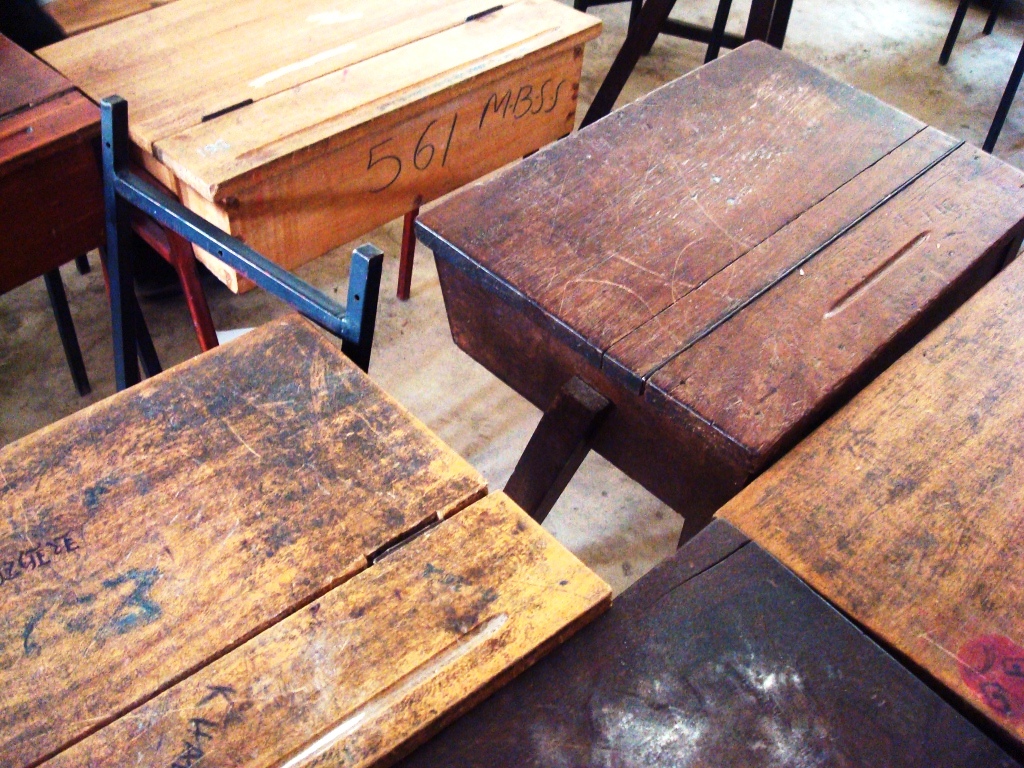
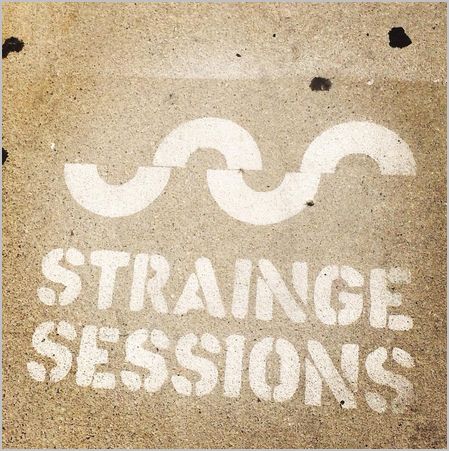
One of my tasks as an academic working in the field of teacher education over the last few years, has been to develop and promote this kind of alternative, off the rails education. Now and then I deviate into some alternative practices, which have been documented on this blog and elsewhere. Things can happen that are not planned, or may not appear to have a clear purpose. You might say these are 'strainge sessions' (I love the alternative spelling) in the sense that they don't comply with conventional educational practice. In one of my recent sessions I asked my students to use their cameras to create a 'story without words'. They not only had to create the videos or image sets, but determine what exactly the learning outcomes were. It goes without saying that each decided their own learning outcomes, and each got something different from their participation. Each had to solve their own idiosyncratic problems, and each had to think critically and creatively to successfully complete their task (the success criteria were also decided by them). Some teachers might consider this to be completely off the rails. For me it's a necessary, creative approach to support and promote personalised and critical learning.

How's that Amy? Anyone else want to set me an image/blog challenge?

All images by Amy Burvall

Creative Commons License
Off the rails? by Steve Wheeler was written in Plymouth, England and is licensed under a Creative Commons Attribution-NonCommercial-ShareAlike 3.0 Unported License.


July 16, 2015

Corporate learning in the digital age

Learning in many organisations is going through radical change. Some are ditching their training rooms in favour of digital delivery of content, and bosses that are forward thinking are investing in social learning, social media and mobile devices to support the learning of their employees. When I was invited to speak at a Human Resources and Corporate Learning conference in Cologne, Germany I did an interview about how organisations are remodelling their learning strategies around new and emerging technology. The interview, by Bettina Wallbrecht and Stefanie Hornung for Zukunft Personal is also available in a more extended version in German at this link. We started by discussing the rapid development of new technologies such as social media and mobile phones, and their implementation in work place learning.

What do these new developments mean for trainers and how do they adapt to these changes?

Some trainers find it hard to keep up because they think it is too fast and too complicated for them to understand. But any teacher or trainer can exploit the power and potential of these new technologies. Many of them are free and easy to use, and there is a definite pedagogy underpinning the use of these technologies. They just have to be aware that there are privacy and identity issues, issues of safety and content management. I urge every teacher and trainer to try these technologies out in a safe environment to see how they work and what they can do for their learners.

Can we apply this also to corporate learning? Do companies use these technologies, and how?

Oh yes. I can give you at least one example: Just recently I was speaking at a conference in London (Learning Technologies). 450 people attended representing many major companies, from for example, banks, manufacturing companies, the police, the military and government departments. Many of these 450 people were already doing something new with technology and wanted to hear all about the latest digital media and technologies. I think that it is a growing trend that corporate trainers are tapping into the power of these new media and technologies.

Do companies support the use of these technologies by their employees?

Well, corporate barriers are a problem - for instance when the management says you are not allowed to use Facebook because it's against company policy. I say to them, if you ban Facebook, you are losing one of the greatest opportunities to gain social credibility and social traction that you are going to have: the power of social media to connect people professionally as well as personally. The ability to tap into a professional network is one of the most valuable that an employee can have. So don't turn your backs on social media in the workplace. Rather than block it, facilitate it in a way that it becomes a benefit to both your employees and your company.

You once said that learning transcends the boundaries of the classroom. Do you see problems when professionals, for example specialists in a certain field, connect with others from different companies?

Companies obviously want to protect their secrets, they have to - to a certain extent - because if they don't, their rivals will come in and steal their ideas and capitalise on them.  But there are ways of sharing information, there are also ways of marketing where messages become viral, enabling you to exploit the power and potential of social media, to sell your ideas to people. You see, all of my content is licensed under Creative Commons, which means that it can be shared and repurposed under the same licence with which I have licensed it. Sometimes people translate my blog posts into other languages, and this way I get a huge audience which I would otherwise not have had. This is what companies have to see: They may wish to protect some things, but they may also wish to open up their ideas to sharing, to gain more credibility, more effective marketing and more efficient promotion of their ideas and products.

In Germany, HR professionals have to face the demographic change. Are the new learning technologies just a new way to learn for digital natives or also for older people? 

I don't believe that younger people are more adept in using technology just because they were born after 1980 and I don't want to categorise people this way. In my view, it is all about context rather than about age. What matters is what uses you see for the technology and then there is a willingness to learn how to use it. When you understand that these technologies are for everybody to use, demographics such as age don't really matter that much.

How far are all these changes we talked about international phenomena?

In one sense, there are huge differentials between how people use technology to learn to connect with each other, to communicate, to do commerce and business. If you go to Singapore, a small country where there is a population of people who are very much immersed in technologies, because it is one of the most wired - or wireless - countries in the world. You can't compare that to the Gambia in Western Africa, another very small nation where they don't even have a power (electrical) infrastructure for most of their country. But in other ways everybody is in the same boat, because everybody wants to learn, everyone wants to have a good life. The needs, aspirations and hopes are the same, but our opportunities are not the same. The future is unevenly distributed, which means tat the future is not here yet.


This is a brief video I did in 2012 at Learning Technologies that is related to theme of companies integrating new technologies into their corporate learning strategy (and how to get around some of the perceived barriers in organisations). Look out for my comments on positive deviance and the IPD - Innovation Prevention Department!

Photo by Niklas Wikström on Flickr
Video courtesy of Martin Couzins

Creative Commons License
Corporate learning in the digital age by Steve Wheeler was written in Plymouth, England and is licensed under a Creative Commons Attribution-NonCommercial-ShareAlike 3.0 Unported License.


July 15, 2015

The first technology

I have been working in the field of learning technologies for almost 40 years. As you can imagine, during this time I've seen quite a few developments. Have there been any surprises along the way? Plenty. In fact my specialism never ceases to amaze me, because there is always something new to learn, some new technology, app or software tool to get to grips with, or some new theory or model that is being proposed. The most important thing for me has been to find out what is coming next, so that not only am I prepared for it, I can also tell my students, colleagues and my wider academic and professional community about what I think will be the potential impacts of new ideas and technologies.

Frankly, that's why I started this blog.

One of the biggest surprises for me has happened in the last decade or so. Social media, in all its forms, is I believe, one of the greatest innovations ever to impact on the world of learning, in all sectors. It has caught on very quickly. The fact that anyone can connect with anyone else in the world, and can tap into any community of practice they are interested in, is very powerful. Knowing that you can learn from others, especially those who are knowledgeable in your field, and can sometimes obtain instant responses from them, wherever they are in the world, is very liberating.

I don't see this as a revolution in learning though. Rather, I'm inclined to agree with the argument proposed by Brian Winston (1998), that we are witnessing an evolution of tools, and that all new technologies and ideas are based upon older versions, updated, upgraded and extended. We are always building on the previous work of others, and we should never forget this. The phrase 'standing on the shoulders of giants' is always very apt in the world of learning technology.

The first technology for me has always been language. We cannot overemphasise the importance of language. All other technologies derive from it. Language was developed by various cultures and societies so we could communicate directly and clearly to each other, and it has evolved into the multiple tongues and dialects we now see being used every day around the globe. Ever since we learnt to communicate through speech, we have been devising new ways to convey our thoughts, to amplify them and to disseminate our knowledge, ideas and beliefs. From the cave paintings of the Paleolithic Age, through the early forms of distance communication such as smoke signals and flag semaphore, then the printing press and the telegraph, to the modern day versions including the telephone, radio, television and the Web, we see a gradual progression of our ability to communicate with each other. One-way communication enabled instruction. Two-way communication enabled discussion.

Inherently, we are always striving to find new ways to connect with each other to communicate our thoughts, share our knowledge, and learn from each other. That is the basis of education, and language is the principle technology upon which all learning is based.

Reference
Winston, B. (1998) Media, Technology and Society: A History: From the Telegraph to the Internet. London: Routledge.

Photo by Pexels

Creative Commons License
The first technology by Steve Wheeler was written in Plymouth, England and is licensed under a Creative Commons Attribution-NonCommercial-ShareAlike 3.0 Unported License.


In the mixer

Blended. It used to be something you did in the kitchen. With a machine. Saved you having to mix ingredients with your hands or a utensil. Took away a lot of the effort. Hopefully, the end result was edible.

Now blended has come to mean something else, at least in the education domain. But what exactly does we mean when we talk about blended learning?

Once, blended learning was an easy concept to understand. It described the difference between traditional and distance education. You mixed your face to face learning experience with remote learning, usually mediated through some kind of technology. First it was paper based, and then there was a rapid evolution of technology, and now the distance side of blended learning comes in many shades and hues. The most common form of blended learning today is where you spend some time in the classroom, but the majority of your time studying online. Some people call it the flipped classroom. Whatever. It's blended. Local and remote. There you go.

But it's not a simple as that now. Blended learning is taking on a number of other connotations, because thanks to the advent of the digital device, there are now many more modes of learning. Consider for example the blend between mobile and tethered learning experiences. You can be mobile and take your learning beyond the classroom, but you can be away from the classroom and still be tethered to your technology. What are the issues here? There is plenty of debate and much research in this area, not least around student preferences. Some people prefer to learn on the move, while others are more comfortable with larger screens, and with all their resources physically around them.

Then there is the blend between paper based texts and e-readers. Which is best? Who prefers which? It's a blend we are taking an increasing interest in, throughout the education community. Both can support learning on the move, but then, learning has always taken place exactly where the learner goes.

This blog post was inspired by the above illustration by Amy Burvall
What about the blend between social learning and personal learning? Surely this is another important dimension to contemporary education? You can learn different things when you're in close proximity to others, especially if they are intent on reaching similar goals to you. And yet, personalised approaches to learning are also on the increase, and although social and personal learning are not mutually exclusive, they tend to be separated out because they afford different possibilities. My view is that social learning amplifies personal learning, and all can benefit from the knowledge of each individual in the community. Blended again.

There is also learning within the same time frame, and learning outside of the time frame. In education we call these modes synchronous and asynchronous, and each has its own benefits. For example, in asynchronous mode, you don't have to respond immediately to a prompt - you can take your time, reflect, go and do some research, and then come back to contribute to a forum or online discussion. Another kind of blended.

So blended learning is becoming an increasingly complex concept, with multiple possibilities and infinite options. Blended is about choice, and about maximising your learning in the modes you find most convenient. Learning in all its forms is a little like the blender in your kitchen. Put in the right ingredients, and use a little effort, and hopefully the result will turn out to be very useful.

Photo by Steve Johnson on Flickr
Image by Amy Burvall

Creative Commons License
In the mixer by Steve Wheeler was written in Plymouth, England and is licensed under a Creative Commons Attribution-NonCommercial-ShareAlike 3.0 Unported License.


July 13, 2015

Is the ivory tower crumbling?

In yesterday's post entitled 'Open or shut', I wrote about a rise in the number of academics who are turning their back on traditional research publications such as closed journals, in favour of more open, accessible outputs such as blogs and open access journals. They are doing so to ensure their research is read by larger audiences, to open up public debate, and to disseminate their knowledge as widely as possible. They are doing this without the approval of their parent institutions, and as an act of conscience. The pitfalls are there, but so are the benefits. As Claude Lord tweeted yesterday, 'it's no longer publish or perish, it's now publish to flourish'. 

The fact is, academics are still judged on their ability to research and publish their findings in 'high impact' peer reviewed journals. High impact journals are those considered to be the most influential in their field, and they are calculated by an algorithm that considers a number of factors including article citations. It's notoriously difficult to get articles accepted for publication in these elite journals - the editors often pride themselves in their high rejection rates. However, the elite journals may have had their day, because as John Bohannon highlighted in 2014, the more highly cited papers are actually beginning to emerge from less prestigious (non-elite) journals. 
"In 1995, only 27% of citations pointed to articles published in non-elite journals. That portion grew to 47% by 2013. And the non-elite journals published an increasing share of the most highly cited papers within each field as well, growing from 14% to 24%."
So is the journal impact system still a valid measure of academic value?

Publication in high impact peer reviewed journals has been the yardstick to measure academic prowess almost since academia began. And yet, as Asit Biswas and Julian Kirshherr argue in a recent online article for the London School of Economics, there is yet another big problem with this:
"Up to 1.5 million peer-reviewed articles are published annually. However, many are ignored even within the scientific community: 82 percent of articles published in humanities are not even cited once. Rarely do scholars refer to 32 percent of the peer-reviewed articles in the social and 27 percent in the natural sciences. If a paper is cited, though, this does not imply it has actually been read. According to one estimate, only 20 percent of papers cited have actually been read. We suspect that an average paper in a peer-reviewed journal is read completely at most by no more than 10 people. Hence, impacts of most peer-reviewed publications even within the scientific community are miniscule."
Those who publish their work elsewhere, in lower echelon journals or (perish the thought) in open access journals, are often frowned upon by the academic community, or are certainly not regarded as playing the game. They are often excluded from research assessment exercises, and can be overlooked for promotion or tenure. This is all part of the ivory tower game that is played out in universities across the globe. 

It has to stop. 

Maintaining such exclusivity is damaging to the credibility of academia, and restricts knowledge that is made available to the general public. There has always been a power struggle between those who control knowledge and those who require it. What would have happened if Jimmy Wales had been overruled by his colleagues, and Wikipedia had been exclusively a knowledge repository populated by credentialled academics and scholars? What if talented and knowledgeable lay-people had been excluded from contributing to Wikipedia? Would it be as popular and useful as it is today? Fortunately Jimmy Wales won the argument, and Wikipedia is testament today of crowd sourced knowledge, the wisdom of the many, and dialogue of the masses. It is the largest and best used knowledge repository in the world. 

In their LSE article, Biswas and Kirshherr go on to argue that academics should participate more in public debate to raise the profile of scientific issues that impact on daily lives. There is currently a paucity of academics willing to do this. Without the use of popular tools such as social media, blogging and public press however, this situation is unlikely to improve. You see, the problem with peer reviewed journal articles is not confined to their lack of accessibility and their exclusivity. They are often lengthy pieces of text that are laden with impenetrable language and scientific jargon, peppered with obscure diagrams, complex tables and statistics. Brevity and to-the-point summaries are required if most people are to understand the implications of research. How do we solve real world problems, and what are the practical applications of academic research results in daily life? These are the questions the general public are interested in, and academics will need to find better ways to disseminate their findings than publishing as they always have, in obscure, privileged-access journals that are read only by a handful of their own community.

If we are going to see a shift away from this elitism, then the universities, the funding councils and ultimately, governmental education ministries must take a lead. Some universities are now beginning to accept opinion pieces, open access journal publications and social media contributions as a part of submissions for the promotion process. It's a good start.

Photo by Tom Murphy on Wikimedia Commons

Creative Commons License
Is the ivory tower crumbling? by Steve Wheeler was written in Plymouth, England and is licensed under a Creative Commons Attribution-NonCommercial-ShareAlike 3.0 Unported License.


July 12, 2015

Open or shut?

A new breed of academics is emerging in the digital age. They are the researchers and teachers who freely share their knowledge and studies online. They are circumventing traditional approaches and discovering new ways of sharing their work. They are the open scholars.

Increasing numbers of high profile academics (such as danah boyd and Martin Weller for example) are turning their backs on traditional methods of research dissemination, publishing their work exclusively on free-to-read open access platforms or on their blogs. Many have openly pledged to never write, edit or review for closed journals again. Others choose to continue publishing their work in conventional peer-reviewed journals, but also disseminate their work widely through non-peer reviewed digital channels.

There are clear advantages to publishing your work by open access (see this article on open scholarship) as this article by Melanie Fullick highlights:
"...for a growing number of academics the benefits of blogging outweigh the drawbacks. Those who blog – including me – agree there are positive outcomes, such as networking and collaborating, finding new audiences and opportunities, disseminating research more widely, and building one’s reputation. Bloggers argue that far from diluting scholarly success, online writing can be a serious tool for academic practice."
These are clear benefits that any academic who has blogged for a while will attest to. The opportunities of networking, discovering new audiences for your research and that rapid dissemination capabilities of the web are just a few of the benefits you cannot find easily in more traditional avenues of publication. Additionally, the potential of social media to amplify content and expand reach exponentially should also be acknowledged.  But there are also disadvnatages, mainly of a political nature. Fullick highlights the disdain some academics hold for open access publishing and personal publishing through blogging:
"Peer-reviewed articles are still the benchmark for academic professionalization, and some graduate students and early-career academics feel that blogging is a waste of precious time that could be spent on “legitimate” publishing. Because it’s a form of self-publishing that lacks peer review, blogging isn’t usually viewed as a legitimate form of scholarship."
Blogging and other non-conventional forms of research dissemination tend to hit a road block where tenure and promotion are concerned. They are not accepted by universities when it comes to applications for research funding either. Blogging and unconventional publishing are not for the faint hearted. Indeed, many early career researchers are forced to toe the traditional line just to stay within their posts. This is a shame, but a necessary obligation.

For established researchers and those who have gained a reputation, it's different story. The benefits of publishing your work through blogging can be huge. Some academic bloggers can boast of thousands, or even millions of views each month. Many would argue that this is what research dissemination is really all about - sharing your knowledge with as many people as quickly as possible, with maximum impact. Universities usually reject this approach because peer-review is absent from the process, and it is difficult to assure the provenance, quality, rigour and veracity of the work. Having had first hand experience of a number of closed journal review panels, I have to say that formal peer review doesn't always assure these. But the universities and the funding bodies persist in their support of this antiquated and far from effective method of research dissemination, and the dominant publishing houses rub their hands as they cash in.

And yet as increasing numbers of academics and scholars are pledging their allegiance to open scholarship and open publishing, so the blogs written by reputable scholars continue to appear. Recently, Dutch universities boycotted the publishing giant Elsevier because of its 'stranglehold' on the academic community. Academics are beginning to stand up and speak out. There is a sense that a change is in the air. We must fervently hope so, because our academic communities deserve to have access to the latest knowledge in a timely manner, in a format that is of high quality and, in an openly accessible form. What they don't deserve is for publicly funded research to be hidden behind pay walls that only a handful of academics will ever read.

Photo by Justinc on Wikimedia Commons

Creative Commons License
Open or shut? by Steve Wheeler was written in Plymouth, England and is licensed under a Creative Commons Attribution-NonCommercial-ShareAlike 3.0 Unported License.


July 07, 2015

Future schools, future visions

I must admit I'm a big fan of Richard Gerver and have had the pleasure of working with him now and then over the last few years. Richard was also kind enough to write the foreword of my latest book Learning with 'e's, in which he swears blind that we met on a camel in the Saudi desert - during a social event for the ELI conference. Well, he spins a very good yarn, but we really did meet in Riyadh, and we had a lengthy conversation during the same conference (back in 2013). We discussed a number of issues around skills for the 21st Century, the role of the teacher, the nature of education and the future of schooling. Richard is a well known speaker on the circuit. He's an ex-headteacher and he has some very thought provoking views and insights on leadership, change and education. And so we took the opportunity to compare our personal visions for the progress of education, discuss our mutual concerns about the current state of schooling, and share our optimism for the future. Our dialogue embraced a number of themes including the necessary skills and literacies children will need to survive in the digital age, the impact of technology and change on education, and an insight into the concept of personalised learning. It was a conversation we enjoyed very much, and as luck would have it, a film crew was on hand to capture the entire discussion on tape. Here is an edited version of that discussion, courtesy of the King Abdullah bin Abdulaziz Public Education Development Project.


Photo by Steve Wheeler

Creative Commons License
Future schools, future visions by Steve Wheeler was written in Plymouth, England and is licensed under a Creative Commons Attribution-NonCommercial-ShareAlike 3.0 Unported License.


<< Back Next >>