Log on:
Powered by Elgg

Clara O'Shea :: Blog

April 12, 2012

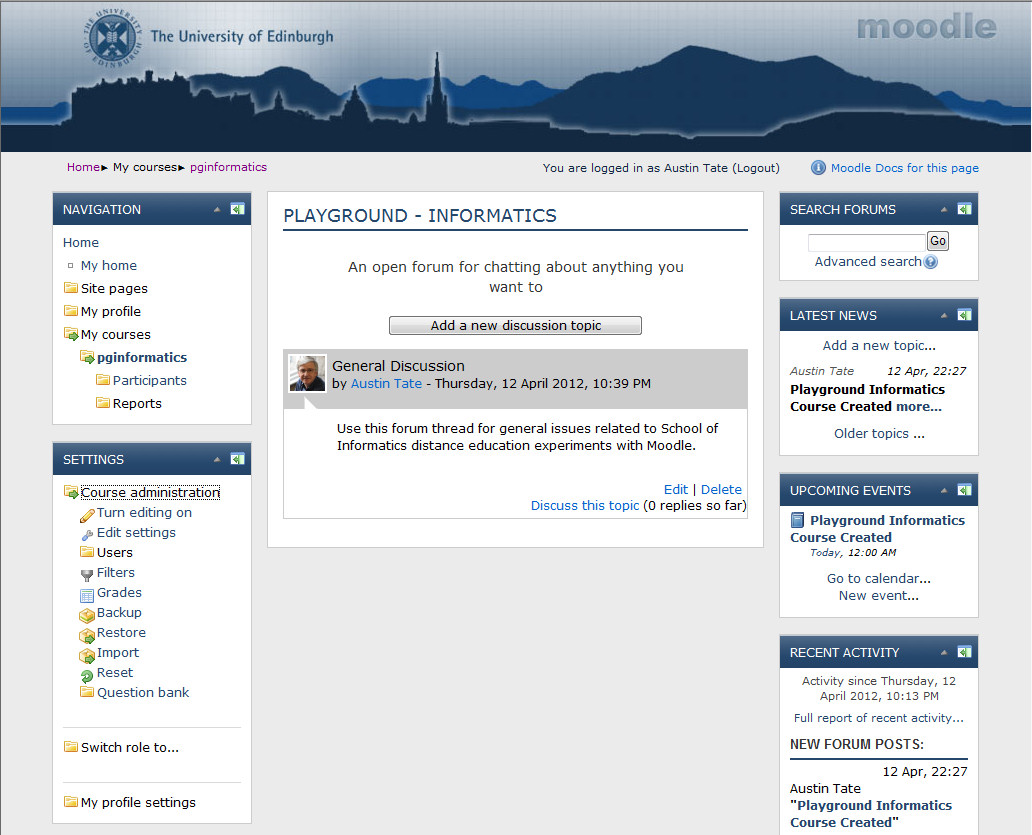
The University of Edinburgh Moodle Virtual Learning Environment is now available at https://www.moodle.is.ed.ac.uk

A playground for experimentation with Moodle for the School of Informatics distance education initiatives is now available with course name "Playground Informatics" (pginformatics).  The UoE Moodle is currently only available for such distance education courses as the service is built up.

People who would like to participate as a course teacher or student should initially contact Austin Tate and provide their EASE UUN, as all users are currrently being added manually.

Note that we also have our own experimental Moodle setup, running in Appleton Tower on an AIAI server... for testing use only as its on one of our manually managed windows desktop servers at http://virtual2.aiai.ed.ac.uk/moodle/

Keywords: Informatics, Moodle, Playground, VLE

Posted by Austin Tate | 0 comment(s)

March 30, 2012

For my MSc in e-Learning IDGBL Game Design exercise I have created an exploration style game with a Na'vi/Avatar theme.

The web site for the game information and links to allow access to the areas in which some elements of it can already be played in Second Life are at:


More details of the elements that went into the design are in this blog entry - Game Design Preliminaries.

Keywords: Game Design, Moon Bloom, Na'vi, Pandora, Second Life

Posted by Austin Tate | 0 comment(s)

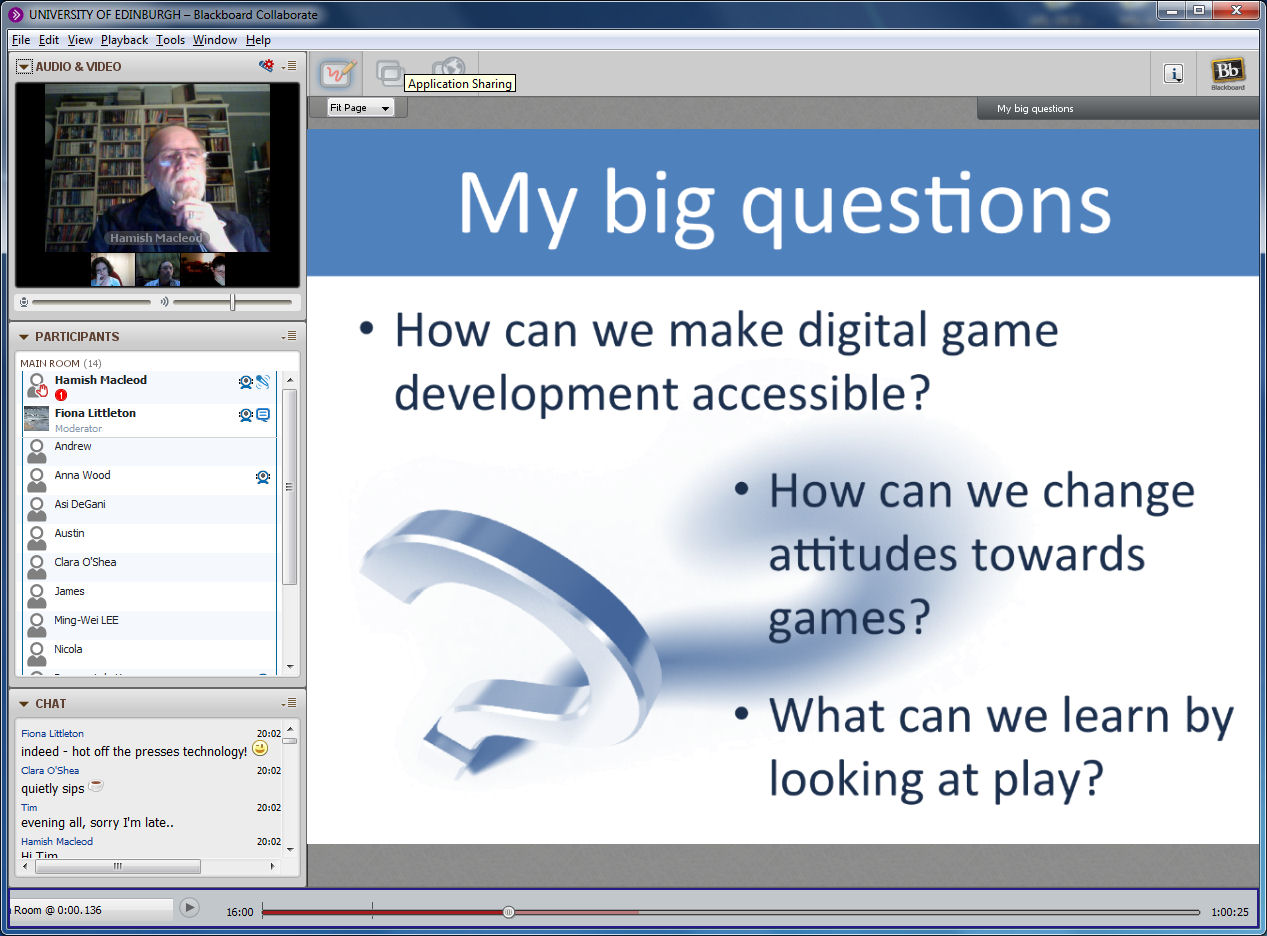
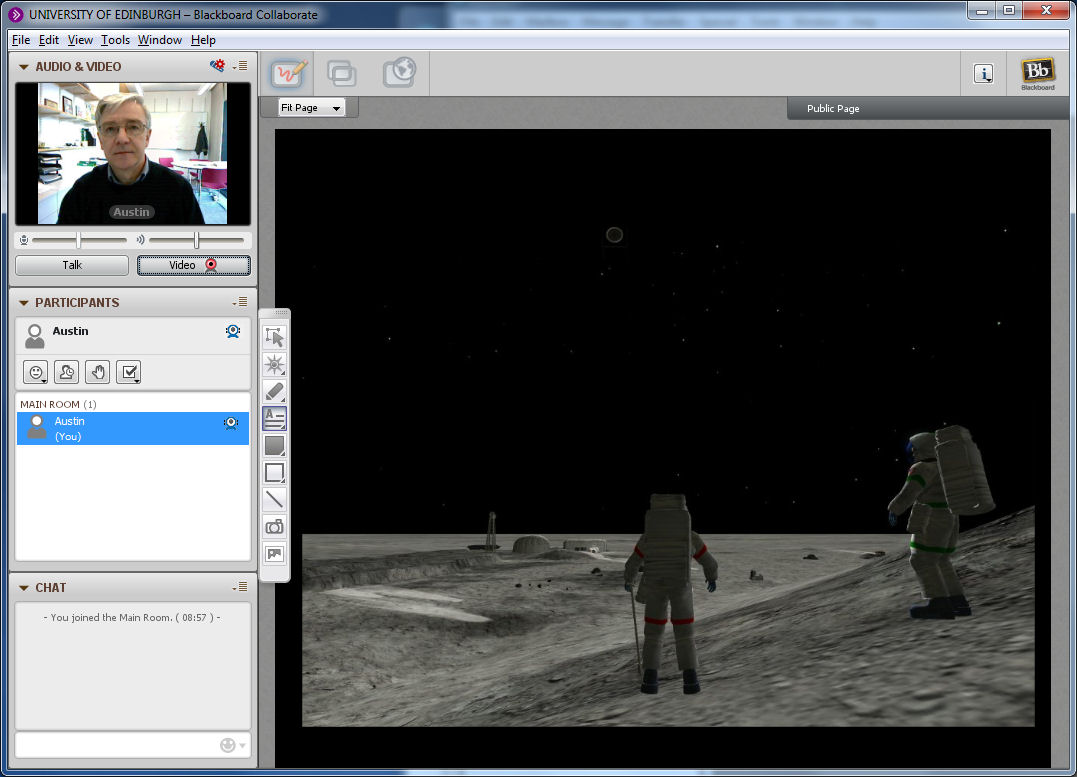
The University of Edinburgh has chosen Blackboard Collaborate as its virtual classroom. It provides Adobe Connect style tools with multi-way video and audio teleconferencing, particpants lists and profiles with hand raising and AFK indicators, and text chat with emoticons. A tools area can be used as a whiteboard with slide upload and markup by participants. It can also be used for application sharing and co-browsing.  The session can be recorded and played back.  Elements like the text chat, participants list and whiteboard contents can also be saved either during a live meeting or from a rercording.

One possibility for use could be to record a synchronised speaker and presentation, and make that available via the recording.  Screen capture tools such as TechSmith Camtasia can be used to capture off a recording to allow for transcoding into a regular video format for other uses, YouTube, streaming, etc.


Keywords: Blackboard, Collaborate, IDGBL, Recordings

Posted by Austin Tate | 0 comment(s)

March 17, 2012

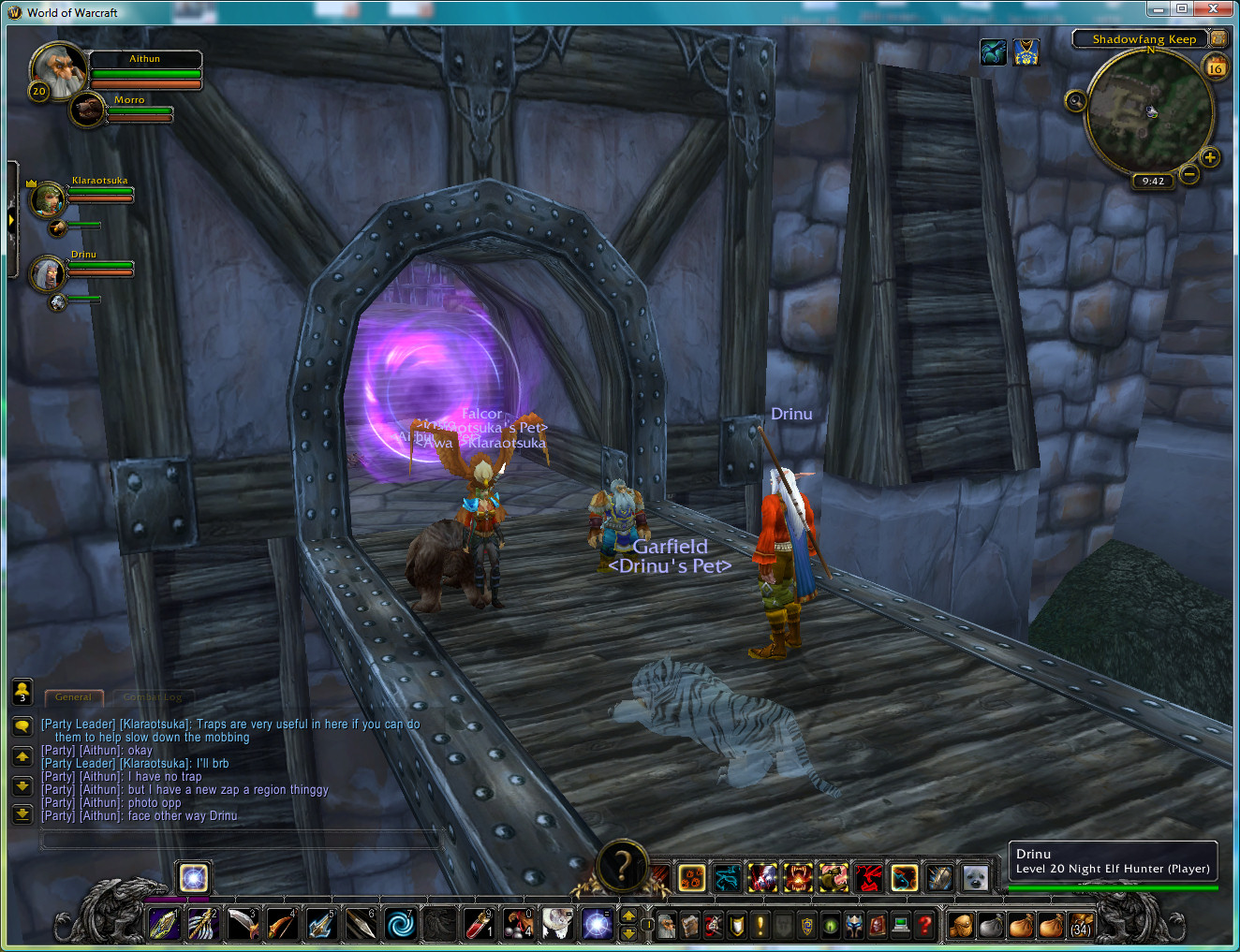
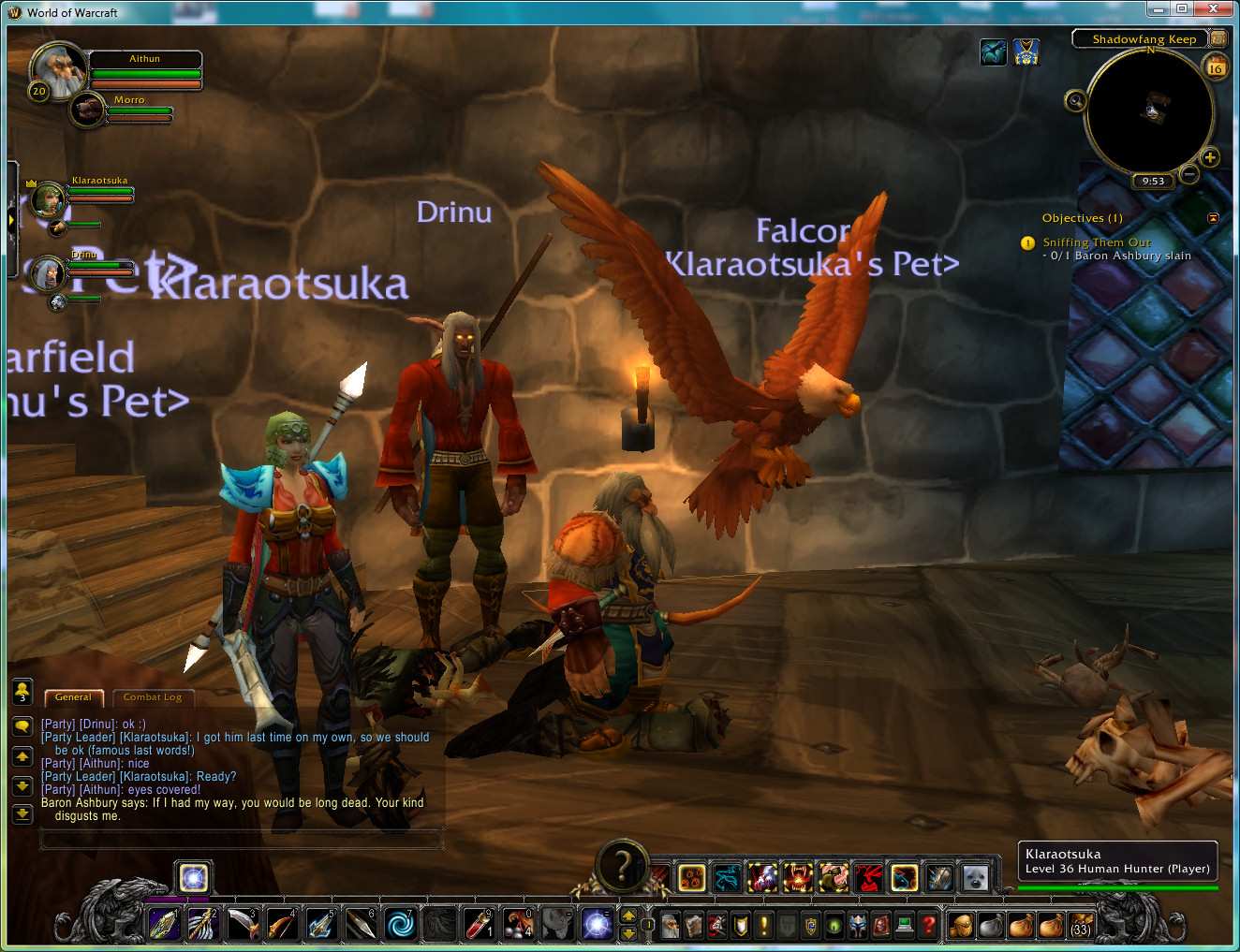
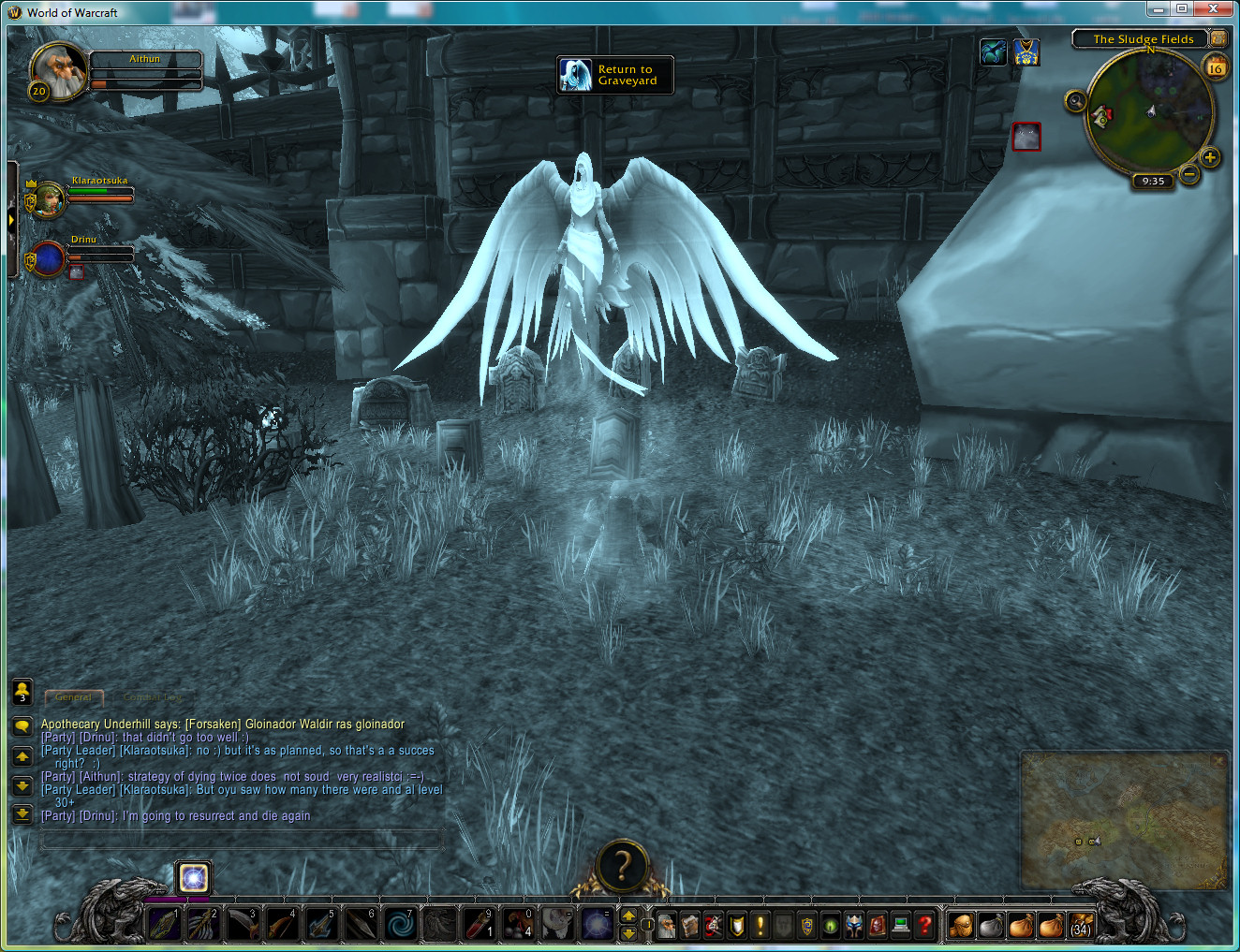
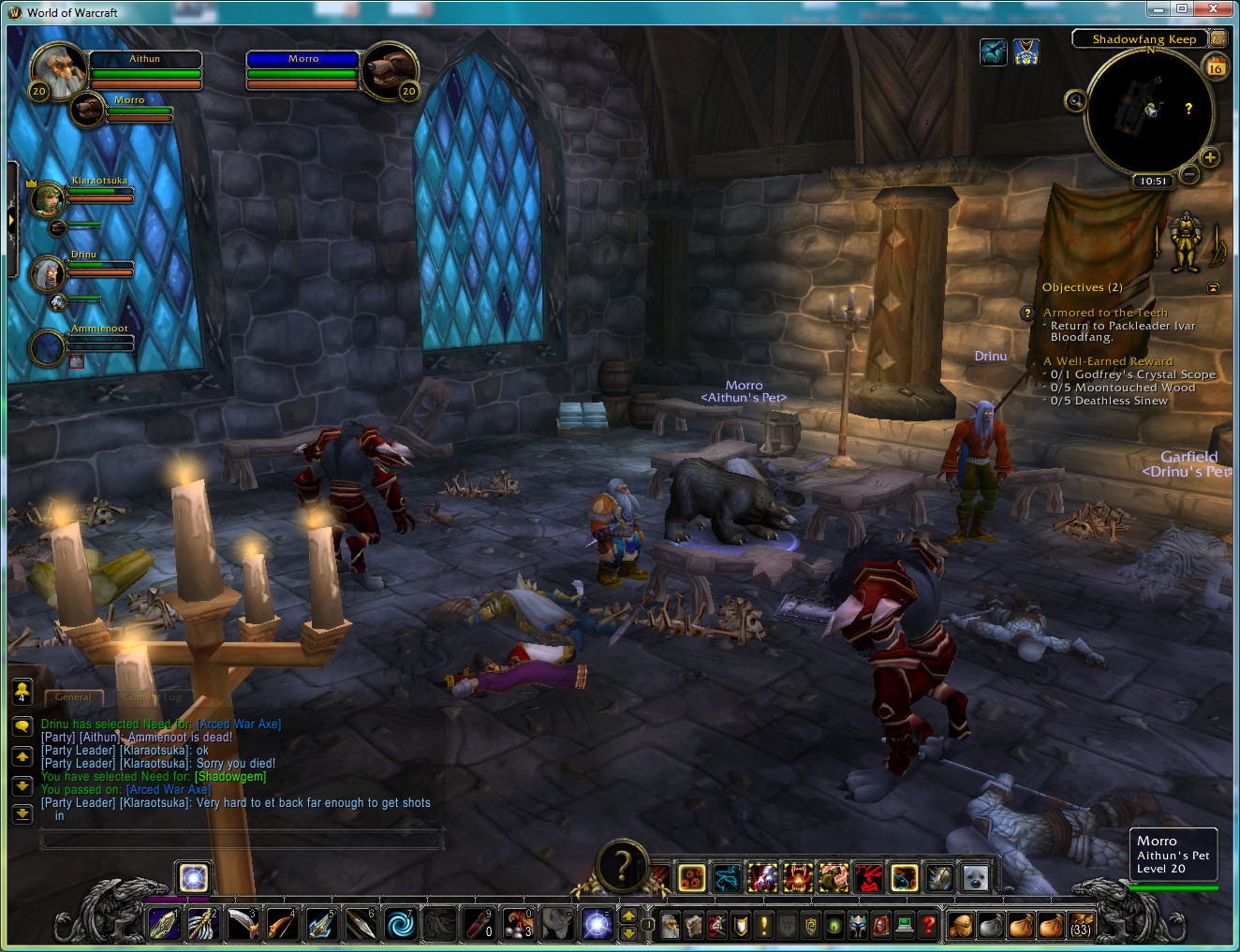
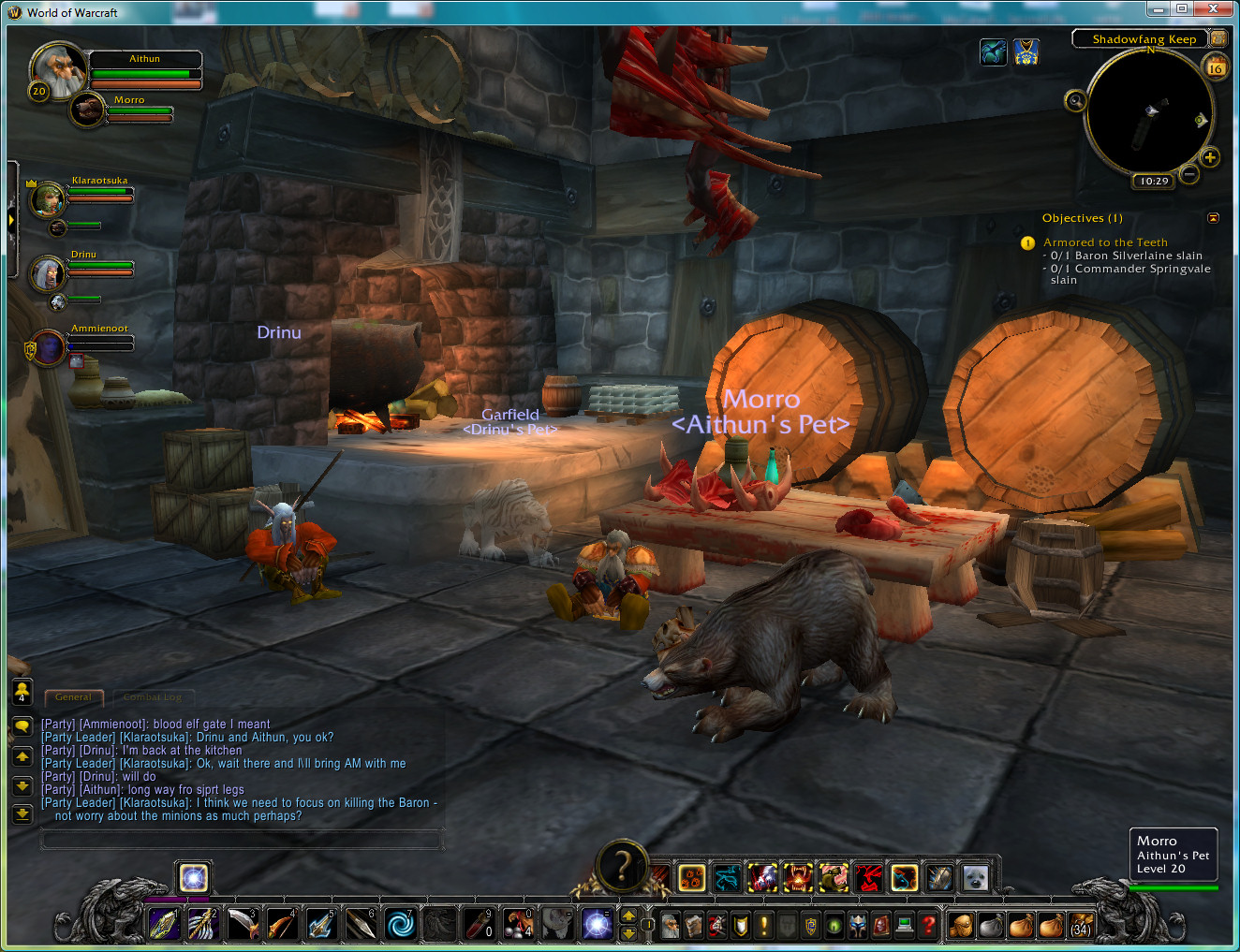
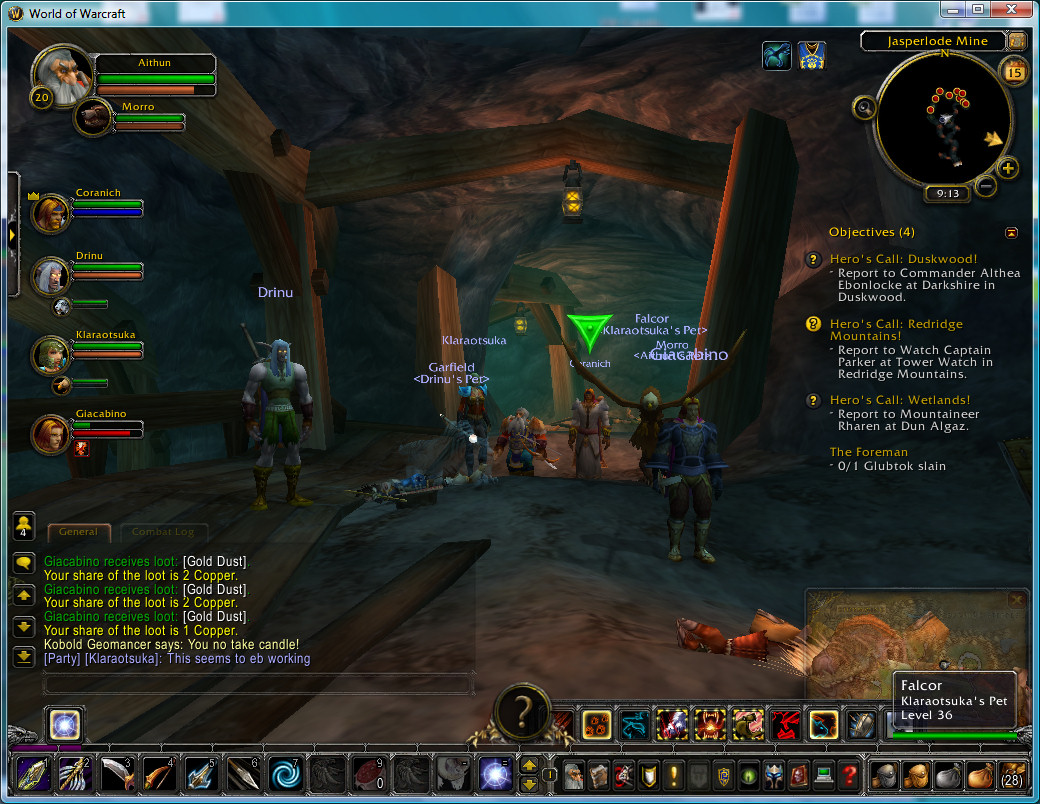
The Fellowship of MSc folks met at the Aerie Peak gryphon point to fight our way North towards Shadowfang Keep. Avoiding death is not an option on this journey, and you quickly become accustomed to making a little progress, dropping dead from the onslaught, appearing as a ghost in the graveyard, returning to your body, and placing yourself as far onwards as possible.  Then looking round for the baddies who may show as ghostly figures near you. Then resurrect and run as fast as you can onwards again. It takes a few goes to get through heavily fortified gates.

Shadowfang Keep is entered via a portal into an "Instance" of the game. These are special areas in World of Warcraft where your group or raid party is able to interact with a dungeon privately; that is, without interference from other parties. See http://www.wowwiki.com/Instance

I also learned that taking in plenty of food in advance, to sit down("x" key), and preferable to eat as well, is important to allow a quicker recovery. Free to play accounts cannot receive health boosts or food supplies from other players.

Good team support meant that weakening players, like my dwarf, were assisted when set upon by multiple "mobs". Carnage did at times occur.

The team prevailed and completed the quest.  We all now have stronger bows thanks to the rewards given by the grateful occupants of the Keep.


Keywords: MSceL, Shadowfang Keep, World of Warcraft

Posted by Austin Tate | 0 comment(s)

March 16, 2012

The Fellowship of IDGBLers met once more on 15th March 2012. This time to take on the challenge of a "Dungeon" available through a portal which takes you into a separate "instance" of the game.

I think we had fantastic teamwork. If we had just sailed in to the Dungeon with 4 strong players and even my short legged dwarf we could have wiped out everyone. Without much stratgey. But Coranich left to pick up a classmate.. and we all got wiped out! We tried again with much more care and planning and despite a few "deaths" we won through. Folks covered one another better, and we went to find lost characters - like myself once too. We had to learn new tricks for blasting open doors too. We were definitely in our ZPD.


Keywords: Deadmines, IDGBL, World of Warcraft

Posted by Austin Tate | 0 comment(s)

March 15, 2012

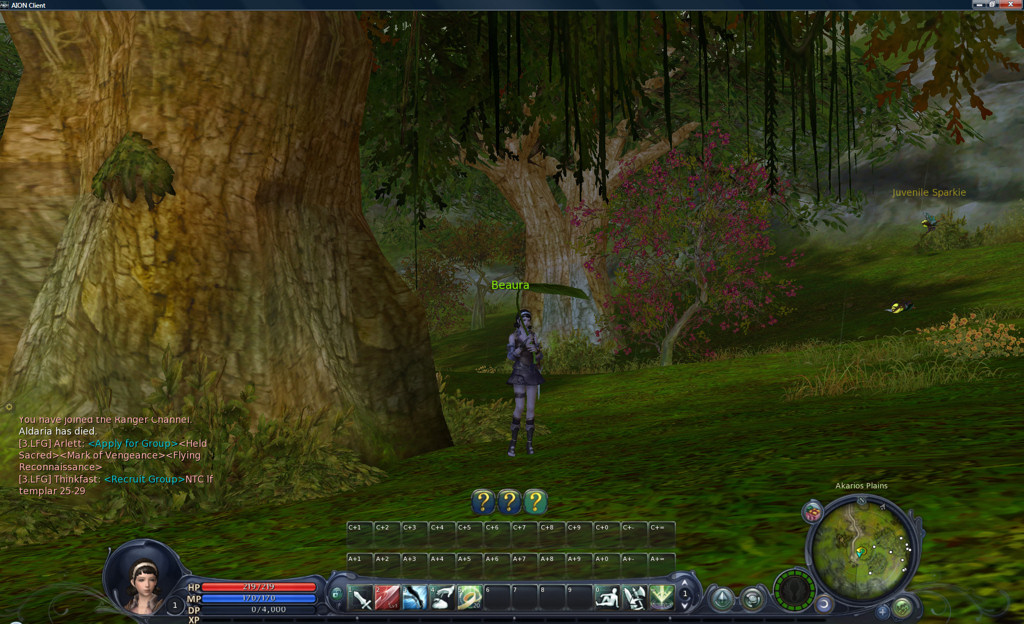
I tried the free to play Aion MMORPG available for download from http://www.aionfreetoplay.com/. I am on EU server "Anuhart".

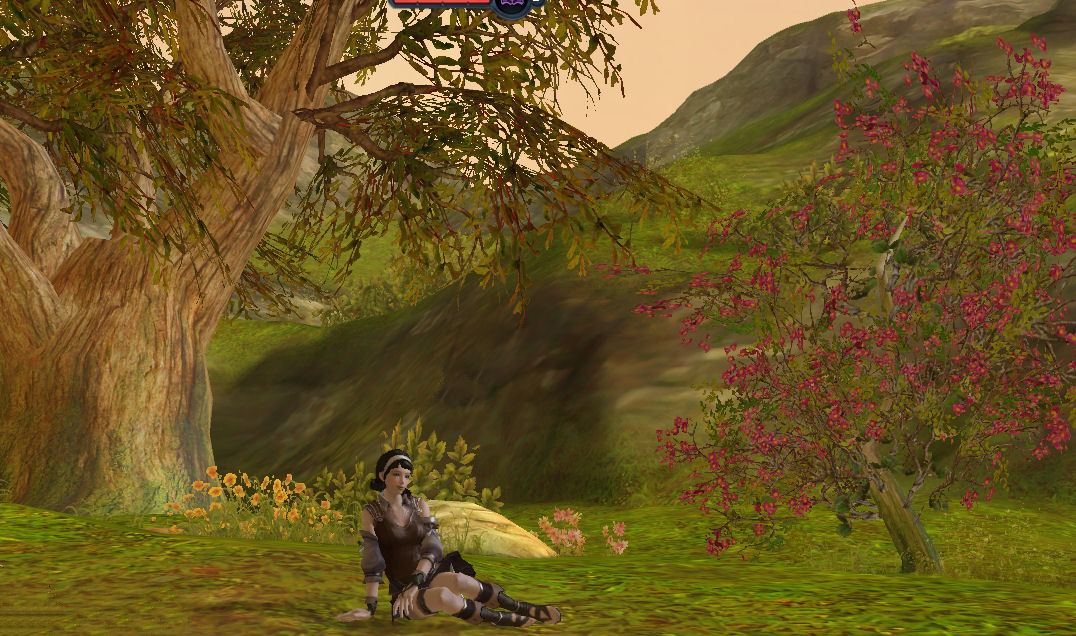
I entered as one of the races of Daeva (assigned to me on account creation), and selected the Elyos faction and Scout class. It was raining, hence the leaf umbrella.

The free to play Aion game allows for only 2 characters to be created, but gives access to all 55 levels, nearly 4,000 quests, and all territory travel, unlike the level 20 restricted World of Warcraft free starter edition.

Entering a new world, with a new character, even though the interface had many similarities to World of Warcraft, reminded me how important scaffolding was, and the value of the community created wiki information sites. I will hold off creating my main (male) character with my usual name prefixed aith "Ai" until I know more about the game and the factions. 

Keywords: Aion, IDGBL

Posted by Austin Tate | 2 comment(s)

March 13, 2012


Studying games based learning means I tend to encounter the phrase ‘I’m no good at games’ a fair bit. The problem I have with it is I’m not sure it is possible. What people who say this actually mean is any one or more of the following:

1) I am intimidated by computers or don’t want to learn

Needs no explanation, we’ve all seen it. In this example ‘no good’ translates quite nicely as ‘don’t want to try’. It’s about motivation. I’ll cite my Grandad as case in point. He doesn’t want a mobile phone because he’s no good at ‘technology’, but he can achieve the kind of magic with the cricket on his Sky+ box that I can only dream of.

2) I consider gaming to be a somehow lower form of entertainment

This one might be a little bit specific to the shire of white middle class England I live in, but there’s a social divide in play. You can test this out for yourself. Next time the ‘what did you do at the weekend’ question comes up in a peer group try alternating your responses between:

  1. I got my hunter up to level 20 in WoW.
  2. We went to the new Titanic exhibition at the city museum and I finally got round to finishing Obama book.

3) I’ve forgotten that ‘games’ is a wider field than that shooting thing my son likes

There’s no question that electronic gaming has got popular. The problem is that people tend to generalise based on what they see in the media. Talk about gaming and our first points of reference are either first person shooters and how they are encouraging little Jonny to go all Black Hawk Down on his school or that weird kid who stays up all night doing strange things with orcs.

Gaming is a massive field. It includes those board games you used to love and still make me play at Christmas, the whole of the sports world, even those stupid games you play with yourself on the commute to work or with the receptionist in your building. I refuse to accept that anybody can be bad at Every Game.

4) I feel the need to project myself as a serious grown up

This is very similar to 2), but needs a section of it’s own. At what point in our lives do we stop playing? Early childhood play is about learning. Go to school and learning becomes work and play what we’re allowed to do afterwards. As ‘serious’ adults do we spend time playing? Would you be prepared to tell your friends in the book group you’ve been playing? Why not?

5) I want to stop this conversation as soon as possible and talk to somebody here who is less geeky

Potentially more a reflection on me rather than the wider subject…

Image source- PS3 Controller by Chi

Posted by Tim Dalton | 0 comment(s)

March 09, 2012

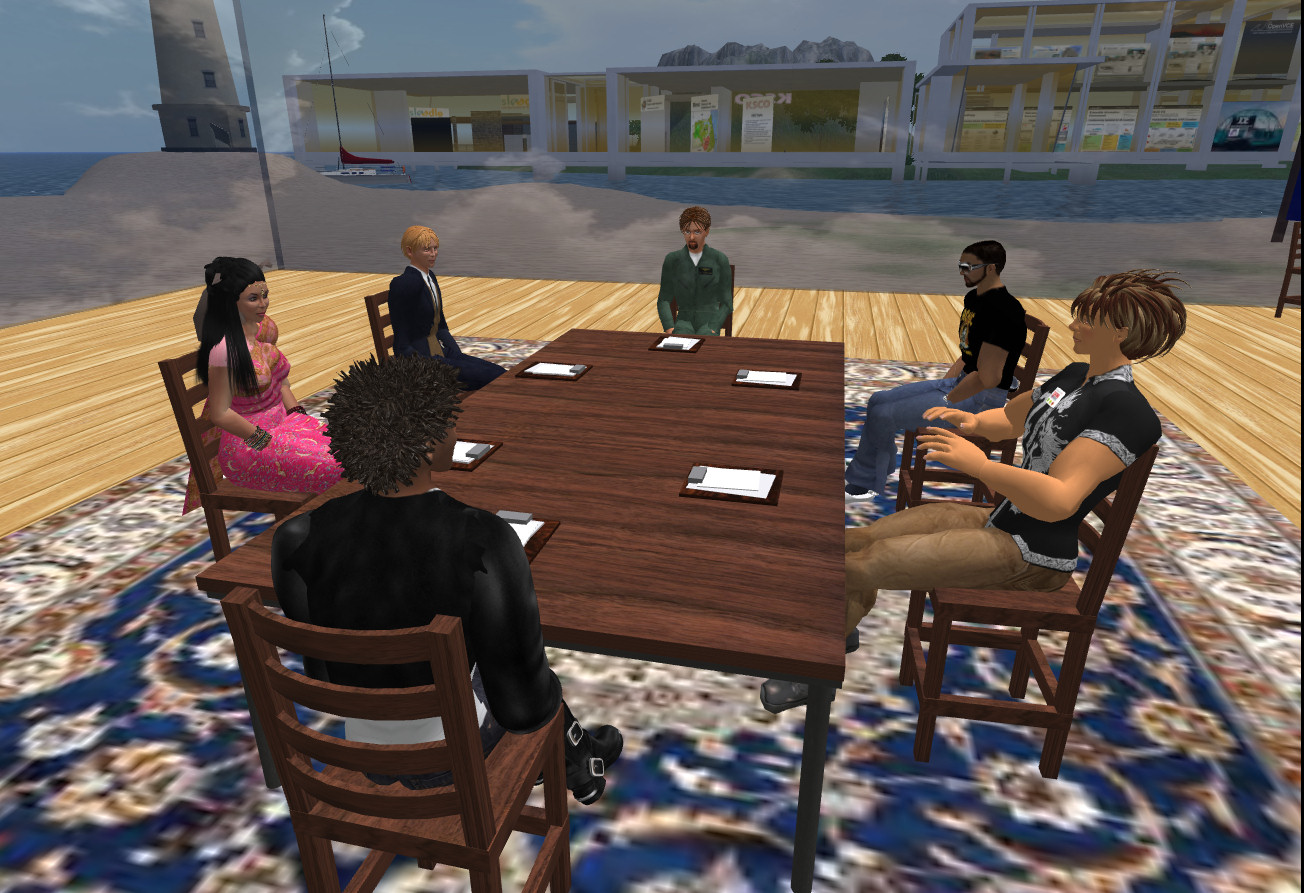
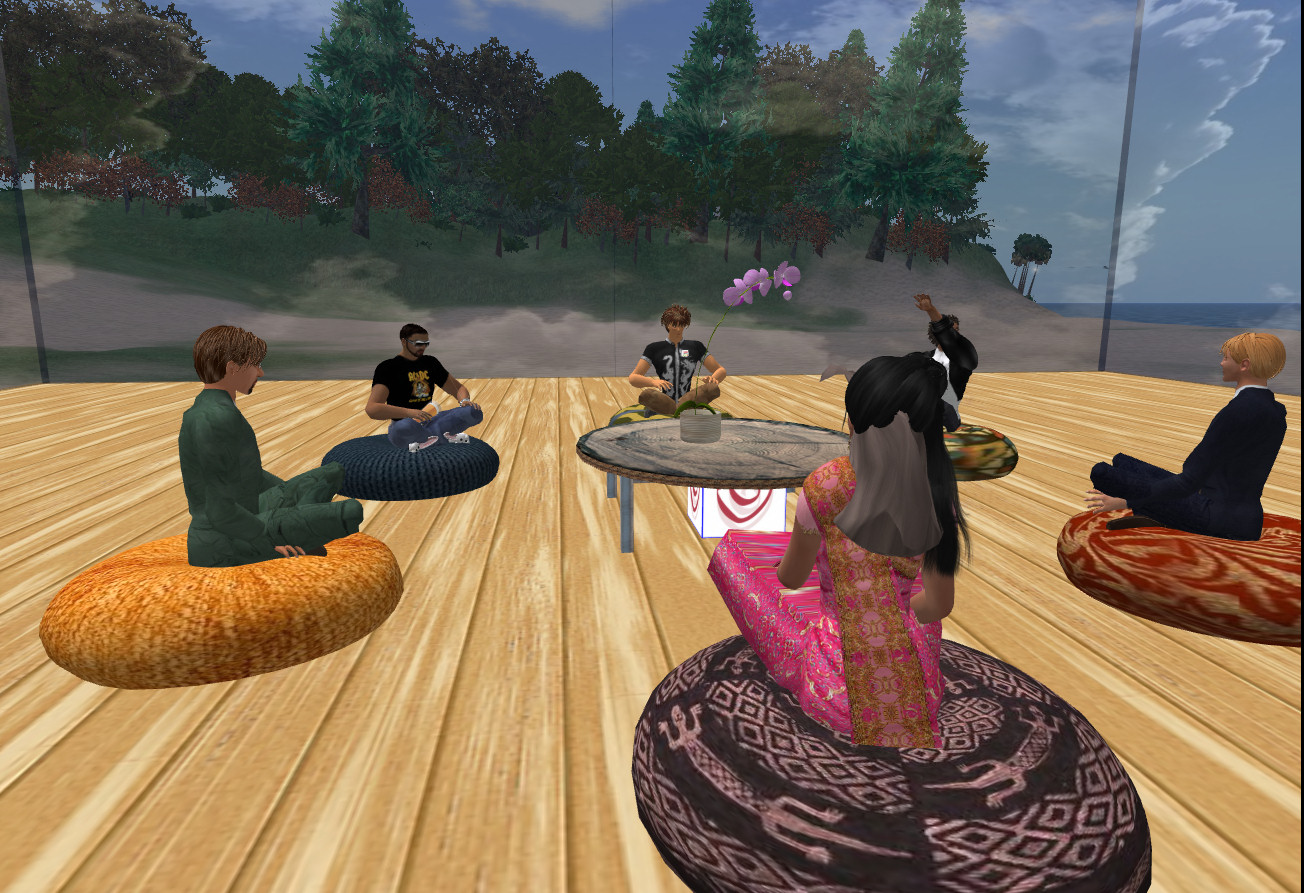
The Introduction to Digital Game-Based Learning class met Elena Northmead at the Virtual University of Edinburgh's Vue South Beach Pavilion in Second Life for a discussion on Augmented Reality Games.

Keywords: ARG, Second Life

Posted by Austin Tate | 0 comment(s)

March 07, 2012

I’ve been spending a fair bit of time in WoW recently, attempting to mash it into the PLTS framework to see what comes out the other end. More on that to come. In this post I want to talk about failing and how we’re not doing it nearly as often as we should.

The thing about learning to fail is that you learn that it’s actually not so bad. You develop skills to help you manage it, to come back afterwards. But we’re scared of it. We’ve built a system where failing is a big bad thing, and we must avoid it at all costs.

Distinctly Average

The problem with that is it breeds mediocrity. The biggest hardest part of my role is dealing with the fear of change, the unknown. It is safer to stick with what we know, maintain the status quo. You see it in individuals, and in whole institutions. You can’t fail if you don’t push it too hard.

This attitude means we end up falling into a trap where can can easily do the same to our students. At the big scary end of school you must pass your exams to get to the next thing. Want to create an environment that’ll scare you about failing? Not being allowed to carry on if you do will achieve that.

I don’t have a huge problem with this though. We need goals to challenge us, targets we are motivated to achieve. Succeeding at a difficult task is such a positive experience, we can’t take that away.

My problem is that because the fail is scary rather than building their confidence to think they can do it, it’s safer make the task easier. Take the BTEC in X because it’s an easy way to 5 GCSEs rather than doing that triple science you’re not smart enough for, improve this coursework by doing Y in order to tick enough boxes on the mark scheme, your current grades mean you should do the foundation paper and get a safe C grade rather than risking the higher, and so on.

Gamification

In the game world the tasks don’t get easier the more you fail. There isn’t an easy way round a hard obstacle, you just have to persevere. What we in schools need to learn from games is why people come back to them, again and again.

One reason is because it’s safe to fail. I’m happy to admit that in WoW I die fairly frequently. When you die in WoW you become a ghost, a little gravestone appears on your map and you have to head off and find your body. Once you’ve found it you carry on from where you left off, having learned from your mistake.

The quest doesn’t become any easier to accommodate my poor play, I don’t get a man over my shoulder telling me which button to press. I reflect on my own performance and adapt, all the time knowing that if I’m still not quite successful I can just have another go.

I’ll finish with a McGonigal quote:

“When we’re playing a well-designed game, failure doesn’t disappoint us. It makes us happy in a very particular way: excited, interested, and most of all optimistic”
Image source- red fail by griffithchris

Posted by Tim Dalton | 0 comment(s)

March 06, 2012

The Introduction to Digital game-Based Learning class met Frank Lassard at the Virtual University of Edinburgh's Sandbox in Second Life for a demonstration of Holodecks for creating scenes for role play and meetings.

Keywords: Holodeck, Second Life

Posted by Austin Tate | 0 comment(s)

<< Back Next >>