Log on:
Powered by Elgg

Vasilis Babouris :: Blog

February 16, 2010

We have been given a couple of research papers for critically evaluation. One of them is by Dunleavy et al (2007) which looks at the "value addedness" of the one child per laptop (OLPC) project. What struck me here is that there are similarities between the OLPC initiaive and that of our partly JISC funded project, iBorrow. Whilst the OLPC project is ensuring that there is a "laptop per child" and iBorrow is about "borrowing a laptop" - the similarities here are one of transformation (or at least potentially).

Our students have a choice of using one of the 200 netbook devices or one of the 120 fixed desktop PCs - which ones are they drawn to and under what circumstances? They have relatively free reign in a large learning space (incorporating library, cafes and student services) the size of a football pitch across three floors - which means they have a choice as to where to work, learn and play with these netbooks - and again, which zones are they drawn to and under what circumstances?

Which leads us to another set of interesting questions:

  • What kind of affordances do these devices bring?
  • Are they indeed "value added" or something else?
  • Does the combination of group work and mobile devices differ from that of group work and fixed devices?
  • Does an "underworld" of virtualised peer support exist in these groupings?

I have a lot to think about and mull over before I finally hand in my project proposal in April 2010 - the trick here is to keep the research question(s) tightly focused.

If you are interesting in delving deeper into the OLPC project, Nicholas Negroponte, author of "Being Digital", founder of MIT Media Labs and founder of the OLPC initiative provides a nice summary of what the initiative is and the some of the issues of getting the project off the ground. James O'Hagan's blog "1 Laptop : 1 Student" offers some "stories" and case studies taken from practitioners of the initiatives.

References

Dunleavy, M., Dexter, S. & Heinecke, W.F. (2007). "What added value does a 1:1 student to laptop ratio bring to technology-supported teaching and learning?". Journal of Computer Assisted Learning, 23, pp. 440-452.

Keywords: choice, iborrow, institutional innovation programme, jisc, mobile technology, one laptop per child, project, questions, research methods, rmel2010

Posted by Wayne Barry | 0 comment(s)

February 04, 2010

My University is involved in phase two of JISC's Institutional Innovation Programme:

"This programme represents a £13.08m investment aimed at supporting existing institutional strategies by providing solutions to institution-wide problems, based upon proven practices, technologies, standards and services. The solutions will act as exemplars to other institutions by demonstrating innovation and good practice, and building knowledge and experience, which can be shared across institutions."

One of those projects is the Academic Social Networking project which is being developed by the Centre for Applied Research in Educational Technologies (CARET) at the University of Cambridge. The project itself "aims to bring some of the affordances of consumer social networks to teaching and learning".

What is interesting to me, and possibly to other students on the research methods module is that CARET collaborated with Flow Interactive, an external company, to investigate whether commercial user-centric design (UCD) techniques could be transferable and be used within a Higher Education context.

As the research team suggest, user-centric design is different because:

"...it explicitly, constructively and actively includes users in the design process from a very early stage."

One of the key features of their particular methodology is the notion of "design personas" and how it enabled them to:

"...identified trends or patterns in user behaviours, expectations and motivations, through conducting a combination of diary studies and interviews, and how this formed the basis of our personas. Having these personas enabled us to focus the design effort on supporting user goals. Also, where traditionally a designer might have lists and lists of requirements, personas allow one to prioritize these requirements to the degree these personas would find them important, offering more clarity."

Moreover, the research team at CARET have published their UCD methodology into a rather useful and compelling handbook for us lucky reseachers to peruse and may even offer a new approach to conducting research with our key stakeholders.

Keywords: academic social networking, caret, design persona, flow interactive, institutional innovation programme, jisc, project, research methods, rmel2010, ucd, user-centric design

Posted by Wayne Barry | 0 comment(s)

February 02, 2010

I have been thinking more about my intended research project as well as bouncing ideas and talking to colleagues about it as well. One of the recurring themes was a person or a groups relationship to and between space (physical, virtual or both?). These relationships could occur between:

  • Student to Student
  • Student to Peer Group
  • Student to Tutor
  • Peer Group to Peer Group
  • Peer Group to Tutor

It reminded me of some journal articles that I read as part of my "Space, Place and Technology" wiki articles for the "Psychological and Social Contexts of e-Learning" module. Specifically, this regards Nova (2005, p. 119) who proposes that when "dealing with the concept of space in collective situations", it should be considered through the lens of a number of dimensions:

  • Person to Person
  • Person to Artefact
  • Person to Place
  • Space, Place and Activity
  • Space and Artefacts
  • Space and Time

The "Space, Place and Technology" wiki articles are now converted into an "as is" electronic paper version on Issuu, if you wish to find out more about these dimensions. We can represent these dimension using the following illustration.

Relationship between space, place, people and artefacts across time

What we are looking at are fixed physical spaces are depicted as solid circles whereas transient physical spaces are denoted with dashed circles. Each circle is inhabited by people with some form of information and communication device like a desktop computer, laptop, mobile phone or PDA; also present are a number of "artefacts" represented by the orange star and the green diamond - these "artefacts" could be a chair, table, books, or Interactive White Boards. As depicted in the diagram, some "spaces" can overlap and be shared. Each information and communication device is connected to one or more virtual spaces as depicted by the computer servers inside a blue dashed cloud formation. These virtual spaces could be blogs, wikis, virtual environments, web pages and such like.

In terms of thinking about methodology, some ethnographic approach could be considered, but as Cousin (2009, p. 109) warns us:

"At first sight, it might seem that anyone can do ethnography but doing it well requires familiarity with a theoretical field, a set of research skills and perhaps, above all, ... an 'enlightened eye'"

Cousin (ibid) goes to say that "ethnography is not so much about studying people as learning from them". In their joint Centre of Excellence in Teaching and Learning (CETL) in Creativity project called inQbate, the Universities of Sussex and Brighton have created "two creativity zones" which offers "exciting opportunities for students to work in spaces that foster collaborative, self-directed and experiential learning".

The methodology for capturing how students reacted to and interacted within the space and with eachother was to use Interpretative Phenomenological Analysis (IPA). This is a relatively recent qualitative approach developed specifically within psychology by Jonathan A. Smith, a Professor of Psychology at Birkbeck, University of London. IPA concerns itself by:

"...trying to understand lived experience and with how participants themselves make sense of their experiences. Therefore it is centrally concerned with the meanings which those experiences hold for the participants."

I am not really considering IPA but it does demonstrate some of the deep and rich approaches to data collection and analysis. What has caught my eye, however, is something called Theory of Planned Behaviour (TPB) which is a theory about the link between attitudes and behaviour. TPB is a quantitative approach developed by Icek Ajzen, a Professor of Psychology at Amherst, University of Massachusetts. It was Siragusa & Dixon (2009) paper for the Ascilite 2009 conference where they were using questionnaire items related to components of the TPB to determine students’ attitudes and planned use of ICT-based instruction. Like any methodology, TPB has its' advocates and detractors.

It has been suggested to me that I could develop a case study. But in the meantime, I think I will look into TPB to see if it has any real value.

References

Cohen, L., Manion, L. & Morrison, K. (2007). Research Methods in Education (6th Edition). New York, London: Routledge.

Cousin, G. (2009). Researching Learning in Higher Education. New York, London: Routledge.

Norton, L.S. (2009). Action Research in Teaching & Learning. New York, London: Routledge.

Nova, N. (2005). "A Review of How Space Affords Socio-Cognitive Processes during Collaboration". PsychNology Journal, 3(2): 118-148.

Robson, C. (2002). Real World Research (2nd Edition). Malden, MA; Oxford; Carlton, Victoria: Blackwell Publishing.

Siragusa, L. & Dixon, K.C. (2009). "Theory of planned behaviour: Higher education students'
attitudes towards ICT-based learning interactions". In Same places, different spaces. Proceedings ascilite Auckland 2009. Available at: http://www.ascilite.org.au/conferences/auckland09/procs/siragusa.pdf [Accessed 02.02.2010].

Keywords: case study, ethnography, interpretative phenomenological analysis, learning spaces, physical spaces, research methods, rmel2010, theory of planned behaviour, virtual spaces

Posted by Wayne Barry | 0 comment(s)

January 21, 2010

So here we are at last, the sixth and final module that is "research methods". I know that I would like to do my dissertation on learning spaces as my institution has just opened it's doors to a new Library and Student Services centre called Augustine House. If you want a feel for the place, there's an interactive floorplan that you can view and there is also a special Flickr set (compare these against the previous library provision). Incidently, anyone wanting to look at different examples of learning spaces that are situated across the UK can view JISC Infonet's Flickr pages.

JISC (2006) informs us that learning spaces:

"...should be able to motivate learners and promote learning as an activity, support collaborative as well as formal practice, provide a personalised and inclusive environment, and be flexible in the face of changing needs." (p. 3)

However, as the JELS (2009) report found out, there is very little by way of evaluating the effectiveness of learning spaces and a fair bit of research would be needed to begin to understand what is going on. Temple (2007), in his literature review, is particularly scathing on how little we understand such spaces:

"...if the curriculum in higher education is a set of experiences, that a student inhabits, experiences that that arise from a student’s interaction with his or her ‘learning environment’, then any attempt to trace the influence of one particular thread of experience may well be doomed..." (p. 69)

So, over the last 18 months I have been involved in a part JISC-funded project that is part of their Institutional Innovation Programme, which:

"...represents a £13.08m investment aimed at supporting existing institutional strategies by providing solutions to institution-wide problems, based upon proven practices, technologies, standards and services. The solutions will act as exemplars to other institutions by demonstrating innovation and good practice, and building knowledge and experience, which can be shared across institutions."

Our project, which we called iBorrow, has deployed 200 location-aware (re: wireless) netbooks within Augustine House which students and staff can "borrow" just by taking them out of the recharging cabinets as if they were picking up a book from off a shelf. One of the many things that we want to see is if it can provide a large-scale demonstration of how thin-client notebooks with location-aware technology can enable us to not only provide "no fuss" access to a full range of software and learning resources but also effectively manage the configuration of the facilities within the large flexible learning spaces of Augustine House.

As part of my preparation and understanding of learning spaces, I have managed to fill three A4 box folders of papers on the subject as well as looking at the notions of "place" and "space" under the auspices of environmental psychology. To help me make sense of all of this information, I have devised a mind map (click on the image below to enlarge) that covers a large number of themes (and I suspect that I have only scratched the surface).

Learning Spaces Mind Map

References

JELS. (2009). A Study of Effective Evaluation Models and Practices for Technology Supported Physical Learning Spaces. Bristol: JISC. Available at: http://www.jisc.ac.uk/whatwedo/projects/learningspaces08.aspx [Accessed 21 January 2010].

JISC. (2006). Designing Spaces For Effective Learning - A Guide To 21st Century Learning Space Design. Bristol: JISC. Available at: http://www.jisc.ac.uk/publications/programmerelated/2006/pub_spaces.aspx [Accessed 21 January 2010].

Temple, P. (2007). Learning Spaces for the 21st Century: A review of the literature. York: The Higher Education Academy. Available at: http://www.heacademy.ac.uk/projects/detail/lr_2007_temple [Accessed 21 January 2010].

Posted by Wayne Barry | 0 comment(s)

November 26, 2009

1) Don't panic

2) Remember the tips Rupert gave me in handling the paper and creating sharp accurate folds

3) Determine what is required to create 1) Dragonfly and 2) Beetle 

O.K so I have just looked them up and they both require the waterbomb base. The good news is that I managed to create a water bomb base after I had completed the duck, but I had found the instructions difficult to follow and was put off with just creating a whole series of bases. It is like everything though a thorough grounding with the basics allows one to develop, build and blossom. So the plan is to do some fairly simple folds that are used in the book as an introduction. Then create the flapping bird; I will then perfect the water bomb base and after this attempt to make the dragonfly. Once the dragonfly has been achieved I shall review where I am and make a decision on what to do next.


I am doing some baby sitting on saturday night so I shall see if I can show them how to make some origami models.

Posted by Nicholas Palmer | 0 comment(s)

It has been a long time since I did anything with origami. Two things happened 1) I became somewhat disillusioned with what I was achieving and 2) One of my stepsons recently showed me how to create a a flapping bird. Rupert made an interesting observation about the book I had chosen to learn from basically it was not the easiest set of  diagram to follow and even he (with his current knowledge) would struggle to complete the flapping bird from the book. Rupert is fairly competent and feltb that I had given myself too big a target with the Dragonfly (which he can do) and the Beetle (which he can't do). I think the beetle is probably a step too far however the dragonfly will be done.Rupert suggested that I did the flapping bird and then looked at where to go next.

I didn't plan out the steps I was going to take to work methodically to the target designs. I actually thought I would learn all of the bases and then work from there, the problem with this is that you don't get any sense of achievement when you create a base not in the way you do when you have a recognisable shape.

I should have referred to more than one book because since his comment I have found that the way diagrams are annotated to create designs are slightly different and that some of the directions are easier to follow than others.


So I need to come up with a plan to successfully achieve my goal.


Posted by Nicholas Palmer | 0 comment(s)

October 12, 2009

The next things to learn were same basic bases, a waterbomb base and a blintz base. I managed to make one of each but they were pretty tatty. I only tried to make them using the large paper squares. I decided to give up wilst I was winning and have another go tomorrow.

Keywords: Origami

Posted by Nicholas Palmer | 0 comment(s)

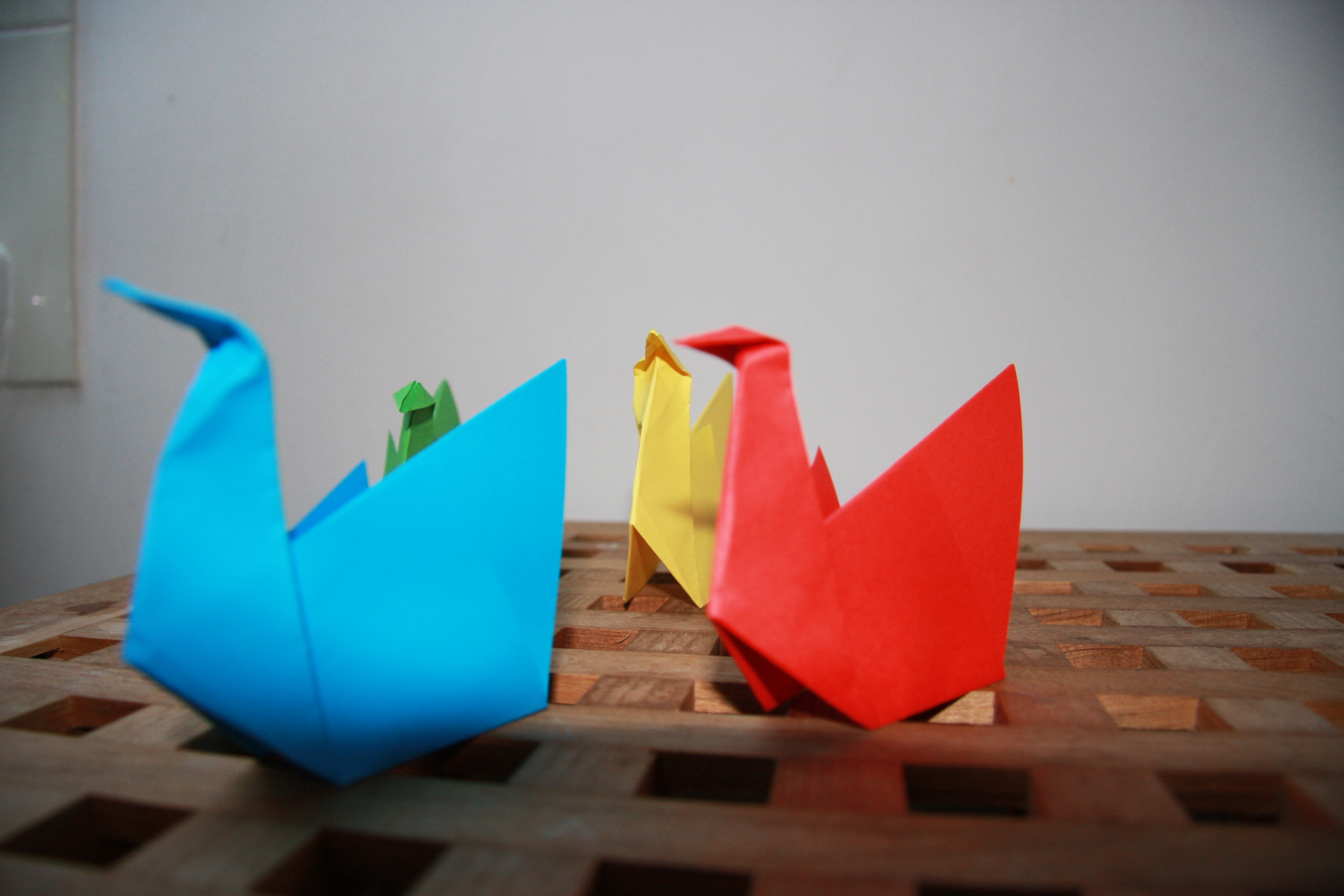
I have become a little fed up with not quite being able to follow through the diagrams and instructions. I therefore spent some time going back through the beginning of the book to make sure that I understood the symbols and what they stood for. After I had done this I tried to create a basic duck with the large paer. This was successfull, I tried again and it seemed as though things were falling into place so I tried to create a basic duck using smaller paper. It worked, so I tried some more. After a few more successes I decided to go back to making them with the larger paper and the next one was to become a base for a complex duck.

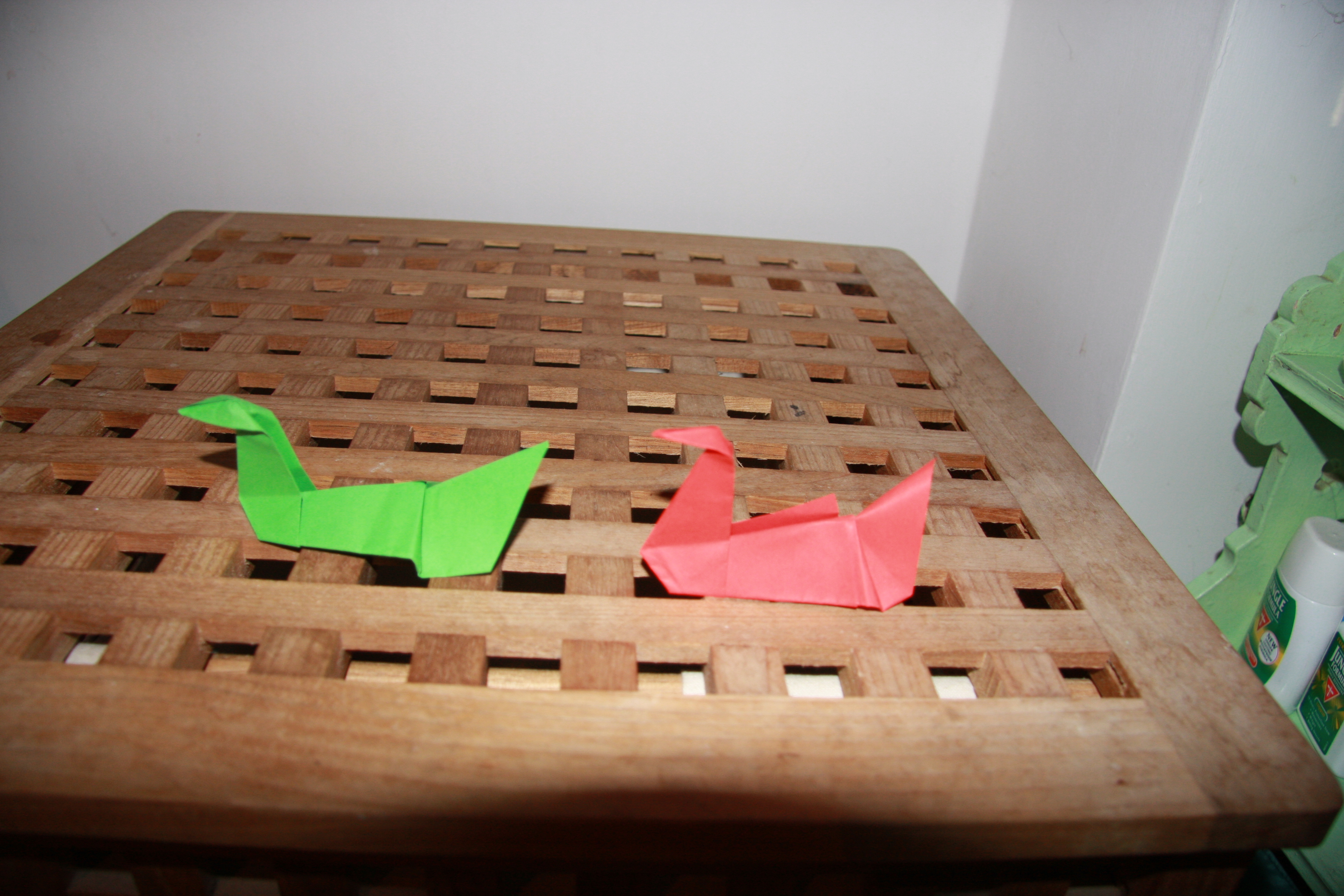
                      The pictue here shows some simple ducks that have been made out of small and larger paper squares.


So I started to create the next basic duck and found that at the stage where I was to make the first fold to create the ducks neck that I had folded it in the wrong direction which meant that when I tried to fold the neck it tried to develop in the wrong way. I managed to find where I went wrong by comparing a successfull model with the one I was having problems with. I also used the pictures to compare the folds and saw my error. Once idnetified the error was very easily corrected. I created an almost perfect basic duck. I then went through the diagrams and suddenly saw correctly how the folds should go and how it all fell into place. I put this all down to the time I spent making sure I understood the symbols and could relate the diagrams to the actual folds.

I found that after all of the initial hassles that I was able to create a complex duck. The first one had a slightly wonky tale but was a much better effort than any I had previously done.

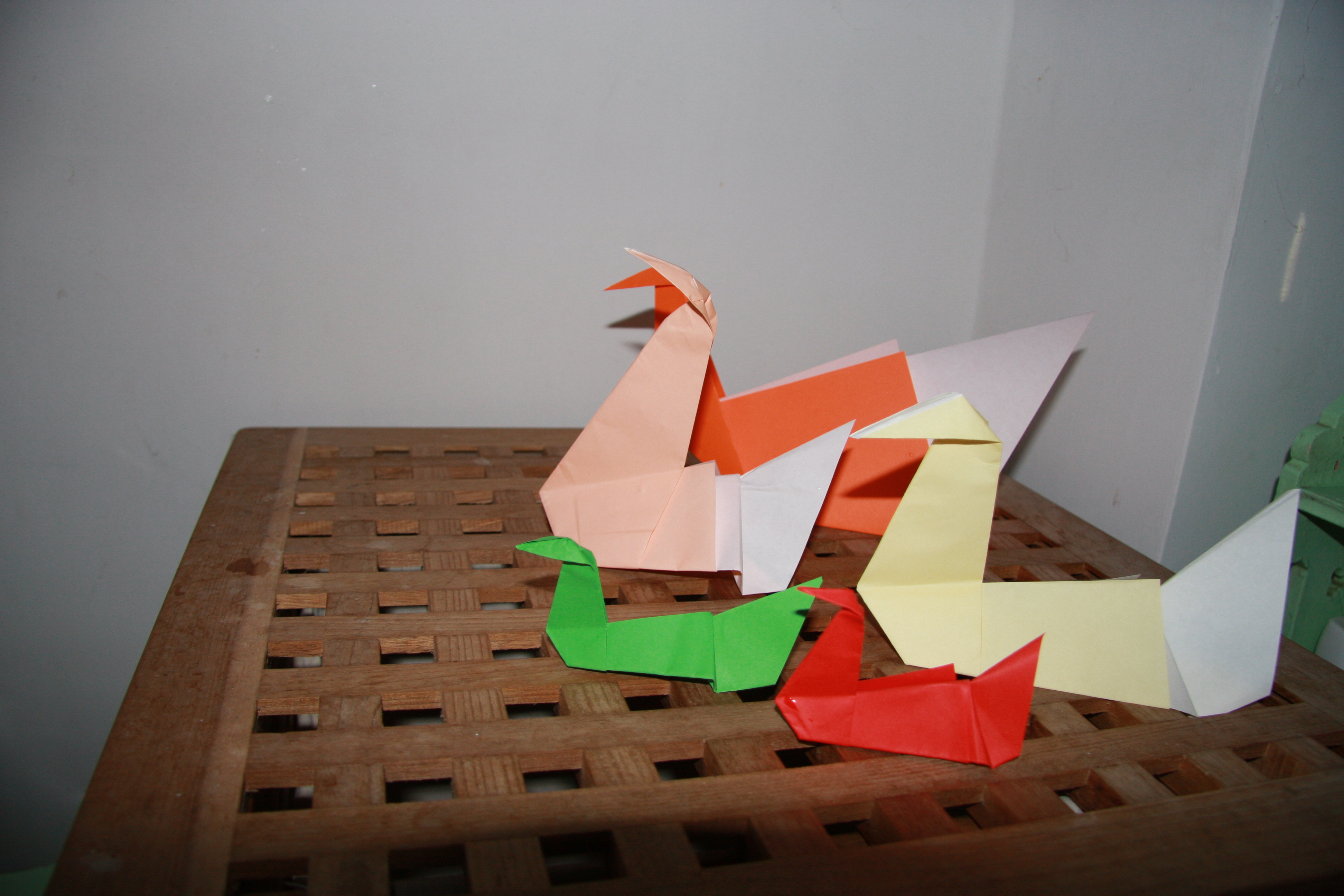
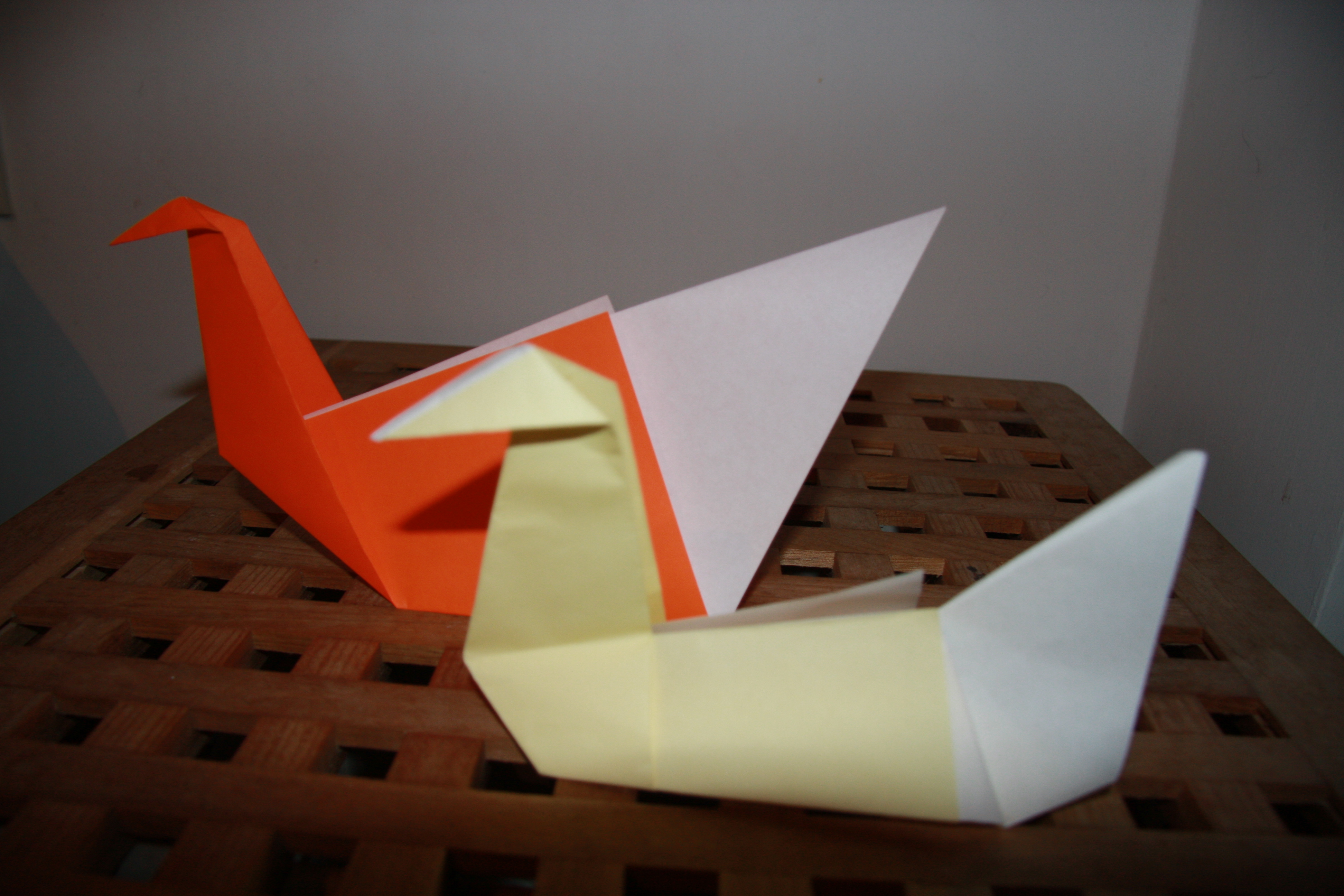
After I made another with the larger paper and it was almost perfect. I then tried with a smaller piece of paper and was really happy with the results. In order to reinforce the process I made several large and small complex ducks and was pretty pleased wit myself as a result.

small basic ducks


a mixture of small and large complex ducks.


More detailed pictures 1) Large ducks of each type 

Small complex ducks in more detail 


Keywords: Origami

Posted by Nicholas Palmer | 0 comment(s)

October 07, 2009

Why on earth did I take up this challenge? I continued with the simple/complex duck. I made an attempt at the complex duck - a stage on from the simple duck and felt good. It wasn't quite right I seemed to be misunderstanding the final step. I then tried to do it again and found that I was struggling to complete a simple duckl. After four pieces of wasted paper I decided to give it a rest.


The positive that has come out of this is that I am feeling confident handling the paper to complete the kite base it feels as though I know what I am doing. It is very straightforward and to be honest I should be feeling confident by now as I have completed this stage a number of times. I am just hoping that I will be able to achieve more tomorrow.

Posted by Nicholas Palmer | 0 comment(s)

October 06, 2009

The origami has been forgotten for a few days. I decided to redo the simple duck using blue paper -I struggled to get there and had to discard two attempts before I succeeded. The more complex version is still alluding me and after an hour I decided it was time to do something else. As an aside I tried to make the simple duck with a smaller piece of paer and was unsuccesful. What was interesting is the paper was thicke and coarser in texture which and did not crease quite as easily as the larger squares.

Posted by Nicholas Palmer | 0 comment(s)

<< Back