Log on:
Powered by Elgg

Marie Leadbetter :: Blog

January 18, 2010

“Mum, you’re not playing a game!”, my eighteen year old daughter exclaimed when she suddenly came into my study.  I quickly showed her my Digital Game-based Learning course book and explained that it was a module for my MSc in E-Learning course.  I think that sums up my starting point with games – playing games is not something associated with me and I am embarrassed to be caught playing a game!  

I was playing PacMan and it was the first time I played that game.  I was successful in getting to Level 2 at my first attempt but I did not realise that when I ate a large sphere and the ghosts turned blue that I could try to ‘eat’ them to earn extra points. I only learned that (and the fact that those things were ghosts) by later googling to find out more about the game. [Note: My getting to stage 2 at my first go was just beginners luck. I found it more difficult subsequently!]

I had a harder time with Donkey Kong.  The up key did not appear to work when I tried to make the man climb the ladder so I decided that I would have to make a number of points jumping over barrels before I could make it to the next level. But that did not seem to work. I got very frustrated and would have given up if I were not on the course. So again I googled ‘Donkey Kong pattern’ and gathered that the man could go up the ladder.  I realised that he had to be positioned exactly in front of the ladder in order to go up it.

Having done some of the initial reading about the definitions of digital or videogames, I realise that I have played some before. In particular, I have played minesweeper on my phone as well as brick???.  And I have played solitaire on my laptop.  I never thought of them as digital games – mainly because I didn’t play with anyone else – they were solitaire games. (And yes, I just used the word ‘game’.)  But I did not go out of my way to get those games – they came with my phone/laptop and I only played them when I was in transit when I was tired of reading.  But I enjoyed playing them (as long as no one I knew saw me playing them!).

Keywords: Donkey_Kong, IDGBL10, Pacman

Posted by Silvana di Gregorio | 1 comment(s)

November 26, 2009

1) Don't panic

2) Remember the tips Rupert gave me in handling the paper and creating sharp accurate folds

3) Determine what is required to create 1) Dragonfly and 2) Beetle 

O.K so I have just looked them up and they both require the waterbomb base. The good news is that I managed to create a water bomb base after I had completed the duck, but I had found the instructions difficult to follow and was put off with just creating a whole series of bases. It is like everything though a thorough grounding with the basics allows one to develop, build and blossom. So the plan is to do some fairly simple folds that are used in the book as an introduction. Then create the flapping bird; I will then perfect the water bomb base and after this attempt to make the dragonfly. Once the dragonfly has been achieved I shall review where I am and make a decision on what to do next.


I am doing some baby sitting on saturday night so I shall see if I can show them how to make some origami models.

Posted by Nicholas Palmer | 0 comment(s)

It has been a long time since I did anything with origami. Two things happened 1) I became somewhat disillusioned with what I was achieving and 2) One of my stepsons recently showed me how to create a a flapping bird. Rupert made an interesting observation about the book I had chosen to learn from basically it was not the easiest set of  diagram to follow and even he (with his current knowledge) would struggle to complete the flapping bird from the book. Rupert is fairly competent and feltb that I had given myself too big a target with the Dragonfly (which he can do) and the Beetle (which he can't do). I think the beetle is probably a step too far however the dragonfly will be done.Rupert suggested that I did the flapping bird and then looked at where to go next.

I didn't plan out the steps I was going to take to work methodically to the target designs. I actually thought I would learn all of the bases and then work from there, the problem with this is that you don't get any sense of achievement when you create a base not in the way you do when you have a recognisable shape.

I should have referred to more than one book because since his comment I have found that the way diagrams are annotated to create designs are slightly different and that some of the directions are easier to follow than others.


So I need to come up with a plan to successfully achieve my goal.


Posted by Nicholas Palmer | 0 comment(s)

October 12, 2009

The next things to learn were same basic bases, a waterbomb base and a blintz base. I managed to make one of each but they were pretty tatty. I only tried to make them using the large paper squares. I decided to give up wilst I was winning and have another go tomorrow.

Keywords: Origami

Posted by Nicholas Palmer | 0 comment(s)

I have become a little fed up with not quite being able to follow through the diagrams and instructions. I therefore spent some time going back through the beginning of the book to make sure that I understood the symbols and what they stood for. After I had done this I tried to create a basic duck with the large paer. This was successfull, I tried again and it seemed as though things were falling into place so I tried to create a basic duck using smaller paper. It worked, so I tried some more. After a few more successes I decided to go back to making them with the larger paper and the next one was to become a base for a complex duck.

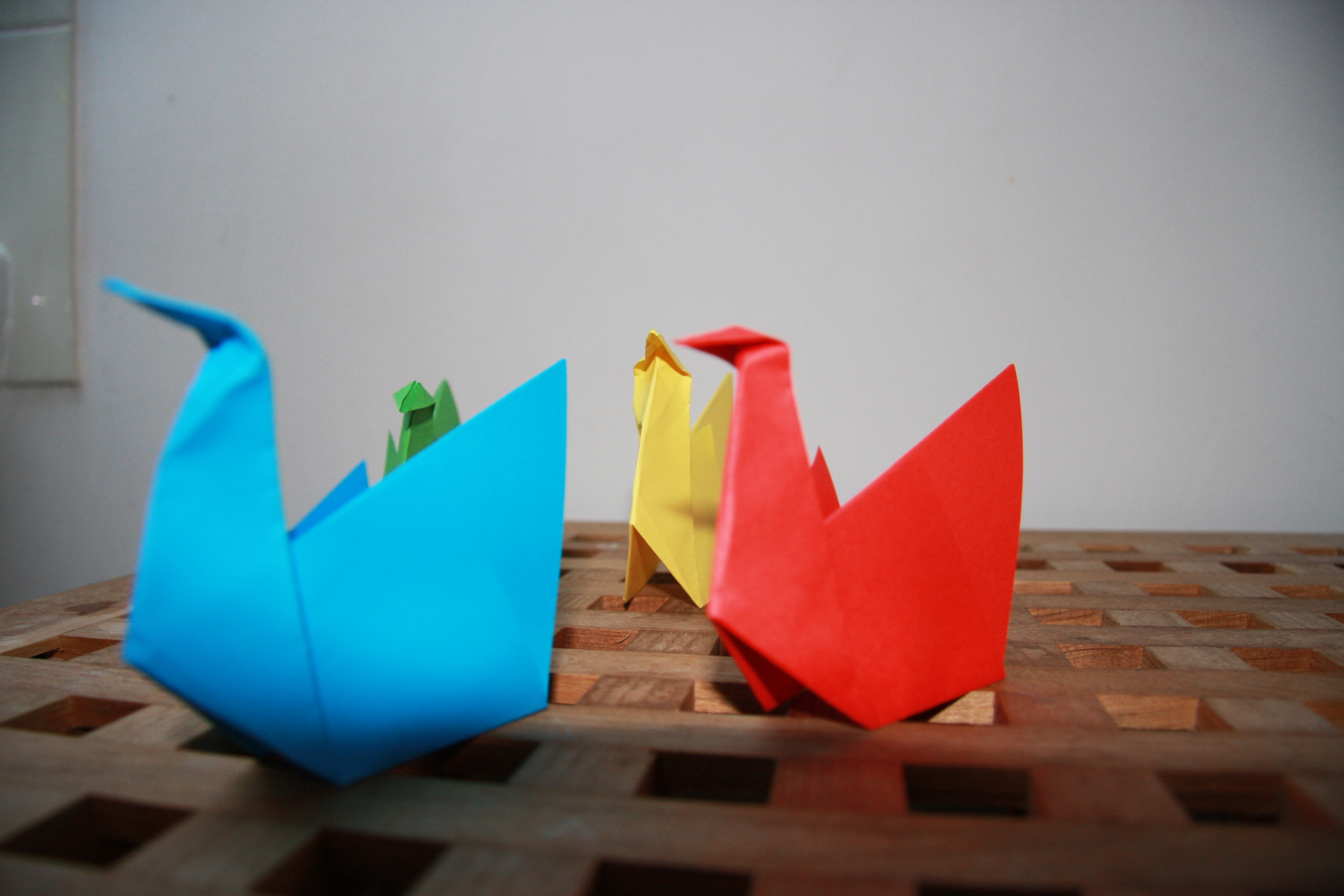
                      The pictue here shows some simple ducks that have been made out of small and larger paper squares.


So I started to create the next basic duck and found that at the stage where I was to make the first fold to create the ducks neck that I had folded it in the wrong direction which meant that when I tried to fold the neck it tried to develop in the wrong way. I managed to find where I went wrong by comparing a successfull model with the one I was having problems with. I also used the pictures to compare the folds and saw my error. Once idnetified the error was very easily corrected. I created an almost perfect basic duck. I then went through the diagrams and suddenly saw correctly how the folds should go and how it all fell into place. I put this all down to the time I spent making sure I understood the symbols and could relate the diagrams to the actual folds.

I found that after all of the initial hassles that I was able to create a complex duck. The first one had a slightly wonky tale but was a much better effort than any I had previously done.

After I made another with the larger paper and it was almost perfect. I then tried with a smaller piece of paper and was really happy with the results. In order to reinforce the process I made several large and small complex ducks and was pretty pleased wit myself as a result.

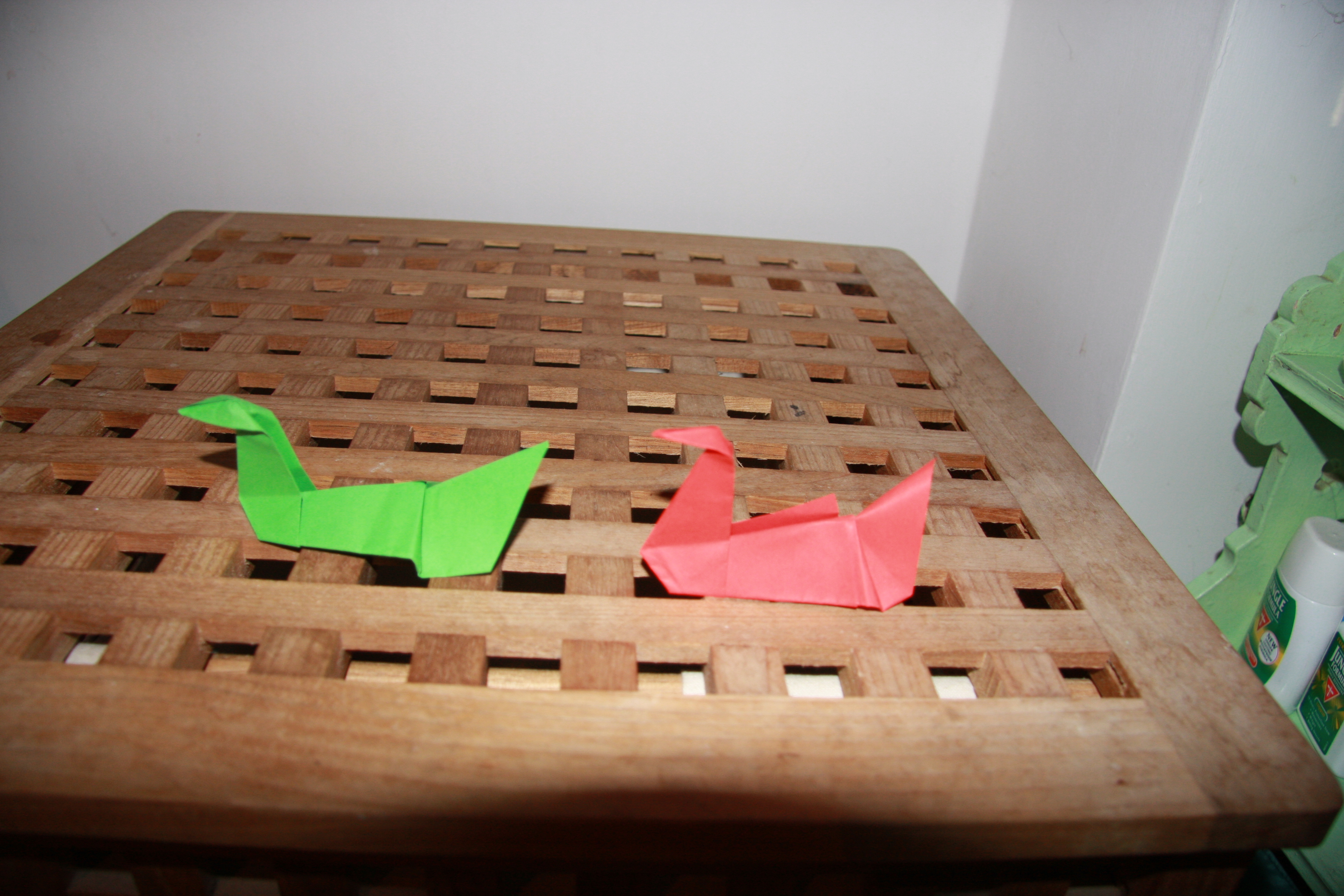
small basic ducks


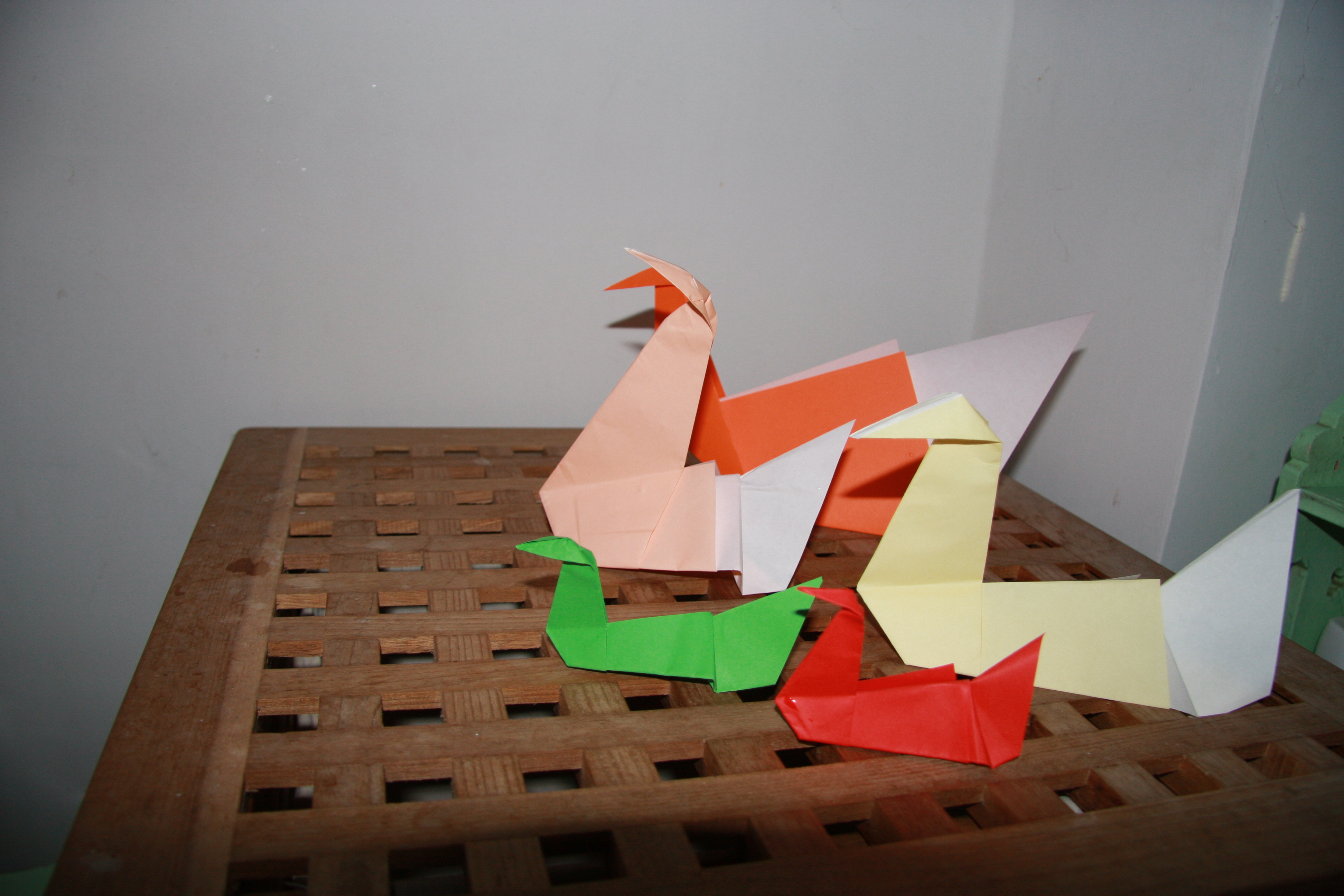
a mixture of small and large complex ducks.


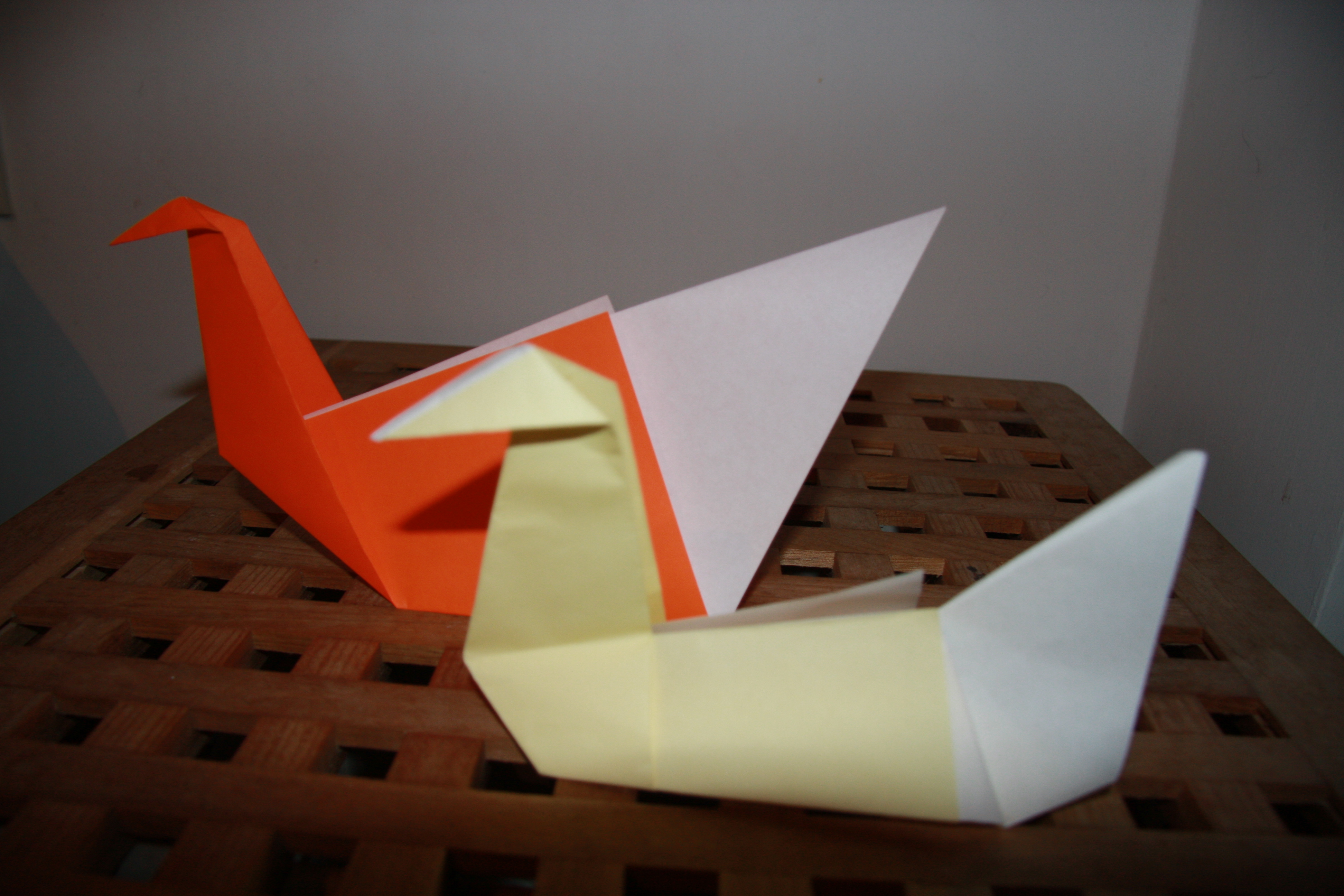
More detailed pictures 1) Large ducks of each type 

Small complex ducks in more detail 


Keywords: Origami

Posted by Nicholas Palmer | 0 comment(s)

October 07, 2009

Why on earth did I take up this challenge? I continued with the simple/complex duck. I made an attempt at the complex duck - a stage on from the simple duck and felt good. It wasn't quite right I seemed to be misunderstanding the final step. I then tried to do it again and found that I was struggling to complete a simple duckl. After four pieces of wasted paper I decided to give it a rest.


The positive that has come out of this is that I am feeling confident handling the paper to complete the kite base it feels as though I know what I am doing. It is very straightforward and to be honest I should be feeling confident by now as I have completed this stage a number of times. I am just hoping that I will be able to achieve more tomorrow.

Posted by Nicholas Palmer | 0 comment(s)

October 06, 2009

The origami has been forgotten for a few days. I decided to redo the simple duck using blue paper -I struggled to get there and had to discard two attempts before I succeeded. The more complex version is still alluding me and after an hour I decided it was time to do something else. As an aside I tried to make the simple duck with a smaller piece of paer and was unsuccesful. What was interesting is the paper was thicke and coarser in texture which and did not crease quite as easily as the larger squares.

Posted by Nicholas Palmer | 0 comment(s)

September 29, 2009


Well week 1 is over and we’re into week 2 and the first reflection is how I’ve failed to keep the planned blog, which I know will help me with the studying (I used one in my first module and not in the second and noticed the difference).   I could link this to work being really busy too but that’s just me making excuses so here’s an attempt at encapsulating the starting points for my thinking.

  • The way in which the course is structured to give us (as students) ownership of both content and direction of the course – and what this means we have to recognise as our responsibilities to ensure a successful programme
    • And to a lesser extent the tutor’s role in supporting/facilitating this work
  • The way in which technology is portrayed in films and books and how this might influence the way in which we perceive it in reality
    • Do we see truths in the films or do we question and disagree with them?
    • What are the implications of films portraying the negative/challenging sides of the relationship between humans and technology?
  • Why we chose to adopt particular technologies
    • What of our choice is linked to design?
    • How are we influenced by our peers?
    • How is Apple influencing the spectrum of early adopters? How do their design choices represent a consideration of the market?
  • The way in which our use of social media develops
    • Rise and fall of facebook
    • Does the use of social software ebb and flow – and if so what’s causing the tide to change? Is it all just linked to popularity and fashion or is there something more fundamentally linked to function?

Keywords: design, pscel09, questions, socialmedia

Posted by Emma King | 0 comment(s)

September 28, 2009

I worked through the introduction and this took me to a section that explained the symbols used in the book for the various folds and moves. I was able to understand this reasonably well until I came across the inside and outside crimp. Still I was reasonably confident and decided to have a go with my current knowledge.


The tips were very useful and one was to use larger  pieces of paper to start with. I have two sizes of paper nine and three quarter inches sq which is coloured oneside and white  the other and  five inches sq (came with the book) coloured bothsides.

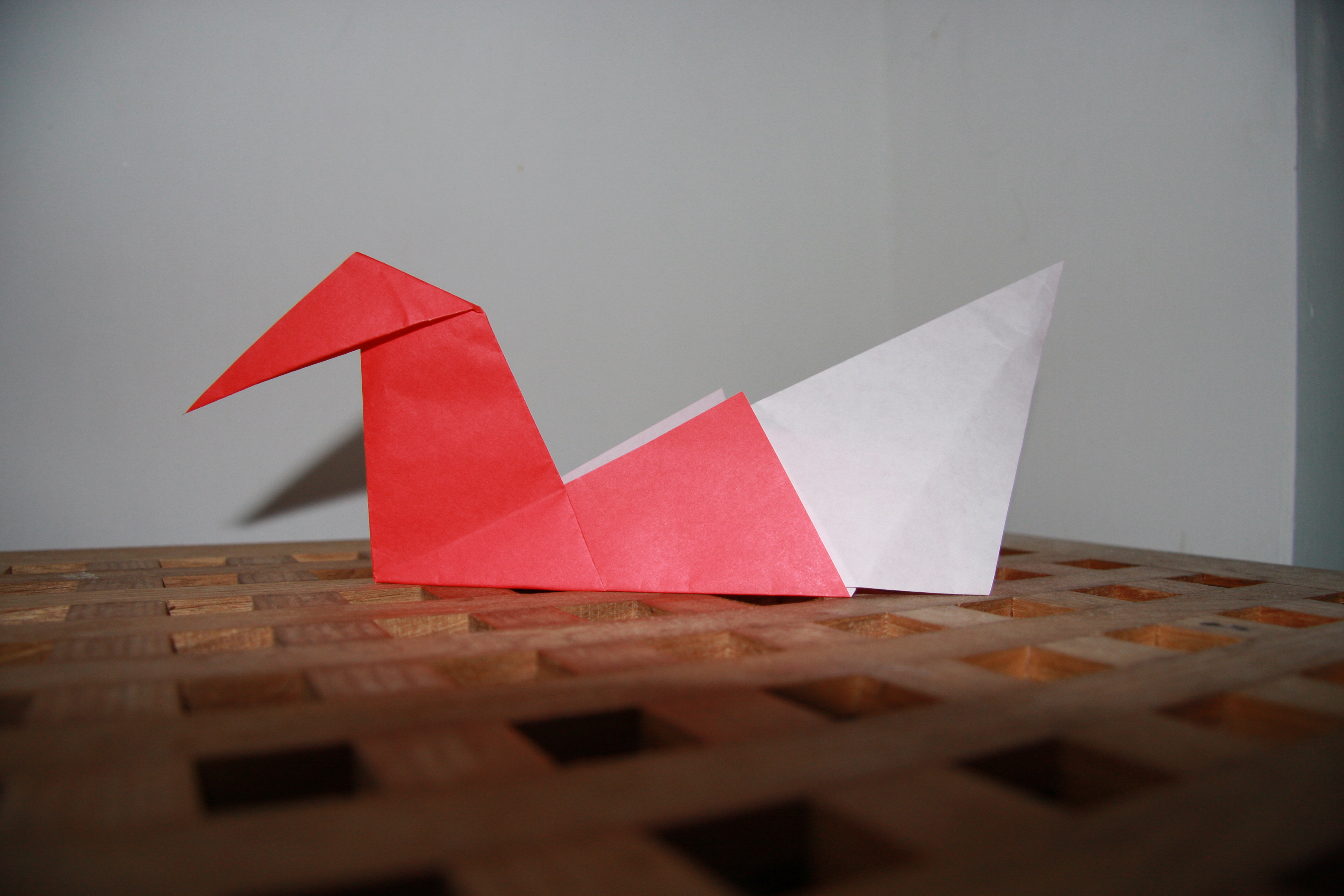
THe first thing I did was to create a kite base with the larger paper using a red piece first. After the base had been created I produced the simple duck. I struggled wioth the diagram a little but perseverance paid off and I took some photographs of the model (model taken from Origami Kit  for Dummies). I then tried to create the more complex duck and this is where I was unable to fully understand the diagram at this point. After struggling for ten minutes I had a break. The overall session lasted 30 to 45 minutes and was partially successful.

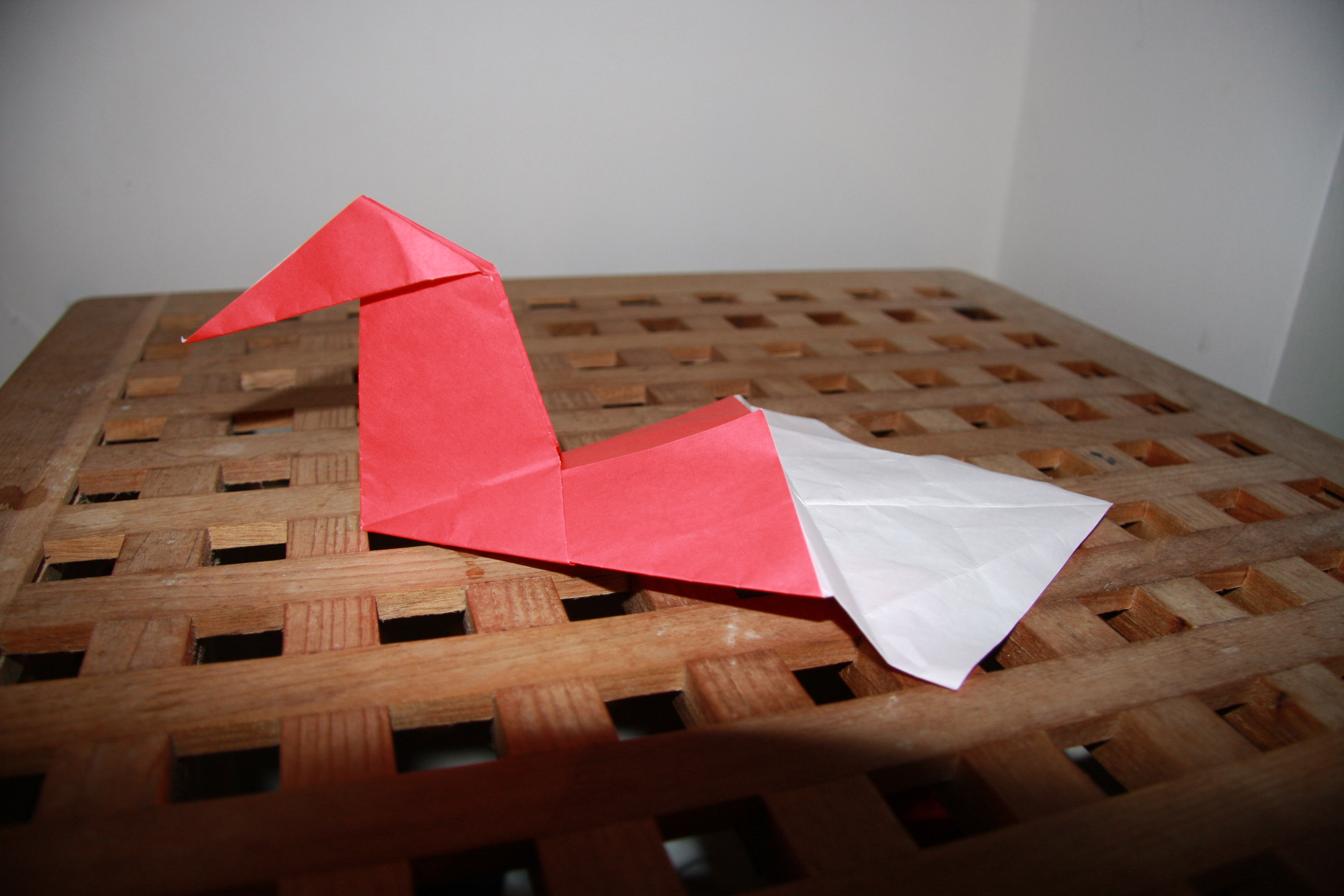
The paper became vey crumpled with my efforts and I was left with a duck with a flat body, so it is time to try again.

First attempt Duck 1

Collapsed attempt Duck 2

Posted by Nicholas Palmer | 0 comment(s)

I am currently studying for an MSc in e-learning at Edinburgh University. I am on my fourth module which is understanding learning in digital environments. One of the assignments is a learning challenge and this blog will outline my experiences, thoughts and feelings whilst performing the learning challenge. I am going to learn how to create origami paper models. My previous attempts have got little further than paper darts or paper planesI tend to be all fingers and thumbs with these types of exercise.

I have chosen to learn how to make Origami figures for this challenge. Ther initial aim is to create a dragonfly (medium difficulty) and a beetle (challenging). I have decided to learn by 1) Working through the Origami Kit for Dummies by Nick Robinson - published John Wiley 2008. 2) websites and 3) videos from sites such as you tube.

The book is broken into three main sections

Introduction

Part 1 Coming to the crease: Basic Techniques

Part 2 Folding on: The Models

Part three: The part of Tens

I first looked atpart three which consists of three chapters 1) Ten Top Tips 2) Ten Origami Styles and 3) Ten Incredible folders ( a summary biog for ten famous Origamists)

It gave me a feel for the subject and those who excel at it. This also points the way to a number of websites which I have not looked at yet.

Lets get on with the folding!!!

Posted by Nicholas Palmer | 0 comment(s)

<< Back Next >>