

At a time when America's relationship with Saudi Arabia is under close scrutiny because of the war against terrorism, this timely profile looks at the colourful history of Saudi Arabia's royal rulers. Discover how charismatic King Ibn Saud went from being a desert warrior to leader of the largest oil-producing nation in the world, and how his 4 successors have been both friends and foes of the U.S.
Intel, that industry bellwether, reported its fourth quarter and the results were no worse than it warned they’d be when it reduced its expectations for the second time. Unfortunately it doesn’t appear there’ll be any relief this quarter. Uncertainty runs so deep that Intel is leery about issuing formal guidance figuring “actual results could differ materially from expectations.”
AccuRev and The Go To Group (Go2Group) announced today that they have joined forces to accelerate the software release process of AccuRev customers investing in a best-of-breed software change and configuration management (SCCM) strategy. Go2Group was certified through AccuRev’s A.C.E. program (AccuRev Certified Engineer), preparing the company to deliver additional services to AccuRev customers including those responsible for large scale AccuRev deployments.
Javaground announced a new component of its Xpress Suite allowing developers to automatically generate a native iPhone program from a Java source code. Traditionally, developers target the iPhone by re-writing their Java source code in Objective C. Now, their existing Java code can be reused and automatically converted to create high-performance iPhone games and applications.
Sun Microsystems announced that SAP has signed a multi-year agreement with Sun to provide Java Platform Standard Edition for Business (Java SE for Business) to its customers using the SAP NetWeaver technology platform. This will allow SAP customers to continue using Java SE 1.4.2 on both Windows and Linux platforms while still having Sun support and indemnification.
Apple CEO Steve Jobs said Wednesday in a company e-mail that he’s going to take a medical leave of absence until June and that COO Tim Cook will take over day-to-day operations as interim CEO. The news is bound to set off speculation that Jobs won’t be coming back. In his last message right before MacWorld Jobs explained that his gaunt appearance was due to an undisclosed hormonal imbalance and that he would remain on the job while he recovers.
i2Telecom International announced that its mobile phone solution, MyGlobalTalk, has been submitted to Apple for inclusion on its iPhone App Store. MyGlobalTalk is a free downloadable application that will allow iPhone users to place inexpensive phone calls to destinations anywhere in the world for as little as two to three cents per minute via their carriers’ cellular voice networks. This contrasts sharply with the current methods in which users place regular calls via their mobile phone service providers at prices that can easily reach or exceed one dollar per minute when calling locations outside of the U.S.
When a product a colleague worked on recently shipped its first generally available release, the event was accompanied by a marketing fanfare of podcasts, press releases, and conference trips to beautiful cities with boxes of presentation materials, branded lapel pins, and flashing fridge magnets. My colleague gave a hugely successful presentation to customers and was rather taken aback afterwards when she was approached by a member of her company’s marking team who asked why it looked as though the development team hadn't done that much to the product since the last presentation six months previously.

Part 1 of 6. Explores the revolution in astronomy launched by the Hubble Space Telescope.

Part 2 of 6. Explores the revolution in astronomy launched by the Hubble Space Telescope.

Part 4 of 6. Explores the revolution in astronomy launched by the Hubble Space Telescope.
Free energy and anti-gravity are new solutions to the world's energy crisis. Rarely mentioned in the media-- even as power shortages cripple the U.S. Zero-Point Energy can transform our earth to a self-sustaining, pollution-free planet. The basic theory of Zero Point Energy maintains that there are fluctuations of electrical field energy embedded within the fabric of space. By identifying the densest energy; and then using today's technology to balance the energy flow, we can acquire free energy which doesn't deplete the earth.
Quickoffice announced the release of MobileFiles Pro, said to be the first application to include editable Office functionality for the iPhone and iPod Touch. The upgrade brings comprehensive editing and saving of Microsoft Office Excel files in the .xls format, Wi-Fi file transfer to and from a desktop (Mac and PC), and the ability to access and synchronize with Apple MobileMe accounts.
Three Pillar Software concluded 2008 with a strategic merger and a tactical acquisition designed to provide the company with significantly enhanced infrastructure and consulting services. According to Three Pillar CEO David DeWolf, the merger with Firefly allows Three Pillar to go to market as a complete IT services provider. Firefly founder Blaine Hall, named executive vice president of infrastructure services for Three Pillar, noted that the Three Pillar/Firefly merger allows the company to authoritatively enter the federal marketplace since more than 95 percent of Firefly's revenue was based on U.S. Department of Defense contracts.
Structured Web Technologies has announced dWebSpec, which provides modeling templates for specification and construction of dynamic web applications. dWebSpec provides a standard way to write blueprints and to capture the various aspects of dynamic web applications such as: user interface, page composition, data presentation and mapping, event handling and parameter passing, navigation paths and rules, and other areas. dWebSpec introduces a means of representing the specifications of applications that could be implemented on various platforms such as Java.
Sun Microsystems announced it has acquired Q-layer, a cloud computing company that automates the deployment and management of both public and private clouds. The Q-layer organization, based in Belgium, will become part of Sun's Cloud Computing business unit. The Q-layer technology simplifies cloud management and allows users to provision and deploy applications, a key component in Sun's strategy to enable building public and private clouds.
AssistiveWare announced that it will preview its product, Proloquo2Go, which uses Acapela Group’s forthcoming iPhone text-to-speech to provide a full-fledged communication solution on the iPhone and iPod touch for people who cannot speak. Also to show is the upcoming version of Infovox iVox, which introduces new British, Italian, Greek, Norwegian and Russian voices for the Mac.
Fifteen Karen villagers from the jungles of Burma go up against oil giants UNOCAL and TOTAL in an inspiring David and Goliath story. Directed by Milena Kaneva (http://www.totaldenialfilm.com, http://www.myspace.com/totaldenialfilm)
This documentary is counting down the top 10 deadliest Kung Fu weapons and fighting techniques. The Kung Fu documentary shows uses of famous Chinese weapons, including rare and unconfirmed weapons like the flying guillotine.
In a feature-length special, we scrutinize ancient writings that didn't 'make the cut' in the battle to create a Christian Bible in the new religion's first few centuries. Biblical archaeologists and scholars examine why they were left out and if others might yet be found. Beginning with the little-known Life of Adam and Eve, we also peruse the Book of Jubilees, the Book of Enoch, the Gospel of Thomas, the Protoevangelium of James, the Gospel of Mary, the Gospel of Nicodemus, and the Apocalypse of Peter.
A documentary about Einstein's formula on gravity and the universe. How his 'mistake' to add the Lambda constanse into the formula was not a mistake afterall. Modern physicists today have revived Einsteins 'mistaken' formula and elaborate on it. Basically the hypothesis they are challenging is "what if the amount energy in the universe was not constant to begin with, but was and still is variable?"
Sun, which has got a speckled record, to say the least, with acquisitions has acquired Q-layer, a three-year-old cloud computing company in Belgium that automates the deployment and management of both public and private clouds. Sun said the undisclosed price was not material. Since it started Q-logic raised what is now worth about $11.5 million in two rounds from VCs Partech International, Wellington Partners and Big Bang Ventures. The operation, whose development folk have been in Cairo, will become part of Sun’s Cloud Computing business unit, which is supposed to develop and integrate cloud computing technologies, architectures and services.
The Flash that you thought you knew has changed. It’s grown up.
In this article, I’ll explain some of the technologies that make up the Flash Platform, how they fit together, and how you can use them to build RIAs. Pay attention, because there will be a quiz at the end! The first 200 people to submit their answers will receive a copy of The Adobe Flash Platform ActionScript Reference for Rich Internet Application Development (that’s the print version) delivered to their door for free, thanks to Adobe.
The transformation that Flash has undergone has been occurring for some time, and many developers are aware of it. Every day I hear of a developer building a powerful new application for the Flash runtime that performs tasks like connecting to enterprise solutions powered by SAP or Oracle – and all with the full blessing of those vendors. Flash has evolved beyond the Skip Intro button for which we used to hate it, and has become ubiquitous – helping the browser perform way beyond the text rendering that it was first built for.
It was Macromedia (back in 2002, in their pre-Adobe acquisition days) who coined the term Rich Internet Application (RIA). The introduction of this term coincided with the release of a set of new custom components for Flash MX, thus supplying Flash developers with a set of UI components and providing them with a means to build their own. Flash already contained the ability to make a call to a remote server without forcing a page refresh, but with the release of ColdFusion MX that same year came Flash Remoting, which allowed applications built with Flash to pass serialized data to the server via AMF (Action Message Format).
These two products – custom components for Flash and Flash Remoting – and the synergy that could be experienced by combining them has since been expanded many times in the six-and-a-half years since they were first released. Recently, these technologies have been termed the Adobe Flash Platform. This umbrella term describes a collection of Adobe products, including multiple runtimes, development tools, and servers.

The Flash Player is the cornerstone of the Adobe Flash Platform; it offers the developer a single, cross-platform runtime with all the capabilities of the Internet today. It supports more than just vector animation – it’s also a multimedia player. In fact, the majority of all online video today is delivered via Flash, with the capacity to offer true High Definition video via the same H.264 codec used in Blu-ray.
The runtime can communicate with application servers via web services, HTTP, and remote object calls without the need to perform a browser refresh. Additionally, the player has had VoIP capacity for many generations, and it’s possible to build and deploy collaborative applications with Flash that can include text chat, whiteboarding, and the sharing of desktops across operating systems.
A lot of effort has been invested into making sure that Flash-based RIAs work successfully for the wide variety of devices and operating systems. For example, Adobe and Google together have recently announced the successful implementation and development of a virtual user that Google uses to retrieve text from Flash content; this enables the content to appear in Google’s search results. Adobe is constantly improving the performance of accessibility within the Flash Player and its compatibility with screen readers for the visually impaired. Deep linking and browser history compatibility are features present in the open source Flex framework for Flash applications; these aim to eliminate the kind of navigation problems encountered with dynamic content in Ajax-based RIAs.
Adobe has successfully matured the Flash runtime in the short time that they’ve had it as a product. With each iteration, particularly Players 9 and 10, significant improvements in performance have occurred; Player 10 now offers hardware acceleration for advanced graphical effects. Flash Player 10 also introduces new functionality, including 3D effects, custom filters and effects, advanced text support, and dynamic streaming for improved video performance.
Flash Player 10 is the latest version of the browser plugin; it’s available for Windows, OS X, Linux, and Solaris. Flash Lite 3 is a scaled-down version of the runtime for use on mobile and handheld devices.
And then there’s Adobe AIR – a new category of runtime that combines Flash Player 10 and WebKit (the web page rendering engine behind Safari and Chrome) into a stand-alone runtime capable of running offline applications. The runtime is available for Windows, OS X, and Linux.
Adobe AIR was introduced by Adobe mid-2008 after a lengthy public beta cycle. Developers can use their web application building skills to create apps for the desktop and deploy them via AIR. The AIR runtime incorporates functionality missing from the browser, such as access to the file system to create, delete, and maintain files and folders.
Adobe AIR supports drag and drop interaction with the operating system, network connection detection, and SQLite for local storage of data; the latter can be easily searched with standard SQL queries. If Acrobat Reader is installed on the client machine, AIR will utilize that software package’s capabilities for rendering PDFs. A version of the AIR runtime for mobile and handheld devices has been hinted at by Adobe, although there’s yet to be a release date announced.
Of course, all of these tools are free to download, and Flash Player is bundled as part of a Windows and OS X distribution.
Flash CS4 Professional is the latest iteration of the Flash authoring environment. Originally an animation tool, the Flash IDE can also be used to program Flash movies using ActionScript, an ECMAScript-based object oriented programming language. It has the necessary tools for ActionScript authoring, including an ActionScript editor and an advanced debugger. Flash CS4 is both a tool for designers and developers, and while it’s possible to create whole applications with Flash, Adobe has created a framework for Flash applications called Flex (check out some of the Flex tutorials on sitepoint.com).
Originally released as an enterprise platform (with an enterprise price to match), Flex is now a free, open source framework for building applications to run within the Flash runtime. Flex applications are authored in a combination of two languages:
MXML, a declarative XML-based language in which tags represent classes within the framework; it’s principally used for UI layouts and behaviors, and ActionScript 3, an object-oriented language typically used for client logic. Developers with a Java background will find ActionScript intuitive and may be tempted to author with it entirely.
The Flex framework contains over 100 extensible UI components. It can be downloaded for free as part of the free Flex 3 SDK, which also contains a stand-alone compiler.

A number of open source frameworks have emerged to assist Flex application development. The most popular of these is Cairngorm, an open source project managed by Adobe. Others worth looking at include Mate, a tag-based, event-driven framework; and PureMVC, a lightweight ActionScript 3 framework for creating applications based on the model-view-controller concept.
While the Flex framework and Flex SDK are free, the Flex development tool, Flex Builder, is a commercial product (although it’s free for educational use). Flex Builder 3 is an Eclipse-based IDE, and is available as either a stand-alone application or as a plugin for Eclipse. There are versions of Flex Builder for both Windows and OS X, and a beta version is available for Linux.
Flex Builder supports the editing of MXML, ActionScript, and CSS files, including code completion, tag insight, and syntax coloring. It also includes a visual layout tool, to facilitate the positioning of components in a WYSIWYG environment.
Flex Builder is available in two editions, Standard and Professional. The Professional edition includes a charting library, performance profiling tools, and support for automated functional testing. Projects built with Flex Builder can be deployed either in the browser via the Flash Player, or as stand-alone applications via Adobe AIR.
A Flash application is able to retrieve data from a remote server via HTTP calls; this can be done with either of the Adobe tools mentioned above. With Flash MX, Macromedia introduced a once proprietary binary data transfer format for communication with an application server called Action Message Format (AMF); this has recently been made open source. AMF borrowed the means to describe the structure of data from the SOAP protocol; automatic translation of this format was provided with the Flash Remoting classes and service that was included in ColdFusion. AMF has also been reverse-engineered and is available for a number of application servers; AMFPHP, WebORB, and RubyAMF are examples of that reverse-engineering.
Adobe now also have an open source, Java remoting and web messaging technology that Flex and Adobe AIR applications can use to connect to Java server logic called BlazeDS. This uses the same AMF protocol mentioned above. BlazeDS integration has recently been added to the Spring framework to make Spring-powered RIAs with Flex front ends possible.
Adobe have additional server products that also support AMF; ColdFusion has been previously mentioned, while another is LiveCycle Data Services, which also includes Flex Messaging for real-time data push and publish/subscribe messaging.
The Adobe Flash Media Server group of products are also included within the Flash Platform. The Flash Media Interactive Server can be used to build Flash-based collaborative applications, which can include features like streaming Flash video, VoIP, chat, webcam chat, and online gaming. The Flash Streaming Media Server is capable of streaming both live and on-demand Flash video.
Adobe’s long-awaited technology preview, Thermo, was released to attendees at Adobe MAX in November 2008 under the new name, Flash Catalyst. This is an interaction design tool for RIAs that will be released as a public beta in the first half of this year. Flash Catalyst will import design comps created in Illustrator, Photoshop, or Fireworks, making use of a new interchange format introduced with all the CS4 design tools called FXG.
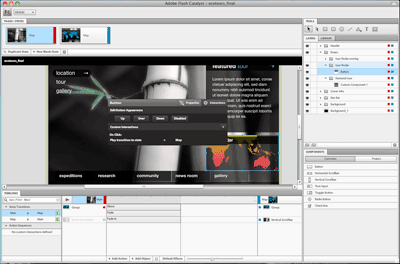
Flash Catalyst can convert the design elements in the artwork into design and interactive elements for an RIA project with workflow; this gives it the ability for an interactive element like a scrollbar to go back to Illustrator for some design tweaks to occur. Flash Catalyst converts elements like buttons or scrollbars into Flex custom components. Interactions and timeline events are added visually to projects in Flash Catalyst, but in reality the application is creating the whole project as MXML. Under the hood, Flash Catalyst is another Eclipse-based application just like Flex Builder.
Flash Catalyst is already listed as a part of the Flash Platform; the MXML that it produces is incompatible with Flex 3, but will be compatible with the next version, Flex 4 (code-named Gumbo), which is in public beta. Flex 4 has graphical enhancements including an implementation of FXG, and customizable components.

Another new project related to Flash that was released at Adobe’s annual developer conference MAX late last year was Alchemy; this is a research project that allows users to compile C and C++ code to run on Flash Player 10. There were quite a few good examples of how additional functionality could be added to Flash-based applications using existing libraries, including encryption, support for RAW digital photographs, and PDF creation.
Adobe’s Flash Platform offers the RIA developer a powerful, ubiquitous runtime in the Flash Player; within the browser it’s a case of code once, deploy everywhere, as there’s a version of the runtime for all major operating systems. The Flex open source framework gives developers the ability to build rich interactive applications to run in both the browser and on the desktop via Adobe AIR; it provides the ability to connect to data through a number of different connection types.
If you’re building a Rich Internet Application, and haven’t checked out the technologies that comprise the Adobe Flash Platform, then now is a good time to start. We’ll be publishing more articles on these topics over the coming months on sitepoint.com, so stay tuned!
In the mean time, test yourself on the contents of this article by taking the quiz. The first 200 people to submit their answers will receive a print copy of The Adobe Flash Platform ActionScript Reference for Rich Internet Application Development, delivered to their door for free, courtesy of Adobe. Take the quiz now!
via Comments on:
From today's integrated J2EE applications through the emergence of service-oriented architectures (SOA), enterprise Web applications are becoming more complex, dynamic, and vital to business success. The payoff is huge, but so are the new risks that have materialized. IT teams have an increasing need for new management solutions that provide visibility, analysis, and control of all tiers – from the application runtime environment to data, and through to Web services and business processes.
Vik Chaudhary, VP of Product Management & Corporate Development at Keynote Systems, will be presenting at SYS-CON's 2nd International Cloud Computing Conference & Expo in New York City this coming March 30-April 1, 2009. Chaudhary, who is a frequent speaker at industry events on software strategy and M&A and has been featured in the New York Times and on the ABC News Nightline program, will be running an application on a cloud platform, and examining performance bottlenecks and their impact on functionality by looking at how various clouds make it easy or hard to monitor the reliability and availability of applications.