Log on:
Powered by Elgg

Tim Dalton :: Blog

March 31, 2012

What game can do for us? A game can be designed with an educational purpose to not only guide the people to learn and to explore the world but also smooth the interpersonal relationships between different social groups. Brandes and Phillips(1977 p.5) indicate that “They can help social inadequacy by developing co-operation with groups; develop sensitivity to the problems of others through games needing trust, and promote inter-dependency as well as an independence of personal identity”.


In order to allow outcomes to be attainable, the types of games can be discussed first. Ellington, Addinall and Percival (1982) try to identify the game in three categories:

1.      Pure games: The features are ’competition and rules’.

2.      Pure simulation: The features are ‘represent a real situation and are on-going’.

3.      Pure case studies: The features are ‘in depth study’ and ‘illustration of special or general characteristics’.

They also believe that these can be combined in a mutual way. For example, ‘simulation games used as case studies’, which can be seen in some educational environment or teaching events.

However, it is relatively difficult to identify ‘game’. Same as the question that I keep in mind, will it still be considered as a ‘game’ without having the component of competition? Of course it is. For example, the online role play scenario will provide the players the environment to explore, however, not necessary to complete with others or even themselves.


How can it be considered as a well-designed educational game?

Whitton (2010 p.79) indicates six components to engage the players in the game:

1.      Completion - completing the game and collecting the set of game challenges.

2.      Competition - competing against others to solve challenges first or fastest.

3.      Narrative - immersion in the ongoing story.

4.      Puzzle-solving - solving the ongoing riddles and challenges.

5.      Community - the discussion boards and live collaborative events.

6.      Creativity - creative problem-solving or the development of artefacts.

For example, the ‘narrative’ and ‘completion’ can be usually seen in the online role play scenario through the conversation between the player and the computer. It is also quite common in commercial computer games.


Reference:

Brandes, D. and Phillips, H. (1977) Gamesters' handbook. 140 games for teachers and group leaders, London : Hutchinson.


Ellington, H., Addinall, E. and Percival, F. (1982) A Handbook Of Game Design, London : Kagan Page


Whitton, N. (2010) Encouraging Engagement in Game-Based Learning, International Journal of Game-Based Learning, 1(1), pp.75-84.

Posted by Ming-Wei LEE | 0 comment(s)

March 30, 2012

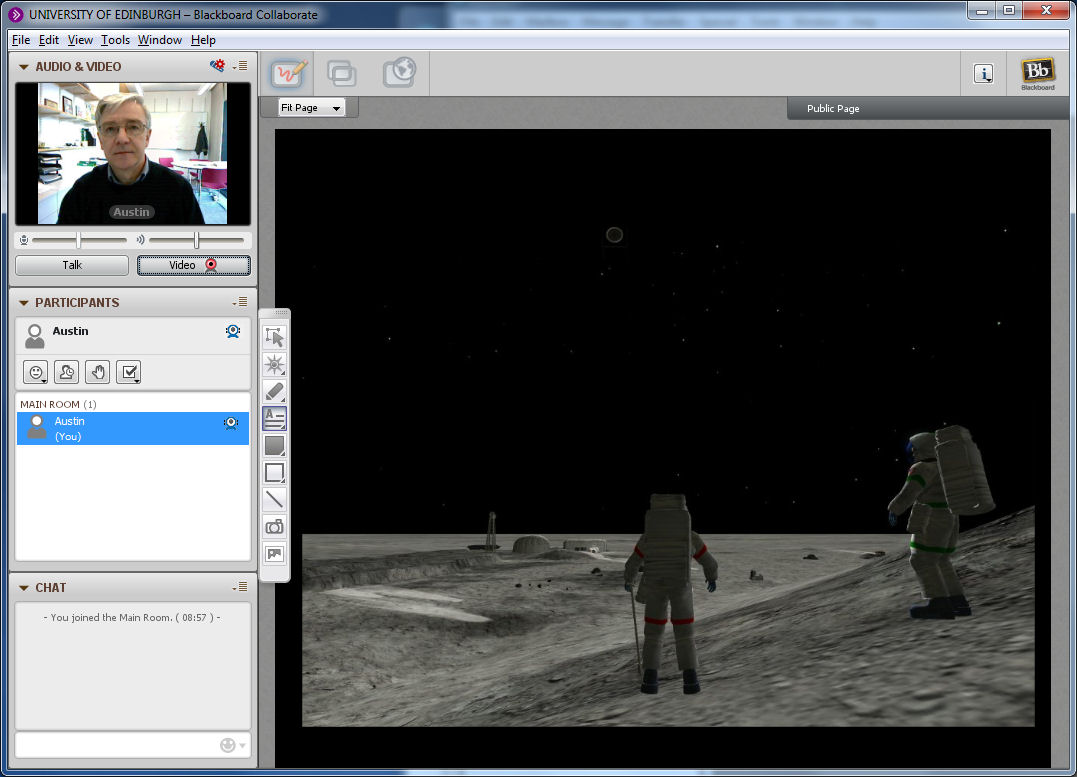
For my MSc in e-Learning IDGBL Game Design exercise I have created an exploration style game with a Na'vi/Avatar theme.

The web site for the game information and links to allow access to the areas in which some elements of it can already be played in Second Life are at:


More details of the elements that went into the design are in this blog entry - Game Design Preliminaries.

Keywords: Game Design, Moon Bloom, Na'vi, Pandora, Second Life

Posted by Austin Tate | 0 comment(s)

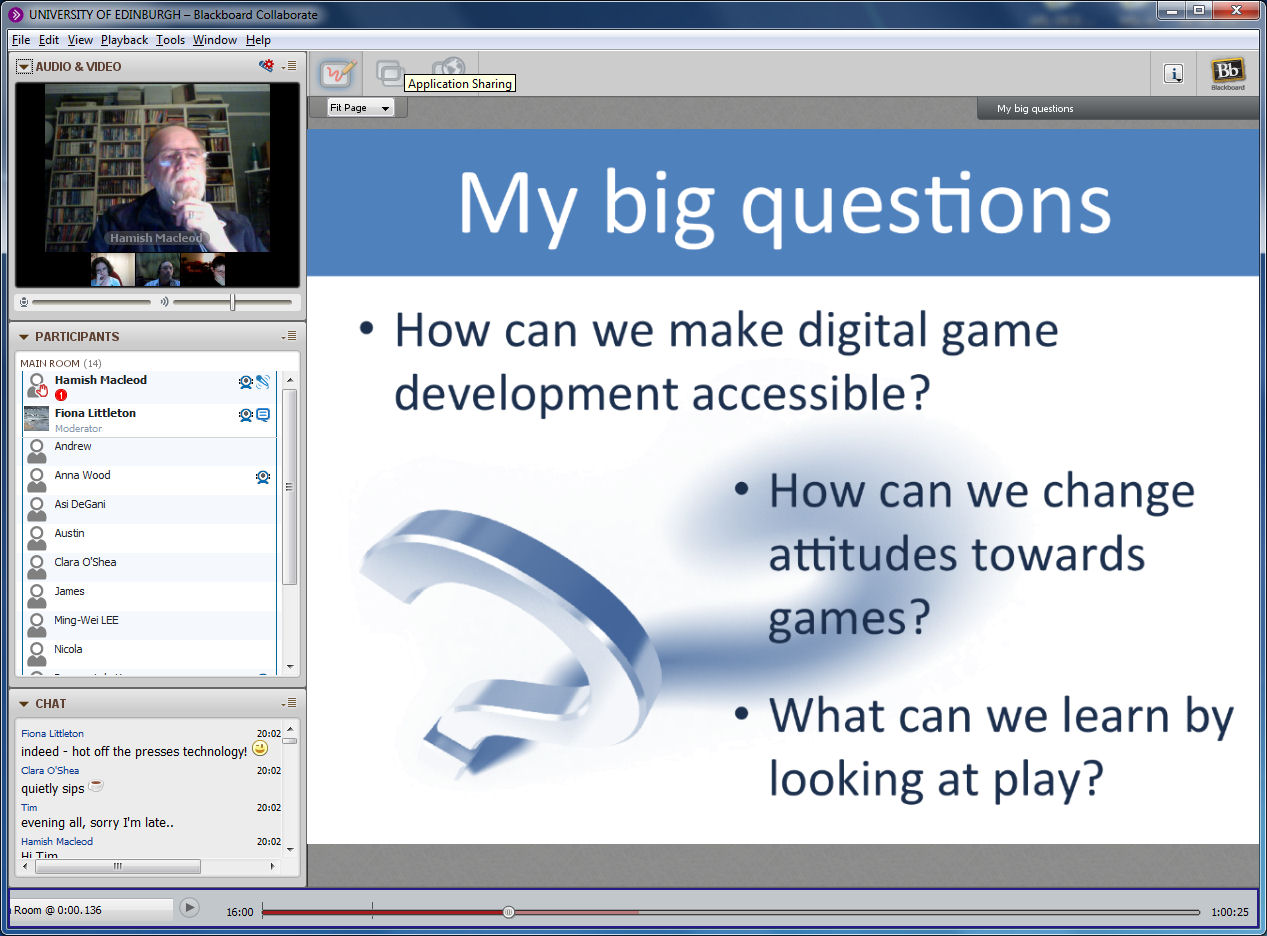
The University of Edinburgh has chosen Blackboard Collaborate as its virtual classroom. It provides Adobe Connect style tools with multi-way video and audio teleconferencing, particpants lists and profiles with hand raising and AFK indicators, and text chat with emoticons. A tools area can be used as a whiteboard with slide upload and markup by participants. It can also be used for application sharing and co-browsing.  The session can be recorded and played back.  Elements like the text chat, participants list and whiteboard contents can also be saved either during a live meeting or from a rercording.

One possibility for use could be to record a synchronised speaker and presentation, and make that available via the recording.  Screen capture tools such as TechSmith Camtasia can be used to capture off a recording to allow for transcoding into a regular video format for other uses, YouTube, streaming, etc.


Keywords: Blackboard, Collaborate, IDGBL, Recordings

Posted by Austin Tate | 0 comment(s)

March 24, 2012

I came across the concept ‘engagement’ in one of my courses last semester.

It is said by Saks (2006) that employees who are engaged exhibit attentiveness and mental absorption in their work. Wagner and Harter (2006) also indicate the engagement allow employees to display a deep, emotional connection toward their workplace.


Although it is related to the organizational performance, it does not directly link to the learning or motivation. While I am considering why immersion can lead people to learn, I think one of the possible reasons is because they are engaged in the game environment, and then they learn naturally with enjoyment.

So, engagement is a key. Why not learn through ‘games’?

After reading part of Gee’s work (2007), I think one of his arguments is as following. The reason why people generally believe that ‘playing video games is a waste of time’ is because video games belong to one of the semiotic domains, and they are not expected as the academic domains by some parents. As a result, they are not considered as valuable objectives in this society.

It seems to be reasonable, however, can people really learn through ‘immersion’?

Murray (1998 p.99) mentions about the enjoyment of immersion “In a participatory medium, immersion implies learning to swim, to do the things that the new environment makes possible.” In the MMOGs environment, we do learn how to navigate our avatar in a brand new environment. By immersing ourselves into the virtual world, we do actively learn how to communicate, interact with people, and gain sense of safety and respect from others.

Look closer to the narrative component of the MMOGs or games.

Murray (1998 p.100) argues that stories arouse the deepest fears and desires from ourselves. We feel satisfied when we project ourselves into a wonderland where the dreams are safe and sound. I believe it is why we are more willing to devote our times into game environment instead of listening to a lecture or attending a seminar. We feel being protected and being cared in the environment, and then we are engaged. Afterwards, taken for granted, we learn better.

“The great advantage of participatory environments in creating immersion is their capacity to elicit behavior that endows the imaginary objects with life”. (Murray, 1998 p.112)

I think that is where the simulation games can take advantage from it.

However, the key is how the learning can be transferred into the real-life content.

Well, to be honest, I don’t know, but I think I have learnt a trick. We need to escape from the real-world to stimulate our potential (a new ‘me’) to learn, but we still need to realize it new ‘me’ is not real, and we should remind ourselves of knowing the way back by seeing Harold’s moon. (Murray, 1998 p.103)

References:

Murray H. J, (1998) "Immersion" In Murray H. J, Hamlet on the Holodeck, pp.97-125, Cambridge, Mass: MIT Press

Gee, J.P. (2007) What video games have to teach us about learning and literacy Palgrave Macmillan.

Posted by Ming-Wei LEE | 0 comment(s)

March 19, 2012

I am here trying to explain in my own words how people exactly ‘learn’ from participating in the MMOG (Massively Multiplayer Online Games) environment after reading the research paper of Steinkuehler in 2004.


The first reflection I would like to make is from the no.1 learning principle of Gee (2004), ‘Active, Critical Learning Principle’. Players “have to play to learn,¨ (Turkle, 1995, p. 70) Once the players choose to enter the virtual world, there is no longer obligation to force the players to learn. However, I still believe that a certain degree of engagement is still required for this informal learning in order to keep immerse in the virtual world. It is relative easy to access the MMOG world, and it is much easier for the players to quit playing it.


The second reflection from me is learning social practice through others. The players have to play and learn from others if they want “to develop genuine expertise.”(Steinkuehler, 2004, p.527) Taking myself as example, I have been used to be a solo online player even in an online environment of MMOG. I can still discover the virtual world quite well. Admittedly, I can learn faster through being coached by senior players. It brings the no.16 learning principle of Gee (2004) to me, ‘Mltiple Rotes Principle Depending on the learning styles the players have, they can choose alternative styles to make progress in the game.


Apart from that, I still believe that the interpersonal relationship building is a significant issue in MMOG environment. Turkle (1995) also mentions that the excitement of the game comes from having personal relationship and being part emerging politics and activities in community. Moreover, according to the no.22 learning principle of Gee (2004), ‘Intuitive Knowledge Principle’, some intuitive or tacit knowledge is often shared in an affinity group, which means you can easily learn from experienced players. Take the apprenticeship in the ‘LINEAGE’ as an example in MMOGs, Steinkuehler (2004) indicates that by modeling successful performance, key material, social, and contextual aspects that are crucial for learning are identified, and opportunity for practice and immediate feedback are allowed.


In this case, not only the social practice is constructed and learned from the players and their tutors but also the no.27 learning principle of Gee (2004) is brought out, ‘Explicit information On-Demand and Just-in-Time Principle’, the leaning can be applied and the feedback can be received both immediately. I believe that this principal makes enormous contribution to learning when applying learning and teaching to CBL(Computer-Based Learning) or CAL(Computer-Assisted Learning) environment.


References:

Gee, J (2004) What Video Games Have To Teach Us About Learning And Literacy, New York ; Basingstoke : Palgrave Macmillan


Steinkuehler, C. A. (2004) Learning in massively multiplayer online games, In Y. B. Kafai, W. A. Sandoval, N. Enyedy, A. S. Nixon, & F. Herrera (Eds.), Proceedings of the Sixth International Conference of the Learning Sciences (pp. 521-528) Mahwah, NJ: Erlbaum.


Turkle, S. (1995) Life on the screen: Identity in the age of the Internet, New York: Touchstone.

Posted by Ming-Wei LEE | 0 comment(s)

March 17, 2012

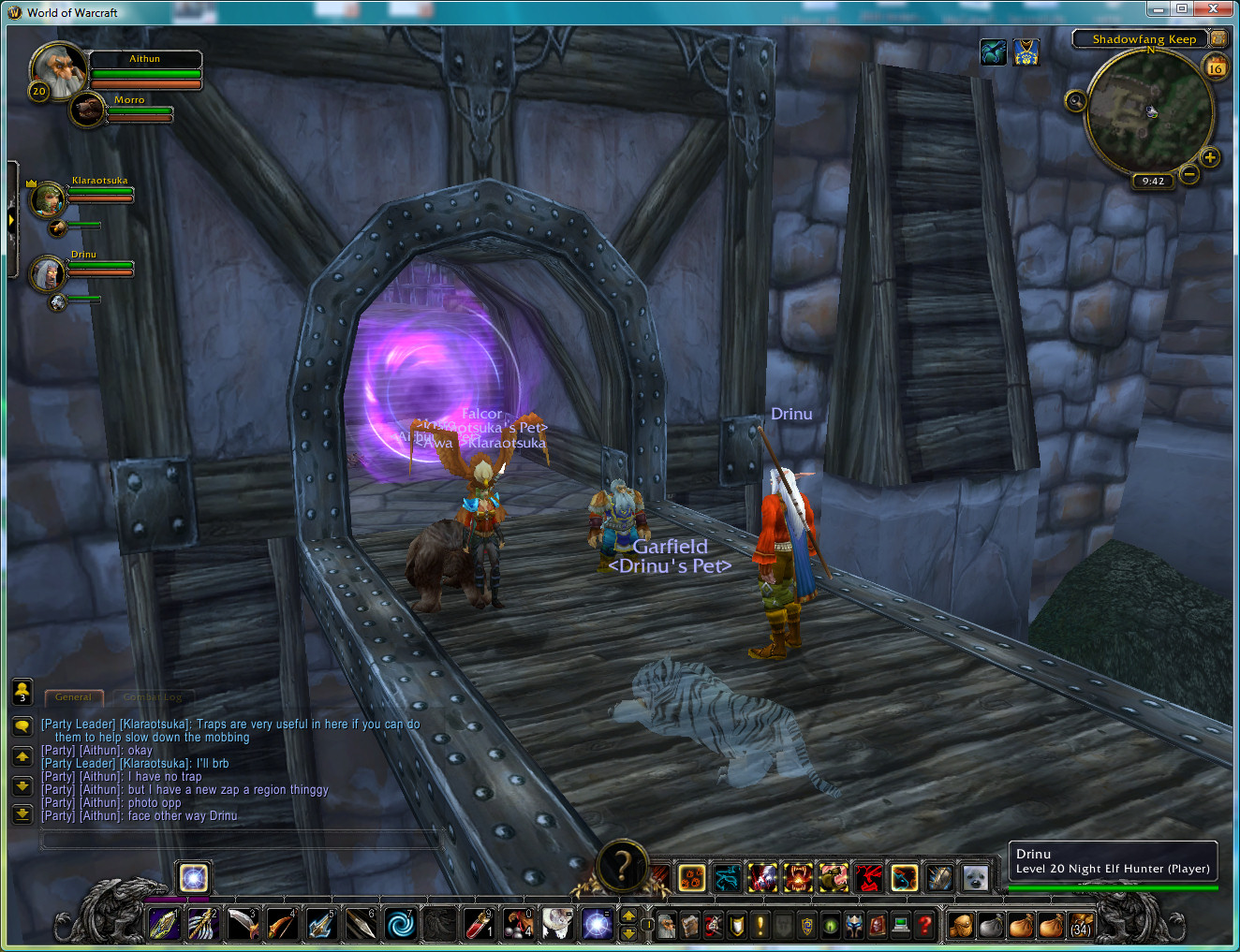
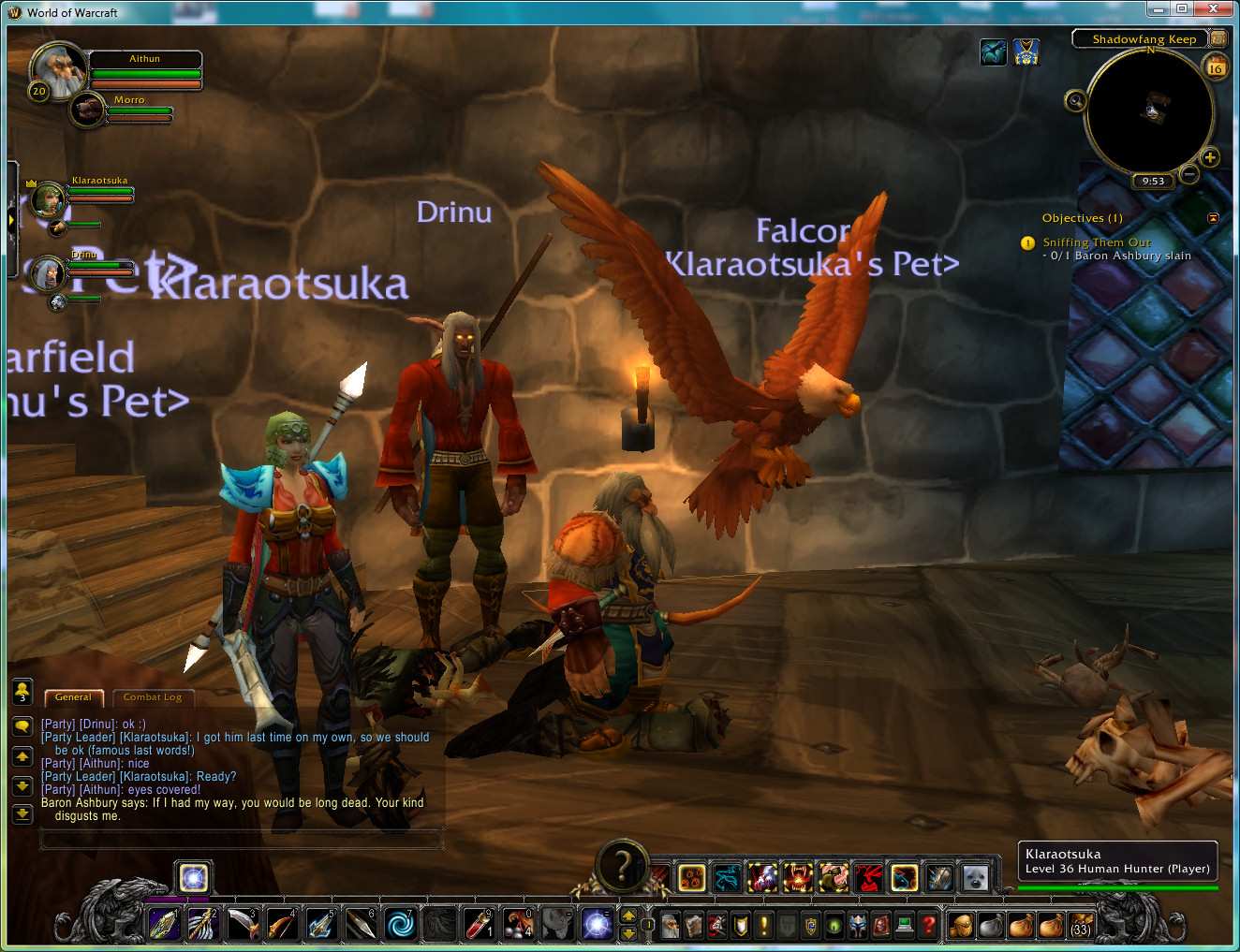
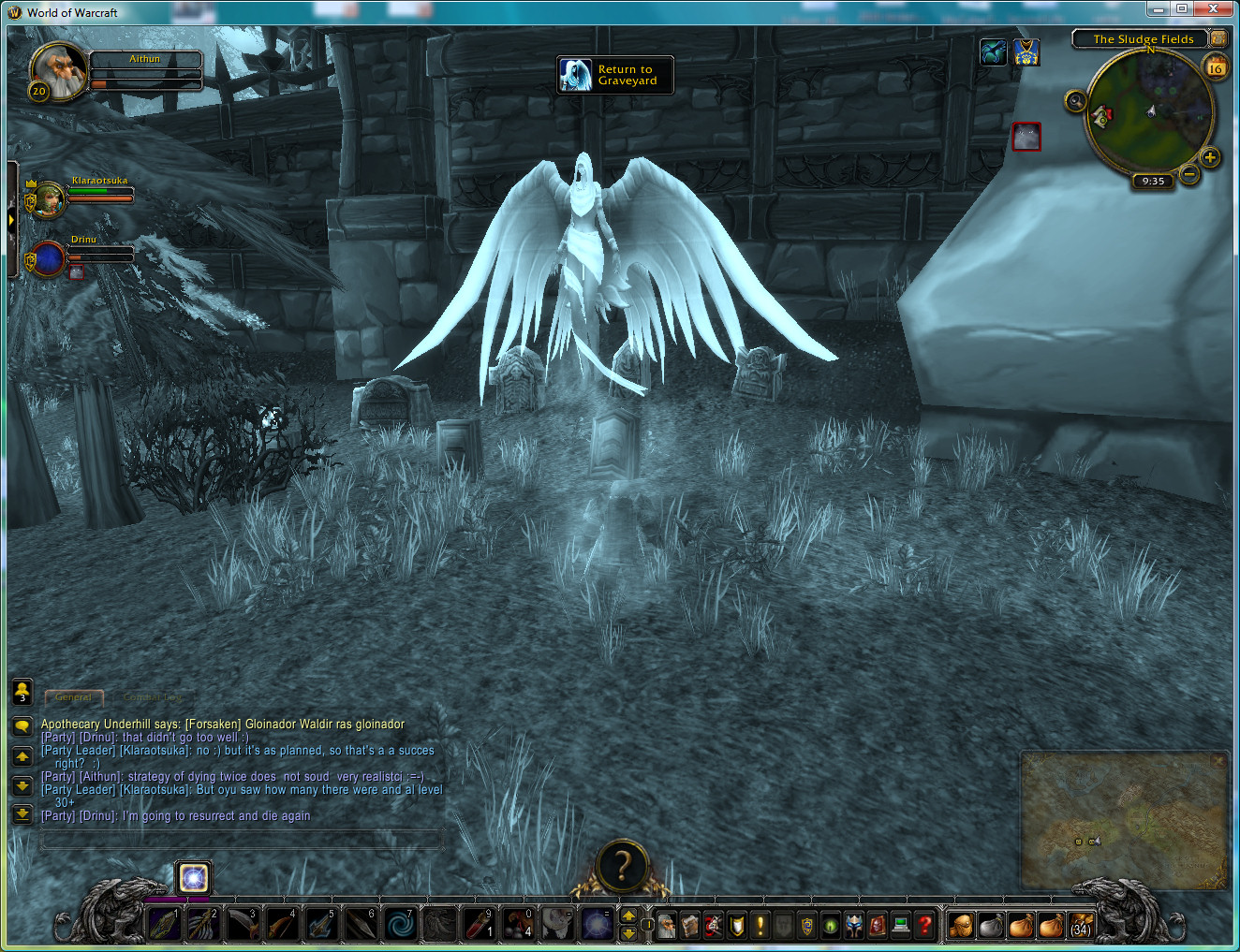
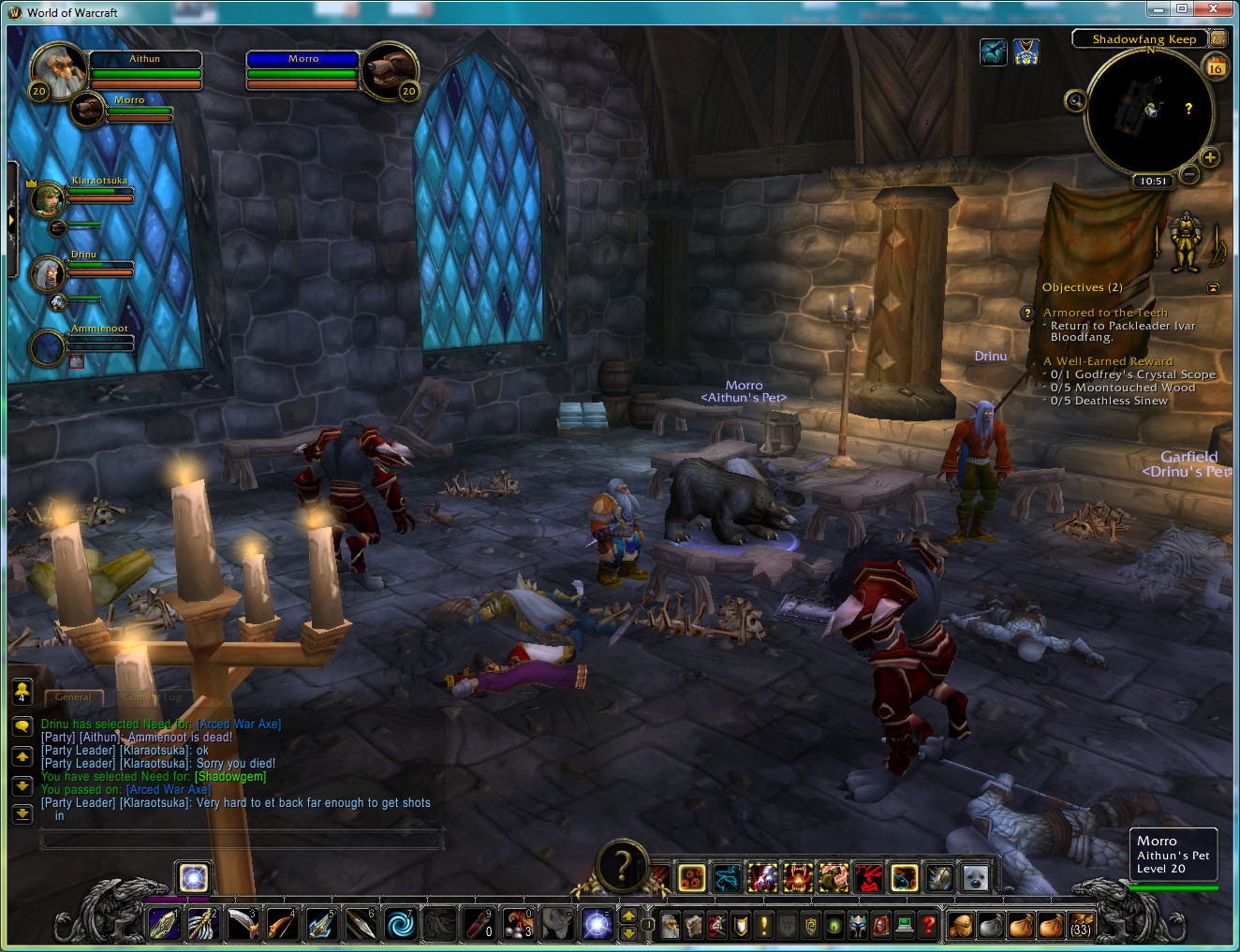
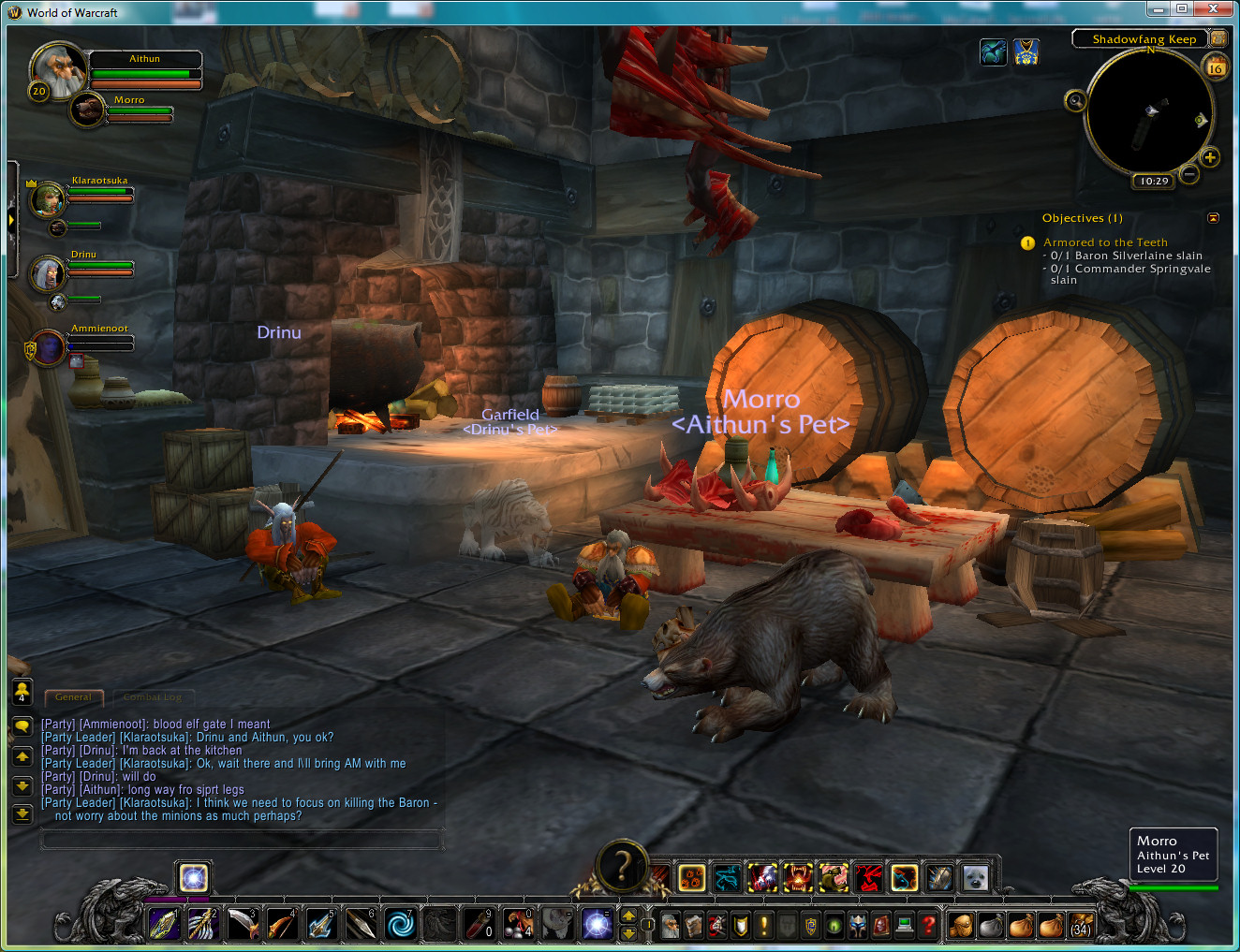
The Fellowship of MSc folks met at the Aerie Peak gryphon point to fight our way North towards Shadowfang Keep. Avoiding death is not an option on this journey, and you quickly become accustomed to making a little progress, dropping dead from the onslaught, appearing as a ghost in the graveyard, returning to your body, and placing yourself as far onwards as possible.  Then looking round for the baddies who may show as ghostly figures near you. Then resurrect and run as fast as you can onwards again. It takes a few goes to get through heavily fortified gates.

Shadowfang Keep is entered via a portal into an "Instance" of the game. These are special areas in World of Warcraft where your group or raid party is able to interact with a dungeon privately; that is, without interference from other parties. See http://www.wowwiki.com/Instance

I also learned that taking in plenty of food in advance, to sit down("x" key), and preferable to eat as well, is important to allow a quicker recovery. Free to play accounts cannot receive health boosts or food supplies from other players.

Good team support meant that weakening players, like my dwarf, were assisted when set upon by multiple "mobs". Carnage did at times occur.

The team prevailed and completed the quest.  We all now have stronger bows thanks to the rewards given by the grateful occupants of the Keep.


Keywords: MSceL, Shadowfang Keep, World of Warcraft

Posted by Austin Tate | 0 comment(s)

March 16, 2012

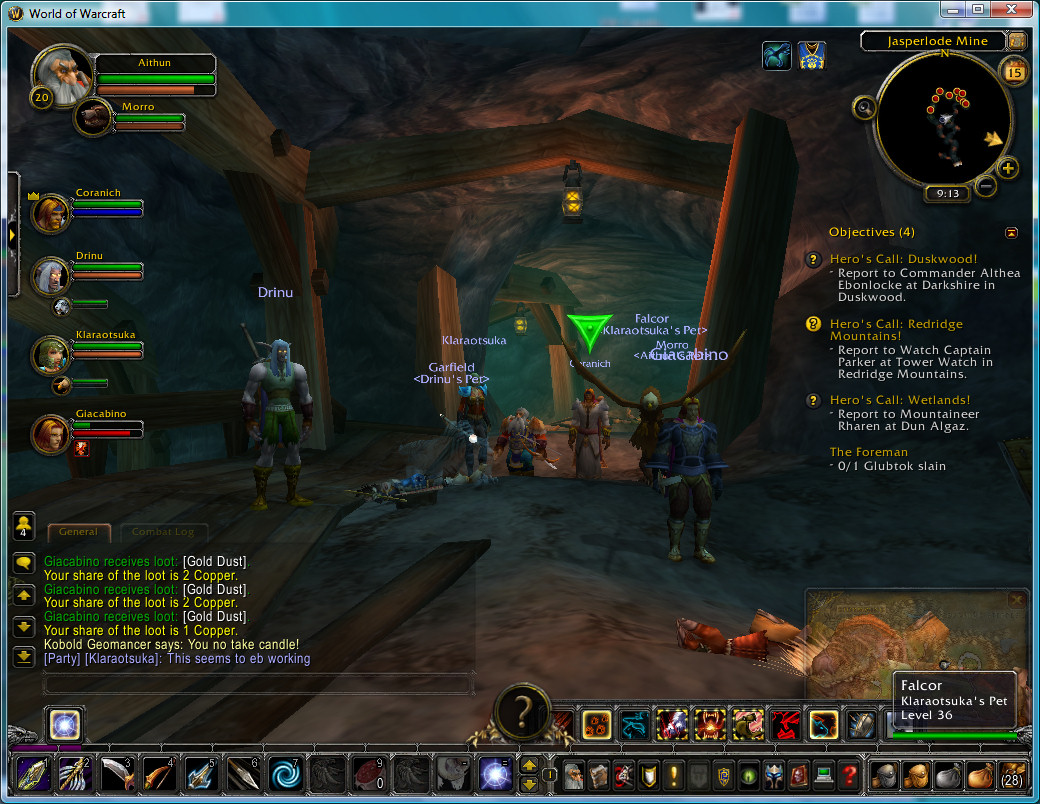
The Fellowship of IDGBLers met once more on 15th March 2012. This time to take on the challenge of a "Dungeon" available through a portal which takes you into a separate "instance" of the game.

I think we had fantastic teamwork. If we had just sailed in to the Dungeon with 4 strong players and even my short legged dwarf we could have wiped out everyone. Without much stratgey. But Coranich left to pick up a classmate.. and we all got wiped out! We tried again with much more care and planning and despite a few "deaths" we won through. Folks covered one another better, and we went to find lost characters - like myself once too. We had to learn new tricks for blasting open doors too. We were definitely in our ZPD.


Keywords: Deadmines, IDGBL, World of Warcraft

Posted by Austin Tate | 0 comment(s)

March 15, 2012

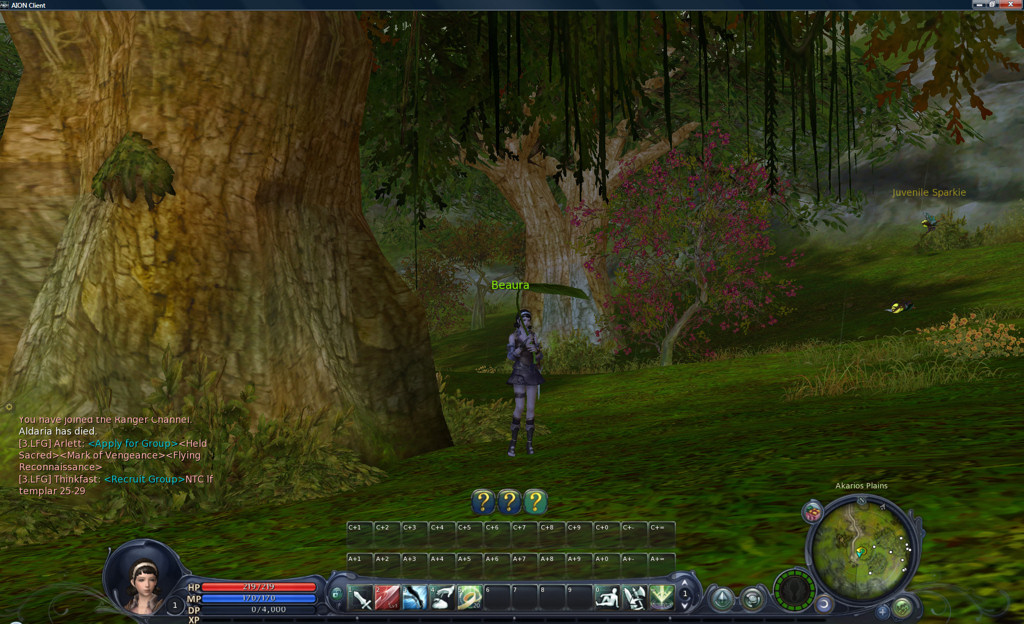
I tried the free to play Aion MMORPG available for download from http://www.aionfreetoplay.com/. I am on EU server "Anuhart".

I entered as one of the races of Daeva (assigned to me on account creation), and selected the Elyos faction and Scout class. It was raining, hence the leaf umbrella.

The free to play Aion game allows for only 2 characters to be created, but gives access to all 55 levels, nearly 4,000 quests, and all territory travel, unlike the level 20 restricted World of Warcraft free starter edition.

Entering a new world, with a new character, even though the interface had many similarities to World of Warcraft, reminded me how important scaffolding was, and the value of the community created wiki information sites. I will hold off creating my main (male) character with my usual name prefixed aith "Ai" until I know more about the game and the factions. 

Keywords: Aion, IDGBL

Posted by Austin Tate | 2 comment(s)

March 14, 2012

1) Active, Critical Learning Principle

It is quite obvious to note that the players are required to participate in gaming actively and take actions all the time.


2) Design Principle

?

3) Semiotic Principle

In the game, chatting with friends by typing is different from waving your hands to them. Even the gifts (weapon or helmet) can be given as a symbol of friendship.


4) Semiotic Domains Principle

I think this one is related to the previous principle, where the players learn how their team image can be symbolized by the flag or items.


5) Meta-level thinking about Semiotic Domain Principle

Based on the previous two principles, players can not only appreciate or master in different groups of semiotic domains but also distinguish between them.


6) "Psychosocial Moratorium" Principle

Players are more willing to take risks in the game. For example, try to kill a forest bear. (But I personally prefer to do something I will never do in real life, such as, kill an innocent rabbit.)


7) Committed Learning Principle

Most of the engaged players can’t get rid of playing, and consider their virtual identities as the extension of real-world ones. (I think it is where the immersion coours)


8) Identity Principle

Real-world identities link to virtual identities by projective identities where we can see the virtual ones are manipulated individually. (Try to play the games in different gender.)


9) Self-Knowledge Principle

This one is really interesting. Players are allowed to get to know themselves more in-depth. Taking myself as an example, I don’t like to fight for a team task in order to reach the huge prize or take challenges. I prefer to enjoy the scenery by myself.


10) Amplification of Input Principle

?

11) Achievement Principle

As it is shown in the game, the achievement records, there are the list of skills which the players have already learnt and the list of tasks which have already been completed.


12) Practice Principle

There are so many quests in this game, can be divided into individual and team. Try and error, players learn to master everything in the virtual world.


13). Ongoing Learning Principle

It seems that learning continues even when the goal is achieved. So, there are always new things to learn and to get familiar with in the game.


14) "Regime of Competence" Principle

The quests are challenging but still attainable. I think it is because of the community of this game, where you can always find someone has already achieve this goal.


15) Probing Principle

It seems to be similar to the experiential learning cycle. The learning happens when the player implement their hypothesis and receive results.


16) Multiple Routes Principle

Being a different race, or a different occupation, players are always able to choose alternative ways to play the game.


17) Situated Meaning Principle

18) Text Principle

19) Intertextual Principle

?

20) Multimodal Principle

This one is obvious. In multimedia environment, it is not essential to “talk” to others, there are so many alternative ways for the players to receive message or knowledge.


21) "Material Intelligence" Principle

I am not sure; maybe, the players can learn to appreciate the items of the game. Therefore, they comprehend how to utilize the resources to achieve the goal.


22) Intuitive Knowledge Principle

Maybe, player can learn to distinguish the places where high possibility to complete the quest / find the desired items is more guaranteed.


23) Subset Principle

?

24) Incremental Principle

The patterns players learn in early stage can be still taken into account when they move to advance levels. (EX: the geography information of the virtual world)


25) Concentrated Sample Principle

Players learn how to swim and how to talk with a character in very first beginning from instruction.


26) Bottom-up Basic Skills Principle

Players start to discover the unknown world from the basic skills and then move to the advanced ones.


27) Explicit Information On-Demand and Just-in-Time Principle

Players can always find the assistance from the “menu” or “help” in the game environment.


28) Discovery Principle

In the game environment, the hints from the game are limited. For example, the location of the key character of the task is provided but some of them are hidden in buildings and may be difficult to locate. Players need to discover and experience the game in their own way.


29) Transfer Principle

Players can recognize the hints from the map to carry out the quest, and they learn from the process. By repeating the same process and behavior patterns, players can master in completing the quests.


30) Cultural Models about the World Principle

31) Cultural Models about Learning Principle

32) Cultural Models about Semiotic Domains Principle

Cultural differentiation? To be honest, I didn’t perceive this perspective very clearly.


33) Distributed Principle

The knowledge is distributed and shared in the environment, and it can be easily noted through the language the players use and the symbols they agree on.


34) Dispersed Principle

I am kind of disagreeing with this one, if my perception is correct. I think the meaning of this game may be gone, but the rules of this kind of online role-play game can be applied to another similar game. Therefore, new learners will get to know the new environment more easily due to the previous game experience.


35) Affinity Group Principle

I think this one is related to the team building, sharing the goals and being together as a whole.


36) Insider Principle

Due to the impacts of immersion, some players can even take part in being a bug tracker for this game. They do know the game environment.


Reference:

Gee, J 2004, What Video Games Have To Teach Us About Learning And Literacy, New York ; Basingstoke : Palgrave Macmillan

Posted by Ming-Wei LEE | 0 comment(s)

March 12, 2012

WBT enables learners to explore by themselves. The general approach of how people learn is through the process ‘Tell them, show them, and let them try’. Compared with traditional learning, it is easier to access for the learners to ‘try’ by themselves. Taking simulation training as an example, the learners are able to play multiple roles in simulation. They can experience consequences of alternative behaviors and even the negative behaviors can be included. (Horton, 2000)

        In terms of test and exercise, WBT enables ‘immediate feedback’ to fit learners’ expectation. (Horton, 2000) In traditional approach, it takes ages for the learners to wait for their feedback. Even if the feedback is revealed after the test is completed, they will usually receive them as a whole instead of in piecemeal. WBT allows feedback to be demonstrated piece by piece, and keeps learners from missing several related questions because of a single misunderstanding. (Horton, 2000)

        Moreover, the hints can be provided in order to assist the learners to investigate the learning in depth. Hints can take many forms, such as: background information or instructions on how to perform the next step. (Horton, 2000) The role of giving the hints is quite similar to the role of facilitator in traditional training. However, to guide the learners in more specific way individually is definitely one of the strengths of WBT.

Finally, WBT enables learners to experience something nearly impossible to occur in real life. In a role-play scenario, Lee and Hoadley (2007) indicate that by acting as a different gender, learners observe more details in sexual incidences and even discriminations. Likewise, if the costs of failure are high, it is relatively suitable to use simulation for learning (Horton, 2000). For example, nuclear plant operators, airplane navigator.

Reference

Horton, W. (2000) Designing Web-Based Training : How To Teach Anyone Anything Anywhere Anytime, New York ; Chichester : Wiley


Lee, J.J., and Hoadley, C.M. (2007) Leveraging Identity to Make Learning Fun: Possible Selves and Experiential Learning in Massively Multiplayer Online Games(MMOGS), Innovate, Vol. 3, No. 6, http://innovateonline.info/?view=article&id=348

Keywords: simulation, Web-Based Training

Posted by Ming-Wei LEE | 0 comment(s)

<< Back Next >>