Log on:
Powered by Elgg

Blog :: All

You can filter this page to certain types of posts:

Filtered: Showing posts with comments (Remove filter)

February 12, 2010

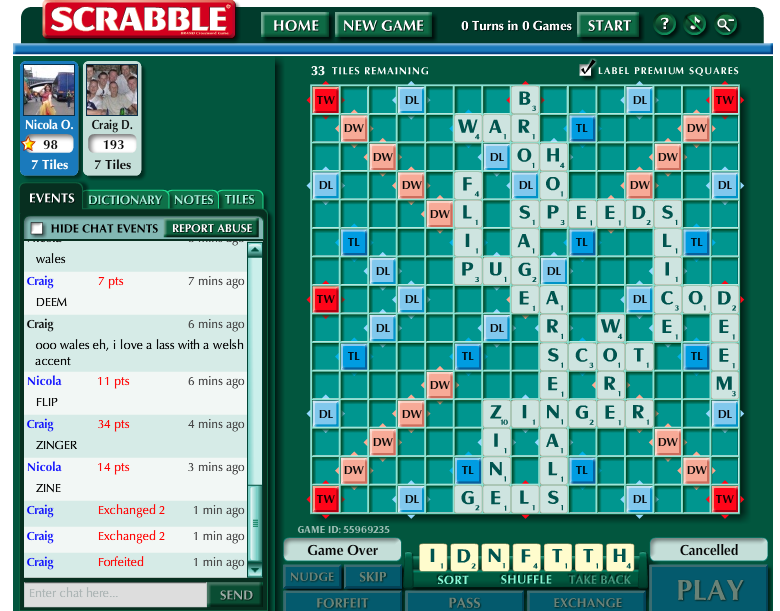
This weeks games felt more educational than last week's <Casual Games> although I think in part this may be leisure snobbery. Scrabble is a game I'm very familiar with as a boardgame but also online in it's unlicensed form (on Facebook) of “Scrabulous”. I like a word game and see it as a more worthwhile waste of time than Tetris or Solitaire because it is about words and patterns and, for right or wrong, I feel that words are somehow more worthwhile than visual patterns (which is an odd sort of bias now that I think about it). What I was not prepared for was the social aspect of Scrabble in the Hasbro version of the Facebook app. What was immediately disconcerting was the fact that I was presented with a huge wall of possible players who I don't know at all. It looked most like one of those late night “There are girls in your area!” type ads which I found immediately off-putting – I've never thought of boardgames as the online equivalent of a dubious Wednesday night in a particularly low rent pub but that was about the vibe listings like “Theresa – 2 player – casual – 2 mins” gives. The effect was compounded by the chat from my automatically (and with no opt out) found opponent Craig D. (Games: 187; Won 38%; Top Score 429):

Thus, as I played the game my concentration was largely consumed with avoiding either offending or leading on my opponent (rather easier said than done) rather than on the gameplay itself. Actually social interaction is part of the game I suppose, I was just more interested in the word part of play than the social play here. I found myself pining for my dusty old cardboard and plastic set to avoid Craig D. However when his chat up lines failed he, despite having double my score (see image below), forfeited the game to me. Which explains the stats in his profile actually – a score of over 400 is a good score (or so my scrabble obsessed friends always inform me) so his 38% win rate, especially given he was playing casual games, seemed odd. However if he is seeing the game as a game of flirtation around Scrabble rather than the Srabble itself as the game I can see why his win rate is less you might expect – perhaps it is more a representation of his flirting success than a reflection of his Scrabble skills.


After that experience I was loath to return to Scrabble with strangers (if ever in the past I've longed for someone to play a game with I'm not sure I will again now). However in the course of playing online I note that a lot of the thrilling uncertainties are removed – the interface includes a dictionary (including the mystical Scrabble 2 letter word list) rather than a simple possibility of a rejected work; a timer is included in the casual game to discourage slow long term games and encourage quick mechanical games (something my super fan friends with love, something I don't play the game for); and friends are de-prioritised as competitors even though, even with anonymous opponents, there are chat and social features. Most upsettingly of all the Tiles tab lists every available tile – a view into the virtual bag and a breach of one of the nice Scrabble features – you can guess at probabilities of letters appearing but unless you have a photographic memory these are guesses (and always, in any case, assume no one has lost/eaten/changed/replaced any times. Addig all those practical functions takes away from some of the core gameplay aspects. Evidently the Scrabulous creators knew more about what it is to play scrabble and be engaged by it than the brand owners themselves. Really interesting.


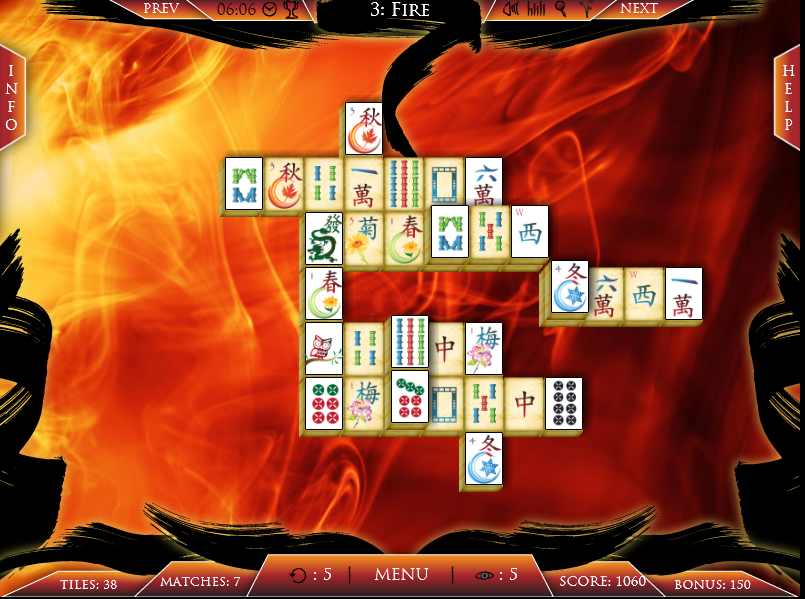
Mahjong is a complex strategic game I've been shown several times and like but struggle with. Mahjong (solitaire) on the other hand had me baffled at first. I'm not a big reader of instructions – particularly for online games (and yes, in Week 4's education games that is proving interesting) – so I was confused to see the tiles all face up and laid out in strange shapes. Whilst I couldn't remember the proper way to play Mahjong I knew this wasn't it. And then my partner looked over and said “It's a Mac thing. I used to play that years ago. It's just to do with matching pairs”. To that I looked disappointed but then proceeded to get very absorbed in spotting patterns and looking out for moveable/flipable tiles. There are some very minor nods to Mahjong (proper) but otherwise this is a memory and pattern recognition game with very enticingly attractive graphics. The game made lots of sense once I knew the basic goal but the guidance and introduction to the game – and especially the rather misleading optional login screen - wasn't really very helpful to establishing what those goals were but, after playing, I read the help text and it was actually pretty good – just why it wasn't labelled “How to Play” or “Rules” or something similar rather than “Help” was a bit of a mystery though. I'm not sure I learned anything at all but I enjoyed playing the game, I did progressively better and I was encouraged to go back and find my Mahjong tiles and play with them a bit. I'll probably also go back again as it was a very graphically sophisticated game, the music and sound cues were useful and fun, and the rules regarding nearby tiles, scoring, timing, tile layout etc. all added to the gameplay and strategies that were useful for completing a level. It was difficult but not too difficult and I liked that.


Finally I was trying out Bookworm this week. Of all the games it felt most educational and most frustrating. Firstly it required download which, in an era of browser based games, seemed quite old fashioned to me. The graphics were also a little out of date but squarely aimed at educational connotations.


Gameplay seemed like it was going to be great – there is an element of random chance, a need to match patterns and find words, and a good range of possible directions to create words in. What I found problematic in practice was the fact that the possible routes round tiles weren't entirely intuitive (some looked close enough but were not). I got very into the game though and headed at a score of over 40,000 moving from “Encyclopedia Salesman” up to “BookBinder”- they seem like odd sorts of level names though – the game is about books not literature. That is reflected in gameplay as well – you get points for flashing letters, strategies, avoiding burning letters (you have only one life in Bookworm!) etc. but the emphasis is on time and points rather than elegant word finding. This is not unlike Scrabble but in bookworm you cannot elect to play long words as easily as the choice and mixture of vowels and consonants tends to make shorter words more viable. Worrying I also got one of my highest scores with “Barf” - not the masters student level of verbal dexterity I fear.


The music and graphics were fun for play although the music quickly grew repetitive and, though it gave musical cues to the game action, only served to panic rather than focus me. Overall though this was an interesting counterpart to the other two games this week. It is an engaging game and the Bookworm character is quite charming – he even spouts explanations when a word looks especially interesting (“cud” was one of the words that triggered a definition in my game). And the high score feature at the end is quite a nice way of allowing you to compare your performance – in theory at least – and by setting the default comparison names to low scores it's quite encouraging too.


I think the puzzle game genre is a hard one to place. Though educational in the sense of improving your skills in both the game and, perhaps, your knowledge of words these games provide odd motivational opportunities as often the area of learning is not necessarily compatible with the highest scores – in Scrabble two letter words that can be used in many directions are often far higher scoring than a complex word and anything over 7 letters is rare and usually a compound of two words rather than, say, a technical or scientific term; in bookworm you are discouraged from looking for longer words by the time/burning challenges; in Mahjong the more numeric and strategic skills are exchanged for simple pairs play (only the season tiles challenge the simplicity of the game). Progress is rewarded in these games with speed or score challenges rather than building up activity to feed into some sort of reward or conclusion. All three games look attractive and have big usable buttons but in all three there is no compelling reason to start playing. Once you get going you are engaged but the motivation to engage in the first place seems to be expected to come from a place of boredom rather than interest (e.g. Scrabble's auto-selecting opponents) and that does not bode as well for serious educational goals. Additionally the downside of attractive games like these is that they look like games and that often neither feels nor looks like work/education to others since they are so associated with time-wasting patterns of use. The fantasy element in these games is also quite weak, particularly with regard to intrinsic fantasy since puzzles are, by their nature, artificially reliant on rules, restrictions and arbitrary goals.

Keywords: bookworm, facebook, IDGBL10, mahjong, scrabble, scrabulous

Posted by Nicola Osborne | 2 comment(s)

February 10, 2010

I just spent a couple of hours yesterday in Quest Atlantis (in the plague village - which is teaching about persuasive writing). I was totally immersed in this world and didn't notice the time go by. Barab et al talk about their learning engagement theory which they developed in QA - integrating learning, playing and helping in the context of social issues in an aesthetically-rich dramatic play. The plague story does this with students taking on the role of an investigative journalist trying to find evidence to persuade the community to either support or not Dr Frank(instein)'s experiment to find a cure for the plague. The story line is engaging (satisfying Malone's idea of fantasy and curiosity and uncertain outcome). QA seems to emphasize social responsibility as well - so there are moral issues interwoven in the story. I haven't finished all the activities but I think the storyline will let you argue both sides of the argument although there are nudges to re-consider your argument as you gather more evidence - but you only are suppose to use evidence that supports your argument (but I haven't finished it yet - so I don't know if there is scope to address counter-evidence in a way that supports your argument.)

Keywords: Barab, IDGBL10, Malone, Quest_Atlantis

Posted by Silvana di Gregorio | 2 comment(s)

February 06, 2010

Play

I enjoyed the Rousseau references in Kane’s work, which led to the idea of removing boundaries that would, as later indicated by Maria Montessori, allow children’s “natural urge to explore and hypothesize, compare and dramatized.”

In secondary schools, the connotations carried by the term ‘play’ are very much the domain of primary and pupils are expected to have left that behind.

This paper explored the ideas whereby ‘play’ allowed the player (children) to articulate and simulate ideas and imaginative constructs in the ‘real’ world; it facilitates the inevitability of ‘change’ that shapes our futures and destinies.

I now view ‘play’ as a powerful activity, which should underpin – wherever possible – educational activities and processes.  ‘Teaching to the test’ suits the passive, simply regurgitate content model of education – one born from the Dickens era and the Industrial Revolution.  If we are to produce critical minds, we must allow these minds to ‘forage’.

Keywords: IDGBL10

Posted by Hugh O'Donnell | 1 comment(s)

February 04, 2010

This week we are looking at the theme of natives versus immigrants on the web, the technology being explored is twitter. I will leave the discussion about natives to my next blog but wanted to say a few words about twitter service/product which I have never felt comfortable with until now.


I will start with an admission – until this week I have never really used twitter. I explored it several times, run a few searches, looked at the discussions, but never contributed (or for that matter even set up a profile). My perception of it is is stronger than that of the BBC: “Twitter tweets are 40% 'babble'” (I believe that they were using a very lenient definition of 'babble'). In fact, a random screenshot taken from the twitter homepage shows the topics discussed:


Twitter trends


So, while war rages in Afghanistan and Iraq, cars in the US are losing their breaks (Toyota) and MPs in the UK are asked to pay back their expenses the main topics being discussed on twitter are – entertainment and boy bands (4/7 topics) and technology (2/7 topics), I tried reading the last thread “OhJustLikeMe” but still have no idea what it was about.


On the very first page of “the University of Google” by Tara Barbazon, I found the following quote: “Students, in these ruthless times, desperately wants to feel something – anything – beyond the repetitive and pointless patterns of the casualised workplace and the selection of mobile phone ring tones.” I have to admit that after following a few of the threads appearing as the most trendy in twitter (and I am really not a fan of boy bands) I found little evidence of this on Twitter. If anything this reminded me much more of the nihilism that Dreyfus mentions in “on the Internet”; Twitter encourages you to get lost in the crowd, commit to nothing but have an opinion about everything as long as, it is in less than 140 characters. Whereas some of my fellow students found Dreyfus' book to be disparaging and depressing I was actually encouraged when I ran into this headline: “60% Of Twitter Users Quit After A Month”. Some of the metrics behind that report may be flawed but the comments to the article (and others presenting the same data) all circle around “what is twitter for?”


I have to admit that I found twitter to be almost disabling - it seems to encourage the culture of “looking for”, no new idea was actually developed during our chat, things written by other people were simply recycled. So, is twitter the human-based search engine that Dreyfus believes is needed? Not in my mind, simply because - if you do not know to follow then you cannot find the “good stuff”.


On a final note, while I do find twitter to be of very limited use in the classroom (and more so in the corporate training environment) I did find the conversation that we had as a group to be very engaging. Saying that, this had more to do with the content of the conversation rather than the medium it was done through. This, along with the Skype conversation we had the week before is pushing me in the direction of synchronous communication – what if we could replace the corporate training 'flip books' with an hour-long chat were people from different locations guided by more experienced employees gets to develop and understand, truly understand, ideas and information. This will never be a tool to cover compliance requirements but in the information economy could be a very powerful, differentiating, tool.

Keywords: IDELJAN10

Posted by Asi DeGani | 1 comment(s)

February 01, 2010


So this is my first post about the course content directly. The reason I wanted to start, before, with posts about my background in gaming was that I think game aesthetics and expectations are based a great deal on what you already know. That's not just about the digital games you already know but the larger context of games and gameplay. I find very violent games quite disturbing but then I was also bullied at school so only find very physical tomboy play quite threatening. I know friends who have grown up with in boistrous families (with lots of brothers or lots of cousins or lots of sports played by the whole family) find physical games quite fun and playful so perhaps also have a different take on their digital equivelents. Anyway.... On with the more course content specific bit.


Week 1 has been all about platform games, the definition of which immediately clashed with my own idea of platform games. Although I knew that the early games with static or moving platform games fitted the label I've always seen games with a similar structure – lots of small hierarchical levels – as also being platform game. This appears to have been a little way off so it's interesting to think about how limiting/limitless classifying a game based on certain elements of screen layout and play in this way. I guess it is no better or worse from calling films “action” or “comedy” or “romance” in terms of how much it tells you about play. For me the games this week seem to be about beating the clock and perfecting simple speedy key combinations to progress. The fact that they feature platforms seems to be of lesser or equal importance to these playing features.


This week was all about game definitions and characteristics and it was an interesting starting point for looking at digital games. Whitton [1] approaches this by looking at what might be a game in general and what characteristics a game has in order to be classified as such. This sounds like an obvious thing to do but personally I think it is difficult to classify lots of forms of playful gamelike behaviour. When I attempted Whitton's activity to identify what I think of as a game all of my initial answers were sports and, specifically, games I had played with other people in the past (lacrosse, tennis, etc.) and as well as being fun, challenging, competitive and social I also thought that to work they must be easy to start, where enjoyment depends on play with well-matched competitors and where absorption in the game was crucial. Whitton's own 10 characteristics seem to capture some of the same criteria as well as some interesting additional characteristics but there are a few that I am not sure I agree with.


Whitton includes Fantasy, Safety, and Rules as being key characteristics and I think there are some problems there. Of course Whitton allows for games that have only one or several characteristics but I am not sure that Fantasy is a key game characteristic. Few games have truly fantastical possibilities - there are peripheral fantasy elements but most computer games follow conventions that are very much based on the real and traditional media world in terms of gender, aesthetics, behavioural options (there are few adventure games that are wholly non combative for instance), etc. I think Safety, in the sense of a lack of real world consequence, seems to have huge overlap with Fantasy as a characteristic since the benefit of fantastical elements is surely escapism both in terms of escaping broad constraints of reality (gravity, financial possibility etc.) as well as personal physical, social and cultural limitations and embodiments (gender, sexuality, race, physique, etc.). So I think I feel that Safety and Fantasy are really one characteristic in most game scenarios.


Rules is an odd one. I agree that it's important to the notion of a game – particularly the sports games I identified – but I'm not sure why they are important. The parts of the games I identified reading Whitton were neither the goals nor the limitations of rules but the game play itself. However much of that game play is dictated or shaped by the nature of the rules. For instance I was a keen Lacrosse player for many years and it was the social and analytical elements of the game that I found fun. I wouldn't have found the game fun if there had been aggressive tackling or if I'd been playing attacking roles in the game and those were perks of having rules to shape the game. The thing is that in digital games, especially those in which learning explicitly takes place, I find it less frustrating to be allowed to make mistakes (and learn why they are mistakes) than being restricted to completing a task one specific way and/or being able to make mistakes without any indication of why something has not worked. One of the great advantages of learning from other people rather than interactive games is that feedback can be paced to meet a learners need. Some learners are happier to try over and over again and learn the answer themselves whilst that will be incredibly demotivating for some learners who would rather be guided through after a few early attempts. The problem with any learning process based upon complex algorithms is tailoring educational elements of play to the learning style of the student. Rules, rightly or wrongly, is a phrase that brings back to my mind the inflexibility of many gaming spaces.


It was actually quite challenging for me to see de Freitas' definition of computer based learning (p. 22 in Whitton 2010) which, if I am reading it correctly, assumes that learning can only take place in environments where education is the intent. I am not sure I agree with that. Learning cane take place at any time regardless of the intent of a given space I think though knowing de Freitas' background at the Serious Gaming Institute I suspect that this may be quite a tailored perspective on a particular type of computer based learning.


I do agree, however, with Whitton's non-Game activities. I am perplexed when Second Life is defined as a game as, whilst there are game spaces within the space, it is a space and a mechanism to create new spaces and activities but not a game itself. The idea that role play is not a game is a little tricky. I largely agree but the difference between that hybrid Safety/Fantasy element and role-play seems extremely subtle to me. There is something innately playful and removed about role play and, since “fun” is not in the list of characteristics, I wonder how playful and “game” intersect as terms since in terms of learning the “play” part of both would seem to be the most crucial element.


Newman [2] baffled me at first by insisting on the term “videogame” which I'd long ago associated only with the earliest days of Pong type games so I think I am going to stick with “computer game” or “digital game” in my post here as that, to me, sums up a wider array of gaming options.


I also found Newman's discussion of why players engage in games quite interesting especially given the current trend for extremely performative forms of game play. Singstar, GuitarBand, RockBand, etc. are all games based around a Kareoke style mixture of participation and voyerism in a way few previous games have been focused. Whilst there was always an element of watch-ability to games that allowed them to be played in social settings these new music-focused games are about, to an extent, recreating both traditional notions of community and performance and modern concepts of reality television. With a microphone, console and a series of classic hits you too can be a legend in your own living room and even friends or family members who are not physically participating in game play are invested and participating as a real audience to augment the on-screen fans. Their passive role is, nonetheless, an active part of the game whilst game play is all about practice and performance and not (only) goals related to control (Livingstone 2002 quoted in Newman 2004), progress and completion of the game.


Indeed games that make use of internet capable consoles add a further aspect to the player/viewer balance in that saved games are not only shared with those physically near a console but also those further afield whilst additional game material is acquired through free or paid online shops directly form the gaming environment. This is quite a disruptive idea to the notion of what a game can be. If you play Singstar and upload your video to the Singstar community are you a player of the game or an internet performer? If you create a level on Little Big Planet and share it with other gamers is that act of level creation part of game play or something else?


Fig 1. Screenshot of the Singstar performance gallery


How can competitive notions of being a winner or a loser properly defined in networked expandable and viewable games? Frasca's (1999 quotes in Newman 2004) modifications Caillois' (2001) “paidea” and “ludus” only seem to go part of the way to addressing this. Paidea, a term to define enjoyable but not goal or rule orientated games does not, as Newman suggests, seem to adequately describe the activity in playing The Sims since that game, whilst not exhibiting hierarchical goals, is structured around a defined narrative and can be (easily) lost. You can not be defeated, perhaps, but you can certainly win or lose. The goals are even stated, albeit in fuzzy terms, by the desires of the created character at a given time and by their needs to be fed, cleaned, etc. in order to live. If it were just about pleasure and no achievement (as Paidea would seem to suggest) then surely game play would not include such sophisticated levels of skills or achievement.


Whilst Church (2000 quoted in Newman 2004) identifies that players exert their own Ludus rules on The Sims I dispute that these are the only goals or achievements that are set. What is more complex in The Sims is the fact that many of the goals which are both implicitly and explicitly stated are based on traditional social constructs that are subtley introduced into game play. It is a mundane goal to eat, sleep and shower each day but it is an explicit feature of playing The Sims and is as crucial to your avatar's survival as mission achievement may be in more adventure-based titles. I don't want to dwell too much on The Sims (though I note it's repeated mention as one of the very few games played by women across various readings) but I am merely wanting to highlight that to split gameplay into enjoyment (Peidea) and achievement (Ludus) is, to my mind a rather bizarre way to split up types of game. Surely achievement and goal orientated play is not enough to motivate players through a game they are not enjoying? And surely enjoyment without progression is not enough to keep a player entertained? One of the curious features of this week's Platform games was a version of Donkey Kong that restarted rather than progresing at the end of a successfully completed level. This led to confusion and frustration because even something playful and simple needs to move on and exhibit some sort of change to hold attention. Thus I am not sure Ludus and Peidea, as I understand them (through the lens of Newman) can ever actually be separated as mutually exclusive terms. Any good game should, surely, include both elements?


On another classification note it was interesting, especially after reading Whitton, to see the fantastically restrictive set of elements of a videogame from Howland (1998a in Newman 2004 [2]) to add a little perspective on just how tricky it is to identify, categorise and classify a computer game. I think, in some ways, this is a good sign of how culturally assimilated gaming is since I think many people could be presented with a game and know it as such but defining why it is a game seems, like the definition of “Life” used by biologists [3], to collect only symptomatic information not the character or essence of what is being examined. This is perhaps why both Whitton and Newman both refer back to definitions of what a game is not as part of their definition of what a game may be.


I think this week we have come to the course with our own expectations and ideas of what constitutes a game from our own past experience (or relative lack of experience) so it is a very challenging notion to start by reflecting on the meaning of what we are yet to more fully explore. But then for Whitton and Newman even a long period of study and reflection cannot prepare any characteristics or definition of a game that they might make automatically stand up to the future technological and societal changes that will follow. I think one of the reasons that both give a flexible range of characteristics and qualities is precisely to allow a little space for gaming to adapt and change as it will, inevitably do. Whether my own sense of what a game is moves a little faster I think we shall see over the next few weeks...


So, finally to comment on this week's games a little. I was astonished to find that all three games were games I had, at some point, encountered before. Donkey Kong was, when I was a child, my least favourite of this week's three and I was surprised to find that it was still tremendously frustrating and irritating for me. In part this was because I wasn't very good at the game – I (Mario) died quickly and repeatedly. However there were several aspects that I found interesting after several attempts. Firstly I was surprised by how quick gameplay was. In around 45 minutes of attempts to complete the level I had probably played 40 times. This is astonishingly fast though not massively out of step with the other platform games this week. In part I think this reflects the fact that I only really completed a level or two of any of the games but I think it also reflects some of the access and social constructs in which this games were expected to work. Arcades, as noted in one of the week 2 readings on addiction (see later blog post for reference) actually taxes inexperienced players most disproportionately since your coins buy you only a few seconds or minutes of play. Similarly early games consoles were expected to sell to families and be used as social devices with friends, siblings etc. Games could not usually be saved and you were, in all likelihood, playing in a group and each taking turns. Short and simple game play is a perk to both platform game scenerios.

Pattern matching was discussed during the week across coursemates and Donkey Kong was the game where I found predictable patterns most quickly as I became aware that certain moves would trigger specific barrel movements. This was quite exciting – it rewarded my observation and skill – but also irritating as it made waiting as crucial a move as running and jumping. In fact I came late to the jumping part of the game. My most recent gaming experiences have all relied on either mice or console controllers so the idea of keyboard controls had rather passed me by and, instinctively, I had failed to read the instructions to discover that the space bar had a crucial role in the game. It was only when I was failing to get anywhere in the level that I realised I must be missing something important and went back to check. I also found the (unstated) rules about where Mario could jump quite perplexing as there was no audio or visual cue to make sense of why jumping only worked at certain platform distances. Again my game playing style was conditioned by games with complex audio signals and I was rather missing this clues as I played. Finally the one thing I really found odd about Donkey Kong was the infantalised hysterical girl I was supposed to be rescuing. For a start I could not work out why she needed rescuing rather than being able to make progress herself (certainly she seemed to be in the very prime running away position) but secondly her screaming seemed, to me, highly counterintuitive. Were she really in danger of an angry violent mammal she would, surely, be looking to lie low rather than rocking back and forth screaming at the world. Honestly I felt she was just too unwilling to get her hands dirty. And I also felt like the particular gender stereotype that sees a plucky plumber David fend off a giant gorilla Goliath in order to save a hysterical infant woman just too clichéd. I was really not feeling any sort of interest in contining any further with the game.


Frogger was a much more enticing prospect. I liked the basic premise as it was simple but infuriatingly reliant on quick button taps and very very good timing. I found the movements very intuitive to control but was particularly impressed by the simple but highly disorientating effect of having a game road function almost but not quite like reality – the changes in direction were tremendously unsettling and the variant speeds of cars quite challenging. Once you knew the general rules of what happened where it was fairly easy to play but one of the interesting conceptual elements was the fact that the screen was the universe. Should your frog float on a log off screen he was a gonner. Which is in stark contrast to the conceptual space in most games that, as in most television and film constructs, encourages you to believe there is a whole world beyond that which can be seen.


Pacman, our final game this week, had an alternative but again novel approach to structuring it's 2D game play with a layout that provides a tunnel from one side of the screen to the other suggesting that the screen is your universe but that it is, at least, a fairly smart space with it's own peculiar rules of time and space. Pacman proved to be the most addictive game of the week for me. It was intensely fast, baffling, but fun. Audio clues were minimal but helpful and it was aesthetically the best game because it was built around clear engaging highly abstract visuals that worked in a low resolution context whereas Donkey Kong and Frogger both required big leaps of faith to believe that the pixellated detail on screen were worth becoming engaged with. I did not, sadly, find all the clever little patterns and twists (more on this next week) but I did feel, of all three games, that there was a noticable difference between playing at initial skill level and, after a few hours, playing at a more developed level. I completed level 1 of Pacman and found it a really compelling game to return to to see if I could again reach (and this time conquer) level 2. I think part of what made it so playable was the option to play vertically or horizontally. Working bottom to top in Frogger and Donkey Kong seemed peculiar especially as email, blogging and most internet sites order content to avoid scrolling making top to bottom as key a default reading style as left to right. Which makes me wonder how much the structuring of these games depends on other conventions of players. For instance are some games (particularly those with complex status information shown on screen) easier to play with those used to scripts that write from right to left rather than left to right? Is the vertical game play in puzzle and platform games easier for those used to vertical kanji rather than western scripts? I'm not sure but I have a feeling those expectations do definitely influence enjoyability and the success of the first few plays of a game.


References

  • [1] Whitton, N. (2010). Chapter 2, “Recognising the characteristics of digital games”. In Learning with Digital Games: A practical guide to engaging students in higher education, London: Routledge.

  • [2] Newman, J. (2004). Chapter 2, “What is a video game? Rules, Puzzles and Simulation”. In Videogames, London: Routledge.

  • [3] Wikipedia. (2010). Section 2.1, “Biology”. In Life. Accessed 31st January 2010. http://en.wikipedia.org/wiki/Life#Biology


Keywords: DinkeyKong, frogger, IDGBL10, Newman2004, pacman, Singstar, Whitton2010

Posted by Nicola Osborne | 3 comment(s)

January 31, 2010

By the time I reached university I had reached the point when I had not only access to networked computers but also a PC in my own room so I brought myself the Monty Pythons the Meaning of Life game as a way to expend spare time. It was all based around the film and included additional Terry Gilliam animation it looked incredibly slick. It ran off a CD Rom and included lots of clips of film between a progressive series of puzzles and daft trivia games. It appealed to me because I liked the Monty Python TV show and films but I returned to play it as it had several entry points and the games were fairly random and witty: it was entertaining even when you did badly.


At university I found myself trapped at a campus out of town for lots of lunch hours with little to do so joined my peers in playing Light Bikes and, when flash started powering lots of online games, things like Tetris and Solitaire but played online (wisely the university did not include the games in the standard Windows installs on computer lab machines). I was still on the whole more interesting in writing, blogging and starting to edit websites most of the time but remember reviewing films one festival with a team of video and flash producers. At the time flash games were starting to be used particularly on brand websites (as they still are) to create lively slick looking add ons to the site (rather than as the core style of presenting the whole website as is the case with lots of brand sites now). The process of creating them was, however, fairly complex and time-consuming (though, at the time, less taxing than trying to capture and deliver video to a good standard online) and the team I'd been working with went off to lucrative work in London as every company was starting to need a website and starting to want something slick and playful to draw people in.


A few other games started popping up as well. A friend lent me his copy of Incredible Machines, a rather geeky game based on building wonderful surreal gadgets and vehicles to solve peculiar puzzles on screen. Of the games I'd played this was one of the most educational feeling – although since I was studying engineering in between games I knew that this was more puzzle than study – and one of the most engaging as it was quite analytical, very creative and there were multiple ways to find a solution. 

I enjoyed Incredible Machines but, when I complained how much I wanted an even more freeform game – something where I could create and build and control what I wanted, I found myself receiving a box set of the Myst series for Christmas. I tried to fathom the game but whilst it was the most graphically glorious game I'd encountered it was also terribly frustrating. It did take creative skills to master but it seemed to need a psychic connection to the games developer to find the goals and solutions to progress. I gave up quite quickly as I grew tired of reading obtuse text introductions and then playing baron (but beautiful) game areas where only a few areas had any type of (obscure) functionality. It had the aesthetic I'd been hoping for but the “creative” game play aspect felt too regimented.


I started working part time in a computer lab and, since the job amounted to babysitting the room and filling the printer, I found myself with long shifts to fill with things that could be regularly interrupted. GemMine and various other deeply daft puzzle games kept me entertained as gameplay only took a few minutes on the whole.


 But it was when I moved into a shared flat with a console (and subsequently several consoles) that I really started to play computer games. I spent hours and hours playing Tony Hawk's Pro Skater 4 with my flatmates. There felt like a real progression of skill in the game and, as I perfected my grinds, I felt like I was really progressing through the game. Key to this sense was the fact that the flatmate I played with most often was of a similar skill level so a slight difference in skill or experience from playing individually made shared game play that much better. Both of us, however, were regularly shown tips and masterful play by two casual experts of the game who came round for parties and video nights and trounced our scores. One night we decided that we should play with the custom settings on game and decided to create players for our games that looked just like our real life experts. This new bizarre embodiment in the game actually made it much more fun to play – suddenly our skaters had a name, a look and a personality as well as some custom skill points to match our best playing skills. The game kept us entertained for months and months – and cleverly blended the ability to save long term progressive games with short unsaved party modes - and felt really sociable so I have very fond memories and reached probably the highest level of game skills of any game I've played before or since. I really felt like I knew what I was doing. And years later I was amazed to find that the realistic landscapes used in the San Francisco levels of the game had been so good that I was able to guide my partner (who grew up near the city and had often visited) round the areas she hadn't visited before. In fact Alcatraz was so like the game that I had flashbacks to specific favourite moves as I walked around and felt like I had been there before. It was wonderful and very bizarre.


Computer game sessions at the end of video nights become the standard end to the night in the flat with Bishi Bashi, Super Monkey Ball/Monkey Tennis, TimeSplitters 2, Grand Turismo, and Tekken Tag Tournament were all very popular.


My flatmate also brought a few more slow burn titles so we both attempted Pikmin - which was highly enjoyable if not wildly exciting and Mario Sunshine, a game we again traded off tips and progressive game play in. Luigi's Mansion didn't entertain for long but was silly and fun but The Legend of Zelda: Wind Waker proved to be an even more compelling experience than Tony Hawks since it combined slick animation and a whole rich complex universe. It was, however, definitely a solitary game and the most social it ever reached was in the exchanging of tips or new level info between game play sessions.


My flatmate also acquired GTA: Vice City for his PC at about the same time as a whole raft of our (male) friends did. After hearing about some of the notorious features of the game – freeform gameplay was the most enticing element but the idea of a game where you scored points for killing, mugging and using prostitutes had a certain amoral charm – that I requested a wee play on the game. Again I was wowed with the graphics and I did enjoy the custom cars and their multiple radio stations. I didn't really get the goals (perhaps the point if Games Britannia [1] is to be believed) but I enjoyed the openness of the space – Tony Hawk's and GTA were the first two games where I could go in the wrong direction, do something purely for entertainment or craft my own narrative and they were both much more enticing for this. The animation and, most particularly, the soundtrack packed with great well known tracks that set the mood were key to the games' success. However the progressing goals and narrative scenes of GTA, though slick, seemed to interrupt more explorative play and I never quite got the hang of taking part in these missions and areas of the game where you were taken out of game play to view important information. I do know friends who wanted to progress through the game in a much faster more goal orientated way though and I think these sequences (longer but not unusual in any video game) felt less disruptive in this style of play.


The rather warped moral code in the GTA gameplay didn't bother me too much at the time but then I was an adult woman playing the game. As subsequent titles have come out in the franchise I've been interested to see how they are marketed as I think the same subversion that makes these edgy and witty games has some odd implications for who plays them and how really committed players may view other people. I am astonished, for instance, how few protagonists in any modern computer games are women. Lara Croft may have been designed to look great to male gamers but that at least meant that she was a tough and multi faceted character (and led to the hyper feminist and equally quite exploitative Bits[2], a female fronted answer to Games Master[3] ) and gamers of all genders played the game in the embodiment of a woman (although more often as voyeur than through her eyes). GTA had men cast as various characters – gang members and bosses, taxi drivers, irate by standers, police men radio shock jocks etc. - but women seemed only to appear very peripherally and as prostitutes and mob girlfriends (which may or may not effectively equate to the same thing in the game). That actually means the game had more women in it than more random aggressive games – such as Halo, a game I played only a few times but found fairly dull (though exquisitely rendered) - but is, nonetheless, quite an odd experiential landscape.


When I moved out of that flat a few years ago my partner and I sat down and talked about buying a games console. We'd both gotten used to playing a lot of games quite regularly and the Game Cube seemed the most enticing option. Indeed I still occasionally look into the windows of second hand gaming shops and ponder a discounted bundle of console and games to relive my gaming student days. At that time we decided to leave it for the time being. I lost track of what games were coming out and decided I was fine without a gaming console. However with several friends in the industry I do waver quite often and when the WII came out both my partner and I thought it looked like it could be a fun console to get. We haven't got one yet but that's mainly because we look at the price, we look at the amount of free time we have and we generally decide that we'd rather use the money on knitting, crochet, beading and cooking equipment – things that we tend to do together. Spare time is at more of a premium than money so my partner currently plays The Sims 2 on and off (very obsessively at times) when she has free time but, partly because of studying for this course, and partly because of other hobbies that tend to be my first choice of time filling activity, I've been pretty much off games for a few years.


Although I never think of it as a game I have flirted with Second Life both for this course and for general entertainment. As a space it ticks many of those boxes that Myst never did but it is really a social space and for that reason it tends only to capture my attention when I have a social use for it. The most compelling element of Second Life for me is the ability to create things but the tie to cash for importing and housing any items or textures in SL feels very alienating to me. I might be happy to pay a one off fee for software/a game but I don't use the space enough to subscribe (as I do to Flickr and PodBean) and really use it as an alternative space to be. What I would love it to be able to take out some of that SL experience and share it in other spaces.

OpenSim is interesting as a possibility and I also like the type of Machinima that comes out of SL as a way to share experience and creativity to those who do not want to register and take part in the same virtual world. I have also looked at World of Warcraft but have not been terribly tempted yet, in part because of the fantasy element of the game (not a style of game play in any format that has ever terribly inspired me) but mainly because the cost barrier is fairly high to get started and I'm just not sure I have the time to make the most of the game and thus get the value out of paying (even if I liked the game play). Those I know who do play a lot of WoW have existing groups of peers who already play in the space and this, in part, is a motivating factor as it allows them to play some fun challenging situations with old friends in areas near and far – as well as friendly strangers. And I cannot argue that WoW looks immeasurably more slick than Second Life.


Although I'm not gaming at the moment it seems that more and more of my friends do. Singing games show up at parties, WII Fit seems to be regularly mentioned as a modern alternative to the fitness videos and DVDs that used to be ubiquitous at this time of year. Given this upturn in gaming I'm surprised gaming doesn't appear in mainstream media and most particularly doesn't feature on TV outside of the adverts. When I started to take an interest in computers Knightmare (for a taster have a look at this (realplayer) clip) was on TV. By the time I had a PC and was wondering what I could eventually do with the technology Cyber Zone was on TV suggesting that we'd all be playing virtual reality games in the near future...


And by the time I actually played console games I was watching the excellent Bits and I felt like I had a connection to what was going on in gaming. But at that point gaming was gaming, as in a particular hobby with a fairly geeky connotation...


At the moment I see ads for gaming – more often than not featuring A list actresses or footballing dynasties. The emphasis is on games as a leisure pursuit for all – not just geeks but older players, women, and families – to play in sociable group contexts (the big screen TV acting like a roaring fire at the heart of a modern living room).


Particularly interesting are the brain training games ads – a particularly enthusiastic attempt to get older consumers to buy hand held gaming devices that seems, if the cafes and commuter routes of Edinburgh is anything to go by, to have had a fairly successful impact. Oddly this is marketing pitch claiming that games are educational but in such a way that the ads almost play like dietary supplement infomercials. It adds credibility to learning through games but only in the context of Sudoku style puzzles that are specifically labelled as learning games.


So, after looking back at all those gaming encounters a few things are highlighted for me. Firstly I am a hard gamer to capture. Although I seem to have played a lot of games and can be easily absorbed in many types of game it actually takes a great deal for me to become properly invested in playing a game. The long term games that allow the saving of positions and more freeform explorations work best for me and I learn skills in these. I like creative spaces but I get a little lost when there is no structure at all. Choice is good, infinite choice is quickly baffling. And finally I am quite price sensitive to games. I will happily try a free or inexpensive game but I am wary of entering a game that may prove expensive to continue. This is not because I could not afford to play (generally) but more to do with where value lies for me: virtual goods have limited value to me and regular payments must represent decent value for money. For educational games this last element would not, on the whole, be an issue but game play would. I have seen demos of “Serious Games” and these look fantastic but very much based on following a specific response. There are good reasons for this but the idea of free choice that traps you in a single level until you make the one approved move is a tricky one – it can feel like Groundhog Day.


Notes

[1] Games Brittania is a BBC 4 Series from late 2009 tracking the history of computer gaming. More information on the shows website: http://www.bbc.co.uk/programmes/b00pddc6

[2] Bits was a games review and news show running in the late '90s and early 00's and hosted by three female games journalists/presenters. Websites about the show are sparse but Charlie Brooker gives the show mention in his own review of gaming shows on TV.

[3] Games Master was a Channel 4 computer gaming show which began in 1992. A detailed page about the series can be found here:http://www.gamesmasterlive.co.uk/gamesmaster/gamesmaster.php.

Keywords: Bits, gamecube, GamesBrittania, GamesMaster, gaming, IDGBL10, tonyhawks, zelda

Posted by Nicola Osborne | 2 comment(s)

Last week I was frustrated by the arcade games I was playing.  I realized that they weren’t just random and that there were patterns but I couldn’t quite make out the patterns. At one point, I stopped the Pacman to see if I could discern a pattern in the behaviour of the ghosts (without any success!). Having read Greenfield now, I realise that was the wrong strategy. The strategy is not in identifying a pattern in just one element of the game e.g. the ghosts – but the pattern depends on the interaction between the ghosts, the pacman and the board itself.

I was starting to ‘feel’ that some parts of the board were more dangerous than others.  But I did not have the patience to pursue and investigate that feeling. I think it does have to do with learning styles – as Emma mentioned on the Discussion Board.  Thinking of Kolb’s learning cycle, I think arcade games would favour those who prefer an active experimentation style.  I, on the other hand, have a more reflective learning style and the sheer speed of the games does not allow any time for reflection. 

James Paul Gee’s account of the view that videogames are a waste of time as they have no content has resonance with the views expressed by my friends including my husband.  I never held that view myself mainly because I have no experience of those games.  Gee argues elegantly that a semiotic domain is not just content but...

”a  lived and historically changing set of social practices. It is in these social practices that 'content' is generated, debated and transformed via certain distinctive was of thinking, talking, valuing, acting, and often, writing and reading. “p.21

For people who have never engaged in playing videogames, the ‘silliness’ of the content is an easy target.  But Gee demonstrates that a lot of learning can be acquired in well-designed games. If a game is actively and critically played the player:

·         Learns to experience in a new way

·         Gains the potential to join and work with a new affinity group

·         Develops resources for future learning and problem solving in related semiotic domains

·         Learns to think of semiotic domains as design spaces that engage and manipulate people in certain ways and help create certain relationships in society among people which could have social justice implications

The key to critical learning is the ability of the player to be able to reflect on, to critique and manipulate the design grammar of a game at the meta level.  This requires looking well beyond the content of a game – but how it is structured, what elements it has, the characteristics of these elements, how it is similar and different to other games of this type. 

Gee sees the value of videogames in that they:

“...situate meaning in a multimodal space through embodied experiences to solve problems and reflect on the intricacies of the design of imagined worlds and the design of both real and imagined social relationships and identities in the modern world.” p. 48

The player learns to think critically about the simulation and thus gain literacy of multimodal spaces.

Gee points out that the key is not questioning the ‘content’ of games per se but whether it is worth spending time pursuing the semiotic domain of a particular game.  And the questions he poses are ones of value judgements:

·         Is this a good way to experience the world?

·         Is this a good and valuable affinity group to join?

·         Are these resources for future learning applicable to other good and valued semiotic domains?

  • is this domain leading the learner to reflect on design spaces and their intricate relationships to each other in ways that could lead to critique, innovation and good and valued thinking and acting in society? 

In the beginning of the book, Gee argues that even violent video games can be valuable. And I can see that he is thinking beyond the actual content.  But in terms of the value questions he poses, I feel there is a contradiction here. I have not read yet what he says in particular about violent games but Greenfield indicates that it is action rather than violence which children find attractive.

References

Gee, J. P. (2003) Chapter 2, 'Semiotic Domains: Is playing video games a "waste of time"?'In What video games have to teach us about learning and literacy, New York: Palgrave Macmillan. (core textbook)

Greenfield, P. M. (1984) Chapter 7, 'Video Games'. In Mind and media : the effects of television, video games, and computers. Cambridge, Mass: Harvard University Press


Kolb, D. (1993). The process of experiential learning. In Culture and processes of Adult Learning. M. Thorpe, R. Edwards, and A. Hanson (Eds.). (Buckingham, OUP): pp. 138-156


Keywords: Gee, Greenfield, IDGBL10, Kolb, semiotic_domains

Posted by Silvana di Gregorio | 1 comment(s)

This week the Learning Technologies show (2010) took place at the Olympia exhibition Centre (The 27th and 28th of January). Working for a company that offers a number of products in this field I spent both days exhibiting at the event. This gave me an excellent opportunity to contrast where the corporate world is in terms of e-learning (technologies and usage) with how e-learning is used in the academic setting (having been on the course for two weeks now).

It seems as if the corporate world is still using the “traditional” e-learning of two decades ago: the number of companies still offering e-learning authoring (“click on the 'next' button 30 times and you are done”) is phenomenal. On the administrative side the main products being offered are LMS systems (which are mainly responsible for scheduling the presence of employees in classrooms or when they need to go through e-learning packages). In other words while interfaces have changed and systems have been speeding up there is little change in this field from the 1990s.

The buzz words of yesteryear – Mobile learning has now become more common (being used mostly for performance support and just in time knowledge) and so while many companies offer something in this field it is no longer a main attraction.

There is however some good news for corporate learning: the main product which seems to be making tracks is the e-portfolio. In fact, in a number of conversations that I have had during the show it seems as if corporates are finally starting to understand that being able to schedule employee A in classroom B at time C (with an LMS) does not actually mean that employee A has learned anything. Therefore, e-portfolio (and 'Talent management') systems are becoming of greater interest as they offer a mixture of skills and competency management (“what does the employee know” rather than “what does the employee need to learn”).

According to researchers such as Jay Cross most learning is informal. In such a case managing the skills and competencies of an employee rather than what they need to learn is very good news for learning in general. Over the next decade I believe that we are going to see the LMS become a subset of the e-portfolio system (it will still be needed to track learning for compliancy reasons).

The second trend that was obvious at the show is all about “social learning” on the one side this is closer to what is happening in the academic environment but it also acknowledges the way that younger employees (those currently joining the workforce) live their digital lives. The theme of “Google is today's main learning application” is a recurring one appearing in Barbazon's “the University of Google” and other sources. However, we have to remember that these books have all ready been out for a while (3 years in Barbazon's case) and the younger generation look at Facebook, MySpace and Twitter as their main port of call. In other words we have gone from learning from a teacher (with the book) to learning from an infinite library (searching it via Google) to learning from our peers. An example of this is given by Steve Johnson in his article “How Twitter will change the way we live”: describing an instance where a certain celebrity (Oprah) asked for help removing ticks from her dog.

I think that the main significance of this 'peer learning' to the corporate environment (and this is the main point which interests me personally) is that it brings closer the learning organisation as described in such books as Peter M. Senge's - “The Fifth Discipline” and Argyris and Schon's “Organizational Learning II”. Achieving the state of a learning organisation is not possible without the help of technology due to the simple reason of mass – the amount of data generated, updated, stored, queried and retrieved on a daily basis is by far too much for a non-technological system to handle. In his article “How Twitter will change the way we live” Steve Johnson claims that the value of twitter (and this apply to any system which generate great volumes of data) is not in the data it helps create but in the tools that allow users to manipulate and search it and so transform the data into information. I will be following closely the development of these systems for the corporate environment and their impact.

On a personal note, now that the show is finally over the weeks of preparation has paid off and I can finally returned (Begin) to make a more regular contribution to this blog and my studies in general. I look forward to this end to the reduction in day-to-day pressure.

Keywords: IDELJAN10

Posted by Asi DeGani | 2 comment(s)

James Paul Gee's 5 Learning Principles are extended here:

http://mason.gmu.edu/~lsmithg/jamespaulgee2


Keywords: IDGBL10

Posted by Hugh O'Donnell | 1 comment(s)

January 27, 2010

I found the Greenfield article extremely engaging.

She begins by stating that moving visual imagery (p89) is important and is developed via the skills acquired during TV viewing - an activity still frowned upon if undertaken to extremes. But it is the interaction – being able to control the narrative in addition that creates the engagement or the fascination with videogames.  Other factors include, automatic score keeping, randomness, audio, speed (91)

I have an interest in gender roles, when considering any ICT (teaching S3 & S4 all boys classes) and was interested in her observation that the entry point to computing is a via gaming, which was predominantly male. (94)  I find that boys in mixed classes can often be heard discussing computer games, especially their collaborations/challenges online.  Spatial skills, said to better exhibited by males.

I was interested in the principle that the human brain looks for patterns as a way to discern the world: computer games call up inductive skills much more (100)  Pattern recognition is required, as is parallel processing – the assimilation of several sources of information at the same time.

Whitton notes that:  

  • Pictorial – parallel
  • Audible – serial

something which I am keenly aware of during my teaching practice. Also, one must consider the context/setting in interpreting “interacting dynamic variables” (102).

Which leads to the issue of ‘transfer’ – into other domains – and generalization of these skills.  How can this be achieved?  For an English Teacher, Fantasy Games allow for the creation of far more complex characterization.  This is useful in conjunction with any imaginative/creative writing activities - I have noted that the Neverwinter Nights has the feature(s) for users to create and build within the videogame domain.  Again, something that offer more features that allow for creativity. 

A LADDER OF CHALLENGES

Closely linked to the motivation and the maintenance of an optimal level of engagement:

  • visible progress
  • improved score
  • next level progression, to a level of increased difficulty

during all of which, the user (children) need to feel control.

This seems to be the elixir of creative and successful education.

Keywords: IDGBL10

Posted by Hugh O'Donnell | 3 comment(s)

<< Back Next >>