

This weeks games felt more educational than last week's <Casual Games> although I think in part this may be leisure snobbery. Scrabble is a game I'm very familiar with as a boardgame but also online in it's unlicensed form (on Facebook) of “Scrabulous”. I like a word game and see it as a more worthwhile waste of time than Tetris or Solitaire because it is about words and patterns and, for right or wrong, I feel that words are somehow more worthwhile than visual patterns (which is an odd sort of bias now that I think about it). What I was not prepared for was the social aspect of Scrabble in the Hasbro version of the Facebook app. What was immediately disconcerting was the fact that I was presented with a huge wall of possible players who I don't know at all. It looked most like one of those late night “There are girls in your area!” type ads which I found immediately off-putting – I've never thought of boardgames as the online equivalent of a dubious Wednesday night in a particularly low rent pub but that was about the vibe listings like “Theresa – 2 player – casual – 2 mins” gives. The effect was compounded by the chat from my automatically (and with no opt out) found opponent Craig D. (Games: 187; Won 38%; Top Score 429):
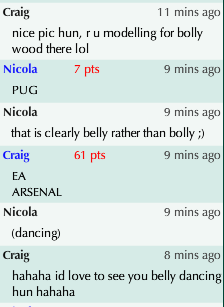
Thus, as I played the game my concentration was largely consumed with avoiding either offending or leading on my opponent (rather easier said than done) rather than on the gameplay itself. Actually social interaction is part of the game I suppose, I was just more interested in the word part of play than the social play here. I found myself pining for my dusty old cardboard and plastic set to avoid Craig D. However when his chat up lines failed he, despite having double my score (see image below), forfeited the game to me. Which explains the stats in his profile actually – a score of over 400 is a good score (or so my scrabble obsessed friends always inform me) so his 38% win rate, especially given he was playing casual games, seemed odd. However if he is seeing the game as a game of flirtation around Scrabble rather than the Srabble itself as the game I can see why his win rate is less you might expect – perhaps it is more a representation of his flirting success than a reflection of his Scrabble skills.
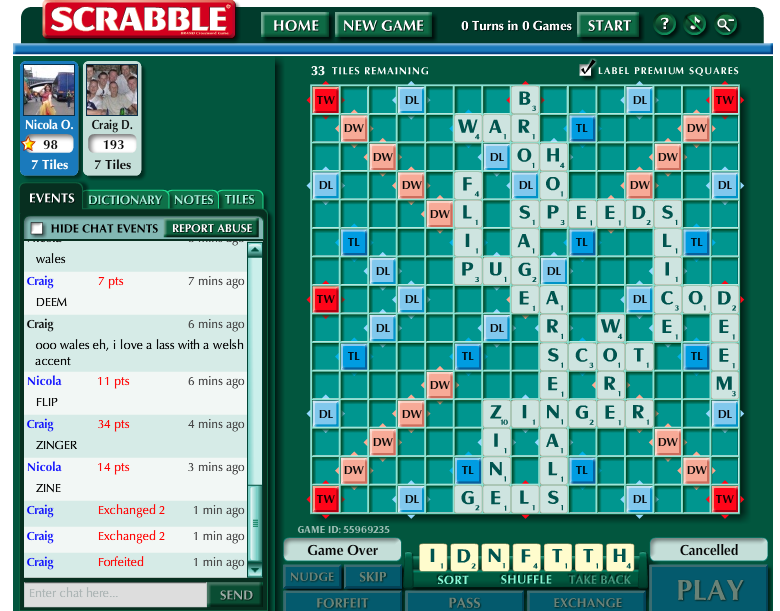
After that experience I was loath to return to Scrabble with strangers (if ever in the past I've longed for someone to play a game with I'm not sure I will again now). However in the course of playing online I note that a lot of the thrilling uncertainties are removed – the interface includes a dictionary (including the mystical Scrabble 2 letter word list) rather than a simple possibility of a rejected work; a timer is included in the casual game to discourage slow long term games and encourage quick mechanical games (something my super fan friends with love, something I don't play the game for); and friends are de-prioritised as competitors even though, even with anonymous opponents, there are chat and social features. Most upsettingly of all the Tiles tab lists every available tile – a view into the virtual bag and a breach of one of the nice Scrabble features – you can guess at probabilities of letters appearing but unless you have a photographic memory these are guesses (and always, in any case, assume no one has lost/eaten/changed/replaced any times. Addig all those practical functions takes away from some of the core gameplay aspects. Evidently the Scrabulous creators knew more about what it is to play scrabble and be engaged by it than the brand owners themselves. Really interesting.
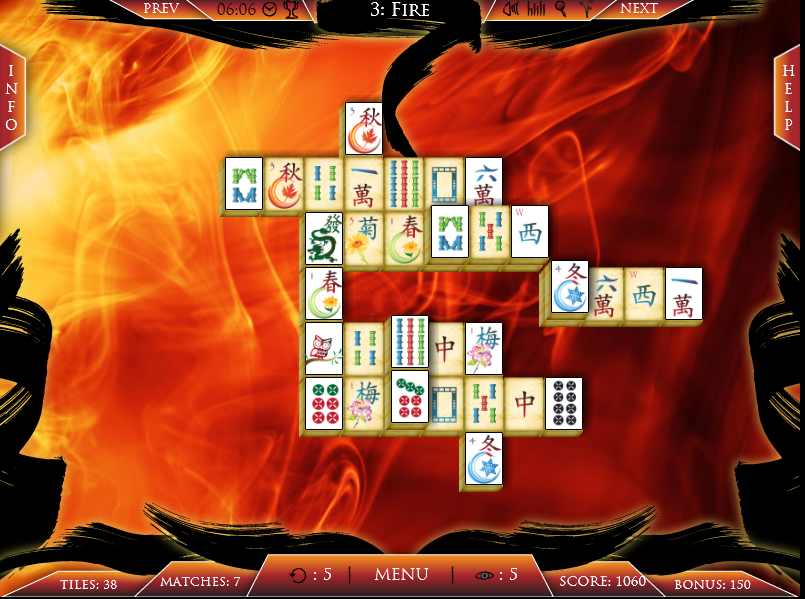
Mahjong is a complex strategic game I've been shown several times and like but struggle with. Mahjong (solitaire) on the other hand had me baffled at first. I'm not a big reader of instructions – particularly for online games (and yes, in Week 4's education games that is proving interesting) – so I was confused to see the tiles all face up and laid out in strange shapes. Whilst I couldn't remember the proper way to play Mahjong I knew this wasn't it. And then my partner looked over and said “It's a Mac thing. I used to play that years ago. It's just to do with matching pairs”. To that I looked disappointed but then proceeded to get very absorbed in spotting patterns and looking out for moveable/flipable tiles. There are some very minor nods to Mahjong (proper) but otherwise this is a memory and pattern recognition game with very enticingly attractive graphics. The game made lots of sense once I knew the basic goal but the guidance and introduction to the game – and especially the rather misleading optional login screen - wasn't really very helpful to establishing what those goals were but, after playing, I read the help text and it was actually pretty good – just why it wasn't labelled “How to Play” or “Rules” or something similar rather than “Help” was a bit of a mystery though. I'm not sure I learned anything at all but I enjoyed playing the game, I did progressively better and I was encouraged to go back and find my Mahjong tiles and play with them a bit. I'll probably also go back again as it was a very graphically sophisticated game, the music and sound cues were useful and fun, and the rules regarding nearby tiles, scoring, timing, tile layout etc. all added to the gameplay and strategies that were useful for completing a level. It was difficult but not too difficult and I liked that.
Finally I was trying out Bookworm this week. Of all the games it felt most educational and most frustrating. Firstly it required download which, in an era of browser based games, seemed quite old fashioned to me. The graphics were also a little out of date but squarely aimed at educational connotations.
Gameplay seemed like it was going to be great – there is an element of random chance, a need to match patterns and find words, and a good range of possible directions to create words in. What I found problematic in practice was the fact that the possible routes round tiles weren't entirely intuitive (some looked close enough but were not). I got very into the game though and headed at a score of over 40,000 moving from “Encyclopedia Salesman” up to “BookBinder”- they seem like odd sorts of level names though – the game is about books not literature. That is reflected in gameplay as well – you get points for flashing letters, strategies, avoiding burning letters (you have only one life in Bookworm!) etc. but the emphasis is on time and points rather than elegant word finding. This is not unlike Scrabble but in bookworm you cannot elect to play long words as easily as the choice and mixture of vowels and consonants tends to make shorter words more viable. Worrying I also got one of my highest scores with “Barf” - not the masters student level of verbal dexterity I fear.
The music and graphics were fun for play although the music quickly grew repetitive and, though it gave musical cues to the game action, only served to panic rather than focus me. Overall though this was an interesting counterpart to the other two games this week. It is an engaging game and the Bookworm character is quite charming – he even spouts explanations when a word looks especially interesting (“cud” was one of the words that triggered a definition in my game). And the high score feature at the end is quite a nice way of allowing you to compare your performance – in theory at least – and by setting the default comparison names to low scores it's quite encouraging too.
I think the puzzle game genre is a hard one to place. Though educational in the sense of improving your skills in both the game and, perhaps, your knowledge of words these games provide odd motivational opportunities as often the area of learning is not necessarily compatible with the highest scores – in Scrabble two letter words that can be used in many directions are often far higher scoring than a complex word and anything over 7 letters is rare and usually a compound of two words rather than, say, a technical or scientific term; in bookworm you are discouraged from looking for longer words by the time/burning challenges; in Mahjong the more numeric and strategic skills are exchanged for simple pairs play (only the season tiles challenge the simplicity of the game). Progress is rewarded in these games with speed or score challenges rather than building up activity to feed into some sort of reward or conclusion. All three games look attractive and have big usable buttons but in all three there is no compelling reason to start playing. Once you get going you are engaged but the motivation to engage in the first place seems to be expected to come from a place of boredom rather than interest (e.g. Scrabble's auto-selecting opponents) and that does not bode as well for serious educational goals. Additionally the downside of attractive games like these is that they look like games and that often neither feels nor looks like work/education to others since they are so associated with time-wasting patterns of use. The fantasy element in these games is also quite weak, particularly with regard to intrinsic fantasy since puzzles are, by their nature, artificially reliant on rules, restrictions and arbitrary goals.
Comments
Thanks for posting on your experience with Scrabble and strangers. It’s something that makes me wary of social networking. I’ve signed up for a Facebook account but used a semi-obvious pseudonym – same gender but my avatar is the image I use in Twitter (picture of a snow-covered tree). With your experience, I was encouraged to give a game of social scrabble a try (and no, I wasn’t looking for flirtations). I started a public game and shortly a female, self-described newbie joined the game. We played to the finish and the limited chat was very polite, focused on the game play. My first *real* experience in Facebook and it was generally positive. But I think I’d still rather play a round of Bookworm over social Scrabble.
And there are two versions of Bookworm on their website. The online version doesn’t load immediately as there is an ad that’s displayed. Yet the download button is quite prominently displayed – does that count for some “skeaziness” on the part of Bookworm’s publishers?
Damon,
I don't think that Scrabble is terribly indicative of social networking in general. One of the odd things about the Scrabble game is the way in which it uses a social network site whose main value is derived from basing all apps - games, productive stuff, etc. - on your existing social network of friends who are already on Facebook (although Facebook itself seems to miss this sometimes when it gets a little loose with users' personal data). It is therefore weird to have an app that directs you first and foremost to play with strangers with no connection to your personal social networks. Most games make maximum leverage of existing peer groups in significantly more successful ways I think. However I am very glad you had a better experience of Facebook Scrabble than I did - I was telling my partner about my experience yesterday and she was unimpressed with my coping skills and challenging me to explain why exactly the person I was playing was unreasonable - after thinking that through properly it was definitely the face that I expect Facebook to be about people I know. My guard is up on other social spaces but when I play a game on Facebook I expect to see familiar faces rather than strangers. On Twitter, or Flickr, or the open webit's a bit different. However in those spaces I can also see more about the people I interact with wheres Scrabble offered me someone's picture and first name but no other information or access to information other than whatever they said in conversation - it was doing a lot of peculiar mediation for me that I prefer to manage myself normally.
Oh and I stand corrected re: Bookworm. I have a very very low tolerance for loud colours, ads, alerts etc. :-/ It probably is a tad skeazy for Bookworm to make it more obvious to download rather than play online but I think I'd like Bookworm's publisher's site a lot more if they stripped out the ads a bit more I think (so the game doesn't appear "after the fold") and so you actually wait for the game to load rather avoid what appears to only be an ad.