The Introduction to Digital Game-Based Learning class met Elena Northmead at the Virtual University of Edinburgh's Vue South Beach Pavilion in Second Life for a discussion on Augmented Reality Games.


Keywords: ARG, Second Life

You can filter this page to certain types of posts:
Filtered: Showing posts with no comments (Remove filter)
The Introduction to Digital Game-Based Learning class met Elena Northmead at the Virtual University of Edinburgh's Vue South Beach Pavilion in Second Life for a discussion on Augmented Reality Games.
Keywords: ARG, Second Life
Posted by Austin Tate | 0 comment(s)
To begin with, among the six reasons why the players had engaged with the game (Whitton, 2011), I personally can be easily motivated by ‘completion’, ‘narrative’ and ‘puzzle-solving’. I think these educational games are quite interesting and fun compared to the rest of learning methods and approaches, such as: lecture, group discussion…
However, in the ARGOSI project, there is huge amount of responses indicate the disengagement of the learners. As it is mentioned in the conclusion part, if it is formally assessed and arranged as part of the education content, the percentage of engagement may increase. (Whitton, 2011) What I am thinking here is, by doing so, the learners may engage not because of the game design or the attractive true natural of ARG gams but because it is one of the mandatory elements of their study. So, the form of learning may not matter at all, just like the post-graduate students are all engaging in their dissertation if they need to obtain their master degree.
I also realize that it is not easy to find out why people do not engage instead of engaging. My initial thought to this is quite straightforward. Maybe it is just because that this game is designed as education-oriented, not leisure-oriented. Therefore, students will not easily accept the new policy or new learning materials which purely come from school authority. In my own experience and opinion, they usually consider these interventions as another kind of bothering. Moreover, according to adult learning theory, the learners are likely to resist unless they can choose the learning objects as being relevant to their own needs. (Swanson, 2011) Further, I assume that the low response rate is due to the learners’ self-diagnose needs do not match with the outcomes which they assume this ARGOSI project will produce.
What if the aim of the ARG game is to assist students to practice job interview skills, will it benefit their engagement? This goal is so practical and in my opinion, it can attract students to a certain extent. To be honest, I would like to design a game with this topic, and maybe I can do some research accordingly to investigate further.
Referenes:
Knowles, M., Holton, E., & Swanson, R. (2011) The Adult Learner : The Definitive Classic In Adult Education And Human Resource Development, Amsterdam ; Boston : Elsevier.
Whitton, N. (2010) Encouraging Engagement in Game-Based Learning. International Journal of Game-Based Learning, 1(1), pp.75–84.
Keywords: ARG, ARGOSI project
Posted by Ming-Wei LEE | 0 comment(s)

I’ve been spending a fair bit of time in WoW recently, attempting to mash it into the PLTS framework to see what comes out the other end. More on that to come. In this post I want to talk about failing and how we’re not doing it nearly as often as we should.
The thing about learning to fail is that you learn that it’s actually not so bad. You develop skills to help you manage it, to come back afterwards. But we’re scared of it. We’ve built a system where failing is a big bad thing, and we must avoid it at all costs.
Distinctly Average
The problem with that is it breeds mediocrity. The biggest hardest part of my role is dealing with the fear of change, the unknown. It is safer to stick with what we know, maintain the status quo. You see it in individuals, and in whole institutions. You can’t fail if you don’t push it too hard.
This attitude means we end up falling into a trap where can can easily do the same to our students. At the big scary end of school you must pass your exams to get to the next thing. Want to create an environment that’ll scare you about failing? Not being allowed to carry on if you do will achieve that.
I don’t have a huge problem with this though. We need goals to challenge us, targets we are motivated to achieve. Succeeding at a difficult task is such a positive experience, we can’t take that away.
My problem is that because the fail is scary rather than building their confidence to think they can do it, it’s safer make the task easier. Take the BTEC in X because it’s an easy way to 5 GCSEs rather than doing that triple science you’re not smart enough for, improve this coursework by doing Y in order to tick enough boxes on the mark scheme, your current grades mean you should do the foundation paper and get a safe C grade rather than risking the higher, and so on.
Gamification
In the game world the tasks don’t get easier the more you fail. There isn’t an easy way round a hard obstacle, you just have to persevere. What we in schools need to learn from games is why people come back to them, again and again.
One reason is because it’s safe to fail. I’m happy to admit that in WoW I die fairly frequently. When you die in WoW you become a ghost, a little gravestone appears on your map and you have to head off and find your body. Once you’ve found it you carry on from where you left off, having learned from your mistake.
The quest doesn’t become any easier to accommodate my poor play, I don’t get a man over my shoulder telling me which button to press. I reflect on my own performance and adapt, all the time knowing that if I’m still not quite successful I can just have another go.
I’ll finish with a McGonigal quote:
“When we’re playing a well-designed game, failure doesn’t disappoint us. It makes us happy in a very particular way: excited, interested, and most of all optimistic”Image source- red fail by griffithchris
Posted by Tim Dalton | 0 comment(s)
The Introduction to Digital game-Based Learning class met Frank Lassard at the Virtual University of Edinburgh's Sandbox in Second Life for a demonstration of Holodecks for creating scenes for role play and meetings.
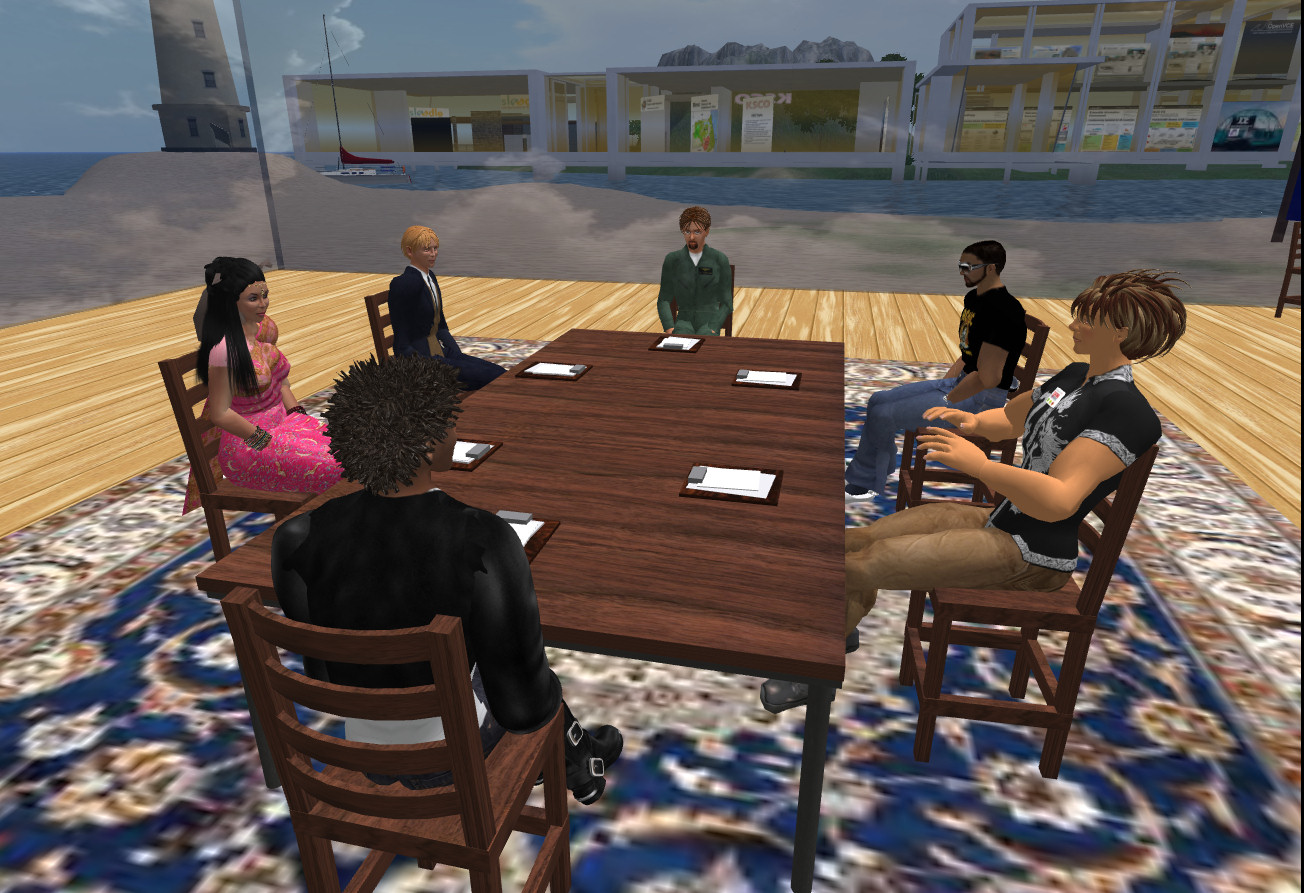
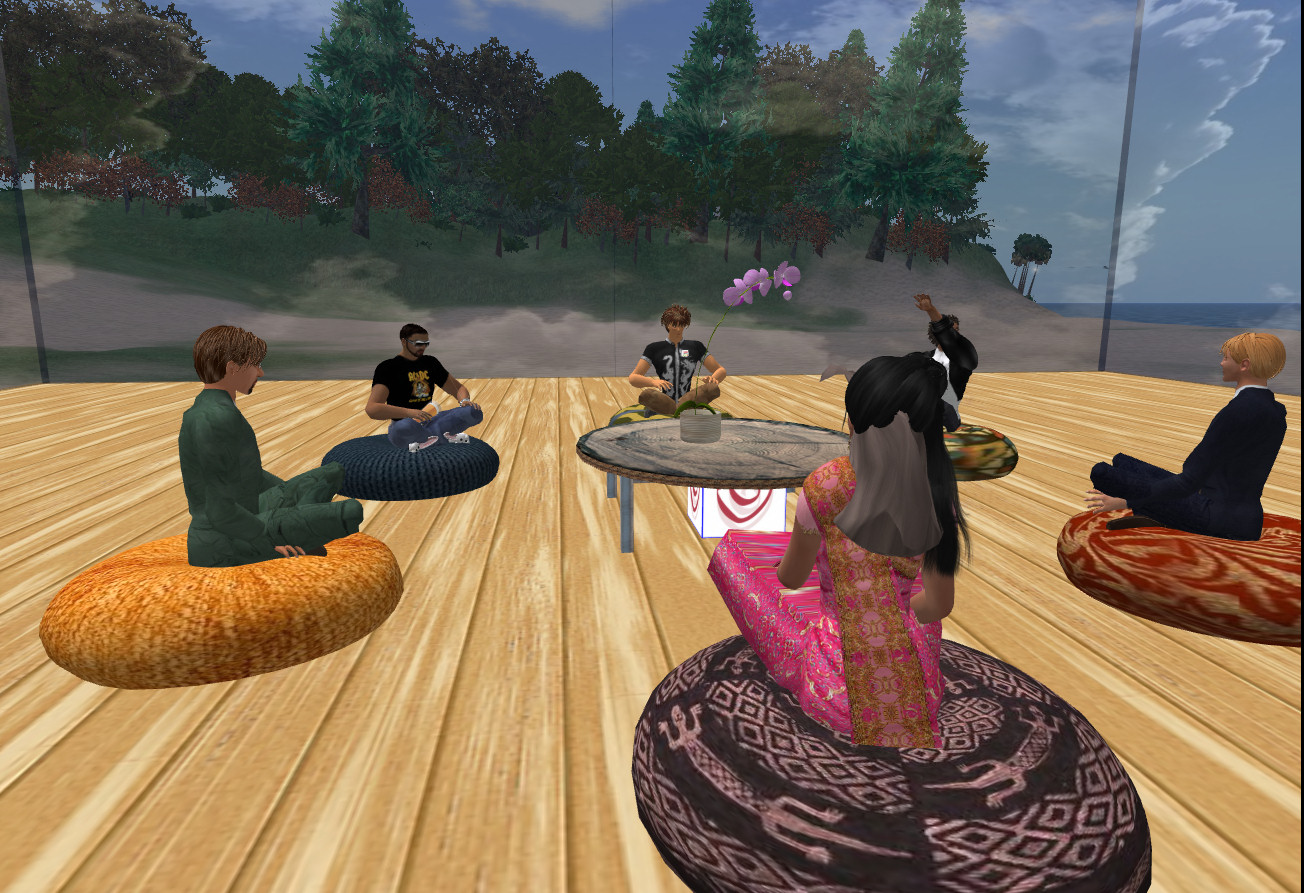
Keywords: Holodeck, Second Life
Posted by Austin Tate | 0 comment(s)
In mid 2011, "Kirstens Viewer" based on Linden Labs' open source Second Life Viewer code, added support for 3D stereo vision using a variety of 3D methods, including simple red/cyan glasses. This viewer is no longer maintained and is not available for download. but the last version created - Kirstens S21(9) - still works with current Second Life servers. Here is an example image from Kirtsen's Viewer in red/cyan 3D (click on image for a full sized copy and get out your 3D glasses to see the effect):

There was an earlier patch for an early version of the Second Life Viewer from the University of Michigan to support 3D stereoscopic views in Second Life. See http://3dvision-blog.com/forum/viewtopic.php?f=2&t=142 and https://jira.secondlife.com/browse/VWR-2972?
Keywords: 3D, I-Room, Kirtsens Viewer, Red/Cyan, Second Life, Stereo
Posted by Austin Tate | 0 comment(s)
I have found it much more interesting to explore the routes, travel mechanisms and locations which can be reached in World of Warcraft rather than just carrying out more quests, which I find are very linear in their design, with seemingly pointless to and fro movements.
I explored Stormwind Harbour, used the boat routes available from there (and Menethil Harbour) to locations on the continent of Kalimdor, and found Thargold Ironwing who kindly gave me a free gryphon tour of the harbour - see http://www.wowwiki.com/Thargold_Ironwing.

At level 20 my Dwarf Hunter was able to learn a riding skill to allow for a mount to be purchased and used. So I now have the steed appropriate to the Dwarf race, a ram. This makes movement between sites much quicker and allows low level attacks to be avoided.

I am now discovering more route and vehicle types including an ornithopter and a (repaired) bomber.


Keywords: Travel, World of Warcraft
Posted by Austin Tate | 0 comment(s)


Posted by Tim Dalton | 0 comment(s)

This is about motivation, but I want to look specifically here at the over justification hypothesis. Lots of work around this, but a nice short read on it here.
The link is a short explanation of work by Lepper and Greene from 1975. What it tells us is that for children who already enjoy a specific activity an expected reward is actually a negative on their motivation. Further than that, it also shows that there is no statistically significant difference between a surprise reward and none at all.
One of the little projects I'm working on at the moment is related to how we could use Warcraft to teach particular skills. The hypothesis above causes some concerns here, and an idea that can be more generally applied to using other games in education.
In our early years we learn through play, and it is only once we arrive at school that learning appears to turn into work. Something we have to do in order to achieve a specific goal rather than purely for the sake of learning itself.

In a general sense we see this in secondary with the games branded up as 'educational'. To make a sweeping generalisation about those we usually see that they aren't hugely popular with students, just another task set in the classroom. Yes, they are often more popular than achieving the same outcome using pen and paper but I wouldn't be going too far out on a limb to suggest this is more about the novelty of the activity rather than the specific game mechanics at play.
The challenge for me with Warcraft, and to educators using other games for an educational purpose is to avoid this over justification. I have a group of students who already enjoy MMORPGs, they spend hours of their own time already doing it. If it becomes a school task with associated reward for completing certain things is it too much?
Like the students who enjoyed drawing in the example- once it becomes a task they must complete in order to achieve X certificate we are in danger of damaging the intrinsic motivation (and any learning that was going along with it) they had to participate in the activity to start with. Image sources- MMOsymposium.com, perspicuity.com
Posted by Tim Dalton | 0 comment(s)
There are some ideas I would like to reflect as below:
1. Culture factors may matter
As it is mentioned in the article provided, due to the fact that the participants are international students, it may be relatively difficult for second language users to have real-time meetings purely online. Take myself as an example, I need to spend more time to read the discussion and then try to response some of them, I can’t image that if I can type all the real-time conversation in text and try to be as fast as while I am speaking to them. Can the language be a benefit instead of being a barrier? Will the technology help?
Not only are these, but also the factors of cultural issue involved. As it can be seen clearly, privacy is a main issue in Western counties. However, it is relatively weak when comparing with the Eastern world. In my country, most of companies declare strict regulation regarding prohibit employees to discuss the details of individual compensation and reward with others. In contrast, it is always an open ‘secret’ for all of the individuals and departments. You will always know your current ‘ranking’ among the whole group. Can this platform apply to all the culture?
2. Advantages
I believe that creativity may not be limited in the virtual world. By providing more possibility, it is easier to be ‘different’ in a virtual world. Due to the fact that ‘In virtual world, anything is possible’, you can even fly if you want. Why not try to having a conversation while walking along the beach?
Although it is emotionally inappropriate to chat through text only, not noticing any facial expression and emotional information is not provided, the delays of texts allow participants to monitor and self-censor their own thoughts. In real life, it can be easily out of control due to the immediate emotional reaction. However, in the Second Life environment, in order to chat through text, participants can confirm their own words before submitting to others.
3. Anonymity
Can we keep it fully anonymous? Even if providing voice communication, which is extremely convenient and more ‘real’ to the real world, the function itself limits the level of anonymity. Can we not only design our own avatar but also design our voice? Or, can ‘picking up your own voice’ be a pack of modules?
4. Identity
How you want your avatar (projected identity) to be? Why? Does it project something from yourself?
In business content, I think this point doesn’t really matter while carrying out a real ‘performance appraisal’. However, it can be well-managed when designing a training programme in order to fulfill some conditions in a training design. I fully agree that something which is difficult or impossible to be achieved may be easily access through virtual world, such as: inappropriate clothing and gender swaps.
Reference:
Morse, S. Littleton, F., Macleod, H. and Ewins, R. (2009) The Theatre of Performance Appraisal: potential for role play training in Second Life, in Higher Education in Virtual Worlds: Teaching and Learning in Second Life, (ed) Wankel, C, and Kingsley, J. Emerald Group Publishing Ltd.
Keywords: Performance Appraisal, Role-Play, Second Life, Training
Posted by Ming-Wei LEE | 0 comment(s)
On the importance of objectives for game, learning and activities design
“A key challenge when designing a game for e-learning is ensuring that the goals within the game support to the learning objectives and not detract from them.” (Whitton, 2010, P.90)
The importance of a well defined 'learning goal' in the design process became painfully apparent during the third and fourth week of the course. Somewhere during the activity of designing a Learning game using Google Earth group 2 focused more on the interactions (activities) then achieving the learning goal. The reason: a learning goal was not defined.
I think the main reason behind this was the reversal of the design process: instead of asking - “Can a game help me deliver content (or concept) X?“ the question leading the group was: “Design a game with a learning goal”. The time scale made the problem worse – instead of designing a coherent game with a story threading through it the group focused on specific gaming like activities.
Gee claims that “Good game designers are practical theoreticians of learning” (Gee, 2004) – especially if the reverse is true one would not go about designing a lesson without having defined the learning objectives first.
Scot Lake from the BrandonHall discusses the difficulty of introducing the 'game' idea into the workplace and instead suggests the gamification of specific experiences: as an example he provides loyalty cards – the idea of getting 'points' for specific Activities (in this case shopping with a specific store) is then used to encourage us to do more of that activity (and of course there are also 'prizes').
The idea of using commercial-off-the-shelf games has been discussed in different publications (Gee, Whitton, Malone etc) but, while existing off-the-shelf games can be included in day-to-day learning (in schools or universities) the same cannot be said of the workplace (with a few specific exceptions). Regardless of the scope of the planning (single activity or a complete game) it is hard to ignore the Importance of object definition.
References
Lake, Scot “Gaming Mechanics” http://brandon-hall.com/blogs/learning/ Accessed: 25/1/2012
Whitton, Nicola. 2010, “Learning with digital games”, Routledge, New York
Gee James Paul, 2004, “Learning by Design: Good Video Games as Learning Machines”, available at: http://www.academiccolab.org/resources/documents/Game%20Paper.pdf
Posted by Asi DeGani | 0 comment(s)