Log on:
Powered by Elgg

Asi DeGani :: Blog

March 07, 2012

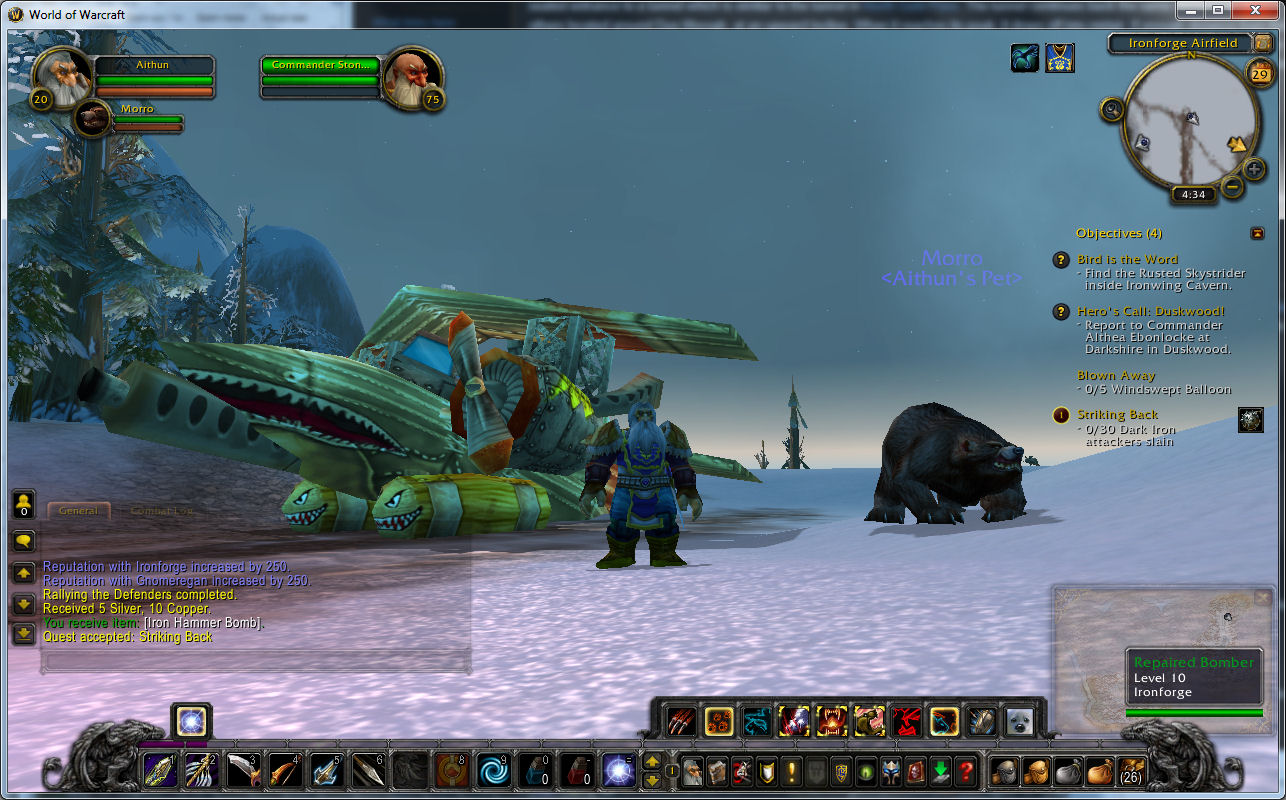
I’ve been spending a fair bit of time in WoW recently, attempting to mash it into the PLTS framework to see what comes out the other end. More on that to come. In this post I want to talk about failing and how we’re not doing it nearly as often as we should.

The thing about learning to fail is that you learn that it’s actually not so bad. You develop skills to help you manage it, to come back afterwards. But we’re scared of it. We’ve built a system where failing is a big bad thing, and we must avoid it at all costs.

Distinctly Average

The problem with that is it breeds mediocrity. The biggest hardest part of my role is dealing with the fear of change, the unknown. It is safer to stick with what we know, maintain the status quo. You see it in individuals, and in whole institutions. You can’t fail if you don’t push it too hard.

This attitude means we end up falling into a trap where can can easily do the same to our students. At the big scary end of school you must pass your exams to get to the next thing. Want to create an environment that’ll scare you about failing? Not being allowed to carry on if you do will achieve that.

I don’t have a huge problem with this though. We need goals to challenge us, targets we are motivated to achieve. Succeeding at a difficult task is such a positive experience, we can’t take that away.

My problem is that because the fail is scary rather than building their confidence to think they can do it, it’s safer make the task easier. Take the BTEC in X because it’s an easy way to 5 GCSEs rather than doing that triple science you’re not smart enough for, improve this coursework by doing Y in order to tick enough boxes on the mark scheme, your current grades mean you should do the foundation paper and get a safe C grade rather than risking the higher, and so on.

Gamification

In the game world the tasks don’t get easier the more you fail. There isn’t an easy way round a hard obstacle, you just have to persevere. What we in schools need to learn from games is why people come back to them, again and again.

One reason is because it’s safe to fail. I’m happy to admit that in WoW I die fairly frequently. When you die in WoW you become a ghost, a little gravestone appears on your map and you have to head off and find your body. Once you’ve found it you carry on from where you left off, having learned from your mistake.

The quest doesn’t become any easier to accommodate my poor play, I don’t get a man over my shoulder telling me which button to press. I reflect on my own performance and adapt, all the time knowing that if I’m still not quite successful I can just have another go.

I’ll finish with a McGonigal quote:

“When we’re playing a well-designed game, failure doesn’t disappoint us. It makes us happy in a very particular way: excited, interested, and most of all optimistic”
Image source- red fail by griffithchris
Posted by Tim Dalton | 0 comment(s)

March 06, 2012

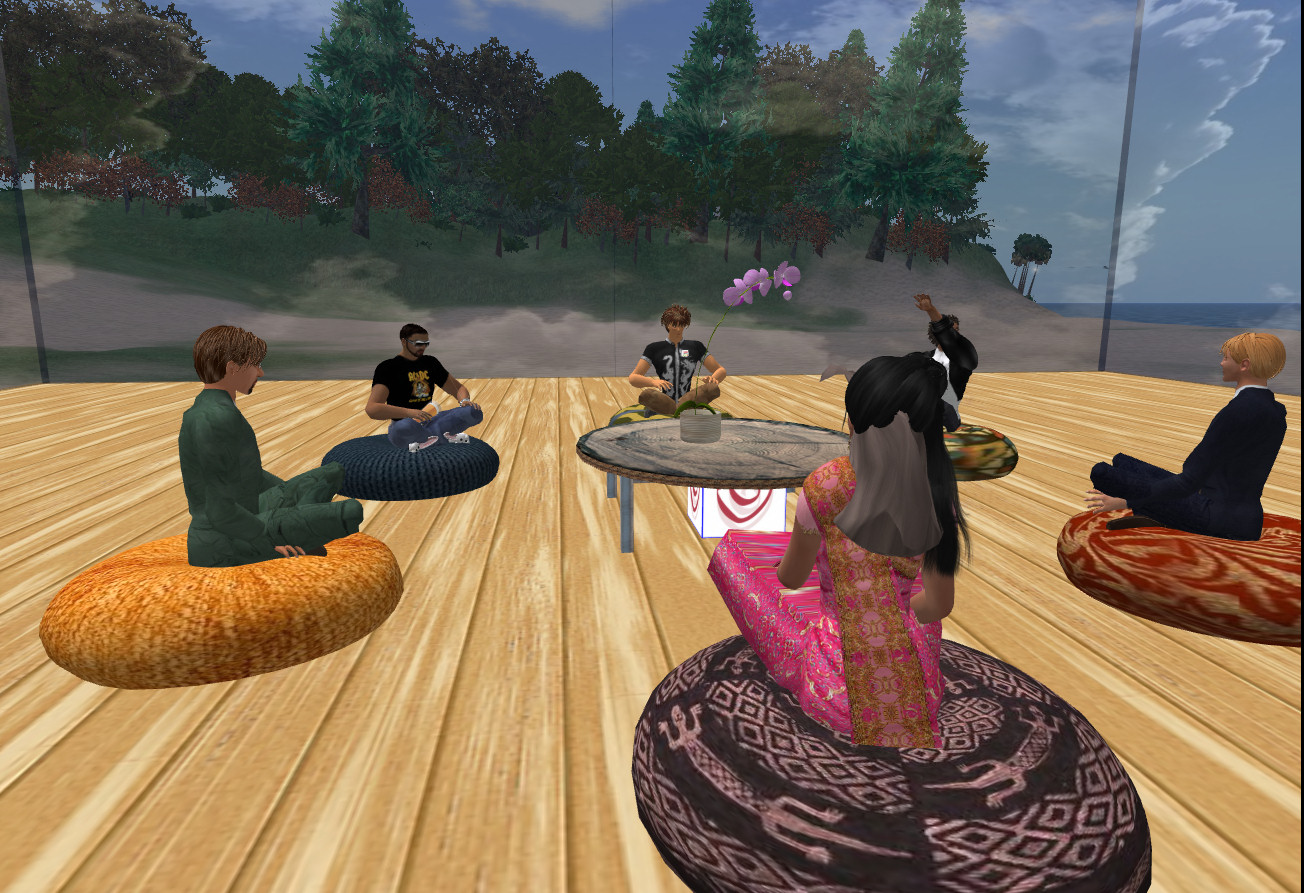
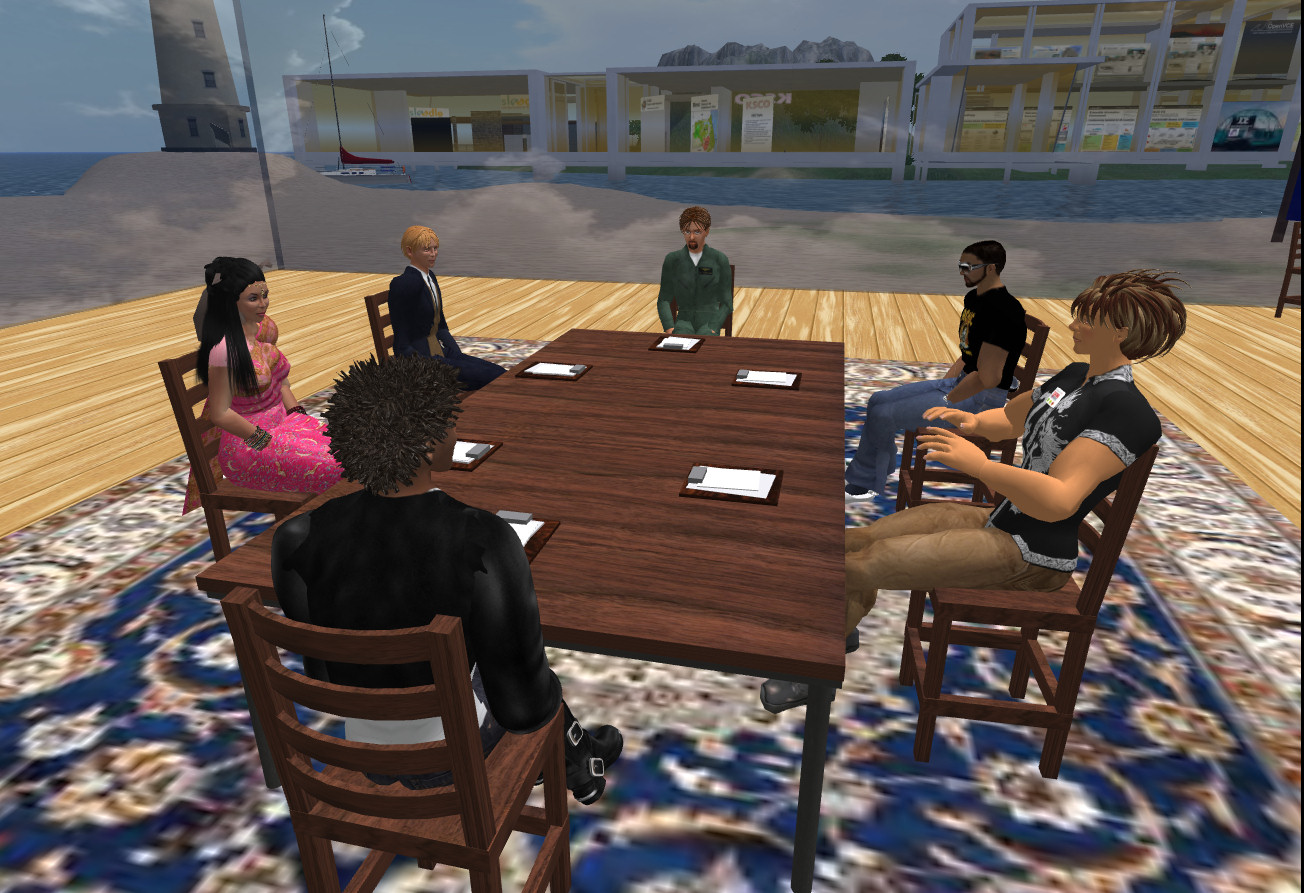
The Introduction to Digital game-Based Learning class met Frank Lassard at the Virtual University of Edinburgh's Sandbox in Second Life for a demonstration of Holodecks for creating scenes for role play and meetings.

Keywords: Holodeck, Second Life

Posted by Austin Tate | 0 comment(s)

March 04, 2012

In mid 2011, "Kirstens Viewer" based on Linden Labs' open source Second Life Viewer code, added support for 3D stereo vision using a variety of 3D methods, including simple red/cyan glasses.  This viewer is no longer maintained and is not available for download.  but the last version created - Kirstens S21(9) - still works with current Second Life servers. Here is an example image from Kirtsen's Viewer in red/cyan 3D (click on image for a full sized copy and get out your 3D glasses to see the effect):

There was an earlier patch for an early version of  the Second Life Viewer from the University of Michigan to support 3D stereoscopic views in Second Life. See http://3dvision-blog.com/forum/viewtopic.php?f=2&t=142 and https://jira.secondlife.com/browse/VWR-2972?

Keywords: 3D, I-Room, Kirtsens Viewer, Red/Cyan, Second Life, Stereo

Posted by Austin Tate | 0 comment(s)

March 02, 2012

I have been thinking about the game design asessment since Christmas.  It is my style to make notes and get ideas flowing early on and collect assets before seriously starting any work element.  I had originally thought a game using assets already available to me from a project on the "Virtual World of Whisky" might make a suitable topic for the game design.  See for example:

I have seen other opportunities while exploring quests in World of Warcraft, a number of space-themed games mentioned in this blog, and playing a range of new (to me) games on the course.

I am finding that a number of themes keep arising in my interests while engaging with these games and thinking about their narrative, objectives, and the ways in which they introduce artifacts and skills.

  • Situated Learning and Narrative
  • Levels, Scaffolding and Push to the ZPD (Vygotsky)
  • Use of encyclopaedia resources
  • Community-based Learning
  • "Ancient" style of learning at the feet of teachers

My interests continue to be strongly with games which have a social and community dimension, and a way to engage players with the broader community involved is often something they involve.

So, I have begun development of a game design for a quest style game in the Avatar movie theme areas of a MMO such as Second Life. The game is based on an exploration of the Pandora moon flora and Na'vi culture.  It will have strong community and knowledge sharing aspects, but allow for play that engages with others or not, with consequences.  I call the game "Moon Bloom – The Legend of the Bloom of the Aligned Moons".

Posted by Austin Tate | 3 comment(s)

I have found it much more interesting to explore the routes, travel mechanisms and locations which can be reached in World of Warcraft rather than just carrying out more quests, which I find are very linear in their design, with seemingly pointless to and fro movements.

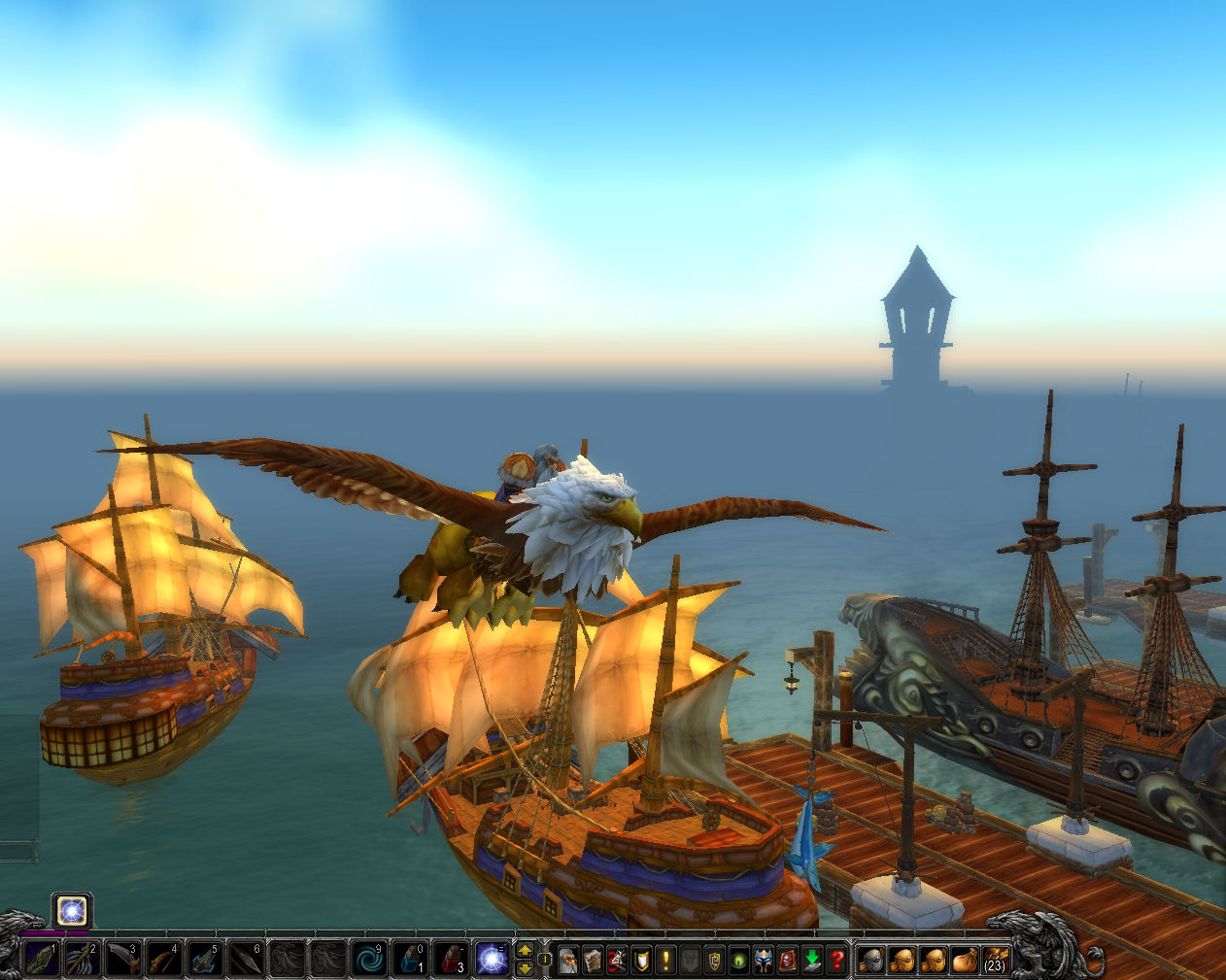
I explored Stormwind Harbour, used the boat routes available from there (and Menethil Harbour) to locations on the continent of Kalimdor, and found Thargold Ironwing who kindly gave me a free gryphon tour of the harbour - see http://www.wowwiki.com/Thargold_Ironwing

At level 20 my Dwarf Hunter was able to learn a riding skill to allow for a mount to be purchased and used.  So I now have the steed appropriate to the Dwarf race, a ram. This makes movement between sites much quicker and allows low level attacks to be avoided.

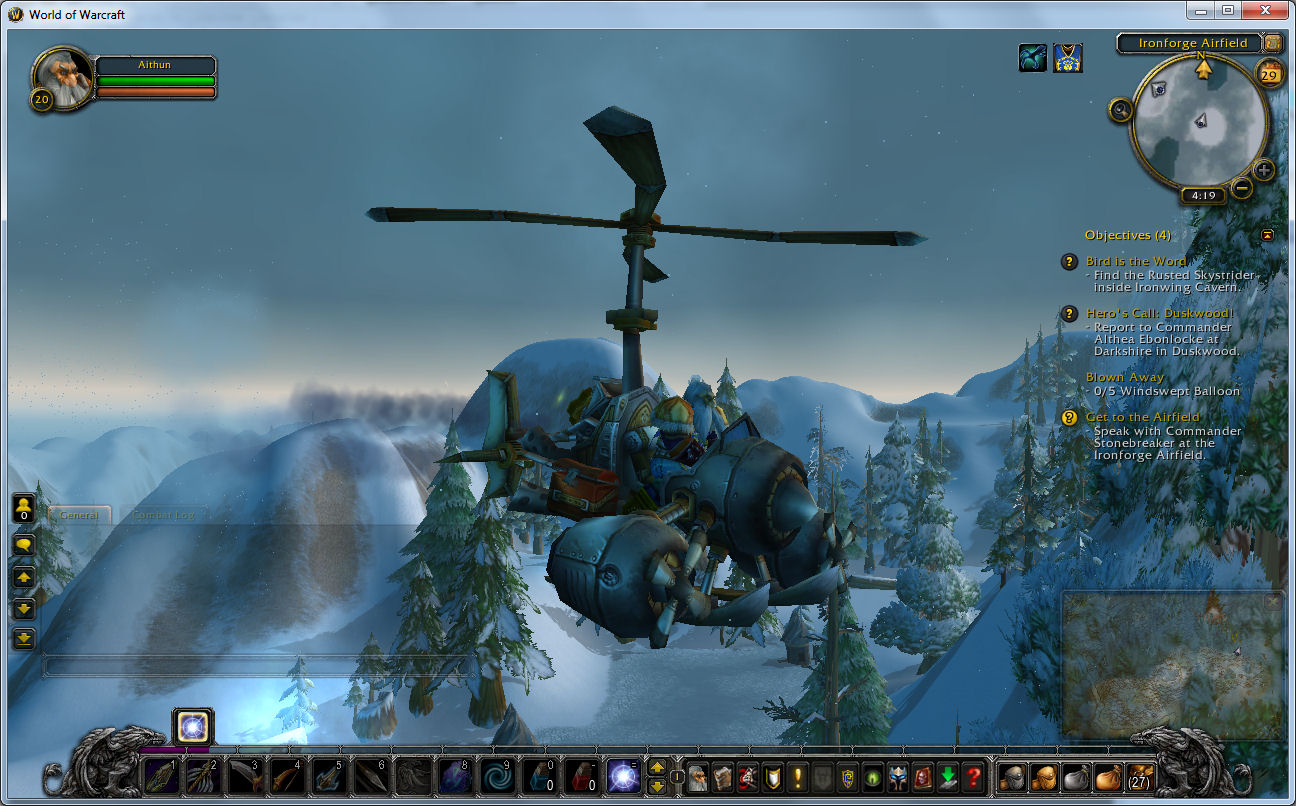
I am now discovering more route and vehicle types including an ornithopter and a (repaired) bomber.

Posted by Austin Tate | 0 comment(s)

February 27, 2012

‘The importance of narrative in game-based learning is that it provides a cognitive framework for problem-solving’. (Dickey, 2000 p.131) To be precise, the narrative design provides the learners some hints about the scenario behind and actively involved them in the game environment.


Therefore, regarding the digital games, there are two ways of approaches to the narrative game design, and they can be listed as below.


1. Quest: Hero’s journey, storyline with task to be completed by a character, and followed by a starting point and an ending point.


2. Plot hooks: The storyline is conducted by revealing unanswered questions and uncertainties. It allows players to choose actions to activate responses from the scenes.


As it can be seen that the platform of Labyrinth allows people to investigate the learning process and unique learning path by clicking one of the options provided, I think it can be considered as a method to create through the Plot hook approach or similarly.


Furthermore, if the designer intent to involve a ‘Quest’ approach to a course on the environment of Labyrinth, it is also possible to adopt both ways (quest and plot hooks) to the game design.


Reference:

Dickey, M., 2000. Murder on Grimm Isle: The design of a Game-based Learning Environment. In: Freitas, S., & Maharg, P. eds., 2010, Digital Games And Learning, London : Continuum. Ch.6.

Posted by Ming-Wei LEE | 2 comment(s)

February 17, 2012

Earlier in the year I touched on Pac-man scores and the motivating factors around being the highest. Is it possible for the rewards linked to these scores to be high enough that I'm encouraged to cheat? And, how many of these answers related to GBL also apply to grading in school?
 
Why I might cheat
 
Quite simply, so I can be the best. Games commonly reward you as you progress, the better you do, the better the reward.
 
This is never really a problem all the time the reward is a sideline to my reason for playing. In my time in WOW achieving a higher level was not a direct goal for me. It's nice when it happens, but my motivation is not to just get to the next level. In a teaching and learning sense- I do well in history lessons because I am interested in the subject and motivated to learn more about it, not because I need a C to get to college.
 
Introducing competition moves the bar. The in-game league table is a nice way to see how you're doing against everybody else, but as soon as you're placed in an environment where you are competing against others it's easier to justify trying things to make your score higher. For all the Words with Friends users out there- have you ever been tempted to let Google help you find a higher scoring word so you can beat your opponent? In the classroom our grading systems can create these types of league tables pitching students against each other, grading on a curve pretty much the worst example of this.
 
Stopping the cheats
A game designer may do everything they can to remove ways for players to cheat, in the same way that plagiarism software gets better and better at catching me copying my essay or the web filter in your school more intelligently blocks content. But, you'll never close off all the options, it becomes a losing battle. For example, 4 hours after COD Modern Warfare 3 was released the first cheats were available.
 
In some games users are encouraged to report others they find cheating so they can be banned. I like the community driven aspect of this, but it's still not a 100% successful method. Would I just be encouraged to find co-conspirators to my actions? Is it a bit like bribing the examiner marking my paper?
 
Encouraging cheating
Again, a topic I've touched on before. When does an original new way to achieve a goal become a cheat?
 
In some cases game designers seem to not worry about it. The 98 season of Championship Manager included a data editor that allowed players to directly alter stats in the game. Yes there are positive reasons to do this, but in opening up this option Sports Interactive must have been very aware that it also gives me the choice to artificially elevate my team beyond what is fair.
 
In others the designers actively build in cheat codes for players to find. This suggests that for the designer completion/highest score isn't a hugely significant factor.
 
Intrinsic motivation again
 
The reason cheating happens is because playing for enjoyment is not always enough. As a game designer you may not mind too much about this- once the game has been purchased is it too important how the player completes the objectives as long as they enjoy the experience? Maybe.. But it's not so simple when you consider that many games use different business models now.
 
We need to think very carefully about this whole topic if we're using games for learning. Potentially this is because cheating my way to the final level of a game teaching me the content of GCSE History is in conflict with our need for the student to actually learn what is in each level. Completing is not the target, experiencing the content is.
 
All feels a little bit like the conflict in the assessment system to me. Is getting my 5 A*-C's my goal, or is it a sideline of the actual goal to learn as much as I can about the subjects while at school?


Posted by Tim Dalton | 0 comment(s)

This is about motivation, but I want to look specifically here at the over justification hypothesis. Lots of work around this, but a nice short read on it here.

The link is a short explanation of work by Lepper and Greene from 1975. What it tells us is that for children who already enjoy a specific activity an expected reward is actually a negative on their motivation. Further than that, it also shows that there is no statistically significant difference between a surprise reward and none at all.

One of the little projects I'm working on at the moment is related to how we could use Warcraft to teach particular skills. The hypothesis above causes some concerns here, and an idea that can be more generally applied to using other games in education.

In our early years we learn through play, and it is only once we arrive at school that learning appears to turn into work. Something we have to do in order to achieve a specific goal rather than purely for the sake of learning itself.

In a general sense we see this in secondary with the games branded up as 'educational'. To make a sweeping generalisation about those we usually see that they aren't hugely popular with students, just another task set in the classroom. Yes, they are often more popular than achieving the same outcome using pen and paper but I wouldn't be going too far out on a limb to suggest this is more about the novelty of the activity rather than the specific game mechanics at play.

The challenge for me with Warcraft, and to educators using other games for an educational purpose is to avoid this over justification. I have a group of students who already enjoy MMORPGs, they spend hours of their own time already doing it. If it becomes a school task with associated reward for completing certain things is it too much?

Like the students who enjoyed drawing in the example- once it becomes a task they must complete in order to achieve X certificate we are in danger of damaging the intrinsic motivation (and any learning that was going along with it) they had to participate in the activity to start with. Image sources- MMOsymposium.com, perspicuity.com

Posted by Tim Dalton | 0 comment(s)

February 16, 2012

There are some ideas I would like to reflect as below:


1. Culture factors may matter

As it is mentioned in the article provided, due to the fact that the participants are international students, it may be relatively difficult for second language users to have real-time meetings purely online. Take myself as an example, I need to spend more time to read the discussion and then try to response some of them, I can’t image that if I can type all the real-time conversation in text and try to be as fast as while I am speaking to them. Can the language be a benefit instead of being a barrier? Will the technology help?

Not only are these, but also the factors of cultural issue involved. As it can be seen clearly, privacy is a main issue in Western counties. However, it is relatively weak when comparing with the Eastern world. In my country, most of companies declare strict regulation regarding prohibit employees to discuss the details of individual compensation and reward with others. In contrast, it is always an open ‘secret’ for all of the individuals and departments. You will always know your current ‘ranking’ among the whole group. Can this platform apply to all the culture?


2. Advantages

I believe that creativity may not be limited in the virtual world. By providing more possibility, it is easier to be ‘different’ in a virtual world. Due to the fact that ‘In virtual world, anything is possible’, you can even fly if you want. Why not try to having a conversation while walking along the beach?

Although it is emotionally inappropriate to chat through text only, not noticing any facial expression and emotional information is not provided, the delays of texts allow participants to monitor and self-censor their own thoughts. In real life, it can be easily out of control due to the immediate emotional reaction. However, in the Second Life environment, in order to chat through text, participants can confirm their own words before submitting to others.


3. Anonymity

Can we keep it fully anonymous? Even if providing voice communication, which is extremely convenient and more ‘real’ to the real world, the function itself limits the level of anonymity. Can we not only design our own avatar but also design our voice? Or, can ‘picking up your own voice’ be a pack of modules?


4. Identity

How you want your avatar (projected identity) to be? Why? Does it project something from yourself?

In business content, I think this point doesn’t really matter while carrying out a real ‘performance appraisal’. However, it can be well-managed when designing a training programme in order to fulfill some conditions in a training design. I fully agree that something which is difficult or impossible to be achieved may be easily access through virtual world, such as: inappropriate clothing and gender swaps.


Reference:

Morse, S. Littleton, F., Macleod, H. and Ewins, R. (2009) The Theatre of Performance Appraisal: potential for role play training in Second Life, in Higher Education in Virtual Worlds: Teaching and Learning in Second Life, (ed) Wankel, C, and Kingsley, J. Emerald Group Publishing Ltd.

Keywords: Performance Appraisal, Role-Play, Second Life, Training

Posted by Ming-Wei LEE | 0 comment(s)

February 07, 2012

A couple of posts ago I wrote about game walk-throughs after a conversation with a fellow MSc-er suggested that they thought they constituted cheating. I'm quite a fan of them and it got me thinking about the true value of these documents in a learning context.

So, Bloom. He and his committee mates wrote themselves a taxonomy. This is the revised 2001 version which most of us are familiar with, it is worth going back and looking at the original too. As always wikipedia a good start point.

And, this is the WOWwiki. It's a community created guide to the game spanning over 90,000 pages, after Wikipedia it's the 2nd largest community authored document on the Internet. There are loads of examples of game walkthroughs out there, but the really interesting ones are those that involve this level of collaboration. 

Here are some ideas about how each of the skill levels in the diagram are demonstrated by the wiki users:

Knowledge: Do I need to explain this one? I've been to the wiki and read up on a particular quest, remembered what I needed to do, job done.

Understand: At a basic level of ability in the game I can read the wiki to fill in any blanks, and have successfully broken down complex tasks into simple individual stages I can share with others.

Apply: I can take something I read in one quest, and see where a particular skill would work in another. This is also where the benefits of writing the walkthrough rather than just reading it start to come in. I take something I discovered in the game, write it down to share for others.

Analyse: Writing the walkthrough forces this. Look back at how you got through a particular stage, was it similar to something else you have done? Are there other possible outcomes? As an individual player you may do some of this in passing naturally, but the act of authorship brings it to the foreground.

Evaluate: This is the real high order part of the walkthrough. If you look in any detail at a quest page in the WOWWiki it's really obvious. This page is discussing a single task in a huge game, but it looks at the best method to complete with each particular race, strategies for approaching it in a group, and places it in context with other things Warcraft related both past and present.

Create: Beyond the obvious here, how the users structure and link throughout the wiki is an interesting aspect of the creation process.

So, what is interesting here is that while we can apply these skills to gameplay itself (I probably should have written a post on that too..), what the walkthrough achieves is to extend these. The cognitive abilities involved in this process are certainly something that justify it more attention from educators than simply labeling it as cheating.

Image source- Signpost by JMC Photos

Posted by Tim Dalton | 2 comment(s)

<< Back Next >>