

 |
| Image from Wikimedia Commons |


 |
| Photo from Pxhere |

 |
| Photo by Charles Deluvio on unsplash |

 |
| Image from Pixabay |

 |
| Image by Mike MacKenzie on Flickr |


 |
| Photo by William White on unsplash |



 |
| Image from Pixabay |

 It was Howard Rheingold (2002) who coined the term ‘smart mobs’ (a play on the word 'mobile' or mobile phone) to describe individuals who work collectively and intelligently toward a mutual goal without necessarily having met. Unlike their more feral counterparts, smart mobs tend to act intelligently and with a purpose.
They are distributed beings (Curtis, 2004), carrying devices that have immense computing power and telecommunication capability, enabling them to collaborate in ways which were previously inconceivable.
The immediacy of their communicative ability and the ubiquity and persistence of their engagement (they are always connected) within the smart mob enable them to perform collective feats of imagination, co-operation, trading and the exploitation of aggregative mind power, beyond anything humankind has ever achieved up to this point in its history.
This may appear to read as a eulogy, but in reality smart mobs are the vanguard of an influential social movement that will gather pace over the next few years and will ultimately radically change the face of education.
Smart mobs can act for the public good, for example where drivers use their mobile phones to inform a local radio station of a road traffic accident. They can also act concertedly for more nefarious purposes, such as tram or bus passengers who text their ticketless friends to warn them of the location of ticket inspectors. Some smart mob activities may be pointless to all but those who participate in the action. In recent years, a new social phenomenon has been observed, particularly in urban areas.
Known as ‘flash mobs’, they are large groups of people who suddenly gather in a public place, perform some meaningless activity for a period of time, and then just as quickly disappear. The T-Mobile dance was an example of this phenomenon and there are many more examples. Flash mobs are almost always co-ordinated by one or more individuals through mass SMS texting, e-mails or other electronic message transmission methods.
Technology directed flash mobs have occasionally gathered for political purposes at times of civil unrest in Romania and China, but generally their purpose is ill defined. Flash mobs have been explained as a classic example of the innate need for people to belong to a group, be privy to inside knowledge, and be able to participate in what is ‘happening’.
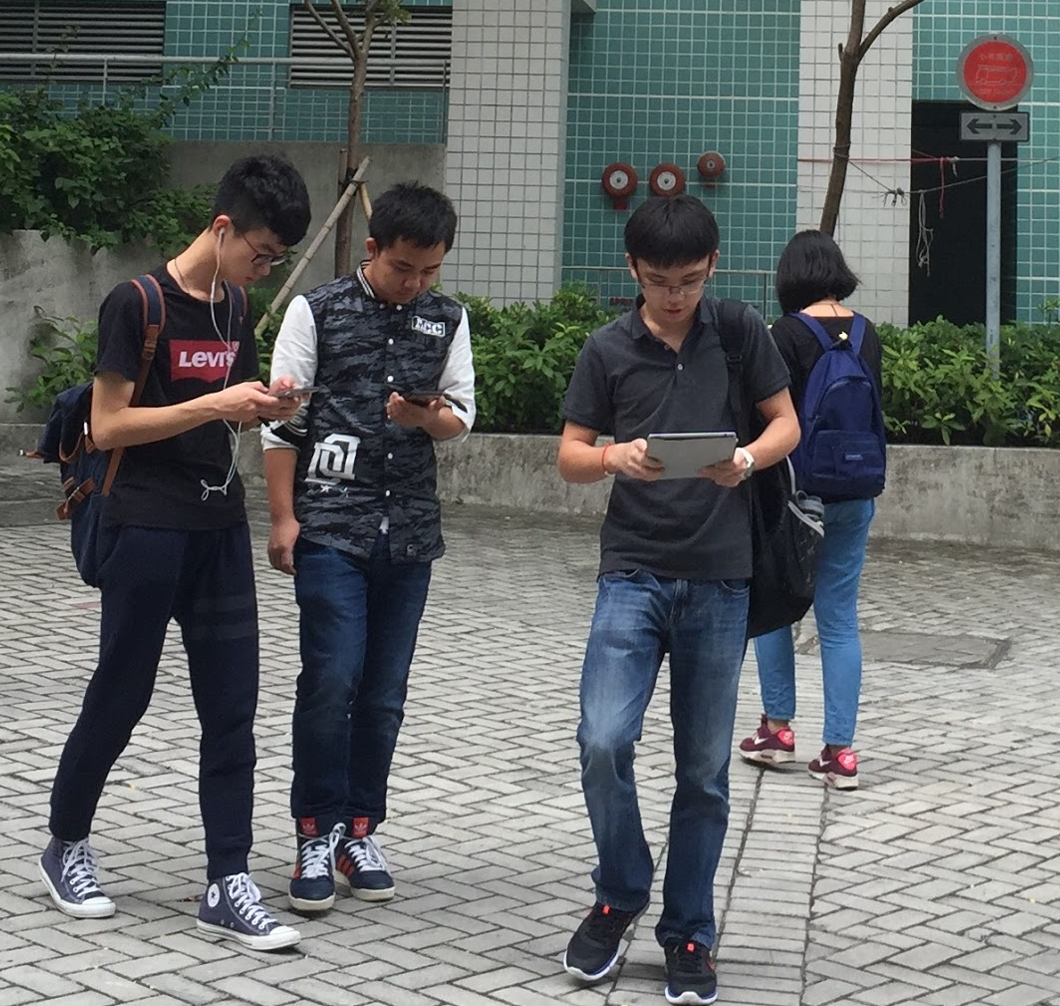
Rheingold also identifies a ‘thumb tribe’ which consists predominantly of those younger members of society who appear to be constantly connected to the rest of their tribe and who use ‘one thumb signalling’ via text to communicate. They belong to the larger tribe of the ‘always connected’ who are identifiable by their apparent dependency on mobile telecommunication technologies. They are clearly identified not only by the means through which they communicate, but also by the manner in which this communication is constructed, i.e their vocabulary.
SMS text is constrained by a single message limit of 160 characters. To save money, txters have developed a reduced form of language made up of letters, numbers and symbols. Known as ‘squeeze text’ (Carrington, 2005) this clannish form of language changes the morphology of the language being used, with little or no loss of its semantics for those who are members of the clan. For those outside the clan however, txting can present a bewildering conundrum.
Previous posts in this series:
1. Digital tribal identity
2. Digital tribes and the network nation
Tomorrow: Digital pervasion and loss of identity
References
Carrington, V. (2005) Txting: The end of civilisation (again?) Cambridge Journal of Education. 35 (2), 161-175.
Curtis, M. (2004) Distraction: Being human in a digital world. London: Futuretext.
Rheingold, H. (2002) Smart Mobs: The Next Social Revolution. Cambridge, MA: Basic Books.
Always connected by Steve Wheeler was written in Plymouth, England and is licensed under a Creative Commons Attribution-NonCommercial-ShareAlike 3.0 Unported License.

 |
| Photo from Wikimedia Commons |

 |
| Photo by Bruce Warrington |

 |
| Photo by Andras Vas on unsplash |
"As an example, course developers at leading institutions will utilize AI technologies to help them quickly assemble their courseware and reduce the manual effort required by up to 80 percent. This frees up course developers and administrators to be more strategic and plan their portfolio roadmaps in close collaboration with business and community partners."This is due in part, he claims, to the capability of emerging AI technologies to be able to 'learn' based on the massive array of data patterns they can access. Evans is optimistic about how computer vision may play a constructive part in observing and interpreting human behaviour:
"Trainable AI will be able to observe a physical class via machine vision and thereafter create a template or blueprint for the online equivalent of the course. This will speed online course creation and the ability for leading institutions to produce up-to-the-minute courseware."I'm more sceptical about the next prediction from Evans. He suggests that automatic grading of student work will be sufficiently advanced to determine fair grades for all:
"In addition, AI-enabled course grading will be at highly advanced stage in 5 to 10 years where course administrators will be confident of the fairness and accuracy of automated free-text grading algorithms due to advances in machine learning, semantics and natural language processing. If they have questions about a student’s grade, they will be able to speak with the AI system, understand the rationale, and adjust as and where necessary."It's not so much the prediction about AI development that is problematic - AI is advancing at a pace, and is likely to reach this level soon. Rather, it is the persistent assumption that 'grading' is paramount for the measurement of student understanding, and that we should focus the power of AI to support this kind of pedagogy. If teachers are still grading students' work in 10 years, then AI can indeed remove the tedium of interpreting marking rubrics and wading through pages of written text. However, if we believe that assessment should focus on providing students with constructive criticism and feedback on their work so that they can learn and improve, we will question this. Teachers provide assessment for learning, alongside assessment of learning.

 |
| Image from Pixabay |

 |
| Photo by Loewe Technologies on unsplash |
"Firstly, online education will have evolved beyond omni-channel (anytime, anywhere) to omni-choice whereby students will be able to select and configure every pathway in their learning journey to personalize and customize their near-term and long-term learning plan and approach to their unique situation, needs and interests.
"As an example, with self-driving cars commonplace – learning will be conducted at home, in class or on the road during lengthy commutes, with students able to pick up and resume their online courses on any device in any location and in any duration and format. AI will help to hyper-personalize this omni-choice functionality so that students can focus more on their actual learning and less on the mechanics of their learning."I quite like the idea of 'omni-choice' learning, where each learner can shape their pathways individually to suit their expectations, needs, approaches to study and personal contexts. At present it is quite impossible for any educator to tailor-make study programmes for individual students. Evans doesn't go on to describe how AI will make omni-choice learning possible, but the promise sits there, ripe for the picking. It will likely be achieved through a combination of learning analytics (big data) and the evolution of personal technologies and ubiquitous computing. We will see in the next few years whether this promise is realised.

There's no such thing as down-time, or spare time. Only time. Time is finite, each day we are allocated exactly the same amount as everyone else, and how we use that time is our personal choice. So time is a precious resource, and what we do with our time determines the outcomes of our lives. Sobering stuff.
I was therefore interested in a recent tweet from my friend and colleague Nick Shackleton-Jones on our use of time. Here's what he said:


 |
| Photo by Jason Roswell on unsplash |

 |
| Photo by Filip Mroz on unsplash |
What forms of content, activity and pedagogy are needed now to ensure the success of online education?What are your views, words of advice or supplementary questions? Please post them in the comments box below.

 |
| Photo by Steinar Engeland on unsplash |
What do teachers need to know and do, to be able to successfully transition into, and harness the potential of, online education?

 |
| Photo by Sergey Zolkin on unsplash |

 |
| Photo from Pxhere |

 |
| Photo by Jesper Sehested on Flickr |

 |
| Photo from Pixabay |

 |
| Photo by Steve Wheeler |

 |
| Photo by Erich Ferdinand on Flickr |
