Log on:
Powered by Elgg

Ania Rolinska :: Feeds

September 11, 2019

EDENTube


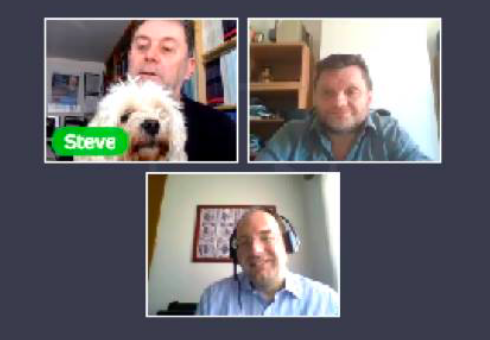
Normally I'm the one doing the interviews. I have hosted more than 2 dozen for EDEN over the last few years at conferences in Spain, Norway, Hungary and Sweden. But this time, EDEN (the European Distance and E-Learning Network) turned the tables on me and I was the one in the hot seat. I was one of the opening keynotes for the annual EDEN conference in Bruges (#eden19), and because most of the keynotes are usually interviewed for the EDENTube channel, I found myself in front of the microphone being interviewed by Krisztina Tatrai, one of the secretariat's full time staff.

The result is a 6-7 minute interview in which I talk about the EDEN community of academics and professionals, mobile learning and games in education, and digital badges, as well as some elaboration on the way EDEN has been leveraging the potential of social media over the last few years. It was fun, but I think I know which side of the microphone I prefer. I encourage you to check out the EDENTube video interviews - there are some great insights into people's thinking, and some nice examples of technology supported learning in there waiting to be discovered.


Creative Commons License
EDENTube by Steve Wheeler was written in Plymouth, England and is licensed under a Creative Commons Attribution-NonCommercial-ShareAlike 3.0 Unported License.


September 05, 2019

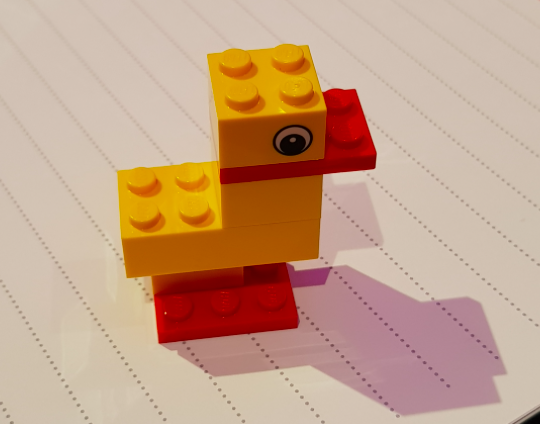
What the duck?

Photo by Steve Wheeler (Duck by Denise Hudson)
If I didn't know any better I would believe in synchronicity. Let me elaborate....

We enjoyed an animated and challenging keynote speech from Graham Brown-Martin at the LPI's Learning Live conference in London earlier today. At the same time, up in Edinburgh ALT-C was wrapping up with a keynote from Lego's Ollie Bray.

At one point in his London keynote, Graham touched on creativity and individualism. To illustrate his key points, he asked us to create a duck using just six pieces of Lego which were distributed to the audience. We all did our best, and our creations were then shared with each other on social media. It was interesting (and probably inevitable) that without a clear plan, each of us created ducks that were slightly different, from the same six Lego building bricks.

As we began to share the photos of our creations on Twitter, we began to notice that several of our colleagues who were attending ALT-C were doing exactly the same. It seems that Ollie Bray, in his keynote had simultaneously facilitated the same exercise (with the same number of Lego bricks) with his Edinburgh audience. Our timelines were saturated with images of Lego ducks. So, either great minds think alike, or .... synchronicity is actually a thing.

As a side note, it's ironic that although the exercises were designed to demonstrate that we all think differently and create accordingly and the importance of playful learning, the same exercise was being done (without any co-ordination) by two different keynote speakers at two separate events. It's also interesting to note that both Ollie and Graham chose to speak about learning innovation and change in their keynotes. A splendid time was had by all both in London and Edinburgh, and we also learnt from the exercise. I'm just sorry as usual, that I couldn't be in two places at once, but for once, it probably didn't matter.

NB: Search on Twitter for 'LEGO duck' to see the baffling array of possible duck configurations that people created from the same 6 Lego bricks at the two events.

Creative Commons License
What the duck? by Steve Wheeler was written in Plymouth, England and is licensed under a Creative Commons Attribution-NonCommercial-ShareAlike 3.0 Unported License.


August 29, 2019

Back to Berlin

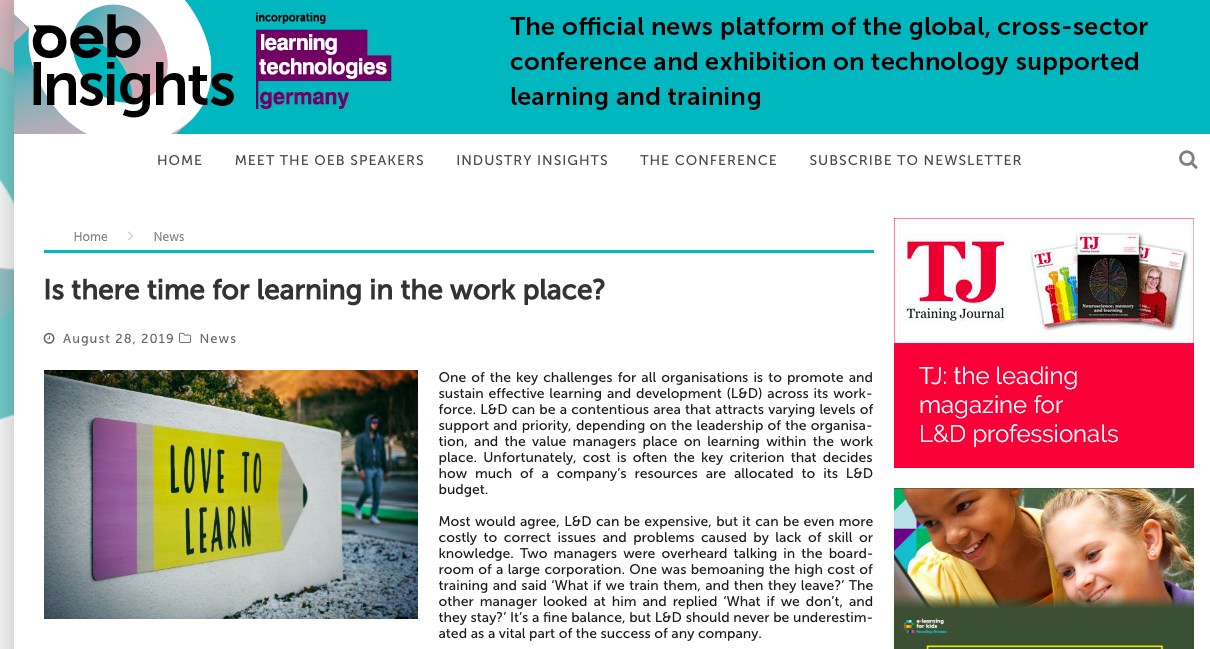
Image from OEB website 2019
It's been a few years since I last spoke at Online Educa in Berlin (OEB). It's one of my favourite European cities, and I took my wife there last Christmas for a short break. I have fond memories of OEB, including the Marlene (Dietrich) Bar, live lounge piano entertainment, some great keynote speakers, some excellent food and great company.... and the endless rows of vendors, all trying to flog you something. I also remember the Christmas lights, wrapping up warm, and of course the gluhwein and frankfurters at the Christmas markets (sehr schön!), especially around the old Gedächtniskirche in Ku'Damm. Most of all I remember the icy cold wind because OEB is always hosted around the last few weeks before the festivities. Usually the snow and ice were magical but sometimes they could be an absolute menace if the conditions were right.

My first appearance at the event was way back in 1998, and I think I spoke there on at least half a dozen other occasions. But it has been several years since I last attended OEB. It was my great joy then, to be invited to give not one, but two presentations for the event this year. The first, in conjunction with EADL will be a workshop on the future of distance education, where I will focus on the new technologies, theories and practices that are emerging in this field. This will be on the pre-conference afternoon, Wednesday 27 November (Session A5).

My second, is an invited Spotlight presentation for the main conference on the following day, Thursday 28th in the afternoon. This session will be more focused on corporate learning and development, where I will examine work based learning and digital transformation of organisations. In preparation for these presentations I was invited to write a short piece for the OEB newsletter. The link is here for further reading. It's called 'Is there time for learning in the workplace?'

Creative Commons License
Back to Berlin by Steve Wheeler was written in Plymouth, England and is licensed under a Creative Commons Attribution-NonCommercial-ShareAlike 3.0 Unported License.


Assessment in the digital age

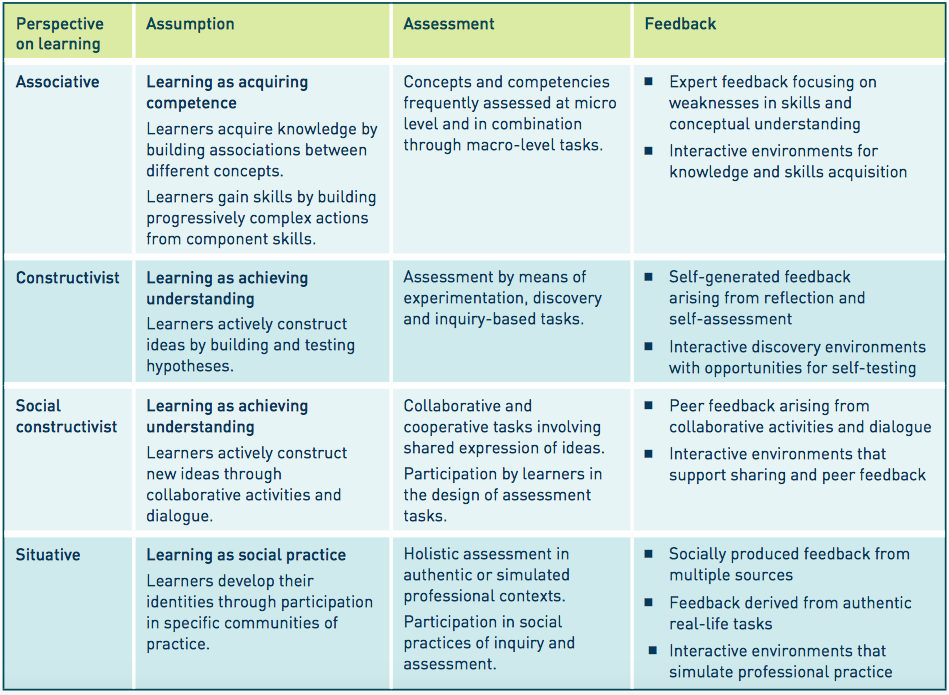
Image from JISC publication

This table is very useful summary for anyone who is interested in aligning assessment with teaching methods. It's important that this is achieved, because as Biggs and Tang (2011) argue, students create their own meaning from their experiences, by seeking out learning engagement. The teacher's role is to create or facilitate the environments, content and dialogue that optimises the student's activities. This include assessment and feedback - which are vital in scaffolding the student's progress through their education. It is known as constructive alignment, and is inherently student centred. The task of teachers is to align student learning outcomes with appropriate and relevant activities and assessment.

If assessment fails to align with outcomes, or militates against student engagement, it becomes more of a barrier than an enabler. Examples include testing that misses essential learning outcomes, or inappropriate methods of assessment that students are unable to successfully complete. Feedback that is incomplete or insufficient to encourage better learning is another failure of constructive alignment in assessment. In principle, each of the four pedagogical perspective seem discrete, but in practice, the best teachers tend to borrow from all of these approaches at different times to support students in multiple ways.

Assessing learning in the digital age, where students are using a growing range of technologies and approaches to learn, is complex. The table above helps to simplify the complexity somewhat, and provides educators with models that helpfully describe alternative approaches to pedagogy.

References
Biggs, J., and Tang, C. (2011) Teaching for quality learning at university. 4th ed. Buckingham: The Society for Research into Higher Education & Open University Press.
JISC (2017) Effective Assessment in the Digital Age.

Creative Commons License
Assessment in the digital age by Steve Wheeler was written in Plymouth, England and is licensed under a Creative Commons Attribution-NonCommercial-ShareAlike 3.0 Unported License.


August 28, 2019

Space for exploration

Photo from RosanBosch website
I like the idea of schools without classrooms. Classrooms tend to restrict and contain, and they are a remnant of the Industrial Age. Watching the 2018 documentary Bauhaus Spirit on Sky Arts this week brought this idea back to life. The documentary, directed by German film makers Niels Bolbrinker and Thomas Tielsch, traces the history of the Bauhaus Art movement and its current impact on the built environment and contemporary culture. It's a must watch for anyone interested in art, craft and design and their relationship with industry, environment and culture.

I have visited a few schools that have attempted to create spaces without classrooms, and have seen partial implementation of the idea, resulting in some success. But a school completely without classrooms has now been created in Stockholm by Danish designer Rosan Bosch, who specialises in innovative spaces. In fact, the designs studio has designed three schools for the Vittra Telefonplan consortium of charter schools in the region.

Rosan has some interesting views on how education spaces can be designed to optimise exploration, discovery and interaction. Vittra School in Stockholm, Sweden is a progressive institution that believes in free movement, interaction with the environment and creative expression. Bosch says:
'It's a weird concept that our minds are separated from our bodies - that we learn with our minds and not with our bodies. This is completely absurd. It's obvious that our bodies are the shells that create our understanding of the world. We interact with our environment, we modify our movements, adjust our ways of communicating with each other, in relationship to our physical spaces.'
Bosch is very pragmatic about how these spaces can be used to promote deeper learning - learning that engages not only children's minds, but their bodies also. She sees education as something that should be enjoyed rather than endured, and is particularly vocal about how spaces can be used to create joyful environments for education, particularly in a time where change and disruption are rapid and far reaching:
'We don't really know what children have to learn in order to be best prepared for the future, for tomorrow. But if they have experienced the joy of learning, then they are best prepared for the future.'
It's about time we reappraised the use of spaces in our schools, so we can find optimal ways for children to explore, discover and learn more about themselves and the world around them, and in so doing, find joy in their education.

Creative Commons License
Space for exploration by Steve Wheeler was written in Plymouth, England and is licensed under a Creative Commons Attribution-NonCommercial-ShareAlike 3.0 Unported License.


August 27, 2019

Emergent thinker?

Image from Emergent Thinker website
Apparently I'm an emergent thinker. I've been called lots of names in the past, some of which are unrepeatable, and some I'm comfortable with. It sounds good, but I'm not sure what it means, so I will reserve judgement until someone explains it to me.

But 'emergent thinkers' is the title of the website used to promote a recent interview I did with Felicity Healey-Benson. She runs a great series of interviews about people who are engaged in making business education/learning and development a better place. I'm also called 'the mind behind harnessing technology for learning' but I can think of several hundred other people who would be more worthy to take that title.

Notwithstanding the issues around nomenclature, Felicity has done a great job teasing out from me some of the issues and challenges that face education and training at this time and packaging them up as an interview. The onslaught of digital change and disruption alone is enough to make your hair curl, but we discuss more than this in a text based dialogue that encompasses curriculum, inspiration, creativity, communication and the future of learning. Take a look. It should only take a few minutes to read.

Here's the link.

Creative Commons License
Emergent thinker? by Steve Wheeler was written in Plymouth, England and is licensed under a Creative Commons Attribution-NonCommercial-ShareAlike 3.0 Unported License.


August 21, 2019

Top ten UK education blogs

Photo by Hence The Book on unsplash
Today I was notified that this blog has been listed in the top ten of the UK's most influential education blogs by Vuelio for 2019. Now, I don't normally pay that much attention to lists of top ten or top whatever, (they cause too much controversy!) but this list is quite interesting because of the algorithm it employs and the research that goes into deciding each year who will be in the top ten.

There are thousands of blogs dedicated to education in the UK, and many of them have great content that can inspire, inform or challenge. So it was very gratifying to see that Vuelio (a company that specialises 'in software for public relations, public affairs and stakeholder communications professionals seeking to identify, understand and engage with the right influencers for them – whether they’re part of mainstream or emerging media, or influential within more niche, real-world networks') had published its latest research into which education blogs in the UK are the biggest influencers, and rated mine so highly.

This blog comes in at number 4 for 2019, so I'm delighted that the metrics (visitor traffic, design, social media shares, post frequency, interactions, etc) support the many hours of effort I make each month to contribute to the knowledge of my learning community. Here's the list for 2019 plus some of the previous listings (Congratulations to TeacherToolKit - who always seems to come top, so I suppose I must try harder!):

2019 Top Ten
1. TeacherToolKit - Ross McGill 
2. Teacherhead - Tom Sherrington 
3. Learning Spy - David Didau
4. Learning with 'e's - Steve Wheeler 
5. Leading Learner - Stephen Tierney
6. Resourceaholic - Jo Morgan
7. ICT Evangelist - Mark Anderson 
9. Class Teaching - Durrington High School staff
10. The PIE blog - The PIE company

2016 Top Ten
1. @TeacherToolkit (ranked 1st in 2013, 2014, 2015)
2. Resourceaholic (ranked 10th in 2015 – highest mover)
3. ICT Evangelist (ranked 2nd in 2015)
4. Mr. P’s ICT Blog (ranked 7th in 2015)
5. Scenes From The Battleground (ranked 8th in 2015)
6. Learning with ‘e’s (ranked 3rd in 2015)
7. The Learning Spy (ranked 4th in 2015)
8. HeadGuruTeacher (new entry)
9. The Whiteboard Blog (ranked 6th in 2015)
10. Magical Maths (ranked 5th in 2015)

2015 Top Ten
1. @TeacherToolkit (ranked 1st in 2013, 2014)
2. ICTEvangelist (ranked 2nd in 2014)
3. Learning with ‘e’s (ranked 8th in 2014)
4. The Learning Spy (ranked 2nd in 2014)
5. Magical Maths (ranked 7th in 2014)
6. The Whiteboard Blog (ranked 5th in 2014)
7. Mr. P’s ICT Blog (ranked 4th in 2014)
8. Scenes From The Battleground (ranked 6th in 2014)
9. Agility – Teaching Toolkit (ranked 9th in 2014)
10. Resourceaholic (new entry)

Creative Commons License
Top ten UK education blogs by Steve Wheeler was written in Plymouth, England and is licensed under a Creative Commons Attribution-NonCommercial-ShareAlike 3.0 Unported License.


Digital transformation of our world

Photo by Markus Spiske on unsplash
Below are some thoughts ahead of my invited presentation at Learning Live 2019:

I have been invited to speak about digital transformation of organisations for an invited audience of industry leaders, who will predominantly be drawn from Learning and Development and Human Resources departments. They will be on the look out for new ideas, trends to watch and insight into what to do to prepare for rapid and irreversible changes that are happening in industry over the next few years.

My thinking is always shaped by the writings of others in the field, and one book that has exercised my mind in recent weeks was written by Thomas Siebel. In Digital Transformation (Siebel, 2019) Siebel uses the theory of evolution as an analogy for the current disruptions we see across the business world.  He particularly draws on the work of biologist Stephen Jay Gould, whose New Scientist article Punctuated Equilibrium hypothesised about the periods of disruption and stasis that have occurred over the history of our planet (Gould, 1982). In essence, punctuation is an event, or a series of events, that causes a disruption in the normal equilibrium of life. Such events (one example is the Yucatan peninsula meteor strike that supposedly wiped out the dinosaurs) create chaos and then establish a new order, and the subsequent change brings about new life or speciation. In the case of the meteor strike, there was a mass extinction and speciation in which dinosaurs ultimately gave way to mammals.

Siebel claims that we are in a similar mass extinction event right now, where businesses are struggling to cope with the rapid and irreversible changes that are taking place due to new and emerging digital technologies. He cites several cases of well established industries that suddenly disappeared, because they did not adapt quickly enough to the changing environment. He also lists a number of companies who have emerged in a new speciation of business, because they are more agile in coping with and exploiting the affordances of new, connected technologies.

As with biological evolution, where long periods of stasis are punctuated with rapid speciation events, Thomas Siebel points out that in the past, long periods of equilibrium occurred between transformational events such as the introduction of new inventions or radical ideas. He argues that in the digital age, these periods are lessening in length, while disruptive punctuations are occurring with increasing regularity. He predicts that the four key technologies that will shape the future of our world are Artificial Intelligence, Cloud Computing, the Internet of Things and Big Data.

It is on this basis that my presentation will be founded. I will argue that for organisations to succeed, they will need to learn to rapidly adjust to new conditions, anticipate new trends, and be agile enough to respond quickly, to keep ahead of the competition, to survive and thrive. The best, and only future proof way to succeed is to maintain a knowledgeable and flexible work force who are digitally ready to respond quickly to the rapid changes as they happen (and in the best cases, to actually cause those changes to occur). Learning and Development professionals within each organisation will thus play major roles as change agents and each work force will need to become digitally literate in many new and varied skills. I'm looking forward to discussing these ideas with my audience at Learning Live.

Learning Live will take place in London, 4-5 September.

References
Gould, S. J. (1982) "Punctuated Equilibrium—A Different Way of Seeing. New Scientist 94 (Apr. 15): 137-139.
Siebel, T. M. (2019) Digital Transformation: Survive and Thrive in an Era of Mass Extinction. New York: Rosetta Books.

Creative Commons License
Digital transformation of our world by Steve Wheeler was written in Plymouth, England and is licensed under a Creative Commons Attribution-NonCommercial-ShareAlike 3.0 Unported License.


August 05, 2019

Victims of the system

Photo by Ramakant Sharda on unsplash
Teachers do their best. I know they do. I worked for 20 years in classrooms, am married to a secondary school teachers, and I have been involved in teacher education for more years than I care to mention. I know teachers do their best, and I know the pressure they are under. Those who are at the peak of their abilities tend to go the extra mile to care for and support the children and young people in their charge. But teachers are under pressure to ensure that all the children in their classrooms perform. This tends to mean 'teaching to the test', at the detriment to everything else a child could learn at school. Teachers are leaving the profession at an alarming rate, because they can't cope with the relentless requirements imposed on them. They are just as much victims of an oppressive, metric led system as the students they strive to teach.

If we want change in the classrooms across our nations, we need change at the top. We need leadership instead of management for the teaching profession. Governments seem obsessed with trying to keep up with their neighbours, to 'drive up standards' and to prove that their school system is better than any other school system in the world. It's all about league tables, metrics and performance.

Teachers need more freedom to be able to teach across the curriculum, promoting skills as well as knowledge, and preparing students for the world they will inherit. Children don't need to learn how to score high grades in tests. They need critical thinking skills, a sound knowledge base, literacy and numeracy skills, and they need to be given freedom to express their creativity.

Below is a poignant excerpt from a resignation letter written by Zoe Brown, an assistant head teacher in inner city London, that highlights many of the issues and challenges for the teaching profession today:

'In some ways I don't feel like a teacher at all. I prepare children for tests and I do it quite well. It's not something I'm particularly proud of, as it's not provided my class with transferable, real life skills during the process. They've not enjoyed it, but now they know how to answer exam questions. They can do test questions but they've not had the time to do anything else. Worse than being a teacher in the system is being a child, at the mercy of it.'

The complete resignation letter to the then Secretary of State for Education, Nicky Morgan, can be read on the Washington Post site.

Creative Commons License
Victims of the system by Steve Wheeler was written in Plymouth, England and is licensed under a Creative Commons Attribution-NonCommercial-ShareAlike 3.0 Unported License.


July 31, 2019

In their own write

Photo by StemT4L on unsplash
Many teachers by now will be familiar with blogging for education projects that encourage children to write. If you haven't heard of any, then take a look at David Mitchell's Quadblogging project which encourages schools to team up to create audiences for students' blogs. Or, checkout Julia Skinner's 100 Word Challenge, which similarly creates global audiences for children's writing online.

These represent successful, proven attempts to harness the power and potential of the 'hidden audience' of readers. Knowing that they have an audience usually encourages children to raise their game, because they are no longer writing for an audience of one, but have a potential global audience for their work. Imagine their excitement when they start to receive back comments from readers.

Here's an excerpt I would like to share with you from a teacher called Rushton Hurley:

'If students are sharing their work with the world, they want it to be good. If they are only doing it for the teacher, they just want it to be good enough.'

It's easy to set up blogs for children to use in school, and it's also prudent to invoke a filter system (also easy to set up) to protect them from trolling and undesirable content.

Creative Commons License
In their own write by Steve Wheeler was written in Plymouth, England and is licensed under a Creative Commons Attribution-NonCommercial-ShareAlike 3.0 Unported License.


July 30, 2019

Plugging in

Photo by Alex Bl?jan on unsplash
Universities around the globe are experiencing a protracted period of disruption. Two decades into the 21st Century, the university has been characterised by an emphasis on technology supported education. Simultaneously has come a struggle to reconcile trusted, tested, traditional methods with the unfamiliar and new. 

The Bring Your Own Device (BYOD) trend, and the personal learning agenda are just two of the disruptive challenges faced by universities. Much of the disruptive change in higher education finds its origins in the break-neck speed in which technology, especially personal devices, has proliferated across the sector.

Student-led learning continues to gather pace, and some teaching staff now find themselves co-learning as much as lecturing. Many students generate their own content, repurposing, sharing and organising their learning using their own devices, something that is alien to much of the traditional content delivery approaches academics are more comfortable with. Those teaching, researching and studying within Higher Education need not only to be able to respond to these new demands, they need also to be aware that new challenges are posed by disruptive technology and previously unknown modes of use.

Academics and students alike need to be aware that many of our previously cherished rules and social mores are changing or in some cases, being supplanted. Our understanding of privacy, relationships, ownership, copyright, personal identity, literacy and plagiarism may need to be revised.

All of the above issues and challenges are present in the modern university, and they will increase their traction on the fabric of higher education. The extent to which each academic responds to these disruptive changes will determine how effective they will be in facilitating learning amongst a generation of students that is tech-savvy, digitally literate and determined to keep online and in connection wherever and whenever they can.

Do today's students learn best when they are sat in a lecture hall, or when they have plugged their ear buds in? Do they thrive academically when they are writing a 5000 word essay, or when they are creating a YouTube video to express their learning? Are today's students best assessed by a 3 hour written examination, or by a continuous process of assessment that can be expressed through multiple modes of articulation? In what context are each of these modes applicable and relevant? These are important questions we need to address if we are to create and sustain learning environments that are relevant to life and learning in the 21st Century.

What are your views? Comments welcome below:

Creative Commons License
Plugging in by Steve Wheeler was written in Plymouth, England and is licensed under a Creative Commons Attribution-NonCommercial-ShareAlike 3.0 Unported License.


July 29, 2019

Blogging: Five of the best

Photo by Florian Klauer on unsplash
I have been privileged over the past few years to have garnered a good audience for my writing. As this blog approaches 8.5 million views, I though it would be interesting to reflect back the posts that have attracted the most interest from readers, and why they might have been so successful.

Blogging has always been one of the ways I best express my ideas, and coupled with teaching, public speaking and a number of interviews on video and through podcasting, it has been my main channel of communication and dialogue with my professional community in recent years. I haven't given up on peer reviewed publishing, but I have turned away from closed journals and publications toward openness and accessibility.

That is one of the key reasons I believe blogging is a powerful method of professional engagement, and as Lawrence Lessig argues: "Blogging, a bit like forums, are spaces where people can congregate to share ideas, engage in dialogue over particular issues, and learn a great deal. They are the important form of unchoreographed public discourse we have.” (Lessig, 2005, p. 41).

It's important to realise that the posts listed below have been amplified through social media, reposted and shared on various platforms, and also translated into other languages. All this has been possible because they are all labelled as Creative Commons with a repurpose licence. So here they are - the top five posts in the history of Learning With 'E's:

1. Fire And Brimstone (>92,000 views, 11 comments)
I wrote this post in a beach hotel just outside Lisbon, Portugal where I was an invited speaker at a conference. Ostensibly, the post is about a bizarre blog post by an academic who claimed that (ironically) blogging is 'sinful' and hampers research productivity. The author claimed that academics who blog are simply avoiding 'the harshness of the peer review system' and that their ideas are 'Half-baked'. I couldn't let that one lie. I wrote a riposte and gave it the title above. As an added measure of my invective, I found an image of fire and published it at the head of my post. Interestingly, the post went viral not so much because of the subject matter, but more likely because the image I had inadvertently chosen was the top Google image search hit for 'fire'.

2. The Meaning Of Pedagogy (>62,000 views, 8 comments)
This was a post I wrote in response to questions from my students while working at the Plymouth Institute of Education. One group asked what the origin of the word 'pedagogy' was, and as I explained, I realised that I needed to capture the idea behind 'leading someone to learning'. This post was created the following day and it shows no signs of slowing down in its popularity, with regular visits from readers from all over the globe. It helps that the image used to illustrate the post shows ancient Greeks, one of whom appears to be using a laptop computer and stylus!

3. Seven Reasons Teachers Should Blog (>53,000 views, 46 comments)
At the headers of this post is an image from the start of the First World War, in a British high street, with a soldier and his partner walking past a man selling newspapers. I have doctored the image with speech bubbles to illustrate my zeal for educational blogging (read it to discover the joke). I still maintain that blogging is one of the best methods of engaging with professional practice, and is a very powerful aid to reflection. It attracted many comments from readers, some more useful than others. For balance I also wrote and published a follow-up blog called Reasons Teachers Don't Blog - which also attracted significant comments from readers.

4. One Of The Best (50,000 views, 18 comments)
Carol Woodward was a wonderfully gifted and caring head teacher who led the school my three children attended. She took particular interest in supporting my son who is on the Autistic Spectrum. Tragically, following a bad Ofsted visit to her school, her body was discovered in her garage. She had taken her own life. This post paid tribute to her life, and questioned the stress to which teachers are subject. The issues flagged up around mental health support were particularly of interest to readers. The post went viral (especially on Facebook) and received more than 40,000 views in the first week of posting. The 18 comments on the blog were dwarfed by the hundreds of comments received on my Facebook wall. We need to value the teachers in our communities, and we need to ensure that they know how much they are appreciated. One reader wrote 'The world needs many Carols to care for the little ones who struggle with their challenges.'

5. A Convenient Untruth (42,000 views, 39 comments)
I wrote this post while travelling in New Zealand. I was in the middle of a lecture tour and I noticed the same questions kept popping up from my audiences. The questions related to learning styles, and whether they could be useful in higher education. My view was no, because there is no scientific or empirical evidence to show that learning styles actually exist, let alone have any effect. I gave the post the title in homage to former US Vice President Al Gore's book on climate change, An Inconvenient Truth, which similarly was an attempt to debunk commonly held views in society. As you can see from the number of comments and discussion that ensued, the post certainly hit a nerve and got people talking. Some people complained that they found the accompanying cartoon distasteful, but I appreciate the shock value.

Honourable mentions:
6.  Ten Characteristics Of Authentic Learning (>34,000 views)
7.  The Industrialisation Of Learning (31,000 views)
8.  Anatomy Of A PLE (>29,000 views)
9.  What The Flip? (>29,000 views)
10. Learning Theories For The Digital Age (>22,000 views)


Reference
Lessig, L. (2005) Free Culture: The Nature and Future of Creativity. Penguin Books: New York.

Creative Commons License
Blogging: Five of the best by Steve Wheeler was written in Plymouth, England and is licensed under a Creative Commons Attribution-NonCommercial-ShareAlike 3.0 Unported License.


July 26, 2019

Writes of passage

Photo by Nick Morrison on unsplash
Language, like all forms of human communication, tends to evolve as each new generation uses it. It can be argued that language was the first human technology, a means developed by our ancestors to communicate within communities (Wheeler, 2015).

As it has evolved, so it has developed to encompass all of the achievements of our human history. Our lexicon contains words that describe just about everything that has ever occurred in the past, and we continually develop words and expressions that describe new concepts, ideas and events. Language is organic, subject to change at any time.

The manner in which language is conveyed from one person to another is, at its most elemental form, through verbal and non-verbal expression. When there is substantial geographical distance between two interlocutors, technology must be used to mediate the interactions. It is at this stage that we begin to see marked changes in the way we communicate through language. New expressions begin to emerge as language is mediated through the technology. For example, we see the emergence of textuality - in all its possible forms of expression. Orality becomes literacy as direct speech is translated into text.

As David Crystal has pointed out, the practice of texting on smartphones and in other formats of telecommunication, has spawned entirely new methods of communicating, where people change the structure and appearance of words and even entire sentences to accommodate the constraints and affordances of technology. Indeed, according to Crystal, people can become adept at playing the language game, inventing many new words and idioms, and devising entirely new ways of communicating through text (Crystal, 2008).

Gunther Kress extends the notion of literacy to encompass multimodality - the means through which people widely adapt their use of text and speech through the use of multiple new digital media and technologies. Kress argues that new media will continue to change the way we communicate and that this will have enormous economic, social, cultural and political implications (Kress, 2009).

With the rapid evolution of language and communication, we should consider the way we teach literacy in schools. Presently, there is still an emphasis on the teaching of cursive writing (longhand) in primary (elementary) education, and rightly so. There is a growing corpus of research that suggests handwriting can improve our ability to think and learn through note taking (See for example Mueller and Oppenheimer, 2014). However, children and young people tend to text and type much more than they handwrite and this is a growing trend (Deselle and Shane, 2018). Oppenheimer also counselled that technology such as laptops should be seen as neutral - it can be a constraint on thinking and learning, or it can be liberating, depending on how each individual student uses it.

It perhaps boils down to this: Are you more adept at typing on a keyboard, or handwriting? Which can you use more effectively to articulate your ideas? Which offers the most provisionality (ability to change, edit, add, delete etc)? And which mode enables you to capture your ideas more quickly? There are clearly other questions we could add, but I hope I have shown that the choice is down to the individual. The ultimate question is whether the next generation of students are going to choose to write their notes by hand, or use digital technology for note taking. I believe it will be overwhelmingly the latter option.

References
Crystal, D. (2008) Txting: The gr8 db8. Oxford: Oxford University Press.
Deselle, S. P. and Shane, P. A. (2018) Laptop versus Longhand Note Taking in a Professional Doctorate Course. Innovations in Pharmacy, 9 (3) 15. DOI: https://doi.org/10.24926/iip.v9i3.1392
Kress, G. (2009) Literacy in the New Media Age. Oxford: Routledge.
Mueller, P. A. and Oppenheimer, D. M. (2014) The pen is mightier than the keyboard: Advantages of longhand over laptop note taking. Psychological Science, 25 (6), 1159-1168. Available online here.
Wheeler, S. (2015) Learning with 'e's: Educational theory and practice in the digital age. Carmarthen: Crown House.

Creative Commons License
Writes of passage by Steve Wheeler was written in Plymouth, England and is licensed under a Creative Commons Attribution-NonCommercial-ShareAlike 3.0 Unported License.


July 25, 2019

Cool daydreaming

Image created by Steve Wheeler (spot the skull)
We all have our favourite places. Spaces in which we can relax, be one with nature, or unleash our creative instincts. When it comes to creativity, one of the best places for me is my 'home office space'.

I call it that, but it started life as a garage. Several years ago I realised that we never used the garage to house our car and it had become our dumping ground. It wasn't the best use of the space, so we decided to convert it into another room. I'm glad we did. It's now a comfortable little space just off from our main lounge. I spend a lot of my time there. It's where I feel comfortable and unharrassed. It's a space in which I know he location of everything (more or less) and where all my resources are at my fingertips.

What you can't see in the image above is the seat I took this picture from before I processed it into cartoon format. It's an old electric-blue leather sofa, and it's very comfortable. Next to it there is my vinyl record player (with a USB port to burn to digital audio) and a table lamp for reading. I also have several musical instruments to hand and plenty of sketching and writing materials.

It's a place where I feel free to daydream - and in doing so, I am able to tap into the rich layers of imagination that might otherwise be fleeting and elusive. It is in the daydreaming that ideas emerge - some difficult to capture without pen and paper, others more akin to ephemeral thoughts that need to be crystallised and elaborated through a blog post or perhaps an audio or video recording.

This wasn't always possible for me. Daydreaming was something that I could very rarely do when I was in full-time employment, but now, in my self-employed mode, and with the option to throw the 'retirement' switch when it suits me, I have much more time on my hands to delve into creative, imaginative and reflective aspects of my life.

If you can take just five or ten minutes out of each day to set aside for thinking, reflection, meditation - call it what you wish (for me it's still daydreaming) - it may enable you to become more productive in your work. And even if it doesn't it's not important. Downtime isn't wasted time. The time to take a break is when you can't afford it. The crucial aspect of daydreaming is that it allows you a moment to yourself, a period to be mindful. It might be just the time you need to recharge your mind, and set you back on the pathway you have been travelling upon, with fresh impetus. Where is your daydreaming space?

Creative Commons License
Cool daydreaming by Steve Wheeler was written in Plymouth, England and is licensed under a Creative Commons Attribution-NonCommercial-ShareAlike 3.0 Unported License.


July 18, 2019

Makeshift reality

Photo by Samuel Seller on unsplash
Virtual Reality (VR), some might argue, has yet to live up to the hype. Often vaunted as the 'next big thing' in training and education, critics suggest that VR has proven to be expensive, difficult to deploy and may present health issues. However, the concept behind VR - simulation - is a sound and successfully used method of training in many fields of work.

In an interview recently I was asked why I thought that simulation was important for learning and development. My reply was that it prepares us for what will eventually come and for future eventualities. It gets us ready to respond and interact with environments, problems and challenges we have yet to encounter. Simulation orients us and enables us to navigate future scenarios. I can give three examples:

In the UK, Royal Navy recruits new to the topography of nuclear submarines can experience a virtual reality version on their laptops. They can navigate around as if they were in a FPS (First Person Shooter) game, and explore every inch of the internal environment of the submarine. When they eventually join the crew of the submarine, they are better informed and more familiar with the general layout of the entire boat.

National Health Service (NHS) training back in the 1980s was conducted using video simulation. I remember capturing several hours of footage of a large scale emergency simulation which was used for future training purposes. Several hundred emergency staff, including ambulance and paramedic crews, the fire and rescue service and the police force were invited to take part during their off duty time, along with dozens of members of the Casualty Union (a group of volunteers who pretend to be injured, complete with fake fractures and blood).

Flight simulators are regularly used by pilots in commercial and military contexts so their skills, decision making and reaction times can be continually honed. Flight simulators can be programmed to present just about any challenge (emergencies are a particular speciality) to the pilots and their performances are analysed and feedback given at the end of each simulation.

This kind of 'makeshift reality' will continue to grow in importance and as the price of VR systems reduces and we begin to understand more about the effects on learning, so we can expect see new and exciting emergent applications for these tools in learning and development.

Creative Commons License
Makeshift reality by Steve Wheeler was written in Plymouth, England and is licensed under a Creative Commons Attribution-NonCommercial-ShareAlike 3.0 Unported License.


July 17, 2019

Giant leaps

Photo by NASA on Wikimedia Commons
This week we celebrate 50 years since the launch of Apollo 11. It was the first mission to land humans on the moon. As we reflect back on this momentous achievement and what it has meant for humankind, we should also be grateful for the many innovations, scientific, engineering, medical and technical, that emerged as a direct or indirect result of the so called 'space-race'.

Several technologies that we regularly use today have their origins in the early days of space flight. Here are just six of those innovations, all of which are in regular use today (hint: velcro isn't one of them).

Computer Mouse
During the 1960s, researchers working at NASA (the National Aeronautics and Space Administration) were trying to create better interactivity for computer/user interfaces. Discussions about how to best manipulate data on screen eventually led to the development of the first computer mouse. (Source: California Institute of Technology)  

Camera Phones
In the 1990s, a team at the Joint Propulsion Laboratories (JPL), one of NASA's main sub-contractors, was tasked with creating cameras that were small and light enough to be carried into space. The cameras also needed to be of sufficiently high quality to capture details at a specific level of resolution. Over 30 per cent of today's smartphones contain this technology. (Source: JPL/NASA)

Wireless Headsets
Astronauts need to be able to communicate effectively without being encumbered with trailing wires and cables. NASA's engineers developed the cable-free systems that were forerunners of today's commonly used wireless headsets. (Source: JPL/NASA)

GPS Signal Error Correction
During the 1990s, NASA scientists working at JPL developed software capable of correcting for GPS signal errors, enabling greater accuracy that could be measured in inches/centimetres. This is known as Real-Time GIPSY (RTG). Since 2016, almost 70 per cent of North American farmland is cultivated by self-driving tractors which rely on the RTG technology that was developed by NASA. (Source: Wikipedia)

Video Analysis
Intergraph Government Solutions developed its Video Analyst System (VAS) by building on Video Image Stabilization and Registration (VISAR) technology created by NASA to help analyse video footage. Originally used for enhancing video images from nighttime videotapes made with hand-held camcorders, VAS is a tool for video enhancement and analysis offering support of full-resolution digital video, stabilization, frame-by-frame analysis, conversion of analogue video to digital storage formats, and increased visibility of filmed subjects without altering underlying footage. (Source: Wikipedia)

Digital Image Sensors
The invention of digital image sensors used in products like mobile phones and GoPro cameras can be traced back to NASA JPL scientist Eric Fossum who was tasked to miniaturise cameras for interplanetary missions. Fossum invented CMOS image sensors that have become NASA's most ubiquitous spinoff technology, enabling the use of cameras inside mobile phones. Fossum found a way to reduce the signal noise that had plagued earlier attempts at CMOS imagers, applying a technique called intra-pixel charge transfer with correlated double sampling that results in a clearer image, this led to the creation of CMOS active pixel sensors, which are used today in all smartphone cameras and many other applications. (Source: Wikipedia)

Related posts
Small steps

Creative Commons License
Giant leaps by Steve Wheeler was written in Plymouth, England and is licensed under a Creative Commons Attribution-NonCommercial-ShareAlike 3.0 Unported License.


July 16, 2019

Small steps

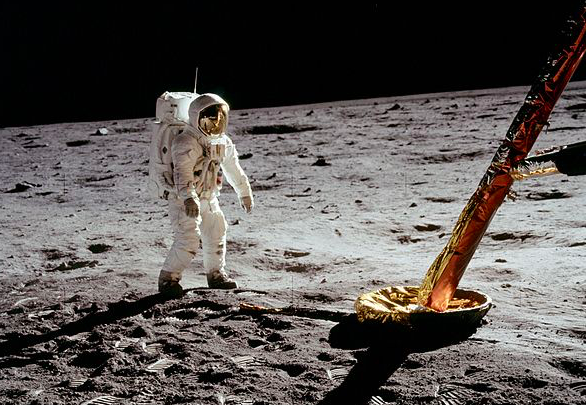
Aldrin on the moon. Photo by NASA on Wikimedia Commons
My memories of the first moon landing are not in vivid colour. I remember them in greyscale.

I was sat inside a small croft in the tiny village of Sandwick, on the Shetland Islands on the morning of July 20th, 1969. Our croft had no running water, was sat on the side of a hill overlooking the bay, and if to be honest, was quite primitive. Five of us lived inside this two-up two-down grey stone building, the wind never stopped blowing, and the electricity supply could be intermittent. It was ironic, because up to that point, what I was witnessing was the most high-tech event in history.

I was 12 years old, and unusually for me, I was up very early before 0500 to watch the Apollo 11 astronauts walk on the moon. It was a grey morning, and I watched excited, huddled up in a large blanket, as the action unfolded on our small monochrome TV set. The images I saw were fuzzy and grey and the movement seemed ghostly, as first Armstrong, and then Aldrin, descended from the Lunar Excursion Module and kicked up grey moondust as they bounced around the surface in their voluminous white spacesuits. And yet I felt like I was there with them, and imagined what it must be like to be a quarter of a million miles away from home, in an alien environment, the first humans to walk on that dusty surface.

The year before, as the three Apollo 8 astronauts (Borman, Lovell and Anders) circumnavigated the moon for the first time, I had been captivated by space exploration, and I had built my own scale model of the Saturn V rocket, which actually stood a couple of centimetres taller than me. I knew just about everything that an eleven-year-old boy needed to know about the moon shots. I could tell you the escape velocity from the earth's gravitational pull, the distance from the Earth to the moon, and I could name all the astronauts on all the Apollo missions. I was completely absorbed by it all.

I learnt a lot from following the Apollo moon missions. The science, engineering and technology of Apollo fascinated me, and in combination they enabled me to appreciate what an amazing feat had been accomplished by NASA. I have carried at least five important lessons from following the Apollo missions with me throughout my life:

1. Follow your dreams. If you are passionate enough about anything, you learn everything you need to know about it. Whatever the subject, if you are interested in it, you will become completely familiar with it, to the finest detail.

2. Believe in yourself. If you reach high enough and far enough, you will achieve what you need to achieve. All it requires is vision, commitment and effort.

3. Have courage. The astronauts needed great resolve to launch themselves into the unknown, and they were probably fearful. But still they took the ultimate risk, relied on the expertise and knowledge of their team, and they achieved their goal.

4. Work with others. No single human could have achieved what Apollo and NASA did. It took dedicated people from all walks of life, and from many backgrounds to achieve the moon landing.

5. Nothing is impossible (See number 2). It takes small steps at first, but giant leaps will follow.

Tomorrow: Giants leaps

Creative Commons License
Small steps by Steve Wheeler was written in Plymouth, England and is licensed under a Creative Commons Attribution-NonCommercial-ShareAlike 3.0 Unported License.


July 12, 2019

Happy accidents

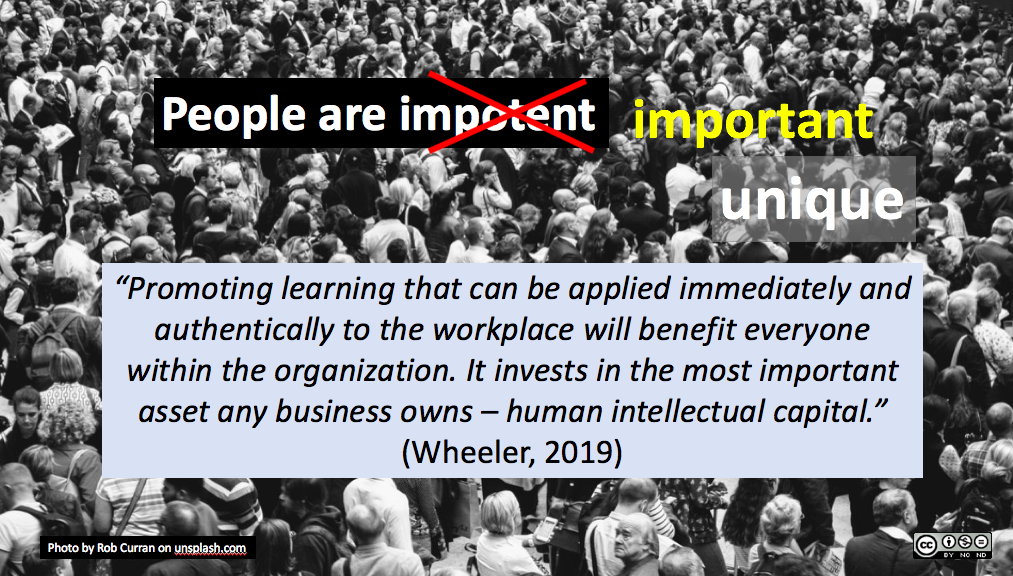
Background image by Rob Cullen on unsplash.com
Serendipity. The happy accident. Things you didn't plan to happen, but when they do, in a random kind of way, it actually turns out a lot better. Serendipity has happened to me professionally on numerous occasions, usually during teaching sessions. But it also happened recently as I was preparing a presentation for a conference.

For my invited presentation at the Learning Technologies Summer Forum (#LTSF19) in London recently, I spoke on the topic of 'People, Personalisation and Personal Learning.'

I deliberately used alliteration in the title as I often do, to emphasise my points. But the serendipity happened when I was putting my slide deck together. The second slide was meant to say 'People are important'. But my word processor had other ideas, and when I looked up, it had been corrected to 'People are impotent'. I decided to keep it there, and used it as a little light relief during my session, but it was also kept in as an important message - that people can be impotent if they feel forced into situations at work, especially in learning and development contexts, where they feel powerless to change anything, or cannot exert their autonomy.

Self directed forms of learning, especially those within personal learning contexts, I said, can be similar - where people find they don't know where to go next, or lose impetus as they attempt to navigate through particularly complex passages of learning on their own.

By far the most important message of the day though was that we should treat people as highly valuable within organisations. The slide on this post shows a quote from my latest book Digital Learning in Organizations, that people are the centrally most important asset any company can own. Let's treat them that way, and provide them with the best possible environments and opportunities to develop themselves and improve their performance.

Creative Commons License
Happy accidents by Steve Wheeler was written in Plymouth, England and is licensed under a Creative Commons Attribution-NonCommercial-ShareAlike 3.0 Unported License.


July 09, 2019

Learning with bees

Photo by Patrick Brinksma on unsplash
One of the most impressive TED talks I ever viewed was presented by Neuroscientist Beau Lotto and a 12 year-old student called Amy O'Toole.

Amy had earlier attended Blackawton Primary School in South Devon, under the headship of visionary educator Dave Strudwick. Dave invited Beau to do some research with the children on visual perception, and they turned their attention to the vision of bees.

The research was based on the question: What do science and play have in common? Beau Lotto thinks all people (kids included) should participate in science and, through the process of discovery, change perceptions. He cop resents with 12-year-old Amy O'Toole, who, along with 25 of her classmates, published the first peer-reviewed article by schoolchildren, about the Blackawton bees project.

This just shows that anyone can be involved in research at the highest level, and that includes primary school children. Other schools are now adopting these ideas, and several have set up apiaries for keeping bees.


Creative Commons License
Learning with bees by Steve Wheeler was written in Plymouth, England and is licensed under a Creative Commons Attribution-NonCommercial-ShareAlike 3.0 Unported License.


July 02, 2019

Blends, borders and boundaries

Photo by Sylwia Bartyzel on Unsplash
Here are some further thoughts on the 'blend' in blended learning:

Blends are made of disparate elements. Elements are often separated by boundaries, and these must be transgressed if blends are to be effected. In other words, we need to bring elements together that might not naturally co-exist.

Boundaries also mark a transition from one state to another. Cross over a border, and you find yourself in new territory. In online and virtual forms of education, especially blended forms of pedagogy, learners are constantly transitioning between complex states as they learn, interact with their tools, content and with others; and as they navigate, discover, create, organise, remix, repurpose and share content.

Such complexities have been the focus of concerted research, but they are still less understood than we might wish. Many types of borders (binaries) exist in 'the blend', including those between personal/social, learner as producer/consumer of knowledge, synchronous/asynchronous, local/global, closed/open, real life/virtual and local/distance.

It is these many and various modes of learning and associated activities that ensure 'blended learning' cannot be a simple proposition. However, these may be complexities that matter more in theory than in practice.  After all, the term 'blended learning' is a relatively new label for something that has been practiced for aeons. It is only since the advent of telecommunications that we have begun to recognise some of the complexities that result from our engagement with technology.

Such complexities are generally only problematic for academics, course designers and teachers. Students largely ignore the boundaries between states or do not consider them as anything particularly significant, usually getting on with the task of learning and applying. That is, until a technology fails to function, and the normally smooth transition between states is found to be blocked. When the border crossing is blocked, and no transition is possible, learning can be restricted or constrained. In such situations, our theoretical knowledge of these complexities can enable us to find new practical ways to obviate the problems.

Related posts:
Trends and blends
In the mixer
Mobile learning and blended interaction

Creative Commons License
Blends, borders and boundaries by Steve Wheeler was written in Plymouth, England and is licensed under a Creative Commons Attribution-NonCommercial-ShareAlike 3.0 Unported License.


June 28, 2019

Trends and blends

Image captured by Angeles Sánchez-Elvira Paniagua
Earlier this week I took part in two online webinars. The first was a presentation of my thoughts on the state of play of blended learning methods in universities. The second, two days later was a panel discussion focused on the present day practices and the future of blended learning. All of the links are below, courtesy of the Empower Higher Education events team at EADTU (European Association for Distance Teaching Universities).

Webinar recordings:
Wednesday 26 June: Good practices in Blended Learning part 1part 2
Thursday 27 June: Panel discussion on the present and future of Blended Learning with Steve Wheeler, Antonio Moreira Teixeira and Stephan Poelmans.

PowerPoint presentations:
Tuesday 25 June: 
In the Mix (Steve Wheeler, Learning Innovations

Wednesday 26 June:

Creative Commons License
Trends and blends by Steve Wheeler was written in Plymouth, England and is licensed under a Creative Commons Attribution-NonCommercial-ShareAlike 3.0 Unported License.

June 26, 2019

Literacy in the New Media Age

I was saddened to hear news of the passing of Professor Gunther Kress (26 November 1940 – 20 June 2019) this week. Gunther was chair of Semiotics and Education in the Department of Culture, Communication and Media within the Institute of Education of University College London.

He was born in Austria and trained as a linguist in Australia before eventually taking up citizenship in the United Kingdom. He was awarded the honour of Member of the Order of the British Empire (MBE) in the 2012 Birthday Honours for his services to scholarship.

I talked with Gunther Kress when he visited my own institution to speak several years ago. His book Literacy in the New Media Age, which was first published by Routledge in 2003, was prescient and far sighted.

Ever approachable and friendly, Gunther signed a copy and presented it to me after our conversations about digital literacy and the use of media and technology to support learning. I treasure that copy and often find myself dipping into it - and I have cited his work in several of my own publications over the last decade. Here's a thoughtful and challenging quote from Kress for educators everywhere:

"The world of communication is not standing still. The communicational world of children now in school is both utterly unremarkable to them and yet it looks entirely different to that which the school still imagines and for which it still, hesitantly and ever more insecurely, attempts to prepare them."  (Kress, 2003, p. 16)

Reference
Kress, G. R. (2003) Literacy in the New Media Age. London: Routledge.

Creative Commons License
Literacy in the New Media Age by Steve Wheeler was written in Plymouth, England and is licensed under a Creative Commons Attribution-NonCommercial-ShareAlike 3.0 Unported License.


June 22, 2019

Making a splash!

Image by Craig Whitehead on Unsplash
While in conversation last week at the EDEN annual conference in Bruges, my good friend Marci Powell told me about a brilliant resource called Unsplash. It's a website that hosts a huge, and ever growing repository of superb images, shared freely by talented photographers.

The search algorithms on Unsplash are quite sophisticated. Let's say you want to find a picture of colourful, neon lights, reflected off a wet street. Now that's quite specific, but if you insert the search string 'neon lights wet road', you are immediately presented with dozens of quality images, each of which fits the criterion.

The image on this page was found using that search phrase. It's by Craig Whitehead and is free to download and use, just like all of the other images on the site. You can choose to acknowledge the creator of the image or not, but either way, the images are all free to use.

As with any other social media platform, there are useful devices such as trending search notifications, API/developer sections and licensing advice, and there are special zones where you can find wallpaper or slide background images. You can also search for specific photographers on the landing page, and see their entire uploaded collections instantly.

For educators, this is a particularly useful resource, which I for one, will return to time and time again. I hope you will find it as useful as I have. Thank you Marci for this great tip!


Creative Commons License
Making a splash! by Steve Wheeler was written in Plymouth, England and is licensed under a Creative Commons Attribution-NonCommercial-ShareAlike 3.0 Unported License.

June 21, 2019

Communities and connections

Photo by Airina Volungevi?ien?
My opening keynote speech at the 29th annual EDEN conference at VIVES University of Applied Sciences in Bruges, Belgium earlier this week was given the title Connected pedagogies - Learning and teaching in the digital age.

I told my audience at the outset that I would not attempt to educate them, because they are far too sophisticated and knowledgeable community of experts and professionals. Rather, I promised, I would offer them some of my thoughts on developments in education and would conclude with three key challenges to consider. These are presented at the very end of my keynote.

Before this, I presented some of my thinking around new theories and emerging pedagogies that leverage to power and potential of networked technologies, and spoke about the personal devices students use and how they might be incorporated into every day teaching and learning. I also mentioned some of the emerging tools and technologies that are just becoming available, and speculated on how these might influence changes in pedagogy in the coming years.

The video of my keynote (a clipped version from the entire opening plenary session which can be viewed in its entirety on EDENTube) is about 30 minutes in duration and is followed by a panel discussion with the audience.

via ytCropper

Creative Commons License
Communities and connections by Steve Wheeler was written in Bruges, Belgium and is licensed under a Creative Commons Attribution-NonCommercial-ShareAlike 3.0 Unported License.


June 07, 2019

Reflecting on practice

Reflection on practice is vital for all professionals, not only to improve their performance, but also to help them to think critically about their domain of expertise. Action research derives from reflective practice, and there are many tools that can be used to promote reflection on, in and through practice. This interview was recorded in 2016 in Riyadh, Saudi Arabia, specifically focusing on reflective practice for educators.


Creative Commons License
Reflecting on practice by Steve Wheeler was written in Plymouth, England and is licensed under a Creative Commons Attribution-NonCommercial-ShareAlike 3.0 Unported License.

<< Back Next >>