

clipped by: anzbau
clipper's remarks: How to teach textspeak - a guide for innovative teachers 

clipped by: anzbau
clipper's remarks: New language has emerged.

clipped by: anzbau
clipper's remarks: According to government-funded research approximately 20% of teens are functionally illiterate and/or innumerate.
The latest evidence on reading shows 17 per cent of 16- to 19-year-olds are functionally illiterate and Professor Brooks said this had also been the case for at least two decades.
“People at this level can handle only simple tests and straightforward questions on them where no distracting information is adjacent or nearby,” his report says.
“Making inferences and understanding forms of indirect meaning, eg allusion and irony, are likely to be difficult or impossible. This is less than the functional literacy needed to partake fully in employment, family life and citizenship and to enjoy reading for its own sake.”
 If you have a few moments to spare over the next few weeks, you could check out the Manifesto for Media Education site, where educators and media specialists from around the world are being invited to post their thoughts and ideas on best practice, learning philosophy and the future of education, all around the context of media. Here are Pete Fraser and John Wardle, the minds behind the Manifesto project:


 Tonight I'm travelling up to Loughborough University to speak at tomorrow's Google Apps for Education User Group meeting. Together with the University of Portsmouth's Manish Malik I will be presenting a paper on our latest thinking around Cloud Learning Environments. Other speakers include Tony Hirst and Niall Sclater (both at the Open University), Nick Skelton (University of Bristol) and presided over by Martin Hamilton (Loughborough University). You can follow the entire day's proceedings by checking the Twitter hashtag #guug11. Here's our abstract:
Manish Malik (Faculty Learning and Teaching Coordinator at the University of Portsmouth) and Steve Wheeler (Associate Professor of Learning Technology at the University of Plymouth) discuss the recent developments and the patterns emerging within the CMS/LMS/VLE product sector. From BB & Moodle 1.0 to BBoogle & Moodle 2.0/Google to Sakai 3.0/Canvas to a GApps based learning environment. Also they highlight and demo an application that shows the potential that Google Apps and other loosely coupled Web 2.0 services have in creating an open Virtual Learning Environment that is cloud based or a "Cloud Learning Environment."
Image source by Marcos Papapopolus
In the clouds again by Steve Wheeler is licensed under a Creative Commons Attribution-NonCommercial-ShareAlike 3.0 Unported License.


What is the future of education? With the upsurge in ownership of smart mobile devices such as iPhones, Androids and Blackberries, the rapid social penetration of touchscreen computers such as iPads, and an increase in the purchase of Kindles and other e-reader devices, the future of learning is definitely smart mobile. 80 per cent or so of the learning that most of us engage in is of an informal nature. Informal learning is becoming an increasingly enriched experience with personal tools, and there is improved connectivity too, ensuring that anyone who has a mobile smart device is more likely to be able to connect to the Internet quickly and seamlessly. Social networking sites and online media sharing sites are also enjoying exponential increases in membership, leading to the supposition that this generation is a profoundly connected generation. Students will use Facebook when they want to, and their institutional managed learning environment when they have to.
It is clear that education will not share the same future as the state funded school, because education and school are not synonymous. It doesn't end at school either. Those who pursue formal learning to the level of further and higher education will experience a growing gulf between the capabilities of the technology they arrive with in their hands, and technology that is provided in the classroom. They are different tools, for different purposes. The Blackberry or iPhone will be used to connect to informal learning and friends, for fun, entertainment and social purposes. The institutional system will be used for connecting to formal learning, and activities that are more formalised and by their nature, less entertaining and engaging. The personal technologies will be sleek, attractive, must-have, rapid action and intuitive devices, while the institutional systems will be rule-bound, clunky, opaque and bland. It follows that many students will prefer to access learning resources, their tutors and peers through their own personal technologies. We will thus witness a gradual decline in on-campus learning, with an increasing number of blended programmes made available to meet the demand of an increasingly mobile student population. Because students will increasingly rely on smart mobile tools for learning, FE and HE institutions may agree special arrangements with telecommunications companies to offset the call cost for students, as a trade off to the money the save by reducing their on-campus operations.
The blended learning courses of the future will be those that combine formal and informal learning features. Formal learning will be undertaken mainly for the purpose of gaining accreditation, informal learning will be engaged with for the remainder of the waking hours. Unless we can harness the power, excitement and richness of the informal personalised learning experience and translate it into formalised settings, we will continue to see a widening rift between school and education. The slideshow above - a part of the keynote speech I gave at LearnTEC in Karlsruhe, Germany, earlier this month - illustrates these and other thoughts about what we might see in the future of learning.
The future of learning by Steve Wheeler is licensed under a Creative Commons Attribution-NonCommercial-ShareAlike 3.0 Unported License.


 In several previous posts on this blog I have extolled the virtues of open content, and have called for traditional journals to go open access. Recently we heard the excellent news that the flagship journal of the Association for Learning Technologies (ALT-J) which recently changed its name to Research in Learning Technology, will go fully open access in January 2012. It took a change of publisher to achieve it. In future, I predict that the 3 issue a year publication will reach a significantly larger and more diverse audience than it has ever previously achieved. That's what happens when content is made free and open for all. For me and an increasing number of other academics in all disciplines, open access is the way forward, and I am becoming disenchanted with the idea of writing for closed and pay-wall ridden publications.
I therefore sat up and took notice this week when the American publishing house Nova Science sent me an e-mail asking me if I wanted my recently published chapters to be open and freely available to readers. What an opportunity! I thought. It's a no brainer! So I checked the fine print. Here's the deal: Any Nova published author can participate in the open access scheme - it's easy. All we have to do is complete an order form and send it off to Nova with our credit card information. For only $400 I can enjoy option 1. "This feature allows your chapter to be visible free of charge to anyone in the world with internet access. In addition, the Publisher will send e-announcements to up to 100 recipients upon request and provision of the email list." For a paltrey $700 my readers and I can enjoy option 2: "The Express version of Open Access provides Open Access immediately after page proofs resulting in full Open Access 8-12 weeks before publication." Not satisfied with such an unbelievably generous offer, Nova are really pushing the boat out, creatively offering additional options for only a small extra payment, including colour print versions ($300 for the first 10 pages and just a little more for additional pages), video enhancement (a snip at $400 for 10 minutes) and even 'personalised offprints' at $14.50 per item.
It thrills me to think that Nova Science (and hopefully other publishers too) have finally decided to put their authors and readers first, while worrying less about their shareholders, as they fully adopt the ethos of open content and open access for all the content they publish. After all, the content is only there as a result of the hard work of academics and authors, so it's only fair. It warms my heart to think that they are now putting aside their profiteering instincts to ensure that knowledge is democratised and freely available for all. I'm going to sign up to this most excellent arrangement ... just as soon as the pigs that are flying around outside my window stop for a swill break.
Image source by Stephanie Pouyllau


 Conrad Wolfram is a man dripping with ideas and innovation. He is also a decent, unassuming and thoroughly pleasant guy. He has a high powered vision of the world 'where computation meets knowledge.' Since May 2009, when it was released for general use, Wolfram Alpha has caused some waves. For the Wolfram brothers Stephen and Conrad, Alpha is less a search engine, more an answer engine, because it processes queries against structured data rather than simply presenting a list of pages or hyperlinks found through word-matching.
 During his LearnTEC keynote, Conrad Wolfram (pictured left with conference chair Peter Henning and I) had given a live demonstration of both the Wolfram Alpha answer engine itself and also a new experimental site which 'I'm not supposed to show you just yet.' It is impressive stuff, with powerful computation that goes beyond simple interpretation of the words entered, generates 3 dimensional visualisation of data and promises the capability to automatically create widgets when the user asks the right questions. How old was Queen Victoria in 1890? It will give you the answer and then create a widget to deal with other, similar queries. Where is Victoria Falls? It provides a location map, and offers a number of geolocation options. The four pillars of WA, said Conrad Wolfram, were linguistic analysis, curated data, dynamic computation and computed presentation. If used correctly and intelligently, WA is indeed an extremely powerful research and computational tool.

 When Doug Belshaw invited me to write a blog post on the purpose of education for the Purpos/ed project I could see the importance of revisiting this vital question. Your own rationale for becoming an educator should reveal quite a lot about your own personal philosophy on education. For me, it's about making a positive impact on people's lives and inspiring them to learn.
Let's start with the word 'education'. One of the Latin root words is 'educere' which means to draw out (from within). If we practice education properly, we will see that it's not about getting students to perform to standardised tests that bear no resemblance to reality. Standardised tests allow governments to check on the performance of the school, not on individual learning. This is not education, it's schooling.
If we practice education properly we will also realise that it's more about learning than teaching. I often think about what I actually learnt in my school years. I was taught to read and write and to perform elementary mathematical functions so I wasn't ripped off when I visited a shop. But this was nothing compared to what I learnt through my own endeavours, in my own time - the science I learnt through my keen interest in the NASA Apollo Moon missions was far superior to anything I picked up in my physics and biology lessons. I wrote my own 'books', made posters of the moon and models of rocketships, knew all the planets, the star systems. Even now I can tell you the exact escape velocity from the Earth's gravity and can describe the physics of an eliptical orbit in fine detail.
My profound appreciation of music is more down to the long hours I devoted learning to play guitar in my bedroom until my fingers bled. In fact I learnt more about music by self-teaching myself guitar and watching films of my rock heroes than I ever learnt playing repetitive scales on a recorder in school.
I think you can see where this is all going. In school, my teachers (with one or two notable exceptions) actually failed to draw out from within me the desire to learn - to develop the aptitude I already possessed to become a reasonably good musician or the ability to convey my thoughts and ideas in a number of ways including writing and public speaking. I'm at the top of my game now, and I owe most of it to ..... me. Sure, others have inspired me to learn, but this has generally happened in the long years since I left school. All of my professional and academic qualifications were achieved studying part-time, after I reached 30. I studied for 3 degrees and a teaching certificate on the basis that I wanted to do so. I was interested, so it was well worth the sacrifice. And I keep learning now, as often and as much as I can, to stay as close to the leading edge of my profession as I can. Because I want to. I have it within me to do so.  School for me wasn't so much a waste of time, as something I had to endure to become who I ultimately have become. I left with very few qualifications. Some teachers inspired me but many were wide of the mark because they didn't have the time or the interest in me to see my potential. One told my parents: 'Stephen is a very sociable lad, but he will never become an academic.' I didn't have it within me, he assured them. 'Maybe he can find something useful to do with his hands' he advised sagely. Well, I did have it within me, but I had to draw it out of myself in the end.
Schools are not all bad news. There are plenty of good teachers who take time to get to know their students and try to find ways to draw them out. Dispense with the rigid, compartmentalised curricula, and the standardised testing, and let the kids express themselves more creatively through their own means (including the open use of personal technologies in the classroom) and school would be a place where people could be drawn out to achieve their highest potential. Take away government meddling and allow schools to govern themselves, and we might see some positive changes taking place, with children engaged more in learning, and actually eager to get into school every day.
So back to the original question - what is the purpose of education? It is to inspire students to learn to the best of their ability, to draw them out to be the best they can be, and so enable them to aspire to great things. Just make sure you don't confuse education with school.
Image source
I have it within me... by Steve Wheeler is licensed under a Creative Commons Attribution-NonCommercial-ShareAlike 3.0 Unported License.


 The January special issue of Interactive Learning Environments is out right now. Our guest editors have done a great job drawing together 5 excellent papers under the banner of 'Semantic Technologies for Multimedia Enhanced Learning Environments' and for Learning with 'e's readers, here is the editorial in full, with excellent summaries of all the papers by our special issue editors Marco Bertini, Vladan Devedzic, Dragan Gasevic and Carlo Torniai:
Widely available learning material is recognized as a key asset that enables aggregation, provisioning, retrieval, reusability, adaptation, and personalization of educational content. Besides being able to author, publish, discover, and use high-quality learning objects, it is equally important to use multimedia-rich learning objects. Many domains require very advanced content, where different concepts and processes require the use of multimedia (e.g. image, sound, and video) to provide students with a better understanding of concepts under study. This inevitably sets new requirements in multimedia-enhanced learning environments for the advanced representation and creation of learning metadata. The goal is not only to have a richer representation of learning content but it is also important to consider multimedia learning objects in various learning situations where interaction and collaboration are required features. For example, interaction needs to be improved across all the six dimensions of the well-known interactivity triangle with the three main participating nodes of interaction - instructors, students, and content (Anderson & Garrison, 1998). Yet, students are also content creators. This is nicely facilitated by Social Web technologies (e.g. blogs and wikis), which better enable learning environments to support principles of social constructivism. While today user-created multimedia content is a commodity in learning environments, we need to have pedagogical strategies to show how to make the best use of the available technologies. Creative solutions are needed and new perspectives are more than welcome. Just as we can expect learners to easily create and publish multimedia content, we should also facilitate interaction between learners, their peers and educators through multimodal channels of communication and help new users benefit from the experience of previous users of multimedia learning content. Spector (2009) of Google Inc. refers to this phenomenon as “fluidity among the modalities,” where many new modalities will come in addition to the more frequently used ones - text, video, voice, and image.
Scope of the special issue
This special issue analyzes how semantic technologies can be leveraged to address some of the above-mentioned challenges of multimedia-rich learning environments. To perform this analysis, it is first important to define the concept of semantic technologies. Traditionally, the Semantic Web is associated with semantic technologies (Gaevi, Jovanovi, & Devedi, 2007). Ontologies, as the backbone of the Semantic Web defining formally and explicitly represented shared domain conceptualization, are the main way for representing and sharing metadata. Current research in learning technologies has shown that in learning environments Semantic Web technologies can integrate data about learning objects, learning activities and learners captured from various e-Learning systems and tools. Due to the intensive use of Web 2.0 techniques (e.g. collaborative tagging, social networking, mash-ups, and wikis), lightweight representation of semantics and metadata is used in the form of folksonomies, user comments, and ratings. Despite the initial perception that Web 2.0 opposes the Semantic Web, these two efforts are being jointly used to create a common space of semantic technologies (Hendler, 2009). Therefore, semantically enhanced metadata for learning multimedia cannot be considered without the social and interaction context, in which learning constantly happens (Jovanovi, Gaevi, Torniai, Bateman, & Hatala, 2009). Metadata is used to facilitate the discovery and sharing of learning multimedia objects and metadata created through the interaction of learners and educators among themselves and with the learning content.
This special issue solicited papers focused on the use of semantic technologies in multimedia-enhanced learning environments. In this call, we were especially interested in publishing research reports and lessons learned in the following research tasks:
Selected papers
After an enthusiastic response to the open call for papers, followed by a rigorous peer-review process, we are pleased to present five papers addressing some of the indentified research topics. While it would be unrealistic to expect a complete coverage of all research topics due to their vast scope, the paper selection reflects thoroughly the state-of-the-art in this area and some promising research results. More importantly, we can also see many needs for future research, which will hopefully be addressed in the years to come.
In the paper entitled “Automatic generation of tests from domain and multimedia ontologies,” Andreas Papasalouros, Konstantinos Kotis and Konstantinos Kanaris look at the problem of automated generation of quizzes for assessment from domain knowledge. The authors recognized that currently there are many approaches allowing for generating and analyzing tests, but they all rely on text-based content. However, in many different areas, it is important to include multimedia content into the questions asked in quizzes. In their approach, the authors make use of ontologies to represent knowledge of a domain at hand. The domain ontologies are then used together with multimedia annotation ontologies to annotate multimedia learning objects. On top of such annotated multimedia, the authors propose several different strategies for generation of multiple choice questions, where the assessment of students' answers is making use of ontology-based reasoning (i.e. subsumption). Besides applications on text-based content, the authors also demonstrate how their approach can be used for images and argue that the approach can easily be applied to other types of multimedia content. With the use of a prototypical implementation of the proposed approach, the results obtained in the evaluation demonstrate some very promising practical prospects.
Semantic annotation of multimedia learning objects is the topic addressed in the paper entitled “Semantic annotation of video fragments as learning objects: a case study with YouTube videos and the Gene Ontology” by Elena Garca-Barriocanal, Miguel-Angel Sicilia, Salvador Sanchez-Alonso and Miltiadis Lytras. The authors focus their effort on user-generated content (in particular videos posted on YouTube) that can be used as learning material. The need for effective ways to annotate this content is addressed by an annotation tool based on domain ontologies. The generated metadata are then used as a filter for selecting relevant parts of annotated clips as learning objects.
Another paper also focuses on collaborative annotation of multimedia learning content - “A collaborative multimedia annotation tool for enhancing knowledge sharing in CSCL,” by Stephen J.H. Yang, Jia Zhang, Addison Y.S. Su and Jeffrey J.P. Tsai. The authors investigate various annotation techniques (e.g. comments or tags) as instruments helping students develop their critical thinking skills through collaborative learning. In particular, they proposed an architecture based on the use of semantic technologies (for conceptual modelling of collaborative annotations) and web services (for distributed collection and flexible integration of shared annotations). By developing a novel learning environment for collaborative e-Learning and knowledge sharing, using a personalized annotation management system (PAMS 2.0), the authors extensively evaluated the implications of their architecture and approach in a course involving 94 junior university students. The analysis of the collected data indicates that the proposed approach to knowledge sharing helps learners better comprehend their readings and stimulate them ask engaging questions to be discussed with their peers.
The role that semantic technologies can play in reusing and sharing learning resources is well depicted by A. Yessad, C. Faron Zucker, R. Dieng-Kuntz and M.T. Laskri. In their paper entitled “Ontology-based semantic relatedness for detecting the relevance of learning resources,” they describe a novel approach to the computation of the semantic relevance of learning resources to a learning context of a learner. The idea is to compute the relevance between conceptual annotations for the learning resource (built using its role in the learning process and its learning topics) and the concept of interest to the learner. The proposed method offers promising results compared to both semantic measure of similarity and experts ratings.
While it is important to discover some parts of multimedia content, it is also equally important to validate the quality and relevance of the learning content to be used by a learner. In the paper “Constraint modeling for curriculum planning and validation,” Matteo Baldoni, Cristina Baroglio, Ingo Brunkhorst, Nicola Henze, Elisa Marengo and Viviana Patti recognize in authoring of personalized curricula, a gap between learners' traits (e.g. background knowledge or various cognitive traits) and curricula that educational institutions may offer. To address this research challenge, the authors propose a constraint-based technique based on the use of ontologies, model checking principles, and temporal logic to validate whether personal curricula being proposed for each individual learner satisfy the learner's personal traits. The prototypical implementation of the Personal Reader system for education allowed the authors to evaluate their proposed method and to report on some important lessons learned.
Image source by Taylor & Francis


 Every so often, someone who 'wishes to remain anonymous' slithers out from under a stone to post a few destructive or malicious comments on someone else's blog, vandalises a wiki page (like 'Furballer' did recently) or hacks into a site. Sometimes the comments are quite clever. More often though, they are simply meant to hurt, damage or undermine. The perpetrator hides behind their anonymity because they wouldn't have the courage to say the same thing to a person's face. It's so easy to be anonymous on the web. Then you can say exactly what you want to say, and suffer no personal consequences, because there's no come back. Right? Er... wrong. Let me introduce you all to 'elearning101' (whoever he or she may be), and point you in the direction of their recent post on my Slideshare site. This is what elearning101 wrote:
"Another rehash of the same old stuff. Is this really what passes off as a keynote nowadays? Any chance of of evidence rather than a load of hyperbole. This is just a list of ideas loosely thrown together without any examples, evaluation or evidence Can anyone explain what a CC Steve Wheeler licence is? Does the author have his own version of Creative Commons?"
This was posted in response to a slideset several people asked me to share after they heard my keynote presentation in Germany for the LearnTEC Conference. I don't want to make a big fuss out of this, or act like a wounded victim, because I'm not. I'm big enough and old enough not to worry too much about a few negative comments. The positive comments I receive about my work far outnumber the negative, abusive or disparaging ones. No, instead I want to point out that posting anonymous rude comments on someone else's site is unacceptable. For me, it's a form of cyber bullying. I won't stand for it, and neither should you. I'm writing this blogpost because I want to bring such behaviour out into the open. In so doing I hope the community of practice I value, the readers of this blog, and those who are as passionate as me about learning and technology can read, be aware, assess and otherwise discuss the implications of it.
Here's what I wrote in response to elearning101 on my Slideshare site:
"Wow, thanks for your comments elearning101 - if that is your real name. :-D Unfortunately, your comments don’t really bear any resemblance to reality and I’m almost certain you wouldn’t be bold enough to say this to my face. Agreed, some of the slides have been used before in previous presentations, but the content and message were specific to the audience at LearnTEC so I repurposed some of them appropriately.
Ask anyone who attended for their comments and feedback and I think you will find they would be all very positive, and we had a lot of constructive dialogue afterwards. That has to be worth something? I would like to discuss this with you without you hiding behind your shroud of anonymity sometime perhaps... I’m open to criticism, when people are honest with their identities, and then perhaps your comments might actually carry some weight."
Ironically, since I posted the slideshow, it has received over 1500 hits in 24 hours. Not bad for a slideshow filled with hyperbole and a lack of examples, evaluation and evidence eh? I would also like to ask this: How does elearning101 know that my talk was all hyperbole and lacking evidence? Answer - they don't, unless they were in the audience. Then they would have heard the evidence I cited from my own recent studies into my students' use of social media. I will also say this (although I doubt very much if elearning101 will dare to reveal their true identity, especially now I have made their activity public). I repeat my challenge to elearning101 to discuss with me why s/he thinks my slides are valueless. They actually make a valid point about the Creative Commons licence - I failed to post the final slide which tells viewers exactly which licence I selected - a share alike, non-commercial licence. Shame, because these kinds of argument would hold more water if these anonymous commenters provide their real name. I would also like to hear if elearning101 or anyone like them has ever been up to their tricks on anyone else's sites. What is the extent of this kind of anonymous commenting? I'm well aware that elearning101 has been active on other sites, including Wikipedia, so watch out - your website could be next.
Please don't misunderstand me, I'm open to any amount of criticism, as long as it is constructive and is given without spite. Tell me what is wrong but then tell me what you think I could do to improve it. I learn a lot from the feedback of my own personal learning network. When it's anonymous and destructive though, I think the writer forfeits their right to be taken seriously. But I also wonder what you think as you read this? I welcome comments from anyone (including elearning101 of course) on this incident, but please identify yourself if you are able to. Have you experienced the same or similar? What are your views on such incidents? And what are the implications for us all as an online community?
Image source by Jeff the Trojan
Dear elearning101... by Steve Wheeler is licensed under a Creative Commons Attribution-NonCommercial-ShareAlike 3.0 Unported License.


 It was very refreshing to see the set up of LearnTEC in Karlsruhe, Germany this week. Billed as one of the largest learning technology trade fairs in Europe, it dwarfs the likes of mega conferences such as Online Educa Berlin, with well over 7000 visitors over the three days of the exhibition and conference. I was honoured to be invited to give a public keynote within the trade fair arena (see yesterday's post for more on this), and afterwards was inundated by requests for interviews and discussion. Several of the vendors also button-holed me to discuss my previous blogpost Upstairs downstairs, where I gave a critical report on the previous week's Learning Technologies Conference London exhibition. The ensuing discussion heated up the blogosphere for a while, with vendors defending their various positions, and practitioners giving their own views. To their credit, the vendors at this exhibition seemed to be a little more in contact with their training and teaching colleagues. I deliberately went around to the stands to question vendors on their approaches and examine their wares. I was pleasantly surprised by their candour and their openness.
 LearnTEC certainly seems to have the balance right between academic discourse and vendor demonstrations. The way they were mixed within the same space, in a public and freely open environment seemed to work well. The discussion was rich and productive as a result. On a final note, the image on the left was taken of a stand in the middle of the exhibition - it was a reminder to everyone who walked past about where we have come from, and where we should never, ever, return to, because learning is about looking to the future, not the past. Take note, conference organisers - all of this is the future of the learning technology conference.

 My public keynote yesterday in the trade fair arena at the LearnTEC Trade Fair and Conference in Karlsruhe, Germany was quite an experience. I wore a microphone headset which made me feel like an astronaut (but alas none could be found, despite the close proximity to Darmstadt European Space Agency Centre). The headset didn't make me look like Michael McIntyre, but it certainly gave me a lot of freedom to move around the audience and interact dynamically with them, and with over 300 people crowding in from all parts of the arena, we had an interesting and fast moving session. I presented a talk entitled: The future of learning: Web 2.0, Web 3.0 and the eXtended Web (Slideset here) which seemed to capture the mood of the conference. They like talking about the future here at LearnTEC, even if it is uncertain (the future, not LearnTEC - which seems to be growing from strength to strength, already in its 19th year, with 6000 exhibition visitors and 1200 conference delegates over the three day event).
  I talked about how the Web, in all its incarnations, is changing the way learning can be conducted, and discussed the impact of mobile technologies. We touched on a number of new and emergent technologies including augmented reality (AR) and non-touch, natural gesture interfaces such as the XBox 360 Kinect and MIT's Sixth Sense wearable. At the end there was at least 15 minutes of questions and discussions, and I could tell from the questions that everyone seemed to be thinking deeply about what was being said. It was an ideal environment for this presentation, as hopefully the pictures above will show. To be deep in the heart of exhibitor land, and with many of the exhibitors leaving their stands to participate, just has to be a way forward in the context of the debate on the divide between vendor and practitioner (see the comments on my previous post for the discussion thread).
One of the comments from conference convenor Prof Peter Henning was that the discovery of fire was a game changer. I added in my response that perhaps it was not the discovery of fire that was so important, but the discovery of the ability to make fire. We discussed the disruptive innovation of the Gutenberg Press (invented so close to Karlsruhe, in Heidelberg) and its role ín democratising knowledge. Previous to movable type setting, publishing was extremely limited, but with the introduction of mass affordable publishing came the need to develop the entire population's literacy skills. My message to the audience was that with the introduction of social media and semantic web technologies, a new disruption is now occuring - and we now need new literacies - digital literacies for the entire population. We also discussed how to harness the excitement and richness of informal learning within formalised contexts, and how the future of learning will rely for its success on preparing young people not to learn facts (which are often outdated by the time students graduate) but to instill within them all the ability to learn how to learn, solve problems and adapt quickly to changing situations. The final message for the audience was that just as with fire, web tools have the capability to be used skillfully, or badly, and without care. We can either heat the home, or we can burn the house down.
Image source by Gudrun Porath
Heating the house or burning it down? by Steve Wheeler is licensed under a Creative Commons Attribution-NonCommercial-ShareAlike 3.0 Unported License.


 The gulf is widening between the vendors and the practitioners. It was never more apparent this week than at Learning Technologies - one of the largest events of its type in Europe. The conference attracted over 400 delegates, the free exhibition downstairs several times that many punters. But something was seriously amiss. Several people remarked openly that the 'downstairs' learning technology and skills exhibition was the 'same old same old' and that it contrasted sharply with the practices that were being debated, disseminated and discussed 'upstairs' in the main conference venue at Olympia 2, in West London.
So I went down to see for myself. What struck me about the downstairs exhibition which took up two floors and consisted of over 240 company stands was that it really hadn't moved on from last year. It was just as busy, with plenty of potential customers wandering around. As usual there were plenty of chocolates, pens, mouse mats and squeezy toys being given away for free, and lots of colourful lights and backdrops. There were the same polished corporate presentations. The technology was just as shiny and so were the salespeople, but looking past the veneer you could see that many were offering the same tired old fayre as last year. This exhibition was very much about the technology, very little about learning. Again, these were the observations of several people.
I did no better down on the ground floor where the 'learning skills vendors' were plying their trade. In the first two conversations I had, I was asked if I wanted to know more about learning styles and if I was interested in a course in Neural Linguistic Programming. Whilst the first has absolutely no scientific basis, the second is so unsound and risky it is tantamount to dark ages shamanism. I almost started looking for the chicken bones. I didn't waste time telling the vendors what I really thought about their 'products'. I just politely but firmly told them that I wasn't the right person to be asking. I then shook the dust of my shoes, and smartly returned back up the stairs to sanity. But think about this for a minute. If training companies are still peddling such unsound, unproved and frankly dangerous concepts after all these years, what kind of a future can we expect for learning and development in the corporate sector? And who is driving change in education and training? Let's hope it's not the vendors. For some very good reasons.
Fortunately, returning to the upstairs conference venue, it was possible to hear sensible, visionary and practical stories from many of the excellent speakers at the Learning Technologies event. The likes of Jane Bozarth, James Clay, Craig Taylor and Cathy Moore regaled their audiences with inspiring and challenging talks. My own talk was packed out as I talked about Web 3.0, Web x.0 and the future of web based learning. My new best buddy Clark Quinn (pictured - who at the last minute stepped in to replace Mark Oehlert) was excellent value with his own personal take on games based learning, and Olympic Medal winning high jumper Steve Smith also shone with his motivational speaking on - motivation. I had the pleasure of meeting and spending time with Itiel Dror, and although I failed to find time to hear him speak, we did have the dubious honour of sharing the experience in the small hours of Thursday morning standing outside shivering in the sub zero temperatures, while the Novotel staff and London Fire and Rescue Service tried to discover what had triggered off the fire alarms at 3.30 in the morning.
All in all, and the interrupted sleep aside, LT11UK was a great event, well organised, and replete with great speakers, all thanks to the talents of Donald H Taylor and his excellent team. But for me there was only one floor in the building that mattered. It's clear that the practitioners, the L and D professionals, have moved on and advanced their agendas from last year. But not so the vendors. They appear to have been stuck in a time warp. I'm sorry to report that the exhibition downstairs was lagging so far behind the times it could quite easily have been located on another planet.


 Warning - this is a rant. On the day the UK government announces its new 'slimmed down' curriculum, here's my personal view on the current situtation in schools:
Guy Claxton once remarked on the complexity of life: 'We have to learn to make our own way through a complex world without the benefit of an accepted trustworthy route map.' In a climate of constant change and disruption, this is more pertinent today than the day it was first written. Disruption is not a bad thing. An enormous amount of things need changing and a great deal of reform needs to be done, particularly in the compulsory education sector. We need to deliberately disrupt what exists to achieve any positive change or meaningful progress. But we don't have a road map. So education sits where it is with little or no forward movement and it stagnates. No matter how much successive governments pontificate on 'the way ahead' and no matter how much (or how little) money they throw at the problem, the fact is - we are standing still, because no one really knows where we are going. Anyone who claims they know the way forward is either deluded, or lying.
Yet we do know this: Education needs reform, because far too many young people are being let down by the current system. My wife, who is a secondary school teacher of English informs me that each year, in every new year 7 intake, there are children who enter secondary school unable to read and write properly, and there are always a few who are completely illiterate. Some go all the way through secondary school, still unable to effectively express themselves in writing. This is completely unacceptable of course. Forget the demographic variables of gender and ethnicity - they are socially constructed anyway - and think about some stark statistics. In March 2010 the Telegraph reported that the number of schools placed in the lowest category by OFSTED had doubled over the previous year. These statistics were published before the change of government. The present economic crisis has prompted the new government to impose deep funding cuts. We don't know what OFSTED's statistics are going to be this year, but with fewer resources available, you can bet your bottom copy of the TES that the new figures won't be an improvement on those of 2010.
Will the academy scheme move us forward? I very much doubt it. What they will do in most cases will be to widen the gap between those who are priviledged and those who aren't. It doesn't matter which government is in power - the scheme will continue regardless. The present government wants academies to use as a weapon to force schools to improve. But throwing a lifeline only to those who can actually swim seems like a ridiculous rescue plan to me. And as the BBC News site warns, in 2011 we are already sinking fast, with only one child in six actually attaining results that measure up to international standards of education.
You see, there is a cycle of failure that is perpetuated by the formal schooling culture and the legislation surrounding it. A child gets poor grades, and the school reacts negatively (as do the parents). This causes the child's self-esteem to suffer a blow. He performs poorly again, doesn't want to do any homework or put any effort in, and struggles to catch up. Perhaps he is dropped down a set. Another blow to his self esteem. His performance drops further and the school and parents react negatively again - it's affecting the school's reputation and may even influence their league table position if the child's performance is reflected in poor exam grades. The child doesn't care anymore. He's apathetic now and just wants to leave school. He becomes a truant. He gives up, saying that school is 'rubbish'. More negative reactions from the school and sanctions taken ... and on it goes, an ever downward spiral. Don't even get me started on post compulsory education. We'd be here all night...
What I think we need to move forward is a change in culture and a change in governance. We need to move away from the standardised testing (and the resultant league tables) that are so needlessly punitive. All standardised testing ultimately achieves is a measure of how successfully a school can get it's children to comply with the rules needed to pass standardised testing. It's tautological. And it's part of the problem rather than part of the solution. When are we going to free up the curriculum to give teachers the freedom to teach in a way that personalises learning and unleashes creativity? When are we going to start assessing children to encourage better, deeper learning? Why do tests have to be used as a political weapon to show how well government funds are being used to educate the next workforce? Will technology provide any answers?
I don't think we'll have the answers to any of these questions until we deliberately disrupt and radically reform the tired, outmoded and hopelessly inadequate systems that currently exist. I made my own views on alternatives to the current system in a recent blogpost - outrageous alternatives. Sorry, there is no roadmap, because we are still building the road. And we are rapidly running out of construction materials. What we now need is knowledgeable, passionate and fearless outriders who will forge ahead to lay down a pathway for us. They need to be allowed to do so without fear and without sanction. Rant over.
Image source by Boekmania
Where is the road map? by Steve Wheeler is licensed under a Creative Commons Attribution-NonCommercial-ShareAlike 3.0 Unported License.


 Steve Wheeler, Associate Professor of Learning Technology at the University of Plymouth, will give a public keynote on February 2 at the LEARNTEC Bildungsforum, in Karlsruhe, Germany. Being a self-declared 'disruptive activist', the subject of his speech 'The Future of Web 2.0 Technologies in Learning' is very close to the core of his professional interests and endeavours. In the following interview he talks about the necessity of harnessing the potential of Web 2.0 for education and training.


 We are all Big Brother now. Not in the Orwellian dystopic sense of course. But we all have access to the power of social media, and with appropriate use, and with enough of us involved, we are all watchers - and we can all make a difference. Reading a blog post by Jonathan MacDonald today got me thinking about the vast, untapped potential of the social web to inform, challenge, educate and motivate. MacDonald witnessed a tube train guard threatening and verbally abusing a passenger. He reported it online, sharing his outrage with his social network. The story went viral, spreading rapidly across other networks. YouTube, Twitter and the rest of the social media family were quickly unundated with comments and views. Within 24 hours, the story (and others of a similar nature) had made it into the mainstream on traditional mass media, where it was covered by the likes of BBC TV News and Sky TV News, The Telegraph and The Daily Mail. Even the Mayor of London joined in with the discussion. The guard was subsequently suspended and is under investigation.


 One of the things I dislike greatly about many online learning environments is poor design. Students often complain that they cannot navigate easily around VLEs to find the links, tools or resources they need. They have to spend time thinking about how to get to a discussion group, or how to save content, when their energy and time should be spent learning. Some platforms are better than others of course, but generally many institutional managed learning environments suffer from the same problem - opacity.
I sat in a planning meeting today for our Faculty of Health at the University of Plymouth and one thing we were all agreed on was that courses delivered using any form of technology needed to be designed in such as way that students didn't have to struggle to make them work. In other words, students needed to 'see through' the technology and get to the learning quickly. Essentially, the more transparent the technology is, the easier the learner will be able to use it. The more opaque it is, the more difficult it is to navigate and therefore the harder it is for the learner to use.
In 2008, in partnership with Peter John, I published a book called 'The Digital Classroom'. I elaborated on the notion of 'opaque and transparent technology':
Technology that is opaque and requires a lot of investment in time, mental energy and effort will be rejected in favour of something easier. On the other hand, technology that is transparent is easy to use and has little demands on the cognitive energy of the user. Transparent technology is often referred to as 'user friendly' in that it allows the user to 'see through' the device into what it is able to do for them. (John & Wheeler, 2008; p 96)
We are talking here about minimising effort for maximum pay off - simple design of spaces such as ensuring that all links, guidance and information are in the same place, easy to see and easy to use. Now, that can't be so difficult, can it?
Reference: John, P. D. and Wheeler, S. (2008) The Digital Classroom: Harnessing Technology for the Future. London: Routledge.
Image source


 I doubt if there is anyone reading this blog who has not used Wikipedia in some way in the last 12 months. The free online encyclopedia has become such a part of our daily lives I sometimes wonder what we did without it. And we all have one man to thank for it (all right, two if you also count Larry Sangar. Well, OK - also one or two others...).
The final keynote speaker at Learning without Frontiers was the Wikipedia founder Jimmy Wales. He started with a statement that very few changes seem to be happening in the world of education. The most important changes, he argued, were happening in the world of informal learning and this was being led by technology, and particularly the web. And that is where services such as Wikipedia come in.
When people contribute to Wikipedia they are contributing to the entire storehouse of human knowledge, not just one encyclopedia, said Jimmy Wales. Wikipedia is not a text book, nor even a volume of content - therefore it should not be used as such in formal education, he warned. Rather it is a free online resource which is a growing treasure house of knowledge for everyone to use, repurpose and share. If you want to understand Wikipedia, he said, you need to consider all of the thousands of volunteers out there - the community of users, authors and editors, rather than the office staff - who have no direct official input into the content or its organisation. Wikipedia is a global phenomenon which means that it differs from culture to culture around the world. 408 million people each month edit and generate content on Wikipedia. For young people, Wikipedia is the prime source of knowledge for them. They don't reach for the encyclopedia on the shelf - they go to Wikipedia. It is such an important source of information today, that we should know who makes it - so just who are the Wikipedians? asked Wales. He showed a video to illustrate the diversity of backgrounds and cultures of those who are 'Wikipedians':
Two thirds of those creating and editing content are at least educated to graduate level and many contributors hold PhDs. They are sharing their knowledge and expertise freely. No-one writes an article alone, said Wales. They are collaborating with other people who have similar interest and knowledge around the same topic. That is both the beauty and the power of Wikipedia.
Who are the Wikipedians? by Steve Wheeler is licensed under a Creative Commons Attribution-NonCommercial-ShareAlike 3.0 Unported License.


 Lord David Puttnam started his speech by reading a passage from a book by the British philospher Bertrand Russell who said there is no state on Earth where there is no conflict between what the child needs and what the state wants. In other words, state education is failing children. This still remains true today, said Lord Puttnam - and launched into a damning endictment on the state education system. Education could become one of the most effective drivers of economic growth - if we let it, he said. Disruptive innovations are essential for forward movement he suggested, but the opposite is actually happening when we look at current government policies. Affordable, accessible technology is now embedded in the lives of teachers, but how at liberty are they to use them effectively in the context of school?


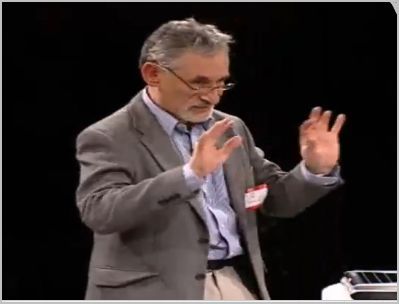 Speech to text. Natural gesture interfaces. MIT's Sixth Sense wearable computer. Touch surfaces and non-touch interfaces. All of them have one thing in common. They do away with the need to use a standard keyboard or mouse. Computing is changing, and the place to hear about where we are heading with it all, is at Learning Without Frontiers.


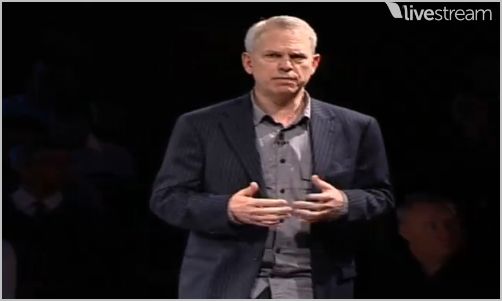 Games based learning as expected, had a highly visible profile at this year's Learning without Frontiers festival, in London. Take David Samuelson for example. As Head of Augmented Reality development for Pearson Education, he must have one of the coolest jobs in the world. He gets to explore all the latest possibilities technology can offer to education, and to ask the "what if?" questions each day.
In his invited presentation at today's Learning Without Frontiers festival, David emphasised what his audience already believed - for children, video games are an ideal, natural medium for learning. Kids love playing games, he said, and they learn from them without effort or inhibition. They are often 'in the flow' and don't have any hang ups about expressing themselves. He is interested in mashups - where augmented reality can be embedded within games. It's a new generation of games that is emerging, but with the advancement of games console design, the new 3DS Nintendo screens, and the natural gesture controls of devices such as XBox 360, the time is right. The universal appeal of games must be a natural extension to learning in formal situations. What excites him most is the story telling that is seen in the latest games, for example Heavy Rain. 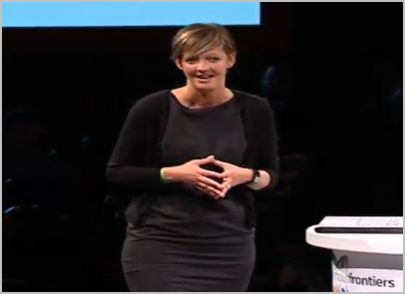 Another invited speaker at #lwf is Dawn Hallybone, the ICT co-ordinator and senior teacher at Oakdale Junior School in Essex, whom I had the pleasure of meeting at the LWF teachmeet on Sunday night. She had entered into the spirit of the fancy dress teachmeet and was wearing a luminous pink wig. In a very engaging presentation today (without her wig), she talked about playful learning and highlighted how handheld devices such as the Nintendo DS (used in her school as a brain training tool) and games such as Professor Layton puzzle adventure stories can be used to inspire kids to learn a range of key skills such as literacy, numeracy, problem solving, team working and interpersonal communication.


 Although I am missing being at Learning Without Frontiers, after having had a tantalising taste of it during the Sunday Service (the free first day of the festival), I am following remotely via the Twitter stream (#lwf and #lwf11) and also watching some of the keynote speeches via the streaming media channel on the LWF main website. It is very high quality, both in audio and visual terms, and there is also a separate live stream for slides. It really is almost like being there in person. Congratulations must go to Graham Brown-Martin and his team for such a well organised and dynamic conference.
I was particularly impressed by the presentation from Sony UK managing director Ray Maguire, who seems to have monitored the pulse of the UK compulsory education sector. He made several important statements about the future of learning technology. Why can't we take the best teachers and the best lessons and broadcast/stream them to all interested schools? he asked. We have the technology. (Yes, and we did it over a decade ago during the Star Schools project I was involved in, in South Dakota). We need to encourage schools to let more kids create content and share it he counselled. And on the subject of institutional VLEs, although he didn't go as far as to claim they were outmoded, he did admit that they had been instigated before the advent of social media, and VLEs were premised on behaviour and practice of a decade ago. In his concluding statement, Maguire called for collaboration between Sony and schools to extend and enhance provision for education, particularly with games and other handheld technologies. Maguire also called for decisions to be made at government level and for an operational budget to be made available for wide implementation. We won't hold our collective breaths on that one, but guess there's no harm in asking, is there?


 We had a great day on Sunday at the Learning without Frontiers festival at the Brewery in the East End of London. The day started well with an 'in the round' session with super geek and TV Gadget Show host Jason Bradbury who in his inimitable, mad cap style did live demonstrations of several fun robots including a flying drone he controlled from his iPhone. This was much to the delight of the many kids who had assembled (I count myself among them of course). There was also a break dance-off between himself, a teenage boy and a robot. The robot won. Must see is this video of Jason with his punk robot, which goes on the rampage and trashes his kitchen - hilarious stuff.


 My recent post on disruptive activism and Edupunk provoked some good discussion, not only on this blog, but also elsewhere on Twitter and on my own Facebook account, where I had shared the link.
In particular, there was an interesting exchange between two highly experienced educators Walter McKenzie and Graham Davies, which (with their permission) I am sharing below.
Walter and Graham raise a number of pertinent issues in relation to the nature of technology, disruptive change and learning, and I welcome further debate on this blog.
Walter McKenzie: I understand disruptive activism....disruptive technologies not so much. It's how we use the technologies. Technology in and of itself cannot be disruptive...
Sunday at 22:50 ·
Graham Davies: Disruptive technology as defined by Christensen is not necessarily a negative term. It usually takes the form of an innovation that we may initially resist but finally accept when it becomes clear that it works better than it's predecessors. Many new technologies are poor performers in their early stages and take a while to become stable and reliable. Some never make it, e.g. CDI which was pipped at the post by DVD.
Monday at 00:34 ·
Walter McKenzie: My discomfort isn't with the concept of being disruptive, but the personification of technology as being able to be disruptive simply by its existence. It can only be disruptive if it is applied in such a way by people...
Monday at 00:44 ·
Graham Davies: No, technology can just be disruptive. Back the wrong horse in a period of change and then you are in trouble. I'm a watch-and-wait person.
Monday at 00:52 ·
Walter McKenzie: Please explain further? I'm probably just slow....I need more context to understand what you are saying....
Monday at 00:55 ·
Graham Davies: What I am saying is that it is essential to wait until it is clear that a new technology really works better than its predecessors rather than seizing a new technology before it has settled down.
Monday at 01:02 ·
Walter McKenzie: OK I agree with that. No need to be jumping on bandwagons without thoughtful evaluation of them first. But ultimately it is how we use them and assess their use, yes?
Monday at 01:10 ·
Graham Davies: I agree.
Monday at 01:12 ·
Walter McKenzie: Thanks for your patience in talking this through with me.
Monday at 01:22 ·
Graham Davies: No problem. I am rarely an early adopter, but once I am convinced about the advantages of a new technology I am keen to promote it. I adopted CD audio quite early on, but held off going completely digital with iTunes until a couple of years ago. Now I am just pissed off with having to convert my huge collection of 33rpm LPs to digital format. That IS disruption :-) Maybe I'll just hang on to my 16-year-old Kenwood deck...
Monday at 01:33 ·
Image source
More disruption by Steve Wheeler is licensed under a Creative Commons Attribution-NonCommercial-ShareAlike 3.0 Unported License.


