Log on:
Powered by Elgg

Ania Rolinska :: Feeds

June 04, 2019

Connected pedagogy: Shared minds

Image from Pixabay
In preparation for my EDEN19 keynote later this month in Bruges, I have been making notes on connected learning. In the previous posts in this series (see list below) I explored the digital age and its impact on learning and teaching. I posed some questions for educators to address, and proposed that much of our technology in recent years has been used to connect and to communicate.

From the telegraph, through the telephone and radio and television, to 21st Century satellites, smartphones, the Internet and social media, all were designed to communicate. Humans have an innate need to connect with each other, to share stories and ideas, learn from each other, to warn and to celebrate. I noted that we tend to swarm together online in what I have called digital tribes (Wheeler, 2008). The entirety of the global social network we all inhabit is predominantly about sharing our minds. We can now learn at any time, in any place and at a pace that suits our personal preferences. I call this connected pedagogy.

The first thing we notice when minds are connected together is a shared sense of purpose. When people connect using technology, they seek out commonalities and look for shared experiences. At a conference or other event, those tweeting using the same hashtag are all sharing the same experience, albeit from different perspectives. At a human level, sharing is particularly important. It's comforting to know that others are experiencing the same doubts and difficulties as we are, or that we can all work together to succeed in a common task. We learn best when we feel we belong, and we feel more comfortable when we perceive psychological safety (Maslow, 1954). The selection of common goals and purposes is a powerful motivator for those engaged in collaborative learning.

One essential element of connected pedagogy is communication. In this era of digital proliferation, communication has never been easier. Think about it. You tap a number into your smartphone, and somewhere in the world, another phone will ring. Within seconds you are connected to another person, and the mind sharing commences. This can now also be achieved through video, text and other media, and we have taken this rapid technological advance for granted. Educators everywhere can now exploit the potential of this kind of connectedness to propagate and promote learning at a global level.

Another key component of sharing minds in the digital age is the active experimentation, design, production and sharing of content. This can be shared in numerous formats, including text, images, sound and video, all of which are easily disseminated to potentially huge audiences through social media. Connected pedagogy also relies on establishing an environment that is characterised by meaningful engagement, participation, self expression, problems solving and peer-evaluation.

Finally, connected minds should be open to all possibilities. Critical thinking and creative self expression can coexist comfortably, provided peers are open minded in the evaluation of content, performances, artefacts and experiences. The bottom line is that learning should be authentic, relevant to the real world (situated) and to the culture of the learner. The participatory element of this form of learning relies on the networked technologies, but also on the willingness of learners, and their teachers, to engage fully in activities.

Related blog posts
Connected pedagogy: Social media
Connected pedagogy: Smart technology

References
Maslow, A. H. (1954) Motivation and Personality. New York: Harper and Row.
Wheeler, S. (2008) Connected Minds, Emerging Cultures. Charlotte, NC: Information Age.

Creative Commons License
Connected pedagogy: Shared minds by Steve Wheeler was written in Plymouth, England and is licensed under a Creative Commons Attribution-NonCommercial-ShareAlike 3.0 Unported License.


May 31, 2019

Connected pedagogy: Social networks

Photo by Steve Wheeler
In a previous post I outlined some of the metrics around the use of digital media, technologies and social networks. I wrote that:
"The age of social technologies has radically transformed the way we live our lives, and that includes how we learn and teach. Connected students can become the nodes of their own production, and are creating more content than ever before as they perform their learning for global audiences."
Most of us are connected to each other through numerous social media platforms. Global social networks such as Facebook, LinkedIn and Twitter support various forms of communication and sharing actions that were previously unavailable. Being able to share content as text, hyperlinks, video, audio and images allows us to be more versatile in the way we assimilate and apply knowledge. Recent ad hoc crowd sourcing projects such as #Blimage have shown that people can learn from each other in a distributed manner, through simple ideas such as sharing images and blogging about them. A large proportion of younger learners are perpetually online, constantly using their smartphones as gateways into this world.

However, being connected means more than using connected technologies. It also affords us a connected mentality, where we expect to be members of communities that are distributed. The idea that we are all members of various digital tribes, and that we gather around digital totems such as YouTube, Wikipedia and eBay, shows that connected extends beyond learning, to entertainment, commerce and culture. This influences our expectations as consumers of knowledge, and it will influence the way teachers will educate in the future. It involves our perception of emotional connection, along with a sense of belonging to a larger group of likeminded individuals.

Many writers have highlighted the power of the global digital tribe, particularly the way groups tend to solve problems more effectively than individual experts (Surowiecki, 2009). We read of how groups can self-organise and co-ordinate their actions in connected global environments (Shirky, 2008) and that there seems to be no limit what a tribe can do when it is given the appropriate tools (Godin, 2008). Mobile and personal technologies that are connected to global networks have afforded us with the priceless ability to collaborate and cooperate in new and inventive ways (Rheingold, 2002), and allow us to rapidly self organise into new collective forces (Tapscott and Williams, 2008). Connected technology not only gives us access to existing knowledge, it encourages and enables us to create new knowledge and share it widely to a global audience.

In the light of this, there are several key challenges for teachers in this ever shifting knowledge terrain, where students have the entire world of learning at their fingertips: What can you teach that will never go out of date, and that will create constant wonder in the minds of your students? What are you able to do that capitalises on, rather than negates, the potential of students' personal devices? How can you optimise the connectedness that exists to create new and dynamic learning environments, so that students learn how to be citizens of the digital universe?

American president Woodrow Wilson once said: "I not only use all the brains that I have, but all that I can borrow."

Next time: Connected Minds

References
Godin, S. (2008) Tribes. London: Piatkus.
Rheingold, H. (2002) Smartmobs: The Next Social Revolution. Cambridge, MA: Perseus Books.
Shirky, C. (2008) Here Comes Everybody. London: Penguin.
Surowiecki, J. (2009) The Wisdom of Crowds. London: Abacus.
Tapscott, D. and Williams, A (2008) Wikinomics: How Mass Collaboration Changes Everything. London: Atlantic Books.

Creative Commons License
Connected pedagogy: Social networks by Steve Wheeler was written in Plymouth, England and is licensed under a Creative Commons Attribution-NonCommercial-ShareAlike 3.0 Unported License.


May 30, 2019

Connected pedagogy: Smart technology

Photo by Steve Wheeler
This is the first of a short series of posts, presenting my thoughts leading up to a keynote speech I will give at EDEN 2019, in Bruges. The theme of the conference is 'connecting through educational technology' - this echoes the themes of a number of other recent conferences, many of which explore the idea of connected learning. My thoughts on this are still emerging, so please feel free to contribute your own thoughts in the comments box below.

The age of social technologies has radically transformed the way we live our lives, and that includes how we learn and teach. Connected students can become the nodes of their own production, and are creating more content than ever before as they perform their learning for global audiences. A variety of new approaches to pedagogy have been introduced as a result of our hyperconnected society (of which more in a future blog post). The fact that any of us can access knowledge, expertise and resources so we can learn at any time and in virtually any place, means that the way we see pedagogy must change.

In the industrialised nations of the world, digital is now default. The metrics speak for themselves. Every minute online, over 1 million people log on to Facebook, nearly 4 million search enquires are made on Google, 4.5 million videos are viewed on YouTube and over 2 million images are shared via Snapchat. This is just the tip of the iceberg. Similar growth is seen on dozens of other popular platforms, and the trend is accelerating. This is largely due to our easy access to smartphones and other connected personal devices.

Emerging technologies will increasingly impact upon our connectedness and will challenge teachers everywhere. Take the Pilot Smart Earbuds technology for example. It's an ear bud connected to your smartphone, that simultaneously translates a foreign language into your own, as you converse. This means that potentially, you can now communicate with anyone, regardless of your language skills. It's also clear that connected tools such as Pilot only allow you to hear another person's language in your own language, but doesn't enable you to speak in the foreign language.

Does this mean that foreign language teachers will be redundant in the future? Probably not, but teachers will need to re-evaluate what they do, and the pedagogies they employ, when we have tools such as the Pilot available. How many other skills will be replaced by smart technologies in the near future? How many other new smart and connected technologies will emerge in the coming years to challenge our notion of pedagogy? Living in a digital society where hyperconnection is commonplace should certainly cause teachers to think about what they teach and the way they teach it.

Next time: Social Media

Creative Commons License
Connected pedagogy: Smart technology by Steve Wheeler was written in Plymouth, England and is licensed under a Creative Commons Attribution-NonCommercial-ShareAlike 3.0 Unported License.


May 28, 2019

Cruel pedagogy

Image by Amboo Who? on Flickr
1. Place all chairs and tables in rows facing 'the front'
2. Talk at your students
3. Cram your slides with text (green on red is a particularly confusing colour combination)
4. Insist on there being only one right answer
5. Ensure there is no time for questions and discussion
6. Test and grade regularly
7. Fail students who don't meet the test standards
8. Assign copious amounts of homework
9. Compartmentalise knowledge so students can't make connections
10. Ban the use of all technology from your classroom

(With thanks to Bryan Alexander)

Related posts
Cruel Pedagogy: Adding to the list (by Tim Holt)

Creative Commons License
Cruel pedagogy by Steve Wheeler was written in Plymouth, England and is licensed under a Creative Commons Attribution-NonCommercial-ShareAlike 3.0 Unported License.


May 15, 2019

Our digital future 5: Artificial Intelligence


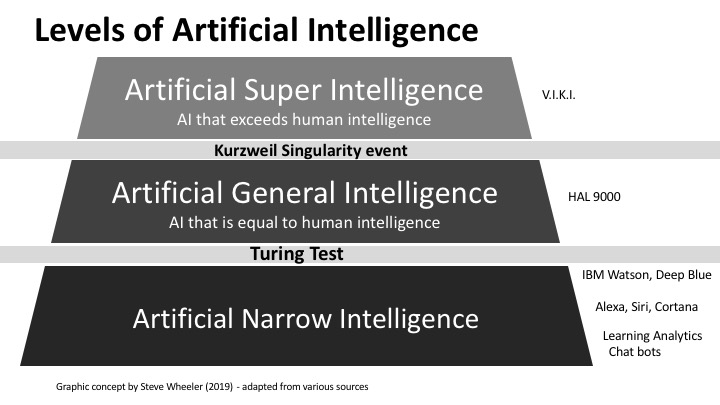
One key element that will impact all our futures is artificial intelligence. Now, I have written about AI on several previous occasions, and I also feature an entire chapter on its applications to learning and development in my new book, Digital Learning in Organisations. But here, on this more informal channel that I call my blog, I just wanted to share with you a few thoughts about the impact I think it will (and won't) have on our learning future. The term 'artificial intelligence' is often misused, because many of us fail to recognise that there are many levels of AI and misunderstandings can occur. It's important that we distinguish between the several kinds of AI and recognise their differences in a critical manner. Here are some thoughts:

Firstly, AI has been overhyped. There are many 'in the know' who claim that AI will radically transform our lives. For some that may be true, but the stark reality is that even if AI reaches its full potential, it will be for those in the developed world, while hundreds of millions of other citizens of this planet will continue to live out their lives unaware of its impact. The digital divide between those who have access to technology and those who don't, continues to grow wider and more pronounced as technology advances. As writer William Gibson put it 'The future is here. It's just not evenly distributed.' Bottom line: AI will only benefit those who live in the connected regions of our society.

Secondly, there are some who claim that AI is an existential threat to humanity. At the highest level of AI, known as Artificial Super Intelligence (ASI) this might be true, but only as physicist Max Tegmark suggests, if the 'intentions' of a super intelligent machine do not align to those of humanity. But the reality is that we are still working predominantly at a very low, 'or weak' level of AI known as Artificial Narrow Intelligence (ANI) where in many cases, AI has not surpassed human capabilities, and possibly won't for some time. To reach the intermediate level of AI, which we refer to as Artificial General Intelligence (AGI), computers must first pass the Turing Test. This is a test created by mathematician Alan Turing in the 1950s to determine whether a machine could be sufficiently 'intelligent' to fool a human into thinking they were communicating with another human. Many would argue that this test has yet to be passed by 'artificially intelligent' technologies. Note that in the diagram above, the only AGI and ASI examples are from science fiction. IBM's Deep Blue and Watson are specialist technologies, but limited to one narrow activity, i.e. playing chess or winning TV quiz shows.

Thirdly, AI is developing and is still nascent. The idea that a machine can perform the roles and duties of a human being has been with us for a long time. Popular novels and movies have featured numerous 'artificial life forms' or sentient machines such as robots that can match the performance of humans, if not exceed them. Although in some specific fields of activity AI can indeed best a human being, it is far from universal. At present most of the AI we see around us is at the 'narrow' level, meaning that computers are following code that instructs them to perform a single task. Examples of narrow intelligence include the supermarket checkout robots, personal virtual assistants such as Alexa and Siri, and internet chatbots. More advanced forms of AI that perform generally are rare, and expensive, and certainly not yet available for use by the general public.

Most futurists predict that things will change exponentially in the coming years. Computer technology will advance sufficiently to challenge all of us, but until it does, we are left with artificial (machine) intelligence that is limited in scope, but that is becoming increasingly indispensable.

Previous posts in the series 'Our Digital Future':
1: Gazing down the corridor
2: Smart clothing
3: The semantic web
4: Pervasive computing

Creative Commons License
Our digital future 5: by Steve Wheeler was written in Plymouth, England and is licensed under a Creative Commons Attribution-NonCommercial-ShareAlike 3.0 Unported License.


May 13, 2019

Out of the window

Here's a language lesson: Máš vokno (pronounced mash vokno) is a colloquialism in Bohemia. It can be translated as 'out of the window' but usually means - 'it's somewhere in my head, but I can't quite remember it.'

Ever had that feeling? It's often said by the Czechs when someone is a little worse for wear after too much alcohol. Me? I sometimes experience something similar when I'm sat in a boring lecture. In one ear - and out the other.

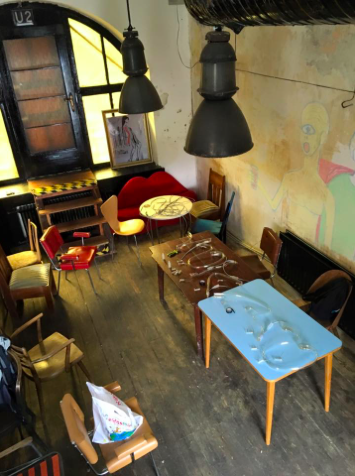
And that's ironic. There's a bar, and a very bohemian one at that, in the north west of the Czech Republic in a town called Liberec. The bar is actually called Vokno, and it's somewhat spartan and minimal, with industrial overtones. It looks as though it's a part of an old warehouse, and it's down a backstreet, not easy to find. The exterior looks like it's about to collapse. The interior isn't much better. Some call it the worst bar in Liberec, while others flock there to hang out with the hipsters and the cool kids. I guess it depends on your perspective. 

I was taken to Vokno by Czech radio host David Hamr, after a hard day recording a series of interviews at the studio (see this post). Everything about the place is alternative - the music, the drinks, the food, the decor....

None of the chairs and tables match, and it looks like they've been begged, borrowed (or possibly stolen) from elsewhere. Anywhere. Some of the beers served at Vokno are curious - I swear the one I tried was gooseberry flavour. I must admit, I didn't try the food on offer. I couldn't decipher the menu. 

My host and I sat outside in the courtyard (you have to climb wooden steps up and then down the other side to reach it, because this looked like it was through a window instead of a door - a clue to the name perhaps), and we sat with various creative types who chatted in Czech, English, German and a smattering of other languages as appropriate.


Images from Bar Vokno
The important thing to remember is that Vokno is a place to gather, to meet like minded people. It's a venue where people share their ideas, create and generally spend time together relaxing while talking and thinking about life. Some of the bar tables look as though they are used for making and creating. In fact, parts of the seating area look more like a workshop than a bar (image adjacent).

It's name - window - is appropriate, because it is a window on another world. Just outside Vokno is a large city, where finance, manufacturing, commerce and industry are constantly in ebb and flow. One of the largest and shiniest shopping malls is only a stone throw away, and this is constructed in ultra modern design out of chrome, steel and glass.  

Vokno, like so many other informal spaces, provides a little haven in which to gather away from the hustle of city life. It's there to encourage community life, for dialogue. This is the basis for much of what we learn, especially when we are adults and no longer in the formal schooling. 

As Nick Shackleton-Jones remarked recently at his book launch - it's a shame we don't facilitate more conversational and relational learning in organisations. Instead, we create lectures, instructional texts and e-learning where conversation is removed completely from the process to be replaced mainly by content. Where is the dialogue in learning and development today? It's no accident that many delegates often rate the social events and after conference sessions as the most valuable aspects of a conference. When we talk together, we learn from each other, and we argue and tell stories - all of which can be elements of rich learning experiences. 

So what will we do with learning in our organisations in the future? Will we continue to produce so much content it overwhelms our participants? Or will we provide more authentic learning where we can discuss, converse and share. I don't know about you, but many of my most memorable, and useful experiences of learning come from conversations. But with instruction and lectures it's often a case of máš vokno.

Creative Commons License
Out of the window Steve Wheeler was written in Liberec, Czech Republic and is licensed under a Creative Commons Attribution-NonCommercial-ShareAlike 3.0 Unported License.


May 12, 2019

Hamr time

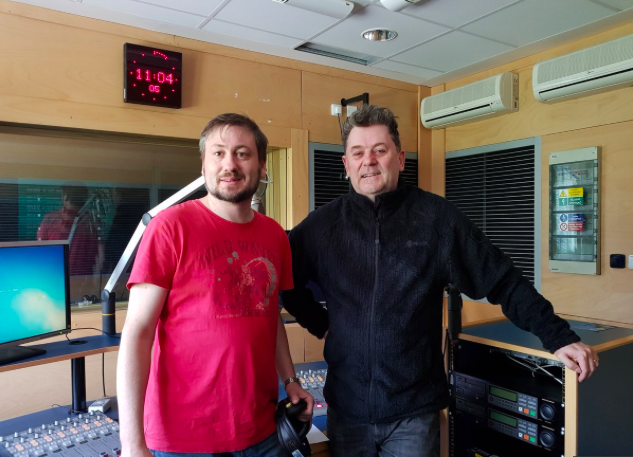
David and me in the studio - Photo by Steve Wheeler
David Hamr is a well known Czech broadcaster and radio journalist. He produces programmes about social trends and culture and is particularly passionate about alternative education. Based in Liberec, in the north of the country, he operates out of ?eský Rozhlas Liberec radio station which has three fully equipped sound studios.

Recently it was my pleasure, during a week of teaching at Technical University Liberec, to take some time out to record a series of interviews with David that will be broadcast in the coming weeks. The programmes will go out both in English and Czech.

We discussed a range of topics around my new book Digital Learning in Organisations, and focused on new technologies in education and training. David was particularly interested in the idea of 'unschooling', or in Ivan Illich's terms, 'deschooling' of society. We talked about the implications of this and several alternative approaches to education. It was a wide ranging and eclectic conversation, and I'm looking forward to hearing the results, once David has edited down our words into programmes for radio.

Creative Commons License
Hamr time Steve Wheeler was written in Liberec, Czech Republic and is licensed under a Creative Commons Attribution-NonCommercial-ShareAlike 3.0 Unported License.


May 06, 2019

Music, learning and pedagogy

Image from Pexels
Being interviewed by Rick Zanotti last week got me thinking about music and learning. The conversation turned to music, my songwriting and performances with various bands during the 80s and 90s.

Rick mentioned that we can all learn a lot from music, and specifically mentioned timing. He said that many educators could benefit from listening more to music, and especially playing an instrument, because timing, pacing and spacing were often lacking in formalised learning settings.

I agreed with him, because I know that timing is crucial in all forms of learning. You cannot make children learn something if they are not yet ready to learn it, and if a teacher paces a lesson too fast, some children are likely to be left behind, while others may become bored and switch off. The same applies equally to adults.

This made me think about all the other transferrable skills I developed as a musician, and am still learning even today. Here are four other things all good musicians know and practice, and how they might be applied to learning, teaching and development:

1) Work as a team. Musicians who play alone, can do essentially what they wish and change tempo, key and emphasis at will. When playing with others in a band, or singing in a choir, is a different matter. It becomes crucial that you pay attention to everyone else around you, and listen to what is being sung and played. If you decide to go off on your own, there is likely to be discord, confusion and a general loss of tempo or impetus in a performance. Teamwork is therefore crucial, and as bands or choirs spend time working together, they discover the nuances and differences within the members, and how they can be co-ordinated for the best possible results. Teachers who work with their students tend to be more effective than those who stand apart.

2) Performance is connection. When a musician plays live for an audience (and also to a lesser extent, when they are recording), they need to project their talents as a performance. There is no point in hiding from the audience, but instead good musicians tend to connect with those that are listening to them perform. The notable exception was Stuart Sutcliffe, former bass guitarist in an early line-up of The Beatles, who famously turned to face away from the audience during the band's concerts. He clearly did not wish to be on stage, preferring instead to listen from the wings, or in the audience. Teaching is often a performance, where the audience needs to be engaged, connected with, and inspired. 

3) Give others space. One of the most important lessons I learnt as a lead guitarist in rock bands was to play only when necessary. This is strange but true for just about every solo instrumentalist. Giving others space within a musical performance is vital. When everyone plays at the same time, the usual result is cacophony - which is quite literally defined as a harsh, discordant mixture of sounds. Space within music often enhances the listening experience. The same applies in teaching - too much information or content all at once can overwhelm and disorientate students. Giving them space occasionally to reflect on their learning and to give them compression time, often brings its own rewards.

4) You are only as good as your last performance. Forget the rest. Musicians focus on their next gig, and try to improve their skills and performances continually. The same should apply to all learning professionals - reflecting on previous lessons should engage thoughts about what can be done to improve one's teaching on the next occasion. Continually working to improve does a great service to all the students in once's care, and causes us to strive for better pedagogical practice and outcomes. 

There are many other lessons to be learnt from music, and I'm sure you would like to let us know about them. Please use the comments box below to add your own thoughts.

My interview with Rick Zanotti and Lesley Price can be viewed on YouTube here.

Creative Commons License
Music, learning and pedagogy  Steve Wheeler was written in Liberec, Czech Republic and is licensed under a Creative Commons Attribution-NonCommercial-ShareAlike 3.0 Unported License.


May 03, 2019

Interview on eLearnChat

I enjoyed chatting with Rick Zanotti and Lesley Price on the Relate Organisation channel's eLearnChat programme yesterday. We discussed my new book Digital Learning in Organizations and the concepts behind it.

We discussed change management, innovation in large organisations, mobile and social learning, personalised learning, artificial intelligence (AI), robotics and inevitably, the psychology of learning.

I was particularly critical of the current state of AI and an interesting discussion ensued around the state of play of machine intelligence and its place in learning and development. We explored several interesting ideas around the nature of digital readiness and literacy and what it means to be technologically agile.

Watch and see - and then ask any additional questions you like in the comments box below. I'll try to answer as promptly as I can.


Paperback, hardback and Kindle versions of Digital Learning in Organizations can be purchased at this site.

Creative Commons License
Interview on eLearnChat Steve Wheeler was written in Plymouth, England and is licensed under a Creative Commons Attribution-NonCommercial-ShareAlike 3.0 Unported License.


May 02, 2019

Video for learning: Today and tomorrow

Photo by Vladimer Shioshvili on Flickr
Educators have been using video for decades.

The first time I saw video being used in a classroom was in 1973. I was studying at college and a man in a white coat wheeled a television and video player into the room. My fellow students and I watched avidly - I can't recall what the topic was, but I do remember the thrill of the experience - it was fresh and new to be able to watch television in a formal education setting.

Later I witnessed the use of video as a feedback method for student teachers on practice. We recorded micro-teaches - usually a 10 minute lesson - and then played back the footage to the students so they could see and hear themselves and learn from the experience. I wrote about other examples of the power of educational video in a previous post.

Today, video use in the classroom is more commonplace. Present-day students, who interact with a steady stream of digital media throughout the day, are generally unsurprised by video in the classroom; if anything, they expect it. But because students are saturated with media, the quality of the videos they consume need to be sleeker, more polished and to the point to maintain their interest.
Alternative modes
Today, education has expanded beyond traditional learning spaces into distance education, blended learning, flipped classrooms, mobile learning, and online delivery through technologies such as MOOCs (Massive Open Online Courses). Video plays an important role in all of these alternative modes of learning experience (Brame, 2015) and will continue to do so with future developments. It's clear that video has evolved into a versatile, accessible and indispensable standard across a variety of formats and contexts of education. Video has been used to encourage independent thinking and critical analysis, and in higher education for example, has been used successfully to promote active engagement and collaborative learning (Parlour, 2019). Video isn't fading in its popularity, but will continue to grow as a mainstay resource for all forms of education in the future.

The future?
So what will educational video look like in the future? Such as question is difficult to address because 'the future' can be quite nebulous, and predictions are often inaccurate due to unexpected events and unforeseen outcomes. Who could have predicted for example, that touch screen technologies would become so important and prevalent in such a short time? There is good reason why futurists tend to project no more than three years into the future. It is difficult to predict the future accurately, but we are able to analyse social trends and determine what we might see with reasonable accuracy for a few years into the future (Kaku, 2011).

We can be assured that video will continue to be used extensively in all forms of education for the foreseeable future. The current generation of students are particularly enthralled with social media, and video has become the 'lifeblood' of that fascination, according to Parlour (2019). Access to video resources will be even more important in the future than it is today. There are many platforms that offer free access to video content, but not so many that do so in an ad-free, safe and secure manner.

Furthermore, educators generally have a strong faith in the efficacy of video. In a recent poll, 93% of institutions expressed a belief that video increases satisfaction levels for students (Parlour, 2019). Today, teachers tend to be pressured and have little time to spare. They need to find resources quickly and effectively, so navigation of content must be quick and simple.  They also need to ensure that the video content they select is free from distracting adverts, security threats and inappropriate content. One platform I recently discovered that can accomplish all of this is Boclips for Teachers, which is currently free to all educators, if they sign up before June 30th, 2019.

Today's learners
Today's learners are more independent and self-sufficient than previous generations of students. They actively seek out content to supplement and extend their learning experiences, and use their personal devices to access online content (Steckner, 2017). Video content is one of the most highly accessed and accessible forms of online content, largely because this generation of learners are encultured into watching and listening. Students not only enjoy using video as part of their everyday entertainment experience, they also expect it in their learning. There is good reason to believe that the next generation of learners will also continue to use video as a favoured method to support their learning.

As video becomes increasingly important for education (see my previous post on this topic), so new ways will be discovered to embed it into educational contexts and experiences. We may see video being used increasingly alongside augmented reality on personal devices, and also as interactive materials to engage students more deeply in doing and making. There is also scope to advance virtual reality and immersive experiences in education, both of which rely heavily on video content. Game based learning is another area of development that has already impacted positively on education. Again, this mode is dependent on high quality video content. Video, if deployed appropriately, can promote active learning; in just about any place; at any time; and at the individual pace of each and every learner. No wonder video is considered by many teachers to be so effective.

Teachers sometimes take their students out into the world. With video, they can bring the world to their students.

References
Brame, C. (2015) Effective educational videos, Available online at: http://cft.vanderbilt.edu/guides-sub-pages/effective-educational-videos/ (Accessed 30 April, 2019).
Kaku, M. (2011) Physics of the future, London: Penguin Books.
Parlour, A. (2019) Why Video is the Future of Higher Education, Available online at: https://edtechnology.co.uk/Blog/why-video-is-the-future-of-he/ (Accessed 30 April, 2019).
Steckner, S. (2017) Can one-to-one initiative and BYOD in schools increase student engagement? Insight, Available online at: https://www.insight.com/en_US/learn/content/2017/03082017-can-byod-in-schools-increase-student-engagement.html (Accessed 1 May, 2019).

NB: This post is sponsored by Boclips for Teachers

Creative Commons License
Video for learning: Today and tomorrow Steve Wheeler was written in Plymouth, England and is licensed under a Creative Commons Attribution-NonCommercial-ShareAlike 3.0 Unported License.


April 26, 2019

Video: The power and the story

Image from Pixabay
I was working as learning resources manager at a large nursing college several years ago when a colleague arrived red faced at my office door. He asked me if he could borrow a video cassette from my library to show to his group of students. As he hurriedly browsed the selection he asked me if there were any that were 90 minutes in duration. I was curious and asked him why he wanted a video that was exactly 90 minutes long. He explained that a visiting speaker had just phoned to tell him that she was unable to present her lecture. He needed a video to 'fill the gap' so that the student nurses had something to do for an hour and a half.

I was appalled. As politely as I could, I explained to him that making his students sit through a full 90 minutes of video was not particularly good pedagogy. Notwithstanding the student attention issues, I explained that video can be at its most effective when it is used in short bursts as a stimulus to enrich and extend learning, to promote discussion, encourage collaboration and to challenge students' thinking - but definitely not as a replacement for the teacher. Perhaps he thought I was moralising. He patiently listened to what I had to say, thanked me for my time, and then took the video cassette, walked into the classroom and played it in its entirety anyway.

Why video?
Video seems to be deeply embedded into the toolkit of educators, because it can be a powerful medium, but whether it is used effectively is open to debate. The story above represents a poor example of how video might be used. There are many more effective methods in which video can be used to engage, inspire and motivate students.

In a recent poll, 92% of teachers reported using video because they believe it increases student satisfaction with the learning experience, while 84% think it improves student achievement. By far the highest use of video in institutions was in the classroom with 92% of institutions showing videos to their students (Kaltura, 2018). Why are educators so enamoured with video?

One reason teachers use video in the classroom may be because it is familiar, a commonly used medium at home for entertainment and information purposes. We can sit for long hours absorbing this medium, but we must not forget that the vast majority of content we consume at home is entertainment. It can usually hold our attention for a great deal longer than formalised educational content. That said, there have been great improvements in the production of educational video in recent years. But there is a lot of difference between watching a blockbuster movie and a documentary on the physiology of the human body.

The psychology of perception
The way we perceive video and multimedia is varied and complex. However, there are key elements of video that we can focus on to ascertain how effectively video can be applied in education. According to Brame (2015) there are three important factors. The first is cognitive load - i.e. the amount of information we can process and absorb through our primary senses; in this case, our audio and visual channels. Second are other, non-cognitive factors, such as the duration of a video, the style of the video presentation, and the level of content and whether it is enough to extend the knowledge of students. Third is the facility of active engagement - to what extent are students prompted to delve deeper into knowledge or encouraged to ask questions, because of the video?

A closer look at cognitive load theory (Sweller, 1988) reveals that human processing relies predominantly on visual and auditory stimuli, but this is limited. Overload of these senses can limit the amount of information we can remember. Furthermore, on-screen cueing or 'signalling' - elements such as graphics and text that highlight important aspects of the presentation; and 'segmenting' - the process of breaking content down into digestible chunks so that memory and recall are easier; are two of the vital components in the success of an educational video. These are important design principles in all media, and are particularly important in educational video.

I expand on these ideas in this post.

Video today
In the digital age, where social media and mobile devices abound, it has never been easier to access video on just about any subject. There is an abundance of knowledge available on the medium, thanks to online services such as Daily MotionYouTube and Vimeo. But these platforms are often riddled with intrusive and distracting pop-up adverts and can be plagued with other issues such as undesirable content or abusive comments. It's somewhat hit and miss. Furthermore, many schools block their use, generally because of the above issues. One new service offers a growing range of educational videos for download that is free of commercials. Boclips for Teachers was set up to provide teachers with safe and seamless content to use directly in classrooms. Sign up is free (teachers - sign up by June 30th and receive a free account for an entire year running to June 30, 2020) and the service can also offer teacher-curated content. It looks like a very useful resource for educators everywhere.

Next time: The future of video in education

References
Brame, C.J. (2015) Effective educational videos, Available online at: http://cft.vanderbilt.edu/guides-sub-pages/effective-educational-videos/ (Accessed 24 April, 2019)
Kaltura (2018) How Video Is Used In Education, Available online at: https://corp.kaltura.com/resources/the-state-of-video-in-education-2018/ (Accessed 24 April, 2019)
Sweller,  J. (1988) Cognitive load during problem solving: Effects on learning. Cognitive Science 12, 257-285.

NB: This post is sponsored by Boclips for Teachers

Creative Commons License
Video: The power and the story Steve Wheeler was written in Plymouth, England and is licensed under a Creative Commons Attribution-NonCommercial-ShareAlike 3.0 Unported License.


April 23, 2019

Second chance #OU50

Image from the Open University


I left school with nothing. No qualifications. Not a sausage. Most of the teachers in the schools I attended (I was a forces kid and went to 9 during my school years) didn't seem to care, and failed to motivate me to study. I simply wasn't interested.

Later in life, I was working in a low paid job when I realised, sometime in my early thirties, that I wanted to do something more with my life. I was fascinated by psychology, so I applied, and was accepted as a mature student on an undergraduate degree programme at Plymouth University. It was my dream to become a psychologist, and perhaps also to teach at the university in later years. I told some of my colleagues about this dream, but they didn't take me seriously, and one or two actually laughed out loud.

It turned out that because we were in a time of economic instability, and the interest rates soared, that our mortgage was suddenly very expensive to maintain. It transpired that we could not afford for me to leave my job and study full-time as a student, so I reluctantly withdrew from my place at Plymouth University.

And then I heard about the British Open University. I saw that they were offering a pathway to a BSc (Hons) degree in psychology and I inquired further. I was told it would take me up to six years to complete a full degree. I told them I would do it in half that time. My advisors told me it couldn't be done. My colleagues in work, even the two I knew who had completed OU degrees, told me it was impossible. My boss asked me why I wanted to do a degree - after all, as far as she was concerned, I was 'just a technician'.


This was a red rag to a bull. I was now even more determined to prove them all wrong. And so I enrolled on my first module with the Open University. I completed it successfully and began planning for two more modules. I paid for the entire degree myself, and worked hard in the evenings and at weekends, avidly consuming the materials as they came through, and submitting my TMAs (Tutor Marked Assignments) every month, as deadlines loomed. I began to receive back feedback and improved my writing style. On it went, attending summer schools, and evening tutorials with my local groups, learning more about human behaviour, perception and cognitive science.

I applied, and received advanced standing for my teaching qualification (Cert Ed) to the value of one full module. Now all that was left was to complete two final modules to gain the credits I needed to be awarded my degree. During this time I took on another job, teaching three evenings each week at the local further education college. I also worked every other Saturday afternoon at Plymouth Argyle FC as a steward. Looking back, I now realise just how crazy I must have seemed, working and studying all hours, sometimes right through the night to achieve my dream.

But achieve it I did, in my final year pushing my average TMA grades up into the 80s. One of my final assignments was graded 97%, and it was then inevitable that I would complete my studies with a first class honours degree.

It was a very proud day when I finally walked onto that stage at Exeter University to receive my degree from the Open University. I will always be grateful to my family, and to all of the academic staff who supported me as I studied largely at a distance, working through materials and submitting my assignments by mail. I learnt more than just psychology - the OU taught me about my limits and my motivation to succeed, and how to push beyond them, how to manage my time and commitments, and how to create my own pathways in life. It taught me greater self confidence, built my resilience and developed within me a love of learning that will last a lifetime.

Happy birthday, Open University. Here's to the next 50 years!

Creative Commons License
Second chance #OU50 Steve Wheeler was written in Plymouth, England and is licensed under a Creative Commons Attribution-NonCommercial-ShareAlike 3.0 Unported License.


April 22, 2019

Through us and between us

Image from Wikimedia Commons

Below is an excerpt from my new book Digital Learning in Organisations - it relates to the future of learning and the changing face of education. I am interested in reading your views and comments on this:

"As we become more intimate with our personal devices and advance our knowledge to a point where it becomes ubiquitous and abundant, learning must take on new meaning and nuance. To be an 'expert' in the future may not mean that we have learnt extensively around one specific knowledge domain. It may instead mean that we have access to technologies that enable this kind of knowledge to follow freely through us and between us." (p 237)

Discuss

Reference
Wheeler, S. (2019) Digital Learning in Organisations, London: Kogan Page.

Creative Commons License
Through us and between us by Steve Wheeler was written in Plymouth, England and is licensed under a Creative Commons Attribution-NonCommercial-ShareAlike 3.0 Unported License.


April 07, 2019

Goodnight Mum

My dear mother Ruth passed away last night after a long period of illness. I was privileged to be alongside her, surrounded by the rest of our family, holding her hand as she slipped peacefully away. I know she is now in the arms of her Saviour, with no more pain or anxiety, and I have faith that one day we will be reunited.

Mum taught me many things for which I can be grateful. Here are three:

Stand up for what you believe in. Mum was quite stubborn and always stood on her principles. When she knew she was right, she was relentless. When a certain head teacher had the temerity to tell her that I would never be academic, he was left red faced with embarrassment. It turned out she was right, and he was so, so hopelessly wrong.

Keep learning. Wherever Mum went, she picked up new skills. In the Shetland Islands she taught herself to make traditional Shetland knitwear and earner an income from the sales. While we were living in the Netherlands, my mother learnt to speak Dutch. She was coached by our next door neighbour and would haggle with the best of them down in the marketplaces.

Fight for the weak. My mother did endless work for charity, making and baking, selling  raising money for those in unfortunate situations. She never stopped caring for those in need and poured her love and compassion into helping others.

There is an incredible sense of loss and sadness right now because she is no longer here, and I will miss a lot, but that sadness is tempered by the knowledge of a life well lived, and one full of love and compassion for others.

Goodnight Mum. See you in the morning.

Ruth W. M. Wheeler 21 August 1930 - 6 April 2019

Creative Commons License
Goodnight Mum by Steve Wheeler was written in Plymouth, England and is licensed under a Creative Commons Attribution-NonCommercial-ShareAlike 3.0 Unported License.


April 02, 2019

The power of the narrative

Photo from Flickr
I'm fascinated by the power of story telling, and it makes me wonder why TV series are so compelling. This is especially so when I'm binge watching a DVD boxed set. Whether you are a fan of Game of Thrones, The Walking Dead, Doctor Who, Harry Potter, Lord of The Rings or Line of Duty (or all of them!), you will probably, like many millions of people each week, devote yourself avidly to watching as the tales unfold on your screens.

Generally, such TV shows are so compelling because they have some strategic story telling ingredients that always work. The first is that the writers make sure you invest in the characters and actually care about what happens to them. The writers ensure that enough information is provided so that you can decide whether you want to fall in love with the character (hero), or learn to hate them (villain). Fleshing out the character is a key literary device, presenting the viewer with their weaknesses and strengths, their hopes and fears, their history, their relationships and perhaps their ultimate quest in life.

Secondly, a good tale cannot be predictable, and therefore requires some plot twists. These are often unexpected occurrences, but sometimes they can be anticipated, which may be just as powerful when they finally occur. There is an excitement in this anticipation, and masterly storytellers are able to manipulate your emotions as they weave their tales, building to a climax.

Sometimes there are red herrings in the mix - things that occur that ultimately have no meaning, but are placed there simply to divert your attention or make you question what you are witnessing. Other times, a Chekov's Gun may be present - something that may appear to be irrelevant to the narrative, but ultimately emerges as an important occurrence, artefact or character, salient to the plot. (Ron Weasley's pet rat in Harry Potter is an example of this).

A number of recurring plot lines (or as Kurt Vonnegut called them 'deep narrative shapes') throughout the history of story telling are used again and again, with great success to hook your attention, gain your allegiance and manipulate your emotions. The hero's quest (Frodo's journey to Mordor in Lord of The Rings), rags to riches (Daenerys Targaryen in Game of Thrones), the rise-fall-rise (Daenerys again), and switched allegiances (just about every character in Line of Duty) are just a few examples of recurring plot lines.

What is not said or revealed can also be very powerful in a narrative. Make them believe they will know what will happen next, and then blind-side them with another plot twist to make them gasp in surprise. Leaving the audience guessing with a classic 'cliff hanger' (Glen Rhee falling from the top of the garbage can into a herd of zombie walkers in TWD) can have a powerful effect on bringing them back for more in the next episode (or in Glen's case three episodes later!). Just about every television series employs this regularly.

In combination, these devices make TV series very powerful and attractive to millions. We all need to know what will happen next, and we can't wait to find out. This makes me think that many of these devices can also be applied to teaching and learning. How hard would it be to weave a little of these into our everyday lessons to tease our students, seize their attention, and compel them to return time and time again for more?

Related posts
Narrative Pedagogy 1: Focusing their attention
Narrative Pedagogy 2: Maintaining the suspense
Narrative Pedagogy 3: Out of the blue
Narrative Pedagogy 4: Connecting the dots
Learning, story telling and technology
Storytelling with technology (great student video attached to this one)

Creative Commons License
The power of the narrative by Steve Wheeler was written in Plymouth, England and is licensed under a Creative Commons Attribution-NonCommercial-ShareAlike 3.0 Unported License.


April 01, 2019

Honesty and dialogue

Photo from Pixnio
One of the most important lessons I learnt right at the start of my career in education was that teaching was not about 'telling' but about communication. I spent time like any teacher, struggling to share what I knew with students, almost like I was a jug, pouring my knowledge into their mugs. How arrogant that must have seemed.

I soon adopted a more participative approach where my students and I had more of a dialogue about what was being learnt. Content was still just as important, but the manner in which it was accessed became more student centred, and I acted as a facilitator rather than a narrator. From then onwards, we all began to enjoy the sessions more and of course, learning became a reciprocal event. There was a constant exchange of thoughts and ideas around the content, rather than a one way stream of information.

Reading an advance copy of Richard Gerver's book Education: A Manifesto for Change this week confirms yet again that this approach is both effective and desirable, especially in the rapidly changing world of the 21st Century.

There is also a need for more honesty in teaching. Here's a quote from the book: "As a teacher there is a perception that we must KNOW. This is not just dangerous but unhelpful, in that it creates a false aura that can make us appear inaccessible and daunting to our students. [...] Nothing strengthens the bond between teacher and student more than honesty and the fact that they can relate to you as a person and as a learner, as fallible." (pp 54-55).

Reference
Gerver, R. (2019) Education: A Manifesto for Change. London: Bloomsbury

NB: Education: A Manifesto for Change is published on April 4.

Creative Commons License
Honesty and dialogue by Steve Wheeler was written in Plymouth, England and is licensed under a Creative Commons Attribution-NonCommercial-ShareAlike 3.0 Unported License.


March 30, 2019

Openness in the Digital Age

Here's a wonderful video montage of the Open Education in a Digital Age event that took place recently in Romania.

The event was hosted by the Virtual Campus department/Centre for e-Learning at the Polytechnic University of Timisoara, and it captures much of the essence of what was discussed about openness, digital media in education and the future of learning.

My opening question for everyone was 'how open are you, as a teacher?'


Creative Commons License
Openness in the Digital Age by Steve Wheeler was written in Plymouth, England and is licensed under a Creative Commons Attribution-NonCommercial-ShareAlike 3.0 Unported License.


March 29, 2019

Digital Learning in Organizations

Cover design by Kogan Page
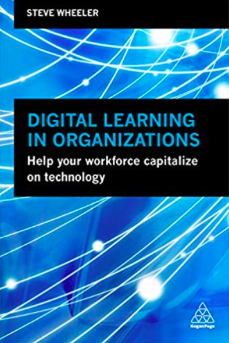
My new book will be published on April 3 by Kogan Page. Digital Learning in Organizations has already been positively reviewed by several leading figures in the world of Learning and Development (L and D), including Jane Hart, Laura Overton, Charles Jennings, Edmund Monk and Richard Gerver, and it includes case studies and interviews with many more, as well as forewords by Donald H Taylor and Shelly Terrell.

The book is aimed at those working as learning and development professionals in industry, but will also be of interest to any, and all, those working in the world of learning technology, knowledge and education. It is available in paperback, hardback and Kindle (Amazon site) formats, and can be pre-ordered on the Kogan Page website (use the promotional code FHRDL20 and get 20% discount on the purchase price). The promotional text is below:

Technology holds vast potential for learning and development (L and D) practitioners. It can improve performance, productivity, engagement and knowledge retention. However, if employees aren't able to leverage the potential of these technologies, any investment in them is futile. Digital Learning in Organizations shows L and D professionals how to make sure that their workforce is 'digitally ready' and has the skills, capabilities and understanding needed to capitalize on the opportunities created by learning technologies and feel confident in their ability to get the most out of them. It includes guidance on how technologies can be used to improve both social and personal learning, how the increased flexibility created by technology enables a multi-located workforce to develop simultaneously and discussion of how to ensure that technology really does facilitate employee development and doesn't become a distraction.

Digital Learning in Organizations also includes comprehensive coverage of the ways in which L and D practitioners can engage with learning technologies and digital capabilities such as mobile learning, wearable technology, learning analytics, virtual presence tools as well as augmented, mixed and virtual reality. Packed with insights from leading L and D practitioners, this an essential read for all L and D practitioners needing to improve employee and company performance in a digital world.

NB: If you are interested in booking me for a keynote, workshop, seminar or corporate event, Kogan Page are able to print bespoke versions of my new book which can include your corporate branding, message from CEO and other company specific text and artwork. Contact me via email at steve@steve-wheeler.net

Update: A Facebook page promoting the new book is now online at this link. Check it out and like it (if you like)! Visit to get a 20% discount on the cover price.


Creative Commons License
Digital Learning in Organizations by Steve Wheeler was written in Plymouth, England and is licensed under a Creative Commons Attribution-NonCommercial-ShareAlike 3.0 Unported License.


March 26, 2019

Confessions of a teacher

Photo from Wikimedia Commons
During the life of the Plymouth Enhanced Learning Conference (PELeCon), we tried to be innovative, introducing new features over the ten years the event ran.

One of the most innovative (and perhaps controversial) was the inclusion of a confessional booth during the final PELeCon. The idea was simple, and a counterpoint to the sometimes congratulatory culture seen in many conferences. In many other events, all delegates tend to hear are the success stories, and how great everything is.

But all those of us who have been engaged in education at any level will know that not everything goes smoothly and teaching and learning is not a bed of roses. It can be messy, divisive, disappointing, even heartbreaking.

The idea behind the confessional booth was to introduce some reality and honesty to the conference and to encourage teachers to share. The idea was simple, and my learning technology team made it happen. They built a small booth large enough for a person to sit inside, with a curtain at the back.

The delegates were invited to sit inside the booth, and use a web cam and microphone to record a short 'confession' of something that went wrong - with some commentary about what they had learnt from the failure. If they felt confident, they could then tap a red button, and the entire recording would be published on YouTube. 

Several delegates recorded 'confessions' and posted them to YouTube. Many didn't take up the offer, and it was a one-off event, because my university cancelled funding for any future events, and PELeCon was no more. Who knows what library of confessionals we might have generated. The last element was the most important - we can all learn from success stories, but it is often the failures we learn the most from. 

Sharing is a big component of collaborative culture, and learning from each other should be a normal activity for all teachers. Reading Richard Gerver's latest book Education: A Manifesto of Change triggered further thoughts on this idea. He writes: 

'Collaboration will always suffer if there is an underlining lack of respect and trust. Many teachers feel vulnerable and actually quite insecure about their own practice, even the greatest ones, and this means that as a profession, we are sometimes nervous of sharing.' (Gerver, 2019, p 19)

Gerver documents some of the issues around teachers trolling each other and being openly hostile if they see ideas that they cannot agree with on social media. He maintains that there should be a balance between echo chambers (where everyone agrees with each other and there is no learning) and hostile, fear ridden environments where people feel they cannot speak out for fear of being humiliated by stronger voices. 

Like him, I call for a better, more psychologically safe environment within which educators can discuss and share their ideas, hopes and fears with no fear of ridicule or humiliation. The only way we can achieve this is for all of us to separate ourselves from those who would seek to undermine, threaten and bully anyone who doesn't agree with their own views. We have had too much of this in recent years and it's time it came to an end. 

Teachers - we are all in this together, and we have the same aim in mind - to provide the highest quality learning experiences for our students, our community and our society. Let's be more tolerant of each other's views, and openly share and debate in a civilised, professional and caring manner.

Reference
Gerver, R. (2019) Education: A Manifesto for Change. London: Bloomsbury Education.    

Creative Commons License
Confessions of a teacher by Steve Wheeler was written in Plymouth, England and is licensed under a Creative Commons Attribution-NonCommercial-ShareAlike 3.0 Unported License.


March 25, 2019

On air

Photo courtesy of Diana Andone
It was a delight to return to Romania exactly 20 years after my last visit.

I was in Timisoara last week to give the opening address for the Open Education conference hosted by Universitatea Polytehnica Timisoara's Virtual Campus Centre.

Director of the Centre is Diana Andone, whom I first met many years ago across the table when I examined her PhD viva. She told me I gave her a tough time, but we have been friends and colleagues since, and have served together on the executive board of the European Distance and E-learning Network (EDEN).

Diana invited me to give the keynote speech and I spoke on Open education, open scholarship and technology supported learning. There was much conversation afterwards, and I enjoyed all of the arguments and debates that ensued, especially the challenging questions from the delegates. It was good to see old friends Carmen Holotescu and Gabriela Grosseck in the audience and great to catch up with them both afterwards. I did two recorded video interviews before Diana whisked me away after lunch to the TV studios, where we did a live broadcast to the Romanian TVR channel in conversation with the host of the afternoon show.

A lot of the interview was dedicated to education reform, and our TV host Tania Stavilã-?una? quizzed me on a range of topics including the curriculum, assessment and technology in classrooms. One of the key things I mentioned in both my speech and during the TV interview was that Romania always seems to have been at, or near the front of the vanguard of Web based learning.

Way back in 1990s as the potential of the web was beginning to emerge, we began to meet annually for discussions, papers and activities in the north of the country (Transylvania). Our small conference, known as the Romanian Internet Learning Workshop focused on issues and challenges of the emerging web for a range of educational purposes and interventions. It was one of the first European conference to focus solely on web based learning.

Tania asked me how we could possible have spent an entire week discussing the web. My response was that there was plenty to talk about, because at the time, everything was new, and the ethical, technical, social, cultural, pedagogical and practical aspects of the web were explored in detail. Several pioneering publications emerged from this workshop series which laid the groundwork for the web based learning we know today.

Creative Commons License
On air by Steve Wheeler was written in Plymouth, England and is licensed under a Creative Commons Attribution-NonCommercial-ShareAlike 3.0 Unported License.


March 19, 2019

#3quotes from Papert

Image from Wikimedia Commons
MIT professor Seymour Papert wanted to turn education on its head.

He was disillusioned with the idea that we should 'instruct' children and that they would learn solely from content delivery. He was particularly critical of the use of computers as 'replacements' for teachers. There's a clear indication of those sentiments in this quote from his seminal work from 1980, Mindstorms: Children, Computers and Powerful Ideas:

“In many schools today, the phrase 'computer-aided instruction' means making the computer teach the child. One might say the computer is being used to program the child. In my vision, the child programs the computer and, in doing so, both acquires a sense of mastery over a piece of the most modern and powerful technology and establishes an intimate contact with some of the deepest ideas from science, from mathematics, and from the art of intellectual model building.” (Papert, 1980, p. 5)

He saw the learner as an active and engaged agent who could make things happen. Papert's ideas were brought together in a new model of learning which is now known as social constructionism. It is not simply about learning through making and doing, but also has other elements of problem solving, computational thinking, situated learning and negotiation of new meaning through the use of tools and technologies. Papert saw very little evidence of these elements in formalised education:

Schooling is not a natural act. Quite the contrary: the institution of school, with its daily lesson plans, fixed curriculum, standardized tests, and other such paraphernalia tends to constantly reduce learning to a series of technical acts and the teacher to the role of a technician. (Papert, 1993, p. 55)

Papert went on to discuss the tensions teachers often endure between their school-imposed roles as 'technicians' and their natural instincts to enter into 'warm human relationships.' One school Papers worked with introduced computers not as instructional tools, but as tools to encourage children to think and do for themselves. Much of what children learn while using computers was unplanned, and often deeper than what could be anticipated. In 1982 he related the story of one kindergarten child:

.... children were given access to a set of games using the computer. They loved playing games. But once more the most important events were not what was intended but what the children decided for themselves. After a few weeks a member of the nursery class called over a teacher to set up a new game. The teacher did this by typing at the computer's keyboard. The child said "I want to do that". Another teacher might have said "Next year." But, instead she said "Sure. I will write on this piece of cardboard all the stuff I type… if you want to type it go ahead." The little girl did very much want to type it. It was grueling work. At a typing speed of several minutes a word she kept at it for many weeks. Slowly, the speed went up. Slowly she learned to type without copying. She was building up a vocabulary of spelled words. (Papert, 1982, p 32).

References
Papert, S. (1980) Mindstorms: Children, Computers and Powerful Ideas. Brighton: Harvester Press.
Papert, S. (1993) The Children's Machine: Rethinking School in the Age of the Computer. New York: Perseus Books.
Papert, S. (1982) Tomorrow's Classrooms. Times Educational Supplement March 5, 1982 (pp. 31-32, 41)

Creative Commons License
#3quotes from Papert by Steve Wheeler was written in Plymouth, England and is licensed under a Creative Commons Attribution-NonCommercial-ShareAlike 3.0 Unported License.

March 15, 2019

Is sharing caring? #OpenBlog19

Photo by Krzyboy2o on Wikimedia Commons
This is a post for #OpenBlog19. I attended an event in Utrecht, in the Netherlands way back in 2007, at around the time that social media was emerging as a serious learning technology. Together for two days, we discussed how digital technologies and networks could support learning. The event was called 'Show that you Share' and focused on tools such as Creative Commons, personal learning environments and mobile phones as a means of creating, sharing and repurposing content, knowledge and artefacts for education.

I learnt a lot from interacting with the other delegates and was involved in several discussions that are still ongoing, even today. I firmly believe that educators, as far as possible, should share their content as widely and feely as possible. Sure, there are conditions under which teachers cannot, will not, or should not share content freely. But personally, I have never had a problem about giving away my content, as long as I am acknowledged as the source (note that the image on this page follows that criterion - I have acknowledge the source and provided the link to comply with the licence of the original work). As you will have noticed if you read this blog, watched my YouTube channel or used my slide decks, I almost always attach a Creative Commons share-and-share-alike licence on my work.

Just the fact that I allow repurposing on much of my content has reaped its own rewards over the years. A few years ago I discovered that there had been a sharp rise in the visitor count on this blog (which is currently approaching 8.5 million views). I wasn't sure why that might be, but then discovered that someone had taken some of my blog posts, and had translated them into Spanish. Suddenly, most of the South American continent had access to my work, and the link back to my blog include, ensured an increased visitor count.

But the main reason for sharing content freely is that I care. I care about the education of people, whatever their age, and I want to share what I know. It doesn't cost me anything, except a little time and effort, to be able to share content globally. It's still quite magical to me, to think that I can be writing this post right now, and in a few minutes, when I press the Publish button, these words have the potential to appear on millions of screens in millions of homes, schools, colleges and universities around the world. It's still a buzz, I can tell you.

So, I have got into the habit of sharing my content freely. For me it is a form of caring for my community of colleagues and friends. But I get back a lot more than I give. Others are doing the same thing, and I regularly read posts that have been freely shared by colleagues around the world. That's what a community is, and should be - sharing and learning together.

One final thought: Knowledge is like love. You can give it away as much as you like, because you still get to keep it.

Creative Commons License
Is sharing caring? #OpenBlog19 by Steve Wheeler was written in Plymouth, England and is licensed under a Creative Commons Attribution-NonCommercial-ShareAlike 3.0 Unported License.


March 13, 2019

Bridge to the future

Photo by Neiljs on Wikimedia Commons
I recorded a podcast interview with Martin Couzins and Nigel Paine recently, and it's now available online to listen to. It's part of a series called From Scratch, and I really enjoyed being quizzed by the dynamic duo about my new book Digital Learning in Organisations. Some of the questions really made me dig deeply into my thoughts to address.

Nigel actually thought my book was something of a 'bridge to the future' in his closing comments. That's reassuring to hear, because the danger of writing a new book on technology is that it can quickly go out of date. Hopefully, my new book is future proofed - at least for a few years!

Thanks to Nigel and Martin for inviting me to participate. I hope you enjoy listening to the interview, and if you listen carefully, you'll hear a 20% discount code being mentioned on the price of the book!


Creative Commons License
Bridge to the future by Steve Wheeler was written in Plymouth, England and is licensed under a Creative Commons Attribution-NonCommercial-ShareAlike 3.0 Unported License.


March 12, 2019

Work arounds

Photo by Jeshoots on Pexels
In my two previous posts here and here I've been writing about how the use of smartphones and other personal devices and technologies in the workplace can have negative effects on concentration, memory, task completion and social interaction. It's not all bad news. There are many advantages of bringing personal devices into the workplace, especially around new learning opportunities. Yet the use of personal devices needs to be tempered against how they can improve our performance, without becoming distractions and introducing new problems. Also, we should not forget that other technologies such as desk phones, email and social media can distract us just as much as receiving notifications or texts on our smartphones.

How can we optimise our daily productivity while living alongside our technology? Can the two be mutually supportive? Here are just a few ways I have been able to minimise distraction while I'm at work:

  • Firstly, create set times when you consult your smartphone. Try to stick to those times, and avoid access to your smartphone at other times. You may even consider switching your phone off during particularly mission-critical times of the day. 
  • Secondly, you can set similar times during the day when you read and respond to emails and other messages from colleagues, friends and even clients. Training your mind to focus on specific tasks while ignoring stimuli such as email is more successful if you turn off audio so that notifications cannot be heard.
  • Thirdly, if you work from home, create a specific space in which you can focus on your work. Remove any clutter, and as many distractions as possible from this space. It is your work space. A television that is 'on in the background' can become a major distraction if it is within your hearing/vision range. 
  • Fourth, set yourself specific goals to achieve, and time limits within which to achieve them. Give yourself a small reward when you meet those goals, especially if you have been able to avoid distractions to accomplish them. 
  • Finally, avoid consulting email and other work related technologies when you are 'out of the office' and in your own personal time. Don't take your smartphone to bed with you unless you really need to do so. You will gain more downtime to recharge your energy, and you will probably sleep better too. Going to work alert and refreshed enables most people to focus more keenly on their work and usually improves performance. 
  • Some bonus tips: Work to your own tempo whenever you can. Avoid having your day dictated by others if at all possible. Complete older projects fully before you start new ones. If you can establish your own work rhythm, it will pay off in the long term. 
Creative Commons License
Work arounds by Steve Wheeler was written in Plymouth, England and is licensed under a Creative Commons Attribution-NonCommercial-ShareAlike 3.0 Unported License.


March 07, 2019

Standard deviation

Photo by Pedro Figueras on Pexels
In my last post I wrote about smartphones and other personal devices, and their tendency to distract us by diverting our attention.  This is a continuation.

Distractions in the workplace are common. They interrupt the flow of work. An email pops up on your desktop screen asking for your 'urgent' attention, Facebook messenger pings on your smartphone telling you someone has responded to your earlier status update. A colleague phones you to invite you out to lunch, and then you get talking....

Interruption at work can have serious consequences. The proliferation of technologies such as smartphones, social media and email means employees are increasingly exposed to task interruption. Yes, technology in the workplace can be indispensable. It provide important support and offers numerous benefits to help us work better and smarter. However, technology can remove us one step away from the task, and can cause us to deviate from our focus.

As Curtis (2004) writes, the digital age has introduced a spatial shift where we are explicitly and implicitly connected to each other as never before. Ostensibly, this is very useful for communication at all levels, but ubiquitous, continuous connectivity can come with a cost.

First there is the social impact: Communication technology may create a psychological distance between people; it can have detrimental effects on our concentration. Studies have shown that greater dialogue can lessen the psychological distance between people, but psychological distance may increase with colocated colleagues and friends when devices distract us. Two friends are in conversation. It is interrupted by a notification on a smartphone. Now less attention is being paid to the other person than is socially expected. A deviation occurs - an interruption of the normal and acceptable social conventions of conversation and interaction.

Secondly, distraction due to overuse of personal devices may also create serious workplace issues and challenges. Research has shown that when we become distracted, we are often more error prone, and once interrupted, it may be more difficult to resume the task, or even to forget the task completely. Such deviation from tasks can seriously effect productivity, and may compromise the health and safety of self and others. Interruptions to a task can lead to feelings of increased stress and anxiety, frustration, and can increase the incidence of errors. Distractions can also lead to poor decision making and inevitably increase task completion time (Lee and Duffy, 2015). In short, productivity can be adversely affected.

How can organisations address these issues and problems?

[Continues in next post]

Reference
Curtis, M. (2004) Distraction: Being Human in the Digital Age. London: Futuretext.
Lee, B. C. and Duffy, V. J. (2015) The Effects of Task Interruption on Human Performance: A Study of the Systematic Classification of Human Behavior and Interruption Frequency, Human Factors and Ergonomics in Manufacturing and Service Industries, 25 (2) 137–152.

Creative Commons License
Standard deviation by Steve Wheeler was written in Plymouth, England and is licensed under a Creative Commons Attribution-NonCommercial-ShareAlike 3.0 Unported License.


<< Back Next >>