|
| Photo by Julia M Cameron on Pexels |
In previous posts in this series (see links below), I explored some of the nuances of engaging online learners in creative writing and critical thinking. It's not an easy prospect, especially when you are some distance away and all your communication is being mediated through technology.
The next two posts will focus on some of the methods used to engage students for other purposes, for example, reflection on practice, problem solving, creating content and performing learning. Next time, I'll discuss asynchronous forms of distance education, but in this post we'll look at
synchronous modes.
When we think about synchronous distance education, we normally visualise video conferencing using tools such as
Zoom, MS Teams, Collaborate,
Google Meet or FaceTime. Increasingly, these technologies are being used because they seem to have all of the vital elements - video and audio communication, slide sharing and text messaging - that can make distance teaching successful. But there are other forms of synchronous communication - consider for example the standard phone, whether tethered or smart, or live discussion forums. Many of the earliest research on distance education methods came from studying these modes of communication.
All of the above work in 'real time', with teachers and students needing to be present in the same time space. Attendance is therefore more or less obligatory, although there are features on many of the above tools that can capture and archive discussion and content for later use. But time shifting an experience is not necessarily as rich as actually 'being there'. It follows then that engagement once students are there is equally as important. So how can we create the environment in which students engage? Below are seven ideas I have tried and found useful, both in traditional and online lessons:
1. Keep online sessions fairly brief. If your session runs for more than 20 minutes, break up the content, activities and interaction in some way. Students usually won't be able to focus in the same mode for more than this amount of time, but switching the pace and interaction can keep them focused for longer.
2. Smaller groups can help. If you are only teaching a small number of students, you can focus more on their responses during interaction, and there is more onus on each to participate. They don't feel 'hidden in the crowd'.
3. Ask questions, and make sure the students know you'll be doing this. Let them know that any one of them can be chosen to respond to your questions about something that has just been covered. This will keep them on their toes.
4. Field questions from the text chat (or
Twitter backchannel with a unique hashtag) during the session . Encourage each students to ask/post at least one relevant question or comment during the session, and respond directly to as many as you can during the session.
5. Inform your students that at some point during your session there will either be a lie or an inaccuracy. Ask them to see if they can spot it, and at the end of the session find out who is paying attention!
6. Break up the session with some breakout time, asking students to perform some specific task, and then report back (this is where the session will benefit from smaller groups).
7. Ensure there is as much activity for students to engage in as possible. This could be discussion groups, tasks involving them making something, on the fly writing, live annotation, or other engaging activity that maintains their interest.
Previous posts in this series
Engaging online learners 1: Collaborative spaces
Engaging online learners 2: 5 Phase model
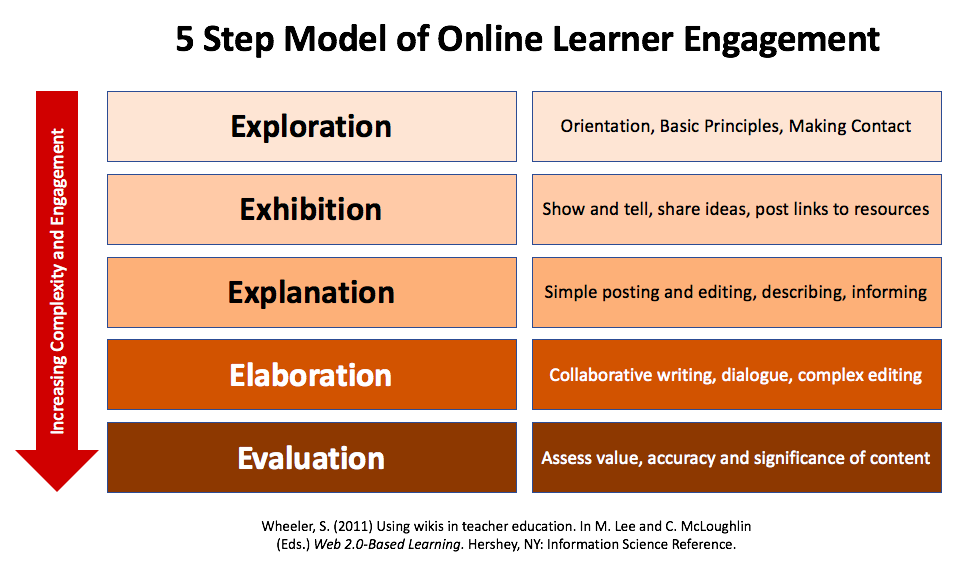
Engaging online learners 3: 5 Step Model
See also
Free online course:
Supporting Online Learners

Engaging online learners 4 by
Steve Wheeler was written in Plymouth, England and is licensed under a
Creative Commons Attribution-NonCommercial-ShareAlike 3.0 Unported License.