Log on:
Powered by Elgg

Ania Rolinska :: Feeds

June 11, 2020

Engaging online learners 2

Photo from Pxhere
In my previous blog post I remarked that engaging learners can be difficult in any context, but is often harder in online environments. Today, as many of us attempt to teach online, it's often that case that a lot of our energy is expended on keeping students focused and engaged - and at a distance. I also mentioned a very useful model that promotes creative, collaboration online writing.

From Gunawardena (1995) we get this five phase model. It can be adapted for a number of contexts, especially to promote various kinds of collaborative learning.

Phase 1: The sharing or comparing of information
Phase 2: Discovery and exploration of dissonance and inconsistency among ideas, concepts or statements by different participants
Phase 3: Negotiation of meaning and co-construction of knowledge
Phase 4: Testing and modification of proposed synthesis or co-construction
Phase 5: Phrasing of agreement, statements and application of newly constructed meaning.

I wrote back in 2009 about how I had used the model to frame my own efforts to engage online learners, in wikis - collaborative web pages. Here's how I created engaging activities:

The first simple activity has been used both as a warm-ip activity for new groups and as a means of familiarising students with the topography of the wiki space. Students are asked to introduce themselves with a few words about their personal interests and background. They are also asked to post an image which they think best represents themselves. A mix of photographs, cartoons and inanimate objects or animals is the result. This activity is a phase 1 activity and involves minimum social interchange. (Wheeler, 2009, p 487)

Read more in the next post.

References
Gunawardena, C. (1995) Social presence theory and implications for interaction and collaborative learning in computer conferences. International Journal of Educational Technologies, 1 (2/3), 147-166.
Wheeler, S. (2009) Destructive creativity on the social web. In S. Hatzipanagos and S. Warburton (Eds.) Social Software and Developing Community Ontologies. Hershey, NY: Information Science Reference.

Creative Commons License
Engaging online learners 2 by Steve Wheeler was written in Plymouth, England and is licensed under a Creative Commons Attribution-NonCommercial-ShareAlike 3.0 Unported License.


Engaging online learners 2

Photo from Pxhere
In my previous blog post I remarked that engaging learners can be difficult in any context, but is often harder in online environments. Today, as many of us attempt to teach online, it's often that case that a lot of our energy is expended on keeping students focused and engaged - and at a distance. I also mentioned a very useful model that promotes creative, collaboration online writing.

From Gunawardena (1995) we get this five phase model. It can be adapted for a number of contexts, especially to promote various kinds of collaborative learning.

Phase 1: The sharing or comparing of information
Phase 2: Discovery and exploration of dissonance and inconsistency among ideas, concepts or statements by different participants
Phase 3: Negotiation of meaning and co-construction of knowledge
Phase 4: Testing and modification of proposed synthesis or co-construction
Phase 5: Phrasing of agreement, statements and application of newly constructed meaning.

I wrote back in 2009 about how I had used the model to frame my own efforts to engage online learners, in wikis - collaborative web pages. Here's how I created engaging activities:

The first simple activity has been used both as a warm-ip activity for new groups and as a means of familiarising students with the topography of the wiki space. Students are asked to introduce themselves with a few words about their personal interests and background. They are also asked to post an image which they think best represents themselves. A mix of photographs, cartoons and inanimate objects or animals is the result. This activity is a phase 1 activity and involves minimum social interchange. (Wheeler, 2009, p 487)

Read more in the next post.

References
Gunawardena, C. (1995) Social presence theory and implications for interaction and collaborative learning in computer conferences. International Journal of Educational Technologies, 1 (2/3), 147-166.
Wheeler, S. (2009) Destructive creativity on the social web. In S. Hatzipanagos and S. Warburton (Eds.) Social Software and Developing Community Ontologies. Hershey, NY: Information Science Reference.

Creative Commons License
Engaging online learners 2 by Steve Wheeler was written in Plymouth, England and is licensed under a Creative Commons Attribution-NonCommercial-ShareAlike 3.0 Unported License.


Engaging online learners 2

Photo from Pxhere
In my previous blog post I remarked that engaging learners can be difficult in any context, but is often harder in online environments. Today, as many of us attempt to teach online, it's often that case that a lot of our energy is expended on keeping students focused and engaged - and at a distance. I also mentioned a very useful model that promotes creative, collaboration online writing.

From Gunawardena (1995) we get this five phase model. It can be adapted for a number of contexts, especially to promote various kinds of collaborative learning.

Phase 1: The sharing or comparing of information
Phase 2: Discovery and exploration of dissonance and inconsistency among ideas, concepts or statements by different participants
Phase 3: Negotiation of meaning and co-construction of knowledge
Phase 4: Testing and modification of proposed synthesis or co-construction
Phase 5: Phrasing of agreement, statements and application of newly constructed meaning.

I wrote back in 2009 about how I had used the model to frame my own efforts to engage online learners, in wikis - collaborative web pages. Here's how I created engaging activities:

The first simple activity has been used both as a warm-ip activity for new groups and as a means of familiarising students with the topography of the wiki space. Students are asked to introduce themselves with a few words about their personal interests and background. They are also asked to post an image which they think best represents themselves. A mix of photographs, cartoons and inanimate objects or animals is the result. This activity is a phase 1 activity and involves minimum social interchange. (Wheeler, 2009, p 487)

Read more in the next post.

References
Gunawardena, C. (1995) Social presence theory and implications for interaction and collaborative learning in computer conferences. International Journal of Educational Technologies, 1 (2/3), 147-166.
Wheeler, S. (2009) Destructive creativity on the social web. In S. Hatzipanagos and S. Warburton (Eds.) Social Software and Developing Community Ontologies. Hershey, NY: Information Science Reference.

Creative Commons License
Engaging online learners 2 by Steve Wheeler was written in Plymouth, England and is licensed under a Creative Commons Attribution-NonCommercial-ShareAlike 3.0 Unported License.


June 10, 2020

Engaging online learners 1


Photo by Steve Wheeler
Engaging learners can be difficult in any context. Engaging them in online environments can amplify the problem. You're not in the room to intervene, and behaviour management is much more of a concern when you're separated from your students. It's not as if you can run down the corridor and bang a few heads together. All you have is your voice. And perhaps your social presence, if you know how to invoke it.

From my experience in traditional classrooms lack of engagement, and its cousin, low-level disruptive behaviour, are often the result of boredom. When it has happened in the past, I have asked myself how I can make my sessions more engaging. There are many, many ways to do this of course, and in this series of blog posts I will aim to explore a few methods that I have tried with success in engaging my own students. Let's start with collaborative online spaces.

Below is an extract from a book chapter I wrote several years ago. It relates to critical writing on wikis, but it can be applied to just about any collaborative online learning space:

There is a spectrum of wiki activities that can be used to encourage critical thinking in writing. In order to rationalise activities within such a collaborative space, it is prudent to identify a framework within which activities can be defined. Perhaps one of the most useful frameworks is offered by Gunawardena (1995) in which five phases of knowledge construction within shared collaborative learning environments were identified:

Phase 1: The sharing or comparing of information
Phase 2: Discovery and exploration of dissonance and inconsistency among ideas, concepts or statements by different participants
Phase 3: Negotiation of meaning and co-construction of knowledge
Phase 4: Testing and modification of proposed synthesis or co-construction
Phase 5: Phrasing of agreement, statements and application of newly constructed meaning.

Several activities have been used often in recent wiki based learning with my trainee teachers and it is possible to locate these within the phases proposed by Gunawardena and her colleagues (Wheeler, 2009, p 487).

Read more in the next post

References
Gunawardena, C. (1995) Social presence theory and implications for interaction and collaborative learning in computer conferences. International Journal of Educational Technologies, 1 (2/3), 147-166.
Wheeler, S. (2009) Destructive creativity on the social web. In S. Hatzipanagos and S. Warburton (Eds.) Social Software and Developing Community Ontologies. Hershey, NY: Information Science Reference.

Creative Commons License
Engaging online learners 1 by Steve Wheeler was written in Plymouth, England and is licensed under a Creative Commons Attribution-NonCommercial-ShareAlike 3.0 Unported License.


Engaging online learners 1


Photo by Steve Wheeler
Engaging learners can be difficult in any context. Engaging them in online environments can amplify the problem. You're not in the room to intervene, and behaviour management is much more of a concern when you're separated from your students. It's not as if you can run down the corridor and bang a few heads together. All you have is your voice. And perhaps your social presence, if you know how to invoke it.

From my experience in traditional classrooms lack of engagement, and its cousin, low-level disruptive behaviour, are often the result of boredom. When it has happened in the past, I have asked myself how I can make my sessions more engaging. There are many, many ways to do this of course, and in this series of blog posts I will aim to explore a few methods that I have tried with success in engaging my own students. Let's start with collaborative online spaces.

Below is an extract from a book chapter I wrote several years ago. It relates to critical writing on wikis, but it can be applied to just about any collaborative online learning space:

There is a spectrum of wiki activities that can be used to encourage critical thinking in writing. In order to rationalise activities within such a collaborative space, it is prudent to identify a framework within which activities can be defined. Perhaps one of the most useful frameworks is offered by Gunawardena (1995) in which five phases of knowledge construction within shared collaborative learning environments were identified:

Phase 1: The sharing or comparing of information
Phase 2: Discovery and exploration of dissonance and inconsistency among ideas, concepts or statements by different participants
Phase 3: Negotiation of meaning and co-construction of knowledge
Phase 4: Testing and modification of proposed synthesis or co-construction
Phase 5: Phrasing of agreement, statements and application of newly constructed meaning.

Several activities have been used often in recent wiki based learning with my trainee teachers and it is possible to locate these within the phases proposed by Gunawardena and her colleagues (Wheeler, 2009, p 487).

Read more in the next post

References
Gunawardena, C. (1995) Social presence theory and implications for interaction and collaborative learning in computer conferences. International Journal of Educational Technologies, 1 (2/3), 147-166.
Wheeler, S. (2009) Destructive creativity on the social web. In S. Hatzipanagos and S. Warburton (Eds.) Social Software and Developing Community Ontologies. Hershey, NY: Information Science Reference.

Creative Commons License
Engaging online learners 1 by Steve Wheeler was written in Plymouth, England and is licensed under a Creative Commons Attribution-NonCommercial-ShareAlike 3.0 Unported License.


Engaging online learners 1


Photo by Steve Wheeler
Engaging learners can be difficult in any context. Engaging them in online environments can amplify the problem. You're not in the room to intervene, and behaviour management is much more of a concern when you're separated from your students. It's not as if you can run down the corridor and bang a few heads together. All you have is your voice. And perhaps your social presence, if you know how to invoke it.

From my experience in traditional classrooms lack of engagement, and its cousin, low-level disruptive behaviour, are often the result of boredom. When it has happened in the past, I have asked myself how I can make my sessions more engaging. There are many, many ways to do this of course, and in this series of blog posts I will aim to explore a few methods that I have tried with success in engaging my own students. Let's start with collaborative online spaces.

Below is an extract from a book chapter I wrote several years ago. It relates to critical writing on wikis, but it can be applied to just about any collaborative online learning space:

There is a spectrum of wiki activities that can be used to encourage critical thinking in writing. In order to rationalise activities within such a collaborative space, it is prudent to identify a framework within which activities can be defined. Perhaps one of the most useful frameworks is offered by Gunawardena (1995) in which five phases of knowledge construction within shared collaborative learning environments were identified:

Phase 1: The sharing or comparing of information
Phase 2: Discovery and exploration of dissonance and inconsistency among ideas, concepts or statements by different participants
Phase 3: Negotiation of meaning and co-construction of knowledge
Phase 4: Testing and modification of proposed synthesis or co-construction
Phase 5: Phrasing of agreement, statements and application of newly constructed meaning.

Several activities have been used often in recent wiki based learning with my trainee teachers and it is possible to locate these within the phases proposed by Gunawardena and her colleagues (Wheeler, 2009, p 487).

Read more in the next post

References
Gunawardena, C. (1995) Social presence theory and implications for interaction and collaborative learning in computer conferences. International Journal of Educational Technologies, 1 (2/3), 147-166.
Wheeler, S. (2009) Destructive creativity on the social web. In S. Hatzipanagos and S. Warburton (Eds.) Social Software and Developing Community Ontologies. Hershey, NY: Information Science Reference.

Creative Commons License
Engaging online learners 1 by Steve Wheeler was written in Plymouth, England and is licensed under a Creative Commons Attribution-NonCommercial-ShareAlike 3.0 Unported License.


May 24, 2020

Mixed up

There's been a lot of idle chit-chat about blended learning, and how 'indispensable' it is during the historic online pivot. Blended this and blended that - it's spoken of as though it were some kind of magic bullet that will cure all pedagogical ills. It isn't. But it could be.

No, scrub that. It isn't. Blended is simply a crazy idea that learning can occur anywhere, in both formal and informal contexts, inside school and outside of it, using a mix of technology - as and when it suits. I wish I'd been clever enough to think of such a novel idea.

I often write about blended in all its many guises (I don't get out much these days), and several posts that haven't yet been taken down are still available including this one about boundaries and how to transgress them (yes, sounds like a disaster waiting to happen, and it probably is). I also wrote several in which I riffed drunkenly about how blended learning can literally change the world (see below for all this goodness). I have also written about Blended Society (or BS for short). But dip me in mayonnaise if this ain't the cherry on the cake (yeah, mixing metaphors - that's yet another kind of blend): A complete online course about the magnificent topic of how to blend. Don't make me regret writing it. Honestly, you really should check it out - here's the link. It's free. It's blended. You have nothing to lose, except about an hour of your life that you won't ever get back.

And here are all the other posts in all their glorious fullness:
Blends, borders and boundaries
Trends and blends (includes links to a live webinar of me if you can take it)
In the mixer (keep it simple)
Mobile learning and blended interaction (in which I propose some pretentious new models and ideas)

Creative Commons License
Mixed up by that Steve Wheeler was probably written in Plymouth, England or somewhere, and is licensed under a Creative Commons Attribution-NonCommercial-ShareAlike 3.0 Unported License, or so we are told.


Mixed up

There's been a lot of idle chit-chat about blended learning, and how 'indispensable' it is during the historic online pivot. Blended this and blended that - it's spoken of as though it were some kind of magic bullet that will cure all pedagogical ills. It isn't. But it could be.

No, scrub that. It isn't. Blended is simply a crazy idea that learning can occur anywhere, in both formal and informal contexts, inside school and outside of it, using a mix of technology - as and when it suits. I wish I'd been clever enough to think of such a novel idea.

I often write about blended in all its many guises (I don't get out much these days), and several posts that haven't yet been taken down are still available including this one about boundaries and how to transgress them (yes, sounds like a disaster waiting to happen, and it probably is). I also wrote several in which I riffed drunkenly about how blended learning can literally change the world (see below for all this goodness). I have also written about Blended Society (or BS for short). But dip me in mayonnaise if this ain't the cherry on the cake (yeah, mixing metaphors - that's yet another kind of blend): A complete online course about the magnificent topic of how to blend. Don't make me regret writing it. Honestly, you really should check it out - here's the link. It's free. It's blended. You have nothing to lose, except about an hour of your life that you won't ever get back.

And here are all the other posts in all their glorious fullness:
Blends, borders and boundaries
Trends and blends (includes links to a live webinar of me if you can take it)
In the mixer (keep it simple)
Mobile learning and blended interaction (in which I propose some pretentious new models and ideas)

Creative Commons License
Mixed up by that Steve Wheeler was probably written in Plymouth, England or somewhere, and is licensed under a Creative Commons Attribution-NonCommercial-ShareAlike 3.0 Unported License, or so we are told.


Mixed up

There's been a lot of idle chit-chat about blended learning, and how 'indispensable' it is during the historic online pivot. Blended this and blended that - it's spoken of as though it were some kind of magic bullet that will cure all pedagogical ills. It isn't. But it could be.

No, scrub that. It isn't. Blended is simply a crazy idea that learning can occur anywhere, in both formal and informal contexts, inside school and outside of it, using a mix of technology - as and when it suits. I wish I'd been clever enough to think of such a novel idea.

I often write about blended in all its many guises (I don't get out much these days), and several posts that haven't yet been taken down are still available including this one about boundaries and how to transgress them (yes, sounds like a disaster waiting to happen, and it probably is). I also wrote several in which I riffed drunkenly about how blended learning can literally change the world (see below for all this goodness). I have also written about Blended Society (or BS for short). But dip me in mayonnaise if this ain't the cherry on the cake (yeah, mixing metaphors - that's yet another kind of blend): A complete online course about the magnificent topic of how to blend. Don't make me regret writing it. Honestly, you really should check it out - here's the link. It's free. It's blended. You have nothing to lose, except about an hour of your life that you won't ever get back.

And here are all the other posts in all their glorious fullness:
Blends, borders and boundaries
Trends and blends (includes links to a live webinar of me if you can take it)
In the mixer (keep it simple)
Mobile learning and blended interaction (in which I propose some pretentious new models and ideas)

Creative Commons License
Mixed up by that Steve Wheeler was probably written in Plymouth, England or somewhere, and is licensed under a Creative Commons Attribution-NonCommercial-ShareAlike 3.0 Unported License, or so we are told.


May 18, 2020

Transforming online learning experiences

In 'normal times' transformation is often slow, usually driven by technology. During the Second World War, which was far from normal, a number of radical developments in medicine, science and technology rapidly emerged. They had to. It was expedient, because lives were at stake.  In a time of crisis, we all try to cope in any way we can.

Today's crisis is precisely one of those moments in history. There is a race to develop new methods of health care, vaccines, medicines and of course, new social rules and civic responsibility. Schools, colleges and universities are either locked down, or operating at a reduced capacity. Technology solutions are sought so that education can continue. These are often solutions that have previously been ignored, or worse - dismissed by many educators as undesirable, unfeasible.

Yes, technology often drives transformation, but a virus pandemic can transform things more quickly and pervasively. The educators who previously avoided technology solutions now have to hurriedly embrace these solutions to keep working. But some are doing so in ways that inadvertently perpetuate their prejudices about technology. Perhaps they still see it as a poor substitute, or a second rate method of teaching. Content is still king in their minds, and everything relies on their knowledge, and the 'delivery' of learning. A new pedagogy is required, but perhaps they aren't listening. A telling quote from Katheryn Skelton, Chief Transformation Office at Futurelearn, made the headlines on the BBC news site earlier today. She said:

"Educators need to take a step back and ask not 'how can I replicate what I do in the classroom', but 'how can I redesign this learning experience to take advantage of a whole wealth of technology that can deliver a full learning experience - not just the delivery of information?'"

I used that quote this morning when I presented online at a conference hosted by Near East University in Turkey. Below is the YouTube live streaming link to my full presentation, as well as those by Carmen Holetescu (Romania), Ramesh Sharma (India), Robert Repnik (Slovenia) and Zehra Altinay Gazi (Turkey). Listen in...


Creative Commons License
Transforming online learning experiences by Steve Wheeler was written in Plymouth, England and is licensed under a Creative Commons Attribution-NonCommercial-ShareAlike 3.0 Unported License.


Transforming online learning experiences

In 'normal times' transformation is often slow, usually driven by technology. During the Second World War, which was far from normal, a number of radical developments in medicine, science and technology rapidly emerged. They had to. It was expedient, because lives were at stake.  In a time of crisis, we all try to cope in any way we can.

Today's crisis is precisely one of those moments in history. There is a race to develop new methods of health care, vaccines, medicines and of course, new social rules and civic responsibility. Schools, colleges and universities are either locked down, or operating at a reduced capacity. Technology solutions are sought so that education can continue. These are often solutions that have previously been ignored, or worse - dismissed by many educators as undesirable, unfeasible.

Yes, technology often drives transformation, but a virus pandemic can transform things more quickly and pervasively. The educators who previously avoided technology solutions now have to hurriedly embrace these solutions to keep working. But some are doing so in ways that inadvertently perpetuate their prejudices about technology. Perhaps they still see it as a poor substitute, or a second rate method of teaching. Content is still king in their minds, and everything relies on their knowledge, and the 'delivery' of learning. A new pedagogy is required, but perhaps they aren't listening. A telling quote from Katheryn Skelton, Chief Transformation Office at Futurelearn, made the headlines on the BBC news site earlier today. She said:

"Educators need to take a step back and ask not 'how can I replicate what I do in the classroom', but 'how can I redesign this learning experience to take advantage of a whole wealth of technology that can deliver a full learning experience - not just the delivery of information?'"

I used that quote this morning when I presented online at a conference hosted by Near East University in Turkey. Below is the YouTube live streaming link to my full presentation, as well as those by Carmen Holetescu (Romania), Ramesh Sharma (India), Robert Repnik (Slovenia) and Zehra Altinay Gazi (Turkey). Listen in...


Creative Commons License
Transforming online learning experiences by Steve Wheeler was written in Plymouth, England and is licensed under a Creative Commons Attribution-NonCommercial-ShareAlike 3.0 Unported License.


Transforming online learning experiences

In 'normal times' transformation is often slow, usually driven by technology. During the Second World War, which was far from normal, a number of radical developments in medicine, science and technology rapidly emerged. They had to. It was expedient, because lives were at stake.  In a time of crisis, we all try to cope in any way we can.

Today's crisis is precisely one of those moments in history. There is a race to develop new methods of health care, vaccines, medicines and of course, new social rules and civic responsibility. Schools, colleges and universities are either locked down, or operating at a reduced capacity. Technology solutions are sought so that education can continue. These are often solutions that have previously been ignored, or worse - dismissed by many educators as undesirable, unfeasible.

Yes, technology often drives transformation, but a virus pandemic can transform things more quickly and pervasively. The educators who previously avoided technology solutions now have to hurriedly embrace these solutions to keep working. But some are doing so in ways that inadvertently perpetuate their prejudices about technology. Perhaps they still see it as a poor substitute, or a second rate method of teaching. Content is still king in their minds, and everything relies on their knowledge, and the 'delivery' of learning. A new pedagogy is required, but perhaps they aren't listening. A telling quote from Katheryn Skelton, Chief Transformation Office at Futurelearn, made the headlines on the BBC news site earlier today. She said:

"Educators need to take a step back and ask not 'how can I replicate what I do in the classroom', but 'how can I redesign this learning experience to take advantage of a whole wealth of technology that can deliver a full learning experience - not just the delivery of information?'"

I used that quote this morning when I presented online at a conference hosted by Near East University in Turkey. Below is the YouTube live streaming link to my full presentation, as well as those by Carmen Holetescu (Romania), Ramesh Sharma (India), Robert Repnik (Slovenia) and Zehra Altinay Gazi (Turkey). Listen in...


Creative Commons License
Transforming online learning experiences by Steve Wheeler was written in Plymouth, England and is licensed under a Creative Commons Attribution-NonCommercial-ShareAlike 3.0 Unported License.


May 08, 2020

Finding a balance

Photo by Wiros on Wikimedia Commons
Here's another response to a question I received from participants during the recent webinar I presented for EDEN. You can watch the entire webinar on YouTube at this link. The question is one of several I couldn't answer in full because of time constraints, so here is the question again with a few additional thoughts:

A major challenge at the moment, especially for teachers, but also translated to students, is keeping up with the curriculum. This limits the possibility of allowing students to learn on their own and finding their own path of learning. This period could be a window of opportunity in personalised learning, in finding students finding "their own pathway." How do you create a balance?

Frankly, I don't know how to answer this question. I'm not sure anyone does. I don't think it's possible to create a balance, because currently, most school curricula are over-stuffed and content heavy. Saying this in the past has meant I've laughingly been labelled an anti-intellectual, but I'm not against content and I've always championed teachers and education. I would just like to see more balanced curricula in our schools. 

The situation isn't likely to change very quickly. It's not the fault of teachers, or even school leaders. We see a 'just in case' curriculum being taught in most schools because successive government education departments have insisted that every subject is covered, and that every student is tested on everything the curriculum contains so that it can be demonstrated that teachers have been 'doing their jobs'. Some might consider this to be cynical, and you can call me any names you wish, but in the words of Tom Petty - I won't back down. A lot of the content children learn in school is there for one reason only - to pass tests. It is promptly forgotten as they move on to real life. I'm going to avoid the trap of offering specific examples, because if I do, some Smart Alec is going to try to show that that piece of knowledge is useful in some way. But if you're honest, you'll look back on your school years, and wonder why you had to learn certain knowledge, because you never, ever had a reason to use it again.

Some would argue that the over-stuffed 'just in case' curriculum is responsible for a lack of time for other activities such as creative expression, transferrable skills or entrepreneurship. It's certainly the reason there is little or no opportunity to pursue personalised learning in schools. Personalised learning (not to be confused with personal learning) is rarely possible because there is simply no time or space for it. A 'just for me' curriculum is anathema to most government education departments, because it would be considered to be too expensive. So most countries persist with the tired old, tried and tested bloated curriculum that prepares children for the past rather than the future. 

This isn't going to change unless some global crisis happens that forces everyone to stop and think about how we could do things better. 

Oh.... wait.

Creative Commons License
Finding a balance by Steve Wheeler was written in Plymouth, England and is licensed under a Creative Commons Attribution-NonCommercial-ShareAlike 3.0 Unported License.


Finding a balance

Photo by Wiros on Wikimedia Commons
Here's another response to a question I received from participants during the recent webinar I presented for EDEN. You can watch the entire webinar on YouTube at this link. The question is one of several I couldn't answer in full because of time constraints, so here is the question again with a few additional thoughts:

A major challenge at the moment, especially for teachers, but also translated to students, is keeping up with the curriculum. This limits the possibility of allowing students to learn on their own and finding their own path of learning. This period could be a window of opportunity in personalised learning, in finding students finding "their own pathway." How do you create a balance?

Frankly, I don't know how to answer this question. I'm not sure anyone does. I don't think it's possible to create a balance, because currently, most school curricula are over-stuffed and content heavy. Saying this in the past has meant I've laughingly been labelled an anti-intellectual, but I'm not against content and I've always championed teachers and education. I would just like to see more balanced curricula in our schools. 

The situation isn't likely to change very quickly. It's not the fault of teachers, or even school leaders. We see a 'just in case' curriculum being taught in most schools because successive government education departments have insisted that every subject is covered, and that every student is tested on everything the curriculum contains so that it can be demonstrated that teachers have been 'doing their jobs'. Some might consider this to be cynical, and you can call me any names you wish, but in the words of Tom Petty - I won't back down. A lot of the content children learn in school is there for one reason only - to pass tests. It is promptly forgotten as they move on to real life. I'm going to avoid the trap of offering specific examples, because if I do, some Smart Alec is going to try to show that that piece of knowledge is useful in some way. But if you're honest, you'll look back on your school years, and wonder why you had to learn certain knowledge, because you never, ever had a reason to use it again.

Some would argue that the over-stuffed 'just in case' curriculum is responsible for a lack of time for other activities such as creative expression, transferrable skills or entrepreneurship. It's certainly the reason there is little or no opportunity to pursue personalised learning in schools. Personalised learning (not to be confused with personal learning) is rarely possible because there is simply no time or space for it. A 'just for me' curriculum is anathema to most government education departments, because it would be considered to be too expensive. So most countries persist with the tired old, tried and tested bloated curriculum that prepares children for the past rather than the future. 

This isn't going to change unless some global crisis happens that forces everyone to stop and think about how we could do things better. 

Oh.... wait.

Creative Commons License
Finding a balance by Steve Wheeler was written in Plymouth, England and is licensed under a Creative Commons Attribution-NonCommercial-ShareAlike 3.0 Unported License.


Finding a balance

Photo by Wiros on Wikimedia Commons
Here's another response to a question I received from participants during the recent webinar I presented for EDEN. You can watch the entire webinar on YouTube at this link. The question is one of several I couldn't answer in full because of time constraints, so here is the question again with a few additional thoughts:

A major challenge at the moment, especially for teachers, but also translated to students, is keeping up with the curriculum. This limits the possibility of allowing students to learn on their own and finding their own path of learning. This period could be a window of opportunity in personalised learning, in finding students finding "their own pathway." How do you create a balance?

Frankly, I don't know how to answer this question. I'm not sure anyone does. I don't think it's possible to create a balance, because currently, most school curricula are over-stuffed and content heavy. Saying this in the past has meant I've laughingly been labelled an anti-intellectual, but I'm not against content and I've always championed teachers and education. I would just like to see more balanced curricula in our schools. 

The situation isn't likely to change very quickly. It's not the fault of teachers, or even school leaders. We see a 'just in case' curriculum being taught in most schools because successive government education departments have insisted that every subject is covered, and that every student is tested on everything the curriculum contains so that it can be demonstrated that teachers have been 'doing their jobs'. Some might consider this to be cynical, and you can call me any names you wish, but in the words of Tom Petty - I won't back down. A lot of the content children learn in school is there for one reason only - to pass tests. It is promptly forgotten as they move on to real life. I'm going to avoid the trap of offering specific examples, because if I do, some Smart Alec is going to try to show that that piece of knowledge is useful in some way. But if you're honest, you'll look back on your school years, and wonder why you had to learn certain knowledge, because you never, ever had a reason to use it again.

Some would argue that the over-stuffed 'just in case' curriculum is responsible for a lack of time for other activities such as creative expression, transferrable skills or entrepreneurship. It's certainly the reason there is little or no opportunity to pursue personalised learning in schools. Personalised learning (not to be confused with personal learning) is rarely possible because there is simply no time or space for it. A 'just for me' curriculum is anathema to most government education departments, because it would be considered to be too expensive. So most countries persist with the tired old, tried and tested bloated curriculum that prepares children for the past rather than the future. 

This isn't going to change unless some global crisis happens that forces everyone to stop and think about how we could do things better. 

Oh.... wait.

Creative Commons License
Finding a balance by Steve Wheeler was written in Plymouth, England and is licensed under a Creative Commons Attribution-NonCommercial-ShareAlike 3.0 Unported License.


May 07, 2020

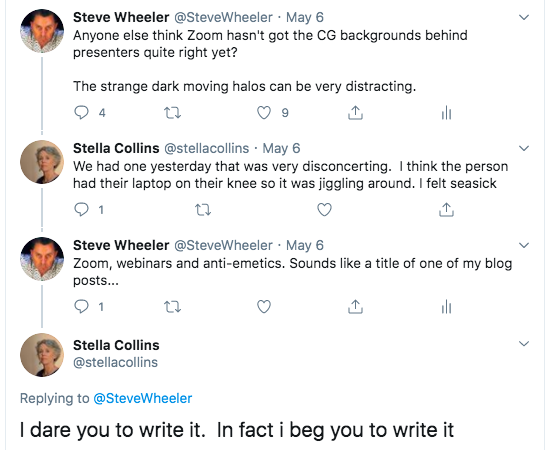
Zoom, webinars and anti-emetics

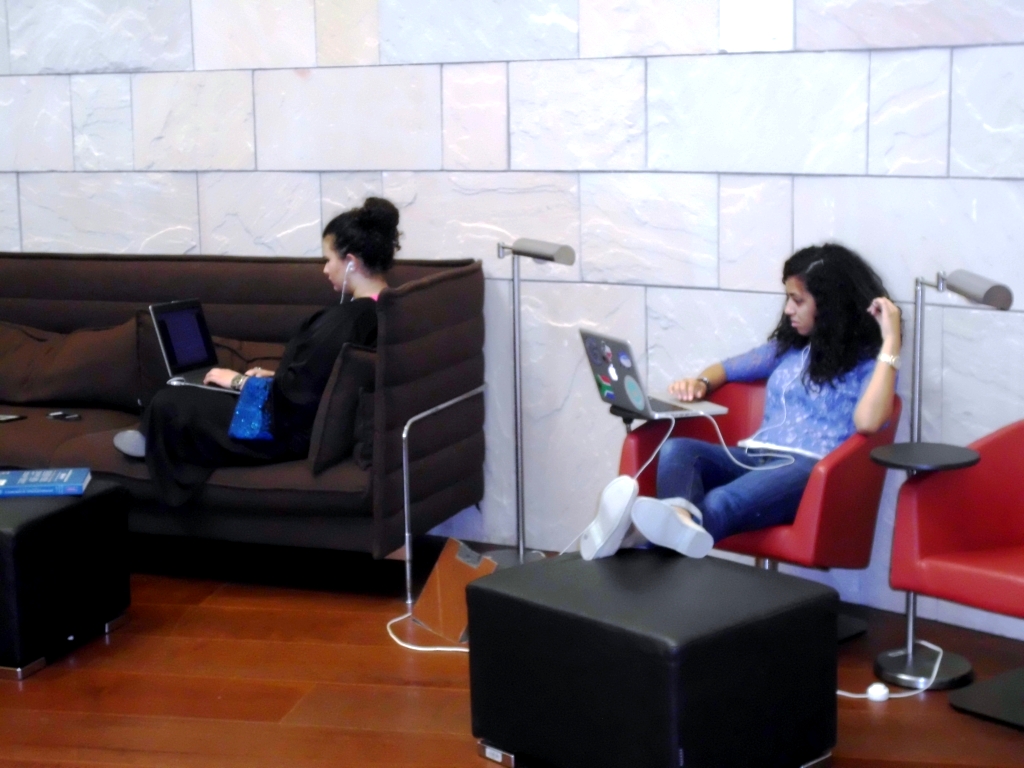
Photo by Marcus Aurelius on Pexels
What fresh kind of hell is this? Cue a deluge of complaints about video call fatigue. Yes, video call fatigue. You know it's a thing. That washed-out feeling when you have taken one too many Skype calls, and it's beginning to dawn on you that you've lost a part of your soul in that vacuum between your screen and theirs. It's that awkward gut-feeling that while you've been struggling with your inadequate, bandwidth challenged wi-fi hub that's perched precariously next to your three-year old laptop in your makeshift home office, your strength has been steadily draining, and you may actually be losing the will to live. Or at least, the will to waddle over to your fridge for the umpteenth time today to scoop another spoonful out of that tub of Ben and Jerry's (other brands are available, but they're probably not worth a mention).

Go on, admit it. You thought working from home would be a doddle, didn't you? The morning commute is as quick and easy as you thought it might be as long as you can avoid tripping on the discarded sock on the third stair from the top, but the trade off isn't that great once you open your laptop. WFH isn't quite the same as you thought it would be. It's more WTF than FTW.

As every day of lockdown passes, you crave more for that human contact. You try to get your fix each and every day, not just during working hours when you need to talk to your colleagues. You love video calls - and you hate video calls. It's doubly true in the evenings when you call Granny so she can do her FaceTime thing with the family she hasn't seen for seven weeks, four hours and a long weekend. When she eventually gets her camera to work all you and the kids get to see is a blurry close up of her knitted cardigan and the image is jumping all over the place, yet you still have to listen politely as she complains about her lumbago.

Video calls are inescapable now. Throughout your day the meetings beckon, students demand tutorials, webinar and conference invitations bombard your in-box. It's obligatory. It is a gradual erosion of your fortitude. It's a lock-down certainty that shortly after you sit down on that rickety old chair in your home office, you'll need to click a certain little icon. Well, here's some advice. You should never mention Zoom. Too much controversy. Avoid it like that discarded sock on the stairs. And Microsoft Teams? Don't even go there. It's enough to make a bishop kick a hole in a stain glass window (if bishops could get into their churches and cathedrals to do the kicking, which they can't because right now they're under exactly the same frustrating lock-down restrictions as us non-cassock wearers).

Do we deserve this purgatory?.... perhaps. We demand our social exchanges. We simply must connect. We will endure the medieval torture chamber to make sure we get our conversation. If you can actually fire up a video call, and it doesn't force your laptop to crash and float off to that blue screen Valhalla where all technology goes when it finally gives up the ghost (in the machine)....  and if you can get a picture and sound that's usable, and there's no pixellation or latency .... and if the 'other side' has actually remembered to turn up..... and if they know how to get their video working..... it's then - you realise - that you are doomed to sit through yet another hour of turgid meetings/webinar presentations. But you know it can get a lot worse.

Chaotic evil is to be found in the behaviour of those 'on the other side'. You know them... those who don't mute their audio while they shout profanities at the cat. Those who don't know how to un-mute when they speak (and that includes some journalists). Those who all speak at once, and then stop simultaneously. And then start again in unison. and then stop again. Multiple times. The buggers who won't stop tinkering with their cameras, 'touching up' their self images, vainly repositioning their laptops every few seconds to achieve the best picture of themselves, constantly moving their laptop and causing inertia sickness for the rest of the group. Repeat, and repeat again, ad nauseam.

You think that's bad? Some will insist on projecting CG backgrounds to create 'an ambience' of professionalism. Their bookcase and lamp standard aren't enough. They don't want the rest of the world to see their sad, untidy little homes. So they resort to CGI. Low video processing speeds cause a constantly shimmering dark halo to appear behind the perpetrator's head, lending them the disturbing appearance of a evil god from the darkest recesses of Wes Craven's diseased imagination. It's more distracting than a seagull pinching your chips and just as vomit inducing as a back-seat ride on the biggest roller-coaster at Blackpool Pleasure Beach. Worse still is when the 'other side' begins to tap heavily on their keyboard, typing while you're talking, causing their image to vibrate up and down like they're Lindy hopping on a sprung dance floor.

Well, it looks as though for the foreseeable future we're all stuck with video call fatigue, shaky images and pixellation. So, pass me the anti-emetics, and keep that sick bucket on standby. Oh, for the days of meetings where people got bored but at least the room wasn't moving about. I'll tell you this for nowt. If I don't get off this video merry-go-round soon I think there's going to be a massive technicolour yawn.

WFH, WTF? FTW? SMH TBH. Seriously. See you on the other side.

......
......

NB: I was goaded to write this post by none other than that Stella Collins. It was an innocent question, but look where's it's ended....


Creative Commons License
Zoom, webinars and anti-emetics by Steve Wheeler was written in Plymouth, England and is licensed under a Creative Commons Attribution-NonCommercial-ShareAlike 3.0 Unported License.


Zoom, webinars and anti-emetics

Photo by Marcus Aurelius on Pexels
What fresh kind of hell is this? Cue a deluge of complaints about video call fatigue. Yes, video call fatigue. You know it's a thing. That washed-out feeling when you have taken one too many Skype calls, and it's beginning to dawn on you that you've lost a part of your soul in that vacuum between your screen and theirs. It's that awkward gut-feeling that while you've been struggling with your inadequate, bandwidth challenged wi-fi hub that's perched precariously next to your three-year old laptop in your makeshift home office, your strength has been steadily draining, and you may actually be losing the will to live. Or at least, the will to waddle over to your fridge for the umpteenth time today to scoop another spoonful out of that tub of Ben and Jerry's (other brands are available, but they're probably not worth a mention).

Go on, admit it. You thought working from home would be a doddle, didn't you? The morning commute is as quick and easy as you thought it might be as long as you can avoid tripping on the discarded sock on the third stair from the top, but the trade off isn't that great once you open your laptop. WFH isn't quite the same as you thought it would be. It's more WTF than FTW.

As every day of lockdown passes, you crave more for that human contact. You try to get your fix each and every day, not just during working hours when you need to talk to your colleagues. You love video calls - and you hate video calls. It's doubly true in the evenings when you call Granny so she can do her FaceTime thing with the family she hasn't seen for seven weeks, four hours and a long weekend. When she eventually gets her camera to work all you and the kids get to see is a blurry close up of her knitted cardigan and the image is jumping all over the place, yet you still have to listen politely as she complains about her lumbago.

Video calls are inescapable now. Throughout your day the meetings beckon, students demand tutorials, webinar and conference invitations bombard your in-box. It's obligatory. It is a gradual erosion of your fortitude. It's a lock-down certainty that shortly after you sit down on that rickety old chair in your home office, you'll need to click a certain little icon. Well, here's some advice. You should never mention Zoom. Too much controversy. Avoid it like that discarded sock on the stairs. And Microsoft Teams? Don't even go there. It's enough to make a bishop kick a hole in a stain glass window (if bishops could get into their churches and cathedrals to do the kicking, which they can't because right now they're under exactly the same frustrating lock-down restrictions as us non-cassock wearers).

Do we deserve this purgatory?.... perhaps. We demand our social exchanges. We simply must connect. We will endure the medieval torture chamber to make sure we get our conversation. If you can actually fire up a video call, and it doesn't force your laptop to crash and float off to that blue screen Valhalla where all technology goes when it finally gives up the ghost (in the machine)....  and if you can get a picture and sound that's usable, and there's no pixellation or latency .... and if the 'other side' has actually remembered to turn up..... and if they know how to get their video working..... it's then - you realise - that you are doomed to sit through yet another hour of turgid meetings/webinar presentations. But you know it can get a lot worse.

Chaotic evil is to be found in the behaviour of those 'on the other side'. You know them... those who don't mute their audio while they shout profanities at the cat. Those who don't know how to un-mute when they speak (and that includes some journalists). Those who all speak at once, and then stop simultaneously. And then start again in unison. and then stop again. Multiple times. The buggers who won't stop tinkering with their cameras, 'touching up' their self images, vainly repositioning their laptops every few seconds to achieve the best picture of themselves, constantly moving their laptop and causing inertia sickness for the rest of the group. Repeat, and repeat again, ad nauseam.

You think that's bad? Some will insist on projecting CG backgrounds to create 'an ambience' of professionalism. Their bookcase and lamp standard aren't enough. They don't want the rest of the world to see their sad, untidy little homes. So they resort to CGI. Low video processing speeds cause a constantly shimmering dark halo to appear behind the perpetrator's head, lending them the disturbing appearance of a evil god from the darkest recesses of Wes Craven's diseased imagination. It's more distracting than a seagull pinching your chips and just as vomit inducing as a back-seat ride on the biggest roller-coaster at Blackpool Pleasure Beach. Worse still is when the 'other side' begins to tap heavily on their keyboard, typing while you're talking, causing their image to vibrate up and down like they're Lindy hopping on a sprung dance floor.

Well, it looks as though for the foreseeable future we're all stuck with video call fatigue, shaky images and pixellation. So, pass me the anti-emetics, and keep that sick bucket on standby. Oh, for the days of meetings where people got bored but at least the room wasn't moving about. I'll tell you this for nowt. If I don't get off this video merry-go-round soon I think there's going to be a massive technicolour yawn.

WFH, WTF? FTW? SMH TBH. Seriously. See you on the other side.

......
......

NB: I was goaded to write this post by none other than that Stella Collins. It was an innocent question, but look where's it's ended....


Creative Commons License
Zoom, webinars and anti-emetics by Steve Wheeler was written in Plymouth, England and is licensed under a Creative Commons Attribution-NonCommercial-ShareAlike 3.0 Unported License.


Zoom, webinars and anti-emetics

Photo by Marcus Aurelius on Pexels
What fresh kind of hell is this? Cue a deluge of complaints about video call fatigue. Yes, video call fatigue. You know it's a thing. That washed-out feeling when you have taken one too many Skype calls, and it's beginning to dawn on you that you've lost a part of your soul in that vacuum between your screen and theirs. It's that awkward gut-feeling that while you've been struggling with your inadequate, bandwidth challenged wi-fi hub that's perched precariously next to your three-year old laptop in your makeshift home office, your strength has been steadily draining, and you may actually be losing the will to live. Or at least, the will to waddle over to your fridge for the umpteenth time today to scoop another spoonful out of that tub of Ben and Jerry's (other brands are available, but they're probably not worth a mention).

Go on, admit it. You thought working from home would be a doddle, didn't you? The morning commute is as quick and easy as you thought it might be as long as you can avoid tripping on the discarded sock on the third stair from the top, but the trade off isn't that great once you open your laptop. WFH isn't quite the same as you thought it would be. It's more WTF than FTW.

As every day of lockdown passes, you crave more for that human contact. You try to get your fix each and every day, not just during working hours when you need to talk to your colleagues. You love video calls - and you hate video calls. It's doubly true in the evenings when you call Granny so she can do her FaceTime thing with the family she hasn't seen for seven weeks, four hours and a long weekend. When she eventually gets her camera to work all you and the kids get to see is a blurry close up of her knitted cardigan and the image is jumping all over the place, yet you still have to listen politely as she complains about her lumbago.

Video calls are inescapable now. Throughout your day the meetings beckon, students demand tutorials, webinar and conference invitations bombard your in-box. It's obligatory. It is a gradual erosion of your fortitude. It's a lock-down certainty that shortly after you sit down on that rickety old chair in your home office, you'll need to click a certain little icon. Well, here's some advice. You should never mention Zoom. Too much controversy. Avoid it like that discarded sock on the stairs. And Microsoft Teams? Don't even go there. It's enough to make a bishop kick a hole in a stain glass window (if bishops could get into their churches and cathedrals to do the kicking, which they can't because right now they're under exactly the same frustrating lock-down restrictions as us non-cassock wearers).

Do we deserve this purgatory?.... perhaps. We demand our social exchanges. We simply must connect. We will endure the medieval torture chamber to make sure we get our conversation. If you can actually fire up a video call, and it doesn't force your laptop to crash and float off to that blue screen Valhalla where all technology goes when it finally gives up the ghost (in the machine)....  and if you can get a picture and sound that's usable, and there's no pixellation or latency .... and if the 'other side' has actually remembered to turn up..... and if they know how to get their video working..... it's then - you realise - that you are doomed to sit through yet another hour of turgid meetings/webinar presentations. But you know it can get a lot worse.

Chaotic evil is to be found in the behaviour of those 'on the other side'. You know them... those who don't mute their audio while they shout profanities at the cat. Those who don't know how to un-mute when they speak (and that includes some journalists). Those who all speak at once, and then stop simultaneously. And then start again in unison. and then stop again. Multiple times. The buggers who won't stop tinkering with their cameras, 'touching up' their self images, vainly repositioning their laptops every few seconds to achieve the best picture of themselves, constantly moving their laptop and causing inertia sickness for the rest of the group. Repeat, and repeat again, ad nauseam.

You think that's bad? Some will insist on projecting CG backgrounds to create 'an ambience' of professionalism. Their bookcase and lamp standard aren't enough. They don't want the rest of the world to see their sad, untidy little homes. So they resort to CGI. Low video processing speeds cause a constantly shimmering dark halo to appear behind the perpetrator's head, lending them the disturbing appearance of a evil god from the darkest recesses of Wes Craven's diseased imagination. It's more distracting than a seagull pinching your chips and just as vomit inducing as a back-seat ride on the biggest roller-coaster at Blackpool Pleasure Beach. Worse still is when the 'other side' begins to tap heavily on their keyboard, typing while you're talking, causing their image to vibrate up and down like they're Lindy hopping on a sprung dance floor.

Well, it looks as though for the foreseeable future we're all stuck with video call fatigue, shaky images and pixellation. So, pass me the anti-emetics, and keep that sick bucket on standby. Oh, for the days of meetings where people got bored but at least the room wasn't moving about. I'll tell you this for nowt. If I don't get off this video merry-go-round soon I think there's going to be a massive technicolour yawn.

WFH, WTF? FTW? SMH TBH. Seriously. See you on the other side.

......
......

NB: I was goaded to write this post by none other than that Stella Collins. It was an innocent question, but look where's it's ended....


Creative Commons License
Zoom, webinars and anti-emetics by Steve Wheeler was written in Plymouth, England and is licensed under a Creative Commons Attribution-NonCommercial-ShareAlike 3.0 Unported License.


May 06, 2020

Problem based learning

Photo by Cyrano82 on Deviant Art
Over the course of the next few posts, I'm responding directly and more expansively to some of the questions posted during my live webinar for EDEN. For those who are not familiar with EDEN, it's a large international organisation dedicated to the promotion of distance education and e-learning. It has its roots in Europe, but its scope is truly international, with members from many other countries across the globe. During the pandemic crisis, EDEN has instigated a number of live webinars in which specialist academics are invited to present their thoughts on a variety of technology supported learning topics. Mine, which can be seen again on YouTube was called 'Face to face at a distance: Building communities of learning online.'

Below is my response to one of the questions that arose during my presentation:

Should we pay more attention to defining paths for acquiring skills rather than worrying about content, for example, by placing a great emphasis on project-based learning (PBL)?

A slight correction here: During my webinar I mentioned PBL in the context of Problem Based Learning and offered an example of how I had used it online with Masters students. The question clearly has interpreted PBL as Project Based Learning, which is only a part of the story. PBL can also work beyond projects too, and when it is applied appropriately, it can support skills learning, knowledge development and a whole lot more. 

One of the examples I mentioned required Masters students to solve an ill-structured problem (where some of the parameters are missing) by examining a problem space, discover appropriate reading and research around the theme, and then formulate a solution. Essentially, ill-structured problems have no single correct answer.

Because the students worked in several sectors of education (primary, secondary, tertiary as well as learning and development and training) they naturally drew upon their own previous experience and knowledge to complete their task. They arrived at their solutions from their own perspectives, and the solutions were diverse and unique. It was only when the students posted their solutions to the online forum that they were able to see each other's ideas and perspectives. This was quite revealing, because some of the solutions differed vastly from each other, as would be expected from the diverse backgrounds. A valuable discussion always ensued, where each student defended their own solution against those of others. Every solution had some merits, but also some challenges. An expert solution was also presented, so that students could see a further dimension. Using the problem as the base for their discussions, students were able to gain a number of perspectives and consider several alternative views they would not have thought of without the online learning community. This is a classic example of paragogy - where everyone knows something, but no-one knows everything (not even the expert). Through discursive interaction across the platform, students were able to learn more together than they could on their own. 

Ultimately, I had no need to consider or plan a lot of content for the students. Just the bare minimum of stimulus materials was required, along with the presentation of the messy problem. The students did the rest, motivated to analyse, research, devise and then present their solution. The learning was in the struggle to understand, and then in the act of defending their decisions. In this way they were able to define their own pathways to their learning, and develop their academic skills accordingly.

Creative Commons License
Problem Based Learning by Steve Wheeler was written in Plymouth, England and is licensed under a Creative Commons Attribution-NonCommercial-ShareAlike 3.0 Unported License.


Problem based learning

Photo by Cyrano82 on Deviant Art
Over the course of the next few posts, I'm responding directly and more expansively to some of the questions posted during my live webinar for EDEN. For those who are not familiar with EDEN, it's a large international organisation dedicated to the promotion of distance education and e-learning. It has its roots in Europe, but its scope is truly international, with members from many other countries across the globe. During the pandemic crisis, EDEN has instigated a number of live webinars in which specialist academics are invited to present their thoughts on a variety of technology supported learning topics. Mine, which can be seen again on YouTube was called 'Face to face at a distance: Building communities of learning online.'

Below is my response to one of the questions that arose during my presentation:

Should we pay more attention to defining paths for acquiring skills rather than worrying about content, for example, by placing a great emphasis on project-based learning (PBL)?

A slight correction here: During my webinar I mentioned PBL in the context of Problem Based Learning and offered an example of how I had used it online with Masters students. The question clearly has interpreted PBL as Project Based Learning, which is only a part of the story. PBL can also work beyond projects too, and when it is applied appropriately, it can support skills learning, knowledge development and a whole lot more. 

One of the examples I mentioned required Masters students to solve an ill-structured problem (where some of the parameters are missing) by examining a problem space, discover appropriate reading and research around the theme, and then formulate a solution. Essentially, ill-structured problems have no single correct answer.

Because the students worked in several sectors of education (primary, secondary, tertiary as well as learning and development and training) they naturally drew upon their own previous experience and knowledge to complete their task. They arrived at their solutions from their own perspectives, and the solutions were diverse and unique. It was only when the students posted their solutions to the online forum that they were able to see each other's ideas and perspectives. This was quite revealing, because some of the solutions differed vastly from each other, as would be expected from the diverse backgrounds. A valuable discussion always ensued, where each student defended their own solution against those of others. Every solution had some merits, but also some challenges. An expert solution was also presented, so that students could see a further dimension. Using the problem as the base for their discussions, students were able to gain a number of perspectives and consider several alternative views they would not have thought of without the online learning community. This is a classic example of paragogy - where everyone knows something, but no-one knows everything (not even the expert). Through discursive interaction across the platform, students were able to learn more together than they could on their own. 

Ultimately, I had no need to consider or plan a lot of content for the students. Just the bare minimum of stimulus materials was required, along with the presentation of the messy problem. The students did the rest, motivated to analyse, research, devise and then present their solution. The learning was in the struggle to understand, and then in the act of defending their decisions. In this way they were able to define their own pathways to their learning, and develop their academic skills accordingly.

Creative Commons License
Problem Based Learning by Steve Wheeler was written in Plymouth, England and is licensed under a Creative Commons Attribution-NonCommercial-ShareAlike 3.0 Unported License.


Problem based learning

Photo by Cyrano82 on Deviant Art
Over the course of the next few posts, I'm responding directly and more expansively to some of the questions posted during my live webinar for EDEN. For those who are not familiar with EDEN, it's a large international organisation dedicated to the promotion of distance education and e-learning. It has its roots in Europe, but its scope is truly international, with members from many other countries across the globe. During the pandemic crisis, EDEN has instigated a number of live webinars in which specialist academics are invited to present their thoughts on a variety of technology supported learning topics. Mine, which can be seen again on YouTube was called 'Face to face at a distance: Building communities of learning online.'

Below is my response to one of the questions that arose during my presentation:

Should we pay more attention to defining paths for acquiring skills rather than worrying about content, for example, by placing a great emphasis on project-based learning (PBL)?

A slight correction here: During my webinar I mentioned PBL in the context of Problem Based Learning and offered an example of how I had used it online with Masters students. The question clearly has interpreted PBL as Project Based Learning, which is only a part of the story. PBL can also work beyond projects too, and when it is applied appropriately, it can support skills learning, knowledge development and a whole lot more. 

One of the examples I mentioned required Masters students to solve an ill-structured problem (where some of the parameters are missing) by examining a problem space, discover appropriate reading and research around the theme, and then formulate a solution. Essentially, ill-structured problems have no single correct answer.

Because the students worked in several sectors of education (primary, secondary, tertiary as well as learning and development and training) they naturally drew upon their own previous experience and knowledge to complete their task. They arrived at their solutions from their own perspectives, and the solutions were diverse and unique. It was only when the students posted their solutions to the online forum that they were able to see each other's ideas and perspectives. This was quite revealing, because some of the solutions differed vastly from each other, as would be expected from the diverse backgrounds. A valuable discussion always ensued, where each student defended their own solution against those of others. Every solution had some merits, but also some challenges. An expert solution was also presented, so that students could see a further dimension. Using the problem as the base for their discussions, students were able to gain a number of perspectives and consider several alternative views they would not have thought of without the online learning community. This is a classic example of paragogy - where everyone knows something, but no-one knows everything (not even the expert). Through discursive interaction across the platform, students were able to learn more together than they could on their own. 

Ultimately, I had no need to consider or plan a lot of content for the students. Just the bare minimum of stimulus materials was required, along with the presentation of the messy problem. The students did the rest, motivated to analyse, research, devise and then present their solution. The learning was in the struggle to understand, and then in the act of defending their decisions. In this way they were able to define their own pathways to their learning, and develop their academic skills accordingly.

Creative Commons License
Problem Based Learning by Steve Wheeler was written in Plymouth, England and is licensed under a Creative Commons Attribution-NonCommercial-ShareAlike 3.0 Unported License.

May 04, 2020

Building online communities of learning

I presented a webinar for EDEN's series on education in the time of a pandemic' earlier today, and was pleased to see almost 300 participants from across the globe. I covered a lot of theory and related it to practice, offering some worked examples of how I had previously conducted online learning in undergraduate and post-graduate education programmes.

I paid specific attention to the building of community, touching on issues around empathy, tutor knowledge, teacher passion, social presence and immediacy - all of which are key elements, I would argue, in the success level of online learning.  I also worked through some classic neo-Marxist perspectives and explored the extent to which they are useful as explanations in contemporary online education.

Some excellent, searching questions ensued at the end of my presentation which you can see me attempt to answer in the video link below. Ultimately, it is the sense of community and belonging that can make the difference between those students who persist and succeed, and those who drop out. I'm very grateful to the EDEN community for inviting me to present at this event, and I hope the YouTube video below is useful to you.


Creative Commons License
Building online communities of learning by Steve Wheeler was written in Plymouth, England and is licensed under a Creative Commons Attribution-NonCommercial-ShareAlike 3.0 Unported License.


Building online communities of learning

I presented a webinar for EDEN's series on education in the time of a pandemic' earlier today, and was pleased to see almost 300 participants from across the globe. I covered a lot of theory and related it to practice, offering some worked examples of how I had previously conducted online learning in undergraduate and post-graduate education programmes.

I paid specific attention to the building of community, touching on issues around empathy, tutor knowledge, teacher passion, social presence and immediacy - all of which are key elements, I would argue, in the success level of online learning.  I also worked through some classic neo-Marxist perspectives and explored the extent to which they are useful as explanations in contemporary online education.

Some excellent, searching questions ensued at the end of my presentation which you can see me attempt to answer in the video link below. Ultimately, it is the sense of community and belonging that can make the difference between those students who persist and succeed, and those who drop out. I'm very grateful to the EDEN community for inviting me to present at this event, and I hope the YouTube video below is useful to you.


Creative Commons License
Building online communities of learning by Steve Wheeler was written in Plymouth, England and is licensed under a Creative Commons Attribution-NonCommercial-ShareAlike 3.0 Unported License.


Building online communities of learning

I presented a webinar for EDEN's series on education in the time of a pandemic' earlier today, and was pleased to see almost 300 participants from across the globe. I covered a lot of theory and related it to practice, offering some worked examples of how I had previously conducted online learning in undergraduate and post-graduate education programmes.

I paid specific attention to the building of community, touching on issues around empathy, tutor knowledge, teacher passion, social presence and immediacy - all of which are key elements, I would argue, in the success level of online learning.  I also worked through some classic neo-Marxist perspectives and explored the extent to which they are useful as explanations in contemporary online education.

Some excellent, searching questions ensued at the end of my presentation which you can see me attempt to answer in the video link below. Ultimately, it is the sense of community and belonging that can make the difference between those students who persist and succeed, and those who drop out. I'm very grateful to the EDEN community for inviting me to present at this event, and I hope the YouTube video below is useful to you.


Creative Commons License
Building online communities of learning by Steve Wheeler was written in Plymouth, England and is licensed under a Creative Commons Attribution-NonCommercial-ShareAlike 3.0 Unported License.


April 27, 2020

Lockdown learning

Photo source: Pexels
Social distancing. Stay at home. Lockdown. These are phrases that will be forever synonymous with the year 2020 - the year of the virus. And what about resilience?

We are only a third of the way through this terrible year, and there will be more pain to come. But we are a resilient people. Humanity doesn't just lay down and submit. We fight back. When we are going through Hell, we keep going. And that's a tribute not only to essential front-line staff such as health professionals, utility workers and emergency personnel. It's also a shout out to the teachers, the school staff, nursery workers and others who look after and educate our young people, week in, week out, whatever else is going on in the world.

For education people, learning doesn't stop even though all around, social life, commerce, business, mortgage payments, air travel and other common practices have ground to a halt. No, learning continues, and so does the need to provide great educational environments within which children can continue to develop their knowledge and skills. Schools all over the world have remained open (even though they are officially 'closed'), to provide care and support for the children of essential workers, and also to continue to offer students everywhere remote learning opportunities. Some of the stories of how teachers have achieved and sustained this are herculean, and others will emerge when the dust finally settles.  The pandemic has compelled educators to teach at a distance in many instances, and the scramble to find solutions has been frenetic. But some have been doing this for many years, have a lot of experience in distance education, and can point to standard tools that will enable this to be done effectively. We have become a technology mediated society and education is at the forefront of the efforts to connect and continue.

I wrote a post called Pandemic Pedagogy about some of the first resources that had been created during the early days of the pandemic. They are mainly high quality, focused and sought after resources, but there is still (and never will be) a substitute for empathetic, knowledgeable teaching input. And so teachers have been sat in front of their laptops teaching via Zoom, Skype, Teams and Hangouts, and a whole host of other video link tools. It's not easy. In fact, in some instances, it's almost impossible to engage every student, everywhere, at the same time. A bit like a traditional classroom really. But more so. Teachers have begun to discover that behaviour management issues are magnified when you're at a distance from your students. Communication challenges are amplified when all you are relying on is your home wifi bandwidth and a 3 year old laptop.

But survive we will, and in years to some we'll look back on the 'year of the virus', and say - yes, it was a terrible time, but we got through it, and now we know a lot more about ourselves and our limitations, we have learnt to be more resilient, and we can get through anything. I salute educators everywhere. Technology will not replace you. You will always be needed.

Creative Commons License
Lockdown learning by Steve Wheeler was written in Plymouth, England and is licensed under a Creative Commons Attribution-NonCommercial-ShareAlike 3.0 Unported License.


<< Back Next >>