Log on:
Powered by Elgg

Ania Rolinska :: Feeds

May 01, 2015

Opening up #learning: Google in the exam room

Learning is changing, but are schools systems and testing methods keeping pace with these changes? Should they? In a recent BBC TV interview, the head of the examination and qualifications organisation OCR, Mark Dawe, argued that exams and other testing should change to accommodate the new ways of learning that are emerging. He suggested that we should now allow internet access into the exam room, because 'it reflected the way pupils learned and how they would work in the future.'  His ideas were immediately shot down by Chris McGovern ,representing the Campaign for Real Education, who remarked that this proposal was tantamount to dumbing down education. 'We have to test what children are carrying in their heads,' he said.

Dawe of course disagrees with this conclusion, preferring a more progressive approach to testing. He suggests that Google and Internet enabled devices in the exam room is inevitable. He argued that 'when we are asking a question and we know there is access to the Internet, we could ask a different question - it's about the interpretation, the discussion.' This is a fundamental challenge to the way examinations are conducted, and a positive nod in the direction of the new ways of technology enabled learning that some educators find entirely problematic.

What are your views on this debate? Do you think children should be able to access the Internet during their exams? Or should we be cautious and continue to maintain the status quo? If Internet access is made available during exams, will the questions need to change? If so, what will be the benefits and the challenges? The comments box below awaits your views.

Photo by Alejandro Caicedo on Wikimedia Commons

Creative Commons License
Opening up learning: Google in the exam room by Steve Wheeler was written in Plymouth, England is licensed under a Creative Commons Attribution-NonCommercial-ShareAlike 3.0 Unported License.


April 29, 2015

Opening up #learning: Simpler does not mean better

This is a continuation from my last blog post on the affordances of learning technology. In the last post, Access to Knowledge, I wrote about how technology has made access to content - and thus to knowledge - easier and open to all. Of course, the caveat is that access to content that is open requires users to be able to discern good from bad content. There are further caveats when we use technology to learn. The post was based on the first of the four levels of affordances model proposed by Putnam, whose second level relates to automating, simplifying and transforming tasks. Although these three facets are in no way synonymous, Putnam nevertheless places them together. Let's deconstruct this trio of affordances.

Automation of tasks relieves the user of having to spend cognitive energy on (or thinking about) mundane tasks. Spreadsheets and calculators can perform a range of mathematical operations obviating the need to add, multiply, divide, subtract or work out mean averages. Is this a desirable affordance? If you are a graduate researcher working to tight deadlines and needing to complete complex calculations, it is probably essential. On the other hand, if you are a primary school student who needs to understand how to perform these mathematical operations, then the spell checker probably does more harm than good.

The same applies to simplifying tasks. Word processors afford spell checking, which can be a valuable tool for those who do a lot of writing. New iterations can be achieved instantly through continuous editing and polishing of text (known as provisionality), and the spell checker accompanies this, simplifying the normally tedious and time consuming function of proof reading. If however, you are a school student who has learnt to use the spell checker without fully considering what a sentence comprises, or that certain words can be bypassed by the spell checker and still be spelt wrongly (out of context) then it is probably a mistake to use one.

The ability to transform a task, to advance it beyond what would normally have been achievable without the technology, is excellent. Using an interactive whiteboard (IWB) to transform the learning experiences of your students is great pedagogy.  IWBs can display multimedia and multiple pages can be accessed instantly. It has a number of other features such as the capability to transform sizes and shapes of content through touch gestures, and it can of course record an entire teaching session, which can be saved as a file and sent as an e-mail attachment to students who may have been absent from that session. Better still, when students are allowed to use the IWB to develop their thinking, create new understanding, and interact with diverse content, transformation of learning can occur. Yet when the IWB is used in much the same way as a traditional white board, it is often a failure in pedagogy. At the very least, it is an abdication of the affordances of the IWB, which does a disservice to the students who then are deprived of an interactive experience to support their learning.

In the final analysis, we can echo Putnam's view that the consequences of automating, simplifying and transforming tasks through technology are not always desirable, and in some cases, are best avoided. However, when used appropriately and thoughtfully, teaching and learning can be transformed for the better, and our learning experiences improved beyond recognition.

Image by Agsandrew on Deviant Art

Creative Commons License
Opening up learning: Simpler does not mean better by Steve Wheeler was written in Plymouth, England is licensed under a Creative Commons Attribution-NonCommercial-ShareAlike 3.0 Unported License.


April 26, 2015

Opening up #learning: Access to knowledge

Learning is opening up like never before. Open learning was originally used to describe the opening up on education to previously disenfranchised individuals - those who had not followed the traditional pathways to education. In the 70s and 80s, many people suddenly had a chance to pursue a degree when the open universities were established. The British Open University for example, was nicknamed 'the university of the second chance'. As a concept, openness began to gain purchase. Soon there were open colleges, and open learning centres, and then open software appeared - software that could be shared and developed by anyone. The last few years have seen the rise of Massive Open Online Courses, used by millions of students around the world to participate in learning that was previously closed to them. It's something of a revolution for education.

Generally we have technology to thank for this sea-change in education. Based on the work of psychologist J.J. Gibson on perception, Ralph Putnam has identified four categories of technology affordances. All are specifically related to learning:
  • providing access to information
  • automating, simplifying, and transforming tasks
  • representing knowledge and thinking
  • communicating and collaborating with peers and experts 
In my next few posts I plan to elaborate on these four (and possibly other) affordances that will impact on learning and education in the foreseeable future.

Here's the first: Access to knowledge. Putnam's view of the Internet is similar to many other educators - it has provided unprecedented access to the world's knowledge. The advent of the Web, and subsequently the rise in use of social media and media sharing services has amplified this capability. The copious flow of user generated content offers great benefits but also presents huge challenges. The benefits are that we can all learn from each other, and can freely share our ideas, developing worldwide communities of practice that thrive on this access to knowledge. The ethos of sharing extends across open content, open source software, open courses and open scholarship. Resources such as Wikipedia and Wikimedia Commons have advanced learning to new levels.

At the same time, users must be aware of content that is inaccurate, ill-informed or otherwise less useful than verified peer reviewed content. Some content is simply misleading, whilst other content can be extremely dangerous. Sat somewhere in the middle of this spectrum is a great deal of personal opinion. Students who use the Web for any serious learning purpose need to develop digital wisdom - the ability to discern between good and bad content. This is a new form of literacy. One of the important challenges for educators in the coming years is to help learners to develop digital literacy. Those who know the difference between good and bad content will be in a far better position to exploit the potential of the Web to its full.

Reference
Putnam, R. (2006) What are the affordances of technology?

Photo by Jacques Cousteau on Wikimedia Commons

Creative Commons License
Opening up learning by Steve Wheeler was written in Plymouth, England is licensed under a Creative Commons Attribution-NonCommercial-ShareAlike 3.0 Unported License.


April 22, 2015

#EDENchat How effective is mobile learning?

Mobile communication has become increasingly popular for a number of reasons. The cost of smart phones is falling, and we enjoy increased functionality. The advent of social media has further advanced this evolution at a pace. Hence, mobile learning is now becoming a key part of educational strategy. And yet it is still largely an unknown strategy for many educators.

In the #EDENchat on 22nd April we focused on issues surrounding mobile learning. In #EDENchats we critically evaluate what we know so far and share our experiences globally and this chat was no exception. There were several key conversations, around usability, around technological or social trends, around the nature of ubiquity, and of course there was some useful discussion around the perennial question about pedagogy and the impact of technology on learning.

The archive of the discussion on Storify can be found at this link. The transcripts of previous #EDENchats can also be found on the main EDEN site as Storified archives.

Photo by Johan Larsson on Wikimedia Commons

Creative Commons License
#EDENchat How effective is mobile learning? by Steve Wheeler was written in Plymouth, England is licensed under a Creative Commons Attribution-NonCommercial-ShareAlike 3.0 Unported License.


April 21, 2015

Fair measures

Last week I wrote about the issues and challenges of assessment. There are many. One is to understand that measuring is not the same as providing good feedback. Yesterday at the London Grid for learning Conference I asked my audience of over 400 teachers if they knew what ipsative assessment was. One teacher raised their hand. This is a standard response. Ipsative assessment is not a commonly known method, and yet most of us use it just about every day to measure ourselves. Here's what Wikipedia says (and it's accurate):

In education, ipsative assessment is the practice of assessing present performance against the prior performance of the person being assessed. One place where this might be implemented is in reference to tests used with K-12 students in the United States, where teacher performance is currently popular. 

Ipsative assessment is used in everyday life, and features heavily in physical education and also in computer games. Encouraging pupils to beat their previous scores can take peer pressure out of situations and eliminates the competitive element associated with norm-based referencing. It can be particularly useful for children with learning disabilities and can improve motivation.

Let me expand on this. In games playing, children (and adults) are often in a battle with themselves. Gamers are constantly obsessed with trying to better their own scores. Ask an avid gamer what level he has achieved on XIII or Call of Duty and they won't hesitate to tell you. When you go to the gym or out for a run - and especially if you are training for a marathon or competition of some kind - you become very focused on your times and you strive to improve them. Teachers of physical education use ipsative assessment regularly with their students, to motivate them to become faster, higher, stronger, more skillful. It's the ethos behind the spirit of the Olympic Games. You participate to better yourself and winning is the icing on the cake. Children play games and sport all the time. They are fascinated by how far they can go and how many points they can score. It's a natural part of their every day experience.

Here's John Kleeman on the benefits of ipsative assessment:

.... an advantage of ipsative assessment is that it measures progress and development – a test-taker can see if he or she is improving and whether or not he/she is taking advantage of feedback from previous assessments. Using ipsative assessment can help all test-takers improve: A weaker performer will be encouraged by seeing performance improvements over earlier attempts, and a stronger performer can be challenged to do better. This can deal with the risks of the weaker performer becoming demotivated from a poor test result and the strong performer complacent from a good one. Ipsative assessment can be used for objective measures (e.g. did I get a better score?) and also for more subjective measures (e.g. am I more confident about something?)

From my professional experience, I would argue that Ipsative assessment is by far the fairest, and most relevant form of assessment there is. Students are competing against themselves, and only themselves. Imagine what might happen if, instead of measuring children's maths or science knowledge against some arbitrary benchmark (criterion referencing), we assessed them on how well they had personally progressed against their previous attainment levels. We might have ourselves a fairer assessment system for learning. Will it happen? Criterion referenced assessment is deeply ingrained within the fabric of the school system in most countries now. Whether we can effectively replace our current system of assessment with ipsative assessment is another question entirely.

If it happened, it would be a seismic shift in education.

Photo by Areta Ekarafi on Flickr

Creative Commons License
Fair measures by Steve Wheeler was written in Plymouth, England is licensed under a Creative Commons Attribution-NonCommercial-ShareAlike 3.0 Unported License.


April 19, 2015

Twitter in the classroom

Today I had an interesting exchange of views on Twitter... about Twitter. I mentioned that I strongly encourage the use of Twitter in my classes. Someone remarked that they thought it was strange that I 'interposed media between myself and my students.' Well, firstly, this sounds as though I am deliberately trying to hide behind technology, which is patently untrue. If I wanted to hide behind technology, I would stay at home, and use my laptop and 'death by PowerPoint' to lecture to my students from a safe distance. I would probably turn off my camera too, so I didn't have to shave or comb my hair. No, you can be assured that if I use any technology with my students, it is for a clearly thought through, and logical reason that supports good pedagogy.

Secondly, students are going to use Twitter and other media anyway, regardless. My view is, let's harness whatever personal tools students bring with them to enhance their learning experience, and provide them with opportunities to extend their learning. My education students are usually in year cohorts of about 180 students. Large plenaries are presented with guest speakers in lecture theatres, and then they are split into 6 or 7 smaller seminar groups where discussion, debate, and other forms of discursive learning are supported.

During the lectures, I encourage students to interact with each other and the speakers by using Twitter as a backchannel. We select a unique hashtag for the module and this is used on all the tweets that are relevant to the lessons. This means that only the relevant tweets can be shown on large screens, or filtered by individuals on their handheld devices. Most students carry a mobile phone and/or tablet computer/laptop around with them and use them during the sessions to search for additional content, interact and post messages to their student spaces on Facebook. They also use them to capture images and sounds during the lecture for reference later on. The backchannel is an ideal medium for them to engage with people outside the classroom too. On at least one occasion students have been able to interact directly with well known authors and academics who are highly relevant to the topics they are studying.

When students are split up for seminars, and where the seminars run simultaneously, Twitter is used as an addiional medium of communication, and ideas are shared between groups. Often students take and send pictures of their group work so that other students can benefit from the discussion without being present in the room. The hashtag ensure that an archive of all relevant tweets can be accessible weeks after the seminars and lectures, so that students can refer back to content that may be useful for their assignments.

Twitter continues to be a versatile tool for good pedagogy. Those who reject it as frivolous or a distraction are often those who have seen poor use or have simply not given it enough time to see its relevance.

Photo from Wikimedia Blog

Creative Commons License
Twitter in the classroom by Steve Wheeler was written in Plymouth, England is licensed under a Creative Commons Attribution-NonCommercial-ShareAlike 3.0 Unported License.


April 16, 2015

From EDUPUNK to ds106... 10Q: Jim Groom

Recently on this blog I featured an interview with Martin Weller, one of the keynote speakers for EDEN 2015. I was also privileged to conduct an interview another of our EDEN keynote speakers, Jim Groom, adjunct professor at Mary Washington University in Virginia, the transcript is reproduced below:


1) What is Bavatuesdays, and why are you known as the Reverend?

bavatuesdays (the b is lowercase!) is the best blog in the land, and I am known as the Reverend because I lay down the gospel :) More seriously, bavatuesdays is my personal blog, and I've been hammering out posts there for almost a decade now. It's a mishmash of edtech, 80s pop culture, animated GIFs, retro toys, ds106 art, and all things cinema. It's a "b blog" in that it pretends to nothing more than schlock, and it achieves its goal regularly. The actual name comes from the maestro of Italian horror films Mario Bava. It's a reference to a film club some friends and I imagined wherein we would watch Mario Bava films on Tuesday nights. The club never materialized, but the name stuck with me for some strange reason. I thought it might be a cool band name, but given I have no musical talent, I reserved the domain and settled for a blog. The rest is the underground history of the web.

As for the title Reverend, I was given that nickname by Chip German (then CIO of University of Mary Washington) back in 2006 or 2007. I think because I started to sound a bit like a fervent preacher when I started talking about teaching, learning and technology. I've played the role of evangelist at UMW for almost a decade, and I always hated the term evangelist when used outside of its religious context, so I made a point of reframing edtech as a faith system akin to Cotton Mather's Puritanism. My avatar is actually a headshot of Cotton Mather from the 1977 Marvel Team-Up comic featuring Spider-Man, Scarlet Witch, and Cotton Mather as a super-villain. In another life I was an early American literature Ph.D. student, so the marriage of biblical exegesis, fear mongering, and bullshitting comes easy.

2) You've had quite a distinguished career in education. How did you first become involved in teaching, and what keeps you motivated to educate?

I started in education back in 1997 when I became a grad student at the City University of New York's Graduate Center. CUNY's Ph.D. program was trial by fire, or was it purity by fire? As soon as I was accepted I was given two classes to teach at the College of Staten Island. I was a green 26 year-old and I had no idea what I was doing, but I really loved being in the classroom and tripping out on early American texts with students. In early American literature (pre-1800), the works are more cultural, political, and/or historical than poetic, which invites the examination of these texts as cultural artifacts.

This approach has always kept me interested as an educator, because it imbues everything around you with potential cultural meaning. I just got lucky when I came to UMW that they not only allowed, but encouraged me to take a similar approach to my work with instructional technology---and bavatuesdays became the outlet for that. The internet more generally, but the web specifically, is very similar to early American lit in my mind because it is still working through its various forms and voices, and the analogies and metaphors are in constant flux. I think that's what I love most about the edtech space, the ability to try and make sense of the cultural moment we are living through by way of analogy and metaphor. The search for new ways of making sense of our moment through outlandish metaphor keeps me highly motivated and truly dedicated. Uh rah!

3) You've been referred to as the 'posterboy' of Edupunk. Can you tell us what Edupunk is, why it's relevant to education today, and how you arrived at the concept?

Well, for me EDUPUNK (all caps, like EDUCAUSE) was one of those outlandish metaphors I threw out there to try and explain the state of educational technology back in 2008. And it quickly resonated with a lot of people. In fact, far more than I could have ever imagined. Don't get me wrong, it wasn't like MOOCs or anything, but it was a pretty strong response from a simple blog post. The idea behind EDUPUNK was pretty simple and still quite relevant: corporate-driven edtech is soulless-it robs the field of any deep, meaningful interrogation of the issues we need to be struggling with, such as digital identity, digital fluency the new cultures around piracy and privacy, student empowerment, and how we can begin to think like the web. None of this happens in an LMS (or VLE), in fact, that systematic design of that system is anathema to all of these crucial elements of educating in the digital era.

That said, I had to breakup with EDUPUNK in 2010 because it wasn't fun any more. People took it too seriously, and I was being accused of being a Neo-con. It was interesting to see how quickly the idea went from playful and generative to prescriptive and suffocating. I think some folks confused EDUPUNK with some movement to usurp institutions, rather than a call to actually reclaim the work you do from bowels of the corporate web. Although, in retrospect, I think the fact people interpreted EDUPUNK in so many different ways could be seen as its strength, but it got caught up in a broader discourse around the failure of public institutions that I wasn't initially prepared for, and ultimately interested in pursuing. I didn't want to be the EDUPUNK poster boy, I wanted to actually create something rather than defend a half-baked idea one way or the other.

4) Tell us about DS106. What is it, who is involved in it, and what has it achieved?

ds106 (lowercase ds) was the reincarnation of EDUPUNK without the annoying discourse and political baggage. ds106 is the purest and greatest thing I have ever been a part of, it is #4LIFE! ds106 was the attempt to take all those crucial elements of learning on the web I listed above (digital identity, fluency, empowerment, thinking like the web, etc.) and try and integrate them into a class on digital storytelling. The idea was to enact the principles of EDUPUNK through teaching rather than sit around an argue about a term. Who the hell is gonna argue about ds106? It's just letters and numbers, there is no meaning save that which we give it as a community over time. ds106 has become a rich, distributed, and emergent international online community that happens to run as a class sometimes at UMW.

I could take up this entire interview talking just about ds106 (and I will talk at length about it during my presentation at EDEN), but let me summarize it here as follows: ds106 is both a class and a community at once. Its objective is to help participants interrogate the emergent culture of the web by actively engaging in a steady diet of creating and reflecting on the web. Although, it's also an assignment bank, radio station, daily create, and much, much more. ds106 is people! There are too many people to list in terms of who is involved, but the open, online portion of ds106 that went live in Spring 2011 was architected by Martha Burtis, Tom Woodward, and Alan Levine. But scores of people continue to make that community so remarkable. You can see it for yourself at Twitter hashtag #ds106. It's #4life :)

5) How has education changed in the last ten years, and are there good changes?

Slowly. The most dangerous thing about the technology revolution in education is the fact that it is often ahistorical. It seems like every new development, whether a device, product, or service, is the great game changer or disruptor. And that logic is insidious in the field right now because it often dehumanizes the truly inter-personal and dialogic nature of learning. Technology becomes a fantasy of scaling efficiency: the teacher-less classroom, the pre-recorded lecture, the automated grader.

The vision of technology as the augmentation of human intellect driving the pioneers of computing in the 1960s and 70s seems too often replaced with the idea of computers as time and money savers for educational institutions. That said, the state of education has never been greater as a result of the haphazard connections made possible by the web. You can learn just about anything thanks to YouTube and Wikipedia. But rather than running away from this fact, or imagining it as a cost saver---universities need to be augmenting the culture of the web, by framing how we learn as part and parcel of this wonder-filled medium.

We still need to think together, enable dialogue, and get feedback. Educational institutions have does this fairly well over the last century, and we need to continually push on how the enterprise of teaching and learning changes in relationship to the web and explore it. That's why it is so crucial we don't sellout all the the R and D around edtech to corporations making products. If we did that with the internet in the late 60s, AT&T would have kyboshed the whole thing and we wouldn't have had the internet in 1969. The was from the very beginning a collaboration between businesses, government and higher ed, and a majority of the protocols for the internet were created at universities---institutions where exploration and research seemed paramount.

6) Why are open access and online programmes of study becoming so important in the learning ecology? What is the secret behind the success of MOOCs?

Not sure MOOCs are a success, do we have any real sense of that? I think the success of MOOCs, at least initially, might be linked to the fact that administrators around the world started to pay attention to online learning. But the fact they all just tried to do MOOCs (bigger online classes in a bigger "open" LMS) might be a good example of their limitations. I am not a fan of the MOOC as they're sold by Coursera, Udacity, and the like. The original vision of MOOCs from folks like Stephen Downes and George Siemens was that you can scale a class community through individuals' personal networks and the web---and the MOOC is about aggregation and distributed community. How is pushing 50K people into an LMS radical? It's just super-sized learning. McDonald's figured that out for fast food decades ago, and we all became fat in American as a result :) I guess now we can be fat and stupid.

7) What will be the next big thing in education? What is on your horizon for new technology, new ways of learning and new pedagogies?

Right now I am really interested in the idea that IT infrastructure has never been more agile and affordable. With technology like containerization (the virtualized deployment of micro-instances of servers) we can run and scale infrastructure as big and/or small as we want. I believe this will ultimately make it easier for everyone to manage and control there own bit of the web, and truly be a sysadmin of their online education, and archivist of their digital life. What's more, IT infrastructure can transform to make enterprise systems more porous when it comes to enabling students and faculty to Publishes from their Own Spaces but Syndicate Everywhere (POSSE). The idea of federated networks that enable us all to manage and control our work but share and fork it seamlessly remains the holy grail for edtech---and it also just seems really scifi and cool.

8) What three things do educators need to be made aware of, right now?

1) Who controls their data 2) The power of the open web 3) The air-speed velocity of an unladen swallow 

9) What themes will you be speaking on when you give your keynote at EDEN 2015?

I'll be talking about taking control of your online presence as a necessary part of being an educator in the 21st century. I'l be using ds106 as an example of how this played out in my own work over the last 5 years. What's more, I'll be diving into the ideas of virtualization, containerization and the changing nature of IT infrastructure in providing brave new learning environments. But, as is always the case, I'll be returning to the theme that has been driving my work for the last decade. Namely, how can we most effectively integrate the web into education, because I strongly believe teaching and learning can be that much cooler when it's done well.

10) What gets you out of bed in the morning?

My three kids. Literally, they jump up and down on me and harass me until I get up. It's actually horrible. If they didn't do that I would sleep in every single day.

Photo courtesy of Jim Groom

Creative Commons License
From EDUPUNK to ds106... 10Q: Jim Groom by Steve Wheeler is licensed under a Creative Commons Attribution-NonCommercial-ShareAlike 3.0 Unported License.


Just disinfect

I need to disinfect. Recently I've been receiving a lot of requests to publish blog posts from freelance writers. When I first began to receive this requests, I admit I was curious, because it made a change from companies trying to get advertising space on my site. So I asked to see some of the 'guest posts' that were being offered. What I was sent was disappointing. 

The 'guest posts' weren't written very well at all, looked rather formulaic, and as I suspected, many of them were trying to plug some kind of product or service. Some of the more subtle ones merely eulogised over the product or service without endorsing or naming it. It's apparent to me now that there are likely to be commercial companies lurking behind these wannabe 'guest bloggers', who are almost certainly as freelance as I am a Dutchman. 

I can see it all now: These companies must pay top dollar for their 'social media marketing' executives to sit down for hours on end in front of a screen fastidiously trawling the web for blogs that attract more than a thousand hits each month. When they spot one, the office lights flash on and off and the warning klaxon sounds. Then all the company's designated 'guest bloggers' run around like maniacs flash targeting the blogger's e-mail inbox to try to convince him that their 'freelance' post should be hosted on his blog. 

There's another name for these people - parasites (not to be confused with Parisiens, who are in fact the lovely residents of the capital of France). I name them parasites because they all want to cash in on the success of someone else's endeavours. They want a free ride on the back of a winning steed. They want to hijack popular blogs to get their message across to the largest audience they can, with the minimum of effort. 

I have a message for these parasites: Blog off! Don't try to cash in on the success of hardworking people. Go and get your own blog to play with. That way you will understand just how difficult it is to build up a decent following through hard work and a lot of hours of thinking, researching and writing you will need to do. 


Don't misunderstand me. I think guest blogging is a good idea, and if you can find someone you trust, who can write a great blog post or two while you're away sunning yourself on the Costa del Sol, then go for it. As long as they can maintain your high standards as a blogger, it's a useful strategy. But my advice for any decent blogger who receives an e-mail from one of these wannabe social media marketing guest blogger parasites, is this: Don't say no. Don't even respond. Just delete the e-mail. Then disinfect.

Image source
 (modified)


A shorter version of this post entitled 'Parasites!' first appeared on Learning with 'e's on 13 December, 2010.

Creative Commons Licence
Just disinfect by Steve Wheeler is licensed under a Creative Commons Attribution-NonCommercial-ShareAlike 3.0 Unported License.


April 15, 2015

The numbers game

When you mark a student's work, do you give them a grade or do you offer them advice? Both, do I hear you say? If you are offering both, then you're doing well. But not all teachers do, and I should point out that there is a big difference between assessment of learning and assessment for learning. Assessing students' work can be tedious and time consuming, and it turns out to be the bane of many teachers' lives. But it is a vitally important part of pedagogy.

Assessment of learning focuses largely on the student's work and offers metrics - awarding a grade with a numerical value - that reflect how the work is measured against specific criteria. By contrast, assessment for learning focuses on the student - particularly recognising that their learning is an ongoing process - and seeks to inform learners on how they can improve their work in the future. Some would argue that giving grades reflects a product-based pedaogogy, while offering feedback supports a process-based pedagogy.

Ever stopped to wonder why we give grades? What value do students place on numbers, or letters? What does it mean to get a 'B' for an essay, or to achieve 50% in an exam? In higher education, students' efforts - whether they take the form of essay, project or an exam - are 'marked' on a 100 point scale. Anything below 40 is a fail, and anything above 70 is a first class result. The majority of students achieve grades somewhere between these two scores, because more often than not, students tend to produce average work. Sometimes it's because lecturers mark conservatively and don't like to fail students (that could reflect badly on their own academic reputation) or draw attention by awarding an outstanding piece of work a 95 or even a 100.

Why do we need to attach a number to someone's work? Is the numbers game teachers play a meaningful exercise or a nonsense? To reduce a student's work - which they have often painstakingly constructed over a period of several weeks or months - to a single number, seems a little unfair. Although a student's grade can be accompanied by comments on their work, it is the grade that usually takes centre stage, because ultimately, over a period of time, grades determine the classification of degree the student will be awarded. Whether employers value degree classifications as much as universities, is a moot point, and to be debated elsewhere. Assessment for learning can also incorporate grades, but the emphasis is on the feedback (some might say feed-forward) which is a form of scaffolding to support students as they strive to do better in their academic endeavours.

In the final analysis, marking of students' work is either about how their work measures up against standards, or it is about how well the teacher can get them to understand what they need to do better next time. The two outcomes are vastly different. They represents a clash of ideologies on how education should be conducted. They have their roots in the same battle for education I have previously articulated. Unsurprisingly, there were a few antagonistic responses to these posts, because some disliked my argument that there might be a binary and saw it as too simplistic. The arguments remains - that although we can all choose how we teach and assess, our decisions are often influenced by ideology and the culture we find ourselves immersed within. Personal views on the purpose of education shape professional practice. In reality, a range of assessment practices do exist, but as educators we should acknowledge that personal philosophy in education drives everything a teacher does. Without adequate feedback, students find it difficult to progress. Simply placing a number at the top of an assignment does little to support their development as learners.

Assessment is at the heart of education. If measurement of learning is done well, not only can teachers be reasonably sure how well their students are doing, they can provide evaluation on the effectiveness of the curriculum, teaching methods and resources. However, we know there is no substitute for good scaffolding of learning, and useful feedback is central.

Photo by Andy Barrow on Flickr

Creative Commons License
The numbers game by Steve Wheeler was written in Plymouth, England is licensed under a Creative Commons Attribution-NonCommercial-ShareAlike 3.0 Unported License.


April 11, 2015

Reinventing learning spaces

Phone charging station at Stratford Shopping Centre, London
I have written extensively about education spaces, architectures for learning, and personal learning environments. I elaborated on these ideas in my recent book Learning with 'e's like this:

If the design of a space is wrong, learning can be constrained or even stifled. It's hard to engage students when their surroundings are poor. Too much noise, not enough light, too much heat or cold, uncomfortable seats, even poorly configured seating in a classroom can adversely affect learning. Teachers should be the architects of learning spaces (Wheeler, 2015, p 102).

My most recent blog post, Hi-Tech Campus? highlighted the need for better design of learning spaces in higher education, but the principle applies to all educational environments. I outlined some inherent problems in my own university campus, and asked others on Twitter to suggest what they thought the campus of the future might look like. Actually, the campus of the future, wherever that may be, is already being reinvented right now, and the present and the future are blurring. The need for students to be able to access their content, peers and tutors at any time and in any place necessitates redesign of many environments around a typical university or school campus.

Firstly, Dan Axson, a teacher in Brighton, England, responded to my Twitter question, drawing my attention to a very interesting innovation: Wireless charging of mobile devices would certainly meet many of the needs currently experienced in traditional teaching environments such as lecture theatres where no provision has been made to include power sockets. There is nothing more frustrating than wishing to capture something interesting with your camera or social media tool, and finding that your battery has died. Others see charging stations appearing on campuses in the near future, just as they have already done in shopping malls, airports and hotels. Jose Picardo, an assistant principal in Surbiton, England, made a similar point, suggesting that inductive charging desks, table tops and other emergent technologies that are built into the furniture might soon obviate the need for power sockets at all. Nothing was said about improving wifi connectivity in learning environments, but I suspect that this would also be top of most people's agenda for good campus design. Whatever the technology employed, it seems that providing students with the wherewithal to maintain their connections in going to be a key priority.

On the subject of attendance registers, Clive Buckley, a principal lecturer at Glyndwr University, Wales, suggested using handheld scanners to capture information off student smart cards. His university already used such devices, obviating the need to pass around pieces of paper or waste time calling out names. Amy Burvall, an educator in Hawaii, USA, went even further, suggesting an exotic version of scanning students' retinas, because 'you don't forget to bring your eyes with you', whereas students might forget or lose their smart cards. Canadian educator David Horn, over at the University of British Columbia, provided the moderate voice when he remarked that the hi-tech campus needs to incorporate both high and low tech solutions to support the needs and capabilities of all students.

For me, the reconfiguration of seating in large areas is a must. When students sit in rows and in raked auditoriums there is very little scope to enable interaction or collaboration. Although I can achieve this with my groups through social media, sometimes the physical interaction - sitting down together to discuss or create in face to face mode - is vital. Swivel chairs, or flexible seating that can be adjusted, is something that I think would considerably improve interaction and dialogue in large groups.

What are your views on these ideas? Do you have experience in any of these areas already? What are your suggestions for the campus of the future? Your comments, as ever, are always welcome.

Reference
Wheeler, S. (2015) Learning with 'e's: Educational theory and practice in the digital age. Carmarthen: Crown House Publishing.

Photo by Steve Wheeler

Creative Commons License
Reinventing learning spaces by Steve Wheeler was written in Plymouth, England is licensed under a Creative Commons Attribution-NonCommercial-ShareAlike 3.0 Unported License.


April 10, 2015

Hi-tech campus?

An article on connected cities in the latest edition of Wired Magazine got me thinking. It talked of solar powered bike paths, footfall sensors and other Internet enabled environments. I wondered if such ideas could also be applied to schools, colleges and universities to make life easier. The fine balance between surveillance and freedom must be considered of course, but what applications of smart technology might we introduce into education?

I'm an associate professor at Plymouth University, in South West England. It's a compact inner city campus, and it's a great environment to work in, with everything close at hand. However, the longer you work on a single campus, the more you notice the inherent problems that exist. One of the problems I have known about for a while is the log-jam of students that occurs every two hours or so in one of our main lecture centres. It doesn't actually demand a high-tech solution, just some common sense.

The Sherwell Centre (pictured) is an old United Reform Church building, which several years ago was converted (see what I did there?) into a facility that features two large upstairs lecture theatres. There are two staircases either side leading up to the front of each lecture theatre and there is a third staircase at the rear. Lectures are scheduled for 2 hours duration, and whilst one large cohort of 200 or so students is exiting, another 200 or so is queuing up on the stairs outside waiting to enter. Students invariably use the same door to exit and enter. This causes delays and frustration, and creates potential health and safety issues. One smart solution of course, would be for the exiting students to use on door while the entering students use another. This would improve the flow of students, lectures could start on time and the risk to injury could be minimised. And yet, as far as I am aware, no-one has ever officially suggested this as a solution.

Another problem we experience with large cohorts of students gathered together in lecture halls, is how to take an attendance register. We need to do this not only to maintain a record of who has been present at each lecture, but also for health and safety reasons. If there is a fire or other major incident and we need to evacuate the building, someone needs to know that everyone has exited safely. Some students have been caught marking other students as present when they are in fact absent. It's a practice we have tried to dissuade, but it will no doubt continue, as the errant few 'cover' for their mates. A technology solution here (and one that I have been told is planned) is to issue each student with a smart card which they are then required to swipe to enter and exit the lecture theatre. This sounds a little mechanistic and managerial, and there are potential problems with students forgetting their cards, or losing them, but it is a solution many university campuses are adopting across the globe to keep tabs on comings and goings of large groups of students. It eliminates the need to pass sheets of paper around, and gets around later claims that students were present or absent which cannot be verified.

These are just two of the instances of how campus life could be made smarter. One is no-tech and the other is low-tech. What might the hi-tech applications be? I'm sure there are many you can think of from your own experiences working in schools, colleges or universities. What innovations would you like to see in your hi-tech connected campus in the future? Please comment if you wish to share.

Photo by Hugh Venables

Creative Commons License
Hi-tech campus? by Steve Wheeler was written in Plymouth, England is licensed under a Creative Commons Attribution-NonCommercial-ShareAlike 3.0 Unported License.


April 08, 2015

#EDENChat What does openness mean to you?

A few weeks ago I featured an interview with Professor Martin Weller of the Open University. Martin will be keynoting the 20th Anniversary EDEN Conference in Barcelona in June, and is a passionate supporter of openness in education. It is therefore fitting that tonight's relaunch of the Twitter #EDENChat series should focus on the topic of openness in education.

I first heard of the idea of open education when I was working in the National Health Service. The year was 1993. A working group was set up in the School of Nursing where I worked, and I was invited to join the group. We investigated a number of ways in which we could open up education for our nursing students. My own particular research interest at the time was to use audio and video conferencing technology (videoconferencing was very new at the time) as a means of connecting together our remote study centres so that all students could access the same content and hear the same visiting lecturers without missing out on the experience. This was a way of opening up content and also opening up opportunities for wider participation. It worked quite well, and we eventually, with the aid of Plymouth University, were able to access satellite technology to broadcast some of our seminars across the region. Audio and text connections back into the TV studio enabled interactions between the speakers and the remote sites. It eventually became the basis of a £5 million European funded research project RATIO where we set up over 40 open access learning centres across the South West rural areas.

Open education has grown and matured beyond those early days of experimentation into a spectrum of learning experiences, and we now talk about open scholarship, open content and even massive open online courses (MOOCs). But what does openness in education mean to you? Is it a threat or an opportunity? How can we be truly open in today's educational systems and ecologies? Is it possible to be an open scholar and still maintain ownership of your ideas? Or is openness really all about giving everything away because there are people out there who will really benefit from it?

The latest #EDENChat took place on Twitter just after this post was published. The archive of the entire discussion, along with the records of 10 other #EDENChat conversations, can be found at the foot of the NAP EDEN site.

Photo by Marcel Oosterwijk on Flickr

Creative Commons License
What does openness mean to you? by Steve Wheeler was written in Plymouth, England is licensed under a Creative Commons Attribution-NonCommercial-ShareAlike 3.0 Unported License.


April 07, 2015

#EDENChat returns

Last year, as the newly elected chair of EDEN's Network of Academics and Professionals, I launched a new Twitter chat called #EDENChat. It ran for ten sessions lasting an hour each, over a period of several months, and we discussed a wide range of subjects such as the future of distance education, embedding technology into education and digital literacies. The sessions were moderated my NAP committee members, and were open for anyone to participate and engage in discussion. An archive of all ten previous #EDENChats has been created on Storify and can be found here.

It's our wish to continue this dialogue and develop #EDENChat, so as of tomorrow, it will return, and in the run up to the EDEN summer conference Expanding Learning Scenarios (our 20th Anniversary, in Barcelona), we will discuss some of the themes of the event, culminating in several live chats direct from the conference itself. Watch this space for further announcements about those, but for now, here's the schedule:

April 8: Openness in education: What does it mean to you? (20.00 CET)
April 22: What is the impact of mobile learning? (20.00 CET)
May 6: MOOCs and online learning: How will they shape the future of education? (20.00 CET)
May 20: What are your experiences of personal learning? (20.00 CET)
June 10: Live from the EDEN Barcelona Conference (various times to be announced)
June 11: Live from the EDEN Barcelona Conference (various times to be announced)
June 17: What next for EDEN? (Post conference discussion) (20.00 CET)

All times are in Central European time (one hour ahead of British Summer Time BST). Other dates will be announced for the remainder of 2015 in due course.

Please join us for an hour of informal discussion on the above topics, and do share this news with anyone you think might be interested! We look forward to hearing your views on #EDENChat!

Photo by Ed Yourdon on Flickr

Creative Commons License
#EDENChat returns by Steve Wheeler was written in Plymouth, England is licensed under a Creative Commons Attribution-NonCommercial-ShareAlike 3.0 Unported License.


....I blog and I understand

I hear and I forget. I see and I remember. I blog and I understand. - Confucius (almost)

In early April this year, this blog quietly crossed the threshold of 5 million views. This was not an earth shattering event, nor were lives changed, or kingdoms overthrown. But reaching 5 million views was a personal - and a significant - milestone for me.

When I started blogging around seven or eight years ago, I set out to share my thoughts with a small community of my own colleagues and friends. I didn't intend - nor did I strive - to achieve a publishing platform that would be so widely read. Nor did it happen overnight. Over the past few years I have mainly written about ideas that interest me. I have shared some run-of-the-mill teaching experiences. I have written about things that have surprised or challenged me. Occasionally I have written provocative pieces designed to stir up heated discussion, and now and then I have also turned my hand to satire. Some of my posts have dealt with emerging or exotic new technologies that I believe will have an impact on education. I have also featured interviews with thought leaders in education, and I have shared a number of videos, slideshows and links to resources produced by my own hand, or by others whom I respect and value. I have always tried to ground my posts in research or successful and proven professional practice. Some of my most popular posts have been incorporated into my new book which was published by Crown House just a few weeks ago.

Across the years, my top five posts so far have been: Fire and Brimstone (>92,000 views, went viral when linked to a certain web image), Teaching with Twitter (>56,000 views and featured twice on the BBC News website), 7 reasons teachers should blog (>39,000 views and retweeted almost 1000 times), The Meaning of Pedagogy (>33,000 views) and A Convenient Untruth (one of my most controversial posts with more than 30,000 views).

It is gratifying to think that every time I publish a new post here, it has the potential to reach between 3-4 thousand readers in a single 24 hour period. Why this blog has become so popular and has maintained its success for so long, I really have no idea. But I can speculate. I use a specific formula each time I write, usually accompanied by a snappy title, always an evocative image, and most importantly, a concise but usually thought provoking message that can generally be read through in about 5 minutes. I usually include a handful of hyperlinks which readers can click on to drill down and explore further if they wish to read more and have the time to do so. It's a formula I have kept to for the last 4-5 years and it seems to work. I also try to engage with readers' comments and try to respond quickly to as many as I can in the time available. Many 'guides to successful blogging' articles say much the same thing - that these are useful principles to follow.

I will continue to write regularly on this blog for as long as I have an audience for my ideas. I would probably still continue to write and publish regularly even without the audience, because as I write down my thoughts, I find they become more concrete, and I begin to understand more clearly what I am trying to express. But the audience does help to focus my mind and keep me honest. So, a big thank you to all those of you who continue to read and support this blog. To all those who re-blog share and repurpose this content, and to all those who retweeet, or otherwise amplify, translate, like or comment on this blog - thank you! I hope you continue to partner me as I share my thoughts - as ever your comments are very welcome to keep the dialogue going!

Photo by GFlores on Wikimedia Commons

Creative Commons License
....I blog and I understand by Steve Wheeler was written in Plymouth, England is licensed under a Creative Commons Attribution-NonCommercial-ShareAlike 3.0 Unported License.


April 05, 2015

Share trading

We teach our children that sharing is good. And yet as adults, we are more reluctant to share with each other. What's mine is mine. I don't give my time away for nothing. I'll trade you. You don't get something for nothing. These are the mantras of adulthood in a Western, commercialised society.

Until now. The Internet is challenging this culture. The entire social web is founded on freely shared content. Prior to the social web, public sharing wasn't that common a theme. If you wrote something, or created a visual artefact, you published it under a copyright licence to protect it from being used or claimed by others. Sharing of free content had always been there though. There were always a few philanthropists who gave their stuff away for nothing. One such benevolent soul was Sir Tim Berners-Lee. Without his generosity of spirit, the Web would not be as popular as it is, because many of us simply wouldn't be able to afford to participate. Sharing was not unknown, it just wasn't that commonplace.

Sharing content for free was amplified into popularity by the advent of the social networks. The likes of Friendster, and later MySpace, Bebo and Faceboook (some would argue that the BBS users were the first), promoted the idea that you could connect with those you knew, and you could share your thoughts with them. Later, you were able to share your photographs, and other content such as music or video with your friends and family, and see the content they shared with you. The arrival of YouTube, Flickr and Slideshare and of course Twitter, made it easier to share than ever. And to remix. And re-share. Sharing content became a reciprocal arrangement, an unspoken agreement, and it established a new kind of sharing culture that many began to understand and participate within. People began to realise that you didn't lose ownership of these thoughts or content. You simply shared them so that others could also appreciate them. Tagging made it even more personal. This wasn't like passing around a bag of sweets in the cinema, or handing out ten pound notes in a crowd. The more you shared something, the more it belonged to you, because others acknowledged that you were the originator, by liking and commenting on your content, and perhaps remixing it with attribution, thereby reinforcing your ownership. It was more like organising your own art gallery, newspaper or broadcast studio. The arrival of Creative Commons licensing made free sharing a more attractive proposition for everyone.

As van Dijk (2013) has proposed, the ready acceptance of Facebook and other social media into the every day lives of a global population of users ensured that the ethos of sharing became second nature. People now upload their pictures and videos, and share their ideas on Facebook and other popular social media platforms without thinking. They contribute to Wikipedia and Wikimedia Commons (where the picture on this page was found) with no qualms about copyright, or how much of their time they are giving up. Furthermore, this culture of free sharing has an ideological influence for it is, in Castells' words, 'geared towards collective action and shared ideals, such as ... creating community' (Castells, 2012, p. 230).

The educational implications of social media culture are clear. To create an effective community of learning, people need to be able to identify with each other, share a common set of ideals, and ultimately, share their content with each other so they can learn together. So share your content for free - it just doesn't make cents.

Reference
Castells, M. (2012) Networks of Outrage and Hope: Social movements in the Internet Age. Cambridge: Polity Press.
van Dijk, J. (2013) The Culture of Connectivity: A critical history of social media. Oxford: Oxford University Press.  

Photo from Wikimedia Commons

Creative Commons License
Share trading by Steve Wheeler was written in Plymouth, England is licensed under a Creative Commons Attribution-NonCommercial-ShareAlike 3.0 Unported License.


April 04, 2015

Connected kids

Children today have more opportunities than ever to experiment and conduct their own research. When I was a school boy, my parents gave me a chemistry set. They probably regretted it. I immediately set about blowing things up, making bad smells (sodium bicarbonate and iron filings make a great stink bomb) and generally discovering what kind of disasters I could perpetrate when I mixed certain chemicals together. I did this all on my own, and it was probably a good thing that I did. No animals or children were harmed in the process.

Science education today is much more sophisticated than it was in my day. It exploits a range of new technologies, most of which are connected. It develops children not just as scientists and researchers, but also as inventors because it gives them opportunities to find out and discover for themselves how the world works. Data logging and sensing tools can capture data which is then digitised, and possibly shared within a large network of learners. Children can also access data from other schools, research agencies such as the Met Office, the Natural History Museum and even space exploration organisations such as NASA. But the ultimate is just arriving on the scene - and once it has been integrated into the curriculum, we expect to see science becoming even more connected, and children learning from each other at a global level. When we are able to connect any object to the Internet and use surfaces as control tools, we will be using the Internet of Things. Tools already being used in schools such as Makey Makey are exploiting this possibility at a rudimentary level (See the video below):


One organisation, The Internet of School Things, aims to transform the way children learn about themselves, their world around them and ultimately, how we will shape our future. Here's their mission statement:

We want to use the Internet of (School) Things to transform the way students learn about our world. We have worked with teachers and students from eight schools to design connected devices and learning materials that encourage people to explore the Internet of Things. Our learning materials have been designed to get educators using our kits to teach a broad swathe of subjects across Key Stages 2, 3 and 4.

Once our plug and play devices have been set up, students can explore their live data and conduct experiments on this website. They are also able to interact with other schools' networked devices, such as our array of Weather Stations across the UK.

The plug and play devices can be created by the children before they perform their experiments. It gives them ownership of their tools as well as the process of investigation. It makes more sense to them. Being able to turn every day objects such as six inch nails and tin foil into science experiments has always been fun. Being able to connect them to the internet and share your findings with children all over the world takes it to another level.

Photo from Wikimedia Commons

Creative Commons License
Connected kids by Steve Wheeler was written in Plymouth, England is licensed under a Creative Commons Attribution-NonCommercial-ShareAlike 3.0 Unported License.


April 02, 2015

Not so shallow

Nicholas Carr's book The Shallows is the literary equivalent of Marmite. You will either love it or you will hate it. It's like many books that have recently critiqued the Internet Age. Similarly to Brabazon's Digital Hemlock or Keen's Cult of the Amateur - The Shallows takes a controversial stance. It has one message - the Internet is dumbing down society by trivialising knowledge. Carr's book develops this argument a little further by arguing that the things we do on the Internet have a physical effect on our brains. And yet this is not a new idea - it was proposed earlier during the 1960s by Marshall McLuhan who suggested that after we shape our tools, our tools shape us. Arguably, this notion was itself borrowed from Sir Winston Churchill who had earlier argued that we design our buildings and then our building in turn dictate our behaviour once we are contained within them.

Carr's book gained traction because the time was ripe for its publication. There were already many criticisms of how users simply Googled something when they needed to know something. Web searches could only go so far to provide knowledge, and that knowledge might be superficial anyway, especially if it had been generated by amateurs on a site such as Wikipedia. The web sceptics needed to gain some purchase around this kind of argument, and Carr provided it in a timely manner - in the form of a paperback that eloquently argued these points on their behalf - the Internet is not as good as it's cracked up to be. But five years on from the publication of The Shallows, we now need to ask - was he right?

Consider this excerpt: The Net grants us instant access to a library of information unprecedented in its size and scope, and it makes it easy for us to sort through that library - to find, if not exactly what we were looking for, at least something sufficient for our immediate purposes. What the Net diminishes is Johnson's primary kind of knowledge: the ability to know, in depth, a subject for ourselves, to construct within our own minds the rich and idiosyncratic set of connections that give rise to a singular intelligence (Carr, 2010, p 143).

Disregarding the rather twee reference to 'the Net', we can see the essence of Carr's argument in a nutshell. His reference to Samuel Johnson's 'two kinds of knowledge' - the explicit and tacit - is earlier explained, as actually 'knowing' a subject, or merely knowing where to find it. The first, in cognitive terms is declarative (knowing that), and the second is procedural (knowing how). Carr implies that the former is more desirable the latter, because knowing something is superior to knowing where to find that knowledge prior to knowing it. It can be conceded that in the pre-Internet knowledge economy, this set of values would have been agreed by most and it persists today in formal education. But we now live in an information rich world where knowledge is distributed, mutable and negotiated. The distinction between the two forms of knowledge assumes less importance, because tacit and implicit knowledge are equally vital, and tend to blur together anyway. This is indeed a principle of connectivist theory, which argues that through the use of technology, knowing where to find knowledge when one requires has equal potency to actually 'knowing'.

Furthermore, if we believe as Carr does, that our technology shapes the way we behave, and we allow it to do so, we abdicate a great deal of the responsibility we hold as human beings. If we believe our autonomy is undermined by our technology, then we should also accept that technology is undesirable. This is the key flaw in Carr's argument - that if technology is 'undermining and trivialising' knowledge, and adversely influencing the way the think, it is inherently bad for us. Clearly though, technology is like any other tool - it can be used for good or for bad, and can shape our behaviour if we allow it. As Richard Clark once argued, all technology is neutral, and merely a vehicle delivers the goods, just as the Internet is a system that delivers knowledge.

What we do with that knowledge once we own it, is up to each of us - and in reality we can and often do construct our own idiosyncratic versions of that knowledge to create our 'singular intelligences'. What's more, through the Web we can create, share, remix and repurpose our knowledge in a multitude of new ways that were impossible prior to the Internet age. Now that doesn't sound too shallow to me.

Reference
Carr, N. (2010) The Shallows: How the Internet is changing the way we think read and remember. London: Atlantic Books.

Photo by Lars Lentz on Wikimedia Commons

Creative Commons License
Not so shallow by Steve Wheeler was written in Plymouth, England is licensed under a Creative Commons Attribution-NonCommercial-ShareAlike 3.0 Unported License.


April 01, 2015

Life in the freezer

Post graduate students at University of Antarctica
I'm very lucky because I get to travel the world and visit many exotic places. My research into learning technology has attracted many invitations to speak at universities in far flung places. Although I sometimes find the travel to these places tedious, once I have arrived I really enjoy meeting and talking to people. I learn a lot and I'm excited to discover new approaches and practices in education. I therefore jumped at the chance recently to visit one of the most remote (and coolest) universities on the planet. It was the mother of all invitations, and an offer that I simply couldn't refuse. Here's the story:

My invitation to present a research seminar for staff and post graduate students at the University of Antarctica, came out of the blue. My first thought was that it must be some kind of a joke. I have played pranks in the past, and others have played pranks on me. Some of the jokes have been quite sophisticated, and I assumed that this was yet another one. Before I responded I decided to investigate, make a few enquires and do some searches, to make sure there was actually such a place as the University of Antarctica. After all, the continent is international territory. No-one actually owns Antarctica, and it is so remote and so covered in a permanent icecap, that only long bearded research scientists and penguins live there, surely? And that of course, should have been the clue. The University of Antarctica (UANT) turns out to be a very small, but never the less incredibly active research university, attached to the U.S. science base, McMurdo Station. UANT specialises in geological, biomedical, marine science, climate studies and astronomy, and of course, it is uniquely positioned to do so.

McMurdo Station thaws out in the summer month of January
And so I took a deep breath, and agreed to go and speak at UANT. I then endured a tortuous journey lasting more than 40 hours to get to the university campus, and I couldn't say that I would recommend the journey to anyone. It wasn't easy. From London Heathrow, on a British Airways flight, I made my way via a stopover in Singapore, to Brisbane, Australia. From there, with New Zealand Airlines, I travelled onwards to Christchurch. After far too long a layover, I then caught another flight down to the very tip of the South Island of New Zealand to a place called Invercargill. Finally I managed to board a supply flight on a cargo plane across the Southern Ocean due south down to McMurdo Station, Antarctica. To be honest, the in-flight catering wasn't much to write home about, and McMurdo isn't the most desirable tourist destination. The live webcam at the base shows the conditions perfectly all year round.

I have to say arriving in such a remote place was a bit of a shock, both culturally and thermally. I have never been so far flung - it felt as though I had arrived on another planet. Everything was white, and even the airstrip was carved out of ice. The -10 C degree temperature (in the Southern Hemisphere summer month of January) cut right through you and took your breath away. There is little at this southernmost air base except for a few squat concrete buildings, several large storage tanks, dozens of half track vehicles and lots of men running around wearing long beards. And of course, there are plenty of penguins. The University of Antarctica is located very close to McMurdo, about 10 minutes away by halftrack. Fortunately there were no blizzards, the sky was clear blue, and I made it to my centrally heated bivouac with no mishap.

My research seminar the following day in the Arctowski College of Education (named after the Polish polar explorer Henryk Arctowski) was well attended by around 20 of the university's bearded academics (they only have around 60 full time staff, so this was quite a turn out), and several penguins.  I spoke about distance education, for which there was a great deal of interest, because clearly, it is difficult to get to UANT, and although it's a great place to visit, no-one in their right mind actually wants to stay there. The university wishes to attract more students, but accommodation is very basic, student life is somewhat dull, and people often go missing and are never seen again. So distance education seemed like the best method for them to gain more students. The college has already invested heavily in correspondence courses, and is also gearing up to deliver its first MOOC later this year once they get their internet connection. The subject? - Antarctic Studies, of course.

After a lunch of roasted penguin, the head of education, the heavily bearded Dr Ivan Ivanovich Zykov and his assistant Annie Spysz (also bearded) took me on a short tour that included a visit to the Astronomy Observatory atop University Peak, and the very small but extremely well appointed UANT history and culture Museum. The display of artwork by the indigenous population was spectacular, but not particularly extensive. It was a brief, fascinating, and very chilly tour, and a fitting end to my visit before catching my flight back to New Zealand. I never got the chance to visit the South Pole, which still remains one of my life's ambitions, but who knows, maybe next time. After all, it's a mere 850 miles journey south across the ice from the University of Antarctica - literally the coolest university on the planet.

Photos by Eli Duke and Gaelen Marsden

Creative Commons License
Life in the freezer by Steve Wheeler was written in Plymouth, England is licensed under a Creative Commons Attribution-NonCommercial-ShareAlike 3.0 Unported License.

March 31, 2015

Game changers

I was in Spain in early March to keynote the 9th International Conference on Technology, Education and Development (INTED 2015). The event, held in Madrid, is one I have previously written about on this blog. Over 600 people attended from more than 75 countries, and over several days, they explored a range of ideas around new approaches to education, new and emerging technologies and of course professional and personal development. It was a great event, and I remember wishing that I could have stayed for more than one day to join in with the entire conference. I was quite busy on the first and only day I attended, giving one of the two opening keynote addresses, before doing a book signing and then participating in a one hour panel discussion. After this I remember being whisked away by the conference organisers to sit under the lights in a make-shift studio somewhere in the bowels of the hotel for a television interview. The questions were well thought through. I was asked for example, what I thought would be the key game changers in education technology in the coming years, what the perfect school might look like, and what was the best experience in my entire school career. Below is the entire interview - I hope you enjoy it.


Creative Commons License
Game changers by Steve Wheeler was written in Plymouth, England and is licensed under a Creative Commons Attribution-NonCommercial-ShareAlike 3.0 Unported License.


March 25, 2015

Social, mobile, and personal learning futures

Many of my public presentations have the prefix: Digital Learning Futures, because for me, the future of education and learning will be greatly influenced by digital technologies.

The presentation below was for the ELI 2015 (4th international conference on e-Learning and Distance Education) event in Riyadh, Saudi Arabia, where education and learning professionals from the entire gulf region and beyond came together to discuss the possibilities of future education scenarios.

My argument in my presentation was that social learning, the use of mobile devices, and personal learning environments will all be vitally important components of any future learning ecology. I counselled that technology is not a silver bullet, and cannot solve all the problems education is currently experiencing. Nor can it replace good pedagogy. However, once those concerns are settled I said - technology, especially the personalised, mobile devices student now own - can and often does make a huge difference in how people learn, and can neither dismissed nor omitted from any future pedagogical discourse.


Photo by Victor Grigas on Wikimedia Commons

Creative Commons License
Social, mobile, and personal learning futures by Steve Wheeler was written in Plymouth, England is licensed under a Creative Commons Attribution-NonCommercial-ShareAlike 3.0 Unported License.


March 24, 2015

Battle lines

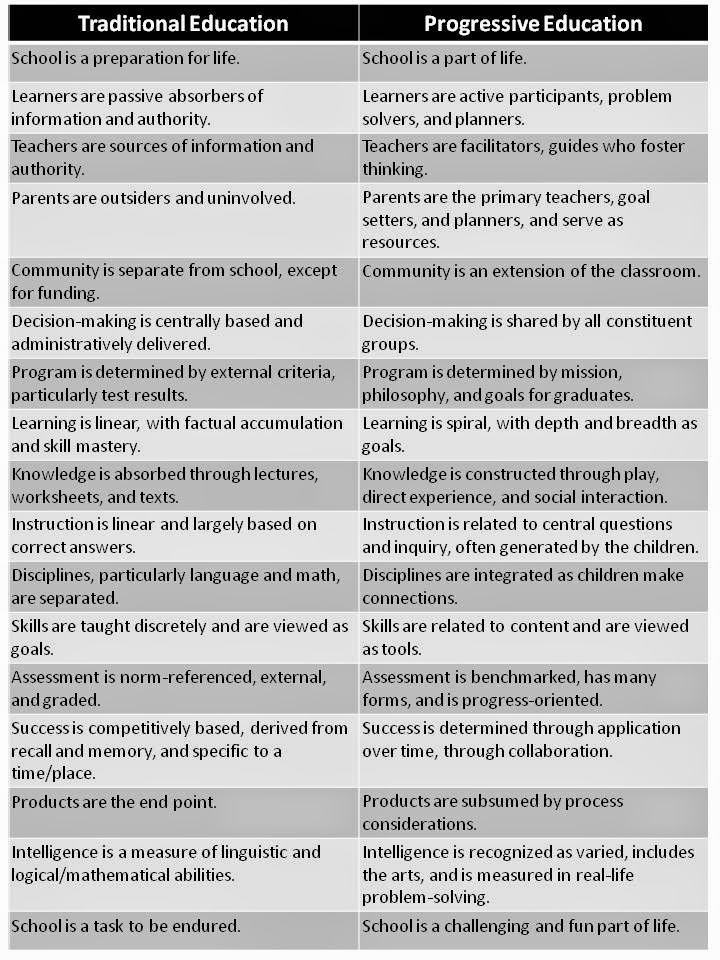
In yesterday's post entitled 'The Battle for Education', I showed a chart that characterised two opposing educational philosophies - traditional and progressive. I argued that educators are in a battle over how education is conducted, and this will determine our children's futures. Often, the differences between the two philosophies determine how students are treated, how they are assessed and ultimately, how they view their education and their own achievements.

Some comments on Twitter and on my blog have suggested that the binary between the two positions is unhelpful. There have been arguments that teachers switch between the two positions according to context. I'm not denying either of these two kinds of argument. But I will say this: it matters not whether or not individual teachers switch between modes, what matters is that there are indeed two opposing philosophies, and they both heavily influence the way schools are run. The tension between the two stances has previously caused disagreement, and will continue to do so, among educators. A binary does exist, and if leaders of schools subscribe to say a traditional approach to education, generally the school they manage will tend to follow that pattern of delivery. I have visited schools that are fully traditional in their approach and I have also been to schools where the ethos is wholly progressive. The differences are stark. Individual teachers do have a choice to determine their approach in the classroom, but realistically, these choices are limited, particularly if they are expected to tow the party line of their leadership.

One of the most marked distinctions between traditional and progressive approaches - and a battle line that will play increasing importance as the debate continues - concerns the role of the teacher. In the purest format of traditional education, teachers act as experts who deliver content to their students. They generally take a position at the front of the classroom and this is where all the action takes place. The whiteboard and other teacher resources are located here. Students are physically oriented toward this position by carefully planned seating. They are expected to pay attention to the expert, and learning is largely passive. The teacher's responsibility is to ensure that all students receive the same knowledge, at the same time. Later they are assessed on what they have remembered, and are given a grade to show how well they have been able to do so.

By contrast, progressive education views the role of the teacher as a co-learner. The teacher may be a content expert, but the most important part of their role is to facilitate learning of that content rather than simply to present it. This might involve active forms of learning where students discuss, explore through making and through solving problems. In progressive education approaches, teachers stand back and avoid the delivery of content as much as possible, creating an environment within which enquiry can be undertaken and where students generally assume more responsibility over their own learning. Assessment of learning in progressive education is more likely to be assessment for learning. This focuses more on individual progress than to measuring performance against a specific set of norm referenced criteria.

Again this is a simplistic characterisation of the two positions and there are bound to be more objections, but the definitions of roles above resonate with my experiences of recent school visits. This is by no means a complete argument. You can see them as notes in an ongoing series of thoughts about how education is being shaped and how this will play out in the continuing battle over our children's futures.

Photo by Shakata Ga Nai on Wikimedia Commons

Creative Commons License
Battle lines by Steve Wheeler was written in Plymouth, England and is licensed under a Creative Commons Attribution-NonCommercial-ShareAlike 3.0 Unported License.


March 23, 2015

The battle for education

Education is underpinned by several philosophies, some of which are incompatible. As a result, there are many educational approaches, a myriad of theories and a bewildering number of perspectives. My students are currently grappling with this problem, as they seek to answer the essay question: 'who should define the curriculum?' To answer such a seemingly simply but deceptively complex question, they need to spend time exploring a number of philosophical positions, and two in particular:

Socrates was an idealist, believing that reality is subjective, and that it is represented differently in each human mind. In the idealist perspective, reality is personally constructed by the individual, learning is also believed to be constructed, and all meaning is therefore negotiable. In Socratic discourse, no destination can be arrived at, nor can a definitive answer be found to any question, but other questions are generated and discussed. Social constructivist theory clearly derived from this set of tenets. Alternatively, Aristotle, an acolyte of Socrates' student Plato, subscribed to the realist perspective, believing that reality is objective. From these ancient roots grew two separate and opposing philosophies on how education should be conducted. Aristolean realist theory became the basis for behaviourist beliefs that content was central to education, under the control of experts. Adherents of behaviourism also argued that observable and measurable behaviour was central to understanding learning, giving rise to standardised testing. One the opposite end of the spectrum, Socratic idealist philosophy heavily influenced constructivist and humanist approaches to education, which privileged the learner at the centre of the process, and emphasised the importance of the student making meaning. Progressive educators see teachers as co-learners who work alongside their students, rather than experts who control content. A battle of words and ideals is raging about which is the most effective, and indeed, the most appropriate approach to adopt for the needs of today's society.


The chart above (my design), comes courtesy of Wingra School in Madison, Wisconsin is derived from the work of a number of educational theorists. It highlights several key counter views between the two positions, and is quite revealing. It shows where the battle lines have been drawn. Have a look at the list and see which one you subscribe to the most - are you a progressive or a traditionalist?

Photo by Stuart Pilbrow on Flickr

Creative Commons License
The battle for education by Steve Wheeler was written in Plymouth, England and is licensed under a Creative Commons Attribution-NonCommercial-ShareAlike 3.0 Unported License.


March 21, 2015

Making connections

One major phenomenon of the last decade has undoubtedly been the global and exponential rise of social media. Seeded at the turn of the century, the social web phase of Internet development promoted connections, participation, networked sociality. It didn't take long for the emerging social networking services to gain massive worldwide subscriptions. To be able to connect to others and to share ideas and content instantly, caught the imagination of many. Van Dijck (2013) calls this phenomenon the culture of connectivity, but it has been spoken of by many others including Jenkins (2006) who argued that the prevailing culture was convergence - where old and new media combined to create new and distinctly different social contexts. Manuel Castells (2012) remarked on the autonomous nature of social media, and how ideas and other content can be amplified across vast networks, reaching huge audiences in seconds. News of world events on Twitter and other large social media platforms have often stolen the march of the mainstream media, reaching hundreds of millions of people several hours ahead of any major media breaking news announcements. The social web truly is a powerful communication technology.

This is one reason why teachers and other professionals should get involved. We are no longer in the age of isolation. Professionals should never be isolated, and that is why, in the past, conferences and symposia were organised, professional societies and associations were established. Now, in the social media age, anyone can connect to a worldwide network of professionals with similar interests to their own. They can share their ideas, concerns and triumphs, and gain feedback. A vast array of user generated content, much of it very useful, is available for free use on numerous sites, including YouTube, Flickr, Vimeo and Slideshare. Teachers need not feel isolated any longer. Simply connecting into the appropriate community of practice is enough to assuage any feelings of loneliness. You are no longer alone, but it's a matter of choice for each of us as to whether, or how, we engage. As Carl Jung eloquently put it: 'Loneliness does not come from being alone, but from being unable to communicate the things that seem important.'

References
Castells, M. (2012) Networks of Outrage and Hope: Social Movements in the Internet Age. Cambridge: Polity Press.
Jenkins, H. (2006) Convergence Culture: Where Old and New Media Collide. New York: New York University Press.
Van Dijck, J. (2013) The Culture of Connectivity: A Critical History of Social Media. Oxford: Oxford University Press.

Graphic by Ashley Knight

Creative Commons License
Making connections by Steve Wheeler was written in Istanbul, Turkey is licensed under a Creative Commons Attribution-NonCommercial-ShareAlike 3.0 Unported License.


March 17, 2015

Unevenly distributed

It was a great pleasure to speak at the opening plenary session of INTED 2015 in Madrid earlier this month. Over 600 delegates from more than 70 countries attended, and I shared the platform with TED Talks veteran and technology innovator Charles Leadbeater. Below is the video of my presentation, entitled 'Digital Futures; Mind the Gap!' I have given a similar talk before, notably at the FOTE Conference held last year in London, but I have added some new content and discuss the perceptual gaps between teachers intentions and student expectations. I believe that this will become an important gulf to bridge in the coming years, as new learners enter the gates of universities and demand more in terms of technologies, new pedagogies and support. Topics dealt with include mobile learning, new communication cultures, the flipped classroom and change management. Best quote of the presentation has to be that of Canadian author William Gibson who once said: 'The future is already here - it's just not evenly distributed.' The many divides in society, especially the digital ones, tend to maginalise some as others benefit. But for me, the greatest uneven distribution is that teachers and students think differently. They often have different agendas, power structures and contexts, and within some form of reconciliation, education will never be fully equitable.


Photo courtesy of INTED 2015

Creative Commons License
Unevenly distributed by Steve Wheeler was written in Istanbul, Turkey is licensed under a Creative Commons Attribution-NonCommercial-ShareAlike 3.0 Unported License.


March 16, 2015

10Q: Martin Weller - the battle for open

Now and then, I have the privilege to interview some great thought leaders in the field of education. I usually feature them on this blog under the banner of 10Q - ten questions. This time, I'm very happy to interview two of the keynote speakers for the EDEN 2015 conference, which will be held in Barcelona. In a few days I'll post my interview with Jim Groom, but first, here's the conversation that ensued when I caught up with The British Open University's Martin Weller.

1)      You’re currently professor of educational technology at the British Open University. What first attracted you to working in education/teaching/research, and why are you still there?

I joined the OU in 1995 just as the web was taking off. It was a very exciting time, as we were exploring the possibility of using the internet, particularly in distance education.  My field was ArtificialIntelligence, but I started experimenting with online tutor groups, producing web pages, etc and migrated into educational technology (as many people did). I chaired the OU's first big elearning course in 1999 with 12,000 students which really demonstrated the potential for elearning. I've stayed in it because it changes a lot and there are always new developments, eg I've been through VLEs, web 2.0, blogs, social media, learning objects, OERs, MOOCs, etc in this period.

2)      You wrote a book on being a digital scholar in 2011. What is digital scholarship, and why is it so important for educators?

 I see digital scholarship as a shorthand really for the intersection between digital technology, the internet and open practice. The intersection of these three offers many opportunities for changes in every aspect of scholarly practice. In the book I took Boyer's 1990 categorisation of scholarship as being discovery, integration, application and teaching, and demonstrated how each of these scholarly functions could be transformed by digital scholarship.

3)      In your experience, how has education changed over the last ten years – and have those changes been good?

I think it's a good news, bad news story. Sometimes it can seem that not much has changed and education (higher education in particular, which is my area of focus) has been very slow to realise the potential of new technologies. Sometimes this is appropriate, for instance not getting swept up in the latest silicon valley hype, but other times it's just a dismissal of any change. But I think this can underestimate a lot of the change that has taken place. It's gradual, and occurs alongside traditional practices - so we still have lectures and campus universities, which might lead you to think nothing much has changed, but parallel with this the role of blended and elearning has become mainstream practice. And we've seen a lot of innovation in the area of open education.

As to whether it's a good thing or not, I've just written a whole book exploring some of this in The Battle for Open, so it's difficult to say in a short answer. Generally I think the use of new tech has allowed education to be more flexible, and opened it up beyond the traditional notion of what constituted a university student. But there has also been some terrible hype about new developments, and technology can also been seen as a route for commercial interests to undermine the role of the university. So, it's a mixed picture. 

4)      Open online provision of courses has seen a surge in popularity around the globe with Openlearn, Futurelearn, and others. Will the bubble burst, or will this momentum be sustained? What are the success factors?

I think the hype is definitely over. But that is often when things get interesting. I think many MOOCs (and MOOC providers) will struggle to find a sustainable financial model in their current guise. But also the genie is out of the bottle in some respects. We will see them adapted and modified, but what the MOOC interest has done is raise the profile of open education and elearning in general, so increasingly universities and governments will look to this as a model.

5)      What is your response to the criticism of MOOCs (e.g. large scale dropouts, superficial learning)?

I think it is easy to be snobbish about MOOCs. It's nearly always a good thing to have people engaged with learning - it's better than having a population sitting around watching reality TV for instance. But equally the MOOC proponents have to take those criticisms seriously. MOOC dropouts are a real issue - at the Open University we've known for a long time that students really require a lot of support if they are to succeed. This is particularly true of the sort of learners you might want to reach with MOOCs (people who cannot access normal higher education for instance). If MOOCs are only good for experienced learners then they won't offer much of a solution.

6)      There has been at least 20 years of research into online learning, and over 40 years of research into distance education. How much of this is relevant to MOOCs, or are they a game changer?

They're a game changer in that they have made people who make decisions and have funding pay attention, but in teaching and learning terms they offer very little that we didn't know already. Apart from some of the more experimental ones that employ connectivist or rhizomatic approachesfor instances, they are fairly limited in terms of pedagogy. It has been mildly entertaining to see many of the MOOC companies making 'discoveries' of things that we have known for ages (eg that students require support). But I think they have raised the profile of elearning, particularly with the entrance of prestigious universities into the area, and that changes the whole landscape.

7)      What do you think will be the next big thing in education? Will we see something new that will transform the learner experience, or simply more of the same?

I don't do predictions anymore! I think it's been a while since we've had a real 'big thing'. MOOCs made a lot of noise, but compared with the impact of the web 2.0/social media developments of the late 00s this was quite small scale. I think we are entering a phase of many different technologies becoming more sophisticated and more integrated into education eg mobile learning, social media, learning analytics

8)      What three things should educators be made aware of right now?

I think the general move to openness - MOOCs, OERs, open access, digital scholarship, open data - all these things are part of a bigger picture.  Related to this the nature of academic identity online, and how that relates to traditional practice. Analytics - good and bad uses of this.

9)      What will be the main theme(s) of your keynote at EDEN Barcelona?

I'm going to explore some of the issues around the battle for openness.  

10)   What gets you out of bed in the morning?

My two dogs need to go out the back garden and let me know :)


I feel very fortunate to be in a field (educational technology) and living through a period that it witnessing such rapid and large scale change. Regardless of what you think of MOOCs for instance it was fascinating to watch how they came from nowhere and saw such rapid growth, and then criticism. Being able to both participate in this field and be a recorder, researcher of it is exciting.

Read Martin's blog, the EdTechie.

Photo courtesy of Martin Weller

This interview is mirrored on the EDEN Conference Website

Creative Commons License
10Q: Martin Weller by Steve Wheeler is licensed under a Creative Commons Attribution-NonCommercial-ShareAlike 3.0 Unported License.


<< Back Next >>