Log on:
Powered by Elgg

Tracy Swallow :: Blog

February 07, 2010

Week 3 – Update on game experience

While I did not enjoy the arcade games, I have enjoyed Solitaire, Tetris and Columns and this week Mahjong and Bookworm. I haven’t had a chance to play Scrabble yet but that is a game I have played since I was a child.  I also have always played Solitaire as well as puzzle games such as crosswords and sudoku.  I like to look for patterns and also having some time to reflect, although all the games had a timed element but I didn’t find them as frantic as the arcade games.

I didn’t realise how complex Mahjong was – I was concentrating on clearing all the tiles. I did notice the scoring but didn’t understand it. It wasn’t until Anna directed us to the link explaining the rules and the different suits you could make that I realised the complexity. But I am quite happy to play it on a simple level. I think I could get into it, and slowly learn the different suits you could make and think more strategically.

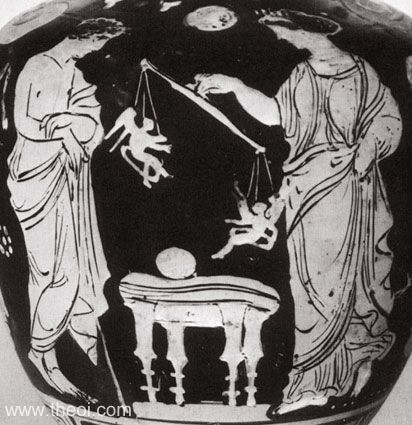
I never gave much thought before this course about defining what is ‘play’.  I think I just thought of it as a negative – the opposite of work. But I enjoyed the Kane and Sutton-Smith readings. I liked the focus on the different rhetorics of ‘play’ and situating them within their historical and/or scholarly context.  In particular, I find interesting the tension Kane points out between ancient (fate, chance and community) and modern rhetorics (freedom, progress and imagination).  As Kane says, there is a paradox:

To be a player is to try to live and thrive between freedom and determinism, chance and necessity. P. 40
vs.

I am not sure, though, how much the modern rhetorics are free of fate and determinism.  Progress can be seen as deterministic – particularly following Piaget - that there are stages of development that a child must go through.  Intertwining this developmental approach with play, turns play as something inherent in our genetic makeup, something we do not have control over.  Rather than being the ‘playthings’ of the gods, the child is a ‘plaything’ of his/her genetic make-up. Kane does touch upon this in saying that there is a tension between the modern rhetoric of play as progress –something that is hard-wired in our make-up and the modern rhetoric of play as imagination.  But Kane talks about our biological urge fusing with our creative imagination.  But where does our creative imagination come from? It comes back to the age old debate of nature vs. nurture.  But instead of posing fate and freedom or nature and nurture as oppositions, shouldn’t they be seem as a kind of continuum – in some areas we have more control than others. Or should they be visualized as concentric circles with freedom within fate/ or nature.  That we have certain ‘room for manoeuvre’ within a certain context.  Hence, our genetic composition or social circumstances at birth are fate or beyond our control.  But within that context, we have some freedom in the ‘raw material’ we have to start with.  And isn’t that what happens within game?  There are rules that are given but within the context of rules, we have some control over how we play the game.

Kane brings an interesting dimension into the discussion of play – considering what is ethical play. 

by dignifying our play with an ethical force, we can begin to create and act, rather than simply consume and spectate p. 62 

I think his choice of the term dignifying is revealing.  It seems he is countering the interpretation of play as being frivolous.  But there is also a moral dimension in his argument which is a critique of what he sees as the dominance of Western consumer-oriented society.

References

Kane, P. (2005) Chapter 2, 'A General Theory of Play'. In The Play Ethic : a Manifesto for a Different Way of Living. London, Pan. p35-6

Sutton-Smith, B. (1997) Chapter 1, 'Play and Ambiguity'. In The Ambiguity of Play. Cambridge, Mass: Harvard University Press.


Posted by Silvana di Gregorio | 0 comment(s)

January 31, 2010

Last week I was frustrated by the arcade games I was playing.  I realized that they weren’t just random and that there were patterns but I couldn’t quite make out the patterns. At one point, I stopped the Pacman to see if I could discern a pattern in the behaviour of the ghosts (without any success!). Having read Greenfield now, I realise that was the wrong strategy. The strategy is not in identifying a pattern in just one element of the game e.g. the ghosts – but the pattern depends on the interaction between the ghosts, the pacman and the board itself.

I was starting to ‘feel’ that some parts of the board were more dangerous than others.  But I did not have the patience to pursue and investigate that feeling. I think it does have to do with learning styles – as Emma mentioned on the Discussion Board.  Thinking of Kolb’s learning cycle, I think arcade games would favour those who prefer an active experimentation style.  I, on the other hand, have a more reflective learning style and the sheer speed of the games does not allow any time for reflection. 

James Paul Gee’s account of the view that videogames are a waste of time as they have no content has resonance with the views expressed by my friends including my husband.  I never held that view myself mainly because I have no experience of those games.  Gee argues elegantly that a semiotic domain is not just content but...

”a  lived and historically changing set of social practices. It is in these social practices that 'content' is generated, debated and transformed via certain distinctive was of thinking, talking, valuing, acting, and often, writing and reading. “p.21

For people who have never engaged in playing videogames, the ‘silliness’ of the content is an easy target.  But Gee demonstrates that a lot of learning can be acquired in well-designed games. If a game is actively and critically played the player:

·         Learns to experience in a new way

·         Gains the potential to join and work with a new affinity group

·         Develops resources for future learning and problem solving in related semiotic domains

·         Learns to think of semiotic domains as design spaces that engage and manipulate people in certain ways and help create certain relationships in society among people which could have social justice implications

The key to critical learning is the ability of the player to be able to reflect on, to critique and manipulate the design grammar of a game at the meta level.  This requires looking well beyond the content of a game – but how it is structured, what elements it has, the characteristics of these elements, how it is similar and different to other games of this type. 

Gee sees the value of videogames in that they:

“...situate meaning in a multimodal space through embodied experiences to solve problems and reflect on the intricacies of the design of imagined worlds and the design of both real and imagined social relationships and identities in the modern world.” p. 48

The player learns to think critically about the simulation and thus gain literacy of multimodal spaces.

Gee points out that the key is not questioning the ‘content’ of games per se but whether it is worth spending time pursuing the semiotic domain of a particular game.  And the questions he poses are ones of value judgements:

·         Is this a good way to experience the world?

·         Is this a good and valuable affinity group to join?

·         Are these resources for future learning applicable to other good and valued semiotic domains?

  • is this domain leading the learner to reflect on design spaces and their intricate relationships to each other in ways that could lead to critique, innovation and good and valued thinking and acting in society? 

In the beginning of the book, Gee argues that even violent video games can be valuable. And I can see that he is thinking beyond the actual content.  But in terms of the value questions he poses, I feel there is a contradiction here. I have not read yet what he says in particular about violent games but Greenfield indicates that it is action rather than violence which children find attractive.

References

Gee, J. P. (2003) Chapter 2, 'Semiotic Domains: Is playing video games a "waste of time"?'In What video games have to teach us about learning and literacy, New York: Palgrave Macmillan. (core textbook)

Greenfield, P. M. (1984) Chapter 7, 'Video Games'. In Mind and media : the effects of television, video games, and computers. Cambridge, Mass: Harvard University Press


Kolb, D. (1993). The process of experiential learning. In Culture and processes of Adult Learning. M. Thorpe, R. Edwards, and A. Hanson (Eds.). (Buckingham, OUP): pp. 138-156


Keywords: Gee, Greenfield, IDGBL10, Kolb, semiotic_domains

Posted by Silvana di Gregorio | 1 comment(s)

January 24, 2010

This is a reflection on this week’s reading, my experience of playing the platform games of this week, and how I am relating it to my own work on supporting qualitative analysis through the use of software tools such as CAQDAS e.g. ATLAS.ti, NVivo, MAXqda etc.

I found Whitton’s thesis that good learning activities share similar characteristics to games as illuminating.  While a game may have more or less of the characteristics she defines – competition, challenge, exploration, fantasy, goals, interaction, outcomes, people, rules and safety, so too, can learning activities share some of these characteristics.  She acknowledges that some of these characteristics need to be understood with caution when applied to education e.g. safety is not usually relevant as the outcome of a course will have real-life consequences – however, safe activities can be constructed to aid learning e.g. in this module, our contribution to the discussion board is not graded but people use it as a way to test their ideas.  Her premise is that we as educators can learn from good game design and I look forward to reading more of her book.

Newman’s discussion about the context of where games are played helped me understand my frustration with the platform games we played with this week – Pacman, Donkey Kong and Frogger.  They were originally arcade games, designed to be played on coin-operated machines to generate money for the arcade owners.  Given this function they can’t last that long.  But also playing them was a public performance and observers could learn about patterns and tricks by observing how others played.  The noise, which I found irritating when I played (I turned off the sound), was an essential attraction of the games. Newman reminded me of the arcade halls in British piers – Brighton is the one I know.  And the sound of the games and the flashing lights was a way to attract kids – it made the pier an ‘exciting place’.  There are quite a few Youtube videos on arcade games and there is a big nostalgia for them.  The comments on the Youtube videos below support that. I am of a different generation so missed out on playing games in arcades.  My step-children did (and my daughter is of another generation yet again).

A more polished tribute to arcade games.

In relation to my own work, Newman’s discussion around paedia and ludus is pertinent.  I do consulting and training on supporting people who are analyzing qualitative data (i.e. unstructured data, such as indepth interviews, videos, graphics etc.)  I have always talked about ‘playing’ with the data when starting an analysis.  The CAQDAS software platforms I support can be seen as ‘playgrounds’ where the data is located and can be played with.  Although I am currently exploring (and have recently published an article) on how Web 2.0 tools have the potential to do the same.  There is a tension though, particularly with new students, between wanting and needing rules and the freedom to play.  But this tension is also apparent in different epistemological stances towards data analysis. In particular, those of a post-modern turn have been turned off these software tools because of a belief that they impose some rigid structure – are rule-bound in some way – whereas in fact they are flexible generic tools that the analyst decides how to use – much the same way Newman argues that the player has control over moving between paedia and ludus.  While I have always thought of qualitative data analysis as about playing with the data, I never thought of the platforms as similar to games before.   This week has given me a lot to think about!

 References

Newman, J. (2004) Chapter 2, 'What is a video game? Rules, Puzzles and Simulation'. In Videogames, London: Routledge.

Whitton, N. (2010) Chapter 2, 'Recognising the characteristics of digital games'. In Learning with Digital Games: A practical guide to engaging students in higher education, London: Routledge.

Keywords: videogames definitions pacman donkey_kong frogger platform_games Whitton Newman arcade_games IDGBL10

Posted by Silvana di Gregorio | 0 comment(s)

January 20, 2010

I experienced a combination of compulsion and frustration playing Pacman, Donkey Kong, and Frogger.  The compulsion was that I kept going – replaying the game, thinking this time I will get through to the next level.  Frustration was when I nearly made it but not quite.  I also experienced a kind of recklessness when I was close to completing a level – just rushing in to finish it instead of calming down and taking my time to finish.  There is definitely a physiological response – I found myself holding my breath, feeling slightly anxious and the adrenalin pumping around my body.  It was totally immersive but I partly resented this immersiveness.  The resentment is due to feeling that I was ‘wasting my time’ playing these games – although having to experience them for the course did give them a legitimacy for me. 

Newman looks at why do players play. He  cites Rouse’s key motivations: challenge, immersion and the fact that players expect to do, not watch.  Certainly, I have experienced the immersion.  It is interesting what Newman (2004) says about ‘challenge’ – that players expect to lose.  Maybe that is why I find them so frustrating – I don’t expect to lose (but I keep losing).  The pleasure he claims is through replaying and practicing until the performance gets better.  For me these platform games are too simple – in that I find the repetition too boring. Maybe I would enjoy it more if the rewards were more ‘real’ – rather than just getting to the next level.  Although I expect I would get elated if I ever make it to the next level.

 Newman, J. (2004) Chapter 2, 'What is a video game? Rules, Puzzles and Simulation'. In Videogames, London: Routledge.

Posted by Silvana di Gregorio | 2 comment(s)

January 18, 2010

“Mum, you’re not playing a game!”, my eighteen year old daughter exclaimed when she suddenly came into my study.  I quickly showed her my Digital Game-based Learning course book and explained that it was a module for my MSc in E-Learning course.  I think that sums up my starting point with games – playing games is not something associated with me and I am embarrassed to be caught playing a game!  
I was playing PacMan and it was the first time I played that game.  I was successful in getting to Level 2 at my first attempt but I did not realise that when I ate a large sphere and the ghosts turned blue that I could try to ‘eat’ them to earn extra points. I only learned that (and the fact that those things were ghosts) by later googling to find out more about the game. [Note: My getting to stage 2 at my first go was just beginners luck. I found it more difficult subsequently!]

I had a harder time with Donkey Kong.  The up key did not appear to work when I tried to make the man climb the ladder so I decided that I would have to make a number of points jumping over barrels before I could make it to the next level. But that did not seem to work. I got very frustrated and would have given up if I were not on the course. So again I googled ‘Donkey Kong pattern’ and gathered that the man could go up the ladder.  I realised that he had to be positioned exactly in front of the ladder in order to go up it.

Having done some of the initial reading about the definitions of digital or videogames, I realise that I have played some before. In particular, I have played minesweeper on my phone as well as brick???.  And I have played solitaire on my laptop.  I never thought of them as digital games – mainly because I didn’t play with anyone else – they were solitaire games. (And yes, I just used the word ‘game’.)  But I did not go out of my way to get those games – they came with my phone/laptop and I only played them when I was in transit when I was tired of reading.  But I enjoyed playing them (as long as no one I knew saw me playing them!).

Keywords: Donkey_Kong, IDGBL10, Pacman

Posted by Silvana di Gregorio | 1 comment(s)

November 26, 2009

1) Don't panic

2) Remember the tips Rupert gave me in handling the paper and creating sharp accurate folds

3) Determine what is required to create 1) Dragonfly and 2) Beetle 

O.K so I have just looked them up and they both require the waterbomb base. The good news is that I managed to create a water bomb base after I had completed the duck, but I had found the instructions difficult to follow and was put off with just creating a whole series of bases. It is like everything though a thorough grounding with the basics allows one to develop, build and blossom. So the plan is to do some fairly simple folds that are used in the book as an introduction. Then create the flapping bird; I will then perfect the water bomb base and after this attempt to make the dragonfly. Once the dragonfly has been achieved I shall review where I am and make a decision on what to do next.


I am doing some baby sitting on saturday night so I shall see if I can show them how to make some origami models.

Posted by Nicholas Palmer | 0 comment(s)

It has been a long time since I did anything with origami. Two things happened 1) I became somewhat disillusioned with what I was achieving and 2) One of my stepsons recently showed me how to create a a flapping bird. Rupert made an interesting observation about the book I had chosen to learn from basically it was not the easiest set of  diagram to follow and even he (with his current knowledge) would struggle to complete the flapping bird from the book. Rupert is fairly competent and feltb that I had given myself too big a target with the Dragonfly (which he can do) and the Beetle (which he can't do). I think the beetle is probably a step too far however the dragonfly will be done.Rupert suggested that I did the flapping bird and then looked at where to go next.

I didn't plan out the steps I was going to take to work methodically to the target designs. I actually thought I would learn all of the bases and then work from there, the problem with this is that you don't get any sense of achievement when you create a base not in the way you do when you have a recognisable shape.

I should have referred to more than one book because since his comment I have found that the way diagrams are annotated to create designs are slightly different and that some of the directions are easier to follow than others.


So I need to come up with a plan to successfully achieve my goal.


Posted by Nicholas Palmer | 0 comment(s)

October 12, 2009

The next things to learn were same basic bases, a waterbomb base and a blintz base. I managed to make one of each but they were pretty tatty. I only tried to make them using the large paper squares. I decided to give up wilst I was winning and have another go tomorrow.

Keywords: Origami

Posted by Nicholas Palmer | 0 comment(s)

I have become a little fed up with not quite being able to follow through the diagrams and instructions. I therefore spent some time going back through the beginning of the book to make sure that I understood the symbols and what they stood for. After I had done this I tried to create a basic duck with the large paer. This was successfull, I tried again and it seemed as though things were falling into place so I tried to create a basic duck using smaller paper. It worked, so I tried some more. After a few more successes I decided to go back to making them with the larger paper and the next one was to become a base for a complex duck.

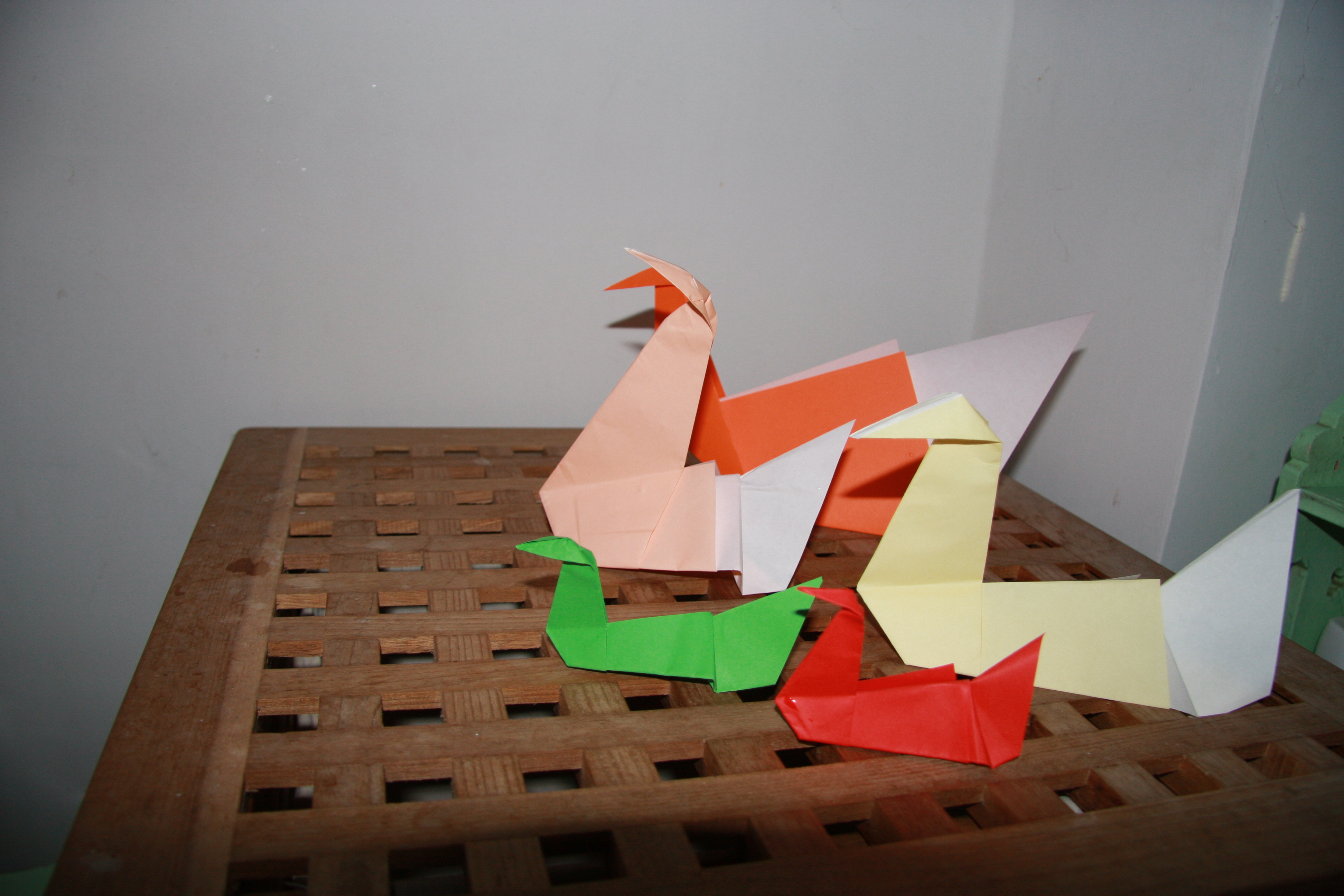
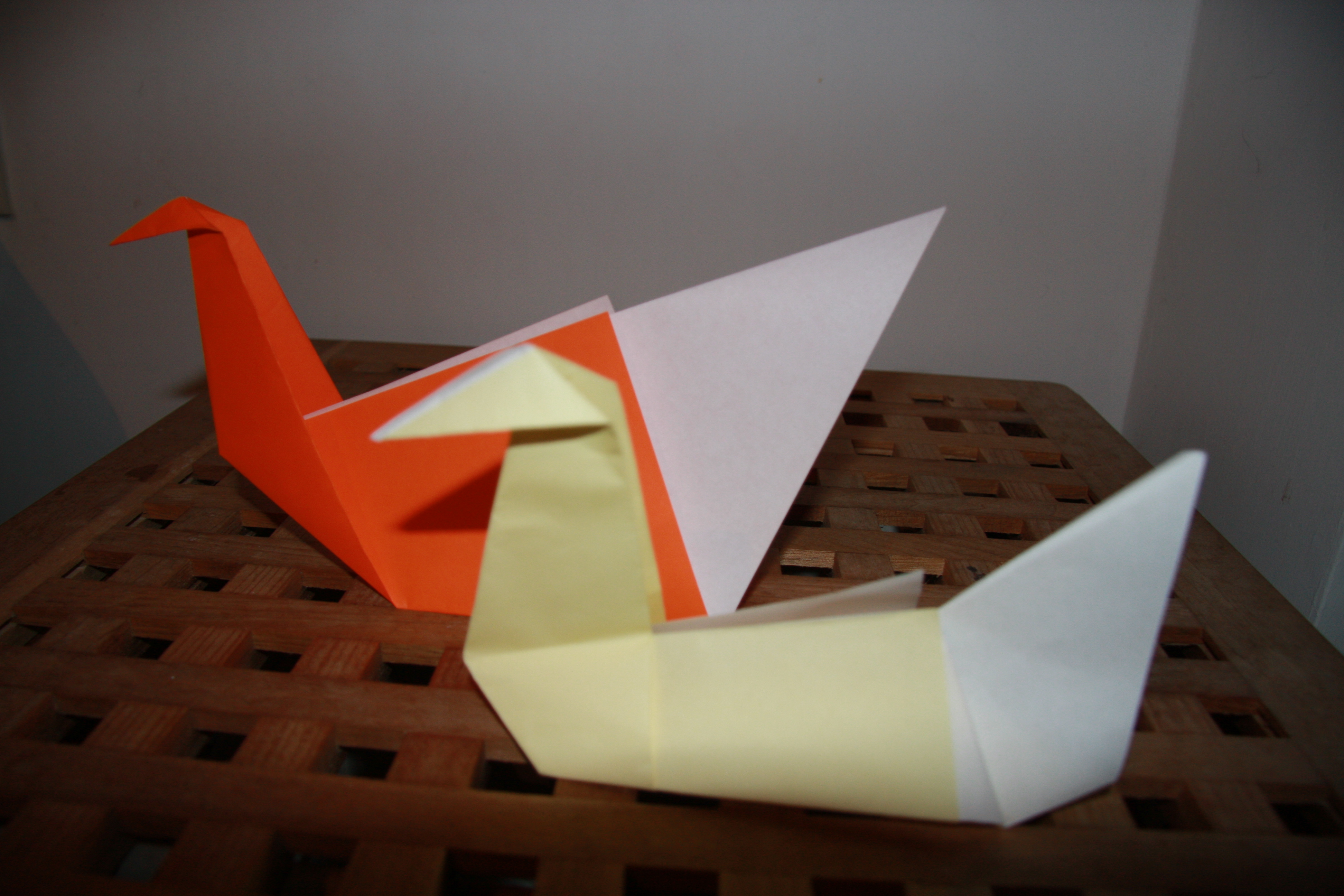
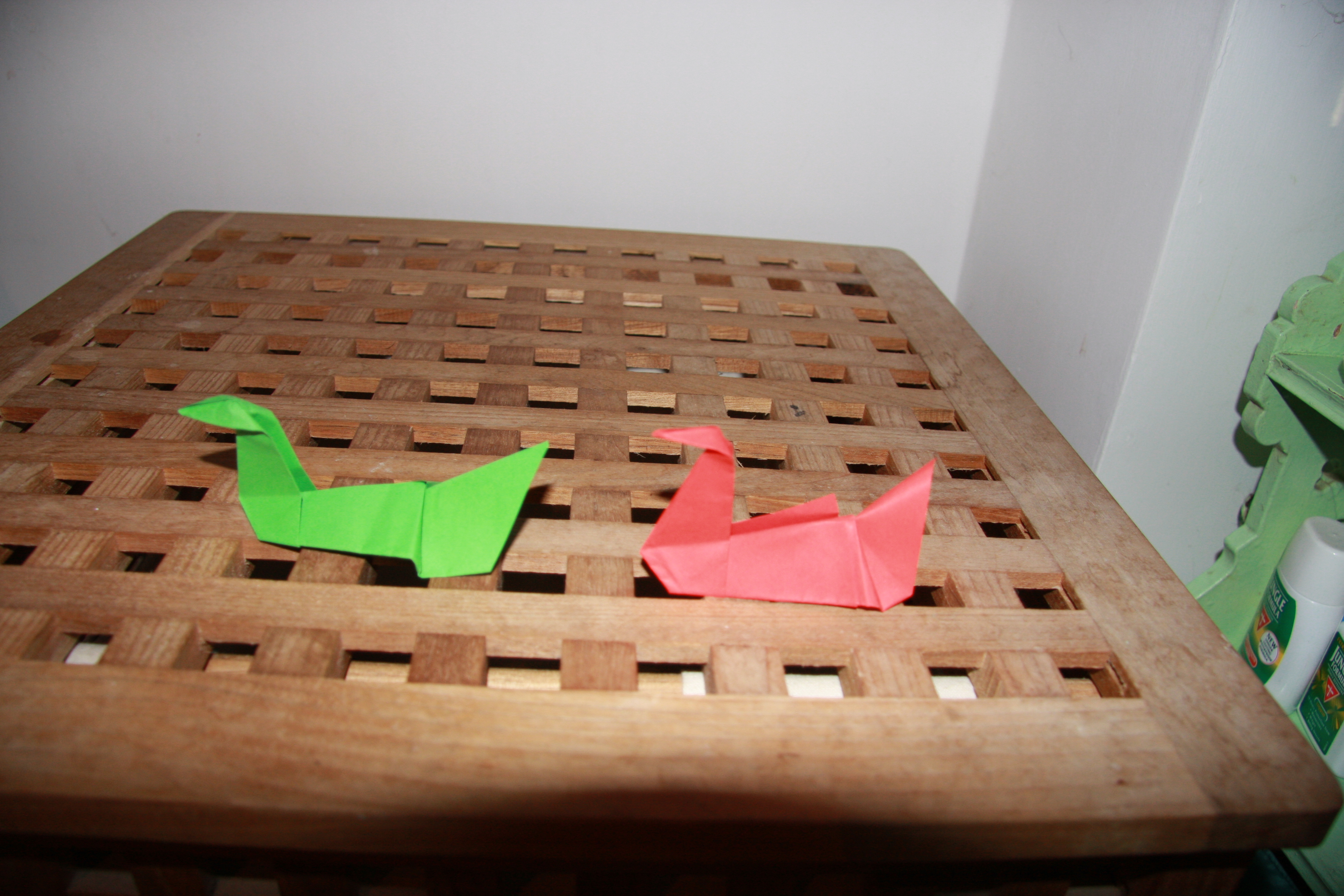
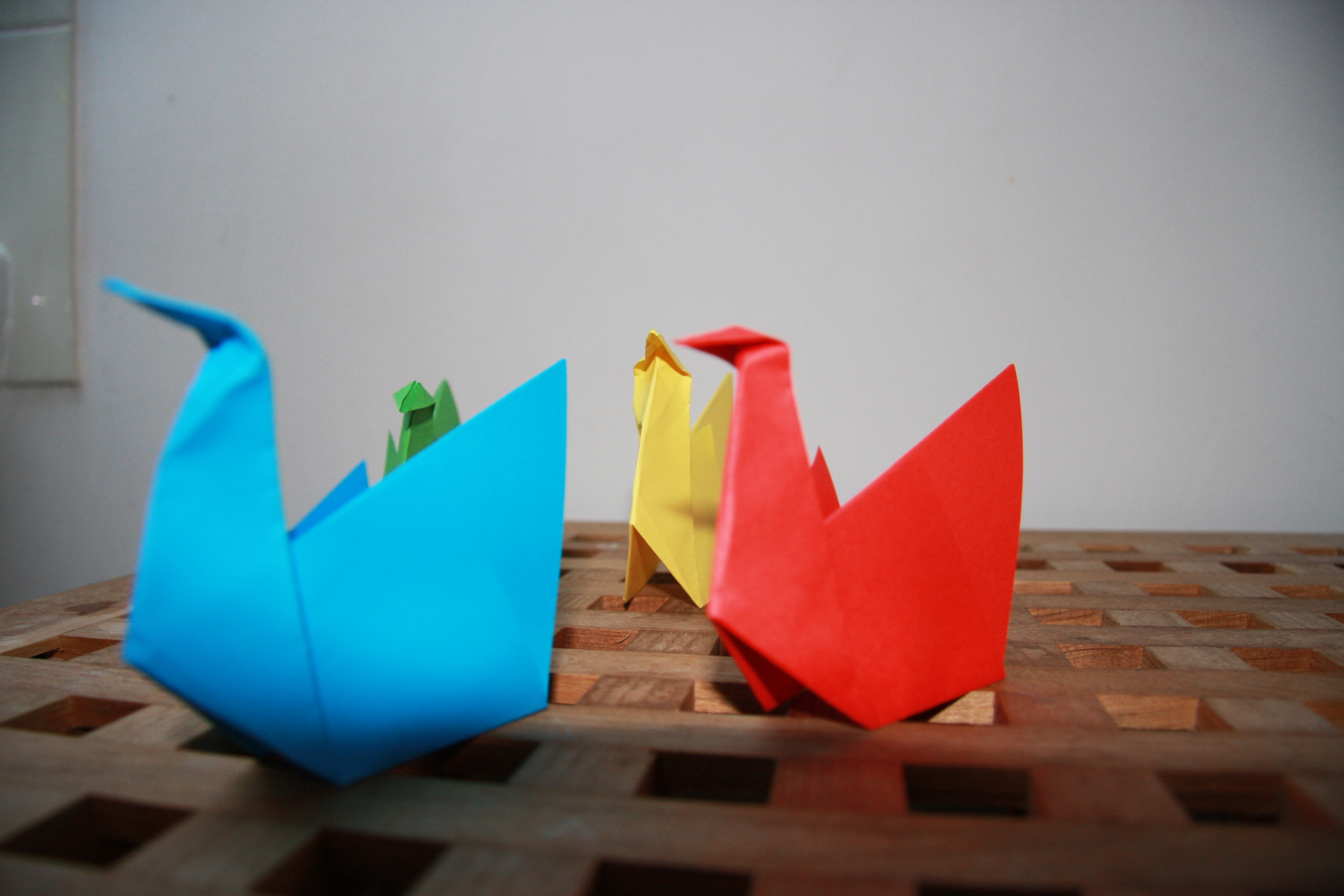
                      The pictue here shows some simple ducks that have been made out of small and larger paper squares.


So I started to create the next basic duck and found that at the stage where I was to make the first fold to create the ducks neck that I had folded it in the wrong direction which meant that when I tried to fold the neck it tried to develop in the wrong way. I managed to find where I went wrong by comparing a successfull model with the one I was having problems with. I also used the pictures to compare the folds and saw my error. Once idnetified the error was very easily corrected. I created an almost perfect basic duck. I then went through the diagrams and suddenly saw correctly how the folds should go and how it all fell into place. I put this all down to the time I spent making sure I understood the symbols and could relate the diagrams to the actual folds.

I found that after all of the initial hassles that I was able to create a complex duck. The first one had a slightly wonky tale but was a much better effort than any I had previously done.

After I made another with the larger paper and it was almost perfect. I then tried with a smaller piece of paper and was really happy with the results. In order to reinforce the process I made several large and small complex ducks and was pretty pleased wit myself as a result.

small basic ducks


a mixture of small and large complex ducks.


More detailed pictures 1) Large ducks of each type 

Small complex ducks in more detail 


Keywords: Origami

Posted by Nicholas Palmer | 0 comment(s)

October 07, 2009

Why on earth did I take up this challenge? I continued with the simple/complex duck. I made an attempt at the complex duck - a stage on from the simple duck and felt good. It wasn't quite right I seemed to be misunderstanding the final step. I then tried to do it again and found that I was struggling to complete a simple duckl. After four pieces of wasted paper I decided to give it a rest.


The positive that has come out of this is that I am feeling confident handling the paper to complete the kite base it feels as though I know what I am doing. It is very straightforward and to be honest I should be feeling confident by now as I have completed this stage a number of times. I am just hoping that I will be able to achieve more tomorrow.

Posted by Nicholas Palmer | 0 comment(s)

<< Back Next >>