Keywords: Learning Challenge, Origami


| View blog | Archive | Friends' blogs | View all posts
Keywords: Learning Challenge, Origami
Posted by Nicholas Palmer | 0 comment(s)
Well week 1 is over and we’re into week 2 and the first reflection is how I’ve failed to keep the planned blog, which I know will help me with the studying (I used one in my first module and not in the second and noticed the difference). I could link this to work being really busy too but that’s just me making excuses so here’s an attempt at encapsulating the starting points for my thinking.
Keywords: design, pscel09, questions, socialmedia
Posted by Emma King | 0 comment(s)
I worked through the introduction and this took me to a section that explained the symbols used in the book for the various folds and moves. I was able to understand this reasonably well until I came across the inside and outside crimp. Still I was reasonably confident and decided to have a go with my current knowledge.
The tips were very useful and one was to use larger pieces of paper to start with. I have two sizes of paper nine and three quarter inches sq which is coloured oneside and white the other and five inches sq (came with the book) coloured bothsides.
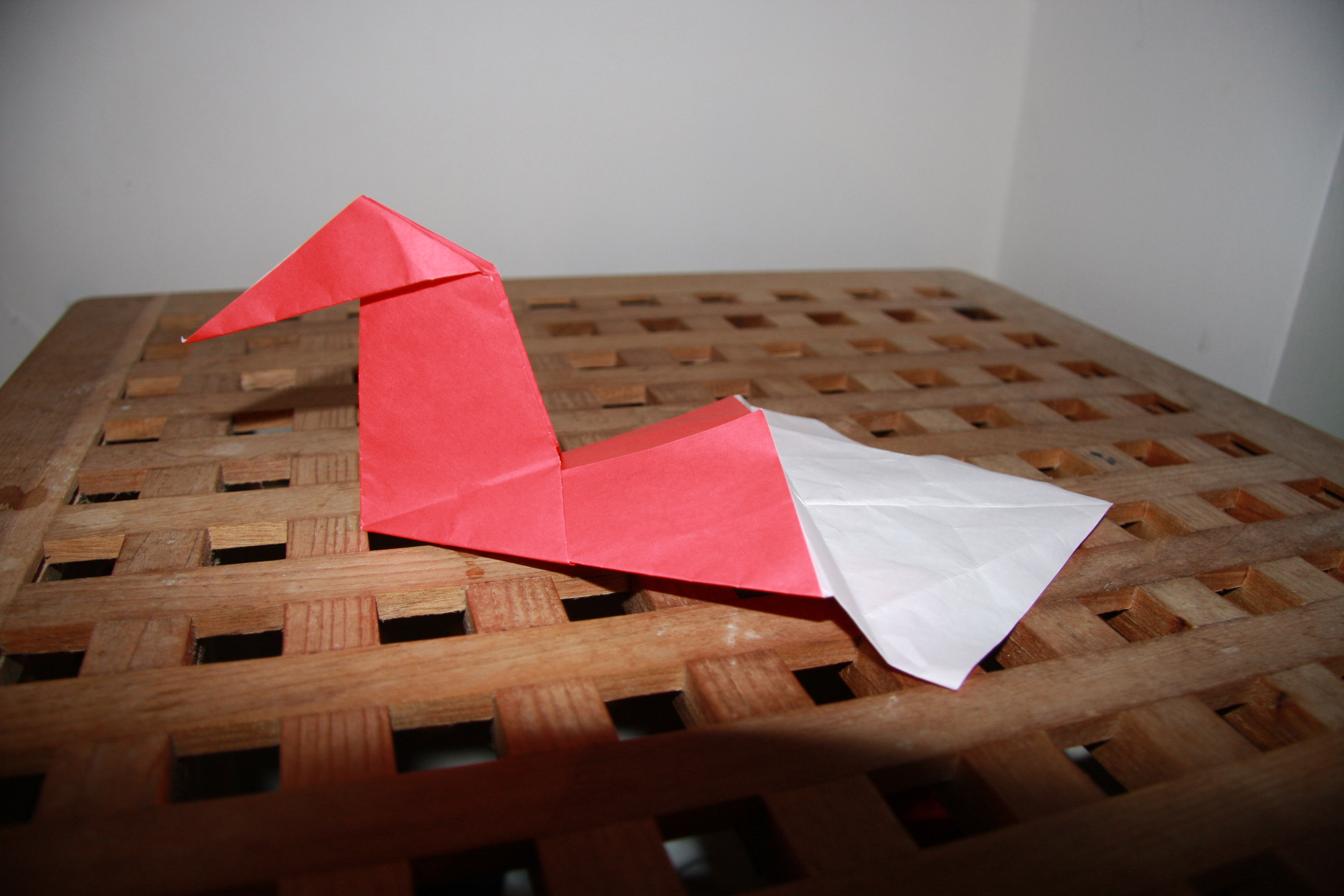
THe first thing I did was to create a kite base with the larger paper using a red piece first. After the base had been created I produced the simple duck. I struggled wioth the diagram a little but perseverance paid off and I took some photographs of the model (model taken from Origami Kit for Dummies). I then tried to create the more complex duck and this is where I was unable to fully understand the diagram at this point. After struggling for ten minutes I had a break. The overall session lasted 30 to 45 minutes and was partially successful.
The paper became vey crumpled with my efforts and I was left with a duck with a flat body, so it is time to try again.
First attempt Duck 1 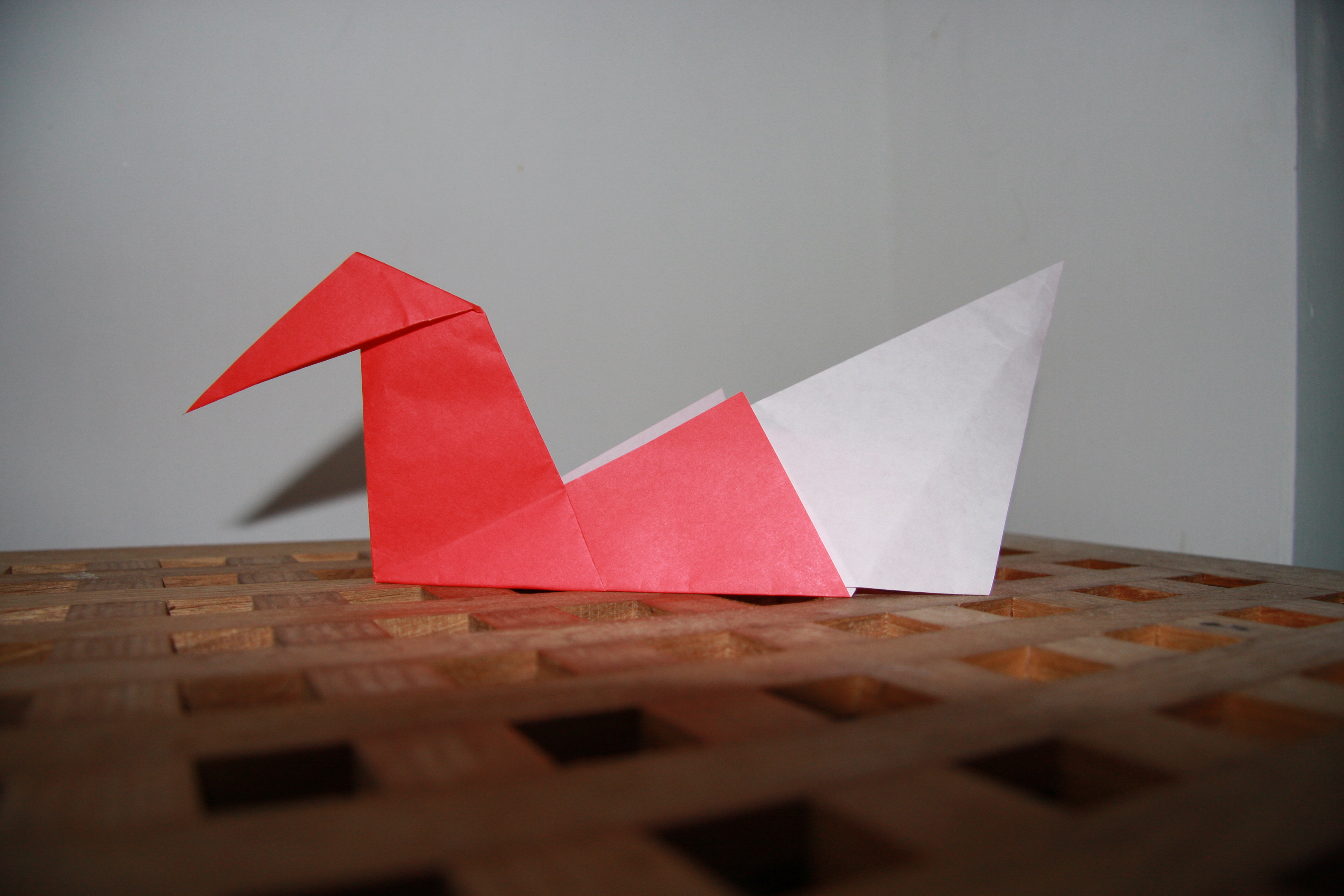
Collapsed attempt Duck 2
Keywords: Learning Challenge, Origami
Posted by Nicholas Palmer | 0 comment(s)
I am currently studying for an MSc in e-learning at Edinburgh University. I am on my fourth module which is understanding learning in digital environments. One of the assignments is a learning challenge and this blog will outline my experiences, thoughts and feelings whilst performing the learning challenge. I am going to learn how to create origami paper models. My previous attempts have got little further than paper darts or paper planesI tend to be all fingers and thumbs with these types of exercise.
I have chosen to learn how to make Origami figures for this challenge. Ther initial aim is to create a dragonfly (medium difficulty) and a beetle (challenging). I have decided to learn by 1) Working through the Origami Kit for Dummies by Nick Robinson - published John Wiley 2008. 2) websites and 3) videos from sites such as you tube.
The book is broken into three main sections
Introduction
Part 1 Coming to the crease: Basic Techniques
Part 2 Folding on: The Models
Part three: The part of Tens
I first looked atpart three which consists of three chapters 1) Ten Top Tips 2) Ten Origami Styles and 3) Ten Incredible folders ( a summary biog for ten famous Origamists)
It gave me a feel for the subject and those who excel at it. This also points the way to a number of websites which I have not looked at yet.
Lets get on with the folding!!!
Keywords: Learning Challenge, Origami
Posted by Nicholas Palmer | 0 comment(s)
Welcome to a new academic year, and to the holyroodpark.net blog space, one of the core environments for the MSc in E-learning! Please don't hesitate to get in touch with Jen Ross, the programme technical co-ordinator, if you have any questions or need any help getting set up.
Her contact details are in the technologies handbook.
Keywords: welcome
Posted by Holyroodpark Admin | 2 comment(s)
During the wiki weeks I thought I would first take a look at the approach I was grappling most with - social critical and reading Shor's education is politics article - I found it very interesting due to the many parallels with this modules approach....
It seems our tutors are quite the libertines and problem posers! - and it all lies in the chat.......
here are the connections I could relate to:
' a Freirean pedagogy tries to develop a student centred dialogue'
Some values describing the 'Freirean pedagogy':
Participatory - learning process interactive and co-operative so that students do a lot of discussing and writing instead of listening to teacher talk
Situated - course material situated in student thought begining from their words and understanding of material
Critical - discussion encourages self reflection, how we know what we know, and quality of learning process -(why do we do what we do - what personal filters or biais or previous experience guides the way we are (holistically or at any one point in time), choices we make or how we act, react and interact - a lot of interpersonal, communication, rapport and building relatonship skills in the work place also covers this - for a commercial gain however rather than a socially driven libertine reason!)
Democratic - classroom discourse is mutually constructed between teacher and student - students have equal speaking rights in the dialog
Dialogic - basic format of class is dialog around problems posed by student and teacher. Teacher initiates process and guides it into deeper phases. Teacher invites students to take ownership of learning
Desocialisation - dialog desocialises students from passivity in classroom and challenges their learned authority-dependence and desocialises teacher from domineering teacher-talk socialised into - instead they are problem posers and dialogue leaders
.........
Affective - problem posing and dialogic method includes a range of emotions from humour to compassion to indignation - and we have seen many of these emotions already within our own discourse
Shor, I. (1993). Education is politics: Paulo Freire's critical pedagogy. In Paulo Freire: a critical encounter. P. McLaren and P. Leonard (Eds.). (London, Routledge): pp. 25-35
Keywords: Conversation, Curriculum Design, Dialogue, Social Critical Approach
Posted by Alison Johnson | 0 comment(s)
Firstly you'll need to try and get back into FlashMx after a few weeks of not using it.. the shear amount of stuff you've forgotten is needed as a catalyst for distraction.
Secondly you'll need access to the internet,
Third, have something in the back of you mind that needs sorting out, in the following case it's CAD software for the Mac, at the moment is seems non exsistant.
and lastly have something really cool to do instead.
OK. the method..
Get into Flash with the following photos.
[You do not have permission to access this file]
[You do not have permission to access this file]
These are two photos of a milling machine as found in a general DT workshop.
the difference between the two photos is that one has the guard down the other up.
Fairly simple and you can see where i'm going with them.. the'll go into flash as another quick fire challeng, "whats wrong" "click it" "next level" type thing
Before they can go into flash, we need to get rid of the crap in the background and replace any white space with a transparent background, called the alpha channel... i think.
[You do not have permission to access this file] [You do not have permission to access this file]
This take about an hour to do the two photo.. quicker if you're organised, infinately long if you're not.
With these two images, open flash and get really confused... realise that you've never done this type of action before and start looking on the net for a solution, find a CAD program that is used for MAC, download it and get a pleasant surprise when you see its a Virtual Lego builder
[You do not have permission to access this file]
spend a few hours building stuff and wonder if there is anyway to up the image quality with lighting dynamics.
[You do not have permission to access this file]
Find that the program you need requires two other programs and a separate utility to expand them both.
[You do not have permission to access this file] [You do not have permission to access this file]
Get back to Flash when you realise that you're not achieving anything... although now you're thinking of different applications for the newly found software and you want to incorporate it, or at least make a Lego movie
ok so the mill..
eventually found out how to do the action by looking back at my blog and comparing notes to the past scenes I had done.
[You do not have permission to access this file]
Now I'm getting distracted by this blog....
off to play cooking mama
Keywords: distraction, flash. milling, game design, lego
Posted by Matthew Weaver | 0 comment(s)
It all started with rats in space but led to the emergence of natural born cyborgs, at least in Clark's eyes (2003).
I have just finished reading his article 'Cyborgs Unplugged' where a Cyborg, acronym for Cybernetic Organism or Cybernetically Controlled Organism, is described as being an 'entity' which captures the 'notion of human-machine merging' or 'human-machine symbiosis'.
Clark's perspective is that these sort of man-machine link ups exist already without the need for puncture, surgery and implants and that they evolve with such a natural form of integration that most happen invisibly and beneath our level of conscious awareness.
This has generated a little debate on our discussion board about machines which can find cars in car-parks and 'man' and 'specticles' working together to 'extend the brain' - it certainly leads to an interesting perspective and one which I feel we seem more attune with 'socially' or in 'everyday digital life' than 'educationally' at present.
Clark already mentions 'Amazon' (or similar services) and how it tracks an individual's reading habits... 'other people who bought the same book you are looking at have also bought the following.....'
and 'Ebay' like services which track an individual's purchasing habits..... 'you might also be interested in......' or 'do you want to see what other things the seller is selling...'
IPODs and mobile phones allow you to take photos, download personalised music and video choices and transfer treasured possesions like this via blue tooth technology (which I have not quite mastered yet but my kids have!) between friends.
We also see this man-machine integration with FACEBOOK.
Have you noticed the flags for 'mutual friends'? The ones you have 'in common' with those you have listed as friends. Or have you noticed the adverts appearing when you log in? I have skiing as an interest in my profile and I get skiing holidays advertised...... ummmmmm!
At work, the portal I log into recognises my login as staff not student and I get access to information students don't see whilst they get access to information on the courses/modules they are registered on and the faculty they reside in. We all get information on our own library borrowing accounts and records.
I can set up alerts on databases to help me keep track of new material published on areas that interest me or subscribe to RSS feeds to help me keep track of new posts to blogs or websites of interest.
Also cookies on machines also act in the same way I guess, shortening processes or recognising you when you login and therefore you do not have to remember your login .......
As Clark says....
'The more closely the smart world becomes tailored to an individual's specific needs, habits and preferences the harder it will become to tell where a person stops and this tailor-made, co-evolving smart world begins.'
This too, I think will be invisible... not so much for others to see, but how we see ourselves..........
A member of our discussion board recently flagged that they do not like changing computer - as the keyboard and set ups are often different. I don't like it because my cookies are not present or my favourites to hand (unless you use delicious). These are 'intimate' feelings and highlight perhaps the 'functioning of the smart world in intimate harmony with the biological brain' that Clark (2003) is talking about?
Bringing it back educationally - spotted the following.... although this appendage is not terribly invisible......... :~) 'Robodoc'
Clark, A. (2003) Natural born cyborgs: minds, technologies and the future of human intelligence, Oxford: OUP chapter 1, 'Cyborgs unplugged' pp.13-34.
Robodoc. http://www.pbs.org/kcet/wiredscience/ [accessed November 2008]
Keywords: Cyborgs, Embodiment, IDEL08, Man-Machine Symbiosis
Posted by Alison Johnson | 0 comment(s)
Atmospheric, emotive and deeply personal...
I have attached a transcript of a discussion our group had last week on the metaphor of stepping stones and pebbles - 'kidnapping them' in particular (courtesy of Tracy) in relation to E-portfolios. Several of our group related to this thread and added their own stories which enriched the whole experience. This experience deepened when we explored pebble pad, e-portfolio technology, with its related imagery and simplicity. I also came across the video below from Youtube this evening and have added it due to its imagery of streams, stones, stepping stones and reflections.
Finally, the discussion file attached demonstrates the connective power of collective thought and what can happen when multiplicity and serendipity meet, resulting in a link to another discussion thread 'seemingly relevant' to the fluidity of the web, 'web of flow' and Tracey's story of kidnapping pebbles........ Which leaves me wondering and questioning where the role of conversation resides if learning is truly social. Is there a place for it as artefact in an e-portfolio?
[You do not have permission to access this file]
Keywords: Connectivity, Conversation, Cyberspace, E-portfolios, IDEL08, Metaphors, Web of Flow
Posted by Alison Johnson | 1 comment(s)
In previous posts - see communities and collaboration or individualism and isolation, I have explored a possible assignment topic for this module.
Another has just occured to me, having particularly enjoyed our week looking at E-portfolios and following the discussion and emotive connections associated with something so deeply personal as 'reflection'.
In many discussions, not just this week's, the role of social learning has been considered and debated. If learning is indeed truly social, this has left me wondering where 'conversation' belongs in an elearning context; and how technology could facilitate the integration of this type of learning, - discussion board posts and threads, personal discussions/reflections in weblogs and e-porfolios. Is there a missing link?
Keywords: Assignment, Conversation, Discussion, IDEL08, Learning, Reflection
Posted by Alison Johnson | 2 comment(s)