My inaugural lecture is taking place on 10 June 2026, in Edinburgh and online – it’s a public event, and all are welcome. Registration and details are here: https://www.eventbrite.co.uk/e/what-does-it-take-to-make-new-digital-futures-for-education-tickets-1985362896869
Many past dreams for digital technologies in education, including my own, foregrounded their capacity to foster meaningful connections and new forms of knowledge production. However, these technologies can also increase fragmentation, surveillance and extraction, and these negative capacities currently outweigh the positive for many people, ecosystems and communities around the world.
What is left of past positive aspirations, what visions of digital education do we currently need, and how can we create the conditions for better futures to flourish? In this lecture, I will reflect on my work over the past 15 years, including on open and online learning, digital cultural heritage engagement, and technologies of automation in education. I will share what I’ve learned about how digital technologies shape and are shaped by issues of power, audience, surveillance, trust and openness.
And I’ll argue that, to make new digital futures, it is necessary to speculate, imagine and experiment with technologies and the practices and relations around them.
via jenrossity

I got covid a few weeks ago, and as a result I had to miss my favourite academic conference – Networked Learning – at which I was due to give the opening keynote. From what I heard, the conference was fabulous, and I appreciated the lovely messages from friends and colleagues through the week.
The disappointment of missing Networked Learning was somewhat compensated for by something great that happened the same week – I have been promoted to Professor at the University of Edinburgh! From 1 August, my title will be Professor of Digital Culture and Education Futures, and I am delighted.
Other nice news has been the acceptance of some pieces of collaborative work that I’m proud to have worked on – all in press and coming soon:
Bayne, S. and Ross, J. (in press) Speculative Futures for Higher Education. International Journal of Educational Technology in Higher Education.
Noteboom, J. and Ross, J. (in press). Speculation: Challenging the Invisibility and Inevitability of Data in Education. in Buch, A., Lindberg, Y. and Ceratto Pargman, T. (eds), Framing Futures in Postdigital Education
Critical Concepts for Data-driven Practices. Postdigital Science and Education series, Springer.
Wilson, A. and Ross, J. (in press). “Your U-Well-Being Journal is due today”: on some possible intersections between surveillance and student wellbeing in the future University. Studies in Higher Education.
I am also happy to share the assignment galleries of fabulous work of students on two of my courses in 2023/24:
As ever, I am endlessly impressed by the quality of imagination, thought and criticality of participants on these courses.
Another current teaching project is the five-week, online, Teaching Futures Thinking course that James Lamb and I are delivering this month along with our excellent teaching assistant, Ari Beckingham. The course is being run in collaboration with Professors without Borders, with particpants from all over the world (with an emphasis on the African continent), including Kenya, Rwanda, Zambia, South Africa, Uganda, Cameroon, Eswatini, Zimbabwe, Tanzania, Malaysia, Lebanon, Germany, Switzerland, UK, Italy, the US and Canada. You can read more about the course on Linkedin, and we’ll be sharing our experiences and reflections once the course is finished.
Last but not least, things are moving right along with the AI and Education Futures projects I mentioned in my last post. Craig Steele from Digital Skills Education has written about the BRAID project’s generative AI science show (in progress, to be launched in August at Dynamic Earth in Edinburgh).

Finally, I had the pleasure of interviewing Dr Wayne Holmes recently for the National Centre for Research Methods’ ‘in conversation’ series – our discussion was on the topic of critical perspectives on AI in education and research, and it’s available to watch on Youtube.
image from Alice in Wonderland deck of playing cards, Te Papa Tongarewa/Museum of New Zealand.
via jenrossity
With my Centre for Research in Digital Education colleagues Judy Robertson and Cara Wilson, a new, interdisciplinary and cross-Centre programme of research is under way. We are leading two projects this year that are investigating futures for generative AI in schools.
The first, led byJudy and also involving co-leads from the University of East Anglia, Esther Priyadharshini and Harry Dyer, is part of the BRAID (Bridging Responsible AI Divides) programme, funded by the Arts and Humanities Research Council. Our project is aimed at understanding how responsible AI principles of explainability, privacy and fairness might be understood by young people as part of possible futures for generative AI in secondary education. We’ll be drawing on the team’s previous work on AI literacies, participatory speculative design, digital sociology, critical education futures work, and speculative approaches in digital education, to develop and run speculative and participatory workshops with young people, create learning resources (including in an exciting partnership with Dynamic Earth in Edinburgh) and develop materials that will inform and inspire educators and policymakers about how young people want to see education unfold in a future that may include a lot more AI technologies.
The second, which I’m leading, will build on the work of Judy, Cara and me, and the BRAID project, to further explore AI futures for Scottish education. This is an ESRC Impact Accelerator grant, and will run from April. Our partner for the project (and also involved in BRAID) is Goodison Group in Scotland (GGiS), a futures-focused charity that provides a forum for educators, policymakers, businesses and the third sector to share thinking about education and learning throughout life. We’ll be working closely with GGiS to ensure that the work of both of these projects reaches as wide an audience and engages as many people as possible.
I’m excited about developing speculative approaches in this setting and with these colleagues. I have been involved in and written about previous speculative work on automation in education, which provides a really good foundation here. I’ve also been speaking and sharing insights about AI futures over the past year, at the Scottish Parliament, Scottish Policy Conference, and Learning for Sustainability Scotland, with a forthcoming talk at the NHS Education Scotland conference, and an ‘in conversation’ session with Dr Wayne Holmes about the ethics and use of AI in social science research, for the National Centre for Research Methods (NRCM).
There is so much AI activity going on in education right now, as in many other sectors, and there is a risk of overstating the importance of particular technologies or allowing techno-determinist thinking to swamp other conversations that are needed. Thankfully there is also a strong strand of critical approaches to AI in Education.
Our projects are aiming to be critically creative – to experiment, explore, and imagine a range of futures with and beyond generative AI, while asking a lot of questions and keeping a focus on the ethical risks and the harms that may come if the responsible AI divide between theory and practice can’t be sufficiently bridged.
via jenrossity
It’s now been eight months since the publication of my book, Digital Futures for Learning (Routledge, 2023), and I’m using this post to gather up a summary of what’s been happening, as well as a few resources and interesting discussions that have emerged.
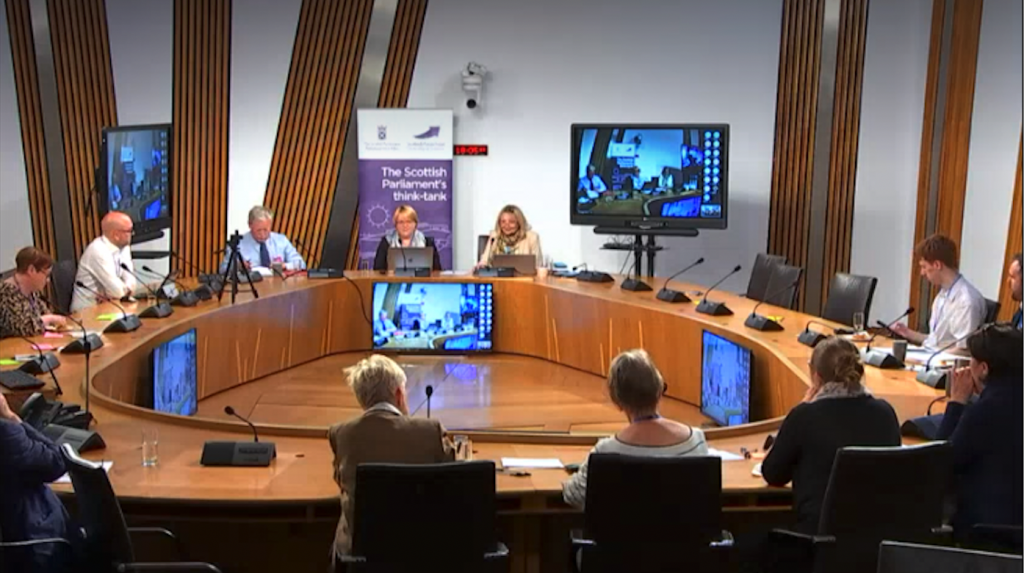
I’ve had the chance to talk about the book and about speculative approaches to researching and teaching education futures with people in a number of settings, including:
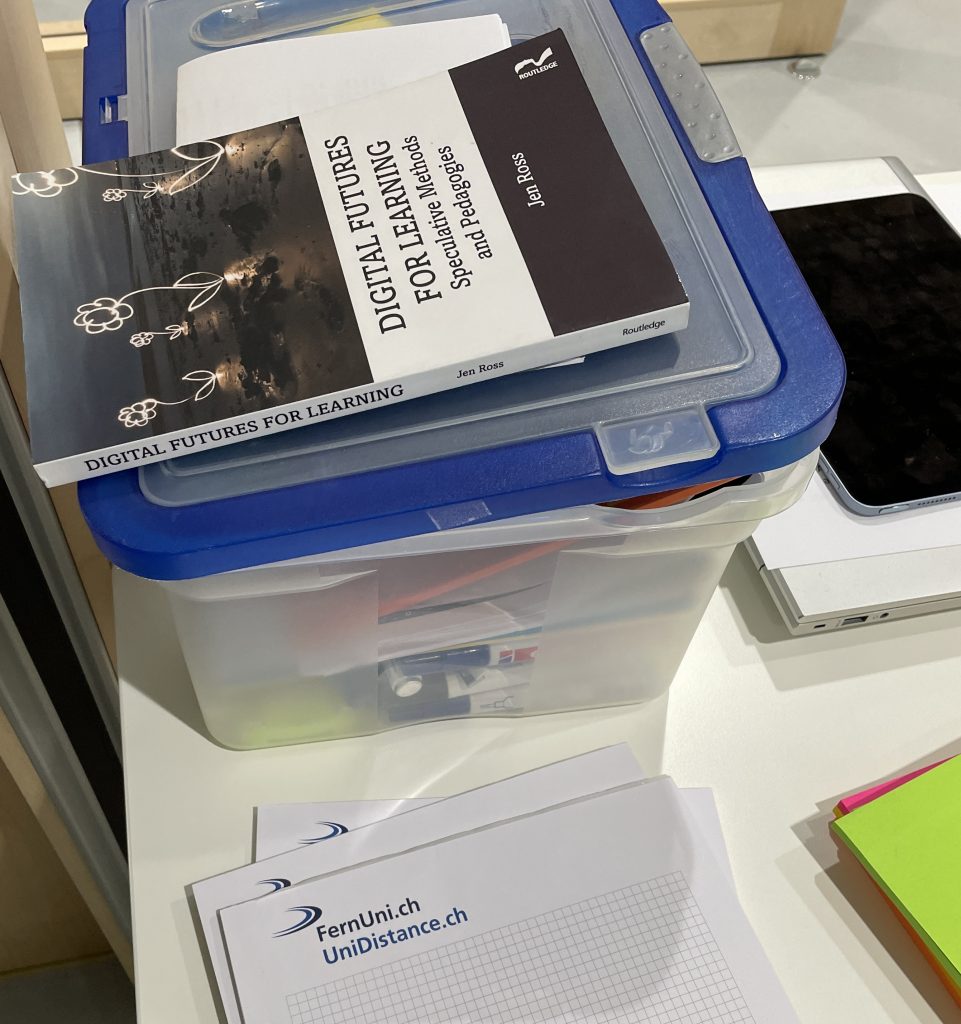
I’ve been involved in writing projects that have drawn from the book, including work on data cultures, postdigital speculation, postdigital research and surveillance futures[1], and I’m co-editing a special issue of the International Journal of Educational Technology in Higher Education, on the theme of “Higher Education Futures at the intersection of justice, hope, and educational technology”, with George Veletsianos, Shandell Houlden, Sakinah Alhadad and Camille Dickson-Deane (the call is still open, until the end of October).
In the coming months I’ll be returning to Sweden to give a keynote at a follow-up workshop in Stockholm, attending the Irish Learnovation summit as a featured speaker, taking part in an ‘in conversation’ event with Professor Mike Michael during the National Centre for Research Methods e-festival, and in May 2024 I will have the honour of being a keynote speaker at the Networked Learning conference.
I have learned so much from the conversations, questions and ideas that have been shared with me since the book launched, and from the ways that people continue to take up, use and develop the speculative approaches I discuss (both in the book and earlier work). Some of the work that is currently influencing my thinking about where to go next includes:
Also, I have been greatly inspired by the speculative work of doctoral researchers I’m co-supervising, including Sharon Boyd, Joe Noteboom, John Morrison and Nicolás Ruiz. Students on my Culture, Heritage and Learning Futures course at the Edinburgh Futures Institute also use speculative methods to develop their “Stories from the Future”, and you can read some of the stories from 2022 here.
Altogether, I’ve been really appreciative of the opportunities for discussion, debate and imagination the past eight months have brought, and I’m looking forward to the months ahead.
[1] Knox, J. and Ross, J (2023). Afterword. In Data Cultures in Higher Education: Emergent Practices and the Challenge Ahead. Eds: J. Raffaghelli & A. Sangrà. Springer.
Ross, J. (in press). Postdigital Speculation. Encyclopedia of Postdigital Science and Education.
Fawns, T., Ross, J., Carbonel, H., Noteboom, J., Finnegan-Dehn, S. & Raver, M. (2023). Mapping and Tracing the Postdigital: Approaches and Parameters of Postdigital Research. Postdigital Science and Education.
Ross, J. and Wilson, A. (in press). Reconfiguring surveillance futures for higher education using speculative data stories In Bonderup Dohn, N., Jaldemark, J., Öberg, L-M., Mozelius, P., Håkonsson Lindqvist, M., Ryberg, T. & de Laat, M. (eds.). Sustainable Networked Learning: Individual, Sociological and Design Perspectives. Springer.
Wilson, A. and Ross, J. (in press). Surveillance imaginaries: learning from participatory speculative fiction. Surveillance and Society.
References
Cerratto Pargman, T., Lindberg, Y., & Buch, A. (2022). Automation Is Coming! Exploring Future(s)-Oriented Methods in Education. Postdigital Science and Education. https://doi.org/10.1007/s42438-022-00349-6
Hrastinski, S. (2023). Characteristics of Education Fiction. Postdigital Science and Education. https://doi.org/10.1007/s42438-023-00400-0
Hrastinski, S., & Jandri?, P. (2023). Imagining Education Futures: Researchers as Fiction Authors. Postdigital Science and Education. https://doi.org/10.1007/s42438-023-00403-x
Jewitt, C., Barker, N., & Golmohammadi, L. (2022). Creative Probes, Proxy Feelers, and Speculations on Interactive Skin. Multimodal Technologies and Interaction, 6(4), Article 4. https://doi.org/10.3390/mti6040022
Jewitt, C., Barker, N., & Golmohammadi, L. (2023). Feeling our way: Methodological explorations on researching touch through uncertainty. International Journal of Social Research Methodology, 0(0), 1–19. https://doi.org/10.1080/13645579.2023.2173423
Lindberg, Y. (2023). Review of Jen Ross (2023). Digital Futures for Learning: Speculative Methods and Pedagogies. Postdigital Science and Education. https://doi.org/10.1007/s42438-023-00396-7
Olofsdotter Bergström, A., & Restrepo-Giraldo, J. (2023, June 12). Walking backwards as a radical practice for design. Nordes Conference Series. Nordes 2023: This Space Left Intentionally Blank. https://dl.designresearchsociety.org/nordes/nordes2023/researchpapers/32
Robinson, B. (2023). Speculative Propositions for Digital Writing Under the New Autonomous Model of Literacy. Postdigital Science and Education, 5(1), 117–135. https://doi.org/10.1007/s42438-022-00358-5
via jenrossity
As part of a collaboration around education futures, a group of colleagues led by George Veletsianos are co-editing a special collection for the fully open access International Journal of Educational Technology in Higher Education. The theme of the collection is “Higher Education Futures at the intersection of justice, hope, and educational technology”. The journal works with a rolling submission framework, so papers are reviewed and (potentially) published as they come in rather than all at once. This is interesting from an editorial point of view!
The final deadline for submissions for this collection is 31 October 2023, but please submit any time before then.
The collection invites prospective authors to turn towards reimagining the futures of education, and to contribute scholarship that speculates what higher education at the intersection of justice, hope, and educational technology could look like. Read all the details of the call on George’s blog.
For me, this way of tackling digital education futures – connecting justice and hope – is potentially really rich, because it suggests the complexity of exploring the idea of ‘responsibility to the future’ (Adam and Groves, 2007, Facer 2021). My recent work around speculative methods has shown me how tricky this is – I’ve tended to think about this in terms of the balance of play and responsbility, for example:
Insisting on responsibility is not to overstate our ability to predict, but instead to recognise that what we do and say about the future matters. Regardless of the complexity involved, teachers and researchers, students and participants can be part of producing new things in the world, including beliefs, practices and technologies (Urry, 2016). In addition, it has implications for how we understand caring… [reframing] care of the future to take account of open-endedness. (Ross 2023, p.50)
I’m really looking forward to seeing the range of different approaches and responses to this call.
Editors for the special collection:
George Veletsianos: Royal Roads University, Canada
Shandell Houlden: Royal Roads University, Canada
Jen Ross: University of Edinburgh, UK
Sakinah Alhadad: Griffith University, Australia
Camille Dickson-Deane: University of Technology Sydney, Australia
References:
Adam, B. and Groves, C. (2007) Future Matters: Action, Knowledge, Ethics. Boston, the Netherlands: Brill.
Facer, K. (2021) Futures in education: Towards an ethical practice. UNESCO. Available at: https://unesdoc.unesco.org/ark:/48223/pf0000375792 .
Ross, J. (2023) Digital Futures for Learning: Speculative Methods and Pedagogies. Routledge.
Urry, J. (2016) What is the Future? John Wiley & Sons.
via jenrossity
Over the past six months or so, I’ve been working with my great colleagues Siân Bayne and Michael Gallagher on a new set of resources for working with higher education futures.
Speculative Futures for Higher Education includes 8 scenarios, 8 tarot cards and 8 short stories builds on the 2017–19 Near Future Teaching project, which used design-based methodologies to co-create
a vision for the future of digital education at the University of Edinburgh. Two short trend-mapping reviews were done as part of that project, and we returned to these reviews in 2022 to update them, identifying the 8 scenarios presented in this new resource.
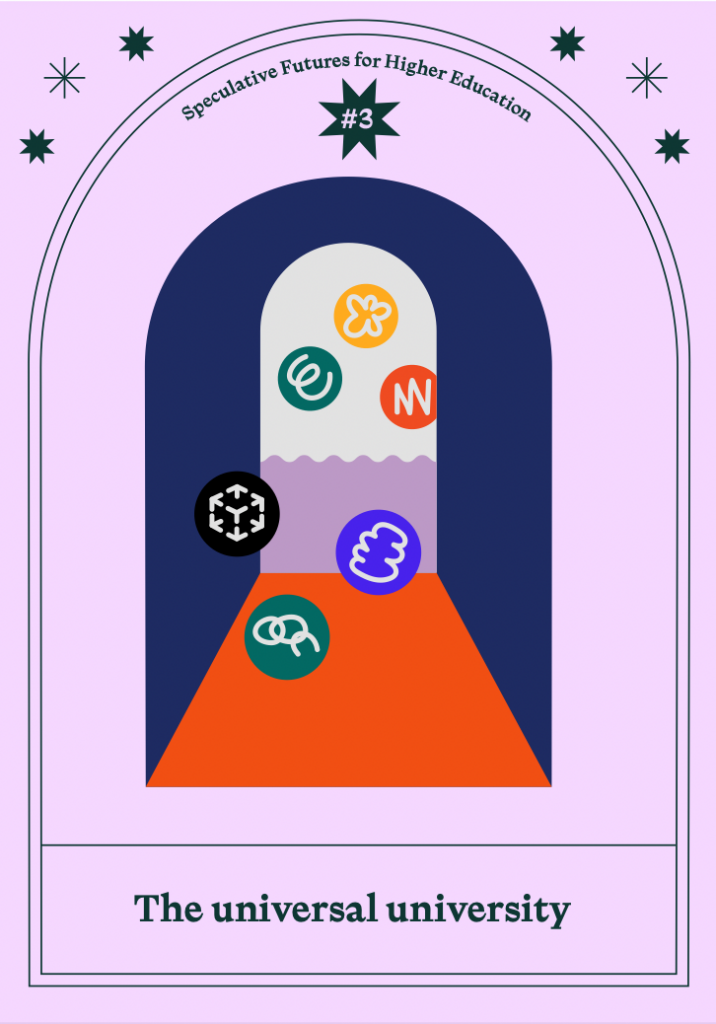
In addition to the 8 scenarios, the resource also includes 8 very short stories, written to evoke one form of the future proposed in each scenario.
The eight scenarios are:
All the materials and the scenario and story texts are available on the Centre web site, free to download and reuse with attribution.

via jenrossity
My new book will be published on 8 November 2022. Here’s what it looks like!
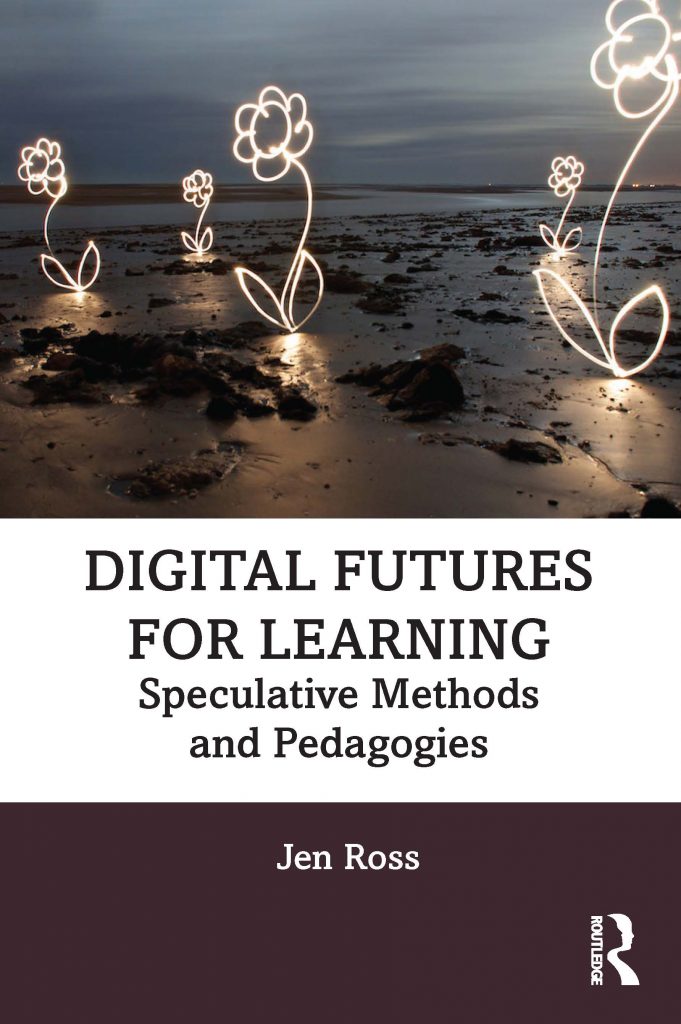
It has been a really positive experience – it’s given me space and time to step back and consider how the variety of work I’ve been doing on education and digital learning futures over the past decade or so comes together around a methodological and pedagogical position on complexity, responsibility, creativity and uncertainty. In the book, I define speculative approaches as working with the future as a space of uncertainty, and using that uncertainty creatively in the present. It’s been a real pleasure to revisit projects and ideas, and to develop arguments about the role speculative methods can play in the landscape of digital education and critical education futures.
One of the things I got the most from was working through the ways that education futures (particularly digital education futures) are made and how they come to be seen as legitimate (or otherwise). This took me on a journey through work on critical education futures, anticipation, imaginaries and different kinds of predictions. That exploration was extremely useful for the development of the new MSc in Education Futures that has launched this month! I hope it will be helpful for other people too (I wrote about it in chapter 2).
I see the theoretical foundation for speculative methods as emerging in education from work on complexity (which chapter 3 of the book is all about). However, a speculative approach to research can in turn be suitable for exploring a lot of different kinds of ideas – the second section of the book discusses speculative projects that developed around theories of posthumanism, mobilities and surveillance, for example.
When I first started writing about speculative approaches to educational research and teaching back in 2016, there weren’t that many examples of their use, but happily the situation has changed a lot in the years since, and chapter 4 of the book explores this literature and draws attention to some of the big questions and ideas that have emerged from it (here are just a few examples). It’s also been good to see the range of methods people actually use – for example, an approach that has been developing quite rapidly is the use of speculative fiction writing as a way of working with education futures, and there is a lot of energy around examining current visions of the future and telling stories about new ones.
There are four case studies in the book – each of which discusses speculative approaches in practice, including speculative objects, audiences and ways of knowing produced through research and teaching projects. In Chapter 5, a speculative Twitter bot makes a surprising entrance into the social space of a Massive Open Online Course and proceeds to engage with participants about the nature of teaching. The chapter explores debates about automation and massification of higher education, and investigates the glitch as a speculative object. Chapter 6 focuses on the speculative pedagogy of the Digital Futures for Learning postgraduate course, in which the course itself is partly made up of Open Educational Resources produced by students. It examines openness and co-creation as educational qualities and as challenges for higher education. Chapter 7 turns to engagement in museums and galleries, and to the Artcasting project, which explored alternatives to problematic forms of evaluation that cultural heritage organisations were grappling with. Chapter 8 is about the Data Stories Creator, developed as part of work to imagine surveillance futures in higher education at a time of radical shifts in modes and visibility of education, partly driven by the Covid- 19 pandemic.
The final section of the book tries to capture elements of speculative research, and teaching, in ways that others will be able to use and build on. I had already written about this a bit in a research context, but the chapter on speculative pedagogies is completely new, and it was good to think about issues of ethics and participation in the context of assessment, course design and lifelong learning (for example).
Overall, I want the book to provide encouragement for others who are working – or want to work – on digital education futures in their own contexts. Speculative work is located in a complex web of uncertainty, playfulness and responsibility (a theme that I found myself returning to a lot), and this has implications for how we work as well as what we do:
The relationships created and revealed within speculative practices, however playful they may sometimes be, are also serious about the future, responsible to the present and thoughtful about the history of our field. This means that the tensions and contradictions and complexities of our work are not there to be resolved – they are the work.
(Ross 2023, p.205)
Many of us can gain something from understanding our work in a more spacious, generous way than the customs of research and teaching, and the visions of the future that are currently in play give us room for. A lot of innovative and interesting stuff is going on in the social sciences, arts and humanities right now to make this kind of space, and I see speculative approaches as part of that. It’s a little bit daunting to see the book head out into the world, but I hope it finds the people who will find it useful!
via jenrossity
The last few years of my professional life have involved a number of projects with significant ‘behind the scenes’ activity, and none more than the development of the new MSc in Education Futures at the Edinburgh Futures Institute (EFI). I started working in earnest on this programme in early 2019, when I was appointed to an EFI fellowship to develop a programme on the topic of ‘future education’. Along with a group of programme leads from across the university, the past three years have been a whirlwind of interdisciplinary conversations, curriculum and pedagogical design debates, administrative and academic milestones, and many and varied discussions about how to engage people across sectors in considering what the future of learning will be like, and what it will be for.
The public launch of the programme last week, along with five others (Creative Industries, Data, Inequality and Society, Future Governance, Narrative Futures and Service Management and Design), means that we will quite soon know who will be joining us for the very first year of this new adventure. I really can’t wait, because a lot of our design considerations have been about how to bring together a group of participants with diverse experiences and areas of focus to investigate key topics around education and learning futures. It will be fantastic to see how this plays out when the programme begins next September.
One of the most interesting aspects of EFI is the ‘fusion’ design of the courses: all the Education Futures courses are designed around two-day ‘intensive’ sessions – available to study online or on campus – and wraparound online activity. Each 10-credit course will run for five weeks, including the two full-day intensives. My programme co-director, James Lamb, has written about how we are going about designing these courses – check out his blog post here.
The curriculum design process has been equally interesting. I’ve been engaging with speculative research and teaching approaches for the past ten years or so, and it has highlighted the productive challenges of working with ideas of the future (I’m currently writing a book about this!). The first year of courses will cover topics like the design of learning organisations, and education’s role in wicked problems and challenging futures. We are also working on courses that explore methods of engaging with futures (including through cultural heritage approaches, postdigital and speculative experiments, and social science fictions), issues of personalisation, social change, creativity and resilience, and lots more. In addition to these, there are shared ‘core’ courses that all EFI students will have access to that help develop creative and data skills, and a set of electives from across the programmes that are open to all EFI students to choose from.
We’ll be piloting two of the courses between January-March 2022 – Future of Learning Organisations and Postdigital Society. The intensive sessions will take place in a specially designed fusion teaching space, and we’ve been playing around in that space and investigating the possibilities it is able to support. The programme team meets regularly and we have had amazing discussions about things like learning times and spaces, decolonising a futures-focused curriculum, and approaches to collaboration. There is a lot of energy for the new programme and for what we are each bringing from our own research, disciplinary context, teaching experiences, ideas about the future, and so on. I’ll introduce some other members of the team in a future post, and look out for a co-authored position paper from us in the next few months.
In the meantime, I warmly welcome questions about the programme – feel free to get in touch! To learn more, including about how to apply, check out the web site:
via jenrossity

I’m in the process of writing a book about speculative methods and pedagogies (due from Routledge in 2022). As part of the writing process I’ve been enjoying engaging with recent literature that builds on ideas I wrote about in my 2017 paper on speculative method in digital education research (Ross, 2017). This post is a little taster of the diverse contexts of use of speculation and not-yetness (Ross and Collier, 2016), and how these concepts are being developed by others.
Speculative methods for research and teaching are aimed at envisioning or crafting futures or conditions which may not yet currently exist, to provoke new ways of thinking and to bring particular ideas or issues into focus. Michael (2012) describes them as “’inventive problem making’ in which the parameters of the issue are reconfigured” (p.536). In their canonical speculative design text, Dunne and Raby (2013) identify speculative design as a way to use futures as “a medium to aid imaginative thought… [to] loosen, even just a bit, reality’s grip on our imagination” (p.3). Enactments of speculative methods are found in critical design, speculative design, inventive method and design fiction, and across the social sciences and art and design disciplines. Speculative methods are often described as research methods, but they are equally suited to teaching contexts in a range of different disciplines, with recent published work highlighting their use in social anthropology, law, education and art. Plus there is some great work being done on speculative engagements in informal learning contexts like museum and galleries.
I’m seeing a lot of richness and diversity in the literature around speculative approaches, and increasing interest in these. I think this is because their close couplings of provocation, engagement and inquiry are a good fit with the complex knowledge-production spaces of learning and education and the wicked problems we are facing. As George Veletsianos (2020) notes:
the current state of education, at all levels, is situated within a context of ever-evolving social, cultural, political, and technological shifts, [so] we face an urgent need to engage with uncertainty on multiple levels. The use of speculative methods, therefore, may enable us to offer guidance when making current decisions related to the future of higher education, and to explore what may or may not be possible in different contexts. (p.605)
Of the many excellent things I’ve been reading, I want to highlight four papers that have developed my previous work on speculative method in generative ways.
Osborn, J.R., Barba, E., Henderson, G.E., Strong, L.M. and Kadish, L.H. (2019) ‘The Pilgrimage Project: Speculative design for engaged interdisciplinary education’, Arts and Humanities in Higher Education, 18(4), pp. 349–371. Osborn et al (2019) describe their pedagogical approach to engaging with historical materials in a speculative manner as “retrofuturology”. They embarked on a year-long “experiment in interdisciplinary pedagogy” with a focus on Georgetown University’s Old North Building. The Pilgrimage project brought together students and teachers from six courses on topics including creative writing, media production and museum studies, and “applied the not-yetness of speculative method [to explore] how technological, artistic, and creative projects can inspire and maintain student engagement when directed toward a topic of shared concern” (p.351). Using approaches such as mediated collaboration (where student work from one course was used as prompts for another), students ultimately produced a public exhibition.
Gallagher, M. and Breines, M. (2021) ‘Surfacing knowledge mobilities in higher education: reconfiguring the teacher function through automation’, Learning, Media and Technology, 46(1), pp. 78–90.
and
Breines, M.R. and Gallagher, M. (2020) ‘A return to Teacherbot: rethinking the development of educational technology at the University of Edinburgh’, Teaching in Higher Education, 0(0), pp. 1–15.
Working with university students, faculty and staff to investigate the notion of automation and the ‘teacher function’, this project used speculative co-design methods to understand perspectives of teachers, staff and students and to produce use cases for teacherbots at the University of Edinburgh. The researchers facilitated prototype-building workshops which, combined with interview data (Gallagher and Breines, 2021), generated 85 discrete use-cases for instances of automation in a future university. The project developed a framework for evaluating teacherbot designs, moving away from efficiency as a core value, and criteria were the extent to which the designs were pedagogically generative, expressed university values, had potential to positively influencing the student and teaching experience, were ethical, were supportive of teacher professionalism, and were technologically feasible (Breines and Gallagher, 2020, p. 8). Examples of teacherbot designs produced through participatory design sessions included bots for helping students identify their knowledge of a subject before a course began, creating peer groupings based on sophisticated criteria, generating discussion, preparing students for tutorials, and collecting resources from students to help co-create knowledge (pp.9-10).
Smythe, S., Pelan, D. and Breshears, S. (2018) ‘The LinkVan Project: Participatory Technology Design in Vancouver’, Language and Literacy, 20(3), pp. 9–25. The authors found speculative analysis essential to grapple with the “’wicked’ and entangled issues” (p.21) that emerged from their project examining a mobile van for supporting digital literacies amongst Vancouver, Canada’s low-income and homeless population. These issues included problems of scarcity, the slippage of digital inclusion to a more radical demand for more equitable digital landscapes, and the tensions between anonymity and relationality in providing community services. For them, the ‘not-yetness’ of the socio-technical landscape they were working in required reaching beyond the technological to a more experimental way of thinking about learning and resource sharing (p.22).
Ehret, C. and ?iklovan, L. (2020) ‘How speculative designs produce new potentials for education research in digital culture’, Discourse: Studies in the Cultural Politics of Education, 41(5), pp. 708–722. doi:10.1080/01596306.2020.1774713. Ehret and ?iklovan (2020) built on a traditional multimodal discourse analysis of toxic digital discourse on the Twitch.tv livestreamed gaming platform to produce a ‘critical remix video’ to synthesise toxic content and then “repurpose[] and reconfigure[] those media in order to communicate messages that expose pernicious ideologies and behaviors”. They add to speculative methods in education a focus on emerging technocultures, arguing that pedagogical development should flow from “emerging experiences of digital, social life” (p.721). For them, speculative design experiments need to develop “new pedagogic potentials that themselves may inform social change through youths’ expanded and nuanced repertoire of digital practices in the future” (ibid).
From these authors, I’m taking some key points forward into development of a speculative framework for digital learning futures in the book. I’m really grateful to them for their work and for these great papers.
References
Breines, M.R. and Gallagher, M. (2020) ‘A return to Teacherbot: rethinking the development of educational technology at the University of Edinburgh’, Teaching in Higher Education, 0(0), pp. 1–15.
Dunne, A. and Raby, F. (2013) Speculative everything: design, fiction, and social dreaming. Cambridge, Massachusetts; The MIT Press.
Ehret, C. and ?iklovan, L. (2020) ‘How speculative designs produce new potentials for education research in digital culture’, Discourse: Studies in the Cultural Politics of Education, 41(5), pp. 708–722.
Gallagher, M. and Breines, M. (2021) ‘Surfacing knowledge mobilities in higher education: reconfiguring the teacher function through automation’, Learning, Media and Technology, 46(1), pp. 78–90.
Michael, M. (2012) ‘“What Are We Busy Doing?” Engaging the Idiot’, Science, Technology & Human Values, 37(5), pp. 528–554.
Osborn, J.R. et al. (2019) ‘The Pilgrimage Project: Speculative design for engaged interdisciplinary education’, Arts and Humanities in Higher Education, 18(4), pp. 349–371.
Ross, J. (2017) ‘Speculative method in digital education research’, Learning, Media and Technology, 42(2), pp. 214–229.
Ross, J. and Collier, A. (2016) ‘Complexity, mess, and not-yetness: Teaching online with emerging technologies’, Emergence and Innovation in Digital Learning: Foundations and Applications, pp. 17–33.
Veletsianos, G. (2020) ‘How should we respond to the life-altering crises that education is facing?’, Distance Education, 41(4), pp. 604–607. doi:10.1080/01587919.2020.1825066.
via jenrossity
In June 2018, I attended a workshop at Lancaster University called “Staying with Speculation”. This wasn’t long after the publication of my paper on “speculative method in digital education research” (Learning, Media & Technology, 2017) and I was keen to think about next steps for the work. The workshop was organised by Luke Moffat and colleagues in sociology at Lancaster, and it was a really good event with lots of discussion and the development of ideas for a special issue on the same topic. At the workshop, I met Shawn Bodden, a doctoral researcher in Human Geography who also happened to be based at the University of Edinburgh. We have a few people in common but I doubt we would have met otherwise – and the meeting proved really fruitful. Over the following year we worked together on an idea that was sparked at the workshop – the role of the ‘glitch’ in producing speculative orientations to the future – and this week one outcome of that work is this new publication:
Bodden, S. and Ross, J. (2020, online first) Speculating with glitches: Keeping the future moving. Special issue, Staying with Speculation. Global Discourse.
The paper explores the glitch as a generative problem which is capable of introducing unanticipated possibilities and futures into situations. We understand the glitch as a sociomaterial encounter rather than merely a technical error, and argue that it calls for (re)consideration of here-and-now possible futures through practices of response and repair. Exploring the ways that people seek to respond to glitches, we consider two case studies in which unexpected problems provoke those involved to speculate playfully and practically about new possibilities. In the first case, a malfunctioning ‘Teacherbot’ incites new challenges and pedagogical opportunities in an online learning environment. In the second, Hungarian activists creatively use infrastructural and political problems to make new spaces of protest and to press the government to respond to their concerns. Considering these empirical cases allows us to observe how playful and disruptive dispositions have worked to question the terms of possible futures in the real world, and to unsettle the seemingly given terms of power-relations. Glitches are not a panacea, but they can provide an impetus to act from within situations that are uncertain, and can therefore point to new trajectories and possible futures.
One of the cool things about this journal is that each article they publish is accompanied by a reply, so in addition to our paper, there is also a thought-provoking response from Joe Deville –
Deville, J. (2020, online first) ‘A reply to Speculating with glitches: Keeping the future moving by Shawn Bodden and Jen Ross: Covid-19 as glitch: A provocation for speculative ethics?’, Global Discourse, (Special Issue: Staying with speculation).
In this reply, Deville ponders whether Covid-19 can be seen as a glitch – exploring its role as an interruption and the dangers of ‘blind optimism’ in relation to its possible effects. He concludes that:
COVID-19 as glitch is very unlikely, on its own, to prompt major shifts in our relationship to the world. But we can hope that it opens up new spaces for critical thought.
Drawing on our discussion of the “temporalities of contemporary life that amplify the potential for glitching” (Deville 2020) to examine what Covid-19 is doing or might do as it breaks down infrastructures and makes them visible seems to offer something really generative to our thinking about the present moment and about speculation. So, I appreciated this reply a lot.
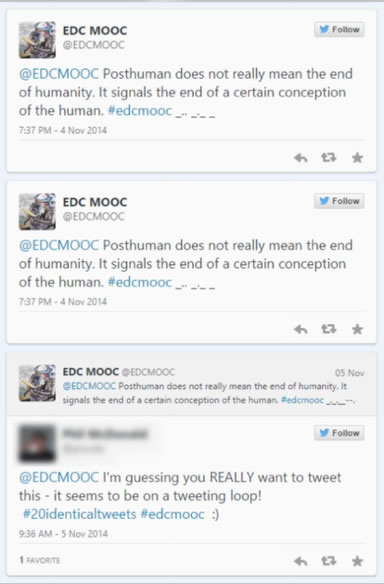
Co-authoring this paper and the discussions it has led to has been an extremely positive experience. At its best, working in a university offers these chance encounters with extremely smart and interesting people, and (occasionally) the time and space to try to make something new together. Thanks to Shawn, and to Malé Luján Escalante and Christine Mortimer (co-editors of the special issue), Luke Moffat, and all the participants at the 2018 workshop. Thanks also to the Coding the MOOC teacher research team – one case study from this paper came from the first outing of the Teacherbot in EDCMOOC!
via jenrossity
Along with some fellow members of the Higher Education After Surveillance Network, Anna Wilson, Amy Collier and Martin Hawksey, as well as Jane McKie, I’ve just finished work on a small research project which aimed to facilitate the creation of short pieces of speculative fiction by people with an interest in the growing use of surveillance technologies in Higher Education.
The Speculative Data Storytelling project‘s purpose was to facilitate stories that explored possible futures, in order to give expression to perhaps previously un-recognised hopes, concerns and fears.
Initial work focused on the development of face-to-face co-design activities, but we shifted approach as a result of the Covid-19 pandemic, revising our plans to create a remote method of generating data, enabling participants to engage in brief, asynchronous ways.
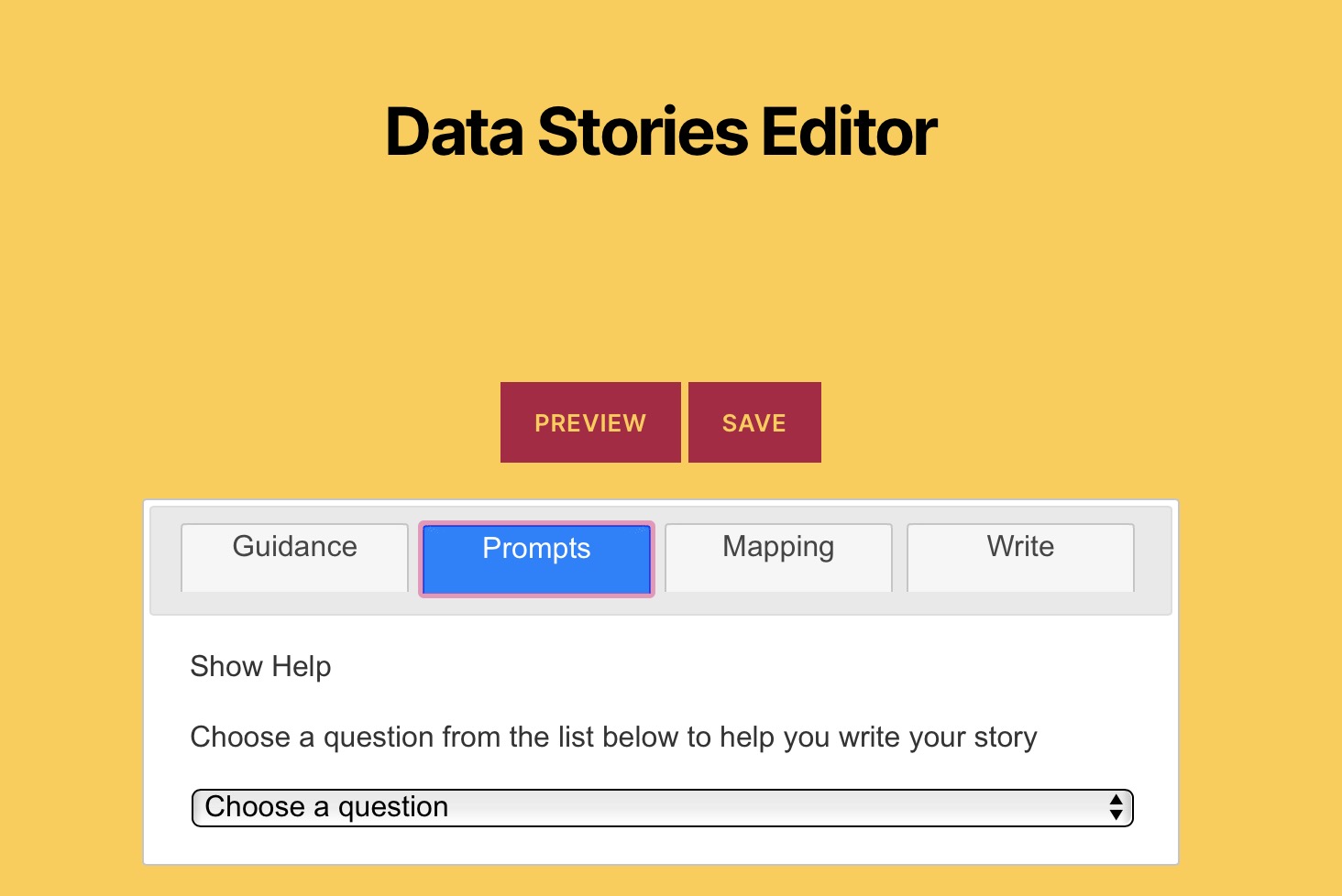
Over the project period, we explored how speculative data stories can be scaffolded and created. Anna led on designing and testing a methodology to help participants create data stories. Working with Pat Lockley, we mapped this methodology onto a web based interface (in the form of a WordPress plugin, built by Pat). An iterative process of building, testing and refining led to a three-part data storytelling tool: prompts, mapping and writing. Prompts and mapping help users identify actors and explore possible interactions between them, while the writing section gives a space to write an anonymous multimedia story (text, images, video, tweets and GIFs are all possible elements of the story). The finished story can be saved, and also (optionally) submitted to be shared publicly on the data stories site.
Like a lot of things this year, this project did not go as planned, but I am really grateful to the team, the network, and all the people who participated in the testing phase, for being involved in creating something that I think is really worthwhile, and I hope will be of interest and use to others. Thanks, too, to the Edinburgh Futures Institute Research Awards for the funding that supported this project.
via jenrossity

The team behind the Manifesto for Teaching Online has just published a book! The book version (2020, MIT Press) was co-written by all the 2016 manifesto authors, and its purpose is to link the abbreviated, punchy statements of the manifesto to the large body of research and practice from which it emerges.
Online teaching has leapt from the margins to the mainstream in many universities around the world in 2020. It’s been good to find that the manifesto has held up, and I am really proud to have contributed to this in-depth exploration of how distance can be a positive principle, the way digital education reshapes subjects and practices, issues of distrust and surveillance, the recoding of education through automation and algorithms, and much more.
To launch the book, we are hosting three online events. The first is tomorrow (16 September), on the theme of ‘recoding’. The other two are ‘we are the campus’ (7 October) and ‘text has been troubled’ (15 October). All are free to attend. More details and signup information is here: https://www.de.ed.ac.uk/event/manifesto-teaching-online-launch-events
via jenrossity
I was really happy to spend the first part of the week at the online Networked Learning conference – this is one of my favourite research conferences, and it was a really good few days.
George Veletsianos and I facilitated a session on speculative methods in networked learning – building on work each of us have been doing in this area over the past few years. A few people asked for some insights into how to design speculative methods into a research project. I wrote a textbook chapter a few years ago on this topic, and I thought I’d summarise what I see as the key ‘ingredients’ of a speculative project (in digital education.)

First, it’s important to say that there are many ways to enact speculative or inventive method – and some are explicitly theoretical in nature (see Lury and Wakeford’s 2012 collection on Inventive Methods for examples of this). I am focusing here on more applied approaches, and specifically those that can be used to think about the future of education and educational technology. These are not methods that can be implemented by following a straightforward recipe; they have to be designed in relationship to the question they are seeking to illuminate or the topic they seek to develop new questions around (see Ross 2017 for more on this). However, there are some ingredients which are likely to be significant:
Speculative method can be a powerful approach to generating and examining new perspectives and questions, and to helping understand and shape complex topics, especially those that deal with the future. For researchers aiming to understand emerging ideas or technologies, the ability to work with uncertainty is a key benefit of such an approach. It requires, however, a willingness to take risks with the design and implementation of a research project – moving away from approaches which are well-established with clear protocols. Nevertheless, I think it’s an approach that can be carefully designed, and well-justified in terms of both quality and rigour – and I’m excited to see more such research emerging in our field.
adapted from Ross, J (2018). Speculative Method as an Approach to Researching Emerging Educational Issues and Technologies. In L Hamilton and J Ravenscroft (eds) Building Research Design in Education. London: Bloomsbury.
References:
Knox, J. (2014) ‘The “Tweeting Book” and the question of “non-human data”’, TechTrends, 59(1), pp. 72–75. doi: 10.1007/s11528-014-0823-9.
Lury, C. and Wakeford, N. (2012) Inventive Methods: The Happening of the Social. London: Routledge.
Ross, J. (2017) ‘Speculative method in digital education research’, Learning, Media and Technology, 42(2), pp. 214–229. doi: 10.1080/17439884.2016.1160927.
Turkle, S. (1997) ‘Computational technologies and images of the self’, Social Research, pp. 1093–1111.
Wilkie, A., Michael, M. and Plummer-Fernandez, M. (2015) ‘Speculative method and Twitter: Bots, energy and three conceptual characters’, The Sociological Review, 63(1), pp. 79–101. doi: 10.1111/1467-954X.12168.
via jenrossity
I’m pleased to announce the launch of the Digital Cultural Heritage cluster, part of the Centre for Data, Culture and Society. The cluster has been in development for the past year, and I’m the cluster lead/facilitator.
There are about 25 University of Edinburgh colleagues associated with the cluster so far, and we hope it will continue to grow as more people who are doing work in this area get involved. In addition to providing a way to amplify the University’s work in this area, we are also aiming to host workshops, showcases, roundtables and other events (including some to be co-organised with the Digital Cultural Heritage Research Network); facilitate research networking and exchanges; and develop exhibitions and teaching resources.
You can visit the Cluster’s new web site at https://www.cdcs.ed.ac.uk/research-clusters/digital-cultural-heritage

via jenrossity
Following on from my last post, I’m happy to announce that the funded PhD studentship on the topic of “Ethical and Social Futures of Data-Driven Education” is now open for applications (closing date 15 May 2020). The studentship is co-supervised by Dr Karen Gregory and me, and so the successful candidate will be working at the intersections of digital sociology and digital education.
This is a really (really!) important time to be doing this work, and we hope there will be lots of interest in applying, even under the strange circumstances in which we all find ourselves. In addition to the project itself, the successful applicant will be part of the first cohort of the Edinburgh Futures Institute’s Baillie Gifford programme in the Ethics of Data and Artificial Intelligence. Have a look at the other four projects being advertised to get a sense of the interdisciplinary opportunities being part of that cohort will bring. Professor Shannon Vallor is leading the programme, and there are a lot of great plans being developed for the cohort.
Beyond that, you’d be part of the Digital Sociology research group, the Centre for Research in Digital Education, and have links with the international “Higher Education After Surveillance” network and a range of other organisations and researchers around the world doing important policy, development, pedagogical and scholarly work in this area.
Please contact Karen or me with any questions about the research.

via jenrossity
I thought it was time to summarise some of the work I’ve been doing with colleagues in and beyond Edinburgh on the topic of higher education and surveillance. I’ve touched on these issues in the context of my doctoral research (trying to understand how students viewed the ‘audience’ for their high-stakes reflection) and in relation to work around plagiarism detection, surveillance and trust (see the conference paper Hamish Macleod and I wrote, and the forthcoming book on the Manifesto for Teaching Online). In early 2019, Amy Collier and I began to put together an international network of people – so far mostly in the UK, US and Canada) to explore possible futures for surveillance in universities – we’ve called this network Higher Education After Surveillance, and it is full of truly brilliant people doing urgently needed work in this area.
Amy and I wrote a commentary for Postdigital Science and Education, explaining some of our thinking behind the idea of ‘after surveillance;’. We explain that when we say ‘after surveillance’ we are not looking back, but instead:
gesturing toward a future that involves a deeper understanding of the role surveillance has played and continues to play in universities and tactics and strategies for interrupting and perhaps reducing or reconfiguring its impacts. This requires a willingness to speculate that some of the surveillance roles we have come to accept could be otherwise, along with an acknowledgment that we are implicated in what Lyon terms ‘surveillance culture’ in education. What can we do with that knowledge, and what culture shifts can we collectively provoke?
Two new things have so far emerged from the network. One is a research project called Co-designing with Speculative Data Stories. This was funded by the Edinburgh Futures Institute Research Awards scheme, and the research team (me, Amy, Anna Wilson, Jane McKie and Martin Hawksey) proposed to run ‘speculative data stories’ workshops with groups of colleagues in UK universities whose roles involve supporting, promoting and working with learning technologies. With the current closure of campuses and intense pressures on those very colleagues to support their institutions to move considerable amounts of university work online, we have had to put this project on hold – but we are hoping to be able to reimagine it in some form, soon.
The second new thing – and the prompt to write this blog post today – is that Karen Gregory and I have been successful in securing one of five new funded PhD studentships on the theme of data ethics (Edinburgh Futures Institute/Baillie Gifford). These projects will be advertised in the next few weeks – ours is called The University of Data: Ethical and Social Futures of Data-Driven Education. I am very happy, as is Karen, to hear from anyone who might be interested in applying for this! More info to follow soon, in a separate blog post.
References
Collier, A. and Ross, J. (2020). Higher education after surveillance? Commentary, Postdigital Science and Education. Online First. https://link.springer.com/article/10.1007/s42438-019-00098-z
Ross, J. and Macleod, H. (2018). Surveillance, (dis)trust and teaching with plagiarism detection technology. Proceedings of the 11th International Conference on Networked Learning 2018, Edited by: Baji?, M, Dohn, NB, de Laat, M, Jandri?, P & Ryberg, T. ISBN 978-1-86220-337-2.
image source: Unsplash. Photographer: Franki Chamaki.
via jenrossity

A big part of my working life for the next few years involves the development of a new postgraduate programme, to be part of the Edinburgh Futures Institute (EFI). The programme is made up of a number of interlinked pathways, including one on Education Futures – this is the one I’m leading on. The programme will be interdisciplinary, challenge-led, and have core data and creative skills courses as well as a range of core and option courses for each pathway.
Education Futures is particularly exciting (in my view!) because it will focus on some of the key ideas and topics informing learning, knowledge and education across the whole life course, with an emphasis on understanding the relationships between data and education. I want to see the pathway appealing to people from all sectors of education and learning, including schools, workplace learning, community education, and higher and further education. Things are still in the early stages of development, but by studying this pathway, we want students to be able to:
Course topics we’re currently discussing include the future of learning organisations; educating for the future; personalisation, surveillance and anonymity; policy, metrics and governance; education and work; agency and social change; participation, care, inclusion and culture; expertise, literacies, trust and data fluency – and more!
I’ll have lots more to say about this in the coming months. However, EFI has just launched a ‘market pulse’ survey to learn more about what people think about the proposed programme and Education pathway so far (there are also surveys available for some of the other pathways). If you are interested in the future of education, knowledge and learning, and have thoughts about this programme or might even be interested in studying something like this, I’d be really grateful for your input! https://www.surveymonkey.co.uk/r/EFI_MSc_Edu_ws
Get in touch if you have any questions about what we’re up to.
(ps – I chose the image for this post because it’s in the new University of Edinburgh collections colouring book, which is sitting on my desk waiting for me to colour…)
via jenrossity

I’ve meant to post about this for a while, but things have been hectic! Higher Education After Surveillance is a new project that my colleague Amy Collier (Middlebury College) and I dreamed up last year, in light of work we are each doing around issues of surveillance, trust, visibility, digital sanctuary and more, and as a way of trying to think big about some of the challenges we are currently facing. We enlisted the help of a small but mighty group of colleagues around the UK, US and Canada to get involved, and we hosted a virtual roundtable in March as a way of beginning to scope what such a group might do.
We’re aiming to develop this project in a sustainable way – it isn’t funded (or not yet, anyway), and everyone involved is already incredibly busy – so that it can become something genuinely meaningful, critical and impactful. We also need to think carefully about the scope (geographical and otherwise) of this work. It’s all very exciting, and timely, if daunting – it seems there are new stories, questions and areas for attention emerging most days (this week in the UK it was the announcement of a collaboration involving JISC and the Office for Students, led by Northumbria University, to ‘lead transformation in how the Higher Education sector identifies mental health issues in students‘. It… has not gone over well).
If you are or know someone who needs to be involved in what we’re doing, please do get in touch.
via jenrossity

UPDATE, 3 April 2019: The advert for this studentship is now live on the University of Edinburgh web site! Closing date is 3 May 2019.
We are so excited about this new PhD studentship that we want to let people know it’s coming. We’ll soon be advertising a fully funded AHRC Collaborative Doctoral Partnership (CDP) studentship, for a project we are (for the moment!) calling “Unlike a version: the lives of digitised artworks”. It was a working title, but we all found it so funny that we decided to keep it – and that probably tells you something about the team our lucky student will be joining (and in case you aren’t a 1980s-era Madonna fan, this is the reference (Youtube link) ). The studentship will start in October 2019.
If you don’t know about CDPs, these are amazing funded studentships that not only pay fees and a stipend (for eligible UK/EU students – there are some rules about this), but create really brilliant opportunities for students to be immersed in a cultural heritage organisation over the period of their studies, and support their professional development and scholarship with travel funding, a student development fund, and membership of a network of other doctoral students across the UK.
So: this project is the perfect opportunity for someone whose interests span art, digitisation, digital cultures, engagement and interpretation to spend a few years in Edinburgh working with a team of supervisors from National Galleries of Scotland (Christopher Ganley and Màiri Lafferty) and the University of Edinburgh (Jen Ross and Melissa Terras) on a project that will explore the meanings and movements of digitised artworks in the context of NGS’ collections. We think the right starting position here is that digitised artworks are more than merely versions of the ‘real thing’: they have meaning and value in their own right, and significance for sharing, interpretation, connection and inspiration. The project will develop a richer picture of digital objects and how they contribute to the shifting boundaries of the institution, to curatorial practice, and to NGS’ ambitions to open more of its collections to digital re-use.
The project and the supervisory team are obviously great, but this is also a magnificent time to be a creative/digital/data person in Edinburgh. Do you know about the Edinburgh Futures Institute? The Creative Informatics programme? The city-wide Data Driven Innovation programme? The Centre for Research in Digital Education? What about the festivals, the heritage organisations, the cultural scene? All happening here, with people, projects, networks and opportunities second to none.
If this sounds interesting to you, and you want to know more, please contact me! I’m happy to have informal conversations and answer questions.
via jenrossity
My most recent article was published last week, and it bridges the recent Artcasting project with work I am currently developing about what ‘open futures’ for digital cultural heritage may look like, and why this matters.
Ross, J. (2019). Casting a line: digital co-production, hospitality and mobilities in cultural heritage settings. Curator: The Museum Journal, 61/4. 575-592.
I’m fond of this paper. It came about because of the co-production strand at the Association of Critical Heritage Studies’ conference in 2016, where I first talked about the idea of digital co-production and got really useful feedback from some fantastic researchers. Since then I’ve been developing the idea further, and refining the key elements of digital co-production.
In a nutshell, I argue that digital co-production:
• unfolds across multiple times and spaces;
• involves the ‘unknowable other’;
• challenges the stability of relationships;
• invites a rethinking of hospitality.
I use the example of the Artcasting project to illustrate these four elements. Ultimately, the theoretical contribution is the bringing together of hospitality and mobilities to consider hospitality as a ‘trajectory’, building on David Bell‘s (2012) notion of ‘host-spots’.
In the context of co-production, trajectory invites us to consider movements of people into, through and away from the museum, taking up different positions in relation to shifting host/guest trajectories as they enter, leave, and reencounter it. A range of practices in relation to access and use of digital cultural heritage objects offers many possible trajectories of hospitality. The position of ‘host’ shifts from the museum to the aggregator web site to the user themselves as control over and location of the digital object moves. Guesting is constructed and reconfigured through timelines, searches, mentions, likes and upvotes. The user-as-host might even extend a welcome to the museum-as-guest by mentioning it on their personal feed.
All of these trajectories coalesce around an object whose meanings are shifting in the process. I think the role of the museum in this context is to set up co-productive situations that can allow for multiple hostings and guestings, and (following Doron 2009) inhabit more uncertain, less secure positions in relation to its role as ‘host’. (Artcasting was a very interesting example of this multiplicity.)
References:
Bell, D. 2012. “Moments of Hospitality.” In Mobilizing Hospitality: The Ethics of Social Relations in a Mobile World, edited by J. G. Molz and S. Gibson. Ashgate Publishing Ltd.
Doron, E. 2009. “At Hospitality’s Threshold: From Social Inclusion to Exilic Education.” Curator: The Museum Journal 52(2): 169–82.
Shout outs to Melissa Terras, Smita Kheria, Christopher Ganley, Mairi Lafferty, Ashley Beamer and Louise Rasmussen for all their contributions to the thinking-in-progress, to Phil Sheail for the work we did on hospitality that informed this paper, to Sian Bayne for reading and commenting, and to Jeremy Knox, Claire Sowton and Chris Speed for everything Artcasting related. 
via jenrossity
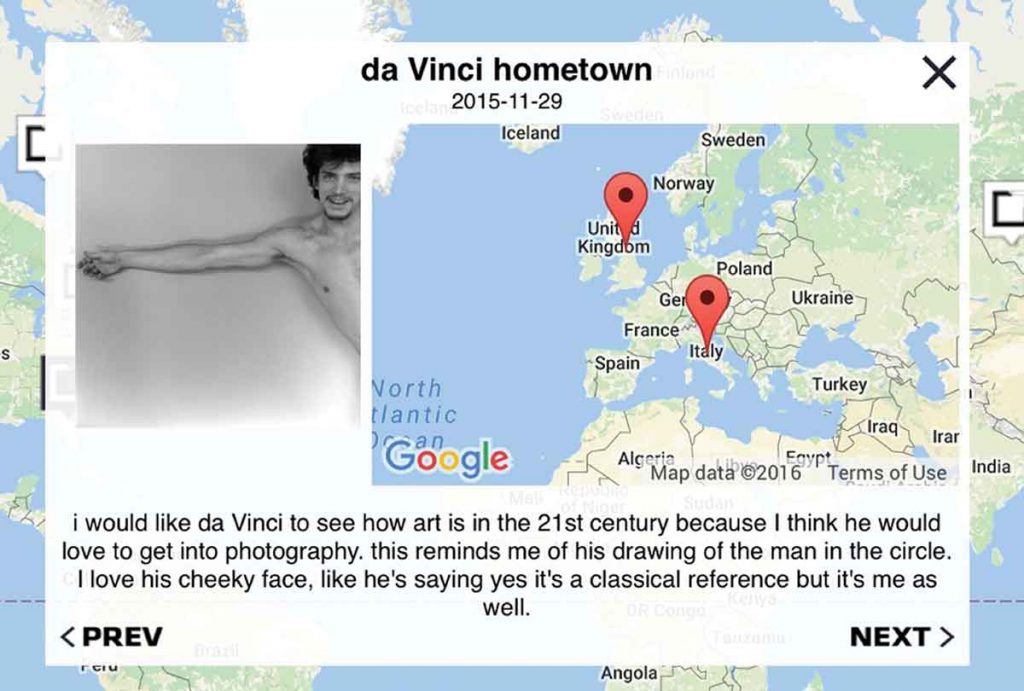
My newest article has been published in the International Journal of Heritage Studies. Its focus is on interpreting data from the Artcasting project, a 2015-16 research project that was funded by the AHRC to understand how people’s connections with art can be visualised and used to enrich evaluation practice in museums and galleries. The article is open access and available now
Ross, J., Knox, J., Sowton, C. & Speed, C. (2018) Mobilising connections with art: Artcasting and the digital articulation of visitor engagement with cultural heritage. International Journal of Heritage Studies.
The article looks at how digital methods in cultural heritage settings can help evoke and illuminate the richness of visitor engagement and interpretation. Through the process of analysing the Artcasting data, we found it really useful to look for ways to make sense of difference in visitors’ responses to artworks. We did that in this article by conducting both a thematic analysis, and a more mobilities-informed analysis of the same dataset. We argue that:
The Artcasting project focused on supporting visitors to articulate their responses to artworks using a method that was provocative, performative, and attuned to the mobilities of interpretation, engagement and ownership. This mobility, and the sparking of expressions of ownership through the question of where and when an artwork belonged, created new articulations… The capture of these articulations constitutes a contribution and valuable step forward in our understanding of how heritage is performed at an individual level through the production of memory and messages; and at a collective level through the hypermobility of interpretation. (Ross et al 2018, p.17)
I’m pleased and proud to see this article in print – many thanks to my co-researchers and -authors Claire Sowton, Jeremy Knox and Chris Speed; and to our research partners from the ARTIST ROOMS programme at National Galleries of Scotland, Tate and the Bowes Museum.
via jenrossity
I presented a very short ‘pecha kucha’ style talk yesterday at the inaugural Learning and Teaching Conference at the University of Edinburgh. I was speaking on behalf of two colleagues, Dr Amani Bell and Dr Jen Scott Curwood, who are members of the Centre for Research on Learning and Innovation at the University of Sydney. This super quick talk was a summary of research we’ve been doing into how teachers and students understand the assessment of students’ digital multimodal work – work that incorporates multiple modes such as images, text, sound, video and hyperlinks.
(Jen is presenting a poster of this work at the Festival of Learning next week in London: https://www.londonfestivallearning.com/agenda/session/6811 (poster number 1900) – if you are there, do stop by to talk to her!)

This research is supported by an Edinburgh-Sydney Partnership Collaboration Award, which funded travel between Sydney and Edinburgh and some of our research activity. The overall project is about methodological innovations for assessing learning in digital spaces, and it was designed to bring our two centres together to develop partnerships and research collaborations.
Our strand of the project took a closer look at how digital assignments are being assessed and how this is working for students and teachers. These kinds of assignments are pretty common in a lot of disciplines now, and they can range from making diagrams to making films, web essays, infographics and portfolios. In some disciplines this is well established, but in others it’s emerging as institutions look for ways to translate students’ engagement with visual, interactive media spaces outside formal education, to critical capacities within it.
However, when it comes to assessing these capacities, teachers might find their practices are still rooted in what Jen calls ‘a paradigm of assessment rooted in print-based theoretic culture’ (Curwood, 2012, p. 232). This can happen because of the constraints of assessment systems, or because of assumptions that teachers and students have about what constitutes legitimate knowledge production in universities, or a combination of things. So, we wanted our project to look specifically at how assessment – and particularly rubrics – takes account of multimodality.
Our research questions were about how students use assessment criteria, how teachers design and assess these kinds of assignments, and how theories of mobilities and place-based learning could inform our thinking about these issues:
Exploring the literature around grade descriptors and rubrics, there is a wide range of student responses:
The answer to the last research question is still very much in development. However, thinking about multimodality, it’s really useful to also consider how students are producing materials that reflect changing dynamics of space and time, and the significance of how these digital assignments circulate:
The multimodal production of culture [is] characterised by changing dynamics of space and time, dynamics that are changing the meanings and effects of cultural production and distribution (Leander and Vasudevan 2009, p. 130).
Production of assignments can feel even higher stakes when they are public in some form – for example, the course we looked at this year asked all students to upload their final videos to youtube. These kinds of mobilities intersect with technical skills, composition elements, modes and meaning to determine what ends up in these assignments, and a need for a nuanced understanding of the “complex ways in which technical skills, composition elements, modes, and meaning interact” in student work (Curwood 2012, p. 242). Greater attention to materiality, including artefacts (Pahl & Rowsell, 2011), movement (Leander & Vasudevan, 2009), and place (Ruitenberg, 2005) enriches this understanding.
Methodology:
Over two semesters we analysed the creation and assessment of a single assignment on an undergraduate course about film and theatre at the University of Sydney. About 130 students take this course each year, mostly study abroad or international students. The assignment we looked at was the final assignment – a three minute film made in pairs about some aspect of students’ ‘Australian cultural experience’. There were specific technical requirements for the film, and an emphasis on ‘narrative’.
The original assessment rubric for the course was divided into three sections – cultural narrative experience, cinematic elements, and collaboration. The second section – on cinematic elements – had the most detail and specificity. The ‘narrative’ section referred to a ‘sophisticated’, ‘adequate’ or ‘not adequate’ narrative. The collaboration section talked about ‘high order’ personal statements. Unsurprisingly, students tended to focus much more on meeting the criteria in the second section than the first – this meant that while often very technically proficient, the narratives varied considerably in the extent to which they connected with the critical themes of the course, for example.
Findings:
Here are some of the things that people said in our initial interviews. This first quote comes from a tutor, who talked about how he used the criteria, but also how he used his own judgement when something might not have exactly followed the technical criteria but was ‘absolutely brilliant’:
[one group] used one interview but used it extremely well. I’m quite flexible and adaptable when it comes within the criteria. So if something is absolutely brilliant, of which this one was overall, then I wouldn’t penalise them. They really still came up here in the ‘exceeds criteria’ which is why they ended up getting a high distinction. (Tutor, Interview 1)
The question of what can be contained within the rubric and what, by necessity, goes beyond it in these types of assessments, is a central one for this project.
One of the students on the course talked about struggling to understand what was meant by ‘narrative’ and what was expected in this respect. They were clear about the technical expectations, but unclear about what to do about the narrative dimension.
We knew we needed a lot of cool angles, and different shots, so we started thinking ‘What would be really neat and catching to eye?’ The thing we struggled with looking at the rubric was the narrative, having a narrative, but everything else we were able to look at and make sure was in the project. (Carla, Focus Group 2)
The rubric guided students in the use of discipline-specific vocabulary and highlighted the importance of collaboration in reflecting on the meaning of Australian culture and representing it within a multimodal composition. Students felt, though, that the rubric ‘left a lot of room for interpretation’. As Carla added, “The Australian cultural experience from the videos [viewed as a class after submission] meant so many different things. I liked that it was open…but then again that’s also the challenge…” This highlights the importance of agency and creativity, but a tension exists with the tutor’s responsibility to communicate expectations and fairly assess student learning. One student noted, after the marks were returned and she knew she had done very well on the assignment:
when it says ‘the video demonstrates a sophisticated Australian cultural experience narrative, I don’t really know what [the tutor] means by sophisticated. Personally our project was more humorous, I don’t think you’d look at our video and say ‘That’s a sophisticated piece of art’. …But I still got really high marks on my assignment, and so really vague words like ‘sophisticated’, I think really limits people’s creativity. …[the students] don’t exactly know what [the tutors] want.(Sarah, focus group 1)
She was clear that their assignment wasn’t ‘sophisticated art’, but it still did well – so what was going on here?
It was clear from the reflective interviews students included at the end of their assignments that they were trying to grapple with both form and content, and how these intersect. In looking at these artefacts and talking to students and teachers, we think there are five main things that teachers need to take account of in developing multimodal assessments.
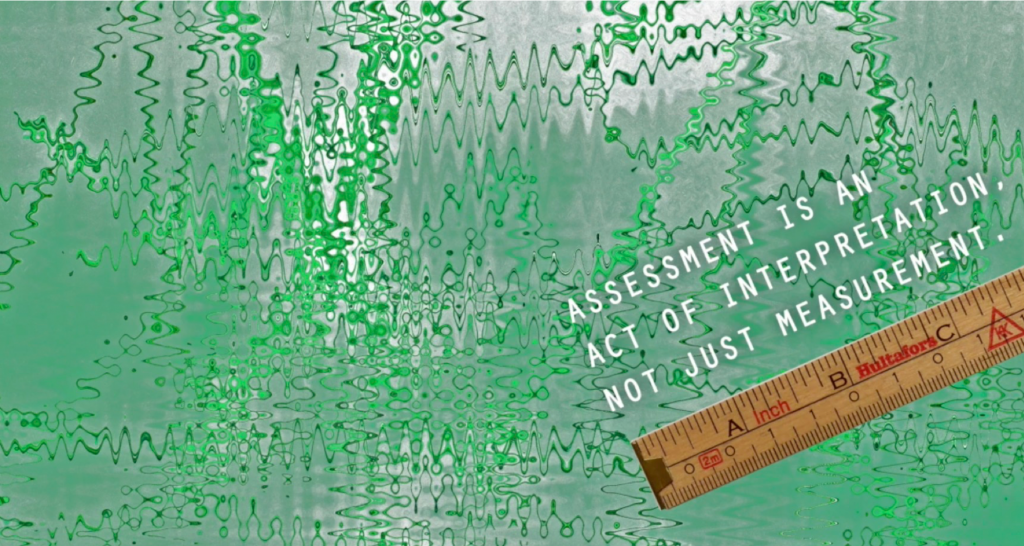
We’re working now on our framework, which has four dimensions – criticality, cultivating creativity, taking a holistic approach, and valuing multimodality. More to come on this! Our next steps are to finalise this framework, write and publish from this initial stage of the research, and develop some new ideas and use cases. We’re having conversations with our colleagues who led the other strand of the project, about automating feedback. We think it would be really useful to explore the potential for supporting these kinds of complex assignments through automated processes – lots to discuss!
References
Bateman, J. (2012). The decomposability of semiotic modes. In K. O’Halloran and B. Smith (Eds.), Multimodal studies: Exploring issues and domains. New York: Routledge.
Bell A, Mladenovic R and Price M (2013). Students’ perceptions of the usefulness of marking guides, grade descriptors and annotated exemplars. Assessment & Evaluation in Higher Education. 38(7), 769-788.
Bloxham, S., and A. West. 2004. Understanding the rules of the game: Marking peer assessment as a medium for developing students’ conceptions of assessment. Assessment & Evaluation in Higher Education29(6): 721–733
Curwood, J.S. (2012). Cultural shifts, multimodal representations, and assessment practices: A case study. E-Learning and Digital Media, 9(2), 232-244.
Leander, K. M., & Vasudevan, L. (2009). Multimodality and mobile culture. In C. Jewitt (Ed.), Handbook of multimodal analysis(pp. 127-139). New York, NY: Routledge.
Miles, M.B., Huberman, A., & Saldaña, J. (2014). Qualitative data analysis: A methods sourcebook. Thousand Oaks, CA: Sage.
Norton, L. (2004). Using assessment criteria as learning criteria: A case study in psychology. Assessment & Evaluation in Higher Education,29(6), 687–702.
O’Donovan, B., Price, M. & Rust, C. (2001). The student experience of criterion-referenced assessment. Innovations in Education and Teaching International,38(1), 74–85.
Pahl, K.H. & Rowsell, J. (2011). Artifactual critical literacy: A new perspective for literacy education. Berkeley Review of Education, 2(2), 129-151.
Price, M., & Rust, C. (1999). The experience of introducing a common criteria assessment grid across an academic department. Quality in Higher Education, 5(2), 133–144.
Ruitenberg, C. (2005). Deconstructing the experience of the local: Toward a radical pedagogy of place. Philosophy of Education Archive, 2005, 212-220.
via jenrossity
Several of the research and writing projects and discussions I’ve been involved with this year have directly or indirectly addressed issues of trust and surveillance, and this is an area of work I’m planning to develop further, along with a number of great colleagues.
In several talks this year, at Strathclyde in Glasgow; the University of Sydney; and the Networked Learning Conference in Zagreb, I’ve been drawing on our Manifesto for Teaching Online to develop my thinking about plagiarism detection and attendance monitoring – two routine processes which are becoming increasingly intensive and often invasive in most universities. For example, Hamish Macleod and I recently argued that
Logics of surveillance are strongly at work in practices which attempt to regulate student behaviour through the exposure of their writing to algorithmic scanning and monitoring. These logics frame students as in need of careful monitoring to ensure learning and teaching runs smoothly, and framing academic writing as a space of dishonesty which is both rampant and solvable through technology. Routines of plagiarism detection intervene negatively in one of the central facets of student-teacher relationships: the production and assessment of student work. Where these relationships become risk-averse and mutually suspicious, trust is blocked or lost and not easily regained. (Ross and Macleod 2018, 235)
We end that paper by arguing that we need to find “ways to re-sensitise ourselves and our students to the values we want to prioritise in our classrooms, and offering means by which students can voice their responses to surveillance cultures in higher education; and [address] issues at strategic levels within our institutions and the sector more widely by developing robust mechanisms for engaging in critical debate, discussion about and review of technology platforms and practices”. This second point echoes one of the key observations made by Laura Czerniewicz at her keynote address in Zagreb last month:
feel like taking some radical action after @Czernie ’s excellent opening keynote? one of her calls to action: engage with (even the boring) policy discussions within the university, because decisions there matter a great deal. #nlc2018
— Jen Ross (@jar) May 14, 2018
My talk in Zagreb (Hamish couldn’t make it, being retired and all!) generated quite a lot of interest, and it’s clear this is resonating with people from across a number of higher education contexts:
Here at #nlc2018 @PetarPjandric says work by @jar was very provocative piece about surveillance and software – surveillance will be next hot topic in education- ping @cristinacost
— Helen Crump (@crumphelen) May 15, 2018
I’ve been involved in a number of intense discussions on these issues, during my seminars in Glasgow and Sydney, and with colleagues in the UK and North America (including Amy Collier and George Veletsianos). A highlight was a discussion with David Lyon and Sava Saheli Singh at Queen’s University in Canada last month. David’s latest work on surveillance culture is greatly informing my thinking. Colleagues closer to home are also doing fantastic work in related areas – Sian Bayne on anonymity; Jeremy Knox on learning analytics, Phil Sheail on data bodies in the library, Ben Williamson on monitoring in the school classroom.
The relationship of trust and technology in higher education is one that, in my view, requires a lot more attention.
Tensions between technological possibilities, being surveilled and the importance of trust between institution, teacher and students – trust needs space for risk @jar #nlc2018
— Tim Fawns (@timbocop) May 15, 2018
It’s emerging as a key issue not only in the context of technologies of monitoring and surveillance, but in other more surprising places – like the current blockchain craze, which is generating new discussions about all sort of things…
#Blockchain: Designing the Future of University Value @EdinburghUni with @NearFutureTeach https://t.co/BStVVNCSXp #diged #elearning pic.twitter.com/DWlsNVTLso
— NearFutureTeaching (@NearFutureTeach) October 30, 2017
…but perhaps less than it should about what kinds of models of trust (or trustlessness) we are inviting into the academy with these new technologies. Helen Murphy, one of the participants on my Digital Futures for Learning course this year, developed an excellent Open Educational Resource on this topic: https://educationandtheblockchain.weebly.com
She says:
|
First, data.
The data in the blockchain is immutable and transparent, permanent and unalterable. Data in the blockchain is added by consensus, and because it is distributed there is no single copy of the data. In theory, it can be accessed by anyone. So it is trustless in the sense that no trust is required: it can be taken for granted that the data is accurate and permanent. |
?Second, decentralisation.
With the blockchain, there is no need for a centralised authority (such as a bank or university) to verify transactions. Instead all of this verification can be done independently, by the technology and the mechanisms by which it works. So it is trustless because it does not require any trust in these third-party institutions. |
(Murphy 2018)
I’m doing some work with colleagues in Digital Education and Information Services on exploring the potential and issues around blockcert technology, and these questions of trust and trustlessness are figuring strongly.
So, look out for more writing on this from me and others in the near future!
One of the most important things, I think, is beginning to speculate and design futures for higher education that are ‘beyond surveillance’. Importantly (and thanks to Peter Goodyear in Sydney for highlighting how important this point is), this doesn’t mean alternatives that require us to return to imagined better analog times – instead, we need to develop trusting digital futures and approach our technologies critically and creatively to help us do so. I, and others, will be working on this over the next year – get in touch if you want to discuss!
References:
Lyon, D. 2018. The Culture of Surveillance: Watching as a Way of Life. Polity Press.
Murphy, H. 2018. Education and the Blockchain. https://educationandtheblockchain.weebly.com
Ross, J. and Macleod, H. 2018. Surveillance, (dis)trust and teaching with plagiarism detection technology. Proceedsing of Networked Learning 2018, Zagreb.
via jenrossity
Along with Professor Dragan Gasevic here at Edinburgh, and Dr Jen Scott Curwood, Associate Professor Abelardo Pardo, and Dr Amani Bell from the Centre for Research in Learning and Innovation at the University of Sydney, this year I’ve been awarded a Partnership Collaboration Award on the topic of Methodological Innovations for Assessing Learning in Digital Spaces. The project is building on research connections between the two Centres, weaving together two complementary strands: an approach to multimodal assessment and a framework to analyse learning strategies in digital spaces. Jen, Amani and I are working on the first strand, developing new insights into the nature of digital assignments and methodologies for their design and assessment, drawing on theories of place-based learning, mobilities and multimodality.
Along with getting to work closely with Jen and Amani (and returning to the lovely Sydney in March), and to think very broadly about assessment methodologies with all the partners, this project is also a brilliant chance to bring together expertise from a number of colleagues here in the Centre: James Lamb, Sharon Boyd, Yi-Shan Tsai and Sian Bayne are all contributing their insights to the multimodal assessment strand.
There’s a bit more information about this collaboration on the Digital Education site, and I’ll share findings and materials here as they develop.
via jenrossity
One of the four main strands of research I pursue is about digital cultural heritage engagement and learning, and lots has been happening!
The Artcasting project continues to generate great speaking, writing and conversation opportunities – most recently at the AHRC and Association of Critical Heritage Studies’ Critical Approaches and New Directions conference in London in early October. My colleague Michael Gallagher and I gave a talk about mobilities, mobile technologies and heritage futures. Particular highlights for me from the event were Chris Whitehead‘s keynote, and Hayden Lorimer’s fascinating overview of work at St Peter’s Seminary at Kilmahew. It was also fantastic to see so many of the people I first met last year at the ACHS conference in Montreal, and to hear that Liz Stainforth is going to be spending a few months in Edinburgh as an IASH fellow at the start of next year.
Also re Artcasting, I’ve just finished and submitted a paper about hospitality and digital co-production; and the team recently reconvened with a number of others who have helped us a lot in thinking about Artcasting futures, to talk about a whole bunch of fascinating issues still to be explored. There is a summary of these on the Artcasting site blog.
Beyond Artcasting and its ripples, London also allowed a bit of time for Koula Charitonos and I to talk through some ideas – including to propose a symposium for next year’s ICLS conference on museum visitor experiences in the digital age. We hope this will be able to come together!
Here in Edinburgh, the new academic year has brought a number of new members to the Digital Cultural Heritage Research Network – not least our new chair of digital cultural heritage, Melissa Terras, who joined the University of Edinburgh this week. We’ve already tempted her to get involved with a couple of projects in development – it’s going to be great to have her here. Sian, Chris, James, Kirsty, Melissa and I hope to organise a few DCHRN events in the new year.
Serendipitously, I’ve got the opportunity to supervise not one but two masters students this year who are exploring aspects of 3d printing, scanning and visualisation in cultural heritage contexts – I look forward to learning lots from both of them about this topic.
Last but not least, I’ll be in Manchester for the Researching Digital Cultural Heritage conference on 30 November-1 December (sadly only for the second day) – the programme looks amazing.
via jenrossity